
Ezekiel 20:13

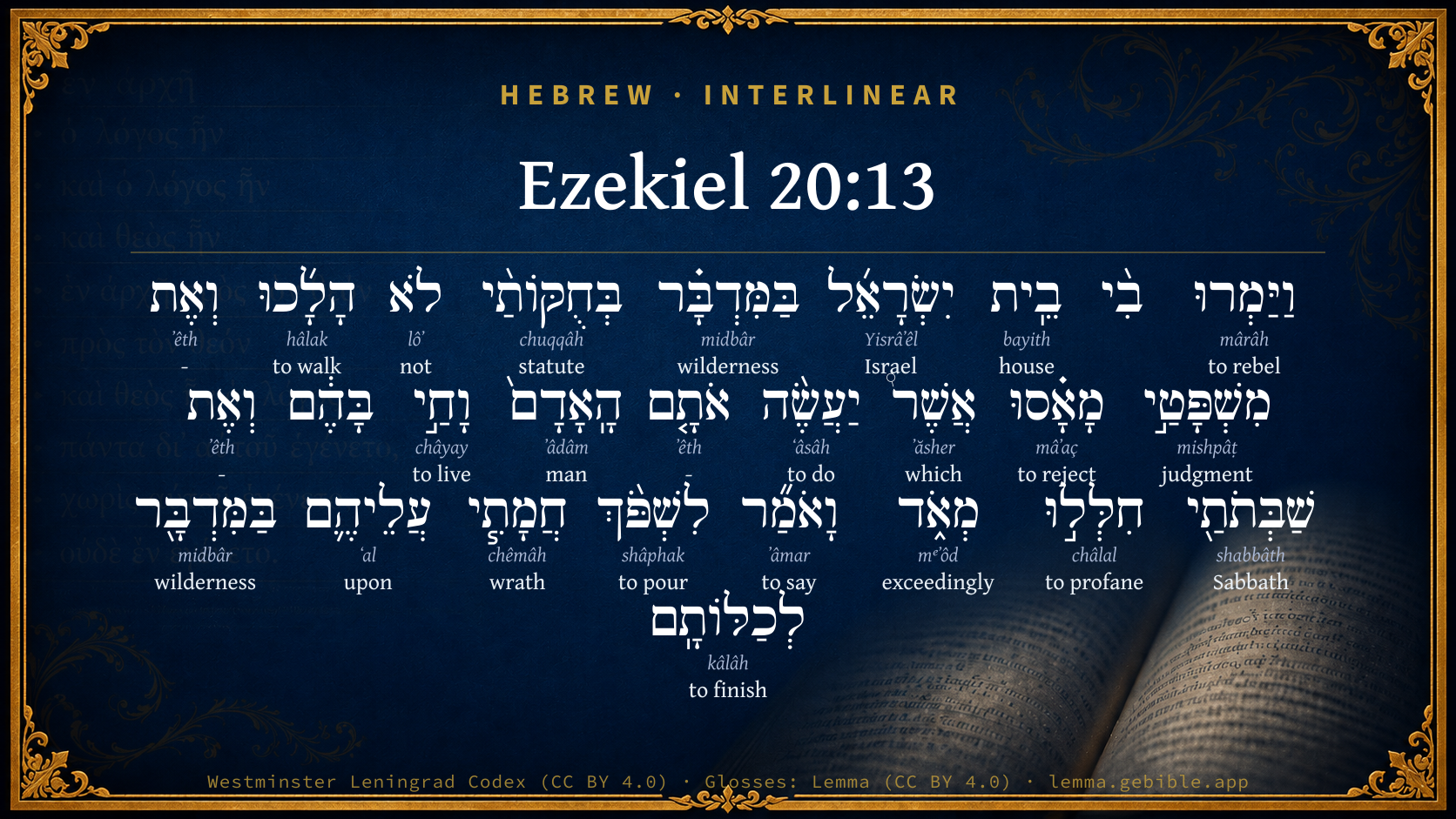
Hebrew (Westminster Leningrad Codex) Ezekiel 20:13 appears in the Hebrew Old Testament. The text above is from the Westminster Leningrad Codex. Each word links to its Strong’s number, a concise gloss, and parsing drawn from the Open Scriptures Hebrew Bible morphology. Click any word for its full Brown-Driver-Briggs (BDB) entry.
Download image
Cite this verse

Ezekiel 20:13 (World English Bible). Public Domain. Lemma interlinear Bible study tool, https://lemma.gebible.app/v/ezekiel/20/13.

Show BibTeX & RIS
BibTeX
RIS
English Translation
But the house of Israel rebelled against me in the wilderness: they didn't walk in my statutes, and they rejected my ordinances, which if a man keep, he shall live in them; and my Sabbaths they greatly profaned. Then I said I would pour out my wrath on them in the wilderness, to consume them.
World English Bible · Public Domain
Download a study sheet

One document with this verse’s original text, its word-by-word gloss line, the meaning frame, cross-references with their text, attributed commentary, and full source and license credits — printable, and it pastes into notes with its structure intact.

This verse Autodidact and up

Study sheet (.html) Plain text (.txt)

A passage Seminary Student

Up to 50 verses in one chapter. A passage sheet keeps up to 6 commentary sources and 12 cross-references per verse, in the order this page ranks them, and says so on the sheet whenever that leaves anything out. Ask for a single verse and you get the Autodidact verse sheet above.

Everything on this page stays free to read, with no account — the sheet is a download of what is already on screen, not access to it.

Want to remove ads? Support Godless Engineer
Compare translations 3

The same verse in 3 English versions, stacked beneath the original-language interlinear above. Click any original word for its lexicon entry.

Each is an independent rendering of the whole verse — the interlinear is not word-aligned to these translations.

Highlighted words mark where these versions differ — a whole-verse word diff, not a word-by-word alignment.

  • World English Bible Public Domain
    But the house of Israel rebelled against me in the wilderness: they didn't walk in my statutes, and they rejected my ordinances, which if a man keep, he shall live in them; and my Sabbaths they greatly profaned. Then I said I would pour out my wrath on them in the wilderness, to consume them.
  • King James Version Public Domain
    But the house of Israel rebelled against me in the wilderness: they walked not in my statutes, and they despised my judgments, which if a man do, he shall even live in them; and my sabbaths they greatly polluted: then I said, I would pour out my fury upon them in the wilderness, to consume them.
  • unfoldingWord Literal Text CC BY-SA 4.0
    But the house of Israel rebelled against me in the wilderness. They did not walk in my statutes; instead, they rejected my decrees, by which a man will live if he obeys them. They greatly profaned my Sabbaths, so I said I would pour out my fury upon them in the wilderness in order to end them.

unfoldingWord Literal Text — © unfoldingWord, licensed CC BY-SA 4.0. Word-aligned USFM3 via Door43 (git.door43.org/unfoldingWord/en_ult).

Versions to compare (up to 4)

3 of 4 selected

Show all 18 translations

Every available English version of this verse, each an independent rendering of the whole verse.

  • World English Bible Public Domain
    But the house of Israel rebelled against me in the wilderness: they didn't walk in my statutes, and they rejected my ordinances, which if a man keep, he shall live in them; and my Sabbaths they greatly profaned. Then I said I would pour out my wrath on them in the wilderness, to consume them.
  • Berean Standard Bible Public Domain
    Yet the house of Israel rebelled against Me in the wilderness. They did not follow My statutes and they rejected My ordinances—though the man who does these things will live by them—and they utterly profaned My Sabbaths. Then I resolved to pour out My wrath upon them and put an end to them in the wilderness.
  • Majority Standard Bible Public Domain
    Yet the house of Israel rebelled against Me in the wilderness. They did not follow My statutes and they rejected My ordinances—though the man who does these things will live by them—and they utterly profaned My Sabbaths. Then I resolved to pour out My wrath upon them and put an end to them in the wilderness.
  • King James Version Public Domain
    But the house of Israel rebelled against me in the wilderness: they walked not in my statutes, and they despised my judgments, which if a man do, he shall even live in them; and my sabbaths they greatly polluted: then I said, I would pour out my fury upon them in the wilderness, to consume them.
  • American Standard Version (1901) Public Domain
    But the house of Israel rebelled against me in the wilderness: they walked not in my statutes, and they rejected mine ordinances, which if a man keep, he shall live in them; and my sabbaths they greatly profaned. Then I said I would pour out my wrath upon them in the wilderness, to consume them.
  • Revised Version (1885) Public Domain
    But the house of Israel rebelled against me in the wilderness: they walked not in my statutes, and they rejected my judgments, which if a man do, he shall live in them; and my sabbaths they greatly profaned: then I said I would pour out my fury upon them in the wilderness, to consume them.
  • Geneva Bible (1599) Public Domain
    But the house of Israel rebelled against me in the wildernes: they walked not in my statutes, and they cast away my iudgements, which if a man doe, he shall liue in them, and my Sabbaths haue they greatly polluted: then I thought to powre out mine indignation vpon them in the wildernes to consume them,
  • Douay-Rheims (1899) Public Domain
    But the house of Israel provoked me in the desert: they walked not in my statutes, and they cast away my judgments, which if a man do he shall live in them: and they grievously violated my sabbaths. I said therefore that I would pour out my indignation upon them in the desert, and would consume them.
  • Young's Literal Translation Public Domain
    And -- rebel against me do the house of Israel in the wilderness, In My statutes they have not walked, And My judgments they have despised, Which the man who doth -- liveth by them. And My sabbaths they have greatly polluted, And I say to pour out My fury on them in the wilderness, to consume them.
  • Literal Standard Version CC BY-SA 4.0
    And the house of Israel rebels against Me in the wilderness, || They have not walked in My statutes, || And they have despised My judgments, || Which the man who does—lives by them. And they have greatly defiled My Sabbaths, || And I speak—to pour out My fury on them in the wilderness, to consume them.
  • Unlocked Literal Bible CC BY-SA 4.0
    But the house of Israel rebelled against me in the wilderness. They did not walk in my statutes; instead, they rejected my decrees, by which a man will live if he obeys them. They greatly profaned my Sabbaths, so I said I would pour out my fury upon them in the wilderness in order to end them.
  • unfoldingWord Literal Text CC BY-SA 4.0
    But the house of Israel rebelled against me in the wilderness. They did not walk in my statutes; instead, they rejected my decrees, by which a man will live if he obeys them. They greatly profaned my Sabbaths, so I said I would pour out my fury upon them in the wilderness in order to end them.
  • Darby Bible Public Domain
    But the house of Israel rebelled against me in the wilderness: they walked not in my statutes, and they rejected mine ordinances, which if a man do, he shall live by them; and my sabbaths they greatly profaned: and I said I would pour out my fury upon them in the wilderness, to consume them.
  • World Messianic Bible Public Domain
    “‘“But the house of Israel rebelled against me in the wilderness. They didn’t walk in my statutes and they rejected my ordinances, which if a man keeps, he shall live in them. They greatly profaned my Sabbaths. Then I said I would pour out my wrath on them in the wilderness, to consume them.
  • Webster's Bible Public Domain
    But the house of Israel rebelled against me in the wilderness: they walked not in my statutes, and they despised my judgments, which if a man doeth, he shall even live in them; and my sabbaths they greatly profaned: then I said, I would pour out my fury upon them in the wilderness, to consume them.
  • Free Bible Version CC BY-SA 4.0
    But the people of Israel rebelled against me in the desert, refusing to observe my laws and rejecting my regulations, even though they would have given them life. They violated my Sabbaths. So I warned them that I would punish them and wipe them out there in the desert.
  • Bible in Basic English Public Domain
    But the children of Israel would not be controlled by me in the waste land: they were not guided by my rules, and they were turned away from my orders, which, if a man does them, will be life to him; and they had no respect for my Sabbaths: then I said that I would let loose my passion on them in the waste land, and put an end to them.
  • JPS Tanakh (1917) Public Domain
    But the house of Israel rebelled against Me in the wilderness; they walked not in My statutes, and they rejected Mine ordinances, which if a man do, he shall live by them, and My sabbaths they greatly profaned; then I said I would pour out My fury upon them in the wilderness, to consume them.

Literal Standard Version (2020), Covenant Press — licensed CC BY-SA 4.0. Text via the HelloAO Bible API (eBible.org). Unlocked Literal Bible (unfoldingWord) — licensed CC BY-SA 4.0. Text via the HelloAO Bible API (eBible.org). unfoldingWord Literal Text — © unfoldingWord, licensed CC BY-SA 4.0. Word-aligned USFM3 via Door43 (git.door43.org/unfoldingWord/en_ult). Free Bible Version, Dr. Jonathan Gallagher — licensed CC BY-SA 4.0. Text via the HelloAO Bible API (eBible.org).

Word by word

More ways to search: Search by grammar → Find every occurrence → Compare this word →

Practice this passage: Drill this verse → Learn its vocabulary →

וָחַ֣י
châyay
H2425
“and · to live”
Conjunction + Verb, Qal, Sequential Perfect, 3rd Person, Masculine, Singular
Part of Speech
Conjunction + Verb
Stem
Qal
Form
Sequential Perfect
Person
3rd Person
Gender
Masculine
Number
Singular
Full BDB Definition

Origin: a primitive root [compare H2421 ]

TWOT: 644

to live, have life, remain alive, sustain life, live prosperously, live for ever, be quickened, be alive, be restored to life or health - (Qal) - to live - to have life - to continue in life, remain alive - to sustain life, to live on or upon - to live (prosperously) - to revive, be quickened - from sickness - from discouragement - from faintness - from death - (Piel) - to preserve alive, let live - to give life - to quicken, revive, refresh - to restore to life - to cause to grow - to restore - to revive - (Hiphil) - to preserve alive, let live - to quicken, revive - to restore (to health) - to revive - to restore to life
  1. וַיַּמְרוּ mârâh H4784 “and · to rebel” Conjunction + Verb, Hiphil, Sequential Imperfect, 3rd Person, Masculine, Plural
  2. בֵֽית bayith H1004 “house of” Noun, Common, Masculine, Singular, Construct
  3. יִשְׂרָאֵ֜ל Yisrâʼêl H3478 “Israel” Noun, Proper
  4. בַּמִּדְבָּ֗ר midbâr H4057 “in/at the · wilderness” Preposition, Determined + Noun, Common, Masculine, Singular, Absolute
  5. בְּחֻקּוֹתַ֨י chuqqâh H2708 “in/at · statutes · my” Preposition + Noun, Common, Both, Plural, Construct + Suffix, Personal, 1st Person, Common, Singular
  6. לֹא lôʼ H3808 “not” Particle, Negative
  7. הָלָ֜כוּ hâlak H1980 “to walk” Verb, Qal, Perfect, 3rd Person, Common, Plural
  8. וְאֶת ʼêth H853 “and · -” Conjunction + Particle, Direct Object
  9. מִשְׁפָּטַ֣י mishpâṭ H4941 “judgments · my” Noun, Common, Masculine, Plural, Construct + Suffix, Personal, 1st Person, Common, Singular
  10. מָאָ֗סוּ mâʼaç H3988 “to reject” Verb, Qal, Perfect, 3rd Person, Common, Plural
  11. אֲשֶׁר֩ ʼăsher H834 “which” Particle, Relative
  12. יַעֲשֶׂ֨ה ʻâsâh H6213 “to do” Verb, Qal, Imperfect, 3rd Person, Masculine, Singular
  13. אֹתָ֤ם ʼêth H853 “- · them” Particle, Direct Object + Suffix, Personal, 3rd Person, Masculine, Plural
  14. הָֽאָדָם֙ ʼâdâm H120 “the · man” Particle, Definite Article + Noun, Common, Masculine, Singular, Absolute
  15. וְאֶת ʼêth H853 “and · -” Conjunction + Particle, Direct Object
  16. שַׁבְּתֹתַ֖י shabbâth H7676 “Sabbaths · my” Noun, Common, Both, Plural, Construct + Suffix, Personal, 1st Person, Common, Singular
  17. חִלְּל֣וּ châlal H2490 “to profane” Verb, Piel, Perfect, 3rd Person, Common, Plural
  18. מְאֹ֑ד mᵉʼôd H3966 “exceedingly” Adverb
  19. וָאֹמַ֞ר ʼâmar H559 “and · to say” Conjunction + Verb, Qal, Sequential Imperfect, 1st Person, Common, Singular
  20. לִשְׁפֹּ֨ךְ shâphak H8210 “to pour” Preposition + Verb, Qal, Infinitive Construct
  21. חֲמָתִ֧י chêmâh H2534 “wrath · my” Noun, Common, Feminine, Singular, Construct + Suffix, Personal, 1st Person, Common, Singular
  22. עֲלֵיהֶ֛ם ʻal H5921 “upon · them” Preposition + Suffix, Personal, 3rd Person, Masculine, Plural
  23. בַּמִּדְבָּ֖ר midbâr H4057 “in/at the · wilderness” Preposition, Determined + Noun, Common, Masculine, Singular, Absolute
  24. לְכַלּוֹתָֽם kâlâh H3615 “to finish · them” Preposition + Verb, Piel, Infinitive Construct + Suffix, Personal, 3rd Person, Masculine, Plural

About this verse

These counts appear in no published source. They are computed here, from the morphology-tagged text and Lemma’s own curated glosses. What Lemma adds →

27
words
22
distinct lemmas
Prophets
section

Notable vocabulary

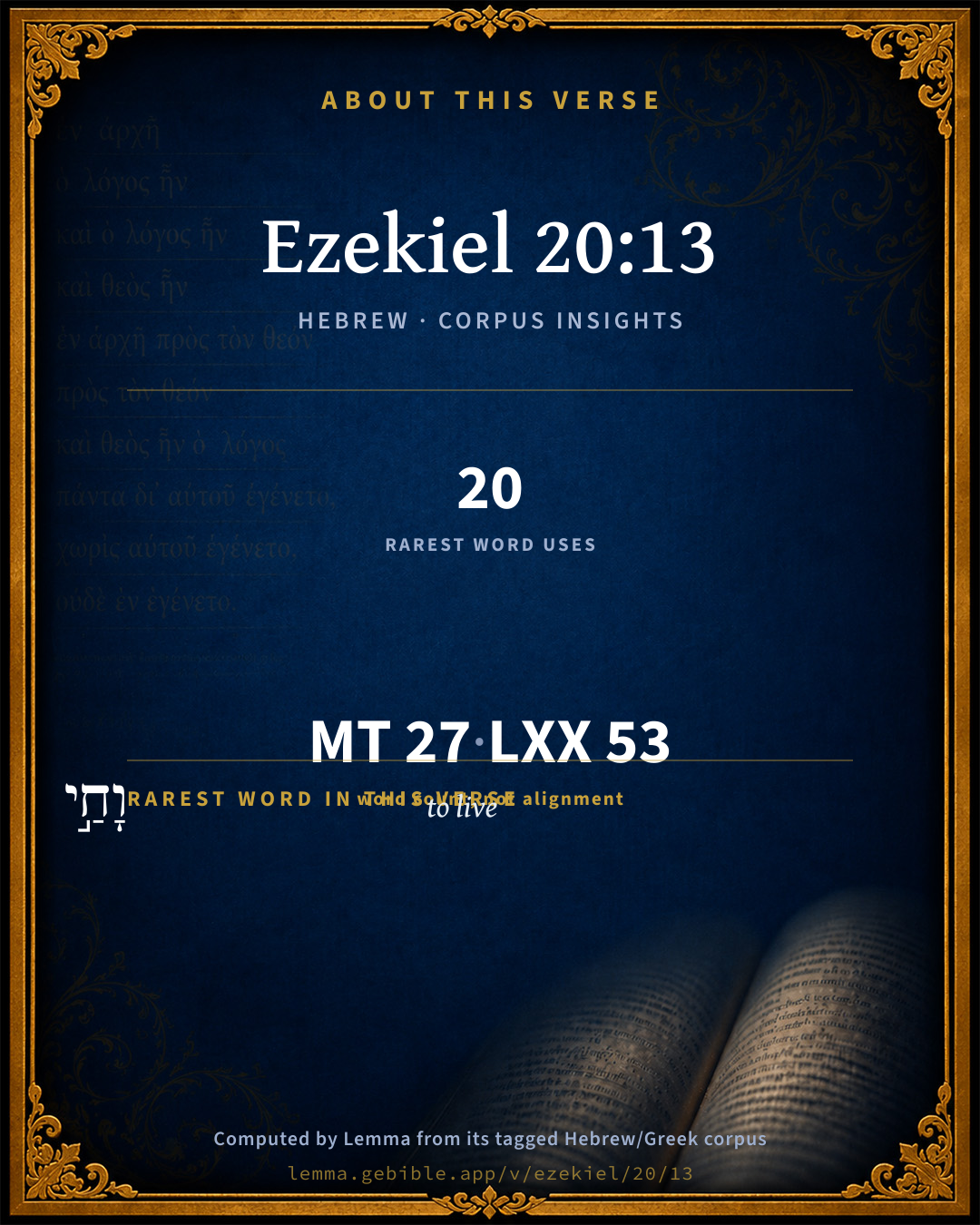
The rarest word here is וָחַ֣י to live H2425 — appearing just 20 times in the whole Hebrew Bible.

Shared distinctive vocabulary

וָחַ֣י to live H2425 occurs in 20 verses of the Hebrew Bible. Also found in:

Grammatical profile

  • 9 verbs
  • 9 nouns
  • 3 prepositions
  • 1 adverb
  • 5 particles

Verb forms

  • וַיַּמְרוּ Hiphil · Sequential Imperfect
  • הָלָ֜כוּ Qal · Perfect
  • מָאָ֗סוּ Qal · Perfect
  • יַעֲשֶׂ֨ה Qal · Imperfect
  • וָחַ֣י Qal · Sequential Perfect
  • חִלְּל֣וּ Piel · Perfect
  • וָאֹמַ֞ר Qal · Sequential Imperfect
  • לִשְׁפֹּ֨ךְ Qal · Infinitive Construct
  • לְכַלּוֹתָֽם Piel · Infinitive Construct

Repetition

A word recurs within this verse — often emphatic in Hebrew:

  • בַּמִּדְבָּ֗ר wilderness H4057 ×2

Hebrew & Septuagint length

In English translation the verse runs 55 words from the Hebrew and 63 from the Septuagint (LXX English) — closely comparable.

A rough comparison of the two English renderings, which tokenize alike — not a word-level alignment.

Word counts can differ between the Hebrew and the Greek without any difference in meaning — e.g. the Hebrew direct-object marker אֵת has no separate Greek word, and Greek often adds the article ὁ.

In the original languages it is 27 Hebrew tokens and 53 Greek tokens — but the two are counted differently (Hebrew bundles its prefixes and suffixes into one token; the Greek is in lemma form), so that isn’t a like-for-like length.

Cross-references

32

Topical passages linked to Ezekiel 20:13 in the Treasury of Scripture Knowledge — connected by theme and wording, ordered by reader-vote popularity; previews shown in the World English Bible.

  • Ezekiel 20:21 But the children rebelled against me; they didn't walk in my statutes, neither kept my ordinances to do them, which if a man do, he shall live in them; they profaned my Sabbaths. Then I said I would pour out my wrath on them, to accomplish my anger against them in the wilderness.
  • Ezekiel 20:8 But they rebelled against me, and would not listen to me; they did not every man cast away the abominations of their eyes, neither did they forsake the idols of Egypt. Then I said I would pour out my wrath on them, to accomplish my anger against them in the midst of the land of Egypt.
  • Deuteronomy 9:8 Also in Horeb you provoked Yahweh to wrath, and Yahweh was angry with you to destroy you.
  • Isaiah 56:6 Also the foreigners who join themselves to Yahweh, to minister to him, and to love the name of Yahweh, to be his servants, everyone who keeps the Sabbath from profaning it, and holds fast my covenant;
  • Ezekiel 20:24 because they had not executed my ordinances, but had rejected my statutes, and had profaned my Sabbaths, and their eyes were after their fathers' idols.
  • Exodus 32:10 Now therefore leave me alone, that my wrath may burn hot against them, and that I may consume them; and I will make of you a great nation."
  • Numbers 14:11–12 Yahweh said to Moses, How long will this people despise me? and how long will they not believe in me, for all the signs which I have worked among them?
  • Numbers 14:22 because all those men who have seen my glory, and my signs, which I worked in Egypt and in the wilderness, yet have tempted me these ten times, and have not listened to my voice;
  • Numbers 14:29 your dead bodies shall fall in this wilderness; and all who were numbered of you, according to your whole number, from twenty years old and upward, who have murmured against me,
  • Exodus 16:27–28 It happened on the seventh day, that some of the people went out to gather, and they found none.
  • Exodus 32:8 They have turned aside quickly out of the way which I commanded them. They have made themselves a molten calf, and have worshiped it, and have sacrificed to it, and said, 'These are your gods, Israel, which brought you up out of the land of Egypt.'"
  • Leviticus 26:15 and if you shall reject my statutes, and if your soul abhors my ordinances, so that you will not do all my commandments, but break my covenant;
  • Leviticus 26:43 The land also will be left by them, and will enjoy its sabbaths while it lies desolate without them: and they will accept the punishment of their iniquity; because, even because they rejected my ordinances, and their soul abhorred my statutes.
  • Numbers 15:31–36 Because he has despised the word of Yahweh, and has broken his commandment, that soul shall utterly be cut off; his iniquity shall be on him.
  • Numbers 16:20–21 Yahweh spoke to Moses and to Aaron, saying,
  • Numbers 16:45 Get away from among this congregation, that I may consume them in a moment. They fell on their faces.
  • Numbers 26:25 These are the families of Issachar according to those who were numbered of them, sixty-four thousand three hundred.
  • Deuteronomy 9:12–24 Yahweh said to me, Arise, get you down quickly from hence; for your people whom you have brought forth out of Egypt have corrupted themselves; they have quickly turned aside out of the way which I commanded them; they have made them a molten image.
  • Deuteronomy 31:27 For I know your rebellion, and your stiff neck: behold, while I am yet alive with you this day, you have been rebellious against Yahweh; and how much more after my death?
  • 1 Samuel 8:8 According to all the works which they have done since the day that I brought them up out of Egypt even to this day, in that they have forsaken me, and served other gods, so do they also to you.
  • 2 Samuel 12:9 Why have you despised the word of Yahweh, to do that which is evil in his sight? You have struck Uriah the Hittite with the sword, and have taken his wife to be your wife, and have slain him with the sword of the children of Ammon.
  • Nehemiah 9:16–18 But they and our fathers dealt proudly and hardened their neck, and didn't listen to your commandments,
  • Psalms 78:40–41 How often they rebelled against him in the wilderness, And grieved him in the desert!
  • Psalms 95:8–11 Don't harden your heart, as at Meribah, As in the day of Massah in the wilderness,
  • Psalms 106:13–33 They soon forgot his works. They didn't wait for his counsel,
  • Proverbs 1:25 But you have ignored all my counsel, And wanted none of my reproof;
  • Proverbs 13:13 Whoever despises instruction will pay for it, But he who respects a command will be rewarded.
  • Isaiah 63:10 But they rebelled, and grieved his holy Spirit: therefore he was turned to be their enemy, [and] himself fought against them.
  • Ezekiel 20:16 because they rejected my ordinances, and didn't walk in my statutes, and profaned my Sabbaths: for their heart went after their idols.
  • Amos 2:4 Thus says Yahweh: "For three transgressions of Judah, yes, for four, I will not turn away its punishment; Because they have rejected Yahweh's law, And have not kept his statutes, And their lies have led them astray, After which their fathers walked;
  • 1 Thessalonians 4:8 Therefore he who rejects doesn't reject man, but God, who has also given his Holy Spirit to you.
  • Hebrews 10:28–29 A man who disregards Moses' law dies without compassion on the word of two or three witnesses.

Cross-references courtesy of OpenBible.info (CC BY 4.0).

Hebrew and Greek witnesses Masoretic Hebrew ↔ Greek Septuagint

The same verse in the two great witnesses to the Old Testament, shown verse-for-verse.

These are two independent witnesses, not word-aligned to each other, and the Septuagint is shown in lemma (dictionary) form.

Hebrew Ezekiel 20:13 Masoretic · Westminster Leningrad Codex

וַיַּמְרוּ בִ֨י בֵֽית יִשְׂרָאֵ֜ל בַּמִּדְבָּ֗ר בְּחֻקּוֹתַ֨י לֹא הָלָ֜כוּ וְאֶת מִשְׁפָּטַ֣י מָאָ֗סוּ אֲשֶׁר֩ יַעֲשֶׂ֨ה אֹתָ֤ם הָֽאָדָם֙ וָחַ֣י בָּהֶ֔ם וְאֶת שַׁבְּתֹתַ֖י חִלְּל֣וּ מְאֹ֑ד וָאֹמַ֞ר לִשְׁפֹּ֨ךְ חֲמָתִ֧י עֲלֵיהֶ֛ם בַּמִּדְבָּ֖ר לְכַלּוֹתָֽם

But the house of Israel rebelled against me in the wilderness: they didn't walk in my statutes, and they rejected my ordinances, which if a man keep, he shall live in them; and my Sabbaths they greatly profaned. Then I said I would pour out my wrath on them in the wilderness, to consume them.

World English Bible · Public Domain

Greek LXX Ezekiel 20:13 Septuagint · lemma form

καί εἶπον πρός ὁ οἶκος ὁ ἰσραήλ ἐν ὁ ἔρημος ἐν ὁ πρόσταγμα ἐγώ πορεύομαι καί οὐ πορεύομαι καί ὁ δικαίωμα ἐγώ ἀποὠθέω ὅς ποιέω αὐτός ἄνθρωπος καί ζάω ἐν αὐτός καί ὁ σάββατον ἐγώ βεβηλόω σφόδρα καί εἶπον ὁ ἐκχέω ὁ θυμός ἐγώ ἐπί αὐτός ἐν ὁ ἔρημος ὁ ἐκ ἀναἁλίσκω αὐτός

And I said to the house of Israel in the wilderness, Walk you⌃ in my commandments: but they walked not in them, and they rejected my ordinances, which if a man shall do, he shall even live in them; and they grievously profaned my sabbaths: and I said that I would pour out my wrath upon them in the wilderness, to consume them.

LXX2012 (modern English Septuagint) · Public Domain

Hebrew: Westminster Leningrad Codex (CC BY 4.0). Greek: Septuagint (public domain); English from LXX2012 (modern English Septuagint) (Public Domain). How the Septuagint differs from the Hebrew →

Targum (Aramaic paraphrase)

1

The Targum is the ancient Jewish Aramaic paraphrase of the Hebrew Scriptures — an interpretive translation, not the Hebrew text itself. Onkelos (literal) and Pseudo-Jonathan (expansive) render the Torah, and Jonathan the Prophets. Coverage is partial: where no permissively-licensed English translation exists for a verse, only the Aramaic is shown. This is verse-level text, not a word-by-word alignment to the Hebrew.

  1. Targum Jonathan Prophets (Joshua–Malachi)
    וְסָרִיבוּ עַל מֵימְרִי בֵּית יִשְׂרָאֵל בְּמַדְבְּרָא בִּקְיָמַי לָא הֲלִיכוּ וְיַת דִינַי קָצוּ דְאִם יַעְבֵּיד יַתְהוֹן אֱנָשָׁא וְיֵיחֵי בְהוֹן חַיֵי עַלְמָא וְיַת יוֹמֵי שַׁבַּיָא דִילִי אֲחִילוּ לַחֲדָא וַאֲמָרֵית לְמִשְׁפַּךְ חֲמָתִי עֲלֵיהוֹן בְּמַדְבְּרָא לְשֵׁיצָיוּתְהוֹן:

    (no public-domain English translation for this verse)

    Targum Jonathan — Aramaic: “Mikraot Gedolot” (public domain). English: “Sefaria Community Translation” (CC0 1.0 (public-domain dedication)); “London "Chaldee Paraphrase," 1871” (public domain). Text via Sefaria.

Commentary

Notes on Ezekiel 20:13 from classic Christian and Jewish commentators (each source and its license shown beneath its notes). The classic Christian expositions comment on the surrounding passage and are grouped to its opening verse, so a note may address several verses; the Jewish commentaries on the Tanakh (Rashi and others) are per-verse, so they appear only where the commentator wrote on this verse.

Lemma curates 59 commentaries, every one of them public domain or Creative Commons licensed, each selected and text-cleaned for this edition rather than reprinted as found. About our sources →

Trapp's Complete Commentary

John Trapp

Eze 20:13 But the house of Israel rebelled against me in the wilderness: they walked not in my statutes, and they despised my judgments, which [if] a man do, he shall even live in them; and my sabbaths they greatly polluted: then I said, I would pour out my fury upon them in the wilderness, to consume them.

Ver. 13. But the house of Israel rebelled.] They did little else; they made it their trade for forty years long. {Psa 95:8-11}

And my Sabbaths they greatly polluted.] They vehemently violated; either they rested only thereon, or else they shamelessly troubled and disquieted that sanctified day of God’s rest. The world, saith one, {a} is now grown perfectly profane, and can play on the Lord’s-day without book.

Then I said, I would pour out my fury.] God’s sayings are of two sorts; some are the sayings of his eternal counsel, and these are immutable; others of his threatening only, and these oft are conditional. God therefore threateneth that he may not punish, saith an ancient.

{a} Bishop King on Jonah.

John Trapp, A Commentary or Exposition upon All the Books of the Old and New Testament (1647–1656) — public domain. Text from a community e-Sword module.

Joseph Benson's Commentary

Eze 20:13-17. But the house of Israel — Not a few, but the generality of the people; rebelled against me — Were undutiful, disobedient, contumacious, and even openly and repeatedly rebellious; in the wilderness — Where they were receiving daily and great mercies from me; where they were on their way to Canaan, and were peculiarly dependant upon me for direction in the way, protection from their enemies, and the supply of all their wants; where they most needed my care and favour, and where the preserving their lives from being destroyed by noxious creatures and by famine, in that barren, desolate, and howling desert, required and was a continued miracle. They walked not in my statutes — Given them as the rule of their conduct toward me and one another. And they despised my judgments — Slighted them first as of little excellence, and then refused and cast them off. They who disobey God’s statutes despise them; they show by their disobedience that they have a mean opinion of them, and of him whose statutes they are. And my sabbaths they greatly polluted — That is, profaned, neglecting the duties enjoined to be done on those holy days, and employing them in worldly business, in pursuing sensual gratifications, or in practising secret idolatry and other wickedness. But I wrought, &c. — See on Eze 20:9. Yet I lifted up my hand, &c. — I solemnly swore (see Eze 20:5) they should not enter into that rest I had designed for them. So all the murmuring, disobedient, unbelieving generation was excluded, and their children were brought in. Because they despised, &c. — See on Eze 20:13. For their heart went after their idols — They were still inclined to the idolatries which they had learned in Egypt, to which they added new idols, which they had seen in the countries through which they travelled, namely, the idols of the Midianites, Amorites, &c: see the margin. Nevertheless, mine eye spared them — Though they did highly provoke me, and deserved to be all cut off, I had great patience with them, often reprieved them after sentence of condemnation was passed, and bore with their untoward manners, till a new and better disposed generation arose, to whom I could, consistently with my holiness, fulfil my promises made to their fathers.

Joseph Benson's Commentary on the Old and New Testaments (1811–1818) — public domain. Text from a community e-Sword module.

Jamieson, Fausset & Brown

Robert Jamieson, A. R. Fausset & David Brown

in the wilderness--They "rebelled" in the very place where death and terror were on every side and where they depended on My miraculous bounty every moment!

Jamieson, Fausset & Brown — Commentary Critical and Explanatory on the Whole Bible (1871) — public domain (CC PDM 1.0). Text via the HelloAO Bible API.

Adam Clarke's Commentary

Verse 13. But the house of Israel rebelled] They acted in the wilderness just as they had done in Egypt; and he spared them there for the same reason. See Eze 20:9.

Adam Clarke's Commentary on the Bible (1810–1826) — public domain. Text from a community e-Sword/MySword module.

John Calvin's Commentaries

Here God pronounces that the sons were like their fathers; and that the people, after their deliverance from Egypt, were so obstinate in their wickedness as not to profit in any way. He had complained already before of their rejecting his grace: for it is equivalent to rejecting all offers to be corrupted by superstitions, and not to cleanse themselves from that defilement, although they knew it to be abominable before God. But after the law was promulgated, they then might have put away their perverse affections. And surely redemption ought to have conformed them to obey God; when they beheld his hand stretched out as it were from heaven, how was it that this spectacle did not avail to humble them, and to make them submissive to God? But in addition to the teaching of the law, God’s promise was given, by which he bore witness to them, that, if they sought from him the spirit of regeneration, the Sabbath would be really given them as a pledge and sign of it; and since all these things produced no effect, that was a proof of astounding contumacy. God says, therefore, that he obtained nothing more in the desert than he had formerly experienced from the people under their Egyptian tyranny: then, also, says he, the house of Israel exasperated me in the desert. The circumstance of place must be noticed, because they were wonderfully rescued by God’s incredible power, and they depended every moment on his good pleasure; for there they wanted food and drink: God daily rained down manna from heaven, and brought them water from the rock. (Exodus 16:14; Numbers 11:9; Deuteronomy 8:15, 16.) Since, therefore, necessity compelled them every moment to look to God, was it not more than brutal stupidity to exasperate God? When men grow wanton, it arises from becoming intoxicated by prosperity, and forgetful of their lot through not feeling how much they need God’s help. But when death is presented to our view, when terror hems us in on every side, when God is up in arms against us, what madness it is to despise him! We see, then, why the Prophet dwells so on this point.

He says too, they did not walk in God’s precepts, and they despised his judgments. He confirms what was said yesterday, that they were not deceived through ignorance, but manifested utter contempt of God, since they knew well enough what was pleasing to him. Since, then, they had a sure rule which could not deceive them, we see how they wandered away after their own superstitions by deliberate wickedness. This is the reason, then, why Ezekiel says that they despised God’s judgments. He repeats the promise which I expounded yesterday. For this reason also availed to exaggerate their crime, namely, the mildness of God in deigning to allure, them: he did not command them, exactingly and imperiously, as he might have done, but he entered into a covenant with them, and testified that a reward was prepared for them if they kept the law. Since, therefore, they neglected this promise, we see that they were not only rebels, but ungrateful to God. He adds, they had polluted his Sabbaths; which I refer not only to the outward rite, but rather to the inward spirit. It is true, indeed, that their impiety was sufficiently notorious as to outward desecration, as it appears from the seventeenth chapter of Jeremiah, when he says, that they carried their burdens on the Sabbath, and occupied themselves in common business. (Jeremiah 17:21, 22.) There is no doubt that they broke the Sabbath when they then promiscuously transacted their own business. But when it is added, that they violated the Sabbath greatly or grievously, we may understand that profanation is denoted in the mystery itself, since they struck off the yoke, and gave the rein to their own desires: for Isaiah also shows that the Sabbath was violated in this way, especially when the will of men is consulted. (Isaiah 58:13.) For hypocrites think they have discharged every duty by abstaining from all work; but the Prophet replies that this is a mere laughing-stock, since they fast on a Sabbath for strife and contention, and then that they gratify their will, which is opposed to self-denial. Hence God not only accuses the ancient people here for not hallowing the Sabbath, but also for neglecting its legitimate object and use. He now repeats what we saw yesterday. I have determined, therefore, to pour out upon them mine anger in the desert to consume them. If it is asked when this was done, it is sufficient to reply, that God’s wrath was frequently inflamed by the people’s wickedness. For although Moses does not verbally relate every event, yet there is no doubt that God often threatened the people with destruction, as we shall soon see with reference to their dispersion. It follows, I did it for my name’s sake, that it should not be profaned in the eyes of the Gentiles. God repeats again that he was appeased, not because he pardoned them, but because he was unwilling to allow his name to become a laughing-stock among the nations. We said that in this way God’s twofold pity is commended, as he had already gratuitously adopted the people: hence their redemption could only be ascribed to his sole and gratuitous liberality, since it flowed from the election or adoption which we have mentioned. But though this was one kind of mercy, yet it did not suffice to render the people worthy of the grace offered them. Hence it came to pass that the promise given to Abraham could not profit them, unless God conquered the nation’s iniquity. This is the meaning of the Prophet when he says, that the people were preserved, although unworthy of it, since God saw that otherwise his name would be profaned among the nations. Without doubt he had respect to the covenant, since the Israelites had perished a hundred times over without any help from the name of God unless he had adopted them. It was necessary, therefore, that God should spare them, since their preservation was connected with his sacred name and regard for his covenant. It now follows —

John Calvin's Commentaries (1540-1563) — public domain. Text from the Calvin Translation Society English edition (1840s-50s) via the Christian Classics Ethereal Library (ccel.org). Calvin's coverage is partial (roughly two-thirds of the Bible); uncommented books and verses are honest gaps, never fabricated. The 19th-century editor's footnotes and remarks are omitted so the notes are faithfully Calvin's own voice.

Ellicott's Commentary for English Readers

(13) Rebelled against me.—See Exo_32:1-6; Num_14:1-4; Num_14:16; Num_25:1-3; and for the desecration of the Sabbath in particular, Exo_16:27; Num_15:32.

I will pour out my fury.—Comp. Exo_32:10; Num_15:12; and on Eze_20:14 comp. Note on Eze_20:9.

A Bible Commentary for English Readers, edited by Charles John Ellicott (1878–1897) — public domain. Text from a community e-Sword module.

The Cambridge Bible for Schools and Colleges

gen. ed. J. J. S. Perowne

13. Provocation of the people in the wilderness. They rejected the statutes of Jehovah and “polluted,” better: profaned, his sabbaths, i.e. failed to dedicate and keep them to Jehovah. The profanation is to be taken in a wider sense than the special instances of neglect, Exo_16:27; Num_15:32. This profanation of the Sabbath was oblivion of the covenant, cf. Amo_8:5.

pour out my fury] Cf. Exo_32:10 seq.; Num_14:11-12; Num_14:29.

The Cambridge Bible for Schools and Colleges (gen. ed. J. J. S. Perowne; Cambridge University Press, 1878–1918) — public domain. Text from a community e-Sword module.

John Gill's Exposition

But the house of Israel rebelled against me in the wilderness,.... Where they were wholly at the mercy of God, entirely dependent upon him; and miracles were wrought every day for the sustaining and preservation of, them from famine, wild beasts, and enemies; yet they rebelled against the Lord; provoked him bitterly by their manifold transgressions, their ingratitude, unbelief, and idolatry; and this not a few of them only, but the whole body of the people, the house of Israel, the whole family, and that for the space of forty years, Psa 95:9;

they walked not in my statutes; did not make them the rule of their walk and conversation, and steer the course of their lives and actions by them, as they ought to have done:

and they despised my judgments; as not worthy their notice and regard, as useless and unprofitable; nay, had an aversion to them, and a loathing of them, as the word (h) signifies; such is the corrupt and wicked heart of man; it is enmity against God and his law, and all that is good:

which if a man do, he shall even live in them; See Gill on Eze 20:11;

and my sabbaths they greatly polluted; or "profaned", or "made them common" (i); that is, with other days; by going out for manna on them; by gathering sticks upon them; by doing their own work, speaking their own words, and seeking their own pleasure, and worshipping false deities:

then I said, I would pour out, my fury upon them in the wilderness to consume them; that they should not enter into the land of Canaan; as the generation that came out of Egypt were consumed in the wilderness, excepting two; as the Lord threatened, Num 14:35.

(h) "abjeoerunt", Pagninus; "reprobaverunt", Montanus. (i) "prophanarunt", Vatablus, Piscator, Cocceius.

John Gill's Exposition of the Whole Bible (1746–1763) — public domain (CC PDM 1.0). Text via the HelloAO Bible API.

Haydock's Catholic Bible Commentary

Sabbaths. We only read of one man gathering sticks, and the people manna once on those days, Exodus xv., and xvi. But Moses does not mention all. (Calmet) --- Sabbath often denotes the whole law, which they transgressed; and as long as they retained an affection for idols, they could not observe the sabbaths so as to please God.

George Leo Haydock (1774–1849), Haydock's Catholic Family Bible and Commentary, 1859 edition — public domain. Excludes Psalms (Douay-Rheims chapter numbering differs from Protestant) and Deuterocanonical books (Catholic canon only).

Matthew Poole's English Annotations

The house of Israel; not a few, this I might have borne in silence, but most of them; they were, as we are, a rebellious house.

Rebelled against me; provoked me bitterly to indignation by their contumacies, and that frequently, as Exo 17:7; Num 20:24; Deu 1:26,43; a stubborn and rebellious generation, Psa 78:8, with Eze 20:40.

In the wilderness; where they most needed my care and favour, where the preserving their life from destruction by the noxious creatures, and from famine by the barrenness of the wilderness, was a continued miracle, which required their obedience and dependence.

Walked not in my statutes; made not them the only rule of their religion, and exercise of it, as they should have done, but framed religion to their own or their neighbours’ idolatrous inclinations.

Despised my judgments; slighted first, as of little excellency, refused next, and cast off with disdain and loathing.

Which, the equitable and necessary rules for government of their civil affairs, which were framed to the safety and welfare of a people,

if a man do, he shall even live in them: see Eze 20:11.

Polluted; profained with working what was prohibited, misemploying those days on idols, or on any common ordinary business, as Exo 16:27; Num 15:32; Jer 17:22,23.

Then I said: see Eze 20:8.

To consume them; to cut them off from being a people, as Num 16:21.

Matthew Poole's English Annotations on the Holy Bible (1683–1685) — public domain. Text from a community e-Sword/MySword module.

The Pulpit Commentary

It is hardly necessary to count up the several instances of rebellion, from the sin of the golden calf onward. Of direct violation of the sabbath we have but two recorded instances (Exo_16:27; Num_15:32) but the prophet looked below the surface, and would count a mere formal observance, that did not sanctify the sabbath, as a pollution of the holy day. (For parallel teaching in the prophets, see Isa_56:2-4 Isa_58:13; Jer_17:21-27; and later on in the history, probably as the result of their teaching, Neh_10:31-33 Neh_13:15-22)

Then I said. The history of Num_14:26 and Num_26:65 was probably in Ezekiel"s thoughts.

The Pulpit Commentary (1880–1919), ed. H.D.M. Spence-Jones & Joseph S. Exell — public domain. Text from a community e-Sword module.

John Wesley's Explanatory Notes

In the wilderness - Where they most needed my care and favour; where the preserving their life from destruction by the noxious creatures, and from famine by the barrenness of the wilderness, was a continued miracle.

John Wesley, Explanatory Notes Upon the Whole Bible (1754–1765) — public domain. Text via the GEBible commentary corpus.

unfoldingWord translationNotes

Door43 World Missions Community

General Information:

Yahweh continues giving Ezekiel his message to the elders of Israel.

They did not walk in my statutes

Yahweh speaks of obeying his statutes as if the statutes were a path along which a person walks. AT: "They did not obey my statutes" (See: Metaphor)

I would pour out my fury upon them

Yahweh speaks of expressing his fury by punishing them as if his fury were a liquid that he poured out on them. See how you translated this in Ezekiel 20:8. AT: "I would act against them in my fury" (See: Metaphor)

in order to end them

The euphemism "to end them" refers to killing them. AT: "in order to kill them" (See: Euphemism)

I acted for my name's sake

Here the word "name" represents Yahweh's reputation. See how you translated this in Ezekiel 20:9. AT: "I acted for the sake of my reputation" (See: Metonymy)

so it would not be profaned in the eyes of the nations

This can be stated in active form. See how you translated this in Ezekiel 20:9. AT: "so that the people would not profane it in the eyes of the nations" (See: Active or Passive)

in the eyes of the nations

Here the "nations" refer to the people who live in those places. The eyes represent seeing, and seeing represents thoughts or judgment. See how you translated this in Ezekiel 20:9. AT: "in the thoughts of the people in other nations" (See: Metonymy and Metaphor)

in whose sight I had brought them out of Egypt

"in whose presence I brought my people out of Egypt"

translationWords

rebel

desert

walk

statute

reject

decree

profane

Sabbath

unfoldingWord translationNotes — © Distant Shores Media and the Door43 World Missions Community, licensed CC BY-SA 4.0. Source: git.door43.org/Door43/en_tn.

Rashi

Rabbi Shlomo Yitzchaki (Rashi)

they walked not in My statutes They tested Me with the calf, and in Rephidim [i.e., showing unwillingness] to receive the Torah, and they left over some of the manna.

and My Sabbaths they desecrated Some of the people went out to gather manna.

Rashi on the Tanakh — English translations: “The Judaica Press complete Tanach with Rashi, translated by A. J. Rosenberg” (CC BY 4.0); “Pentateuch with Rashi's commentary by M. Rosenbaum and A.M. Silbermann, 1929-1934” (public domain); “The Metsudah Tanach series, Lakewood, N.J” (CC BY 4.0); and “The Book of Joshua, Metsudah Publications, 1997” (CC BY 4.0). Text via Sefaria.

Lesson kit

Teaching starters — assembled from the data on this page, not authored interpretation. Every prompt links to the verse data it draws on. Edit before teaching.

Ezekiel, in the Prophets, opens this verse with 27 words (22 distinct Hebrew lemmas). Its most distinctive word is châyay (“to live”). A historical commentator’s framing appears above. Read the whole chapter for the surrounding context.

Discussion questions

  1. What does “to live” (châyay) contribute to the verse as a whole?
  2. How does Genesis 3:22, which shares the word «to live», read alongside this verse?
  3. What does the repetition of “wilderness” (2× in this one verse) do in this verse?
  4. These translations render this verse differently; the difference is in the English rendering, not the original. What questions does that raise?
  5. «וַיַּמְרוּ» is a Hiphil Sequential Imperfect verb. How does that grammatical form shape the action described?
  6. Compare how Trapp's Complete Commentary and Joseph Benson's Commentary read this verse. Where do they agree or differ?

Things to notice

Reading settings

Reading text

Shown beneath each verse's original-language words.

Old Testament
Old Testament edition

Read the OT as the Masoretic Hebrew (MT) or the Greek Septuagint (LXX).

English shown for the Greek Septuagint (in the Hebrew ↔ Greek comparison).

Comparing translations? Open the Compare panel on any verse page to stack up to four side by side.