
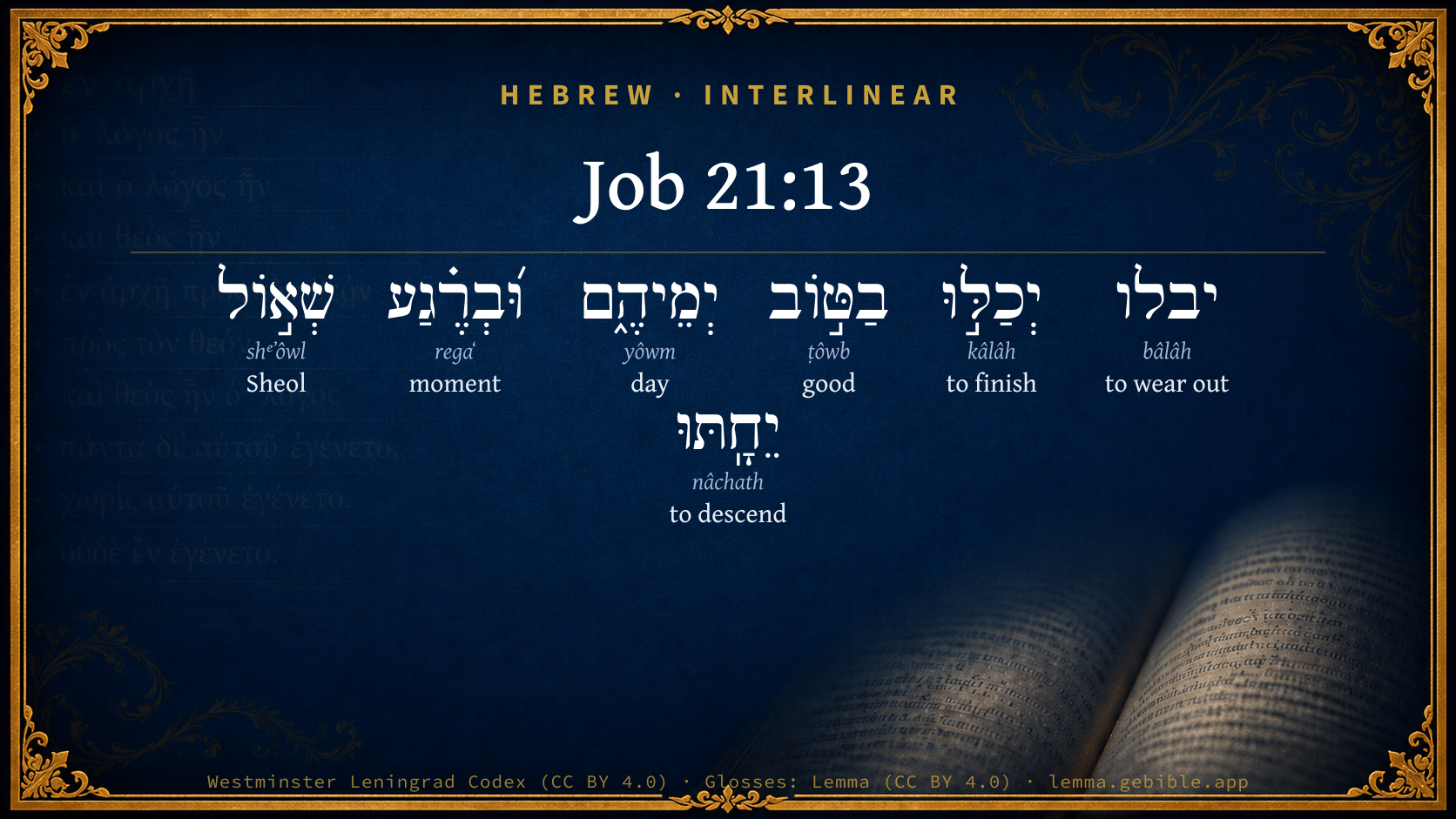
Job 21:13

Hebrew (Westminster Leningrad Codex) Job 21:13 appears in the Hebrew Old Testament. The text above is from the Westminster Leningrad Codex. Each word links to its Strong’s number, a concise gloss, and parsing drawn from the Open Scriptures Hebrew Bible morphology. Click any word for its full Brown-Driver-Briggs (BDB) entry.
Download image
Cite this verse

Job 21:13 (World English Bible). Public Domain. Lemma interlinear Bible study tool, https://lemma.gebible.app/v/job/21/13.

Show BibTeX & RIS
BibTeX
RIS
English Translation
They spend their days in prosperity. In an instant they go down to Sheol.
World English Bible · Public Domain
Download a study sheet

One document with this verse’s original text, its word-by-word gloss line, the meaning frame, cross-references with their text, attributed commentary, and full source and license credits — printable, and it pastes into notes with its structure intact.

This verse Autodidact and up

Study sheet (.html) Plain text (.txt)

A passage Seminary Student

Up to 50 verses in one chapter. A passage sheet keeps up to 6 commentary sources and 12 cross-references per verse, in the order this page ranks them, and says so on the sheet whenever that leaves anything out. Ask for a single verse and you get the Autodidact verse sheet above.

Everything on this page stays free to read, with no account — the sheet is a download of what is already on screen, not access to it.

Want to remove ads? Support Godless Engineer
Compare translations 3

The same verse in 3 English versions, stacked beneath the original-language interlinear above. Click any original word for its lexicon entry.

Each is an independent rendering of the whole verse — the interlinear is not word-aligned to these translations.

Highlighted words mark where these versions differ — a whole-verse word diff, not a word-by-word alignment.

  • World English Bible Public Domain
    They spend their days in prosperity. In an instant they go down to Sheol.
  • King James Version Public Domain
    They spend their days in wealth, and in a moment go down to the grave.
  • unfoldingWord Literal Text CC BY-SA 4.0
    They spend their days in prosperity, and they go down Sheol in a moment.

unfoldingWord Literal Text — © unfoldingWord, licensed CC BY-SA 4.0. Word-aligned USFM3 via Door43 (git.door43.org/unfoldingWord/en_ult).

Versions to compare (up to 4)

3 of 4 selected

Show all 18 translations

Every available English version of this verse, each an independent rendering of the whole verse.

  • World English Bible Public Domain
    They spend their days in prosperity. In an instant they go down to Sheol.
  • Berean Standard Bible Public Domain
    They spend their days in prosperity and go down to Sheol in peace.
  • Majority Standard Bible Public Domain
    They spend their days in prosperity and go down to Sheol in peace.
  • King James Version Public Domain
    They spend their days in wealth, and in a moment go down to the grave.
  • American Standard Version (1901) Public Domain
    They spend their days in prosperity, And in a moment they go down to Sheol.
  • Revised Version (1885) Public Domain
    They spend their days in prosperity, and in a moment they go down to Sheol.
  • Geneva Bible (1599) Public Domain
    They spend their dayes in wealth, and suddenly they go downe to the graue.
  • Douay-Rheims (1899) Public Domain
    They spend their days in wealth, and in a moment they go down to hell.
  • Young's Literal Translation Public Domain
    They wear out in good their days, And in a moment `to' Sheol go down.
  • Literal Standard Version CC BY-SA 4.0
    They wear out their days in good, || And in a moment go down [to] Sheol.
  • Unlocked Literal Bible CC BY-SA 4.0
    They spend their days in prosperity, and they go down quietly to Sheol.
  • unfoldingWord Literal Text CC BY-SA 4.0
    They spend their days in prosperity, and they go down Sheol in a moment.
  • Darby Bible Public Domain
    They spend their days in prosperity, and in a moment go down to Sheol.
  • World Messianic Bible Public Domain
    They spend their days in prosperity. In an instant they go down to Sheol.
  • Webster's Bible Public Domain
    They spend their days in wealth, and in a moment go down to the grave.
  • Free Bible Version CC BY-SA 4.0
    They live out their lives contentedly, and go down to Sheol in peace.
  • Bible in Basic English Public Domain
    Their days come to an end without trouble, and suddenly they go down to the underworld.
  • JPS Tanakh (1917) Public Domain
    They spend their days in prosperity, and peacefully they go down to the grave.

Literal Standard Version (2020), Covenant Press — licensed CC BY-SA 4.0. Text via the HelloAO Bible API (eBible.org). Unlocked Literal Bible (unfoldingWord) — licensed CC BY-SA 4.0. Text via the HelloAO Bible API (eBible.org). unfoldingWord Literal Text — © unfoldingWord, licensed CC BY-SA 4.0. Word-aligned USFM3 via Door43 (git.door43.org/unfoldingWord/en_ult). Free Bible Version, Dr. Jonathan Gallagher — licensed CC BY-SA 4.0. Text via the HelloAO Bible API (eBible.org).

Word by word

More ways to search: Search by grammar → Find every occurrence → Compare this word →

Practice this passage: Drill this verse → Learn its vocabulary →

About this verse

These counts appear in no published source. They are computed here, from the morphology-tagged text and Lemma’s own curated glosses. What Lemma adds →

7
words
7
distinct lemmas
Wisdom
section

Notable vocabulary

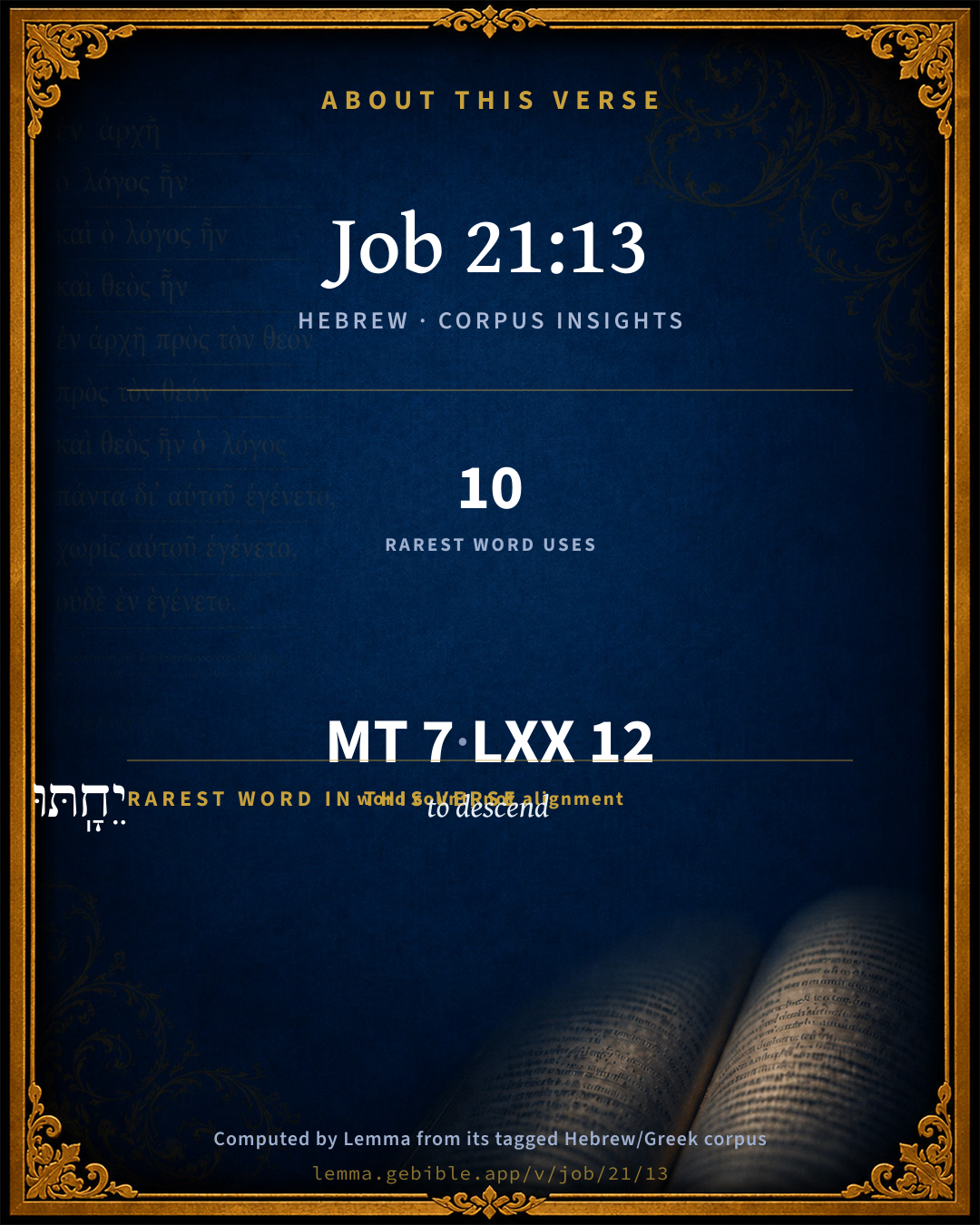
The rarest word here is יֵחָֽתּוּ to descend H5181 — appearing just 10 times in the whole Hebrew Bible.

Shared distinctive vocabulary

יֵחָֽתּוּ to descend H5181 occurs in 9 verses of the Hebrew Bible. Also found in:

Grammatical profile

  • 3 verbs
  • 3 nouns
  • 1 adjective

Verb forms

  • יבלו Piel · Imperfect
  • יְכַלּ֣וּ Piel · Imperfect
  • יֵחָֽתּוּ Qal · Imperfect

Hebrew & Septuagint length

In English translation the verse runs 14 words from the Hebrew and 16 from the Septuagint (LXX English) — closely comparable.

A rough comparison of the two English renderings, which tokenize alike — not a word-level alignment.

Word counts can differ between the Hebrew and the Greek without any difference in meaning — e.g. the Hebrew direct-object marker אֵת has no separate Greek word, and Greek often adds the article ὁ.

In the original languages it is 7 Hebrew tokens and 12 Greek tokens — but the two are counted differently (Hebrew bundles its prefixes and suffixes into one token; the Greek is in lemma form), so that isn’t a like-for-like length.

Cross-references

5

Topical passages linked to Job 21:13 in the Treasury of Scripture Knowledge — connected by theme and wording, ordered by reader-vote popularity; previews shown in the World English Bible.

  • Job 36:11 If they listen and serve him, They shall spend their days in prosperity, And their years in pleasures.
  • Psalms 73:4 For there are no struggles in their death, But their strength is firm.
  • Matthew 24:38–39 For as in those days which were before the flood they were eating and drinking, marrying and giving in marriage, until the day that Noah entered into the ark,
  • Luke 12:19–20 I will tell my soul, "Soul, you have many goods laid up for many years. Take your ease, eat, drink, be merry."'
  • Luke 17:28–29 Likewise, even as it happened in the days of Lot: they ate, they drank, they bought, they sold, they planted, they built;

Cross-references courtesy of OpenBible.info (CC BY 4.0).

Hebrew and Greek witnesses Masoretic Hebrew ↔ Greek Septuagint

The same verse in the two great witnesses to the Old Testament, shown verse-for-verse.

These are two independent witnesses, not word-aligned to each other, and the Septuagint is shown in lemma (dictionary) form.

Hebrew Job 21:13 Masoretic · Westminster Leningrad Codex

יבלו יְכַלּ֣וּ בַטּ֣וֹב יְמֵיהֶ֑ם וּ֝בְרֶ֗גַע שְׁא֣וֹל יֵחָֽתּוּ

They spend their days in prosperity. In an instant they go down to Sheol.

World English Bible · Public Domain

Greek LXX Job 21:13 Septuagint · lemma form

συντελέω δέ ἐν ἀγαθός ὁ βίος αὐτός ἐν δέ ἀνάπαυσις ᾅδης κοιμάω

And they spend their days in wealth, and fall asleep in the rest of the grave.

LXX2012 (modern English Septuagint) · Public Domain

On this verse, Joseph Benson's Commentary discusses the Septuagint’s reading. Read the note in Commentary ↓

Hebrew: Westminster Leningrad Codex (CC BY 4.0). Greek: Septuagint (public domain); English from LXX2012 (modern English Septuagint) (Public Domain). How the Septuagint differs from the Hebrew →

Commentary

Notes on Job 21:13 from classic Christian and Jewish commentators (each source and its license shown beneath its notes). The classic Christian expositions comment on the surrounding passage and are grouped to its opening verse, so a note may address several verses; the Jewish commentaries on the Tanakh (Rashi and others) are per-verse, so they appear only where the commentator wrote on this verse.

Lemma curates 59 commentaries, every one of them public domain or Creative Commons licensed, each selected and text-cleaned for this edition rather than reprinted as found. About our sources →

Trapp's Complete Commentary

John Trapp

Job 21:13 They spend their days in wealth, and in a moment go down to the grave.

Ver. 13. They spend their days in wealth] Or, in mirth. Heb. In good. They wallow in wealth, and have the world at their will, even more than heart could wish, as David phraseth it in Psa 73:2-12, which may well serve for a comment upon this text; and the rich glutton for an instance. He in his lifetime received good things, and in a moment went down to the grave, Luk 16:25. True it is, that this is not every wicked man’s case; for some of them live wretchedly and die lamentably, being held long upon the rack of a torturing disease (as Jehoram), all which is to them none other than a type and foretaste of hell, whither they are hastening.

And in a moment they go down to the grave] Ad inferna, to hell, saith the Vulgate; they spend their days in wealth, and end their days in woe; their merry dance determineth in a miserable downfall. Thus that "rich man died, and was buried; and in hell he lifted up his eyes, being in torment," &c., Luk 16:22-23. But though the same Hebrew word signifieth hell and the grave (both which have their names from their unsatiableness, Pro 30:15-16), yet here, in a suitableness to what went before, the grave is to be understood; and the sense is, Dicto citius moriuntur, they die easily, suddenly, sweetly, without much pain of body or trouble of mind; "there are no bands in their death," saith David, Psa 73:4. They die without much ado, like a lamb, or like a lamp, that goeth out of itself when the oil faileth; they go quickly and quietly to the grave. Some wicked persons indeed die piecemeal by a complicated disease, and a long lingering death, as did Antiochus, Herod, Philip II of Spain, &c. Dionysius the tyrant is said to have envied a beast, whose throat he saw cut, because he died so soon. Julius Caesar wished he might die speedily, saith Suetonius. Pliny commendeth sudden death as the chief felicity of life. That is a good death to nature which is neither feared nor expected; yet that is the best death which hath been longest expected and prepared for. Mors iucunda cuius nulla praecessit expectatio aut metus. Happy is he that, after due preparation, is passed through the gates of death ere he be aware. Happy is he that, by the holy use of long sickness, is taught to see the gates of death afar off, and addresseth for a resolute passage. The one dieth like Elijah, the other like Elisha, both blessedly.

John Trapp, A Commentary or Exposition upon All the Books of the Old and New Testament (1647–1656) — public domain. Text from a community e-Sword module.

The Biblical Illustrator

Joseph S. Exell

Job_21:13

And in a moment go down to the grave.

Things contingent upon a moment

Whatever begins, begins in a moment, and whatever ends, ends in a moment. Thoughts and purposes are formed in a moment--plans contemplated for years are decided in a moment--instantaneously. In so short a space everything comes to life and expires. In a moment we plant seed which takes centuries to grow, but which, in a moment only, the storm may cast down to the ground. The lightning may, in a moment, blast the work of a thousand years. A mans character may be ruined in a moment. In a little space of time it begins to go down. Break the law of gravitation, and crash would go creation. Job is moralising thus with his friends, and it seems to him strange that one event befalls the righteous and the wicked. It is a quick text, and has a sudden termination.

1. Life is a very little thing. It may be crushed as we would crush an eggshell. It need not take an hour to strike the blow which shall shiver it. Indeed, the wonder is that with such a little thing we live at all, for death is lurking all around us--the destructive forces so thick, that it seems as if the earth was made of nothing else. The pestilence rings at no mans door to toll of its coming, but it comes suddenly, and sweeps hundreds of men into the tomb. We stand on the graves brink every day.

2. Some men think death to be a long way off when the precipice is right at their side, and they are liable to fall into it at any moment. The young are not more free from the enemies of destruction than their parents. The great and the small, the good and the evil, are taken away in a moment. What is to rescue us from deaths dominion? Moses on Pisgahs top might plead that he was but 120 years old, that his eye was not dim, that he greatly desired to enter the promised land, but the plea was too weak, and he laid him down there on the top of the Mount. The man of business may plead that he is young and healthy, and his plans not yet accomplished; but death is inexorable, and he bows his head and gives up the ghost. Charles I and Marie Antoinette might plead their royal blood, or the popular will in their exaltation, but the executioners axe severed their heads and their excuses in a moment. Death cares for none of these things.

3. How suddenly, too, his arrows fly. Like that night in Egypt, when suddenly at midnight the gleam of the destroying angels sword was seen in the darkness, and, in a moment, the firstborn of all that land passed from life to death. The kings son and the chained captive lie side by side in deaths embrace, and a kingdom is in tears. How sudden the exit of Dickens, Thackeray, and others, hurried off ere their last chapter was written and last page dried. And sometimes death aggravates his work, and takes thousands on the battlefield, and hacks and tears them ¢o pieces; or, on the steamer, burns and scalds their flesh from their bones. Learn from destructive forces being near not to tempt Providence by carelessness and negligence. A great deal is sot down to Providence which should be set down to ourselves. And let us be always ready, since but a step between us and the grave! (Anon.)

The Biblical Illustrator, edited by Joseph S. Exell (c. 1880s–1900s) — public domain. Text from a community e-Sword module.

Joseph Benson's Commentary

Job 21:13. They spend their days in wealth — Hebrews בשׂוב, batob, in good: εν αγαθοις, LXX., in good things: in deliciis, in delights, Arab. ver: that is, in the enjoyment of all the good things of this life without any mixture of evil. And in a moment go down to the grave — They do not die of a lingering disease, as many good men die, but suddenly and sweetly.

Joseph Benson's Commentary on the Old and New Testaments (1811–1818) — public domain. Text from a community e-Sword module.

Geneva Bible (1599)

Geneva Bible translators

Not being tormented with long sickness.

Geneva Bible (1599) marginal notes — public domain. Text via Bolls.life.

Jamieson, Fausset & Brown

Robert Jamieson, A. R. Fausset & David Brown

wealth--Old English Version for "prosperity."

in a moment--not by a lingering disease. Great blessings! Lengthened life with prosperity, and a sudden painless death (Psa 73:4).

Jamieson, Fausset & Brown — Commentary Critical and Explanatory on the Whole Bible (1871) — public domain (CC PDM 1.0). Text via the HelloAO Bible API.

Adam Clarke's Commentary

Verse 13. They spend their days in wealth] There is a various reading here of some importance. In the text we have יבלו yeballu, they grow old, or wear out as with old age, terent vetustate; and in the margin, יכלו yechallu, they consume; and the Masora states that this is one of the eleven words which are written with ב beth and must be read with כ caph. Several editions have the former word in the text, and the latter in the margin; the former being what is called the kethib, the latter keri. יבלו yeballu, they grow old, or wear out, is the reading of the Antwerp, Paris, and London Polyglots; יכלו yechallu, they accomplish or spend, is the reading of the Complutensian Polyglot, thirteen of Kennicott's and De Rossi's MSS., the Septuagint, Chaldee, Syriac, and Arabic. The Vulgate has ducunt, "they lead or spend," from which our translation is borrowed. I incline to the former, as Job's argument derives considerable strength from this circumstance; they not only spend their days in faring sumptuously every day; but they even wear out so as to grow old in it; they are not cut off by any sudden judgment of God. This is fact; therefore your doctrine, that the wicked are cut off suddenly and have but a short time, is far from the truth.

In a moment go down to the grave.] They wear out their years in pleasure; grow old in their gay and giddy life; and die, as in a moment, without previous sickness; or, as Mr. Good has it, They quietly descend into the grave.

Adam Clarke's Commentary on the Bible (1810–1826) — public domain. Text from a community e-Sword/MySword module.

Ellicott's Commentary for English Readers

(13) In a moment.—They go down to death without being made to feel the lingering tortures that Job had to undergo.

A Bible Commentary for English Readers, edited by Charles John Ellicott (1878–1897) — public domain. Text from a community e-Sword module.

The Cambridge Bible for Schools and Colleges

gen. ed. J. J. S. Perowne

13. in wealth] i. e. weal, prosperity. The word has not here its modern meaning of riches, but its older, more general sense:—“in all time of our tribulation, in all time of our wealth … good Lord deliver us.” The Litany.

to the grave] Heb., to Sheol. They die in a moment without pain—there are no bands in their death, Psa_73:4. This idyllic picture of a joyous untroubled life, rich in possessions and filled with all that gives a charm to existence, and having a peaceful close, forms the counterpart to the picture drawn by the friends of the troubled conscience, Job_15:20, the early death, Job_20:11, the childless solitariness, Job_18:19, and the disastrous end, Job_20:24, of the wicked man.

The Cambridge Bible for Schools and Colleges (gen. ed. J. J. S. Perowne; Cambridge University Press, 1878–1918) — public domain. Text from a community e-Sword module.

John Gill's Exposition

Therefore they say unto God,.... While in health and life, amidst all their outward prosperity, and because of it; for worldly riches have this tendency, to make men proud and insolent, and not only to behave ill to their fellow creatures, and to slight and despise them; but even to forsake God, and lightly esteem their Creator and benefactor; yea, even to kick against him, and oppose him, to set their mouths against him, and speak very contemptuously and blasphemously of him, as in the following words; which though not expressly uttered and pronounced, which yet may have been by some, however are conceived in the mind, and inwardly spoken; and by their lives and conversations outwardly declared and abundantly proclaimed:

depart from us; not as to his general presence, which cannot be, and without which they would not be able to subsist; God is everywhere, and near to everyone, and all live, and move, and have their being, in him; nor as to his spiritual presence, which wicked men know nothing of, and are unconcerned about; but they do not choose to have him so near them as that their minds should be conversant about him; they do not care to have him in their thoughts, they are desirous if possible of banishing him out of their minds; they would live without thinking of God, or thinking that there is a God in the world, for such a thought makes them uneasy; they do not love to have their consciences awakened by him, so as to check and accuse for what they do; they had rather have them cauterized or seared, as with a red hot iron, and be past feeling, that they may go on in their sinful courses without control: this is the just character of a worldling, who is afraid he shall be a loser by God and religion, should he attend thereunto; and therefore, as the Gergesenes for a like reason desired Christ to depart out of their coasts, so such desire God to depart from them, Mat 8:28; and of the epicure, whose God is his belly, and that only; and most righteously will it be said to such at the last day, "depart from me"; this will be a just retaliation:

for we desire not the knowledge of thy ways; the ways which God prescribes, directs, and enjoins men to walk in, even the ways of his commandments; these are unknown to men, until shown and taught them; but wicked men do not desire to be instructed in them; they have no pleasure and delight neither in them, nor in the knowledge of them; they fancy there is no pleasure to be had in them, and they think they have got into a much more pleasant way, which they have chosen, and their souls delight in; though destruction and misery are in it, and it leads into it: they wilfully affect ignorance of the ways of God; they do not care to come to the light, lest their deeds should be reproved, their consciences be made uneasy, and they not able to go on so peaceably and quietly in their own ways.

John Gill's Exposition of the Whole Bible (1746–1763) — public domain (CC PDM 1.0). Text via the HelloAO Bible API.

Albert Barnes' Notes on the Bible

They spend their days in wealth - Margin, or, “mirth.” Literally, “they wear out their days in good” - בטוב baṭôb. Vulgate “in bonis.” Septuagint, ἐν ἀγαθοῖς en agathois - “in good things;” in the enjoyment of good. They are not oppressed with the evils of poverty and want, but they have abundance of “the good things” of life.

And in a moment go down to the grave - Hebrew to שׁאול she'ôl - but here meaning evidently the grave. The idea is, that when they die they are not afflicted with lingering disease, and great bodily pain, but having lived to an old age in the midst of comforts, they drop off suddenly and quietly, and sleep in the grave. God gives them prosperity while they live, and when they come to die he does not come forth with the severe expressions of his displeasure, and oppress them with long and lingering sickness. The author of Ps. 73 had a view of the death of the wicked remarkably similar to this, when he said,

For I was envious at the foolish,

When I saw the prosperity of the wicked.

For there are no bands in their death,

But their strength is firm. Psa 73:3-4.

All that Job says here is predicated on the supposition that such a sudden removal is preferable to death accompanied with long and lingering illness. The idea is, that it is in itself “desirable” to live in tranquility; to reach an honorable old age surrounded by children and friends, and then quietly and suddenly to drop into the grave without being a burden to friends. The wicked, he says, often live such a life, and he infers, therefore, that it is not a fact that God deals with people according to their character in this life, and that it is not right to draw an inference respecting their moral character from his dealings with them in this world. There are instances enough occurring in every age like those supposed here by Job, to justify the conclusion which he draws.

Albert Barnes' Notes on the Bible (1834–1885) — public domain. Text from a community e-Sword/MySword module.

Haydock's Catholic Bible Commentary

Moment. Septuagint, "in the rest of the lower region, Greek: adou, they shall be laid," (Haydock) in the grave. (Menochius) --- A sudden death, without agony or sickness, (Haydock) was the choice of Julius Cæsar, the night before he was slain. Repentinum inopinatumque prætulerat. (Suetonius) --- But the enlightened servant of God would rather desire time to do penance, and to prepare for death. For who shall presume that he has that charity which banisheth fear? (Calmet) --- Hell. The same term is used for the place where the damned are tormented, as for that where the souls of the just waited (chap. vii., and xvii.) for their Redeemer’s coming. But here Job is speaking of the apparent happiness of the wicked; (Haycock) and only alludes to the grave, (Calmet; Menochius) or comfortable death and burial of the reprobate: though, at the same time, he may declare that their souls are buried in hell. (Haydock)

George Leo Haydock (1774–1849), Haydock's Catholic Family Bible and Commentary, 1859 edition — public domain. Excludes Psalms (Douay-Rheims chapter numbering differs from Protestant) and Deuterocanonical books (Catholic canon only).

Matthew Poole's English Annotations

In wealth; in good, i.e. in the enjoyment of all the good things of this life, without any mixture of evil. They do not die of a lingering and tormenting disease, as I now and many other good men die, but suddenly and sweetly, like lambs; as is usually said in such cases.

Matthew Poole's English Annotations on the Holy Bible (1683–1685) — public domain. Text from a community e-Sword/MySword module.

Whedon's Commentary on the Bible

Daniel D. Whedon

13. Spend their days — They wear out — make the most of — life. “In connexion with this, one thinks of a coat which is not laid aside until it isentirely worn out.” — Delitzsch.

Wealth שׂוב — Septuagint, good things. Dives also had his “good things.” The life and burial of Dives have several points in common with Job’s description of the wicked rich man.

In a moment — Their lot brings no grievous protracted sickness — “there are no bands in their death.” Having no idea of repentance, and no sense of eternal things, they evidently esteemed sudden death desirable. Suetonius tells us that Augustus Caesar expired suddenly, dying a very easy death, and such as he himself had always wished for. (xcix.)

The grave — Sheol.

Daniel D. Whedon (gen. ed.), Commentary on the Old and New Testaments (1874–1909) — public domain. Text from a community e-Sword module.

The Pulpit Commentary

They spend their days in wealth, and in a moment go down to the grave. They die, i.e. , without suffering from any prolonged or severe illness, such as that grievous affliction from which Job himself was suffering. Probably Job does not mean to maintain all this absolutely, or as universally the case, but he wishes to force his friends to acknowledge that there are many exceptions to their universal law, that wickedness is always visited in this world with condign punishment, and he wants them to account for them exceptions (see ver. 7).

The Pulpit Commentary (1880–1919), ed. H.D.M. Spence-Jones & Joseph S. Exell — public domain. Text from a community e-Sword module.

John Wesley's Explanatory Notes

Moment - They do not die of a lingering and tormenting disease.

John Wesley, Explanatory Notes Upon the Whole Bible (1754–1765) — public domain. Text via the GEBible commentary corpus.

Scofield Reference Notes

C. I. Scofield

grave

Heb. "Sheol," (See Scofield "Hab 2:5")

The Scofield Reference Bible (1917 edition), notes by C. I. Scofield — public domain. Text from a community e-Sword module.

unfoldingWord translationNotes

Door43 World Missions Community

Connecting Statement:

Job continues speaking with his friends.

their days

"their lifetime"

they go down quietly to Sheol

This is a polite way of saying that they die. AT: "they die peacefully" (See: Euphemism)

your ways

This refers to how God wants people to behave.

What is the Almighty, that we should worship him? What advantage would we get if we prayed to him?

The wicked people use these questions to mock God. AT: "We do not believe that this Almighty God is worthy of our worship. He can do nothing for us." (See: Rhetorical Question)

translationWords

prosper

Hades

God

know

Almighty

worship

pray

unfoldingWord translationNotes — © Distant Shores Media and the Door43 World Missions Community, licensed CC BY-SA 4.0. Source: git.door43.org/Door43/en_tn.

Rashi

Rabbi Shlomo Yitzchaki (Rashi)

and in a moment they descend to the grave When his dying day arrived, he would die in a moment, easily, without suffering.

they descend Heb. יחתו, they descend, which is in Targum נחיתוּ.

Rashi on the Tanakh — English translations: “The Judaica Press complete Tanach with Rashi, translated by A. J. Rosenberg” (CC BY 4.0); “Pentateuch with Rashi's commentary by M. Rosenbaum and A.M. Silbermann, 1929-1934” (public domain); “The Metsudah Tanach series, Lakewood, N.J” (CC BY 4.0); and “The Book of Joshua, Metsudah Publications, 1997” (CC BY 4.0). Text via Sefaria.

Lesson kit

Teaching starters — assembled from the data on this page, not authored interpretation. Every prompt links to the verse data it draws on. Edit before teaching.

Job, in the Wisdom, opens this verse with 7 words (7 distinct Hebrew lemmas). Its most distinctive word is nâchath (“to descend”). A historical commentator’s framing appears above. Read the whole chapter for the surrounding context.

Discussion questions

  1. What does “to descend” (nâchath) contribute to the verse as a whole?
  2. 1 Samuel 2:10 shares the word «to descend» with this verse. How do the two illuminate each other?
  3. These translations render this verse differently. What is at stake in choosing one wording over another?
  4. The verb «יבלו» is Piel Imperfect. How does its form color the action?
  5. Reading how Trapp's Complete Commentary and The Biblical Illustrator read this verse, where do the two commentators agree and where do they part?

Things to notice

Reading settings

Reading text

Shown beneath each verse's original-language words.

Old Testament
Old Testament edition

Read the OT as the Masoretic Hebrew (MT) or the Greek Septuagint (LXX).

English shown for the Greek Septuagint (in the Hebrew ↔ Greek comparison).

Comparing translations? Open the Compare panel on any verse page to stack up to four side by side.