
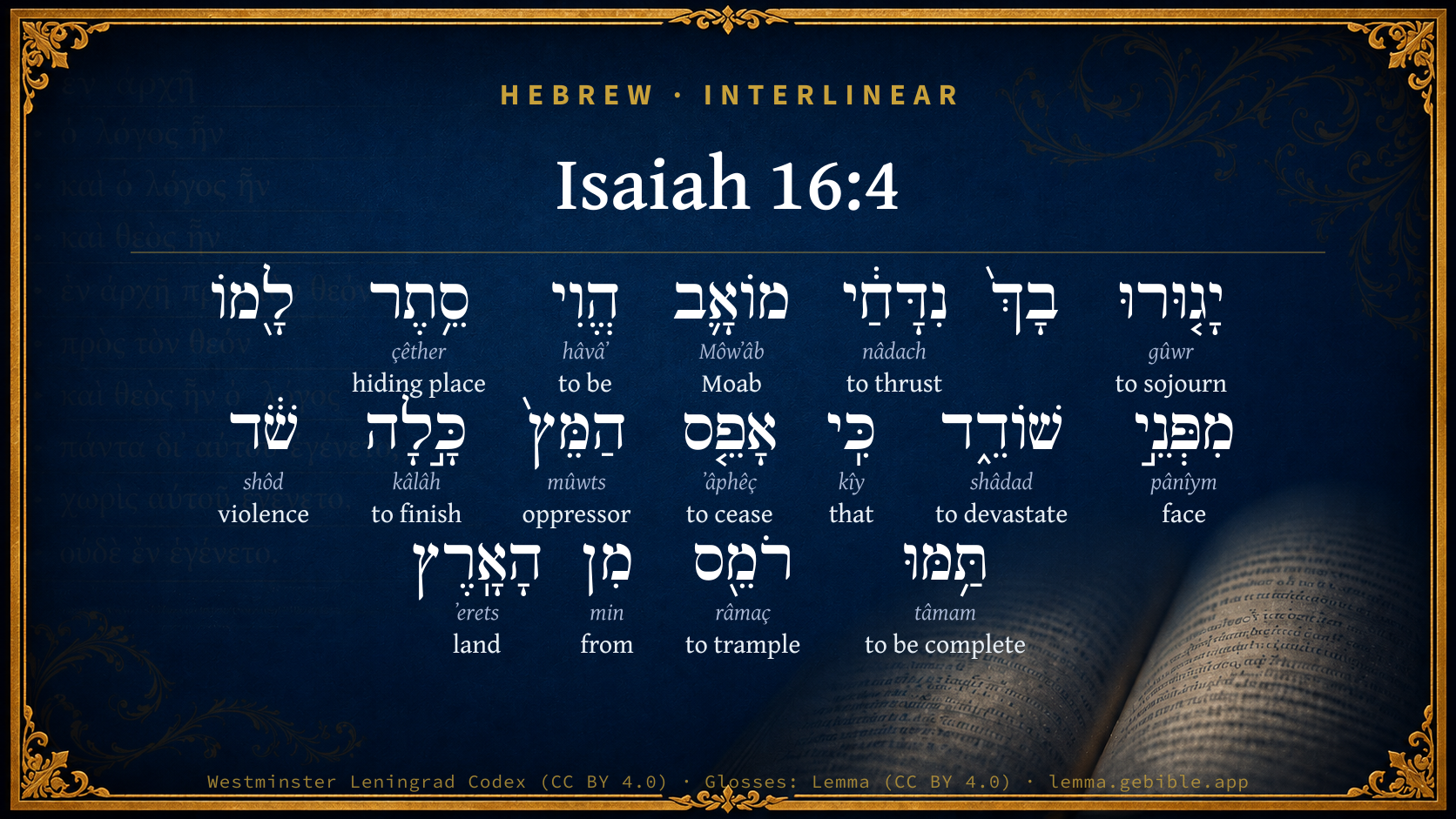
Isaiah 16:4

Hebrew (Westminster Leningrad Codex) Isaiah 16:4 appears in the Hebrew Old Testament. The text above is from the Westminster Leningrad Codex. Each word links to its Strong’s number, a concise gloss, and parsing drawn from the Open Scriptures Hebrew Bible morphology. Click any word for its full Brown-Driver-Briggs (BDB) entry.
Download image
Cite this verse

Isaiah 16:4 (World English Bible). Public Domain. Lemma interlinear Bible study tool, https://lemma.gebible.app/v/isaiah/16/4.

Show BibTeX & RIS
BibTeX
RIS
English Translation
Let my outcasts dwell with you; as for Moab, be a covert to him from the face of the destroyer. For the extortioner is brought to nothing, destruction ceases, the oppressors are consumed out of the land.
World English Bible · Public Domain
Highlights
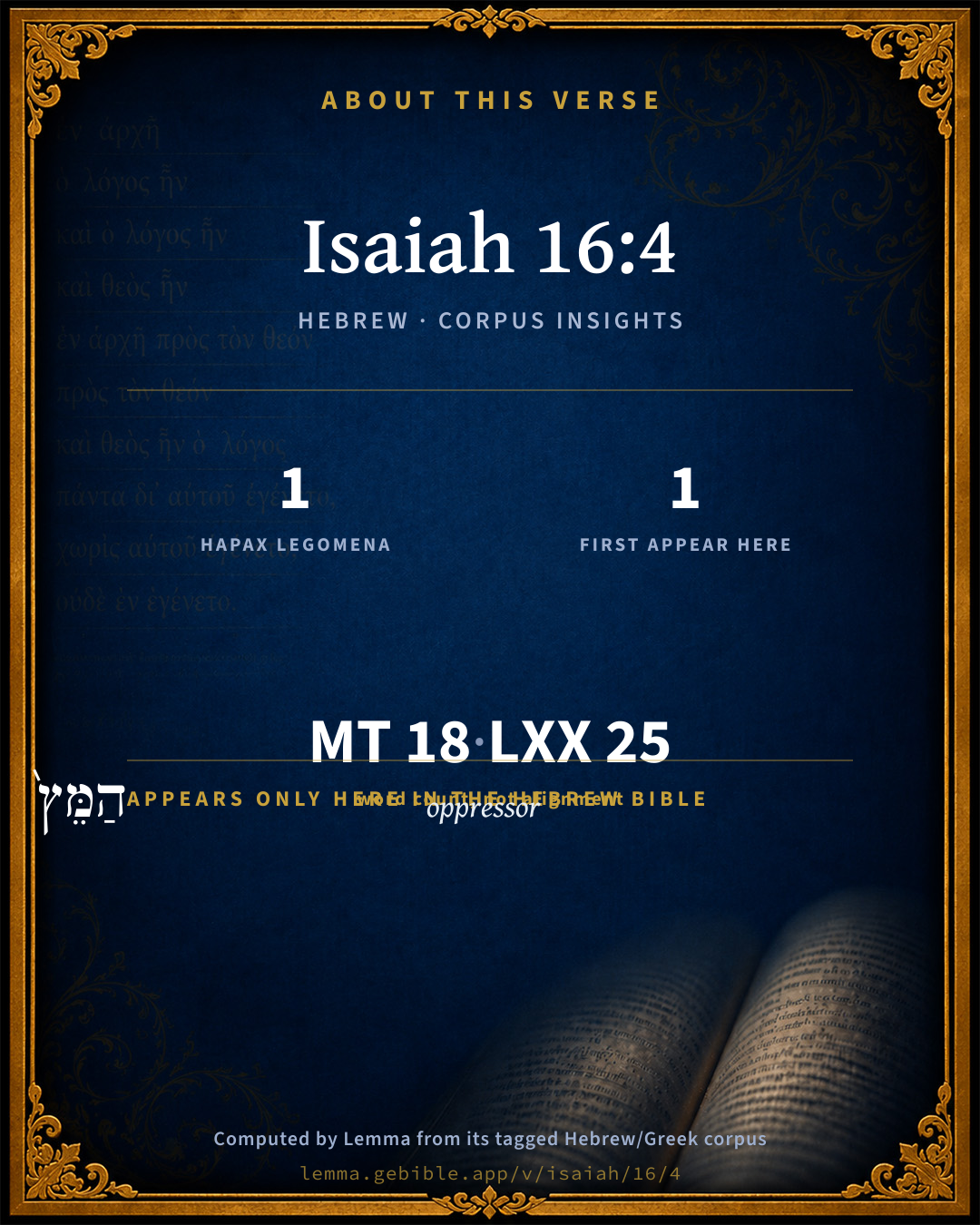
  • 1 hapax legomenon — only here in the Hebrew Bible
  • 1 first appearance in the Hebrew Bible
Full analysis ↓
Download a study sheet

One document with this verse’s original text, its word-by-word gloss line, the meaning frame, cross-references with their text, attributed commentary, and full source and license credits — printable, and it pastes into notes with its structure intact.

This verse Autodidact and up

Study sheet (.html) Plain text (.txt)

A passage Seminary Student

Up to 50 verses in one chapter. A passage sheet keeps up to 6 commentary sources and 12 cross-references per verse, in the order this page ranks them, and says so on the sheet whenever that leaves anything out. Ask for a single verse and you get the Autodidact verse sheet above.

Everything on this page stays free to read, with no account — the sheet is a download of what is already on screen, not access to it.

Want to remove ads? Support Godless Engineer
Compare translations 3

The same verse in 3 English versions, stacked beneath the original-language interlinear above. Click any original word for its lexicon entry.

Each is an independent rendering of the whole verse — the interlinear is not word-aligned to these translations.

Highlighted words mark where these versions differ — a whole-verse word diff, not a word-by-word alignment.

  • World English Bible Public Domain
    Let my outcasts dwell with you; as for Moab, be a covert to him from the face of the destroyer. For the extortioner is brought to nothing, destruction ceases, the oppressors are consumed out of the land.
  • King James Version Public Domain
    Let mine outcasts dwell with thee, Moab; be thou a covert to them from the face of the spoiler: for the extortioner is at an end, the spoiler ceaseth, the oppressors are consumed out of the land.
  • unfoldingWord Literal Text CC BY-SA 4.0
    Let the outcast ones of Moab sojourn among you. Be a shelter for them from the face of the destroyer. For the oppressor will cease, destruction will end, the trampler will finish from the land.

unfoldingWord Literal Text — © unfoldingWord, licensed CC BY-SA 4.0. Word-aligned USFM3 via Door43 (git.door43.org/unfoldingWord/en_ult).

Versions to compare (up to 4)

3 of 4 selected

Show all 18 translations

Every available English version of this verse, each an independent rendering of the whole verse.

  • World English Bible Public Domain
    Let my outcasts dwell with you; as for Moab, be a covert to him from the face of the destroyer. For the extortioner is brought to nothing, destruction ceases, the oppressors are consumed out of the land.
  • Berean Standard Bible Public Domain
    Let my fugitives stay with you; be a refuge for Moab from the destroyer.” When the oppressor has gone, destruction has ceased, and the oppressors have vanished from the land,
  • Majority Standard Bible Public Domain
    Let my fugitives stay with you; be a refuge for Moab from the destroyer.” When the oppressor has gone, destruction has ceased, and the oppressors have vanished from the land,
  • King James Version Public Domain
    Let mine outcasts dwell with thee, Moab; be thou a covert to them from the face of the spoiler: for the extortioner is at an end, the spoiler ceaseth, the oppressors are consumed out of the land.
  • American Standard Version (1901) Public Domain
    Let mine outcasts dwell with thee; as for Moab, be thou a covert to him from the face of the destroyer. For the extortioner is brought to nought, destruction ceaseth, the oppressors are consumed out of the land.
  • Revised Version (1885) Public Domain
    Let mine outcasts dwell with thee; as for Moab, be thou a covert to him from the face of the spoiler: for the extortioner is brought to nought, spoiling ceaseth, the oppressors are consumed out of the land.
  • Geneva Bible (1599) Public Domain
    Let my banished dwell with thee: Moab be thou their couert from the face of the destroyer: for the extortioner shall ende: the destroyer shalbe consumed, and the oppressour shall cease out of the land.
  • Douay-Rheims (1899) Public Domain
    My fugitives shall dwell with thee: O Moab, be thou a covert to them from the face of the destroyer: for the dust is at an end, the wretch is consumed: he hath failed, that trod the earth under foot.
  • Young's Literal Translation Public Domain
    Sojourn in thee do My outcasts, O Moab, Be a secret hiding-place to them, From the face of a destroyer, For ceased hath the extortioner, Finished hath been a destroyer, Consumed the treaders down out of the land.
  • Literal Standard Version CC BY-SA 4.0
    My outcasts sojourn in you, O Moab, || Be a secret hiding place for them, || From the face of a destroyer, || For the extortioner has ceased, || Devastation has been finished, || The tramplers are consumed out of the land.
  • Unlocked Literal Bible CC BY-SA 4.0
    Let them live among you, the refugees from Moab; be a hiding place for them from the destroyer.” For the oppression will stop, and destruction will cease, those who trample will disappear from the land.
  • unfoldingWord Literal Text CC BY-SA 4.0
    Let the outcast ones of Moab sojourn among you. Be a shelter for them from the face of the destroyer. For the oppressor will cease, destruction will end, the trampler will finish from the land.
  • Darby Bible Public Domain
    Let mine outcasts dwell with thee, Moab; be thou a covert to them from the face of the waster. For the extortioner is at an end, the wasting hath ceased, the oppressors are consumed out of the land.
  • World Messianic Bible Public Domain
    Let my outcasts dwell with you! As for Moab, be a hiding place for him from the face of the destroyer. For the extortionist is brought to nothing. Destruction ceases. The oppressors are consumed out of the land.
  • Webster's Bible Public Domain
    Let my outcasts dwell with thee, Moab; be thou a covert to them from the face of the spoiler: for the extortioner is at an end, the spoiler ceaseth, the oppressors are consumed out of the land.
  • Free Bible Version CC BY-SA 4.0
    Let my refugees stay among you, Moab. Hide them from our enemies until the destroyer is no more, the destruction is over, and the aggressive invaders have gone.
  • Bible in Basic English Public Domain
    Let those who have been forced out of Moab have a resting-place with you; be a cover to them from him who is making waste their land: till the cruel ones are cut off, and wasting has come to an end, and those who take pleasure in crushing the poor are gone from the land.
  • JPS Tanakh (1917) Public Domain
    Let mine outcasts dwell with thee; as for Moab, be thou a covert to him from the face of the spoiler.' For the extortion is at an end, spoiling ceaseth, they that trampled down are consumed out of the land;

Literal Standard Version (2020), Covenant Press — licensed CC BY-SA 4.0. Text via the HelloAO Bible API (eBible.org). Unlocked Literal Bible (unfoldingWord) — licensed CC BY-SA 4.0. Text via the HelloAO Bible API (eBible.org). unfoldingWord Literal Text — © unfoldingWord, licensed CC BY-SA 4.0. Word-aligned USFM3 via Door43 (git.door43.org/unfoldingWord/en_ult). Free Bible Version, Dr. Jonathan Gallagher — licensed CC BY-SA 4.0. Text via the HelloAO Bible API (eBible.org).

Word by word

More ways to search: Search by grammar → Find every occurrence → Compare this word →

Practice this passage: Drill this verse → Learn its vocabulary →

הַמֵּץ֙
mûwts
H4160
“the · oppressor”
Particle, Definite Article + Noun, Common, Masculine, Singular, Absolute
Part of Speech
Particle + Noun
Type
Common
Gender
Masculine
Number
Singular
State
Absolute
Full BDB Definition

Origin: a primitive root

TWOT: 1162

(Qal) squeezer, extortioner, oppressor
  1. יָג֤וּרוּ gûwr H1481 “to sojourn” Verb, Qal, Imperfect, 3rd Person, Masculine, Plural
  2. נִדָּחַ֔י nâdach H5080 “thrust · me” Verb, Niphal, Participle Passive, Masculine, Plural, Construct + Suffix, Personal, 1st Person, Common, Singular
  3. מוֹאָ֛ב Môwʼâb H4124 “Moab” Noun, Proper
  4. הֱוִי hâvâʼ H1933 “be” Verb, Qal, Imperative, 2nd Person, Feminine, Singular
  5. סֵ֥תֶר çêther H5643 “hiding place” Noun, Common, Masculine, Singular, Absolute
  6. מִפְּנֵ֣י pânîym H6440 “from · face(s) of” Preposition + Noun, Common, Both, Plural, Construct
  7. שׁוֹדֵ֑ד shâdad H7703 “devastating” Verb, Qal, Participle Active, Masculine, Singular, Absolute
  8. כִּֽי kîy H3588 “that” Conjunction
  9. אָפֵ֤ס ʼâphêç H656 “to cease” Verb, Qal, Perfect, 3rd Person, Masculine, Singular
  10. כָּ֣לָה kâlâh H3615 “to finish” Verb, Qal, Perfect, 3rd Person, Masculine, Singular
  11. שֹׁ֔ד shôd H7701 “violence” Noun, Common, Masculine, Singular, Absolute
  12. תַּ֥מּוּ tâmam H8552 “to be complete” Verb, Qal, Perfect, 3rd Person, Common, Plural
  13. רֹמֵ֖ס râmaç H7429 “trampling” Verb, Qal, Participle Active, Masculine, Singular, Absolute
  14. מִן min H4480 “from” Preposition
  15. הָאָֽרֶץ ʼerets H776 “the · land” Particle, Definite Article + Noun, Common, Both, Singular, Absolute

About this verse

These counts appear in no published source. They are computed here, from the morphology-tagged text and Lemma’s own curated glosses. What Lemma adds →

18
words
16
distinct lemmas
Prophets
section

Notable vocabulary

1 hapax legomenon — a word that appears only here in the entire Hebrew Bible:

  • הַמֵּץ֙ oppressor H4160

First appearance in Scripture

This word makes its first canonical appearance in the Hebrew Bible here:

  • הַמֵּץ֙ oppressor H4160

Shared distinctive vocabulary

אָפֵ֤ס to cease H656 occurs in 5 verses of the Hebrew Bible. Also found in:

Grammatical profile

  • 8 verbs
  • 6 nouns
  • 3 prepositions
  • 1 conjunction

Verb forms

  • יָג֤וּרוּ Qal · Imperfect
  • נִדָּחַ֔י Niphal · Participle Passive
  • הֱוִי Qal · Imperative
  • שׁוֹדֵ֑ד Qal · Participle Active
  • אָפֵ֤ס Qal · Perfect
  • כָּ֣לָה Qal · Perfect
  • תַּ֥מּוּ Qal · Perfect
  • רֹמֵ֖ס Qal · Participle Active

Hebrew & Septuagint length

In English translation the verse runs 37 words from the Hebrew and 38 from the Septuagint (LXX English) — closely comparable.

A rough comparison of the two English renderings, which tokenize alike — not a word-level alignment.

Word counts can differ between the Hebrew and the Greek without any difference in meaning — e.g. the Hebrew direct-object marker אֵת has no separate Greek word, and Greek often adds the article ὁ.

In the original languages it is 18 Hebrew tokens and 25 Greek tokens — but the two are counted differently (Hebrew bundles its prefixes and suffixes into one token; the Greek is in lemma form), so that isn’t a like-for-like length.

Cross-references

17

Topical passages linked to Isaiah 16:4 in the Treasury of Scripture Knowledge — connected by theme and wording, ordered by reader-vote popularity; previews shown in the World English Bible.

  • Isaiah 14:4 that you shall take up this parable against the king of Babylon, and say, How has the oppressor ceased! the golden city ceased!
  • Isaiah 9:4 For the yoke of his burden, and the staff of his shoulder, the rod of his oppressor, you have broken as in the day of Midian.
  • Isaiah 51:13 and have forgotten Yahweh your Maker, who stretched forth the heavens, and laid the foundations of the earth; and fear continually all the day because of the fury of the oppressor, when he makes ready to destroy? and where is the fury of the oppressor?
  • Malachi 4:3 You shall tread down the wicked; for they will be ashes under the soles of your feet in the day that I make," says Yahweh of Hosts.
  • Deuteronomy 23:15–16 You shall not deliver to his master a servant who is escaped from his master to you:
  • Deuteronomy 24:14 You shall not oppress a hired servant who is poor and needy, whether he be of your brothers, or of your foreigners who are in your land within your gates:
  • Isaiah 15:6 For the waters of Nimrim shall be desolate; for the grass is withered away, the tender grass fails, there is no green thing.
  • Isaiah 25:10 For in this mountain will the hand of Yahweh rest; and Moab shall be trodden down in his place, even as straw is trodden down in the water of the dung-hill.
  • Isaiah 33:1 Woe to you who destroy, and you weren't destroyed; and deal treacherously, and they didn't deal treacherously with you! When you have ceased to destroy, you shall be destroyed; and when you have made an end of dealing treacherously, they shall deal treacherously with you.
  • Jeremiah 21:12 House of David, thus says Yahweh, Execute justice in the morning, and deliver him who is robbed out of the hand of the oppressor, lest my wrath go forth like fire, and burn so that none can quench it, because of the evil of your doings.
  • Jeremiah 48:8 The destroyer shall come on every city, and no city shall escape; the valley also shall perish, and the plain shall be destroyed; as Yahweh has spoken.
  • Jeremiah 48:18 You daughter who dwells in Dibon, come down from your glory, and sit in thirst; for the destroyer of Moab is come up against you, he has destroyed your strongholds.
  • Zechariah 10:5 They shall be as mighty men, Treading down muddy streets in the battle; And they shall fight, because Yahweh is with them; And the riders on horses will be confounded.
  • Luke 21:24 They will fall by the edge of the sword, and will be led captive into all the nations. Jerusalem will be trampled down by the Gentiles, until the times of the Gentiles are fulfilled.
  • Revelation 11:2 Leave out the court which is outside of the temple, and don't measure it, for it has been given to the gentiles. They will tread the holy city under foot for forty-two months.
  • Zechariah 9:8 I will encamp around my house against the army, That none pass through or return; And no oppressor will pass through them any more: For now I have seen with my eyes.
  • Romans 16:20 And the God of peace will quickly crush Satan under your feet. The grace of our Lord Jesus Christ be with you.

Cross-references courtesy of OpenBible.info (CC BY 4.0).

Hebrew and Greek witnesses Masoretic Hebrew ↔ Greek Septuagint

The same verse in the two great witnesses to the Old Testament, shown verse-for-verse.

These are two independent witnesses, not word-aligned to each other, and the Septuagint is shown in lemma (dictionary) form.

Hebrew Isaiah 16:4 Masoretic · Westminster Leningrad Codex

יָג֤וּרוּ בָךְ֙ נִדָּחַ֔י מוֹאָ֛ב הֱוִי סֵ֥תֶר לָ֖מוֹ מִפְּנֵ֣י שׁוֹדֵ֑ד כִּֽי אָפֵ֤ס הַמֵּץ֙ כָּ֣לָה שֹׁ֔ד תַּ֥מּוּ רֹמֵ֖ס מִן הָאָֽרֶץ

Let my outcasts dwell with you; as for Moab, be a covert to him from the face of the destroyer. For the extortioner is brought to nothing, destruction ceases, the oppressors are consumed out of the land.

World English Bible · Public Domain

Greek LXX Isaiah 16:4 Septuagint · lemma form

παραοἰκέω σύ ὁ φυγάς μωαβ εἰμί σκέπης σύ ἀπό πρόσωπον διώκω ὅτι αἴρω ὁ συμμαχία σύ καί ὁ ἄρχων ἀποὀλλύω ὁ καταπατέω ἐπί ὁ γῆ

The fugitives of Moab shall sojourn with you; they shall be to you a shelter from the face of the pursuer: for your alliance has been taken away, and the oppressing ruler has perished from off the earth.

LXX2012 (modern English Septuagint) · Public Domain

On this verse, Adam Clarke's Commentary discusses the Septuagint’s reading. Read the note in Commentary ↓

Hebrew: Westminster Leningrad Codex (CC BY 4.0). Greek: Septuagint (public domain); English from LXX2012 (modern English Septuagint) (Public Domain). How the Septuagint differs from the Hebrew →

Targum (Aramaic paraphrase)

1

The Targum is the ancient Jewish Aramaic paraphrase of the Hebrew Scriptures — an interpretive translation, not the Hebrew text itself. Onkelos (literal) and Pseudo-Jonathan (expansive) render the Torah, and Jonathan the Prophets. Coverage is partial: where no permissively-licensed English translation exists for a verse, only the Aramaic is shown. This is verse-level text, not a word-by-word alignment to the Hebrew.

  1. Targum Jonathan Prophets (Joshua–Malachi)
    יִתְיַתְבוּן בִּיךְ מְטַלְטְלֵי מַלְכוּת מוֹאָב הֲוֵי סִתְרָא לְהוֹן מִן קֳדָם בְּזוֹזִין אֲרֵי סַף מֵעַיָקָא אִשְׁתֵּיצֵי בְזָזָא סָפוּ כָּל דַהֲווֹ דָיְשִׁין מִן אַרְעָא:

    Let my outcasts dwell with thee, O kingdom of Moab! be thou a covert to them on account of the spoilers: for the extortioner is at an end, the spoiler ceaseth, all that trampled under foot have come to au end.

    Targum Jonathan — Aramaic: “Mikraot Gedolot” (public domain). English: “Sefaria Community Translation” (CC0 1.0 (public-domain dedication)); “London "Chaldee Paraphrase," 1871” (public domain). Text via Sefaria.

Commentary

Notes on Isaiah 16:4 from classic Christian and Jewish commentators (each source and its license shown beneath its notes). The classic Christian expositions comment on the surrounding passage and are grouped to its opening verse, so a note may address several verses; the Jewish commentaries on the Tanakh (Rashi and others) are per-verse, so they appear only where the commentator wrote on this verse.

Lemma curates 59 commentaries, every one of them public domain or Creative Commons licensed, each selected and text-cleaned for this edition rather than reprinted as found. About our sources →

Trapp's Complete Commentary

John Trapp

Isa 16:4 Let mine outcasts dwell with thee, Moab; be thou a covert to them from the face of the spoiler: for the extortioner is at an end, the spoiler ceaseth, the oppressors are consumed out of the land.

Ver. 4. Let mine outcasts.] Who are dear to me, {Jer 30:17} though I may seem to have cast off the care of them. Outcasts they may be, but not castaways. See Isa 52:5-6; "Persecuted, but not forsaken." {2Co 4:9} "Bowels of mercy" must be "put on" towards godly exiles especially, who are Dei φυγαδες, and should therefore be dear to us.

For the extortioner is at an end.] Heb., Emunctor, the milker, or squeezer, or wringer out, {Pro 30:33} so the Assyrian tyrant is called; as also Vastator et proculcator, the spoiler or plunderer; and conculcator, the oppressor or treader down, is consumed out of the land; and it shall not be long ere I fetch home my banished; be content therefore to harbour them awhile; herein thou shalt do thyself no disservice at all.

John Trapp, A Commentary or Exposition upon All the Books of the Old and New Testament (1647–1656) — public domain. Text from a community e-Sword module.

The Biblical Illustrator

Joseph S. Exell

Isa_16:4

Let Mine outcasts dwell with thee, Moab

Gods outcasts in Moab

An injunction is given to Moab to shelter the Jewish fugitives.

I. GOD OWNS HIS PEOPLE WHEN ALL THE WORLD FORSAKES OR OPPOSES THEM. No doubt Sennacherib thought the outcasts to be his victims, his prey; but God claims a personal interest in them, watches over them when they wander, supplies them in their need, and protects them by His guardian providence. They are His: His as the subjects of His government; His as the objects of His regard; His as the children of His grace.

II. GOD RAISES UP FRIENDS AND COMFORTERS FOR HIS CHURCH IN STRANGE AND UNEXPECTED QUARTERS. Here He provides for them a shelter before the storm comes on, and makes Moab, one of the most powerful of the Churchs enemies, a near and a present friend. God proves to Moab that it was their interest to do so, because the Jews would soon be in a condition to requite the favour, when their country should be invaded, and their daughters should wander without a home (Isa_16:2). The providence of God often makes the hostile feelings of bad men the occasion of good to the righteous.

III. GOD CAN OVERRULE CALAMITIES, WHICH THREATEN NOTHING BUT DISASTER TO HIS CHURCH, INTO THE MEANS OF CONFIRMING FAITH AND HOPE. Gods outcasts in Moab learned many a useful lesson there, and when they returned it was to uphold the government of Hezekiah, and to promote the welfare of the people with whom they had sojourned. And the throne shall be established in mercy, and He shall sit upon it in truth in the tabernacle of David (Isa_16:5). Sennacheribs invasion, which scattered his subjects in exile, threatened the overthrow of Hezekiah, but it really tended to establish him, for never was his kingdom more secure than after the overthrow of the Assyrian army. The same thing obtains in the experience of the Christian. As the birds sing most sweetly after a tempest; as torches shine brighter for shaking; as the flowers shed forth their fragrance at the close of a troubled day, so the graces of a Christian, his faith, his patience, and his hope, are matured by the trials that threatened their utter extinction. In the kingdom of Christ, a kingdom which is established in mercy, you find perpetual progress amidst perpetual storm, and a noontide of brightness often succeeds the darkest night.

IV. AMIDST ALL WANDERINGS GOD WOULD HAVE HIS PEOPLE REMEMBER THEIR DISTINCTIVE CHARACTER AND PREPARE FOR RETURN. They were to dwell in Moab, but only for a season, and always to bear the heart of a stranger. It is a great thing in days of worldly compliance and conformity, when everyone seems to live as if he were to live here always, to have in exercise a better hope, and for Christians to preserve the distinctness of their character. The Divine hand that created our frame and put life into it, has provided us with other resources than are found in feeble self, or in creatures feeble as ourselves. Besides this earth and these lower skies, there is an invisible world, and a kingdom of spirits. Let Christians seek to be in the world, but not of it. (Homiletic Magazine.)

The Biblical Illustrator, edited by Joseph S. Exell (c. 1880s–1900s) — public domain. Text from a community e-Sword module.

The Preacher's Complete Homiletical Commentary

Joseph S. Exell (gen. ed.)

GOD’S OUTCASTS

Isa_16:4. Let Mine outcasts dwell with thee, Moab.

I. In the most deserted condition of His people, God acknowledges them as His own. “Mine outcasts.” Sennacherib thought them his; but though forsaken by all the world, God claims them as His own, and avows His interest in them. Men pursue an opposite course; when individuals sink in the social scale, the kindly warmth of friendship is chilled, and the bond of intercourse broken (H. E. I., 23, 24, 2152–2157; P. D., 1422). But God is the friend who sticketh closer than any brother [1033] True, they sometimes esteem themselves outcasts even from Him (Psa_42:2), and still more frequently are thought to be so by the ungodly (Psa_42:3); but in this the ungodly make a mistake which in their case is natural, and God’s people should never wrong Him by suspecting Him of fickleness (chap. Isa_49:15).

[1033] Philip Henry says, “God’s people may be an outcast people—cast out from men’s love, their synagogue, their country; but God will own His people when men cast them out. They are outcasts, but they are His; and somehow or other He will provide a dwelling for them.” He adds, that though many of the ejected ministers were brought very low, had many children, were greatly harassed by persecutors, and their friends were unable to support them, yet in all his acquaintance he never knew, nor had heard of, any Nonconformist minister being in prison for debt.

II. God provides a refuge for His people when and where it might be least expected. “With thee, Moab.” Moab was not a neutral, but a hostile state, one of Israel’s most inveterate foes, always on the outlook for opportunities to display its hostility. Strange, therefore, that Moab should be selected as a protector for Jehovah’s outcasts; strange, but not unexampled. God often raises up friends for His people in unexpected quarters, supplies their needs by unexpected means, or turns their foes into friends (Pro_16:7). Esau’s heart was suddenly changed; Joseph found favour in the eyes of the keeper of the prison; Elijah was fed by ravens; the hungry lions forbore to touch Daniel, &c.

III. God would have His people to be only sojourners in Moab. His outcasts were merely to dwell there; they were not to be incorporated with the Moabitish nation; they were not to adopt either the social customs or the religious beliefs of that people. In like manner He would have His people remember always that in this world they are only sojourners (1Pe_2:11; H. E. I., 5026–5065).

IV. God is preparing to bring His outcast and scattered people home. He hath prepared for them a city, and He will bring them to the city He hath prepared for them (Joh_14:1). Let them recognise, rejoice in, and live in harmony with this gracious purpose (Php_3:17-21).—Samuel Thodey. [1036]

[1036] “I have long looked for you,” said a persecuting magistrate to a poor woman, “and now I commit you to prison; and then what will you do?” “If it please my Heavenly Father,” she replied, “I shall be fed at your table;” and so she was, for his own wife, who sat by, sent her daily food (Psa_84:11-12).

The Preacher's Complete Homiletical Commentary (gen. ed. Joseph S. Exell; Funk & Wagnalls, c. 1892) — public domain (pre-1929). A full-Bible homiletical/sermon-outline anthology covering 65 of 66 books (2 John is absent from the source module). Text from a community e-Sword module.

Tyndale Open Study Notes

Tyndale Open Resources

16:4-5 This prophecy of salvation spoke of the future of David’s dynasty. • Activities such as oppression and destruction would cease with the end of Moabite hostilities (see 2 Kgs 13:20).

Tyndale Open Study Notes — © Tyndale Open Resources, licensed CC BY-SA 4.0. Text via the HelloAO Bible API.

Geneva Bible (1599)

Geneva Bible translators

The Assyrians shall oppress the Israelites, but for a while.

Geneva Bible (1599) marginal notes — public domain. Text via Bolls.life.

Jamieson, Fausset & Brown

Robert Jamieson, A. R. Fausset & David Brown

Rather, "Let the outcasts of Moab dwell with thee" (Judah) [HORSLEY].

for the extortioner, &c.--The Assyrian oppressor probably.

is at an end--By the time that Moab begs Judah for shelter, Judah shall be in a condition to afford it, for the Assyrian oppressor shall have been "consumed out of the land."

Jamieson, Fausset & Brown — Commentary Critical and Explanatory on the Whole Bible (1871) — public domain (CC PDM 1.0). Text via the HelloAO Bible API.

Adam Clarke's Commentary

Verse 4. Let mine outcasts dwell with thee, Moab - "Let the outcasts of Moab sojourn with thee, O Zion"] Setting the points aside, this is by much the most obvious construction of the Hebrew, as well as most agreeable to the context, and the design of the prophet. And it is confirmed by the Septuagint οἱ φυγαδες Μωαβ, and Syriac.

The oppressors - "The oppressor"] Perhaps the Israelites, who in the time of Ahab invaded Judah, defeated his army, slaying one hundred and twenty thousand men, and brought the kingdom to the brink of destruction. Judah, being now in a more prosperous condition, is represented as able to receive and to protect the fugitive Moabites. And with those former times of distress the security and flourishing state of the kingdom under the government of Hezekiah is contrasted.

Adam Clarke's Commentary on the Bible (1810–1826) — public domain. Text from a community e-Sword/MySword module.

Ellicott's Commentary for English Readers

(4) Let mine outcasts dwell with thee . . .—Better, let the outcasts of Moab dwell with thee. Judah, as being herself in safety, is once more appealed to to show mercy to the Moabite fugitives. The “oppressors” are, literally, they that trample under foot.

A Bible Commentary for English Readers, edited by Charles John Ellicott (1878–1897) — public domain. Text from a community e-Sword module.

The Cambridge Bible for Schools and Colleges

gen. ed. J. J. S. Perowne

4. Let mine outcasts dwell with thee, Moab] Rather, Let the outcasts of Moab sojourn with thee (as protected guests). This implies a slight change of the vowel points, but has the authority of the chief ancient versions in its favour. The A.V. is a correct translation of the text as pointed, and far preferable to that of R.V., which joins the word Moab to the next clause, a construction unnatural in the extreme, although suggested by the Heb. accents. The vocative use of “Moab” in A.V., and probably also in the Massoretic text, implies that Isa_16:3-5 are conceived as an address to the Moabites.

for the extortioner is at an end …] The rest of the verse cannot, in this form, be uttered by the Moabites. We may either suppose with Dillmann that a word meaning “until” has been lost, or (better) with Hitzig take the clauses as protasis to Isa_16:5, “for when the extortioner, &c.” This is perhaps preferable to regarding it as a reflection of the prophet himself.

the spoiler] Strictly spoiling (R.V.).

The Cambridge Bible for Schools and Colleges (gen. ed. J. J. S. Perowne; Cambridge University Press, 1878–1918) — public domain. Text from a community e-Sword module.

John Gill's Exposition

Let mine outcasts dwell with thee,.... Not whom God had cast out, but who were the Lord's people, and whom he owns as such, though cast out by the enemy, or obliged to flee, and quit their country; let these be sojourners in thy land; let them continue awhile there; let them dwell privately and peaceably:

Moab, be thou a covert to them from the face of the spoiler: that is, O king of Moab, or kingdom of Moab, as the Targum, hide and protect the Jews that shall flee to thee for shelter, from the face of the spoiler of their land and substance, Sennacherib king of Assyria; and, to encourage them to do these things, it is suggested that they would not be long troublesome to them, and would quickly be in a capacity of requiting them, and of being serviceable to them in like distress:

for the extortioner is at an end; or "the squeezer", or "wringer out" (a); that oppressed them, and wrung their property out of their hands; that milked them out of their substance, and even sucked their blood; meaning the Assyrian monarch, whose time was short, and an end was soon put to all his schemes and oppressions:

the spoiler ceaseth: out of the land, being obliged to depart out of it:

the oppressors are consumed out of the land: the Assyrian army, and its officers, who were all consumed in one night by an angel, Kg2 19:35.

(a) "expressor", Pagninus, Montanus; "emunctor, vel emulsor", Vatablus.

John Gill's Exposition of the Whole Bible (1746–1763) — public domain (CC PDM 1.0). Text via the HelloAO Bible API.

Albert Barnes' Notes on the Bible

Let mine outcasts - This may be understood as the language of Judea, or of God. ‘Mine outcasts’ may mean the exiles of Judea, or God may call them “his.” The sense is essentially the same. It denotes those who were fugitives, wanderers, exiles from the land of Judea, and who took refuge in the land of Moab; and God claims for them protection.

Dwell with thee - Not dwell permanently, but sojourn (יגוּרוּ yāgûrû), let them remain with you as exiles; or let them find a refuge in your land.

Be thou a covert to them - A refuge; a hiding-place; a place of “secrecy” (סתר sêther).

From the face of the spoiler - That is, the conqueror from whose desolating career they would seek a refuge in the land of Moab. Who this “spoiler” would be, is not known. It would seem to be some invader who was carrying desolation through the land of Judea. It may be observed, however, that Lowth, by setting the points aside, supposes that this should be read, ‘Let the outcasts of Moab sojourn with thee, O Zion.’ So Noyes. But this seems to me not to suit the connection and the design; which is, to persuade the Moabites to conciliate the favor of the Jews by affording a hiding-place to their fugitives.

For the extortioner is at an end - literally, ‘there is an end, or there will be an end of the oppressor; or he will be wonting.’ The Chaldee renders it, ‘The enemy is at an end.’ The idea here seems to be, that the oppressor in the land of Judea would not continue there always; the exiles of the Jews might soon return; and Judea be able “then” to return kindness to Moab. Judea did not ask that her exiles should permanently abide in Moab, but asked only a temporary refuge, with the certainty that she would be soon delivered from her oppressions, and would then be able to furnish aid to Moab in return.

The oppressors are consumed - Or, ‘the treader down,’ he that has trodden down the nations “shall” soon be removed, and “then,” in turn, Judea will be able to repay the kindness which is now asked at the hand of Moab, in pemitting her exiles to remain in their land.

Albert Barnes' Notes on the Bible (1834–1885) — public domain. Text from a community e-Sword/MySword module.

Haydock's Catholic Bible Commentary

Dust. Theglathphalassar. I need not exhort you to receive my people, as I know your dispositions, and they are out of danger. (Calmet)

George Leo Haydock (1774–1849), Haydock's Catholic Family Bible and Commentary, 1859 edition — public domain. Excludes Psalms (Douay-Rheims chapter numbering differs from Protestant) and Deuterocanonical books (Catholic canon only).

Matthew Poole's English Annotations

Mine outcasts; whom though I have forsaken, and sorely chastened, yet I do, and still will, own for my people; and I do observe, and will requite, both the kindnesses and the injuries done to them.

The extortioner is at an end; shall shortly be destroyed, and my people shall ere long be restored, and then thou wilt not lose the fruit of thy kindness. The present tense is put for the future, as it is usually in prophecies.

Matthew Poole's English Annotations on the Holy Bible (1683–1685) — public domain. Text from a community e-Sword/MySword module.

Whedon's Commentary on the Bible

Daniel D. Whedon

4, 5. Be thou a covert — Who the object of address here is, is matter of dispute. Some make it Moab, others, Judah. The sense depends on which it is. If it be Moab, as the older and later but best accredited writers hold, the “outcasts” here are those of Israel; if it be Israel, those of Moab. The exhortation may be appropriate either way. Give the fugitives, whoever they are, shelter; they will not need it long. The extortioner will soon cease. Oppression will soon be over. Trampling invaders, whether here or there, will in judgment be consumed. Not unlikely the reference is to invading Assyrians. Possibly, also, a comprehensive extension is made to oppressors, at one time of Judah, at another of Moab, covering the whole history of both. The transition from the one to the other, if it exist, is sudden and obscure: yet as an appeal it might well enough apply to both. Applying to the Jews as affording shelter to fugitives from Moab, the promise is that their own government shall be strengthened by this exercise of mercy, and their prosperity promoted by the coming of a king in the family of David — the Messianic king — who shall judge and seek justice and be prompt in equity and truth. And this means not Hezekiah merely, but all good kings to come, but chiefly the high antitype of David, the Messiah.

Daniel D. Whedon (gen. ed.), Commentary on the Old and New Testaments (1874–1909) — public domain. Text from a community e-Sword module.

The Pulpit Commentary

Let mine outcasts dwell with thee, Moab. The change of one accent will allow of this passage being translated, Let the outcasts of Moab dwell with thee; and so it is rendered by the LXX, the Syriac, by Lowth, Gesenius, Hitzig, Ewald, and Mr. Cheyne. Delitzsch and Dr. Kay agree with the Authorized Version. For the extortioner is at an end. This seems to be urged as a reason why the protection asked should be given: it will not be for long the oppressor is about to receive chastisement. He is called "the extortioner," as exacting the utmost possible tribute from conquered lands. Such exaction was characteristic of Assyria. (2Ki_15:19 2Ki_18:14; "Assyrian Inscriptions," passim ) The spoiler ceaseth; literally, devastation ceaseth.

The Pulpit Commentary (1880–1919), ed. H.D.M. Spence-Jones & Joseph S. Exell — public domain. Text from a community e-Sword module.

John Wesley's Explanatory Notes

Mine out-casts - Whom tho' I have sorely chastened, yet I own for my people. At an end - Shall shortly be destroyed, and then thou wilt not lose the fruit of thy kindness. The present tense is put for the future.

John Wesley, Explanatory Notes Upon the Whole Bible (1754–1765) — public domain. Text via the GEBible commentary corpus.

J. A. Alexander on Isaiah

Joseph Addison Alexander

“Let my outcasts, Moab, sojourn with thee, be thou a covert (refuge or hiding-place) to them from the face (or presence) of the spoiler (or oppressor); for the extortioner is at an end, oppression has ceased, consumed are the tramplers out of the land.” Here, as in the preceding verse, the sense depends upon the object of address. If it be Moab, as the older writers held, the outcasts referred to are the outcasts of Israel. If the address be to Israel, the outcasts are those of Moab. The latter interpretation seems to be irreconcilable with the form of expression. Most interpreters, ancient and modern, give the verbs in this last clause a future sense. As if he had said, ‘Give the fugitives a shelter; they will not need it long, for the extortioner will soon cease,’ etc. This gives an appropriate sense, whether the words be addressed to Israel or Moab.

Joseph Addison Alexander, The Prophecies of Isaiah (1846–1847; New York: Scribner, 1870–1878) — public domain. Text from a community e-Sword module.

Rashi

Rabbi Shlomo Yitzchaki (Rashi)

May My exiles sojourn among you The fleeing children of Israel.

become a hiding place for them for you too shall know the soul of the wanderers, what their distress is.

for the milking has come to an end Your squeezing, your wealth and your glory, which you had through your flocks and your cattle, from which you would squeeze milk and cream.

the udders have vanished Heb. כָּלָה שֹׁד, an expression of breasts that supply milk. Comp. (infra 60:16) “And the breast of (וְשֹׁד) the kings you shall suck.”

the tramplers have ceased Your animals that trample [the earth] in your land.

Rashi on the Tanakh — English translations: “The Judaica Press complete Tanach with Rashi, translated by A. J. Rosenberg” (CC BY 4.0); “Pentateuch with Rashi's commentary by M. Rosenbaum and A.M. Silbermann, 1929-1934” (public domain); “The Metsudah Tanach series, Lakewood, N.J” (CC BY 4.0); and “The Book of Joshua, Metsudah Publications, 1997” (CC BY 4.0). Text via Sefaria.

Ibn Ezra

Rabbi Abraham ibn Ezra

Mine outcasts. The outcasts, who are the brethren of the prophet, or who are the people of the Lord. It is certainly flattering attribute assigned to the Israelites.

The spoiler, who had conquered Samaria, viz., the king of Assyria.

For the extortioner, etc. For there shall yet be a time, when this tyrant will perish and oppression cease.

המץ The extortioner. A transitive adjective; root מצץ to suck, or to press; comp. תמצו You press out (66:11).

They are gone. The armies of the oppressor, the king of Assyria, are gone.

Ibn Ezra on the Tanakh — English translations: “Sefaria Community Translation” (CC0 1.0 (public-domain dedication)); “Yalkut, Sifsei Chachomim Chumash, Metsudah Publications, 2009” (CC BY 4.0); and “Commentary of Ibn Ezra on Isaiah - trans. by M. Friedlander, 1873” (public domain). Text via Sefaria.

Lesson kit

Teaching starters — assembled from the data on this page, not authored interpretation. Every prompt links to the verse data it draws on. Edit before teaching.

Isaiah, in the Prophets, opens this verse with 18 words (16 distinct Hebrew lemmas). Its most distinctive word is mûwts (“oppressor”). A historical commentator’s framing appears above. Read the whole chapter for the surrounding context.

Discussion questions

  1. The word mûwts carries the sense “oppressor.” How does it shape the verse?
  2. This verse holds 1 word here found nowhere else in the Hebrew Bible. What might the rare word draw attention to?
  3. The word “oppressor” first appears here in Scripture. What is being introduced at this debut?
  4. Genesis 47:15 shares the word «to cease» with this verse. How do the two illuminate each other?
  5. These translations render this verse differently; the difference is in the English rendering, not the original. What questions does that raise?
  6. The verb «יָג֤וּרוּ» is Qal Imperfect. How does its form color the action?
  7. Reading how Trapp's Complete Commentary and The Biblical Illustrator read this verse, where do the two commentators agree and where do they part?

Things to notice

Reading settings

Reading text

Shown beneath each verse's original-language words.

Old Testament
Old Testament edition

Read the OT as the Masoretic Hebrew (MT) or the Greek Septuagint (LXX).

English shown for the Greek Septuagint (in the Hebrew ↔ Greek comparison).

Comparing translations? Open the Compare panel on any verse page to stack up to four side by side.