
Jeremiah 49:37

Hebrew (Westminster Leningrad Codex) Jeremiah 49:37 appears in the Hebrew Old Testament. The text above is from the Westminster Leningrad Codex. Each word links to its Strong’s number, a concise gloss, and parsing drawn from the Open Scriptures Hebrew Bible morphology. Click any word for its full Brown-Driver-Briggs (BDB) entry.
Download image
Cite this verse

Jeremiah 49:37 (World English Bible). Public Domain. Lemma interlinear Bible study tool, https://lemma.gebible.app/v/jeremiah/49/37.

Show BibTeX & RIS
BibTeX
RIS
English Translation
I will cause Elam to be dismayed before their enemies, and before those who seek their life; and I will bring evil on them, even my fierce anger, says Yahweh; and I will send the sword after them, until I have consumed them;
World English Bible · Public Domain
Download a study sheet

One document with this verse’s original text, its word-by-word gloss line, the meaning frame, cross-references with their text, attributed commentary, and full source and license credits — printable, and it pastes into notes with its structure intact.

This verse Autodidact and up

Study sheet (.html) Plain text (.txt)

A passage Seminary Student

Up to 50 verses in one chapter. A passage sheet keeps up to 6 commentary sources and 12 cross-references per verse, in the order this page ranks them, and says so on the sheet whenever that leaves anything out. Ask for a single verse and you get the Autodidact verse sheet above.

Everything on this page stays free to read, with no account — the sheet is a download of what is already on screen, not access to it.

Want to remove ads? Support Godless Engineer
Compare translations 3

The same verse in 3 English versions, stacked beneath the original-language interlinear above. Click any original word for its lexicon entry.

Each is an independent rendering of the whole verse — the interlinear is not word-aligned to these translations.

Highlighted words mark where these versions differ — a whole-verse word diff, not a word-by-word alignment.

  • World English Bible Public Domain
    I will cause Elam to be dismayed before their enemies, and before those who seek their life; and I will bring evil on them, even my fierce anger, says Yahweh; and I will send the sword after them, until I have consumed them;
  • King James Version Public Domain
    For I will cause Elam to be dismayed before their enemies, and before them that seek their life: and I will bring evil upon them, even my fierce anger, saith the LORD; and I will send the sword after them, till I have consumed them:
  • unfoldingWord Literal Text CC BY-SA 4.0
    So I will shatter Elam before their enemies and before those who seek their lives. For I will bring disaster against them, the fury of my wrath—this is Yahweh’s declaration— and I will send the sword after them until I have annihilated them.

unfoldingWord Literal Text — © unfoldingWord, licensed CC BY-SA 4.0. Word-aligned USFM3 via Door43 (git.door43.org/unfoldingWord/en_ult).

Versions to compare (up to 4)

3 of 4 selected

Show all 18 translations

Every available English version of this verse, each an independent rendering of the whole verse.

  • World English Bible Public Domain
    I will cause Elam to be dismayed before their enemies, and before those who seek their life; and I will bring evil on them, even my fierce anger, says Yahweh; and I will send the sword after them, until I have consumed them;
  • Berean Standard Bible Public Domain
    So I will shatter Elam before their foes, before those who seek their lives. I will bring disaster upon them, even My fierce anger,” declares the LORD. “I will send out the sword after them until I finish them off.
  • Majority Standard Bible Public Domain
    So I will shatter Elam before their foes, before those who seek their lives. I will bring disaster upon them, even My fierce anger,” declares the LORD. “I will send out the sword after them until I finish them off.
  • King James Version Public Domain
    For I will cause Elam to be dismayed before their enemies, and before them that seek their life: and I will bring evil upon them, even my fierce anger, saith the LORD; and I will send the sword after them, till I have consumed them:
  • American Standard Version (1901) Public Domain
    And I will cause Elam to be dismayed before their enemies, and before them that seek their life; and I will bring evil upon them, even my fierce anger, saith Jehovah; and I will send the sword after them, till I have consumed them;
  • Revised Version (1885) Public Domain
    And I will cause Elam to be dismayed before their enemies, and before them that seek their life: and I will bring evil upon them, even my fierce anger, saith the LORD; and I will send the sword after them, till I have consumed them:
  • Geneva Bible (1599) Public Domain
    For I will cause Elam to be afraied before their enemies, and before them that seeke their liues, and will bring vpon them a plague, euen the indignation of my wrath, saieth the Lord, and I wil sende the sworde after them till I haue consumed them.
  • Douay-Rheims (1899) Public Domain
    And I will cause Elam to be afraid before their enemies, and in the sight of them that seek their life: and I will bring evil upon them, my fierce wrath, saith the Lord: and will send the sword after them, till I consume them.
  • Young's Literal Translation Public Domain
    And I have affrighted Elam before their enemies, And before those seeking their life, And I have brought in against them evil, The heat of Mine anger, An affirmation of Jehovah, And I have sent after them the sword, Till I have consumed them;
  • Literal Standard Version CC BY-SA 4.0
    And I have frightened Elam before their enemies, || And before those seeking their life, || And I have brought calamity on them, || The heat of My anger, || A declaration of YHWH, || And I have sent the sword after them, || Until I have consumed them;
  • Unlocked Literal Bible CC BY-SA 4.0
    So I will shatter Elam before their enemies and before those who seek their lives. for I will bring disaster against them, the fury of my wrath—this is Yahweh's declaration— and I will send the sword after them until I have annihilated them.
  • unfoldingWord Literal Text CC BY-SA 4.0
    So I will shatter Elam before their enemies and before those who seek their lives. For I will bring disaster against them, the fury of my wrath—this is Yahweh’s declaration— and I will send the sword after them until I have annihilated them.
  • Darby Bible Public Domain
    And I will cause Elam to be dismayed before their enemies, and before them that seek their life; and I will bring evil upon them, my fierce anger, saith Jehovah; and I will send the sword after them, till I have consumed them.
  • World Messianic Bible Public Domain
    I will cause Elam to be dismayed before their enemies, and before those who seek their life. I will bring evil on them, even my fierce anger,’ says the LORD; ‘and I will send the sword after them, until I have consumed them.
  • Webster's Bible Public Domain
    For I will cause Elam to be dismayed before their enemies, and before them that seek their life: and I will bring evil upon them, even my fierce anger, saith the LORD; and I will send the sword after them, till I have consumed them:
  • Free Bible Version CC BY-SA 4.0
    I will smash the Elamites in front of their enemies, before those who want to kill them. In my furious anger I will bring disaster down on them, declares the Lord. I will chase them down with the sword until I have destroyed them.
  • Bible in Basic English Public Domain
    And I will let Elam be broken before their haters, and before those who are making designs against their lives: I will send evil on them, even my burning wrath, says the Lord; and I will send the sword after them till I have put an end to them:
  • JPS Tanakh (1917) Public Domain
    And I will cause Elam to be dismayed before their enemies, and before them that seek their life; and I will bring evil upon them, even My fierce anger, saith the LORD; and I will send the sword after them, till I have consumed them;

Literal Standard Version (2020), Covenant Press — licensed CC BY-SA 4.0. Text via the HelloAO Bible API (eBible.org). Unlocked Literal Bible (unfoldingWord) — licensed CC BY-SA 4.0. Text via the HelloAO Bible API (eBible.org). unfoldingWord Literal Text — © unfoldingWord, licensed CC BY-SA 4.0. Word-aligned USFM3 via Door43 (git.door43.org/unfoldingWord/en_ult). Free Bible Version, Dr. Jonathan Gallagher — licensed CC BY-SA 4.0. Text via the HelloAO Bible API (eBible.org).

Word by word

More ways to search: Search by grammar → Find every occurrence → Compare this word →

Practice this passage: Drill this verse → Learn its vocabulary →

עֵ֠ילָם
ʻÊylâm
H5867
“Elam”
Noun, Proper
Part of Speech
Noun
Type
Proper
Full BDB Definition

Origin: probably from H5956

TWOT: None

Elam = "eternity" - a Korhite Levite in the time of David (noun proper masculine) - a chief man of the tribe of Benjamin (noun proper masculine) - ancestor of a family of exiles who returned with Zerubbabel (noun proper masculine) - a chief of the people who signed the covenant with Nehemiah (noun proper masculine) - another ancestor of another family of exiles who returned with Zerubbabel (noun proper masculine) - a priest who assisted at the dedication of the wall of Jerusalem in the time of Nehemiah (noun proper masculine) - another head of a family of returning exiles (noun proper masculine) - a province east of Babylon and northeast of the lower Tigris (noun proper locative)
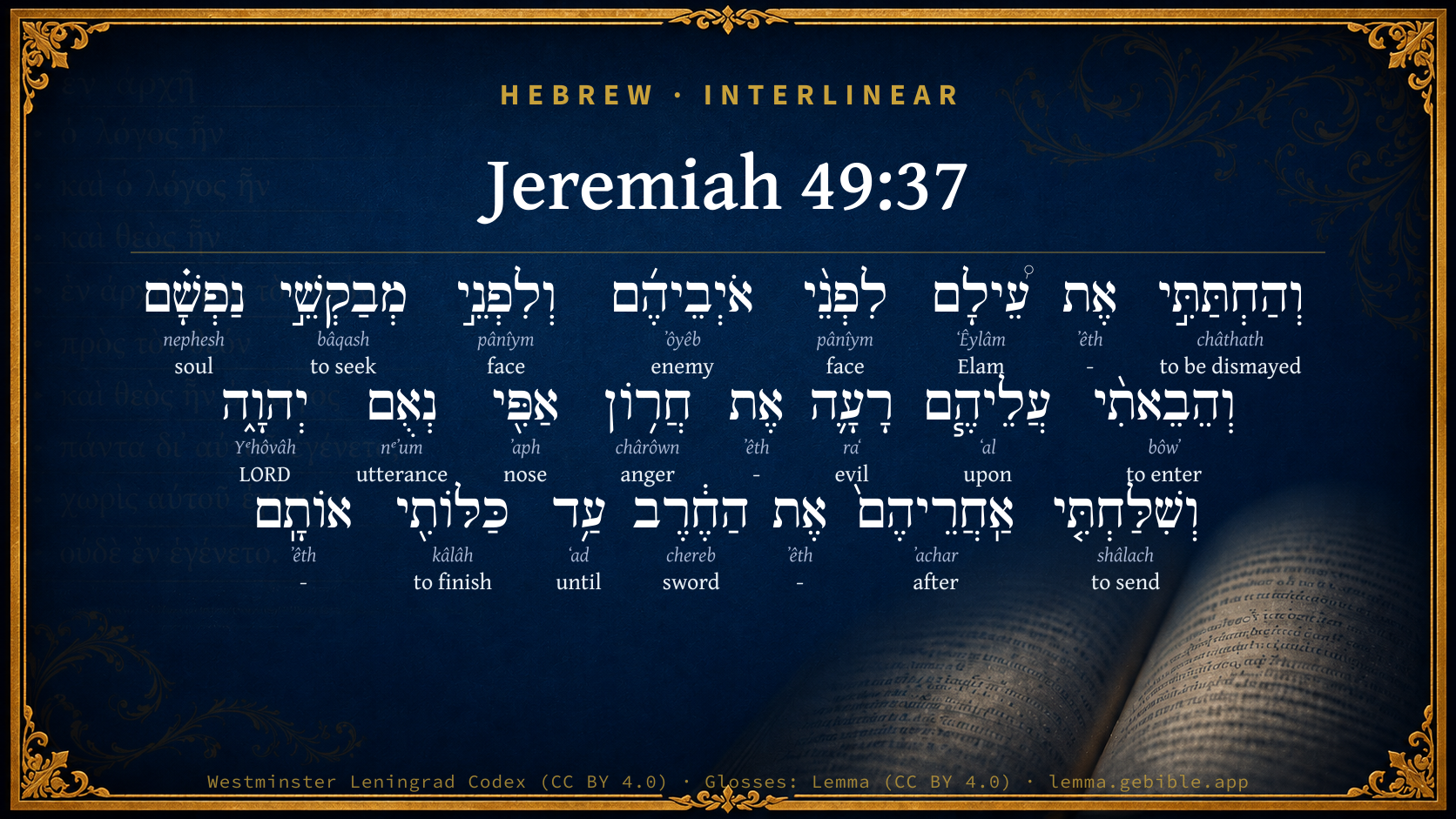
  1. וְהַחְתַּתִּ֣י châthath H2865 “and · to be dismayed” Conjunction + Verb, Hiphil, Sequential Perfect, 1st Person, Common, Singular
  2. אֶת ʼêth H853 “-” Particle, Direct Object
  3. לִפְנֵ֨י pânîym H6440 “to/for · face(s) of” Preposition + Noun, Common, Both, Plural, Construct
  4. אֹיְבֵיהֶ֜ם ʼôyêb H341 “enemy · them” Verb, Qal, Participle Active, Masculine, Plural, Construct + Suffix, Personal, 3rd Person, Masculine, Plural
  5. וְלִפְנֵ֣י pânîym H6440 “and · to/for · face(s) of” Conjunction + Preposition + Noun, Common, Both, Plural, Construct
  6. מְבַקְשֵׁ֣י bâqash H1245 “seeking” Verb, Piel, Participle Active, Masculine, Plural, Construct
  7. נַפְשָׁ֗ם nephesh H5315 “soul · their” Noun, Common, Both, Singular, Construct + Suffix, Personal, 3rd Person, Masculine, Plural
  8. וְהֵבֵאתִ֨י bôwʼ H935 “and · to enter” Conjunction + Verb, Hiphil, Sequential Perfect, 1st Person, Common, Singular
  9. עֲלֵיהֶ֧ם ʻal H5921 “upon · them” Preposition + Suffix, Personal, 3rd Person, Masculine, Plural
  10. רָעָ֛ה raʻ H7451 “evil” Noun, Common, Feminine, Singular, Absolute
  11. אֶת ʼêth H853 “-” Particle, Direct Object
  12. חֲר֥וֹן chârôwn H2740 “anger of” Noun, Common, Masculine, Singular, Construct
  13. אַפִּ֖י ʼaph H639 “nose · my” Noun, Common, Masculine, Singular, Construct + Suffix, Personal, 1st Person, Common, Singular
  14. נְאֻם nᵉʼum H5002 “utterance of” Noun, Common, Masculine, Singular, Construct
  15. יְהוָ֑ה Yᵉhôvâh H3068 “LORD” Noun, Proper
  16. וְשִׁלַּחְתִּ֤י shâlach H7971 “and · to send” Preposition + Suffix, Personal, 3rd Person, Masculine, Plural
  17. אַֽחֲרֵיהֶם֙ ʼachar H310 “after · them” Preposition + Suffix, Personal, 3rd Person, Masculine, Plural
  18. אֶת ʼêth H853 “-” Particle, Direct Object
  19. הַחֶ֔רֶב chereb H2719 “the · sword” Particle, Definite Article + Noun, Common, Feminine, Singular, Absolute
  20. עַ֥ד ʻad H5704 “until” Preposition
  21. כַּלּוֹתִ֖י kâlâh H3615 “to finish · me” Verb, Piel, Infinitive Construct + Suffix, Personal, 1st Person, Common, Singular
  22. אוֹתָֽם ʼêth H853 “- · them” Particle, Direct Object + Suffix, Personal, 3rd Person, Masculine, Plural

About this verse

These counts appear in no published source. They are computed here, from the morphology-tagged text and Lemma’s own curated glosses. What Lemma adds →

23
words
19
distinct lemmas
Prophets
section

Shared distinctive vocabulary

עֵ֠ילָם Elam H5867 occurs in 27 verses of the Hebrew Bible. Also found in:

Grammatical profile

  • 5 verbs
  • 10 nouns
  • 4 prepositions
  • 4 particles

Verb forms

  • וְהַחְתַּתִּ֣י Hiphil · Sequential Perfect
  • אֹיְבֵיהֶ֜ם Qal · Participle Active
  • מְבַקְשֵׁ֣י Piel · Participle Active
  • וְהֵבֵאתִ֨י Hiphil · Sequential Perfect
  • כַּלּוֹתִ֖י Piel · Infinitive Construct

Repetition

A word recurs within this verse — often emphatic in Hebrew:

  • לִפְנֵ֨י face H6440 ×2

Cross-references

16

Topical passages linked to Jeremiah 49:37 in the Treasury of Scripture Knowledge — connected by theme and wording, ordered by reader-vote popularity; previews shown in the World English Bible.

  • Jeremiah 9:16 I will scatter them also among the nations, whom neither they nor their fathers have known; and I will send the sword after them, until I have consumed them.
  • Jeremiah 48:2 The praise of Moab is no more; in Heshbon they have devised evil against her: Come, and let us cut her off from being a nation. You also, Madmen, shall be brought to silence: the sword shall pursue you.
  • Leviticus 26:33 I will scatter you among the nations, and I will draw out the sword after you: and your land will be a desolation, and your cities shall be a waste.
  • Psalms 48:4–6 For, behold, the kings assembled themselves, They passed by together.
  • Jeremiah 30:24 The fierce anger of Yahweh shall not return, until he has executed, and until he have performed the intents of his heart: in the latter days you shall understand it.
  • Jeremiah 34:20–21 I will even give them into the hand of their enemies, and into the hand of those who seek their life; and their dead bodies shall be for food to the birds of the sky, and to the animals of the earth.
  • Jeremiah 48:39 How is it broken down! [how] do they wail! how has Moab turned the back with shame! so shall Moab become a derision and a terror to all who are round about him.
  • Jeremiah 49:5 Behold, I will bring a fear on you, says the Lord, Yahweh of Hosts, from all who are round about you; and you shall be driven out every man right forth, and there shall be none to gather together the fugitives.
  • Jeremiah 49:22 Behold, he shall come up and fly as the eagle, and spread out his wings against Bozrah: and the heart of the mighty men of Edom at that day shall be as the heart of a woman in her pangs.
  • Jeremiah 49:24 Damascus has grown feeble, she turns herself to flee, and trembling has seized on her: anguish and sorrows have taken hold of her, as of a woman in travail.
  • Jeremiah 49:29 Their tents and their flocks shall they take; they shall carry away for themselves their curtains, and all their vessels, and their camels; and they shall cry to them, Terror on every side!
  • Jeremiah 50:36 A sword is on the boasters, and they shall become fools; a sword is on her mighty men, and they shall be dismayed.
  • Ezekiel 5:2 A third part shall you burn in the fire in the midst of the city, when the days of the siege are fulfilled; and you shall take a third part, and strike with the sword round about it; and a third part you shall scatter to the wind, and I will draw out a sword after them.
  • Ezekiel 5:12 A third part of you shall die with the pestilence, and with famine shall they be consumed in the midst of you; and a third part shall fall by the sword round about you; and a third part I will scatter to all the winds, and will draw out a sword after them.
  • Ezekiel 12:14 I will scatter toward every wind all who are round about him to help him, and all his bands; and I will draw out the sword after them.
  • Ezekiel 32:23 whose graves are set in the uttermost parts of the pit, and her company is round about her grave; all of them slain, fallen by the sword, who caused terror in the land of the living.

Cross-references courtesy of OpenBible.info (CC BY 4.0).

Hebrew and Greek witnesses Masoretic Hebrew ↔ Greek Septuagint

The same verse in the two great witnesses to the Old Testament, shown verse-for-verse.

These are two independent witnesses, not word-aligned to each other, and the Septuagint is shown in lemma (dictionary) form.

Hebrew Jeremiah 49:37 Masoretic · Westminster Leningrad Codex

וְהַחְתַּתִּ֣י אֶת עֵ֠ילָם לִפְנֵ֨י אֹיְבֵיהֶ֜ם וְלִפְנֵ֣י מְבַקְשֵׁ֣י נַפְשָׁ֗ם וְהֵבֵאתִ֨י עֲלֵיהֶ֧ם רָעָ֛ה אֶת חֲר֥וֹן אַפִּ֖י נְאֻם יְהוָ֑ה וְשִׁלַּחְתִּ֤י אַֽחֲרֵיהֶם֙ אֶת הַחֶ֔רֶב עַ֥ד כַּלּוֹתִ֖י אוֹתָֽם

I will cause Elam to be dismayed before their enemies, and before those who seek their life; and I will bring evil on them, even my fierce anger, says Yahweh; and I will send the sword after them, until I have consumed them;

World English Bible · Public Domain

Greek LXX Structure differs

In the Septuagint, Jeremiah is about an eighth shorter than the Hebrew and arranges its material differently — the Oracles Against the Nations (Hebrew chapters 46–51) appear in the middle of the Greek book, after 25:13. Because the chapter and verse boundaries do not line up, a verse-for-verse comparison with the Hebrew is not shown.

A verse-for-verse comparison isn’t shown here because the chapters and verses don’t line up. Switch to the LXX edition with the MT / LXX toggle above to read the Greek directly.

Hebrew: Westminster Leningrad Codex (CC BY 4.0). Greek: Septuagint (public domain); English from a public-domain English Septuagint. How the Septuagint differs from the Hebrew →

Targum (Aramaic paraphrase)

1

The Targum is the ancient Jewish Aramaic paraphrase of the Hebrew Scriptures — an interpretive translation, not the Hebrew text itself. Onkelos (literal) and Pseudo-Jonathan (expansive) render the Torah, and Jonathan the Prophets. Coverage is partial: where no permissively-licensed English translation exists for a verse, only the Aramaic is shown. This is verse-level text, not a word-by-word alignment to the Hebrew.

  1. Targum Jonathan Prophets (Joshua–Malachi)
    וְאֶתְּבַר יַת עֵילָם קֳדָם בַּעֲלֵי דְבָבֵיהוֹן וּקְדָם דְבָעָן לְמִקְטַלְהוֹן וְאַיְתֵי עֲלֵיהוֹן בִּישָׁא יַת תְּקוֹף רוּגְזִי אֲמַר יְיָ וֶאֱגָרֵי בַתְרֵיהוֹן דְקַטְלִין בְּחַרְבָא עַד דֶאֱשֵׁיצֵי יַתְהוֹן:

    (no public-domain English translation for this verse)

    Targum Jonathan — Aramaic: “Mikraot Gedolot” (public domain). English: “Sefaria Community Translation” (CC0 1.0 (public-domain dedication)); “London "Chaldee Paraphrase," 1871” (public domain). Text via Sefaria.

Commentary

Notes on Jeremiah 49:37 from classic Christian and Jewish commentators (each source and its license shown beneath its notes). The classic Christian expositions comment on the surrounding passage and are grouped to its opening verse, so a note may address several verses; the Jewish commentaries on the Tanakh (Rashi and others) are per-verse, so they appear only where the commentator wrote on this verse.

Lemma curates 59 commentaries, every one of them public domain or Creative Commons licensed, each selected and text-cleaned for this edition rather than reprinted as found. About our sources →

Trapp's Complete Commentary

John Trapp

Jer 49:37 For I will cause Elam to be dismayed before their enemies, and before them that seek their life: and I will bring evil upon them, [even] my fierce anger, saith the LORD; and I will send the sword after them, till I have consumed them:

Ver. 37. For I will cause Elam to be dismayed,] q.d., They trust in their great strength, and hold themselves insuperable; but I can easily dispirit (and so destroy) them. See Jer 49:5; Jer 49:14; Jer 49:29.

John Trapp, A Commentary or Exposition upon All the Books of the Old and New Testament (1647–1656) — public domain. Text from a community e-Sword module.

Tyndale Open Study Notes

Tyndale Open Resources

49:37 The Lord would express his fierce anger through the great disaster to come upon Elam. No specific charge is mentioned here, but like other nations, Elam served false gods and was cruel in its wars against its neighbors.

Tyndale Open Study Notes — © Tyndale Open Resources, licensed CC BY-SA 4.0. Text via the HelloAO Bible API.

Jamieson, Fausset & Brown

Robert Jamieson, A. R. Fausset & David Brown

consumed--as a distinct nation (Dan. 8:2-27). Fulfilled under Alexander and his successors.

Jamieson, Fausset & Brown — Commentary Critical and Explanatory on the Whole Bible (1871) — public domain (CC PDM 1.0). Text via the HelloAO Bible API.

John Calvin's Commentaries

This verse especially shews that the Elamites were of the number of those who had inhumanly raged against God’s people, for he did not without reason set forth the severity of his vengeance towards them. We must, then, bear in mind that the Elamites had been among the chief of God’s enemies, or at least had been in no ordinary way cruel, delighting in slaughters. Hence he says, I will dismay, or affright, etc. The verb חתת, chetat, means to tear in pieces, or to break; it may therefore be rendered, “I will break.” They who render it “I will lay prostrate,” do not seem to know the difference between consternere, to lay prostrate, and consternare, to dismay. But the most suitable meaning is, that God would terrify the Elamites, for he had spoken before of their flight and exile.

He then mentions the cause of their dread, even because God would dismay them and frighten them before their enemies, so that they would not be able to stand before them. By these words he intimates, that however warlike the Elamites were, they yet would not stand their ground when it seemed good to God to render to them their reward, for in his hand are the hearts of men. Though, then, the Elamites were brave, yet the Prophet declares that they would be so faint-hearted at the sight of enemies, as immediately to flee away, even because God would terrify them.

He afterwards adds, I will send the sword after them He means by this clause that he would not be content with terrifying them, but that when they began to flee, he would take them, because he would follow them, that is, urge on their enemies. And it ought ever to be observed, that what proceeds from men is ascribed to God, because men, however little they may think of it, yet execute his purpose, and are not only the proclaimers of his wrath, but also the instruments of it.

But he mentions the evil of the indignation of his wrath This mode of speaking seems indeed harsh; but we have elsewhere stated, that the Prophets did not without reason join together these words, which appear somewhat harsh. Now wrath does not in a strict sense belong to God, for no feelings of this kind appertain to him. But when heat of wrath or indignation is mentioned, it doubles its vehemence in order to shake off the torpor of men, who would otherwise, as I lately said, be wholly insensible and indifferent. In short, by indignation the Prophet means no other thing than that vengeance is dreadful, and ought to astonish all mortals, so that they ought to fall down immediately as it were lifeless, as soon as they hear that God is displeased with them. In the meantime he shews what I have stated, that God was grievously offended with that people whom he threatens with extreme punishment, for he says, until I shall have consumed them We see what I have said, that this people were not slightly chastised, according to what has been mentioned of others: it hence follows that their wickedness had been very atrocious. The two clauses seem however to be inconsistent, — that God would scatter the Elamites through all nations, — and that he would consume them, for dispersion and consumption widely differ. But consumption refers to the body of the nation or to its name, as though he had said, that no Elamites would survive, because they would be merged in other nations, and disappear like chaff. It follows —

John Calvin's Commentaries (1540-1563) — public domain. Text from the Calvin Translation Society English edition (1840s-50s) via the Christian Classics Ethereal Library (ccel.org). Calvin's coverage is partial (roughly two-thirds of the Bible); uncommented books and verses are honest gaps, never fabricated. The 19th-century editor's footnotes and remarks are omitted so the notes are faithfully Calvin's own voice.

John Gill's Exposition

For I will cause Elam to be dismayed before their enemies,.... Frightened; thrown into the utmost consternation, so that they shall have no heart nor spirit to go out against them, and meet them, and defend themselves; but make all haste imaginable to flee from them, such a panic would seize them:

and before them that seek their life; a further description of their enemies; they being such, who, not content with their substance, sought to take away their lives; nothing less would satisfy them, being: cruel and blood thirsty ones:

and I will bring evil upon them, even my fierce anger, saith the Lord; and a greater evil than that cannot be; signifying that the destruction that should be made among them would be the effect of the wrath of God upon them for their sins:

and I will send the sword after them, till I have consumed them; that is, those that slay with the sword, as the Targum; these should go after those that fled, and destroy them, till the greater part of them were consumed; for all of them that were taken were not destroyed; or otherwise there would have been none to return from captivity, as is promised at the close of this prophecy.

John Gill's Exposition of the Whole Bible (1746–1763) — public domain (CC PDM 1.0). Text via the HelloAO Bible API.

Matthew Poole's English Annotations

We met with the like threatenings Jer 49:5,24,29, as to fear; and as to their destruction, we have often met with the like threatenings.

Matthew Poole's English Annotations on the Holy Bible (1683–1685) — public domain. Text from a community e-Sword/MySword module.

unfoldingWord translationNotes

Door43 World Missions Community

General Information:

Yahweh continues speaking about what will happen to Elam.

I will shatter Elam

These words are a metonym for Yahweh causing enemies to destroy Elam. AT: "I will cause Elam's enemies to destroy Elam" (See: Metonymy)

Elam

the people of Elam (See: Metonymy)

those who seek their lives

Seeking a person's life represents wanting or desiring to kill someone. AT: "those who want to kill them" (See: Metaphor)

I will bring disaster against them

Yahweh causing people to experience disaster is spoken of as if he would bring disaster against them. AT: "I will cause them to experience disaster" or "I will cause terrible things to happen to them" (See: Metaphor)

the fury of my wrath

This is the reason that Yahweh will destroy the people of Elam. AT: "because I am very angry" (See: Connecting Words)

this is Yahweh's declaration

Yahweh speaks of himself by name to express the certainty of what he is declaring. See how you translated this in Jeremiah 1:8. AT: "this is what Yahweh has declared" or "this is what I, Yahweh, have declared" (See: First, Second, or Third Person)

the sword after them

Here "sword" represents the enemy army carrying their weapons. AT: "the enemy army to pursue and kill them" (See: Metonymy)

I will put my throne in Elam

Here "throne" represents Yahweh's right to rule and judge as the king. AT: "I will judge the people of Elam" (See: Metonymy)

in later days

"in the future"

I will bring back the fortunes of Elam

"I will cause things to go well for Elam again" or "I will cause Elam to live well again." See how similar words are translated in Jeremiah 29:14.

translationWords

adversary

wrath

sword

throne

unfoldingWord translationNotes — © Distant Shores Media and the Door43 World Missions Community, licensed CC BY-SA 4.0. Source: git.door43.org/Door43/en_tn.

Lesson kit

Teaching starters — assembled from the data on this page, not authored interpretation. Every prompt links to the verse data it draws on. Edit before teaching.

Jeremiah, in the Prophets, opens this verse with 23 words (19 distinct Hebrew lemmas). Its most distinctive word is ʻÊylâm (“Elam”). A historical commentator’s framing appears above. Read the whole chapter for the surrounding context.

Discussion questions

  1. What does “Elam” (ʻÊylâm) contribute to the verse as a whole?
  2. Genesis 10:22 shares the word «Elam» with this verse. How do the two illuminate each other?
  3. “face” occurs 2× in this one verse. What is the effect of the repetition?
  4. These translations render this verse differently; the difference is in the English rendering, not the original. What questions does that raise?
  5. The verb «וְהַחְתַּתִּ֣י» is Hiphil Sequential Perfect. How does its form color the action?
  6. Reading how Trapp's Complete Commentary and Tyndale Open Study Notes read this verse, where do the two commentators agree and where do they part?

Things to notice

Reading settings

Reading text

Shown beneath each verse's original-language words.

Old Testament
Old Testament edition

Read the OT as the Masoretic Hebrew (MT) or the Greek Septuagint (LXX).

English shown for the Greek Septuagint (in the Hebrew ↔ Greek comparison).

Comparing translations? Open the Compare panel on any verse page to stack up to four side by side.