
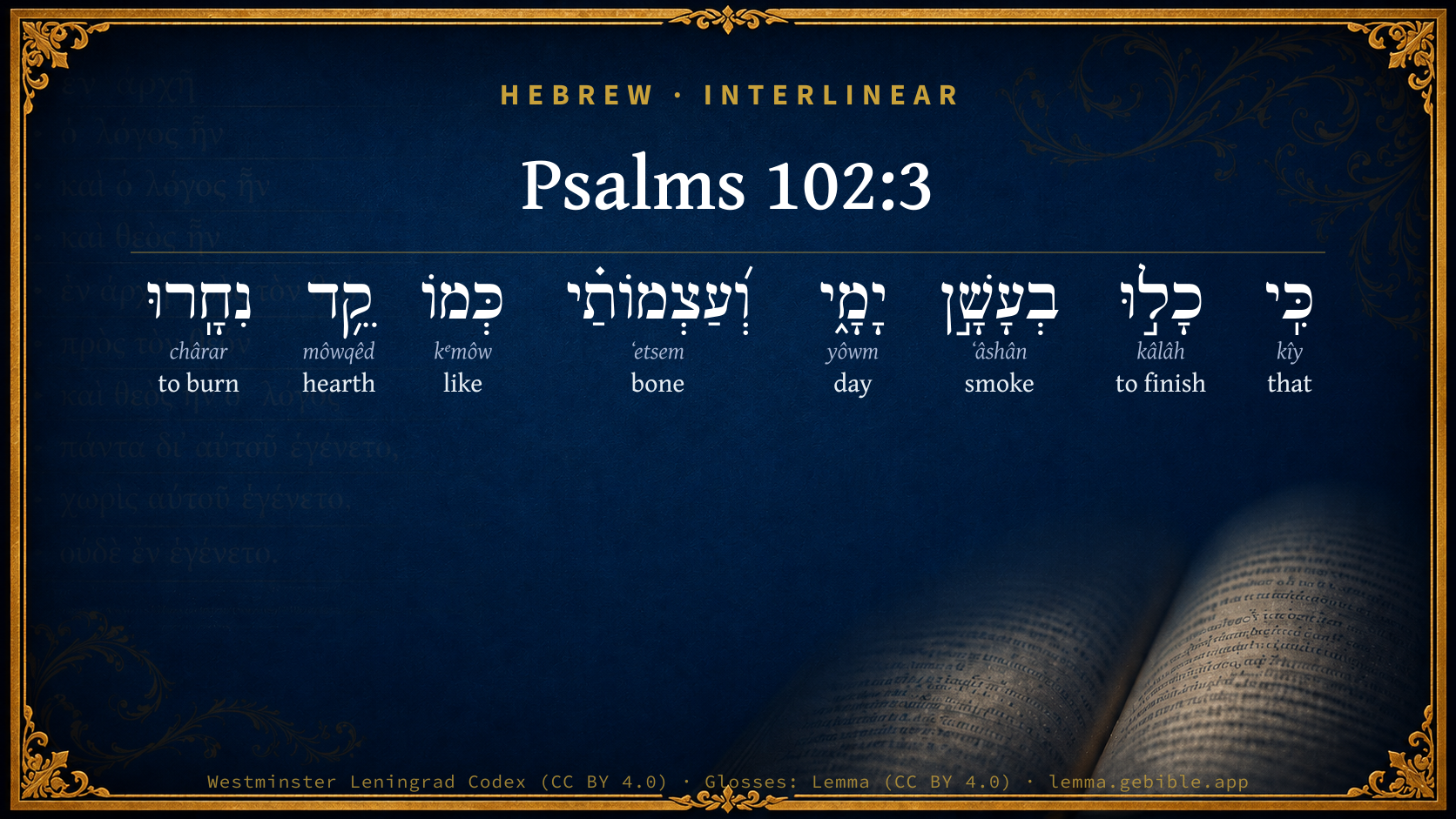
Psalms 102:3

Hebrew (Westminster Leningrad Codex) Psalms 102:3 appears in the Hebrew Old Testament. The text above is from the Westminster Leningrad Codex. Each word links to its Strong’s number, a concise gloss, and parsing drawn from the Open Scriptures Hebrew Bible morphology. Click any word for its full Brown-Driver-Briggs (BDB) entry.
Download image
Cite this verse

Psalms 102:3 (World English Bible). Public Domain. Lemma interlinear Bible study tool, https://lemma.gebible.app/v/psalms/102/3.

Show BibTeX & RIS
BibTeX
RIS
English Translation
For my days consume away like smoke. My bones are burned as a firebrand.
World English Bible · Public Domain
Highlights
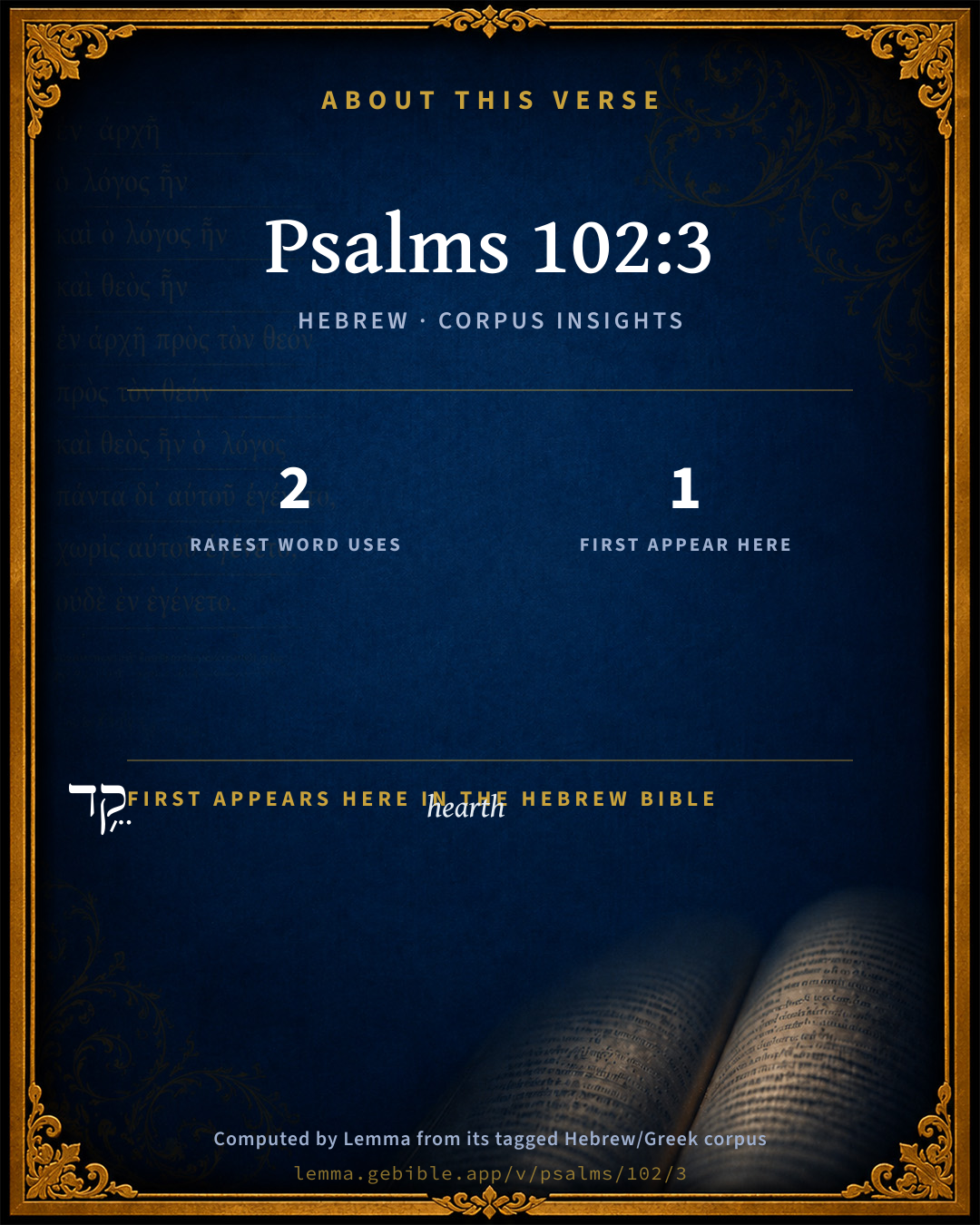
  • 1 first appearance in the Hebrew Bible
Full analysis ↓
Download a study sheet

One document with this verse’s original text, its word-by-word gloss line, the meaning frame, cross-references with their text, attributed commentary, and full source and license credits — printable, and it pastes into notes with its structure intact.

This verse Autodidact and up

Study sheet (.html) Plain text (.txt)

A passage Seminary Student

Up to 50 verses in one chapter. A passage sheet keeps up to 6 commentary sources and 12 cross-references per verse, in the order this page ranks them, and says so on the sheet whenever that leaves anything out. Ask for a single verse and you get the Autodidact verse sheet above.

Everything on this page stays free to read, with no account — the sheet is a download of what is already on screen, not access to it.

Want to remove ads? Support Godless Engineer
Compare translations 3

The same verse in 3 English versions, stacked beneath the original-language interlinear above. Click any original word for its lexicon entry.

Each is an independent rendering of the whole verse — the interlinear is not word-aligned to these translations.

Highlighted words mark where these versions differ — a whole-verse word diff, not a word-by-word alignment.

  • World English Bible Public Domain
    For my days consume away like smoke. My bones are burned as a firebrand.
  • King James Version Public Domain
    For my days are consumed like smoke, and my bones are burned as an hearth.
  • unfoldingWord Literal Text CC BY-SA 4.0
    For my days expire like smoke, and my bones are charred like a fireplace.

unfoldingWord Literal Text — © unfoldingWord, licensed CC BY-SA 4.0. Word-aligned USFM3 via Door43 (git.door43.org/unfoldingWord/en_ult).

Versions to compare (up to 4)

3 of 4 selected

Show all 18 translations

Every available English version of this verse, each an independent rendering of the whole verse.

  • World English Bible Public Domain
    For my days consume away like smoke. My bones are burned as a firebrand.
  • Berean Standard Bible Public Domain
    For my days vanish like smoke, and my bones burn like glowing embers.
  • Majority Standard Bible Public Domain
    For my days vanish like smoke, and my bones burn like glowing embers.
  • King James Version Public Domain
    For my days are consumed like smoke, and my bones are burned as an hearth.
  • American Standard Version (1901) Public Domain
    For my days consume away like smoke, And my bones are burned as a firebrand.
  • Revised Version (1885) Public Domain
    For my days consume away like smoke, and my bones are burned as a firebrand.
  • Geneva Bible (1599) Public Domain
    For my dayes are consumed like smoke, and my bones are burnt like an herthe.
  • Douay-Rheims (1899) Public Domain
    Turn not away thy face from me: in the day when I am in trouble, incline thy ear to me. In what day soever I shall call upon thee, hear me speedily.
  • Young's Literal Translation Public Domain
    For consumed in smoke have been my days, And my bones as a fire-brand have burned.
  • Literal Standard Version CC BY-SA 4.0
    For my days have been consumed in smoke, || And my bones have burned as a firebrand.
  • Unlocked Literal Bible CC BY-SA 4.0
    For my days pass away like smoke, and my bones burn like fire.
  • unfoldingWord Literal Text CC BY-SA 4.0
    For my days expire like smoke, and my bones are charred like a fireplace.
  • Darby Bible Public Domain
    For my days are consumed like smoke, and my bones are burned as a firebrand.
  • World Messianic Bible Public Domain
    For my days consume away like smoke. My bones are burned as a torch.
  • Webster's Bible Public Domain
    \\102:2\\Hide not thy face from me in the day when I am in trouble; incline thy ear to me: in the day when I call, answer me speedily.
  • Free Bible Version CC BY-SA 4.0
    My life is disappearing like smoke; my body feels like it's on fire!
  • Bible in Basic English Public Domain
    My days are wasted like smoke, and my bones are burned up as in a fire.
  • JPS Tanakh (1917) Public Domain
    (102-4) For my days are consumed like smoke, and my bones are burned as a hearth.

Literal Standard Version (2020), Covenant Press — licensed CC BY-SA 4.0. Text via the HelloAO Bible API (eBible.org). Unlocked Literal Bible (unfoldingWord) — licensed CC BY-SA 4.0. Text via the HelloAO Bible API (eBible.org). unfoldingWord Literal Text — © unfoldingWord, licensed CC BY-SA 4.0. Word-aligned USFM3 via Door43 (git.door43.org/unfoldingWord/en_ult). Free Bible Version, Dr. Jonathan Gallagher — licensed CC BY-SA 4.0. Text via the HelloAO Bible API (eBible.org).

Word by word

More ways to search: Search by grammar → Find every occurrence → Compare this word →

Practice this passage: Drill this verse → Learn its vocabulary →

About this verse

These counts appear in no published source. They are computed here, from the morphology-tagged text and Lemma’s own curated glosses. What Lemma adds →

8
words
8
distinct lemmas
Wisdom
section

Notable vocabulary

The rarest word here is קֵ֥ד hearth H4168 — appearing just 2 times in the whole Hebrew Bible.

First appearance in Scripture

This word makes its first canonical appearance in the Hebrew Bible here:

Shared distinctive vocabulary

קֵ֥ד hearth H4168 occurs in 2 verses of the Hebrew Bible. Also found in:

Grammatical profile

  • 2 verbs
  • 4 nouns
  • 1 pronoun
  • 1 conjunction

Verb forms

  • כָל֣וּ Qal · Perfect
  • נִחָֽרוּ Niphal · Perfect

Hebrew & Septuagint length

In English translation the verse runs 14 words from the Hebrew and 16 from the Septuagint (LXX English) — closely comparable.

A rough comparison of the two English renderings, which tokenize alike — not a word-level alignment.

Word counts can differ between the Hebrew and the Greek without any difference in meaning — e.g. the Hebrew direct-object marker אֵת has no separate Greek word, and Greek often adds the article ὁ.

Cross-references

9

Topical passages linked to Psalms 102:3 in the Treasury of Scripture Knowledge — connected by theme and wording, ordered by reader-vote popularity; previews shown in the World English Bible.

  • James 4:14 Whereas you don't know what your life will be like tomorrow. For what is your life? For you are a vapor, that appears for a little time, and then vanishes away.
  • Lamentations 1:13 From on high has he sent fire into my bones, and it prevails against them; He has spread a net for my feet, he has turned me back: He has made me desolate and faint all the day.
  • Job 30:30 My skin grows black and peels from me. My bones are burned with heat.
  • Psalms 31:10 For my life is spent with sorrow, My years with sighing. My strength fails because of my iniquity. My bones are wasted away.
  • Psalms 37:20 But the wicked shall perish. The enemies of Yahweh shall be like the beauty of the fields. They will vanish-- Vanish like smoke.
  • Psalms 22:14–15 I am poured out like water. All my bones are out of joint. My heart is like wax; It is melted within me.
  • Psalms 119:83 For I have become like a wineskin in the smoke. I don't forget your statutes.
  • Lamentations 3:4 My flesh and my skin has he made old; he has broken my bones.
  • Psalms 38:3 There is no soundness in my flesh because of your indignation, Neither is there any health in my bones because of my sin.

Cross-references courtesy of OpenBible.info (CC BY 4.0).

Hebrew and Greek witnesses Masoretic Hebrew ↔ Greek Septuagint

The same verse in the two great witnesses to the Old Testament, shown verse-for-verse.

You’re reading Greek Psalm 101 (Hebrew Psalm 102). The Septuagint counts the superscription, so verse numbers can differ from the Hebrew — chapter-level alignment, not verse-by-verse. Numbering follows Rahlfs.

These are two independent witnesses, not word-aligned to each other, and the Septuagint is shown in lemma (dictionary) form.

Hebrew Psalms 102:3 Masoretic · Westminster Leningrad Codex

כִּֽי כָל֣וּ בְעָשָׁ֣ן יָמָ֑י וְ֝עַצְמוֹתַ֗י כְּמוֹ קֵ֥ד נִחָֽרוּ

For my days consume away like smoke. My bones are burned as a firebrand.

World English Bible · Public Domain

Greek LXX Greek Psalm 101:3 Septuagint · lemma form

μή ἀποστρέφω ὁ πρόσωπον σύ ἀπό ἐγώ ἐν ὅς ἄν ἡμέρα θλίβω κλίνω ὁ οὖς σύ πρός ἐγώ ἐν ὅς ἄν ἡμέρα ἐπικαλέω σύ ταχύς εἰςἀκούω ἐγώ

For my days have vanished like smoke, and my bones have been parched like a stick.

LXX2012 (modern English Septuagint) · Public Domain

On this verse, Ellicott's Commentary for English Readers discusses the Septuagint’s reading. Read the note in Commentary ↓

Hebrew: Westminster Leningrad Codex (CC BY 4.0). Greek: Septuagint (public domain); English from LXX2012 (modern English Septuagint) (Public Domain). How the Septuagint differs from the Hebrew →

Commentary

Notes on Psalms 102:3 from classic Christian and Jewish commentators (each source and its license shown beneath its notes). The classic Christian expositions comment on the surrounding passage and are grouped to its opening verse, so a note may address several verses; the Jewish commentaries on the Tanakh (Rashi and others) are per-verse, so they appear only where the commentator wrote on this verse.

Lemma curates 59 commentaries, every one of them public domain or Creative Commons licensed, each selected and text-cleaned for this edition rather than reprinted as found. About our sources →

Trapp's Complete Commentary

John Trapp

Psa 102:3 For my days are consumed like smoke, and my bones are burned as an hearth.

Ver. 3. For my days are consumed like smoke] Which the higher it mounteth the sooner it vanisheth. Some read it, in the smoke. So Psa 119:83, "I am become like a bottle in the smoke," dried and withered, exsuccus et exsanguis.

And my bones are burnt as an hearth] Ossa mea quasi frixa contabuerunt. My strength is gone, Veluti sartagines (Arab.). Here, to the twelfth verse, is a most lively picture of a dejected person, such as can hardly be paralleled; teaching us to be deeply affected with the Church’s afflictions.

John Trapp, A Commentary or Exposition upon All the Books of the Old and New Testament (1647–1656) — public domain. Text from a community e-Sword module.

The Treasury of David

Charles H. Spurgeon

Ver. 3. For my days are consumed like smoke. My grief has made life unsubstantial to me, I seem to be but a puff of vapour which has nothing in it, and is soon dissipated. The metaphor is very admirably chosen, for, to the unhappy, life seems not merely to be frail, but to be surrounded by so much that is darkening, defiling, blinding, and depressing, that, sitting down in despair, they compare themselves to men wandering in a dense fog, and themselves so dried up thereby that they are little better than pillars of smoke. When our days have neither light of joy nor fire of energy in them, but become as a smoking flax which dies out ignobly in darkness, then have we cause enough to appeal to the Lord that he would not utterly quench us.

And my bones are burned as an hearth. He became as dry as the hearth on which a wood fire has burned out, or as spent ashes in which scarcely a trace of fire can be found. His soul was ready to be blown away as smoke, and his body seemed likely to remain as the bare hearth when the last comforting ember is quenched. How often has our piety appeared to us to be in this condition! We have had to question its reality, and fear that it never was anything more than a smoke; we have had the most convincing evidence of its weakness, for we could not derive even the smallest comfort from it, any more than a chilled traveller can derive from the cold hearth on which a fire had burned long ago. Soul-trouble experienced in our own heart will help us to interpret the language here employed; and church-troubles may help us also, if unhappily we have been called to endure them. The psalmist was moved to grief by a view of national calamities, and these so wrought upon his patriotic soul that he was wasted with anxiety, his spirits were dried up, and his very life was ready to expire. There is hope for any country which owns such a son; no nation can die while true hearts are ready to die for it.

Ver. 3. Consumed like smoke, would be better read, "pass away as in smoke, "as if they disappeared into smoke and ashes. Burned as an hearth, is not a felicitous translation, for a "hearth" should be incombustible. Better "burned as a faggot, "as any fuel. The sentiment, My days waste away to nothing, turn to no good account, are lost. Henry Cowles.

Ver. 3. My days are consumed like smoke; or, as Hebrew, literally, "in (into) smoke." The very same expression which David in Ps 37:20 had used of "the enemies of the Lord:" "They shall consume into smoke" (compare Ps 68:2). Hereby the ideal sufferer virtually complains that the lot of the wicked befalls him, though being righteous (Ps 101:1-8). A. R. Fausset.

Ver. 3. My days are consumed like smoke. As the smoke is a vapour proceeding from the fire, yet hath no heat in it: so my days are come from the torrid zone of youth into the region of cold and age; and as the smoke seems a thick substance for the present, but presently vanisheth into air; so my days made as great shew at first as if they would never have been spent; but now, alas, are wasted and leave me scarce a being. As the smoke is fuliginous and dark, and affords no pleasure to look upon it; so my days are all black and in mourning; no joy nor pleasure to be taken in them. And as the smoke ascends indeed, but by ascending wastes itself and comes to nothing: so my days are wasted in growing, are diminished in increasing; their plenty hath made a scarcity, and the more they have been the fewer they are. And how, indeed, can my days choose but be consumed as smoke, when

my bones are burned as an hearth? for as when the hearth is burned there can be made no more fire upon it; so, when my bones, which are as the hearth upon which my fire of life is made, come once to be burned; how can any more fire of life be made upon them? and when no fire can be made, what will remain but only smoke? Sir R. Baker.

Ver. 3. As an hearth. Or, as a trivet, or, gridiron;so the Targum: or, as a frying-pan: so the Arabic version. John Gill.

Ver. 3-11.

1. The causes of grief. (a) The brevity of life. Ps 102:3. (b) Bodily pain. Ps 102:3. (c) Dejection of spirit. Ps 102:4- 5. (d) Solitariness. Ps 102:6-7. (e) Reproach. Ps 102:8. (f) Humiliation. Ps 102:9. (g) The hidings of God's countenance. Ps 102:10. (h) Wasting away. Ps 102:11.

2. The eloquence of grief. (a) The brevit of life is as vanishing "smoke." (b) Bodily pain is fire in the bones. (c) Dejection of spirit is "withered grass." Who can eat when the heart is sad? (d) Solitariness is like "The pelican in the wilderness, the owl in the desert, and the sparrow upon the housetop." (e) Reproach is being surrounded by madmen"they that are mad." (f) Humiliation is "eating ashes like bread, "and "drinking tears." (g) The hidings of God's countenance is lifting up in order to be cast down. (h) Wasting away is a shadow declining and grass withering. G. R.

Psalms 102:4*

Charles H. Spurgeon's The Treasury of David (1869–1885) — public domain. Psalms only. Text from a community e-Sword/MySword module.

J. A. Alexander on Psalms

Joseph Addison Alexander

4. (Psa 102:3) For wasted in smoke are my days, and my bones like a burning are kindled. With the first clause compare Psa 37:20. The bones are mentioned as the seat of strength. See above, on Psa 6:2, Psa 31:10, Psa 35:10; Psa 42:10. This description, although strictly applicable to the case of individual sufferers, may also be applied to the decline of the theocratic monarchy and the approach of its catastrophe.

Joseph Addison Alexander, The Psalms Translated and Explained (1850) — public domain. Text from a community e-Sword module.

Tyndale Open Study Notes

Tyndale Open Resources

102:3 Smoke is an image of transitory life (37:20; 68:2). • The psalmist’s bones represent his whole being (see 6:2; 34:19-22).

Tyndale Open Study Notes — © Tyndale Open Resources, licensed CC BY-SA 4.0. Text via the HelloAO Bible API.

Geneva Bible (1599)

Geneva Bible translators

These excessive kinds of speech show how much the affliction of the Church ought to wound the hearts of the godly.

Geneva Bible (1599) marginal notes — public domain. Text via Bolls.life.

Adam Clarke's Commentary

Verse 3. My days are consumed like smoke] He represents himself (for the psalmist speaks in the name of the people) under the notion of a pile of combustible matter, placed upon a fire, which soon consumes it; part flying away in smoke, and the residue lying on the hearth in the form of charred coal and ashes. The Chaldeans were the fire, and the captive Jews the fuel, thus converted into smoke and ashes.

Adam Clarke's Commentary on the Bible (1810–1826) — public domain. Text from a community e-Sword/MySword module.

John Calvin's Commentaries

3 For my days are consumed like smoke These expressions are hyperbolical, but still they show how deeply the desolation of the Church ought to wound the hearts of the people of God. Let every man, therefore, carefully examine himself on this head. If we do not prefer the Church to all the other objects of our solicitude, we are unworthy of being accounted among her members. Whenever we meet with such forms of expression as these, let us remember that they reproach our slothfulness in not being affected with the afflictions of the Church as we ought. The Psalmist compares his days to smoke, and his bones to the stones of the hearth, which, in the course of time, are consumed by the fire. By bones he means the strength of man. And, were not men devoid of feeling, such a melancholy spectacle of the wrath of God would assuredly have the effect of drying up their bones, and wasting away their whole rigor.

John Calvin's Commentaries (1540-1563) — public domain. Text from the Calvin Translation Society English edition (1840s-50s) via the Christian Classics Ethereal Library (ccel.org). Calvin's coverage is partial (roughly two-thirds of the Bible); uncommented books and verses are honest gaps, never fabricated. The 19th-century editor's footnotes and remarks are omitted so the notes are faithfully Calvin's own voice.

Ellicott's Commentary for English Readers

(3) Like smoke.—Or, in smoke. (See margin. Comp. Psa_37:20.)

Hearth.—Better, a brand or fuel; so LXX. and Vulgate, Aquila, and this meaning suits Isa_33:14. (For the image see Psa_22:15; Psa_31:10; Psa_32:3.)

A Bible Commentary for English Readers, edited by Charles John Ellicott (1878–1897) — public domain. Text from a community e-Sword module.

The Cambridge Bible for Schools and Colleges

gen. ed. J. J. S. Perowne

3. like smoke] Or, in smoke, a natural figure for speedy and complete disappearance. Cp. Psa_37:20; Jas_4:14.

are burnt as a hearth] Rather (cp. P.B.V. and R.V.), burn as a firebrand. He compares himself to a sick man whose strength is being consumed by the burning heat of fever. Cp. Psa_22:15; Jer_20:9.

The Cambridge Bible for Schools and Colleges (gen. ed. J. J. S. Perowne; Cambridge University Press, 1878–1918) — public domain. Text from a community e-Sword module.

John Gill's Exposition

My heart is smitten, and withered like grass,.... Like grass in the summer solstice (d), which being smitten with the heat of the sun, or by some blast of thunder and lightning, is dried up, and withers away; so his heart was smitten with a sense of sin, and of God's wrath and displeasure at him, and with the heat of affliction and trouble, that it failed him, and he could not look up with joy and comfort:

so that I forget to eat my bread; sometimes, through grief and trouble, persons refuse to eat bread, as Jonathan and Ahab, which is a voluntary act, and purposely done; but here, in the psalmist, there was such a loss of appetite, through sorrow, that he forgot his stated meals, having no manner of inclination to food: some understand this of spiritual food, the bread of life, refusing to be comforted with it; so the Targum,

"for I forgot the law of my doctrine.''

(d) "Quasi solstitialis herba paulisper fui", Plauti Pseudolus, Act. 1. Sc. 1. v. 36.

John Gill's Exposition of the Whole Bible (1746–1763) — public domain (CC PDM 1.0). Text via the HelloAO Bible API.

Albert Barnes' Notes on the Bible

For my days are consumed like smoke - Margin, “into smoke.” Literally, “in smoke.” That is, They vanish as smoke; they pass away and become nothing; they are spent in affliction, and seem to accomplish nothing. The idea is, that in his affliction he seemed to accomplish none of the ends of life. His life seemed to be wasted. This is often the feeling in trial: and yet in trial a man may be more useful, he may do more to accomplish the real ends of life, he may do more to illustrate the power and excellence of religion, than he ever did in the days of prosperity.

And my bones are burned as an hearth - Or rather, as faggots or fuel. Literally, “They are burned as a burning.” The idea is, that in his troubles, his very bones, the most solid and substantial part of himself, seemed to be consumed and to waste away. See the notes at Psa 31:10.

Albert Barnes' Notes on the Bible (1834–1885) — public domain. Text from a community e-Sword/MySword module.

Matthew Poole's English Annotations

Like smoke; which passeth away in obscurity, and swiftly, and irrecoverably. Or, into smoke; as wood or any combustible matter put into the fire wasteth away in smoke and ashes.

My bones; the most strong and solid parts of my body, which seemed safest from the fire.

Are burnt as an hearth; either as an hearth is heated or burnt up by the coals which are laid upon it; or as the hearth, being so heated, burns up that which is put upon it.

Matthew Poole's English Annotations on the Holy Bible (1683–1685) — public domain. Text from a community e-Sword/MySword module.

Whedon's Commentary on the Bible

Daniel D. Whedon

3. My days are consumed like smoke—Or, My days have ended in smoke. Life, once so real, so desirable, has passed away like “smoke,” which dissolves and disappears. The same is an Eastern proverb to this day.

Burned as a hearth—Consumed like a fagot. The judgments of God have dried up my bones like a fagot, or brand, in the fire. Psa_69:3

Daniel D. Whedon (gen. ed.), Commentary on the Old and New Testaments (1874–1909) — public domain. Text from a community e-Sword module.

The Pulpit Commentary

For my days are consumed like smoke; or, according to another reading (rvb, instead of rvk), "are consumed into smoke," i.e. "disappear, pass away into nothingness." And my bones are burned as an hearth. Dr. Kay translates, "My bones smoulder like a firebrand," which is better. (compare the Prayer book Version, and see Lev_6:2 and Isa_33:14) (For the sentiment, see Psa_31:10 Psa_32:3 Psa_42:10)

Vers. 3-5. The depression attending bodily pain.

The point of this pathetic complaint on which we just now dwell is given in ver. 4. "My heart is smitten, and withered like grass." There may be pain of body, and sorrow of circumstance, but these only become seriously distressing when they affect our minds, our spirits. "As the smitten flower no longer drinks in the dew, or draws up nutriment from the soil, so a heart parched with intense grief often refuses consolation for itself, and nourishment for the bodily frame, and descends at a doubly rapid rate into weakness, despondency, and dismay.

I SOME FORMS OF DISEASE INVOLVE DEPRESSION OF SPIRITS. Certain types of stomach and kidney disease have depression as a necessary symptom. So certain brain and nerve diseases. Then depression is not to be dealt with as a moral, but as a physical, evil. This feature of disease is specially trying to the Christian, who longs to keep ever alive his joy in God. And it makes extremely painful the duties of those who watch and tend the sick. Such may often gain patience for bearing work by treating depression as but a symptom of disease.

II DEPRESSION OF SPIRITS IS OFTENTIMES MISCONCEIVED.

1. By the good man. Often leads him to think he has been deceiving himself, and has never known the grace of God. As well say, when there are clouds in the sky, that they prove we were mistaken when we believed the sunshine warmed us. Varying moods of feeling do not affect spiritual facts. Depressions belong to the sphere of the feelings, the emotions; they do not belong, necessarily, to the sphere of the will. If the will were set against God, we should never be depressed about it.

2. By those who are in relations with the good man. They are easily carried away by his despondencies, and they are filled with fear concerning him.

The low spirited will often say and write bitter things against themselves; and we are always wise to make no decisions about them, and form no opinions concerning them, while they walk in darkness. "At eventide it shall be light.

III DEPRESSION OF SPIRITS CALLS FOR ALL-TRIUMPHING PATIENCE. On those who have to deal with such persons, patience has its perfect work.

(1) We think how much patience the depressed require from their fellows; but

(2) can we conceive aright of the infinite patience God has with them? For at such times they not only say bitter things against themselves, they say bitter things against God. R.T.

The Pulpit Commentary (1880–1919), ed. H.D.M. Spence-Jones & Joseph S. Exell — public domain. Text from a community e-Sword module.

John Wesley's Explanatory Notes

An hearth - An hearth is heated or burnt by the coals which are laid upon it.

John Wesley, Explanatory Notes Upon the Whole Bible (1754–1765) — public domain. Text via the GEBible commentary corpus.

Keil & Delitzsch

C. F. Keil & F. Delitzsch

From this point onward the Psalm becomes original. Concerning the Beth in בעשׁן, vid., on Psa 37:20. The reading כּמו קד (in the Karaite Ben-Jerucham) enriches the lexicon in the same sense with a word which has scarcely had any existence. מוקד (Arabic mauḳid) signifies here, as in other instances, a hearth. נחרוּ is, as in Psa 69:4, Niphal: my bones are heated through with a fever-heat, as a hearth with the smouldering fire that is on it. הוּכּה (cf. יגודּוּ, Psa 94:21) is used exactly as in Hos 9:16, cf. Psa 121:5. The heart is said to dry up when the life's blood, of which it is the reservoir, fails. The verb שׁכח is followed by מן of dislike. On the cleaving of the bones to the flesh from being baked, i.e., to the skin (Arabic bašar, in accordance with the radical signification, the surface of the body = the skin, from בשׂר, to brush along, rub, scrape, scratch on the surface), cf. Job 19:20; Lam 4:8. ל (אל) with דּבק is used just like בּ. It is unnecessary, with Bttcher, to draw מקּול אנחתי to Psa 102:5. Continuous straining of the voice, especially in connection with persevering prayer arising from inward conflict, does really make the body waste away.

Keil & Delitzsch — Biblical Commentary on the Old Testament (1861–1891) — public domain (CC PDM 1.0). Text via the HelloAO Bible API. (Old Testament only.)

unfoldingWord translationNotes

Door43 World Missions Community

my days pass away like smoke

Here "my days" refers to the author's life and the idea of "smoke" is something that quickly disappears. AT: "my life passes away quickly" (See: Simile)

my bones burn like fire

Here the author refers to his "body" as his "bones." AT: "my body feels like it is burning" (See: Synecdoche and Simile)

My heart is crushed

Here the author refers to himself as his "heart." This can be stated in active form. AT: "I am in despair" (See: Synecdoche and Active or Passive)

I am like grass that has withered

This is another way to describe his despair. AT: "I feel like I am drying up like withered grass" (See: Simile)

translationWords

fire

heart

unfoldingWord translationNotes — © Distant Shores Media and the Door43 World Missions Community, licensed CC BY-SA 4.0. Source: git.door43.org/Door43/en_tn.

Lesson kit

Teaching starters — assembled from the data on this page, not authored interpretation. Every prompt links to the verse data it draws on. Edit before teaching.

Psalms, in the Wisdom, opens this verse with 8 words (8 distinct Hebrew lemmas). Its most distinctive word is môwqêd (“hearth”). A historical commentator’s framing appears above. Read the whole chapter for the surrounding context.

Discussion questions

  1. The word môwqêd carries the sense “hearth.” How does it shape the verse?
  2. The word “hearth” first appears here in Scripture. What is being introduced at this debut?
  3. Isaiah 33:14 shares the word «hearth» with this verse. How do the two illuminate each other?
  4. These translations render this verse differently; the difference is in the English rendering, not the original. What questions does that raise?
  5. The verb «כָל֣וּ» is Qal Perfect. How does its form color the action?
  6. Reading how Trapp's Complete Commentary and The Treasury of David read this verse, where do the two commentators agree and where do they part?

Things to notice

  • 1 word makes its first canonical appearance in Scripture here.
  • These translations choose different wording for 9 words in this verse.
  • 8 distinct Hebrew lemmas span 8 words in this verse.

Reading settings

Reading text

Shown beneath each verse's original-language words.

Old Testament
Old Testament edition

Read the OT as the Masoretic Hebrew (MT) or the Greek Septuagint (LXX).

English shown for the Greek Septuagint (in the Hebrew ↔ Greek comparison).

Comparing translations? Open the Compare panel on any verse page to stack up to four side by side.