
Jeremiah 10:25

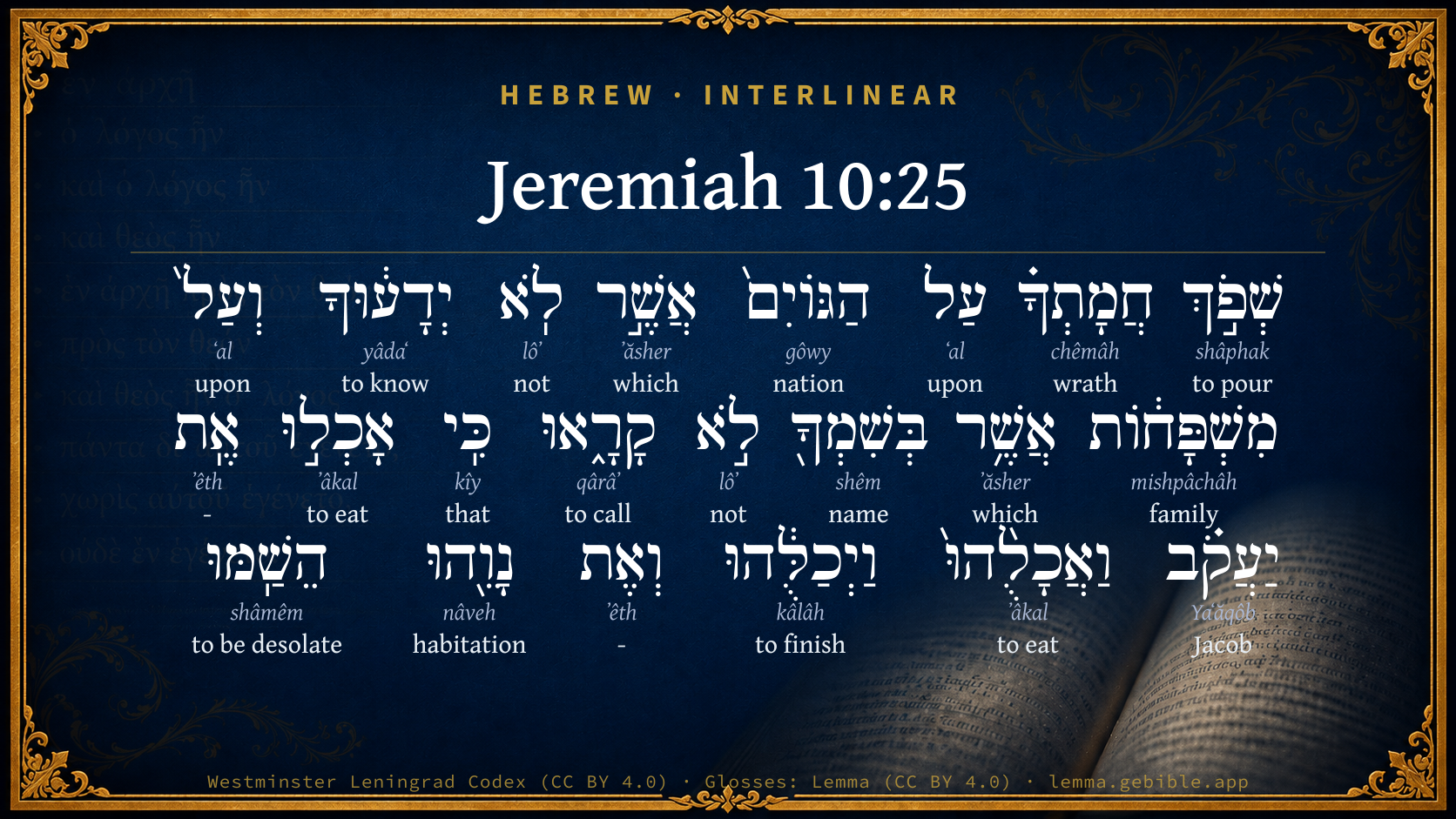
Hebrew (Westminster Leningrad Codex) Jeremiah 10:25 appears in the Hebrew Old Testament. The text above is from the Westminster Leningrad Codex. Each word links to its Strong’s number, a concise gloss, and parsing drawn from the Open Scriptures Hebrew Bible morphology. Click any word for its full Brown-Driver-Briggs (BDB) entry.
Download image
Cite this verse

Jeremiah 10:25 (World English Bible). Public Domain. Lemma interlinear Bible study tool, https://lemma.gebible.app/v/jeremiah/10/25.

Show BibTeX & RIS
BibTeX
RIS
English Translation
Pour out your wrath on the nations that don't know you, and on the families that don't call on your name: for they have devoured Jacob, yes, they have devoured him and consumed him, and have laid waste his habitation.
World English Bible · Public Domain
Download a study sheet

One document with this verse’s original text, its word-by-word gloss line, the meaning frame, cross-references with their text, attributed commentary, and full source and license credits — printable, and it pastes into notes with its structure intact.

This verse Autodidact and up

Study sheet (.html) Plain text (.txt)

A passage Seminary Student

Up to 50 verses in one chapter. A passage sheet keeps up to 6 commentary sources and 12 cross-references per verse, in the order this page ranks them, and says so on the sheet whenever that leaves anything out. Ask for a single verse and you get the Autodidact verse sheet above.

Everything on this page stays free to read, with no account — the sheet is a download of what is already on screen, not access to it.

Want to remove ads? Support Godless Engineer
Compare translations 3

The same verse in 3 English versions, stacked beneath the original-language interlinear above. Click any original word for its lexicon entry.

Each is an independent rendering of the whole verse — the interlinear is not word-aligned to these translations.

Highlighted words mark where these versions differ — a whole-verse word diff, not a word-by-word alignment.

  • World English Bible Public Domain
    Pour out your wrath on the nations that don't know you, and on the families that don't call on your name: for they have devoured Jacob, yes, they have devoured him and consumed him, and have laid waste his habitation.
  • King James Version Public Domain
    Pour out thy fury upon the heathen that know thee not, and upon the families that call not on thy name: for they have eaten up Jacob, and devoured him, and consumed him, and have made his habitation desolate.
  • unfoldingWord Literal Text CC BY-SA 4.0
    Pour out your fury on the nations that do not know you and on the clans that do not call on your name, for they have consumed Jacob and they have consumed him and they have destroyed him and desolated his habitation.

unfoldingWord Literal Text — © unfoldingWord, licensed CC BY-SA 4.0. Word-aligned USFM3 via Door43 (git.door43.org/unfoldingWord/en_ult).

Versions to compare (up to 4)

3 of 4 selected

Show all 18 translations

Every available English version of this verse, each an independent rendering of the whole verse.

  • World English Bible Public Domain
    Pour out your wrath on the nations that don't know you, and on the families that don't call on your name: for they have devoured Jacob, yes, they have devoured him and consumed him, and have laid waste his habitation.
  • Berean Standard Bible Public Domain
    Pour out Your wrath on the nations that do not acknowledge You, and on the families that do not call on Your name. For they have devoured Jacob; they have consumed him and finished him off; they have devastated his homeland.
  • Majority Standard Bible Public Domain
    Pour out Your wrath on the nations that do not acknowledge You, and on the families that do not call on Your name. For they have devoured Jacob; they have consumed him and finished him off; they have devastated his homeland.
  • King James Version Public Domain
    Pour out thy fury upon the heathen that know thee not, and upon the families that call not on thy name: for they have eaten up Jacob, and devoured him, and consumed him, and have made his habitation desolate.
  • American Standard Version (1901) Public Domain
    Pour out thy wrath upon the nations that know thee not, and upon the families that call not on thy name: for they have devoured Jacob, yea, they have devoured him and consumed him, and have laid waste his habitation.
  • Revised Version (1885) Public Domain
    Pour out thy fury upon the heathen that know thee not, and upon the families that call not on thy name: for they have devoured Jacob, yea, they have devoured him and consumed him, and have laid waste his habitation.
  • Geneva Bible (1599) Public Domain
    Powre out thy wrath vpon the heathen, that knowe thee not, and vpon the families that call not on thy Name: for they haue eaten vp Iaakob and deuoured him and consumed him, and haue made his habitation desolate.
  • Douay-Rheims (1899) Public Domain
    Pour out thy indignation upon the nations that have not known thee, and upon the provinces that have not called upon thy name: because they have eaten up Jacob, and devoured him, and consumed him, and have destroyed his glory.
  • Young's Literal Translation Public Domain
    Pour out Thy fury on the nations that have not known Thee, And on the families that have not called in Thy name, For they have eaten up Jacob, Yea, they have eaten him up, yea, they consume him, And his habitation they have made desolate!
  • Literal Standard Version CC BY-SA 4.0
    Pour out Your fury on the nations that have not known You, || And on the families that have not called on Your Name, || For they have eaten up Jacob, || Indeed, they have eaten him up, indeed, they consume him, || And they have made his habitation desolate!
  • Unlocked Literal Bible CC BY-SA 4.0
    Pour your fury on the nations that do not know you and on the families that do not call on your name. For they have devoured Jacob and consumed him so as to completely destroy him and demolish his habitation.
  • unfoldingWord Literal Text CC BY-SA 4.0
    Pour out your fury on the nations that do not know you and on the clans that do not call on your name, for they have consumed Jacob and they have consumed him and they have destroyed him and desolated his habitation.
  • Darby Bible Public Domain
    Pour out thy fury upon the nations that know thee not, and upon the families that call not on thy name; for they have eaten up Jacob, yea, they have eaten him up and consumed him, and have laid waste his dwelling-place.
  • World Messianic Bible Public Domain
    Pour out your wrath on the nations that don’t know you, and on the families that don’t call on your name; for they have devoured Jacob. Yes, they have devoured him, consumed him, and have laid waste his habitation.
  • Webster's Bible Public Domain
    Pour out thy fury upon the heathen that know thee not, and upon the families that call not on thy name: for they have eaten up Jacob, and devoured him, and consumed him, and have made his habitation desolate.
  • Free Bible Version CC BY-SA 4.0
    Pour out your fury on the nations that don't recognize you as God, and on their families that don't worship you. For they have completely destroyed the Israelites, wiping us out. They have devastated our country.
  • Bible in Basic English Public Domain
    Let your wrath be let loose on the nations which have no knowledge of you, and on the families who give no worship to your name: for they have made a meal of Jacob, truly they have made a meal of him and put an end to him and made his fields a waste.
  • JPS Tanakh (1917) Public Domain
    Pour out Thy wrath upon the nations that know Thee not, and upon the families that call not on Thy name; for they have devoured Jacob, yea, they have devoured him and consumed him, and have laid waste his habitation.

Literal Standard Version (2020), Covenant Press — licensed CC BY-SA 4.0. Text via the HelloAO Bible API (eBible.org). Unlocked Literal Bible (unfoldingWord) — licensed CC BY-SA 4.0. Text via the HelloAO Bible API (eBible.org). unfoldingWord Literal Text — © unfoldingWord, licensed CC BY-SA 4.0. Word-aligned USFM3 via Door43 (git.door43.org/unfoldingWord/en_ult). Free Bible Version, Dr. Jonathan Gallagher — licensed CC BY-SA 4.0. Text via the HelloAO Bible API (eBible.org).

Word by word

More ways to search: Search by grammar → Find every occurrence → Compare this word →

Practice this passage: Drill this verse → Learn its vocabulary →

נָוֵ֖הוּ
nâveh
H5116
“habitation · his”
Noun, Common, Both, Singular, Construct + Suffix, Personal, 3rd Person, Masculine, Singular
Part of Speech
Noun
Type
Common
Gender
Both
Number
Singular
State
Construct
Full BDB Definition

Origin: from H5115

TWOT: 1322a , 1322b , 1322c

abode, habitation, abode of shepherds or flocks, pasture (noun masculine) - abode (of sheep) - abode (of shepherds) - meadow - habitation - dwelling, abiding (adjective)
  1. שְׁפֹ֣ךְ shâphak H8210 “pour” Verb, Qal, Imperative, 2nd Person, Masculine, Singular
  2. חֲמָתְךָ֗ chêmâh H2534 “wrath · your” Noun, Common, Feminine, Singular, Construct + Suffix, Personal, 2nd Person, Masculine, Singular
  3. עַל ʻal H5921 “upon” Preposition
  4. הַגּוֹיִם֙ gôwy H1471 “the · nations” Particle, Definite Article + Noun, Common, Masculine, Plural, Absolute
  5. אֲשֶׁ֣ר ʼăsher H834 “which” Particle, Relative
  6. לֹֽא lôʼ H3808 “not” Particle, Negative
  7. יְדָע֔וּךָ yâdaʻ H3045 “to know · you” Verb, Qal, Perfect, 3rd Person, Common, Plural + Suffix, Personal, 2nd Person, Masculine, Singular
  8. וְעַל֙ ʻal H5921 “and · upon” Conjunction + Preposition
  9. מִשְׁפָּח֔וֹת mishpâchâh H4940 “families” Noun, Common, Feminine, Plural, Absolute
  10. אֲשֶׁ֥ר ʼăsher H834 “which” Particle, Relative
  11. בְּשִׁמְךָ֖ shêm H8034 “in/at · name · your” Preposition + Noun, Common, Masculine, Singular, Construct + Suffix, Personal, 2nd Person, Masculine, Singular
  12. לֹ֣א lôʼ H3808 “not” Particle, Negative
  13. קָרָ֑אוּ qârâʼ H7121 “to call” Verb, Qal, Perfect, 3rd Person, Common, Plural
  14. כִּֽי kîy H3588 “that” Conjunction
  15. אָכְל֣וּ ʼâkal H398 “to eat” Verb, Qal, Perfect, 3rd Person, Common, Plural
  16. אֶֽת ʼêth H853 “-” Particle, Direct Object
  17. יַעֲקֹ֗ב Yaʻăqôb H3290 “Jacob” Noun, Proper
  18. וַאֲכָלֻ֨הוּ֙ ʼâkal H398 “and · to eat · him” Conjunction + Verb, Qal, Perfect, 3rd Person, Common, Plural + Suffix, Personal, 3rd Person, Masculine, Singular
  19. וַיְכַלֻּ֔הוּ kâlâh H3615 “and · to finish · him” Conjunction + Verb, Piel, Sequential Imperfect, 3rd Person, Masculine, Plural + Suffix, Personal, 3rd Person, Masculine, Singular
  20. וְאֶת ʼêth H853 “and · -” Conjunction + Particle, Direct Object
  21. הֵשַֽׁמּוּ shâmêm H8074 “to be desolate” Verb, Hiphil, Perfect, 3rd Person, Common, Plural

About this verse

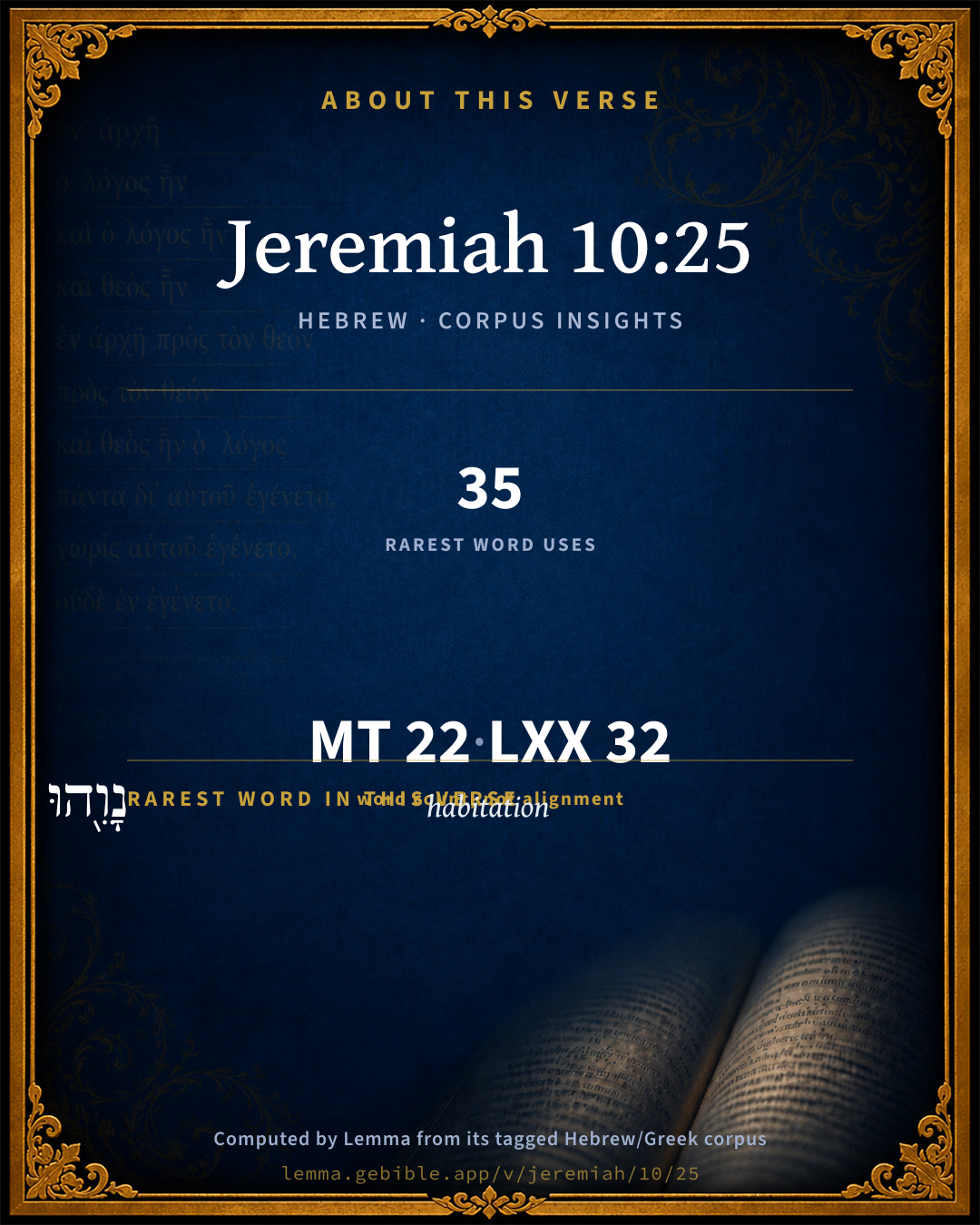
These counts appear in no published source. They are computed here, from the morphology-tagged text and Lemma’s own curated glosses. What Lemma adds →

22
words
17
distinct lemmas
Prophets
section

Shared distinctive vocabulary

נָוֵ֖הוּ habitation H5116 occurs in 34 verses of the Hebrew Bible. Also found in:

Grammatical profile

  • 7 verbs
  • 6 nouns
  • 2 prepositions
  • 1 conjunction
  • 6 particles

Verb forms

  • שְׁפֹ֣ךְ Qal · Imperative
  • יְדָע֔וּךָ Qal · Perfect
  • קָרָ֑אוּ Qal · Perfect
  • אָכְל֣וּ Qal · Perfect
  • וַאֲכָלֻ֨הוּ֙ Qal · Perfect
  • וַיְכַלֻּ֔הוּ Piel · Sequential Imperfect
  • הֵשַֽׁמּוּ Hiphil · Perfect

Repetition

Words recur within this verse — often emphatic in Hebrew:

  • עַל upon H5921 ×2
  • אָכְל֣וּ to eat H398 ×2
  • אֲשֶׁ֣ר which H834 ×2
  • לֹֽא not H3808 ×2

Hebrew & Septuagint length

In the original languages it is 22 Hebrew tokens and 32 Greek tokens — but the two are counted differently (Hebrew bundles its prefixes and suffixes into one token; the Greek is in lemma form), so that isn’t a like-for-like length.

Cross-references

22

Topical passages linked to Jeremiah 10:25 in the Treasury of Scripture Knowledge — connected by theme and wording, ordered by reader-vote popularity; previews shown in the World English Bible.

  • Psalms 79:6–7 Pour out your wrath on the nations that don't know you; On the kingdoms that don't call on your name;
  • Jeremiah 8:16 The snorting of his horses is heard from Dan: at the sound of the neighing of his strong ones the whole land trembles; for they are come, and have devoured the land and all that is in it; the city and those who dwell therein.
  • Job 18:21 Surely such are the dwellings of the unrighteous, This is the place of him who doesn't know God."
  • Psalms 14:4 Have all the workers of iniquity no knowledge, Who eat up my people as they eat bread, And don't call on Yahweh?
  • Psalms 27:2 When evil-doers came at me to eat up my flesh, Even my adversaries and my foes, they stumbled and fell.
  • Jeremiah 50:7 All who found them have devoured them; and their adversaries said, We are not guilty, because they have sinned against Yahweh, the habitation of righteousness, even Yahweh, the hope of their fathers.
  • Jeremiah 50:17 Israel is a hunted sheep; the lions have driven him away: first, the king of Assyria devoured him; and now at last Nebuchadrezzar king of Babylon has broken his bones.
  • Ezekiel 25:6–8 For thus says the Lord Yahweh: Because you have clapped your hands, and stamped with the feet, and rejoiced with all the despite of your soul against the land of Israel;
  • Obadiah 1:10–16 For the violence done to your brother Jacob, shame will cover you, and you will be cut off forever.
  • Zephaniah 1:6 those who have turned back from following Yahweh, and those who haven't sought Yahweh nor inquired after him.
  • Zechariah 1:15 I am very angry with the nations that are at ease; for I was but a little displeased, but they added to the calamity."
  • 1 Thessalonians 4:5 not in the passion of lust, even as the Gentiles who don't know God;
  • 2 Thessalonians 1:8 giving vengeance to those who don't know God, and to those who don't obey the Gospel of our Lord Jesus,
  • Isaiah 43:22 Yet you have not called on me, Jacob; but you have been weary of me, Israel.
  • Isaiah 64:7 There is none who calls on your name, who stirs up himself to take hold of you; for you have hid your face from us, and have consumed us by means of our iniquities.
  • Jeremiah 51:34–35 Nebuchadrezzar the king of Babylon has devoured me, he has crushed me, he has made me an empty vessel, he has, like a monster, swallowed me up, he has filled his maw with my delicacies; he has cast me out.
  • Lamentations 2:22 You have called, as in the day of a solemn assembly, my terrors on every side; There was none that escaped or remained in the day of Yahweh's anger: Those that I have dandled and brought up has my enemy consumed.
  • Ezekiel 35:5–10 Because you have had a perpetual enmity, and have given over the children of Israel to the power of the sword in the time of their calamity, in the time of the iniquity of the end;
  • Zephaniah 3:8 "Therefore wait for me," says Yahweh, "until the day that I rise up to the prey, for my determination is to gather the nations, that I may assemble the kingdoms, to pour on them my indignation, even all my fierce anger, for all the earth will be devoured with the fire of my jealousy.
  • John 17:25 Righteous Father, the world hasn't known you, but I knew you; and these knew that you sent me.
  • Acts 17:23 For as I passed along, and observed the objects of your worship, I found also an altar with this inscription: 'TO AN UNKNOWN GOD.' What therefore you worship in ignorance, this I announce to you.
  • 1 Corinthians 15:34 Wake up righteously, and don't sin, for some have no knowledge of God. I say this to your shame.

Cross-references courtesy of OpenBible.info (CC BY 4.0).

Hebrew and Greek witnesses Masoretic Hebrew ↔ Greek Septuagint

The same verse in the two great witnesses to the Old Testament, shown verse-for-verse.

These are two independent witnesses, not word-aligned to each other, and the Septuagint is shown in lemma (dictionary) form.

Hebrew Jeremiah 10:25 Masoretic · Westminster Leningrad Codex

שְׁפֹ֣ךְ חֲמָתְךָ֗ עַל הַגּוֹיִם֙ אֲשֶׁ֣ר לֹֽא יְדָע֔וּךָ וְעַל֙ מִשְׁפָּח֔וֹת אֲשֶׁ֥ר בְּשִׁמְךָ֖ לֹ֣א קָרָ֑אוּ כִּֽי אָכְל֣וּ אֶֽת יַעֲקֹ֗ב וַאֲכָלֻ֨הוּ֙ וַיְכַלֻּ֔הוּ וְאֶת נָוֵ֖הוּ הֵשַֽׁמּוּ

Pour out your wrath on the nations that don't know you, and on the families that don't call on your name: for they have devoured Jacob, yes, they have devoured him and consumed him, and have laid waste his habitation.

World English Bible · Public Domain

Greek LXX Structure differs

In the Septuagint, Jeremiah is about an eighth shorter than the Hebrew and arranges its material differently — the Oracles Against the Nations (Hebrew chapters 46–51) appear in the middle of the Greek book, after 25:13. Because the chapter and verse boundaries do not line up, a verse-for-verse comparison with the Hebrew is not shown.

A verse-for-verse comparison isn’t shown here because the chapters and verses don’t line up. Switch to the LXX edition with the MT / LXX toggle above to read the Greek directly.

Hebrew: Westminster Leningrad Codex (CC BY 4.0). Greek: Septuagint (public domain); English from a public-domain English Septuagint. How the Septuagint differs from the Hebrew →

Targum (Aramaic paraphrase)

1

The Targum is the ancient Jewish Aramaic paraphrase of the Hebrew Scriptures — an interpretive translation, not the Hebrew text itself. Onkelos (literal) and Pseudo-Jonathan (expansive) render the Torah, and Jonathan the Prophets. Coverage is partial: where no permissively-licensed English translation exists for a verse, only the Aramaic is shown. This is verse-level text, not a word-by-word alignment to the Hebrew.

  1. Targum Jonathan Prophets (Joshua–Malachi)
    שְׁפוֹךְ חֵימָתָךְ עַל עַמְמַיָא דְלָא אֲלִיפוּ לְמֵידַע דְחַלְתָּךְ וְעַל זַרְעִיתָא דְכַשְׂדָאֵי דִי בְפּוּלְחַן שְׁמָךְ לָא תְבָעוּ אֲרֵי שְׁלִיטוּ בִּדְבֵית יַעֲקֹב וּבְזוּ נִכְסֵהוֹן וְשֵׁיצִיאוּנוּן וְיַת מְדוֹרְהוֹן אַצְדִיאוּ:

    (no public-domain English translation for this verse)

    Targum Jonathan — Aramaic: “Mikraot Gedolot” (public domain). English: “Sefaria Community Translation” (CC0 1.0 (public-domain dedication)); “London "Chaldee Paraphrase," 1871” (public domain). Text via Sefaria.

Commentary

Notes on Jeremiah 10:25 from classic Christian and Jewish commentators (each source and its license shown beneath its notes). The classic Christian expositions comment on the surrounding passage and are grouped to its opening verse, so a note may address several verses; the Jewish commentaries on the Tanakh (Rashi and others) are per-verse, so they appear only where the commentator wrote on this verse.

Lemma curates 59 commentaries, every one of them public domain or Creative Commons licensed, each selected and text-cleaned for this edition rather than reprinted as found. About our sources →

Trapp's Complete Commentary

John Trapp

Jer 10:25 Pour out thy fury upon the heathen that know thee not, and upon the families that call not on thy name: for they have eaten up Jacob, and devoured him, and consumed him, and have made his habitation desolate.

Ver. 25. Pour out, &c.] This is not more votum, than vaticinium; a prayer, than a prophecy.

And upon the families.] Neglect of family prayer uncovers the roof, as it were, for God’s curse to be rained down upon men’s tables, meals, enterprises, &c.

John Trapp, A Commentary or Exposition upon All the Books of the Old and New Testament (1647–1656) — public domain. Text from a community e-Sword module.

Joseph Benson's Commentary

Jer 10:25. Pour out thine indignation upon the heathen, &c. — Let thy justice be made known, by bringing an exemplary punishment upon the Chaldeans and their allies, (see Jer 1:15,) who do not acknowledge thy providence, but ascribe all their successes to their idols: for they have eaten up Jacob, &c. — See note on Jer 6:3. This prayer, it must be observed, did not proceed from a spirit of malice or revenge in the prophet, nor was it intended to prescribe to God on whom he should execute his judgments, or in what order; but, 1st, It is an appeal to his justice; as if he had said, Lord, we are a provoking people, but are there not other nations that are more so? And shall we only be punished?

2d, It is a prediction of God’s judgments upon all the impenitent enemies of his church and kingdom. If judgment begin thus at the house of God: what shall be the end of those that obey not his gospel? 1Pe 4:17.

Joseph Benson's Commentary on the Old and New Testaments (1811–1818) — public domain. Text from a community e-Sword module.

Geneva Bible (1599)

Geneva Bible translators

Forasmuch as God cannot only be known and glorified by his mercy, that he useth toward his Church, but also by his justice in punishing his enemies, he prayeth that this glory may fully appear both in the one and the other, Ps. 79:6.

Geneva Bible (1599) marginal notes — public domain. Text via Bolls.life.

Adam Clarke's Commentary

Verse 25. Pour out thy fury upon the heathen] Even those who are now the executors of thy justice upon us will, in their turn, feel its scourge; for if judgment begins at us, who have been called thy house and thy people, shall they who have not acknowledged thee escape? It is impossible. The families and tribes which invoke thee not shall have thy fury poured out upon them, and especially they who "have eaten up Jacob and consumed him, and have made his habitation desolate." This was fulfilled in the Chaldeans. Nebuchadnezzar was punished with madness, his son was slain in his revels, and the city was taken and sacked by Cyrus; and the Babylonish empire was finally destroyed! This verse has been often quoted against those ungodly families who set not up the worship of God in their houses. These are spiritual Chaldeans, worse indeed than the Chaldeans ever were: they acknowledge God and his Christ; and yet neither worship nor serve him. How can that family expect the blessing of God, where the worship of God is not daily performed? No wonder their servants are wicked, their children profligate, and their goods cursed! What an awful reckoning shall such heads of families have with the Judge in the great day, who have refused to petition for that mercy which they might have had for the asking.

Adam Clarke's Commentary on the Bible (1810–1826) — public domain. Text from a community e-Sword/MySword module.

John Calvin's Commentaries

The Prophet confirms his prayer by this reason — that God had sufficient ground for executing his vengeance on the wicked and ungodly heathens who were alienated from him; and there is no doubt but that he had respect to the promise to which we have referred; for the Prophet knew that what had been said once to David was promised to the whole Church throughout all ages. Hence He reminds God, as it were, of the difference which he had made between domestics and foreigners; as though he had said, “O Lord, though it is right and also useful for our salvation to be chastised by thy hand, yet thou dost not indiscriminately visit with vengeance the sins of men; for thou hast promised paternally to chastise thy children: but as to aliens, thou art their judge, so that they may be wholly destroyed. Now then, O Lord, shew that this has not been said in vain; and as thou hast been pleased to adopt us as thy peculiar people, forgive us according to thy paternal kindness.” Hence we see that the Prophet did not inconsiderately pour forth his prayer into the air, but had a regard to God’s promise, and referred to that difference which God himself was pleased to make between his Church and unbelievers.

He then says, Pour forth thy wrath on the nations who know not thee: and he exaggerates what he says by adding, that Jacob had been devoured by these heathen nations as by wild beasts; as though he had said, “We have indeed sinned, O Lord; but (lost thou shew thyself to be the Judge of the world for our destruction, and yet sparest the Egyptians, the Assyrians, and the Chaldeans, who have so cruelly distressed us, yea, who have not only torn us, but have also wholly devoured us? (For he uses the word devour twice; and then he adds, They have consumed him; and lastly, His tents have they laid waste ) Since then they have so atrociously raged against thy people, are they to go unpunished, when thou castest us down, who are thine? Even had we given thee ever so great a cause for punishing us, still thine adoption should avail us; and thou mightest in the meantime execute thy judgment on the heathen nations.”

There is no doubt but that the Prophet, or whoever he was who composed the seventy-ninth Psalm, borrowed the words used here, for it is there said,

“Pour forth thy wrath on the nations who know not thee, and on the kingdoms which have not called on thy name; for they have consumed Jacob and his inheritance.” (Psalm 79:6, 7)

It may be that Jeremiah himself wrote that Psalm, after having been driven into Egypt, when that city had been destroyed. It was, however, suitable to the time when dreadful scattering had happened; for the Psalm seems to have been composed for the benefit of the miserable, and as it were of the lost Church. It is yet more probable that it was written under the tyranny of Antiochus, or at the time when the cruelty of God’s enemies raged against his people. However this may be, the author of that Psalm wished to repeat what is contained here.

It may now be asked, Whether it is right to pray for evils on the ungodly and wicked, while we are doubtful and uncertain as to their final doom. For as God has not made it known how he purposes to deal at last with them, the rule of charity ought on the contrary to turn us another way, — that we are to hope for their salvation and to pray God to forgive them: but the Prophet; consigns them only to destruction; and he speaks not according to his own private feeling, but dictates a prayer which all the faithful were to use. To this I answer, — that we are not to denounce a sentence on this or that man individually, and that our prejudging would be presumptuous, were we to consign individuals to eternal death and to pray for evil on them: but we may use this form of prayer generally with regard to the obstinate enemies of God, so as still to refer to him the certainty of the issue; and yet we are not to mix in one mass all those whom we know to be now ungodly, for this, as I have said, would be presumptuous It would then be more becoming in us to pray for the good of all and to wish their salvation, and, as far as we can, to promote it. Yet when we thus entertain love towards every individual, we may still so pray in general, that God would lay prostrate, consume, scatter, and reduce to nothing his enemies. There is then no doubt but that the Prophet here turns his own thoughts to God’s judgment, as though He had said, “Lord, it was thy work to make a distinction between domestics and aliens; it has pleased thee to adopt this people; what now remains, but that thou shouldest deal mercifully with them, inasmuch as thou sustainest towards them the character of a Father? As to the heathen nations, as they are aliens to thee and belong not to thy flock, destruction awaits them; let them therefore perish.”

Now the Prophet in thus speaking of heathen nations, does not anticipate God’s judgment so as to restrain him from doing what he pleased: but he only mentions, as I have already said, what he derived from God’s word, — that some are elected, and that others are reprobates. He infers God’s election from his vocation or his covenant; and, on the other hand, he regards all those reprobate on whom God has not been pleased to bestow the privilege of his paternal favor.

The question then is now solved: and hence it appears how it is lawful for us to pray for the destruction of the reprobate, and of those who despise God, — that our prayers ought not to anticipate God’s judgment, — and that we are not to determine as to individuals, but only remember this distinction — that God acts as a Father towards his elect, and as a judge towards the reprobate.

Pour forth then thy wrath: as he had subjected himself and the whole people to God’s chastisements, so he says, Pour forth thy wrath; that is, deal with them with strict justice; but yet moderate thy wrath towards us, lest like the deluge it should swallow us up; for the word “pour forth” conveys this meaning. By saying, on the nations which know not thee, which have not called on thy name, he uses words which ought to be carefully noticed; for we are by them taught that the beginning of religion is the knowledge of God. He then mentions the fruit or the effect, which is invocation or prayer. These two things are connected together: but we must bear in mind the order also; for God cannot be invoked, except the knowledge of him previously shines on us. Indeed all everywhere call on God; even the unbelieving commonly cry on him when urged by danger; but they do not rightly address their prayers to him, nor offer them as legitimate sacrifices. How so? How can they call on him,” says Paul, “in whom they have not believed?” Hence it is necessary, as I have said, that God himself should shew us the way before we can rightly pray: and therefore where there is no knowledge of God, there can be no way of praying to him. But when God has once given us light, then there is a way of access open to us. Invocation then is ever the fruit of faith, as it is an evidence of religion; for all who call not on God, and that seriously, prove that they have never known anything of religion. If then we desire to pray aright, we must first learn what is God’s will towards us: we must also know that we then only advance as we ought in the attainment of salvation, when we flee to God and exercise ourselves in prayer.

He lastly adds, For they have consumed Jacob, they have consumed him, they have consumed him, and his tents have they laid waste. Two things are to be observed here: we see how sad and miserable was the state of the Church; for he says not that the Israelites had suffered many wrongs, or had been treated violently and reproachfully, but that they had been devoured by the nations, and he repeats this twice; and then he adds, that they had been consumed, and that their tents had been laid waste. Since then we see how cruelly afflicted were God’s children formerly, let us not wonder if the Church at this day be exposed to the most grievous calamities, and let us not be frightened as though it was something new and unusual; but as the same thing happened formerly to our fathers, let us bear such trials with a submissive mind. The other thing to be observed is, — that as the Prophet was not here led to pray by the impulse of his flesh, but by the guidance of the Spirit, we may hence with certainty conclude, that though the enemies of the Church triumph at this day, and think that they have everything in their own power, while they cruelly treat the innocent, they shall at length be punished; for the Spirit who guided the tongue of the Prophet intended this form of prayer to be unto us like a promise, so that we may feel assured that the more atrociously the ungodly rage against God’s children, the heavier punishment is nigh them as the wages of their cruelty. They indeed devour, at this day, like wild beasts; but God will sooner or later put forth his hand, and shew how precious to him is the blood of his people.

John Calvin's Commentaries (1540-1563) — public domain. Text from the Calvin Translation Society English edition (1840s-50s) via the Christian Classics Ethereal Library (ccel.org). Calvin's coverage is partial (roughly two-thirds of the Bible); uncommented books and verses are honest gaps, never fabricated. The 19th-century editor's footnotes and remarks are omitted so the notes are faithfully Calvin's own voice.

Ellicott's Commentary for English Readers

(25) Pour out thy fury.—The words are identical with those of Psa_79:6-7, but it is more probable that the Psalmist borrowed from the Prophet. By many critics the Psalm is referred to the time of the Maccabees, and it would seem, from the language of Jer_10:1-3, that it must at any rate have been after the destruction of the Temple by the Chaldeans. On the last supposition the two writers may have been contemporaries.

A Bible Commentary for English Readers, edited by Charles John Ellicott (1878–1897) — public domain. Text from a community e-Sword module.

The Cambridge Bible for Schools and Colleges

gen. ed. J. J. S. Perowne

25. yea, they have devoured him] Plainly by an error of repetition in MT. In the Ps. (see above) the words are not found.

The Cambridge Bible for Schools and Colleges (gen. ed. J. J. S. Perowne; Cambridge University Press, 1878–1918) — public domain. Text from a community e-Sword module.

John Gill's Exposition

Pour out thy fury upon the Heathen that know thee not,.... Make a difference between thy people that know thee, and make a profession of thy name, and worship thee, and the Heathen, the nations of the world who are ignorant of God, and worship stocks and stones; while thou correctest thine own people in measure, in love, and not in wrath, pour out without measure all thy fury upon the Gentiles that know not God, and are guilty of the grossest idolatry:

and upon the families that call not on thy name; this does not signify single families, commonly so called; but kingdoms, as the Targum interprets it; Heathen kingdoms and nations, that call not upon or worship the God of Israel, but their own idols; such as the family of Egypt, Zac 14:17 and so it is expressed in a parallel place, Psa 79:6, which is either taken from hence, or this from thence:

for they have eaten up Jacob, and devoured him, and consumed him, and have made his habitation desolate; a heap of words to express the great destruction and desolation of the land of Israel, of Jerusalem, and the cities of Judah; and of their houses and dwelling places, private and public; and of their spoiling them of all their goods, substance, wealth, and riches; which is given as a reason of the above imprecation.

Next: Jeremiah Chapter 11

John Gill's Exposition of the Whole Bible (1746–1763) — public domain (CC PDM 1.0). Text via the HelloAO Bible API.

Haydock's Catholic Bible Commentary

Glory. This is repeated from Psalm lxxviii. 6. (Menochius) --- The prophet supposes that these nations will not repent, and that their sins are more enormous. To see God’s people treated with greater severity, might scandalize the weak, while infidels would take occasion to abuse their own impunity. (Calmet)

George Leo Haydock (1774–1849), Haydock's Catholic Family Bible and Commentary, 1859 edition — public domain. Excludes Psalms (Douay-Rheims chapter numbering differs from Protestant) and Deuterocanonical books (Catholic canon only).

Matthew Poole's English Annotations

Pour out thy fury upon the heathen: this may imply both petition, that God would do so, and prediction, that God will certainly do so, which toward the close of the prophecy we find was fulfilled, God first sending the king of Babylon to overthrow divers of the heathen nations, and then Babylon itself destroyed with a great destruction. He will make a difference between us and the heathen, such as

know thee not, i.e. such as do not acknowledge and own thee for their God: the phrase is frequent; 1Sa 2:12; Job 18:21; 2Th 1:8; the sense is expressed here in the next words, that do not call on thy name. That call not on thy name; a synecdoche, one part of worship put for the whole: q.d. If thou wilt be pouring out thy fury, the effects of it be to thine enemies, not unto thine own people, who worship thee.

For they have eaten up Jacob, and devoured him, and consumed him, and have made his habitation desolate: here he gives a reason as a motive to God why he should do so; which words see explained on Psa 79:5-7, whence they are taken, and possibly Jeremiah himself was the author of that Psalm after the city was destroyed, and he carried into Egypt; and for the phrase of devouring him, see Jer 8:16.

Matthew Poole's English Annotations on the Holy Bible (1683–1685) — public domain. Text from a community e-Sword/MySword module.

Whedon's Commentary on the Bible

Daniel D. Whedon

25. With very slight difference this verse is identical in language with Psa_79:6-7.

Daniel D. Whedon (gen. ed.), Commentary on the Old and New Testaments (1874–1909) — public domain. Text from a community e-Sword module.

The Pulpit Commentary

This verse is repeated, with slight differences, in Psa_79:6, Psa_79:7. The fault of the heathen is that they exceeded their commission, (Isa_10:6, 7 47:6 Zec_1:15) and aimed at destroying, instead of merely punishing, Jehovah"s erring people. His habitation; rather, his pasture (comp. Jer_12:10)

The Pulpit Commentary (1880–1919), ed. H.D.M. Spence-Jones & Joseph S. Exell — public domain. Text from a community e-Sword module.

John Wesley's Explanatory Notes

The Heathen - Such as do not acknowledge thee for their God. Call not - One part of worship put for the whole. If thou wilt pour out thy fury, let the effects of it be to thine enemies, not unto thine own people.

John Wesley, Explanatory Notes Upon the Whole Bible (1754–1765) — public domain. Text via the GEBible commentary corpus.

Rashi

Rabbi Shlomo Yitzchaki (Rashi)

they have devoured (devorerent in French). The same applies to “and consumed him” (ואכלהוּ).

Rashi on the Tanakh — English translations: “The Judaica Press complete Tanach with Rashi, translated by A. J. Rosenberg” (CC BY 4.0); “Pentateuch with Rashi's commentary by M. Rosenbaum and A.M. Silbermann, 1929-1934” (public domain); “The Metsudah Tanach series, Lakewood, N.J” (CC BY 4.0); and “The Book of Joshua, Metsudah Publications, 1997” (CC BY 4.0). Text via Sefaria.

Lesson kit

Teaching starters — assembled from the data on this page, not authored interpretation. Every prompt links to the verse data it draws on. Edit before teaching.

Jeremiah, in the Prophets, opens this verse with 22 words (17 distinct Hebrew lemmas). Its most distinctive word is nâveh (“habitation”). A historical commentator’s framing appears above. Read the whole chapter for the surrounding context.

Discussion questions

  1. The word nâveh carries the sense “habitation.” How does it shape the verse?
  2. How does Exodus 15:13, which shares the word «habitation», read alongside this verse?
  3. What does the repetition of “upon” (2× in this one verse) do in this verse?
  4. These translations render this verse differently. What is at stake in choosing one wording over another?
  5. «שְׁפֹ֣ךְ» is a Qal Imperative verb. How does that grammatical form shape the action described?
  6. Compare how Trapp's Complete Commentary and Joseph Benson's Commentary read this verse. Where do they agree or differ?

Things to notice

Reading settings

Reading text

Shown beneath each verse's original-language words.

Old Testament
Old Testament edition

Read the OT as the Masoretic Hebrew (MT) or the Greek Septuagint (LXX).

English shown for the Greek Septuagint (in the Hebrew ↔ Greek comparison).

Comparing translations? Open the Compare panel on any verse page to stack up to four side by side.