
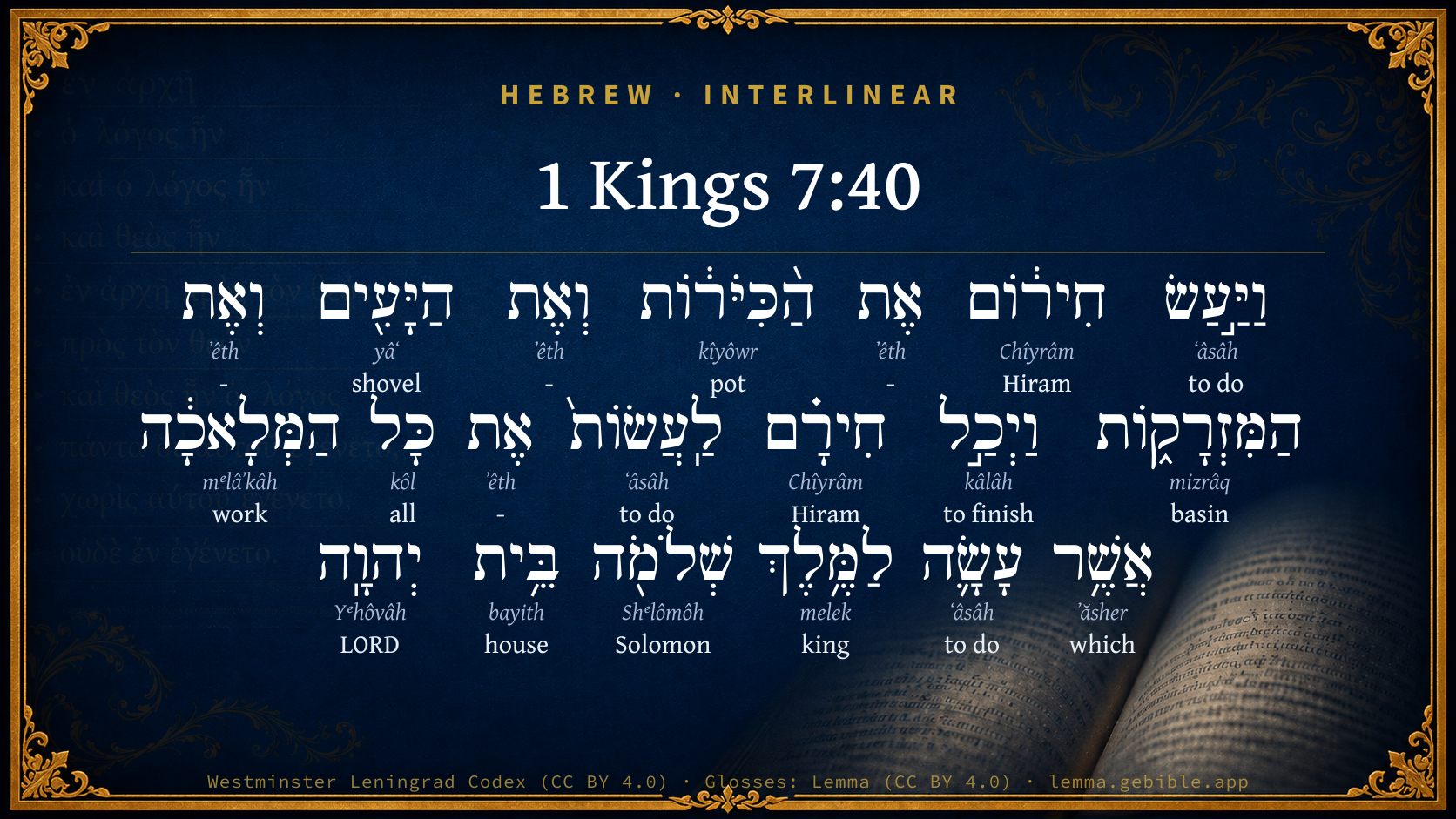
1 Kings 7:40

Hebrew (Westminster Leningrad Codex) 1 Kings 7:40 appears in the Hebrew Old Testament. The text above is from the Westminster Leningrad Codex. Each word links to its Strong’s number, a concise gloss, and parsing drawn from the Open Scriptures Hebrew Bible morphology. Click any word for its full Brown-Driver-Briggs (BDB) entry.
Download image
Cite this verse

1 Kings 7:40 (World English Bible). Public Domain. Lemma interlinear Bible study tool, https://lemma.gebible.app/v/1-kings/7/40.

Show BibTeX & RIS
BibTeX
RIS
English Translation
Hiram made the basins, and the shovels, and the basins. So Hiram made an end of doing all the work that he worked for king Solomon in the house of Yahweh:
World English Bible · Public Domain
Download a study sheet

One document with this verse’s original text, its word-by-word gloss line, the meaning frame, cross-references with their text, attributed commentary, and full source and license credits — printable, and it pastes into notes with its structure intact.

This verse Autodidact and up

Study sheet (.html) Plain text (.txt)

A passage Seminary Student

Up to 50 verses in one chapter. A passage sheet keeps up to 6 commentary sources and 12 cross-references per verse, in the order this page ranks them, and says so on the sheet whenever that leaves anything out. Ask for a single verse and you get the Autodidact verse sheet above.

Everything on this page stays free to read, with no account — the sheet is a download of what is already on screen, not access to it.

Want to remove ads? Support Godless Engineer
Compare translations 3

The same verse in 3 English versions, stacked beneath the original-language interlinear above. Click any original word for its lexicon entry.

Each is an independent rendering of the whole verse — the interlinear is not word-aligned to these translations.

Highlighted words mark where these versions differ — a whole-verse word diff, not a word-by-word alignment.

  • World English Bible Public Domain
    Hiram made the basins, and the shovels, and the basins. So Hiram made an end of doing all the work that he worked for king Solomon in the house of Yahweh:
  • King James Version Public Domain
    And Hiram made the lavers, and the shovels, and the basins. So Hiram made an end of doing all the work that he made king Solomon for the house of the LORD:
  • unfoldingWord Literal Text CC BY-SA 4.0
    And Hiram made basins and shovels and bowls. And Hiram finished doing all of the work that he did for King Solomon the house of Yahweh:

unfoldingWord Literal Text — © unfoldingWord, licensed CC BY-SA 4.0. Word-aligned USFM3 via Door43 (git.door43.org/unfoldingWord/en_ult).

Versions to compare (up to 4)

3 of 4 selected

Show all 18 translations

Every available English version of this verse, each an independent rendering of the whole verse.

  • World English Bible Public Domain
    Hiram made the basins, and the shovels, and the basins. So Hiram made an end of doing all the work that he worked for king Solomon in the house of Yahweh:
  • Berean Standard Bible Public Domain
    Additionally, Huram made the pots, shovels, and sprinkling bowls. So Huram finished all the work that he had undertaken for King Solomon in the house of the LORD:
  • Majority Standard Bible Public Domain
    Additionally, Huram made the pots, shovels, and sprinkling bowls. So Huram finished all the work that he had undertaken for King Solomon in the house of the LORD:
  • King James Version Public Domain
    And Hiram made the lavers, and the shovels, and the basins. So Hiram made an end of doing all the work that he made king Solomon for the house of the LORD:
  • American Standard Version (1901) Public Domain
    And Hiram made the lavers, and the shovels, and the basins. So Hiram made an end of doing all the work that he wrought for king Solomon in the house of Jehovah:
  • Revised Version (1885) Public Domain
    And Hiram made the lavers, and the shovels, and the basons. So Hiram made an end of doing all the work that he wrought for king Solomon in the house of the LORD:
  • Geneva Bible (1599) Public Domain
    And Hiram made caldrons, and besomes, and basens, and Hiram finished all the worke that he made to King Salomon for the house of ye Lord:
  • Douay-Rheims (1899) Public Domain
    And Hiram made caldrons, and shovels, and basins, and finished all the work of king Solomon in the temple of the Lord.
  • Young's Literal Translation Public Domain
    And Hiram maketh the lavers, and the shovels, and the bowls; and Hiram completeth to do all the work that he made for king Solomon, `for' the house of Jehovah;
  • Literal Standard Version CC BY-SA 4.0
    And Hiram makes the lavers, and the shovels, and the bowls; and Hiram completes to do all the work that he made for King Solomon, [for] the house of YHWH:
  • Unlocked Literal Bible CC BY-SA 4.0
    Huram made the basins and the shovels and the sprinkling bowls. Then he finished all the work that he did for King Solomon in the temple of Yahweh:
  • unfoldingWord Literal Text CC BY-SA 4.0
    And Hiram made basins and shovels and bowls. And Hiram finished doing all of the work that he did for King Solomon the house of Yahweh:
  • Darby Bible Public Domain
    And Hiram made the lavers, and the shovels, and the bowls. So Hiram ended doing all the work that he made for king Solomon [for] the house of Jehovah:
  • World Messianic Bible Public Domain
    Hiram made the pots, the shovels, and the basins. So Hiram finished doing all the work that he worked for King Solomon in the LORD’s house:
  • Webster's Bible Public Domain
    And Hiram made the lavers, and the shovels, and the basins. So Hiram made an end of doing all the work that he executed for king Solomon for the house of the LORD:
  • Free Bible Version CC BY-SA 4.0
    He also made the pots, shovels, and bowls. So Hiram finished making everything required by King Solomon for the Temple of the Lord:
  • Bible in Basic English Public Domain
    And Hiram made the pots and spades and the basins. So Hiram came to the end of all the work he did for King Solomon in the house of the Lord:
  • JPS Tanakh (1917) Public Domain
    And Hiram made the pots, and the shovels, and the basins. So Hiram made an end of doing all the work that he wrought for king Solomon in the house of the LORD:

Literal Standard Version (2020), Covenant Press — licensed CC BY-SA 4.0. Text via the HelloAO Bible API (eBible.org). Unlocked Literal Bible (unfoldingWord) — licensed CC BY-SA 4.0. Text via the HelloAO Bible API (eBible.org). unfoldingWord Literal Text — © unfoldingWord, licensed CC BY-SA 4.0. Word-aligned USFM3 via Door43 (git.door43.org/unfoldingWord/en_ult). Free Bible Version, Dr. Jonathan Gallagher — licensed CC BY-SA 4.0. Text via the HelloAO Bible API (eBible.org).

Word by word

More ways to search: Search by grammar → Find every occurrence → Compare this word →

Practice this passage: Drill this verse → Learn its vocabulary →

הַיָּעִ֖ים
yâʻ
H3257
“the · shovels”
Particle, Definite Article + Noun, Common, Masculine, Plural, Absolute
Part of Speech
Particle + Noun
Type
Common
Gender
Masculine
Number
Plural
State
Absolute
Full BDB Definition

Origin: from H3261

TWOT: 879a

shovel
  1. וַיַּ֣עַשׂ ʻâsâh H6213 “and · to do” Conjunction + Verb, Qal, Sequential Imperfect, 3rd Person, Masculine, Singular
  2. חִיר֔וֹם Chîyrâm H2438 “Hiram” Noun, Proper
  3. אֶת ʼêth H853 “-” Particle, Direct Object
  4. הַ֨כִּיֹּר֔וֹת kîyôwr H3595 “the · pots” Particle, Definite Article + Noun, Common, Masculine, Plural, Absolute
  5. וְאֶת ʼêth H853 “and · -” Conjunction + Particle, Direct Object
  6. וְאֶת ʼêth H853 “and · -” Conjunction + Particle, Direct Object
  7. הַמִּזְרָק֑וֹת mizrâq H4219 “the · basins” Particle, Definite Article + Noun, Common, Masculine, Plural, Absolute
  8. וַיְכַ֣ל kâlâh H3615 “and · to finish” Conjunction + Verb, Piel, Sequential Imperfect, 3rd Person, Masculine, Singular
  9. חִירָ֗ם Chîyrâm H2438 “Hiram” Noun, Proper
  10. לַֽעֲשׂוֹת֙ ʻâsâh H6213 “to do” Preposition + Verb, Qal, Infinitive Construct
  11. אֶת ʼêth H853 “-” Particle, Direct Object
  12. כָּל kôl H3605 “all of” Noun, Common, Masculine, Singular, Construct
  13. הַמְּלָאכָ֔ה mᵉlâʼkâh H4399 “the · work” Particle, Definite Article + Noun, Common, Feminine, Singular, Absolute
  14. אֲשֶׁ֥ר ʼăsher H834 “which” Particle, Relative
  15. עָשָׂ֛ה ʻâsâh H6213 “to do” Verb, Qal, Perfect, 3rd Person, Masculine, Singular
  16. לַמֶּ֥לֶךְ melek H4428 “to/for the · king” Preposition, Determined + Noun, Common, Masculine, Singular, Absolute
  17. שְׁלֹמֹ֖ה Shᵉlômôh H8010 “Solomon” Noun, Proper
  18. בֵּ֥ית bayith H1004 “house of” Noun, Common, Masculine, Singular, Construct
  19. יְהוָֽה Yᵉhôvâh H3068 “LORD” Noun, Proper

About this verse

These counts appear in no published source. They are computed here, from the morphology-tagged text and Lemma’s own curated glosses. What Lemma adds →

20
words
14
distinct lemmas
Historical
section

Notable vocabulary

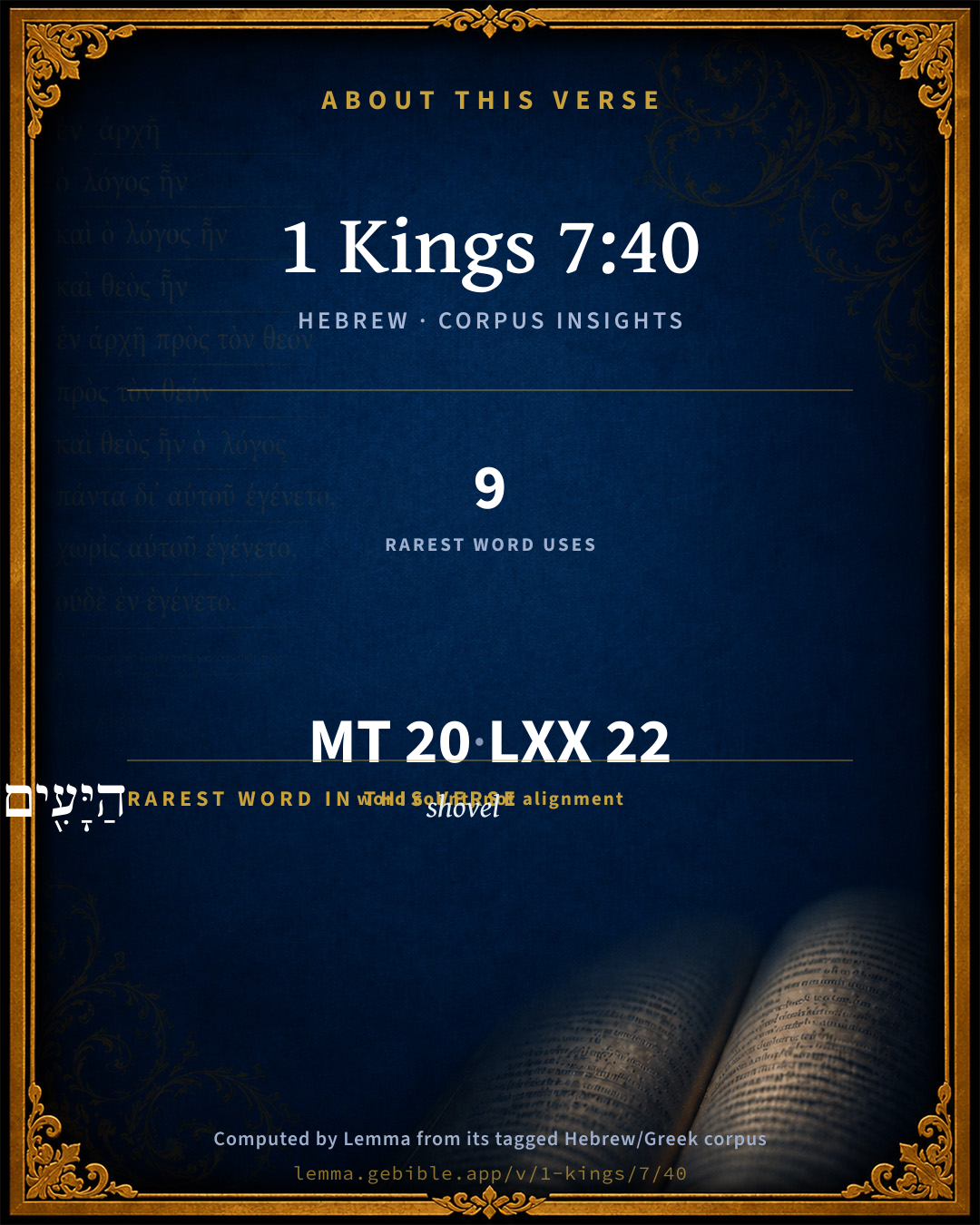
The rarest word here is הַיָּעִ֖ים shovel H3257 — appearing just 9 times in the whole Hebrew Bible.

Shared distinctive vocabulary

הַיָּעִ֖ים shovel H3257 occurs in 9 verses of the Hebrew Bible. Also found in:

Grammatical profile

  • 4 verbs
  • 11 nouns
  • 5 particles

Verb forms

  • וַיַּ֣עַשׂ Qal · Sequential Imperfect
  • וַיְכַ֣ל Piel · Sequential Imperfect
  • לַֽעֲשׂוֹת֙ Qal · Infinitive Construct
  • עָשָׂ֛ה Qal · Perfect

Repetition

Words recur within this verse — often emphatic in Hebrew:

  • וַיַּ֣עַשׂ to do H6213 ×3
  • חִיר֔וֹם Hiram H2438 ×2

Hebrew & Septuagint length

In English translation the verse runs 31 words from the Hebrew and 30 from the Septuagint (LXX English) — closely comparable.

A rough comparison of the two English renderings, which tokenize alike — not a word-level alignment.

Word counts can differ between the Hebrew and the Greek without any difference in meaning — e.g. the Hebrew direct-object marker אֵת has no separate Greek word, and Greek often adds the article ὁ.

In the original languages it is 20 Hebrew tokens and 22 Greek tokens — but the two are counted differently (Hebrew bundles its prefixes and suffixes into one token; the Greek is in lemma form), so that isn’t a like-for-like length.

Cross-references

7

Topical passages linked to 1 Kings 7:40 in the Treasury of Scripture Knowledge — connected by theme and wording, ordered by reader-vote popularity; previews shown in the World English Bible.

  • 2 Chronicles 4:11–16 Huram made the pots, and the shovels, and the basins. So Huram made an end of doing the work that he did for king Solomon in the house of God:
  • Exodus 24:6 Moses took half of the blood and put it in basins, and half of the blood he sprinkled on the altar.
  • Exodus 39:32–43 Thus all the work of the tent of the tent of meeting was finished. The children of Israel did according to all that Yahweh commanded Moses; so they did.
  • 1 Kings 7:28 The work of the bases was on this manner: they had panels; and there were panels between the ledges;
  • 2 Kings 25:14–15 The pots, and the shovels, and the snuffers, and the spoons, and all the vessels of brass with which they ministered, took they away.
  • 2 Chronicles 4:8 He made also ten tables, and placed them in the temple, five on the right side, and five on the left. He made one hundred basins of gold.
  • Jeremiah 52:18–19 The pots also, and the shovels, and the snuffers, and the basins, and the spoons, and all the vessels of brass with which they ministered, took they away.

Cross-references courtesy of OpenBible.info (CC BY 4.0).

Hebrew and Greek witnesses Masoretic Hebrew ↔ Greek Septuagint

The same verse in the two great witnesses to the Old Testament, shown verse-for-verse.

These are two independent witnesses, not word-aligned to each other, and the Septuagint is shown in lemma (dictionary) form.

Hebrew 1 Kings 7:40 Masoretic · Westminster Leningrad Codex

וַיַּ֣עַשׂ חִיר֔וֹם אֶת הַ֨כִּיֹּר֔וֹת וְאֶת הַיָּעִ֖ים וְאֶת הַמִּזְרָק֑וֹת וַיְכַ֣ל חִירָ֗ם לַֽעֲשׂוֹת֙ אֶת כָּל הַמְּלָאכָ֔ה אֲשֶׁ֥ר עָשָׂ֛ה לַמֶּ֥לֶךְ שְׁלֹמֹ֖ה בֵּ֥ית יְהוָֽה

Hiram made the basins, and the shovels, and the basins. So Hiram made an end of doing all the work that he worked for king Solomon in the house of Yahweh:

World English Bible · Public Domain

Greek LXX 1 Kings 7:40 Septuagint · lemma form

καί φατνόω ὁ οἶκος ἄνωθεν ἐπί ὁ πλευρά ὁ στῦλος καί ἀριθμός ὁ στῦλος τεσσαράκοντα καί πέντε δέκα καί πέντε ὁ στίχος

And Chiram made the caldrons, and the pans, and the bowls; and Chiram finished making all the works that he wrought for king Solomon in the house of the Lord:

LXX2012 (modern English Septuagint) · Public Domain

On this verse, Keil & Delitzsch discusses the Septuagint’s reading. Read the note in Commentary ↓

Hebrew: Westminster Leningrad Codex (CC BY 4.0). Greek: Septuagint (public domain); English from LXX2012 (modern English Septuagint) (Public Domain). How the Septuagint differs from the Hebrew →

Targum (Aramaic paraphrase)

1

The Targum is the ancient Jewish Aramaic paraphrase of the Hebrew Scriptures — an interpretive translation, not the Hebrew text itself. Onkelos (literal) and Pseudo-Jonathan (expansive) render the Torah, and Jonathan the Prophets. Coverage is partial: where no permissively-licensed English translation exists for a verse, only the Aramaic is shown. This is verse-level text, not a word-by-word alignment to the Hebrew.

  1. Targum Jonathan Prophets (Joshua–Malachi)
    וַעֲבַד חִירָם יַת כִּיוֹרַיָא וְיַת מַגְרוֹפְיָתָא וְיַת מִזְרְקַיָא וְשֵׁיצֵי חִירָם לְמֶעְבַּד יַת כָּל עֲבִידְתָא דַעֲבַד לְמַלְכָּא שְׁלֹמֹה בְּבֵית מַקְדְשָׁא דַיָי:

    (no public-domain English translation for this verse)

    Targum Jonathan — Aramaic: “Mikraot Gedolot” (public domain). English: “Sefaria Community Translation” (CC0 1.0 (public-domain dedication)); “London "Chaldee Paraphrase," 1871” (public domain). Text via Sefaria.

Commentary

Notes on 1 Kings 7:40 from classic Christian and Jewish commentators (each source and its license shown beneath its notes). The classic Christian expositions comment on the surrounding passage and are grouped to its opening verse, so a note may address several verses; the Jewish commentaries on the Tanakh (Rashi and others) are per-verse, so they appear only where the commentator wrote on this verse.

Lemma curates 59 commentaries, every one of them public domain or Creative Commons licensed, each selected and text-cleaned for this edition rather than reprinted as found. About our sources →

Trapp's Complete Commentary

John Trapp

1Ki 7:40 And Hiram made the lavers, and the shovels, and the basons. So Hiram made an end of doing all the work that he made king Solomon for the house of the LORD:

Ver. 40. And the shovels.] Which were to gather up the ashes, and to carry coals from the altar to put into the censers in the temple, for the incense.

And the basons.] Which were to receive the blood of the sacrifices, and the drink offerings.

John Trapp, A Commentary or Exposition upon All the Books of the Old and New Testament (1647–1656) — public domain. Text from a community e-Sword module.

Joseph Benson's Commentary

1Ki 7:40. Hiram made the lavers, &c. — These seem to have been the last things that he made. For he now finished all his work, most or all the particulars of which are recapitulated, with the addition of some others not mentioned before: shovels, for instance, wherewith they cleansed the altar from the ashes, and basins, wherein the priests received the blood of the sacrifices that were offered.

Joseph Benson's Commentary on the Old and New Testaments (1811–1818) — public domain. Text from a community e-Sword module.

Keil & Delitzsch

C. F. Keil & F. Delitzsch

Summary enumeration of the other vessels of the temple. - In Kg1 7:40 the brazen vessels of the court are given. In Kg1 7:41-47 the several portions of the brazen pillars, the stands and basins, the brazen sea and the smaller vessels of brass, are mentioned once more, together with notices of the nature, casting, and quantity of the metal used for making them. An din Kg1 7:48-50 we have the golden vessels of the Holy Place. This section agrees almost word for word with 2 Chron 4:11-5:1, where, moreover, not only is the arrangement observed in the previous description of the temple-building a different one, but the making of the brazen altar of burnt-offering, of the golden candlesticks, and of the table of shew-bread, and the arrangement of the great court (Ch2 4:7-9) are also described, to which there is no allusion whatever in the account before us; so that these notices in the Chronicles fill up an actual gap in the description of the building of the temple which is given here.

Kg1 7:40

The smaller brazen vessels. - Hiram made the pots, shovels, and bowls. הכּיּרות is a slip of the pen for הסּירות, pots, as we may see by comparing it with Kg1 7:45 and the parallel passages Ch2 4:11 and Kg2 25:14. The pots were used for carrying away the ashes; היּעים, the shovels, for clearing the ashes from the altar; המּזרקות were the bowls used for catching the blood, when the sacrificial animals were slaughtered: compare Exo 27:3 and Num 4:14, where forks and fire-basins or coal-pans are also mentioned.

Kg1 7:40 introduces the recapitulation of all the vessels made by Hiram. יהוה בּית, in the house of the Lord (cf. Ewald, 300, b.); in Ch2 4:11 more clearly, יי בּבית; we find it also in Kg1 7:45, for which we have in Ch2 4:16 יהוה לבית, for the house of Jehovah. The several objects enumerated in Kg1 7:41-45 are accusatives governed by לעשׂות.

Kg1 7:41-42

Kg1 7:41-44, the brazen pillars with the several portions of their capitals; see at Kg1 7:15-22. The inappropriate expression העמּדים על־פּני (upon the face of the pillars) in Kg1 7:42 is probably a mistake for הע על־שׁני, "upon the two pillars," for it could not properly be said of the capitals that they were upon the surface of the pillars.

Kg1 7:43-45

The ten stands and their basins: see at Kg1 7:27-37; Kg1 7:44, the brazen sea: vid., Kg1 7:23-26; lastly, Kg1 7:45, the pots, etc., as at Kg1 7:40. The Chethb האהל is a mistake for האלּה (Keri).

(Note: After האלּה כּל־הלּלים ואת the lxx have the interpolation, καὶ οἱ στῦλοι τεσσαράκοντα καὶ ὀκτὼ τοῦ οἴκου τοῦ βασιλέως καὶ τοῦ οἴκου Κυρίου, which is proved to be apocryphal by the marvellous combination of the king's house and the house of God, though it is nevertheless regarded by Thenius as genuine, and as an interesting notice respecting certain pillars in the enclosure of the inner court of the temple, and in the king's palace!)

ממרט נהשׁת, of polished brass - accusative of the material governed by עשׂה.

Kg1 7:46

"In the Jordan valley he cast them - in thickened earth between Succoth and Zarthan," where the ground, according to Burckhardt, Syr. ii. p. 593, is marly throughout. האדמה בּמעבה, "by thickening of the earth," the forms being made in the ground by stamping together the clayey soil. Succoth was on the other side of the Jordan, - not, however, at the ford near Bethsean (Thenius), but on the south side of the Jabbok (see at Jdg 8:5 and Gen 33:17). Zarthan or Zereda was in the Jordan valley on this side, probably at Kurn Sartabeh (see at Jdg 7:22 and Jos 3:16). The casting-place must have been on this side of the Jordan, as the (eastern) bank on the other side has scarcely any level ground at all. The circumstance that a place on the other side is mentioned in connection with one on this side, may be explained from the fact that the two places were obliquely opposite to one another, and in the valley on this side there was no large place in the neighbourhood above Zarthan which could be appropriately introduced to define the site of the casting-place.

Kg1 7:47

Solomon left all these vessels of excessive number unweighed. ויּנּח does not mean he laid them down (= set them up: Movers), but he let them lie, i.e., unweighed, as the additional clause, "the weight of the brass was not ascertained," clearly shows. This large quantity of brass, according to Ch1 18:8, David had taken from the cities of Hadadezer, adding also the brass presented to him by Toi.

Kg1 7:48-49

The golden vessels of the Holy Place (cf. Ch2 4:19-22). The vessels enumerated here are divided, by the repetition of סגוּר זהב in Kg1 7:49, Kg1 7:50, into two classes, which were made of fine gold; and to this a third class is added in Kg1 7:50 which was made of gold of inferior purity. As סגוּר זהב is governed in both instances by ויּעשׂ as an accusative of the material, the זהב (gold) attached to the separate vessels must be taken as an adjective. "Solomon made all the vessels in the house of Jehovah (i.e., had them made): the golden altar, and the golden table on which was the shew-bread, and the candlesticks ... of costly gold (סגוּר: see at Kg1 6:20). The house of Jehovah is indeed here, as in Kg1 7:40, the temple with its courts, and not merely the Holy Place, or the temple-house in the stricter sense; but it by no means follows from this that כּל־הלּלים, "all the vessels," includes both the brazen vessels already enumerated and also the golden vessels mentioned afterwards. A decisive objection to our taking the כּל (all) as referring to those already enumerated as well as those which follow, is to be found in the circumstance that the sentence commencing with ויּעשׂ is only concluded with סגוּר זהב in Kg1 7:49. It is evident from this that כּל־הלּלים is particularized in the several vessels enumerated from סגוּר את onwards. These vessels no doubt belonged to the Holy Place or temple-house only; though this is not involved in the expression "the house of Jehovah," but is apparent from the context, or from the fact that all the vessels of the court have already been enumerated in Kg1 7:40-46, and were made of brass, whereas the golden vessels follow here. That there were intended for the Holy Place is assumed as well known from the analogy of the tabernacle. יהוה בּית אשׁר merely affirms that the vessels mentioned afterwards belonged to the house of God, and were not prepared for the palace of Solomon or any other earthly purpose. We cannot infer from the expression "Solomon made" that the golden vessels were not made by Hiram the artist, as the brazen ones were (Thenius). Solomon is simply named as the builder of the temple, and the introduction of his name was primarily occasioned by Kg1 7:47. The "golden altar" is the altar of incense in the Holy Place, which is called golden because it was overlaid with gold-plate; for, according to Kg1 6:20, its sides were covered with cedar wood, after the analogy of the golden altar in the tabernacle (Exo 30:1-5). "And the table, upon which the shew-bread, of gold." זהב belongs to השּׁלחן, to which it stands in free subjection (vid., Ewald, 287, h), signifying "the golden table." Instead of השּׁלחן we have השּׁלחנות in Ch2 4:19 (the tables), because there it has already been stated in Ch2 4:8 that ten tables were made, and put in the Holy Place. In our account that verse is omitted; and hence there is only a notice of the table upon which the loaves of shew-bread generally lay, just as in Ch2 29:18, in which the chronicler does not contradict himself, as Thenius fancies. The number ten, moreover, is required and proved to be correct in the case of the tables, by the occurrence of the same number in connection with the candlesticks. In no single passage of the Old Testament is it stated that there was only one table of shew-bread in the Holy Place of Solomon's temple.

(Note: Nothing can be learned from Ch2 29:18 concerning the number of the vessels in the Holy Place. If we were to conclude from this passage that there were no more vessels in the Holy Place than are mentioned there, we should also have to assume, if we would not fall into a most unscientific inconsistency, that there was neither a candlestick nor a golden altar of incense in the Holy Place. The correct meaning of this passage may be gathered from the words of King Abiam in Ch2 13:11 : "We lay the shew-bread upon the pure table, and light the golden candlestick every evening;" from which it is obvious that here and there only the table and the candlestick are mentioned, because usually only one table had shew-bread upon it, and only one candlestick was lighted.)

The tables were certainly made of wood, like the Mosaic table of shew-bread, probably of cedar wood, and only overlaid with gold (see at Exo 25:23-30). "And the candlesticks, five on the right and five on the left, before the back-room." These were also made in imitation of the Mosaic candlestick (see Exo 25:31.), and were probably placed not near to the party wall in a straight line to the right and left of the door leading into the Most Holy Place, but along the two longer sides of the Holy Place; and the same with the tables, except that they stood nearer to the side walls with the candlesticks in front of them, so that the whole space might be lighted more brilliantly. The altar of burnt-offering, on the contrary, stood in front of and very near to the entrance into the Most Holy Place (see at Kg1 6:20).

In the following clause (Kg1 7:49, Kg1 7:50) the ornaments of the candlesticks are mentioned first, and then the rest of the smaller golden vessels are enumerated. הפּרח, the flower-work, with which the candlesticks were ornamented (see Exo 25:33). The word is evidently used collectively here, so that the גּביעים mentioned along with them in the book of Exodus (l.c.) are included. הגּרת, the lamps, which were placed upon the shaft and arms of the candlestick (Exo 25:37). המּלקחים, the snuffers (Exo 25:38). ספּות, basins in Exo 12:22, here probably deep dishes (Schalen). מזמּרות, knives. מזרקות, bowls (Schalen) or cans with spouts for the wine for the libations; according to Ch2 4:8, there were a hundred of these made. כּפּות, small flat vessels, probably for carrying the incense to the altar. מחתּות, extinguishers; see at Exo 25:38.

Kg1 7:50-51

The פּתות were also of gold, possibly of inferior quality. These were either the hinges of the doors, or more probably the sockets, in which the pegs of the doors turned. They were provided for the doors of the inner temple, viz., the Holy Place and the Most Holy Place. We must supply Vv before לדלתי.

All the vessels mentioned in Kg1 7:48, Kg1 7:49 belonged to the Holy Place of the temple, and were the same as those in the tabernacle; so that the remarks made in the Comm. on Exo 25:30, Exo 25:39, and Exo 30:1-10, as to their purpose and signification, apply to them as well. Only the number of the tables and candlesticks was ten times greater. If a multiplication of the number of these two vessels appeared appropriate on account of the increases in the size of the room, the number was fixed at ten, to express the idea of completeness by that number. No new vessel was made for the Most Holy Place, because the Mosaic ark of the covenant was placed therein (Kg1 8:4 : compare the remarks on this at Exo 25:10-22). - The account of the vessels of the temple is brought to a close in Kg1 7:51 : "So was ended all the work that king Solomon made in the house of the Lord; and Solomon brought all that was consecrated by his father, (namely) the silver and the gold (which were not wrought), and the vessels he placed in the treasuries of the house of Jehovah." As so much gold and brass had already been expended upon the building, it might appear strange that Solomon should not have used up all the treasures collected by his father, but should still be able to bring a large portion of it into the treasuries of the temple. But according to Ch1 22:14, Ch1 22:16, and Ch1 29:2., David had collected together an almost incalculable amount of gold, silver, and brass, and had also added his own private treasure and the freewill offerings of the leading men of the nation (Ch1 29:7-9). Solomon was also able to devote to the building of the temple a considerable portion of his own very large revenues (cf. Kg1 10:14), so that a respectable remnant might still be left of the treasure of the sanctuary, which was not first established by David, but had been commenced by Samuel and Saul, and in which David's generals, Joab and others, had deposited a portion of the gold and silver that they had taken as booty (Ch1 26:20-28). For it is evident that not a little had found its way into this treasure through the successful wars of David, from the fact that golden shields were taken from the generals of Hadadezer, and that these were consecrated to the Lord along with the silver, golden, and brazen vessels offered as gifts of homage by king Toi of Hamath, in addition to the gold and silver which David had consecrated from the defeated Syrians, Moabites, Ammonites, Philistines, and Amalekites (Sa2 8:7, Sa2 8:11-12; Ch1 18:7, Ch1 18:10-11).

(Note: The amazing extent to which this booty may possibly have reached, may be inferred from the accounts we have concerning the quantity of the precious metals in Syria in the Macedonian age. In the gaza regia of Damascus, Alexander found 2600 talents of gold and 600 talents of uncoined silver (Curt. iii. 13, 16, cf. Arrian, ii. 11, 10). In the temple of Jupiter at Antioch there was a statue of this god of solid silver fifteen cubits high (Justin, xxxix. 2, 5. 6); and in the temple at Hierapolis there was also a golden statue (Lucian, de Dea Syr. 31). According to Appian (Parth. 28, ed. Schweigh.), this temple was so full of wealth, that Crassus spent several days weighing the vessels of silver and gold. And from the unanimous testimony of the ancients, the treasures of the palaces and temples of Asia in the earlier times were greater still. Of the many accounts which Bhr (Symbolik, i. p. 258ff.) and Movers (Phnizier, ii. 3, p. 40ff.) have collected together on this subject, we will mention only a few here, the credibility of which cannot be disputed. According to Varro (in Plin. 33:15), Cyrus had taken 34,000 pounds of gold as booty after the conquest of Asia, beside the gold wrought into vessels and ornaments, and 500,000 talents of silver. In Susa, Alexander took 40,000, or, according to other accounts, 50,000, talents from the royal treasury; or, as it is still more definitely stated, 40,000 talents of uncoined gold and silver, and 9000 talents of coined dariks. Alexander had these brought to Ecbatana, where he accumulated 180,000 talents. Antigonus afterwards found in Susa 15,000 talents more in vessels and wrought gold and silver. In Persepolis, Alexander took 120,000 talents, and in Pasargada 6000 talents. For the proofs, see Movers, pp. 42, 43.)

Keil & Delitzsch — Biblical Commentary on the Old Testament (1861–1891) — public domain (CC PDM 1.0). Text via the HelloAO Bible API. (Old Testament only.)

Tyndale Open Study Notes

Tyndale Open Resources

7:40-45 Huram had great skill in casting items of varying size and complexity. He also made the bronze altar for the inner court that was used for burnt offerings (2 Chr 4:1).

Tyndale Open Study Notes — © Tyndale Open Resources, licensed CC BY-SA 4.0. Text via the HelloAO Bible API.

Jamieson, Fausset & Brown

Robert Jamieson, A. R. Fausset & David Brown

And Hiram made the lavers, and the shovels, and the basins--These verses contain a general enumeration of Hiram's works, as well as those already mentioned as other minor things. The Tyrian artists are frequently mentioned by ancient authors as skilful artificers in fashioning and embossing metal cups and bowls; and we need not wonder, therefore, to find them employed by Solomon in making the golden and brazen utensils for his temple and palaces.

Jamieson, Fausset & Brown — Commentary Critical and Explanatory on the Whole Bible (1871) — public domain (CC PDM 1.0). Text via the HelloAO Bible API.

Adam Clarke's Commentary

Verse 40. So Hiram made an end] It is truly surprising, that in so short a time one artist could design and execute works of such magnitude, taste, and variety, however numerous his assistants might be. The mere building of the house was a matter of little difficulty in comparison of these internal works.

Adam Clarke's Commentary on the Bible (1810–1826) — public domain. Text from a community e-Sword/MySword module.

Ellicott's Commentary for English Readers

(40) The lavers.—These should be (as in 1Ki_7:45) “pots.” The verse describes the completion of Hiram’s work by the making of the smaller vessels.

It is curious that no mention is made of the construction of the brasen altar. It has been supposed by some that the old altar reared by David (2Sa_24:25) was retained. But in 2Ch_4:1, and in Josephus’s account, it is expressly said that a brasen altar was made by Hiram, 30 feet square and 15 feet high. Probably, therefore, the absence of all mention of it here is simply an omission in the record.

A Bible Commentary for English Readers, edited by Charles John Ellicott (1878–1897) — public domain. Text from a community e-Sword module.

The Cambridge Bible for Schools and Colleges

gen. ed. J. J. S. Perowne

40–51. Summary of Hiram’s work. Completion of the Temple (2Ch_4:11-22; 2Ch_5:1)

40. And Hiram made the lavers] Many ancient authorities (see R.V. marg.) read pots instead of ‘lavers,’ and this is given in 2Ch_4:11. The difference is so slight between כירות = lavers, and סירות = pots, that we need not be surprised at the variation in different mss.

that he made king Solomon] R.V. reads, with the same sense, ‘that he wrought for king Solomon.’ Perhaps it reads a little more easily. In some mss. and Versions the reading is ‘that king Solomon made,’ just as in 1Ki_7:51 below, where the same phrase is used of the whole work.

The Cambridge Bible for Schools and Colleges (gen. ed. J. J. S. Perowne; Cambridge University Press, 1878–1918) — public domain. Text from a community e-Sword module.

John Gill's Exposition

In the plain of Jericho did the king cast them in the clay ground,.... Which being thick, as the word signifies, and stiff and close, was fit for such a purpose as casting brass; of such clay, furnaces of earth used to be made to melt metals in; but here were large things to be cast, as the two pillars, the sea, the ten lavers, &c. moulds were made in the ground, and so the melted brass was poured into them, which gave it its different forms; this, no doubt, was done by Hiram, though said to be done by the king, because done by his orders: the place where it was done was a part of the plain of Jericho, which lay

between Succoth and Zarthan; Succoth was in the tribe of Gad, on the other side Jordan; Zarthan was near it on this side, in the tribe of Manasseh, the same that is called Zartanah, Kg1 4:12 and Zaretan, Jos 3:16 and Zeredathah, Ch2 4:17. The first casters of brass are said (h) to be Theodorus and Rhaecus, both Samians.

(h) Pausau. Arcadica, sive, l. 8. p. 479. & Boeotica, sive, l. 9. p. 607.

John Gill's Exposition of the Whole Bible (1746–1763) — public domain (CC PDM 1.0). Text via the HelloAO Bible API.

Albert Barnes' Notes on the Bible

Lavers - Rather, according to the true reading, “pots.” (Compare 1Ki 7:45; 2Ch 4:16.) The “pots” were the caldrons in which it was usual to boil the peace-offerings. See 1Sa 2:13-14,

Albert Barnes' Notes on the Bible (1834–1885) — public domain. Text from a community e-Sword/MySword module.

Haydock's Catholic Bible Commentary

Shovels. Scutras may also signify "cauldrons," from their resemblance with a shield. These terms occur [in] Exodus xxvii. 3., (Calmet) and are there properly translated, shovels, &c. (Haydock) --- The Jews say there were always , at least, three things of the same species, that one might be ready in case another was defiled.

George Leo Haydock (1774–1849), Haydock's Catholic Family Bible and Commentary, 1859 edition — public domain. Excludes Psalms (Douay-Rheims chapter numbering differs from Protestant) and Deuterocanonical books (Catholic canon only).

The Pulpit Commentary

And Hiram made the layers So the Rec. Text. But perhaps we ought to read twOrysi, i.e., pots, here, as in ver. 45 and 2Ch_4:11. This word is joined with shovels and basons, not only in these two passages, but also in Exo_27:3, 2Ki_25:14, Jer_52:18; in other words, the appropriate term in this connexion would be "pots," while "layers," having been just mentioned in ver. 38, would involve an idle repetition. Altogether, therefore, there can be little doubt that we should here read twrysh for twrykh. It is apparently the reading of the Chald., LXX, and some MSS. These" pots "were used, not for carrying away the ashes (Keil), but, as the name implies (rysi, effervescere), for boiling the flesh of the peace offering, (1Sa_2:13, 1Sa_2:14) and the shovels these, again, as the name implies (y from hy abstulit; see Gesen., Thesaurus, p. 607), were used for taking away the ashes from the altar (Exo_27:3; Num_4:14) and the basons. The sacrificial bowls for receiving the blood of the victims Exo_38:3; Num_4:14 So Hiram made an end of doing all the work the writer now recapitulates the work of Hiram. The repetition may be due to the fact that the history was compiled from various lists and documents that he made king Solomon for Heb. omits the prep. the house of the Lord.

The Pulpit Commentary (1880–1919), ed. H.D.M. Spence-Jones & Joseph S. Exell — public domain. Text from a community e-Sword module.

unfoldingWord translationNotes

Door43 World Missions Community

Huram made ... he finished

Huram would have commanded his workers to do this work. AT: "Huram had them make ... they finished" (See: Metonymy)

the bowl-like capitals

The capitals were shaped like bowls. (See: Simile)

decorative latticework

"crossed metal strips woven together"

translationWords

king

Solomon

temple

Yahweh

column

unfoldingWord translationNotes — © Distant Shores Media and the Door43 World Missions Community, licensed CC BY-SA 4.0. Source: git.door43.org/Door43/en_tn.

Rashi

Rabbi Shlomo Yitzchaki (Rashi)

And Chirom made, etc. And Rebbi said, that the כיורות are one and the same as the סירות, as it is stated, “like a pan of fire burning wood,” and similarly, “and he thrust it into the pan.”

The [wash] basins. Of copper, used to remove the ashes from the altar.

The rakes. Copper shovels which are called vedil, in German, [were used] to rake the ashes into the pots.

Rashi on the Tanakh — English translations: “The Judaica Press complete Tanach with Rashi, translated by A. J. Rosenberg” (CC BY 4.0); “Pentateuch with Rashi's commentary by M. Rosenbaum and A.M. Silbermann, 1929-1934” (public domain); “The Metsudah Tanach series, Lakewood, N.J” (CC BY 4.0); and “The Book of Joshua, Metsudah Publications, 1997” (CC BY 4.0). Text via Sefaria.

Lesson kit

Teaching starters — assembled from the data on this page, not authored interpretation. Every prompt links to the verse data it draws on. Edit before teaching.

1 Kings, in the Historical, opens this verse with 20 words (14 distinct Hebrew lemmas). Its most distinctive word is yâʻ (“shovel”). A historical commentator’s framing appears above. Read the whole chapter for the surrounding context.

Discussion questions

  1. How does “shovel” (yâʻ) shape what this verse is saying?
  2. Exodus 27:3 shares the word «shovel» with this verse. How do the two illuminate each other?
  3. “to do” occurs 3× in this one verse. What is the effect of the repetition?
  4. These translations render this verse differently. What is at stake in choosing one wording over another?
  5. The verb «וַיַּ֣עַשׂ» is Qal Sequential Imperfect. How does its form color the action?
  6. Reading how Trapp's Complete Commentary and Joseph Benson's Commentary read this verse, where do the two commentators agree and where do they part?

Things to notice

Reading settings

Reading text

Shown beneath each verse's original-language words.

Old Testament
Old Testament edition

Read the OT as the Masoretic Hebrew (MT) or the Greek Septuagint (LXX).

English shown for the Greek Septuagint (in the Hebrew ↔ Greek comparison).

Comparing translations? Open the Compare panel on any verse page to stack up to four side by side.