
Ezekiel 7:8

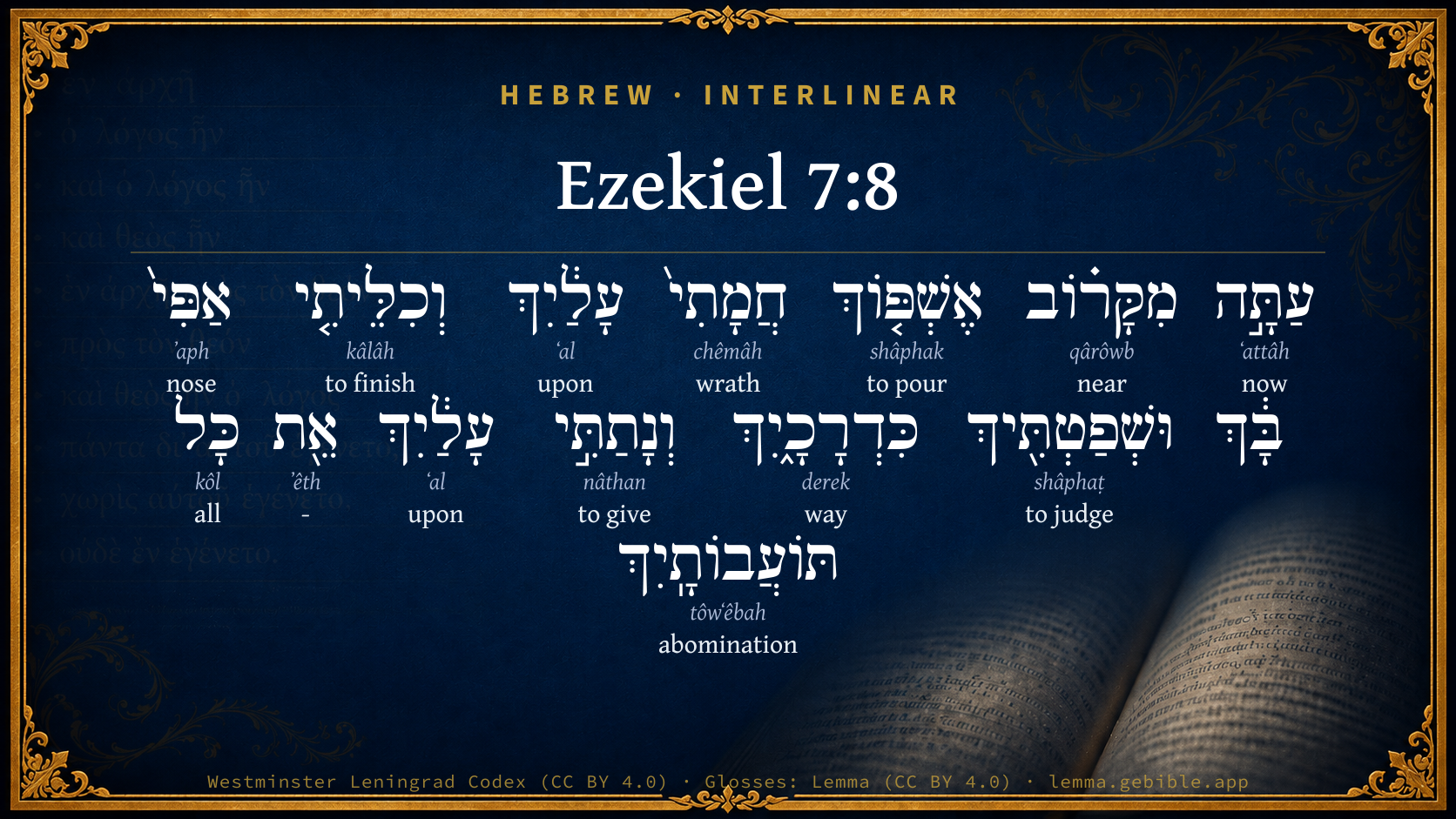
Hebrew (Westminster Leningrad Codex) Ezekiel 7:8 appears in the Hebrew Old Testament. The text above is from the Westminster Leningrad Codex. Each word links to its Strong’s number, a concise gloss, and parsing drawn from the Open Scriptures Hebrew Bible morphology. Click any word for its full Brown-Driver-Briggs (BDB) entry.
Download image
Cite this verse

Ezekiel 7:8 (World English Bible). Public Domain. Lemma interlinear Bible study tool, https://lemma.gebible.app/v/ezekiel/7/8.

Show BibTeX & RIS
BibTeX
RIS
English Translation
Now will I shortly pour out my wrath on you, and accomplish my anger against you, and will judge you according to your ways; and I will bring on you all your abominations.
World English Bible · Public Domain
Download a study sheet

One document with this verse’s original text, its word-by-word gloss line, the meaning frame, cross-references with their text, attributed commentary, and full source and license credits — printable, and it pastes into notes with its structure intact.

This verse Autodidact and up

Study sheet (.html) Plain text (.txt)

A passage Seminary Student

Up to 50 verses in one chapter. A passage sheet keeps up to 6 commentary sources and 12 cross-references per verse, in the order this page ranks them, and says so on the sheet whenever that leaves anything out. Ask for a single verse and you get the Autodidact verse sheet above.

Everything on this page stays free to read, with no account — the sheet is a download of what is already on screen, not access to it.

Want to remove ads? Support Godless Engineer
Compare translations 3

The same verse in 3 English versions, stacked beneath the original-language interlinear above. Click any original word for its lexicon entry.

Each is an independent rendering of the whole verse — the interlinear is not word-aligned to these translations.

Highlighted words mark where these versions differ — a whole-verse word diff, not a word-by-word alignment.

  • World English Bible Public Domain
    Now will I shortly pour out my wrath on you, and accomplish my anger against you, and will judge you according to your ways; and I will bring on you all your abominations.
  • King James Version Public Domain
    Now will I shortly pour out my fury upon thee, and accomplish mine anger upon thee: and I will judge thee according to thy ways, and will recompense thee for all thine abominations.
  • unfoldingWord Literal Text CC BY-SA 4.0
    Now before long I will pour out my fury against you and fill up my wrath upon you when I judge you according to your ways and bring all your abominations upon you.

unfoldingWord Literal Text — © unfoldingWord, licensed CC BY-SA 4.0. Word-aligned USFM3 via Door43 (git.door43.org/unfoldingWord/en_ult).

Versions to compare (up to 4)

3 of 4 selected

Show all 18 translations

Every available English version of this verse, each an independent rendering of the whole verse.

  • World English Bible Public Domain
    Now will I shortly pour out my wrath on you, and accomplish my anger against you, and will judge you according to your ways; and I will bring on you all your abominations.
  • Berean Standard Bible Public Domain
    Very soon I will pour out My wrath upon you and vent My anger against you; I will judge you according to your ways and repay you for all your abominations.
  • Majority Standard Bible Public Domain
    Very soon I will pour out My wrath upon you and vent My anger against you; I will judge you according to your ways and repay you for all your abominations.
  • King James Version Public Domain
    Now will I shortly pour out my fury upon thee, and accomplish mine anger upon thee: and I will judge thee according to thy ways, and will recompense thee for all thine abominations.
  • American Standard Version (1901) Public Domain
    Now will I shortly pour out my wrath upon thee, and accomplish mine anger against thee, and will judge thee according to thy ways; and I will bring upon thee all thine abominations.
  • Revised Version (1885) Public Domain
    Now will I shortly pour out my fury upon thee, and accomplish mine anger against thee, and will judge thee according to thy ways; and I will bring upon thee all thine abominations.
  • Geneva Bible (1599) Public Domain
    Now I will shortly powre out my wrath vpon thee, and fulfil mine anger vpon thee: I will iudge thee according to thy wayes, and will lay vpon thee all thine abominations.
  • Douay-Rheims (1899) Public Domain
    Now very shortly I will pour out my wrath upon thee, and I will accomplish my anger in thee: and I will judge thee according to thy ways, and I will lay upon thee all thy crimes.
  • Young's Literal Translation Public Domain
    Now, shortly I pour out My fury on thee, And have completed Mine anger against thee, And judged thee according to thy ways, And set against thee all thine abominations.
  • Literal Standard Version CC BY-SA 4.0
    Now shortly I pour out My fury on you, || And have completed My anger against you, || And judged you according to your ways, || And set all your abominations against you.
  • Unlocked Literal Bible CC BY-SA 4.0
    Now before long I will pour out my fury against you and fill up my wrath upon you when I judge you according to your ways and bring all your abominations upon you.
  • unfoldingWord Literal Text CC BY-SA 4.0
    Now before long I will pour out my fury against you and fill up my wrath upon you when I judge you according to your ways and bring all your abominations upon you.
  • Darby Bible Public Domain
    Now will I soon pour out my fury upon thee, and accomplish mine anger against thee; and I will judge thee according to thy ways, and will bring upon thee all thine abominations.
  • World Messianic Bible Public Domain
    Now I will shortly pour out my wrath on you, and accomplish my anger against you, and will judge you according to your ways. I will bring on you all your abominations.
  • Webster's Bible Public Domain
    Now will I shortly pour out my fury upon thee, and accomplish my anger upon thee: and I will judge thee according to thy ways, and will recompense thee for all thy abominations.
  • Free Bible Version CC BY-SA 4.0
    Very shortly I'm going to show you how angry I am with you. I will judge you by what you have done, and punish you for all your disgusting sins.
  • Bible in Basic English Public Domain
    Now, in a little time, I will let loose my passion on you, and give full effect to my wrath against you, judging you for your ways, and sending punishment on you for all your disgusting works.
  • JPS Tanakh (1917) Public Domain
    Now will I shortly pour out My fury upon thee, and spend Mine anger upon thee, and will judge thee according to thy ways; and I will bring upon thee all thine abominations.

Literal Standard Version (2020), Covenant Press — licensed CC BY-SA 4.0. Text via the HelloAO Bible API (eBible.org). Unlocked Literal Bible (unfoldingWord) — licensed CC BY-SA 4.0. Text via the HelloAO Bible API (eBible.org). unfoldingWord Literal Text — © unfoldingWord, licensed CC BY-SA 4.0. Word-aligned USFM3 via Door43 (git.door43.org/unfoldingWord/en_ult). Free Bible Version, Dr. Jonathan Gallagher — licensed CC BY-SA 4.0. Text via the HelloAO Bible API (eBible.org).

Word by word

More ways to search: Search by grammar → Find every occurrence → Compare this word →

Practice this passage: Drill this verse → Learn its vocabulary →

מִקָּר֗וֹב
qârôwb
H7138
“from · near”
Preposition + Adjective, Adjective, Masculine, Singular, Absolute
Part of Speech
Preposition + Adjective
Type
Adjective
Gender
Masculine
Number
Singular
State
Absolute
Full BDB Definition

Origin: from H7126

TWOT: 2065d

near - of place - of time - of personal relationship - kinship
  1. עַתָּ֣ה ʻattâh H6258 “now” Adverb
  2. אֶשְׁפּ֤וֹךְ shâphak H8210 “to pour” Verb, Qal, Imperfect, 1st Person, Common, Singular
  3. חֲמָתִי֙ chêmâh H2534 “wrath · my” Noun, Common, Feminine, Singular, Construct + Suffix, Personal, 1st Person, Common, Singular
  4. עָלַ֔יִךְ ʻal H5921 “upon · you” Preposition + Suffix, Personal, 2nd Person, Feminine, Singular
  5. וְכִלֵּיתִ֤י kâlâh H3615 “and · to finish” Conjunction + Verb, Piel, Sequential Perfect, 1st Person, Common, Singular
  6. אַפִּי֙ ʼaph H639 “nose · my” Noun, Common, Masculine, Singular, Construct + Suffix, Personal, 1st Person, Common, Singular
  7. וּשְׁפַטְתִּ֖יךְ shâphaṭ H8199 “and · to judge · you” Conjunction + Verb, Qal, Sequential Perfect, 1st Person, Common, Singular + Suffix, Personal, 2nd Person, Feminine, Singular
  8. כִּדְרָכָ֑יִךְ derek H1870 “like/as · ways · your” Preposition + Noun, Common, Both, Plural, Construct + Suffix, Personal, 2nd Person, Feminine, Singular
  9. וְנָתַתִּ֣י nâthan H5414 “and · to give” Conjunction + Verb, Qal, Sequential Perfect, 1st Person, Common, Singular
  10. עָלַ֔יִךְ ʻal H5921 “upon · you” Preposition + Suffix, Personal, 2nd Person, Feminine, Singular
  11. אֵ֖ת ʼêth H853 “-” Particle, Direct Object
  12. כָּל kôl H3605 “all of” Noun, Common, Masculine, Singular, Construct
  13. תּוֹעֲבוֹתָֽיִךְ tôwʻêbah H8441 “abominations · your” Noun, Common, Feminine, Plural, Construct + Suffix, Personal, 2nd Person, Feminine, Singular

About this verse

These counts appear in no published source. They are computed here, from the morphology-tagged text and Lemma’s own curated glosses. What Lemma adds →

15
words
13
distinct lemmas
Prophets
section

Grammatical profile

  • 4 verbs
  • 5 nouns
  • 1 adjective
  • 3 prepositions
  • 1 adverb
  • 1 particle

Verb forms

  • אֶשְׁפּ֤וֹךְ Qal · Imperfect
  • וְכִלֵּיתִ֤י Piel · Sequential Perfect
  • וּשְׁפַטְתִּ֖יךְ Qal · Sequential Perfect
  • וְנָתַתִּ֣י Qal · Sequential Perfect

Repetition

A word recurs within this verse — often emphatic in Hebrew:

  • עָלַ֔יִךְ upon H5921 ×2

Hebrew & Septuagint length

In English translation the verse runs 33 words from the Hebrew and 38 from the Septuagint (LXX English) — closely comparable.

A rough comparison of the two English renderings, which tokenize alike — not a word-level alignment.

Word counts can differ between the Hebrew and the Greek without any difference in meaning — e.g. the Hebrew direct-object marker אֵת has no separate Greek word, and Greek often adds the article ὁ.

Cross-references

23

Topical passages linked to Ezekiel 7:8 in the Treasury of Scripture Knowledge — connected by theme and wording, ordered by reader-vote popularity; previews shown in the World English Bible.

  • Ezekiel 9:8 It happened, while they were smiting, and I was left, that I fell on my face, and cried, and said, Ah Lord Yahweh! will you destroy all the residue of Israel in your pouring out of your wrath on Jerusalem?
  • Ezekiel 14:19 Or if I send a pestilence into that land, and pour out my wrath on it in blood, to cut off from it man and animal;
  • Isaiah 42:25 Therefore he poured on him the fierceness of his anger, and the strength of battle; and it set him on fire round about, yet he didn't know; and it burned him, yet he didn't lay it to heart.
  • Ezekiel 20:8 But they rebelled against me, and would not listen to me; they did not every man cast away the abominations of their eyes, neither did they forsake the idols of Egypt. Then I said I would pour out my wrath on them, to accomplish my anger against them in the midst of the land of Egypt.
  • Ezekiel 20:21 But the children rebelled against me; they didn't walk in my statutes, neither kept my ordinances to do them, which if a man do, he shall live in them; they profaned my Sabbaths. Then I said I would pour out my wrath on them, to accomplish my anger against them in the wilderness.
  • Nahum 1:6 Who can stand before his indignation? Who can endure the fierceness of his anger? His wrath is poured out like fire, and the rocks are broken apart by him.
  • Ezekiel 20:33 As I live, says the Lord Yahweh, surely with a mighty hand, and with an outstretched arm, and with wrath poured out, will I be king over you:
  • 2 Chronicles 34:21 Go you, inquire of Yahweh for me, and for those who are left in Israel and in Judah, concerning the words of the book that is found; for great is the wrath of Yahweh that is poured out on us, because our fathers have not kept the word of Yahweh, to do according to all that is written in this book.
  • Psalms 79:6 Pour out your wrath on the nations that don't know you; On the kingdoms that don't call on your name;
  • Jeremiah 7:20 Therefore thus says the Lord Yahweh: Behold, my anger and my wrath shall be poured out on this place, on man, and on animal, and on the trees of the field, and on the fruit of the ground; and it shall burn, and shall not be quenched.
  • Lamentations 2:4 He has bent his bow like an enemy, he has stood with his right hand as an adversary, Has killed all that were pleasant to the eye: In the tent of the daughter of Zion he has poured out his wrath like fire.
  • Lamentations 4:11 Yahweh has accomplished his wrath, he has poured out his fierce anger; He has kindled a fire in Zion, which has devoured the foundations of it.
  • Ezekiel 6:12 He who is far off shall die of the pestilence; and he who is near shall fall by the sword; and he who remains and is besieged shall die by the famine: thus will I accomplish my wrath on them.
  • Ezekiel 7:3–4 Now is the end on you, and I will send my anger on you, and will judge you according to your ways; and I will bring on you all your abominations.
  • Ezekiel 20:13 But the house of Israel rebelled against me in the wilderness: they didn't walk in my statutes, and they rejected my ordinances, which if a man keep, he shall live in them; and my Sabbaths they greatly profaned. Then I said I would pour out my wrath on them in the wilderness, to consume them.
  • Ezekiel 22:31 Therefore have I poured out my indignation on them; I have consumed them with the fire of my wrath: their own way have I brought on their heads, says the Lord Yahweh.
  • Ezekiel 30:15 I will pour my wrath on Sin, the stronghold of Egypt; and I will cut off the multitude of No.
  • Ezekiel 36:18–19 Therefore I poured out my wrath on them for the blood which they had poured out on the land, and because they had defiled it with their idols;
  • Daniel 9:11 Yes, all Israel have transgressed your law, even turning aside, that they should not obey your voice: therefore has the curse been poured out on us, and the oath that is written in the law of Moses the servant of God; for we have sinned against him.
  • Daniel 9:27 He shall make a firm covenant with many for one week: and in the midst of the week he shall cause the sacrifice and the offering to cease; and on the wing of abominations [shall come] one who makes desolate; and even to the full end, and that determined, shall [wrath] be poured out on the desolate.
  • Hosea 5:10 The princes of Judah are like those who remove a landmark. I will pour out my wrath on them like water.
  • Revelation 14:10 he also will drink of the wine of the wrath of God, which is prepared unmixed in the cup of his anger. He will be tormented with fire and sulfur in the presence of the holy angels, and in the presence of the Lamb.
  • Revelation 16:2–21 The first went, and poured out his bowl into the earth, and it became a harmful and evil sore on the people who had the mark of the beast, and who worshiped his image.

Cross-references courtesy of OpenBible.info (CC BY 4.0).

Hebrew and Greek witnesses Masoretic Hebrew ↔ Greek Septuagint

The same verse in the two great witnesses to the Old Testament, shown verse-for-verse.

These are two independent witnesses, not word-aligned to each other, and the Septuagint is shown in lemma (dictionary) form.

Hebrew Ezekiel 7:8 Masoretic · Westminster Leningrad Codex

עַתָּ֣ה מִקָּר֗וֹב אֶשְׁפּ֤וֹךְ חֲמָתִי֙ עָלַ֔יִךְ וְכִלֵּיתִ֤י אַפִּי֙ בָּ֔ךְ וּשְׁפַטְתִּ֖יךְ כִּדְרָכָ֑יִךְ וְנָתַתִּ֣י עָלַ֔יִךְ אֵ֖ת כָּל תּוֹעֲבוֹתָֽיִךְ

Now will I shortly pour out my wrath on you, and accomplish my anger against you, and will judge you according to your ways; and I will bring on you all your abominations.

World English Bible · Public Domain

Greek LXX Ezekiel 7:8 Septuagint · lemma form

οὐ φείδομαι ὁ ὀφθαλμός ἐγώ ἐπί σύ οὐδέ μή ἐλεέω διότι ὁ ὁδός σύ ἐπί σύ δίδωμι καί ὁ βδέλυγμα σύ ἐν μέσος σύ εἰμί καί ἐπιγιγνώσκω διότι ἐγώ κύριος

My eye shall not spare, nor will I have any mercy: for I will recompense your way upon you, and your abominations shall be in the midst of you; and you shall know that I am the Lord.

LXX2012 (modern English Septuagint) · Public Domain

On this verse, The Cambridge Bible for Schools and Colleges discusses the Septuagint’s reading. Read the note in Commentary ↓

Hebrew: Westminster Leningrad Codex (CC BY 4.0). Greek: Septuagint (public domain); English from LXX2012 (modern English Septuagint) (Public Domain). How the Septuagint differs from the Hebrew →

Targum (Aramaic paraphrase)

1

The Targum is the ancient Jewish Aramaic paraphrase of the Hebrew Scriptures — an interpretive translation, not the Hebrew text itself. Onkelos (literal) and Pseudo-Jonathan (expansive) render the Torah, and Jonathan the Prophets. Coverage is partial: where no permissively-licensed English translation exists for a verse, only the Aramaic is shown. This is verse-level text, not a word-by-word alignment to the Hebrew.

  1. Targum Jonathan Prophets (Joshua–Malachi)
    כְּעַן מִקָרֵיב אֶשְׁפּוֹךְ חֵימְתִי עֲלָךְ וְיֵחוֹל רוּגְזִי בִּיךְ וְאִתְפְּרַע מִנִיךְ כְּאוֹרְחָתָיִךְ וְאֶתֵּן עֲלָךְ יַת כָּל תּוֹעֲבָתָיִךְ:

    (no public-domain English translation for this verse)

    Targum Jonathan — Aramaic: “Mikraot Gedolot” (public domain). English: “Sefaria Community Translation” (CC0 1.0 (public-domain dedication)); “London "Chaldee Paraphrase," 1871” (public domain). Text via Sefaria.

Commentary

Notes on Ezekiel 7:8 from classic Christian and Jewish commentators (each source and its license shown beneath its notes). The classic Christian expositions comment on the surrounding passage and are grouped to its opening verse, so a note may address several verses; the Jewish commentaries on the Tanakh (Rashi and others) are per-verse, so they appear only where the commentator wrote on this verse.

Lemma curates 59 commentaries, every one of them public domain or Creative Commons licensed, each selected and text-cleaned for this edition rather than reprinted as found. About our sources →

The Cambridge Bible for Schools and Colleges

gen. ed. J. J. S. Perowne

8, 9. Eze_7:8-9 are virtually Eze_7:3-4 repeated, except that Eze_7:9 ends with the words: that I am Jehovah that smiteth. The order of Eze_7:1-9 in LXX. differs from the Heb. thus: Eze_7:1-2; Eze_7:6 the end is come, 7 unto thee O inhabitant of the land, &c., 8, 9, 3, 4. This order is certainly not original, because Eze_7:3-4, being virtually the same as 8, 9 cannot have followed these verses immediately. It is probable that 3, 4 and 8, 9 are duplicates and that they should stand only once. On the other hand they might be regarded as a kind of refrain, first to the judgment on the land (Eze_7:3-4) and then to the judgment on the inhabitants (Eze_7:8-9); if so the pronouns in 8, 9 should possibly be read in the masculine.

The Cambridge Bible for Schools and Colleges (gen. ed. J. J. S. Perowne; Cambridge University Press, 1878–1918) — public domain. Text from a community e-Sword module.

Trapp's Complete Commentary

John Trapp

Eze 7:8 Now will I shortly pour out my fury upon thee, and accomplish mine anger upon thee: and I will judge thee according to thy ways, and will recompense thee for all thine abominations.

Ver. 8. Now will I shortly pour out my fury.] See on Eze 5:13.

And I will judge thee, &c.] See on Eze 7:3.

John Trapp, A Commentary or Exposition upon All the Books of the Old and New Testament (1647–1656) — public domain. Text from a community e-Sword module.

Jamieson, Fausset & Brown

Robert Jamieson, A. R. Fausset & David Brown

Repetition of Eze 7:3-4; sadly expressive of accumulated woes by the monotonous sameness.

Jamieson, Fausset & Brown — Commentary Critical and Explanatory on the Whole Bible (1871) — public domain (CC PDM 1.0). Text via the HelloAO Bible API.

John Calvin's Commentaries

He repeats here almost the same words. We have explained the intention, namely, that the Israelites should be positively assured that God threatened not for the sake of frightening them, but because the execution of his wrath was prepared. Now, says he, I will shortly pour out my indignation He had said the day was at hand. This refers to the time; for it would be foolish to place together I will shortly pour out my indignation, against thee, and I will fulfill my indignation against thee; this fulfilling explains what he had formerly said concerning the end. For God had formerly executed his vengeance against the Israelites, but not completely. This completion, then, of God’s wrath prevails even as far as their ultimate destruction. Now I have explained those words — I will judge thee according to thy ways, and I will put upon thee all thine abominations

John Calvin's Commentaries (1540-1563) — public domain. Text from the Calvin Translation Society English edition (1840s-50s) via the Christian Classics Ethereal Library (ccel.org). Calvin's coverage is partial (roughly two-thirds of the Bible); uncommented books and verses are honest gaps, never fabricated. The 19th-century editor's footnotes and remarks are omitted so the notes are faithfully Calvin's own voice.

John Gill's Exposition

And mine eye shall not spare, neither will I have pity,.... This verse is the same with Eze 7:4; only instead of "I will recompense thy ways upon thee", here it is,

I will recompense thee according to thy ways upon thee and thine abominations that are in the midst of thee; which have both the same sense, showing the equity and justice of the divine proceedings: and to the clause, it is added,

and ye shall know that I am the Lord that smiteth; with the rod of his anger, inflicts punishment for sin. The Syriac version is, "that smiteth them"; the Jews, by suffering them to be carried captive: and so the Targum,

"I am the Lord that bringeth upon you a smiting,''

or the blow; the sense is, that when it came, they should be sensible that it was the Lord's doing. See Gill on Eze 7:4.

John Gill's Exposition of the Whole Bible (1746–1763) — public domain (CC PDM 1.0). Text via the HelloAO Bible API.

Matthew Poole's English Annotations

Shortly; or from a near distance, as well as in a short time, that the flood of my wrath may bear all down before it.

Pour out my fury; my wrath shall not be poured out as water from a cloud at mighty distance, but like the breaking out of the sea on the neighbouring villages, which swallows up houses, cattle, and men without remedy. See Eze 5:13, and Eze 7:3.

Matthew Poole's English Annotations on the Holy Bible (1683–1685) — public domain. Text from a community e-Sword/MySword module.

Whedon's Commentary on the Bible

Daniel D. Whedon

8, 9. See Eze_7:3-4.

Daniel D. Whedon (gen. ed.), Commentary on the Old and New Testaments (1874–1909) — public domain. Text from a community e-Sword module.

The Pulpit Commentary

Vers. 8, 9. The verses repeat, like the burden of a lyric ode, but end more emphatically, ye shall know that I am Jehovah that smiteth.

The Pulpit Commentary (1880–1919), ed. H.D.M. Spence-Jones & Joseph S. Exell — public domain. Text from a community e-Sword module.

unfoldingWord translationNotes

Door43 World Missions Community

General Information:

These are Yahweh's words to the people of Israel.

Now before long

"Very soon now"

I will pour out my fury against you and fill up my wrath upon you

Yahweh uses the terms "pour out" and "fill up" to speak of his anger as if it were water that he poured out into a jar. These phrases emphasize that Yahweh will punish the people severely. AT: "I will punish you severely because I am very angry" (See: Metaphor and Parallelism)

fury

"wrath" or "great anger"

For my eye will not look compassionately

The eye is a synecdoche for the person whose eye it is. AT: "I will not look on them with compassion" or "I will not be compassionate to them" (See: and Synecdoche)

I will not spare you

"I will not leave you without punishment" or "I will punish you"

your abominations will be in your midst so you will know that I am Yahweh

See how you translated this in Ezekiel 7:4.

translationWords

wrath

judge

abomination

compassion

unfoldingWord translationNotes — © Distant Shores Media and the Door43 World Missions Community, licensed CC BY-SA 4.0. Source: git.door43.org/Door43/en_tn.

Rashi

Rabbi Shlomo Yitzchaki (Rashi)

Speedily Heb. מקרוב, [lit. from close.] Quickly.

Rashi on the Tanakh — English translations: “The Judaica Press complete Tanach with Rashi, translated by A. J. Rosenberg” (CC BY 4.0); “Pentateuch with Rashi's commentary by M. Rosenbaum and A.M. Silbermann, 1929-1934” (public domain); “The Metsudah Tanach series, Lakewood, N.J” (CC BY 4.0); and “The Book of Joshua, Metsudah Publications, 1997” (CC BY 4.0). Text via Sefaria.

Lesson kit

Teaching starters — assembled from the data on this page, not authored interpretation. Every prompt links to the verse data it draws on. Edit before teaching.

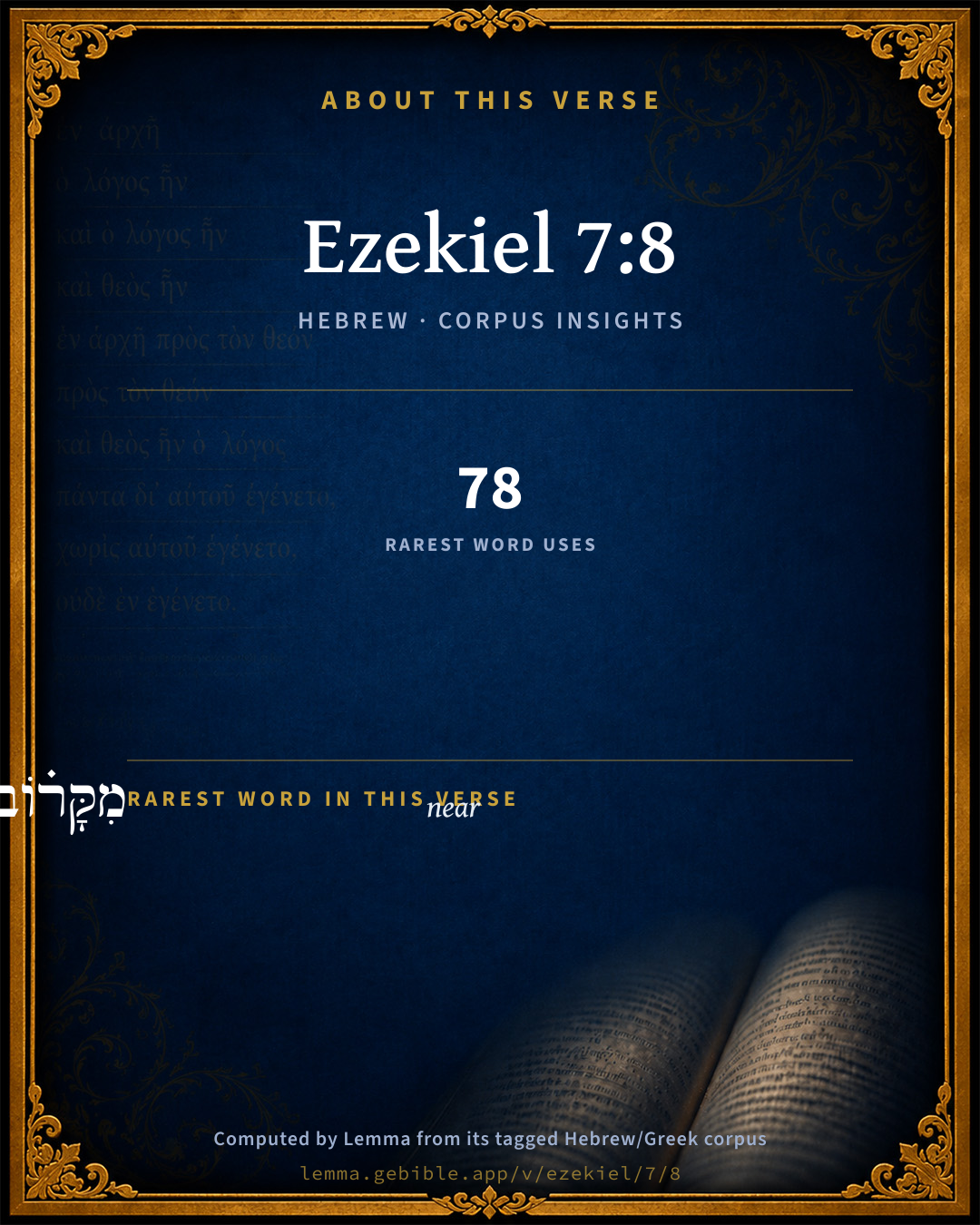
Ezekiel, in the Prophets, opens this verse with 15 words (13 distinct Hebrew lemmas). Its most distinctive word is qârôwb (“near”). A historical commentator’s framing appears above. Read the whole chapter for the surrounding context.

Discussion questions

  1. The word qârôwb carries the sense “near.” How does it shape the verse?
  2. Ezekiel 9:8 shares this passage’s theme. How do the two illuminate each other?
  3. “upon” occurs 2× in this one verse. What is the effect of the repetition?
  4. These translations render this verse differently. What is at stake in choosing one wording over another?
  5. The verb «אֶשְׁפּ֤וֹךְ» is Qal Imperfect. How does its form color the action?
  6. Reading how The Cambridge Bible for Schools and Colleges and Trapp's Complete Commentary read this verse, where do the two commentators agree and where do they part?

Things to notice

Reading settings

Reading text

Shown beneath each verse's original-language words.

Old Testament
Old Testament edition

Read the OT as the Masoretic Hebrew (MT) or the Greek Septuagint (LXX).

English shown for the Greek Septuagint (in the Hebrew ↔ Greek comparison).

Comparing translations? Open the Compare panel on any verse page to stack up to four side by side.