Isaiah 32:10

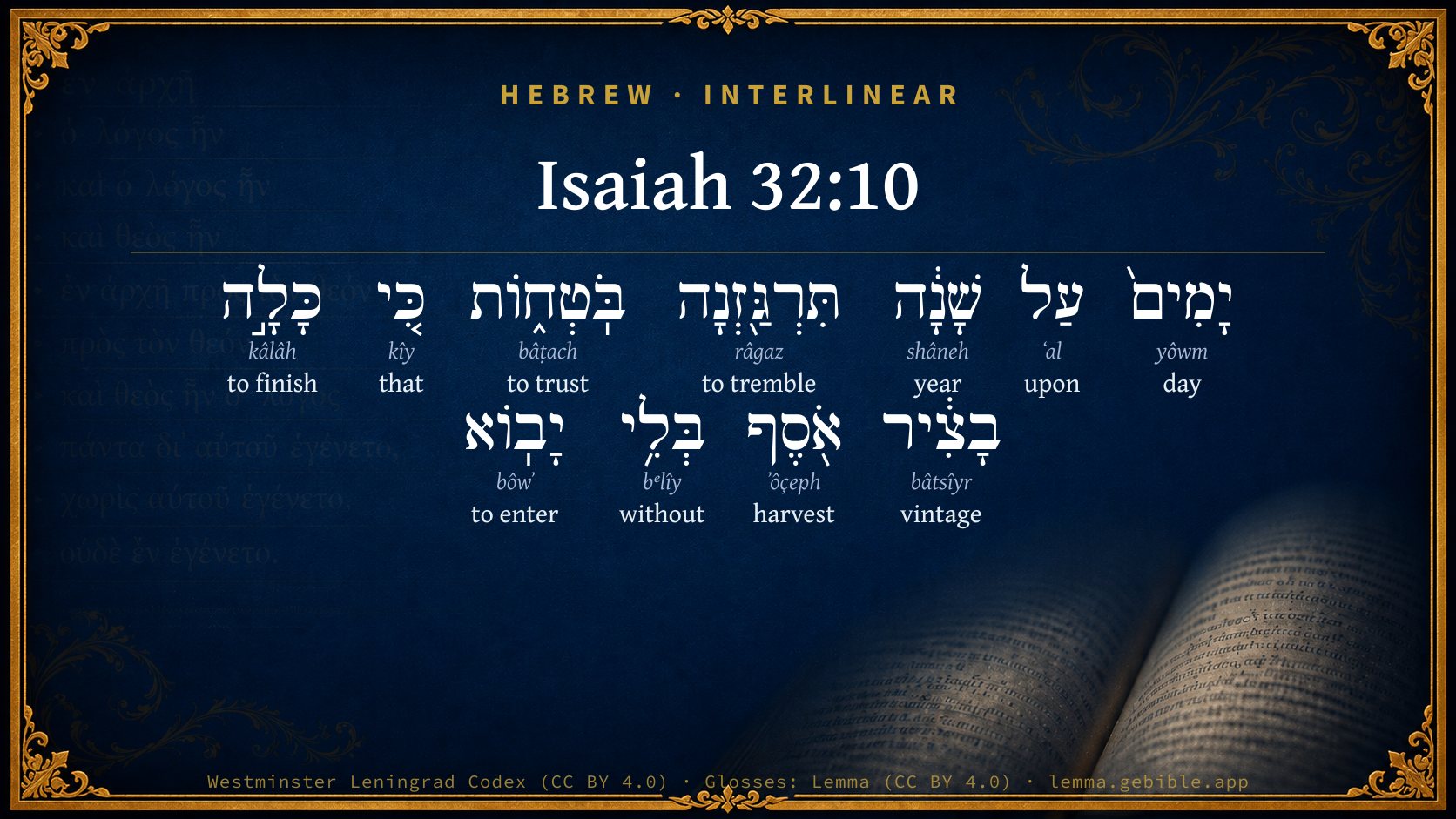
Hebrew (Westminster Leningrad Codex) Isaiah 32:10 appears in the Hebrew Old Testament. The text above is from the Westminster Leningrad Codex. Each word links to its Strong’s number, a concise gloss, and parsing drawn from the Open Scriptures Hebrew Bible morphology. Click any word for its full Brown-Driver-Briggs (BDB) entry.
Download image
Cite this verse

Isaiah 32:10 (World English Bible). Public Domain. Lemma interlinear Bible study tool, https://lemma.gebible.app/v/isaiah/32/10.

Show BibTeX & RIS
BibTeX
RIS
English Translation
For days beyond a year shall you be troubled, you careless women; for the vintage shall fail, the harvest shall not come.
World English Bible · Public Domain
Highlights
  • 1 first appearance in the Hebrew Bible
Full analysis ↓
Download a study sheet

One document with this verse’s original text, its word-by-word gloss line, the meaning frame, cross-references with their text, attributed commentary, and full source and license credits — printable, and it pastes into notes with its structure intact.

This verse Autodidact and up

Study sheet (.html) Plain text (.txt)

A passage Seminary Student

Up to 50 verses in one chapter. A passage sheet keeps up to 6 commentary sources and 12 cross-references per verse, in the order this page ranks them, and says so on the sheet whenever that leaves anything out. Ask for a single verse and you get the Autodidact verse sheet above.

Everything on this page stays free to read, with no account — the sheet is a download of what is already on screen, not access to it.

Want to remove ads? Support Godless Engineer
Compare translations 3

The same verse in 3 English versions, stacked beneath the original-language interlinear above. Click any original word for its lexicon entry.

Each is an independent rendering of the whole verse — the interlinear is not word-aligned to these translations.

Highlighted words mark where these versions differ — a whole-verse word diff, not a word-by-word alignment.

  • World English Bible Public Domain
    For days beyond a year shall you be troubled, you careless women; for the vintage shall fail, the harvest shall not come.
  • King James Version Public Domain
    Many days and years shall ye be troubled, ye careless women: for the vintage shall fail, the gathering shall not come.
  • unfoldingWord Literal Text CC BY-SA 4.0
    Days upon a year, ones being confident will tremble, for the grape harvest will end, the gathering will not come.

unfoldingWord Literal Text — © unfoldingWord, licensed CC BY-SA 4.0. Word-aligned USFM3 via Door43 (git.door43.org/unfoldingWord/en_ult).

Versions to compare (up to 4)

3 of 4 selected

Show all 18 translations

Every available English version of this verse, each an independent rendering of the whole verse.

  • World English Bible Public Domain
    For days beyond a year shall you be troubled, you careless women; for the vintage shall fail, the harvest shall not come.
  • Berean Standard Bible Public Domain
    In a little more than a year you will tremble, O secure ones. For the grape harvest will fail and the fruit harvest will not arrive.
  • Majority Standard Bible Public Domain
    In a little more than a year you will tremble, O secure ones. For the grape harvest will fail and the fruit harvest will not arrive.
  • King James Version Public Domain
    Many days and years shall ye be troubled, ye careless women: for the vintage shall fail, the gathering shall not come.
  • American Standard Version (1901) Public Domain
    For days beyond a year shall ye be troubled, ye careless women; for the vintage shall fail, the ingathering shall not come.
  • Revised Version (1885) Public Domain
    For days beyond a year shall ye be troubled, ye careless women: for the vintage shall fail, the ingathering shall not come.
  • Geneva Bible (1599) Public Domain
    Yee women, that are carelesse, shall be in feare aboue a yeere in dayes: for the vintage shall faile, and the gatherings shall come no more.
  • Douay-Rheims (1899) Public Domain
    For after days and a year, you that are confident shall be troubled: for the vintage is at an end, the gathering shall come no more.
  • Young's Literal Translation Public Domain
    Days and a year ye are troubled, O confident ones, For consumed hath been harvest, The gathering cometh not.
  • Literal Standard Version CC BY-SA 4.0
    In days and a year || You are troubled, O confident ones, || For harvest has been consumed, || The gathering does not come.
  • Unlocked Literal Bible CC BY-SA 4.0
    For in a little more than a year your confidence will be broken, you carefree women, for the grape harvest will fail, the ingathering will not come.
  • unfoldingWord Literal Text CC BY-SA 4.0
    Days upon a year, ones being confident will tremble, for the grape harvest will end, the gathering will not come.
  • Darby Bible Public Domain
    In a year and [some] days shall ye be troubled, ye careless women; for the vintage shall fail, the ingathering shall not come.
  • World Messianic Bible Public Domain
    For days beyond a year you will be troubled, you careless women; for the vintage will fail. The harvest won’t come.
  • Webster's Bible Public Domain
    Many days and years shall ye be troubled, ye careless women: for the vintage shall fail, the gathering shall not come.
  • Free Bible Version CC BY-SA 4.0
    In just over a year, you who think yourselves so safe will tremble with fear. The grape harvest is going to fail and there'll be no harvest.
  • Bible in Basic English Public Domain
    In not much more than a year, you, who are not looking for evil, will be troubled: for the produce of the vine-gardens will be cut off, and there will be no getting in of the grapes.
  • JPS Tanakh (1917) Public Domain
    After a year and days shall ye be troubled, ye confident women; for the vintage shall fail, the ingathering shall not come.

Literal Standard Version (2020), Covenant Press — licensed CC BY-SA 4.0. Text via the HelloAO Bible API (eBible.org). Unlocked Literal Bible (unfoldingWord) — licensed CC BY-SA 4.0. Text via the HelloAO Bible API (eBible.org). unfoldingWord Literal Text — © unfoldingWord, licensed CC BY-SA 4.0. Word-aligned USFM3 via Door43 (git.door43.org/unfoldingWord/en_ult). Free Bible Version, Dr. Jonathan Gallagher — licensed CC BY-SA 4.0. Text via the HelloAO Bible API (eBible.org).

Word by word

More ways to search: Search by grammar → Find every occurrence → Compare this word →

Practice this passage: Drill this verse → Learn its vocabulary →

About this verse

These counts appear in no published source. They are computed here, from the morphology-tagged text and Lemma’s own curated glosses. What Lemma adds →

11
words
11
distinct lemmas
Prophets
section

Notable vocabulary

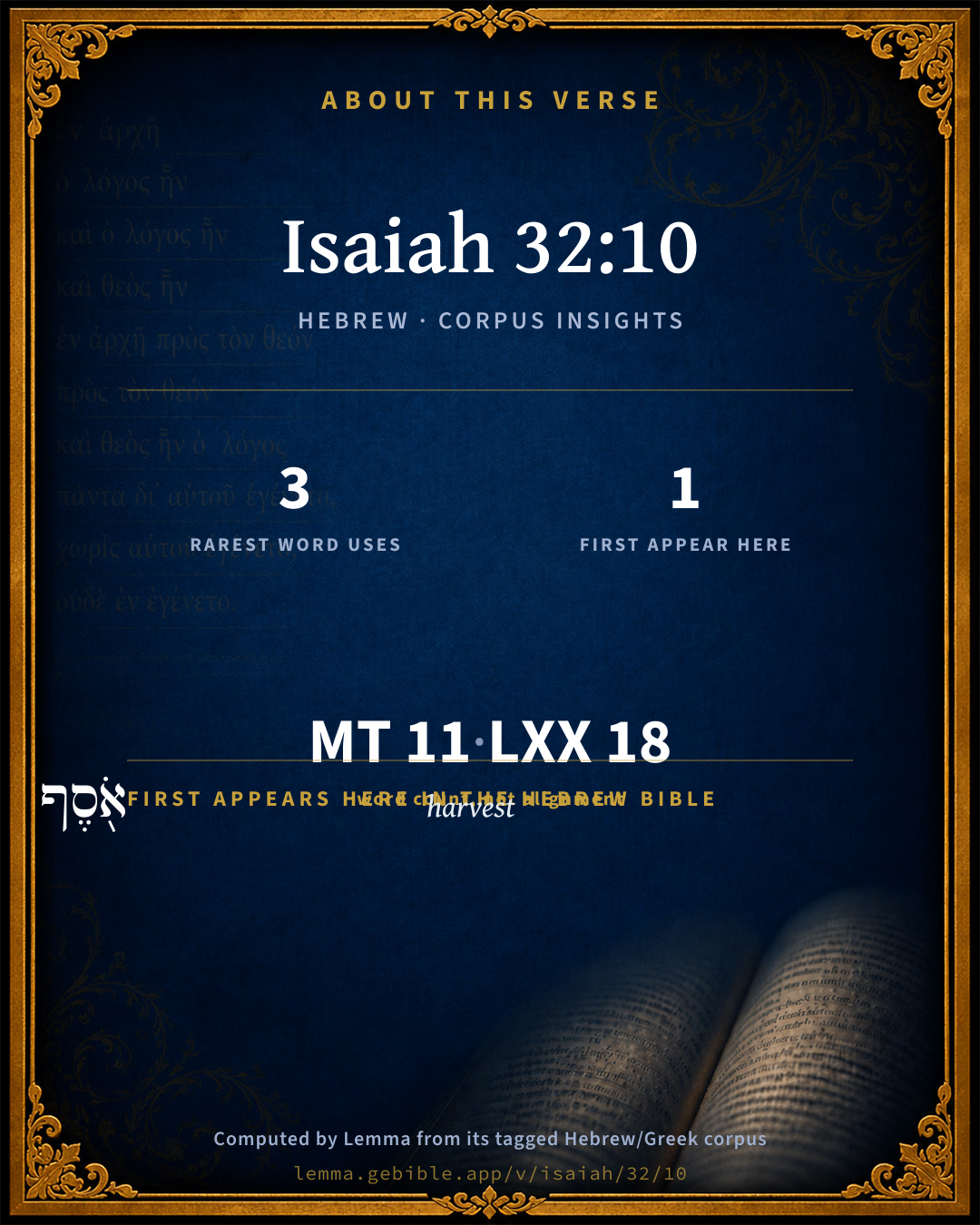
The rarest word here is אֹ֖סֶף harvest H625 — appearing just 3 times in the whole Hebrew Bible.

First appearance in Scripture

This word makes its first canonical appearance in the Hebrew Bible here:

  • אֹ֖סֶף harvest H625

Shared distinctive vocabulary

אֹ֖סֶף harvest H625 occurs in 3 verses of the Hebrew Bible. Also found in:

Grammatical profile

  • 4 verbs
  • 4 nouns
  • 1 preposition
  • 1 conjunction
  • 1 particle

Verb forms

  • תִּרְגַּ֖זְנָה Qal · Imperfect
  • בֹּֽטְח֑וֹת Qal · Participle Active
  • כָּלָ֣ה Qal · Perfect
  • יָבֽוֹא Qal · Imperfect

Hebrew & Septuagint length

In English translation the verse runs 22 words from the Hebrew and 26 from the Septuagint (LXX English) — closely comparable.

A rough comparison of the two English renderings, which tokenize alike — not a word-level alignment.

Word counts can differ between the Hebrew and the Greek without any difference in meaning — e.g. the Hebrew direct-object marker אֵת has no separate Greek word, and Greek often adds the article ὁ.

In the original languages it is 11 Hebrew tokens and 18 Greek tokens — but the two are counted differently (Hebrew bundles its prefixes and suffixes into one token; the Greek is in lemma form), so that isn’t a like-for-like length.

Cross-references

13

Topical passages linked to Isaiah 32:10 in the Treasury of Scripture Knowledge — connected by theme and wording, ordered by reader-vote popularity; previews shown in the World English Bible.

  • Isaiah 7:23 It will happen in that day that every place where there were a thousand vines at a thousand silver shekels, shall be for briers and thorns.
  • Jeremiah 8:13 I will utterly consume them, says Yahweh: there shall be no grapes on the vine, nor figs on the fig tree, and the leaf shall fade; and [the things that] I have given them shall pass away from them.
  • Isaiah 3:17–26 Therefore the Lord brings sores on the crown of the head of the women of Zion, And Yahweh will make their scalps bald."
  • Isaiah 5:5–6 Now I will tell you what I will do to my vineyard. I will take away its hedge, and it will be eaten up. I will break down its wall of it, and it will be trampled down.
  • Isaiah 16:10 Gladness is taken away, and joy out of the fruitful field; and in the vineyards there shall be no singing, neither joyful noise: nobody shall tread out wine in the presses; I have made the [vintage] shout to cease.
  • Isaiah 24:7–12 The new wine mourns, the vine languishes, all the merry-hearted do sigh.
  • Jeremiah 25:10–11 Moreover I will take from them the voice of mirth and the voice of gladness, the voice of the bridegroom and the voice of the bride, the sound of the millstones, and the light of the lamp.
  • Hosea 2:12 I will lay waste her vines and her fig trees, About which she has said, 'These are my wages that my lovers have given me; And I will make them a forest,' And the animals of the field shall eat them.
  • Hosea 3:4 For the children of Israel shall abide many days without king, and without prince, and without sacrifice, and without sacred stone, and without ephod or idols.
  • Joel 1:7 He has laid my vine waste, And stripped my fig tree. He has stripped its bark, and thrown it away. Its branches are made white.
  • Joel 1:12 The vine has dried up, and the fig tree withered; the pomegranate tree, the palm tree also, and the apple tree, Even all of the trees of the field are withered; For joy has withered away from the sons of men.
  • Habakkuk 3:17 For though the fig tree doesn't flourish, Nor fruit be in the vines; The labor of the olive fails, The fields yield no food; The flocks are cut off from the fold, And there is no herd in the stalls:
  • Zephaniah 1:13 Their wealth will become a spoil, and their houses a desolation. Yes, they will build houses, but won't inhabit them. They will plant vineyards, but won't drink their wine.

Cross-references courtesy of OpenBible.info (CC BY 4.0).

Hebrew and Greek witnesses Masoretic Hebrew ↔ Greek Septuagint

The same verse in the two great witnesses to the Old Testament, shown verse-for-verse.

These are two independent witnesses, not word-aligned to each other, and the Septuagint is shown in lemma (dictionary) form.

Hebrew Isaiah 32:10 Masoretic · Westminster Leningrad Codex

יָמִים֙ עַל שָׁנָ֔ה תִּרְגַּ֖זְנָה בֹּֽטְח֑וֹת כִּ֚י כָּלָ֣ה בָצִ֔יר אֹ֖סֶף בְּלִ֥י יָבֽוֹא

For days beyond a year shall you be troubled, you careless women; for the vintage shall fail, the harvest shall not come.

World English Bible · Public Domain

Greek LXX Isaiah 32:10 Septuagint · lemma form

ἡμέρα ἐνιαυτός μνεία ποιέω ἐν ὀδύνη μετά ἐλπίς ἀναἁλίσκω ὁ τρύγητος παύω ὁ σπόρος καί οὐκέτι μή ἔρχομαι

Remember for a full year in pain, yet with hope: the vintage has been cut off; it has ceased, it shall by no means come again.

LXX2012 (modern English Septuagint) · Public Domain

On this verse, Albert Barnes' Notes on the Bible discusses the Septuagint’s reading. Read the note in Commentary ↓

Hebrew: Westminster Leningrad Codex (CC BY 4.0). Greek: Septuagint (public domain); English from LXX2012 (modern English Septuagint) (Public Domain). How the Septuagint differs from the Hebrew →

Targum (Aramaic paraphrase)

1

The Targum is the ancient Jewish Aramaic paraphrase of the Hebrew Scriptures — an interpretive translation, not the Hebrew text itself. Onkelos (literal) and Pseudo-Jonathan (expansive) render the Torah, and Jonathan the Prophets. Coverage is partial: where no permissively-licensed English translation exists for a verse, only the Aramaic is shown. This is verse-level text, not a word-by-word alignment to the Hebrew.

  1. Targum Jonathan Prophets (Joshua–Malachi)
    יוֹמִין עִם שְׁנִין יְזוּעוּן דִי שָׁרָן לְרוֹחֲצָן אֲרֵי סַף עִבּוּרָא עֲלָלָא לֵית לְמִכְנַשׁ:

    Those who dwell at ease shall be agitated for days and years, because the corn is come to an end, and there is no fruit to gather.

    Targum Jonathan — Aramaic: “Mikraot Gedolot” (public domain). English: “Sefaria Community Translation” (CC0 1.0 (public-domain dedication)); “London "Chaldee Paraphrase," 1871” (public domain). Text via Sefaria.

Commentary

Notes on Isaiah 32:10 from classic Christian and Jewish commentators (each source and its license shown beneath its notes). The classic Christian expositions comment on the surrounding passage and are grouped to its opening verse, so a note may address several verses; the Jewish commentaries on the Tanakh (Rashi and others) are per-verse, so they appear only where the commentator wrote on this verse.

Lemma curates 59 commentaries, every one of them public domain or Creative Commons licensed, each selected and text-cleaned for this edition rather than reprinted as found. About our sources →

Trapp's Complete Commentary

John Trapp

Isa 32:10 Many days and years shall ye be troubled, ye careless women: for the vintage shall fail, the gathering shall not come.

Ver. 10. Many days and years shall ye be troubled.] A just punishment of your former security, which usually ushereth in destruction. Days above a year your calamity shall last, by the invasion of the Assyrians, but not two full years; take that for your comfort.

For the vintage shall fail.] War makes woeful work and waste.

John Trapp, A Commentary or Exposition upon All the Books of the Old and New Testament (1647–1656) — public domain. Text from a community e-Sword module.

Tyndale Open Study Notes

Tyndale Open Resources

32:10 In a short time: Assyria’s siege of Jerusalem (701 BC) was looming.

Tyndale Open Study Notes — © Tyndale Open Resources, licensed CC BY-SA 4.0. Text via the HelloAO Bible API.

Geneva Bible (1599)

Geneva Bible translators

Meaning, that the affliction should continue long, and when one year were past, yet they should look for new plagues.

God will take from you the means and occasions, which made you to contemn him: to wit, abundance of worldly goods.

Geneva Bible (1599) marginal notes — public domain. Text via Bolls.life.

Jamieson, Fausset & Brown

Robert Jamieson, A. R. Fausset & David Brown

Many days and years--rather, "In little more than a year" [MAURER]; literally, "days upon a year" (so Isa 29:1).

vintage shall fail--through the arrival of the Assyrian invader. As the wheat harvest is omitted, Isaiah must look for the invasion in the summer or autumn of 714 B.C., when the wheat would have been secured already, and the later fruit "gathering," and vintage would be still in danger.

Jamieson, Fausset & Brown — Commentary Critical and Explanatory on the Whole Bible (1871) — public domain (CC PDM 1.0). Text via the HelloAO Bible API.

Ellicott's Commentary for English Readers

(10) Many days and years . . .—Literally, days to the year, a phrase after the pattern of “add ye year to year” in Isa_29:1, but implying, not the long continuance of the trouble, but its quick arrival, as in “a year and a day.”

The vintage shall fail . . .—The words are commonly taken as predicting a literal failure of the vine-crop, and therefore of the supply of wine for the banquets of the rich. A truer insight into the language of a poet-prophet would lead to our seeing in it a symbol of the failure of all forms of earthly joy.

A Bible Commentary for English Readers, edited by Charles John Ellicott (1878–1897) — public domain. Text from a community e-Sword module.

The Cambridge Bible for Schools and Colleges

gen. ed. J. J. S. Perowne

10. Many days and years] The Hebr. reads literally “days beyond a year,” probably a current popular phrase like “year and day.” Both A.V. and R.V. regard the expression as accus. of duration, but the context shews that it fixes the point of time when ease and security give place to anxiety. The meaning is “in little more than a year.” Comp. the less definite note of time in ch. Isa_29:1.

The feature of the judgment which is emphasised is the failure of the vintage and the fruit harvest (gathering); what follows shews that this is not the result of natural causes, but of a wholesale devastation of the land. The significance of the prediction would depend greatly on the season of the year at which it was uttered; on any natural interpretation of his words, the prophet means to assert that the next year’s harvest will never be gathered.

The Cambridge Bible for Schools and Colleges (gen. ed. J. J. S. Perowne; Cambridge University Press, 1878–1918) — public domain. Text from a community e-Sword module.

John Gill's Exposition

Many days and years shall ye be troubled,.... Or, "days above a year" (k); a year, and somewhat more, yet not two years; which some understand of the time from this prophecy, until their troubles began, by the invasion of Sennacherib; and others of the continuance of it, it lasting more than a year; or, "days with a year"; so Kimchi, days upon a year, year upon year, one year after another; and so denotes a long duration of their troubles; and so the troubles of the Jews, before their utter destruction by the Romans, lasted a great while, and since to this day; for the prophecy respects those times. Kimchi says it may be interpreted of the destruction of the whole land of Israel, and of the destruction of the temple in the days of Zedekiah; or of the destruction of the second temple, that is, by the Romans:

for the vintage shall fail; being spoiled by the enemy, or taken for their own use; and so there would be no wine to cheer their hearts, and make them merry:

the gathering shall not come; of the other fruits of the earth; when the time of ingathering should come, at which there was a feast that bore that name, there should be none to be gathered in; the consequence of which must be a famine, and such there was before and at the destruction of Jerusalem by the Romans.

(k) "dies super annum", Vatablus; "dies ultra annum", Cocceius.

John Gill's Exposition of the Whole Bible (1746–1763) — public domain (CC PDM 1.0). Text via the HelloAO Bible API.

Albert Barnes' Notes on the Bible

Many days and years - Margin, ‘Days above a year.’ This is a literal translation of the Hebrew. Septuagint, ‘Make mention of a day of a year in sorrow, with hope.’ Targum, ‘Days with years.’ Kimchi supposes it means ‘two years.’ Grotius supposes it means ‘within three years.’ Various other interpretations may be seen in Poole’s Synopsis. Gesenius renders it, ‘For a year’s time,’ according to the common expression ‘a year and a day,’ denoting a complete year, and supposes that it means a considerable time, a long period. The phrase literally means ‘the days. upon (or beyond) a year,’ and may denote a long time; as the entire days in a year would denote a long period of suffering. Lowth renders it, not in accordance with the Hebrew, ‘Years upon years.’ Noyes, ‘One year more, and ye shall tremble.’ Perhaps this expresses the sense; and then it would denote not the length of time which they would suffer, but would indicate that the calamities would soon come upon them.

For the vintage shall fail - A large part of the wealth and the luxury of the nation consisted in the vintage. When the vine failed, there would be, of course, great distress. The sense is, that in consequence of the invasion of the Assyrians, either the people would neglect to cultivate the lands, or they would fail to collect the harvest. This might occur either from the dread of the invasion, or because the Assyrian would destroy everything in his march.

Albert Barnes' Notes on the Bible (1834–1885) — public domain. Text from a community e-Sword/MySword module.

Haydock's Catholic Bible Commentary

Year. After a long time; or the prophet speaks two years before the arrival of Sennacherib, after the vintage was ended, chap. xxx. 20., and 4 Kings xix. 29. (Calmet)

George Leo Haydock (1774–1849), Haydock's Catholic Family Bible and Commentary, 1859 edition — public domain. Excludes Psalms (Douay-Rheims chapter numbering differs from Protestant) and Deuterocanonical books (Catholic canon only).

Matthew Poole's English Annotations

Many days and years, Heb. Days above a year, i.e. a year and some days; which notes either,

1. The time from this prophecy to the beginning of this judgment; or rather,

2. The time of the continuance of it, that it should last for above one year; as indeed this did, and no longer; for Hezekiah reigned in all but twenty-nine years, 2Ki 18:2, and Sennacherib came in his fourteenth year, and after his defeat and departure God promised and added to him fifteen years more, 2Ki 20:6.

The vintage shall fail, during the time of the Assyrian invasion. And this commination is here added to qualify the foregoing promise, and to warn them, that although God would give them so good a king, and there should be some reformation of their former abuses under the government of Ahaz; yet as there were many sins among them not yet repented of, so they should be severely chastised for them.

The gathering, to wit, of the other fruits of the earth; as that feast which was observed after the gathering of all the fruits was called the feast of ingathering, Exo 23:16.

Matthew Poole's English Annotations on the Holy Bible (1683–1685) — public domain. Text from a community e-Sword/MySword module.

Whedon's Commentary on the Bible

Daniel D. Whedon

10. Many days and years — Literally, Days upon a year, or many days added to a year, as if answering the question, “When shall these troubles come;” and the time given is, More than a year hence, but not two years. The light-hearted confidence is to be dashed, and timely warning is here given.

Daniel D. Whedon (gen. ed.), Commentary on the Old and New Testaments (1874–1909) — public domain. Text from a community e-Sword module.

The Pulpit Commentary

Many days and years shall ye be troubled; rather, in a year and days; i.e. "in less than two years." The object of the prophet is not to fix the duration of the trouble, but to mark the time of its commencement. (Isa_29:1) Shall ye be troubled; rather, shall ye tremble, or shudder. (so Deu_2:25 Psa_77:18 Psa_99:1 Isa_5:25 Jer_33:9, etc.) Ye careless women; rather, ye confident ones. The word is different from that employed in vers. 9 and 11. The vintage shall fail; literally, has failed "the perfect of prophetic certitude" (Cheyne). Some critics understand a literal failure, or destruction, of the vintage through the invasion of the Assyrians. Others suggest a refer once to Isa_5:4-7. The vineyard of the Lord (Judah) has utterly failed to bring forth grapes there is no ingathering therefore destruction shall fall upon it.

The Pulpit Commentary (1880–1919), ed. H.D.M. Spence-Jones & Joseph S. Exell — public domain. Text from a community e-Sword module.

John Wesley's Explanatory Notes

The vintage shall fail - During the time of the Assyrian invasion. The gathering - Of the other fruits of the earth.

John Wesley, Explanatory Notes Upon the Whole Bible (1754–1765) — public domain. Text via the GEBible commentary corpus.

J. A. Alexander on Isaiah

Joseph Addison Alexander

Having called their attention in v. 9, he now proceeds with the prediction which concerned them. “In a year and more (literally, days above a year), ye shall tremble, ye confiding ones, for the vintage fails, the gathering shall not come.” The English Version makes the time denoted to be that of the duration of the threatened evil.

Joseph Addison Alexander, The Prophecies of Isaiah (1846–1847; New York: Scribner, 1870–1878) — public domain. Text from a community e-Sword module.

Rashi

Rabbi Shlomo Yitzchaki (Rashi)

Year after year (lit., ‘days upon a year.’) Comp. (supra 29:1) “Add year to year,” and your sins are constantly becoming more serious, until eventually you shall be troubled, those who are now confident, for the vintage of the grapes shall be over for them, and the ingathering of the grain shall not come into the house.

the ingathering (אֹסֶף) This is a noun; therefore, its accent is on the first syllable and it is vowelized with a ‘pattah’ (now called a ‘segol’).

Rashi on the Tanakh — English translations: “The Judaica Press complete Tanach with Rashi, translated by A. J. Rosenberg” (CC BY 4.0); “Pentateuch with Rashi's commentary by M. Rosenbaum and A.M. Silbermann, 1929-1934” (public domain); “The Metsudah Tanach series, Lakewood, N.J” (CC BY 4.0); and “The Book of Joshua, Metsudah Publications, 1997” (CC BY 4.0). Text via Sefaria.

Ibn Ezra

Rabbi Abraham ibn Ezra

שנה על שנה ═ ימים על שנה. Year after year.

רגזה =רגזנה Be troubled. The opinion of the Nagid is, that רגזה is imperative, referring to the feminine בטחות, although it has a masculine termination; according to R. Moses Hakkohen it is infinitive.

The gathering of the increase shall not come. Repetition of the same idea.

Ibn Ezra on the Tanakh — English translations: “Sefaria Community Translation” (CC0 1.0 (public-domain dedication)); “Yalkut, Sifsei Chachomim Chumash, Metsudah Publications, 2009” (CC BY 4.0); and “Commentary of Ibn Ezra on Isaiah - trans. by M. Friedlander, 1873” (public domain). Text via Sefaria.

Lesson kit

Teaching starters — assembled from the data on this page, not authored interpretation. Every prompt links to the verse data it draws on. Edit before teaching.

Isaiah, in the Prophets, opens this verse with 11 words (11 distinct Hebrew lemmas). Its most distinctive word is ʼôçeph (“harvest”). A historical commentator’s framing appears above. Read the whole chapter for the surrounding context.

Discussion questions

  1. What does “harvest” (ʼôçeph) contribute to the verse as a whole?
  2. This is the first place “harvest” appears in Scripture (first appears here). What does its debut here establish?
  3. How does Isaiah 33:4, which shares the word «harvest», read alongside this verse?
  4. The translations on this page render this verse differently — a whole-verse word diff, not a word-by-word alignment. What might account for the different wordings?
  5. «תִּרְגַּ֖זְנָה» is a Qal Imperfect verb. How does that grammatical form shape the action described?
  6. Compare how Trapp's Complete Commentary and Tyndale Open Study Notes read this verse. Where do they agree or differ?

Things to notice

Reading settings

Reading text

Shown beneath each verse's original-language words.

Old Testament
Old Testament edition

Read the OT as the Masoretic Hebrew (MT) or the Greek Septuagint (LXX).

English shown for the Greek Septuagint (in the Hebrew ↔ Greek comparison).

Comparing translations? Open the Compare panel on any verse page to stack up to four side by side.