2 Chronicles 24:10

Hebrew (Westminster Leningrad Codex) 2 Chronicles 24:10 appears in the Hebrew Old Testament. The text above is from the Westminster Leningrad Codex. Each word links to its Strong’s number, a concise gloss, and parsing drawn from the Open Scriptures Hebrew Bible morphology. Click any word for its full Brown-Driver-Briggs (BDB) entry.
Download image
Cite this verse

2 Chronicles 24:10 (World English Bible). Public Domain. Lemma interlinear Bible study tool, https://lemma.gebible.app/v/2-chronicles/24/10.

Show BibTeX & RIS
BibTeX
RIS
English Translation
All the princes and all the people rejoiced, and brought in, and cast into the chest, until they had made an end.
World English Bible · Public Domain
Download a study sheet

One document with this verse’s original text, its word-by-word gloss line, the meaning frame, cross-references with their text, attributed commentary, and full source and license credits — printable, and it pastes into notes with its structure intact.

This verse Autodidact and up

Study sheet (.html) Plain text (.txt)

A passage Seminary Student

Up to 50 verses in one chapter. A passage sheet keeps up to 6 commentary sources and 12 cross-references per verse, in the order this page ranks them, and says so on the sheet whenever that leaves anything out. Ask for a single verse and you get the Autodidact verse sheet above.

Everything on this page stays free to read, with no account — the sheet is a download of what is already on screen, not access to it.

Want to remove ads? Support Godless Engineer
Compare translations 3

The same verse in 3 English versions, stacked beneath the original-language interlinear above. Click any original word for its lexicon entry.

Each is an independent rendering of the whole verse — the interlinear is not word-aligned to these translations.

Highlighted words mark where these versions differ — a whole-verse word diff, not a word-by-word alignment.

  • World English Bible Public Domain
    All the princes and all the people rejoiced, and brought in, and cast into the chest, until they had made an end.
  • King James Version Public Domain
    And all the princes and all the people rejoiced, and brought in, and cast into the chest, until they had made an end.
  • unfoldingWord Literal Text CC BY-SA 4.0
    And all the chiefs and all the people rejoiced. And they brought in and they threw into the chest until completed.

unfoldingWord Literal Text — © unfoldingWord, licensed CC BY-SA 4.0. Word-aligned USFM3 via Door43 (git.door43.org/unfoldingWord/en_ult).

Versions to compare (up to 4)

3 of 4 selected

Show all 18 translations

Every available English version of this verse, each an independent rendering of the whole verse.

  • World English Bible Public Domain
    All the princes and all the people rejoiced, and brought in, and cast into the chest, until they had made an end.
  • Berean Standard Bible Public Domain
    All the officers and all the people rejoiced and brought their contributions, and they dropped them in the chest until it was full.
  • Majority Standard Bible Public Domain
    All the officers and all the people rejoiced and brought their contributions, and they dropped them in the chest until it was full.
  • King James Version Public Domain
    And all the princes and all the people rejoiced, and brought in, and cast into the chest, until they had made an end.
  • American Standard Version (1901) Public Domain
    And all the princes and all the people rejoiced, and brought in, and cast into the chest, until they had made an end.
  • Revised Version (1885) Public Domain
    And all the princes and all the people rejoiced, and brought in, and cast into the chest, until they had made an end.
  • Geneva Bible (1599) Public Domain
    And all the princes and all the people reioyced, and brought in, and cast into the chest, vntill they had finished.
  • Douay-Rheims (1899) Public Domain
    And all the princes, and all the people rejoiced: and going In they contributed and cast so much into the chest of the Lord, that it was filled.
  • Young's Literal Translation Public Domain
    And all the heads, and all the people rejoice, and they bring in, and cast into the chest, unto completion.
  • Literal Standard Version CC BY-SA 4.0
    And all the heads, and all the people rejoice, and they bring in, and cast into the chest, to completion.
  • Unlocked Literal Bible CC BY-SA 4.0
    All the leaders and all the people rejoiced and brought money in and put it into the chest until they finished filling it.
  • unfoldingWord Literal Text CC BY-SA 4.0
    And all the chiefs and all the people rejoiced. And they brought in and they threw into the chest until completed.
  • Darby Bible Public Domain
    And all the princes and all the people rejoiced, and brought in and cast into the chest, until they had finished.
  • World Messianic Bible Public Domain
    All the princes and all the people rejoiced, and brought in, and cast into the chest, until they had filled it.
  • Webster's Bible Public Domain
    And all the princes and all the people rejoiced, and brought in, and cast into the chest, until they had made an end.
  • Free Bible Version CC BY-SA 4.0
    All the leaders and all the people were glad to do so and brought their taxes. They dropped them in the chest until it was full.
  • Bible in Basic English Public Domain
    And all the chiefs and all the people came gladly and put their money into the chest, till they had all given.
  • JPS Tanakh (1917) Public Domain
    And all the princes and all the people rejoiced, and brought in, and cast into the chest, until they had made an end.

Literal Standard Version (2020), Covenant Press — licensed CC BY-SA 4.0. Text via the HelloAO Bible API (eBible.org). Unlocked Literal Bible (unfoldingWord) — licensed CC BY-SA 4.0. Text via the HelloAO Bible API (eBible.org). unfoldingWord Literal Text — © unfoldingWord, licensed CC BY-SA 4.0. Word-aligned USFM3 via Door43 (git.door43.org/unfoldingWord/en_ult). Free Bible Version, Dr. Jonathan Gallagher — licensed CC BY-SA 4.0. Text via the HelloAO Bible API (eBible.org).

Word by word

More ways to search: Search by grammar → Find every occurrence → Compare this word →

Practice this passage: Drill this verse → Learn its vocabulary →

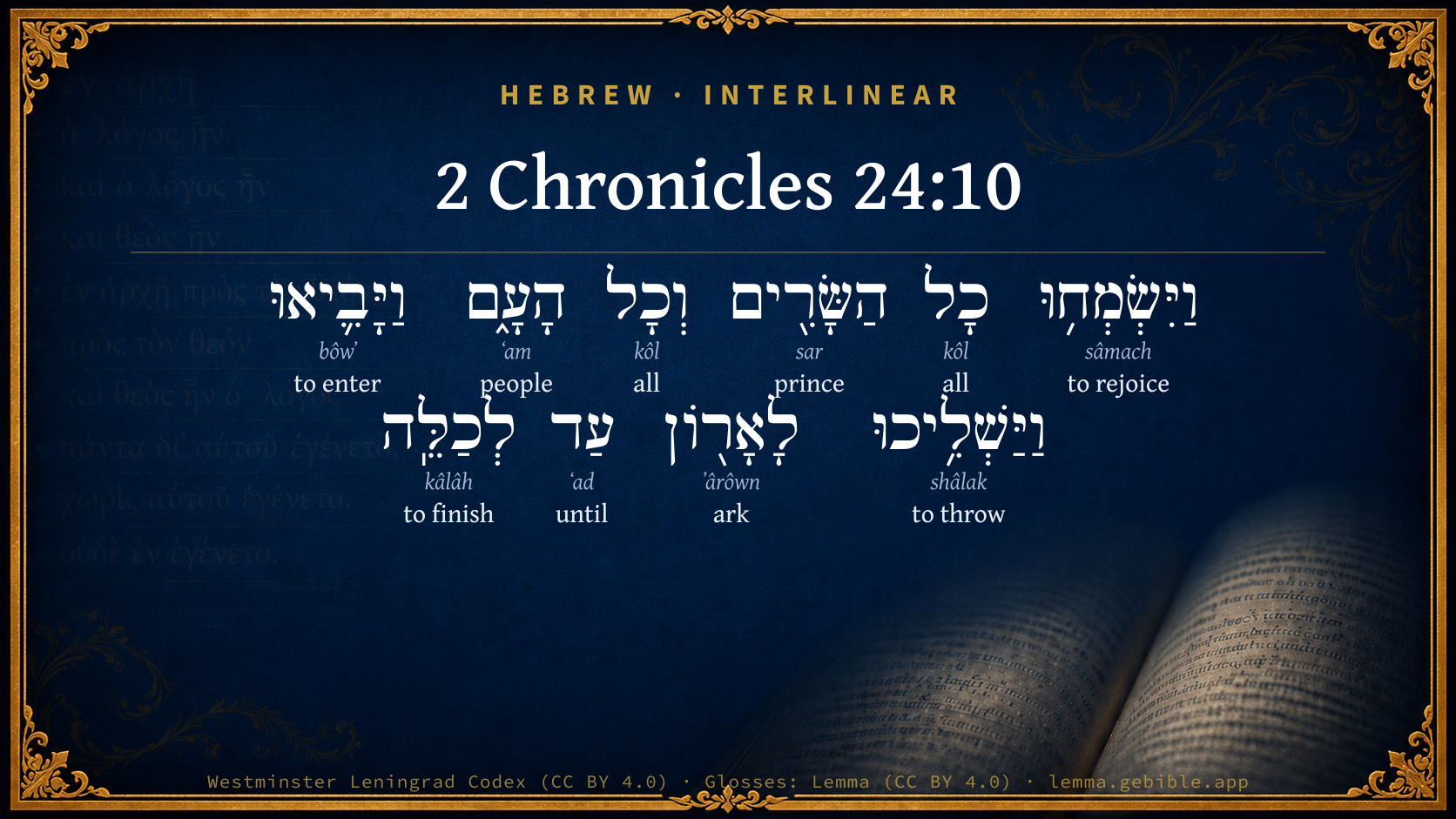
וַיַּשְׁלִ֥יכוּ
shâlak
H7993
“and · to throw”
Conjunction + Verb, Hiphil, Sequential Imperfect, 3rd Person, Masculine, Plural
Part of Speech
Conjunction + Verb
Stem
Hiphil
Form
Sequential Imperfect
Person
3rd Person
Gender
Masculine
Number
Plural
Full BDB Definition

Origin: a primitive root

TWOT: 2398

to throw, cast, hurl, fling - (Hiphil) - to throw, cast, throw away, cast off, shed, cast down - to cast (lots) (figuratively) - (Hophal) - to be thrown, be cast - to be cast forth or out - to be cast down - to be cast (metaphorically)
  1. וַיִּשְׂמְח֥וּ sâmach H8055 “and · to rejoice” Conjunction + Verb, Qal, Sequential Imperfect, 3rd Person, Masculine, Plural
  2. כָל kôl H3605 “all of” Noun, Common, Masculine, Singular, Construct
  3. הַשָּׂרִ֖ים sar H8269 “the · princes” Particle, Definite Article + Noun, Common, Masculine, Plural, Absolute
  4. וְכָל kôl H3605 “and · all of” Conjunction + Noun, Common, Masculine, Singular, Construct
  5. הָעָ֑ם ʻam H5971 “the · people” Particle, Definite Article + Noun, Common, Masculine, Singular, Absolute
  6. וַיָּבִ֛יאוּ bôwʼ H935 “and · to enter” Conjunction + Verb, Hiphil, Sequential Imperfect, 3rd Person, Masculine, Plural
  7. לָאָר֖וֹן ʼârôwn H727 “to/for the · ark” Preposition, Determined + Noun, Common, Both, Singular, Absolute
  8. עַד ʻad H5704 “until” Preposition
  9. לְכַלֵּֽה kâlâh H3615 “to finish” Preposition + Verb, Piel, Infinitive Construct

About this verse

These counts appear in no published source. They are computed here, from the morphology-tagged text and Lemma’s own curated glosses. What Lemma adds →

10
words
9
distinct lemmas
Historical
section

Grammatical profile

  • 4 verbs
  • 5 nouns
  • 1 preposition

Verb forms

  • וַיִּשְׂמְח֥וּ Qal · Sequential Imperfect
  • וַיָּבִ֛יאוּ Hiphil · Sequential Imperfect
  • וַיַּשְׁלִ֥יכוּ Hiphil · Sequential Imperfect
  • לְכַלֵּֽה Piel · Infinitive Construct

Repetition

A word recurs within this verse — often emphatic in Hebrew:

Hebrew & Septuagint length

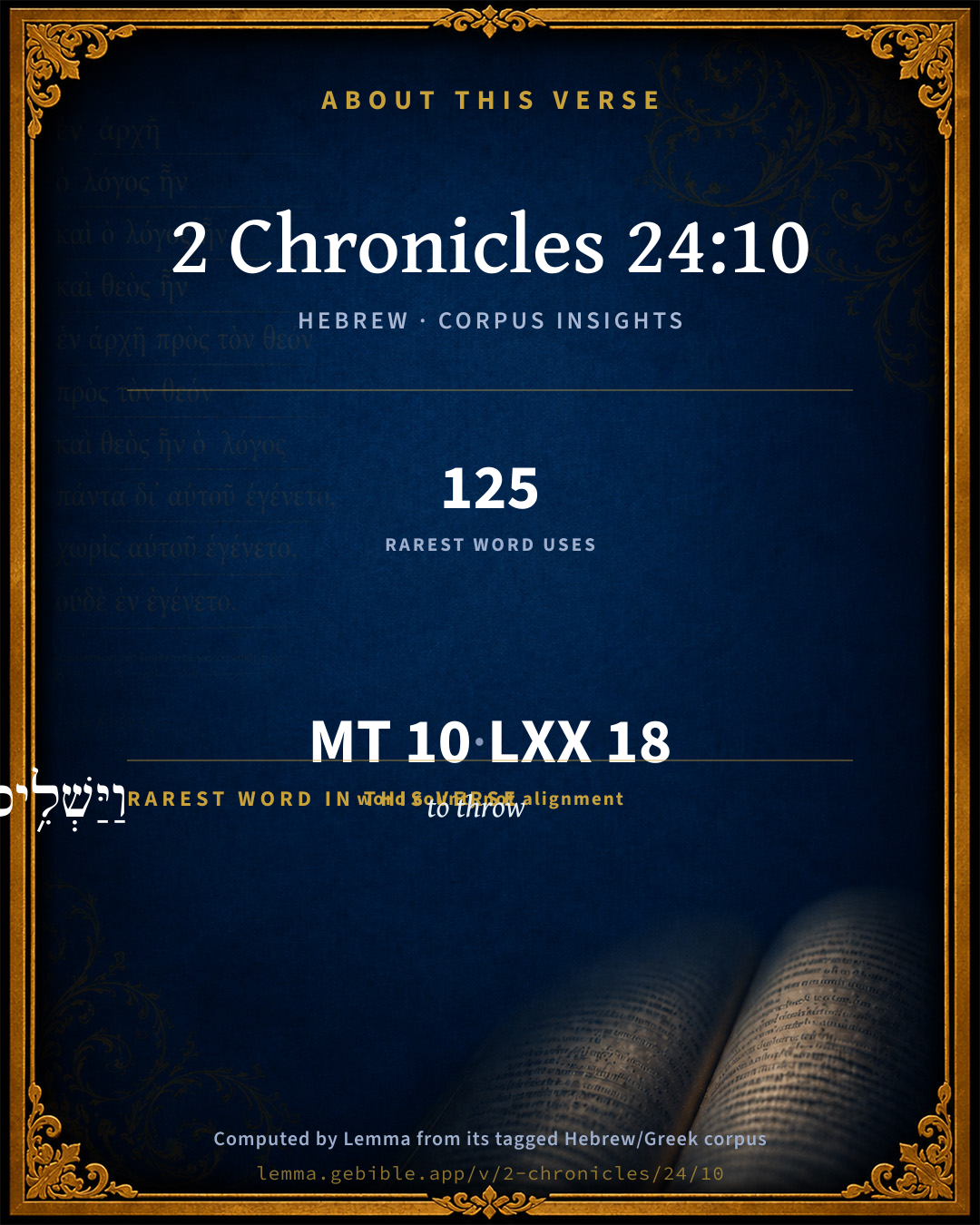
In English translation the verse runs 22 words from the Hebrew and 21 from the Septuagint (LXX English) — closely comparable.

A rough comparison of the two English renderings, which tokenize alike — not a word-level alignment.

Word counts can differ between the Hebrew and the Greek without any difference in meaning — e.g. the Hebrew direct-object marker אֵת has no separate Greek word, and Greek often adds the article ὁ.

In the original languages it is 10 Hebrew tokens and 18 Greek tokens — but the two are counted differently (Hebrew bundles its prefixes and suffixes into one token; the Greek is in lemma form), so that isn’t a like-for-like length.

Cross-references

5

Topical passages linked to 2 Chronicles 24:10 in the Treasury of Scripture Knowledge — connected by theme and wording, ordered by reader-vote popularity; previews shown in the World English Bible.

  • 1 Chronicles 29:9 Then the people rejoiced, because they offered willingly, because with a perfect heart they offered willingly to Yahweh: and David the king also rejoiced with great joy.
  • Acts 2:45–47 They sold their possessions and goods, and distributed them to all, according as anyone had need.
  • 2 Corinthians 8:2 how that in much proof of affliction the abundance of their joy and their deep poverty abounded to the riches of their liberality.
  • 2 Corinthians 9:7 Let each man give according as he has determined in his heart; not grudgingly, or under compulsion; for God loves a cheerful giver.
  • Isaiah 64:5 You meet him who rejoices and works righteousness, those who remember you in your ways: behold, you were angry, and we sinned: in them [have we been] of long time; and shall we be saved?

Cross-references courtesy of OpenBible.info (CC BY 4.0).

Hebrew and Greek witnesses Masoretic Hebrew ↔ Greek Septuagint

The same verse in the two great witnesses to the Old Testament, shown verse-for-verse.

These are two independent witnesses, not word-aligned to each other, and the Septuagint is shown in lemma (dictionary) form.

Hebrew 2 Chronicles 24:10 Masoretic · Westminster Leningrad Codex

וַיִּשְׂמְח֥וּ כָל הַשָּׂרִ֖ים וְכָל הָעָ֑ם וַיָּבִ֛יאוּ וַיַּשְׁלִ֥יכוּ לָאָר֖וֹן עַד לְכַלֵּֽה

All the princes and all the people rejoiced, and brought in, and cast into the chest, until they had made an end.

World English Bible · Public Domain

Greek LXX 2 Chronicles 24:10 Septuagint · lemma form

καί δίδωμι πᾶς ἄρχων καί πᾶς ὁ λαός καί εἰςφέρω καί ἐνβάλλω εἰς ὁ γλωσσόκομον ἕως ὅς πληρόω

And all the princes and all the people gave, and brought in, and cast into the box until it was filled.

LXX2012 (modern English Septuagint) · Public Domain

Hebrew: Westminster Leningrad Codex (CC BY 4.0). Greek: Septuagint (public domain); English from LXX2012 (modern English Septuagint) (Public Domain). How the Septuagint differs from the Hebrew →

Commentary

Notes on 2 Chronicles 24:10 from classic Christian and Jewish commentators (each source and its license shown beneath its notes). The classic Christian expositions comment on the surrounding passage and are grouped to its opening verse, so a note may address several verses; the Jewish commentaries on the Tanakh (Rashi and others) are per-verse, so they appear only where the commentator wrote on this verse.

Lemma curates 59 commentaries, every one of them public domain or Creative Commons licensed, each selected and text-cleaned for this edition rather than reprinted as found. About our sources →

Trapp's Complete Commentary

John Trapp

2Ch 24:10 And all the princes and all the people rejoiced, and brought in, and cast into the chest, until they had made an end.

Ver. 10-12. See 2Ki 12:10-11.

John Trapp, A Commentary or Exposition upon All the Books of the Old and New Testament (1647–1656) — public domain. Text from a community e-Sword module.

The Biblical Illustrator

Joseph S. Exell

2Ch_24:10

And cast into the chest until they had made an end.

Compulsory and free-will offerings

The restoration of Solomons temple by Jehoiada under Joashs authority is a remarkable instance of cheerful giving, of a truly voluntary offering. The money was not raised by a royal edict imposing a subsidy, nor were the workmen impressed for service for so many months in the year. By taxation and by forced labour, or levies, had Solomons temple been erected. Such indeed was, and is, the almost invariable custom of Eastern monarchs in the construction of all great works, whether religious or secular. Though the prince might be lauded as a patron of religion or of art, a rankling sense of oppression and injustice remained in the breasts of the toilers. This Rehoboam had found to his cost, when his people demanded relief from the burdens which the glories of Solomon had entailed on them. We may illustrate this by an interesting inscription at Abilene. A splendid aqueduct and military road have been engineered along the face of the lofty cliff which bounds the deep valley. At the commencement of the aqueduct is the long inscription in honour of the Emperor Trajan, for whom the gratitude of posterity is claimed because of this great achievement. But below the inscription is chiseled deep on the face of the rock, in letters of a rather different shape, added, no doubt, after the emperors departure, Impensis Abilenorum--At the expense of the people of Abilene. (Canon Tristram.)

The Biblical Illustrator, edited by Joseph S. Exell (c. 1880s–1900s) — public domain. Text from a community e-Sword module.

John Gill's Exposition

And the king and Jehoiada gave it to such as did the work of the service of the house of the Lord,.... That is, they gave it to those who were overseers of them, to pay them with it, Kg2 12:11.

and hired masons and carpenters to repair the house of the Lord see Kg2 12:12.

and also such as wrought iron and brass to mend the house of the Lord; where it required any work of that kind.

John Gill's Exposition of the Whole Bible (1746–1763) — public domain (CC PDM 1.0). Text via the HelloAO Bible API.

Haydock's Catholic Bible Commentary

That, &c. Heb. "till it was done," according to the law. Pagnin)

George Leo Haydock (1774–1849), Haydock's Catholic Family Bible and Commentary, 1859 edition — public domain. Excludes Psalms (Douay-Rheims chapter numbering differs from Protestant) and Deuterocanonical books (Catholic canon only).

The Pulpit Commentary

Until they had made an end; Hebrew, hLeKil, piel infin. The meaning can scarcely be till enough was obtained, because day after day, as the next verso tells us, the chest was brought; but either till those who had come that day to give had all given in their contributions, or, as some think with much less probability, till the chest was full for the day. At the same time, the clause, occupying only one word in the original, may quite possibly purport to state summarily by anticipation that the same system was observed to the end, and the method of the chest not departed from.

The Pulpit Commentary (1880–1919), ed. H.D.M. Spence-Jones & Joseph S. Exell — public domain. Text from a community e-Sword module.

Lesson kit

Teaching starters — assembled from the data on this page, not authored interpretation. Every prompt links to the verse data it draws on. Edit before teaching.

2 Chronicles, in the Historical, opens this verse with 10 words (9 distinct Hebrew lemmas). Its most distinctive word is shâlak (“to throw”). A historical commentator’s framing appears above. Read the whole chapter for the surrounding context.

Discussion questions

  1. How does “to throw” (shâlak) shape what this verse is saying?
  2. How does 1 Chronicles 29:9, which shares this passage’s theme, read alongside this verse?
  3. What does the repetition of “all” (2× in this one verse) do in this verse?
  4. The translations on this page render this verse differently — a whole-verse word diff, not a word-by-word alignment. What might account for the different wordings?
  5. «וַיִּשְׂמְח֥וּ» is a Qal Sequential Imperfect verb. How does that grammatical form shape the action described?
  6. Compare how Trapp's Complete Commentary and The Biblical Illustrator read this verse. Where do they agree or differ?

Things to notice

Reading settings

Reading text

Shown beneath each verse's original-language words.

Old Testament
Old Testament edition

Read the OT as the Masoretic Hebrew (MT) or the Greek Septuagint (LXX).

English shown for the Greek Septuagint (in the Hebrew ↔ Greek comparison).

Comparing translations? Open the Compare panel on any verse page to stack up to four side by side.