
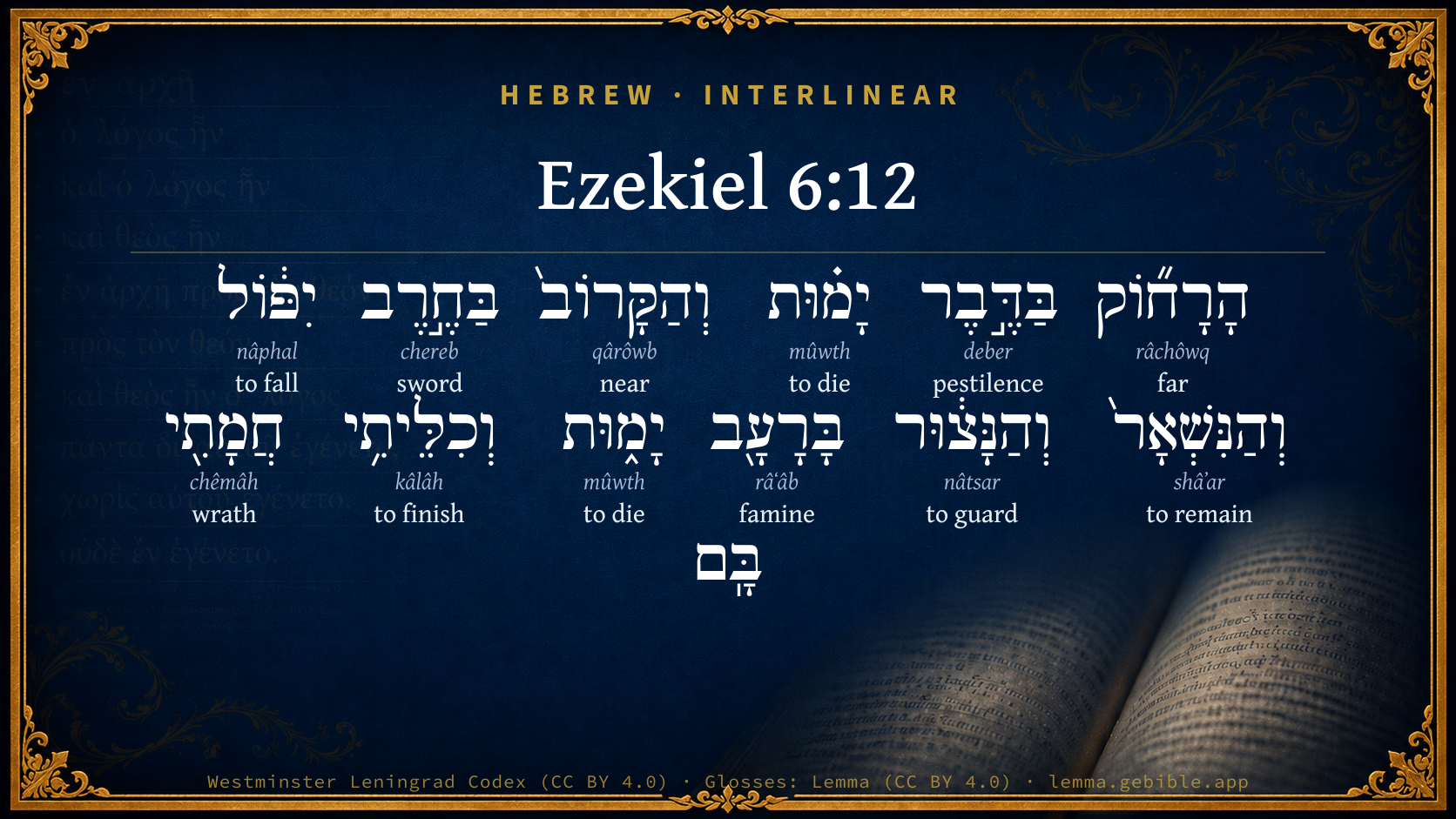
Ezekiel 6:12

Hebrew (Westminster Leningrad Codex) Ezekiel 6:12 appears in the Hebrew Old Testament. The text above is from the Westminster Leningrad Codex. Each word links to its Strong’s number, a concise gloss, and parsing drawn from the Open Scriptures Hebrew Bible morphology. Click any word for its full Brown-Driver-Briggs (BDB) entry.
Download image
Cite this verse

Ezekiel 6:12 (World English Bible). Public Domain. Lemma interlinear Bible study tool, https://lemma.gebible.app/v/ezekiel/6/12.

Show BibTeX & RIS
BibTeX
RIS
English Translation
He who is far off shall die of the pestilence; and he who is near shall fall by the sword; and he who remains and is besieged shall die by the famine: thus will I accomplish my wrath on them.
World English Bible · Public Domain
Download a study sheet

One document with this verse’s original text, its word-by-word gloss line, the meaning frame, cross-references with their text, attributed commentary, and full source and license credits — printable, and it pastes into notes with its structure intact.

This verse Autodidact and up

Study sheet (.html) Plain text (.txt)

A passage Seminary Student

Up to 50 verses in one chapter. A passage sheet keeps up to 6 commentary sources and 12 cross-references per verse, in the order this page ranks them, and says so on the sheet whenever that leaves anything out. Ask for a single verse and you get the Autodidact verse sheet above.

Everything on this page stays free to read, with no account — the sheet is a download of what is already on screen, not access to it.

Want to remove ads? Support Godless Engineer
Compare translations 3

The same verse in 3 English versions, stacked beneath the original-language interlinear above. Click any original word for its lexicon entry.

Each is an independent rendering of the whole verse — the interlinear is not word-aligned to these translations.

Highlighted words mark where these versions differ — a whole-verse word diff, not a word-by-word alignment.

  • World English Bible Public Domain
    He who is far off shall die of the pestilence; and he who is near shall fall by the sword; and he who remains and is besieged shall die by the famine: thus will I accomplish my wrath on them.
  • King James Version Public Domain
    He that is far off shall die of the pestilence; and he that is near shall fall by the sword; and he that remaineth and is besieged shall die by the famine: thus will I accomplish my fury upon them.
  • unfoldingWord Literal Text CC BY-SA 4.0
    The one far away will die by plague, and the one who is near will fall by the sword. Those who remain and survive will die by famine. In this way I will accomplish my fury against them.

unfoldingWord Literal Text — © unfoldingWord, licensed CC BY-SA 4.0. Word-aligned USFM3 via Door43 (git.door43.org/unfoldingWord/en_ult).

Versions to compare (up to 4)

3 of 4 selected

Show all 18 translations

Every available English version of this verse, each an independent rendering of the whole verse.

  • World English Bible Public Domain
    He who is far off shall die of the pestilence; and he who is near shall fall by the sword; and he who remains and is besieged shall die by the famine: thus will I accomplish my wrath on them.
  • Berean Standard Bible Public Domain
    He who is far off will die by the plague, he who is near will fall by the sword, and he who remains will die by famine. So I will vent My fury upon them.
  • Majority Standard Bible Public Domain
    He who is far off will die by the plague, he who is near will fall by the sword, and he who remains will die by famine. So I will vent My fury upon them.
  • King James Version Public Domain
    He that is far off shall die of the pestilence; and he that is near shall fall by the sword; and he that remaineth and is besieged shall die by the famine: thus will I accomplish my fury upon them.
  • American Standard Version (1901) Public Domain
    He that is far off shall die of the pestilence; and he that is near shall fall by the sword; and he that remaineth and is besieged shall die by the famine: thus will I accomplish my wrath upon them.
  • Revised Version (1885) Public Domain
    He that is far off shall die of the pestilence; and he that is near shall fall by the sword; and he that remaineth and is besieged shall die by the famine: thus will I accomplish my fury upon them.
  • Geneva Bible (1599) Public Domain
    He that is farre off, shall dye of the pestilence, and he that is neere, shall fall by the sword, and hee that remaineth and is besieged, shall dye by the famine: thus will I accomplish my wrath vpon them.
  • Douay-Rheims (1899) Public Domain
    He that is far off shall die of the pestilence: and he that is near, shall fall by the sword: and he that remaineth, and is besieged, shall die by the famine: and I will accomplish my indignation upon them.
  • Young's Literal Translation Public Domain
    The far-off by pestilence dieth, And the near by sword falleth, And the left and the besieged by famine dieth, And I have completed my fury upon them.
  • Literal Standard Version CC BY-SA 4.0
    The far-off dies by pestilence, || And the near falls by sword, || And the left and the besieged dies by famine, || And I have completed My fury on them.
  • Unlocked Literal Bible CC BY-SA 4.0
    The one far away will die by plague, and the one who is near will fall by the sword. Those who remain and survive will die by famine. In this way I will accomplish my fury against them.
  • unfoldingWord Literal Text CC BY-SA 4.0
    The one far away will die by plague, and the one who is near will fall by the sword. Those who remain and survive will die by famine. In this way I will accomplish my fury against them.
  • Darby Bible Public Domain
    He that is far off shall die of the pestilence; and he that is near shall fall by the sword; and he that is left, and is besieged, shall die by the famine: and I will accomplish my fury upon them.
  • World Messianic Bible Public Domain
    He who is far off will die of the pestilence. He who is near will fall by the sword. He who remains and is besieged will die by the famine. Thus I will accomplish my wrath on them.
  • Webster's Bible Public Domain
    He that is far off shall die by the pestilence; and he that is near shall fall by the sword; and he that remaineth and is besieged shall die by the famine: thus will I accomplish my fury upon them.
  • Free Bible Version CC BY-SA 4.0
    Those living far away will die from disease, those who are close by will be killed by the sword, and those who are left will die of starvation. This is how I will express my anger towards them.
  • Bible in Basic English Public Domain
    He who is far away will come to his death by disease; he who is near will be put to the sword; he who is shut up will come to his death through need of food; and I will give full effect to my passion against them.
  • JPS Tanakh (1917) Public Domain
    He that is far off shall die of the pestilence; and he that is near shall fall by the sword; and he that remaineth and is besieged shall die by the famine; thus will I spend My fury upon them.

Literal Standard Version (2020), Covenant Press — licensed CC BY-SA 4.0. Text via the HelloAO Bible API (eBible.org). Unlocked Literal Bible (unfoldingWord) — licensed CC BY-SA 4.0. Text via the HelloAO Bible API (eBible.org). unfoldingWord Literal Text — © unfoldingWord, licensed CC BY-SA 4.0. Word-aligned USFM3 via Door43 (git.door43.org/unfoldingWord/en_ult). Free Bible Version, Dr. Jonathan Gallagher — licensed CC BY-SA 4.0. Text via the HelloAO Bible API (eBible.org).

Word by word

More ways to search: Search by grammar → Find every occurrence → Compare this word →

Practice this passage: Drill this verse → Learn its vocabulary →

בַּדֶּ֣בֶר
deber
H1698
“in/at the · pestilence”
Preposition, Determined + Noun, Common, Masculine, Singular, Absolute
Part of Speech
Preposition + Noun
Type
Common
Gender
Masculine
Number
Singular
State
Absolute
Full BDB Definition

Origin: from H1696 (in the sense of destroying)

TWOT: 399b

pestilence, plague - murrain, cattle disease, cattle-plague
  1. הָרָח֞וֹק râchôwq H7350 “the · far” Particle, Definite Article + Adjective, Adjective, Masculine, Singular, Absolute
  2. יָמ֗וּת mûwth H4191 “to die” Verb, Qal, Imperfect, 3rd Person, Masculine, Singular
  3. וְהַקָּרוֹב֙ qârôwb H7138 “and · the · near” Conjunction + Particle, Definite Article + Adjective, Adjective, Masculine, Singular, Absolute
  4. בַּחֶ֣רֶב chereb H2719 “in/at the · sword” Preposition, Determined + Noun, Common, Feminine, Singular, Absolute
  5. יִפּ֔וֹל nâphal H5307 “to fall” Verb, Qal, Imperfect, 3rd Person, Masculine, Singular
  6. וְהַנִּשְׁאָר֙ shâʼar H7604 “and · the · remaining” Conjunction + Particle, Definite Article + Verb, Niphal, Participle Active, Masculine, Singular, Absolute
  7. וְהַנָּצ֔וּר nâtsar H5341 “and · the · guarded” Conjunction + Particle, Definite Article + Verb, Qal, Participle Passive, Masculine, Singular, Absolute
  8. בָּרָעָ֖ב râʻâb H7458 “in/at the · famine” Preposition, Determined + Noun, Common, Masculine, Singular, Absolute
  9. יָמ֑וּת mûwth H4191 “to die” Verb, Qal, Imperfect, 3rd Person, Masculine, Singular
  10. וְכִלֵּיתִ֥י kâlâh H3615 “and · to finish” Conjunction + Verb, Piel, Sequential Perfect, 1st Person, Common, Singular
  11. חֲמָתִ֖י chêmâh H2534 “wrath · my” Noun, Common, Feminine, Singular, Construct + Suffix, Personal, 1st Person, Common, Singular

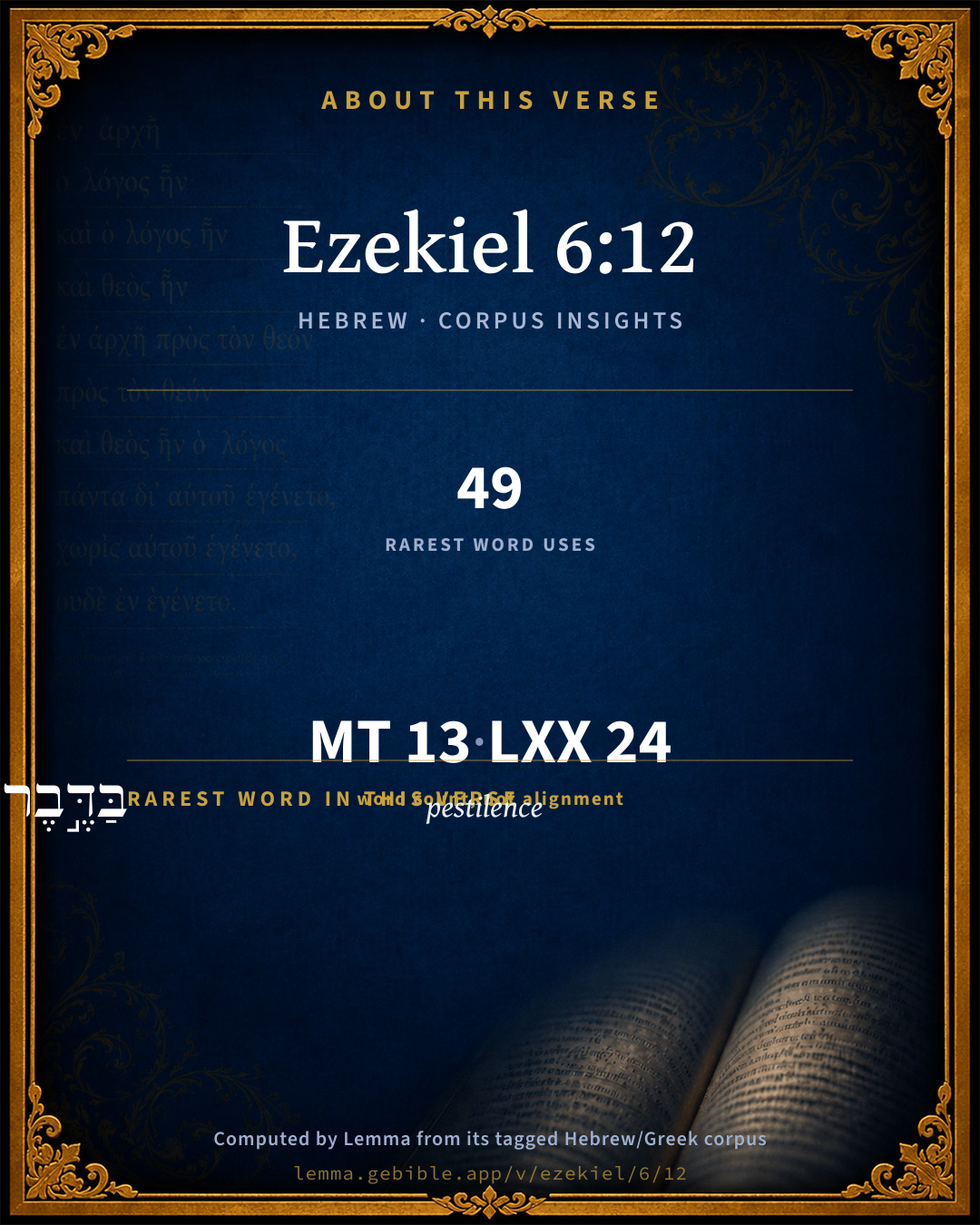
About this verse

These counts appear in no published source. They are computed here, from the morphology-tagged text and Lemma’s own curated glosses. What Lemma adds →

13
words
11
distinct lemmas
Prophets
section

Shared distinctive vocabulary

בַּדֶּ֣בֶר pestilence H1698 occurs in 48 verses of the Hebrew Bible. Also found in:

Grammatical profile

  • 6 verbs
  • 4 nouns
  • 2 adjectives
  • 1 preposition

Verb forms

  • יָמ֗וּת Qal · Imperfect
  • יִפּ֔וֹל Qal · Imperfect
  • וְהַנִּשְׁאָר֙ Niphal · Participle Active
  • וְהַנָּצ֔וּר Qal · Participle Passive
  • יָמ֑וּת Qal · Imperfect
  • וְכִלֵּיתִ֥י Piel · Sequential Perfect

Repetition

A word recurs within this verse — often emphatic in Hebrew:

  • יָמ֗וּת to die H4191 ×2

Hebrew & Septuagint length

In English translation the verse runs 40 words from the Hebrew and 40 from the Septuagint (LXX English) — the same length.

A rough comparison of the two English renderings, which tokenize alike — not a word-level alignment.

Word counts can differ between the Hebrew and the Greek without any difference in meaning — e.g. the Hebrew direct-object marker אֵת has no separate Greek word, and Greek often adds the article ὁ.

In the original languages it is 13 Hebrew tokens and 24 Greek tokens — but the two are counted differently (Hebrew bundles its prefixes and suffixes into one token; the Greek is in lemma form), so that isn’t a like-for-like length.

Cross-references

5

Topical passages linked to Ezekiel 6:12 in the Treasury of Scripture Knowledge — connected by theme and wording, ordered by reader-vote popularity; previews shown in the World English Bible.

  • Ezekiel 5:13 Thus shall my anger be accomplished, and I will cause my wrath toward them to rest, and I shall be comforted; and they shall know that I, Yahweh, have spoken in my zeal, when I have accomplished my wrath on them.
  • Lamentations 4:11 Yahweh has accomplished his wrath, he has poured out his fierce anger; He has kindled a fire in Zion, which has devoured the foundations of it.
  • Lamentations 4:22 The punishment of your iniquity is accomplished, daughter of Zion; he will no more carry you away into captivity: He will visit your iniquity, daughter of Edom; he will uncover your sins.
  • Daniel 9:7 Lord, righteousness belongs to you, but to us confusion of face, as at this day; to the men of Judah, and to the inhabitants of Jerusalem, and to all Israel, who are near, and who are far off, through all the countries where you have driven them, because of their trespass that they have trespassed against you.
  • Isaiah 40:2 Speak comfortably to Jerusalem; and cry to her, that her warfare is accomplished, that her iniquity is pardoned, that she has received of Yahweh's hand double for all her sins.

Cross-references courtesy of OpenBible.info (CC BY 4.0).

Hebrew and Greek witnesses Masoretic Hebrew ↔ Greek Septuagint

The same verse in the two great witnesses to the Old Testament, shown verse-for-verse.

These are two independent witnesses, not word-aligned to each other, and the Septuagint is shown in lemma (dictionary) form.

Hebrew Ezekiel 6:12 Masoretic · Westminster Leningrad Codex

הָרָח֞וֹק בַּדֶּ֣בֶר יָמ֗וּת וְהַקָּרוֹב֙ בַּחֶ֣רֶב יִפּ֔וֹל וְהַנִּשְׁאָר֙ וְהַנָּצ֔וּר בָּרָעָ֖ב יָמ֑וּת וְכִלֵּיתִ֥י חֲמָתִ֖י בָּֽם

He who is far off shall die of the pestilence; and he who is near shall fall by the sword; and he who remains and is besieged shall die by the famine: thus will I accomplish my wrath on them.

World English Bible · Public Domain

Greek LXX Ezekiel 6:12 Septuagint · lemma form

ὁ ἐγγύς ἐν ῥομφαία πίπτω ὁ δέ μακράν ἐν θάνατος τελευτάω καί ὁ περιἔχω ἐν λιμός συντελέω καί συντελέω ὁ ὀργή ἐγώ ἐπί αὐτός

He that is near shall fall by the sword; and he that is far off shall die by the pestilence; and he that is in the siege shall be consumed with famine: and I will accomplish my anger upon them.

LXX2012 (modern English Septuagint) · Public Domain

On this verse, The Cambridge Bible for Schools and Colleges discusses the Septuagint’s reading. Read the note in Commentary ↓

Hebrew: Westminster Leningrad Codex (CC BY 4.0). Greek: Septuagint (public domain); English from LXX2012 (modern English Septuagint) (Public Domain). How the Septuagint differs from the Hebrew →

Targum (Aramaic paraphrase)

1

The Targum is the ancient Jewish Aramaic paraphrase of the Hebrew Scriptures — an interpretive translation, not the Hebrew text itself. Onkelos (literal) and Pseudo-Jonathan (expansive) render the Torah, and Jonathan the Prophets. Coverage is partial: where no permissively-licensed English translation exists for a verse, only the Aramaic is shown. This is verse-level text, not a word-by-word alignment to the Hebrew.

  1. Targum Jonathan Prophets (Joshua–Malachi)
    דְרָחִיק בְּמוֹתָא יְמוּת וּדְקָרִיב בְּחַרְבָּא יִתְקְטֵיל וּדְיִשְׁתְּאַר וּדְיֵעוֹל לִכְרַכֵּי צַיְרָא בְּכַפְנָא יְמוּת וְיָחוּל רוּגְזִי בְּהוֹן:

    (no public-domain English translation for this verse)

    Targum Jonathan — Aramaic: “Mikraot Gedolot” (public domain). English: “Sefaria Community Translation” (CC0 1.0 (public-domain dedication)); “London "Chaldee Paraphrase," 1871” (public domain). Text via Sefaria.

Commentary

Notes on Ezekiel 6:12 from classic Christian and Jewish commentators (each source and its license shown beneath its notes). The classic Christian expositions comment on the surrounding passage and are grouped to its opening verse, so a note may address several verses; the Jewish commentaries on the Tanakh (Rashi and others) are per-verse, so they appear only where the commentator wrote on this verse.

Lemma curates 59 commentaries, every one of them public domain or Creative Commons licensed, each selected and text-cleaned for this edition rather than reprinted as found. About our sources →

Trapp's Complete Commentary

John Trapp

Eze 6:12 He that is far off shall die of the pestilence; and he that is near shall fall by the sword; and he that remaineth and is besieged shall die by the famine: thus will I accomplish my fury upon them.

Ver. 12. He that is far off shall die of the pestilence.] Pluribus verbis hunc locum tractat. Ointments must not only be laid upon the part that acheth, but also robbed and chafed in; so must menaces and promises, that they may soak and sink into the soul.

John Trapp, A Commentary or Exposition upon All the Books of the Old and New Testament (1647–1656) — public domain. Text from a community e-Sword module.

Tyndale Open Study Notes

Tyndale Open Resources

6:12 anyone who survives: See 5:3-4.

Tyndale Open Study Notes — © Tyndale Open Resources, licensed CC BY-SA 4.0. Text via the HelloAO Bible API.

Jamieson, Fausset & Brown

Robert Jamieson, A. R. Fausset & David Brown

He that is far off--namely, from the foe; those who in a distant exile fear no evil.

he that remaineth--he that is left in the city; not carried away into captivity, nor having escaped into the country. Distinct from "he that is near," namely, those outside the city who are within reach of "the sword" of the foe, and so fall by it; not by "famine," as those left in the city.

Jamieson, Fausset & Brown — Commentary Critical and Explanatory on the Whole Bible (1871) — public domain (CC PDM 1.0). Text via the HelloAO Bible API.

John Calvin's Commentaries

Now the Prophet explains himself how the Israelites were to be destroyed by famine, the sword, and pestilence, namely, those who shall be far off shall die by pestilence; that is, after they think themselves hidden in secret places, so that no danger nor inconvenience can overtake them, they shall die there by pestilence. For when they were dragged into distant exile, they thought themselves altogether remote from all harm. But pestilence, he says, shall attack them although the sword shall cease. Then those who shall be at hand, that is, those who remain at home, the sword shall consume. Now the remnant, he says, who had been besieged and hemmed in, shall die by famine. And so he confirms what we formerly saw, that there should be no cause why the Israelites should sleep amidst their sins when God spared them: because if they do not all perish by the sword, God has other means of punishing them; for he has pestilence and famine in his hand, so that he can extinguish those who are far off, since pestilence will pursue them even there; then if any are left, they shall perish — even in the midst of peace — nevertheless, because God will destroy them by famine and want. Then he adds, I will fulfill my burning wrath against them: by which words God signifies that he had borne with that impious people thus far, but if at any time he pleased to exercise rigor, that he had not yet exacted sufficient punishment for their wickedness. Hence God blames them, though he had borne with them thus far, and although he had sometimes stricken them with his rods, yet he was not a rigid judge, but admonishes them as a father to return to the right way. But since they had so obstinately abused God’s forbearance, he here pronounces that his last act was approaching, and for this reason he speaks of the fulfilling of his burning anger: thus the Prophet turns away all envy from God, that the Israelites should not charge him with cruelty; thus he shows them that whatever evils they suffered were only a prelude to a horrible slaughter which was overhanging them, and which they still despised. It follows —

John Calvin's Commentaries (1540-1563) — public domain. Text from the Calvin Translation Society English edition (1840s-50s) via the Christian Classics Ethereal Library (ccel.org). Calvin's coverage is partial (roughly two-thirds of the Bible); uncommented books and verses are honest gaps, never fabricated. The 19th-century editor's footnotes and remarks are omitted so the notes are faithfully Calvin's own voice.

Ellicott's Commentary for English Readers

(12) That is far off . . . that is near.—That is, all, wherever they may be, shall be reached and overwhelmed by the coming judgments; yet not in such wise that we are to think of one kind of judgment as especially reserved for one class, and another kind for another. The different forms of punishment shall all fall upon the people; and they that escape one shall fall by another.

A Bible Commentary for English Readers, edited by Charles John Ellicott (1878–1897) — public domain. Text from a community e-Sword module.

The Cambridge Bible for Schools and Colleges

gen. ed. J. J. S. Perowne

12. and is besieged] and he that is besieged. In LXX. the previous “he that remaineth” is wanting. With this omission “he that is besieged” might stand, cf. ch. Eze_7:15, “he that is in the city, famine shall devour him.” Otherwise the sense seems rather as in R.V. marg. preserved, as Isa_49:6.

The Cambridge Bible for Schools and Colleges (gen. ed. J. J. S. Perowne; Cambridge University Press, 1878–1918) — public domain. Text from a community e-Sword module.

John Gill's Exposition

Then shall ye know that I am the Lord,.... Whom they had denied, by serving other gods; but now by those punishments their eyes would be opened to see, and be obliged to acknowledge, that there was no God but the Lord:

when their slain men shall be among their idols round about their altars; as is threatened, Eze 6:5; by which it will appear that the idols whom they worshipped could not save them; since they should fall just by them, round about the altars on which they sacrificed unto them; which idols were placed, and altars for their worship built,

upon every high hill, in all the tops of the mountains: mountains and high hills were usual places of idolatry among the Heathens, in which the Jews imitated them, and particularly Herodotus (e) says of the Persians, that, going up to the highest parts of mountains, they offered sacrifice to Jupiter; so they called the whole circle of the heavens:

and under every green tree, and under every thick oak; see Kg1 14:23; here their slain were to fall, where they committed their idolatry: even in

the place where they did offer sweet savour to all their idols; or dunghill gods; yet, though they were such, sweet savour or incense was offered to them; wherefore, in righteous judgment, here their carcasses should fill and lie, and rot and stink.

(e) Clio, sive l. 1. c. 131.

John Gill's Exposition of the Whole Bible (1746–1763) — public domain (CC PDM 1.0). Text via the HelloAO Bible API.

Matthew Poole's English Annotations

Far off; either by his early and voluntary flight from his own country; or, he that is carried away captive, and sent by the enemy into a far country.

Pestilence; the arrow I will shoot after them.

He that is near; who stays in his own country, or dwells near to Jerusalem, or would retire to it when the Babylonians approach, but is taken before he can get thither.

He that remaineth; that surviveth those slain, but is shut up and besieged where he sought safety.

I will accomplish my fury; I will satisfy my just displeasure, and give them full measures of punishment; I will fulfil my threats.

Matthew Poole's English Annotations on the Holy Bible (1683–1685) — public domain. Text from a community e-Sword/MySword module.

Whedon's Commentary on the Bible

Daniel D. Whedon

12. Kautzsch and R.V. read “preserved” and “saved” instead of besieged.

Daniel D. Whedon (gen. ed.), Commentary on the Old and New Testaments (1874–1909) — public domain. Text from a community e-Sword module.

The Pulpit Commentary

He that is far off, etc. The three forms of judgment named in ver. 11 have each their special victims. Pestilence comes chiefly on those who are outside the city, exposed to the weather changes and the taint of unburied corpses (ver. 5); the sword of the Chaldeans on those who venture on a sally, or try to escape from the city; famine presses heaviest on those who are besieged within it. None can escape the judgment. The word besieged is the same as in Isa_1:8; but it may have the sense, Isa_49:6, of "kept," or "preserved," for the worst evil of the three.

The Pulpit Commentary (1880–1919), ed. H.D.M. Spence-Jones & Joseph S. Exell — public domain. Text from a community e-Sword module.

John Wesley's Explanatory Notes

Far off - Either by flight, or captivity. Shall fall - Who dwell near to Jerusalem, or would retire to it, when the Babylonians approach.

John Wesley, Explanatory Notes Upon the Whole Bible (1754–1765) — public domain. Text via the GEBible commentary corpus.

Rashi

Rabbi Shlomo Yitzchaki (Rashi)

and who is in the siege Heb. והנצור, one who is gathered into the city when they besiege it.

and I shall spend My fury I shall finish all My fury and My desire to do evil to them.

Rashi on the Tanakh — English translations: “The Judaica Press complete Tanach with Rashi, translated by A. J. Rosenberg” (CC BY 4.0); “Pentateuch with Rashi's commentary by M. Rosenbaum and A.M. Silbermann, 1929-1934” (public domain); “The Metsudah Tanach series, Lakewood, N.J” (CC BY 4.0); and “The Book of Joshua, Metsudah Publications, 1997” (CC BY 4.0). Text via Sefaria.

Lesson kit

Teaching starters — assembled from the data on this page, not authored interpretation. Every prompt links to the verse data it draws on. Edit before teaching.

Ezekiel, in the Prophets, opens this verse with 13 words (11 distinct Hebrew lemmas). Its most distinctive word is deber (“pestilence”). A historical commentator’s framing appears above. Read the whole chapter for the surrounding context.

Discussion questions

  1. The word deber carries the sense “pestilence.” How does it shape the verse?
  2. Exodus 5:3 shares the word «pestilence» with this verse. How do the two illuminate each other?
  3. “to die” occurs 2× in this one verse. What is the effect of the repetition?
  4. The translations on this page render this verse differently — a whole-verse word diff, not a word-by-word alignment. What might account for the different wordings?
  5. The verb «יָמ֗וּת» is Qal Imperfect. How does its form color the action?
  6. Reading how Trapp's Complete Commentary and Tyndale Open Study Notes read this verse, where do the two commentators agree and where do they part?

Things to notice

Reading settings

Reading text

Shown beneath each verse's original-language words.

Old Testament
Old Testament edition

Read the OT as the Masoretic Hebrew (MT) or the Greek Septuagint (LXX).

English shown for the Greek Septuagint (in the Hebrew ↔ Greek comparison).

Comparing translations? Open the Compare panel on any verse page to stack up to four side by side.