
Jeremiah 9:16

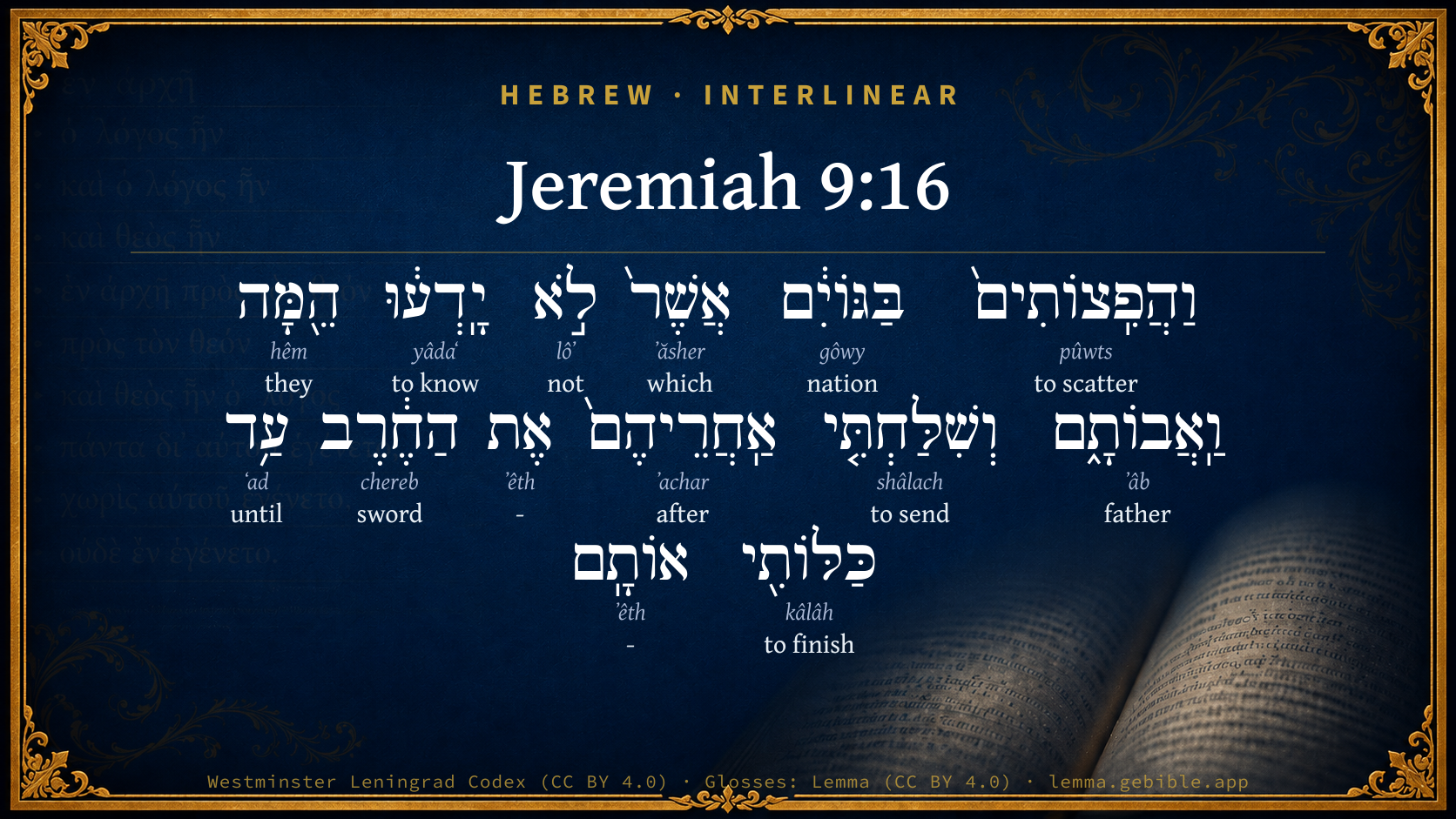
Hebrew (Westminster Leningrad Codex) Jeremiah 9:16 appears in the Hebrew Old Testament. The text above is from the Westminster Leningrad Codex. Each word links to its Strong’s number, a concise gloss, and parsing drawn from the Open Scriptures Hebrew Bible morphology. Click any word for its full Brown-Driver-Briggs (BDB) entry.
Download image
Cite this verse

Jeremiah 9:16 (World English Bible). Public Domain. Lemma interlinear Bible study tool, https://lemma.gebible.app/v/jeremiah/9/16.

Show BibTeX & RIS
BibTeX
RIS
English Translation
I will scatter them also among the nations, whom neither they nor their fathers have known; and I will send the sword after them, until I have consumed them.
World English Bible · Public Domain
Download a study sheet

One document with this verse’s original text, its word-by-word gloss line, the meaning frame, cross-references with their text, attributed commentary, and full source and license credits — printable, and it pastes into notes with its structure intact.

This verse Autodidact and up

Study sheet (.html) Plain text (.txt)

A passage Seminary Student

Up to 50 verses in one chapter. A passage sheet keeps up to 6 commentary sources and 12 cross-references per verse, in the order this page ranks them, and says so on the sheet whenever that leaves anything out. Ask for a single verse and you get the Autodidact verse sheet above.

Everything on this page stays free to read, with no account — the sheet is a download of what is already on screen, not access to it.

Want to remove ads? Support Godless Engineer
Compare translations 3

The same verse in 3 English versions, stacked beneath the original-language interlinear above. Click any original word for its lexicon entry.

Each is an independent rendering of the whole verse — the interlinear is not word-aligned to these translations.

Highlighted words mark where these versions differ — a whole-verse word diff, not a word-by-word alignment.

  • World English Bible Public Domain
    I will scatter them also among the nations, whom neither they nor their fathers have known; and I will send the sword after them, until I have consumed them.
  • King James Version Public Domain
    I will scatter them also among the heathen, whom neither they nor their fathers have known: and I will send a sword after them, till I have consumed them.
  • unfoldingWord Literal Text CC BY-SA 4.0
    And I will scatter them among the nations whom they have not known, they nor their fathers, and I will send out the sword after them until I consume them.”

unfoldingWord Literal Text — © unfoldingWord, licensed CC BY-SA 4.0. Word-aligned USFM3 via Door43 (git.door43.org/unfoldingWord/en_ult).

Versions to compare (up to 4)

3 of 4 selected

Show all 18 translations

Every available English version of this verse, each an independent rendering of the whole verse.

  • World English Bible Public Domain
    I will scatter them also among the nations, whom neither they nor their fathers have known; and I will send the sword after them, until I have consumed them.
  • Berean Standard Bible Public Domain
    I will scatter them among the nations that neither they nor their fathers have known, and I will send a sword after them until I have finished them off.”
  • Majority Standard Bible Public Domain
    I will scatter them among the nations that neither they nor their fathers have known, and I will send a sword after them until I have finished them off.”
  • King James Version Public Domain
    I will scatter them also among the heathen, whom neither they nor their fathers have known: and I will send a sword after them, till I have consumed them.
  • American Standard Version (1901) Public Domain
    I will scatter them also among the nations, whom neither they nor their fathers have known; and I will send the sword after them, till I have consumed them.
  • Revised Version (1885) Public Domain
    I will scatter them also among the nations, whom neither they nor their fathers have known: and I will send the sword after them, till I have consumed them.
  • Geneva Bible (1599) Public Domain
    I wil scatter them also among the heathen, whom neither they nor their fathers haue knowen, and I will send a sworde after them, til I haue consumed them.
  • Douay-Rheims (1899) Public Domain
    And I will scatter them among the nations, which they and their fathers have not known: and I will send the sword after them till they be consumed.
  • Young's Literal Translation Public Domain
    And I have scattered them among nations Which they knew not, they and their fathers, And have sent after them the sword, Till I have consumed them.
  • Literal Standard Version CC BY-SA 4.0
    And I have scattered them among nations || Which they did not know, they and their fathers, || And have sent the sword after them, || Until I have consumed them.”
  • Unlocked Literal Bible CC BY-SA 4.0
    Then I will scatter them among the nations that they have not known, neither they nor their ancestors. I will send out a sword after them until I have completely destroyed them.'”
  • unfoldingWord Literal Text CC BY-SA 4.0
    And I will scatter them among the nations whom they have not known, they nor their fathers, and I will send out the sword after them until I consume them.”
  • Darby Bible Public Domain
    and will scatter them among the nations, whom neither they nor their fathers have known; and I will send the sword after them, till I have consumed them.
  • World Messianic Bible Public Domain
    I will scatter them also among the nations, whom neither they nor their fathers have known. I will send the sword after them, until I have consumed them.”
  • Webster's Bible Public Domain
    I will scatter them also among the heathen, whom neither they nor their fathers have known: and I will send a sword after them, till I have consumed them.
  • Free Bible Version CC BY-SA 4.0
    I'm about to scatter them among nations unfamiliar to them and their forefathers, and I will send enemies with swords to chase after them until I have wiped them out.
  • Bible in Basic English Public Domain
    And I will send them wandering among the nations, among people strange to them and to their fathers: and I will send the sword after them till I have put an end to them.
  • JPS Tanakh (1917) Public Domain
    (9-15) I will scatter them also among the nations, whom neither they nor their fathers have known; and I will send the sword after them, till I have consumed them.

Literal Standard Version (2020), Covenant Press — licensed CC BY-SA 4.0. Text via the HelloAO Bible API (eBible.org). Unlocked Literal Bible (unfoldingWord) — licensed CC BY-SA 4.0. Text via the HelloAO Bible API (eBible.org). unfoldingWord Literal Text — © unfoldingWord, licensed CC BY-SA 4.0. Word-aligned USFM3 via Door43 (git.door43.org/unfoldingWord/en_ult). Free Bible Version, Dr. Jonathan Gallagher — licensed CC BY-SA 4.0. Text via the HelloAO Bible API (eBible.org).

Word by word

More ways to search: Search by grammar → Find every occurrence → Compare this word →

Practice this passage: Drill this verse → Learn its vocabulary →

וַהֲפִֽצוֹתִים֙
pûwts
H6327
“and · to scatter · them”
Conjunction + Verb, Hiphil, Sequential Perfect, 1st Person, Common, Singular + Suffix, Personal, 3rd Person, Masculine, Plural
Part of Speech
Conjunction + Verb
Stem
Hiphil
Form
Sequential Perfect
Person
1st Person
Gender
Common
Number
Singular
Full BDB Definition

Origin: a primitive root

TWOT: 1745 , 1746 , 1800

to scatter, be dispersed, be scattered - (Qal) to be dispersed, be scattered - (Niphal) - to be scattered - to be spread abroad - (Hiphil) to scatter - Hithpael) scatter - (Qal) to flow, overflow - to break - (Polel) to shatter - (Pilpel) to dash to pieces
  1. בַּגּוֹיִ֔ם gôwy H1471 “in/at the · nations” Preposition, Determined + Noun, Common, Masculine, Plural, Absolute
  2. אֲשֶׁר֙ ʼăsher H834 “which” Particle, Relative
  3. לֹ֣א lôʼ H3808 “not” Particle, Negative
  4. יָֽדְע֔וּ yâdaʻ H3045 “to know” Verb, Qal, Perfect, 3rd Person, Common, Plural
  5. הֵ֖מָּה hêm H1992 “they” Pronoun, Personal, 3rd Person, Masculine, Plural
  6. וַֽאֲבוֹתָ֑ם ʼâb H1 “and · fathers · their” Conjunction + Noun, Common, Masculine, Plural, Construct + Suffix, Personal, 3rd Person, Masculine, Plural
  7. וְשִׁלַּחְתִּ֤י shâlach H7971 “and · to send” Conjunction + Verb, Piel, Sequential Perfect, 1st Person, Common, Singular
  8. אַֽחֲרֵיהֶם֙ ʼachar H310 “after · them” Preposition + Suffix, Personal, 3rd Person, Masculine, Plural
  9. אֶת ʼêth H853 “-” Particle, Direct Object
  10. הַחֶ֔רֶב chereb H2719 “the · sword” Particle, Definite Article + Noun, Common, Feminine, Singular, Absolute
  11. עַ֥ד ʻad H5704 “until” Preposition
  12. כַּלּוֹתִ֖י kâlâh H3615 “to finish · me” Verb, Piel, Infinitive Construct + Suffix, Personal, 1st Person, Common, Singular
  13. אוֹתָֽם ʼêth H853 “- · them” Particle, Direct Object + Suffix, Personal, 3rd Person, Masculine, Plural

About this verse

These counts appear in no published source. They are computed here, from the morphology-tagged text and Lemma’s own curated glosses. What Lemma adds →

14
words
13
distinct lemmas
Prophets
section

Grammatical profile

  • 4 verbs
  • 3 nouns
  • 1 pronoun
  • 2 prepositions
  • 4 particles

Verb forms

  • וַהֲפִֽצוֹתִים֙ Hiphil · Sequential Perfect
  • יָֽדְע֔וּ Qal · Perfect
  • וְשִׁלַּחְתִּ֤י Piel · Sequential Perfect
  • כַּלּוֹתִ֖י Piel · Infinitive Construct

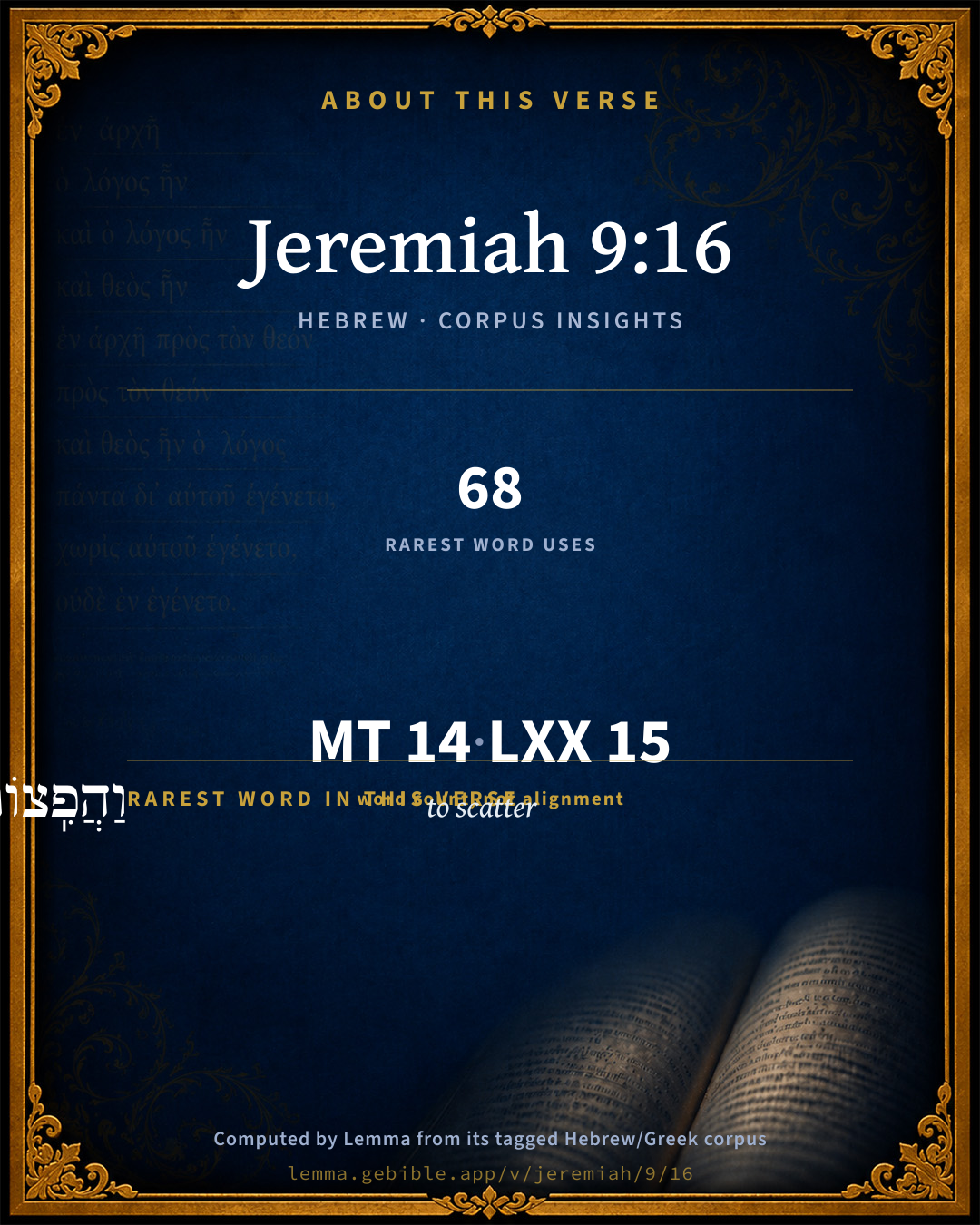
Hebrew & Septuagint length

In the original languages it is 14 Hebrew tokens and 15 Greek tokens — but the two are counted differently (Hebrew bundles its prefixes and suffixes into one token; the Greek is in lemma form), so that isn’t a like-for-like length.

Cross-references

23

Topical passages linked to Jeremiah 9:16 in the Treasury of Scripture Knowledge — connected by theme and wording, ordered by reader-vote popularity; previews shown in the World English Bible.

  • Leviticus 26:33 I will scatter you among the nations, and I will draw out the sword after you: and your land will be a desolation, and your cities shall be a waste.
  • Deuteronomy 28:64 Yahweh will scatter you among all peoples, from the one end of the earth even to the other end of the earth; and there you shall serve other gods, which you have not known, you nor your fathers, even wood and stone.
  • Ezekiel 5:2 A third part shall you burn in the fire in the midst of the city, when the days of the siege are fulfilled; and you shall take a third part, and strike with the sword round about it; and a third part you shall scatter to the wind, and I will draw out a sword after them.
  • Ezekiel 5:12 A third part of you shall die with the pestilence, and with famine shall they be consumed in the midst of you; and a third part shall fall by the sword round about you; and a third part I will scatter to all the winds, and will draw out a sword after them.
  • Jeremiah 44:27 Behold, I watch over them for evil, and not for good; and all the men of Judah who are in the land of Egypt shall be consumed by the sword and by the famine, until there be an end of them.
  • Jeremiah 13:24 Therefore will I scatter them, as the stubble that passes away, by the wind of the wilderness.
  • Deuteronomy 4:27 Yahweh will scatter you among the peoples, and you shall be left few in number among the nations, where Yahweh shall lead you away.
  • Deuteronomy 28:25 Yahweh will cause you to be struck before your enemies; you shall go out one way against them, and shall flee seven ways before them: and you shall be tossed back and forth among all the kingdoms of the earth.
  • Deuteronomy 28:36 Yahweh will bring you, and your king whom you shall set over you, to a nation that you have not known, you nor your fathers; and there shall you serve other gods, wood and stone.
  • Deuteronomy 32:26 I said, I would scatter them afar, I would make the memory of them to cease from among men;
  • Nehemiah 1:8 Remember, I beg you, the word that you commanded your servant Moses, saying, If you trespass, I will scatter you abroad among the peoples:
  • Psalms 106:27 That he would overthrow their seed among the nations, And scatter them in the lands.
  • Jeremiah 15:2–4 It shall happen, when they tell you, Where shall we go forth? then you shall tell them, Thus says Yahweh: Such as are for death, to death; and such as are for the sword, to the sword; and such as are for the famine, to the famine; and such as are for captivity, to captivity.
  • Jeremiah 24:10 I will send the sword, the famine, and the pestilence, among them, until they be consumed from off the land that I gave to them and to their fathers.
  • Jeremiah 25:27 You shall tell them, Thus says Yahweh of Hosts, the God of Israel: Drink you, and be drunken, and spew, and fall, and rise no more, because of the sword which I will send among you.
  • Jeremiah 29:17 thus says Yahweh of Hosts; Behold, I will send on them the sword, the famine, and the pestilence, and will make them like vile figs, that can't be eaten, they are so bad.
  • Jeremiah 49:36–37 On Elam will I bring the four winds from the four quarters of the sky, and will scatter them toward all those winds; and there shall be no nation where the outcasts of Elam shall not come.
  • Ezekiel 11:17 Therefore say, Thus says the Lord Yahweh: I will gather you from the peoples, and assemble you out of the countries where you have been scattered, and I will give you the land of Israel.
  • Ezekiel 12:15 They shall know that I am Yahweh, when I shall disperse them among the nations, and scatter them through the countries.
  • Ezekiel 14:17 Or if I bring a sword on that land, and say, Sword, go through the land; so that I cut off from it man and animal;
  • Ezekiel 20:23 Moreover I swore to them in the wilderness, that I would scatter them among the nations, and disperse them through the countries;
  • Zechariah 7:14 "but I will scatter them with a whirlwind among all the nations which they have not known. Thus the land was desolate after them, so that no man passed through nor returned: for they made the pleasant land desolate."
  • James 1:1 James, a servant of God and of the Lord Jesus Christ, to the twelve tribes which are in the Dispersion: Greetings.

Cross-references courtesy of OpenBible.info (CC BY 4.0).

Hebrew and Greek witnesses Masoretic Hebrew ↔ Greek Septuagint

The same verse in the two great witnesses to the Old Testament, shown verse-for-verse.

These are two independent witnesses, not word-aligned to each other, and the Septuagint is shown in lemma (dictionary) form.

Hebrew Jeremiah 9:16 Masoretic · Westminster Leningrad Codex

וַהֲפִֽצוֹתִים֙ בַּגּוֹיִ֔ם אֲשֶׁר֙ לֹ֣א יָֽדְע֔וּ הֵ֖מָּה וַֽאֲבוֹתָ֑ם וְשִׁלַּחְתִּ֤י אַֽחֲרֵיהֶם֙ אֶת הַחֶ֔רֶב עַ֥ד כַּלּוֹתִ֖י אוֹתָֽם

I will scatter them also among the nations, whom neither they nor their fathers have known; and I will send the sword after them, until I have consumed them.

World English Bible · Public Domain

Greek LXX Structure differs

In the Septuagint, Jeremiah is about an eighth shorter than the Hebrew and arranges its material differently — the Oracles Against the Nations (Hebrew chapters 46–51) appear in the middle of the Greek book, after 25:13. Because the chapter and verse boundaries do not line up, a verse-for-verse comparison with the Hebrew is not shown.

A verse-for-verse comparison isn’t shown here because the chapters and verses don’t line up. Switch to the LXX edition with the MT / LXX toggle above to read the Greek directly.

On this verse, Keil & Delitzsch discusses the Septuagint’s reading. Read the note in Commentary ↓

Hebrew: Westminster Leningrad Codex (CC BY 4.0). Greek: Septuagint (public domain); English from a public-domain English Septuagint. How the Septuagint differs from the Hebrew →

Targum (Aramaic paraphrase)

1

The Targum is the ancient Jewish Aramaic paraphrase of the Hebrew Scriptures — an interpretive translation, not the Hebrew text itself. Onkelos (literal) and Pseudo-Jonathan (expansive) render the Torah, and Jonathan the Prophets. Coverage is partial: where no permissively-licensed English translation exists for a verse, only the Aramaic is shown. This is verse-level text, not a word-by-word alignment to the Hebrew.

  1. Targum Jonathan Prophets (Joshua–Malachi)
    כִּדְנַן אֲמַר יְיָ צְבָאוֹת אִסְתַּכָּלוּ וּקְרוֹ לְאֶלְיָתָא וְיֵיתְיָן וּלְחַכִּימָתָא שָׁלְחוּ וְיַיתְיָן:

    (no public-domain English translation for this verse)

    Targum Jonathan — Aramaic: “Mikraot Gedolot” (public domain). English: “Sefaria Community Translation” (CC0 1.0 (public-domain dedication)); “London "Chaldee Paraphrase," 1871” (public domain). Text via Sefaria.

Commentary

Notes on Jeremiah 9:16 from classic Christian and Jewish commentators (each source and its license shown beneath its notes). The classic Christian expositions comment on the surrounding passage and are grouped to its opening verse, so a note may address several verses; the Jewish commentaries on the Tanakh (Rashi and others) are per-verse, so they appear only where the commentator wrote on this verse.

Lemma curates 59 commentaries, every one of them public domain or Creative Commons licensed, each selected and text-cleaned for this edition rather than reprinted as found. About our sources →

Trapp's Complete Commentary

John Trapp

Jer 9:16 I will scatter them also among the heathen, whom neither they nor their fathers have known: and I will send a sword after them, till I have consumed them.

Ver. 16. And I will scatter them also among the heathen.] As had been forethreatened. {Deu 28:15-68 Lev 26:14-39} But men will not believe till they feel. They read the threats of God’s law, as they do the old stories of foreign wars, and as if they lived out of the reach of God’s rod.

John Trapp, A Commentary or Exposition upon All the Books of the Old and New Testament (1647–1656) — public domain. Text from a community e-Sword module.

Whedon's Commentary on the Bible

Daniel D. Whedon

THE CARNIVAL OF DEATH, Jer_9:16-21.

16. I will scatter them — God’s determination thus to do is rendered more appalling by the statement whom neither they nor their fathers have known.

Till I have consumed them — Not utterly, as is repeatedly indicated in this book: God’s forbearance still continuing to the remnant who should be spared a feeble life in their own land.

Daniel D. Whedon (gen. ed.), Commentary on the Old and New Testaments (1874–1909) — public domain. Text from a community e-Sword module.

Keil & Delitzsch

C. F. Keil & F. Delitzsch

Zion laid waste. - Jer 9:16. "Thus hath Jahveh of hosts said: Give heed and call for mourning women, that they may come, and send to the wise women, that they may come, Jer 9:17. And may make haste and strike up a lamentation for us, that our eyes may run down with tears and our eyelids gush out with water. Jer 9:18. For loud lamentation is heard out of Zion: How are we spoiled, sore put to shame! because we have left the land, because they have thrown down our dwellings. Jer 9:19. For year, ye women, the word of Jahve, and let your ear receive the word of His mouth, and teach your daughters lamentation, and let one teach the other the song of mourning! Jer 9:20. For death cometh up by our windows, he entereth into our palaces, to cut off the children from the streets, the young men from the thoroughfares. Jer 9:21. Speak: Thus runs the saying of Jahve: And the carcases of men shall fall as dung upon the field, and as a sheaf behind the shearer, which none gathereth."

In this strophe we have a further account of the execution of the judgment, and a poetical description of the vast harvest death is to have in Zion. The citizens of Zion are called upon to give heed to the state of affairs now in prospect, i.e., the judgment preparing, and are to assemble mourning women that they may strike up a dirge for the dead. התבּונן, to be attentive, give heed to a thing; cf. Jer 2:10. Women cunning in song are to come with speed (תּמהרנה takes the place of an adverb). The form תּבואינה (Psa 45:16; Sa1 10:7) alternates with תּבואנהּ, the usual form in this verb, e.g., Gen 30:38; Kg1 3:16, etc., in order to produce an alternating form of expression . "For us" Ng. understands of those who call the mourning women, and in it he finds "something unusual," because ordinarily mourners are summoned to lament for those already dead, i.e., others than those who summon them. "But here they are to raise their laments for the very persons who summon them, and for the death of these same, which has yet to happen." There is a misunderstanding at the bottom of this remark. The "for us" is not said of the callers; for these are addressed in the second person. If Ng.'s view were right, it must be "for you," not "for us." True, the lxx has εφ ̓ ὑμᾶς; but Hitz. has rejected this reading as a simplification and weakening expression, and as disturbing the plan. "For us" is used by the people taken collectively, the nation as such, which is to be so sorely afflicted and chastised by death that it is time for the mourning women to raise their dirge, that so the nation may give vent to its grief in tears. We must also take into account, that even although the lamentations were for the dead, they yet chiefly concerned the living, who had been deeply afflicted by the loss of beloved relations; it would not be the dead merely that were mourned for, but the living too, because of their loss. It is this reference that stands here in the foreground, since the purpose of the chanting of dirges is that our eyes may flow with tears, etc. Zion will lament the slain of her people (Jer 8:22), and so the mourning women are to strike up dirges. תּשּׂנה for תּשּׂאנה, as in Rut 1:14; cf. Ew. 198, b. On the use of ירד and נזל with the accus.: flow down in tears, cf. Gesen. 138, 1, Rem. 2, Ew. 281, b.

Keil & Delitzsch — Biblical Commentary on the Old Testament (1861–1891) — public domain (CC PDM 1.0). Text via the HelloAO Bible API. (Old Testament only.)

Jamieson, Fausset & Brown

Robert Jamieson, A. R. Fausset & David Brown

nor their fathers have known--alluding to Jer 9:14, "Their fathers taught them" idolatry; therefore the children shall be scattered to a land which neither their fathers nor they have known.

send a sword after them--Not even in flight shall they be safe.

Jamieson, Fausset & Brown — Commentary Critical and Explanatory on the Whole Bible (1871) — public domain (CC PDM 1.0). Text via the HelloAO Bible API.

John Calvin's Commentaries

As he had said that the Jews were following what theyhad received from their fathers, so he says now that God would scatter them among nations,which had been unknown to them and to their fathers. He then alludes to their mischievous tradition; for the fathers had imbued their children with ungodly errors, and had withdrawn them from God, that their doctrine might become altogether familiar to them. There is then a contrast to be noticed between the knowledge with which the fathers had inebriated their children, and their ignorance of the language of the nations.

And then as he had said, that they were walking after the hardness of their own heart and after Baalim, he says, I will send a sword after them We hence see that the Prophet in both clauses alludes to the defection of which he had spoken. And he adds, Until I shall have consumed them; and this is added, that they might not promise themselves a temporary or a moderate chastisement. Jeremiah then declares, that as they had abused God’s forbearance, destruction was nigh them, and that God would contimle to consume them, until he had wholly destroyed them. It follows —

John Calvin's Commentaries (1540-1563) — public domain. Text from the Calvin Translation Society English edition (1840s-50s) via the Christian Classics Ethereal Library (ccel.org). Calvin's coverage is partial (roughly two-thirds of the Bible); uncommented books and verses are honest gaps, never fabricated. The 19th-century editor's footnotes and remarks are omitted so the notes are faithfully Calvin's own voice.

John Gill's Exposition

I will scatter them also among the Heathen,.... Besides the bitter judgments of famine and pestilence during the siege, what remained of them should be carried captive out of their own land into foreign countries, than which nothing could be more distressing:

whom neither they or their fathers have known; a circumstance greatly aggravating their captivity:

and I will send a sword after them, till I have consumed them; or men that kill with the sword, as the Targum: it chiefly regards such of them as were scattered among the Moabites and Ammonites, and especially that went into Egypt; see Jer 44:27.

John Gill's Exposition of the Whole Bible (1746–1763) — public domain (CC PDM 1.0). Text via the HelloAO Bible API.

Haydock's Catholic Bible Commentary

Consumed. Chap. xliv. 27. No country shall afford them protection. (Calmet) --- The richer sort were made captives, and most of the people destroyed, but not all, chap. iv. 25. (Worthington)

George Leo Haydock (1774–1849), Haydock's Catholic Family Bible and Commentary, 1859 edition — public domain. Excludes Psalms (Douay-Rheims chapter numbering differs from Protestant) and Deuterocanonical books (Catholic canon only).

Matthew Poole's English Annotations

I will scatter them also among the heathen; either you shall wander up and down among strangers, like Cain’s curse; or rather, you shall have no friend abroad, but be sold as so many slaves from person to person.

Whom neither they nor their fathers have known; part of the curse threatened Deu 28:64.

And I will send a sword after them: neither shall this serve their turn, but I will follow them with the sword till they be destroyed; probably meant of those that might escape out of Jerusalem, and flee into Egypt, the Chaldeans should pursue them thither, and either take or slay them there, i.e. such of them as were appointed for destruction; for otherwise they were not all consumed, a full end was not to be made, as is promised, Jer 5:10.

Matthew Poole's English Annotations on the Holy Bible (1683–1685) — public domain. Text from a community e-Sword/MySword module.

The Pulpit Commentary

I will scatter them also, etc. (comp. Deu_28:64 Lev_26:33) I will send a the sword after them. Even in the land of their captivity they shall have no rest. A special prophecy to the same effect was addressed to the Jewish fugitives in Egypt. (Jer_44:27) In both cases it is the unbelievers who are referred to; the nation as such was, through its Divine calling, indestructible.

The Pulpit Commentary (1880–1919), ed. H.D.M. Spence-Jones & Joseph S. Exell — public domain. Text from a community e-Sword module.

John Wesley's Explanatory Notes

A sword - But I will follow them with the sword, 'till they be destroyed, such of them as were appointed for destruction; for otherwise, they were not all consumed, a full end was not to be made.

John Wesley, Explanatory Notes Upon the Whole Bible (1754–1765) — public domain. Text via the GEBible commentary corpus.

Lesson kit

Teaching starters — assembled from the data on this page, not authored interpretation. Every prompt links to the verse data it draws on. Edit before teaching.

Jeremiah, in the Prophets, opens this verse with 14 words (13 distinct Hebrew lemmas). Its most distinctive word is pûwts (“to scatter”). A historical commentator’s framing appears above. Read the whole chapter for the surrounding context.

Discussion questions

  1. What does “to scatter” (pûwts) contribute to the verse as a whole?
  2. How does Leviticus 26:33, which shares this passage’s theme, read alongside this verse?
  3. The translations on this page render this verse differently — a whole-verse word diff, not a word-by-word alignment. What might account for the different wordings?
  4. «וַהֲפִֽצוֹתִים֙» is a Hiphil Sequential Perfect verb. How does that grammatical form shape the action described?
  5. Compare how Trapp's Complete Commentary and Whedon's Commentary on the Bible read this verse. Where do they agree or differ?

Things to notice

Reading settings

Reading text

Shown beneath each verse's original-language words.

Old Testament
Old Testament edition

Read the OT as the Masoretic Hebrew (MT) or the Greek Septuagint (LXX).

English shown for the Greek Septuagint (in the Hebrew ↔ Greek comparison).

Comparing translations? Open the Compare panel on any verse page to stack up to four side by side.