
Joshua 10:20

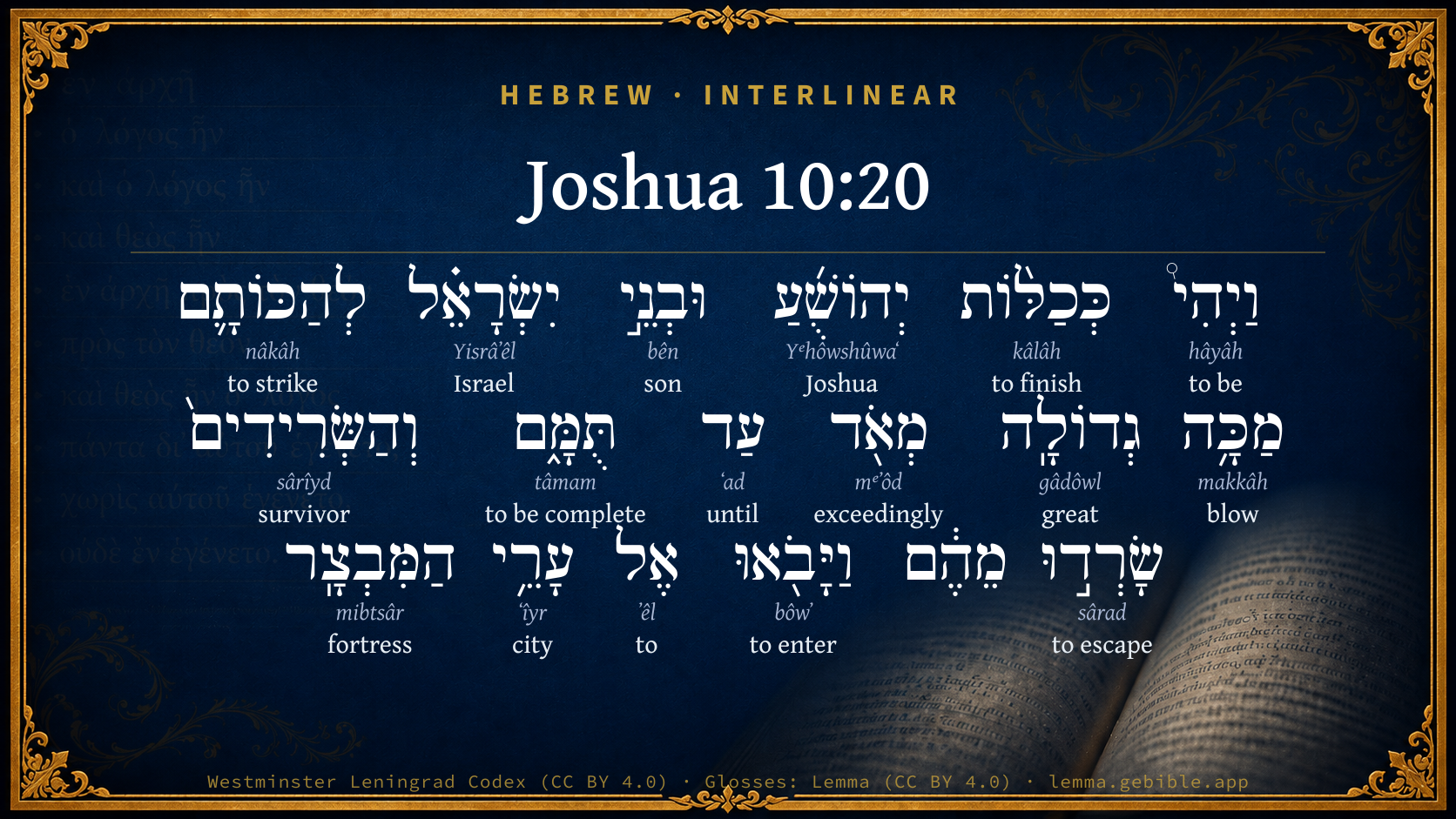
Hebrew (Westminster Leningrad Codex) Joshua 10:20 appears in the Hebrew Old Testament. The text above is from the Westminster Leningrad Codex. Each word links to its Strong’s number, a concise gloss, and parsing drawn from the Open Scriptures Hebrew Bible morphology. Click any word for its full Brown-Driver-Briggs (BDB) entry.
Download image
Cite this verse

Joshua 10:20 (World English Bible). Public Domain. Lemma interlinear Bible study tool, https://lemma.gebible.app/v/joshua/10/20.

Show BibTeX & RIS
BibTeX
RIS
English Translation
It happened, when Joshua and the children of Israel had made an end of killing them with a very great slaughter, until they were consumed, and the remnant which remained of them had entered into the fortified cities,
World English Bible · Public Domain
Highlights
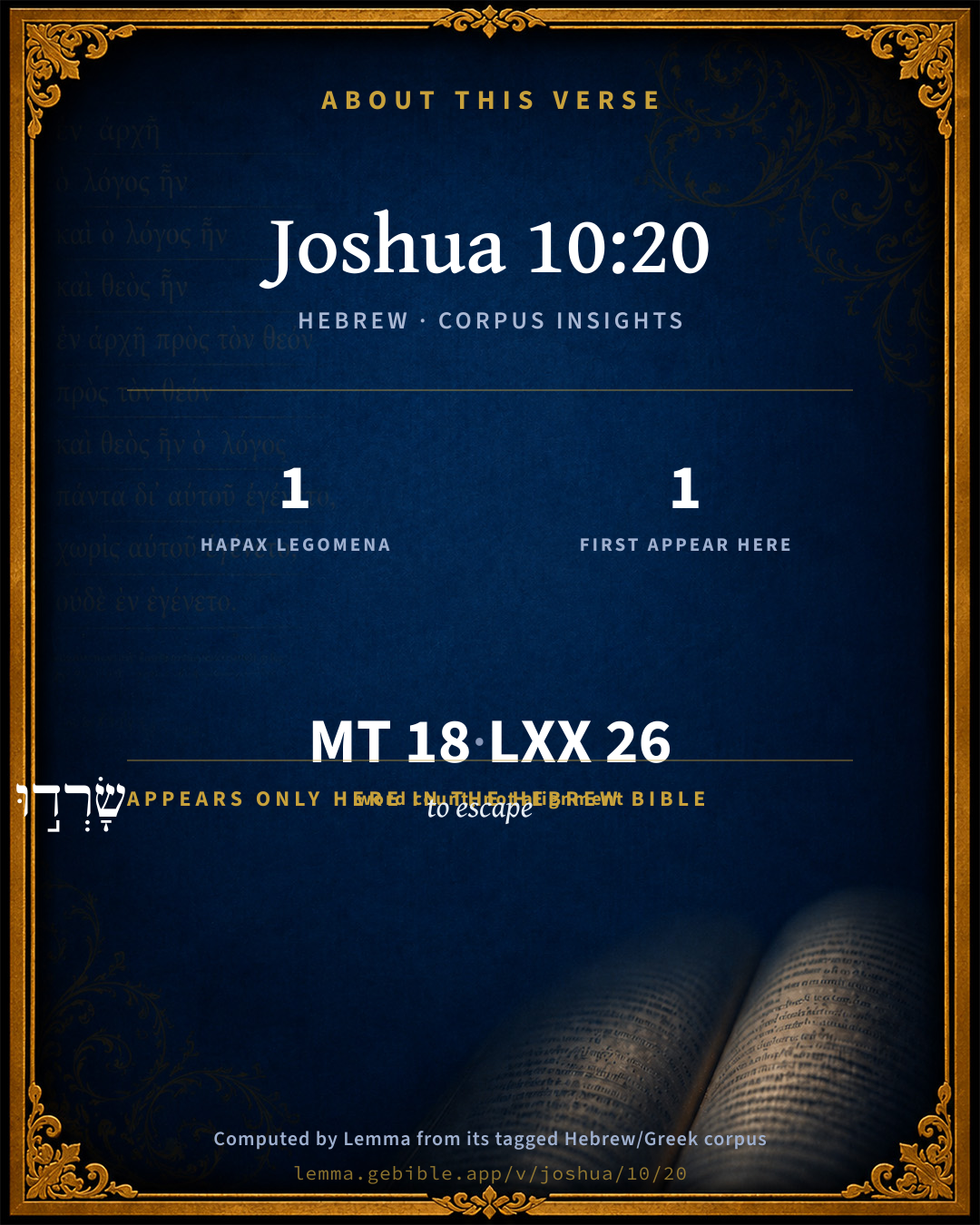
  • 1 hapax legomenon — only here in the Hebrew Bible
  • 1 first appearance in the Hebrew Bible
Full analysis ↓
Download a study sheet

One document with this verse’s original text, its word-by-word gloss line, the meaning frame, cross-references with their text, attributed commentary, and full source and license credits — printable, and it pastes into notes with its structure intact.

This verse Autodidact and up

Study sheet (.html) Plain text (.txt)

A passage Seminary Student

Up to 50 verses in one chapter. A passage sheet keeps up to 6 commentary sources and 12 cross-references per verse, in the order this page ranks them, and says so on the sheet whenever that leaves anything out. Ask for a single verse and you get the Autodidact verse sheet above.

Everything on this page stays free to read, with no account — the sheet is a download of what is already on screen, not access to it.

Want to remove ads? Support Godless Engineer
Compare translations 3

The same verse in 3 English versions, stacked beneath the original-language interlinear above. Click any original word for its lexicon entry.

Each is an independent rendering of the whole verse — the interlinear is not word-aligned to these translations.

Highlighted words mark where these versions differ — a whole-verse word diff, not a word-by-word alignment.

  • World English Bible Public Domain
    It happened, when Joshua and the children of Israel had made an end of killing them with a very great slaughter, until they were consumed, and the remnant which remained of them had entered into the fortified cities,
  • King James Version Public Domain
    And it came to pass, when Joshua and the children of Israel had made an end of slaying them with a very great slaughter, till they were consumed, that the rest which remained of them entered into fenced cities.
  • unfoldingWord Literal Text CC BY-SA 4.0
    And it happened, when Joshua and the sons of Israel had finished striking them a very great striking until their finishing, that the survivors from them survived and entered into the cities of fortification.

unfoldingWord Literal Text — © unfoldingWord, licensed CC BY-SA 4.0. Word-aligned USFM3 via Door43 (git.door43.org/unfoldingWord/en_ult).

Versions to compare (up to 4)

3 of 4 selected

Show all 18 translations

Every available English version of this verse, each an independent rendering of the whole verse.

  • World English Bible Public Domain
    It happened, when Joshua and the children of Israel had made an end of killing them with a very great slaughter, until they were consumed, and the remnant which remained of them had entered into the fortified cities,
  • Berean Standard Bible Public Domain
    So Joshua and the Israelites continued to inflict a terrible slaughter until they had finished them off, and the remaining survivors retreated to the fortified cities.
  • Majority Standard Bible Public Domain
    So Joshua and the Israelites continued to inflict a terrible slaughter until they had finished them off, and the remaining survivors retreated to the fortified cities.
  • King James Version Public Domain
    And it came to pass, when Joshua and the children of Israel had made an end of slaying them with a very great slaughter, till they were consumed, that the rest which remained of them entered into fenced cities.
  • American Standard Version (1901) Public Domain
    And it came to pass, when Joshua and the children of Israel had made an end of slaying them with a very great slaughter, till they were consumed, and the remnant which remained of them had entered into the fortified cities,
  • Revised Version (1885) Public Domain
    And it came to pass, when Joshua and the children of Israel had made an end of slaying them with a very great slaughter, till they were consumed, and the remnant which remained of them had entered into the fenced cities,
  • Geneva Bible (1599) Public Domain
    And when Ioshua and the children of Israel had made an ende of slaying them with an exceeding great slaughter till they were consumed, and the rest that remained of them were entred into walled cities,
  • Douay-Rheims (1899) Public Domain
    So the enemies being slain with a great slaughter, and almost utterly consumed, they that were able to escape from Israel, entered into fenced cities.
  • Young's Literal Translation Public Domain
    And it cometh to pass, when Joshua and the sons of Israel finish to smite them -- a very great smiting, till they are consumed, and the remnant who have remained of them go in unto the fenced cities,
  • Literal Standard Version CC BY-SA 4.0
    And it comes to pass, when Joshua and the sons of Israel finish to strike them [with] a very great striking until they are consumed, and the remnant who have remained of them go into the fortified cities,
  • Unlocked Literal Bible CC BY-SA 4.0
    Joshua and the sons of Israel had finished slaughtering them with a very great slaughter, until they were almost completely destroyed; only a few survivors who escaped reached the fortified cities.
  • unfoldingWord Literal Text CC BY-SA 4.0
    And it happened, when Joshua and the sons of Israel had finished striking them a very great striking until their finishing, that the survivors from them survived and entered into the cities of fortification.
  • Darby Bible Public Domain
    And it came to pass when Joshua and the children of Israel had ended smiting them with a very great slaughter, until they were consumed, that the remnant which remained of them entered into fortified cities;
  • World Messianic Bible Public Domain
    When Joshua and the children of Israel had finished killing them with a very great slaughter until they were consumed, and the remnant which remained of them had entered into the fortified cities,
  • Webster's Bible Public Domain
    And it came to pass, when Joshua and the children of Israel had made an end of slaying them with a very great slaughter, till they were consumed, that the rest who remained of them entered into fortified cities.
  • Free Bible Version CC BY-SA 4.0
    So Joshua and the Israelites totally defeated them, striking them down and killing them. Only a few of them survived to escape back to their towns.
  • Bible in Basic English Public Domain
    Now when Joshua and the children of Israel had come to the end of their war of complete destruction, and had put to death all but a small band who had got safely into the walled towns,
  • JPS Tanakh (1917) Public Domain
    And it came to pass, when Joshua and the children of Israel had made an end of slaying them with a very great slaughter, till they were consumed, and the remnant which remained of them had entered into the fortified cities,

Literal Standard Version (2020), Covenant Press — licensed CC BY-SA 4.0. Text via the HelloAO Bible API (eBible.org). Unlocked Literal Bible (unfoldingWord) — licensed CC BY-SA 4.0. Text via the HelloAO Bible API (eBible.org). unfoldingWord Literal Text — © unfoldingWord, licensed CC BY-SA 4.0. Word-aligned USFM3 via Door43 (git.door43.org/unfoldingWord/en_ult). Free Bible Version, Dr. Jonathan Gallagher — licensed CC BY-SA 4.0. Text via the HelloAO Bible API (eBible.org).

Word by word

More ways to search: Search by grammar → Find every occurrence → Compare this word →

Practice this passage: Drill this verse → Learn its vocabulary →

שָׂרְד֣וּ
sârad
H8277
“to escape”
Verb, Qal, Perfect, 3rd Person, Common, Plural
Part of Speech
Verb
Stem
Qal
Form
Perfect
Person
3rd Person
Gender
Common
Number
Plural
Full BDB Definition

Origin: a primitive root

TWOT: 2285

(Qal) to escape, survive
  1. וַיְהִי֩ hâyâh H1961 “and · to be” Conjunction + Verb, Qal, Sequential Imperfect, 3rd Person, Masculine, Singular
  2. כְּכַלּ֨וֹת kâlâh H3615 “like/as · to finish” Preposition + Verb, Piel, Infinitive Construct
  3. יְהוֹשֻׁ֜עַ Yᵉhôwshûwaʻ H3091 “Joshua” Noun, Proper
  4. וּבְנֵ֣י bên H1121 “and · sons of” Conjunction + Noun, Common, Masculine, Plural, Construct
  5. יִשְׂרָאֵ֗ל Yisrâʼêl H3478 “Israel” Noun, Proper
  6. לְהַכּוֹתָ֛ם nâkâh H5221 “to strike · them” Preposition + Verb, Hiphil, Infinitive Construct + Suffix, Personal, 3rd Person, Masculine, Plural
  7. מַכָּ֥ה makkâh H4347 “blow” Noun, Common, Feminine, Singular, Absolute
  8. גְדוֹלָֽה gâdôwl H1419 “great” Adjective, Adjective, Feminine, Singular, Absolute
  9. מְאֹ֖ד mᵉʼôd H3966 “exceedingly” Adverb
  10. עַד ʻad H5704 “until” Preposition
  11. תֻּמָּ֑ם tâmam H8552 “to be complete · them” Verb, Qal, Infinitive Construct + Suffix, Personal, 3rd Person, Masculine, Plural
  12. וְהַשְּׂרִידִים֙ sârîyd H8300 “and · the · survivors” Conjunction + Particle, Definite Article + Noun, Common, Masculine, Plural, Absolute
  13. וַיָּבֹ֖אוּ bôwʼ H935 “and · to enter” Conjunction + Verb, Qal, Sequential Imperfect, 3rd Person, Masculine, Plural
  14. אֶל ʼêl H413 “to” Preposition
  15. עָרֵ֥י ʻîyr H5892 “cities of” Noun, Common, Feminine, Plural, Construct
  16. הַמִּבְצָֽר mibtsâr H4013 “the · fortress” Particle, Definite Article + Noun, Common, Masculine, Singular, Absolute

About this verse

These counts appear in no published source. They are computed here, from the morphology-tagged text and Lemma’s own curated glosses. What Lemma adds →

18
words
17
distinct lemmas
Historical
section

Notable vocabulary

1 hapax legomenon — a word that appears only here in the entire Hebrew Bible:

  • שָׂרְד֣וּ to escape H8277

First appearance in Scripture

This word makes its first canonical appearance in the Hebrew Bible here:

  • שָׂרְד֣וּ to escape H8277

Shared distinctive vocabulary

וְהַשְּׂרִידִים֙ survivor H8300 occurs in 28 verses of the Hebrew Bible. Also found in:

Grammatical profile

  • 6 verbs
  • 7 nouns
  • 1 adjective
  • 3 prepositions
  • 1 adverb

Verb forms

  • וַיְהִי֩ Qal · Sequential Imperfect
  • כְּכַלּ֨וֹת Piel · Infinitive Construct
  • לְהַכּוֹתָ֛ם Hiphil · Infinitive Construct
  • תֻּמָּ֑ם Qal · Infinitive Construct
  • שָׂרְד֣וּ Qal · Perfect
  • וַיָּבֹ֖אוּ Qal · Sequential Imperfect

Hebrew & Septuagint length

In English translation the verse runs 38 words from the Hebrew and 29 from the Septuagint (LXX English) — closely comparable.

A rough comparison of the two English renderings, which tokenize alike — not a word-level alignment.

Word counts can differ between the Hebrew and the Greek without any difference in meaning — e.g. the Hebrew direct-object marker אֵת has no separate Greek word, and Greek often adds the article ὁ.

In the original languages it is 18 Hebrew tokens and 26 Greek tokens — but the two are counted differently (Hebrew bundles its prefixes and suffixes into one token; the Greek is in lemma form), so that isn’t a like-for-like length.

Cross-references

6

Topical passages linked to Joshua 10:20 in the Treasury of Scripture Knowledge — connected by theme and wording, ordered by reader-vote popularity; previews shown in the World English Bible.

  • Joshua 8:24 It happened, when Israel had made an end of killing all the inhabitants of Ai in the field, in the wilderness in which they pursued them, and they were all fallen by the edge of the sword, until they were consumed, that all Israel returned to Ai, and struck it with the edge of the sword.
  • Deuteronomy 20:16 But of the cities of these peoples, that Yahweh your God gives you for an inheritance, you shall save alive nothing that breathes;
  • Joshua 10:10 Yahweh confused them before Israel, and he killed them with a great slaughter at Gibeon, and chased them by the way of the ascent of Beth Horon, and struck them to Azekah, and to Makkedah.
  • 2 Samuel 20:6 David said to Abishai, Now will Sheba the son of Bichri do us more harm than did Absalom: take your lord's servants, and pursue after him, lest he get him fortified cities, and escape out of our sight.
  • 2 Chronicles 13:17 Abijah and his people killed them with a great slaughter: so there fell down slain of Israel five hundred thousand chosen men.
  • Jeremiah 8:14 Why do we sit still? assemble yourselves, and let us enter into the fortified cities, and let us be silent there; for Yahweh our God has put us to silence, and given us water of gall to drink, because we have sinned against Yahweh.

Cross-references courtesy of OpenBible.info (CC BY 4.0).

Hebrew and Greek witnesses Masoretic Hebrew ↔ Greek Septuagint

The same verse in the two great witnesses to the Old Testament, shown verse-for-verse.

These are two independent witnesses, not word-aligned to each other, and the Septuagint is shown in lemma (dictionary) form.

Hebrew Joshua 10:20 Masoretic · Westminster Leningrad Codex

וַיְהִי֩ כְּכַלּ֨וֹת יְהוֹשֻׁ֜עַ וּבְנֵ֣י יִשְׂרָאֵ֗ל לְהַכּוֹתָ֛ם מַכָּ֥ה גְדוֹלָֽה מְאֹ֖ד עַד תֻּמָּ֑ם וְהַשְּׂרִידִים֙ שָׂרְד֣וּ מֵהֶ֔ם וַיָּבֹ֖אוּ אֶל עָרֵ֥י הַמִּבְצָֽר

It happened, when Joshua and the children of Israel had made an end of killing them with a very great slaughter, until they were consumed, and the remnant which remained of them had entered into the fortified cities,

World English Bible · Public Domain

Greek LXX Joshua 10:20 Septuagint · lemma form

καί γίγνομαι ὡς καταπαύω ἰησοῦς καί πᾶς υἱός ἰσραήλ κόπτω αὐτός κοπή μέγας σφόδρα ἕως εἰς τέλος καί ὁ διασώζω διασώζω εἰς ὁ πόλις ὁ ὀχυρός

And it came to pass when Joshua and all Israel ceased destroying them utterly with a very great slaughter, that they that escaped took refuge in the strong cities.

LXX2012 (modern English Septuagint) · Public Domain

Hebrew: Westminster Leningrad Codex (CC BY 4.0). Greek: Septuagint (public domain); English from LXX2012 (modern English Septuagint) (Public Domain). How the Septuagint differs from the Hebrew →

Targum (Aramaic paraphrase)

1

The Targum is the ancient Jewish Aramaic paraphrase of the Hebrew Scriptures — an interpretive translation, not the Hebrew text itself. Onkelos (literal) and Pseudo-Jonathan (expansive) render the Torah, and Jonathan the Prophets. Coverage is partial: where no permissively-licensed English translation exists for a verse, only the Aramaic is shown. This is verse-level text, not a word-by-word alignment to the Hebrew.

  1. Targum Jonathan Prophets (Joshua–Malachi)
    וַהֲוָה כַּד שֵׁיצֵי יְהוֹשֻׁעַ וּבְנֵי יִשְׂרָאֵל לְמִמְחֵיהוֹן מְחָתָא רַבְּתָא לַחֲדָא עַד דִשְׁלִימוּ וּמְשֵׁיזְבַיָא אִשְׁתֵּזִיבוּ מִנְהוֹן וְעָלוּ לְקִרְוִין כְּרִיכָן:

    (no public-domain English translation for this verse)

    Targum Jonathan — Aramaic: “Mikraot Gedolot” (public domain). English: “Sefaria Community Translation” (CC0 1.0 (public-domain dedication)); “London "Chaldee Paraphrase," 1871” (public domain). Text via Sefaria.

Commentary

Notes on Joshua 10:20 from classic Christian and Jewish commentators (each source and its license shown beneath its notes). The classic Christian expositions comment on the surrounding passage and are grouped to its opening verse, so a note may address several verses; the Jewish commentaries on the Tanakh (Rashi and others) are per-verse, so they appear only where the commentator wrote on this verse.

Lemma curates 59 commentaries, every one of them public domain or Creative Commons licensed, each selected and text-cleaned for this edition rather than reprinted as found. About our sources →

Trapp's Complete Commentary

John Trapp

Jos 10:20 And it came to pass, when Joshua and the children of Israel had made an end of slaying them with a very great slaughter, till they were consumed, that the rest [which] remained of them entered into fenced cities.

Ver. 20. Entered into their fenced cities.] Which yet could not long secure them: their preservation was but a reservation.

John Trapp, A Commentary or Exposition upon All the Books of the Old and New Testament (1647–1656) — public domain. Text from a community e-Sword module.

Joseph Benson's Commentary

Jos 10:20-21. Joshua and the children of Israel — Rather, the children of Israel, by the command of Joshua; for Joshua himself went not with them, but abode at the siege before Makkedah. And all the people returned to the camp — To the body of the army, who were encamped there with Joshua, to besiege that place. In peace — That is, in safety; all that detachment sent to pursue the enemies came back safe to the camp; not a man of them was lost, or so much as wounded. None moved his tongue — Not only their men of war could not find their hands, but they were so confounded that they could not move their tongues to reproach any of the children of Israel, as doubtless they did when the Israelites were first repulsed and smitten at Ai: but now they were silenced as well as conquered.

Joseph Benson's Commentary on the Old and New Testaments (1811–1818) — public domain. Text from a community e-Sword module.

The Cambridge Bible for Schools and Colleges

gen. ed. J. J. S. Perowne

20. the rest] i.e. broken remnants of the fugitives.

fenced cities] “the strengthid citees,” Wyclif, = the fortified towns of great strength and impregnable position. Comp. Num_32:17; Deu_3:5; Deu_9:1; Jos_14:12; 1Sa_6:18, &c. The fortifications of the cities of Palestine regularly fenced, consisted of one or more walls crowned with battlemented parapets, having towers at regular intervals (2Ch_32:5; Jer_31:38), on which in later times engines of war were placed, and in time of war watch was kept night and day (Jdg_9:46-47; 2Ki_9:17; 2Ch_26:9; 2Ch_26:15). The earlier Egyptian fortifications consisted of a quadrangular and sometimes double wall of sun-dried brick, fifteen feet thick, and often fifty feet in height, with square towers at intervals of the same height as the walls, both crowned with a parapet, and a round-headed battlement in shape like a shield. See Smith’s Bib. Dict. 1:616.

The Cambridge Bible for Schools and Colleges (gen. ed. J. J. S. Perowne; Cambridge University Press, 1878–1918) — public domain. Text from a community e-Sword module.

John Gill's Exposition

And all the people returned to the camp to Joshua at Makkedah in peace,.... Sound and well, as not one killed or missing, so not one wounded, as the Vulgate Latin version,"sound and in full number:"

none moved his tongue against any of the children of Israel; as to curse them, reproach them, and speak ill of them, for invading them, and using them in the manner they did, such was the terror that was upon them. It may be supplied, "not a dog moved" his tongue, as in Exo 11:7; as it was with them when they came out of Egypt, so it was when they entered the land of Canaan. It seems to be a proverbial expression, as Ben Gersom observes, signifying that no harm was done to them by word or deed.

John Gill's Exposition of the Whole Bible (1746–1763) — public domain (CC PDM 1.0). Text via the HelloAO Bible API.

Matthew Poole's English Annotations

i.e. Joshua by the children of Israel; or the children of Israel, i.e. a party of them, by the command, direction, and encouragement of Joshua; for Joshua himself went not with them, but abode in the siege before Makkedah, Jos 10:21.

Matthew Poole's English Annotations on the Holy Bible (1683–1685) — public domain. Text from a community e-Sword/MySword module.

Whedon's Commentary on the Bible

Daniel D. Whedon

20. Till they were consumed — That is, utterly defeated, demoralized, and dispersed.

That the rest which remained — These words and the restof this verse should be put in parentheses and rendered, And the survivors escaped from them and went into fortified cities. The sense of this passage is, therefore, well expressed by Keil: “Only a remnant of them was left, and they took refuge in the fortified cities.” The parenthesis thus qualifies the clause till they were consumed.

Daniel D. Whedon (gen. ed.), Commentary on the Old and New Testaments (1874–1909) — public domain. Text from a community e-Sword module.

The Pulpit Commentary

Until they were consumed. An expression not necessarily involving the destruction of every individual, but the entire annihilation of them as an army. A few scattered fugitives only remained, who sought the protection of the fortified towns. "Si ca quae per Moysen de tabernaculo vel sacrificiis, et omni illo cultu adumbrabantur, typus ct umbra dicuntur esse ccelestium, sine dubio et bella quae per Jesum geruntur, et regmn et hostium strages, ecelestium rerum umbra et typus esse dicenda aunt, eorum auntaxat bellorum quae Dominus noster Jesus cure suo exercitu et magistratibus id est credentium populis atquo eorum ducibus contra diabolum et ejus angelos praeliatur" (Orig., Hom. 12 on Joshua). Fenced cities. These were

(1) walled,

(2) crowned with battlements (twONpi), and

(3) defended by towers. See for further information the article in Smith"s "Dictionary of the Bible."

The Pulpit Commentary (1880–1919), ed. H.D.M. Spence-Jones & Joseph S. Exell — public domain. Text from a community e-Sword module.

John Wesley's Explanatory Notes

The children of Israel - That is, a party of them by the command of Joshua; for Joshua himself went not with them, but abode in the siege before Makkedah, ver. 21.

John Wesley, Explanatory Notes Upon the Whole Bible (1754–1765) — public domain. Text via the GEBible commentary corpus.

Keil & Delitzsch

C. F. Keil & F. Delitzsch

When the great battle and the pursuit of the enemy were ended, and such as remained had reached their fortified towns, the people returned to the camp to Joshua at Makkedah in peace, i.e., without being attacked by anybody. "There pointed not (a dog) its tongue against the sons of Israel, against any one" (see at Exo 11:7). לאישׁ is in apposition to ישׂראל לבני, and serves to define it more precisely. It is possible, however, to regard the ל as a copyist's error, as Houbigant and Maurer do, in which case אישׁ would be the nominative to the verb.

Keil & Delitzsch — Biblical Commentary on the Old Testament (1861–1891) — public domain (CC PDM 1.0). Text via the HelloAO Bible API. (Old Testament only.)

unfoldingWord translationNotes

Door43 World Missions Community

Makkedah

Translate the same way as you did in Joshua 10:10. (See: How to Translate Names)

No one dared to say one word against

"No one dared to say anything against" or "No one dared to complain or protest against"

translationWords

Joshua

Israel

slaughter

unfoldingWord translationNotes — © Distant Shores Media and the Door43 World Missions Community, licensed CC BY-SA 4.0. Source: git.door43.org/Door43/en_tn.

Lesson kit

Teaching starters — assembled from the data on this page, not authored interpretation. Every prompt links to the verse data it draws on. Edit before teaching.

Joshua, in the Historical, opens this verse with 18 words (17 distinct Hebrew lemmas). Its most distinctive word is sârad (“to escape”). A historical commentator’s framing appears above. Read the whole chapter for the surrounding context.

Discussion questions

  1. How does “to escape” (sârad) shape what this verse is saying?
  2. 1 word here appears nowhere else in the Hebrew Bible. Why might the author reach for such rare wording?
  3. This is the first place “to escape” appears in Scripture (first appears here). What does its debut here establish?
  4. How does Numbers 21:35, which shares the word «survivor», read alongside this verse?
  5. The translations on this page render this verse differently — a whole-verse word diff, not a word-by-word alignment. What might account for the different wordings?
  6. «וַיְהִי֩» is a Qal Sequential Imperfect verb. How does that grammatical form shape the action described?
  7. Compare how Trapp's Complete Commentary and Joseph Benson's Commentary read this verse. Where do they agree or differ?

Things to notice

Reading settings

Reading text

Shown beneath each verse's original-language words.

Old Testament
Old Testament edition

Read the OT as the Masoretic Hebrew (MT) or the Greek Septuagint (LXX).

English shown for the Greek Septuagint (in the Hebrew ↔ Greek comparison).

Comparing translations? Open the Compare panel on any verse page to stack up to four side by side.