
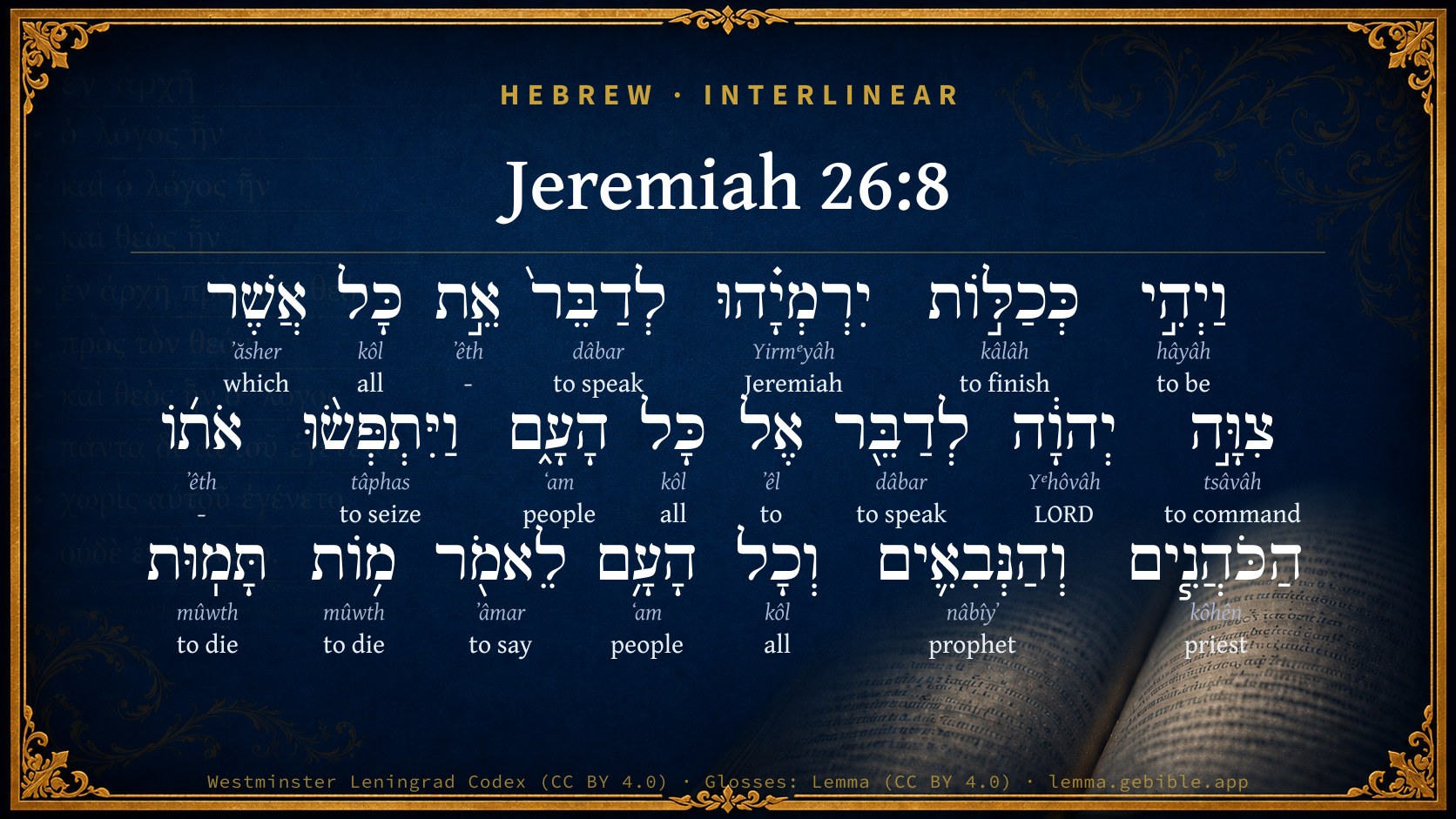
Jeremiah 26:8

Hebrew (Westminster Leningrad Codex) Jeremiah 26:8 appears in the Hebrew Old Testament. The text above is from the Westminster Leningrad Codex. Each word links to its Strong’s number, a concise gloss, and parsing drawn from the Open Scriptures Hebrew Bible morphology. Click any word for its full Brown-Driver-Briggs (BDB) entry.
Download image
Cite this verse

Jeremiah 26:8 (World English Bible). Public Domain. Lemma interlinear Bible study tool, https://lemma.gebible.app/v/jeremiah/26/8.

Show BibTeX & RIS
BibTeX
RIS
English Translation
It happened, when Jeremiah had made an end of speaking all that Yahweh had commanded him to speak to all the people, that the priests and the prophets and all the people laid hold on him, saying, You shall surely die.
World English Bible · Public Domain
Download a study sheet

One document with this verse’s original text, its word-by-word gloss line, the meaning frame, cross-references with their text, attributed commentary, and full source and license credits — printable, and it pastes into notes with its structure intact.

This verse Autodidact and up

Study sheet (.html) Plain text (.txt)

A passage Seminary Student

Up to 50 verses in one chapter. A passage sheet keeps up to 6 commentary sources and 12 cross-references per verse, in the order this page ranks them, and says so on the sheet whenever that leaves anything out. Ask for a single verse and you get the Autodidact verse sheet above.

Everything on this page stays free to read, with no account — the sheet is a download of what is already on screen, not access to it.

Want to remove ads? Support Godless Engineer
Compare translations 3

The same verse in 3 English versions, stacked beneath the original-language interlinear above. Click any original word for its lexicon entry.

Each is an independent rendering of the whole verse — the interlinear is not word-aligned to these translations.

Highlighted words mark where these versions differ — a whole-verse word diff, not a word-by-word alignment.

  • World English Bible Public Domain
    It happened, when Jeremiah had made an end of speaking all that Yahweh had commanded him to speak to all the people, that the priests and the prophets and all the people laid hold on him, saying, You shall surely die.
  • King James Version Public Domain
    Now it came to pass, when Jeremiah had made an end of speaking all that the LORD had commanded him to speak unto all the people, that the priests and the prophets and all the people took him, saying, Thou shalt surely die.
  • unfoldingWord Literal Text CC BY-SA 4.0
    And it happened, when Jeremiah had finished speaking all that Yahweh had commanded to speak to all the people, that the priests and the prophets and all the people seized him, saying, “Dying you must die!

unfoldingWord Literal Text — © unfoldingWord, licensed CC BY-SA 4.0. Word-aligned USFM3 via Door43 (git.door43.org/unfoldingWord/en_ult).

Versions to compare (up to 4)

3 of 4 selected

Show all 18 translations

Every available English version of this verse, each an independent rendering of the whole verse.

  • World English Bible Public Domain
    It happened, when Jeremiah had made an end of speaking all that Yahweh had commanded him to speak to all the people, that the priests and the prophets and all the people laid hold on him, saying, You shall surely die.
  • Berean Standard Bible Public Domain
    and as soon as he had finished telling all the people everything the LORD had commanded him to say, the priests and prophets and all the people seized him, shouting, “You must surely die!
  • Majority Standard Bible Public Domain
    and as soon as he had finished telling all the people everything the LORD had commanded him to say, the priests and prophets and all the people seized him, shouting, “You must surely die!
  • King James Version Public Domain
    Now it came to pass, when Jeremiah had made an end of speaking all that the LORD had commanded him to speak unto all the people, that the priests and the prophets and all the people took him, saying, Thou shalt surely die.
  • American Standard Version (1901) Public Domain
    And it came to pass, when Jeremiah had made an end of speaking all that Jehovah had commanded him to speak unto all the people, that the priests and the prophets and all the people laid hold on him, saying, Thou shalt surely die.
  • Revised Version (1885) Public Domain
    And it came to pass, when Jeremiah had made an end of speaking all that the LORD had commanded him to speak unto all the people, that the priests and the prophets and all the people laid hold on him, saying, Thou shalt surely die.
  • Geneva Bible (1599) Public Domain
    Nowe when Ieremiah had made an end of speaking all that the Lord had commanded him to speake vnto all the people, then the Priestes, and the prophets, and all the people tooke him, and saide, Thou shalt die the death.
  • Douay-Rheims (1899) Public Domain
    And when Jeremias made an end of speaking all that the Lord had commanded him to speak to all the people, the priests, and the prophets, and all the people laid hold on him, saying: Let him be put to death.
  • Young's Literal Translation Public Domain
    And it cometh to pass, at the completion of Jeremiah's speaking all that Jehovah hath commanded him to speak unto all the people, that the priests, and the prophets, and all the people catch him, saying, Thou dost surely die,
  • Literal Standard Version CC BY-SA 4.0
    and it comes to pass, at the completion of Jeremiah’s speaking all that YHWH has commanded him to speak to all the people, that the priests, and the prophets, and all the people catch him, saying, “You surely die!
  • Unlocked Literal Bible CC BY-SA 4.0
    So it happened that when Jeremiah had finished announcing all that Yahweh commanded him to say to all the people, the priests, prophets, and all the people seized him and said, “You will certainly die!
  • unfoldingWord Literal Text CC BY-SA 4.0
    And it happened, when Jeremiah had finished speaking all that Yahweh had commanded to speak to all the people, that the priests and the prophets and all the people seized him, saying, “Dying you must die!
  • Darby Bible Public Domain
    And it came to pass when Jeremiah had ended speaking all that Jehovah had commanded [him] to speak unto all the people, that the priests and the prophets and all the people seized him, saying, Thou shalt certainly die.
  • World Messianic Bible Public Domain
    When Jeremiah had finished speaking all that the LORD had commanded him to speak to all the people, the priests and the prophets and all the people seized him, saying, “You shall surely die!
  • Webster's Bible Public Domain
    Now it came to pass, when Jeremiah had made an end of speaking all that the LORD had commanded him to speak to all the people, that the priests and the prophets and all the people took him, saying, Thou shalt surely die.
  • Free Bible Version CC BY-SA 4.0
    As soon as he had finished telling everyone all that the Lord had ordered him to say, the priests and prophets and all the people grabbed him, shouting, “You'll die for this!
  • Bible in Basic English Public Domain
    Now, when Jeremiah had come to the end of saying everything the Lord had given him orders to say to all the people, the priests and the prophets and all the people took him by force, saying, Death will certainly be your fate.
  • JPS Tanakh (1917) Public Domain
    Now it came to pass, when Jeremiah had made an end of speaking all that the LORD had commanded him to speak unto all the people, that the priests and the prophets and all the people laid hold on him, saying: 'Thou shalt surely die.

Literal Standard Version (2020), Covenant Press — licensed CC BY-SA 4.0. Text via the HelloAO Bible API (eBible.org). Unlocked Literal Bible (unfoldingWord) — licensed CC BY-SA 4.0. Text via the HelloAO Bible API (eBible.org). unfoldingWord Literal Text — © unfoldingWord, licensed CC BY-SA 4.0. Word-aligned USFM3 via Door43 (git.door43.org/unfoldingWord/en_ult). Free Bible Version, Dr. Jonathan Gallagher — licensed CC BY-SA 4.0. Text via the HelloAO Bible API (eBible.org).

Word by word

More ways to search: Search by grammar → Find every occurrence → Compare this word →

Practice this passage: Drill this verse → Learn its vocabulary →

וַיִּתְפְּשׂ֨וּ
tâphas
H8610
“and · to seize”
Conjunction + Verb, Qal, Sequential Imperfect, 3rd Person, Masculine, Plural
Part of Speech
Conjunction + Verb
Stem
Qal
Form
Sequential Imperfect
Person
3rd Person
Gender
Masculine
Number
Plural
Full BDB Definition

Origin: a primitive root

TWOT: 2538

to catch, handle, lay hold, take hold of, seize, wield - (Qal) - to lay hold of, seize, arrest, catch - to grasp (in order to) wield, wield, use skilfully - (Niphal) to be seized, be arrested, be caught, be taken, captured - (Piel) to catch, grasp (with the hands)
  1. וַיְהִ֣י hâyâh H1961 “and · to be” Conjunction + Verb, Qal, Sequential Imperfect, 3rd Person, Masculine, Singular
  2. כְּכַלּ֣וֹת kâlâh H3615 “like/as · to finish” Preposition + Verb, Piel, Infinitive Construct
  3. יִרְמְיָ֗הוּ Yirmᵉyâh H3414 “Jeremiah” Noun, Proper
  4. לְדַבֵּר֙ dâbar H1696 “to speak” Preposition + Verb, Piel, Infinitive Construct
  5. אֵ֣ת ʼêth H853 “-” Particle, Direct Object
  6. כָּל kôl H3605 “all of” Noun, Common, Masculine, Singular, Construct
  7. אֲשֶׁר ʼăsher H834 “which” Particle, Relative
  8. צִוָּ֣ה tsâvâh H6680 “to command” Verb, Piel, Perfect, 3rd Person, Masculine, Singular
  9. יְהוָ֔ה Yᵉhôvâh H3068 “LORD” Noun, Proper
  10. לְדַבֵּ֖ר dâbar H1696 “to speak” Preposition + Verb, Piel, Infinitive Construct
  11. אֶל ʼêl H413 “to” Preposition
  12. כָּל kôl H3605 “all of” Noun, Common, Masculine, Singular, Construct
  13. הָעָ֑ם ʻam H5971 “the · people” Particle, Definite Article + Noun, Common, Masculine, Singular, Absolute
  14. אֹת֜וֹ ʼêth H853 “- · him” Particle, Direct Object + Suffix, Personal, 3rd Person, Masculine, Singular
  15. הַכֹּהֲנִ֧ים kôhên H3548 “the · priests” Particle, Definite Article + Noun, Common, Masculine, Plural, Absolute
  16. וְהַנְּבִאִ֛ים nâbîyʼ H5030 “and · the · prophets” Conjunction + Particle, Definite Article + Noun, Common, Masculine, Plural, Absolute
  17. וְכָל kôl H3605 “and · all of” Conjunction + Noun, Common, Masculine, Singular, Construct
  18. הָעָ֥ם ʻam H5971 “the · people” Particle, Definite Article + Noun, Common, Masculine, Singular, Absolute
  19. לֵאמֹ֖ר ʼâmar H559 “to say” Preposition + Verb, Qal, Infinitive Construct
  20. מ֥וֹת mûwth H4191 “to die” Verb, Qal, Infinitive Absolute
  21. תָּמֽוּת mûwth H4191 “to die” Verb, Qal, Imperfect, 2nd Person, Masculine, Singular

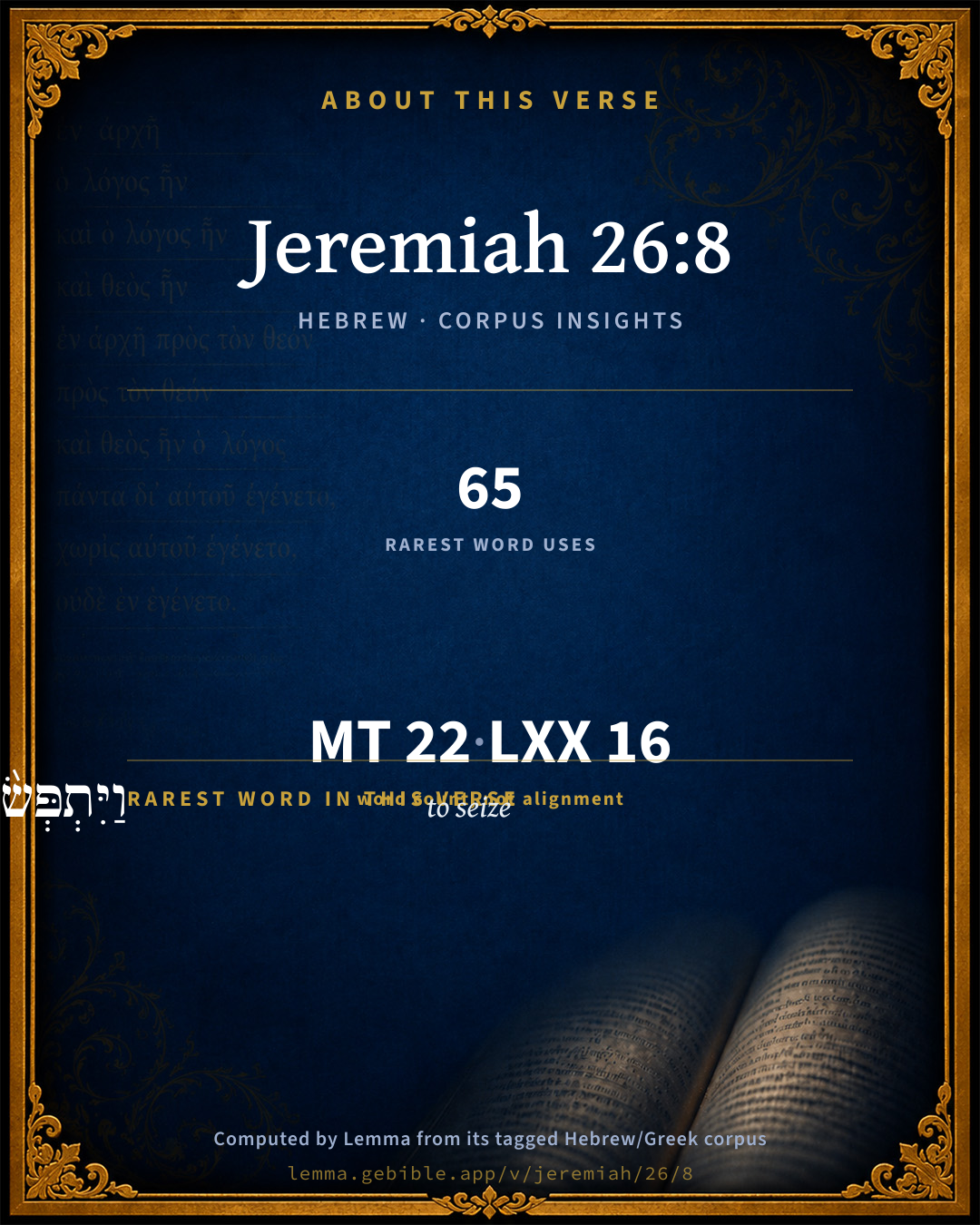
About this verse

These counts appear in no published source. They are computed here, from the morphology-tagged text and Lemma’s own curated glosses. What Lemma adds →

22
words
16
distinct lemmas
Prophets
section

Grammatical profile

  • 9 verbs
  • 9 nouns
  • 1 preposition
  • 3 particles

Verb forms

  • וַיְהִ֣י Qal · Sequential Imperfect
  • כְּכַלּ֣וֹת Piel · Infinitive Construct
  • לְדַבֵּר֙ Piel · Infinitive Construct
  • צִוָּ֣ה Piel · Perfect
  • לְדַבֵּ֖ר Piel · Infinitive Construct
  • וַיִּתְפְּשׂ֨וּ Qal · Sequential Imperfect
  • לֵאמֹ֖ר Qal · Infinitive Construct
  • מ֥וֹת Qal · Infinitive Absolute
  • תָּמֽוּת Qal · Imperfect

Repetition

Words recur within this verse — often emphatic in Hebrew:

  • כָּל all H3605 ×3
  • לְדַבֵּר֙ to speak H1696 ×2
  • הָעָ֑ם people H5971 ×2
  • מ֥וֹת to die H4191 ×2

Hebrew & Septuagint length

In the original languages it is 22 Hebrew tokens and 16 Greek tokens — but the two are counted differently (Hebrew bundles its prefixes and suffixes into one token; the Greek is in lemma form), so that isn’t a like-for-like length.

Cross-references

16

Topical passages linked to Jeremiah 26:8 in the Treasury of Scripture Knowledge — connected by theme and wording, ordered by reader-vote popularity; previews shown in the World English Bible.

  • Lamentations 4:13–14 [It is] because of the sins of her prophets, [and] the iniquities of her priests, That have shed the blood of the just in the midst of her.
  • 2 Chronicles 36:16 but they mocked the messengers of God, and despised his words, and scoffed at his prophets, until the wrath of Yahweh arose against his people, until there was no remedy.
  • Jeremiah 2:30 In vain have I struck your children; they received no correction: your own sword has devoured your prophets, like a destroying lion.
  • Jeremiah 11:19–21 But I was like a gentle lamb that is led to the slaughter; and I didn't know that they had devised devices against me, [saying], Let us destroy the tree with the fruit of it, and let us cut him off from the land of the living, that his name may be no more remembered.
  • Jeremiah 12:5–6 If you have run with the footmen, and they have wearied you, then how can you contend with horses? and though in a land of peace you are secure, yet how will you do in the pride of the Jordan?
  • Jeremiah 18:18 Then said they, Come, and let us devise devices against Jeremiah; for the law shall not perish from the priest, nor counsel from the wise, nor the word from the prophet. Come, and let us strike him with the tongue, and let us not give heed to any of his words.
  • Jeremiah 20:1–2 Now Pashhur, the son of Immer the priest, who was chief officer in the house of Yahweh, heard Jeremiah prophesying these things.
  • Jeremiah 20:8–11 For as often as I speak, I cry out; I cry, Violence and destruction! because the word of Yahweh is made a reproach to me, and a derision, all the day.
  • Matthew 21:35–39 The farmers took his servants, beat one, killed another, and stoned another.
  • Matthew 22:6 and the rest grabbed his servants, and treated them shamefully, and killed them.
  • Matthew 23:31–35 Therefore you testify to yourselves that you are children of those who killed the prophets.
  • Matthew 26:3–4 Then the chief priests, the scribes, and the elders of the people were gathered together in the court of the high priest, who was called Caiaphas.
  • Matthew 26:59–66 Now the chief priests, the elders, and the whole council sought false testimony against Jesus, that they might put him to death;
  • Acts 5:33 But they, when they heard this, were cut to the heart, and determined to kill them.
  • Acts 7:52 Which of the prophets didn't your fathers persecute? They killed those who foretold the coming of the Righteous One, of whom you have now become betrayers and murderers.
  • Revelation 18:24 In her was found the blood of prophets and of saints, and of all who have been slain on the earth."

Cross-references courtesy of OpenBible.info (CC BY 4.0).

Hebrew and Greek witnesses Masoretic Hebrew ↔ Greek Septuagint

The same verse in the two great witnesses to the Old Testament, shown verse-for-verse.

These are two independent witnesses, not word-aligned to each other, and the Septuagint is shown in lemma (dictionary) form.

Hebrew Jeremiah 26:8 Masoretic · Westminster Leningrad Codex

וַיְהִ֣י כְּכַלּ֣וֹת יִרְמְיָ֗הוּ לְדַבֵּר֙ אֵ֣ת כָּל אֲשֶׁר צִוָּ֣ה יְהוָ֔ה לְדַבֵּ֖ר אֶל כָּל הָעָ֑ם וַיִּתְפְּשׂ֨וּ אֹת֜וֹ הַכֹּהֲנִ֧ים וְהַנְּבִאִ֛ים וְכָל הָעָ֥ם לֵאמֹ֖ר מ֥וֹת תָּמֽוּת

It happened, when Jeremiah had made an end of speaking all that Yahweh had commanded him to speak to all the people, that the priests and the prophets and all the people laid hold on him, saying, You shall surely die.

World English Bible · Public Domain

Greek LXX Structure differs

In the Septuagint, Jeremiah is about an eighth shorter than the Hebrew and arranges its material differently — the Oracles Against the Nations (Hebrew chapters 46–51) appear in the middle of the Greek book, after 25:13. Because the chapter and verse boundaries do not line up, a verse-for-verse comparison with the Hebrew is not shown.

A verse-for-verse comparison isn’t shown here because the chapters and verses don’t line up. Switch to the LXX edition with the MT / LXX toggle above to read the Greek directly.

On this verse, Haydock's Catholic Bible Commentary discusses the Septuagint’s reading. Read the note in Commentary ↓

Hebrew: Westminster Leningrad Codex (CC BY 4.0). Greek: Septuagint (public domain); English from a public-domain English Septuagint. How the Septuagint differs from the Hebrew →

Targum (Aramaic paraphrase)

1

The Targum is the ancient Jewish Aramaic paraphrase of the Hebrew Scriptures — an interpretive translation, not the Hebrew text itself. Onkelos (literal) and Pseudo-Jonathan (expansive) render the Torah, and Jonathan the Prophets. Coverage is partial: where no permissively-licensed English translation exists for a verse, only the Aramaic is shown. This is verse-level text, not a word-by-word alignment to the Hebrew.

  1. Targum Jonathan Prophets (Joshua–Malachi)
    וַהֲוָה כַּד שֵׁיצֵי יִרְמְיָה לְאִתְנַבָּאָה יַת כָּל דְפַקֵיד יְיָ לְמַלָלָא עִם כָּל עַמָא וַאֲחָדוּ יָתֵיהּ כַּהֲנַיָא וְסַפְרַיָא וְכָל עַמָא לְמֵימַר מֵימַת תְּמוּת:

    (no public-domain English translation for this verse)

    Targum Jonathan — Aramaic: “Mikraot Gedolot” (public domain). English: “Sefaria Community Translation” (CC0 1.0 (public-domain dedication)); “London "Chaldee Paraphrase," 1871” (public domain). Text via Sefaria.

Commentary

Notes on Jeremiah 26:8 from classic Christian and Jewish commentators (each source and its license shown beneath its notes). The classic Christian expositions comment on the surrounding passage and are grouped to its opening verse, so a note may address several verses; the Jewish commentaries on the Tanakh (Rashi and others) are per-verse, so they appear only where the commentator wrote on this verse.

Lemma curates 59 commentaries, every one of them public domain or Creative Commons licensed, each selected and text-cleaned for this edition rather than reprinted as found. About our sources →

Trapp's Complete Commentary

John Trapp

Jer 26:8 Now it came to pass, when Jeremiah had made an end of speaking all that the LORD had commanded [him] to speak unto all the people, that the priests and the prophets and all the people took him, saying, Thou shalt surely die.

Ver. 8. That the priests and the prophets, &c.] So they dealt by Stephen, {Act 7:57-58} by Arnulph, an excellent preacher of the truth according to godliness at Rome, A.D. 1125, in the time of Pope Honorius II. Hic clericorum insidiis necatur. {a} This good man was put to death by the instigation of the clergy, against whose avarice, pride, and luxury he bitterly inveighed, and was therefore much favoured by the Roman nobility; as was likewise Wycliffe by the English, and Huss by the Bohemian; but the envious priests wrought their ruin.

{a} Func. Chronol. ex Platina.

John Trapp, A Commentary or Exposition upon All the Books of the Old and New Testament (1647–1656) — public domain. Text from a community e-Sword module.

The Biblical Illustrator

Joseph S. Exell

Jer_26:8-16

When Jeremiah had made an end of speaking all that the Lord had commanded him, the people took him, saying, Thou shalt surely die.

The characteristics of a true prophet

I. The true prophet has a stern message to deliver (4-7). If they ally themselves with Egypt, the Temple will be made desolate, as Shiloh had been destroyed by the Assyrians at the deportation of Israel after the fall of Samaria, 710 b.c. Jerusalem will become a curse to all nations (will be recognised by all nations as having fallen by the curse of God). To prophesy smooth things in a sinful world is to be false to God. How often does even our blessed Lord denounce sin, and remind men of the wrath of God for it! (Mat_11:21-24; Mat_12:41-42; Mat_23:31-38, &c.)

II. The true prophet may not diminish a word of Gods message, however unpopular, or unpleasant, or personal.

1. This message referred to the public policy of the nation. The morality of a nation as imperative as that of an individual

2. Other messages assail the sins of classes, from the king to the humblest citizen.

III. The true prophet will speak fearlessly.

IV. The true prophet is promised the support of God.

V. The true prophet never was and never can be popular, but must raise up enemies against himself.

IV. The true prophet will speak peace as well as wrath if men repent. (J. Cunningham Geikie, D. D.)

Prophetic virtues

The Lord sent me to prophesy against this house. In this apology of the prophet thus answering for himself with a heroic spirit, five noble virtues, fit for a martyr, are by an expositor observed.

1. His prudence in alleging his Divine mission.

2. His charity in exhorting his enemies to repent.

3. His humility in saying, Behold I am in your hand.

4. His magnanimity and freedom of speech in telling them that God would revenge his death.

5. His spiritual security and fearlessness of death in so good a cause and with so good a conscience. (John Trapp.)

A Saints resignation, meekness, and cheerfulness in persecution

One thousand eight hundred years ago an aged saint was being led into Rome by ten rough Roman soldiers, to be thrown to the wild beasts in the amphitheatre. Can you imagine anything more dreary and deplorable? Was he unhappy? Did he count cruelty and martyrdom as evil? No. In one of the seven letters that he wrote on his way, he says: Come fire and iron, come rattling of wild beasts, cutting and mangling and wrenching of my bones, come hacking of my limbs, come crushing of my whole body, come cruel tortures of the devil to assail me! Only be it mine to attain to Jesus Christ! What are those words of St. Ignatius but an echo of the apostles, What things were gain to me, those I counted loss for Christ. Yea, doubtless, and I count all things but loss that I may win Christ? How well the early Christians understood these things by which we opportunists, cringing cowards, effeminate time-servers, as most of us are in this soft, sensuous, hypocritical age, have so utterly forgotten! (Dean Farrar.)

.

The Biblical Illustrator, edited by Joseph S. Exell (c. 1880s–1900s) — public domain. Text from a community e-Sword module.

Joseph Benson's Commentary

Jer 26:8-10. The priests and prophets took him, &c. — As a disturber of the government, and a discourager of the people from defending their country against the enemy, in prophesying that the temple and city of Jerusalem should become a desolation. When the princes of Judah heard these things — That is, the king’s counsellors, or chief officers of the state, who were also members of the great court of the sanhedrim, first instituted Num 11:16, and revived by Jehoshaphat, 2Ch 19:8. They came and sat in the entry of the gate, &c. — This was built by Jotham, as we read 2 Kings 13:35. The intelligent reader will observe a great similarity between the conduct of these priests and false prophets toward Jeremiah, and that of the priests, the scribes, and Pharisees toward Jesus Christ, of whom Jeremiah was a type: see particularly Mar 14:58; Mat 26:61.

Joseph Benson's Commentary on the Old and New Testaments (1811–1818) — public domain. Text from a community e-Sword module.

Whedon's Commentary on the Bible

Daniel D. Whedon

INDIGNATION OF THE PEOPLE, Jer_26:8-19.

8. Had made an end of speaking, etc. — To this point Jeremiah had commanded the respectful attention of the people. Great as was their indignation they did not interrupt his discourse. Of course, the phrase all the people must not be pressed to the extreme. It implies, not absolute unanimity, but general agreement.

Daniel D. Whedon (gen. ed.), Commentary on the Old and New Testaments (1874–1909) — public domain. Text from a community e-Sword module.

Jamieson, Fausset & Brown

Robert Jamieson, A. R. Fausset & David Brown

priests--The captain (or prefect) of the temple had the power of apprehending offenders in the temple with the sanction of the priests.

prophets--the false prophets. The charge against Jeremiah was that of uttering falsehood in Jehovah's name, an act punishable with death (Deu 18:20). His prophecy against the temple and city (Jer 26:11) might speciously be represented as contradicting God's own words (Psa 132:14). Compare the similar charge against Stephen (Act 6:13-14).

Jamieson, Fausset & Brown — Commentary Critical and Explanatory on the Whole Bible (1871) — public domain (CC PDM 1.0). Text via the HelloAO Bible API.

Adam Clarke's Commentary

Verse 8. And all the people] That were in company with the priests and the prophets.

Adam Clarke's Commentary on the Bible (1810–1826) — public domain. Text from a community e-Sword/MySword module.

John Calvin's Commentaries

He says at last, that he was condemned by the priests, and the prophets, and the whole people; he at the same time introduced these words, that he had spoken all that the Lord had commanded him. Thus he briefly exposed the injustice of those by whom he was condemned; for they had no regard to what was right, as we shall presently see. But as they had brought with them a preconceived hatred, so they vomited out what they could no longer contain. It afterwards follows, —

John Calvin's Commentaries (1540-1563) — public domain. Text from the Calvin Translation Society English edition (1840s-50s) via the Christian Classics Ethereal Library (ccel.org). Calvin's coverage is partial (roughly two-thirds of the Bible); uncommented books and verses are honest gaps, never fabricated. The 19th-century editor's footnotes and remarks are omitted so the notes are faithfully Calvin's own voice.

Ellicott's Commentary for English Readers

(8) Thou shalt surely die.—Better, as expressing the Hebrew emphasis of reduplication, Thou shalt die the death. The phrase is the same as in Gen_2:17. The threat of the men of Anathoth (Jer_11:21) is repeated by the priests and prophets of Jerusalem. They look on Jeremiah as one who has incurred the condemnation of Deu_18:20.

A Bible Commentary for English Readers, edited by Charles John Ellicott (1878–1897) — public domain. Text from a community e-Sword module.

The Cambridge Bible for Schools and Colleges

gen. ed. J. J. S. Perowne

8. Thou shalt surely die] That prophet who spoke without God’s command was according to Deu_18:20 to be put to death. The charge against Jeremiah then was of this nature, and the alleged proof, that it was impossible in the nature of things that such a calamity could be allowed to happen to the people of God.

The Cambridge Bible for Schools and Colleges (gen. ed. J. J. S. Perowne; Cambridge University Press, 1878–1918) — public domain. Text from a community e-Sword module.

John Gill's Exposition

Now it came to pass, when Jeremiah had made an end of speaking,.... For they let him alone till he had done, either out of reverence of him as a priest and prophet; or they were awed by a secret influence on their minds that they might not disturb him:

all that the Lord had commanded him to speak unto all the people; he did as he was ordered, kept back nothing, not fearing the resentment of the people, but fearing God:

that the priests, and the prophets, and all the people, took him; the priests and the prophets were the leading men in this action; they stirred up the people against him, and through their instigation he was seized and laid hold on:

saying, thou shall surely die; signifying that they would bring a charge against him, which they were able to support, and which by the law would be death; unless they meant in the manner of zealots to put him to death themselves, without judge or jury; and which they would have put in execution, had not the princes of the land, or the great sanhedrim, heard of it; and therefore to prevent it came to the temple, as is afterwards related.

John Gill's Exposition of the Whole Bible (1746–1763) — public domain (CC PDM 1.0). Text via the HelloAO Bible API.

Haydock's Catholic Bible Commentary

Death. The pretext was plausible, as God seemed to have promised the temple an eternal duration, 3 Kings ix. 3. The Jews accused Christ of the like crime, Matthew xxvi. 61. Such questions were brought before the sanhedrim and priests, chap. xxvi. 57. But the latter are here (Calmet) the chief accusers with "the false prophets." (Septuagint) (Haydock) --- The princes, moved by the elders, (ver. 17.) acquit the prophet, (Calmet) at the persuasion of Ahicam, ver. 24. Several priests would probably judge along with the other princes, as the examination of impostors belonged chiefly to their tribunal. (Haydock) --- All is often used for most part. (Worthington)

George Leo Haydock (1774–1849), Haydock's Catholic Family Bible and Commentary, 1859 edition — public domain. Excludes Psalms (Douay-Rheims chapter numbering differs from Protestant) and Deuterocanonical books (Catholic canon only).

Matthew Poole's English Annotations

Either they had a reverence for the prophet, or the terror of God fell upon them, so as they did not interrupt him till he had fully despatched his errand. Then the chief of the priests, with the assistance of the people, apprehend him, and tell him he should be put to death.

Matthew Poole's English Annotations on the Holy Bible (1683–1685) — public domain. Text from a community e-Sword/MySword module.

The Pulpit Commentary

Had made an end of speaking. They allowed Jeremiah to finish his discourse (of which we have here only the briefest summary), either from a lingering reverence for his person and office, or to obtain fuller materials for an accusation (comp. the trial of Stephen, Act_6:12-14). All the people. The "people" appear to have been always under some constraint. As long as the priests and prophets were alone, they dominated the unofficial classes, but when the princes appeared (ver. 11), the new influence proved superior. In ver. 16 princes and people together go over to the side of Jeremiah. Thou shalt surely die. Death was the legal penalty both for blasphemy (Lev_24:16) and for presuming to prophesy without having received a prophetic revelation. (Deu_18:20) Jeremiah"s declaration ran so entirely counter to the prejudices of his hearers that he may well have been accused of both these sins, or crimes. True, Isaiah and Amos had already predicted the destruction of Jerusalem; (Isa_5:5, 6 6:11 Amo_2:4, 5 6:1, 2) but it may have been contended that the timely repentance of Judah under Hezekiah and Josiah had effectually cancelled the threatened doom, and Isa_64:10, 11 evidently refers to a time later than Josiah, and represents the ruin of Jerusalem as practically certain, it would seem that the prophetic book (Isaiah 40-66) to which this belongs (to say the least) was not generally known.

Vers. 8-19. A scene in a Jewish court of law.

We have here a graphic picture of the procedure under the Hebrew criminal law, for it would appear that Jeremiah was indicted and tried in accordance with correct legal order. The details of such a trial are not unimportant to the student of constitutional history. But they are also full of human interest. The law-court is a strange mirror of character. Many as are the objections to the publication of police news in the daily papers, it does at least serve to open our eyes to the eccentricities as well as the enormities of our variegated human world. Let us see what light this trial of Jeremiah throws upon the various persons concerned.

I THE ACCUSERS. The leading accusers are priests and prophets. The priests, also, were foremost in the accusation of our Lord. Jeremiah had threatened the temple; it is not wonderful that temple officials should be enraged with him. Religious persecution is generally instigated by the professional clerical class, whose vested interests have been attacked by the reformer. The prophets were directly opposed by the teaching of Jeremiah. If orthodoxy is to be decided by the vote of the majority, they were the orthodox of their day. They were annoyed by the contradiction of the greatest man of their order. Unable to answer him, they tried to suppress him. The conduct of these men may suggest some general lessons, viz.

(1) fidelity to the ordinances of worship is no proof of fidelity to God;

(2) professional religiousness may be far removed from religiousness of character;

(3) they who claim to be regular teachers of religion may Be the last to recognize fresh truth;

(4) they who are interested in a controversy are bad judges of the merits of the case.

II THE ACCUSED.

1. Jeremiah remains faithful to his message. He reiterates it with new emphatic warnings. His defense is that he is sent by God to speak as he has spoken. He rests on innocence, truth, Divine authority. With such a plea he dare not recant. The true servants of God will know that they ought to "obey God rather than men," and therefore, like St. Peter and St. John, that they "cannot but speak the things which they have seen and heard". (Act_4:20)

2. Jeremiah showed indifference to his own life (ver. 14). He was a brave man, though his enemies accused him of advocating a coward"s policy. It is noble thus to have strength to act on the conviction that truth is more precious than life.

3. Jeremiah warned the people of the consequences of injustice (ver. 15). This he did more for their sakes than for his own. Nothing can be more fatal to a country than the corruption of justice.

III THE JUDGES. The princes and elders seem to have the position of judges. They are cool and impartial. In the Jewish state the office of judge came with birth and rank. The most radical friend of the people may see that the superior culture and freedom from popular passions of these men may have fitted them in some measure for their work. Unhappily, Jeremiah has exposed another side of their character. It speaks well for them, however, after the severe castigation he had given "the shepherds", (e.g. Jer_25:34-38) that they had the magnanimity to lend the prophet an impartial hearing, in spite of the virulent opposition of the priests. But possibly these two classes of leading men were not on the friendliest of terms with one another. Even if this be the case it is well that, unlike Herod and Pontius Pilate, they did not come to an agreement through the sacrifice of an innocent victim. Some of the elders cited the precedent of Micah"s case. We see here the value of such an illustration. It serves to detach the principle under consideration from the prejudice of the passions of the hour.

IV THE JURY. The assembly of the people seems to have acted as a jury. The priests and prophets present their accusation to them and the princes. The people and the princes pronounce the opinion that Jeremiah is innocent. The elders address themselves exclusively to the assembly of the people. This assembly shows the weakness of a popular concourse. The people are swayed from side to side. First they side with the priests, then with the rulers. It also shows its advantages. The people are open to impression; they do not care for formal consistency to a previous conviction; they like to see fair play. When their broad human instincts are appealed to they respond rightly.

Vers. 8, 9. The perils of prophesying.

I THE PROPHET OF GOD MEETS WITH UNIVERSAL OPPOSITION.

II HE IS IN PERSONAL DANGER.

1. The responsibility of the judgments predicted is attached to himself. This is due to a false principle of association, having its root in human ignorance and depravity. Not even God is responsible. The sinner must blame himself. (Gal_4:16)

2. The worst consequences are threatened. Hatred to God expresses itself in hatred to his servant. It is, therefore, violent and in defiance of all justice. Transgressors think to escape judgment by denying it and destroying its witnesses.

III CHARACTER IS JEOPARDIZED. The verdict was but a halfhearted one, and did not meet with general assent. The worst charges are brought against Christian men who are faithful to their convictions; and it is not always the case that their groundlessness is made clear. This is part of the "reproach of Christ. M.

The Pulpit Commentary (1880–1919), ed. H.D.M. Spence-Jones & Joseph S. Exell — public domain. Text from a community e-Sword module.

Lesson kit

Teaching starters — assembled from the data on this page, not authored interpretation. Every prompt links to the verse data it draws on. Edit before teaching.

Jeremiah, in the Prophets, opens this verse with 22 words (16 distinct Hebrew lemmas). Its most distinctive word is tâphas (“to seize”). A historical commentator’s framing appears above. Read the whole chapter for the surrounding context.

Discussion questions

  1. What does “to seize” (tâphas) contribute to the verse as a whole?
  2. How does Lamentations 4:13–14, which shares this passage’s theme, read alongside this verse?
  3. What does the repetition of “all” (3× in this one verse) do in this verse?
  4. These translations render this verse differently; the difference is in the English rendering, not the original. What questions does that raise?
  5. «וַיְהִ֣י» is a Qal Sequential Imperfect verb. How does that grammatical form shape the action described?
  6. Compare how Trapp's Complete Commentary and The Biblical Illustrator read this verse. Where do they agree or differ?

Things to notice

Reading settings

Reading text

Shown beneath each verse's original-language words.

Old Testament
Old Testament edition

Read the OT as the Masoretic Hebrew (MT) or the Greek Septuagint (LXX).

English shown for the Greek Septuagint (in the Hebrew ↔ Greek comparison).

Comparing translations? Open the Compare panel on any verse page to stack up to four side by side.