1 Kings 6:9

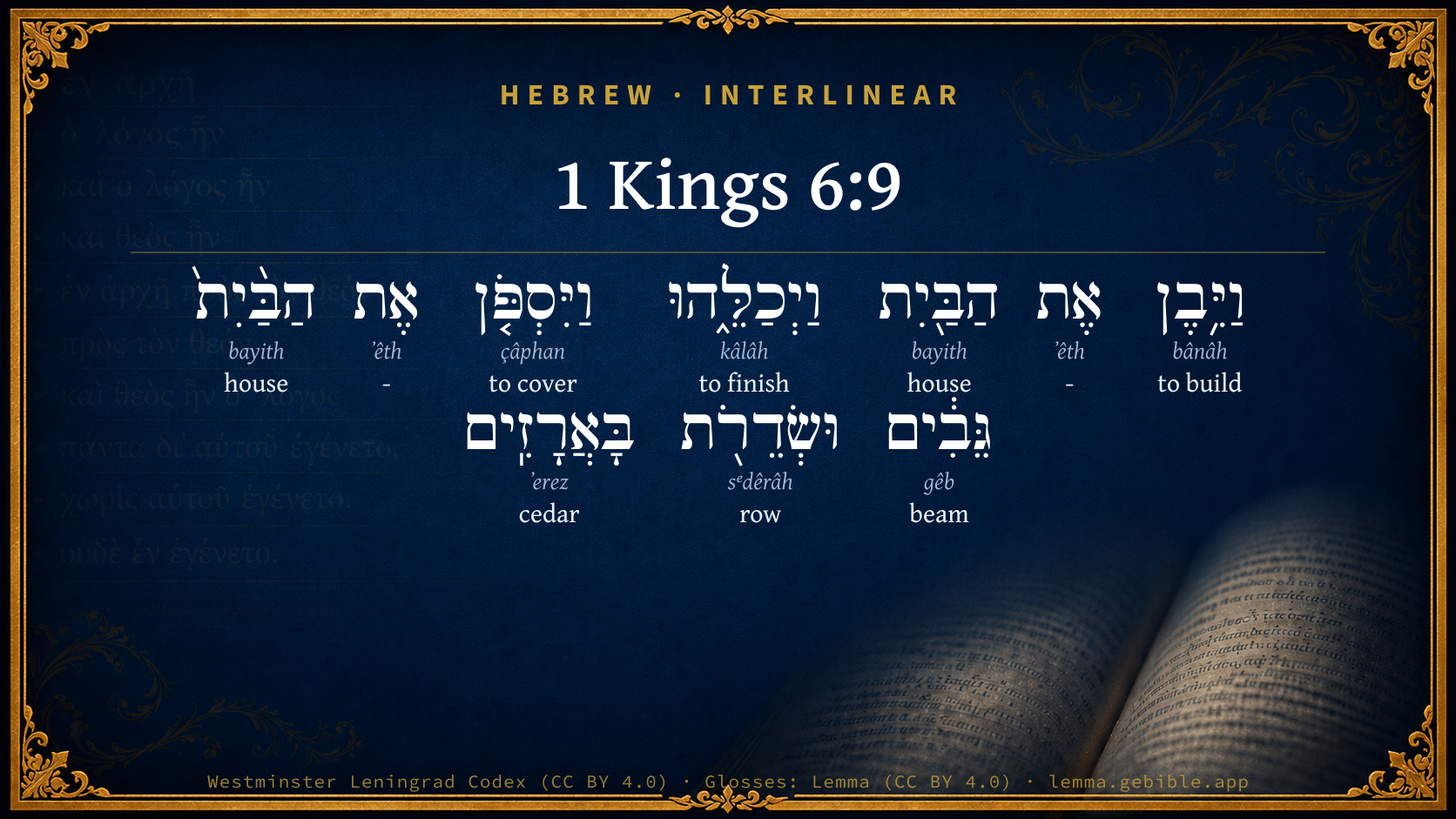
Hebrew (Westminster Leningrad Codex) 1 Kings 6:9 appears in the Hebrew Old Testament. The text above is from the Westminster Leningrad Codex. Each word links to its Strong’s number, a concise gloss, and parsing drawn from the Open Scriptures Hebrew Bible morphology. Click any word for its full Brown-Driver-Briggs (BDB) entry.
Download image
Cite this verse

1 Kings 6:9 (World English Bible). Public Domain. Lemma interlinear Bible study tool, https://lemma.gebible.app/v/1-kings/6/9.

Show BibTeX & RIS
BibTeX
RIS
English Translation
So he built the house, and finished it; and he covered the house with beams and planks of cedar.
World English Bible · Public Domain
Highlights
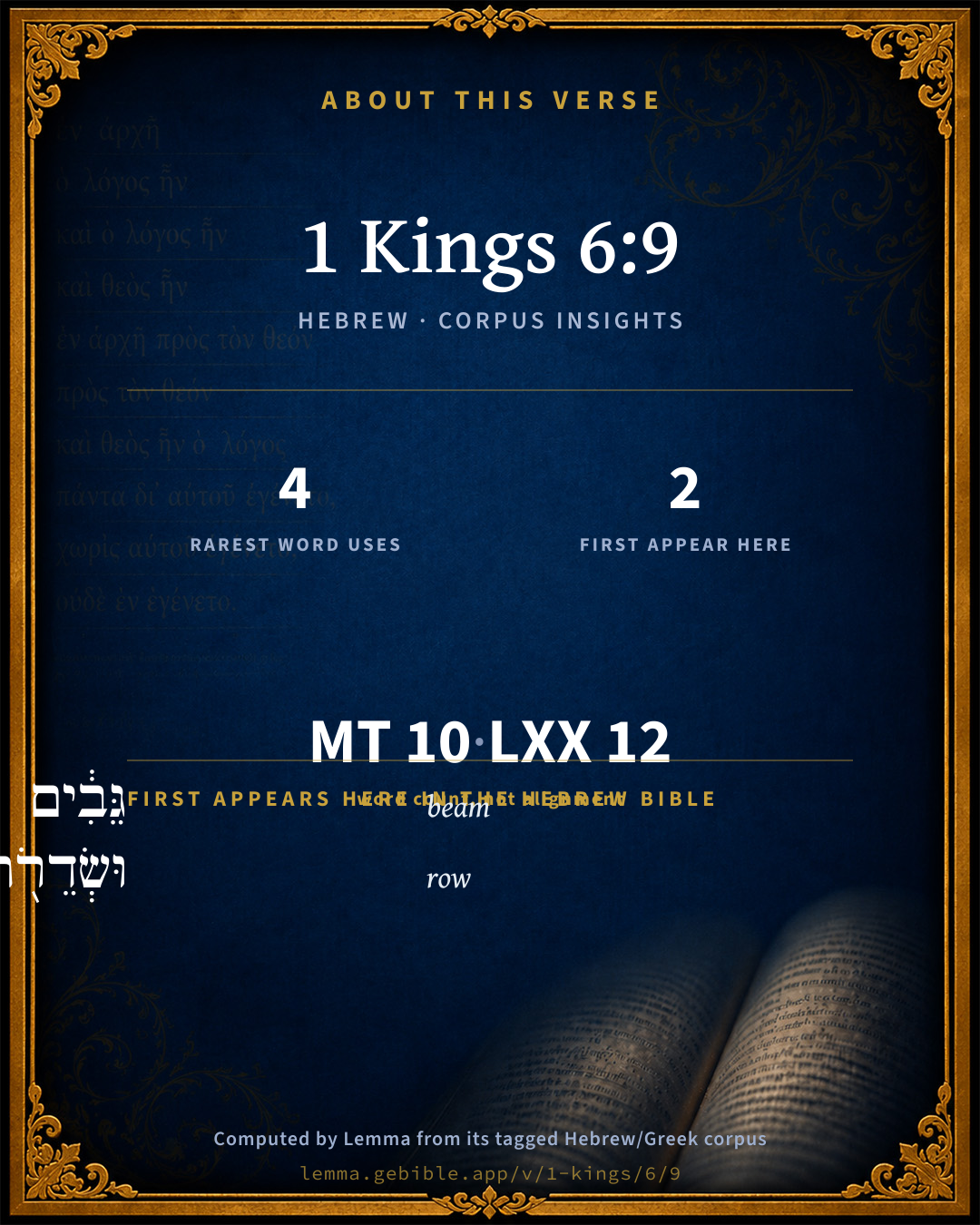
  • 2 first appearances in the Hebrew Bible
Full analysis ↓
Download a study sheet

One document with this verse’s original text, its word-by-word gloss line, the meaning frame, cross-references with their text, attributed commentary, and full source and license credits — printable, and it pastes into notes with its structure intact.

This verse Autodidact and up

Study sheet (.html) Plain text (.txt)

A passage Seminary Student

Up to 50 verses in one chapter. A passage sheet keeps up to 6 commentary sources and 12 cross-references per verse, in the order this page ranks them, and says so on the sheet whenever that leaves anything out. Ask for a single verse and you get the Autodidact verse sheet above.

Everything on this page stays free to read, with no account — the sheet is a download of what is already on screen, not access to it.

Want to remove ads? Support Godless Engineer
Compare translations 3

The same verse in 3 English versions, stacked beneath the original-language interlinear above. Click any original word for its lexicon entry.

Each is an independent rendering of the whole verse — the interlinear is not word-aligned to these translations.

Highlighted words mark where these versions differ — a whole-verse word diff, not a word-by-word alignment.

  • World English Bible Public Domain
    So he built the house, and finished it; and he covered the house with beams and planks of cedar.
  • King James Version Public Domain
    So he built the house, and finished it; and covered the house with beams and boards of cedar.
  • unfoldingWord Literal Text CC BY-SA 4.0
    And he built the house and finished it. And he roofed the house with beams and boards of cedars.

unfoldingWord Literal Text — © unfoldingWord, licensed CC BY-SA 4.0. Word-aligned USFM3 via Door43 (git.door43.org/unfoldingWord/en_ult).

Versions to compare (up to 4)

3 of 4 selected

Show all 18 translations

Every available English version of this verse, each an independent rendering of the whole verse.

  • World English Bible Public Domain
    So he built the house, and finished it; and he covered the house with beams and planks of cedar.
  • Berean Standard Bible Public Domain
    So Solomon built the temple and finished it, roofing it with beams and planks of cedar.
  • Majority Standard Bible Public Domain
    So Solomon built the temple and finished it, roofing it with beams and planks of cedar.
  • King James Version Public Domain
    So he built the house, and finished it; and covered the house with beams and boards of cedar.
  • American Standard Version (1901) Public Domain
    So he built the house, and finished it; and he covered the house with beams and planks of cedar.
  • Revised Version (1885) Public Domain
    So he built the house, and finished it; and he covered the house with beams and planks of cedar.
  • Geneva Bible (1599) Public Domain
    So he built the house and finished it, and sieled the house being vawted with sieling of cedar trees.
  • Douay-Rheims (1899) Public Domain
    So he built the house, and finished it: end he covered the house with roofs of cedar.
  • Young's Literal Translation Public Domain
    And he buildeth the house, and completeth it, and covereth the house `with' beams and rows of cedars.
  • Literal Standard Version CC BY-SA 4.0
    And he builds the house, and completes it, and covers the house [with] beams and rows of cedars.
  • Unlocked Literal Bible CC BY-SA 4.0
    So Solomon built the temple and finished it; he covered the house with beams and planks of cedar.
  • unfoldingWord Literal Text CC BY-SA 4.0
    And he built the house and finished it. And he roofed the house with beams and boards of cedars.
  • Darby Bible Public Domain
    And he built the house, and finished it; and covered the house with beams and boards of cedar.
  • World Messianic Bible Public Domain
    So he built the house and finished it; and he covered the house with beams and planks of cedar.
  • Webster's Bible Public Domain
    So he built the house and finished it; and covered the house with beams and boards of cedar.
  • Free Bible Version CC BY-SA 4.0
    So Solomon finished building the Temple, covering it with a roof made of cedar rafters and planks.
  • Bible in Basic English Public Domain
    So he put up the house and made it complete, roofing it with boards of cedar-wood.
  • JPS Tanakh (1917) Public Domain
    So he built the house, and finished it; and he covered in the house with planks of cedar over beams.

Literal Standard Version (2020), Covenant Press — licensed CC BY-SA 4.0. Text via the HelloAO Bible API (eBible.org). Unlocked Literal Bible (unfoldingWord) — licensed CC BY-SA 4.0. Text via the HelloAO Bible API (eBible.org). unfoldingWord Literal Text — © unfoldingWord, licensed CC BY-SA 4.0. Word-aligned USFM3 via Door43 (git.door43.org/unfoldingWord/en_ult). Free Bible Version, Dr. Jonathan Gallagher — licensed CC BY-SA 4.0. Text via the HelloAO Bible API (eBible.org).

Word by word

More ways to search: Search by grammar → Find every occurrence → Compare this word →

Practice this passage: Drill this verse → Learn its vocabulary →

גֵּבִ֔ים
gêb
H1356
“beams”
Noun, Common, Masculine, Plural, Absolute
Part of Speech
Noun
Type
Common
Gender
Masculine
Number
Plural
State
Absolute
Full BDB Definition

Origin: from H1461

TWOT: 323a , b

pit, trench, ditch, beam, rafter - pit, trench - beam, rafter
  1. וַיִּ֥בֶן bânâh H1129 “and · to build” Conjunction + Verb, Qal, Sequential Imperfect, 3rd Person, Masculine, Singular
  2. אֶת ʼêth H853 “-” Particle, Direct Object
  3. הַבַּ֖יִת bayith H1004 “the · house” Particle, Definite Article + Noun, Common, Masculine, Singular, Absolute
  4. וַיְכַלֵּ֑הוּ kâlâh H3615 “and · to finish · him” Conjunction + Verb, Piel, Sequential Imperfect, 3rd Person, Masculine, Singular + Suffix, Personal, 3rd Person, Masculine, Singular
  5. וַיִּסְפֹּ֤ן çâphan H5603 “and · to cover” Conjunction + Verb, Qal, Sequential Imperfect, 3rd Person, Masculine, Singular
  6. אֶת ʼêth H853 “-” Particle, Direct Object
  7. הַבַּ֨יִת֙ bayith H1004 “the · house” Particle, Definite Article + Noun, Common, Masculine, Singular, Absolute
  8. וּשְׂדֵרֹ֖ת sᵉdêrâh H7713 “and · rows” Conjunction + Noun, Common, Feminine, Plural, Absolute
  9. בָּאֲרָזִֽים ʼerez H730 “in/at the · cedars” Preposition, Determined + Noun, Common, Masculine, Plural, Absolute

About this verse

These counts appear in no published source. They are computed here, from the morphology-tagged text and Lemma’s own curated glosses. What Lemma adds →

10
words
8
distinct lemmas
Historical
section

Notable vocabulary

The rarest word here is גֵּבִ֔ים beam H1356 — appearing just 4 times in the whole Hebrew Bible.

First appearance in Scripture

These words make their first canonical appearance in the Hebrew Bible here:

  • גֵּבִ֔ים beam H1356
  • וּשְׂדֵרֹ֖ת row H7713

Shared distinctive vocabulary

גֵּבִ֔ים beam H1356 occurs in 3 verses of the Hebrew Bible. Also found in:

Grammatical profile

  • 3 verbs
  • 5 nouns
  • 2 particles

Verb forms

  • וַיִּ֥בֶן Qal · Sequential Imperfect
  • וַיְכַלֵּ֑הוּ Piel · Sequential Imperfect
  • וַיִּסְפֹּ֤ן Qal · Sequential Imperfect

Repetition

A word recurs within this verse — often emphatic in Hebrew:

  • הַבַּ֖יִת house H1004 ×2

Hebrew & Septuagint length

In English translation the verse runs 19 words from the Hebrew and 18 from the Septuagint (LXX English) — closely comparable.

A rough comparison of the two English renderings, which tokenize alike — not a word-level alignment.

Word counts can differ between the Hebrew and the Greek without any difference in meaning — e.g. the Hebrew direct-object marker אֵת has no separate Greek word, and Greek often adds the article ὁ.

In the original languages it is 10 Hebrew tokens and 12 Greek tokens — but the two are counted differently (Hebrew bundles its prefixes and suffixes into one token; the Greek is in lemma form), so that isn’t a like-for-like length.

Cross-references

2

Topical passages linked to 1 Kings 6:9 in the Treasury of Scripture Knowledge — connected by theme and wording, ordered by reader-vote popularity; previews shown in the World English Bible.

  • 1 Kings 6:14 So Solomon built the house, and finished it.
  • 1 Kings 6:38 In the eleventh year, in the month Bul, which is the eighth month, was the house finished throughout all the parts of it, and according to all the fashion of it. So was he seven years in building it.

Cross-references courtesy of OpenBible.info (CC BY 4.0).

Hebrew and Greek witnesses Masoretic Hebrew ↔ Greek Septuagint

The same verse in the two great witnesses to the Old Testament, shown verse-for-verse.

These are two independent witnesses, not word-aligned to each other, and the Septuagint is shown in lemma (dictionary) form.

Hebrew 1 Kings 6:9 Masoretic · Westminster Leningrad Codex

וַיִּ֥בֶן אֶת הַבַּ֖יִת וַיְכַלֵּ֑הוּ וַיִּסְפֹּ֤ן אֶת הַבַּ֨יִת֙ גֵּבִ֔ים וּשְׂדֵרֹ֖ת בָּאֲרָזִֽים

So he built the house, and finished it; and he covered the house with beams and planks of cedar.

World English Bible · Public Domain

Greek LXX 1 Kings 6:9 Septuagint · lemma form

καί οἰκοδομέω ὁ οἶκος καί συντελέω αὐτός καί κοιλοσταθμέω ὁ οἶκος κέδρος

So he built the house and finished it; and he made the ceiling of the house with cedars.

LXX2012 (modern English Septuagint) · Public Domain

Hebrew: Westminster Leningrad Codex (CC BY 4.0). Greek: Septuagint (public domain); English from LXX2012 (modern English Septuagint) (Public Domain). How the Septuagint differs from the Hebrew →

Targum (Aramaic paraphrase)

1

The Targum is the ancient Jewish Aramaic paraphrase of the Hebrew Scriptures — an interpretive translation, not the Hebrew text itself. Onkelos (literal) and Pseudo-Jonathan (expansive) render the Torah, and Jonathan the Prophets. Coverage is partial: where no permissively-licensed English translation exists for a verse, only the Aramaic is shown. This is verse-level text, not a word-by-word alignment to the Hebrew.

  1. Targum Jonathan Prophets (Joshua–Malachi)
    וּבְנָא יַת בֵּיתָא וְשַׁכְלְלֵיהּ וְטַלֵיל יַת בֵּיתָא בְּהַנְתּוּכִין וְעֵילָא מִנְהוֹן סִדְרָא דְרִכְפַּת רֵישֵׁיהּ שִׁרְיָתָא אַרְזַיָא:

    (no public-domain English translation for this verse)

    Targum Jonathan — Aramaic: “Mikraot Gedolot” (public domain). English: “Sefaria Community Translation” (CC0 1.0 (public-domain dedication)); “London "Chaldee Paraphrase," 1871” (public domain). Text via Sefaria.

Commentary

Notes on 1 Kings 6:9 from classic Christian and Jewish commentators (each source and its license shown beneath its notes). The classic Christian expositions comment on the surrounding passage and are grouped to its opening verse, so a note may address several verses; the Jewish commentaries on the Tanakh (Rashi and others) are per-verse, so they appear only where the commentator wrote on this verse.

Lemma curates 59 commentaries, every one of them public domain or Creative Commons licensed, each selected and text-cleaned for this edition rather than reprinted as found. About our sources →

Trapp's Complete Commentary

John Trapp

1Ki 6:9 So he built the house, and finished it; and covered the house with beams and boards of cedar.

Ver. 9. So he built the house.] Epilogus est praecedentium. {a}

And boards of cedar.] Which boards were also covered with lead without, and gold within. {1Ki 6:22}

{a} Vatab.

John Trapp, A Commentary or Exposition upon All the Books of the Old and New Testament (1647–1656) — public domain. Text from a community e-Sword module.

Joseph Benson's Commentary

1Ki 6:9-10. So he built the house, and finished it — That is, the walls of the house. And then he built chambers — There is nothing in the Hebrew for the word then, which being omitted, the sense is, that he here gives an account of the height of these chambers, as, 1Ki 6:6, he did of the breadth. But it is very briefly; and we are to understand that those below, and those in the middle, and those above, were all of an equal height, namely, five cubits. So they were fifteen cubits in all, which was five less than the height of the house, for that was twenty cubits; otherwise there would have been no room for the windows, which, it is probable, were above all these chambers, in the top of the house.

Joseph Benson's Commentary on the Old and New Testaments (1811–1818) — public domain. Text from a community e-Sword module.

Geneva Bible (1599)

Geneva Bible translators

In Exodus it is called the Tabernacle: and the Temple is here called the Sanctuary, and the Oracle the most holy place.

Geneva Bible (1599) marginal notes — public domain. Text via Bolls.life.

Jamieson, Fausset & Brown

Robert Jamieson, A. R. Fausset & David Brown

built the house--The temple is here distinguished from the wings or chambers attached to it--and its roofing was of cedar-wood.

Jamieson, Fausset & Brown — Commentary Critical and Explanatory on the Whole Bible (1871) — public domain (CC PDM 1.0). Text via the HelloAO Bible API.

Adam Clarke's Commentary

Verse 9. Covered the house with beams and boards of cedar.] The Eastern custom is very different from ours: we ceil with plaster, and make our floors of wood; they make their floors of plaster or painted tiles, and make their ceilings of wood. But it may not be improper to observe that, in ancient times, our buildings were somewhat similar. Westminster Hall is a proof of this.

Adam Clarke's Commentary on the Bible (1810–1826) — public domain. Text from a community e-Sword/MySword module.

Ellicott's Commentary for English Readers

(9) And covered—that is, roofed the house with a roof of cedar beams and boarding thereon. Some have supposed that he “covered” the outside walls with cedar, so that the whole should still look like a wooden tabernacle; but this is not necessarily implied, and is in itself unlikely.

A Bible Commentary for English Readers, edited by Charles John Ellicott (1878–1897) — public domain. Text from a community e-Sword module.

The Cambridge Bible for Schools and Colleges

gen. ed. J. J. S. Perowne

9. So he built the house] i.e. The Temple building. The next verse speaks of the enclosing framework of chambers. What was now finished was the portion for divine service.

and covered the house] i.e. Made the roof for it. On this roof, see Fergusson, Temples of the Jews, pp. 19 seqq., where the author shews that the covering of the Tabernacle was made with a ridge and sloped to both sides, and that the cedar beams and boards (R.V. planks) spoken of in this verse were to imitate, as nearly as could be done in wood, the Tabernacle roof. Mr Fergusson has suggested (p. 28) that there were most probably pillars inside the Temple to support the beams of the roof. ‘No cedar beams that were available could be laid across an opening 30 feet free without sagging to an unpleasant extent.’

The Cambridge Bible for Schools and Colleges (gen. ed. J. J. S. Perowne; Cambridge University Press, 1878–1918) — public domain. Text from a community e-Sword module.

John Gill's Exposition

So he built the house, and finished it,.... The body of it, the walls of the holy and most holy place, with the chambers on the sides of them, and the porch at the end that led into them:

and covered the house with beams and boards of cedar; with hollow boards, as the Targum, which formed an arch ceiling to it, and made it look very grand and beautiful; and then over them were laid beams and planks of cedar, not properly as a flat roof to it, but rather as a flooring for other buildings; for upon this, as in Kg1 6:10, there were chambers built.

John Gill's Exposition of the Whole Bible (1746–1763) — public domain (CC PDM 1.0). Text via the HelloAO Bible API.

Albert Barnes' Notes on the Bible

He built the house, and finished it - i. e., the external shell of the house. The internal fittings were added afterward. See 1Ki 6:15-22.

Covered the house - Roofed it with a wooden roof, sloped like our roofs.

Albert Barnes' Notes on the Bible (1834–1885) — public domain. Text from a community e-Sword/MySword module.

Haydock's Catholic Bible Commentary

Roofs. Protestants, "beams and boards of cedar." None of the stones appeared within, ver. 18. (Haydock)

George Leo Haydock (1774–1849), Haydock's Catholic Family Bible and Commentary, 1859 edition — public domain. Excludes Psalms (Douay-Rheims chapter numbering differs from Protestant) and Deuterocanonical books (Catholic canon only).

Matthew Poole's English Annotations

He built the house, and finished it, to wit, the bulk and the body of the house.

Covered the house, or, the house i.e. the top of the house, for the like is said of the sides and bottom, 1Ki 6:15, even

the beams and boards, ( or, the vault-beams

and the ceilings; the arched beams and boards wherewith the top of the house was covered, which was made of other wood, which was more pliable than cedar, and would better endure bowing and bending,)

with cedars.

Matthew Poole's English Annotations on the Holy Bible (1683–1685) — public domain. Text from a community e-Sword/MySword module.

Whedon's Commentary on the Bible

Daniel D. Whedon

9. Covered the house — Made the roof, or covered with a roof, of beams and boards of cedar. On the durability of cedar roofs, see note on 1Ki_5:6. The form or shape of the roof is left entirely uncertain. Many conclude, from the silence of the text, that, like Oriental buildings generally, its roof was flat. Others maintain, that, as it was modelled after the tabernacle, (compare Wisdom of Solomon, chapter 1Ki_9:8,) its roof was a gable, like that of an ordinary tent.

Daniel D. Whedon (gen. ed.), Commentary on the Old and New Testaments (1874–1909) — public domain. Text from a community e-Sword module.

The Pulpit Commentary

So he built the house and finished it i.e., the exterior (see on ver. 14) and covered i.e., roofed, same word Deu_33:21; Jer_22:14; Hag_1:4. There is no reference to the lining of cedar which was applied to the interior. That is described in ver. 15 the house with beams and boards Heb. rows, ranks. The same word is used of soldiers 2Ki_11:8, 15 of cedar. It has been universally held till quite lately that the roof was either vaulted (Thenius) or flat (Bahr, Keil). But Mr. Fergussen has alleged some reasons for believing that it was a span or gable roof. It is true that Oriental buildings almost invariably have externally flat( internally arched) roofs. In Palestine, because of the scarcity of timber, no other form is possible. But the temple, as we have seen, was constructed after the model of the tabernacle, and the latter, as the name almost implies, and as necessity would require, had a ridged roof (see Dict. Bib. 3 p. 1453). It does not necessarily follow, however, as Fergusson assumes, that the temple followed the tabernacle in this respect. It is obvious that when a house was built unto the name of the Lord," the form of the tent might be abandoned as inappropriate. It is true that this shape would be consecrated to them by many centuries of use, but it is also possible that in a house it would strike them as altogether bizarre. )

The Pulpit Commentary (1880–1919), ed. H.D.M. Spence-Jones & Joseph S. Exell — public domain. Text from a community e-Sword module.

unfoldingWord translationNotes

Door43 World Missions Community

Solomon built ... he covered ... He built

Solomon would have commanded his workers to do the building. AT: "Solomon's workers built ... they covered ... They built" (See: Metonymy)

beams ... of cedar

A beam is a long heavy piece of wood used to support a building. See how you translated this in 1 Kings 6:6.

planks ... of cedar

A plank is a flat wooden board used for floors and walls.

He built the side rooms

These are the same rooms that are referred to in 1 Kings 6:5.

inner chambers

This phrase is a metonym for the walls that enclosed the chambers. AT: "exterior walls that enclosed the inner chambers" (See: Metonymy)

five cubits

A cubit is 46 centimeters. AT: "2.3 meters" (See: Biblical Distance)

timbers of cedar

The word "timbers" is a general term that refers to wood used for building, such as beams and planks.

translationWords

cedar

unfoldingWord translationNotes — © Distant Shores Media and the Door43 World Missions Community, licensed CC BY-SA 4.0. Source: git.door43.org/Door43/en_tn.

Rashi

Rabbi Shlomo Yitzchaki (Rashi)

And [he] covered. An expression of a ceiling covering.

With decorated boards and connected planks of cedar. [There were] two ceilings, the one made for beauty was below, and the one of cedar planks was above; that of paneling was the lower one. And [Targum] Yonoson rendered [גבים as] בהנתוכין, but I do not know what they are. I heard in the name of Rabbi Menachem, blessed be the memory of the righteous, that they are boards woven beautifully in the form of a design, and it is called in our language [O.F.] celed, and in German, gehimmelt, and that is an expression of “heavenly,” [meaning] the highest part of the beam. But I say, they are hollowed bricks, and they are like half a round reed, which are used as coverings for houses. (In German, dek tzigel.)

Paneling. In Aramaic it is גובתא דקניא which were (above) and the planks (below).

And connected planks. Planks of cedar arranged above the paneling upon which they walk when they go up to repair the building. And similarly, [Targum] Yonoson rendered ושדרות בארזים as, “above them (i.e., the paneling) was an arrangement of a succession [דרכפת] of cedar wooden planks,” and “&רכפת“ is an expression of a succession, comparable to, “clouds of heaven,” which [Targum] Yonoson rendered, “a succession [=מריכפת] of light clouds.”

Rashi on the Tanakh — English translations: “The Judaica Press complete Tanach with Rashi, translated by A. J. Rosenberg” (CC BY 4.0); “Pentateuch with Rashi's commentary by M. Rosenbaum and A.M. Silbermann, 1929-1934” (public domain); “The Metsudah Tanach series, Lakewood, N.J” (CC BY 4.0); and “The Book of Joshua, Metsudah Publications, 1997” (CC BY 4.0). Text via Sefaria.

Lesson kit

Teaching starters — assembled from the data on this page, not authored interpretation. Every prompt links to the verse data it draws on. Edit before teaching.

1 Kings, in the Historical, opens this verse with 10 words (8 distinct Hebrew lemmas). Its most distinctive word is gêb (“beam”). A historical commentator’s framing appears above. Read the whole chapter for the surrounding context.

Discussion questions

  1. The word gêb carries the sense “beam.” How does it shape the verse?
  2. 2 words here appear for the first time in Scripture. What is being introduced at this debut?
  3. 2 Kings 3:16 shares the word «beam» with this verse. How do the two illuminate each other?
  4. “house” occurs 2× in this one verse. What is the effect of the repetition?
  5. These translations render this verse differently. What is at stake in choosing one wording over another?
  6. The verb «וַיִּ֥בֶן» is Qal Sequential Imperfect. How does its form color the action?
  7. Reading how Trapp's Complete Commentary and Joseph Benson's Commentary read this verse, where do the two commentators agree and where do they part?

Things to notice

Reading settings

Reading text

Shown beneath each verse's original-language words.

Old Testament
Old Testament edition

Read the OT as the Masoretic Hebrew (MT) or the Greek Septuagint (LXX).

English shown for the Greek Septuagint (in the Hebrew ↔ Greek comparison).

Comparing translations? Open the Compare panel on any verse page to stack up to four side by side.