
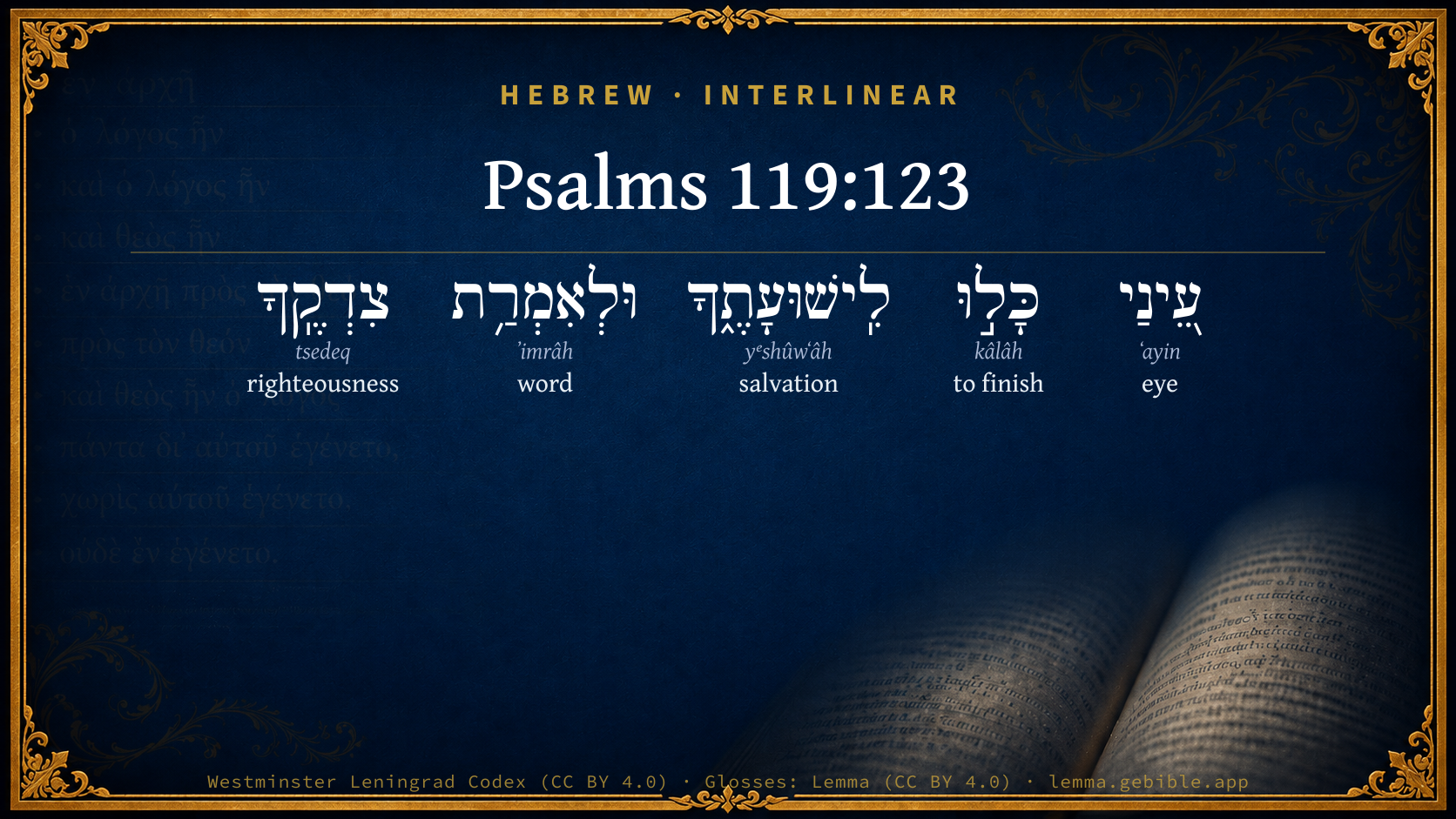
Psalms 119:123

Hebrew (Westminster Leningrad Codex) Psalms 119:123 appears in the Hebrew Old Testament. The text above is from the Westminster Leningrad Codex. Each word links to its Strong’s number, a concise gloss, and parsing drawn from the Open Scriptures Hebrew Bible morphology. Click any word for its full Brown-Driver-Briggs (BDB) entry.
Download image
Cite this verse

Psalms 119:123 (World English Bible). Public Domain. Lemma interlinear Bible study tool, https://lemma.gebible.app/v/psalms/119/123.

Show BibTeX & RIS
BibTeX
RIS
English Translation
My eyes fail looking for your salvation, For your righteous word.
World English Bible · Public Domain
Download a study sheet

One document with this verse’s original text, its word-by-word gloss line, the meaning frame, cross-references with their text, attributed commentary, and full source and license credits — printable, and it pastes into notes with its structure intact.

This verse Autodidact and up

Study sheet (.html) Plain text (.txt)

A passage Seminary Student

Up to 50 verses in one chapter. A passage sheet keeps up to 6 commentary sources and 12 cross-references per verse, in the order this page ranks them, and says so on the sheet whenever that leaves anything out. Ask for a single verse and you get the Autodidact verse sheet above.

Everything on this page stays free to read, with no account — the sheet is a download of what is already on screen, not access to it.

Want to remove ads? Support Godless Engineer
Compare translations 3

The same verse in 3 English versions, stacked beneath the original-language interlinear above. Click any original word for its lexicon entry.

Each is an independent rendering of the whole verse — the interlinear is not word-aligned to these translations.

Highlighted words mark where these versions differ — a whole-verse word diff, not a word-by-word alignment.

  • World English Bible Public Domain
    My eyes fail looking for your salvation, For your righteous word.
  • King James Version Public Domain
    Mine eyes fail for thy salvation, and for the word of thy righteousness.
  • unfoldingWord Literal Text CC BY-SA 4.0
    My eyes have failed for your salvation and for the word of your righteousness.

unfoldingWord Literal Text — © unfoldingWord, licensed CC BY-SA 4.0. Word-aligned USFM3 via Door43 (git.door43.org/unfoldingWord/en_ult).

Versions to compare (up to 4)

3 of 4 selected

Show all 17 translations

Every available English version of this verse, each an independent rendering of the whole verse.

  • World English Bible Public Domain
    My eyes fail looking for your salvation, For your righteous word.
  • Berean Standard Bible Public Domain
    My eyes fail, looking for Your salvation, and for Your righteous promise.
  • Majority Standard Bible Public Domain
    My eyes fail, looking for Your salvation, and for Your righteous promise.
  • King James Version Public Domain
    Mine eyes fail for thy salvation, and for the word of thy righteousness.
  • American Standard Version (1901) Public Domain
    Mine eyes fail for thy salvation, And for thy righteous word.
  • Revised Version (1885) Public Domain
    Mine eyes fail for thy salvation, and for thy righteous word.
  • Geneva Bible (1599) Public Domain
    Mine eyes haue failed in waiting for thy saluation, and for thy iust promise.
  • Young's Literal Translation Public Domain
    Mine eyes have been consumed for Thy salvation. And for the saying of Thy righteousness.
  • Literal Standard Version CC BY-SA 4.0
    My eyes have been consumed for Your salvation. And for the saying of Your righteousness.
  • Unlocked Literal Bible CC BY-SA 4.0
    My eyes grow tired as I wait for your salvation and for your righteous word.
  • unfoldingWord Literal Text CC BY-SA 4.0
    My eyes have failed for your salvation and for the word of your righteousness.
  • Darby Bible Public Domain
    Mine eyes fail for thy salvation, and for the ùword of thy righteousness.
  • World Messianic Bible Public Domain
    My eyes fail looking for your salvation, for your righteous word.
  • Webster's Bible Public Domain
    My eyes fail for thy salvation, and for the word of thy righteousness.
  • Free Bible Version CC BY-SA 4.0
    I strain my eyes looking for your salvation, watching for you to fulfill your promise to make everything good.
  • Bible in Basic English Public Domain
    My eyes are wasted with desire for your salvation, and for the word of your righteousness.
  • JPS Tanakh (1917) Public Domain
    Mine eyes fail for Thy salvation, and for Thy righteous word.

Literal Standard Version (2020), Covenant Press — licensed CC BY-SA 4.0. Text via the HelloAO Bible API (eBible.org). Unlocked Literal Bible (unfoldingWord) — licensed CC BY-SA 4.0. Text via the HelloAO Bible API (eBible.org). unfoldingWord Literal Text — © unfoldingWord, licensed CC BY-SA 4.0. Word-aligned USFM3 via Door43 (git.door43.org/unfoldingWord/en_ult). Free Bible Version, Dr. Jonathan Gallagher — licensed CC BY-SA 4.0. Text via the HelloAO Bible API (eBible.org).

Word by word

More ways to search: Search by grammar → Find every occurrence → Compare this word →

Practice this passage: Drill this verse → Learn its vocabulary →

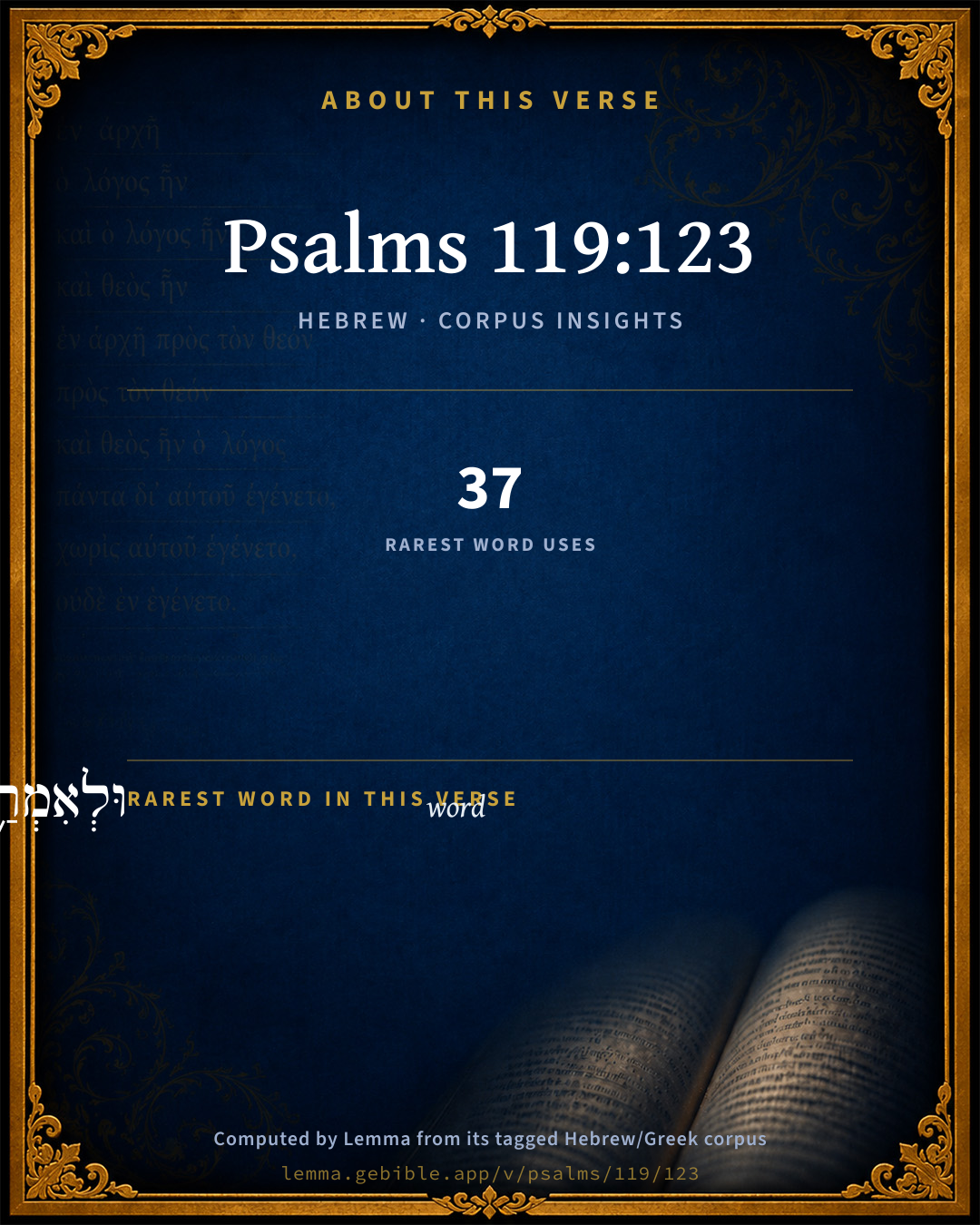
About this verse

These counts appear in no published source. They are computed here, from the morphology-tagged text and Lemma’s own curated glosses. What Lemma adds →

5
words
5
distinct lemmas
Wisdom
section

Shared distinctive vocabulary

וּלְאִמְרַ֥ת word H565 occurs in 35 verses of the Hebrew Bible. Also found in:

Grammatical profile

  • 1 verb
  • 4 nouns

Verb forms

  • כָּל֣וּ Qal · Perfect

Hebrew & Septuagint length

In English translation the verse runs 11 words from the Hebrew and 14 from the Septuagint (LXX English) — closely comparable.

A rough comparison of the two English renderings, which tokenize alike — not a word-level alignment.

Word counts can differ between the Hebrew and the Greek without any difference in meaning — e.g. the Hebrew direct-object marker אֵת has no separate Greek word, and Greek often adds the article ὁ.

Cross-references

5

Topical passages linked to Psalms 119:123 in the Treasury of Scripture Knowledge — connected by theme and wording, ordered by reader-vote popularity; previews shown in the World English Bible.

  • Psalms 130:6 My soul longs for the Lord more than watchmen long for the morning; More than watchmen for the morning.
  • Psalms 69:3 I am weary with my crying. My throat is dry. My eyes fail, looking for my God.
  • Psalms 119:81–82 My soul faints for your salvation. I hope in your word.
  • Psalms 143:7 Hurry to answer me, Yahweh. My spirit fails. Don't hide your face from me, So that I don't become like those who go down into the pit.
  • Lamentations 4:17 Our eyes do yet fail [in looking] for our vain help: In our watching we have watched for a nation that could not save.

Cross-references courtesy of OpenBible.info (CC BY 4.0).

Hebrew and Greek witnesses Masoretic Hebrew ↔ Greek Septuagint

The same verse in the two great witnesses to the Old Testament, shown verse-for-verse.

You’re reading Greek Psalm 118 (Hebrew Psalm 119). The Septuagint counts the superscription, so verse numbers can differ from the Hebrew — chapter-level alignment, not verse-by-verse. Numbering follows Rahlfs.

These are two independent witnesses, not word-aligned to each other, and the Septuagint is shown in lemma (dictionary) form.

Hebrew Psalms 119:123 Masoretic · Westminster Leningrad Codex

עֵ֭ינַי כָּל֣וּ לִֽישׁוּעָתֶ֑ךָ וּלְאִמְרַ֥ת צִדְקֶֽךָ

My eyes fail looking for your salvation, For your righteous word.

World English Bible · Public Domain

Greek LXX Greek Psalm 118:123 Septuagint · lemma form

ὁ ὀφθαλμός ἐγώ ἐκλείπω εἰς ὁ σωτήριον σύ καί εἰς ὁ λόγιον ὁ δικαιοσύνη σύ

My eyes have failed for your salvation, and for the word of your righteousness.

LXX2012 (modern English Septuagint) · Public Domain

On this verse, John Gill's Exposition discusses the Septuagint’s reading. Read the note in Commentary ↓

Hebrew: Westminster Leningrad Codex (CC BY 4.0). Greek: Septuagint (public domain); English from LXX2012 (modern English Septuagint) (Public Domain). How the Septuagint differs from the Hebrew →

Commentary

Notes on Psalms 119:123 from classic Christian and Jewish commentators (each source and its license shown beneath its notes). The classic Christian expositions comment on the surrounding passage and are grouped to its opening verse, so a note may address several verses; the Jewish commentaries on the Tanakh (Rashi and others) are per-verse, so they appear only where the commentator wrote on this verse.

Lemma curates 59 commentaries, every one of them public domain or Creative Commons licensed, each selected and text-cleaned for this edition rather than reprinted as found. About our sources →

Trapp's Complete Commentary

John Trapp

Psa 119:123 Mine eyes fail for thy salvation, and for the word of thy righteousness.

Ver. 123. Mine eyes fail for thy salvation] Not my bodily eyes only, but the eyes of my faith. See Psa 119:81-82.

And for the word of thy righteousness] That is, for thy faithful promises, which many times bear a long date.

John Trapp, A Commentary or Exposition upon All the Books of the Old and New Testament (1647–1656) — public domain. Text from a community e-Sword module.

J. A. Alexander on Psalms

Joseph Addison Alexander

123. (Psa 119:123) My eyes fail for thy salvation, and for the word of thy righteousness. With the first clause compare Psa 119:82. The word of thy righteousness, thyword of righteousness, thy righteous word, the promise of a righteous God who cannot lie.

Joseph Addison Alexander, The Psalms Translated and Explained (1850) — public domain. Text from a community e-Sword module.

Matthew Henry's Commentary

David, being oppressed, is here waiting and wishing for the salvation of the Lord, which would make him easy. 1. He cannot but think that it comes slowly: My eyes fail for thy salvation. His eyes were towards it and had been long so. He looked for help from heaven (and we deceive ourselves if we look for it any other way), but it did not come so soon as he expected, so that his eyes began to fail, and he was sometimes ready to despair, and to think that, because the salvation did not come when he looked for it, it would never come. It is often the infirmity even of good men to be weary of waiting God's time when their time has elapsed. 2. Yet he cannot hope that it comes surely; for he expects the word of God's righteousness, and no other salvation than what is secured by that word, which cannot fall to the ground because it is a word of righteousness. Though our eyes fail, yet God's word does not, and therefore those that build upon it, though now discouraged, shall in due time see his salvation.

Matthew Henry's Commentary on the Whole Bible (1708–1710) — public domain (CC PDM 1.0). Text via the HelloAO Bible API.

Adam Clarke's Commentary

Verse 123. Mine eyes fail] See on Ps 119:82.

Adam Clarke's Commentary on the Bible (1810–1826) — public domain. Text from a community e-Sword/MySword module.

John Calvin's Commentaries

123. My eyes have failed for thy salvation. “In times of great sorrow, when the heart is oppressed with care, and when danger threatens on every side, the human eye expresses with amazing accuracy the distressing and anguished emotions of the soul. The posture here described is that of an individual who perceives himself surrounded with enemies of the most formidable character, who feels his own weakness and insufficiency to enter into conflict with them, but who is eagerly looking for the arrival of a devoted and powerful friend, who has promised to succor him in the hour of his calamity.” — Dr. Morison.

John Calvin's Commentaries (1540-1563) — public domain. Text from the Calvin Translation Society English edition (1840s-50s) via the Christian Classics Ethereal Library (ccel.org). Calvin's coverage is partial (roughly two-thirds of the Bible); uncommented books and verses are honest gaps, never fabricated. The 19th-century editor's footnotes and remarks are omitted so the notes are faithfully Calvin's own voice.

Ellicott's Commentary for English Readers

(123) See Psa_119:82.

A Bible Commentary for English Readers, edited by Charles John Ellicott (1878–1897) — public domain. Text from a community e-Sword module.

The Cambridge Bible for Schools and Colleges

gen. ed. J. J. S. Perowne

123. Cp. Psa_119:81-82.

the word of thy righteousness] The promise of deliverance which Jehovah, as a righteous and therefore a faithful God, is pledged to fulfil.

The Cambridge Bible for Schools and Colleges (gen. ed. J. J. S. Perowne; Cambridge University Press, 1878–1918) — public domain. Text from a community e-Sword module.

John Gill's Exposition

Therefore I love thy commandments,.... Because he was the Lord's servant, as Aben Ezra; or rather because the wicked made void the law. His love was the more inflamed and increased towards it by the contempt it was had in by others; he preferred it

above gold, yea, above fine gold; or gold of Phez, a place where the best gold was, as was thought: the Septuagint and Vulgate Latin versions render it "the topaz"; and the Syriac and Arabic versions, "precious stones" or "gems"; see Psa 119:72.

John Gill's Exposition of the Whole Bible (1746–1763) — public domain (CC PDM 1.0). Text via the HelloAO Bible API.

Albert Barnes' Notes on the Bible

Mine eyes fail for thy salvation - See the notes at Psa 119:81-82.

And for the word of thy righteousness - Thy righteous word - that it may be made known to me, and that I may see its beauty and enjoy it.

Albert Barnes' Notes on the Bible (1834–1885) — public domain. Text from a community e-Sword/MySword module.

Matthew Poole's English Annotations

For the performance of thy righteous, or faithful, or merciful word or promise.

Matthew Poole's English Annotations on the Holy Bible (1683–1685) — public domain. Text from a community e-Sword/MySword module.

The Treasury of David

Charles H. Spurgeon

Ver. 123. Mine eyes fail for thy salvation. He wept, waited, and watched for God's saving hand, and these exercises tried the eyes of his faith till they were almost ready to give out. He looked to God alone, he looked eagerly, he looked long, he looked till his eyes ached. The mercy is, that if our eyes fail, God does not fail, nor do his eyes fail. Eyes are tender things, and so are our faith, hope and expectancy: the Lord will not try them above what they are able to bear. "And for the word of thy righteousness:" a word that would silence the unrighteous words of his oppressors. His eyes as well as his ears waited for the Lord's word: he looked to see the divine word come forth as a fiat for his deliverance. He was "waiting for the verdict" the verdict of righteousness itself. How happy are we if we have righteousness on our side; for then that which is the sinners' terror is our hope, that which the proud dread is our expectation and desire. David left his reputation entirely in the Lord's hand, and was eager to be cleared by the word of the Judge rather than by any defence of his own. He knew that he had done right, and, therefore, instead of avoiding the supreme court, he begged for the sentence which he knew would work out his deliverance. He even watched with eager eyes for the judgment and the deliverance, the word of righteousness from God which meant salvation to himself.

Ver. 123. Mine eyes fail flor thy salvation. In times of great sorrow when the heart is oppressed with care, and when danger threatens on every side, the human eye expresses with amazing accuracy the distressed and anguished emotions of the soul. The posture here described is that of an individual who perceives himself surrounded with enemies of the most formidable character, who feels his own weakness and insufficiency to enter into conflict with them, but who is eagerly looking for the arrival of a devoted and powerful friend who has promised to succour him in the hour of his calamity. As his friend delays the hour of his coming, his fears and anxieties multiply, till he finds himself in the condition of one whose eyes fail and grow dim in looking for the approach of his great deliverer. In this condition was the suppliant here described, his enemies were ready to swallow him up, and except from heaven he had no hope of final extrication. To the promises of God he betook himself, and while waiting their accomplishment, and looking with the utmost eagerness to the word of God's righteousness, he gives utterance to the desponding sentiment, "Mine eyes fail for thy salvation." O for such warm and anxious desires for that great salvation, which will realize the victory over all our spiritual enemies, and enable us to shout triumphantly through all eternity in the name of our almighty Deliverer! John Morison.

Ver. 123. Mine eyes fail...for the word of thy righteousness. Albeit the words of promise be neither performed, nor like to be performed, yet faith should justify the promise, for true and faithful. David Dickson.

Ver. 123. For the word of thy righteousness. This would be the word of promised salvation, which the Lord had given in righteousness. What an amazing plea God on the ground of his own righteousness appealed to for deliverance and yet how true! Or this might be the word of his justice, the issuing of justice, the exercising of a righteous decision between him and his oppressors. He had looked for the Lord to interpose between them, and so to fulfil all he had promised on behalf of the believer. The Lord will vindicate his own. Are any in great difficulty; and are they waiting for the Lord to interpose, to whom they have committed their concerns? ...Wait on; he will not disappoint a gracious hope. John Stephen.

Ver. 123. For the word of thy righteousness, or, "the word of thy justice"; that is to say, for the sentence of justice on my oppressors, as the first part of the verse teaches; for the passing this sentence will be equivalent to the granting the salvation which the psalmist so earnestly desired. George Phillips.

Ver. 123. Holy expectation long maintained, in danger of failing; this fact pleaded; reasons for never renouncing it.

Psalms 119:124*

Charles H. Spurgeon's The Treasury of David (1869–1885) — public domain. Psalms only. Text from a community e-Sword/MySword module.

The Pulpit Commentary

Mine eyes fail for thy salvation; i.e. through looking for it, and vainly expecting it (comp. vers. 81, 82). And for the word of thy righteousness; i.e. and through looking for the fulfillment of thy righteous promises.

The Pulpit Commentary (1880–1919), ed. H.D.M. Spence-Jones & Joseph S. Exell — public domain. Text from a community e-Sword module.

John Wesley's Explanatory Notes

The word - For the performance of thy faithful or merciful promise.

John Wesley, Explanatory Notes Upon the Whole Bible (1754–1765) — public domain. Text via the GEBible commentary corpus.

unfoldingWord translationNotes

Door43 World Missions Community

My eyes grow tired as I wait

Here "eyes" represents the whole person. AT: "I grow tired because I wait and wait" (See: Synecdoche)

for your salvation and for your righteous word

The abstract noun "salvation" can be stated as a verb. AT: "for you to save me as you promised to do" (See: Abstract Nouns)

your righteous word

"your righteous promise"

Show your servant

The writer speaks about himself as "your servant." AT: "Show me" or "Show me, your servant" (See: First, Second, or Third Person)

your covenant faithfulness

The abstract noun "faithfulness" can be stated as an adverb or adjective. AT: "that you faithfully love me" or "that you are faithful to your covenant" (See: Abstract Nouns)

translationWords

save

righteous

word of God

covenant faithfulness

statute

unfoldingWord translationNotes — © Distant Shores Media and the Door43 World Missions Community, licensed CC BY-SA 4.0. Source: git.door43.org/Door43/en_tn.

Rashi

Rabbi Shlomo Yitzchaki (Rashi)

and for the word of Your righteousness The promise that You promised me.

Rashi on the Tanakh — English translations: “The Judaica Press complete Tanach with Rashi, translated by A. J. Rosenberg” (CC BY 4.0); “Pentateuch with Rashi's commentary by M. Rosenbaum and A.M. Silbermann, 1929-1934” (public domain); “The Metsudah Tanach series, Lakewood, N.J” (CC BY 4.0); and “The Book of Joshua, Metsudah Publications, 1997” (CC BY 4.0). Text via Sefaria.

Lesson kit

Teaching starters — assembled from the data on this page, not authored interpretation. Every prompt links to the verse data it draws on. Edit before teaching.

Psalms, in the Wisdom, opens this verse with 5 words (5 distinct Hebrew lemmas). Its most distinctive word is ʼimrâh (“word”). A historical commentator’s framing appears above. Read the whole chapter for the surrounding context.

Discussion questions

  1. What does “word” (ʼimrâh) contribute to the verse as a whole?
  2. How does Genesis 4:23, which shares the word «word», read alongside this verse?
  3. These translations render this verse differently. What is at stake in choosing one wording over another?
  4. «כָּל֣וּ» is a Qal Perfect verb. How does that grammatical form shape the action described?
  5. Compare how Trapp's Complete Commentary and J. A. Alexander on Psalms read this verse. Where do they agree or differ?

Things to notice

Reading settings

Reading text

Shown beneath each verse's original-language words.

Old Testament
Old Testament edition

Read the OT as the Masoretic Hebrew (MT) or the Greek Septuagint (LXX).

English shown for the Greek Septuagint (in the Hebrew ↔ Greek comparison).

Comparing translations? Open the Compare panel on any verse page to stack up to four side by side.