
Zechariah 5:4

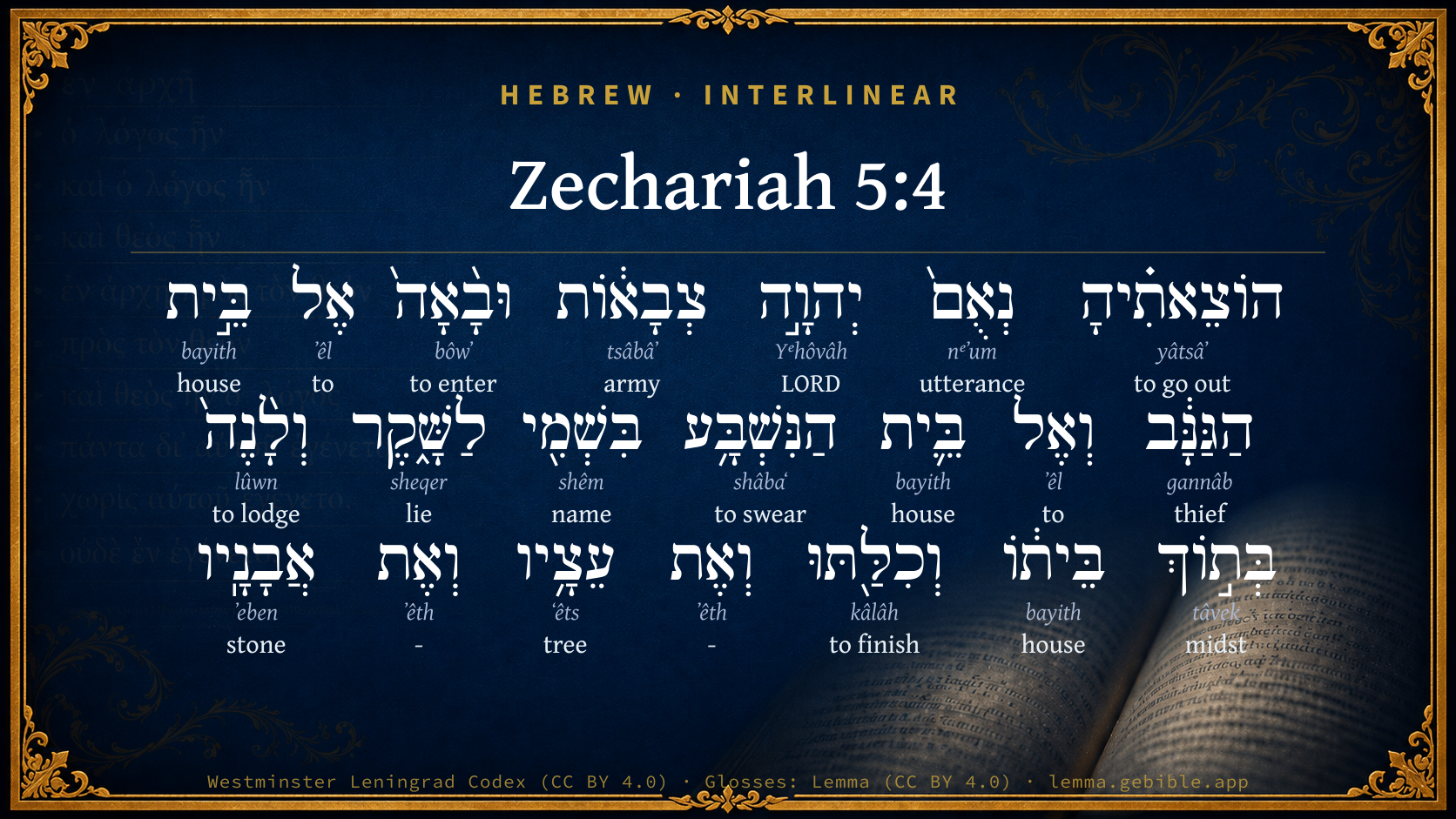
Hebrew (Westminster Leningrad Codex) Zechariah 5:4 appears in the Hebrew Old Testament. The text above is from the Westminster Leningrad Codex. Each word links to its Strong’s number, a concise gloss, and parsing drawn from the Open Scriptures Hebrew Bible morphology. Click any word for its full Brown-Driver-Briggs (BDB) entry.
Download image
Cite this verse

Zechariah 5:4 (World English Bible). Public Domain. Lemma interlinear Bible study tool, https://lemma.gebible.app/v/zechariah/5/4.

Show BibTeX & RIS
BibTeX
RIS
English Translation
I will cause it to go out," says Yahweh of Hosts, "and it will enter into the house of the thief, and into the house of him who swears falsely by my name; and it will remain in the midst of his house, and will destroy it with its timber and its stones."
World English Bible · Public Domain
Download a study sheet

One document with this verse’s original text, its word-by-word gloss line, the meaning frame, cross-references with their text, attributed commentary, and full source and license credits — printable, and it pastes into notes with its structure intact.

This verse Autodidact and up

Study sheet (.html) Plain text (.txt)

A passage Seminary Student

Up to 50 verses in one chapter. A passage sheet keeps up to 6 commentary sources and 12 cross-references per verse, in the order this page ranks them, and says so on the sheet whenever that leaves anything out. Ask for a single verse and you get the Autodidact verse sheet above.

Everything on this page stays free to read, with no account — the sheet is a download of what is already on screen, not access to it.

Want to remove ads? Support Godless Engineer
Compare translations 3

The same verse in 3 English versions, stacked beneath the original-language interlinear above. Click any original word for its lexicon entry.

Each is an independent rendering of the whole verse — the interlinear is not word-aligned to these translations.

Highlighted words mark where these versions differ — a whole-verse word diff, not a word-by-word alignment.

  • World English Bible Public Domain
    I will cause it to go out," says Yahweh of Hosts, "and it will enter into the house of the thief, and into the house of him who swears falsely by my name; and it will remain in the midst of his house, and will destroy it with its timber and its stones."
  • King James Version Public Domain
    I will bring it forth, saith the LORD of hosts, and it shall enter into the house of the thief, and into the house of him that sweareth falsely by my name: and it shall remain in the midst of his house, and shall consume it with the timber thereof and the stones thereof.
  • unfoldingWord Literal Text CC BY-SA 4.0
    I have brought it out”—the declaration of Yahweh of Armies—“and it will come to the house of the thief and to the house of the one swearing by my name to falsehood. And it will spend the night in the midst of his house and will consume it, and its timbers and its stones.”

unfoldingWord Literal Text — © unfoldingWord, licensed CC BY-SA 4.0. Word-aligned USFM3 via Door43 (git.door43.org/unfoldingWord/en_ult).

Versions to compare (up to 4)

3 of 4 selected

Show all 18 translations

Every available English version of this verse, each an independent rendering of the whole verse.

  • World English Bible Public Domain
    I will cause it to go out," says Yahweh of Hosts, "and it will enter into the house of the thief, and into the house of him who swears falsely by my name; and it will remain in the midst of his house, and will destroy it with its timber and its stones."
  • Berean Standard Bible Public Domain
    I will send it out, declares the LORD of Hosts, and it will enter the house of the thief and the house of him who swears falsely by My name. It will remain inside his house and destroy it, down to its timbers and stones.”
  • Majority Standard Bible Public Domain
    I will send it out, declares the LORD of Hosts, and it will enter the house of the thief and the house of him who swears falsely by My name. It will remain inside his house and destroy it, down to its timbers and stones.”
  • King James Version Public Domain
    I will bring it forth, saith the LORD of hosts, and it shall enter into the house of the thief, and into the house of him that sweareth falsely by my name: and it shall remain in the midst of his house, and shall consume it with the timber thereof and the stones thereof.
  • American Standard Version (1901) Public Domain
    I will cause it to go forth, saith Jehovah of hosts, and it shall enter into the house of the thief, and into the house of him that sweareth falsely by my name; and it shall abide in the midst of his house, and shall consume it with the timber thereof and the stones thereof.
  • Revised Version (1885) Public Domain
    I will cause it to go forth, saith the LORD of hosts, and it shall enter into the house of the thief, and into the house of him that sweareth falsely by my name: and it shall abide in the midst of his house, and shall consume it with the timber thereof and the stones thereof.
  • Geneva Bible (1599) Public Domain
    I will bring it forth, saith the Lord of hosts, and it shall enter into the house of the thiefe, and into the house of him, that falsely sweareth by my Name: and it shall remaine in the middes of his house, and shall consume it, with the timber thereof, and stones thereof.
  • Douay-Rheims (1899) Public Domain
    I will bring it forth, saith the Lord of hosts: and it shall come to the house of the thief, and to the house of him that sweareth falsely by my name: and it shall remain in the midst of his house, and shall consume it, with the timber thereof, and the stones thereof.
  • Young's Literal Translation Public Domain
    `I have brought it out -- an affirmation of Jehovah of Hosts -- and it hath come in unto the house of the thief, and unto the house of him who hath sworn in My name to a falsehood, and it hath remained in the midst of his house, and hath consumed it, both its wood and its stones.'
  • Literal Standard Version CC BY-SA 4.0
    “I have brought it out,” a declaration of YHWH of Hosts, “and it has come into the house of the thief, and into the house of him who has sworn in My Name with a falsehood, and it has remained in the midst of his house, and has consumed it, both its wood and its stones.”
  • Unlocked Literal Bible CC BY-SA 4.0
    “I will send it out—this is the declaration of Yahweh of hosts—so it will enter into the house of the thief and into the house of the one that swears falsely by my name. It will remain in his house and consume its timber and stones.”
  • unfoldingWord Literal Text CC BY-SA 4.0
    I have brought it out”—the declaration of Yahweh of Armies—“and it will come to the house of the thief and to the house of the one swearing by my name to falsehood. And it will spend the night in the midst of his house and will consume it, and its timbers and its stones.”
  • Darby Bible Public Domain
    I will cause it to go forth, saith Jehovah of hosts, and it shall enter into the house of the thief, and into the house of him that sweareth falsely by my name; and it shall lodge in the midst of his house, and shall consume it with the timber thereof and the stones thereof.
  • World Messianic Bible Public Domain
    I will cause it to go out,” says the LORD of Hosts, “and it will enter into the house of the thief, and into the house of him who swears falsely by my name; and it will remain in the middle of his house, and will destroy it with its timber and its stones.”
  • Webster's Bible Public Domain
    I will bring it forth, saith the LORD of hosts, and it shall enter into the house of the thief, and into the house of him that sweareth falsely by my name: and it shall remain in the midst of his house, and shall consume it with its timber and its stones.
  • Free Bible Version CC BY-SA 4.0
    “I have sent the curse out and it will go into the house of the thief and into the house of the one who swears lies in my name, declares the Lord Almighty. The curse will remain in that house, and will destroy it, both the timbers and the stones.”
  • Bible in Basic English Public Domain
    And I will send it out, says the Lord of armies, and it will go into the house of the thief and into the house of him who takes a false oath by my name: and it will be in his house, causing its complete destruction, with its woodwork and its stones.
  • JPS Tanakh (1917) Public Domain
    I cause it to go forth, saith the LORD of hosts, and it shall enter into the house of the thief, and into the house of him that sweareth falsely by My name; and it shall abide in the midst of his house, and shall consume it with the timber thereof and the stones thereof.'

Literal Standard Version (2020), Covenant Press — licensed CC BY-SA 4.0. Text via the HelloAO Bible API (eBible.org). Unlocked Literal Bible (unfoldingWord) — licensed CC BY-SA 4.0. Text via the HelloAO Bible API (eBible.org). unfoldingWord Literal Text — © unfoldingWord, licensed CC BY-SA 4.0. Word-aligned USFM3 via Door43 (git.door43.org/unfoldingWord/en_ult). Free Bible Version, Dr. Jonathan Gallagher — licensed CC BY-SA 4.0. Text via the HelloAO Bible API (eBible.org).

Word by word

More ways to search: Search by grammar → Find every occurrence → Compare this word →

Practice this passage: Drill this verse → Learn its vocabulary →

הַגַּנָּ֔ב
gannâb
H1590
“the · thief”
Particle, Definite Article + Noun, Common, Masculine, Singular, Absolute
Part of Speech
Particle + Noun
Type
Common
Gender
Masculine
Number
Singular
State
Absolute
Full BDB Definition

Origin: from H1589

TWOT: 364b

thief
  1. הוֹצֵאתִ֗יהָ yâtsâʼ H3318 “to go out · her” Verb, Hiphil, Perfect, 1st Person, Common, Singular + Suffix, Personal, 3rd Person, Feminine, Singular
  2. נְאֻם֙ nᵉʼum H5002 “utterance of” Noun, Common, Masculine, Singular, Construct
  3. יְהוָ֣ה Yᵉhôvâh H3068 “LORD” Noun, Proper
  4. צְבָא֔וֹת tsâbâʼ H6635 “armies” Noun, Common, Both, Plural, Absolute
  5. וּבָ֨אָה֙ bôwʼ H935 “and · to enter” Conjunction + Verb, Qal, Sequential Perfect, 3rd Person, Feminine, Singular
  6. אֶל ʼêl H413 “to” Preposition
  7. בֵּ֣ית bayith H1004 “house of” Noun, Common, Masculine, Singular, Construct
  8. וְאֶל ʼêl H413 “and · to” Conjunction + Preposition
  9. בֵּ֛ית bayith H1004 “house of” Noun, Common, Masculine, Singular, Construct
  10. הַנִּשְׁבָּ֥ע shâbaʻ H7650 “the · swearing” Particle, Definite Article + Verb, Niphal, Participle Active, Masculine, Singular, Absolute
  11. בִּשְׁמִ֖י shêm H8034 “in/at · name · my” Preposition + Noun, Common, Masculine, Singular, Construct + Suffix, Personal, 1st Person, Common, Singular
  12. לַשָּׁ֑קֶר sheqer H8267 “to/for the · lie” Preposition, Determined + Noun, Common, Masculine, Singular, Absolute
  13. וְלָ֨נֶה֙ lûwn H3885 “and · to lodge” Conjunction + Verb, Qal, Sequential Perfect, 3rd Person, Feminine, Singular
  14. בְּת֣וֹךְ tâvek H8432 “in/at · midst of” Preposition + Noun, Common, Masculine, Singular, Construct
  15. בֵּית֔וֹ bayith H1004 “house · his” Noun, Common, Masculine, Singular, Construct + Suffix, Personal, 3rd Person, Masculine, Singular
  16. וְכִלַּ֖תּוּ kâlâh H3615 “and · to finish · him” Conjunction + Verb, Piel, Sequential Perfect, 3rd Person, Feminine, Singular + Suffix, Personal, 3rd Person, Masculine, Singular
  17. וְאֶת ʼêth H853 “and · -” Conjunction + Particle, Direct Object
  18. עֵצָ֥יו ʻêts H6086 “trees · his” Noun, Common, Masculine, Plural, Construct + Suffix, Personal, 3rd Person, Masculine, Singular
  19. וְאֶת ʼêth H853 “and · -” Conjunction + Particle, Direct Object
  20. אֲבָנָֽיו ʼeben H68 “stones · his” Noun, Common, Feminine, Plural, Construct + Suffix, Personal, 3rd Person, Masculine, Singular

About this verse

These counts appear in no published source. They are computed here, from the morphology-tagged text and Lemma’s own curated glosses. What Lemma adds →

21
words
17
distinct lemmas
Prophets
section

Notable vocabulary

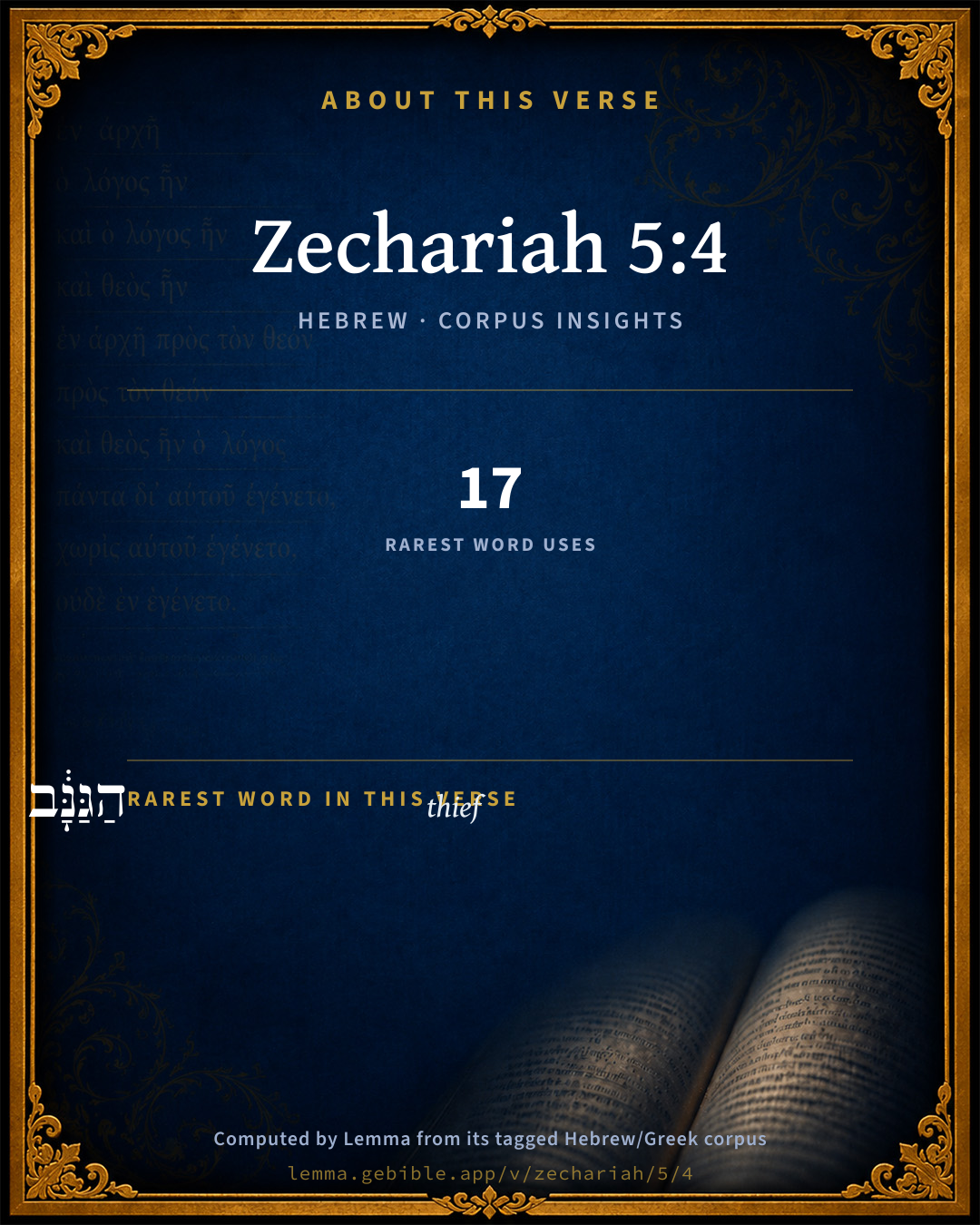
The rarest word here is הַגַּנָּ֔ב thief H1590 — appearing just 17 times in the whole Hebrew Bible.

Shared distinctive vocabulary

הַגַּנָּ֔ב thief H1590 occurs in 17 verses of the Hebrew Bible. Also found in:

Grammatical profile

  • 5 verbs
  • 12 nouns
  • 2 prepositions
  • 2 particles

Verb forms

  • הוֹצֵאתִ֗יהָ Hiphil · Perfect
  • וּבָ֨אָה֙ Qal · Sequential Perfect
  • הַנִּשְׁבָּ֥ע Niphal · Participle Active
  • וְלָ֨נֶה֙ Qal · Sequential Perfect
  • וְכִלַּ֖תּוּ Piel · Sequential Perfect

Repetition

Words recur within this verse — often emphatic in Hebrew:

  • בֵּ֣ית house H1004 ×3
  • אֶל to H413 ×2

Hebrew & Septuagint length

In English translation the verse runs 53 words from the Hebrew and 56 from the Septuagint (LXX English) — closely comparable.

A rough comparison of the two English renderings, which tokenize alike — not a word-level alignment.

Word counts can differ between the Hebrew and the Greek without any difference in meaning — e.g. the Hebrew direct-object marker אֵת has no separate Greek word, and Greek often adds the article ὁ.

Cross-references

8

Topical passages linked to Zechariah 5:4 in the Treasury of Scripture Knowledge — connected by theme and wording, ordered by reader-vote popularity; previews shown in the World English Bible.

  • Proverbs 3:33 Yahweh's curse is in the house of the wicked, But he blesses the habitation of the righteous.
  • Habakkuk 2:9–11 Woe to him who gets an evil gain for his house, that he may set his nest on high, that he may be delivered from the hand of evil!
  • Malachi 3:5 I will come near to you to judgment; and I will be a swift witness against the sorcerers, and against the adulterers, and against the perjurers, and against those who oppress the hireling in his wages, the widow, and the fatherless, and who deprive the foreigner of justice, and don't fear me," says Yahweh of Hosts.
  • Leviticus 14:34–45 "When you have come into the land of Canaan, which I give to you for a possession, and I put a spreading mildew in a house in the land of your possession,
  • Deuteronomy 7:26 You shall not bring an abomination into your house, and become a devoted thing like it: you shall utterly detest it, and you shall utterly abhor it; for it is a devoted thing.
  • Job 18:15 There shall dwell in his tent that which is none of his. Sulfur shall be scattered on his habitation.
  • James 5:2–3 Your riches are corrupted and your garments are moth-eaten.
  • Job 20:26 All darkness is laid up for his treasures. An unfanned fire shall devour him. It shall consume that which is left in his tent.

Cross-references courtesy of OpenBible.info (CC BY 4.0).

Hebrew and Greek witnesses Masoretic Hebrew ↔ Greek Septuagint

The same verse in the two great witnesses to the Old Testament, shown verse-for-verse.

These are two independent witnesses, not word-aligned to each other, and the Septuagint is shown in lemma (dictionary) form.

Hebrew Zechariah 5:4 Masoretic · Westminster Leningrad Codex

הוֹצֵאתִ֗יהָ נְאֻם֙ יְהוָ֣ה צְבָא֔וֹת וּבָ֨אָה֙ אֶל בֵּ֣ית הַגַּנָּ֔ב וְאֶל בֵּ֛ית הַנִּשְׁבָּ֥ע בִּשְׁמִ֖י לַשָּׁ֑קֶר וְלָ֨נֶה֙ בְּת֣וֹךְ בֵּית֔וֹ וְכִלַּ֖תּוּ וְאֶת עֵצָ֥יו וְאֶת אֲבָנָֽיו

I will cause it to go out," says Yahweh of Hosts, "and it will enter into the house of the thief, and into the house of him who swears falsely by my name; and it will remain in the midst of his house, and will destroy it with its timber and its stones."

World English Bible · Public Domain

Greek LXX Zechariah 5:4 Septuagint · lemma form

καί ἐκφέρω αὐτός λέγω κύριος παντοκράτωρ καί εἰςἔρχομαι εἰς ὁ οἶκος ὁ κλέπτης καί εἰς ὁ οἶκος ὁ ὄμνυμι ὁ ὄνομα ἐγώ ἐπί ψεῦδος καί καταλύω ἐν μέσος ὁ οἶκος αὐτός καί συντελέω αὐτός καί ὁ ξύλον αὐτός καί ὁ λίθος αὐτός

And I will bring it forth, says the Lord Almighty, and it shall enter into the house of the thief, and into the house of him that swears falsely by my name: and it shall rest in the midst of his house, and shall consume it, and the timber of it, and the stones of it.

LXX2012 (modern English Septuagint) · Public Domain

On this verse, The Pulpit Commentary discusses the Septuagint’s reading. Read the note in Commentary ↓

Hebrew: Westminster Leningrad Codex (CC BY 4.0). Greek: Septuagint (public domain); English from LXX2012 (modern English Septuagint) (Public Domain). How the Septuagint differs from the Hebrew →

Targum (Aramaic paraphrase)

1

The Targum is the ancient Jewish Aramaic paraphrase of the Hebrew Scriptures — an interpretive translation, not the Hebrew text itself. Onkelos (literal) and Pseudo-Jonathan (expansive) render the Torah, and Jonathan the Prophets. Coverage is partial: where no permissively-licensed English translation exists for a verse, only the Aramaic is shown. This is verse-level text, not a word-by-word alignment to the Hebrew.

  1. Targum Jonathan Prophets (Joshua–Malachi)
    אַפֵּיקְתָּהּ אֲמַר יְיָ צְבָאוֹת וְתֵיעוּל לְבֵית גַנְבָא וּלְבֵית דִמְקַיֵם בִּשְׁמִי לִשְׁקַר וּתְבִית בְּגוֹ בֵיתֵיהּ וּתְשֵׁיצִינֵיהּ וְיַת אָעוֹהִי וְיַת אַבְנוֹהִי:

    (no public-domain English translation for this verse)

    Targum Jonathan — Aramaic: “Mikraot Gedolot” (public domain). English: “Sefaria Community Translation” (CC0 1.0 (public-domain dedication)); “London "Chaldee Paraphrase," 1871” (public domain). Text via Sefaria.

Commentary

Notes on Zechariah 5:4 from classic Christian and Jewish commentators (each source and its license shown beneath its notes). The classic Christian expositions comment on the surrounding passage and are grouped to its opening verse, so a note may address several verses; the Jewish commentaries on the Tanakh (Rashi and others) are per-verse, so they appear only where the commentator wrote on this verse.

Lemma curates 59 commentaries, every one of them public domain or Creative Commons licensed, each selected and text-cleaned for this edition rather than reprinted as found. About our sources →

Trapp's Complete Commentary

John Trapp

Zec 5:4 I will bring it forth, saith the LORD of hosts, and it shall enter into the house of the thief, and into the house of him that sweareth falsely by my name: and it shall remain in the midst of his house, and shall consume it with the timber thereof and the stones thereof.

Ver. 4. I will bring it forth] sc. Out of my treasuries or storehouses of plagues and punishments, Deu 32:34. Or, That which thou hast seen in vision I will put in action; I will produce it into the open light, into the theatre of the world; their faults shall be written in their foreheads, their sins shall go before to judgment, my visible vengeance shall overtake them.

And it shall enter into the house of the thief] Which he calleth his castle; and where he thinks himself most secure, as out of the reach of God’s rod; as if he could mote himself up against God’s fire. But what saith Bildad? "His confidence shall be rooted out of his tabernacle, and it shall bring him to the king of terrors. It shall dwell in his tabernacle, because it is none of his: brimstone shall be scattered upon his habitation," Job 18:14-15, so that if the fire of God’s wrath do but touch it, all is on a light flame. He will unkennel these foxes; and drag Cacus out of his den, to his deserved punishment. Dioclesian, the persecutor (one of those Latrones publici, public robbers, as Cato called them), giving over his empire, after he had sufficiently feathered his nest, decreed to lead the rest of his life quietly. But he escaped not so; for after that his house was wholly consumed with lightning and a flame of fire that fell from heaven, he, hiding himself, for fear of the lightning, died within a while after.

And into the house of him that sweareth falsely by my name] Hence Ribera gathereth that by the whole earth in the former verse is meant Judaea only: because none but Jews swore by the name of the true God, who is indeed the proper object of an oath, Isa 65:16 Jer 12:6. Howbeit in lawful contracts with an infidel or idolater oaths by false gods may be admitted, and are binding. As for perjury, it is a provoking sin; as containing three great evils. 1. The uttering or upholding of a lie. 2. The calling upon God to testify and justify a lie. 3. The praying for a curse upon a man’s self; and beseeching God to be a swift witness against him, Mal 3:1-7; as he was indeed against Zedekiah, Narcissus in the ecclesiastical history, Earl Godwin in Polydor, Virgil, Rodulphus, Duke of Suevia, Ladislaus, King of Hungary, Dr London (Act. and Mon. fol. 1114), Richard Long, a soldier at Calais in King Henry VIII’s days; who, deposing falsely against William Smith, curate of Calais shortly after, upon a displeasure of his wife, desperately drowned himself. And within the memory of man, Feb. 11, A. D. 1574, Anne Averies forswore herself at a shop in Wood Street, London; praying God she might sink where she stood if she had not paid for the wares she took. Hereupon she fell down presently speechless, and with horrible stench died.

And it shall remain in the midst of his house] And be a troublesome inmate with him, such as he cannot rid his hands of though never so fain; there it shall roost and rest, in despite of him. If it distaste not his dough or empty his basket, yet will it fill his store with strife, or mix the wrath of God with his sweet morsels; his meat shall be sauced, his drink spiced, as Job 20:23. It is a moth in his wardrobe, murrain among his cattle, mildew in his field, rot among his sheep, and often times maketh the fruit of his loins his greatest heartbreak.

With the timber thereof and the stones thereof] As in case of treason or other horrible crimes, the very houses of the offenders were pulled down and made a dunghill, Dan 2:5; Dan 3:29. The Popish Council of Toulouse, gathered together against those ancient Protestants, the Albigenses, made a decree that the very house wherein a heretic was found should be pulled down, Illam domum in qua fuerit inventus haereticus diruendam decernimus. The manor house of Milcot, in Warwickshire, built by Lodovike Greevil, deeply guilty of these two grand evils mentioned in the text, and lately burnt to the ground, is commonly looked upon as a speaking monument of God’s just judgment against sacrilege and perjury, whether men personally commit these sins or love them in others, Zec 1:17 Rev 22:15.

John Trapp, A Commentary or Exposition upon All the Books of the Old and New Testament (1647–1656) — public domain. Text from a community e-Sword module.

Tyndale Open Study Notes

Tyndale Open Resources

5:4 This curse is sent like a law officer to punish violations of God’s covenant (see Ps 147:15; Isa 55:11).

Tyndale Open Study Notes — © Tyndale Open Resources, licensed CC BY-SA 4.0. Text via the HelloAO Bible API.

Jamieson, Fausset & Brown

Robert Jamieson, A. R. Fausset & David Brown

The "theft" immediately meant is similar sacrilege to that complained of in Neh 13:10; Mal 3:8. They robbed God by neglecting to give Him His due in building His house, while they built their own houses, forswearing their obligations to Him; therefore, the "houses" they build shall be "consumed" with God's "curse." Probably literal theft and perjury accompanied their virtual theft and perjury as to the temple of God (Mal 3:5). Stealing and perjury go together; for the covetous and fraudulent perjure themselves by God's name without scruple (see Pro 30:9).

enter . . . the house--In vain they guard and shut themselves up who incur the curse; it will inevitably enter even when they think themselves most secure.

consume . . . timber . . . stones--not leaving a vestige of it. So the "stones" and "timber" of the house of a leper (type of the sinner) were to be utterly removed (Lev 14:15; compare Kg1 18:38).

The "ephah" is the Hebrew dry measure containing about thirty-seven quarts. Alluding to the previous vision as to theft and perjury: the ephah which, by falsification of the measure, they made the instrument of defrauding, shall be made the instrument of their punishment [GROTIUS]. Compare "this is their resemblance" (Zac 5:6), that is, this is a representation of what the Jews have done, and what they shall suffer. Their total dispersion ("the land of Shinar" being the emblem of the various Gentile lands of their present dispersion) is herein fortetold, when the measure (to which the ephah alludes) of their sins should be full. The former vision denounces judgment on individuals; this one, on the whole state: but enigmatically, not to discourage their present building [PEMBELLUS]. Rather, the vision is consolatory after the preceding one [CALVIN]. Idolatry and its kindred sins, covetousness and fraud (denounced in the vision of the roll), shall be removed far out of the Holy Land to their own congenial soil, never to return (so Zac 3:9; Isa 27:9; Isa 52:1; Isa 60:21; Jer 50:20; Zep 3:13). For more than two thousand years, ever since the Babylonian exile, the Jews have been free from idolatry; but the full accomplishment of the prophecy is yet future, when all sin shall be purged from Israel on their return to Palestine, and conversion to Christ.

Jamieson, Fausset & Brown — Commentary Critical and Explanatory on the Whole Bible (1871) — public domain (CC PDM 1.0). Text via the HelloAO Bible API.

Adam Clarke's Commentary

Verse 4. Into the house of him] Babylon, the house or city of Nebuchadnezzar, who was a public plunderer, and a most glaring idolater.

Adam Clarke's Commentary on the Bible (1810–1826) — public domain. Text from a community e-Sword/MySword module.

John Calvin's Commentaries

He afterwards adds, It shall come into the house of the thief, and into the house of him who swears in my name falsely; and there will it reside, and it shall consume the hoarse, both the wood and the stones. Here the Prophet further stimulates the Jews to repentance, by showing that the curse would so fly as to enter into all their houses; as though he had said, “In vain shall they, who deserve punishment, fortify or shut up themselves; for this curse, which I send forth, shall come to each individual, and with him it shall remain.” We know that hypocrites so flatter themselves, as though they could escape for the moment while God is angry and displeased; but the Prophet shows here that vain is such a hope, for the curse would overtake all the ungodly, and wholly overthrow them; yea, it would consume their houses, both the wood and the stones. In short, he intimates, that punishment ends not until men are reconciled to God. And by these words he reminds us how terrible it is to fall into the hands of God, for he will punish the ungodly and the wicked until he reduces them to nothing. We now then comprehend the design of the Prophet and the meaning of the words. It now follows —

John Calvin's Commentaries (1540-1563) — public domain. Text from the Calvin Translation Society English edition (1840s-50s) via the Christian Classics Ethereal Library (ccel.org). Calvin's coverage is partial (roughly two-thirds of the Bible); uncommented books and verses are honest gaps, never fabricated. The 19th-century editor's footnotes and remarks are omitted so the notes are faithfully Calvin's own voice.

Ellicott's Commentary for English Readers

(4) It.—The curse, as borne on the scroll.

Bring forth.—As it were, from His treasure-house, where all pre-ordained events are stored up (Deu_32:34-35).

And shall consume it.—In Herodotus (Book vi:86) there is an interesting parallel to this verse. A Milesian had deposited with Glaucus a sum of money on trust. When the sons of the depositor came to claim it, Glaucus consulted the oracle of Delphi whether he might perjure himself and keep the money. The priestess told him that it was best for the present to do as he desired, for that death was the common lot of the honest and the dishonest. “Yet,” added she, “Oath hath a son, nameless, handless, footless, but swift he pursues, until he seize and destroy the whole race and house.”

A Bible Commentary for English Readers, edited by Charles John Ellicott (1878–1897) — public domain. Text from a community e-Sword module.

The Cambridge Bible for Schools and Colleges

gen. ed. J. J. S. Perowne

4. it shall remain] abide, R. V., “until it has accomplished that for which it was sent, its utter destruction.” Pusey.

Mr Wright in his commentary quotes, in illustration of the curse abiding till it has accomplished its mission, the story of Glaucus (Herod. vi. 86), who consulted the oracle as to whether he were at liberty to perjure himself, and retain for his own use a sum of money which had been committed to his trust. The response was that though such a course would be for his present gain, “yet an oath hath a nameless son, handless and footless, yet swift in pursuit till he seize and destroy the whole race and house.” And accordingly, though Glaucus restored the money and asked forgiveness for the thought of his heart, it was observed that, since to design the evil was to incur the guilt of executing it, his family became extinct.

The Seventh Vision. The Woman in the Ephah, Zec_5:5-11. Invited again by the Interpreting Angel to contemplate what was coming into view, Zec_5:5, Zechariah sees an Ephah, or large measure, appearing on the scene, which he is taught to regard as a representation of the wicked and their doom, Zec_5:6. From the mouth of the ephah a circular lid or cover of lead is temporarily lifted up, and a woman is seen sitting in the midst of the ephah, Zec_5:7. This woman, the Angel explains, is a personification of wickedness; and he proceeds to cast her down again into the ephah, from which she had attempted to rise, and to press down the weighty leaden cover on the mouth of the ephah, so as to confine her securely within it, Zec_5:8. As the prophet gazes again, two women, furnished with stork-like wings, lift up the ephah and bear it swiftly through the air with the woman shut up in it, Zec_5:9. On his enquiring its destination, Zec_5:10, he learns from the Angel that it is to be carried into the land of Shinar, and there to find an abiding dwelling-place, Zec_5:11.

The Cambridge Bible for Schools and Colleges (gen. ed. J. J. S. Perowne; Cambridge University Press, 1878–1918) — public domain. Text from a community e-Sword module.

John Gill's Exposition

I will bring it forth, saith the Lord of hosts,.... The roll was come forth, and was flying abroad; but the curse and wrath of God, signified by it, is what God would bring forth out of his treasures, according to his purposes and declarations, and execute upon sinners; which shows the certainty of it, and that there is no escaping it:

and it shall enter into the house of the thief, and into the house of him that sweareth falsely by my name; and it shall remain in the midst of his house, and shall consume it with the timber thereof, and the stones thereof; when wrath is gone forth from the Lord, there is no stopping it; and where it takes place it will remain, there is no getting rid of it; it makes an utter desolation of goods and estates, and entirely destroys both body and soul in hell: there seems to be an allusion to the plague of the leprosy, Lev 14:45. So the son of Sirach says,

"a man that swears much shall be full of iniquity, and the plague shall not depart from his house:''

and again,

"if a man swears in vain, he shall not be innocent or justified, for his house shall be full of calamities (y).''

So the oracle in Herodotus (z), which Grotius has observed, makes an utter destruction of a man's house and family, to be the punishment of the sin of perjury. Moreover, by the house of the thief and swearer may be meant the temple, as in the times of Christ, which was become a den of thieves and perjurers, and for their sins, became desolate, Mat 21:13.

(y) Ecclesiasticus xxiii. 11. (z) Erato, sive l. 6. c. 86.

John Gill's Exposition of the Whole Bible (1746–1763) — public domain (CC PDM 1.0). Text via the HelloAO Bible API.

Albert Barnes' Notes on the Bible

I will bring it forth - Out of the treasure-house, as it were; as he says, “He bringeth forth the wind out of His treasures” Jer 10:13; Jer 51:16; and, “Is not this laid up in store with Me, sealed up among My treasures?” To Me belongeth “vengeance and recompense” Deu 32:34-35. And it shall remain, literally, “lodge for the night,” until it has accomplished that for which it was sent, its utter destruction. Lap.: “So we have seen and see at this day powerful families, which attained to splendor by rapine or ill-gotten goods, destroyed by the just judgment of God, that those who see it are amazed, how such wealth perceptibly yet insensibly disappeared.” Chrys. on the statues 15. n. 13. p. 259. Oxford Translation: “Why doth it overthrow the stones and the wood of the swearer’s house? In order that the ruin may be a correction to all. For since the earth must hide the swearer, when dead, his house, overturned and become a heap, will by the very sight be an admonition to all who pass by and see it, not to venture on the like, lest they suffer the like, and it will be a lasting witness against the sin of the departed.”

Paganism was impressed with the doom of him who consulted the oracle, whether he should foreswear himself for gain. “Swear,” was the answer, “since death awaits too the man, who keeps the oath; yet Oath hath a son, nameless, handless, footless; but swift he pursueth, until he grasp together and destroy the whole race and house.” “In the third generation, there was nought descended from him,” who had consulted about this perjury, “nor hearthstone reputed to be his. It had been uprooted and effaced.” A pagan orator relates, as well known, that “the perjurer escapes not the vengeance of the gods, and if not himself, yet the sons and whole race of the foresworn fall into great misfortunes.” God left not Himself without witness.

Lap.: “The prophet speaks of the curse inflicted on the thieves and false swearers of his own day; but a fortiori he includes that which came upon them for slaying Christ. For this was the greatest of all, which utterly overthrew and consumed Jerusalem, the temple and polity, so that that ancient and glorious Jerusalem exists no longer, as Christ threatened. “They shall lay thee even with the ground, and they shall not leave in thee one stone upon another” Luk 19:44. This resteth upon them these” 1800 “years.”

Albert Barnes' Notes on the Bible (1834–1885) — public domain. Text from a community e-Sword/MySword module.

Haydock's Catholic Bible Commentary

Thief. Nabuchodonosor is often so styled. (St. Jerome iv. 7.) This title comprises all the injuries done to man, as he that sweareth falsely refers to those where God’s honour is concerned (Calmet) more immediately. (Haydock)

George Leo Haydock (1774–1849), Haydock's Catholic Family Bible and Commentary, 1859 edition — public domain. Excludes Psalms (Douay-Rheims chapter numbering differs from Protestant) and Deuterocanonical books (Catholic canon only).

Matthew Poole's English Annotations

I will bring it forth; so exemplarily will I execute this judgment, that it shall appear I do it, my hand, saith God, shall be seen in it.

It shall enter, none shall be able to keep it out, this curse shall come with commission from me,

into the house of the thief, where he laid up that he got by theft, and thought to rejoice in it; or by house understand all his estate and goods, with his family and posterity. The thief; the robbers of God and of their neighbours, and every other notorious transgressor of the precepts of the second table.

And into the house of him that sweareth falsely by my name: this doth explain that of the third verse, and it is plain that the perjured person is here threatened, every one that dares call God to witness to a falsehood, and imprecate themselves if they speak not truth.

It shall remain; this curse shall be a long curse, it shall stick close to them and theirs, like Gehazi’s leprosy.

In the midst of his house; as in the heart and centre of their house, like a sword in the midst of the bowels, or like a disease that seizeth the heart.

Shall consume it; though it do not destroy suddenly, it shall destroy surely.

With the timber thereof, and the stones thereof; the strength of it, nothing shall remain, as when both timber and stones of a house are consumed and wasted. Such execution shall be done on those, whose name and place shall be blotted out.

Matthew Poole's English Annotations on the Holy Bible (1683–1685) — public domain. Text from a community e-Sword/MySword module.

The Pulpit Commentary

I will bring it forth. God will not keep the curse confined and inoperative, (Deu_32:34, etc.) but it shall enter into the house of the thief. The curse shall not fall lightly and pass quickly by, but shall fix its abode with the sinner till it has worked out its fell purpose. It shall remain; it shall pass the night take up its lodging; LXX, katalusei . With the timber thereof, etc. A hyperbolical expression of the terrible effects of Divine vengeance, which consumes utterly like a devouring fire an adumbration of the destruction at the day of judgment. (comp. Deu_4:24 Mal_3:2 Mat_3:12)

The Pulpit Commentary (1880–1919), ed. H.D.M. Spence-Jones & Joseph S. Exell — public domain. Text from a community e-Sword module.

John Wesley's Explanatory Notes

It shall enter - This curse shall come with commission from me. It shall remain - It shall stick close to them and theirs like Gehazi's leprosy. And the stones - Nothing shall remain, as when both the timber and stones of a house are consumed.

John Wesley, Explanatory Notes Upon the Whole Bible (1754–1765) — public domain. Text via the GEBible commentary corpus.

Lesson kit

Teaching starters — assembled from the data on this page, not authored interpretation. Every prompt links to the verse data it draws on. Edit before teaching.

Zechariah, in the Prophets, opens this verse with 21 words (17 distinct Hebrew lemmas). Its most distinctive word is gannâb (“thief”). A historical commentator’s framing appears above. Read the whole chapter for the surrounding context.

Discussion questions

  1. How does “thief” (gannâb) shape what this verse is saying?
  2. Exodus 22:2 shares the word «thief» with this verse. How do the two illuminate each other?
  3. “house” occurs 3× in this one verse. What is the effect of the repetition?
  4. These translations render this verse differently; the difference is in the English rendering, not the original. What questions does that raise?
  5. The verb «הוֹצֵאתִ֗יהָ» is Hiphil Perfect. How does its form color the action?
  6. Reading how Trapp's Complete Commentary and Tyndale Open Study Notes read this verse, where do the two commentators agree and where do they part?

Things to notice

Reading settings

Reading text

Shown beneath each verse's original-language words.

Old Testament
Old Testament edition

Read the OT as the Masoretic Hebrew (MT) or the Greek Septuagint (LXX).

English shown for the Greek Septuagint (in the Hebrew ↔ Greek comparison).

Comparing translations? Open the Compare panel on any verse page to stack up to four side by side.