Psalms 71:13

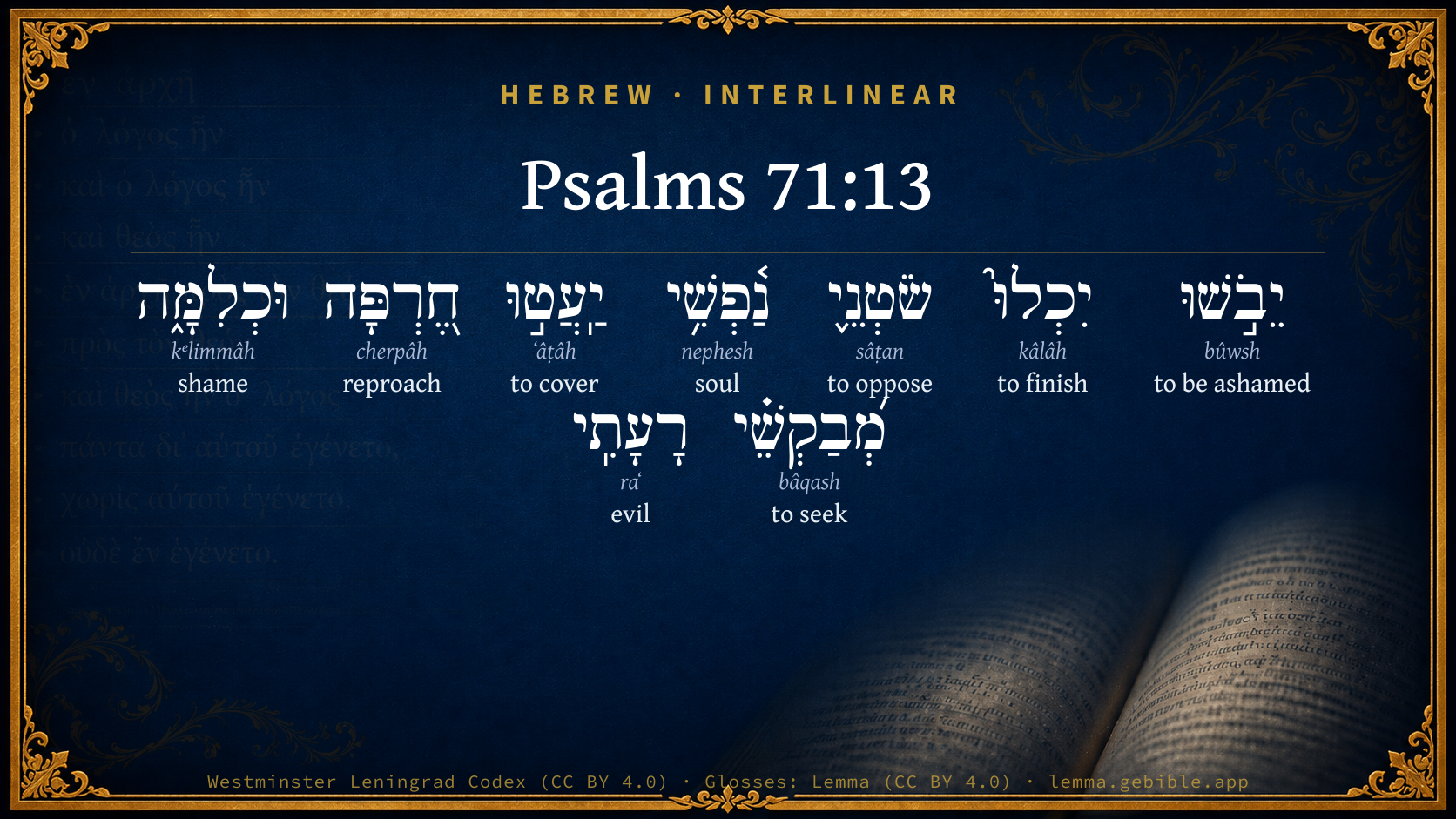
Hebrew (Westminster Leningrad Codex) Psalms 71:13 appears in the Hebrew Old Testament. The text above is from the Westminster Leningrad Codex. Each word links to its Strong’s number, a concise gloss, and parsing drawn from the Open Scriptures Hebrew Bible morphology. Click any word for its full Brown-Driver-Briggs (BDB) entry.
Download image
Cite this verse

Psalms 71:13 (World English Bible). Public Domain. Lemma interlinear Bible study tool, https://lemma.gebible.app/v/psalms/71/13.

Show BibTeX & RIS
BibTeX
RIS
English Translation
Let my accusers be disappointed and consumed. Let them be covered with disgrace and scorn who want to harm me.
World English Bible · Public Domain
Download a study sheet

One document with this verse’s original text, its word-by-word gloss line, the meaning frame, cross-references with their text, attributed commentary, and full source and license credits — printable, and it pastes into notes with its structure intact.

This verse Autodidact and up

Study sheet (.html) Plain text (.txt)

A passage Seminary Student

Up to 50 verses in one chapter. A passage sheet keeps up to 6 commentary sources and 12 cross-references per verse, in the order this page ranks them, and says so on the sheet whenever that leaves anything out. Ask for a single verse and you get the Autodidact verse sheet above.

Everything on this page stays free to read, with no account — the sheet is a download of what is already on screen, not access to it.

Want to remove ads? Support Godless Engineer
Compare translations 3

The same verse in 3 English versions, stacked beneath the original-language interlinear above. Click any original word for its lexicon entry.

Each is an independent rendering of the whole verse — the interlinear is not word-aligned to these translations.

Highlighted words mark where these versions differ — a whole-verse word diff, not a word-by-word alignment.

  • World English Bible Public Domain
    Let my accusers be disappointed and consumed. Let them be covered with disgrace and scorn who want to harm me.
  • King James Version Public Domain
    Let them be confounded and consumed that are adversaries to my soul; let them be covered with reproach and dishonour that seek my hurt.
  • unfoldingWord Literal Text CC BY-SA 4.0
    Let them shame and finish, the adversaries of my life; let them cover reproach and disgrace, the ones seeking my harm.

unfoldingWord Literal Text — © unfoldingWord, licensed CC BY-SA 4.0. Word-aligned USFM3 via Door43 (git.door43.org/unfoldingWord/en_ult).

Versions to compare (up to 4)

3 of 4 selected

Show all 18 translations

Every available English version of this verse, each an independent rendering of the whole verse.

  • World English Bible Public Domain
    Let my accusers be disappointed and consumed. Let them be covered with disgrace and scorn who want to harm me.
  • Berean Standard Bible Public Domain
    May the accusers of my soul be ashamed and consumed; may those who seek my harm be covered with scorn and disgrace.
  • Majority Standard Bible Public Domain
    May the accusers of my soul be ashamed and consumed; may those who seek my harm be covered with scorn and disgrace.
  • King James Version Public Domain
    Let them be confounded and consumed that are adversaries to my soul; let them be covered with reproach and dishonour that seek my hurt.
  • American Standard Version (1901) Public Domain
    Let them be put to shame `and' consumed that are adversaries to my soul; Let them be covered with reproach and dishonor that seek my hurt.
  • Revised Version (1885) Public Domain
    Let them be ashamed and consumed that are adversaries to my soul; let them be covered with reproach and dishonour that seek my hurt.
  • Geneva Bible (1599) Public Domain
    Let them be confounded and consumed that are against my soule: let them be couered with reproofe and confusion, that seeke mine hurt.
  • Douay-Rheims (1899) Public Domain
    Let them be confounded and come to nothing that detract my soul; let them be covered with confusion and shame that seek my hurt.
  • Young's Literal Translation Public Domain
    They are ashamed, they are consumed, Who are opposing my soul, They are covered `with' reproach and blushing, Who are seeking my evil,
  • Literal Standard Version CC BY-SA 4.0
    They are ashamed, they are consumed, || Who are opposing my soul, || They are covered [with] reproach and blushing, || Who are seeking my evil,
  • Unlocked Literal Bible CC BY-SA 4.0
    Let them be put to shame and destroyed, those who are hostile to my life; let them be covered with rebuke and dishonor, those who seek my hurt.
  • unfoldingWord Literal Text CC BY-SA 4.0
    Let them shame and finish, the adversaries of my life; let them cover reproach and disgrace, the ones seeking my harm.
  • Darby Bible Public Domain
    Let them be ashamed, let them be consumed, that are adversaries to my soul; let them be covered with reproach and dishonour that seek my hurt.
  • World Messianic Bible Public Domain
    Let my accusers be disappointed and consumed. Let them be covered with disgrace and scorn who want to harm me.
  • Webster's Bible Public Domain
    Let them be confounded and consumed that are adversaries to my soul; let them be covered with reproach and dishonor that seek my hurt.
  • Free Bible Version CC BY-SA 4.0
    Defeat my accusers, get rid of them! May those who want to cause me trouble be covered with shame and disgrace!
  • Bible in Basic English Public Domain
    Let those who say evil against my soul be overcome and put to shame; let my haters be made low and have no honour.
  • JPS Tanakh (1917) Public Domain
    Let them be ashamed and consumed that are adversaries to my soul; let them be covered with reproach and confusion that seek my hurt.

Literal Standard Version (2020), Covenant Press — licensed CC BY-SA 4.0. Text via the HelloAO Bible API (eBible.org). Unlocked Literal Bible (unfoldingWord) — licensed CC BY-SA 4.0. Text via the HelloAO Bible API (eBible.org). unfoldingWord Literal Text — © unfoldingWord, licensed CC BY-SA 4.0. Word-aligned USFM3 via Door43 (git.door43.org/unfoldingWord/en_ult). Free Bible Version, Dr. Jonathan Gallagher — licensed CC BY-SA 4.0. Text via the HelloAO Bible API (eBible.org).

Word by word

More ways to search: Search by grammar → Find every occurrence → Compare this word →

Practice this passage: Drill this verse → Learn its vocabulary →

שֹׂטְנֵ֪י
sâṭan
H7853
“opposing”
Verb, Qal, Participle Active, Masculine, Plural, Construct
Part of Speech
Verb
Stem
Qal
Form
Participle Active
Gender
Masculine
Number
Plural
State
Construct
Full BDB Definition

Origin: a primitive root

TWOT: 2252

(Qal) to be or act as an adversary, resist, oppose
  1. יֵבֹ֣שׁוּ bûwsh H954 “to be ashamed” Verb, Qal, Imperfect, 3rd Person, Masculine, Plural
  2. יִכְלוּ֮ kâlâh H3615 “to finish” Verb, Qal, Imperfect, 3rd Person, Masculine, Plural
  3. נַ֫פְשִׁ֥י nephesh H5315 “soul · my” Noun, Common, Both, Singular, Construct + Suffix, Personal, 1st Person, Common, Singular
  4. יַֽעֲט֣וּ ʻâṭâh H5844 “to cover” Verb, Qal, Imperfect, 3rd Person, Masculine, Plural
  5. חֶ֭רְפָּה cherpâh H2781 “reproach” Noun, Common, Feminine, Singular, Absolute
  6. וּכְלִמָּ֑ה kᵉlimmâh H3639 “and · shame” Conjunction + Noun, Common, Feminine, Singular, Absolute
  7. מְ֝בַקְשֵׁ֗י bâqash H1245 “seeking” Verb, Piel, Participle Active, Masculine, Plural, Construct
  8. רָעָתִֽי raʻ H7451 “evil · my” Noun, Common, Feminine, Singular, Construct + Suffix, Personal, 1st Person, Common, Singular

About this verse

These counts appear in no published source. They are computed here, from the morphology-tagged text and Lemma’s own curated glosses. What Lemma adds →

9
words
9
distinct lemmas
Wisdom
section

Notable vocabulary

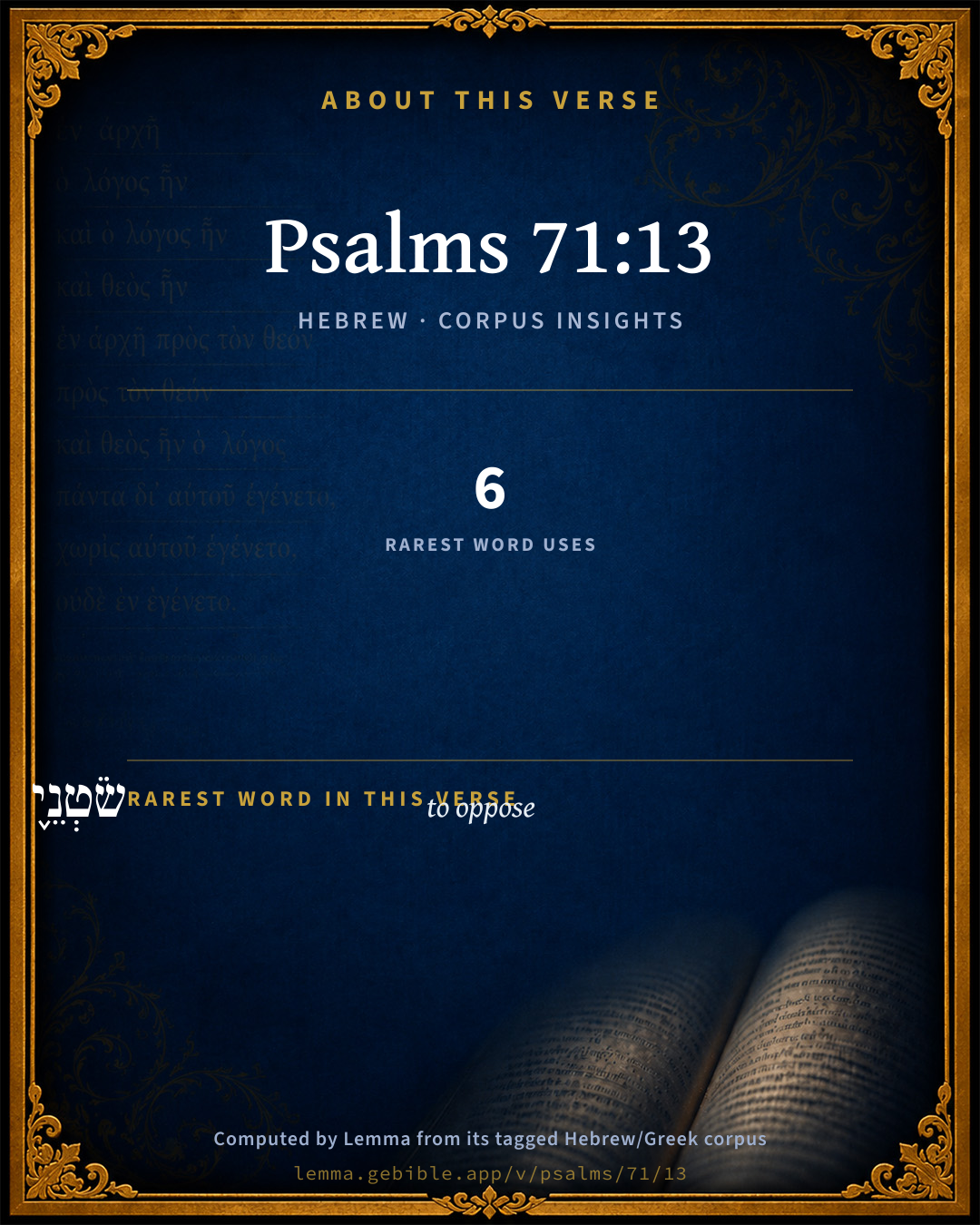
The rarest word here is שֹׂטְנֵ֪י to oppose H7853 — appearing just 6 times in the whole Hebrew Bible.

Shared distinctive vocabulary

שֹׂטְנֵ֪י to oppose H7853 occurs in 6 verses of the Hebrew Bible. Also found in:

Grammatical profile

  • 5 verbs
  • 4 nouns

Verb forms

  • יֵבֹ֣שׁוּ Qal · Imperfect
  • יִכְלוּ֮ Qal · Imperfect
  • שֹׂטְנֵ֪י Qal · Participle Active
  • יַֽעֲט֣וּ Qal · Imperfect
  • מְ֝בַקְשֵׁ֗י Piel · Participle Active

Hebrew & Septuagint length

In English translation the verse runs 20 words from the Hebrew and 24 from the Septuagint (LXX English) — closely comparable.

A rough comparison of the two English renderings, which tokenize alike — not a word-level alignment.

Word counts can differ between the Hebrew and the Greek without any difference in meaning — e.g. the Hebrew direct-object marker אֵת has no separate Greek word, and Greek often adds the article ὁ.

Cross-references

11

Topical passages linked to Psalms 71:13 in the Treasury of Scripture Knowledge — connected by theme and wording, ordered by reader-vote popularity; previews shown in the World English Bible.

  • Jeremiah 20:11 But Yahweh is with me as an awesome mighty one: therefore my persecutors shall stumble, and they shall not prevail; they shall be utterly disappointed, because they have not dealt wisely, even with an everlasting dishonor which shall never be forgotten.
  • Psalms 71:24 My tongue will also talk about your righteousness all day long, For they are disappointed, and they are confounded, who want to harm me.
  • Psalms 109:29 Let my adversaries be clothed with dishonor. Let them cover themselves with their own shame as with a robe.
  • Psalms 35:4 Let those who seek after my soul be disappointed and brought to dishonor. Let those who plot my ruin be turned back and confounded.
  • Psalms 35:26 Let them be disappointed and confounded together who rejoice at my calamity. Let them be clothed with shame and dishonor who magnify themselves against me.
  • Isaiah 41:11 Behold, all those who are incensed against you shall be disappointed and confounded: those who strive with you shall be as nothing, and shall perish.
  • Psalms 6:10 May all my enemies be ashamed and dismayed. They shall turn back, they shall be disgraced suddenly.
  • Psalms 40:14–15 Let them be disappointed and confounded together who seek after my soul to destroy it. Let them be turned backward and brought to dishonor who delight in my hurt.
  • Psalms 132:18 I will clothe his enemies with shame, But on himself, his crown will be resplendant."
  • 1 Peter 5:5 Likewise, you younger ones, be subject to the elder. Yes, all of you gird yourselves with humility, to subject yourselves to one another; for "God resists the proud, but gives grace to the humble."
  • Esther 9:2 the Jews gathered themselves together in their cities throughout all the provinces of the king Ahasuerus, to lay hand on such as sought their hurt: and no man could withstand them; for the fear of them was fallen on all the peoples.

Cross-references courtesy of OpenBible.info (CC BY 4.0).

Hebrew and Greek witnesses Masoretic Hebrew ↔ Greek Septuagint

The same verse in the two great witnesses to the Old Testament, shown verse-for-verse.

You’re reading Greek Psalm 70 (Hebrew Psalm 71). The Septuagint counts the superscription, so verse numbers can differ from the Hebrew — chapter-level alignment, not verse-by-verse. Numbering follows Rahlfs.

These are two independent witnesses, not word-aligned to each other, and the Septuagint is shown in lemma (dictionary) form.

Hebrew Psalms 71:13 Masoretic · Westminster Leningrad Codex

יֵבֹ֣שׁוּ יִכְלוּ֮ שֹׂטְנֵ֪י נַ֫פְשִׁ֥י יַֽעֲט֣וּ חֶ֭רְפָּה וּכְלִמָּ֑ה מְ֝בַקְשֵׁ֗י רָעָתִֽי

Let my accusers be disappointed and consumed. Let them be covered with disgrace and scorn who want to harm me.

World English Bible · Public Domain

Greek LXX Greek Psalm 70:13 Septuagint · lemma form

αἰσχύνω καί ἐκλείπω ὁ ἐν διαβάλλω ὁ ψυχή ἐγώ περιβάλλω αἰσχύνη καί ἐντροπή ὁ ζητέω ὁ κακός ἐγώ

Let those that plot against my soul be ashamed and utterly fail: let those that seek my hurt be clothed with shame and dishonor.

LXX2012 (modern English Septuagint) · Public Domain

On this verse, Keil & Delitzsch discusses the Septuagint’s reading. Read the note in Commentary ↓

Hebrew: Westminster Leningrad Codex (CC BY 4.0). Greek: Septuagint (public domain); English from LXX2012 (modern English Septuagint) (Public Domain). How the Septuagint differs from the Hebrew →

Commentary

Notes on Psalms 71:13 from classic Christian and Jewish commentators (each source and its license shown beneath its notes). The classic Christian expositions comment on the surrounding passage and are grouped to its opening verse, so a note may address several verses; the Jewish commentaries on the Tanakh (Rashi and others) are per-verse, so they appear only where the commentator wrote on this verse.

Lemma curates 59 commentaries, every one of them public domain or Creative Commons licensed, each selected and text-cleaned for this edition rather than reprinted as found. About our sources →

Trapp's Complete Commentary

John Trapp

Psa 71:13 Let them be confounded [and] consumed that are adversaries to my soul; let them be covered [with] reproach and dishonour that seek my hurt.

Ver. 13. Let them be confounded and consumed] Here he beginneth diris devovere, to devote his foes to destruction, who soon also found that these were not bruta fulmina, as the pope’s bulls are (wittily compared by one to a fool’s dagger, rattling and snapping without an edge), but that there was an energy in them, though haply not felt for present; and that they had better have angered all the witches in the country than occasioned David thus to curse them in the name of the Lord.

John Trapp, A Commentary or Exposition upon All the Books of the Old and New Testament (1647–1656) — public domain. Text from a community e-Sword module.

The Treasury of David

Charles H. Spurgeon

Ver. 13. Let them be confounded and consumed that are adversaries to my soul. It will be all this to them to see thy servant preserved; their envy and malice, when disappointed, will fill them with life consuming bitterness. The defeat of their plans shall nonplus them, they shall be confounded as they enquire the reason for their overthrow; the men they seek to destroy seem so weak, and their cause so contemptible, that they will be filled with amazement as they see them not only survive all opposition, but even surmount it. How confounded must Pharaoh have been when Israel multiplied, despite his endeavours to exterminate the race; and how consumed with rage must the Scribes and Pharisees have become when they saw the gospel spreading from land to land by the very means which they used for its destruction.

Let them be covered with reproach and dishonour that seek my hurt. He would have their shame made visible to all eyes, by their wearing it in their blushes as a mantle. They would have made a laughing stock of the believer, if his God had forsaken him; therefore, let unbelief and atheism be made a public scoffing in their persons.

Ver. 13. Let them be confounded, etc. Let them, who were so wicked that they never hoped anything good of me, be confounded by the evidence of the blessings which manifestly fall upon me; and, let them fail, the grounds of their abuse being taken away, as a fire fails when the fagots are removed. Gerhohus.

Ver. 13. Let them be confounded, etc. By the law of retaliation (talio), he might have said: "Be thou an adversary to their souls, and seek their hurt." Nothing of this is hinted at: his only desire is that they may be confounded and fail, that they may be covered with disgrace and shame. He seeks nothing beyond the frustration of their attempts, that they may begin to be ashamed, and have no cause for boasting that they came off victorious. Musculus.

Ver. 13. Shame ariseth from utter disappointments. If hope deferred causeth shame, then much more hope destroyed. When a man sees his hopes quite cut off, so that he can no way reach the thing he looked for, shame takes hold of him strongly. Joseph Caryl.

Ver. 13. That are adversaries to my soul. That hated him with a diabolical hatred, as the devil hates the souls of men, and who has his name Satan from the word here used. All wicked men are Satans, full of enmity against God and all good men; and such were David's enemies, spiteful and malicious, and nothing would satisfy them but his life. John Gill.

Ver. 13-14.

I. What the wicked gain by opposing the righteous:

Let them, etc. Ps 71:13.

II. What the righteous gain from being opposed by them,

Ps 71:14: But I, etc.

Psalms 71:14*

Ver. 13-14.

I. What the wicked gain by opposing the righteous:

Let them, etc. Ps 71:13.

II. What the righteous gain from being opposed by them,

Ps 71:14: But I, etc.

Charles H. Spurgeon's The Treasury of David (1869–1885) — public domain. Psalms only. Text from a community e-Sword/MySword module.

Keil & Delitzsch

C. F. Keil & F. Delitzsch

In view of Psa 40:15 (Psa 70:3), Psa 35:4, Psa 35:26; Psa 109:29, and other passages, the reading of יכּלמוּ, with the Syriac, instead of יכלוּ in Psa 71:13 commends itself; but there are also other instances in this Psalm of a modification of the original passages, and the course of the thoughts is now climactic: confusion, ruin (cf. Ps 6:11), and in fact ruin accompanied by reproach and shame. This is the fate that the poet desires for his deadly foes. In prospect of this he patiently composes himself, Psa 71:14 (cf. 31:25); and when righteous retribution appears, he will find new matter and ground and motive for the praise of God in addition to all such occasion as he has hitherto had. The late origin of the Psalm betrays itself again here; for instead of the praet. Hiph. הוסיף (which is found only in the Books of Kings and in Ecclesiastes), the older language made use of the praet. Ka. Without ceasing shall his mouth tell (ספּר, as in Jer 51:10) of God's righteousness, of God's salvation for he knows not numbers, i.e., the counting over or through of them (Psa 139:17.);

(Note: The lxx renders οὐκ ἔγνων πραγματείας; the Psalterium Romanum, non cognovi negotiationes; Psalt. Gallicum (Vulgate), non cognovi literaturam (instead of which the Psalt. Hebr., literaturas). According to Bttcher, the poet really means that he did not understand the art of writing.)

the divine proofs of righteousness or salvation עצמוּ מסּפּר (Psa 40:6), they are in themselves endless, and therefore the matter also which they furnish for praise is inexhaustible. He will tell those things which cannot be so reckoned up; he will come with the mighty deeds of the Lord Jahve, and with praise acknowledge His righteousness, Him alone. Since גּברות, like the New Testament δυνάμεις, usually signifies the proofs of the divine גּבוּרה (e.g., Psa 20:7), the Beth is the Beth of accompaniment, as e.g., in Psa 40:8; Psa 66:13. בּוא בּ, vernire cum, is like Arab. j'â' b (atâ), equivalent to afferre, he will bring the proofs of the divine power, this rich material, with him. It is evident from Psa 71:18. that בגברות does not refer to the poet (in the fulness of divine strength), but, together with צדקתך, forms a pair of words that have reference to God. לבדּך, according to the sense, joins closely upon the suffix of צדקתך (cf. Ps 83:19): Thy righteousness (which has been in mercy turned towards me), Thine alone (te solum = tui solius). From youth up God has instructed him, viz., in His ways (Psa 25:4), which are worthy of all praise, and hitherto (עד־הנּה, found only in this passage in the Psalter, and elsewhere almost entirely confined to prose) has he, "the taught of Jahve" (למּוּד ה), had to praise the wonders of His rule and of His leadings. May God, then, not forsake him even further on עד־זקנה ושׂיבה. The poet is already old (זקן), and is drawing ever nearer to שׂיבה, silvery, hoary old age (cf. Sa1 12:2). May God, then, in this stage of life also to which he has attained, preserve him in life and in His favour, until (עד = עד־אשׁר, as in Psa 132:5; Gen 38:11, and frequently) he shall have declared His arm, i.e., His mighty interposition in human history, to posterity (דּור), and to all who shall come (supply אשׁר), i.e., the whole of the future generation, His strength, i.e., the impossibility of thwarting His purposes. The primary passage for this is Psa 22:31.

Keil & Delitzsch — Biblical Commentary on the Old Testament (1861–1891) — public domain (CC PDM 1.0). Text via the HelloAO Bible API. (Old Testament only.)

J. A. Alexander on Psalms

Joseph Addison Alexander

Psa 71:13. They shall be shamed, they shall cease (or be consumed)—the adversaries of my soul; they shall put on (or be clothed with) reproach or disgrace —the seekers of my hurt. The verbs may also be translated as optatives, let them be shamed, &c. But this is really included in the strict sense of the future. Compare the parallel passages, Psa 35:4; Psa 35:26; Psa 40:14; Psa 70:2.

Joseph Addison Alexander, The Psalms Translated and Explained (1850) — public domain. Text from a community e-Sword module.

Adam Clarke's Commentary

Verse 13. Let them be confounded] They shall be confounded: these are prophetic denunciations.

Adam Clarke's Commentary on the Bible (1810–1826) — public domain. Text from a community e-Sword/MySword module.

John Calvin's Commentaries

While invoking the aid of God, he at the same time prays (verse 13) that his enemies may be filled with shame until they be consumed. These words, however, may not improperly be read in the future tense; for it is frequently the practice of David, after having ended his prayer, to rise up against his enemies, and, as it were, to triumph over them. But I have followed that which seems more agreeable to the scope of the passage. Having had occasion elsewhere to explain this imprecation, it is unnecessary for me to repeat, in this place, what I have previously said.

John Calvin's Commentaries (1540-1563) — public domain. Text from the Calvin Translation Society English edition (1840s-50s) via the Christian Classics Ethereal Library (ccel.org). Calvin's coverage is partial (roughly two-thirds of the Bible); uncommented books and verses are honest gaps, never fabricated. The 19th-century editor's footnotes and remarks are omitted so the notes are faithfully Calvin's own voice.

Ellicott's Commentary for English Readers

(13) Hurt.—Literally, evil.

A Bible Commentary for English Readers, edited by Charles John Ellicott (1878–1897) — public domain. Text from a community e-Sword module.

John Gill's Exposition

Let them be confounded,.... See Psa 70:2;

and consumed; like smoke; see Psa 37:20; as antichrist will be with the breath of Christ's mouth, and the brightness of his coming, Th2 2:8;

that are adversaries to my soul; that hated him with a diabolical hatred, as the devil hates the souls of men, and who has his name "Satan" from the word here used; all wicked men are Satans, full of enmity against God, and all good men; and such were David's enemies, spiteful and malicious, and nothing would satisfy them but his life;

let them be covered with reproach and dishonour; as with a garment:

that seek my hurt; see Psa 35:26; as Absalom and his company; so Arama.

John Gill's Exposition of the Whole Bible (1746–1763) — public domain (CC PDM 1.0). Text via the HelloAO Bible API.

Albert Barnes' Notes on the Bible

Let them be confounded and consumed - See the notes at the similar passage in Psa 35:4. The sentiment in this verse is the same; the language is slightly varied. See also Psa 40:14, where the same sentiment occurs.

Albert Barnes' Notes on the Bible (1834–1885) — public domain. Text from a community e-Sword/MySword module.

Whedon's Commentary on the Bible

Daniel D. Whedon

13. Let them be confounded—This, with some variation, forms a refrain with Psa_71:24. This is the language of desire, that of experience—the fulfilment of his prayer.

Daniel D. Whedon (gen. ed.), Commentary on the Old and New Testaments (1874–1909) — public domain. Text from a community e-Sword module.

The Pulpit Commentary

Let them be confounded and consumed that are adversaries to my soul; let them be covered with reproach and dishonour that seek my hurt. (comp. Psa_35:4 Psa_40:14 Psa_70:2)

The Pulpit Commentary (1880–1919), ed. H.D.M. Spence-Jones & Joseph S. Exell — public domain. Text from a community e-Sword module.

Kretzmann's Popular Commentary

Paul E. Kretzmann

Warning and Thanksgiving

v. 13. Let them be confounded and consumed, heaped with disgrace and delivered to utter ruin, that are adversaries to my soul; let them be covered, completely enveloped, with reproach and dishonor that seek my hurt, endeavoring to carry their wickedness into practise at every opportunity.

v. 14. But I, in spite of such wicked counsels, will hope continually and will yet praise Thee more and more, knowing that there will be further occasion for expressing his thanksgiving.

v. 15. My mouth shall show forth Thy righteousness and Thy salvation all the day, v. 2. for I know not the numbers thereof; the manifestations of God’s attributes are so innumerable that one cannot keep count, and therefore the material for the praise of God is inexhaustible.

v. 16. I will go in the strength of the Lord God, come forward with His mighty deeds, try to perform the impossible in enumerating them; I will make mention of Thy righteousness, even of Thine only, joyfully confessing it everywhere and upon all occasions.

v. 17. O God, Thou hast taught me from my youth, namely, in His ways, as they agree with His holy will; and hitherto have I declared Thy wondrous works, namely, of the guidance of God in his whole life.

v. 18. Now also, when I am old and gray-headed, showing the effects of old age in his appearance, O God, forsake me not, until I have showed Thy strength, the arm of the Lord, as the symbol of His almighty power and deeds, unto this generation and Thy power to every one that is to come, publishing the mighty works of Jehovah to all whom his voice may reach.

v. 19. Thy righteousness also, O God, is very high, reaching even to the height of heaven, the highest point of creation, who hast done great things, which the psalmist feels constrained to proclaim even now. O God, who is like unto Thee? The God of Israel, the supreme God, is exalted in righteousness and might over all the universe.

v. 20. Thou, which hast showed me great and sore troubles, by having him see and experience affliction and tribulation, shalt quicken me again, rather, "revive us again," for the poet now includes the entire congregation in his hymn of praise, and shalt bring me up again from the depths of the earth, the abysses of earth standing for threatening ruin.

v. 21. Thou shalt increase my greatness, the prominence and authority of the psalmist’s office in the kingdom, and comfort me on every side, chiefly by justifying him before the enemies.

v. 22. I will also praise Thee with the psaltery, the lutelike instrument used to accompany singing, even Thy truth, O my God, the faithfulness with which the Lord keeps His promises; unto Thee will I sing with the harp, with the zither of David, O Thou Holy One of Israel.

v. 23. My lips shall greatly rejoice when I sing unto Thee, composing and declaiming psalms in His honor; and my soul, which Thou hast redeemed, the deliverance from the troubles of this present life being the believer’s guarantee of his final redemption.

v. 24. My tongue also shall talk of Thy righteousness all the day long, v. 15; for they are confounded, for they are brought unto shame, that seek my hurt. That is the proper spirit of prayer, to anticipate the Lord’s favorable answer and to praise Him in advance for all His blessings.

Paul E. Kretzmann, Popular Commentary of the Bible (1921–1924) — public domain. Text from a community e-Sword module.

Lesson kit

Teaching starters — assembled from the data on this page, not authored interpretation. Every prompt links to the verse data it draws on. Edit before teaching.

Psalms, in the Wisdom, opens this verse with 9 words (9 distinct Hebrew lemmas). Its most distinctive word is sâṭan (“to oppose”). A historical commentator’s framing appears above. Read the whole chapter for the surrounding context.

Discussion questions

  1. What does “to oppose” (sâṭan) contribute to the verse as a whole?
  2. Psalms 38:20 shares the word «to oppose» with this verse. How do the two illuminate each other?
  3. The translations on this page render this verse differently — a whole-verse word diff, not a word-by-word alignment. What might account for the different wordings?
  4. The verb «יֵבֹ֣שׁוּ» is Qal Imperfect. How does its form color the action?
  5. Reading how Trapp's Complete Commentary and The Treasury of David read this verse, where do the two commentators agree and where do they part?

Things to notice

Reading settings

Reading text

Shown beneath each verse's original-language words.

Old Testament
Old Testament edition

Read the OT as the Masoretic Hebrew (MT) or the Greek Septuagint (LXX).

English shown for the Greek Septuagint (in the Hebrew ↔ Greek comparison).

Comparing translations? Open the Compare panel on any verse page to stack up to four side by side.