Ezekiel 13:15

Hebrew (Westminster Leningrad Codex) Ezekiel 13:15 appears in the Hebrew Old Testament. The text above is from the Westminster Leningrad Codex. Each word links to its Strong’s number, a concise gloss, and parsing drawn from the Open Scriptures Hebrew Bible morphology. Click any word for its full Brown-Driver-Briggs (BDB) entry.
Download image
Cite this verse

Ezekiel 13:15 (World English Bible). Public Domain. Lemma interlinear Bible study tool, https://lemma.gebible.app/v/ezekiel/13/15.

Show BibTeX & RIS
BibTeX
RIS
English Translation
Thus will I accomplish my wrath on the wall, and on those who have daubed it with whitewash; and I will tell you, The wall is no more, neither those who daubed it;
World English Bible · Public Domain
Download a study sheet

One document with this verse’s original text, its word-by-word gloss line, the meaning frame, cross-references with their text, attributed commentary, and full source and license credits — printable, and it pastes into notes with its structure intact.

This verse Autodidact and up

Study sheet (.html) Plain text (.txt)

A passage Seminary Student

Up to 50 verses in one chapter. A passage sheet keeps up to 6 commentary sources and 12 cross-references per verse, in the order this page ranks them, and says so on the sheet whenever that leaves anything out. Ask for a single verse and you get the Autodidact verse sheet above.

Everything on this page stays free to read, with no account — the sheet is a download of what is already on screen, not access to it.

Want to remove ads? Support Godless Engineer
Compare translations 3

The same verse in 3 English versions, stacked beneath the original-language interlinear above. Click any original word for its lexicon entry.

Each is an independent rendering of the whole verse — the interlinear is not word-aligned to these translations.

Highlighted words mark where these versions differ — a whole-verse word diff, not a word-by-word alignment.

  • World English Bible Public Domain
    Thus will I accomplish my wrath on the wall, and on those who have daubed it with whitewash; and I will tell you, The wall is no more, neither those who daubed it;
  • King James Version Public Domain
    Thus will I accomplish my wrath upon the wall, and upon them that have daubed it with untempered morter, and will say unto you, The wall is no more, neither they that daubed it;
  • unfoldingWord Literal Text CC BY-SA 4.0
    For I will annihilate in my fury the wall and those who whitewashed it. I will say to you, “The wall exists no more, nor do the people who whitewashed it—

unfoldingWord Literal Text — © unfoldingWord, licensed CC BY-SA 4.0. Word-aligned USFM3 via Door43 (git.door43.org/unfoldingWord/en_ult).

Versions to compare (up to 4)

3 of 4 selected

Show all 18 translations

Every available English version of this verse, each an independent rendering of the whole verse.

  • World English Bible Public Domain
    Thus will I accomplish my wrath on the wall, and on those who have daubed it with whitewash; and I will tell you, The wall is no more, neither those who daubed it;
  • Berean Standard Bible Public Domain
    And after I have vented My wrath against the wall and against those who whitewashed it, I will say to you: ‘The wall is gone, and so are those who whitewashed it—
  • Majority Standard Bible Public Domain
    And after I have vented My wrath against the wall and against those who whitewashed it, I will say to you: ‘The wall is gone, and so are those who whitewashed it—
  • King James Version Public Domain
    Thus will I accomplish my wrath upon the wall, and upon them that have daubed it with untempered morter, and will say unto you, The wall is no more, neither they that daubed it;
  • American Standard Version (1901) Public Domain
    Thus will I accomplish my wrath upon the wall, and upon them that have daubed it with untempered `mortar'; and I will say unto you, The wall is no more, neither they that daubed it;
  • Revised Version (1885) Public Domain
    Thus will I accomplish my fury upon the wall, and upon them that have daubed it with untempered mortar; and I will say unto you, The wall is no more, neither they that daubed it;
  • Geneva Bible (1599) Public Domain
    Thus will I accomplish my wrath vpon the wall, and vpon them that haue daubed it with vntempered morter, and will say vnto you, The wall is no more, neither the daubers thereof,
  • Douay-Rheims (1899) Public Domain
    And I will accomplish my wrath upon the wall, and upon them that daub it without tempering the mortar, and I will say to you: The wall is no more, and they that daub it are no more.
  • Young's Literal Translation Public Domain
    And I have completed My wrath on the wall, And on those daubing it with chalk, And I say to you: The wall is not, And those daubing it are not;
  • Literal Standard Version CC BY-SA 4.0
    And I have completed My wrath on the wall, || And on those coating it with chalk, || And I say to you: The wall is not, || And those coating it are not,
  • Unlocked Literal Bible CC BY-SA 4.0
    For I will annihilate in my fury the wall and those who whitewashed it. I will say to you, “The wall exists no more, nor do the people who whitewashed it—
  • unfoldingWord Literal Text CC BY-SA 4.0
    For I will annihilate in my fury the wall and those who whitewashed it. I will say to you, “The wall exists no more, nor do the people who whitewashed it—
  • Darby Bible Public Domain
    And I will accomplish my fury upon the wall, and upon them that daub it with untempered [mortar], and will say unto you, The wall is no [more], neither they that daubed it,
  • World Messianic Bible Public Domain
    Thus I will accomplish my wrath on the wall, and on those who have plastered it with whitewash. I will tell you, ‘The wall is no more, nor those who plastered it—
  • Webster's Bible Public Domain
    Thus will I accomplish my wrath upon the wall, and upon them that have daubed it with untempered mortar, and will say to you, The wall is no more, neither they that daubed it;
  • Free Bible Version CC BY-SA 4.0
    Once the wall and those who whitewashed it have experienced my anger, I will tell you: The wall is no more, and those who whitewashed it are no more,
  • Bible in Basic English Public Domain
    So I will let loose my passion on the wall in full measure, and on those who put whitewash on it; and I will say to you, Where is the wall, and where are those who put whitewash on it?
  • JPS Tanakh (1917) Public Domain
    Thus will I spend My fury upon the wall, and upon them that have daubed it with whited plaster; and I will say unto you: The wall is no more, neither they that daubed it;

Literal Standard Version (2020), Covenant Press — licensed CC BY-SA 4.0. Text via the HelloAO Bible API (eBible.org). Unlocked Literal Bible (unfoldingWord) — licensed CC BY-SA 4.0. Text via the HelloAO Bible API (eBible.org). unfoldingWord Literal Text — © unfoldingWord, licensed CC BY-SA 4.0. Word-aligned USFM3 via Door43 (git.door43.org/unfoldingWord/en_ult). Free Bible Version, Dr. Jonathan Gallagher — licensed CC BY-SA 4.0. Text via the HelloAO Bible API (eBible.org).

Word by word

More ways to search: Search by grammar → Find every occurrence → Compare this word →

Practice this passage: Drill this verse → Learn its vocabulary →

תָּפֵ֑ל
tâphêl
H8602
“tasteless”
Noun, Common, Masculine, Singular, Absolute
Part of Speech
Noun
Type
Common
Gender
Masculine
Number
Singular
State
Absolute
Full BDB Definition

Origin: from an unused root meaning to smear

TWOT: 2534a , 2535a

foolish, insipid (adjective) - (BDB) tasteless, unseasoned (adjective) - whitewash (noun masculine) - meaning uncertain
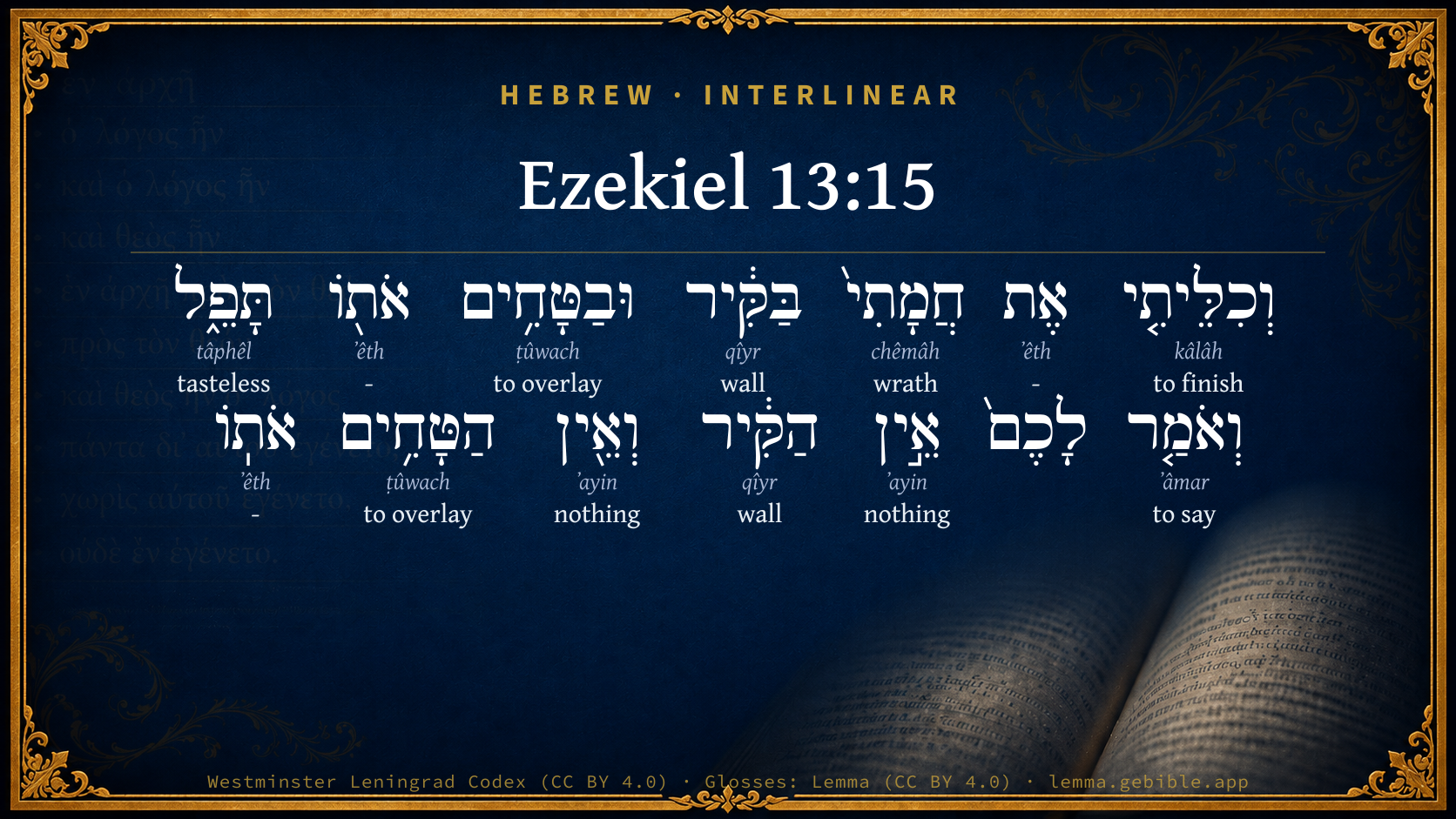
  1. וְכִלֵּיתִ֤י kâlâh H3615 “and · to finish” Conjunction + Verb, Piel, Sequential Perfect, 1st Person, Common, Singular
  2. אֶת ʼêth H853 “-” Particle, Direct Object
  3. חֲמָתִי֙ chêmâh H2534 “wrath · my” Noun, Common, Feminine, Singular, Construct + Suffix, Personal, 1st Person, Common, Singular
  4. בַּקִּ֔יר qîyr H7023 “in/at the · wall” Preposition, Determined + Noun, Common, Masculine, Singular, Absolute
  5. וּבַטָּחִ֥ים ṭûwach H2902 “and · in/at the · overlaying” Conjunction + Preposition, Determined + Verb, Qal, Participle Active, Masculine, Plural, Absolute
  6. אֹת֖וֹ ʼêth H853 “- · him” Particle, Direct Object + Suffix, Personal, 3rd Person, Masculine, Singular
  7. וְאֹמַ֤ר ʼâmar H559 “and · to say” Conjunction + Verb, Qal, Imperfect, 1st Person, Common, Singular
  8. אֵ֣ין ʼayin H369 “nothing” Particle, Negative
  9. הַקִּ֔יר qîyr H7023 “the · wall” Particle, Definite Article + Noun, Common, Masculine, Singular, Absolute
  10. וְאֵ֖ין ʼayin H369 “and · nothing” Conjunction + Particle, Negative
  11. הַטָּחִ֥ים ṭûwach H2902 “the · overlaying” Particle, Definite Article + Verb, Qal, Participle Active, Masculine, Plural, Absolute
  12. אֹתֽוֹ ʼêth H853 “- · him” Particle, Direct Object + Suffix, Personal, 3rd Person, Masculine, Singular

About this verse

These counts appear in no published source. They are computed here, from the morphology-tagged text and Lemma’s own curated glosses. What Lemma adds →

14
words
8
distinct lemmas
Prophets
section

Notable vocabulary

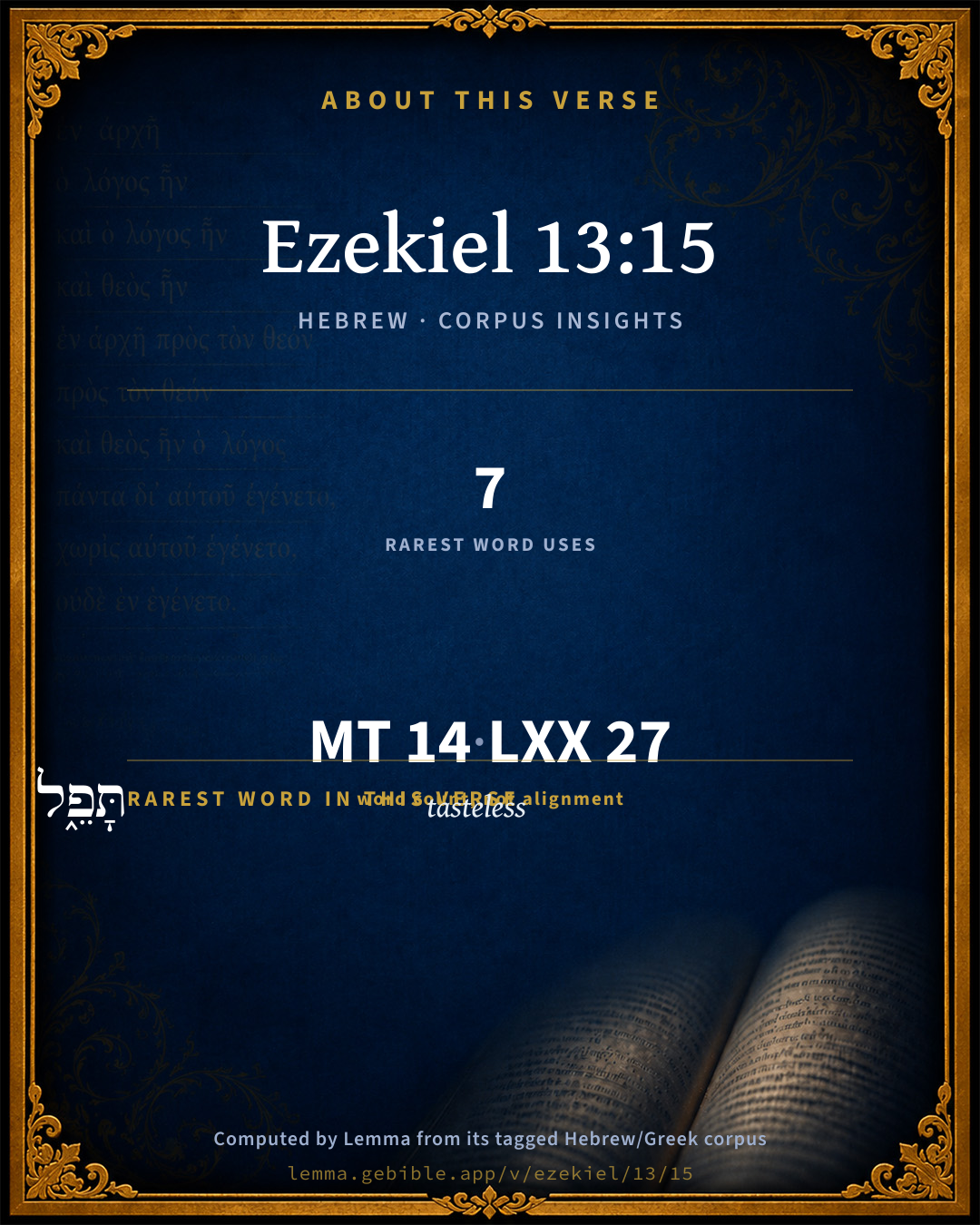
The rarest word here is תָּפֵ֑ל tasteless H8602 — appearing just 7 times in the whole Hebrew Bible.

Shared distinctive vocabulary

תָּפֵ֑ל tasteless H8602 occurs in 7 verses of the Hebrew Bible. Also found in:

Grammatical profile

  • 4 verbs
  • 4 nouns
  • 1 preposition
  • 5 particles

Verb forms

  • וְכִלֵּיתִ֤י Piel · Sequential Perfect
  • וּבַטָּחִ֥ים Qal · Participle Active
  • וְאֹמַ֤ר Qal · Imperfect
  • הַטָּחִ֥ים Qal · Participle Active

Repetition

Words recur within this verse — often emphatic in Hebrew:

  • בַּקִּ֔יר wall H7023 ×2
  • וּבַטָּחִ֥ים to overlay H2902 ×2
  • אֵ֣ין nothing H369 ×2

Hebrew & Septuagint length

In English translation the verse runs 33 words from the Hebrew and 32 from the Septuagint (LXX English) — closely comparable.

A rough comparison of the two English renderings, which tokenize alike — not a word-level alignment.

Word counts can differ between the Hebrew and the Greek without any difference in meaning — e.g. the Hebrew direct-object marker אֵת has no separate Greek word, and Greek often adds the article ὁ.

In the original languages it is 14 Hebrew tokens and 27 Greek tokens — but the two are counted differently (Hebrew bundles its prefixes and suffixes into one token; the Greek is in lemma form), so that isn’t a like-for-like length.

Cross-references

3

Topical passages linked to Ezekiel 13:15 in the Treasury of Scripture Knowledge — connected by theme and wording, ordered by reader-vote popularity; previews shown in the World English Bible.

  • Nehemiah 4:3 Now Tobiah the Ammonite was by him, and he said, Even that which they are building, if a fox go up, he shall break down their stone wall.
  • Psalms 62:3 How long will you assault a man, Would all of you throw him down, Like a leaning wall, like a tottering fence?
  • Isaiah 30:13 therefore this iniquity shall be to you as a breach ready to fall, swelling out in a high wall, whose breaking comes suddenly in an instant.

Cross-references courtesy of OpenBible.info (CC BY 4.0).

Hebrew and Greek witnesses Masoretic Hebrew ↔ Greek Septuagint

The same verse in the two great witnesses to the Old Testament, shown verse-for-verse.

These are two independent witnesses, not word-aligned to each other, and the Septuagint is shown in lemma (dictionary) form.

Hebrew Ezekiel 13:15 Masoretic · Westminster Leningrad Codex

וְכִלֵּיתִ֤י אֶת חֲמָתִי֙ בַּקִּ֔יר וּבַטָּחִ֥ים אֹת֖וֹ תָּפֵ֑ל וְאֹמַ֤ר לָכֶם֙ אֵ֣ין הַקִּ֔יר וְאֵ֖ין הַטָּחִ֥ים אֹתֽוֹ

Thus will I accomplish my wrath on the wall, and on those who have daubed it with whitewash; and I will tell you, The wall is no more, neither those who daubed it;

World English Bible · Public Domain

Greek LXX Ezekiel 13:15 Septuagint · lemma form

καί συντελέω ὁ θυμός ἐγώ ἐπί ὁ τοῖχος καί ἐπί ὁ ἀλείφω αὐτός καί πίπτω καί εἶπον πρός σύ οὐ εἰμί ὁ τοῖχος οὐδέ ὁ ἀλείφω αὐτός

And I will accomplish my wrath upon the wall, and upon them that plaster it; it shall fall: and I said to you, The wall is not, nor they that plaster it,

LXX2012 (modern English Septuagint) · Public Domain

Hebrew: Westminster Leningrad Codex (CC BY 4.0). Greek: Septuagint (public domain); English from LXX2012 (modern English Septuagint) (Public Domain). How the Septuagint differs from the Hebrew →

Targum (Aramaic paraphrase)

1

The Targum is the ancient Jewish Aramaic paraphrase of the Hebrew Scriptures — an interpretive translation, not the Hebrew text itself. Onkelos (literal) and Pseudo-Jonathan (expansive) render the Torah, and Jonathan the Prophets. Coverage is partial: where no permissively-licensed English translation exists for a verse, only the Aramaic is shown. This is verse-level text, not a word-by-word alignment to the Hebrew.

  1. Targum Jonathan Prophets (Joshua–Malachi)
    וְיָחוּל רוּגְזִי בְּקַרְתָּא וּבִנְבִיֵי שִׁקְרָא דְאִתְנַבִּיאוּ בָּהּ נְבוּאַן דִשְׁקַר וְיִתְאַמַר לְכוֹן לֵית קַרְתָּא וְלֵית נְבִיֵי שִׁקְרָא:

    (no public-domain English translation for this verse)

    Targum Jonathan — Aramaic: “Mikraot Gedolot” (public domain). English: “Sefaria Community Translation” (CC0 1.0 (public-domain dedication)); “London "Chaldee Paraphrase," 1871” (public domain). Text via Sefaria.

Commentary

Notes on Ezekiel 13:15 from classic Christian and Jewish commentators (each source and its license shown beneath its notes). The classic Christian expositions comment on the surrounding passage and are grouped to its opening verse, so a note may address several verses; the Jewish commentaries on the Tanakh (Rashi and others) are per-verse, so they appear only where the commentator wrote on this verse.

Lemma curates 59 commentaries, every one of them public domain or Creative Commons licensed, each selected and text-cleaned for this edition rather than reprinted as found. About our sources →

Trapp's Complete Commentary

John Trapp

Eze 13:15 Thus will I accomplish my wrath upon the wall, and upon them that have daubed it with untempered [morter], and will say unto you, The wall [is] no [more], neither they that daubed it;

Ver. 15. Thus will I accomplish my wrath.] God’s wrath is dreadful, when let out in little minums only; but when to be accomplished, who can abide or avoid it?

Neither they that daubed it.] It may very well be that some of these cementaries of Satan were slain by the people, when once they saw themselves cheated by them into remediless misery.

John Trapp, A Commentary or Exposition upon All the Books of the Old and New Testament (1647–1656) — public domain. Text from a community e-Sword module.

Geneva Bible (1599)

Geneva Bible translators

Whereby is meant whatsoever man of himself setteth forth under the authority of God’s word.

Geneva Bible (1599) marginal notes — public domain. Text via Bolls.life.

John Calvin's Commentaries

If the inveterate obstinacy of the people had not been known to us, Ezekiel would seem too verbose, since he might have said in a few words what he explains at such length. But if we bear in mind the perverse and refractory disposition of the people, we shall find that there was need of such continual repetition, I will fulfill, says he, my burning wrath upon the wall; that is, I will show how detestable and destructive to my people was this doctrine. Hence God fined up his anger on the wall, when he reduced to nothing all the lies of the false prophets: afterwards also he attacked them, since the mark of disgrace was attached to their characters, and this rendered their doctrine detestable: afterwards, says he, I will say, There is no wall; those who daubed it are not. When God speaks thus, he means that he will suffer the false prophets to triumph among the people for only a short time. For even to the destruction of the city and temple they always withstood God’s servants with a bold forehead, as if they would thrust their horns against God and his announcements. Let us observe, then, that while Jerusalem was standing, the appearance of a wall existed; for there was the prop of false doctrine, and the people fed willingly on such deceits. Their daubing, therefore, stood till it vanished with the ruin of the city, and then their vanity was proved, for God took vengeance on these insolent triflers. It follows —

John Calvin's Commentaries (1540-1563) — public domain. Text from the Calvin Translation Society English edition (1840s-50s) via the Christian Classics Ethereal Library (ccel.org). Calvin's coverage is partial (roughly two-thirds of the Bible); uncommented books and verses are honest gaps, never fabricated. The 19th-century editor's footnotes and remarks are omitted so the notes are faithfully Calvin's own voice.

John Gill's Exposition

Likewise, thou son of man, set thy face against the daughters of thy people,.... The false prophetesses; for as there were women in some ages, who had the true spirit of prophecy, as Miriam, Deborah, and Huldah, Exo 15:20; so there were some that pretended to it, who had it not, as Noadiah in the times of Nehemiah, Neh 6:14; and such there were in the times of Ezekiel; against whom he is bid to set his face, and look them out of countenance, and make them ashamed; who, contrary to the modesty of the sex, had impudently taken upon them to prophesy to the people; and such have been since in the times of the Gospel, as Jezebel, Rev 2:20; and Prisca, Maximilia, Quintilia, and others:

who prophesy out of their own heart; as the men did, Eze 13:2; what their own hearts suggested to them; what came into their minds, and their own fancies and imaginations led them to; what was according to their carnal affections and desires, and agreeable to those that heard them:

and prophesy thou against them; declare their prophecies false; warn the people from giving heed to them; and foretell what shall befall them for deceiving the people.

John Gill's Exposition of the Whole Bible (1746–1763) — public domain (CC PDM 1.0). Text via the HelloAO Bible API.

Matthew Poole's English Annotations

Thus, in this dreadful manner, by my hand visible in doing it,

will I fulfil what my prophets foretold, and perform my word and theirs, and fully pour out my wrath, so that it shall be fully according to the just displeasure they have provoked in me.

Will say unto you; I will deride them in their ruin, as Psa 2:4; Pro 1:26. God curseth confidences in an arm of flesh, and will destroy them, for they are set up in direct opposition to his justice and sovereignty, to his threats and truth of them.

Matthew Poole's English Annotations on the Holy Bible (1683–1685) — public domain. Text from a community e-Sword/MySword module.

Whedon's Commentary on the Bible

Daniel D. Whedon

15. The wall is no more, neither they that daubed it — The sin of the false prophets seems to be greater than that of the people, for some of the people live through this catastrophe, but the false prophets perish in the ruins (Eze_13:14; Amo_9:1).

Daniel D. Whedon (gen. ed.), Commentary on the Old and New Testaments (1874–1909) — public domain. Text from a community e-Sword module.

John Wesley's Explanatory Notes

Accomplish - Fulfil what my prophets foretold.

John Wesley, Explanatory Notes Upon the Whole Bible (1754–1765) — public domain. Text via the GEBible commentary corpus.

unfoldingWord translationNotes

Door43 World Missions Community

General Information:

Yahweh continues to speak of the false security that the prophets have given to the people by speaking of peace as if the prophets had built a poorly-constructed wall and covered it over with white paint in order to make it look good. (See: Metaphor)

I will annihilate in my fury

"Because I am very angry, I will annihilate"

whitewashed it

The word "whitewash" refers to a white liquid mixture or paint used to cover up impurities and make surfaces white. See how you translated this in Ezekiel 13:10.

the prophets of Israel who prophesied about Jerusalem and who had visions of peace for her

This phrase defines who "the people who whitewashed it" are.

visions of peace for her

The word "her" refers to Jerusalem.

translationWords

prophet

Israel

Jerusalem

vision

peace

Lord Yahweh

declare

unfoldingWord translationNotes — © Distant Shores Media and the Door43 World Missions Community, licensed CC BY-SA 4.0. Source: git.door43.org/Door43/en_tn.

Lesson kit

Teaching starters — assembled from the data on this page, not authored interpretation. Every prompt links to the verse data it draws on. Edit before teaching.

Ezekiel, in the Prophets, opens this verse with 14 words (8 distinct Hebrew lemmas). Its most distinctive word is tâphêl (“tasteless”). A historical commentator’s framing appears above. Read the whole chapter for the surrounding context.

Discussion questions

  1. What does “tasteless” (tâphêl) contribute to the verse as a whole?
  2. How does Job 6:6, which shares the word «tasteless», read alongside this verse?
  3. What does the repetition of “wall” (2× in this one verse) do in this verse?
  4. The translations on this page render this verse differently — a whole-verse word diff, not a word-by-word alignment. What might account for the different wordings?
  5. «וְכִלֵּיתִ֤י» is a Piel Sequential Perfect verb. How does that grammatical form shape the action described?
  6. Compare how Trapp's Complete Commentary and Geneva Bible (1599) read this verse. Where do they agree or differ?

Things to notice

Reading settings

Reading text

Shown beneath each verse's original-language words.

Old Testament
Old Testament edition

Read the OT as the Masoretic Hebrew (MT) or the Greek Septuagint (LXX).

English shown for the Greek Septuagint (in the Hebrew ↔ Greek comparison).

Comparing translations? Open the Compare panel on any verse page to stack up to four side by side.