
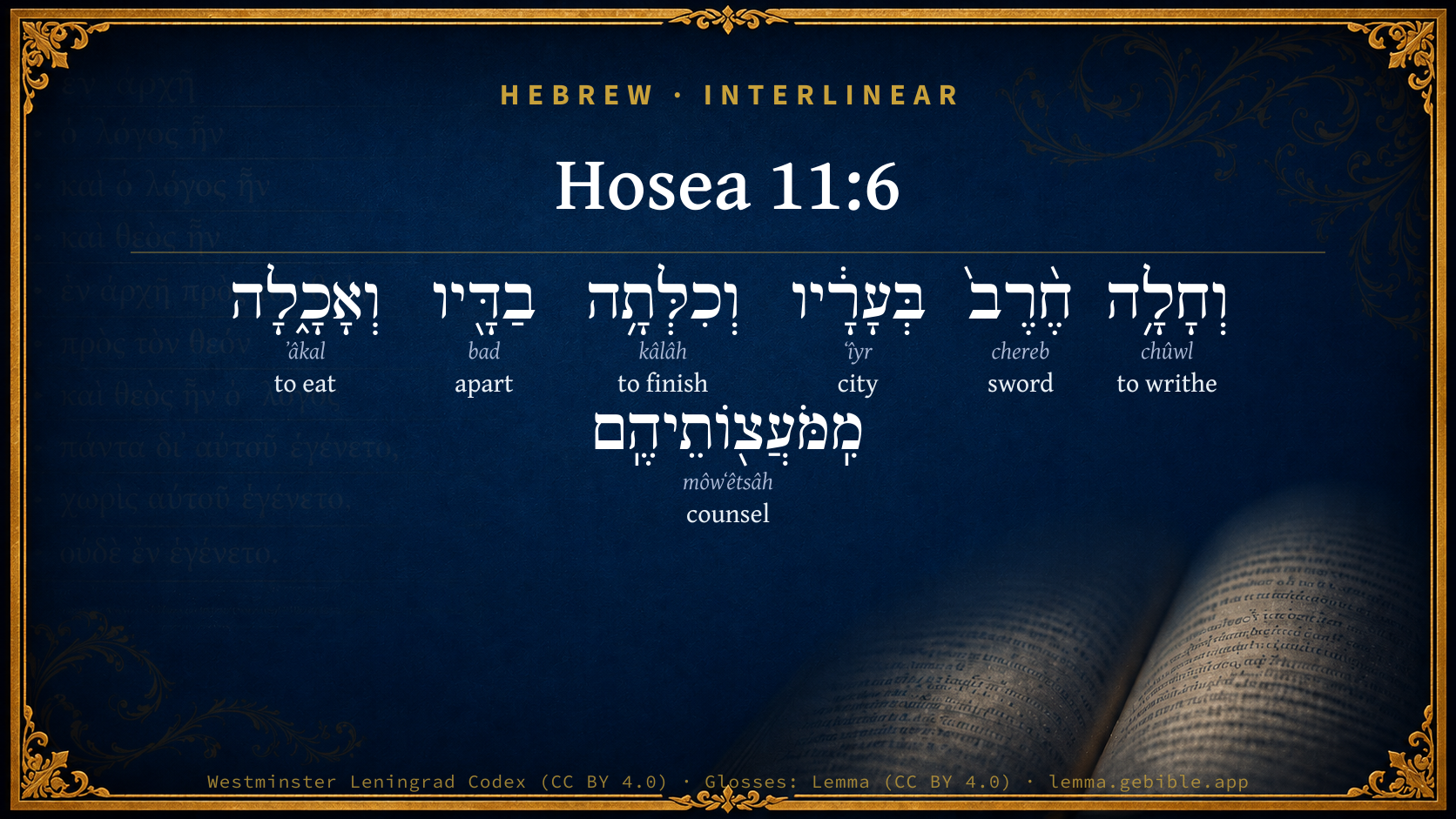
Hosea 11:6

Hebrew (Westminster Leningrad Codex) Hosea 11:6 appears in the Hebrew Old Testament. The text above is from the Westminster Leningrad Codex. Each word links to its Strong’s number, a concise gloss, and parsing drawn from the Open Scriptures Hebrew Bible morphology. Click any word for its full Brown-Driver-Briggs (BDB) entry.
Download image
Cite this verse

Hosea 11:6 (World English Bible). Public Domain. Lemma interlinear Bible study tool, https://lemma.gebible.app/v/hosea/11/6.

Show BibTeX & RIS
BibTeX
RIS
English Translation
The sword will fall on their cities, And will consume their gate bars, And will put an end to their plans.
World English Bible · Public Domain
Download a study sheet

One document with this verse’s original text, its word-by-word gloss line, the meaning frame, cross-references with their text, attributed commentary, and full source and license credits — printable, and it pastes into notes with its structure intact.

This verse Autodidact and up

Study sheet (.html) Plain text (.txt)

A passage Seminary Student

Up to 50 verses in one chapter. A passage sheet keeps up to 6 commentary sources and 12 cross-references per verse, in the order this page ranks them, and says so on the sheet whenever that leaves anything out. Ask for a single verse and you get the Autodidact verse sheet above.

Everything on this page stays free to read, with no account — the sheet is a download of what is already on screen, not access to it.

Want to remove ads? Support Godless Engineer
Compare translations 3

The same verse in 3 English versions, stacked beneath the original-language interlinear above. Click any original word for its lexicon entry.

Each is an independent rendering of the whole verse — the interlinear is not word-aligned to these translations.

Highlighted words mark where these versions differ — a whole-verse word diff, not a word-by-word alignment.

  • World English Bible Public Domain
    The sword will fall on their cities, And will consume their gate bars, And will put an end to their plans.
  • King James Version Public Domain
    And the sword shall abide on his cities, and shall consume his branches, and devour them, because of their own counsels.
  • unfoldingWord Literal Text CC BY-SA 4.0
    The sword will whirl against his cities, and will destroy his bars, and will devour because of their plans.

unfoldingWord Literal Text — © unfoldingWord, licensed CC BY-SA 4.0. Word-aligned USFM3 via Door43 (git.door43.org/unfoldingWord/en_ult).

Versions to compare (up to 4)

3 of 4 selected

Show all 18 translations

Every available English version of this verse, each an independent rendering of the whole verse.

  • World English Bible Public Domain
    The sword will fall on their cities, And will consume their gate bars, And will put an end to their plans.
  • Berean Standard Bible Public Domain
    A sword will flash through their cities; it will destroy the bars of their gates and consume them in their own plans.
  • Majority Standard Bible Public Domain
    A sword will flash through their cities; it will destroy the bars of their gates and consume them in their own plans.
  • King James Version Public Domain
    And the sword shall abide on his cities, and shall consume his branches, and devour them, because of their own counsels.
  • American Standard Version (1901) Public Domain
    And the sword shall fall upon their cities, and shall consume their bars, and devour `them', because of their own counsels.
  • Revised Version (1885) Public Domain
    And the sword shall fall upon his cities, and shall consume his bars, and devour them, because of their own counsels.
  • Geneva Bible (1599) Public Domain
    And the sworde shall fall on his cities, and shall consume his barres, and deuoure them, because of their owne counsels.
  • Douay-Rheims (1899) Public Domain
    The sword hath begun in his cities, and it shall consume his chosen men, and sha.ll devour their heads.
  • Young's Literal Translation Public Domain
    Grievous hath been the sword in his cities, And it hath ended his bars, and consumed -- from their own counsels.
  • Literal Standard Version CC BY-SA 4.0
    The sword has been grievous in his cities, || And it has ended his bars, and consumed—from their own counsels.
  • Unlocked Literal Bible CC BY-SA 4.0
    The sword will fall on their cities and destroy the bars of their gates; it will destroy them because of their own plans.
  • unfoldingWord Literal Text CC BY-SA 4.0
    The sword will whirl against his cities, and will destroy his bars, and will devour because of their plans.
  • Darby Bible Public Domain
    and the sword shall turn about in his cities, and shall consume his bars, and devour [them], because of their own counsels.
  • World Messianic Bible Public Domain
    The sword will fall on their cities, and will destroy the bars of their gates, and will put an end to their plans.
  • Webster's Bible Public Domain
    And the sword shall abide on his cities, and shall consume his branches, and devour them, because of their own counsels.
  • Free Bible Version CC BY-SA 4.0
    War will sweep through their cities, putting an end to their boasting and destroying their plans.
  • Bible in Basic English Public Domain
    And the sword will go through his towns, wasting his children and causing destruction because of their evil designs.
  • JPS Tanakh (1917) Public Domain
    And the sword shall fall upon his cities, and shall consume his bars, and devour them, because of their own counsels.

Literal Standard Version (2020), Covenant Press — licensed CC BY-SA 4.0. Text via the HelloAO Bible API (eBible.org). Unlocked Literal Bible (unfoldingWord) — licensed CC BY-SA 4.0. Text via the HelloAO Bible API (eBible.org). unfoldingWord Literal Text — © unfoldingWord, licensed CC BY-SA 4.0. Word-aligned USFM3 via Door43 (git.door43.org/unfoldingWord/en_ult). Free Bible Version, Dr. Jonathan Gallagher — licensed CC BY-SA 4.0. Text via the HelloAO Bible API (eBible.org).

Word by word

More ways to search: Search by grammar → Find every occurrence → Compare this word →

Practice this passage: Drill this verse → Learn its vocabulary →

מִֽמֹּעֲצ֖וֹתֵיהֶֽם
môwʻêtsâh
H4156
“from · counsels · their”
Preposition + Noun, Common, Feminine, Plural, Construct + Suffix, Personal, 3rd Person, Masculine, Plural
Part of Speech
Preposition + Noun
Type
Common
Gender
Feminine
Number
Plural
State
Construct
Full BDB Definition

Origin: from H3289

TWOT: 887b

counsel, plan, principal, device
  1. וְחָלָ֥ה chûwl H2342 “and · to writhe” Conjunction + Verb, Qal, Sequential Perfect, 3rd Person, Feminine, Singular
  2. חֶ֨רֶב֙ chereb H2719 “sword” Noun, Common, Feminine, Singular, Absolute
  3. בְּעָרָ֔יו ʻîyr H5892 “in/at · cities · his” Preposition + Noun, Common, Feminine, Plural, Construct + Suffix, Personal, 3rd Person, Masculine, Singular
  4. וְכִלְּתָ֥ה kâlâh H3615 “and · to finish” Conjunction + Verb, Piel, Sequential Perfect, 3rd Person, Feminine, Singular
  5. בַדָּ֖יו bad H905 “poles · his” Noun, Common, Masculine, Plural, Construct + Suffix, Personal, 3rd Person, Masculine, Singular
  6. וְאָכָ֑לָה ʼâkal H398 “and · to eat” Conjunction + Verb, Qal, Sequential Perfect, 3rd Person, Feminine, Singular

About this verse

These counts appear in no published source. They are computed here, from the morphology-tagged text and Lemma’s own curated glosses. What Lemma adds →

7
words
7
distinct lemmas
Prophets
section

Notable vocabulary

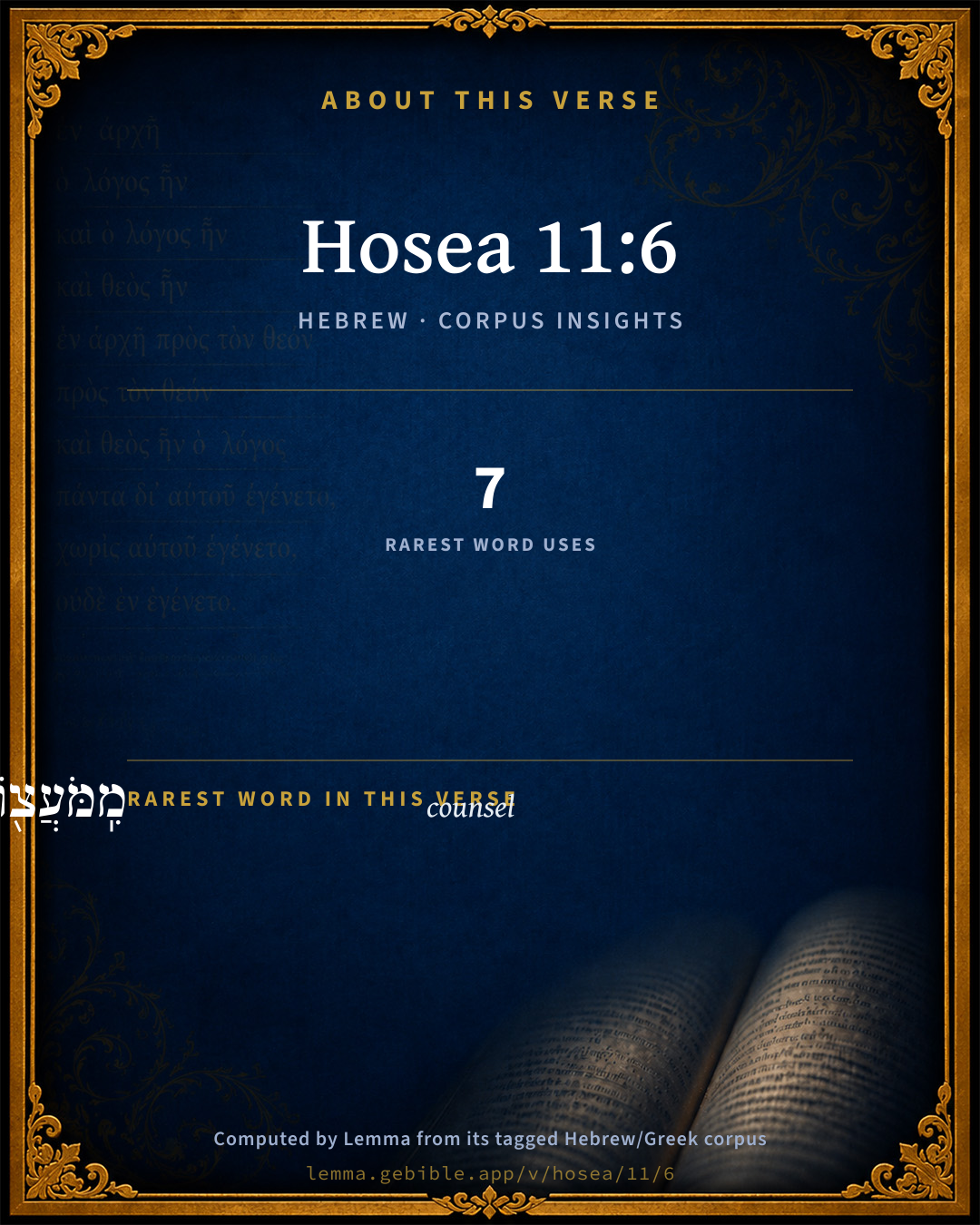
The rarest word here is מִֽמֹּעֲצ֖וֹתֵיהֶֽם counsel H4156 — appearing just 7 times in the whole Hebrew Bible.

Shared distinctive vocabulary

מִֽמֹּעֲצ֖וֹתֵיהֶֽם counsel H4156 occurs in 7 verses of the Hebrew Bible. Also found in:

Grammatical profile

  • 3 verbs
  • 4 nouns

Verb forms

  • וְחָלָ֥ה Qal · Sequential Perfect
  • וְכִלְּתָ֥ה Piel · Sequential Perfect
  • וְאָכָ֑לָה Qal · Sequential Perfect

Hebrew & Septuagint length

In English translation the verse runs 21 words from the Hebrew and 29 from the Septuagint (LXX English) — closely comparable.

A rough comparison of the two English renderings, which tokenize alike — not a word-level alignment.

Word counts can differ between the Hebrew and the Greek without any difference in meaning — e.g. the Hebrew direct-object marker אֵת has no separate Greek word, and Greek often adds the article ὁ.

Cross-references

19

Topical passages linked to Hosea 11:6 in the Treasury of Scripture Knowledge — connected by theme and wording, ordered by reader-vote popularity; previews shown in the World English Bible.

  • Hosea 13:16 Samaria will bear her guilt; For she has rebelled against her God. They will fall by the sword. Their infants will be dashed in pieces, And their pregnant women will be ripped open."
  • Hosea 10:6 It also will be carried to Assyria for a present to a great king. Ephraim will receive shame, And Israel will be ashamed of his own counsel.
  • Hosea 10:14 Therefore a battle roar will arise among your people, And all your fortresses will be destroyed, As Shalman destroyed Beth Arbel in the day of battle. The mother was dashed in pieces with her children.
  • Leviticus 26:31 I will lay your cities waste, and will bring your sanctuaries to desolation, and I will not take delight in the sweet fragrence of your offerings.
  • Leviticus 26:33 I will scatter you among the nations, and I will draw out the sword after you: and your land will be a desolation, and your cities shall be a waste.
  • Deuteronomy 28:52 They shall besiege you in all your gates, until your high and fortified walls come down, in which you trusted, throughout all your land; and they shall besiege you in all your gates throughout all your land, which Yahweh your God has given you.
  • Deuteronomy 32:25 Outside shall the sword bereave, In the chambers terror; [It shall destroy] both young man and virgin, The suckling with the man of gray hairs.
  • Psalms 80:11–16 It sent out its branches to the sea, Its shoots to the River.
  • Psalms 106:39 Thus were they defiled with their works, And prostituted themselves in their deeds.
  • Psalms 106:43 Many times he delivered them, But they were rebellious in their counsel, And were brought low in their iniquity.
  • Isaiah 9:14 Therefore Yahweh will cut off from Israel head and tail, palm-branch and rush, in one day.
  • Isaiah 18:5 For before the harvest, when the blossom is over, and the flower becomes a ripening grape, he will cut off the sprigs with pruning-hooks, and the spreading branches will he take away [and] cut down.
  • Isaiah 27:10 For the fortified city is solitary, a habitation deserted and forsaken, like the wilderness: there shall the calf feed, and there shall he lie down, and consume the branches of it.
  • Isaiah 30:1 Woe to the rebellious children, says Yahweh, who take counsel, but not of me; and who make a league, but not of my Spirit, that they may add sin to sin,
  • Jeremiah 5:17 They shall eat up your harvest, and your bread, [which] your sons and your daughters should eat; they shall eat up your flocks and your herds; they shall eat up your vines and your fig trees; they shall beat down your fortified cities, in which you trust, with the sword.
  • Ezekiel 15:2–7 Son of man, what is the vine tree more than any tree, the vine-branch which is among the trees of the forest?
  • Ezekiel 20:47 and tell the forest of the South, Hear the word of Yahweh: Thus says the Lord Yahweh, Behold, I will kindle a fire in you, and it shall devour every green tree in you, and every dry tree: the flaming flame shall not be quenched, and all faces from the south to the north shall be burnt thereby.
  • Micah 5:11 I will cut off the cities of your land, And will tear down all your strongholds.
  • Malachi 4:1 "For, behold, the day comes, it burns as a furnace; and all the proud, and all who work wickedness, will be stubble; and the day that comes will burn them up," says Yahweh of Hosts, "that it shall leave them neither root nor branch.

Cross-references courtesy of OpenBible.info (CC BY 4.0).

Hebrew and Greek witnesses Masoretic Hebrew ↔ Greek Septuagint

The same verse in the two great witnesses to the Old Testament, shown verse-for-verse.

These are two independent witnesses, not word-aligned to each other, and the Septuagint is shown in lemma (dictionary) form.

Hebrew Hosea 11:6 Masoretic · Westminster Leningrad Codex

וְחָלָ֥ה חֶ֨רֶב֙ בְּעָרָ֔יו וְכִלְּתָ֥ה בַדָּ֖יו וְאָכָ֑לָה מִֽמֹּעֲצ֖וֹתֵיהֶֽם

The sword will fall on their cities, And will consume their gate bars, And will put an end to their plans.

World English Bible · Public Domain

Greek LXX Hosea 11:6 Septuagint · lemma form

καί ἀσθενέω ῥομφαία ἐν ὁ πόλις αὐτός καί καταπαύω ἐν ὁ χείρ αὐτός καί ἐσθίω ἐκ ὁ διαβουλία αὐτός

And in his cities he prevailed not with the sword, and he ceased to war with his hands: and they shall eat of the fruit of their own devices:

LXX2012 (modern English Septuagint) · Public Domain

On this verse, Haydock's Catholic Bible Commentary discusses the Septuagint’s reading. Read the note in Commentary ↓

Hebrew: Westminster Leningrad Codex (CC BY 4.0). Greek: Septuagint (public domain); English from LXX2012 (modern English Septuagint) (Public Domain). How the Septuagint differs from the Hebrew →

Targum (Aramaic paraphrase)

1

The Targum is the ancient Jewish Aramaic paraphrase of the Hebrew Scriptures — an interpretive translation, not the Hebrew text itself. Onkelos (literal) and Pseudo-Jonathan (expansive) render the Torah, and Jonathan the Prophets. Coverage is partial: where no permissively-licensed English translation exists for a verse, only the Aramaic is shown. This is verse-level text, not a word-by-word alignment to the Hebrew.

  1. Targum Jonathan Prophets (Joshua–Malachi)
    וְתָחוּל חַרְבָּא בְּקִרְווֹהִי וְתִקְטֵיל גִבְּרוֹהִי וּתְשֵׁיצִי רַבְרְבוֹהִי מִמַלְכִי עֲצַתְהוֹן:

    (no public-domain English translation for this verse)

    Targum Jonathan — Aramaic: “Mikraot Gedolot” (public domain). English: “Sefaria Community Translation” (CC0 1.0 (public-domain dedication)); “London "Chaldee Paraphrase," 1871” (public domain). Text via Sefaria.

Commentary

Notes on Hosea 11:6 from classic Christian and Jewish commentators (each source and its license shown beneath its notes). The classic Christian expositions comment on the surrounding passage and are grouped to its opening verse, so a note may address several verses; the Jewish commentaries on the Tanakh (Rashi and others) are per-verse, so they appear only where the commentator wrote on this verse.

Lemma curates 59 commentaries, every one of them public domain or Creative Commons licensed, each selected and text-cleaned for this edition rather than reprinted as found. About our sources →

Trapp's Complete Commentary

John Trapp

Hos 11:6 And the sword shall abide on his cities, and shall consume his branches, and devour [them], because of their own counsels.

Ver. 6. And the sword shall abide on his cities] Heb. shall keep residence or rush upon his cities. It can do no less; it cannot return into the scabbard, rest or be still, till the Lord, who put it into commission, call back again his commission, Jer 47:6-7. It is a dreadful thing when the sword abideth on a people; as in Germany, that stage of war; Ireland, still a land of divine ire, &c. England hath some halcyons at present, praise be given to God; and let every good man pray with David, "Scatter thou the people that delight in war," Psa 68:30. The Pirates’ war was despatched by Pompey with incredible swiftness, to his eternal commendation ( incredibili celeritate et temporis brevitate a Pompeio confectum). And we have cause to bless God (saith a countryman of ours) that God hath raised up instruments for us, who have hazarded the shortening of their own lives for the shortening of the war; who have done their work of late, as if they had took it by the great, &c. And the same author observeth, that it is a sad thing for the sword to be in the field; but for the sword to be in the cities it is much more sad: and he instanceth in Jerusalem out of Josephus, where the number of the slain was 1,100,000 (Jos. de Bell. Jud. l. 7 c. 7.). We may further instance in that unhappy city of Magdeburg, in Germany, where so much cruelty was exercised first by Charles V (much regretted by him at last in his retired life, taking account of his actions), and since that in our memory by M. Tilly, who, like a bloody villain, put to the sword there 20,000 persons at least of all ranks, ages, and sexes: that great city also he burned down, utterly turning it into cinders, excepting 139 houses. The like immunity was exercised by the pope’s champions upon the poor Protestants at Angrogue, in France; where they killed and burned without mercy; but could never set fire upon the two temples there, nor upon the minister’s house, which remained whole, the houses round about being all consumed with fire.

And shall consume his branches and devour them] His branches, or his villages, which are as branches of the greater cities. The trees of America (but especially of Brazil) are so large, that it is reported of them that several families have lived in several arms or branches of one tree, to such a number as are in some petty village or parish here. The greater cities are as the body or root of a tree, the village as the branches. The Scripture often calleth them mother and daughter, as Heshbon and all her daughters, that is, villages, Num 21:25, as the Chaldee here explaineth it. See Eze 16:44-45; Eze 16:48; Eze 16:53. Hence we read of a city and mother in Israel, 2Sa 20:19. Branches also are called daughters of the trees they grow from, Gen 49:22. The word here rendered branches is by some rendered bars, by others, diviners or liars, as the word here used is interpreted, Jer 50:36. A sword is upon the liars or diviners, and they shall dote: potest Augur Augurem videre et non ridere? saith Cicero of such diviners: that is, Can they one look upon another and not laugh, considering how they gull people with their lies and fopperies? The sword shall be upon such, as it was upon Balaam, Satan’s spelman, they shall be a portion for foxes, Psa 63:10, as those that

“ Astutam vapido servant sub pectore vulpem. ”

Because of their own counsels] He that goeth to school to his own carnal reason is sure to have a fool to his master; an ignis fatuus, a foolish fire, that will bring him into the bogs and briers. The wisdom of the flesh is enmity to God. Nemo daeditur nisi a seipso. {See Trapp on "Hos 10:6"}

John Trapp, A Commentary or Exposition upon All the Books of the Old and New Testament (1647–1656) — public domain. Text from a community e-Sword module.

Jamieson, Fausset & Brown

Robert Jamieson, A. R. Fausset & David Brown

abide--or, "fall upon" [CALVIN].

branches--villages, which are the branches or dependencies of the cities [CALVIN]. GROTIUS translates, "his bars" (so Lam 2:9), that is, the warriors who were the bulwarks of the state. Compare Hos 4:18, "rulers" (Margin), "shields" (Psa 47:9).

because of their own counsels--in worshipping idols, and relying on Egypt (compare Hos 10:6).

Jamieson, Fausset & Brown — Commentary Critical and Explanatory on the Whole Bible (1871) — public domain (CC PDM 1.0). Text via the HelloAO Bible API.

Adam Clarke's Commentary

Verse 6. The sword shall abide on his cities] Israel was agitated with external and intestine wars from the time of Jeroboam the Second. Although Zechariah his son reigned twelve years, yet it was in continual troubles; and he was at last slain by the rebel Shallum, who, having reigned one month, was slain by Menahem. Pekahiah succeeded his father Menahem, and reigned two years, and was killed by Pekah, son of Remaliah. He joined Rezin, king of Syria, and made an irruption into the land of Judah; but Ahaz having obtained succour from Tiglath-Pileser, king of Assyria, Pekah was defeated, and the tribes of Reuben, Gad, Naphtali, and the half-tribe of Manasseh, were carried away captives by the Assyrian king; and in a short time after, Hosea, son of Elah, slew Pekah, and usurped the kingdom, which he could not possess without the assistance of Shalmaneser, who for his services imposed a tribute on the Israelitish king. Wishing to rid himself of this yoke, he applied to the king of Egypt; but this being known to Shalmaneser, he came against Samaria, and after a three years' siege took and destroyed it. Thus the sword rested on their cities; it continued in the land till all was ruined. See Calmet.

Adam Clarke's Commentary on the Bible (1810–1826) — public domain. Text from a community e-Sword/MySword module.

John Calvin's Commentaries

As it was difficult to persuade proud people that the overthrow was at hand, which Hosea had foretold, seeing, as they did, that they were furnished with many defences, it is therefore now added, that their fortified cities would not prevent the enemy to break through, and to devastate the whole country, and to lead away the people captive. We now understand how this verse is connected with the last. The Prophet had threatened exile; but as the Israelites thought themselves safe in their nests, he adds, that there was no reason for them to trust in their fortresses, for the Lord could by the sword destroy all their cities.

He therefore says, The sword shall fall on their cities. The verb חול, chul, means to abide, and to encamp, and sometimes to fall or rush upon: and this second sense is more suitable to this place. Some, however, render it, The sword shall abide on the cities until it consume them. But as to the meaning, there is not much difference. I will, however, briefly state what I deem the right view. The sword then shall fall, or rush, upon his cities; and further, it shall consume his bars The Hebrews often call bars or bolts בדים“badim”, still oftener, branches, or members, — the branches of a tree, or the members of man. Hence some take the word metaphorically, as meaning towns and villages; for they are, as it were, the branches or members of cities. Others, however, explain it as signifying sons, who grow from their parents as branches from the tree: but this seems too far-fetched. I do not disapprove of the opinion, that the Prophet refers here to towns and villages, which are, as it were, the appendages of cities, as branches spread out here and there from the tree. The sense then is not amiss, that the sword will consume and devour towns and villages, when it shall fall on the cities. But what I have already said of bolts seems more suitable to the design of the Prophet. We must at the same time consider the word בדים, bedim, as including a part for the whole; for bolts were only a part of the fortifications; but the gates, being closed and fastened, render the cities strong. So this place, by taking a part for the whole, may be thus expounded, that the sword, when it fell on cities, would consume and destroy whatever strength and defence they possessed.

He at the same time mentions the cause, Because, he says, of their own counsels No doubt, he added this expression, because the Israelites thought themselves wise; for ungodly men arrogate to themselves much prudence; and this they do, that they may, as it were, from their height look down on God, and laugh at every instruction. Since then they who despise God seem to themselves to be very wise, and to be fortified by their good counsels, the Prophet shows that the cause of ruin to the Israelites would be, that they were swollen with this diabolical prudence, and would not condescend to obey the word of the Lord.

John Calvin's Commentaries (1540-1563) — public domain. Text from the Calvin Translation Society English edition (1840s-50s) via the Christian Classics Ethereal Library (ccel.org). Calvin's coverage is partial (roughly two-thirds of the Bible); uncommented books and verses are honest gaps, never fabricated. The 19th-century editor's footnotes and remarks are omitted so the notes are faithfully Calvin's own voice.

Ellicott's Commentary for English Readers

(6) The rendering of the English version is here incorrect. Render, Then shall the sword be brandished amid his cities, and utterly destroy his princes. The word for “princes” is, literally, bars, the heroes, leaders, or defenders of the state being aptly called barriers, or bulwarks. Analogous metaphors frequently occur in the Old Testament; such is the interpretation of the Targum.

A Bible Commentary for English Readers, edited by Charles John Ellicott (1878–1897) — public domain. Text from a community e-Sword module.

The Cambridge Bible for Schools and Colleges

gen. ed. J. J. S. Perowne

6. And the sword, &c.] Rather, And the sword shall whirl about in his cities, and shall make an end of his defences (lit. his bars; comp. Jer_51:30). The sword is personified as the symbol of war, as Eze_14:17.

The Cambridge Bible for Schools and Colleges (gen. ed. J. J. S. Perowne; Cambridge University Press, 1878–1918) — public domain. Text from a community e-Sword module.

John Gill's Exposition

And the sword shall abide on the cities,.... Or "shall fall" (y), and continue; meaning the sword of the Assyrians, whereby Ephraim should be brought into subjection to them, and the king of Assyria become king over them; his sword should be drawn, and rest upon them, not only on their chief city Samaria, besieged three years by him, but upon all their other cities, which would fall into his hands, with the inhabitants of them:

and shall consume his branches, and devour them; that is, the towns and villages adjoining to the cities; which were to them as branches are to a tree, sprung from them, and were supported by them; and, being near them, prospered or suffered as they did: some render it, "his bars" (z), as the word is sometimes used, and interpret it of the great men and nobles of the land. So the Targum,

"and it shall slay his mighty men, and destroy his princes;''

with which Jarchi agrees;

because of their own counsels; which they took and pursued, contrary to the counsel of God, the revelation of his mind and will; particularly in setting up idolatrous worship, and continuing in it, notwithstanding all the admonitions, exhortations, counsels, and threatenings of God by his prophets; or else because of their counsels with the Egyptians, and their covenants with them, for help against the Assyrian, whose yoke they were for casting off, and refused to pay tribute to; which provoked him to draw his sword upon them, which made the havoc it did in their cities, and the inhabitants of them.

(y) "cedet", Calvin; "incidet", Schmidt; "irruet", Zanchius, Drusius, Liveleus. (z) "vectes ejus", Schmidt. So some in Drusius.

John Gill's Exposition of the Whole Bible (1746–1763) — public domain (CC PDM 1.0). Text via the HelloAO Bible API.

Albert Barnes' Notes on the Bible

And the sword shall abide on his cities - Literally, “shall light, shall whirl” down upon. It shall come with violence upon them as a thing whirled with force, and then it shall alight and abide, to their destruction; as Jeremiah says, “a whirlwind of the Lord is gone forth in fury, a grievous whirlwind; it shall fall grievously (literally, whirl down) on the head of the wicked” Jer 23:19. As God said to David, after the murder of Uriah, “Now therefore the sword shall never depart from thy house” 2Sa 12:10, so as to Israel, whose kings were inaugurated by bloodshed. By God’s appointment, “blood will have blood.” Their own sword first came down and rested upon them; then the sword of the Assyrian. So after they “had killed the Holy One and the Just,” the sword of the Zealots came down and rested upon them, before the destruction by the Romans.

And shall consume his branches - that is, his mighty men. It is all one, whether the mighty men are so called, by metaphor, from the “branches of” a tree, or from the “bars” of a city, made out of those branches. Their mighty men, so far from escaping for their might, should be the first to perish.

And devour them, because of their own counsels - Their counsels, wise after this world’s wisdom, were without God, against the counsels of God. Their destruction then should come from their own wisdom, as it is said, “Let them fall by their own counsels” Psa 5:10, and Job saith, “He taketh the wise in their own craftiness, and the counsel of the cunning is carried headlong” Job 5:13, i. e., it is the clean contrary of what they intend or plan; they purpose, as they think, warily; an unseen power whirls their scheme on and precipitates it. “And his own counsel shall cast him down” Job 18:7; and above; “Israel shall be ashamed through his own counsels” Job 10:6. Hoshea’s conspiracy with So, which was to have been his support against Assyria, brought Assyria against him, and his people into captivity.

Albert Barnes' Notes on the Bible (1834–1885) — public domain. Text from a community e-Sword/MySword module.

Haydock's Catholic Bible Commentary

Heads. Hebrew, "counsellors." Civil war desolated the kingdom, and made way for the Assyrians. Septuagint, "they are devoured on account of their projects." (Calmet) --- They are at a loss what to do.

George Leo Haydock (1774–1849), Haydock's Catholic Family Bible and Commentary, 1859 edition — public domain. Excludes Psalms (Douay-Rheims chapter numbering differs from Protestant) and Deuterocanonical books (Catholic canon only).

Matthew Poole's English Annotations

The sword; either intestine or foreign wars, or both. Shall abide; shall be long, not be as a sudden incursion which doth much mischief to surprised and unfortified places, but it shall be a lasting war; three years Samaria was besieged, so the sword did abide.

On his cities; all the cities of Ephraim, the enemy should have courage and leisure to attend the siege of every one of them.

Shall consume; shall prevail to take, sack, burn, and ruin the branches.

His branches; lesser towns and villages.

Devour them; swallow them up with speed and ease, without remedy. Because of their own counsels; which they first took, 1Ki 12:28, and ever since irreclaimably have followed, in opposition to all the good counsels the prophets gave them from time to time, to all which they have turned a deaf ear; they have sued for Egypt and Asshur’s favour, and slighted mine.

Matthew Poole's English Annotations on the Holy Bible (1683–1685) — public domain. Text from a community e-Sword/MySword module.

The Pulpit Commentary

Ver. 6. And the sword shall abide on his cities, and shall consume his branches, and devour them. A more accurate rendering would be, and the sword shall sweep round in its cities, and destroy its bolts and devour. Nay, they could not free themselves from invasion and attack. The sword of war would whirl down upon their cities and consume the branches, that is, the villages, or the city bars, or the strong warriors set for defense. Some understand the word so variously interpreted in the sense of "liars," and refer it to the prophets, priests, and politicians who spake falsehood and. acted deceitfully. The word jlh is rendered

(1) "the sword," as the principal weapon in ancient warfare anti the symbol of war"s destructive power shall sweep round in, circulate, or make the round of the cities of Israel; but

(2) others," whirl down," "light on;" thus both Rashi and Kimchi. Again, is, as already intimated, variously rendered. The most appropriate translation

(a) is (literally, poles for carrying the ark," (Exo_25:13) bolts or bars" for securing gates, the root being ddb, to separate.

(b) Some explain it as a figure for mighty men;" so Jerome and the Targum, as also Rashi: "It destroys his heroes and consumes them." this is the meaning of the word preferred by Gesenius.

(c) Ewald understands it in the sense of "fortresses," especially on the frontier, by which a land is shut against or opened to the enemy.

(d) Aben Ezra and Kimchi take it to mean "branches," i.e. villages, and are followed by the Authorized Version. "The explanation of yb," says Kimchi, "is "branches," and it is a figure for villages, for he had already mentioned his cities; and villages are related to cities as branches to a tree; in like manner they are called "daughters," being related to a city as daughters to a mother.

(e) The LXX render it by en taiv cersi , having read wydyb, as also the Syriac. Because of their own counsels. The cause of all their calamitous invasions, which city gates barred and bolted could not shut out, was their evil counsels in departing from the Lord, as Kimchi correctly explains: "All this comes upon them in consequence of their evil counsel, because they have forsaken my service to serve other gods." Rashi draws attention to the peculiarity of the accentuation tasha and sellug to separate it from the preceding word. The Septuagint here again blunders, obviously reading Wlkaw, and translating, "And shall eat (the fruit) of their evil counsel."

The Pulpit Commentary (1880–1919), ed. H.D.M. Spence-Jones & Joseph S. Exell — public domain. Text from a community e-Sword module.

John Wesley's Explanatory Notes

His branches - The lesser towns and villages. Their own counsels - Which they have followed in opposition to all the good counsels the prophets gave them from time to time.

John Wesley, Explanatory Notes Upon the Whole Bible (1754–1765) — public domain. Text via the GEBible commentary corpus.

Rashi

Rabbi Shlomo Yitzchaki (Rashi)

And a sword shall rest in his cities Heb. וְחָלָה, and a sword shall rest in his cities.

and it shall destroy his branches, and it shall consume And it shall destroy his mighty men and consume them. [after Targum Jonathan]

because of their counsels (all these came upon them.) The word מִמֹּעֲצוֹתֵיהֶם is punctuated by two accents: it contains a tipcha and it contains a silluk (sof passuk), since it is a clause by itself. Comp. (Lev. 21:4) לְהֵחַלְוֹ, “for him to become profaned,” of the verse commencing, “A husband shall not contaminate himself.” Similarly, (Ex. 30:3l) לדֹרֹתֵיכֶם, “to your generations,” of the verse dealing with the holy anointing oil.

Rashi on the Tanakh — English translations: “The Judaica Press complete Tanach with Rashi, translated by A. J. Rosenberg” (CC BY 4.0); “Pentateuch with Rashi's commentary by M. Rosenbaum and A.M. Silbermann, 1929-1934” (public domain); “The Metsudah Tanach series, Lakewood, N.J” (CC BY 4.0); and “The Book of Joshua, Metsudah Publications, 1997” (CC BY 4.0). Text via Sefaria.

Lesson kit

Teaching starters — assembled from the data on this page, not authored interpretation. Every prompt links to the verse data it draws on. Edit before teaching.

Hosea, in the Prophets, opens this verse with 7 words (7 distinct Hebrew lemmas). Its most distinctive word is môwʻêtsâh (“counsel”). A historical commentator’s framing appears above. Read the whole chapter for the surrounding context.

Discussion questions

  1. The word môwʻêtsâh carries the sense “counsel.” How does it shape the verse?
  2. Psalms 5:10 shares the word «counsel» with this verse. How do the two illuminate each other?
  3. These translations render this verse differently. What is at stake in choosing one wording over another?
  4. The verb «וְחָלָ֥ה» is Qal Sequential Perfect. How does its form color the action?
  5. Reading how Trapp's Complete Commentary and Jamieson, Fausset & Brown read this verse, where do the two commentators agree and where do they part?

Things to notice

Reading settings

Reading text

Shown beneath each verse's original-language words.

Old Testament
Old Testament edition

Read the OT as the Masoretic Hebrew (MT) or the Greek Septuagint (LXX).

English shown for the Greek Septuagint (in the Hebrew ↔ Greek comparison).

Comparing translations? Open the Compare panel on any verse page to stack up to four side by side.