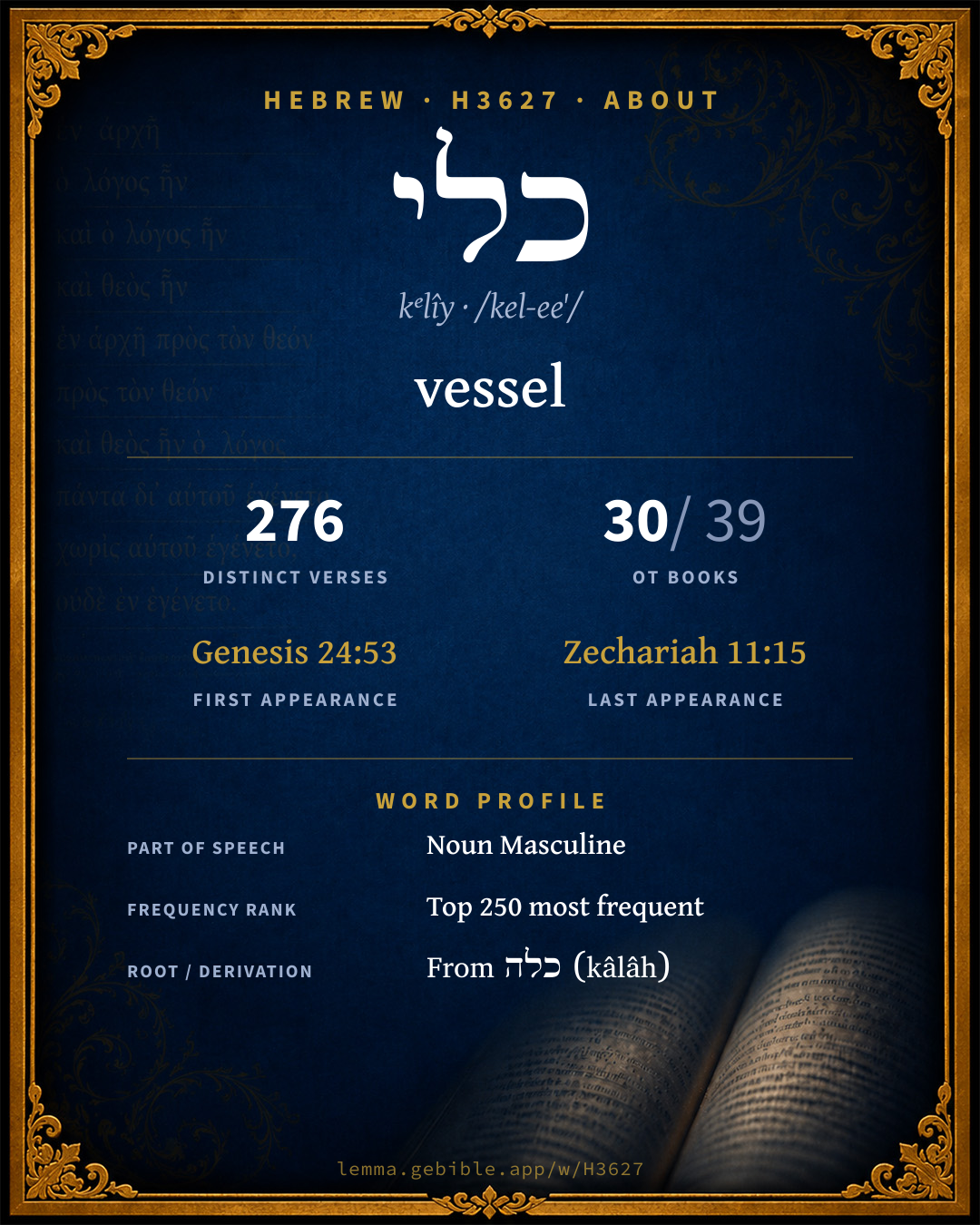
כְּלִי
vessel
also: article, implement, utensil fuller range ↓
Full lexicon entry — Brown-Driver-Briggs (BDB)
From Brown-Driver-Briggs (BDB)
Where this word appears
See every Construct-state word in the Hebrew Bible →
Grammar key — what these labels mean
Part of speech
- Noun
- A naming word — a person, place, thing, or idea.
Noun type
- Common
- A common noun — a general class of person, place, or thing (“king,” “city,” “water”), not a specific name.
State
- Construct
- A noun bound to a following noun in a possessive / “of” relationship (the construct chain).
- Absolute
- The independent form of a noun, not bound to a following word.
Gender
- Masculine
- Grammatically masculine.
Number
- Plural
- More than one (in Hebrew, generally three or more).
- Singular
- One.
Grammatical forms
- Noun, Common, Masculine, Plural, Construct 203 times (62%)
- Noun, Common, Masculine, Plural, Absolute 50 times (15%)
- Noun, Common, Masculine, Singular, Construct 43 times (13%)
- Noun, Common, Masculine, Singular, Absolute 29 times (9%)
Parsed forms decoded from the imported morphology (morphhb / Westminster Leningrad Codex — WLC text public domain, morphhb tagging CC BY 4.0), counted across 325 parsed occurrences — not distinct verses.
Page 1 of 2 — showing verses 1–200 of 276 distinct verses where H3627 appears, across 30 books. Click any verse to open its interlinear word-by-word view. Verse text shown in the World English Bible for context — . Each verse’s Hebrew form is shown with its reference; the English is not keyword-highlighted, since the data carries no word-level English alignment. Use “Compare translations” on any verse to read it across multiple English versions. This concordance covers the Hebrew Bible; Septuagint (Greek Old Testament) occurrences are not indexed here.
Genesis 7 verses
- Genesis 24:53 כְּלֵי וּ/כְלֵ֤י n c mp cs conj + n c mp cs The servant brought forth jewels of silver, and jewels of gold, and clothing, and gave them to Rebekah. He gave also to her brother and to her mother precious things.
- Genesis 27:3 כֵלֶ֔י/ךָ n c mp cs + sfx pers 2ms Now therefore, please take your weapons, your quiver and your bow, and go out to the field, and take me venison.
- Genesis 31:37 כֵּלַ֗/י כְּלֵי n c mp cs + sfx pers 1cs n c mp cs Now that you have felt around in all my stuff, what have you found of all your household stuff? Set it here before my relatives and your relatives, that they may judge between us two.
- Genesis 42:25 כְּלֵי/הֶם֮ n c mp cs + sfx pers 3mp Then Joseph commanded to fill their bags with grain, and to restore every man's money into his sack, and to give them food for the way. So it done to them.
- Genesis 43:11 בִּ/כְלֵי/כֶ֔ם prep + n c mp cs + sfx pers 2mp Their father, Israel, said to them, "If it be so now, do this. Take from the choice fruits of the land in your bags, and carry down a present for the man, a little balm, a little honey, spices and myrrh, nuts, and almonds;
- Genesis 45:20 כְּלֵי/כֶ֑ם n c mp cs + sfx pers 2mp Also, don't concern yourselves about your belongings, for the good of all of the land of Egypt is yours."
- Genesis 49:5 כְּלֵ֥י n c mp cs "Simeon and Levi are brothers; Weapons of violence are their swords.
Exodus 28 verses
- Exodus 3:22 כְּלֵי וּ/כְלֵ֥י n c mp cs conj + n c mp cs But every woman shall ask of her neighbor, and of her who visits her house, jewels of silver, jewels of gold, and clothing; and you shall put them on your sons, and on your daughters. You shall despoil the Egyptians.
- Exodus 11:2 כְּלֵי וּ/כְלֵ֥י n c mp cs conj + n c mp cs Speak now in the ears of the people, and let them ask every man of his neighbor, and every woman of her neighbor, jewels of silver, and jewels of gold."
- Exodus 12:35 כְּלֵי וּ/כְלֵ֥י n c mp cs conj + n c mp cs The children of Israel did according to the word of Moses; and they asked of the Egyptians jewels of silver, and jewels of gold, and clothing.
- Exodus 22:7 כֵלִים֙ n c mp "If a man delivers to his neighbor money or stuff to keep, and it is stolen out of the man's house; if the thief is found, he shall pay double.
- Exodus 25:9 כֵּלָ֑י/ו n c mp cs + sfx pers 3ms According to all that I show you, the pattern of the tent, and the pattern of all of its furniture, even so you shall make it.
- Exodus 25:39 הַ/כֵּלִ֖ים ptcl def.art + n c mp It shall be made of a talent of pure gold, with all these accessories.
- Exodus 27:3 כֵּלָ֖י/ו n c mp cs + sfx pers 3ms You shall make its pots to take away its ashes, its shovels, its basins, its flesh hooks, and its fire pans: all its vessels you shall make of brass.
- Exodus 27:19 כְּלֵ֣י n c mp cs All the instruments of the tent in all its service, and all the pins of it, and all the pins of the court, shall be of brass.
- Exodus 30:27 כֵּלָ֔י/ו כֵּלֶ֑י/הָ n c mp cs + sfx pers 3ms n c mp cs + sfx pers 3fs the table and all its articles, the lampstand and its accessories, the altar of incense,
- Exodus 30:28 כֵּלָ֑י/ו n c mp cs + sfx pers 3ms the altar of burnt offering with all its utensils, and the basin with its base.
- Exodus 31:7 כְּלֵ֥י n c mp cs the tent of meeting, the ark of the testimony, the mercy seat that is on it, all the furniture of the Tent,
- Exodus 31:8 כֵּלָ֔י/ו כֵּלֶ֑י/הָ n c mp cs + sfx pers 3ms n c mp cs + sfx pers 3fs the table and its vessels, the pure lampstand with all its vessels, the altar of incense,
- Exodus 31:9 כֵּלָ֑י/ו n c mp cs + sfx pers 3ms the altar of burnt offering with all its vessels, the basin and its base,
- Exodus 35:13 כֵּלָ֑י/ו n c mp cs + sfx pers 3ms the table with its poles and all its vessels, and the show bread;
- Exodus 35:14 כֵּלֶ֖י/הָ n c mp cs + sfx pers 3fs the lampstand also for the light, with its vessels, its lamps, and the oil for the light;
- Exodus 35:16 כֵּלָ֑י/ו n c mp cs + sfx pers 3ms the altar of burnt offering, with its grating of brass, it poles, and all its vessels, the basin and its base;
- Exodus 35:22 כְּלִ֣י n c ms cs They came, both men and women, as many as were willing-hearted, and brought brooches, ear-rings, signet-rings, and armlets, all jewels of gold; even every man who offered an offering of gold to Yahweh.
- Exodus 37:16 הַ/כֵּלִ֣ים ptcl def.art + n c mp He made the vessels which were on the table, its dishes, its spoons, its bowls, and its pitchers with which to pour out, of pure gold.
- Exodus 37:24 כֵּלֶֽי/הָ n c mp cs + sfx pers 3fs He made it of a talent of pure gold, with all its vessels.
- Exodus 38:3 כְּלֵ֣י כֵּלָ֖י/ו n c mp cs n c mp cs + sfx pers 3ms He made all the vessels of the altar, the pots, the shovels, the basins, the flesh-hooks, and the fire pans. He made all its vessels of brass.
- Exodus 38:30 כְּלֵ֥י n c mp cs With this he made the sockets to the door of the tent of meeting, the brazen altar, the brazen grating for it, all the vessels of the altar,
- Exodus 39:33 כֵּלָ֑י/ו n c mp cs + sfx pers 3ms They brought the tent to Moses, the tent, with all its furniture, its clasps, its boards, it bars, its pillars, its sockets,
- Exodus 39:36 כֵּלָ֔י/ו n c mp cs + sfx pers 3ms the table, all its vessels, the show bread,
- Exodus 39:37 כֵּלֶ֑י/הָ n c mp cs + sfx pers 3fs the pure lampstand, its lamps, even the lamps to be set in order, all its vessels, the oil for the light,
- Exodus 39:39 כֵּלָ֑י/ו n c mp cs + sfx pers 3ms the brazen altar, its grating of brass, its poles, all of its vessels, the basin and its base,
- Exodus 39:40 כְּלֵ֛י n c mp cs the hangings of the court, its pillars, its sockets, the screen for the gate of the court, its cords, its pins, all the instruments of the service of the tent, for the tent of meeting,
- Exodus 40:9 כֵּלָ֖י/ו n c mp cs + sfx pers 3ms You shall take the anointing oil, and anoint the tent, and all that is in it, and shall make it holy, and all its furniture: and it will be holy.
- Exodus 40:10 כֵּלָ֑י/ו n c mp cs + sfx pers 3ms You shall anoint the altar of burnt offering, with all its vessels, and sanctify the altar: and the altar will be most holy.
Leviticus 19 verses
- Leviticus 6:28 וּ/כְלִי בִּ/כְלִ֤י conj + n c ms cs prep + n c ms cs But the earthen vessel in which it is boiled shall be broken; and if it is boiled in a brazen vessel, it shall be scoured, and rinsed in water.
- Leviticus 8:11 כֵּלָ֗י/ו n c mp cs + sfx pers 3ms He sprinkled it on the altar seven times, and anointed the altar and all its vessels, and the basin and its base, to sanctify them.
- Leviticus 11:32 כְּלִי כְּלִ֕י n c ms cs n c ms On whatever any of them falls when they are dead, it shall be unclean; whether it is any vessel of wood, or clothing, or skin, or sack, whatever vessel it is, with which any work is done, it must be put into water, and it shall be unclean until the evening; then it will be clean.
- Leviticus 11:33 כְּלִי n c ms cs Every earthen vessel, into which any of them falls, all that is in it shall be unclean, and you shall break it.
- Leviticus 11:34 כְּלִ֖י n c ms All food which may be eaten, that on which water comes, shall be unclean; and all drink that may be drunk in every such vessel shall be unclean.
- Leviticus 13:49 כְּלִי n c ms cs if the plague is greenish or reddish in the garment, or in the skin, or in the warp, or in the woof, or in anything made of skin; it is the plague of leprosy, and shall be shown to the priest.
- Leviticus 13:52 כְּלִ֣י n c ms cs He shall burn the garment, whether the warp or the woof, in wool or in linen, or anything of skin, in which the plague is: for it is a destructive mildew. It shall be burned in the fire.
- Leviticus 13:53 כְּלִי n c ms cs "If the priest examines it, and, behold, the plague hasn't spread in the garment, either in the warp, or in the woof, or in anything of skin;
- Leviticus 13:57 כְּלִי n c ms cs and if it appears again in the garment, either in the warp, or in the woof, or in anything of skin, it is spreading. You shall burn with fire that in which the plague is.
- Leviticus 13:58 כְּלִ֤י n c ms cs The garment, either the warp, or the woof, or whatever thing of skin it is, which you shall wash, if the plague has departed from them, then it shall be washed the second time, and it will be clean."
- Leviticus 13:59 כְּלִי n c ms cs This is the law of the plague of mildew in a garment of wool or linen, either in the warp, or the woof, or in anything of skin, to pronounce it clean, or to pronounce it unclean.
- Leviticus 14:5 כְּלִי n c ms cs The priest shall command them to kill one of the birds in an earthen vessel over running water.
- Leviticus 14:50 כְּלִי n c ms cs He shall kill one of the birds in an earthen vessel over running water.
- Leviticus 15:4 הַ/כְּלִ֛י ptcl def.art + n c ms "'Every bed whereon he who has the discharge lies shall be unclean; and everything he sits on shall be unclean.
- Leviticus 15:6 הַ/כְּלִ֔י ptcl def.art + n c ms He who sits on anything whereon the man who has the discharge sat shall wash his clothes, and bathe himself in water, and be unclean until the evening.
- Leviticus 15:12 וּ/כְלִי כְּלִי conj + n c ms cs n c ms cs "'The earthen vessel, which he who has the discharge touches, shall be broken; and every vessel of wood shall be rinsed in water.
- Leviticus 15:22 כְּלִ֖י n c ms Whoever touches anything that she sits on shall wash his clothes, and bathe himself in water, and be unclean until the evening.
- Leviticus 15:23 הַ/כְּלִ֛י ptcl def.art + n c ms If it is on the bed, or on anything whereon she sits, when he touches it, he shall be unclean until the evening.
- Leviticus 15:26 הַ/כְּלִי֙ ptcl def.art + n c ms Every bed whereon she lies all the days of her discharge shall be to her as the bed of her period: and everything whereon she sits shall be unclean, as the uncleanness of her period.
Numbers 26 verses
- Numbers 1:50 כֵּלָי/ו֮ כֵּלָ֔י/ו n c mp cs + sfx pers 3ms n c mp cs + sfx pers 3ms but appoint the Levites over the Tabernacle of the Testimony, and over all its furnishings, and over all that belongs to it. They shall carry the tabernacle, and all its furnishings; and they shall take care of it, and shall encamp around it.
- Numbers 3:8 כְּלֵי֙ n c mp cs They shall keep all the furnishings of the Tent of Meeting, and the obligations of the children of Israel, to do the service of the tabernacle.
- Numbers 3:31 וּ/כְלֵ֣י conj + n c mp cs Their charge shall be the ark, the table, the lamp stand, the altars, the vessels of the sanctuary with which they minister, and the screen, and all its service.
- Numbers 3:36 כֵּלָ֔י/ו n c mp cs + sfx pers 3ms The appointed charge of the sons of Merari shall be the tabernacle's boards, its bars, its pillars, its sockets, all its instruments, all its service,
- Numbers 4:9 כְּלֵ֣י n c mp cs They shall take a blue cloth, and cover the lampstand of the light, and its lamps, and its snuffers, and its snuff dishes, and all its oil vessels, with which they minister to it.
- Numbers 4:10 כֵּלֶ֔י/הָ n c mp cs + sfx pers 3fs They shall put it and all its vessels within a covering of sealskin, and shall put it on the frame.
- Numbers 4:12 כְּלֵ֨י n c mp cs They shall take all the vessels of ministry, with which they minister in the sanctuary, and put them in a blue cloth, and cover them with a covering of sealskin, and shall put them on the frame.
- Numbers 4:14 כֵּלָ֞י/ו כְּלֵ֣י n c mp cs + sfx pers 3ms n c mp cs They shall put on it all its vessels, with which they minister about it, the fire pans, the flesh hooks, the shovels, and the basins; all the vessels of the altar; and they shall spread on it a covering of sealskin, and put in its poles.
- Numbers 4:15 כְּלֵ֣י n c mp cs "When Aaron and his sons have finished covering the sanctuary, and all the furniture of the sanctuary, as the camp moves forward; after that, the sons of Kohath shall come to carry it: but they shall not touch the sanctuary, lest they die. These things are the burden of the sons of Kohath in the Tent of Meeting.
- Numbers 4:16 וּ/בְ/כֵלָֽי/ו conj + prep + n c mp cs + sfx pers 3ms "The charge of Eleazar the son of Aaron the priest shall be the oil for the light, the sweet incense, the continual meal offering, and the anointing oil, the charge of all the tabernacle, and of all that is in it, the sanctuary, and its furnishings."
- Numbers 4:26 כְּלֵ֖י n c mp cs and the hangings of the court, and the screen for the door of the gate of the court, which is by the tabernacle and around the altar, and their cords, and all the instruments of their service, and whatever shall be done with them. Therein shall they serve.
- Numbers 4:32 כְּלֵי/הֶ֔ם כְּלֵ֖י n c mp cs + sfx pers 3mp n c mp cs and the pillars of the court around it, and their sockets, and their pins, and their cords, with all their instruments, and with all their service: and by name you shall appoint the instruments of the charge of their burden.
- Numbers 5:17 בִּ/כְלִי prep + n c ms cs and the priest shall take holy water in an earthen vessel; and of the dust that is on the floor of the tabernacle the priest shall take, and put it into the water.
- Numbers 7:1 כֵּלָ֔י/ו כֵּלָ֑י/ו n c mp cs + sfx pers 3ms n c mp cs + sfx pers 3ms It happened on the day that Moses had finished setting up the tabernacle, and had anointed it and sanctified it, with all its furniture, and the altar with all its vessels, and had anointed and sanctified them;
- Numbers 7:85 הַ/כֵּלִ֔ים ptcl def.art + n c mp each silver platter weighing one hundred thirty shekels, and each bowl seventy; all the silver of the vessels two thousand four hundred shekels, after the shekel of the sanctuary;
- Numbers 18:3 כְּלֵ֨י n c mp cs They shall keep your charge, and the charge of all the Tent: only they shall not come near to the vessels of the sanctuary and to the altar, that they not die, neither they, nor you.
- Numbers 19:15 כְּלִ֣י n c ms Every open vessel, which has no covering bound on it, is unclean.
- Numbers 19:17 כֶּֽלִי n c ms For the unclean they shall take of the ashes of the burning of the sin-offering; and running water shall be put thereto in a vessel:
- Numbers 19:18 הַ/כֵּלִ֔ים ptcl def.art + n c mp and a clean person shall take hyssop, and dip it in the water, and sprinkle it on the tent, and on all the vessels, and on the persons who were there, and on him who touched the bone, or the slain, or the dead, or the grave:
- Numbers 31:6 וּ/כְלֵ֥י conj + n c mp cs Moses sent them, one thousand of every tribe, to the war, them and Phinehas the son of Eleazar the priest, to the war, with the vessels of the sanctuary and the trumpets for the alarm in his hand.
- Numbers 31:20 כְּלִי כְּלִי n c ms cs n c ms cs As to every garment, and all that is made of skin, and all work of goats' [hair], and all things made of wood, you shall purify yourselves.
- Numbers 31:50 כְלִֽי n c ms cs We have brought Yahweh's offering, what every man has gotten, of jewels of gold, ankle-chains, and bracelets, signet-rings, ear-rings, and armlets, to make atonement for our souls before Yahweh.
- Numbers 31:51 כְּלִ֥י n c ms cs Moses and Eleazar the priest took the gold of them, even all worked jewels.
- Numbers 35:16 בִּ/כְלִ֨י prep + n c ms cs But if he struck him with an instrument of iron, so that he died, he is a murderer: the murderer shall surely be put to death.
- Numbers 35:18 בִּ/כְלִ֣י prep + n c ms cs Or if he struck him with a weapon of wood in the hand, by which a man may die, and he died, he is a murderer: the murderer shall surely be put to death.
- Numbers 35:22 כְּלִ֖י n c ms But if he thrust him suddenly without enmity, or hurled on him anything without lying in wait,
Deuteronomy 3 verses
- Deuteronomy 1:41 כְּלֵ֣י n c mp cs Then you answered and said to me, We have sinned against Yahweh, we will go up and fight, according to all that Yahweh our God commanded us. You girded on every man his weapons of war, and were forward to go up into the hill-country.
- Deuteronomy 22:5 כְלִי n c ms cs A woman shall not wear men's clothing, neither shall a man put on women's clothing; for whoever does these things is an abomination to Yahweh your God.
- Deuteronomy 23:24 כֶּלְיְ/ךָ֖ n c ms cs + sfx pers 2ms When you come into your neighbor's vineyard, then you may eat of grapes your fill at your own pleasure; but you shall not put any in your vessel.
Joshua 3 verses
- Joshua 6:19 וּ/כְלֵ֤י conj + n c mp cs But all the silver, and gold, and vessels of brass and iron, are holy to Yahweh: they shall come into the treasury of Yahweh.
- Joshua 6:24 וּ/כְלֵ֤י conj + n c mp cs They burnt the city with fire, and all that was therein; only the silver, and the gold, and the vessels of brass and of iron, they put into the treasury of the house of Yahweh.
- Joshua 7:11 בִ/כְלֵי/הֶֽם prep + n c mp cs + sfx pers 3mp Israel has sinned; yes, they have even transgressed my covenant which I commanded them: yes, they have even taken of the devoted thing, and have also stolen, and dissembled also; and they have even put it among their own stuff.
Judges 4 verses
- Judges 9:54 כֵלָ֗י/ו n c mp cs + sfx pers 3ms Then he called hastily to the young man his armor bearer, and said to him, Draw your sword, and kill me, that men not say of me, A woman killed him. His young man thrust him through, and he died.
- Judges 18:11 כְּלֵ֥י n c mp cs There set forth from there of the family of the Danites, out of Zorah and out of Eshtaol, six hundred men girt with weapons of war.
- Judges 18:16 כְּלֵ֣י n c mp cs The six hundred men girt with their weapons of war, who were of the children of Dan, stood by the entrance of the gate.
- Judges 18:17 כְּלֵ֥י n c mp cs The five men who went to spy out the land went up, and came in there, and took the engraved image, and the ephod, and the teraphim, and the molten image: and the priest stood by the entrance of the gate with the six hundred men girt with weapons of war.
Ruth 1 verse
1 Samuel 27 verses
- 1 Samuel 6:8 כְּלֵ֣י n c mp cs and take the ark of Yahweh, and lay it on the cart; and put the jewels of gold, which you return him for a trespass-offering, in a coffer by the side of it; and send it away, that it may go.
- 1 Samuel 6:15 כְלֵֽי n c mp cs The Levites took down the ark of Yahweh, and the coffer that was with it, in which the jewels of gold were, and put them on the great stone: and the men of Beth-shemesh offered burnt offerings and sacrificed sacrifices the same day to Yahweh.
- 1 Samuel 8:12 כְּלֵֽי וּ/כְלֵ֥י n c mp cs conj + n c mp cs and he will appoint them to him for captains of thousands, and captains of fifties; and [he will set some] to plow his ground, and to reap his harvest, and to make his instruments of war, and the instruments of his chariots.
- 1 Samuel 9:7 מִ/כֵּלֵ֔י/נוּ prep + n c mp cs + sfx pers 1cp Then said Saul to his servant, But, behold, if we go, what shall we bring the man? for the bread is spent in our vessels, and there is not a present to bring to the man of God: what have we?
- 1 Samuel 10:22 הַ/כֵּלִֽים ptcl def.art + n c mp Therefore they asked of Yahweh further, Is there yet a man to come here? Yahweh answered, Behold, he has hid himself among the baggage.
- 1 Samuel 14:1 כֵלָ֔י/ו n c mp cs + sfx pers 3ms Now it fell on a day, that Jonathan the son of Saul said to the young man who bore his armor, Come, and let us go over to the Philistines' garrison, that is on yonder side. But he didn't tell his father.
- 1 Samuel 14:6 כֵלָ֗י/ו n c mp cs + sfx pers 3ms Jonathan said to the young man who bore his armor, Come, and let us go over to the garrison of these uncircumcised: it may be that Yahweh will work for us; for there is no restraint to Yahweh to save by many or by few.
- 1 Samuel 14:7 כֵלָ֔י/ו n c mp cs + sfx pers 3ms His armor bearer said to him, Do all that is in your heart: turn you, behold, I am with you according to your heart.
- 1 Samuel 14:12 כֵלָ֗י/ו כֵלָי/ו֙ n c mp cs + sfx pers 3ms n c mp cs + sfx pers 3ms The men of the garrison answered Jonathan and his armor bearer, and said, Come up to us, and we will show you a thing. Jonathan said to his armor bearer, Come up after me; for Yahweh has delivered them into the hand of Israel.
- 1 Samuel 14:13 כֵלָ֖י/ו כֵלָ֖י/ו n c mp cs + sfx pers 3ms n c mp cs + sfx pers 3ms Jonathan climbed up on his hands and on his feet, and his armor bearer after him: and they fell before Jonathan; and his armor bearer killed them after him.
- 1 Samuel 14:14 כֵלָ֖י/ו n c mp cs + sfx pers 3ms That first slaughter, which Jonathan and his armor bearer made, was about twenty men, within as it were half a furrow's length in an acre of land.
- 1 Samuel 14:17 כֵלָֽי/ו n c mp cs + sfx pers 3ms Then said Saul to the people who were with him, Number now, and see who is gone from us. When they had numbered, behold, Jonathan and his armor bearer were not there.
- 1 Samuel 16:21 כֵלִֽים n c mp David came to Saul, and stood before him: and he loved him greatly; and he became his armor bearer.
- 1 Samuel 17:22 הַ/כֵּלִ֜ים הַ/כֵּלִ֔ים ptcl def.art + n c mp ptcl def.art + n c mp David left his baggage in the hand of the keeper of the baggage, and ran to the army, and came and greeted his brothers.
- 1 Samuel 17:40 בִּ/כְלִ֨י prep + n c ms cs He took his staff in his hand, and chose him five smooth stones out of the brook, and put them in the shepherd's bag which he had, even in his wallet; and his sling was in his hand: and he drew near to the Philistine.
- 1 Samuel 17:49 הַ/כֶּ֗לִי ptcl def.art + n c ms David put his hand in his bag, and took there a stone, and slang it, and struck the Philistine in his forehead; and the stone sank into his forehead, and he fell on his face to the earth.
- 1 Samuel 17:54 כֵּלָ֖י/ו n c mp cs + sfx pers 3ms David took the head of the Philistine, and brought it to Jerusalem; but he put his armor in his tent.
- 1 Samuel 20:40 כֵּלָ֔י/ו n c mp cs + sfx pers 3ms Jonathan gave his weapons to his boy, and said to him, Go, carry them to the city.
- 1 Samuel 21:5 כְלֵֽי בַּ/כֶּֽלִי n c mp cs prep det + n c ms David answered the priest, and said to him, Of a truth women have been kept from us about these three days; when I came out, the vessels of the young men were holy, though it was but a common journey; how much more then today shall their vessels be holy?
- 1 Samuel 21:8 כֵּלַ/י֙ n c mp cs + sfx pers 1cs David said to Ahimelech, Isn't there here under your hand spear or sword? for I have neither brought my sword nor my weapons with me, because the king's business required haste.
- 1 Samuel 25:13 הַ/כֵּלִֽים ptcl def.art + n c mp David said to his men, Gird you on every man his sword. They girded on every man his sword; and David also girded on his sword: and there went up after David about four hundred men; and two hundred abode by the baggage.
- 1 Samuel 30:24 הַ/כֵּלִ֖ים ptcl def.art + n c mp Who will listen to you in this matter? for as his share is who goes down to the battle, so shall his share be who tarries by the baggage: they shall share alike.
- 1 Samuel 31:4 כֵלָ֜י/ו כֵלָ֔י/ו n c mp cs + sfx pers 3ms n c mp cs + sfx pers 3ms Then said Saul to his armor bearer, Draw your sword, and thrust me through therewith, lest these uncircumcised come and thrust me through, and abuse me. But his armor bearer would not; for he was sore afraid. Therefore Saul took his sword, and fell on it.
- 1 Samuel 31:5 כֵלָ֖י/ו n c mp cs + sfx pers 3ms When his armor bearer saw that Saul was dead, he likewise fell on his sword, and died with him.
- 1 Samuel 31:6 כֵלָ֜י/ו n c mp cs + sfx pers 3ms So Saul died, and his three sons, and his armor bearer, and all his men, that same day together.
- 1 Samuel 31:9 כֵּלָ֑י/ו n c mp cs + sfx pers 3ms They cut off his head, and stripped off his armor, and sent into the land of the Philistines round about, to carry the news to the house of their idols, and to the people.
- 1 Samuel 31:10 כֵּלָ֔י/ו n c mp cs + sfx pers 3ms They put his armor in the house of the Ashtaroth; and they fastened his body to the wall of Beth-shan.
2 Samuel 6 verses
- 2 Samuel 1:27 כְּלֵ֥י n c mp cs How are the mighty fallen, The weapons of war perished!
- 2 Samuel 8:10 כְּלֵֽי וּ/כְלֵֽי וּ/כְלֵ֥י n c mp cs conj + n c mp cs conj + n c mp cs then Toi sent Joram his son to king David, to Greet him, and to bless him, because he had fought against Hadadezer and struck him: for Hadadezer had wars with Toi. [Joram] brought with him vessels of silver, and vessels of gold, and vessels of brass:
- 2 Samuel 17:28 וּ/כְלִ֣י conj + n c ms cs brought beds, and basins, and earthen vessels, and wheat, and barley, and meal, and parched [grain], and beans, and lentils, and parched [pulse],
- 2 Samuel 18:15 כְּלֵ֣י n c mp cs Ten young men who bore Joab's armor compassed about and struck Absalom, and killed him.
- 2 Samuel 23:37 כְּלֵ֖י n c mp cs Zelek the Ammonite, Naharai the Beerothite, armor bearers to Joab the son of Zeruiah,
- 2 Samuel 24:22 וּ/כְלֵ֥י conj + n c mp cs Araunah said to David, Let my lord the king take and offer up what seems good to him: behold, the oxen for the burnt offering, and the threshing instruments and the yokes of the oxen for the wood:
1 Kings 11 verses
- 1 Kings 6:7 כְּלִ֣י n c ms cs The house, when it was in building, was built of stone made ready at the quarry; and there was neither hammer nor axe nor any tool of iron heard in the house, while it was in building.
- 1 Kings 7:45 הַ/כֵּלִ֣ים ptcl def.art + n c mp and the pots, and the shovels, and the basins: even all these vessels, which Hiram made for king Solomon, in the house of Yahweh, were of burnished brass.
- 1 Kings 7:47 הַ/כֵּלִ֔ים ptcl def.art + n c mp Solomon left all the vessels [unweighed], because they were exceeding many: the weight of the brass could not be found out.
- 1 Kings 7:48 הַ/כֵּלִ֔ים ptcl def.art + n c mp Solomon made all the vessels that were in the house of Yahweh: the golden altar, and the table whereupon the show bread was, of gold;
- 1 Kings 7:51 הַ/כֵּלִ֔ים ptcl def.art + n c mp Thus all the work that king Solomon worked in the house of Yahweh was finished. Solomon brought in the things which David his father had dedicated, [even] the silver, and the gold, and the vessels, and put them in the treasuries of the house of Yahweh.
- 1 Kings 8:4 כְּלֵ֥י n c mp cs They brought up the ark of Yahweh, and the tent of meeting, and all the holy vessels that were in the Tent; even these did the priests and the Levites bring up.
- 1 Kings 10:21 כְּלֵ֞י כְּלֵ֛י n c mp cs n c mp cs All king Solomon's drinking vessels were of gold, and all the vessels of the house of the forest of Lebanon were of pure gold: none were of silver; it was nothing accounted of in the days of Solomon.
- 1 Kings 10:25 כְּלֵ֣י וּ/כְלֵ֨י n c mp cs conj + n c mp cs They brought every man his tribute, vessels of silver, and vessels of gold, and clothing, and armor, and spices, horses, and mules, a rate year by year.
- 1 Kings 15:15 וְ/כֵלִֽים conj + n c mp He brought into the house of Yahweh the things that his father had dedicated, and the things that himself had dedicated, silver, and gold, and vessels.
- 1 Kings 17:10 בַּ/כְּלִ֖י prep det + n c ms So he arose and went to Zarephath; and when he came to the gate of the city, behold, a widow was there gathering sticks: and he called to her, and said, Please get me a little water in a vessel, that I may drink.
- 1 Kings 19:21 וּ/בִ/כְלִ֤י conj + prep + n c ms cs He returned from following him, and took the yoke of oxen, and killed them, and boiled their flesh with the instruments of the oxen, and gave to the people, and they ate. Then he arose, and went after Elijah, and ministered to him.
2 Kings 13 verses
- 2 Kings 4:3 כֵּלִים֙ כֵּלִ֥ים n c mp n c mp Then he said, Go, borrow you vessels abroad of all your neighbors, even empty vessels; borrow not a few.
- 2 Kings 4:4 הַ/כֵּלִ֖ים ptcl def.art + n c mp You shall go in, and shut the door on you and on your sons, and pour out into all those vessels; and you shall set aside that which is full.
- 2 Kings 4:6 הַ/כֵּלִ֗ים כֶּ֔לִי כֶּ֑לִי ptcl def.art + n c mp n c ms n c ms It happened, when the vessels were full, that she said to her son, Bring me yet a vessel. He said to her, There isn't another vessel. The oil stayed.
- 2 Kings 7:15 וְ/כֵלִ֔ים conj + n c mp They went after them to the Jordan: and, behold, all the way was full of garments and vessels, which the Syrians had cast away in their haste. The messengers returned, and told the king.
- 2 Kings 11:8 וְ/כֵלָ֣י/ו conj + n c mp cs + sfx pers 3ms You shall compass the king round about, every man with his weapons in his hand; and he who comes within the ranks, let him be slain: and be you with the king when he goes out, and when he comes in.
- 2 Kings 11:11 וְ/כֵלָ֣י/ו conj + n c mp cs + sfx pers 3ms The guard stood, every man with his weapons in his hand, from the right side of the house to the left side of the house, along by the altar and the house, by the king round about.
- 2 Kings 12:13 כְּלִ֥י וּ/כְלִי n c ms cs conj + n c ms cs But there were not made for the house of Yahweh cups of silver, snuffers, basins, trumpets, any vessels of gold, or vessels of silver, of the money that was brought into the house of Yahweh;
- 2 Kings 14:14 הַ/כֵּלִ֜ים ptcl def.art + n c mp He took all the gold and silver, and all the vessels that were found in the house of Yahweh, and in the treasures of the king's house, the hostages also, and returned to Samaria.
- 2 Kings 20:13 כֵּלָ֔י/ו n c mp cs + sfx pers 3ms Hezekiah listened to them, and shown them all the house of his precious things, the silver, and the gold, and the spices, and the precious oil, and the house of his armor, and all that was found in his treasures: there was nothing in his house, nor in all his dominion, that Hezekiah didn't show them.
- 2 Kings 23:4 הַ/כֵּלִ֗ים ptcl def.art + n c mp The king commanded Hilkiah the high priest, and the priests of the second order, and the keepers of the threshold, to bring forth out of the temple of Yahweh all the vessels that were made for Baal, and for the Asherah, and for all the host of the sky, and he burned them outside of Jerusalem in the fields of the Kidron, and carried the ashes of them to Bethel.
- 2 Kings 24:13 כְּלֵ֣י n c mp cs He carried out there all the treasures of the house of Yahweh, and the treasures of the king's house, and cut in pieces all the vessels of gold, which Solomon king of Israel had made in the temple of Yahweh, as Yahweh had said.
- 2 Kings 25:14 כְּלֵ֧י n c mp cs The pots, and the shovels, and the snuffers, and the spoons, and all the vessels of brass with which they ministered, took they away.
- 2 Kings 25:16 הַ/כֵּלִ֥ים ptcl def.art + n c mp The two pillars, the one sea, and the bases, which Solomon had made for the house of Yahweh, the brass of all these vessels was without weight.
1 Chronicles 19 verses
- 1 Chronicles 9:28 כְּלֵ֣י n c mp cs Certain of them had charge of the vessels of service; for by count were these brought in and by count were these taken out.
- 1 Chronicles 9:29 הַ/כֵּלִ֔ים כְּלֵ֣י ptcl def.art + n c mp n c mp cs Some of them also were appointed over the furniture, and over all the vessels of the sanctuary, and over the fine flour, and the wine, and the oil, and the frankincense, and the spices.
- 1 Chronicles 10:4 כֵלָ֜י/ו כֵלָ֔י/ו n c mp cs + sfx pers 3ms n c mp cs + sfx pers 3ms Then said Saul to his armor-bearer, Draw your sword, and thrust me through therewith, lest these uncircumcised come and abuse me. But his armor-bearer would not; for he was sore afraid. Therefore Saul took his sword, and fell on it.
- 1 Chronicles 10:5 כֵלָ֖י/ו n c mp cs + sfx pers 3ms When his armor-bearer saw that Saul was dead, he likewise fell on his sword, and died.
- 1 Chronicles 10:9 כֵּלָ֑י/ו n c mp cs + sfx pers 3ms They stripped him, and took his head, and his armor, and sent into the land of the Philistines round about, to carry the news to their idols, and to the people.
- 1 Chronicles 10:10 כֵּלָ֔י/ו n c mp cs + sfx pers 3ms They put his armor in the house of their gods, and fastened his head in the house of Dagon.
- 1 Chronicles 11:39 כְּלֵ֖י n c mp cs Zelek the Ammonite, Naharai the Berothite, the armor bearer of Joab the son of Zeruiah,
- 1 Chronicles 12:33 כְּלֵ֥י n c mp cs Of Zebulun, such as were able to go out in the host, who could set the battle in array, with all manner of instruments of war, fifty thousand, and who could order [the battle array, and were] not of double heart.
- 1 Chronicles 12:37 כְּלֵי֙ n c mp cs On the other side of the Jordan, of the Reubenites, and the Gadites, and of the half-tribe of Manasseh, with all manner of instruments of war for the battle, one hundred twenty thousand.
- 1 Chronicles 15:16 בִּ/כְלֵי prep + n c mp cs David spoke to the chief of the Levites to appoint their brothers the singers, with instruments of music, psalteries and harps and cymbals, sounding aloud and lifting up the voice with joy.
- 1 Chronicles 16:5 בִּ/כְלֵ֤י prep + n c mp cs Asaph the chief, and second to him Zechariah, Jeiel, and Shemiramoth, and Jehiel, and Mattithiah, and Eliab, and Benaiah, and Obed-edom, and Jeiel, with psalteries and with harps; and Asaph with cymbals, sounding aloud;
- 1 Chronicles 16:42 וּ/כְלֵ֖י conj + n c mp cs and with them Heman and Jeduthun [with] trumpets and cymbals for those that should sound aloud, and [with] instruments for the songs of God; and the sons of Jeduthun to be at the gate.
- 1 Chronicles 18:8 כְּלֵ֥י n c mp cs From Tibhath and from Cun, cities of Hadarezer, David took very much brass, with which Solomon made the brazen sea, and the pillars, and the vessels of brass.
- 1 Chronicles 18:10 כְּלֵ֛י n c mp cs he sent Hadoram his son to king David, to Greet him, and to bless him, because he had fought against Hadarezer and struck him; (for Hadarezer had wars with Tou;) and [he had with him] all manner of vessels of gold and silver and brass.
- 1 Chronicles 22:19 וּ/כְלֵי֙ conj + n c mp cs Now set your heart and your soul to seek after Yahweh your God; arise therefore, and build the sanctuary of Yahweh God, to bring the ark of the covenant of Yahweh, and the holy vessels of God, into the house that is to be built to the name of Yahweh.
- 1 Chronicles 23:5 בַּ/כֵּלִ֕ים prep det + n c mp and four thousand were doorkeepers; and four thousand praised Yahweh with the instruments which I made, [said David], for giving praise.
- 1 Chronicles 23:26 כֵּלָ֖י/ו n c mp cs + sfx pers 3ms and also the Levites shall no more have need to carry the tent and all the vessels of it for the service of it.
- 1 Chronicles 28:13 כְּלֵ֖י n c mp cs also for the divisions of the priests and the Levites, and for all the work of the service of the house of Yahweh, and for all the vessels of service in the house of Yahweh;
- 1 Chronicles 28:14 כְּלֵ֖י כְּלֵ֤י כְּלֵ֖י n c mp cs n c mp cs n c mp cs of gold by weight for the [vessels of] gold, for all vessels of every kind of service; [of silver] for all the vessels of silver by weight, for all vessels of every kind of service;
2 Chronicles 27 verses
- 2 Chronicles 4:16 כְּלֵי/הֶ֔ם n c mp cs + sfx pers 3mp The pots also, and the shovels, and the flesh-hooks, and all the vessels of it, did Huram his father make for king Solomon for the house of Yahweh of bright brass.
- 2 Chronicles 4:18 הַ/כֵּלִ֥ים ptcl def.art + n c mp Thus Solomon made all these vessels in great abundance: for the weight of the brass could not be found out.
- 2 Chronicles 4:19 הַ/כֵּלִ֔ים ptcl def.art + n c mp Solomon made all the vessels that were in the house of God, the golden altar also, and the tables whereon was the show bread;
- 2 Chronicles 5:1 הַ/כֵּלִ֔ים ptcl def.art + n c mp Thus all the work that Solomon did for the house of Yahweh was finished. Solomon brought in the things that David his father had dedicated, even the silver, and the gold, and all the vessels, and put them in the treasuries of the house of God.
- 2 Chronicles 5:5 כְּלֵ֥י n c mp cs and they brought up the ark, and the tent of meeting, and all the holy vessels that were in the Tent; these did the priests the Levites bring up.
- 2 Chronicles 5:13 וּ/בִ/כְלֵ֣י conj + prep + n c mp cs it happened, when the trumpeters and singers were as one, to make one sound to be heard in praising and thanking Yahweh; and when they lifted up their voice with the trumpets and cymbals and instruments of music, and praised Yahweh, [saying], For he is good; for his loving kindness endures forever; that then the house was filled with a cloud, even the house of Yahweh,
- 2 Chronicles 7:6 בִּ/כְלֵי prep + n c mp cs The priests stood, according to their offices; the Levites also with instruments of music of Yahweh, which David the king had made to give thanks to Yahweh, (for his loving kindness endures for ever), when David praised by their ministry: and the priests sounded trumpets before them; and all Israel stood.
- 2 Chronicles 9:20 כְּלֵ֞י כְּלֵ֛י n c mp cs n c mp cs All king Solomon's drinking vessels were of gold, and all the vessels of the house of the forest of Lebanon were of pure gold: silver was nothing accounted of in the days of Solomon.
- 2 Chronicles 9:24 כְּלֵ֣י וּ/כְלֵ֨י n c mp cs conj + n c mp cs They brought every man his tribute, vessels of silver, and vessels of gold, and clothing, armor, and spices, horses, and mules, a rate year by year.
- 2 Chronicles 15:18 וְ/כֵלִֽים conj + n c mp He brought into the house of God the things that his father had dedicated, and that he himself had dedicated, silver, and gold, and vessels.
- 2 Chronicles 20:25 וּ/כְלֵ֣י conj + n c mp cs When Jehoshaphat and his people came to take the spoil of them, they found among them in abundance both riches and dead bodies, and precious jewels, which they stripped off for themselves, more than they could carry away: and they were three days in taking the spoil, it was so much.
- 2 Chronicles 23:7 וְ/כֵלָ֣י/ו conj + n c mp cs + sfx pers 3ms The Levites shall compass the king round about, every man with his weapons in his hand; and whoever comes into the house, let him be slain: and be you with the king when he comes in, and when he goes out.
- 2 Chronicles 23:13 בִּ/כְלֵ֣י prep + n c mp cs and she looked, and, behold, the king stood by his pillar at the entrance, and the captains and the trumpets by the king; and all the people of the land rejoiced, and blew trumpets; the singers also [played] on instruments of music, and led the singing of praise. Then Athaliah tore her clothes, and said, Treason! treason!
- 2 Chronicles 24:14 כֵלִ֤ים כְּלֵ֣י וּ/כְלֵ֥י n c mp n c mp cs conj + n c mp cs When they had made an end, they brought the rest of the money before the king and Jehoiada, of which were made vessels for the house of Yahweh, even vessels with which to minister and to offer, and spoons, and vessels of gold and silver. They offered burnt offerings in the house of Yahweh continually all the days of Jehoiada.
- 2 Chronicles 25:24 הַ֠/כֵּלִים ptcl def.art + n c mp [He took] all the gold and silver, and all the vessels that were found in the house of God with Obed-edom, and the treasures of the king's house, the hostages also, and returned to Samaria.
- 2 Chronicles 28:24 כְּלֵ֣י כְּלֵ֣י n c mp cs n c mp cs Ahaz gathered together the vessels of the house of God, and cut in pieces the vessels of the house of God, and shut up the doors of the house of Yahweh; and he made him altars in every corner of Jerusalem.
- 2 Chronicles 29:18 כֵּלָ֔י/ו כֵּלָֽי/ו n c mp cs + sfx pers 3ms n c mp cs + sfx pers 3ms Then they went in to Hezekiah the king within [the palace], and said, We have cleansed all the house of Yahweh, and the altar of burnt offering, with all the vessels of it, and the table of show bread, with all the vessels of it.
- 2 Chronicles 29:19 הַ/כֵּלִ֗ים ptcl def.art + n c mp Moreover all the vessels, which king Ahaz in his reign did cast away when he trespassed, have we prepared and sanctified; and, behold, they are before the altar of Yahweh.
- 2 Chronicles 29:26 בִּ/כְלֵ֣י prep + n c mp cs The Levites stood with the instruments of David, and the priests with the trumpets.
- 2 Chronicles 29:27 כְּלֵ֖י n c mp cs Hezekiah commanded to offer the burnt offering on the altar. When the burnt offering began, the song of Yahweh began also, and the trumpets, together with the instruments of David king of Israel.
- 2 Chronicles 30:21 בִּ/כְלֵי prep + n c mp cs The children of Israel who were present at Jerusalem kept the feast of unleavened bread seven days with great gladness; and the Levites and the priests praised Yahweh day by day, [singing] with loud instruments to Yahweh.
- 2 Chronicles 32:27 כְּלֵ֥י n c mp cs Hezekiah had exceeding much riches and honor: and he provided him treasuries for silver, and for gold, and for precious stones, and for spices, and for shields, and for all manner of goodly vessels;
- 2 Chronicles 34:12 בִּ/כְלֵי prep + n c mp cs The men did the work faithfully: and the overseers of them were Jahath and Obadiah, the Levites, of the sons of Merari; and Zechariah and Meshullam, of the sons of the Kohathites, to set it forward; and [others of] the Levites, all who were skillful with instruments of music.
- 2 Chronicles 36:7 וּ/מִ/כְּלֵי֙ conj + prep + n c mp cs Nebuchadnezzar also carried of the vessels of the house of Yahweh to Babylon, and put them in his temple at Babylon.
- 2 Chronicles 36:10 כְּלֵ֖י n c mp cs At the return of the year king Nebuchadnezzar sent, and brought him to Babylon, with the goodly vessels of the house of Yahweh, and made Zedekiah his brother king over Judah and Jerusalem.
- 2 Chronicles 36:18 כְּלֵ֞י n c mp cs All the vessels of the house of God, great and small, and the treasures of the house of Yahweh, and the treasures of the king, and of his princes, all these he brought to Babylon.
- 2 Chronicles 36:19 כְּלֵ֥י n c mp cs They burnt the house of God, and broke down the wall of Jerusalem, and burnt all the palaces of it with fire, and destroyed all the goodly vessels of it.
Ezra 10 verses
- Ezra 1:6 בִּ/כְלֵי prep + n c mp cs All those who were round about them strengthened their hands with vessels of silver, with gold, with goods, and with animals, and with precious things, besides all that was willingly offered.
- Ezra 1:7 כְּלֵ֣י n c mp cs Also Cyrus the king brought forth the vessels of the house of Yahweh, which Nebuchadnezzar had brought forth out of Jerusalem, and had put in the house of his gods;
- Ezra 1:10 כֵּלִ֥ים n c mp thirty bowls of gold, silver bowls of a second sort four hundred and ten, and other vessels one thousand.
- Ezra 1:11 כֵּלִים֙ n c mp All the vessels of gold and of silver were five thousand and four hundred. All these did Sheshbazzar bring up, when they of the captivity were brought up from Babylon to Jerusalem.
- Ezra 8:25 הַ/כֵּלִ֑ים ptcl def.art + n c mp and weighed to them the silver, and the gold, and the vessels, even the offering for the house of our God, which the king, and his counselors, and his princes, and all Israel there present, had offered:
- Ezra 8:26 וּ/כְלֵי conj + n c mp cs I weighed into their hand six hundred fifty talents of silver, and silver vessels one hundred talents; of gold one hundred talents;
About this entry
At a glance — auto-summarized from this page’s data, not written by a person. Every figure links to its source below. This summary describes the numbers; it doesn’t interpret them.
“vessel” is the headline sense of the Hebrew noun כלי (kᵉlîy). Translators differ — “vessels” in the King James Version, then “articles” (Berean Standard Bible), as the renderings breakdown shows. With 276 verses in 30 books, it is a common word in the Hebrew Bible. First canonically at Genesis 24:53, it enters the text early. Beyond “vessel” it also covers “article”, “implement”, and “utensil” — see its full sense range. The sections below give every sense, occurrence, and version rendering.
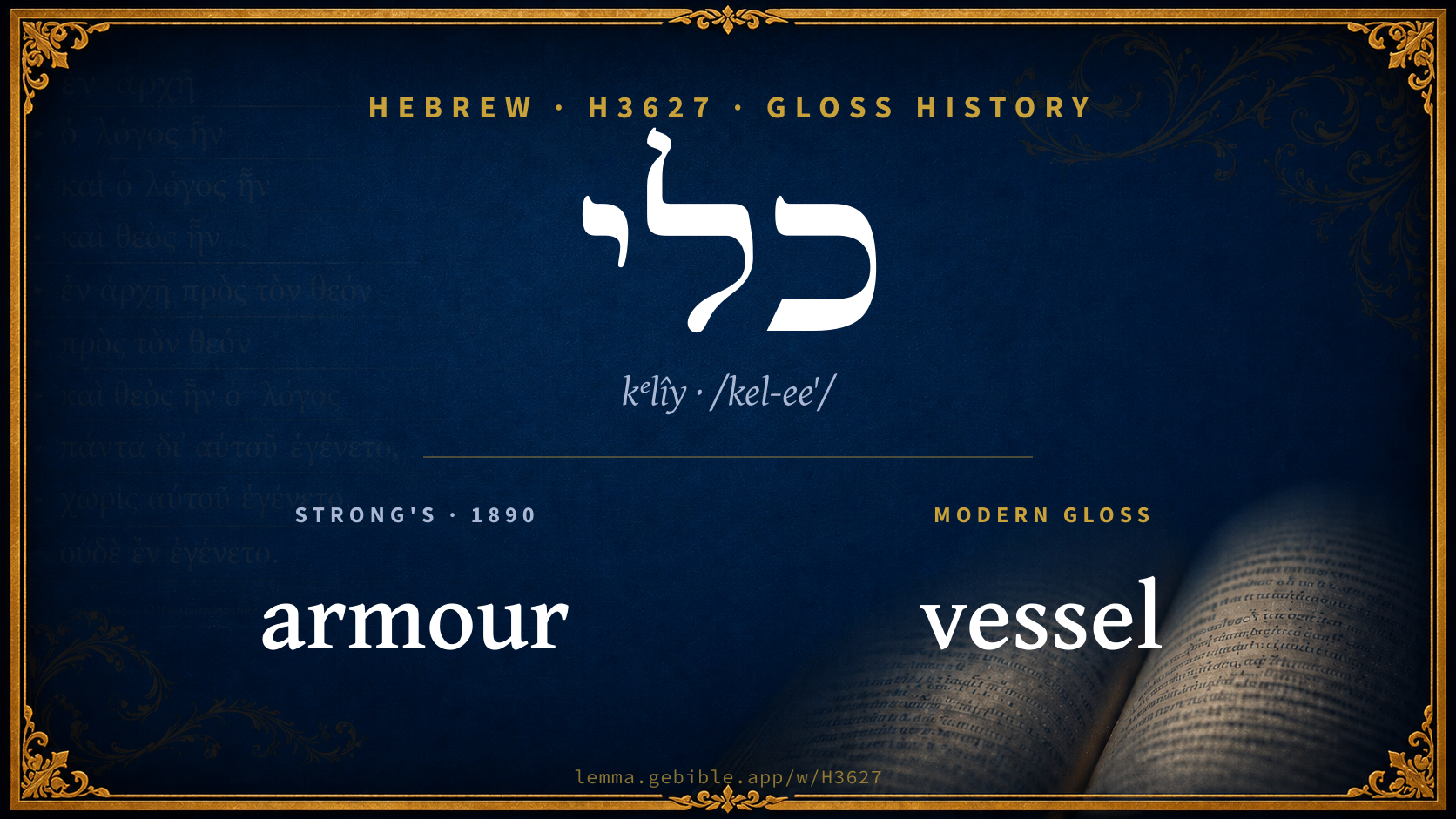
Gloss history
Strong's 1890 vs modern scholarship
About this word
Strong's H3627 catalogs a Hebrew word from the Hebrew Old Testament.
These counts are not copied from any lexicon or concordance. They are computed here, from the morphology-tagged Hebrew Old Testament. What Lemma adds →
- 276
- distinct verses
- The word appears in 276 distinct verses.
- 30 / 39
- OT books
- The word appears in 30 of 39 Old Testament books.
- #153
- by frequency
- Top 250 most frequent Hebrew words (rank 153 of 8,640 Hebrew words by occurrence).
View all 276 occurrences in the concordance →
Most concentrated in
- Exodus 28 verses 10%
- 1 Samuel 27 verses 10%
- 2 Chronicles 27 verses 10%
By section of the Old Testament
By traditional corpus
Conventional, traditional groupings — biblical authorship is debated, so this is a traditional corpus grouping, not an authorship claim. Each share is this word’s portion of its verses in that division of the Hebrew canon. Each figure is a share of the word’s 276 distinct verses.
- Prophets (Nevi'im) 120 verses · 43%
- Torah (Pentateuch) 83 verses · 30%
- Writings (Ketuvim) 73 verses · 26%
How translations render this word
Counts come from each version’s own published word-to-Strong’s tagging or interlinear alignment — an approximate guide to how each version renders this word, not a word-level alignment the data otherwise carries. Because each total is that version’s own tagged count, the per-version totals vary from one another and need not match the appearance or distinct-verse counts above. These counts may also differ from a printed concordance because Lemma counts each distinctly tagged rendering and does not collapse phrase taggings into a single head-word total. This is a fixed set of word-tagged versions (KJV, ASV, BSB, ULT) and does not change with the reading translation you choose elsewhere. Each version’s license is shown beside its name below (and on Sources).
BDB lists this Strong’s number as 2 distinct words (homographs). Each count above pools all of them and is not split by sense — see the Senses section below. A low-frequency rendering may belong to a different one of those words, not the primary meaning.
- King James Version†: Vessels 67×, All the vessels 34×, Vessel 24×
- American Standard Version†: Vessels 67×, All the vessels 31×, Vessel 22×
- Berean Standard Bible†: Articles 58×, Utensils 32×, Weapons 18×
- unfoldingWord Literal Text†: Vessels 46×, Vessels of 39×, Equipment 33×
King James Version Public Domain
Renders H3627 across 306† tagged occurrences — most commonly:
Plus other, less common renderings. Plus 61 renderings that appear only once — usually multi-word phrases or single function words the recovered tagging swept in, not distinct renderings. Not rendered by a distinct English word in 19 further occurrences.
American Standard Version Public Domain
Renders H3627 across 306† tagged occurrences — most commonly:
Plus other, less common renderings. Plus 82 renderings that appear only once — usually multi-word phrases or single function words the recovered tagging swept in, not distinct renderings.
Berean Standard Bible Public Domain
Renders H3627 across 282† tagged occurrences — most commonly:
Plus other, less common renderings. Plus 35 renderings that appear only once — usually multi-word phrases or single function words the recovered tagging swept in, not distinct renderings. Not rendered by a distinct English word in 43 further occurrences.
unfoldingWord Literal Text CC BY-SA 4.0
Renders H3627 across 326† tagged occurrences — most commonly:
Plus other, less common renderings. Plus 42 renderings that appear only once — usually multi-word phrases or single function words the recovered tagging swept in, not distinct renderings.
10 senses and sub-senses in the full BDB
What do BDB’s symbols mean?
BDB uses these scholarly abbreviations:
| Symbol | Meaning |
|---|---|
| 𝔊 | the Septuagint (the ancient Greek translation, LXX) |
| 𝔙 | the Vulgate (the Latin translation) |
| 𝔖 | the Syriac version (the Peshitta) |
| 𝔗 | the Targum (the Aramaic translation) |
| ψ | the Psalms |
| √ | root (the underlying root or stem) |
| ‖ | parallel passage (a synonymous or contrasted parallel) |
| † | the dagger: every passage where the word occurs is cited |
The 10 senses and sub-senses the full Brown-Driver-Briggs lexicon distinguishes for this word, in lexicon order (not ranked by frequency), with BDB’s own verbatim wording and sub-sense lettering. Shown in Hebrew script with BDB’s own scholarly abbreviations. The condensed entry is in the Lexicon Entry tab. See also the Forms in the corpus table below.
כלי I
- 1. in gen., article, object, made of any material, thing, especially thing of value כ׳ זָהָב 1 S 6:8, 15 (images of mice, etc.), personal or household property Gn 31:37(×2) (E; v b כֹּל כְּלֵי־בֵיתֶ֑ךָ), 45:20 (E), כִּלֵי בֵית־טוֹבִיָּהוּ Ne 13:8, Jos 7:11 (JE), כֶּסֶף אוֹ כֵּלִים Ex 22:6 (E) money or articles (property), כְּלִי־פָּ֑ז Jb 28:17 (appar. coll.); things carried, pl. = stuff, load, baggage (impedimenta) 1 S 17:22(×2), appar. = baggage-train 10:22; 25:13; 30:24 Is 10:28; (cf. Gn 31:37 supr.); כְּלֵי גוֹלָה things of exile, i.e. the most necessary articles, such as exiles may take, Je 46:19 Ez 12:3, 4b, 7b, cf. v 4a, 7a; = ornament or jewels Gn 24:53 (J כ׳ כֶסֶף וכ׳ זָהָב, prob. = ornaments), כ׳ כסף וכ׳ זהב also Ex 3:22; 11:2; 12:35 (all E); Is 61:10, Ex 35:22 Nu 31:50, כְּלֵי מַעֲשֶׂה v 51 (all P), כְּלִי יְקָר Pr 20:15 (in fig.), כ׳ תִפְאַרְתֵּךְ Ez 16:17, 39; 23:26 (all in fig.); כְּלֵי נְחשֶׁת as merchandise Ez 27:13; כֵּלִים as cargo of ship Jon 1:5; כסף וזהב וּכְלֵי נְחשֶׁת וּבַרְזֶל Jos 6:19, 24 (JE; spoil of war); of any household article (on which one sits) Lv 15:4, 6, 22, 23, 26 (all P); of skin Nu 31:20, or wood v 20 (P) כְּלִי חֶמְדָּה Na 2:10 precious thing, so Ho 13:15 (fig.), Je 25:34 (sim.), 2 Ch 32:27 Dn 11:8, כלי חֲמֻדוֹת 2 Ch 20:25 (appar. = ornaments); also כְּלִי אֵין־חֵפֶץ בּוֹ Je 22:28 (fig. of Coniah, ‖ עֶצֶב נִבְזֶה נָפוּץ), Ho 8:8 (sim.; cf. Je 48:38 infr.); †specif. of garments (one’s ‘things’): כְּלִי־גֶבֶר Dt 22:5 (‖ שִׂמְלַת אִשָּׁה), so כְּלִי־עוֹר Lv 13:49 (cf. מְלֶאכֶת עוֹר v 48), v 52, 53, 57, 58, 59 (all P). e.g. 1 Samuel 6:8
- 2. utensil, implement, apparatus:
- a. implement of hunting and (especially) war, = weapon Gn 27:3 (J), 1 S 20:40; 21:9 (גַּם חַרְבִּי וְגַם כֵּלַי), 1 K 11:8 = 2 Ch 23:7, 1 K 11:11 Is 54:16, 17 Je 22:7; prob. also Nu 35:22, כְּלִי בַּרְזֶל v 16, כְּלִי עֵץ־יָד v 18 (all P); כְּלֵי חָמָם Gn 49:5 (poem); כְּלִי מַשְׁחֵתוֹ Ez 9:1, כ׳ מַפָּצוֹ v 2; fig. of God’s weapons כְּלֵי־מָוֶת ψ 7:14 (‖ חִצָּיו); כ׳ זַעְמוֹ Is 13:5 Je 50:25; of entire equipment of warrior, armour or armament offensive and defensive 1 S 17:54 (cf. v 5 ff.), 21:6, 9 (v DrSm 139, 293), 31:9, 10 = 1 Ch 10:9, 10; hence (כֵּלָיו) נֹשֵׂא כֵלִים armour- or weapon-bearer Ju 9:54 1 S 14:1, 6, 7, 12(×2), 13(×2), 14, 17; 16:21; 31:4(×2), 5, 6 = 1 Ch 10:4(×2), 5, 2 S 18:15; 23:37 = 1 Ch 11:39; fig. וְכֵלַי כֵּלָיו רָעִים Is 32:7 and a knave, his weapons (i.e. devices, Che ‘machinations’) are evil; more precisely כְּלֵי מִלְחָמָה Ju 18:11, 16, 17 1 S 8:12 2 S 1:27 Dt 1:41 Je 21:4; 51:20 (fig.), Ez 32:27 1 Ch 12:34 (van d. H. v 33); כְּלֵי צְבָא מִלְחָמָה 1 Ch 12:38 (van d. H.) v 37); כְּלֵי קְרָב Ec 9:18; בֵּית כֵּלָיו 2 K 20:13 = Is 39:2 is perhaps armoury; כ׳ Ez 40:42 is sacrificial knife. e.g. Genesis 27:3
- b. instrument of music כְּלֵי (הַ)שִּׁיר Am 6:5 1 Ch 15:16; 16:42 2 Ch 5:13; 7:6 23:13; 34:12; כְּלֵי דָוִיד 29:26, 27, כ׳־שִׁיר דָּוִיד Ne 12:36; כְּלִי נֶבֶל ψ 71:22, כ׳ נְבָלִים 1 Ch 16:5; כֵּלִים alone 1 Ch 23:5, cf. Nu 31:6 (P כְּלֵי הַקֹּדֶשׁ);—for (ליהוה) בִּכְלֵי עֹז 2 Ch 30:21 read בְּכָל־עֹז (KauAT, cf. Be). e.g. Amos 6:5
- c. implement of labour, tool כ׳ בַרְזֶל 1 K 6:7, or of one’s calling, pursuit קַח־לְךָ כְּלִי רֹעֶה אֱוִלִי Zc 11:15 (otherwise 1 S 17:40, v 3). e.g. 1 Kings 6:7
- d. equipment of oxen (yoke, etc.) 2 S 24:22 1 K 19:21. e.g. 2 Samuel 24:22
- e. כְּלֵי רִכְבּוֹ 1 S 8:12 his chariot-equipments. e.g. 1 Samuel 8:12
- f. as gen. term for utensils and furniture of Sol.’s palace 1 K 10:21 = 2 Ch 9:20; especially (very often) of tabern. Ex 25:9, 39; 27:3 + (in Hex always P), and temple 1 K 7:45, 47, 48 2 K 12:14 +; of both palace and temple Je 27:18, 19, 21; combinations are כְּלֵי הַמִּשְׁכָּן Ex 27:19, כ׳ הַמִּזְבֵּחַ 38:3, כ׳ יהוה Is 52:11, כ׳ בֵית י׳ Je 27:16; 28:3, 6 Ezr 1:7, כְּלֵי חֶמְדַּת בֵּית י׳ 2 Ch 36:10, כ׳ בֵית אֱלֹהִים 2 Ch 28:24(×2); 36:18 Ne 13:9 Dn 1:2, כ׳ הַמִּקְדָּשׁ Ne 10:40; כ׳ הַשָּׁרֵת Nu 4:12 utensil of ministry, כ׳ עֲבֹדָתָם Nu 4:26 1 Ch 9:28; 28:14(×2), כ׳ עֲבוֹדַת בֵּית י׳ 1 Ch 28:13, כ׳ מִשְׁמֶרֶת מַשָּׂאָם Nu 4:32; also כ׳ הַקֹּדֶשׁ 1 K 8:4 1 Ch 9:29; of appliances of idol-worship 2 K 23:4. e.g. 1 Kings 10:21
- 3. >vessel, receptacle, of various materials and for various purposes Gn 43:11 (J); 1 S 9:7 Dt 23:25; = sack Gn 42:25 (E; שַׂק in ‖ cl., cf. אַמְתַּחַת v 27); כְּלִי הָרֹעִים shepherd’s bag or wallet 1 S 17:40, cf. v 49; כ׳ חֶרֶשׂ Je 32:14 is earthernware receptacle for deed of sale; for liquids 1 K 17:10 2 K 4:3(×2), 4, 6(×3), כ׳ מַשְׁקֶה 1 K 10:21 = 2 Ch 9:20, כְּלֵי שַׁמְנָהּ Nu 4:9, cf. v 10; וְלֹא הוּרַק מִכְּלִי אֶל־כֶּ֑לִי Je 48:11 (fig.), cf. v 12 (‖ נְבָלִים); for cooking Lv 6:21 (כ׳ חֶרֶשׂ), v 21 (כ׳ נְחשֶׁת); v also (הַ)יּוֹצֵר 2 S 17:28 Je 19:11 (sim.), ψ 2:9 (sim.), לַצֹּרֵף כֶּ֑לִי Pr 25:4; כ׳ פָתוּחַ Nu 19:15 an open (uncovered) vessel. כ׳ טָהוֹר Is 66:20 a clean vessel; fig. of Eliakim’s relatives כְּלֵי הַקָּטָ֑ן מִכְּלֵי הָאַגָּנוֹת וְעַד כָּל־כְּלֵי הַנְּבָלִים Is 22:24 the vessels of smallness (DaSynt. § 32, R 5), from the basin-vessels to all the pitcher-vessels. e.g. Genesis 43:11
- 4. specif. כְּלֵי־גֹמֶא Is 18:2 vessels (boats) of paper-reed. e.g. Isaiah 18:2
כלי II c., v. sub I. כלה.
Senses from the full Brown-Driver-Briggs lexicon (Brown, Driver, Briggs; Oxford 1906 — public domain), digitized via Sefaria, supplemented by the OpenScriptures HebrewLexicon (CC BY 4.0). Full attribution on Sources.
Word origin
I. n.m. Ho 8:8 article, utensil, vessel (NH id.; according to Thes from כלה = conficere, like Ger. Zeug from zeugen; proposes therefore anything finished, made, produced; according to BaZMG 1887, 605 from meaning enclose, contain; he finds pl. of כְּלִי in כלאי M-I23 (cf. כלאים))—כ׳ abs. Je 18:4 +; הַכֶּ֑לִי 1 S 17:49; 21:6; cstr. כְּלִי Ho 13:15 +; sf. כֶּלְיְךָ Dt 23:25; pl. כֵּלִים Ex 22:6 +; cstr. כְּלֵי Gn 24:53 +; sf. כֵּלַי Gn 31:37 + 2 times; כֵּלֶיךָ Gn 27:3 Ez 12:4; כֵּלֵינוּ 1 S 9:7; כְּלֵיכֶם Gn 43:11 +; כְּלֵיהֶם Jos 7:11 +;—
II. etc., v. sub I. כלה.
— Brown-Driver-Briggs (Oxford 1906, public domain), digitized via Sefaria, supplemented by the OpenScriptures HebrewLexicon (CC BY 4.0). See Sources.
Derived from כלה (kâlâh) (H3615) — to finish.
Jastrow Dictionary
A second Hebrew/Aramaic lexicon for comparison, covering Aramaic and post-biblical (Talmudic, Targumic, Midrashic) usage that the biblical-Hebrew BDB does not. Matched by lemma rather than by Strong’s number, so a lemma may carry more than one Jastrow headword (shown separately below), and the entries cover usage well beyond the Bible.
כְּלִי
- next w.)
- 1. vessel, receptacle; bag &c. B. Bath. 85ᵃ כֶּלְיוֹ של אדם וכ׳ a man’s vessel takes possession for him (of its contents). Ber. 23ᵃ כ׳ שהוא כֶלְיָין a receptacle which is intended for them (the T’fillin). Ib. כ׳ בתוך כ׳ one wrapper within the other. Y. Sabb. VII, 10ᵈ top הגודל כְּלִי צורה he who shapes an earthen vessel; הנופח כ׳ זכוכית who shapes a glass vessel by blowing; העושה כ׳ בדפוס who makes a vessel in a mould. Y. Ḥag. III, 79ᵃ top, a. fr. נזקקו לכֶילְיָין they are tied to their vessel, i.e. the vessel in which they are offered makes them to be considered one mass, though they are otherwise disconnected; Ḥag. III, 2 הכ׳ מצרף וכ׳. Mekh. Yithro, Amalek, 2 (ref. to Ex. XVIII, 19) היה להם ככ׳ מלא דברות be unto them like a vessel filled with divine revelations. Ab. d’R. N., II vers., ch. II, v. יָחַד. Mekh. Bo., beg. כלל לדברות; Tanḥ. Bo. 5 כלול לד׳ (read כלי) a vessel of revelation; a. fr.—Pl. כֵּלִים, constr. כְּלֵי. Ḥag. III, 1 כ׳ בתוך כ׳ vessels put into larger vessels. Kel. I, 1. Ib. II, 1; a. fr. e.g. Exodus 18:19
- 2. outfit, apparel, garment, tool, weapon. Pl. as ab. Keth. 59ᵇ כ׳ פשתן linen garments. Sabb. 114ᵃ כ׳ לבנים white garments; a. v. fr.—Gen. R. s. 90 (expl. Gen. XLI, 44) כ׳ ידים official badge of the hands (bracelets, rings &c.), כ׳ רגלים greaves &c.; (Ar. a. Rashi כלידרים, כלידרין, corrupt. of כלי ידים). Gen. R. s. 89 שאין עבד … כ׳ ידים (some ed. כלידים, Ar. כלידרין; Yalk. ib. 147 כלודי, corr. acc.) that no servant was to hold office or wear rings &c. (v. Sm. Ant. s. v. Annulus).—כלי זיין, v. זַיִין.—B. Mets. IX, 13 חייב משום שני כ׳ he is guilty of having seized two implements (the upper and the lower millstone). Ib. שני כ׳ two objects of use (a mattress and a plough). B. Bath. V, 2 כֵּלָיו the outfit of the ass (saddle &c.); a. fr. e.g. Genesis 41:44
כלי
- v. כָּלַל)
- 1. to enclose; to restrain, keep back. Midr. Till. to Ps. CXIII לִכְלוֹת את המכה וכ׳ to ward this plague off from thee. Midd. IV, 6 כֹּלֵה עֹרֵב ‘keeping off the raven’, an arrangement of iron points on the roof of the Temple; Sabb. 90ᵃ כּוֹלֵי עורב (pl.) Ms. M. (ed. כַּלְיָיא ch.; v. Rabb. D. S. a. l. note); Men. 107ᵃ כולי Ms. M. (ed. כַּלְיָה); M. Kat. 9ᵃ כולי Ms. M. (ed. כליא); Arakh. 6ᵃ כליה.—Part. pass. כָּלוּי. Y. Naz. II, beg. 51ᵈ כ׳ אני ממנו I will be restrained from it (for ‘I will abstain’).
- 2. (cmp. שלם) to be full, to be finished, to cease. Ber. 39ᵃ צריך שתִּכְלֶה ברכה וכ׳ the benediction must be finished simultaneously with breaking the bread. Tanḥ. Ki Thissa 5 כבר כָּלוּ ישראל וכ׳ Israel would have ceased to exist; (Pesik. Shek., p. 13ᵇ חיו … מְכוּלִּין, v. infra). Snh. 97ᵇ כלו כל הקצין all the predicted terms of redemption are ended (have passed by); a. fr.—[Pesik. R. s. 12 מת וכלה בקבר, read: ובלה.]—Part. (fr. כּוּל, cmp. חוּל, part. חולות a. חלות) כָּל. Snh. 17ᵃ (ref. to כלאם, Num. XI, 28) הטל … והן כָּלִין מאליהם throw upon them the care for the public, and they will cease (to prophesy) of themselves; a. fr. e.g. Numbers 11:28
- 1. to finish, cease. Yoma 60ᵇ (ref to Lev. XVI, 20) אם כפר כ׳ when he has atoned (for the sanctuary &c.), he has finished (his task). Ib. אם כ׳ כפר when he has done all (the prescribed ritual), he has achieved atonement; Sifra Aḥăré ch. IV, Par. 4; a. e.—Tanḥ. Vayetse 2 מְכַלִּין את שדותיהן they reap their fields entirely (leaving no corners for the poor). Snh. 67ᵇ כַּלֵּה מִדַּבְּרוֹתֶיךָ ולך וכ׳ (some ed. כלך, v. Rab. D. S. a. l. note) cease from thy homiletical interpretations, and turn to &c.; Midr. Till. to Ps. CIV, 6; Ex. R. s. 10, v. כַּלֵּךְ. e.g. Leviticus 16:20
- 2. to finish, destroy. Y. Shek. VI, 50ᵇ top (ref. to מכלות, II Chr. IV, 21) הן כִּילּוּ וכ׳ they (these vessels) consumed all the gold (of the country); Men. 29ᵃ שכִּילַּתּוֹ וכ׳ it consumed &c. Pesik. R. s. 2 שכי׳ אותה וכ׳ whom the Lord destroyed. Num. R. s. 3 היה הארון מְכַלֶּה בבני וכ׳ the Ark made havoc among the sons of Kehath (who had charge of it; cmp. II Sam. VI, 7). Mekh. B’shall., Amalek, s. 2 לכַלָּן to destroy them. Y. Ḥag. II, 78ᵃ bot. (cited in Tosaf. to Ḥag. 17ᵇ a. v. אלא) ובלבד שיְכַלֶּה עיסתו (ed. שיבלים) provided he has used up all his dough for the day; a. fr.—Part. pass. מְכוּלֶּה, pl. מְכוּלִּין. Pesik. Shek., p. 13ᵇ כבר היו ישראל מ׳ וכ׳ Israel would then have been destroyed; a. e. e.g. 2 Chronicles 4:21
- to be destroyed, visited by death. Num. R. s. 5 היו מִתְכַּלִּין they were diminished. Ib. שלא יִתְכַּלּוּ מן וכ׳ that they may not be destroyed from the world. Num. R. s. 3 לא נ׳ וכ׳ not one of them was missing on being counted &c.; a. e.
כְּלֵי
- 1. to keep enclosed, to withhold, restrain. Targ. I Sam. VI, 10. Targ. Ps. XXI, 3. Targ. Is. XXXIII, 15 כָּלֵי (ed. Wil. כָּל) restrains his eyes. Targ. Prov. XI, 26 כָּאלֵא ed. Lag.; ib. XVII, 28 כָּאלֵי ed. Lag.—Part. pass. כְּלֵי. Targ. Jer. XXXII, 2; (Targ. Ps. LXXXVIII, 9 כָּלוּא, h. form).—Sabb. 57ᵇ כַּלְיָא פרוחי, v. בִּזְיוּנָא I; [Var. Ar. דידבי, reminiscence fr. Nidd. 17ᵃ, v. בָּאלֵי.]—כַּלְיָא עורב, v. preced.
- 2. to be finished, gone. Ber. 39ᵃ כַּלְיָא ברכה the benediction is finished &c., v. preced. B. Mets. 79ᵃ וקא כליא קרנא and the capital itself is used up (v. infra). Yoma 69ᵇ כ׳ עלמא the world would come to an end; a. fr.
- 3. (cmp. שלם) [to be entirely with,] to trust. Targ. Ps. XXXI, 7. Ib. 25 כַּלְיָין (ed. Lag. a. oth. כיילין, corr. acc.). Ib. XXXII, 10; a. e.; v. תְּכַל. [Differ. fr. b. h. כָּלָה to be consumed by anxiety, to long, die for.]
- to lock up, restrain. Targ. II Chr. VII, 13.—Kidd. 81ᵇ מַכְלֵי להו מִכּוּלָּהּ וכ׳ Ar. a. Tosaf. (ed. מכלליה, read: מכלי ליה) kept the cattle off from the entire field (in which he walked); (ed.: kept himself aloof from the entire pasture ground). B. Bath. 5ᵃ, v. next w.
- to destroy, use up, diminish. B. Mets. l. c. מְכַלִּינָן קרנא (when hiring the usufruct of an object,) we are permitted to use up the stock itself, e.g. if you hired an ass for travelling, and it died on the road, you may sell its carcass, and hire another ass for the money; ib. לא מכ׳ קרנא we must not use up the stock, i.e. you may buy another ass for the carcass, but not hire one. Ib. Ms. M. לכַלּוּיֵי קרנא לא חיישינן (v. Rabb. D. S. a. l. note 8) and as for using up the stock, we need not take that into consideration. B. Kam. 3ᵃ דמְכַלְּיָא קרנא when the obnoxious subject destroys the object itself (not only the fruits).
- to be closed up, withheld; to refrain. Targ. O. Gen. VIII, 2. Targ. Prov. III, 27; a. fr.
כְּלֵי ²
- , Af. אַכְלֵי (v. preced.) [to assemble, call together (cmp. אוֹכְלוֹסָא),]
- 1. to call, give a signal. Targ. Jer. I, 15. Targ. Zeph. II, 15; a. e.
- 2. (of the lion) to roar; to shout, thunder &c. Targ. Ps. CIV, 21, v. אַכְלִי. Ib. XXIX, 3. Ib. LXXIV, 4; a. e.—B. Bath. 5ᵃ עיזא בעלמא אַכְלוּיֵי מַכְלִינָן בה v. Ar. s. v. כל; (incorr. in eds. לאו לאכלויי בעיא) as to a goat, we need only shout at her (to drive her off). Ib. ולאו גברא בעי לאכלויי Rashi (ed. דמיכלי, read דמַכְלֵי) and need you not a man to shout at her?; [oth. opin. we need only keep her off, v. preced.]
A Dictionary of the Targumim, the Talmud Babli and Yerushalmi, and the Midrashic Literature (Marcus Jastrow; London, Luzac, 1903) — Public Domain. Digitized via Sefaria. Digitized via Sefaria. Full attribution on Sources.
Forms in the corpus
The 128 distinct written forms H3627 takes in the Hebrew Bible, most frequent first — each parse links to that state’s occurrences in the concordance. Hebrew forms include their vowel points and cantillation, so a single lemma takes many written forms.
The 60 most common forms are shown; 68 rarer forms follow in the full concordance.
Same root — word family
Other BDB entries built from the same root as H3627, grouped by Strong’s listed origin. These share a root / origin per the lexicon — not necessarily a shared meaning. Each links to that word’s own entry.
Derives from
Shares the same root
- כלה kâleh H3616 longing
- כלה kâlâh H3617 completion
- כליון killâyôwn H3631 pining
- מכלה miklâh H4357 perfection
- תכלה tiklâh H8502 perfection
- תכלית taklîyth H8503 end
Derived from this word
Proper names from this root
People and places named from this root — a name, not an additional meaning of the word.
Compare all same-root words → Showing 4 of 10 — not the complete family. 1 of the same-root words is a proper name (a person or place). They share a root, not necessarily a meaning.
Septuagint verse parallels
This word appears in 252 verses that also exist in the Greek Old Testament (Septuagint), out of the 276 Hebrew verses it occurs in. You can read those verses in Greek by switching the Old Testament edition to the Septuagint.
Read these verses in the Septuagint
- Genesis 24:53
- Exodus 3:22
- Leviticus 8:11
- Numbers 1:50
- Deuteronomy 1:41
- Joshua 6:19
- Judges 9:54
- Ruth 2:9
- 1 Samuel 6:8
- 2 Samuel 1:27
- 1 Kings 6:7
- 2 Kings 4:3
This is a verse-level parallel only — the same verses exist in both the Hebrew and Greek Old Testaments. No word-level Hebrew↔Greek correspondence is claimed: the data carries no such alignment, so no Greek word is shown as this Hebrew word’s translation. Coverage is not total — the Septuagint omits the deuterocanon and renumbers the Psalms, so some Hebrew verses have no direct Greek parallel.