

Psalms 78:33

Hebrew (Westminster Leningrad Codex) Psalms 78:33 appears in the Hebrew Old Testament. The text above is from the Westminster Leningrad Codex. Each word links to its Strong’s number, a concise gloss, and parsing drawn from the Open Scriptures Hebrew Bible morphology. Click any word for its full Brown-Driver-Briggs (BDB) entry.
Download image
Cite this verse

Psalms 78:33 (World English Bible). Public Domain. Lemma interlinear Bible study tool, https://lemma.gebible.app/v/psalms/78/33.

Show BibTeX & RIS
BibTeX
RIS
English Translation
Therefore he consumed their days in vanity, And their years in terror.
World English Bible · Public Domain
Download a study sheet

One document with this verse’s original text, its word-by-word gloss line, the meaning frame, cross-references with their text, attributed commentary, and full source and license credits — printable, and it pastes into notes with its structure intact.

This verse Autodidact and up

Study sheet (.html) Plain text (.txt)

A passage Seminary Student

Up to 50 verses in one chapter. A passage sheet keeps up to 6 commentary sources and 12 cross-references per verse, in the order this page ranks them, and says so on the sheet whenever that leaves anything out. Ask for a single verse and you get the Autodidact verse sheet above.

Everything on this page stays free to read, with no account — the sheet is a download of what is already on screen, not access to it.

Want to remove ads? Support Godless Engineer
Compare translations 3

The same verse in 3 English versions, stacked beneath the original-language interlinear above. Click any original word for its lexicon entry.

Each is an independent rendering of the whole verse — the interlinear is not word-aligned to these translations.

Highlighted words mark where these versions differ — a whole-verse word diff, not a word-by-word alignment.

  • World English Bible Public Domain
    Therefore he consumed their days in vanity, And their years in terror.
  • King James Version Public Domain
    Therefore their days did he consume in vanity, and their years in trouble.
  • unfoldingWord Literal Text CC BY-SA 4.0
    So he consumed their days in a vapor, and their years in terror.

unfoldingWord Literal Text — © unfoldingWord, licensed CC BY-SA 4.0. Word-aligned USFM3 via Door43 (git.door43.org/unfoldingWord/en_ult).

Versions to compare (up to 4)

3 of 4 selected

Show all 18 translations

Every available English version of this verse, each an independent rendering of the whole verse.

  • World English Bible Public Domain
    Therefore he consumed their days in vanity, And their years in terror.
  • Berean Standard Bible Public Domain
    So He ended their days in futility, and their years in sudden terror.
  • Majority Standard Bible Public Domain
    So He ended their days in futility, and their years in sudden terror.
  • King James Version Public Domain
    Therefore their days did he consume in vanity, and their years in trouble.
  • American Standard Version (1901) Public Domain
    Therefore their days did he consume in vanity, And their years in terror.
  • Revised Version (1885) Public Domain
    Therefore their days did he consume in vanity, and their years in terror.
  • Geneva Bible (1599) Public Domain
    Therefore their daies did hee consume in vanitie, and their yeeres hastily.
  • Douay-Rheims (1899) Public Domain
    And their days were consumed in vanity, and their years in haste.
  • Young's Literal Translation Public Domain
    And He consumeth in vanity their days, And their years in trouble.
  • Literal Standard Version CC BY-SA 4.0
    And He consumes their days in vanity, || And their years in trouble.
  • Unlocked Literal Bible CC BY-SA 4.0
    Therefore God cut short their days; their years were filled with terror.
  • unfoldingWord Literal Text CC BY-SA 4.0
    So he consumed their days in a vapor, and their years in terror.
  • Darby Bible Public Domain
    And he consumed their days in vanity, and their years in terror.
  • World Messianic Bible Public Domain
    Therefore he consumed their days in vanity, and their years in terror.
  • Webster's Bible Public Domain
    Therefore their days did he consume in vanity, and their years in trouble.
  • Free Bible Version CC BY-SA 4.0
    So he snuffed out their futile lives, bringing them to an end in terror.
  • Bible in Basic English Public Domain
    So their days were wasted like a breath, and their years in trouble.
  • JPS Tanakh (1917) Public Domain
    Therefore He ended their days as a breath, and their years in terror.

Literal Standard Version (2020), Covenant Press — licensed CC BY-SA 4.0. Text via the HelloAO Bible API (eBible.org). Unlocked Literal Bible (unfoldingWord) — licensed CC BY-SA 4.0. Text via the HelloAO Bible API (eBible.org). unfoldingWord Literal Text — © unfoldingWord, licensed CC BY-SA 4.0. Word-aligned USFM3 via Door43 (git.door43.org/unfoldingWord/en_ult). Free Bible Version, Dr. Jonathan Gallagher — licensed CC BY-SA 4.0. Text via the HelloAO Bible API (eBible.org).

Word by word

More ways to search: Search by grammar → Find every occurrence → Compare this word →

Practice this passage: Drill this verse → Learn its vocabulary →

About this verse

These counts appear in no published source. They are computed here, from the morphology-tagged text and Lemma’s own curated glosses. What Lemma adds →

5
words
5
distinct lemmas
Wisdom
section

Notable vocabulary

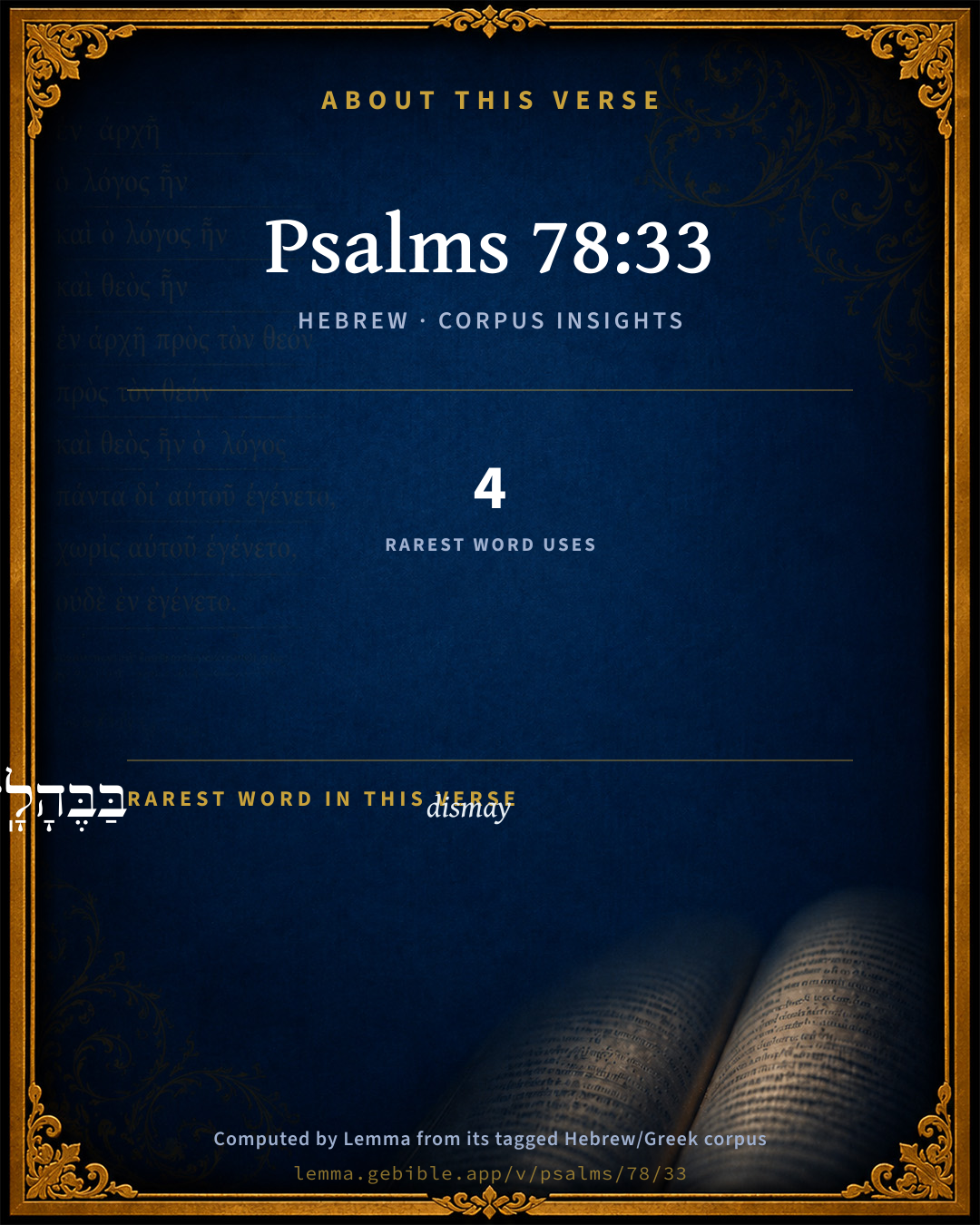
The rarest word here is בַּבֶּהָלָֽה dismay H928 — appearing just 4 times in the whole Hebrew Bible.

Shared distinctive vocabulary

בַּבֶּהָלָֽה dismay H928 occurs in 4 verses of the Hebrew Bible. Also found in:

Grammatical profile

  • 1 verb
  • 4 nouns

Verb forms

  • וַיְכַל Piel · Sequential Imperfect

Hebrew & Septuagint length

In English translation the verse runs 12 words from the Hebrew and 12 from the Septuagint (LXX English) — the same length.

A rough comparison of the two English renderings, which tokenize alike — not a word-level alignment.

Word counts can differ between the Hebrew and the Greek without any difference in meaning — e.g. the Hebrew direct-object marker אֵת has no separate Greek word, and Greek often adds the article ὁ.

Cross-references

12

Topical passages linked to Psalms 78:33 in the Treasury of Scripture Knowledge — connected by theme and wording, ordered by reader-vote popularity; previews shown in the World English Bible.

  • Numbers 14:35 I, Yahweh, have spoken, surely this will I do to all this evil congregation, who are gathered together against me: in this wilderness they shall be consumed, and there they shall die.
  • Numbers 14:29 your dead bodies shall fall in this wilderness; and all who were numbered of you, according to your whole number, from twenty years old and upward, who have murmured against me,
  • Numbers 26:64–65 But among these there was not a man of them who were numbered by Moses and Aaron the priest, who numbered the children of Israel in the wilderness of Sinai.
  • Ecclesiastes 12:13–14 This is the end of the matter. All has been heard. Fear God, and keep his commandments; for this is the whole duty of man.
  • Genesis 3:16–19 To the woman he said, "I will greatly multiply your pain in childbirth. In pain you will bring forth children. Your desire will be for your husband, and he will rule over you."
  • Deuteronomy 2:14–16 The days in which we came from Kadesh-barnea, until we were come over the brook Zered, were thirty-eight years; until all the generation of the men of war were consumed from the midst of the camp, as Yahweh swore to them.
  • Job 5:6–7 For affliction doesn't come forth from the dust, Neither does trouble spring out of the ground;
  • Job 14:1 "Man, who is born of a woman, Is of few days, and full of trouble.
  • Psalms 90:7–9 For we are consumed in your anger. We are troubled in your wrath.
  • Ecclesiastes 1:2 "Vanity of vanities," says the Preacher; "Vanity of vanities, all is vanity."
  • Ecclesiastes 1:13–14 I applied my heart to seek and to search out by wisdom concerning all that is done under the sky. It is a heavy burden that God has given to the sons of men to be afflicted with.
  • Ecclesiastes 12:8 Vanity of vanities, says the Preacher; All is vanity!

Cross-references courtesy of OpenBible.info (CC BY 4.0).

Hebrew and Greek witnesses Masoretic Hebrew ↔ Greek Septuagint

The same verse in the two great witnesses to the Old Testament, shown verse-for-verse.

You’re reading Greek Psalm 77 (Hebrew Psalm 78). The Septuagint counts the superscription, so verse numbers can differ from the Hebrew — chapter-level alignment, not verse-by-verse. Numbering follows Rahlfs.

These are two independent witnesses, not word-aligned to each other, and the Septuagint is shown in lemma (dictionary) form.

Hebrew Psalms 78:33 Masoretic · Westminster Leningrad Codex

וַיְכַל בַּהֶ֥בֶל יְמֵיהֶ֑ם וּ֝שְׁנוֹתָ֗ם בַּבֶּהָלָֽה

Therefore he consumed their days in vanity, And their years in terror.

World English Bible · Public Domain

Greek LXX Greek Psalm 77:33 Septuagint · lemma form

καί ἐκλείπω ἐν ματαιότης ὁ ἡμέρα αὐτός καί ὁ ἔτος αὐτός μετά σπουδή

And their days were consumed in vanity, and their years with anxiety.

LXX2012 (modern English Septuagint) · Public Domain

Hebrew: Westminster Leningrad Codex (CC BY 4.0). Greek: Septuagint (public domain); English from LXX2012 (modern English Septuagint) (Public Domain). How the Septuagint differs from the Hebrew →

Commentary

Notes on Psalms 78:33 from classic Christian and Jewish commentators (each source and its license shown beneath its notes). The classic Christian expositions comment on the surrounding passage and are grouped to its opening verse, so a note may address several verses; the Jewish commentaries on the Tanakh (Rashi and others) are per-verse, so they appear only where the commentator wrote on this verse.

Lemma curates 59 commentaries, every one of them public domain or Creative Commons licensed, each selected and text-cleaned for this edition rather than reprinted as found. About our sources →

Trapp's Complete Commentary

John Trapp

Psa 78:33 Therefore their days did he consume in vanity, and their years in trouble.

Ver. 33. Therefore their days did he consume in vanity] So that they never saw the promised land, for the which they came out of Egypt; but their carcasses fell in the wilderness. Who knoweth, saith a reverend man, whether God purpose not to wear out this present generation that hath been defiled with the superstition of the world, that we may not see the good that he will bring upon this Church?

And their years in trouble] Or, in terror, for they were in continual fear of God’s wrath, of their enemies round about, of wild beasts, fiery serpents, &c.

John Trapp, A Commentary or Exposition upon All the Books of the Old and New Testament (1647–1656) — public domain. Text from a community e-Sword module.

Joseph Benson's Commentary

Psa 78:33. Their days did he consume in vanity — In tedious and fruitless marches hither and thither, sometimes forward and sometimes backward, which they knew would never bring them, in their own persons, to their promised and much desired land; and their years in trouble — In manifold diseases, dangers, and perplexities. In such vanity and trouble were they condemned, by an irreversible doom, for their unbelief, distrust of God, their murmurings and rebellions against him, their idolatries and other sins, to wear out thirty-eight tedious years in that wilderness, which indeed were consumed in it: for in all those years there was not one step taken nearer Canaan, nor one stroke struck toward the conquest of it. Observe, reader, those that sin still must expect to be in trouble still; and the reason why we spend our days in so much vanity and trouble, why we live with so little comfort, and to so little purpose, is because we live in sin, or do not live by faith.

Joseph Benson's Commentary on the Old and New Testaments (1811–1818) — public domain. Text from a community e-Sword module.

J. A. Alexander on Psalms

Joseph Addison Alexander

33. (Psa 78:33) And (therefore) he wasted in vanity their days and their years in terror. As the preceding verse relates to the refusal of the people to go up against the Canaanites in the first year of the exodus, so this relates to the forty years of error in the wilderness, by which that refusal was at once indulged and punished. The fruitless monotony of their existence during this long period, and their constant apprehension of some outbreak of divine wrath, are expressed here by the words translated vanity and terror. The meaning of the verb is that he suffered or caused their years to be thus unprofitably and miserably spent. Compare Psa 73:19.

Joseph Addison Alexander, The Psalms Translated and Explained (1850) — public domain. Text from a community e-Sword module.

Tyndale Open Study Notes

Tyndale Open Resources

78:33 An entire generation died in the wilderness (Num 14:22-23, 28-35).

Tyndale Open Study Notes — © Tyndale Open Resources, licensed CC BY-SA 4.0. Text via the HelloAO Bible API.

Adam Clarke's Commentary

Verse 33. Their days did he consume in vanity] By causing them to wander forty years in the wilderness, vainly expecting an end to their labour, and the enjoyment of the promised rest, which, by their rebellions, they had forfeited.

Adam Clarke's Commentary on the Bible (1810–1826) — public domain. Text from a community e-Sword/MySword module.

John Calvin's Commentaries

33. And he consumed their days in vanity. As the Psalmist here speaks of the whole people, as if he had said, that all without exception were speedily consumed, from the least even to the greatest, this might with probability be referred to that most grievous punishment which was confirmed and ratified by the wrath of God — that they should all perish in the wilderness with only two exceptions, Joshua and Caleb; because, when already near the land of Canaan, they had turned back. That vast multitude, therefore, after they had shut against themselves the door of entrance into the Holy Land, died in the wilderness during the course of forty years. Days are put in the first place, and then years; by which it is intimated, that the duration of their life was cut short by the curse of God, and that it was quite apparent that they failed in the midst of their course. Their days then were consumed in vanity; for they vanished away like smoke: and their years in haste, because they passed swiftly away like a stream. The word בהלה, behalah, here translated haste, is by some rendered terror. I would rather prefer reading tumult; for it is undoubtedly meant that their life was taken away, as when in a tumult any thing is taken by force. But I would not be disposed to change the word haste, which brings out the meaning more perspicuously. It was a display of righteous retribution, on account of their obstinacy, that their strength which made them proud, thus withered and vanished all on a sudden as a shadow.

John Calvin's Commentaries (1540-1563) — public domain. Text from the Calvin Translation Society English edition (1840s-50s) via the Christian Classics Ethereal Library (ccel.org). Calvin's coverage is partial (roughly two-thirds of the Bible); uncommented books and verses are honest gaps, never fabricated. The 19th-century editor's footnotes and remarks are omitted so the notes are faithfully Calvin's own voice.

The Cambridge Bible for Schools and Colleges

gen. ed. J. J. S. Perowne

33. in vanity … in trouble] Or, as a breath, unsubstantial and transitory (Psa_39:5; Psa_39:11; Psa_62:9): with sudden terror (Lev_26:16).

The Cambridge Bible for Schools and Colleges (gen. ed. J. J. S. Perowne; Cambridge University Press, 1878–1918) — public domain. Text from a community e-Sword module.

John Gill's Exposition

When he slew them,.... Some of them, the spies particularly; or when he threatened to slay them, or was about to do it:

then they sought him; that is, those who either survived the slain, or were threatened with destruction; these sought the Lord by prayer and supplication, that he would not destroy them; the Targum is,

"they repented and sought him;''

see Num 14:37,

and they returned; from their evil ways, and by repentance, at least in show and appearance:

and inquired early after God; but not earnestly, and with their whole hearts and spirits; the Targum is,

"they prayed before God;''

which is often done, by carnal professors, in trouble; see Isa 26:16, Hos 5:15.

John Gill's Exposition of the Whole Bible (1746–1763) — public domain (CC PDM 1.0). Text via the HelloAO Bible API.

Albert Barnes' Notes on the Bible

Therefore their days did he consume in vanity - He suffered them to spend their days - the days of that entire generation - in vain and fruitless wanderings in the desert. Instead of leading them at once to the promised land, they were kept there to wear out their life in tedious monotony, accomplishing nothing - wandering from place to place - until all the generation that had come out of Egypt had died.

And their years in trouble - literally, “in terror.” Amidst the troubles, the alarms, the terrors of a vast and frightful desert. Sin - rebellion against God - leads to a course of life, and a death, of which these gloomy, sad, and cheerless wanderings in the desert were a striking emblem.

Albert Barnes' Notes on the Bible (1834–1885) — public domain. Text from a community e-Sword/MySword module.

Matthew Poole's English Annotations

In vanity; in tedious and fruitless marches hither and thither, sometimes forward, and sometimes backward, which they knew would never bring them in their own persons to their promised and much-desired land.

In trouble; in manifold diseases, dangers, perplexities, and horrors of their own minds and consciences.

Matthew Poole's English Annotations on the Holy Bible (1683–1685) — public domain. Text from a community e-Sword/MySword module.

The Treasury of David

Charles H. Spurgeon

Ver. 33. Therefore their days did he consume in vanity. Apart from faith life is vanity. To wander up and down in the wilderness was a vain thing indeed, when unbelief had shut them out of the promised land. It was meet that those who would not live to answer the divine purpose by believing and obeying their God should be made to live to no purpose, and to die before their time, unsatisfied, unblessed. Those who wasted their days in sin had little cause to wonder when the Lord cut short their lives, and sware that they should never enter the rest which they had despised.

And their years in trouble. Weary marches were their trouble, and to come to no resting place was their vanity. Innumerable graves were left all along the track of Israel, and if any ask, "Who slew all these?" the answer must be, "They could not enter in because of unbelief." Doubtless much of the vexation and failure of many lives results from their being sapped by unbelief, and honeycombed by evil passions. None live so fruitlessly and so wretchedly as those who allow sense and sight to override faith, and their reason and appetite to domineer over their fear of God. Our days go fast enough according to the ordinary lapse of time, but the Lord can make them rust away at a bitterer rate, till we feel as if sorrow actually ate out the heart of our life, and like a canker devoured our existence. Such was the punishment of rebellious Israel, the Lord grant it may not be ours.

Ver. 33. Their days did he consume in vanity. He says with great significance, In vanity their days were consumed, because they were plainly deprived of their hope, and endured all their sufferings in vain. They did not attain what they had hoped for, but only their children entered the land. Mollerus.

Ver. 33. Days are put in the first place, and then years; by which it is intimated, that the duration of their life was cut short by the curse of God, and that it was quite apparent that they failed in the midst of their course. John Calvin.

None.

Psalms 78:34*

Charles H. Spurgeon's The Treasury of David (1869–1885) — public domain. Psalms only. Text from a community e-Sword/MySword module.

Whedon's Commentary on the Bible

Daniel D. Whedon

33. Their days did he consume in vanity—During the thirty-eight years of their wandering, after the sentence of Num_14:28-35, nothing is recorded of them except the conspiracy of Korah and his company, and a few camp stations. Vanity and trouble fill up the monotonous record. Psa_90:9

Daniel D. Whedon (gen. ed.), Commentary on the Old and New Testaments (1874–1909) — public domain. Text from a community e-Sword module.

The Pulpit Commentary

Therefore their days did he consume in vanity, and their years in trouble. Their faithlessness was punished by their forty years of vain and purposeless wandering in the wilderness, and by the "troubles" that befell them there.

The Pulpit Commentary (1880–1919), ed. H.D.M. Spence-Jones & Joseph S. Exell — public domain. Text from a community e-Sword module.

John Wesley's Explanatory Notes

Vanity - In tedious and fruitless marches hither and thither. Trouble - In manifold diseases, dangers, and perplexities.

John Wesley, Explanatory Notes Upon the Whole Bible (1754–1765) — public domain. Text via the GEBible commentary corpus.

unfoldingWord translationNotes

Door43 World Missions Community

General Information:

The writer continues telling of what God did to the Israelites.

cut short their days

Here the word "days" refers to a lifetime. The idiom "to cut short ... days" means to cause someone to die before they have lived a long life. AT: "killed them while they were still young" (See: Euphemism)

their years were filled with terror

Asaph speaks of years as if they were containers. AT: "year after year they were afraid all the time" (See: Metaphor)

to seek him

to ask him what they needed to do so he would protect them (See: Idiom)

afflicted them, they would ... they would return and look

These are different people from those whose days God "cut short." When some of them died, others would "start to seek" God.

would return

"would repent" or "would be truly sorry for their sins"

look earnestly

"look urgently" or "look as best they could"

translationWords

terror

afflicted

unfoldingWord translationNotes — © Distant Shores Media and the Door43 World Missions Community, licensed CC BY-SA 4.0. Source: git.door43.org/Door43/en_tn.

Lesson kit

Teaching starters — assembled from the data on this page, not authored interpretation. Every prompt links to the verse data it draws on. Edit before teaching.

Psalms, in the Wisdom, opens this verse with 5 words (5 distinct Hebrew lemmas). Its most distinctive word is behâlâh (“dismay”). A historical commentator’s framing appears above. Read the whole chapter for the surrounding context.

Discussion questions

  1. How does “dismay” (behâlâh) shape what this verse is saying?
  2. How does Leviticus 26:16, which shares the word «dismay», read alongside this verse?
  3. These translations render this verse differently. What is at stake in choosing one wording over another?
  4. «וַיְכַל» is a Piel Sequential Imperfect verb. How does that grammatical form shape the action described?
  5. Compare how Trapp's Complete Commentary and Joseph Benson's Commentary read this verse. Where do they agree or differ?

Things to notice

Reading settings

Reading text

Shown beneath each verse's original-language words.

Old Testament
Old Testament edition

Read the OT as the Masoretic Hebrew (MT) or the Greek Septuagint (LXX).

English shown for the Greek Septuagint (in the Hebrew ↔ Greek comparison).

Comparing translations? Open the Compare panel on any verse page to stack up to four side by side.