
1 Kings 8:54

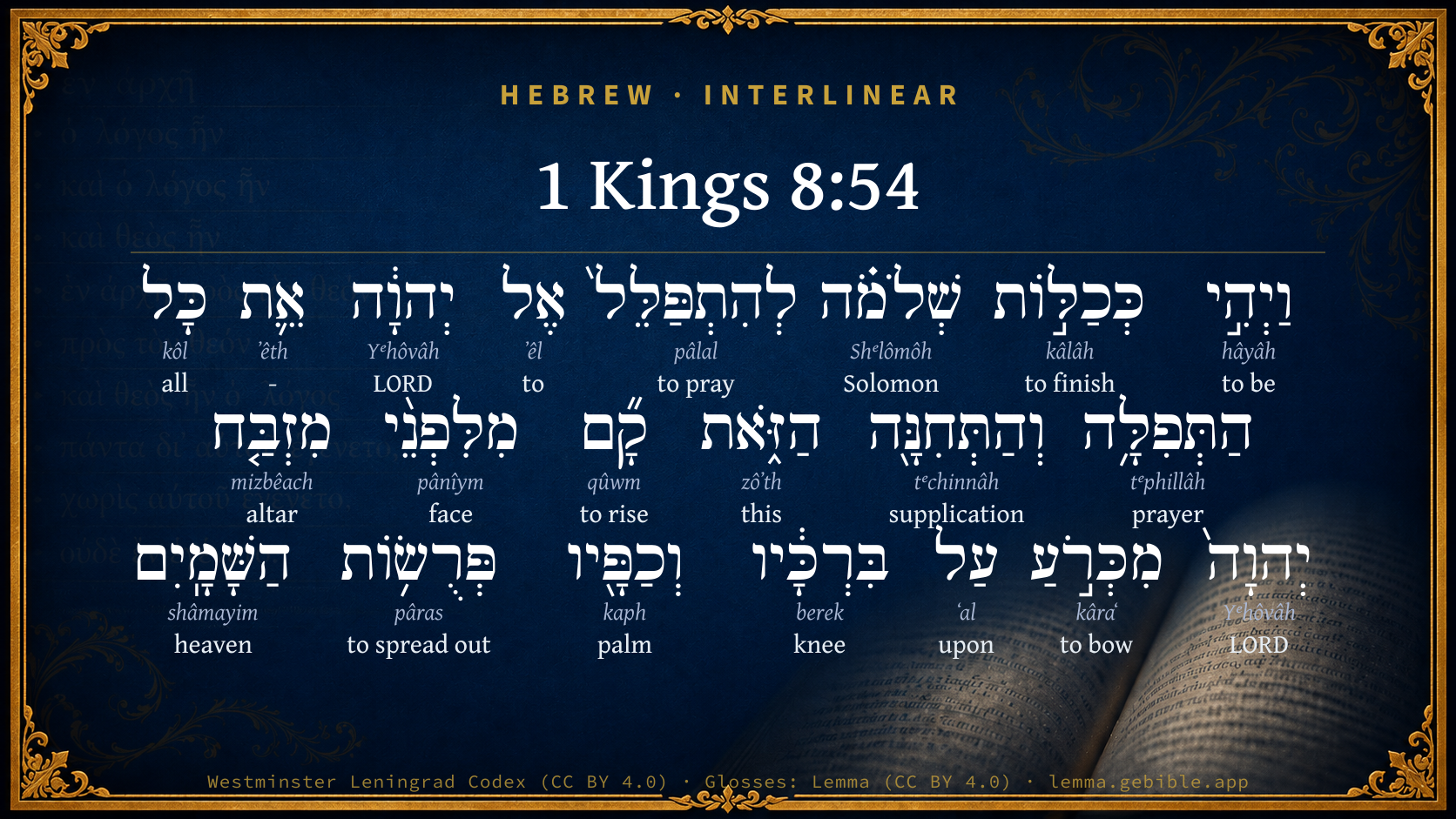
Hebrew (Westminster Leningrad Codex) 1 Kings 8:54 appears in the Hebrew Old Testament. The text above is from the Westminster Leningrad Codex. Each word links to its Strong’s number, a concise gloss, and parsing drawn from the Open Scriptures Hebrew Bible morphology. Click any word for its full Brown-Driver-Briggs (BDB) entry.
Download image
Cite this verse

1 Kings 8:54 (World English Bible). Public Domain. Lemma interlinear Bible study tool, https://lemma.gebible.app/v/1-kings/8/54.

Show BibTeX & RIS
BibTeX
RIS
English Translation
It was so, that when Solomon had made an end of praying all this prayer and supplication to Yahweh, he arose from before the altar of Yahweh, from kneeling on his knees with his hands spread forth toward heaven.
World English Bible · Public Domain
Download a study sheet

One document with this verse’s original text, its word-by-word gloss line, the meaning frame, cross-references with their text, attributed commentary, and full source and license credits — printable, and it pastes into notes with its structure intact.

This verse Autodidact and up

Study sheet (.html) Plain text (.txt)

A passage Seminary Student

Up to 50 verses in one chapter. A passage sheet keeps up to 6 commentary sources and 12 cross-references per verse, in the order this page ranks them, and says so on the sheet whenever that leaves anything out. Ask for a single verse and you get the Autodidact verse sheet above.

Everything on this page stays free to read, with no account — the sheet is a download of what is already on screen, not access to it.

Want to remove ads? Support Godless Engineer
Compare translations 3

The same verse in 3 English versions, stacked beneath the original-language interlinear above. Click any original word for its lexicon entry.

Each is an independent rendering of the whole verse — the interlinear is not word-aligned to these translations.

Highlighted words mark where these versions differ — a whole-verse word diff, not a word-by-word alignment.

  • World English Bible Public Domain
    It was so, that when Solomon had made an end of praying all this prayer and supplication to Yahweh, he arose from before the altar of Yahweh, from kneeling on his knees with his hands spread forth toward heaven.
  • King James Version Public Domain
    And it was so, that when Solomon had made an end of praying all this prayer and supplication unto the LORD, he arose from before the altar of the LORD, from kneeling on his knees with his hands spread up to heaven.
  • unfoldingWord Literal Text CC BY-SA 4.0
    And it happened that when Solomon finished praying to Yahweh all of this prayer and supplication, he arose from to the face of the altar of Yahweh, from kneeling on his knees with his palms spread out the heavens.

unfoldingWord Literal Text — © unfoldingWord, licensed CC BY-SA 4.0. Word-aligned USFM3 via Door43 (git.door43.org/unfoldingWord/en_ult).

Versions to compare (up to 4)

3 of 4 selected

Show all 18 translations

Every available English version of this verse, each an independent rendering of the whole verse.

  • World English Bible Public Domain
    It was so, that when Solomon had made an end of praying all this prayer and supplication to Yahweh, he arose from before the altar of Yahweh, from kneeling on his knees with his hands spread forth toward heaven.
  • Berean Standard Bible Public Domain
    Now when Solomon had finished praying this entire prayer and petition to the LORD, he got up before the altar of the LORD, where he had been kneeling with his hands spread out toward heaven.
  • Majority Standard Bible Public Domain
    Now when Solomon had finished praying this entire prayer and petition to the LORD, he got up before the altar of the LORD, where he had been kneeling with his hands spread out toward heaven.
  • King James Version Public Domain
    And it was so, that when Solomon had made an end of praying all this prayer and supplication unto the LORD, he arose from before the altar of the LORD, from kneeling on his knees with his hands spread up to heaven.
  • American Standard Version (1901) Public Domain
    And it was so, that, when Solomon had made an end of praying all this prayer and supplication unto Jehovah, he arose from before the altar of Jehovah, from kneeling on his knees with his hands spread forth toward heaven.
  • Revised Version (1885) Public Domain
    And it was so, that when Solomon had made an end of praying all this prayer and supplication unto the LORD, he arose from before the altar of the LORD, from kneeling on his knees with his hands spread forth toward heaven.
  • Geneva Bible (1599) Public Domain
    And when Salomon had made an ende of praying all this prayer and supplication vnto the Lord, he arose from before the altar of the Lord, from kneeling on his knees, and stretching of his handes to heauen,
  • Douay-Rheims (1899) Public Domain
    And it came to pass, when Solomon had made an end of praying all this prayer and supplication to the Lord, that he rose from before the altar of the Lord: for he had fixed both knees on the ground, and had spread his hands towards heaven.
  • Young's Literal Translation Public Domain
    And it cometh to pass, at Solomon's finishing to pray unto Jehovah all this prayer and supplication, he hath risen from before the altar of Jehovah, from bending on his knees, and his hands spread out to the heavens,
  • Literal Standard Version CC BY-SA 4.0
    And it comes to pass, at Solomon’s finishing to pray to YHWH all this prayer and supplication, he has risen from before the altar of YHWH, from bending on his knees and [having] his hands spread out to the heavens,
  • Unlocked Literal Bible CC BY-SA 4.0
    So it was that when Solomon had finished praying all this prayer and request to Yahweh, he arose from before the altar of Yahweh, from kneeling on his knees with his hands spread out toward the heavens.
  • unfoldingWord Literal Text CC BY-SA 4.0
    And it happened that when Solomon finished praying to Yahweh all of this prayer and supplication, he arose from to the face of the altar of Yahweh, from kneeling on his knees with his palms spread out the heavens.
  • Darby Bible Public Domain
    And it was so, that when Solomon had ended praying all this prayer and supplication to Jehovah, he arose from before the altar of Jehovah, from kneeling on his knees with his hands spread forth to the heavens,
  • World Messianic Bible Public Domain
    It was so, that when Solomon had finished praying all this prayer and supplication to the LORD, he arose from before the LORD’s altar, from kneeling on his knees with his hands spread out toward heaven.
  • Webster's Bible Public Domain
    And it was so, that when Solomon had made an end of praying all this prayer and supplication to the LORD, he arose from before the altar of the LORD, from kneeling on his knees, with his hands spread up to heaven.
  • Free Bible Version CC BY-SA 4.0
    After Solomon finished praying all these prayers and requests to the Lord, he stood up before the altar of the Lord, where he had been kneeling with his hands held out toward heaven.
  • Bible in Basic English Public Domain
    Then Solomon, after making all these prayers and requests for grace to the Lord, got up from his knees before the altar of the Lord, where his hands had been stretched out in prayer to heaven;
  • JPS Tanakh (1917) Public Domain
    And it was so, that when Solomon had made an end of praying all this prayer and supplication unto the LORD, he arose from before the altar of the LORD, from kneeling on his knees with his hands spread forth toward heaven.

Literal Standard Version (2020), Covenant Press — licensed CC BY-SA 4.0. Text via the HelloAO Bible API (eBible.org). Unlocked Literal Bible (unfoldingWord) — licensed CC BY-SA 4.0. Text via the HelloAO Bible API (eBible.org). unfoldingWord Literal Text — © unfoldingWord, licensed CC BY-SA 4.0. Word-aligned USFM3 via Door43 (git.door43.org/unfoldingWord/en_ult). Free Bible Version, Dr. Jonathan Gallagher — licensed CC BY-SA 4.0. Text via the HelloAO Bible API (eBible.org).

Word by word

More ways to search: Search by grammar → Find every occurrence → Compare this word →

Practice this passage: Drill this verse → Learn its vocabulary →

וְהַתְּחִנָּ֖ה
tᵉchinnâh
H8467
“and · the · supplication”
Conjunction + Particle, Definite Article + Noun, Common, Feminine, Singular, Absolute
Part of Speech
Conjunction + Particle + Noun
Type
Common
Gender
Feminine
Number
Singular
State
Absolute
Full BDB Definition

Origin: from H2603

TWOT: 694f

favour, supplication, supplication for favour - favour - supplication for favour
  1. וַיְהִ֣י hâyâh H1961 “and · to be” Conjunction + Verb, Qal, Sequential Imperfect, 3rd Person, Masculine, Singular
  2. כְּכַלּ֣וֹת kâlâh H3615 “like/as · to finish” Preposition + Verb, Piel, Infinitive Construct
  3. שְׁלֹמֹ֗ה Shᵉlômôh H8010 “Solomon” Noun, Proper
  4. לְהִתְפַּלֵּל֙ pâlal H6419 “to pray” Preposition + Verb, Hithpael, Infinitive Construct
  5. אֶל ʼêl H413 “to” Preposition
  6. יְהוָ֔ה Yᵉhôvâh H3068 “LORD” Noun, Proper
  7. אֵ֛ת ʼêth H853 “-” Particle, Direct Object
  8. כָּל kôl H3605 “all of” Noun, Common, Masculine, Singular, Construct
  9. הַתְּפִלָּ֥ה tᵉphillâh H8605 “the · prayer” Particle, Definite Article + Noun, Common, Feminine, Singular, Absolute
  10. הַזֹּ֑את zôʼth H2063 “the · this” Particle, Definite Article + Pronoun, Demonstrative, Feminine, Singular
  11. קָ֞ם qûwm H6965 “to rise” Verb, Qal, Perfect, 3rd Person, Masculine, Singular
  12. מִלִּפְנֵ֨י pânîym H6440 “from · to/for · face(s) of” Preposition + Preposition + Noun, Common, Both, Plural, Construct
  13. מִזְבַּ֤ח mizbêach H4196 “altar of” Noun, Common, Masculine, Singular, Construct
  14. יְהוָה֙ Yᵉhôvâh H3068 “LORD” Noun, Proper
  15. מִכְּרֹ֣עַ kâraʻ H3766 “from · to bow” Preposition + Verb, Qal, Infinitive Construct
  16. עַל ʻal H5921 “upon” Preposition
  17. בִּרְכָּ֔יו berek H1290 “knees · his” Noun, Common, Feminine, Dual, Construct + Suffix, Personal, 3rd Person, Masculine, Singular
  18. וְכַפָּ֖יו kaph H3709 “and · palms · his” Conjunction + Noun, Common, Feminine, Dual, Construct + Suffix, Personal, 3rd Person, Masculine, Singular
  19. פְּרֻשׂ֥וֹת pâras H6566 “spread out” Verb, Qal, Participle Passive, Feminine, Plural, Absolute
  20. הַשָּׁמָֽיִם shâmayim H8064 “the · heaven(s)” Particle, Definite Article + Noun, Common, Masculine, Plural, Absolute

About this verse

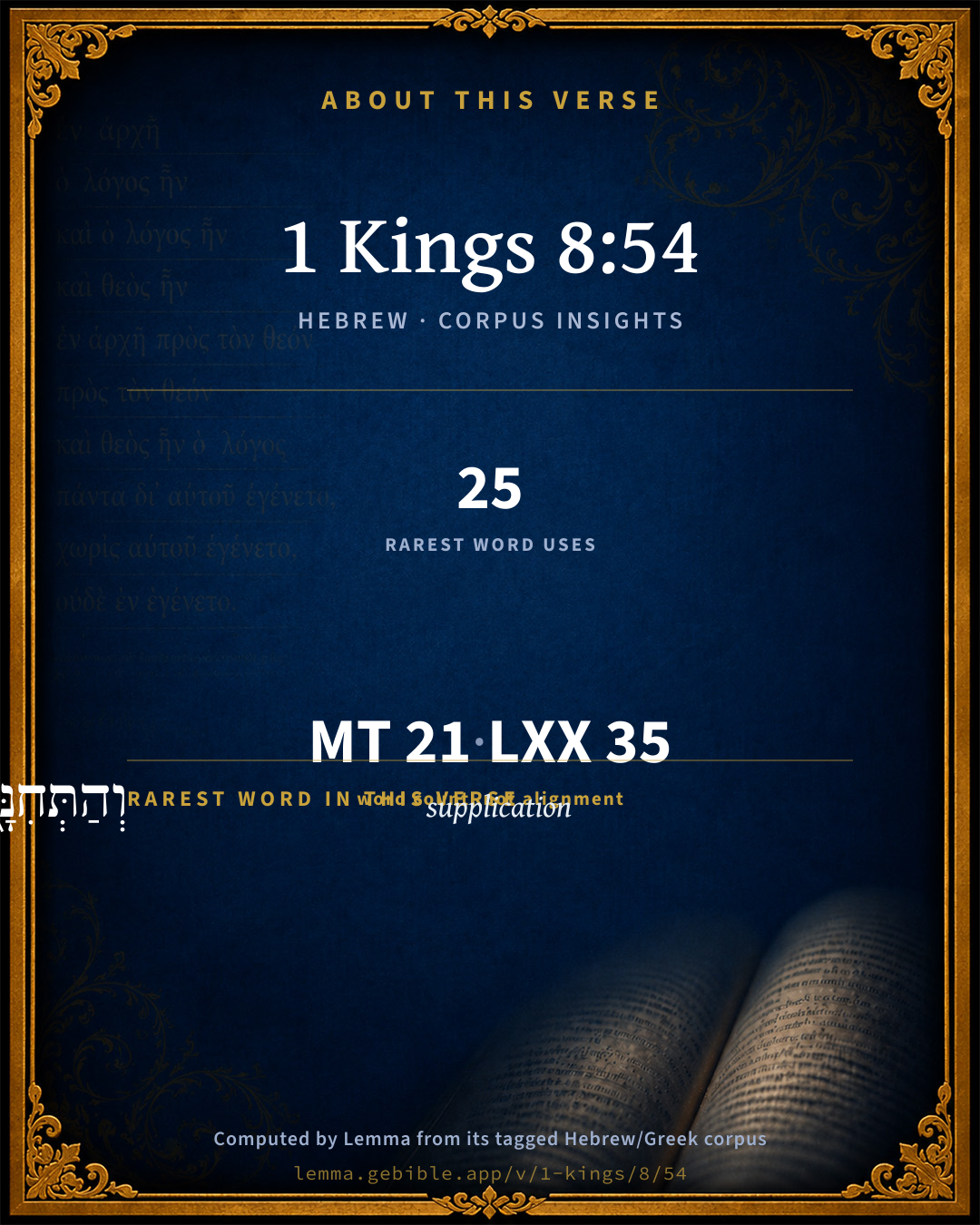
These counts appear in no published source. They are computed here, from the morphology-tagged text and Lemma’s own curated glosses. What Lemma adds →

21
words
20
distinct lemmas
Historical
section

Notable vocabulary

The rarest word here is וְהַתְּחִנָּ֖ה supplication H8467 — appearing just 25 times in the whole Hebrew Bible.

Shared distinctive vocabulary

וְהַתְּחִנָּ֖ה supplication H8467 occurs in 24 verses of the Hebrew Bible. Also found in:

Grammatical profile

  • 6 verbs
  • 11 nouns
  • 1 pronoun
  • 2 prepositions
  • 1 particle

Verb forms

  • וַיְהִ֣י Qal · Sequential Imperfect
  • כְּכַלּ֣וֹת Piel · Infinitive Construct
  • לְהִתְפַּלֵּל֙ Hithpael · Infinitive Construct
  • קָ֞ם Qal · Perfect
  • מִכְּרֹ֣עַ Qal · Infinitive Construct
  • פְּרֻשׂ֥וֹת Qal · Participle Passive

Repetition

A word recurs within this verse — often emphatic in Hebrew:

  • יְהוָ֔ה LORD H3068 ×2

Hebrew & Septuagint length

In English translation the verse runs 39 words from the Hebrew and 43 from the Septuagint (LXX English) — closely comparable.

A rough comparison of the two English renderings, which tokenize alike — not a word-level alignment.

Word counts can differ between the Hebrew and the Greek without any difference in meaning — e.g. the Hebrew direct-object marker אֵת has no separate Greek word, and Greek often adds the article ὁ.

In the original languages it is 21 Hebrew tokens and 35 Greek tokens — but the two are counted differently (Hebrew bundles its prefixes and suffixes into one token; the Greek is in lemma form), so that isn’t a like-for-like length.

Cross-references

9

Topical passages linked to 1 Kings 8:54 in the Treasury of Scripture Knowledge — connected by theme and wording, ordered by reader-vote popularity; previews shown in the World English Bible.

  • 2 Chronicles 6:12–13 He stood before the altar of Yahweh in the presence of all the assembly of Israel, and spread forth his hands
  • 2 Chronicles 7:1 Now when Solomon had made an end of praying, the fire came down from heaven, and consumed the burnt offering and the sacrifices; and the glory of Yahweh filled the house.
  • Luke 22:45 When he rose up from his prayer, he came to the disciples, and found them sleeping because of grief,
  • Psalms 95:6 Oh come, let's worship and bow down. Let's kneel before Yahweh, our Maker,
  • 1 Kings 8:22 Solomon stood before the altar of Yahweh in the presence of all the assembly of Israel, and spread forth his hands toward heaven;
  • Luke 11:1 It happened, that when he finished praying in a certain place, one of his disciples said to him, "Lord, teach us to pray, just as John also taught his disciples."
  • Luke 22:41 He was withdrawn from them about a stone's throw, and he knelt down and prayed,
  • Acts 20:36 When he had spoken these things, he knelt down and prayed with them all.
  • Acts 21:5 When it happened that we had accomplished the days, we departed and went on our journey. They all, with wives and children, brought us on our way until we were out of the city. Kneeling down on the beach, we prayed.

Cross-references courtesy of OpenBible.info (CC BY 4.0).

Hebrew and Greek witnesses Masoretic Hebrew ↔ Greek Septuagint

The same verse in the two great witnesses to the Old Testament, shown verse-for-verse.

These are two independent witnesses, not word-aligned to each other, and the Septuagint is shown in lemma (dictionary) form.

Hebrew 1 Kings 8:54 Masoretic · Westminster Leningrad Codex

וַיְהִ֣י כְּכַלּ֣וֹת שְׁלֹמֹ֗ה לְהִתְפַּלֵּל֙ אֶל יְהוָ֔ה אֵ֛ת כָּל הַתְּפִלָּ֥ה וְהַתְּחִנָּ֖ה הַזֹּ֑את קָ֞ם מִלִּפְנֵ֨י מִזְבַּ֤ח יְהוָה֙ מִכְּרֹ֣עַ עַל בִּרְכָּ֔יו וְכַפָּ֖יו פְּרֻשׂ֥וֹת הַשָּׁמָֽיִם

It was so, that when Solomon had made an end of praying all this prayer and supplication to Yahweh, he arose from before the altar of Yahweh, from kneeling on his knees with his hands spread forth toward heaven.

World English Bible · Public Domain

Greek LXX 1 Kings 8:54 Septuagint · lemma form

καί γίγνομαι ὡς συντελέω σαλωμών προςεὔχομαι πρός κύριος ὅλος ὁ προσευχή καί ὁ δέησις οὗτος καί ἀναἵστημι ἀπό πρόσωπον ὁ θυσιαστήριον κύριος ὀκλάζω ἐπί ὁ γόνυ αὐτός καί ὁ χείρ αὐτός διαπετάζω εἰς ὁ οὐρανός

And it came to pass when Solomon had finished praying to the Lord all this prayer and supplication, that he rose up from before the altar of the Lord, after having knelt upon his knees, and his hands were spread out towards heaven.

LXX2012 (modern English Septuagint) · Public Domain

Hebrew: Westminster Leningrad Codex (CC BY 4.0). Greek: Septuagint (public domain); English from LXX2012 (modern English Septuagint) (Public Domain). How the Septuagint differs from the Hebrew →

Targum (Aramaic paraphrase)

1

The Targum is the ancient Jewish Aramaic paraphrase of the Hebrew Scriptures — an interpretive translation, not the Hebrew text itself. Onkelos (literal) and Pseudo-Jonathan (expansive) render the Torah, and Jonathan the Prophets. Coverage is partial: where no permissively-licensed English translation exists for a verse, only the Aramaic is shown. This is verse-level text, not a word-by-word alignment to the Hebrew.

  1. Targum Jonathan Prophets (Joshua–Malachi)
    וַהֲוָה כַד שֵׁיצֵי שְׁלֹמֹה לְצַלָאָה קֳדָם יְיָ יַת כָּל צְלוֹתָא וּבָעוּתָא הָדָא קָם מִן קֳדָם מַדְבְּחָא דַייָ מִדְהֲוָה כְּרִיעַ עַל בִּרְכּוֹהִי וִידוֹהִי פְּרִיסָן בִּצְלוֹ לְצֵית שְׁמַיָא:

    (no public-domain English translation for this verse)

    Targum Jonathan — Aramaic: “Mikraot Gedolot” (public domain). English: “Sefaria Community Translation” (CC0 1.0 (public-domain dedication)); “London "Chaldee Paraphrase," 1871” (public domain). Text via Sefaria.

Commentary

Notes on 1 Kings 8:54 from classic Christian and Jewish commentators (each source and its license shown beneath its notes). The classic Christian expositions comment on the surrounding passage and are grouped to its opening verse, so a note may address several verses; the Jewish commentaries on the Tanakh (Rashi and others) are per-verse, so they appear only where the commentator wrote on this verse.

Lemma curates 59 commentaries, every one of them public domain or Creative Commons licensed, each selected and text-cleaned for this edition rather than reprinted as found. About our sources →

Trapp's Complete Commentary

John Trapp

1Ki 8:54 And it was [so], that when Solomon had made an end of praying all this prayer and supplication unto the LORD, he arose from before the altar of the LORD, from kneeling on his knees with his hands spread up to heaven.

Ver. 54. When Solomon had made an end of praying.] See 2Ch 6:41, where something more is added, and God’s answer - by fire from heaven consuming the sacrifices - recorded.

From kneeling on his knees.] Notent hoc nobiles delicatuli et gloriosuli, saith A Lapide here, qui orant uno genu in terra fixo, alterio elevato quasi pugnaturi cum Deo, sin concedat; Let this be noted by our stout and stiff gentry, who use to pray kneeling on one knee only, as if they would fight with God, unless they may have what they would of him.

John Trapp, A Commentary or Exposition upon All the Books of the Old and New Testament (1647–1656) — public domain. Text from a community e-Sword module.

The Preacher's Complete Homiletical Commentary

Joseph S. Exell (gen. ed.)

CRITICAL AND EXPLANATORY NOTES.—

1Ki_8:61. Let your heart be perfect with the LORD, שָׁלֵם עִם יְהֹוָה; uprightly with Jehovah (Luther); submissive (Dr. Wette); in friendship with God (Gesenius); undividedly given to the Lord (Keil and Lange). 1Ki_8:62-64. The sacrificial act of consecration—These were the first offerings laid upon the sacred altar. The priests’ court was not sufficiently extensive for such numerous sacrifices; therefore the king did “hallow the middle of the court” temporarily for sacrificial purposes. The immense number of sacrifices offered supplied for the prolonged “feast” which succeeded, lasting fourteen days, and to which assembled great multitudes, from the entering in of Hamath unto the river of Egypt.

HOMILETICS OF 1Ki_8:54-61

THE ELEVATING AND SATISFYING POWER OF TRUE DEVOTION

I. It fills the soul with grateful emotion (1Ki_8:54-55). As Solomon rose from his knees, after his earnest and prolonged pleading with God, his heart was so full of Divine and heavenly influence that it overflowed in earnest and emphatic expressions of gratitude and joy—“He stood and blessed all the congregation with a load voice.” And so it is. They that wait upon the Lord shall renew their strength—shall gain an increase of moral vigour and sympathy. The suppliant may enter the presence-chamber of the Invisible and Eternal God with trembling and fear; but he retires braced up in courage, and clothed with supernatural power, prepared for conflict and hopeful of victory: he comes, stricken down with a gloomy sense of personal unworthiness and defilement, and retires modestly elated with a sense of pardon, transfigured with the radiance of a moral transformation, the very countenance glistening with the chrism of a heavenly benediction. There is no emotion so tender, so profound, so full of nameless pathos and tranquillising joy like that which flows into the heart in its quiet moments of communion with God; or which, like sunshine after storm, visits the soul after it has passed through a season of earnest and successful wrestling with God. The man whose life is spent in devotion, though bound to earth by the dearest human ties, holds high fellowship with the world above. In him earth and heaven are united—both are understood by him in their true significance, and held in proper balance and esteem. He is like a tall, gigantic mountain whose broad base is fixed in the rocks far down beneath our feet, but whose top, springing into the lofty expanse above, reposes under the pure covering of radiant snow and sunlight. He is lifted above the pleasures of this world, and finds consolation and strength in the darkest day of adversity. The apostle was “in prison more frequent,” but in his dungeon he found the presence of Jesus, and could pray and sing praises unto God. “I thought of Jesus,” said the holy John Rutherford, when imprisoned for the Gospel’s sake, “until every stone in the walls of my cell shone like a ruby.”

II. It presents the most exalted and satisfying views of the faithfulness of God (1Ki_8:56).

1. As to a specific Divine promise. “The Lord hath given rest unto His people Israel, according to all that He promised.” Solomon blessed God, not for wealth, grandeur, power, or victory, all of which had been so conspicuously bestowed on Israel, but for rest. Without this blessing all the others would be unavailing. Many weary years wheeled round, and many sharp trials were endured before the promised rest was given; but it came at last. And it will come to us. Oh! how often does the veteran wilderness-traveller, wearied with toil, and battered with conflict, turn his dim, weatherworn eyes towards the shadowy outlines of the Canaan he approaches, and sigh for the rest that remains for the people of God!

2. As to every Divine promise. “There hath not failed one word of all His good promise” (Deu_12:10; Jos_21:45; Jos_23:14). How marked is the contrast between man, the promise-breaker, and God, the promise-keeper! Every Divine promise is based on His unchangeable faithfulness, and backed by His Omnipotence. Not only the nature of God, but every act of His providential and redemptive government, is a guarantee of His incorruptible and unfailing fidelity. Whatever is opposed to the Divine will must inevitably fall: whatever God has promised will be inevitably fulfilled. The united and fiercest opposition of earth and hell cannot hinder the final and complete accomplishment of the Divine Word.

III. It realizes the nearness of God in the ordinary walk of life (1Ki_8:57-58).

1. The nearness of God with His people is a fact of past experience. “As He was with our fathers.” He was with Abraham when he was called by His mysterious voice to leave the idolatrous associations of his early life, and migrate to an unknown country and become the father of a countless heritage. He was with Jacob when he fled from the fury of an incensed brother. He appeared to him at Bethel, assured the distracted traveller of future guidance and prosperity, and renewed to him the promise which had been made to Abraham. He was with Israel in Egypt, preserved them amid the threatenings and cruelties of their relentless taskmasters, delivered them from their oppressors, defended them amid the perils and trials of the wilderness, and guided them in safety to the promised rest. God is with His church to-day; and in this fact is the assurance of her final victory and everlasting blessedness.

2. The nearness of God is matter of personal consciousness. “That He may incline our hearts unto Him.” The heart is the sphere in which God manifests His presence—mind revealing itself to mind, will to will, heart to heart. When the soul is full of love to God, it the more readily recognizes His presence in every event of life. “If we have loving, waiting, Christ-desiring spirits, everything in this world—the common meal, the events of every day, the most veritable trifles of our earthly relationships—will all have hooks and barbs, as it were, which will draw after them thoughts of Him. There is nothing so small but that to it there may be attached some filament which will bring after it the whole majesty and grace of Christ and His love.” Man is never so sweetly conscious of the nearness of God as when he is bowed at His footstool in humble and sincere devotion. He only forsakes those who have forsaken Him (Psa_9:11).

3. The nearness of God is the great inspiration to a life of obedience. “To walk in all His ways, and to keep His commandments and His statutes and His judgments.” The temptations to turn aside from rectitude are many and powerful, but for Divine aid we should be powerless to resist. When, says one, the believer is as nigh to God as a creature can be, the sound of the devil’s feet is heard behind him; but, blessed be God! He is near to His people as the devil can be, and if the devil touch Job’s flesh and Job’s bone too, God is in Job’s heart, and that is nigher. The end of Divine blessing is to bring the heart near to Him, and to give grace to walk in His way with uprightness and perseverance.

IV. It teaches how temporal blessings are to be subordinated and made contributory to the more glorious end of spreading the knowledge of the only true God (1Ki_8:59-60). Jehovah blessed Israel with a marvellous history, with deliverances, successes, and affluence which reached their climax of grandeur and power in the age of Solomon, but He did it all for His name’s sake; and to fit the nation for its great mission in making known His salvation to all people (1Ki_8:60). Every temporal blessing has its moral significance, and increases the responsibility of the recipient. Wealth, intellectual genius, spiritual influence, that is not used for God will only intensify the sorrows and sufferings of the unfaithful possessor. Like most garments, like most carpets, everything has a right side and a wrong side. You can take any joy, and by turning it round find troubles on the other side; or you may take the greatest trouble, and by turning it round find joys on the other side. The gloomiest mountain never casts a shadow on both sides at once, nor does the greatest of life’s calamities. By aiming at the glory of God in all things, sorrows will be turned into joy, reverses into success.

V. It stimulates the soul after a higher standard of moral perfection (1Ki_8:61). The best and greatest wish which a king can form for his people, a father for his children, a pastor for his flock, is—May your heart be righteous—i.e., whole and undivided before the Lord our God. He who elects to side with Him must do so wholly and entirely: all “halting between two opinions” is an abomination to him: the lukewarm he will spue out of his mouth. Be thou on the Lord’s side, and he will be with thee (Lange). The great end of prayer is to encourage a holier life; and it is a mighty agency in promoting that end. We must find happiness in our every-day life and in the performance of our ordinary duties, or we shall miss it altogether. The greatest happiness is the outgrowth of the highest moral perfection, and the spring of both is found in a spirit of profound devotion.

LESSONS:—

1. The soul touches the lowest depth of humiliation and reaches its most exalted blessedness in communion with God.

2. The brightest visions of God’s character and the most practical lessons for the conduct of life are obtained in the best moods of devotion.

3. Prayer is one of the most potent agencies in promoting a holier life.

GERM NOTES ON THE VERSES

1Ki_8:54-61. Solomon’s final address to the people contains—

1. A psalm of praise (1Ki_8:56).

2. A wish for a blessing (1Ki_8:57-60).

3. A warning (1Ki_8:61).

1Ki_8:56. “The Lord hath given rest unto His people.” Compared with 1Ch_23:25. The rest of the people of God. I. In the mysterious polity of the people of Israel, spiritual and temporal blessings were so closely allied that the same language might naturally be employed to signify either. When with the conviction of special divine superintendence was combined the pure and lofty moral nature of the Divine Governor, as revealed in the law issued by Moses, it is inconceivable but that the higher class of Israelitish minds, the holy and meditative class, must often have felt that the mass of ordinances which surrounded them were truly meant as types of some more profound spiritual realities; and that their whole national history was intended to image forth a moral history, wider in its purpose and extent, and more adequate to the power and dignity of a God whom they well knew to be the God of the whole earth as well as of the territory of Israel, yea, even a God whom “the heaven of heavens could not contain.” In the fourth chapter of the Epistle to the Hebrews it is shown that the rest which the Israelites enjoyed in the land of promise, no less than the rest of the Sabbath-day, was symbolical of the repose of the persevering Christian. II. It is not unwarrantable to conjecture that when the patriot cried—“The Lord hath given rest unto His people Israel,” he was not more the patriot of Israel than of mankind; or at least, that the Spirit of God spoke through his lips with a higher purpose, to be explained and developed by the events of subsequent ages. The God of Israel, in permitting His ark to be deposited in a permanent abode, seemed to guarantee the eternal glory of the city of David. And it seemed at length that the Lord was about to give His people the proof of His peculiar favour, which they might naturally have expected, by actually exalting them to the highest temporal position among the nations of the earth, and making the divine glory on the mercy seat the centre from which the deputed authority of God was to radiate to the circumference of the world. It was the destiny of Israel, after a brief period of prosperity, to separate into rival dynasties, to run through a course of much iniquity, to despise constant, reiterated warnings, and at length to merge into utter ruin, undestroyed, indeed, but preserved only as a monument of God’s abiding vengeance. But mark the unsearchable depths of the purposes of Providence! These national misfortunes brought in universal blessedness. Israel fell to prepare the salvation of mankind; and the rest which the Lord denied His people was denied only that an everlasting rest might be secured to His spiritual people for ever! III. This rest which the Lord God of Israel bestows on His spiritual Israel is no unattainable blessing even on this side of the grave. It is the mark of a poor spirit to be satisfied with small things. With the temporal dispensations of God, whatever they be, a Christian is bound to be content; but for the man who is not a Christian, that discontent should be his portion is the prayer of mercy itself! Such discontent is the voice of the Spirit of God, for whom his nature was originally formed, calling upon him to perceive and acknowledge that he has no abiding city here, and that in seeking after the things that belong to his peace, he must turn to the Prince of Peace. What some dreamer imagined as to the structure of the earth we live on, is a truth as regards our own internal nature. “We are, indeed, a fragment struck from the great source of light and heat, from the sun of eternal righteousness; and if the force that wilfully separates us from our origin would but cease to operate, we should return to our native birth-place, even the bosom of our Father; we should fly to the centre of all good, and there abide in blessedness for ever. To effect this union is the great object of our religion: Christ the Mediator is the link that binds us to the centre of everlasting happiness. IV.

1. Rest and peace must fall upon a Christian spirit, first from its devotion to Christ Himself, and its devoted imitation of His pure and perfect example. The life of a Christian is the imitation of Christ. And, among all the imitable attributes of Christ, none is more beautiful than His perfect peace. Blessed Lord! Thou dost indeed give us this peace when Thou givest Thyself as our example! To be thy disciples and copyists is to be at peace with everything but sin.

2. This influence of the character of Christ becoming the great examplar of their actions is not the only cause which works peace and rest in the hearts of his followers. The very singleness of the object of His hope has a power to elevate the Christian above the petty concerns of daily life. The true peace of mind is that which resolves all into a single principle. God is one: let our affections but partake of the unity of that object, and we shall have reached the pathway of real and imperishable rest.

3. The same question might be argued from the very nature of the Christian affections, affections whose very exercise is peace and happiness. In the very exercise of faith and hope and love, there are the materials of peace, even apart from the subject of these feelings. The mere position of a mind believing, trusting, and loving is one of real happiness and rest.

4. In such a state as ours, unless the eternal world in some manner becomes the guarantee of this, we are the slaves of every accident, without any hope for the future, any consolation for misfortune, any substantial or permanent motive for conduct, any reward for endurance, any guide for life. The earthly and the heavenly elements must combine, or we are powerless. To have the great object of our thoughts placed beyond the chances of human life is to place ourselves beyond them! Our hope “entereth into that within the veil.” The Christian lays hold of a chain which is bound to the throne of God; he links himself to the eternal certainties of nature; the immutable attributes of the God of the universe are pledged for his security. As the certainty of the end is greater than that of the means, and as the dead world that surrounds us exists, doubtless, with a main view to the Christian people of God—the less perfect being ever subordinate to the more perfect—so we may say that the finest laws of nature and man, the very foundations of the world that now is, are less firm and durable than the purpose of God to make His faithful people happy! (Condensed from Archer Butler.)

“There hath not failed one word of all His good promise.” The Divine purpose fulfilled.

1. God hath formed a purpose of mercy toward mankind.

2. The fulfilment of this purpose of mercy is committed to the Lord Jesus—accomplished by His own atonement for sin, and by the communication of the Holy Spirit.

3. The Divine purpose of mercy, under the administration of the Lord Jesus, shall be perfectly and triumphantly accomplished.

1Ki_8:57. The presence of God.

1. Necessary.

2. Promised.

3. Actually experienced.

4. Continued on obedience.

5. The source of all help and happiness.

1Ki_8:58. All keeping of the commandments, all mere morality, without submission of the heart to God, is worthless; a mere shell without the kernel.

1Ki_8:59-60. The words which rise out of the depths of the heart to God reach Him and abide with Him. He forgets them not (Rev_8:3-4). That the Lord is God, and none other, seems nowhere more conspicuous than in the choosing and leading of the people Israel, in which He has revealed Himself in His might and glory, in His holiness and justice, His faithfulness and mercy (Psa_145:3-12). No better proof of the existence of a one living God than the history of Israel.—Lange.

1Ki_8:61 (compared with Exo_15:11). Holiness the supreme end of life.

1. We need the revelation of God’s holiness in order to sustain us in the presence of the tremendous forces of the external universe, and in the presence of what sometimes seems to be the chaotic confusion of this world’s affairs. To me it is not the benevolence of God which seems to be supremely necessary for the solace and the peace of the heart, but His justice. I want to know that the law of righteousness, to which my conscience does homage, will sooner or later be openly and completely vindicated; that even now we are not under the government of mere chance or of brute force, but of a living holiness; that there is not only a judgment seat before which, in some remote and uncertain day, all men will have to give an account of the deeds done in the body, but that now a righteous God rules the world, and suffers no irreparable injustice to be inflicted on any man; that however intolerable the actual condition of human affairs may seem to me, He who has power to prevent every accident, every mistake, every folly, every crime; He who could strike the liar dumb before he utters the slander which will break the heart of the innocent; He who could unmask before it is consummated the villainy which will ruin the peace and honour of a fair and virtuous home; He who could strike down with mortal disease the reckless statesman who hurries a nation into an unnecessary and iniquitous war; I want to know that He the Almighty and Omniscient Ruler of all men is not careless of what happens on earth, that He has no selfish purpose to accomplish, that He is not wilful, that He is not capricious, but absolutely and perfectly just; that He has a hatred and scorn as much more intense than mine for every sin as His nature is greater than my own. Knowing this—and I know it—I can look back upon the sorrowful ages of human history, I can look round upon the wild confusions of my own time, I can look forward to the dark and stormy future which, apart from Him, promises no sure relief from the vast and terrible evils which seem to be the inheritance of our race, and my heart is at rest. From the vision of God’s holiness I receive a peace which the world cannot give, and which the world cannot take away.

2. Nor is it only peace of heart which God’s holiness inspires. The Divine holiness is a strong support to all our endeavours to attain moral and spiritual perfection. Whatever mystery may rest upon the Divine government, and however unable we may be to interpret the issues that are to come out of the movements of that providence over which God presides, we can be in no doubt concerning God’s ultimate purpose in relation to ourselves. Apart from any spiritual relation, we have an absolute certainty that wherever there is the capacity for holiness, holiness must be the great end of existence. We are capable of a perfection which transcends, though it includes moral virtue, and this perfection is holiness. Since we are capable of it, it is, and it must be, the supreme end for which we ought to live. We miss the glory which is within our reach if we do not attain to it. God’s holiness makes it certain that He regards our holiness as the very crown of our nature, apart from which the idea which He desires to have illustrated in every man is unfulfilled.

3. God has no ultimate use for a man who is not holy, and such a man does not become what he was meant to be. Being holy Himself, it must be, and it is, His great concern that we should attain to moral and spiritual perfection. God’s supreme concern in relation to you and me is, not that we should be happy to-day or to-morrow, and all our life through: His supreme concern is that we should regard sin with intense and unutterable abhorrence, and that we should regard goodness with a deep and passionate affection. And God will not shrink from inflicting any pain, however sharp, or any suffering, however protracted, upon any of us, that may be necessary in order to fulfil His great design. IV. This was His supreme purpose in sending the Lord Jesus Christ into the world. Christ came to save us from our sins, not merely to release us from the penalty of our sins, much less to assure us that we may remain sinful and yet not miss the glory and the blessedness for which God made us. The grace that Christ reveals does not for a moment suggest that God regards our sin with that pity and compassion with which it is the tendency of our modern religious lives to regard all sin; but that He abhors sin so much, that He Himself stooped to the most terrible sufferings, to shame and to death, in order to deliver us from sin. The holiness of God lies at the very root of the redemptive work of the Lord Jesus Christ. It is just because God is so holy that He set His heart upon redeeming us from the power of sin. Until we know that God is glorious in holiness, as well as infinite in mercy, and find in His very holiness that on which we shall build our trust, and that out of which our joy shall spring, we know very little of the fulness of life, and the depth of peace, and the perfection of blessedness possible to as through Jesus Christ our Lord.—(Condensed from R. W. Dale in C. W. P).

The Preacher's Complete Homiletical Commentary (gen. ed. Joseph S. Exell; Funk & Wagnalls, c. 1892) — public domain (pre-1929). A full-Bible homiletical/sermon-outline anthology covering 65 of 66 books (2 John is absent from the source module). Text from a community e-Sword module.

Keil & Delitzsch

C. F. Keil & F. Delitzsch

Concluding Act of the dedication of the temple. Kg1 8:54-61. Blessing the congregation. - After the conclusion of the prayer, Solomon rose up from his knees and blessed all the assembled congregation. פּרוּשׂות וכפּיו is a circumstantial clause, which must be connected with the previous words and rendered thus: "from lying upon his knees with his hands spread out towards heaven." "And he stood," i.e., he came from the altar and stood nearer to the assembled congregation. The blessing begins with praise to the Lord for the fulfilment of His promises (Kg1 8:16), and consists in the petition that the Lord will always fulfil his (Solomon's) prayers, and grant His people the promised salvation.

(Note: This blessing is omitted from the Chronicles, because it is simply a recapitulation of the longer prayer; but instead of it we have a statement, in Ch2 7:1-4, to the effect that fire fell from heaven and consumed the burnt-offering upon the altar. This statement, which even Movers regards as a traditional, i.e., a legendary addition, according to his erroneous view of the sources of the Chronicles, is confirmed by the similar miracle which occurred at the dedication of the temple. It is omitted, like so many other things in the account before us, because all that was essential in this occurrence was contained implicite in the filling of the temple with the glory of the Lord. Just as at the consecration of the Mosaic sanctuary the Lord did not merely manifest His gracious presence through the cloud which filled the tent, but also kindled the first sacrifice with fire from heaven (Lev 9:24), to sanctify the altar as the legitimate place of sacrifice; so also at the temple the miraculous kindling of the first sacrifice with fire from heaven was the immediate and even necessary consequence of the filling of the temple with the cloud, in which the presence of Jehovah was embodied.)

Keil & Delitzsch — Biblical Commentary on the Old Testament (1861–1891) — public domain (CC PDM 1.0). Text via the HelloAO Bible API. (Old Testament only.)

MacLaren's Expositions of Holy Scripture

Alexander MacLaren

1 Kings

THE KING ‘BLESSING’ HIS PEOPLE

1Ki 8:54 - 1Ki 8:63.

The great ceremonial of dedicating the Temple was threefold. The first stage was setting the ark in its place, which was the essence of the whole thing. God’s presence was the true dedication, and that was manifested by the bright cloud that filled the sanctuary as soon as the ark was placed there. The second stage was the lofty and spiritual prayer, saturated with the language and tone of Deuteronomy, and breathing the purest conceptions of the character and nature of God, and all aglow with trust in Him. Then followed, thirdly, this ‘Blessing of the Congregation.’ The prayer had been uttered by the kneeling king. Now he stands up, and, with ringing tones that reach to the outskirts of the crowd, he gathers the spirit of his prayer into two petitions, preceded by praise for national blessings, and followed by exhortation to national obedience. A huge sacrifice of unexampled magnitude closes the whole.

I. Note the thankful retrospect of the nation’s past {1Ki 8:56}.

Solomon ‘blessed the congregation’ when, in their name, he lifted up his voice to bless the Lord, prayed that God would incline their hearts to keep His law, and would maintain their cause, and exhorted them to keep their hearts perfect with Him. We bless each other when we ask God to bless, and when we draw each other nearer Him. Standing there in the new Temple, with a united nation gathered before him, the cloud filling the house, and peace resting on all his land to its farthest border, the king looks back on the long road from Sinai and the desert, and sums up the whole history in one sentence. The end has vindicated the methods. There had been many a dark time when enemies had oppressed, and many a hard-fought field had been stained with Israel’s blood; but all had tended to this calm hour, when Israel’s multitudes were gathered in worship, and their unguarded homes were safe. There had been many heroes in the long line.

‘Time would fail’ him ‘to tell of Gideon, Barak, Samson, Jephthah; of David and Samuel . . . who . . . turned to flight armies of aliens.’ One name alone is worthy to be named,-the name of the true Deliverer and Monarch. It is the Lord who ‘hath given rest unto His people.’ We look on the past most wisely when we see in it all the working of one mighty Hand, and pass beyond the great names of history or the dear names which have made the light of our homes, to the ever-living God, who works through changing instruments; and ‘the help that is done on earth, He doeth it Himself.’ We read the past most truly when we see in all its vicissitudes God’s unchanging faithfulness, and recognise that the foes and sorrows which often pressed sore upon us were no breach of His faithful promises, but either His loving chastisement for our faithlessness, or His loving discipline meant to perfect our characters. We read the past best from the vantage-ground of the Temple. From its height we understand the lie of the land. Communion with God explains much which is else inexplicable. Solomon’s judgment of Israel’s checkered history will be our judgment of our own when we stand in the higher courts of the heavenly home, and look from that height upon all the way by which the Lord our God hath led us. In the meantime, it is often a trial for faith to repeat these words; but the blessing that comes from believing them true is worth the effort to stifle our tears in order to say them.

II. Note the prayer for obedient hearts {1Ki 8:57 - 1Ki 8:58}. The proper subject-matter of this petition is ‘that He may incline our hearts to walk in His ways,’ and God’s presence is invoked as a means thereto. The deepest desire of a truly religious soul is for the felt nearness of God. That goes before all other blessings, and contains them all. Nothing is so needful or so sweet as that The presence of God is the absence of evil, the evil both of pain and of sin, as surely as the rising sun is the routing of night’s black hosts. ‘The best of all is, God is with us.’ The prayer again looks back to the past, and asks that the ancient experiences may be renewed. The generations of those who trust in God are knit together, and the wonders of old time are capable of repetition to-day. Faith can say with deeper meaning than the Preacher, ‘That which hath been is that which shall be.’ However varying may be the forms, the fact of a divine presence and help according to need is invariable, and they that have gone before have not exhausted the fountain, which will fill the vessel of the latest comer as it did that of the first. How beautifully the abiding God and the fleeting series of ‘our fathers’ is contrasted! A moment of triumph, when some work, like that of building the Temple, which has for ages been looked forward to, and into which the sacrifices and aspirations of a long line of dead toilers are built, brings strongly before all thoughtful men the continuity of a nation or a Church, and the transiency of its individual members. It should suggest the abiding God yet more strongly than it does the passing fathers. The mercy remains the same, while the receivers change. The sunshine and the tree are the same, though the leaves which glisten and grow in the light have but one summer to live.

But Solomon desires that God may be with him and his people for one specific purpose. Is it to bring outward prosperity, or to extend their territory, or to give them victory? As in his choice in his dream, so now, he asks, not for these things, but for an inward influence on heart and will. What he wants most for himself and them is moral conformity to God’s will. All must be right if that be right. The prayer implies that, without God’s help, the heart will wander from the paths of duty. The weakness of human nature, and the consequent necessity for God’s grace in order to obedience, were as deeply felt by the devout men of the Old Testament as by Apostles. They are felt by every man who has honestly tried to measure the sweep and inwardness of God’s law, and to realise it in life. We need go but a very short way on the road to discover that temptations to diverge lie so thick on either side, and that our feet grow weary so soon, that we shall make but little progress without help from above.

The synonyms for the law are worthy of notice. Why are there so many of these in the Old Testament? For the same reason that there are so many for ‘money’ in English,-because those who made the language thought so much about the thing, and delighted in it so much. As ‘commandments,’ it was solemnly imposed by rightful authority, and obedience was obligatory. The word rendered ‘statutes’ means something engraved, or written, and recalls the tables inscribed by God’s finger. ‘Judgments’ are the divine decisions or sentences as to what is right, and therefore the infallible clue to the else bewildering labyrinth. To obey these commandments, to read that solemn writing, and to accept these decisions as our guides, is man’s perfection and blessedness; and for that God’s felt presence is indispensable.

III. Note the prayer for God’s defence {1Ki 8:59 - 1Ki 8:60}. The proper subject-matter of this petition is that God would maintain the cause of king and nation; and it is preceded by a petition that, to that end, the preceding prayer may be answered, and is followed by the desire that thereby the knowledge of God may fill the earth. The prayer for outward blessings comes after the prayer for inward heart-obedience. Is not that the right order? Our prayers need to be prayed for, and a true desire is not contented with one utterance. To ask that what we have asked may be given is no vain repetition, nor a sign of weak faith, or undue anxiety. How bold the figure in asking that the prayer may lie before God day and night, like some suppliant at the foot of His throne!

Note the grand aim of God’s help of Israel,-the universal diffusion of His name among all the peoples of the earth. Solomon understood the divine vocation of Israel, and had risen above desiring blessings only for his own or his subjects’ sake. Later ages fell from that elevation of feeling, and hugged their special privileges without a thought of the obligations which they involved. God’s choice of Israel was not meant for the exclusion of the Gentiles, but as the means of transmitting the knowledge of God to them. The one nation was chosen that God’s grace might fructify through it to all. The fire was gathered into a hearth, that the whole house might be warmed. But selfishness marred the divine plan, and Israel became a nonconductor, and the privileges selfishly kept became corrupt; as the miser’s corn stored in his barns in famine breeds weevils. Christians need no more solemn lesson of what comes from selfishly hoarding spiritual blessings than the fate of Israel. God hath shined into our hearts, that we may give to others who sit in the dark the light which we possess; and if we fail to do so, the light will darken within us.

IV. The blessing ends with one brief, all-comprehensive charge to the people, which seems based, by its ‘therefore,’ on the preceding thought of Jehovah as the only God. The only attitude corresponding to His sole and supreme Majesty is the entire devotion of heart, which leads to thoroughgoing obedience to His commandments. The word rendered ‘perfect’ literally means ‘entire’ or ‘sound,’ and here expresses the complete devotion of the whole nature. Solomon meant that it should be complete, in contradistinction to any sidelong glances to idolatry. The principle underlying that ‘therefore’ is that, God being what He is, our only God and refuge, the only adequate hope and object of our nature, we should give our whole selves to Him. We, too, are tempted to bring Him divided hearts, and to carry some of our love and trust as offerings at other shrines. But if there be ‘one God, and none other but He,’ then to serve Him with all our heart and strength and mind is the dictate of common sense, and the only service which He can accept, or which can bring to our else distracted natures peace and satisfaction. His voice to us is, ‘My son, give Me thy whole heart.’ Our answer to Him should ever be that prayer, ‘Lord, . . . unite my heart to fear Thy name.’ A divided heart is misery. Partial trust is distrust. ‘Love me all in all, or not at all,’ is the requirement of all deep, human love; and shall God ask less than men and women ask from and give to one another?

Alexander MacLaren, Expositions of Holy Scripture (1904–1910) — public domain. Text from a community e-Sword module.

Tyndale Open Study Notes

Tyndale Open Resources

8:54-56 Solomon praised God’s faithfulness and goodness to Israel in giving the people rest as promised (see Josh 21:43-45; 23:14; 2 Sam 7:1). Some Israelites failed to appropriate the rest that only God provides (Ps 95:10-11; Heb 3:7-19; 4:1-11).

Tyndale Open Study Notes — © Tyndale Open Resources, licensed CC BY-SA 4.0. Text via the HelloAO Bible API.

Geneva Bible (1599)

Geneva Bible translators

Solomon is a figure of Christ, who continually is the Mediator between God and his Church.

Geneva Bible (1599) marginal notes — public domain. Text via Bolls.life.

Matthew Henry's Commentary

Solomon, after his sermon in Ecclesiastes, gives us the conclusion of the whole matter; so he does here, after this long prayer; it is called his blessing the people, Kg1 8:55. He pronounced it standing, that he might be the better heard, and because he blessed as one having authority. Never were words more fitly spoken, nor more pertinently. Never was congregation dismissed with that which was more likely to affect them and abide with them.

I. He gives God the glory of the great and kind things he had done for Israel, Kg1 8:56. He stood up to bless the congregation (Kg1 8:55), but began with blessing God; for we must in every thing give thanks. Do we expect God should do well for us and ours? let us take all occasion to speak well of him and his. He blesses God who has given, he does not say wealth, and honour, and power, and victory, to Israel, but rest, as if that were a blessing more valuable than any of those. Let not those who have rest under-value that blessing, though they want some others. He compares the blessings God had bestowed upon them with the promises he had given them, that God might have the honour of his faithfulness and the truth of that word of his which he has magnified above all his name. 1. He refers to the promises given by the hand of Moses, as he did (Kg1 8:15, Kg1 8:24) to those which were made to David. There were promises given by Moses, as well as precepts. It was long ere God gave Israel the promised rest, but they had it at last, after many trials. The day will come when God's spiritual Israel will rest from all their labours. 2. He does, as it were, write a receipt in full on the back of these bonds: There has not failed one word of all his good promises. This discharge he gives in the name of all Israel, to the everlasting honour of the divine faithfulness, and the everlasting encouragement of all those that build upon the divine promises.

II. He blesses himself and the congregation, expressing his earnest desire and hope of these four things: - 1. The presence of God with them, which is all in all to the happiness of a church and nation and of every particular person. This great congregation was now shortly to be scattered, and it was not likely that they would ever be all together again in this world. Solomon therefore dismisses them with this blessing: "The Lord be present with us, and that will be comfort enough when we are absent from each other. The Lord our God be with us, as he was with our fathers (Kg1 8:57); let him not leave us, let him be to us to day, and to ours for ever, what he was to those that went before us." 2. The power of his grace upon them: "Let him be with us, and continue with us, not that he may enlarge our coasts and increase our wealth, but that he may incline our hearts to himself, to walk in all his ways and to keep his commandments," Kg1 8:58. Spiritual blessings are the best blessings, with which we should covet earnestly to be blessed. Our hearts are naturally averse to our duty, and apt to decline from God; it is his grace that inclines them, grace that must be obtained by prayer. 3. An answer to the prayer he had now made: "Let these my words be nigh unto the Lord our God day and night, Kg1 8:59. Let a gracious return be made to every prayer that shall be made here, and that will be a continual answer to this prayer." What Solomon asks here for his prayer is still granted in the intercession of Christ, of which his supplication was a type; that powerful prevailing intercession is before the Lord our God day and night, for our great Advocate attends continually to this very thing, and we may depend upon him to maintain our cause (against the adversary that accuses us day and night, Rev 12:10) and the common cause of his people Israel, at all times, upon all occasions, as the matter shall require, so as to speak for us the word of the day in its day, as the original here reads it, from which we shall receive grace sufficient, suitable, and seasonable, in every time of need. 4. The glorifying of God in the enlargement of his kingdom among men. Let Israel be thus blessed, thus favoured; not that all people may become tributaries to us (Solomon sees his kingdom as great as he desires), but that all people may know that the Lord is God, and he only, and may come and worship him, Kg1 8:60. With this Solomon's prayers, like the prayers of his father David, the son of Jesse, are ended (Psa 72:19, Psa 72:20): Let the whole earth be filled with his glory. We cannot close our prayers with a better summary than this, Father, glorify thy name.

III. He solemnly charges his people to continue and persevere in their duty to God. Having spoken to God for them, he here speaks from God to them, and those only would fare the better for his prayers that were made better by his preaching. His admonition, at parting, is, "Let your heart be perfect with the Lord our God, Kg1 8:61. Let your obedience be universal, without dividing - upright, without dissembling - constant, without declining;" this is evangelical perfection.

Matthew Henry's Commentary on the Whole Bible (1708–1710) — public domain (CC PDM 1.0). Text via the HelloAO Bible API.

Ellicott's Commentary for English Readers

(54) And it was so.—At this point occurs in 2Ch_7:1-3 a striking passage, describing the kindling of the sacrifice by fire from heaven, and, apparently, a second manifestation of the cloud of glory. (See Note on the passage.)

A Bible Commentary for English Readers, edited by Charles John Ellicott (1878–1897) — public domain. Text from a community e-Sword module.

The Cambridge Bible for Schools and Colleges

gen. ed. J. J. S. Perowne

54. he arose from before the altar] In 1Ki_8:22 we are only told that Solomon stood before the altar. It appears from this verse that the addition in 2Ch_6:13, where we read that he first stood and then kneeled down before the people, gives the correct idea of what took place. Josephus tells us that at the close of the prayer the king cast himself upon the ground and continued worshipping a long time, after which he arose and offered sacrifices.

54–61. Solomon’s closing benediction (Not in Chronicles)

The Cambridge Bible for Schools and Colleges (gen. ed. J. J. S. Perowne; Cambridge University Press, 1878–1918) — public domain. Text from a community e-Sword module.

John Gill's Exposition

And he stood and blessed all the congregation of Israel with a loud voice,.... Turning himself the altar, and his face to the people, giving them his benediction, not only as the father of his people, but as preacher in Jerusalem, closing it with a word of exhortation to them:

saying: as follows.

John Gill's Exposition of the Whole Bible (1746–1763) — public domain (CC PDM 1.0). Text via the HelloAO Bible API.

Albert Barnes' Notes on the Bible

If the prayer of Solomon be, as it has all the appearance of being, a genuine document of the time, preserved in the archives to which the authors of both Kings and Chronicles had access, all theories of the late origin of Deuteronomy must be regarded as baseless. While references are not infrequent to other portions of the Pentateuch, the language of the prayer is mainly modelled upon Deuteronomy, the promises and threats contained in which are continually before the mind of the writer. (See the margin reference).

Albert Barnes' Notes on the Bible (1834–1885) — public domain. Text from a community e-Sword/MySword module.

Whedon's Commentary on the Bible

Daniel D. Whedon

54-61. Of this blessing and exhortation, which Solomon uttered at the close of his prayer, the writer in Chronicles makes no mention; but he adds to the prayer (2Ch_6:41-42) a supplication that Jehovah would arise, and with the ark of his strength enter the holiest place; that the priests might be clothed with salvation and the saints rejoice in goodness, and that the mercies shown to David might be remembered.

Daniel D. Whedon (gen. ed.), Commentary on the Old and New Testaments (1874–1909) — public domain. Text from a community e-Sword module.

The Pulpit Commentary

SECTION III The Concluding Blessing.

The service of dedication concludes, as it commenced, with a benediction (ver. 14).

And it was so, that when Solomon had made an end of praying all this prayer and supplication unto the Lord, he arose from before see note on ver. 22 the altar of the Lord, from kneeling on his knees the first mention of this posture in the sacred history (Stanley). The Jews usually stood in prayer (Luk_18:11, Luk_18:13) with Heb. and his hands spread up to heaven.

The Pulpit Commentary (1880–1919), ed. H.D.M. Spence-Jones & Joseph S. Exell — public domain. Text from a community e-Sword module.

Kretzmann's Popular Commentary

Paul E. Kretzmann

The Feast Of Dedication

v. 54. And it was so that, when Solomon had made an end of praying all this prayer and supplication unto the Lord, he arose from before the altar of the Lord, from kneeling on his knees with his hands spread up to heaven.

v. 55. And he stood, facing the people once more, and blessed all the congregation of Israel with a loud voice, saying,

v. 56. Blessed be the Lord, that hath given rest unto His people Israel, all the uncertainty of the last centuries now being exchanged for the certainty of a definite capital and of an established Sanctuary, according to all that he promised; there hath not failed one word of all His good promise which He promised by the hand of Moses, His servant. Cf Deu 12:10; Jos 21:45; Jos 23:14.

v. 57. the Lord, our God, be with us as He was with our fathers, for with His gracious presence in their midst, they were sure of continued blessings. Let Him not leave us nor forsake us, rather granting help against their enemies always,

v. 58. that He may incline our hearts unto Him, to walk in all His ways, and to keep His commandments and His statutes and His judgments which He commanded our fathers, all His instructions to His people, in whatever form they may have come to them;

v. 59. and let these my words wherewith I have made supplication before the Lord be nigh unto the Lord, our God, day and night, that he maintain the cause of His servant and the cause of His people Israel at all times, as the matter shall require, as the needs of every new day require it;

v. 60. that all the people of the earth may know that the Lord is God, and that there is none else.

v. 61. Let your heart therefore be perfect with the Lord, our God, being dedicated to Him in undivided allegiance, to walk in His statutes, and to keep His commandments, as at this day. A real prayer, made in the fervor of a heart trusting in the mercy of Jehovah for Christ’s sake, is always acceptable in His sight.

v. 62. And the king, and all Israel with him, offered sacrifice before the Lord, in a grand and impressive service of worship.

v. 63. And Solomon offered a sacrifice of peace-offerings, to emphasize the soundness of the covenant relationship and to have the people partake of a great sacrificial feast which he offered unto the Lord, two and twenty thousand oxen and an hundred and twenty thousand sheep, a number of sacrificial animals which could easily be handled by the housefathers present, who undoubtedly made use of their priestly prerogatives at that time in assisting the priests by slaughtering animals. So the king and all the children of Israel dedicated the house of the Lord.

v. 64. The same day did the king hallow the middle of the court that was before the house of the Lord, consecrating it as a place where sacrifices might be offered on temporary altars; for there he offered burnt offerings and meat-offerings and the fat of the peace-offerings, of which only the fat was burned, the rest being used for food, because the brazen altar that was before the Lord was too little to receive the burnt offerings and meat-offerings and the fat of the peace-offerings.

v. 65. And at that time Solomon held a feast, the Feast of Tabernacles, in connection with the dedication of the Temple, and all Israel with him, a great congregation, from the entering in of Hamath, in the extreme north, on the Orontes, unto the river of Egypt, in the extreme southwest, before the Lord, our God, seven days and seven days, even fourteen days, doubling the usual number, seven days being devoted to the dedication festival and seven days to the Feast of Tabernacles.

v. 66. On the eighth day, namely, of the Feast of Tabernacles, he sent the people away. And they blessed the king, wishing him the fullness of good fortune, and went unto their tents, returned to their homes, joyful and glad of heart for all the goodness that the Lord had done for David, His servant, and for Israel, His people. He who has sincerely given thanks to the Lord for all His kindness and mercy may return to his work in cheerfulness and peace.

Paul E. Kretzmann, Popular Commentary of the Bible (1921–1924) — public domain. Text from a community e-Sword module.

unfoldingWord translationNotes

Door43 World Missions Community

prayer and request

The words "prayer" and "request" mean basically the same thing and emphasize that he is sincere as he makes his request. See how you translated similar words in 1 Kings 8:28. AT: "request" (See: Doublet)

May Yahweh be praised

This can be stated in active form. AT: "Praise Yahweh" (See: Active or Passive)

Not one word has failed out of all Yahweh's good promises

This can be stated positively. AT: "Yahweh has made every word of his good promises come true" (See: Litotes)

translationWords

Solomon

Yahweh

altar

bless

assembly

voice

praise

rest

word

unfoldingWord translationNotes — © Distant Shores Media and the Door43 World Missions Community, licensed CC BY-SA 4.0. Source: git.door43.org/Door43/en_tn.

Lesson kit

Teaching starters — assembled from the data on this page, not authored interpretation. Every prompt links to the verse data it draws on. Edit before teaching.

1 Kings, in the Historical, opens this verse with 21 words (20 distinct Hebrew lemmas). Its most distinctive word is tᵉchinnâh (“supplication”). A historical commentator’s framing appears above. Read the whole chapter for the surrounding context.

Discussion questions

  1. What does “supplication” (tᵉchinnâh) contribute to the verse as a whole?
  2. Joshua 11:20 shares the word «supplication» with this verse. How do the two illuminate each other?
  3. “LORD” occurs 2× in this one verse. What is the effect of the repetition?
  4. The translations on this page render this verse differently — a whole-verse word diff, not a word-by-word alignment. What might account for the different wordings?
  5. The verb «וַיְהִ֣י» is Qal Sequential Imperfect. How does its form color the action?
  6. Reading how Trapp's Complete Commentary and The Preacher's Complete Homiletical Commentary read this verse, where do the two commentators agree and where do they part?

Things to notice

Reading settings

Reading text

Shown beneath each verse's original-language words.

Old Testament
Old Testament edition

Read the OT as the Masoretic Hebrew (MT) or the Greek Septuagint (LXX).

English shown for the Greek Septuagint (in the Hebrew ↔ Greek comparison).

Comparing translations? Open the Compare panel on any verse page to stack up to four side by side.