
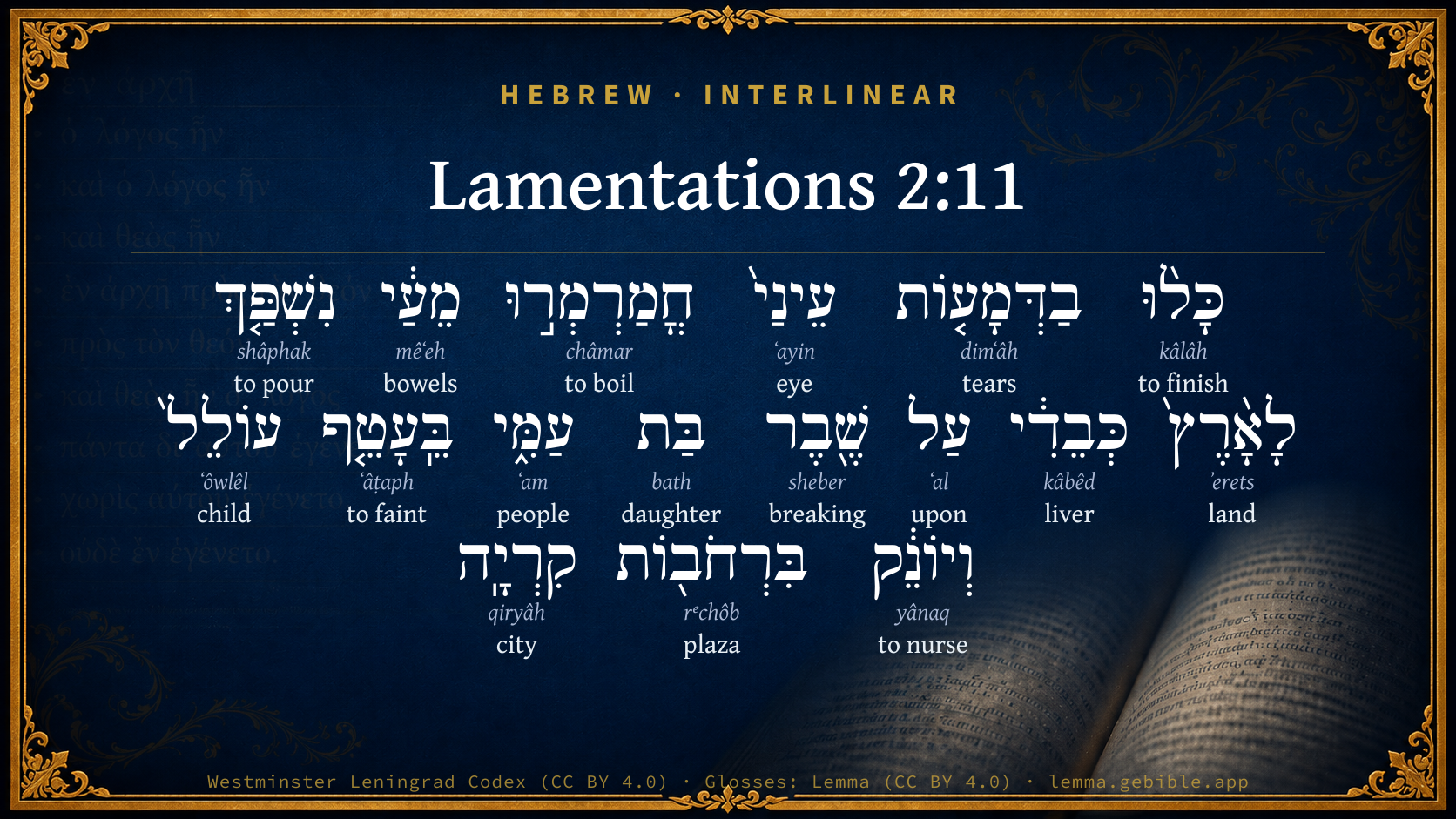
Lamentations 2:11

Hebrew (Westminster Leningrad Codex) Lamentations 2:11 appears in the Hebrew Old Testament. The text above is from the Westminster Leningrad Codex. Each word links to its Strong’s number, a concise gloss, and parsing drawn from the Open Scriptures Hebrew Bible morphology. Click any word for its full Brown-Driver-Briggs (BDB) entry.
Download image
Cite this verse

Lamentations 2:11 (World English Bible). Public Domain. Lemma interlinear Bible study tool, https://lemma.gebible.app/v/lamentations/2/11.

Show BibTeX & RIS
BibTeX
RIS
English Translation
My eyes do fail with tears, my heart is troubled; My liver is poured on the earth, because of the destruction of the daughter of my people, Because the young children and the infants swoon in the streets of the city.
World English Bible · Public Domain
Download a study sheet

One document with this verse’s original text, its word-by-word gloss line, the meaning frame, cross-references with their text, attributed commentary, and full source and license credits — printable, and it pastes into notes with its structure intact.

This verse Autodidact and up

Study sheet (.html) Plain text (.txt)

A passage Seminary Student

Up to 50 verses in one chapter. A passage sheet keeps up to 6 commentary sources and 12 cross-references per verse, in the order this page ranks them, and says so on the sheet whenever that leaves anything out. Ask for a single verse and you get the Autodidact verse sheet above.

Everything on this page stays free to read, with no account — the sheet is a download of what is already on screen, not access to it.

Want to remove ads? Support Godless Engineer
Compare translations 3

The same verse in 3 English versions, stacked beneath the original-language interlinear above. Click any original word for its lexicon entry.

Each is an independent rendering of the whole verse — the interlinear is not word-aligned to these translations.

Highlighted words mark where these versions differ — a whole-verse word diff, not a word-by-word alignment.

  • World English Bible Public Domain
    My eyes do fail with tears, my heart is troubled; My liver is poured on the earth, because of the destruction of the daughter of my people, Because the young children and the infants swoon in the streets of the city.
  • King James Version Public Domain
    Mine eyes do fail with tears, my bowels are troubled, my liver is poured upon the earth, for the destruction of the daughter of my people; because the children and the sucklings swoon in the streets of the city.
  • unfoldingWord Literal Text CC BY-SA 4.0
    My eyes have failed with tears; my inner parts churn. My liver is poured out to the ground over the destruction of the daughter of my people, when child and infant faint in the streets of the city. LAMEDH

unfoldingWord Literal Text — © unfoldingWord, licensed CC BY-SA 4.0. Word-aligned USFM3 via Door43 (git.door43.org/unfoldingWord/en_ult).

Versions to compare (up to 4)

3 of 4 selected

Show all 18 translations

Every available English version of this verse, each an independent rendering of the whole verse.

  • World English Bible Public Domain
    My eyes do fail with tears, my heart is troubled; My liver is poured on the earth, because of the destruction of the daughter of my people, Because the young children and the infants swoon in the streets of the city.
  • Berean Standard Bible Public Domain
    My eyes fail from weeping; I am churning within. My heart is poured out in grief over the destruction of the daughter of my people, because children and infants faint in the streets of the city.
  • Majority Standard Bible Public Domain
    My eyes fail from weeping; I am churning within. My heart is poured out in grief over the destruction of the daughter of my people, because children and infants faint in the streets of the city.
  • King James Version Public Domain
    Mine eyes do fail with tears, my bowels are troubled, my liver is poured upon the earth, for the destruction of the daughter of my people; because the children and the sucklings swoon in the streets of the city.
  • American Standard Version (1901) Public Domain
    Mine eyes do fail with tears, my heart is troubled; My liver is poured upon the earth, because of the destruction of the daughter of my people, Because the young children and the sucklings swoon in the streets of the city.
  • Revised Version (1885) Public Domain
    Mine eyes do fail with tears, my bowels are troubled, my liver is poured upon the earth, for the destruction of the daughter of my people; because the young children and the sucklings swoon in the streets of the city.
  • Geneva Bible (1599) Public Domain
    Mine eyes doe saile with teares: my bowels swell: my liuer is powred vpon the earth, for the destruction of the daughter of my people, because the children and sucklings swoone in the streetes of the citie.
  • Douay-Rheims (1899) Public Domain
    Caph. My eyes have failed with weeping, my bowels are troubled: my liver is poured out upon the earth, for the destruction of the daughter of my people, when the children, and the sucklings, fainted away in the streets of the city.
  • Young's Literal Translation Public Domain
    Consumed by tears have been my eyes, Troubled have been my bowels, Poured out to the earth hath been my liver, For the breach of the daughter of my people; In infant and suckling being feeble, In the broad places of the city,
  • Literal Standard Version CC BY-SA 4.0
    My eyes have been consumed by tears, || My bowels have been troubled, || My liver has been poured out to the earth, || For the breach of the daughter of my people; In infant and suckling being feeble, || In the broad places of the city,
  • Unlocked Literal Bible CC BY-SA 4.0
    My eyes have failed from their tears; my stomach churns; my inner parts are poured out to the ground because of the destruction of the daughter of my people, children and infants faint in the streets of the city.
  • unfoldingWord Literal Text CC BY-SA 4.0
    My eyes have failed with tears; my inner parts churn. My liver is poured out to the ground over the destruction of the daughter of my people, when child and infant faint in the streets of the city. LAMEDH
  • Darby Bible Public Domain
    Mine eyes are consumed with tears, my bowels are troubled; my liver is poured upon the earth, because of the ruin of the daughter of my people; because infant and suckling swoon in the streets of the city.
  • World Messianic Bible Public Domain
    My eyes fail with tears. My heart is troubled. My bile is poured on the earth, because of the destruction of the daughter of my people, because the young children and the infants swoon in the streets of the city.
  • Webster's Bible Public Domain
    My eyes do fail with tears, my bowels are troubled, my liver is poured upon the earth, for the destruction of the daughter of my people; because the children and the sucklings swoon in the streets of the city.
  • Free Bible Version CC BY-SA 4.0
    My eyes are worn out from crying; inside I am in turmoil. I'm sick and exhausted over the destruction of Jerusalem, the daughter of my people, because children and infants are fainting in the city streets.
  • Bible in Basic English Public Domain
    My eyes are wasted with weeping, the inmost parts of my body are deeply moved, my inner parts are drained out on the earth, for the destruction of the daughter of my people; because of the young children and babies at the breast who are falling without strength in the open squares of the town.
  • JPS Tanakh (1917) Public Domain
    Mine eyes do fail with tears, mine inwards burn, my liver is poured upon the earth, for the breach of the daughter of my people; because the young children and the sucklings swoon in the broad places of the city.

Literal Standard Version (2020), Covenant Press — licensed CC BY-SA 4.0. Text via the HelloAO Bible API (eBible.org). Unlocked Literal Bible (unfoldingWord) — licensed CC BY-SA 4.0. Text via the HelloAO Bible API (eBible.org). unfoldingWord Literal Text — © unfoldingWord, licensed CC BY-SA 4.0. Word-aligned USFM3 via Door43 (git.door43.org/unfoldingWord/en_ult). Free Bible Version, Dr. Jonathan Gallagher — licensed CC BY-SA 4.0. Text via the HelloAO Bible API (eBible.org).

Word by word

More ways to search: Search by grammar → Find every occurrence → Compare this word →

Practice this passage: Drill this verse → Learn its vocabulary →

חֳמַרְמְר֣וּ
châmar
H2560
“to boil”
Verb, Pealal, Perfect, 3rd Person, Common, Plural
Part of Speech
Verb
Stem
Pealal
Form
Perfect
Person
3rd Person
Gender
Common
Number
Plural
Full BDB Definition

Origin: a primitive root

TWOT: TWOT- 683 , 683d , 685

to boil, foam, foam up, ferment - (Qal) to boil, foam up - (Poalal) to be troubled, be in turmoil - (Poalal) to be reddened - (Qal) to daub, seal up, cover or smear with asphalt
  1. כָּל֨וּ kâlâh H3615 “to finish” Verb, Qal, Perfect, 3rd Person, Common, Plural
  2. בַדְּמָע֤וֹת dimʻâh H1832 “in/at the · tears” Preposition, Determined + Noun, Common, Feminine, Plural, Absolute
  3. עֵינַי֙ ʻayin H5869 “eyes · my” Noun, Common, Both, Dual, Construct + Suffix, Personal, 1st Person, Common, Singular
  4. מֵעַ֔י mêʻeh H4578 “bowels · my” Noun, Common, Masculine, Plural, Construct + Suffix, Personal, 1st Person, Common, Singular
  5. נִשְׁפַּ֤ךְ shâphak H8210 “to pour” Verb, Niphal, Perfect, 3rd Person, Masculine, Singular
  6. לָאָ֨רֶץ֙ ʼerets H776 “to/for the · land” Preposition, Determined + Noun, Common, Both, Singular, Absolute
  7. כְּבֵדִ֔י kâbêd H3516 “liver · my” Noun, Common, Feminine, Singular, Construct + Suffix, Personal, 1st Person, Common, Singular
  8. עַל ʻal H5921 “upon” Preposition
  9. שֶׁ֖בֶר sheber H7667 “breaking of” Noun, Common, Masculine, Singular, Construct
  10. בַּת bath H1323 “daughter of” Noun, Common, Feminine, Singular, Construct
  11. עַמִּ֑י ʻam H5971 “people · my” Noun, Common, Masculine, Singular, Construct + Suffix, Personal, 1st Person, Common, Singular
  12. בֵּֽעָטֵ֤ף ʻâṭaph H5848 “in/at · to faint” Preposition + Verb, Niphal, Infinitive Construct
  13. עוֹלֵל֙ ʻôwlêl H5768 “child” Noun, Common, Masculine, Singular, Absolute
  14. וְיוֹנֵ֔ק yânaq H3243 “and · nursing” Conjunction + Verb, Qal, Participle Active, Masculine, Singular, Absolute
  15. בִּרְחֹב֖וֹת rᵉchôb H7339 “in/at · plazas of” Preposition + Noun, Common, Feminine, Plural, Construct
  16. קִרְיָֽה qiryâh H7151 “city” Noun, Common, Feminine, Singular, Absolute

About this verse

These counts appear in no published source. They are computed here, from the morphology-tagged text and Lemma’s own curated glosses. What Lemma adds →

17
words
17
distinct lemmas
Prophets
section

Notable vocabulary

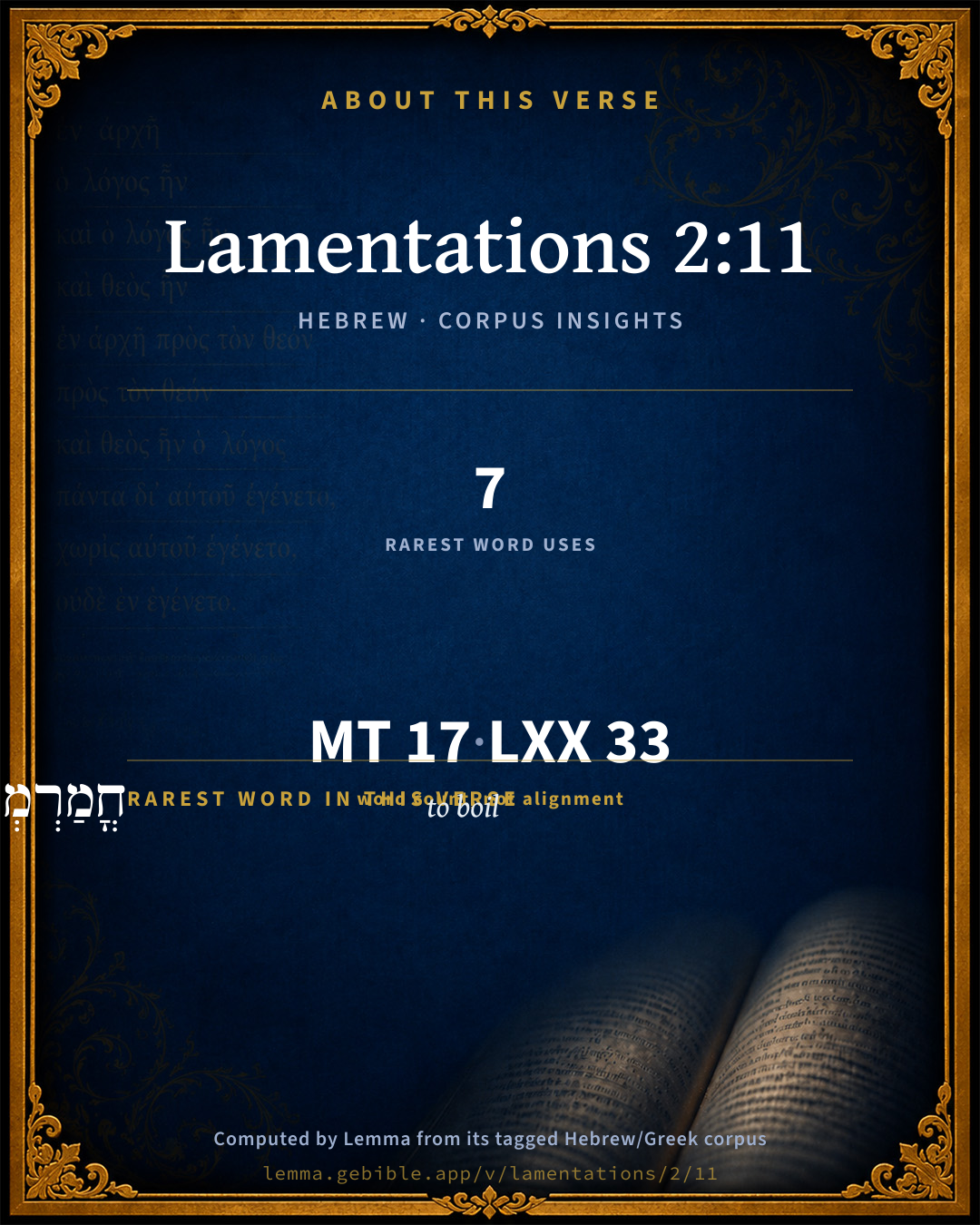
The rarest word here is חֳמַרְמְר֣וּ to boil H2560 — appearing just 7 times in the whole Hebrew Bible.

Shared distinctive vocabulary

חֳמַרְמְר֣וּ to boil H2560 occurs in 6 verses of the Hebrew Bible. Also found in:

Grammatical profile

  • 5 verbs
  • 11 nouns
  • 1 preposition

Verb forms

  • כָּל֨וּ Qal · Perfect
  • חֳמַרְמְר֣וּ Pealal · Perfect
  • נִשְׁפַּ֤ךְ Niphal · Perfect
  • בֵּֽעָטֵ֤ף Niphal · Infinitive Construct
  • וְיוֹנֵ֔ק Qal · Participle Active

Hebrew & Septuagint length

In English translation the verse runs 41 words from the Hebrew and 40 from the Septuagint (LXX English) — closely comparable.

A rough comparison of the two English renderings, which tokenize alike — not a word-level alignment.

Word counts can differ between the Hebrew and the Greek without any difference in meaning — e.g. the Hebrew direct-object marker אֵת has no separate Greek word, and Greek often adds the article ὁ.

In the original languages it is 17 Hebrew tokens and 33 Greek tokens — but the two are counted differently (Hebrew bundles its prefixes and suffixes into one token; the Greek is in lemma form), so that isn’t a like-for-like length.

Cross-references

19

Topical passages linked to Lamentations 2:11 in the Treasury of Scripture Knowledge — connected by theme and wording, ordered by reader-vote popularity; previews shown in the World English Bible.

  • Lamentations 1:20 See, Yahweh; for I am in distress; my heart is troubled; My heart is turned within me; for I have grievously rebelled: Abroad the sword bereaves, at home there is as death.
  • Job 16:13 His archers surround me. He splits my kidneys apart, and does not spare. He pours out my gall on the ground.
  • Jeremiah 4:19 My anguish, my anguish! I am pained at my very heart; my heart is disquieted in me; I can't hold my peace; because you have heard, O my soul, the sound of the trumpet, the alarm of war.
  • Lamentations 1:16 For these things I weep; my eye, my eye runs down with water; Because the comforter who should refresh my soul is far from me: My children are desolate, because the enemy has prevailed.
  • Psalms 6:7 My eye wastes away because of grief; It grows old because of all my adversaries.
  • Psalms 22:14 I am poured out like water. All my bones are out of joint. My heart is like wax; It is melted within me.
  • Isaiah 22:4 Therefore said I, Look away from me, I will weep bitterly; don't labor to comfort me for the destruction of the daughter of my people.
  • Lamentations 3:48–51 My eye runs down with streams of water, for the destruction of the daughter of my people.
  • Luke 23:29 For behold, the days are coming in which they will say, 'Blessed are the barren, the wombs that never bore, and the breasts that never nursed.'
  • Psalms 31:9 Have mercy on me, Yahweh, for I am in distress. My eye, my soul, and my body waste away with grief.
  • Lamentations 2:19–20 Arise, cry out in the night, at the beginning of the watches; Pour out your heart like water before the face of the Lord: Lift up your hands toward him for the life of your young children, that faint for hunger at the head of every street.
  • Lamentations 4:3–4 Even the jackals draw out the breast, they give suck to their young ones: The daughter of my people is become cruel, like the ostriches in the wilderness.
  • Lamentations 4:9–10 Those who are killed with the sword are better than those who are killed with hunger; For these pine away, stricken through, for want of the fruits of the field.
  • 1 Samuel 30:4 Then David and the people who were with him lifted up their voice and wept, until they had no more power to weep.
  • Psalms 69:3 I am weary with my crying. My throat is dry. My eyes fail, looking for my God.
  • Jeremiah 8:19–9:1 Behold, the voice of the cry of the daughter of my people from a land that is very far off: isn't Yahweh in Zion? Isn't her King in her? Why have they provoked me to anger with their engraved images, and with foreign vanities?
  • Jeremiah 14:17 You shall say this word to them, Let my eyes run down with tears night and day, and let them not cease; for the virgin daughter of my people is broken with a great breach, with a very grievous wound.
  • Jeremiah 44:7 Therefore now thus says Yahweh, the God of hosts, the God of Israel: Why commit you [this] great evil against your own souls, to cut off from you man and woman, infant and suckling, out of the midst of Judah, to leave you none remaining;
  • Isaiah 38:14 Like a swallow [or] a crane, so did I chatter; I did moan as a dove; my eyes fail [with looking] upward: Lord, I am oppressed, be my collateral.

Cross-references courtesy of OpenBible.info (CC BY 4.0).

Hebrew and Greek witnesses Masoretic Hebrew ↔ Greek Septuagint

The same verse in the two great witnesses to the Old Testament, shown verse-for-verse.

These are two independent witnesses, not word-aligned to each other, and the Septuagint is shown in lemma (dictionary) form.

Hebrew Lamentations 2:11 Masoretic · Westminster Leningrad Codex

כָּל֨וּ בַדְּמָע֤וֹת עֵינַי֙ חֳמַרְמְר֣וּ מֵעַ֔י נִשְׁפַּ֤ךְ לָאָ֨רֶץ֙ כְּבֵדִ֔י עַל שֶׁ֖בֶר בַּת עַמִּ֑י בֵּֽעָטֵ֤ף עוֹלֵל֙ וְיוֹנֵ֔ק בִּרְחֹב֖וֹת קִרְיָֽה

My eyes do fail with tears, my heart is troubled; My liver is poured on the earth, because of the destruction of the daughter of my people, Because the young children and the infants swoon in the streets of the city.

World English Bible · Public Domain

Greek LXX Lamentations 2:11 Septuagint · lemma form

ἐκλείπω ἐν δάκρυ ὁ ὀφθαλμός ἐγώ ταράσσω ὁ καρδία ἐγώ ἐκχέω εἰς γῆ ὁ δόξα ἐγώ ἐπί ὁ σύντριμμα ὁ θυγάτηρ ὁ λαός ἐγώ ἐν ὁ ἐκλείπω νήπιος καί θηλάζω ἐν πλατύς πόλις

CHAPH. My eyes have failed with tears, my heart is troubled, my glory is cast down to the ground, for the destruction of the daughter of my people; while the infant and suckling swoon in the streets of the city.

LXX2012 (modern English Septuagint) · Public Domain

Hebrew: Westminster Leningrad Codex (CC BY 4.0). Greek: Septuagint (public domain); English from LXX2012 (modern English Septuagint) (Public Domain). How the Septuagint differs from the Hebrew →

Commentary

Notes on Lamentations 2:11 from classic Christian and Jewish commentators (each source and its license shown beneath its notes). The classic Christian expositions comment on the surrounding passage and are grouped to its opening verse, so a note may address several verses; the Jewish commentaries on the Tanakh (Rashi and others) are per-verse, so they appear only where the commentator wrote on this verse.

Lemma curates 59 commentaries, every one of them public domain or Creative Commons licensed, each selected and text-cleaned for this edition rather than reprinted as found. About our sources →

Trapp's Complete Commentary

John Trapp

Lam 2:11 Mine eyes do fail with tears, my bowels are troubled, my liver is poured upon the earth, for the destruction of the daughter of my people; because the children and the sucklings swoon in the streets of the city.

Ver. 11. Mine eyes do fail with tears.] Those fountains (as the Hebrew word signifieth) are even drawn dry. I have wept till I can weep no more, as David did; or I have wept myself blind, as Faustus the son of Vortigern (once king of England) is said to have done.

My bowels are troubled.] Heb., Bemudded. See Lam 1:20.

My liver is poured upon the earth.] I have well nigh vomited up my gall. {as Job 16:13}

For the destruction.] Heb., The breach even to shivers, as young trees or ships are broken by tempests.

Because the children and sucklings swoon in the streets.] Miserabile etiam hostibus spectaculum; a rueful sight.

John Trapp, A Commentary or Exposition upon All the Books of the Old and New Testament (1647–1656) — public domain. Text from a community e-Sword module.

The Biblical Illustrator

Joseph S. Exell

Lam_2:11-13

Mine eyes do fail with tears.

The miseries of the Church taken to heart

1. The true ministers of God do take the miseries of the Church to heart in the greatest measure.

2. Our sorrow, humiliation, earnest prayer, and all other means of extraordinary calling upon God, must increase in us, so long as Gods heavy hand is upon us.

3. Hearty sorrow for spiritual miseries distempereth the whole body.

4. The sorrows of the soul will easily consume the body.

5. A lively member is grieved with the hurt of the body, or any member thereof.

6. The ministers of Christ should have a tender affection to the members of the Church, as a man hath to his daughter.

7. There is no outward thing so much cause of sorrow, as the miseries laid upon our children in our sight. (J. Udall.)

Compassion for sinners

It is the missionary with the fountain of pity that reaches the deepest place in the natives heart. When Livingstone was found dead on his knees in the heart of Africa, his head was resting over his open Bible, and his finger was pointing to the last words he ever penned in his diary: Oh, God, when will the open sore of the world be healed? That was the profound pity which commenced the redemptive work in Africa, and which lives in emancipating influence today. (Hartley Aspen.)

They say to their mothers, Where is corn and wine?--

Great grief

1. It is the greatest grief that can be, to have them whom we would gladly pleasure, seek that at our hands which we cannot help them unto.

2. When God would have us profit by any work of His, He will let us see the true cause of it.

3. The grief that is seen with the eye is the heaviest unto us of all other things that fall upon our friends.

4. When God meaneth to humble us, He will use most effectual means to bring it to pass. (J. Udall.)

What thing shall I take to witness for thee?--

Plain ministries

Ministers must be studious in the Word, to find out everything that may fit the Churchs present condition (Isa_50:4; Mat_13:52).

2. It is the greatest grief that can be, to fall into a trouble that hath not been laid upon others before.

3. That minister loveth us best, that dealeth most plainly with us.

4. The visible state of the Church of God may come to be of a desperate condition, every way vexed more and more. (J. Udall.)

The Biblical Illustrator, edited by Joseph S. Exell (c. 1880s–1900s) — public domain. Text from a community e-Sword module.

Whedon's Commentary on the Bible

Daniel D. Whedon

THE LAMENTATION, Lam_2:11-16.

11, 12. Liver is poured… earth — This language occurs nowhere else in the Old Testament, and the exact force of it is doubtful. “My soul is poured out” occurs in two passages, but this is easier. It would seem that “the liver” is taken as representing the large viscera, usually classed together under the general name of bowels, and regarded as the seat of the emotions. If so, the expression means that he could no longer restrain his feelings; that his grief must have vent in expression.

Swoon — Rather faint; or, with Keil, pine away. No feature of the common calamity — the utter desolation of the people — is more graphic or more painful than the falling down of the children in the street from hunger, and their pitiful and oft repeated cry, Where is corn and wine? until they finally expire in the arms of their miserable mothers.

Daniel D. Whedon (gen. ed.), Commentary on the Old and New Testaments (1874–1909) — public domain. Text from a community e-Sword module.

The Preacher's Complete Homiletical Commentary

Joseph S. Exell (gen. ed.)

EXEGETICAL NOTES.—

(כ) Lam_2:11. So exasperating is his misery that he feels as if organic parts of his body were dismembered. My eyes fail with tears, my bowels are troubled, my liver is poured upon the ground—an effect of terrible grief, showing how body and soul are sympathetic with each other over the breach of the daughter of my people. This shattered condition was replete with the harrowing details of suffering, as when the young children and the sucklings faint in the streets of the city.

(ל) Lam_2:12. His ears heard their piteous cravings, while to their mothers they are saying, Where is corn and wine, solid and liquid nourishment. Even when listening, his eyes saw the older children faint as the wounded in the streets of the city, and infants in arms poured their souls into their mother’s bosom, which could supply no aliment.

HOMILETICS

THE UTTER EXHAUSTION OF GRIEF

(Lam_2:11-12)

I. Because of the hopelessness of the desolation endured. “For the destruction of the daughter of my people” (Lam_2:11). The desolation is complete. Everything is destroyed—Temple, home, army, nation, wealth, food, and the very capacity to rouse themselves from the torpor of despair. When the light of hope is quenched it is impossible to put forth effort. Paralysis is destruction.

II. Because of the heart-rending spectacle of little children fainting in the streets and dying in their mothers’ arms, while they vainly moan for food. “Because the children and the sucklings swoon in the streets. They say to their mothers, ‘Where is corn and wine?’ when their soul was poured out into their mother’s bosom” (Lam_2:11-12). The harrowing details here given are the most affecting that have yet been depicted by the graphic and versatile pen of the prophet. The cry—an oft-repeated cry, as the tense means—of the children for food, which the mothers were powerless to supply, only added to the tortures they already suffered. So completely prostrate were they with their misery, that they saw their children die with indifference, and could not conceal an unnatural relief when they heard their last sob. Excessive grief blunts the edge of the finest natural instincts.

III. Because all the powers for expressing emotion are completely spent. “Mine eyes do fail with tears, my bowels are troubled, my liver is poured upon the earth” (Lam_2:11). Jeremiah employs the terms in ordinary use, and as they were popularly understood. As the heart was regarded by the Jews as the seat of the intellect, so the liver, as the chief of the large viscera classed together under the name of bowels, was supposed to be the seat of the emotions. By the pouring out, therefore, of the liver upon the ground was meant that his feelings had entirely given way under the acuteness of his sorrow, and he could no longer restrain them.—Speaker’s Comm. The agony of grief was passed. It was quelled by sheer exhaustion. He wept till he could weep no more. He grieved till he was incapable of feeling his grief. A tearless sorrow is the most dangerous, and the most difficult to cure.

LESSONS.—

1. There is a limit to the greatest human sorrow.

2. There is a moment in the experience of the sufferer when death itself is welcome.

3. The greatest sorrow is a painful testimony to the desolating power of sin.

ILLUSTRATIONS.—Grief prostrating. Late in the afternoon of a summer day I entered a quiet graveyard where slept one of my dearest friends. It occupied the brow of a hill, which, with many a knoll and graceful undulation, sloped to the green meadow, watered by a winding stream, now catching, at its repeated curves, the rays of the setting sun. On the left was a pleasant wood, where the sturdy pine and fruit-bearing beech concealed narrow paths to cool caves and mossy banks. White birches and the trembling aspen, with the sweet-scented willow, grew upon the right, and from beyond rose the curling smoke from the cottage-houses. A robin sang its song of love and praise, a sparrow passed me bearing food to its little progeny, and the chirp of the merry grasshopper mingled with the hum of hundreds of flitting insects. But for this peace-breathing scene I had no greeting. The wild storm, thunder, rain, and darkness had been more welcome. Yielding utterly to my grief, I threw myself upon the sod, and took no heed of time. There came over me a sense of utter and hopeless desolation; an agony like that of death turned to bitterness the blessings of my lot.

—Grief is a flower as delicate and prompt to fade as happiness. Still it does not wholly die. Like the magic rose, dried and unrecognisable, a warm air breathed on it will suffice to renew its bloom.—De Gasparin.

Misery makes indelible impressions. The rapidity with which ideas grow old in our memories is in a direct ratio to the squares of their importance. Their apparent age runs up miraculously, like the value of diamonds, as they increase in magnitude. A great calamity, for instance, is as old as the trilobites an hour after it has happened. It stains backward through all the leaves we have turned over in the book of life before its blot of tears or of blood is dry on the page we are turning. Did you ever happen to see that most soft-spoken and velvet-handed steam-engine at the Mint? The smooth piston slides backwards and forwards as a lady might slip her delicate finger in and out of a ring. The engine lays one of its fingers calmly but firmly upon a bit of metal; it is a coin now, and will remember that touch, and tell a new race about it, when the date upon it is crusted over with twenty centuries. So it is that a great silent-movingsilent-moving an hour or a moment—as sharp an impression as if it had taken half a lifetime to engrave it.—Holmes.

Distress exhausting. Distress is trouble of a mental kind, tending to despair. Tribulation may be described as the “fighting without,” whilst distress may be described as the “fears within.” That kind of trouble is indicated which comes upon a wrestler when his antagonist has succeeded in throwing him after a long struggle, has got his foot on him, is holding him down, and all seems to be up with him. Before, when wrestling, he was troubled, now he is distressed. Thus we see that the afflictions contemplated by the terms tribulation and distress are no light ones; and it is little wonder that, under the strain of such untoward circumstances of outward and inward trouble, the Christian should lose heart and fear the worst.

Grief excessively indulged. Ebenezer Adams, an eminent member of the Society of Friends, on visiting a lady of rank, whom he found, six months after the death of her husband, seated on a sofa covered with black cloth and in all the dignity of woe, approached her with great solemnity, and gently taking her by the hand, thus addressed her: “So, friend, I see, then, thou hast not yet forgiven God Almighty.” This reproof had so great an effect on the lady, that she immediately laid aside her violent grief, and again entered on the discharge of the duties of life.

The cure of excessive sorrow. A pale mourner stood bending over the tomb, and his tears fell fast and often. As he raised his humid eyes to heaven, he cried, “My brother! O my brother.” A sage passed that way and said, “For whom dost thou mourn?” “One,” replied he, “whom I did not sufficiently love while living, but whose inestimable worth I now feel.” “What wouldst thou do if he were restored to thee?” The mourner replied that he would never offend him by an unkind word, but would take every occasion to show his friendship, if he could but come back to his fond embrace. “Then, waste not thy time in useless grief,” said the sage; “but if thou hast friends, go and cherish the living, remembering that they will one day be dead also.”

—Like the passengers through the tunnelled Alps from the dark, cold, stifling air, emerging on the broad light-flooded plains of Lombardy, it is often by a way which they know not, gloomy and underground, that the convoy is carried which God’s Spirit is bringing to the wealthy place; and your present grief you will have no reason to regret if it introduce you to God’s friendship and to joys which do not perish in the using. Affliction is God’s message.—Hamilton.

The Preacher's Complete Homiletical Commentary (gen. ed. Joseph S. Exell; Funk & Wagnalls, c. 1892) — public domain (pre-1929). A full-Bible homiletical/sermon-outline anthology covering 65 of 66 books (2 John is absent from the source module). Text from a community e-Sword module.

Keil & Delitzsch

C. F. Keil & F. Delitzsch

The impotence of human comfort, and the mockery of enemies. Lam 2:11. The misery that has befallen the people is so fearful, that sorrow over it wears out one's life. "Mine eyes pine away because of tears," is the complaint of the prophet, not merely for himself personally, but in the name of all the godly ones. "Mine eyes pine" is the expression used in Psa 69:4. On חמרמרוּ מעי, cf. Lam 1:20. The expression, "my liver is poured out on the earth," occurs nowhere else, and is variously explained. That the liver is fons sanguinis, and thus the seat of the animal life (Rosenmller, Thenius), cannot be made out from Pro 7:23. This passage rather forms a proof that among the Hebrews, according to a view widely prevalent in ancient times, the liver was considered the seat of sensual desire and lust (cf. Delitzsch's Bib. Psychology, Clark's translation, p. 316). But this view is insufficient as an explanation of the passage now before us. Besides, there are no proofs to show that "liver" is used for "heart," or even for "gall," although Job 16:13 is unwarrantably adduced in support of this position. A closely related expression, certainly, is found in Job 30:16; Psa 42:5, where the soul is said to be poured out; but the liver is different from נפשׁ, the principle of the corporeal life. If the liver was called כּבד because, according to Galen, de usu partium, vi. 17 (in Gesen. Thes. p. 655), omnium viscerum et densissimum et gravissimum est, then it may be regarded, instead of מעים, as the chief bodily organ through which not merely lust, but also pain, is felt; and the pouring out of the liver on the earth may thus mean that the inner man is dissolved in pain and sorrow, - perishes, as it were, through pain. For it is evident from the context, and universally admitted, that it is the effect of pain in consuming the bodily organs that is here meant to be expressed. שׁבר בּת עמּי is a genuine Jeremianic expression (cf. Jer 6:14; Jer 8:11, Jer 8:21, etc.), which again occurs in Lam 2:13, Lam 3:47-48, and Lam 4:10. In what follows, some harrowing details are given regarding the destruction of the daughter of Zion. בּעטף for בּהעטף, while (or because) children and sucklings were pining away on the streets of the city. This figure of heartrending misery is further carried out in Lam 2:12, for the purpose of vividly setting forth the terrible distress. Gerlach is wrong in thinking that the writer brings forward such sad scenes as would be likely to present themselves in the period immediately after the destruction of the city. For, the fact that, in Lam 2:10, the eye of the mourner is directed to the present, is far from being a proof that Lam 2:11 and Lam 2:12 also treat of the present; and the imperfect יאמרוּ, Lam 2:12, is not parallel in time with ישׁבוּ, Lam 2:12, but designates the repetition of the action in past time. "The children say to their mothers, Where is corn and wine?" i.e., Give us bread and wine, or, Where can we eat and drink? Corn and must (as in Jer 31:12, etc.) are mentioned as the usual means of nourishment of the Israelites. דּגן, "corn," is used poetically for bread (cf. Psa 78:24), - not pounded or roasted grain, which was used without further preparation (Thenius), and which is called קלי, Lev 23:14; Sa1 17:17; Sa2 17:28. The sucklings poured out their soul, i.e., breathed out their life, into the bosom of their mothers, i.e., hugging their mothers, although these could not give them nourishment; cf. Lam 4:4.

Keil & Delitzsch — Biblical Commentary on the Old Testament (1861–1891) — public domain (CC PDM 1.0). Text via the HelloAO Bible API. (Old Testament only.)

Geneva Bible (1599)

Geneva Bible translators

Or, faint.

Geneva Bible (1599) marginal notes — public domain. Text via Bolls.life.

Jamieson, Fausset & Brown

Robert Jamieson, A. R. Fausset & David Brown

liver is poured, &c.--that is, as the liver was thought to be the seat of the passions, "all my feelings are poured out and prostrated for," &c. The "liver," is here put for the bile ("gall," Job 16:13; "bowels," Psa 22:14) in a bladder on the surface of the liver, copiously discharged when the passions are agitated.

swoon--through faintness from the effects of hunger.

Jamieson, Fausset & Brown — Commentary Critical and Explanatory on the Whole Bible (1871) — public domain (CC PDM 1.0). Text via the HelloAO Bible API.

Adam Clarke's Commentary

Verse 11. Swoon in the streets of the city.] Through the excess of the famine.

Adam Clarke's Commentary on the Bible (1810–1826) — public domain. Text from a community e-Sword/MySword module.

John Calvin's Commentaries

The Prophet himself now speaks, and says that his eyes were consumed with tears, while weeping on account of the calamities of the people: even in the deepest grief tears at length dry up; but when there is no end of weeping, the sorrow, which as it were never ripens, must necessarily be very bitter. Jeremiah then expresses now the vehemence of his grief when he says that his eyes failed through shedding tears. He said in Jeremiah 9, “Who will give me eyes for fountains?” that is, who will make my eyes to turn into fountains, that they may continually flow? and this he said, because he saw how dreadful a vengeance of God impended over the obstinate. But now, when he sees accomplished what he had dreaded, he says, that his eyes were consumed with weeping.

To the same purpose is what he adds, that his bowels were disturbed. It is the same verb as we have seen before, חמרמרו, chemermeru; which some render “bound,” as we also said then. I know not why one expositor has changed what he had elsewhere said rightly; he puts here, “swollen have my bowels.” But I see no reason why the verb should be taken here in a different sense, for it immediately follows, my liver is poured forth on the ground. He may, indeed, have included other parts of the intestines by stating a part for the whole. The word here properly means the liver, as when Solomon says,

“He hath pierced my liver.” (Proverbs 7:23.)

But Jeremiah, in short, shews that all his faculties were so seized with grief, that no part was exempt. He then says that his liver was poured forth, but in the same sense in which he said that his bowels were disturbed. They are indeed hyperbolical expressions; but as to the meaning, Jeremiah simply expresses his feelings; for there is no doubt but that he was incredibly anxious and sorrowful on account of so great a calamity; for he not only lamented the adversity in no ordinary way, but he also considered how wicked was that obstinacy in which the people had hardened themselves for almost fifty years; for he had spent himself in vain, not for a short time, but for nearly fifty years he never ceased to speak to them. He then, no doubt, thought within himself what the people had deserved, so that he had no common dread of God’s vengeance. This, then, was the reason why he said that his bowels were disturbed and his liver poured forth. He, however, mentions the cause of his sorrow, even the breach or destruction of the daughter of his people; and he mentions one thing in particular, because the little one and he who sucked the breasts vanished away in the streets of the city; for so I render the verb עתף, otheph, which properly means to cover; but its secondary meaning is to vanish away, as we shall again presently see. It was, indeed, a miserable sight, when not only men and women were everywhere slain, but when, through famine, little children also fainted. We, indeed, know that infants move our pity, for the tears of a child in hunger penetrate into our inmost souls. When, therefore, little children and those who hung on their mothers’ breasts, cried through the streets of the city, it must have touched the most iron hearts. It was then not without reason that Jeremiah referred to this in particular, that little children and sucklings vanished away, not in a deserted and barren land, but in the very streets of the city. It follows, —

John Calvin's Commentaries (1540-1563) — public domain. Text from the Calvin Translation Society English edition (1840s-50s) via the Christian Classics Ethereal Library (ccel.org). Calvin's coverage is partial (roughly two-thirds of the Bible); uncommented books and verses are honest gaps, never fabricated. The 19th-century editor's footnotes and remarks are omitted so the notes are faithfully Calvin's own voice.

Ellicott's Commentary for English Readers

(11) My liver is poured upon the earth . . .—The phrase is not found elsewhere, but admits of an easy explanation. The “liver,” like the “heart” and the “bowels,” is thought of as the centre of all intense emotions, both of joy or sorrow (Pro_7:23). As such it is represented as giving way without restraint (comp. Lam_2:19), under the pressure of the horror caused by the calamities which the next words paint, by the starving children who fainted for hunger in the streets of the city.

A Bible Commentary for English Readers, edited by Charles John Ellicott (1878–1897) — public domain. Text from a community e-Sword module.

The Cambridge Bible for Schools and Colleges

gen. ed. J. J. S. Perowne

11. my bowels are troubled] See on ch. Lam_1:20.

My liver is poured upon the earth] The liver seems to have been looked upon, as were the rest of the vitals, as the seat of the emotions, and hence the expression in the text merely denotes strong and painful excitement. Cp. pouring out the heart, Lam_2:19, Psa_62:8; cp. Job_16:13.

destruction] mg. breach. See on Jer_4:20; Jer_17:18.

11–17. Lament over Zion’s exposure to the mockery of her enemies.

The Cambridge Bible for Schools and Colleges (gen. ed. J. J. S. Perowne; Cambridge University Press, 1878–1918) — public domain. Text from a community e-Sword module.

John Gill's Exposition

Mine eyes do fail with tears,.... According to Aben Ezra, everyone of the elders before mentioned said this; but rather they are the words of the Prophet Jeremiah, who had wept his eyes dry, or rather blind, on account of the calamities of his people; though he himself obtained liberty and enlargement by means thereof:

my bowels are troubled; all his inward parts were distressed:

my liver is poured upon the earth; his gall bladder, which lay at the bottom of his liver, broke, and he cast it up, and poured it on the earth; see Job 16:13; and all this was

for the destruction of the daughter of my people; or, the "breach" of them (t); their civil and church state being destroyed and broke to shivers; and for the ruin of the several families of them: particularly

because the children and sucklings swoon in the streets of the city; through famine, for want of bread, with those that could eat it; and for want of the milk of their mothers and nurses, who being starved themselves could not give it; and hence the poor infants fainted and swooned away; which was a dismal sight, and heart melting to the prophet.

(t) "propter contritionem", Pagninus, Montanus, Junius & Tremellius; "propter confractionem", Piscator; "propter fractionem", Cocceius.

John Gill's Exposition of the Whole Bible (1746–1763) — public domain (CC PDM 1.0). Text via the HelloAO Bible API.

Albert Barnes' Notes on the Bible

Troubled - See the margin reference note.

Liver - As the heart was regarded by the Jews as the seat of the intellect, so the liver (or bowels) was supposed to be the seat of the emotions. The pouring out of the liver upon the ground meant that feelings had entirely given way under the acuteness of sorrow, and he could no longer restrain them.

Albert Barnes' Notes on the Bible (1834–1885) — public domain. Text from a community e-Sword/MySword module.

Haydock's Catholic Bible Commentary

Earth, by an overflowing of the bile, occasioned by grief, Job xvi. 14. (Calmet)

George Leo Haydock (1774–1849), Haydock's Catholic Family Bible and Commentary, 1859 edition — public domain. Excludes Psalms (Douay-Rheims chapter numbering differs from Protestant) and Deuterocanonical books (Catholic canon only).

Matthew Poole's English Annotations

This whole verse is but expressive of the prophet’s great affliction for the miseries come upon the Jews: he wept himself almost blind, his passion had disturbed his bodily humours, that his bowels were troubled; his gall lying under his liver, upon this disturbance was vomited up: they are all no more than expressions of very great affliction and sorrow.

For the destination of the daughter of my people; for the miseries befallen the Jews: he had mourned for their sins before, and for their plagues too which he had in prospect, Jer 9:1; he now mourns for them as being come upon them: which mourning considered only as for their miseries, spake no more than the prophet’s good nature and love to his country; but considered as the indication of God’s wrath and displeasure, was also a godly sorrow.

Because the children and the sucklings swoon in the streets of the city; the children and sucklings fainted and swooned, either for want of water, or bread, or milk in their mothers’ or nurses’ breasts during the famine, occasioned by the long siege of the city. This appears in the next verse.

Matthew Poole's English Annotations on the Holy Bible (1683–1685) — public domain. Text from a community e-Sword/MySword module.

The Pulpit Commentary

My bowels are troubled. (see on Lam_1:20) My liver is poured upon the earth. A violent emotion being supposed to occasion a copious discharge of bile. The daughter of my people. A poetic expression for Zion or Judah.

The Pulpit Commentary (1880–1919), ed. H.D.M. Spence-Jones & Joseph S. Exell — public domain. Text from a community e-Sword module.

John Wesley's Explanatory Notes

Mine eyes - This whole verse is but expressive of the prophets great affliction for the miseries come upon the Jews. He wept himself almost blind. Bowels - His passion had disturbed his bodily humours, that his bowels were troubled. Liver - His gall lying under his liver. All these are expressions of great affliction and sorrow. Swoon - During the famine, occasioned by the long siege.

John Wesley, Explanatory Notes Upon the Whole Bible (1754–1765) — public domain. Text via the GEBible commentary corpus.

Kretzmann's Popular Commentary

Paul E. Kretzmann

The Vanity of Human Consolation Together with a Plea for Help

v. 11. Mine eyes do fail with tears, being spent, worn out, with weeping, my bowels are troubled, his heart being most deeply affected, my liver is poured upon the earth, that is,—since the liver was considered the seat of the passions,—all my feelings are dissolved with pain, for the destruction of the daughter of my people, because the children and the sucklings swoon in the streets of the city, the fainting away of these innocent victims of the calamity being the very climax of its severity.

v. 12. They say to their mothers, as they are tortured with the pangs of hunger, Where is corn and wine? anything to eat, when they swooned as the wounded in the streets of the city, faint with weakness for lack of food, when their soul was poured out into their mothers’ bosom, breathing out their lives while lying on their mothers’ laps, the latter being compelled to look on in helpless misery.

v. 13. What thing shall I take to witness for thee? to bring some measure of comfort from the experience of others. What thing shall I liken to thee, O daughter of Jerusalem? in making some comparison which would tend to arouse her drooping spirits. What shall I equal to thee that I may comfort thee, O virgin daughter of Zion? Any attempt of this kind is bound to fail in this instance, since no real comparison can be made. For thy breach is great like the sea, immeasurably boundless in extent and depth; who can heal thee? As the conditions are, Jerusalem can expect neither comfort nor healing from her prophets.

v. 14. Thy prophets have seen vain and foolish things for thee, namely, the false prophets, to whom the people of Jerusalem listened, much against Jeremiah’s advice; and they have not discovered thine iniquity, pointing out the real cause of all this misery, to turn away thy captivity, namely, by leading the people to repentance, but have seen for thee false burdens and causes of banishment, that is, the contents of their prophecies, while apparently directed against the enemies, are such as to bring ruin upon Judah.

v. 15. All that pass by clap their hands at thee, in scorn and mockery; they hiss and wag their head at the daughter of Jerusalem, saying, in expressing the derision which they felt, Is this the city that men call The perfection of beauty, The joy of the whole earth? It is a question of scornful wonderment, denying Jerusalem’s right ever to have borne such designations. To this behavior of strangers is added the mocking triumph of enemies.

v. 16. All thine enemies have opened their mouth against thee, in a gesture of mockery and derision; they hiss and gnash the teeth, as an expression of satisfied rage, of vindictive malice. They say, We have swallowed her up, thus effecting a complete destruction; certainly this is the day that we looked for, which they had so eagerly awaited; we have found, we have seen it, and they feel a corresponding satisfaction and pleasure. But the destruction of Jerusalem was not a chance happening, nor was it alone the culmination of men’s hateful plans.

v. 17. The Lord hath done that which He had devised, what He had resolved upon; He hath fulfilled His word that He had commanded in the days of old, for the holiness of the Lord demands the punishment of every act of rebellion against His holy Law; He hath thrown down and hath not pitied, carrying out His threat with merciless severity; and He hath caused thine enemy to rejoice over thee; He hath set up the horn of thine adversaries, so that they were given power, authority, and victory.

v. 18. Their heart, that of the Jews suffering such great afflictions, cried unto the Lord, even while they addressed the fortifications of their city, O wall of the daughter of Zion, the city with all its inhabitants, let tears run down like a river day and night, in the intensity of grief over the present conditions; give thyself no rest, no surcease from sorrow; let not the apple of thine eye cease, in desisting from shedding tears.

v. 19. Arise, cry out in the night, throughout all the watches of the night; in the beginning of the watches, with the desire and strength for weeping renewed again and again, pour out thine heart like water before the face of the Lord, the very heart dissolving in tears, as it were, in the excess of the sorrow caused by the great calamity; lift up thy hands toward Him, in a gesture of fervent supplication, for the life of thy young children that faint for hunger in the top, at the head, of every street.

v. 20. Behold, O Lord, and consider to whom Thou hast done this, so the prayer of the city’s inhabitants now arises. Shall the women eat their fruit, and children of a span long? in revolting cannibalism caused by excessive hunger. Cf Lev 26:29; ’Deu 28:53; Jer 19:9. Shall the priest and the prophet be slain in the Sanctuary of the Lord? The one was against God’s moral order governing the universe, the other conflicted with His covenant and the worship connected with it.

v. 21. The young and the old lie on the ground in the streets, being slaughtered without mercy; my virgins and my young men are fallen by the sword, neither age nor sex being spared. Thou hast slain them in the day of Thine anger; Thou hast killed and not pitied.

v. 22. Thou hast called as in a solemn day, as for a festival prepared for the enemies, my terrors round about, from every direction, so that Jerusalem was surrounded by them, so that in the day of the Lord’s anger none escaped nor remained, all being involved in the common ruin; those that I have swaddled and brought up, with the fondest love of a parent, hath mine enemy consumed. Fortunate is the person who, when experiencing the Lord’s punishment, cried out thus in true repentance!

Paul E. Kretzmann, Popular Commentary of the Bible (1921–1924) — public domain. Text from a community e-Sword module.

unfoldingWord translationNotes

Door43 World Missions Community

General Information:

The author shifts from describing Jerusalem to describing his own experience.

My eyes have failed from their tears

This is an idiom. AT: "I have cried until I cannot cry anymore" (See: Idiom)

my stomach churns

The word "churn" means to move around violently, normally in a circular rotation. This does not mean the stomach is literally churning, but describes how the author feels. AT: "my insides ache" or "my stomach hurts" (See: Metaphor)

my inner parts are poured out to the ground

The author speaks of feeling grief in his inner being as if his inner body parts had fallen out of his body onto the ground. AT: "my entire inner being is in grief" (See: Metaphor)

the daughter of my people

This is a poetic name of Jerusalem, which is spoken of here as if it were a woman. AT: "my people" (See: Metonymy and Personification)

Where is grain and wine?

This rhetorical question is used as a request for something to eat. The children are telling their mother that they are hungry. The phrase "grain and wine" represents food and drink. This question may be written as a statement. AT: "Give us something to eat and drink." (See: Metonymy and Rhetorical Question)

as they faint like a wounded man

This speaks of the children fainting from hunger and thirst in the same way that a wounded man faints. (See: Simile)

their lives are poured out on the bosom of their mothers

This speaks of the children dying as if their lives were a liquid that was being poured out. AT: "they slowly die in the arms of their mothers" (See: Metaphor)

translationWords

people group

grain

wine

life

unfoldingWord translationNotes — © Distant Shores Media and the Door43 World Missions Community, licensed CC BY-SA 4.0. Source: git.door43.org/Door43/en_tn.

Rashi

Rabbi Shlomo Yitzchaki (Rashi)

my innards burn Heb. חֳמַרְמְרוּ, regrizi(l)lerent in Old French, have shriveled up. It is usual that when a person casts intestines into the fire, they shrivel up and burn.

faint Heb. בֵּעָטֵף, pa(s)mer in Old French, to faint, swoon.

Rashi on the Tanakh — English translations: “The Judaica Press complete Tanach with Rashi, translated by A. J. Rosenberg” (CC BY 4.0); “Pentateuch with Rashi's commentary by M. Rosenbaum and A.M. Silbermann, 1929-1934” (public domain); “The Metsudah Tanach series, Lakewood, N.J” (CC BY 4.0); and “The Book of Joshua, Metsudah Publications, 1997” (CC BY 4.0). Text via Sefaria.

Lesson kit

Teaching starters — assembled from the data on this page, not authored interpretation. Every prompt links to the verse data it draws on. Edit before teaching.

Lamentations, in the Prophets, opens this verse with 17 words (17 distinct Hebrew lemmas). Its most distinctive word is châmar (“to boil”). A historical commentator’s framing appears above. Read the whole chapter for the surrounding context.

Discussion questions

  1. What does “to boil” (châmar) contribute to the verse as a whole?
  2. How does Exodus 2:3, which shares the word «to boil», read alongside this verse?
  3. The translations on this page render this verse differently — a whole-verse word diff, not a word-by-word alignment. What might account for the different wordings?
  4. «כָּל֨וּ» is a Qal Perfect verb. How does that grammatical form shape the action described?
  5. Compare how Trapp's Complete Commentary and The Biblical Illustrator read this verse. Where do they agree or differ?

Things to notice

Reading settings

Reading text

Shown beneath each verse's original-language words.

Old Testament
Old Testament edition

Read the OT as the Masoretic Hebrew (MT) or the Greek Septuagint (LXX).

English shown for the Greek Septuagint (in the Hebrew ↔ Greek comparison).

Comparing translations? Open the Compare panel on any verse page to stack up to four side by side.