
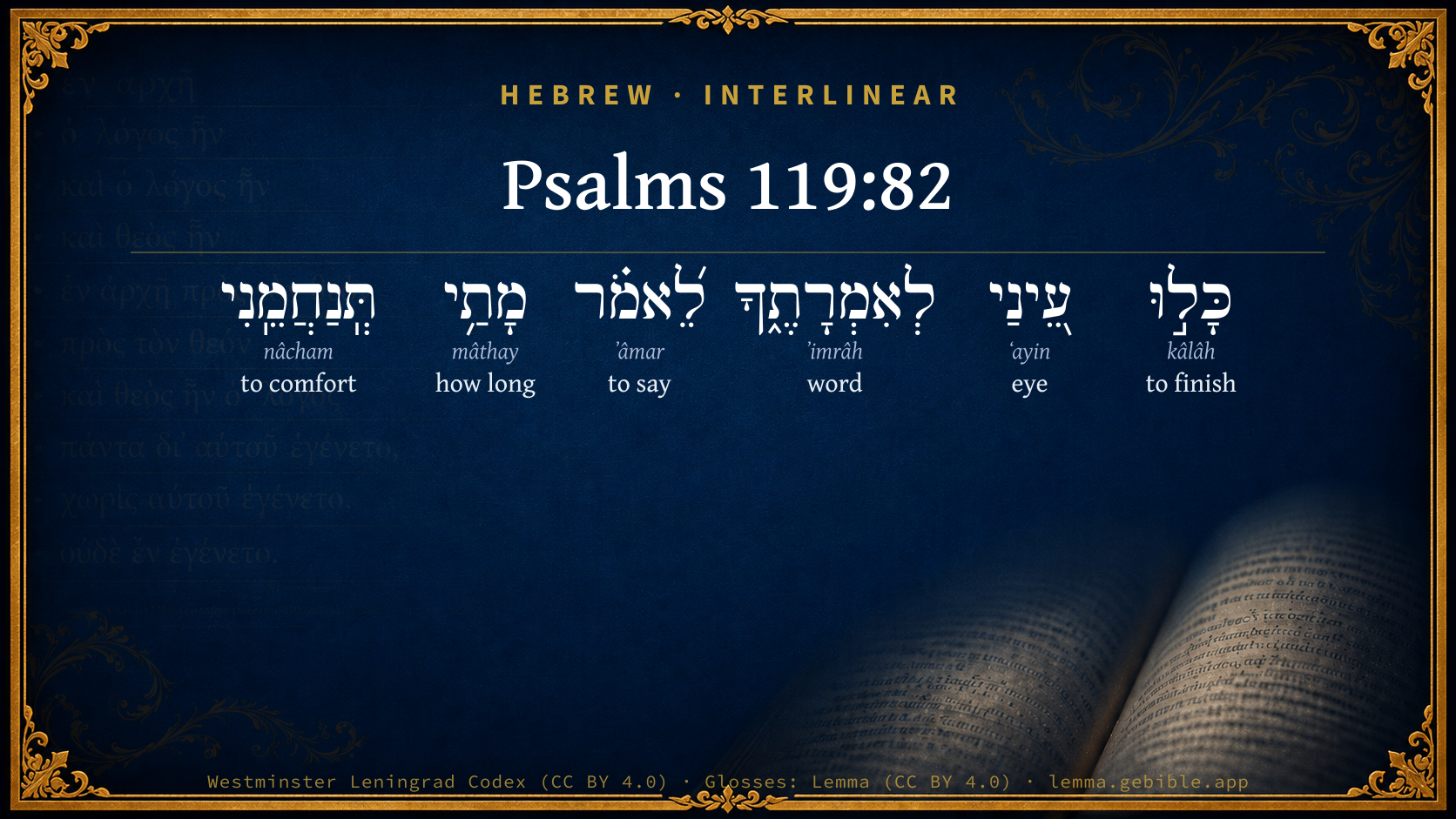
Psalms 119:82

Hebrew (Westminster Leningrad Codex) Psalms 119:82 appears in the Hebrew Old Testament. The text above is from the Westminster Leningrad Codex. Each word links to its Strong’s number, a concise gloss, and parsing drawn from the Open Scriptures Hebrew Bible morphology. Click any word for its full Brown-Driver-Briggs (BDB) entry.
Download image
Cite this verse

Psalms 119:82 (World English Bible). Public Domain. Lemma interlinear Bible study tool, https://lemma.gebible.app/v/psalms/119/82.

Show BibTeX & RIS
BibTeX
RIS
English Translation
My eyes fail for your word. I say, "When will you comfort me?"
World English Bible · Public Domain
Download a study sheet

One document with this verse’s original text, its word-by-word gloss line, the meaning frame, cross-references with their text, attributed commentary, and full source and license credits — printable, and it pastes into notes with its structure intact.

This verse Autodidact and up

Study sheet (.html) Plain text (.txt)

A passage Seminary Student

Up to 50 verses in one chapter. A passage sheet keeps up to 6 commentary sources and 12 cross-references per verse, in the order this page ranks them, and says so on the sheet whenever that leaves anything out. Ask for a single verse and you get the Autodidact verse sheet above.

Everything on this page stays free to read, with no account — the sheet is a download of what is already on screen, not access to it.

Want to remove ads? Support Godless Engineer
Compare translations 3

The same verse in 3 English versions, stacked beneath the original-language interlinear above. Click any original word for its lexicon entry.

Each is an independent rendering of the whole verse — the interlinear is not word-aligned to these translations.

Highlighted words mark where these versions differ — a whole-verse word diff, not a word-by-word alignment.

  • World English Bible Public Domain
    My eyes fail for your word. I say, "When will you comfort me?"
  • King James Version Public Domain
    Mine eyes fail for thy word, saying, When wilt thou comfort me?
  • unfoldingWord Literal Text CC BY-SA 4.0
    My eyes faint for your promise; saying, “When will you comfort me?”

unfoldingWord Literal Text — © unfoldingWord, licensed CC BY-SA 4.0. Word-aligned USFM3 via Door43 (git.door43.org/unfoldingWord/en_ult).

Versions to compare (up to 4)

3 of 4 selected

Show all 17 translations

Every available English version of this verse, each an independent rendering of the whole verse.

  • World English Bible Public Domain
    My eyes fail for your word. I say, "When will you comfort me?"
  • Berean Standard Bible Public Domain
    My eyes fail, looking for Your promise; I ask, “When will You comfort me?”
  • Majority Standard Bible Public Domain
    My eyes fail, looking for Your promise; I ask, “When will You comfort me?”
  • King James Version Public Domain
    Mine eyes fail for thy word, saying, When wilt thou comfort me?
  • American Standard Version (1901) Public Domain
    Mine eyes fail for thy word, While I say, When wilt thou comfort me?
  • Revised Version (1885) Public Domain
    Mine eyes fail for thy word, while I say, When wilt thou comfort me?
  • Geneva Bible (1599) Public Domain
    Mine eyes faile for thy promise, saying, when wilt thou comfort me?
  • Young's Literal Translation Public Domain
    Consumed have been mine eyes for Thy word, Saying, `When doth it comfort me?'
  • Literal Standard Version CC BY-SA 4.0
    My eyes have been consumed for Your word, || Saying, “When does it comfort me?”
  • Unlocked Literal Bible CC BY-SA 4.0
    My eyes long to see your promise; when will you comfort me?
  • unfoldingWord Literal Text CC BY-SA 4.0
    My eyes faint for your promise; saying, “When will you comfort me?”
  • Darby Bible Public Domain
    Mine eyes fail for thy ùword, saying, When wilt thou comfort me?
  • World Messianic Bible Public Domain
    My eyes fail for your word. I say, “When will you comfort me?”
  • Webster's Bible Public Domain
    My eyes fail for thy word, saying, When wilt thou comfort me?
  • Free Bible Version CC BY-SA 4.0
    I strain my eyes looking for you to keep your promises, asking “When will you comfort me?”
  • Bible in Basic English Public Domain
    My eyes are full of weariness with searching for your word, saying, When will you give me comfort?
  • JPS Tanakh (1917) Public Domain
    Mine eyes fail for Thy word, saying: 'When wilt Thou comfort me?'

Literal Standard Version (2020), Covenant Press — licensed CC BY-SA 4.0. Text via the HelloAO Bible API (eBible.org). Unlocked Literal Bible (unfoldingWord) — licensed CC BY-SA 4.0. Text via the HelloAO Bible API (eBible.org). unfoldingWord Literal Text — © unfoldingWord, licensed CC BY-SA 4.0. Word-aligned USFM3 via Door43 (git.door43.org/unfoldingWord/en_ult). Free Bible Version, Dr. Jonathan Gallagher — licensed CC BY-SA 4.0. Text via the HelloAO Bible API (eBible.org).

Word by word

More ways to search: Search by grammar → Find every occurrence → Compare this word →

Practice this passage: Drill this verse → Learn its vocabulary →

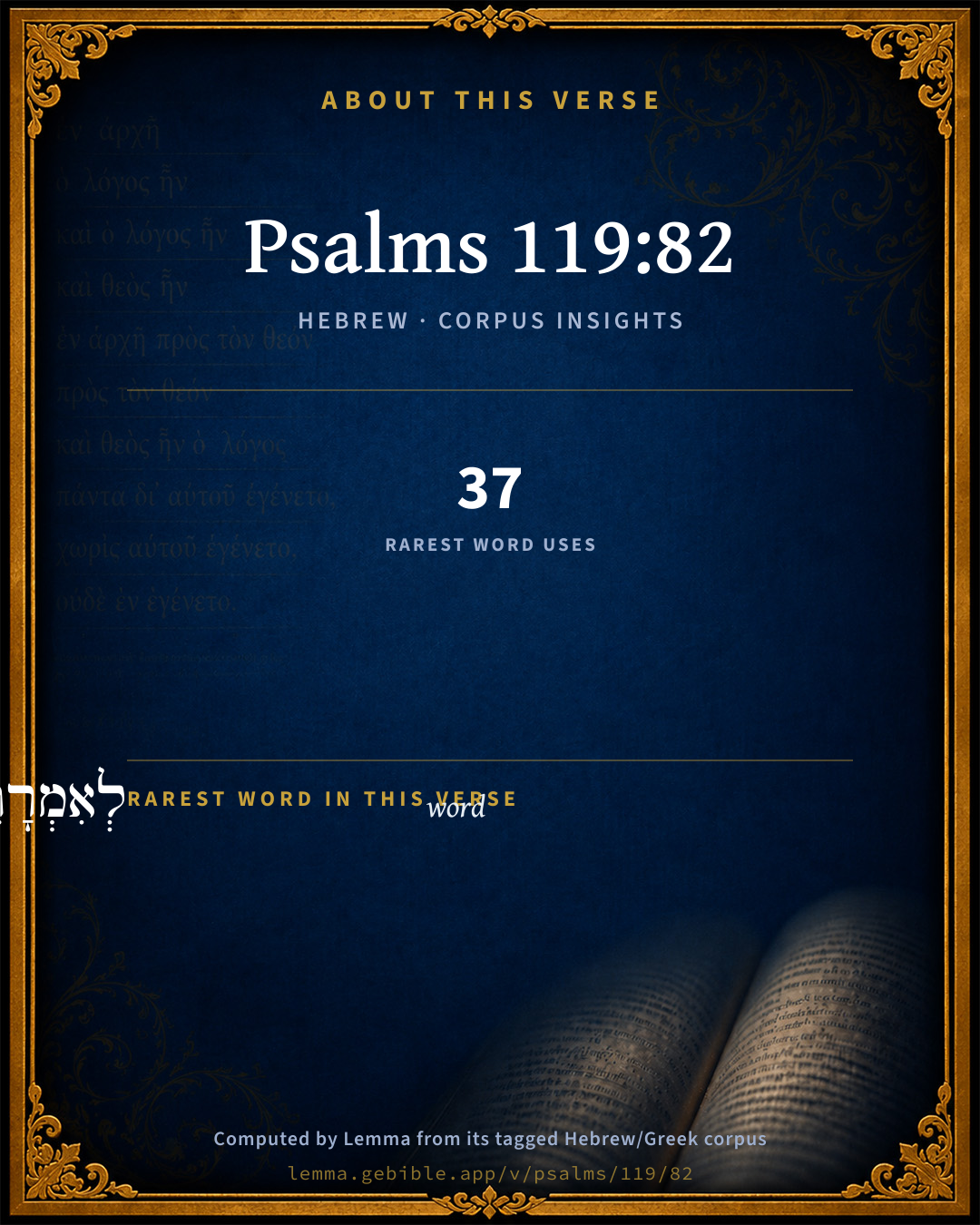
About this verse

These counts appear in no published source. They are computed here, from the morphology-tagged text and Lemma’s own curated glosses. What Lemma adds →

6
words
6
distinct lemmas
Wisdom
section

Shared distinctive vocabulary

לְאִמְרָתֶ֑ךָ word H565 occurs in 35 verses of the Hebrew Bible. Also found in:

Grammatical profile

  • 3 verbs
  • 2 nouns
  • 1 particle

Verb forms

  • כָּל֣וּ Qal · Perfect
  • לֵ֝אמֹ֗ר Qal · Infinitive Construct
  • תְּֽנַחֲמֵֽנִי Piel · Imperfect

Hebrew & Septuagint length

In English translation the verse runs 13 words from the Hebrew and 14 from the Septuagint (LXX English) — closely comparable.

A rough comparison of the two English renderings, which tokenize alike — not a word-level alignment.

Word counts can differ between the Hebrew and the Greek without any difference in meaning — e.g. the Hebrew direct-object marker אֵת has no separate Greek word, and Greek often adds the article ὁ.

Cross-references

8

Topical passages linked to Psalms 119:82 in the Treasury of Scripture Knowledge — connected by theme and wording, ordered by reader-vote popularity; previews shown in the World English Bible.

  • Psalms 69:3 I am weary with my crying. My throat is dry. My eyes fail, looking for my God.
  • Psalms 119:123 My eyes fail looking for your salvation, For your righteous word.
  • Proverbs 13:12 Hope deferred makes the heart sick, But when longing is fulfilled, it is a tree of life.
  • Psalms 86:17 Show me a sign of your goodness, That those who hate me may see it, and be shamed, Because you, Yahweh, have helped me, and comforted me.
  • Psalms 90:13–15 Relent, Yahweh! How long? Have compassion on your servants!
  • Deuteronomy 28:32 Your sons and your daughters shall be given to another people; and your eyes shall look, and fail with longing for them all the day: and there shall be nothing in the power of your hand.
  • Isaiah 38:11 I said, I shall not see Yah, Yah in the land of the living: I shall see man no more with the inhabitants of the world.
  • Lamentations 2:11 My eyes do fail with tears, my heart is troubled; My liver is poured on the earth, because of the destruction of the daughter of my people, Because the young children and the infants swoon in the streets of the city.

Cross-references courtesy of OpenBible.info (CC BY 4.0).

Hebrew and Greek witnesses Masoretic Hebrew ↔ Greek Septuagint

The same verse in the two great witnesses to the Old Testament, shown verse-for-verse.

You’re reading Greek Psalm 118 (Hebrew Psalm 119). The Septuagint counts the superscription, so verse numbers can differ from the Hebrew — chapter-level alignment, not verse-by-verse. Numbering follows Rahlfs.

These are two independent witnesses, not word-aligned to each other, and the Septuagint is shown in lemma (dictionary) form.

Hebrew Psalms 119:82 Masoretic · Westminster Leningrad Codex

כָּל֣וּ עֵ֭ינַי לְאִמְרָתֶ֑ךָ לֵ֝אמֹ֗ר מָתַ֥י תְּֽנַחֲמֵֽנִי

My eyes fail for your word. I say, "When will you comfort me?"

World English Bible · Public Domain

Greek LXX Greek Psalm 118:82 Septuagint · lemma form

ἐκλείπω ὁ ὀφθαλμός ἐγώ εἰς ὁ λόγιον σύ λέγω πότε παρακαλέω ἐγώ

My eyes failed in waiting for your word, saying, When will you comfort me?

LXX2012 (modern English Septuagint) · Public Domain

Hebrew: Westminster Leningrad Codex (CC BY 4.0). Greek: Septuagint (public domain); English from LXX2012 (modern English Septuagint) (Public Domain). How the Septuagint differs from the Hebrew →

Commentary

Notes on Psalms 119:82 from classic Christian and Jewish commentators (each source and its license shown beneath its notes). The classic Christian expositions comment on the surrounding passage and are grouped to its opening verse, so a note may address several verses; the Jewish commentaries on the Tanakh (Rashi and others) are per-verse, so they appear only where the commentator wrote on this verse.

Lemma curates 59 commentaries, every one of them public domain or Creative Commons licensed, each selected and text-cleaned for this edition rather than reprinted as found. About our sources →

Trapp's Complete Commentary

John Trapp

Psa 119:82 Mine eyes fail for thy word, saying, When wilt thou comfort me?

Ver. 82. Mine eyes fail] God sometimes deferreth to help till men have stopped looking: Luk 18:8, "When the Son of man cometh, shall he find faith?" hardly. This he doth to commend his favours to us, and to set a price on them.

Saying, When wilt thou comfort me?] This is a prosopopoeia, as if David’s eyes said thus, while they earnestly expected comfort.

John Trapp, A Commentary or Exposition upon All the Books of the Old and New Testament (1647–1656) — public domain. Text from a community e-Sword module.

J. A. Alexander on Psalms

Joseph Addison Alexander

82. (Psa 119:82) My eyes fail for thy saying, so that I say, when wilt thou comfort me? The first verb in Hebrew is the same with the first in the preceding verse. Thy saying, the fulfilment of thy promise. The Hebrew noun is derived from the following verb, to say, so as to say, so that I say. It might also be translated, but with less exactness, while I say.

Joseph Addison Alexander, The Psalms Translated and Explained (1850) — public domain. Text from a community e-Sword module.

Adam Clarke's Commentary

Verse 82. Mine eyes fail] With looking up for the fulfilment of thy promise, as my heart fails in longing after thy presence.

Adam Clarke's Commentary on the Bible (1810–1826) — public domain. Text from a community e-Sword/MySword module.

John Calvin's Commentaries

82 My eyes have waxed dim in looking for thy word This verse is very similar to the preceding, — transforming to the eyes what had been said before concerning the soul. The only difference is, that, instead of longing after salvation or help, the expression, longing after God’s word compromise, is here used; for salvation is an act, as it is termed; that is to say, it consists in effect, whereas a promise keeps us suspended in expectation. God may not, all at once, openly perform what he has promised; and, in this case, it being only in his word that he promises us help, there is no other way by which we can hope for help, than by our reposing on his word. As, then, the word precedes, in order, the help which God affords, or, rather, as it is the manner in which it is represented to our view, the prophet, when sighing after salvation, very properly declares that he kept his eyes fixed on the Divine word, until his sight failed him. Here we have presented to us the wonderful and incredible power of patience, under the infirmity of the flesh, when, being faint and deprived of all rigor, we have recourse to God for help, even while it is hidden from us. In short, the prophet, to prevent it from being supposed that he was too effeminate and faint-hearted, intimates that his fainting was not without cause. In asking God, When wilt thou comfort me? he shows, with sufficient plainness, that he was for a long time, as it were, cast off and forsaken.

John Calvin's Commentaries (1540-1563) — public domain. Text from the Calvin Translation Society English edition (1840s-50s) via the Christian Classics Ethereal Library (ccel.org). Calvin's coverage is partial (roughly two-thirds of the Bible); uncommented books and verses are honest gaps, never fabricated. The 19th-century editor's footnotes and remarks are omitted so the notes are faithfully Calvin's own voice.

Ellicott's Commentary for English Readers

(82) Mine eyes fail.—The failing of the eyes is here evidently to be understood of the effort of straining to catch or keep sight of a distant object, not, as so frequently in the Psalms (see Psa_6:7, &c), from sickness or even grief. Comp.

“I would have broke my eye-strings, cracked them, but

To look upon him.”—SHAKESPEARE: Cymbeline.

A Bible Commentary for English Readers, edited by Charles John Ellicott (1878–1897) — public domain. Text from a community e-Sword module.

The Cambridge Bible for Schools and Colleges

gen. ed. J. J. S. Perowne

82. saying] R.V. while I say.

The Cambridge Bible for Schools and Colleges (gen. ed. J. J. S. Perowne; Cambridge University Press, 1878–1918) — public domain. Text from a community e-Sword module.

John Gill's Exposition

All thy commandments are faithful,.... Or, "faithfulness" (x) they are made by a faithful God, who is holy, just, and true; they command faithfulness, sincerity, and uprightness; and require men to love their neighbours as themselves, and to do all they do faithfully, cordially, and affectionately; they are to be done in truth and faithfulness, in charity, out of a pure heart, and faith unfeigned; and therefore to dig pits for men must not be after, but contrary, to the law of God;

they persecute me wrongfully; without a cause, purely out of ill will and for religion's sake; which, as it is an argument with the saints to bear persecution patiently, it is used as an argument with the Lord, to arise and appear on the behalf of his persecuted ones, as follows:

help thou me; against my persecutors, and out of their hands: God is able to help his people; he has promised to do it; it may be expected from him; and he is a present help in time of trouble. This is a suitable petition in the mouths of God's people, and should be a prayer of faith.

(x) "fides", Tigurine version, Piscator; "veritas et fidelitas", Michaelis; so Ainsworth.

John Gill's Exposition of the Whole Bible (1746–1763) — public domain (CC PDM 1.0). Text via the HelloAO Bible API.

Albert Barnes' Notes on the Bible

Mine eyes fail for thy word - The same word in Hebrew as in the previous verse and in Psa 73:26. The idea here is that of looking out for a thing - of “straining the eyes” - so that their power becomes exhausted. The language expresses a longing desire - a waiting - an intense wish - for a thing, as when we look for a ship long expected, or for a friend long absent, or for help when in danger. Such a desire the psalmist had for the word of God, for divine truth.

Saying, When wilt thou comfort me? - How long shall I be compelled to wait for comfort? How often in the Psalms do the expressions occur, “When,” and “How long!” How often in the life of the believer now are similar expressions appropriate! God often seems greatly to try the faith and patience of his people by mere delay; and the strength of faith and the power of religion are shown in such circumstances by persevering faith in the divine promises, even when there seems to be no evidence that he will interpose.

Albert Barnes' Notes on the Bible (1834–1885) — public domain. Text from a community e-Sword/MySword module.

Matthew Poole's English Annotations

Mine eyes fail, with looking hither and thither, and to thee for help.

Matthew Poole's English Annotations on the Holy Bible (1683–1685) — public domain. Text from a community e-Sword/MySword module.

The Treasury of David

Charles H. Spurgeon

Ver. 82. Mine eyes fail for thy word, saying, When wilt thou comfort me? His eyes gave out with eagerly gazing for the kind appearance of the Lord, while his heart in weariness cried out for speedy comfort. To read the word till the eyes can no longer see is but a small thing compared with watching for the fulfilment of the promise till the inner eyes of expectancy begin to grow dim with hope deferred. We may not set times to God, for this is to limit the Holy One of Israel; yet we may urge our suit with importunity, and make fervent enquiry as to why the promise tarries. David sought no comfort except that which comes from God; his question is, "When wilt thou comfort me?" If help does not come from heaven it will never come at all: all the good man's hopes look that way, he has not a glance to dart in any other direction. This experience of waiting and fainting is well known by full grown saints, arid it teaches them many precious lessons which they would never learn by any other means. Among the choice results is this one that the body rises into sympathy with the soul, both heart and flesh cry out for the living God, and even the eyes find a tongue, "saying, When wilt thou comfort me?" It must be an intense longing which is not satisfied to express itself by the lips, but speaks with the eyes, by those eyes failing through intense watching. Eyes can speak right eloquently; they use both mutes and liquids, and can sometimes say more than tongues. David says in another place, "The Lord hath heard the voice of my weeping" (Ps 6:8). Specially are our eyes eloquent when they begin to fail with weariness and woe. A humble eye lifted up to heaven in silent prayer may flash such flame as shall melt the bolts which bar the entrance of vocal prayer, and so heaven shall be taken by storm with the artillery of tears. Blessed are the eyes that are strained in looking after God. The eyes of the Lord will see to it that such eyes do not actually fail. How much better to watch for the Lord with aching eyes than to have them sparkling at the glitter of vanity.

Ver. 82. Mine eyes fail for thy word. Has a mother promised to visit her son or daughter? should she not be able to go, the remark of the son or daughter will be: "Alas! my mother promised to come to me: how I have I been looking for her? But a speck has grown on my eye. I cannot see, my eyes have failed me"; that is, by looking so intensely for coming. Joseph Roberts.

Ver. 82. Mine eyes fail for thy word. He was continuously lifting eyes to heaven, looking for help from God. He was so perpetually this, that at length the eyes themselves became dim.

When wilt thou comfort me? He was saying this in his heart; he was saying this with his mouth; he was saying the same thing with his eyes perpetually looking up to heaven. Wolfgang Musculus.

Ver. 82. For thy word. The children of God make more of a mise than others do; and that upon a double account: partly, because value the blessing promised; partly, because they are satisfied with assurance given by God's word; so that, whereas others pass by these thin with a careless eye, their souls are lifted up to the constant and earnest petition of the blessing promised. It is said of the hireling, that he have his wages before the sun go down, because he is poor and hath set heart upon it (De 24:15); or, as it is in the Hebrew, lifted up his to it, meaning thereby both his desire and hope. He esteemeth his for it is the solace of his labours, and the maintenance of his life; and assuredly expects it, upon the promise and covenant of him who him who setteth him awork. So it is with the children of God; they esteem the blessing promised, and God's word giveth them good assurance that they do wait upon him in vain. Thomas Manton

Ver. 82. Saying, When. The same spirit of faith which teaches man to cry earnestly, teaches him to wait patiently; for as it assures that mercy is in the Lord's hand, so it assures him, it will come forth in Lord's time. John Mason, 1688.

Ver. 82. When wilt thou comfort me? It is a customable manner of God's working with his children, to delay the answer to their; prayers, and to suspend the performance of his promises: not because he is unwilling to give, but because he will have them better prepared to receive. Tardins dando qued pettimus instantia nobis orationis indicit:he is slow to give that which we seek, that we should not seek slowly, but may be awakened to instancy and fervency in prayer, which he knows to be the service most acceptable unto him, and most profitable unto ourselves. William Cowper.

Ver. 82. When wilt thou comfort me? Let us complain not of God, but to God. Complaints of God give a vent to murmuring; but complaints to God, to faith, hope, and patience. Thomas Manton.

Ver. 82. The prophet, to prevent it from being supposed that he was too effeminate and faint hearted, intimates that his fainting was not without cause. In asking God, "When wilt thou comfort me?" he shows, with sufficient plainness, that he was for a long time, as it were, east off and forsaken. John Calvin.

Ver. 82. When wilt thou comfort me? The people of God are sometimes very disconsolate, and need comforting, through the prevalence of sin, the power of Satan's temptations, the hiding of God's face, and a variety of afflictions, when they apply to God for comfort, who only can comfort them, and who has set times to do it; but they are apt to think it long, and inquire, as David here, when it will be. John Gill.

Ver. 82. When wilt thou comfort me? A poor woman had been long time questioning herself, and doubting of her salvation; when at last the Lord made it good unto her soul that Christ was her own, then her minister said unto her, The Lord will not always give his children a cordial, but he hath it ready for them when they are fainting. Thomas Hooker.

Ver. 82. When wilt thou comfort me? Comfort is necessary because a great part of our temptations lies in troubles, as well as allurements. Sense of pain may discompose us as well as pleasure entice us. The world is a persecuting as well as a tempting world. The flesh troubleth as well as enticeth. The Devil is a disquieting as well as an ensnaring Devil. But yet comfort, though necessary, is not so necessary as holiness: therefore, though comfort is not to be despised, yet sincere love to God is to be preferred, and, though it be not dispensed so certainly, so constantly, and in so high a degree, in this world, we must be contented. The Spirit's comforting work is oftener interrupted than the work of holiness; yet so much as is necessary to enable us to serve God in this world, we shall assuredly receive. Thomas Manton.

Ver. 82. Answer to the enquiry When wilt thou comfort me?

1. When your grief has answered its purpose.

2. When you believe.

3. When you leave sin.

4. When you obey.

5. When you submit to my will.

6. When you seek my glory.

Ver. 82.

1. How longingly the believer turns to God for comfort in his affliction: "When wilt thou comfort me?"

2. How intently he gazes upon the Divine promises: "My eyes fail for thy word."

3. How the weariness of waiting cannot wear out his patience, while hope increases his importunity: "When wilt thou?" J.F.

Ver. 82. The pleading of the eyes.

1. How the eyes speak. By "expression" of the moods of the soul, as longing, Isa 8:17; faith, Isa 45:22 Heb 12:2; expectation, Ps 5:3 Php 3:20 Tit 2:13; love, 2Co 3:18 Joh 1:14.

2. What the eyes say. "When wilt thou comfort me? Brushing aside all other comforters, thou art my sun: my life: my love: my all."

3. How the pleading eyes shall meet the responsive Eye of the Lord: Heb 9:18. In the look of the recognition of grief, Ex 2:25; in the look of pardon, Lu 22:61; of strength giving, Jud 6:14; of complacent love, Isa 66:2. C.A.D.

Psalms 119:83*

Charles H. Spurgeon's The Treasury of David (1869–1885) — public domain. Psalms only. Text from a community e-Sword/MySword module.

The Pulpit Commentary

Mine eyes fail for thy Word. Yet even here his "eyes fail he has looked so long for the aid promised, and it has not come. Saying, When wilt thou comfort me? "Lord, how long?" is the constant cry of God"s servants under affliction or persecution. When will relief come and the tyranny be overpast?

The Pulpit Commentary (1880–1919), ed. H.D.M. Spence-Jones & Joseph S. Exell — public domain. Text from a community e-Sword module.

Rashi

Rabbi Shlomo Yitzchaki (Rashi)

My eyes pine Heb. כלו, lit. fail. My eyes look constantly until they fail.

Rashi on the Tanakh — English translations: “The Judaica Press complete Tanach with Rashi, translated by A. J. Rosenberg” (CC BY 4.0); “Pentateuch with Rashi's commentary by M. Rosenbaum and A.M. Silbermann, 1929-1934” (public domain); “The Metsudah Tanach series, Lakewood, N.J” (CC BY 4.0); and “The Book of Joshua, Metsudah Publications, 1997” (CC BY 4.0). Text via Sefaria.

Lesson kit

Teaching starters — assembled from the data on this page, not authored interpretation. Every prompt links to the verse data it draws on. Edit before teaching.

Psalms, in the Wisdom, opens this verse with 6 words (6 distinct Hebrew lemmas). Its most distinctive word is ʼimrâh (“word”). A historical commentator’s framing appears above. Read the whole chapter for the surrounding context.

Discussion questions

  1. The word ʼimrâh carries the sense “word.” How does it shape the verse?
  2. How does Genesis 4:23, which shares the word «word», read alongside this verse?
  3. These translations render this verse differently; the difference is in the English rendering, not the original. What questions does that raise?
  4. «כָּל֣וּ» is a Qal Perfect verb. How does that grammatical form shape the action described?
  5. Compare how Trapp's Complete Commentary and J. A. Alexander on Psalms read this verse. Where do they agree or differ?

Things to notice

Reading settings

Reading text

Shown beneath each verse's original-language words.

Old Testament
Old Testament edition

Read the OT as the Masoretic Hebrew (MT) or the Greek Septuagint (LXX).

English shown for the Greek Septuagint (in the Hebrew ↔ Greek comparison).

Comparing translations? Open the Compare panel on any verse page to stack up to four side by side.