
Psalms 69:3

Hebrew (Westminster Leningrad Codex) Psalms 69:3 appears in the Hebrew Old Testament. The text above is from the Westminster Leningrad Codex. Each word links to its Strong’s number, a concise gloss, and parsing drawn from the Open Scriptures Hebrew Bible morphology. Click any word for its full Brown-Driver-Briggs (BDB) entry.
Download image
Cite this verse

Psalms 69:3 (World English Bible). Public Domain. Lemma interlinear Bible study tool, https://lemma.gebible.app/v/psalms/69/3.

Show BibTeX & RIS
BibTeX
RIS
English Translation
I am weary with my crying. My throat is dry. My eyes fail, looking for my God.
World English Bible · Public Domain
Download a study sheet

One document with this verse’s original text, its word-by-word gloss line, the meaning frame, cross-references with their text, attributed commentary, and full source and license credits — printable, and it pastes into notes with its structure intact.

This verse Autodidact and up

Study sheet (.html) Plain text (.txt)

A passage Seminary Student

Up to 50 verses in one chapter. A passage sheet keeps up to 6 commentary sources and 12 cross-references per verse, in the order this page ranks them, and says so on the sheet whenever that leaves anything out. Ask for a single verse and you get the Autodidact verse sheet above.

Everything on this page stays free to read, with no account — the sheet is a download of what is already on screen, not access to it.

Want to remove ads? Support Godless Engineer
Compare translations 3

The same verse in 3 English versions, stacked beneath the original-language interlinear above. Click any original word for its lexicon entry.

Each is an independent rendering of the whole verse — the interlinear is not word-aligned to these translations.

Highlighted words mark where these versions differ — a whole-verse word diff, not a word-by-word alignment.

  • World English Bible Public Domain
    I am weary with my crying. My throat is dry. My eyes fail, looking for my God.
  • King James Version Public Domain
    I am weary of my crying: my throat is dried: mine eyes fail while I wait for my God.
  • unfoldingWord Literal Text CC BY-SA 4.0
    I am weary in my calling out; my throat is parched. My eyes fail I am waiting for my God.

unfoldingWord Literal Text — © unfoldingWord, licensed CC BY-SA 4.0. Word-aligned USFM3 via Door43 (git.door43.org/unfoldingWord/en_ult).

Versions to compare (up to 4)

3 of 4 selected

Show all 18 translations

Every available English version of this verse, each an independent rendering of the whole verse.

  • World English Bible Public Domain
    I am weary with my crying. My throat is dry. My eyes fail, looking for my God.
  • Berean Standard Bible Public Domain
    I am weary from my crying; my throat is parched. My eyes fail, looking for my God.
  • Majority Standard Bible Public Domain
    I am weary from my crying; my throat is parched. My eyes fail, looking for my God.
  • King James Version Public Domain
    I am weary of my crying: my throat is dried: mine eyes fail while I wait for my God.
  • American Standard Version (1901) Public Domain
    I am weary with my crying; my throat is dried: Mine eyes fail while I wait for my God.
  • Revised Version (1885) Public Domain
    I am weary with my crying; my throat is dried: mine eyes fail while I wait for my God.
  • Geneva Bible (1599) Public Domain
    I am wearie of crying: my throte is drie: mine eyes faile, whiles I waite for my God.
  • Douay-Rheims (1899) Public Domain
    I stick fast in the mire of the deep: and there is no sure standing. I am come into the depth of the sea: and a tempest hath overwhelmed me.
  • Young's Literal Translation Public Domain
    I have been wearied with my calling, Burnt hath been my throat, Consumed have been mine eyes, waiting for my God.
  • Literal Standard Version CC BY-SA 4.0
    I have been wearied with my calling, || My throat has been burned, || My eyes have been consumed, waiting for my God.
  • Unlocked Literal Bible CC BY-SA 4.0
    I am weary with my crying; my throat is dry; my eyes fail while I wait for my God.
  • unfoldingWord Literal Text CC BY-SA 4.0
    I am weary in my calling out; my throat is parched. My eyes fail I am waiting for my God.
  • Darby Bible Public Domain
    I am weary with my crying, my throat is parched; mine eyes fail while I wait for my God.
  • World Messianic Bible Public Domain
    I am weary with my crying. My throat is dry. My eyes fail looking for my God.
  • Webster's Bible Public Domain
    \\69:2\\I sink in deep mire, where there is no standing: I am come into deep waters, where the floods overflow me.
  • Free Bible Version CC BY-SA 4.0
    I'm so tired of screaming out for help my throat is totally raw. My eyes are worn out looking for my God to help me.
  • Bible in Basic English Public Domain
    I am tired with my crying; my throat is burning: my eyes are wasted with waiting for my God.
  • JPS Tanakh (1917) Public Domain
    (69-4) I am weary of my crying; my throat is dried; mine eyes fail while I wait for my God.

Literal Standard Version (2020), Covenant Press — licensed CC BY-SA 4.0. Text via the HelloAO Bible API (eBible.org). Unlocked Literal Bible (unfoldingWord) — licensed CC BY-SA 4.0. Text via the HelloAO Bible API (eBible.org). unfoldingWord Literal Text — © unfoldingWord, licensed CC BY-SA 4.0. Word-aligned USFM3 via Door43 (git.door43.org/unfoldingWord/en_ult). Free Bible Version, Dr. Jonathan Gallagher — licensed CC BY-SA 4.0. Text via the HelloAO Bible API (eBible.org).

Word by word

More ways to search: Search by grammar → Find every occurrence → Compare this word →

Practice this passage: Drill this verse → Learn its vocabulary →

גְּר֫וֹנִ֥י
gârôwn
H1627
“throat · my”
Noun, Common, Masculine, Singular, Construct + Suffix, Personal, 1st Person, Common, Singular
Part of Speech
Noun
Type
Common
Gender
Masculine
Number
Singular
State
Construct
Full BDB Definition

Origin: from H1641

TWOT: 378a

neck, throat - neck - throat - of open sepulchre (figuratively)
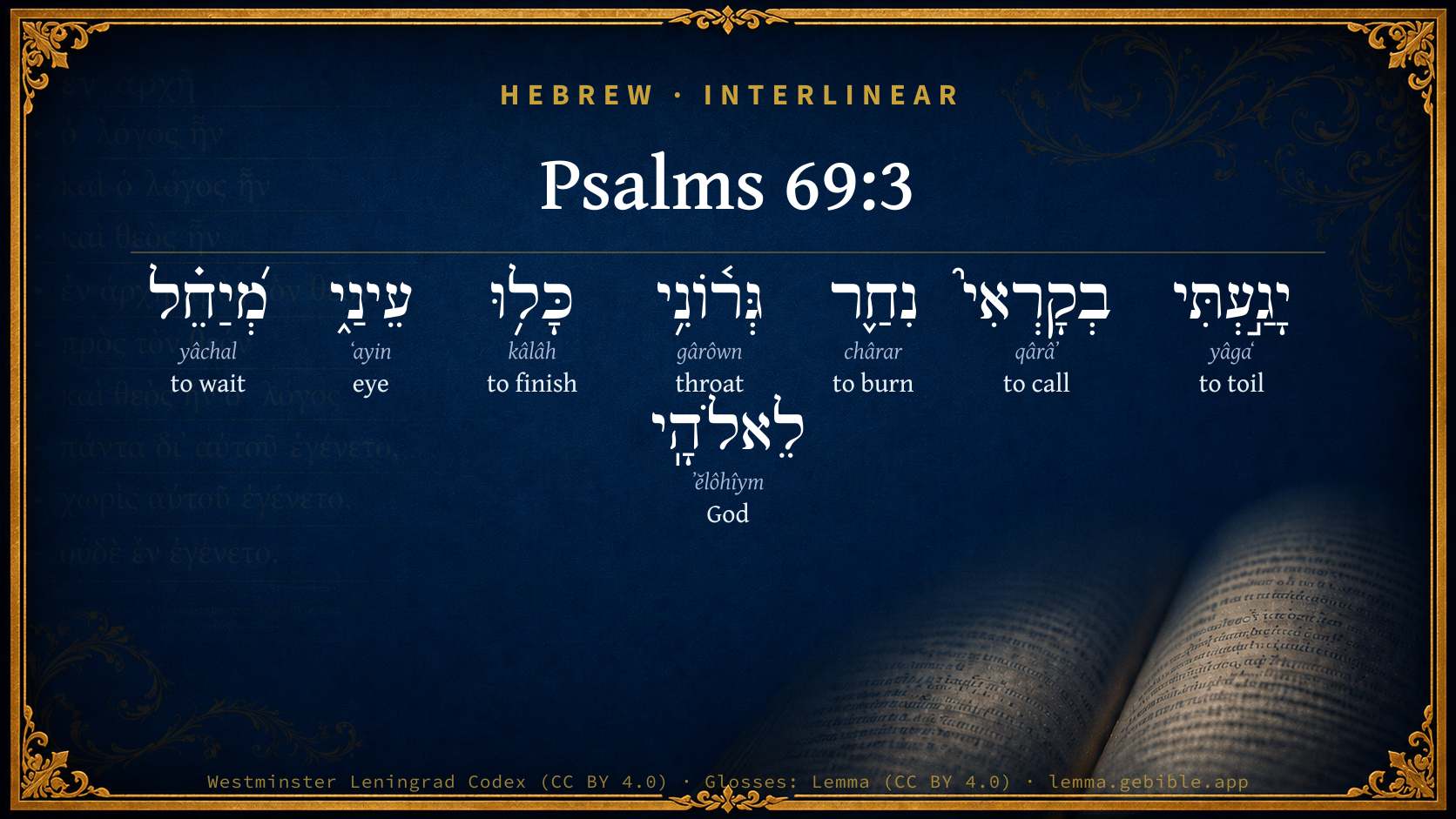
  1. יָגַ֣עְתִּי yâgaʻ H3021 “to toil” Verb, Qal, Perfect, 1st Person, Common, Singular
  2. בְקָרְאִי֮ qârâʼ H7121 “in/at · to call · me” Preposition + Verb, Qal, Infinitive Construct + Suffix, Personal, 1st Person, Common, Singular
  3. נִחַ֪ר chârar H2787 “to burn” Verb, Niphal, Perfect, 3rd Person, Masculine, Singular
  4. כָּל֥וּ kâlâh H3615 “to finish” Verb, Qal, Perfect, 3rd Person, Common, Plural
  5. עֵינַ֑י ʻayin H5869 “eyes · my” Noun, Common, Both, Dual, Construct + Suffix, Personal, 1st Person, Common, Singular
  6. מְ֝יַחֵ֗ל yâchal H3176 “waiting” Verb, Piel, Participle Active, Masculine, Singular, Absolute
  7. לֵאלֹהָֽי ʼĕlôhîym H430 “to/for · God(s) · my” Preposition + Noun, Common, Masculine, Plural, Construct + Suffix, Personal, 1st Person, Common, Singular

About this verse

These counts appear in no published source. They are computed here, from the morphology-tagged text and Lemma’s own curated glosses. What Lemma adds →

8
words
8
distinct lemmas
Wisdom
section

Notable vocabulary

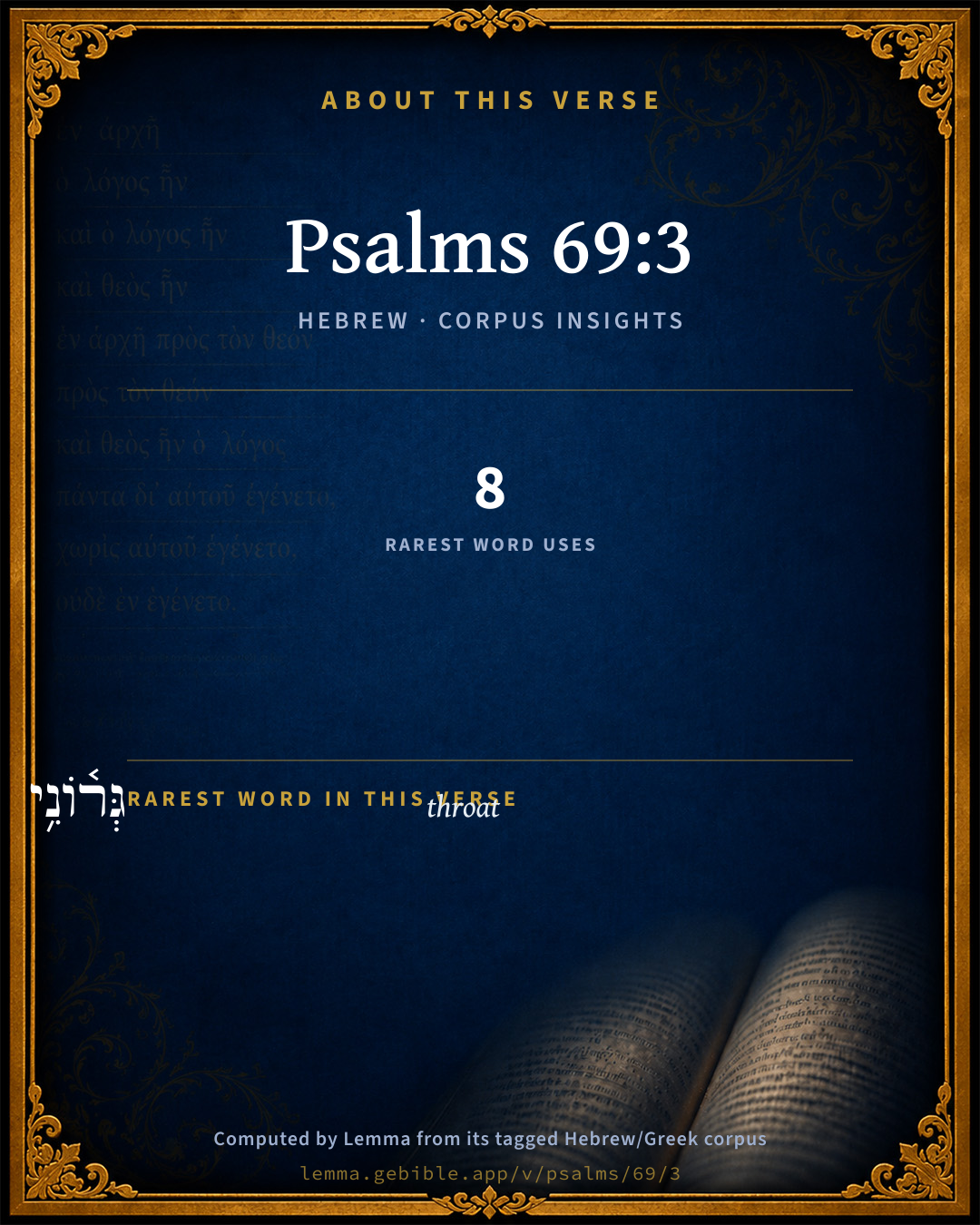
The rarest word here is גְּר֫וֹנִ֥י throat H1627 — appearing just 8 times in the whole Hebrew Bible.

Shared distinctive vocabulary

גְּר֫וֹנִ֥י throat H1627 occurs in 8 verses of the Hebrew Bible. Also found in:

Grammatical profile

  • 5 verbs
  • 3 nouns

Verb forms

  • יָגַ֣עְתִּי Qal · Perfect
  • בְקָרְאִי֮ Qal · Infinitive Construct
  • נִחַ֪ר Niphal · Perfect
  • כָּל֥וּ Qal · Perfect
  • מְ֝יַחֵ֗ל Piel · Participle Active

Hebrew & Septuagint length

In English translation the verse runs 17 words from the Hebrew and 20 from the Septuagint (LXX English) — closely comparable.

A rough comparison of the two English renderings, which tokenize alike — not a word-level alignment.

Word counts can differ between the Hebrew and the Greek without any difference in meaning — e.g. the Hebrew direct-object marker אֵת has no separate Greek word, and Greek often adds the article ὁ.

Cross-references

16

Topical passages linked to Psalms 69:3 in the Treasury of Scripture Knowledge — connected by theme and wording, ordered by reader-vote popularity; previews shown in the World English Bible.

  • Psalms 6:6 I am weary with my groaning; Every night I flood my bed; I drench my couch with my tears.
  • Psalms 119:82 My eyes fail for your word. I say, "When will you comfort me?"
  • Psalms 119:123 My eyes fail looking for your salvation, For your righteous word.
  • Isaiah 38:14 Like a swallow [or] a crane, so did I chatter; I did moan as a dove; my eyes fail [with looking] upward: Lord, I am oppressed, be my collateral.
  • Deuteronomy 28:32 Your sons and your daughters shall be given to another people; and your eyes shall look, and fail with longing for them all the day: and there shall be nothing in the power of your hand.
  • Psalms 25:21 Let integrity and uprightness preserve me, For I wait for you.
  • Job 11:20 But the eyes of the wicked shall fail, They shall have no way to flee; Their hope shall be the giving up of the spirit."
  • Job 16:16 My face is red with weeping. Deep darkness is on my eyelids.
  • Psalms 13:1–3 How long, Yahweh? Will you forget me forever? How long will you hide your face from me?
  • Psalms 22:2 My God, I cry in the daytime, but you don't answer; In the night season, and am not silent.
  • Psalms 22:15 My strength is dried up like a potsherd. My tongue sticks to the roof of my mouth. You have brought me into the dust of death.
  • Psalms 39:7 Now, Lord, what do I wait for? My hope is in you.
  • Psalms 69:21 They also gave me gall for my food. In my thirst, they gave me vinegar to drink.
  • Lamentations 2:11 My eyes do fail with tears, my heart is troubled; My liver is poured on the earth, because of the destruction of the daughter of my people, Because the young children and the infants swoon in the streets of the city.
  • John 19:28 After this, Jesus, seeing that all things were now finished, that the Scripture might be fulfilled, said, "I am thirsty."
  • Hebrews 5:7 He, in the days of his flesh, having offered up prayers and petitions with strong crying and tears to him who was able to save him from death, and having been heard for his godly fear,

Cross-references courtesy of OpenBible.info (CC BY 4.0).

Hebrew and Greek witnesses Masoretic Hebrew ↔ Greek Septuagint

The same verse in the two great witnesses to the Old Testament, shown verse-for-verse.

You’re reading Greek Psalm 68 (Hebrew Psalm 69). The Septuagint counts the superscription, so verse numbers can differ from the Hebrew — chapter-level alignment, not verse-by-verse. Numbering follows Rahlfs.

These are two independent witnesses, not word-aligned to each other, and the Septuagint is shown in lemma (dictionary) form.

Hebrew Psalms 69:3 Masoretic · Westminster Leningrad Codex

יָגַ֣עְתִּי בְקָרְאִי֮ נִחַ֪ר גְּר֫וֹנִ֥י כָּל֥וּ עֵינַ֑י מְ֝יַחֵ֗ל לֵאלֹהָֽי

I am weary with my crying. My throat is dry. My eyes fail, looking for my God.

World English Bible · Public Domain

Greek LXX Greek Psalm 68:3 Septuagint · lemma form

ἐνπήγνυμι εἰς ἰλύς βυθός καί οὐ εἰμί ὑπόστασις ἔρχομαι εἰς ὁ βάθος ὁ θάλασσα καί καταιγίς καταποντίζω ἐγώ

I am weary of crying, my throat has become hoarse; my eyes have failed by my waiting on my God.

LXX2012 (modern English Septuagint) · Public Domain

Hebrew: Westminster Leningrad Codex (CC BY 4.0). Greek: Septuagint (public domain); English from LXX2012 (modern English Septuagint) (Public Domain). How the Septuagint differs from the Hebrew →

Commentary

Notes on Psalms 69:3 from classic Christian and Jewish commentators (each source and its license shown beneath its notes). The classic Christian expositions comment on the surrounding passage and are grouped to its opening verse, so a note may address several verses; the Jewish commentaries on the Tanakh (Rashi and others) are per-verse, so they appear only where the commentator wrote on this verse.

Lemma curates 59 commentaries, every one of them public domain or Creative Commons licensed, each selected and text-cleaned for this edition rather than reprinted as found. About our sources →

Trapp's Complete Commentary

John Trapp

Psa 69:3 I am weary of my crying: my throat is dried: mine eyes fail while I wait for my God.

Ver. 3. I am weary of mg crying] As a drowning man, while he can be heard, crieth for help.

My throat is dried] Or, parched, raucitate laborant fauces.

Mine eyes fail] With much weeping and long looking. This is a piece of the curse, Lev 26:16. Christ became a curse for us, Gal 3:13.

John Trapp, A Commentary or Exposition upon All the Books of the Old and New Testament (1647–1656) — public domain. Text from a community e-Sword module.

The Treasury of David

Charles H. Spurgeon

Ver. 3. I am weary of my crying. Not of it, but by it, with it. He had prayed till he sweat great drops of blood, and well might physical weariness intervene.

My throat is dried, parched, and inflamed. Long pleading with awful fervour had scorched his throat as with flames of fire. Few, very few, of his saints follow their Lord in prayer so far as this. We are, it is to be feared, more likely to be hoarse with talking frivolities to men than by pleading with God; yet our sinful nature demands more prayer than his perfect humanity might seem to need. His prayers should shame us into fervour. Our Lord's supplications were salted with fire, they were hot with agony; and hence they weakened his system, and made him "a weary man and full of woes."

Mine eyes fail while I wait for my God. He wanted in his direst distress nothing more than his God; that would be all in all to him. Many of us know what watching and waiting mean; and we know something of the failing eye when hope is long deferred: but in all this Jesus bears the palm; no eyes ever failed as his did or for so deep a cause. No painter can ever depict those eyes; their pencils fail in every feature of his all but fair but all marred countenance, but most of all do they come short when they venture to pourtray those eyes which were fountains of tears. He knew both how to pray and to watch, and he would have us learn the like. There are times when we should pray till the throat is dry, and watch till the eyes grow dim. Only thus can we have fellowship with him in his sufferings. What! can we not watch with him one hour? Does the flesh shrink back? O cruel flesh to be so tender of thyself, and so ungenerous to thy Lord!

Ver. 3. I am weary of my crying. The word egy means properly, to gape, to gasp, then, to become weary.... but to gasp in his crying, is not so much to grow weary because of the great vehemence thereof, but while the crying lasts, and while he is in the act, to succumb under the burden of his dangerous and shameful calamity. Hermann Venema.

Ver. 3. I am weary of my crying. He had cried to God for the ways of man; he had cried to man of the ways of God; he had not ceased, from his first beginning to teach, till he said upon the cross, "I thirst." His eyes had grown dim, and his flesh was faint and weary with his sufferings, through the long passion of his life on earth. He had been waiting in poverty, and insult, and treachery, and scourging, and pain, until he cried, "My God, my God, why hast thou forsaken me?" From "A Plain Commentary."

Ver. 3. I am weary of my crying, etc. David is like the post, who layeth by three horses as breathless; his heart, his throat, his eyes... Objection. But I have neither weeping one way or other, ordinary nor marred. Answer. Looking up to heaven, lifting up of the eyes, goeth for prayer also in God's books. "My prayer unto thee, and will look up, "(Ps 5:3). Mine eyes fail with looking upward (Ps 69:3). Because, first, prayer is a pouring out of the soul to God, and faith will come out at the eye, in lieu of another door: often affections break out at the window, when the door is closed; as smoke vents at the window, when the chimney refuses passage. Stephen looked up to heaven (Ac 7:55.). He sent a post; a greedy, pitiful, and hungry look up to Christ, out at the window, at the nearest passage, to tell that a poor friend was coming up to him. Second, I would wish no more, if I were in hell, but to send up a look to heaven. There be many love looks of the saints, lying up before the throne, in the bosom of Christ. The twinkling of thy eyes in prayer are not lost to Christ; else Stephen's look, David's look, should not be registered so many hundred years in Christ's written Testament. Samuel Rutherford, in "The Trial and Triumph of Faith."

Ver. 3. Crying. Meanwhile, we see how the saints, in the vicissitudes of affairs, even when they are innocent, are not insensible and stony; they do not despise the threatening perils; they become anxious, they cry and sigh during their temptations. Musculus.

Ver. 3. Mine eyes fail. O pitiable sight! that sight should fail, by which Jesus saw the multitudes and, therefore, ascended the mount to give the precepts of the New Testament; by which, beholding Peter and Andrew, he called them; by which, looking upon the man sitting at the receipt of custom, he called and made him an evangelist; by which, gazing upon the city, he wept over it... With these eyes thou didst look upon Simon, when thou didst say, "Thou art the son of Jonas; thou shalt be called Cephas." With these eyes thou didst gaze upon the woman who was a sinner, to whom thou didst say, "Thy faith hath saved thee; go in peace." Turn these eyes upon us, and never turn them away from our continual prayers. Gerhohus.

Ver. 3. I wait for my God. The hour is coming when our eyes must fail, and be closed; but, even then, "Let us wait for our God; "in this respect, let us die the death of the righteous person, who died for us; "and let our last end be like this." George Horne.

Ver. 2-3. The sinner aware of his position, unable to hope, overwhelmed with fear, finding no comfort in prayer, unvisited with divine consolation. Direct and console him.

Ver. 3.

I. Here is faith in the midst of trouble: My God.

II. Hope in the midst of disappointment: Mine eyes

fail, etc.

III. Prayer in the midst of discouragement: I am weary,

etc.; My throat, etc. Or,

I. There is praying beyond prayer: I am weary, etc.

II. Hoping beyond hope: Mine eyes, etc. G. R.

Psalms 69:4*

Charles H. Spurgeon's The Treasury of David (1869–1885) — public domain. Psalms only. Text from a community e-Sword/MySword module.

Joseph Benson's Commentary

Psa 69:3-4. I am weary of my crying — I have prayed and cried to God long and fervently, and yet God seems to neglect and forsake me. My throat is dried — With loud and frequent cries. Mine eyes fail — With looking to God for that aid and deliverance which he hath promised, and which I confidently expected, but hitherto in vain. They that hate me without a cause — Without any injury or occasion given them by me; are more than the hairs of my head — Are grown more formidable, both for their number, which is exceeding great, and for their power, for they are mighty — So that, if thou do not interpose for my deliverance, they are well able to destroy me, to which they do not want the will, having conceived an implacable and undeserved hatred against me. Though “I have been so far from provoking their malice, that I restored that which I took not away — For I was content, rather than quarrel with them, to part with my own right, and make them satisfaction for a wrong which I never did them.” — Bishop Patrick. Under this one kind of ill usage he comprehends all those injuries and violences which they had practised against him.

Joseph Benson's Commentary on the Old and New Testaments (1811–1818) — public domain. Text from a community e-Sword module.

J. A. Alexander on Psalms

Joseph Addison Alexander

4. (Psa 69:3). I am weary of my crying ; parched is my throat; my eyes fail, waiting for my God. The literal meaning of the first clause is, I am weary in my crying, i.e. have grown weary in the act of calling upon God for help. See above, on Psa 6:6. Parched, dried, by excessive exertion of the voice, or giving the Hebrew verb the stronger sense which properly belongs to it, inflamed. His eyes are represented as exhausted, worn out, by continued looking for God. See below, Psa 119:82, and compare Lam 4:17. The participle waiting does not agree with eyes, as it might seem to do in English, but with the person to whom they belong, and may be construed absolutely, I waiting (me expectante), i.e. while I wait.

Joseph Addison Alexander, The Psalms Translated and Explained (1850) — public domain. Text from a community e-Sword module.

Geneva Bible (1599)

Geneva Bible translators

Though his senses failed him, yet his faith was constant and encouraged him still to pray.

Geneva Bible (1599) marginal notes — public domain. Text via Bolls.life.

Jamieson, Fausset & Brown

Robert Jamieson, A. R. Fausset & David Brown

(Compare Psa 6:6).

mine eyes fail--in watching (Psa 119:82).

Jamieson, Fausset & Brown — Commentary Critical and Explanatory on the Whole Bible (1871) — public domain (CC PDM 1.0). Text via the HelloAO Bible API.

Adam Clarke's Commentary

Verse 3. I am weary of my crying] A pathetic description of the state of the poor captives for about seventy years.

Adam Clarke's Commentary on the Bible (1810–1826) — public domain. Text from a community e-Sword/MySword module.

John Calvin's Commentaries

3 I am weary of crying David, in seeking and calling upon God, when his affairs were in such a confused and desperate condition, exhibited an instance of rare and wonderful patience. He complains of having continued crying until he was exhausted and became hoarse, and all to no purpose. By the word weary, he does not mean that he gave up with prayer, as if he had cast from him all love to and delight in that exercise upon finding that it proved unavailing as a means of deliverance. He rather describes his untiring perseverance; and the same idea is expressed by his hoarse throat and failing eyes. He certainly did not cry out before men from mere affectation, nor was this hoarseness contracted in the course of one day. We perceive, then, that although his bodily senses failed him, the vigor of his faith was by no means extinguished. When we reflect that David has spoken, as it were, out of the mouth of Christ, and, as it were, out of the mouth of all true saints who are the members of Christ, we ought not to think that any strange thing happens to us, if at any time we are so overwhelmed with death, as to be unable to discern the slightest hope of life. Yea, rather let us learn betimes, while God spares us, to meditate on this truth, and derive the aid which it is fitted to impart under calamity, that even in the most profound depths of adversity faith may hold us up, and, what is more, may elevate us to God; there being, as Paul testifies, (Romans 8:39) no height nor depth which can separate us from the infinite love of Him who swallows up all depths, yea, even hell itself.

John Calvin's Commentaries (1540-1563) — public domain. Text from the Calvin Translation Society English edition (1840s-50s) via the Christian Classics Ethereal Library (ccel.org). Calvin's coverage is partial (roughly two-thirds of the Bible); uncommented books and verses are honest gaps, never fabricated. The 19th-century editor's footnotes and remarks are omitted so the notes are faithfully Calvin's own voice.

Ellicott's Commentary for English Readers

(3) Crying.—Better, calling, i.e., on God in prayer. For a similar picture of utter dejection comp. Psa_22:15. The following English lines have caught the feeling of these verses:

“How have I knelt with arms of my aspiring

Lifted all night in irresponsive air,

Dazed and amazed with overmuch desiring,

Blank with the utter agony of prayer.”

St. Paul, by F. Myers.

A Bible Commentary for English Readers, edited by Charles John Ellicott (1878–1897) — public domain. Text from a community e-Sword module.

The Cambridge Bible for Schools and Colleges

gen. ed. J. J. S. Perowne

3. He is worn out and exhausted in mind and body by the prolonged strain of prayer unanswered. Cp. Psa_22:1-2; Psa_22:15; Psa_6:7; Jer_45:3; Psa_119:82; Psa_119:123; Lam_2:11; Lam_4:17. For I am weary of &c., render with R.V. I am weary with my crying.

The Cambridge Bible for Schools and Colleges (gen. ed. J. J. S. Perowne; Cambridge University Press, 1878–1918) — public domain. Text from a community e-Sword module.

John Gill's Exposition

I am weary of my crying,.... In his distress; when, bearing the punishment both of loss and sense, he cried unto God; he prayed earnestly, with great intenseness and fervency of spirit; he offered supplications, with strong cryings and tears, insomuch that he calls it a roaring: and whereas there was a seeming delay of answer to his cries, he cried till he was weary of crying; and yet it is remarkable that his last cry was with a loud voice, which surprised the centurion; see Psa 22:1;

my throat is dried; with crying, so that he was hoarse; or "burnt" (u); with inward heat of a fever, which usually attended persons crucified; see Psa 22:15;

mine eyes fail while I wait for my God; God the Father was the God of Christ, as he was man; he prepared a body for him, and anointed his human nature with the Holy Spirit; he supported and upheld him: and as such Christ loved him, believed in him, prayed to him, and waited and looked for help and salvation from him; this being delayed, his eyes failed with intense looking about for it, as well as with grief and tears. Ainsworth observes, that failing of the eyes is one of the curses of the law, Lev 26:16, and it shows how in every thing Christ was made a curse for his people.

(u) "adustum", Montanus, Gejerus, Michaelis; so Ainsworth.

John Gill's Exposition of the Whole Bible (1746–1763) — public domain (CC PDM 1.0). Text via the HelloAO Bible API.

Albert Barnes' Notes on the Bible

I am weary of my crying - The word “crying” here does not mean weeping, or shedding tears, but calling upon God for help. He had grown weary; his strength had been exhausted in the act of calling upon God to assist him. See the notes at Psa 6:6. This was an instance where one had called so long on God, and prayed so much and so earnestly, that his strength was gone. Compare Mat 26:41.

My throat is dried - Or, “is parched up.” The Hebrew word denotes to burn; to be enkindled; and then, to be inflamed. Here it means that by the excessive exertion of his voice, his throat had become parched, so that he could not speak.

Mine eyes fail - That is, become dim from exhaustion. I have looked so long in that one direction that the power of vision begins to fail, and I see nothing clearly. See the notes at Psa 6:7. Compare Job 17:7; Psa 31:9; Psa 38:10.

While I wait for my God - That is, by continued “looking” to God. The word “wait” is not used here, nor is it generally in the Bible, as it is now with us, in the sense of looking for “future” interposition, or of doing nothing ourselves in expectation of what “may” occur; but it is used in the sense of looking to God alone; of exercising dependence on him; of seeking his aid. This is indeed connnected with the ordinary idea of abiding his will, but it is also an “active” state of mind - a state expressive of intense interest and desire. See the notes at Psa 62:5.

Albert Barnes' Notes on the Bible (1834–1885) — public domain. Text from a community e-Sword/MySword module.

Matthew Poole's English Annotations

I am weary of my crying; I have prayed and cried to God long and fervently, and yet God seems to neglect and forsake me.

My throat is dried with loud and frequent cries.

Mine eyes fail with looking to God for that assistance which he hath promised, and I confidently expected, but in vain.

Matthew Poole's English Annotations on the Holy Bible (1683–1685) — public domain. Text from a community e-Sword/MySword module.

Whedon's Commentary on the Bible

Daniel D. Whedon

3. My throat is dried—Literally, burnt, parched, by grief and weeping.

Eyes fail—Pine away, consume, as Lev_26:16, and 1Sa_2:33, from excessive weeping.

Daniel D. Whedon (gen. ed.), Commentary on the Old and New Testaments (1874–1909) — public domain. Text from a community e-Sword module.

The Pulpit Commentary

I am weary of my crying; i.e. "I have cried to God for aid, until I am weary of so doing." No reply comes, no aid is given. My throat is dried. Parched unable to cry out any more. Mine eyes fail while I wait for my God. (comp. Psa_119:82 Deu_28:32) "I have waited and looked for God, till I can look no more."

The Pulpit Commentary (1880–1919), ed. H.D.M. Spence-Jones & Joseph S. Exell — public domain. Text from a community e-Sword module.

unfoldingWord translationNotes

Door43 World Missions Community

weary

very tired

my eyes fail

This idiom means the writer has cried so much that his eyes do not see well any longer. AT: "my eyes are swollen from tears" (See: Idiom)

more than the hairs on my head

This is an exaggeration to express how many enemies the writer has. AT: "more than I can count, like the hairs on my head" (See: Hyperbole and Generalization)

cut me off

This idiom means "kill me." (See: Idiom)

translationWords

cut off

adversary

might

unfoldingWord translationNotes — © Distant Shores Media and the Door43 World Missions Community, licensed CC BY-SA 4.0. Source: git.door43.org/Door43/en_tn.

Rashi

Rabbi Shlomo Yitzchaki (Rashi)

in muddy depths In the mire, the mud of the deep.

and the current That is the flood of the strength of the river, fil in Old French, current.

Rashi on the Tanakh — English translations: “The Judaica Press complete Tanach with Rashi, translated by A. J. Rosenberg” (CC BY 4.0); “Pentateuch with Rashi's commentary by M. Rosenbaum and A.M. Silbermann, 1929-1934” (public domain); “The Metsudah Tanach series, Lakewood, N.J” (CC BY 4.0); and “The Book of Joshua, Metsudah Publications, 1997” (CC BY 4.0). Text via Sefaria.

Lesson kit

Teaching starters — assembled from the data on this page, not authored interpretation. Every prompt links to the verse data it draws on. Edit before teaching.

Psalms, in the Wisdom, opens this verse with 8 words (8 distinct Hebrew lemmas). Its most distinctive word is gârôwn (“throat”). A historical commentator’s framing appears above. Read the whole chapter for the surrounding context.

Discussion questions

  1. What does “throat” (gârôwn) contribute to the verse as a whole?
  2. Psalms 5:9 shares the word «throat» with this verse. How do the two illuminate each other?
  3. These translations render this verse differently; the difference is in the English rendering, not the original. What questions does that raise?
  4. The verb «יָגַ֣עְתִּי» is Qal Perfect. How does its form color the action?
  5. Reading how Trapp's Complete Commentary and The Treasury of David read this verse, where do the two commentators agree and where do they part?

Things to notice

Reading settings

Reading text

Shown beneath each verse's original-language words.

Old Testament
Old Testament edition

Read the OT as the Masoretic Hebrew (MT) or the Greek Septuagint (LXX).

English shown for the Greek Septuagint (in the Hebrew ↔ Greek comparison).

Comparing translations? Open the Compare panel on any verse page to stack up to four side by side.