
Ezekiel 5:13

Hebrew (Westminster Leningrad Codex) Ezekiel 5:13 appears in the Hebrew Old Testament. The text above is from the Westminster Leningrad Codex. Each word links to its Strong’s number, a concise gloss, and parsing drawn from the Open Scriptures Hebrew Bible morphology. Click any word for its full Brown-Driver-Briggs (BDB) entry.
Download image
Cite this verse

Ezekiel 5:13 (World English Bible). Public Domain. Lemma interlinear Bible study tool, https://lemma.gebible.app/v/ezekiel/5/13.

Show BibTeX & RIS
BibTeX
RIS
English Translation
Thus shall my anger be accomplished, and I will cause my wrath toward them to rest, and I shall be comforted; and they shall know that I, Yahweh, have spoken in my zeal, when I have accomplished my wrath on them.
World English Bible · Public Domain
Download a study sheet

One document with this verse’s original text, its word-by-word gloss line, the meaning frame, cross-references with their text, attributed commentary, and full source and license credits — printable, and it pastes into notes with its structure intact.

This verse Autodidact and up

Study sheet (.html) Plain text (.txt)

A passage Seminary Student

Up to 50 verses in one chapter. A passage sheet keeps up to 6 commentary sources and 12 cross-references per verse, in the order this page ranks them, and says so on the sheet whenever that leaves anything out. Ask for a single verse and you get the Autodidact verse sheet above.

Everything on this page stays free to read, with no account — the sheet is a download of what is already on screen, not access to it.

Want to remove ads? Support Godless Engineer
Compare translations 3

The same verse in 3 English versions, stacked beneath the original-language interlinear above. Click any original word for its lexicon entry.

Each is an independent rendering of the whole verse — the interlinear is not word-aligned to these translations.

Highlighted words mark where these versions differ — a whole-verse word diff, not a word-by-word alignment.

  • World English Bible Public Domain
    Thus shall my anger be accomplished, and I will cause my wrath toward them to rest, and I shall be comforted; and they shall know that I, Yahweh, have spoken in my zeal, when I have accomplished my wrath on them.
  • King James Version Public Domain
    Thus shall mine anger be accomplished, and I will cause my fury to rest upon them, and I will be comforted: and they shall know that I the LORD have spoken it in my zeal, when I have accomplished my fury in them.
  • unfoldingWord Literal Text CC BY-SA 4.0
    Then my wrath will be completed, and I will cause my fury toward them to rest. I will be satisfied, and they will know that I, Yahweh, have spoken in my wrath when I have completed my fury against them.

unfoldingWord Literal Text — © unfoldingWord, licensed CC BY-SA 4.0. Word-aligned USFM3 via Door43 (git.door43.org/unfoldingWord/en_ult).

Versions to compare (up to 4)

3 of 4 selected

Show all 18 translations

Every available English version of this verse, each an independent rendering of the whole verse.

  • World English Bible Public Domain
    Thus shall my anger be accomplished, and I will cause my wrath toward them to rest, and I shall be comforted; and they shall know that I, Yahweh, have spoken in my zeal, when I have accomplished my wrath on them.
  • Berean Standard Bible Public Domain
    And when My anger is spent and I have vented My wrath against them, I will be appeased. And when I have spent My wrath on them, they will know that I, the LORD, in My zeal have spoken.
  • Majority Standard Bible Public Domain
    And when My anger is spent and I have vented My wrath against them, I will be appeased. And when I have spent My wrath on them, they will know that I, the LORD, in My zeal have spoken.
  • King James Version Public Domain
    Thus shall mine anger be accomplished, and I will cause my fury to rest upon them, and I will be comforted: and they shall know that I the LORD have spoken it in my zeal, when I have accomplished my fury in them.
  • American Standard Version (1901) Public Domain
    Thus shall mine anger be accomplished, and I will cause my wrath toward them to rest, and I shall be comforted; and they shall know that I, Jehovah, have spoken in my zeal, when I have accomplished my wrath upon them.
  • Revised Version (1885) Public Domain
    Thus shall mine anger be accomplished, and I will satisfy my fury upon them, and I will be comforted: and they shall know that I the LORD have spoken in my zeal, when I have accomplished my fury upon them.
  • Geneva Bible (1599) Public Domain
    Thus shall mine anger bee accomplished, and I will cause my wrath to cease in them, and I will be comforted: and they shall knowe, that I the Lord haue spoke it in my zeale, when I haue accomplished my wrath in them.
  • Douay-Rheims (1899) Public Domain
    And I will accomplish my fury, and will cause my indignation to rest upon them, and I will be comforted: and they shall know that I the Lord have spoken it in my zeal, when I shall have accomplished my indignation in them.
  • Young's Literal Translation Public Domain
    And completed hath been Mine anger, And I have caused My fury to rest on them, And I have been comforted, And they have known that I, Jehovah, have spoken in My zeal, In My completing My fury on them.
  • Literal Standard Version CC BY-SA 4.0
    And My anger has been completed, || And I have caused My fury to rest on them, || And I have been comforted, || And they have known that I, YHWH, have spoken in My zeal, || In My completing My fury on them.
  • Unlocked Literal Bible CC BY-SA 4.0
    Then my wrath will be completed, and I will cause my fury toward them to rest. I will be satisfied, and they will know that I, Yahweh, have spoken in my wrath when I have completed my fury against them.
  • unfoldingWord Literal Text CC BY-SA 4.0
    Then my wrath will be completed, and I will cause my fury toward them to rest. I will be satisfied, and they will know that I, Yahweh, have spoken in my wrath when I have completed my fury against them.
  • Darby Bible Public Domain
    And mine anger shall be accomplished, and I will satisfy my fury upon them, and I will comfort myself; and they shall know that I Jehovah have spoken in my jealousy, when I have accomplished my fury upon them.
  • World Messianic Bible Public Domain
    “‘Thus my anger will be accomplished, and I will cause my wrath toward them to rest, and I will be comforted. They will know that I, the LORD, have spoken in my zeal, when I have accomplished my wrath on them.
  • Webster's Bible Public Domain
    Thus shall my anger be accomplished, and I will cause my fury to rest upon them, and I will be comforted: and they shall know that I the LORD have spoken it in my zeal, when I have accomplished my fury in them.
  • Free Bible Version CC BY-SA 4.0
    Once my anger is over and I've finished punishing them, then I'll be satisfied. When I've finished punishing them, then they'll know that I, the Lord, meant what I said when I spoke so strongly.
  • Bible in Basic English Public Domain
    So my wrath will be complete and my passion will come to rest on them; and they will be certain that I the Lord have given the word of decision, when my wrath against them is complete.
  • JPS Tanakh (1917) Public Domain
    Thus shall Mine anger spend itself, and I will satisfy My fury upon them, and I will be eased; and they shall know that I the LORD have spoken in My zeal, when I have spent My fury upon them.

Literal Standard Version (2020), Covenant Press — licensed CC BY-SA 4.0. Text via the HelloAO Bible API (eBible.org). Unlocked Literal Bible (unfoldingWord) — licensed CC BY-SA 4.0. Text via the HelloAO Bible API (eBible.org). unfoldingWord Literal Text — © unfoldingWord, licensed CC BY-SA 4.0. Word-aligned USFM3 via Door43 (git.door43.org/unfoldingWord/en_ult). Free Bible Version, Dr. Jonathan Gallagher — licensed CC BY-SA 4.0. Text via the HelloAO Bible API (eBible.org).

Word by word

More ways to search: Search by grammar → Find every occurrence → Compare this word →

Practice this passage: Drill this verse → Learn its vocabulary →

בְּקִנְאָתִ֔י
qinʼâh
H7068
“in/at · jealousy · my”
Preposition + Noun, Common, Feminine, Singular, Construct + Suffix, Personal, 1st Person, Common, Singular
Part of Speech
Preposition + Noun
Type
Common
Gender
Feminine
Number
Singular
State
Construct
Full BDB Definition

Origin: from H7065

TWOT: 2038a

ardour, zeal, jealousy - ardour, jealousy, jealous disposition (of husband) - sexual passion - ardour of zeal (of religious zeal) - of men for God - of men for the house of God - of God for his people - ardour of anger - of men against adversaries - of God against men - envy (of man) - jealousy (resulting in the wrath of God)
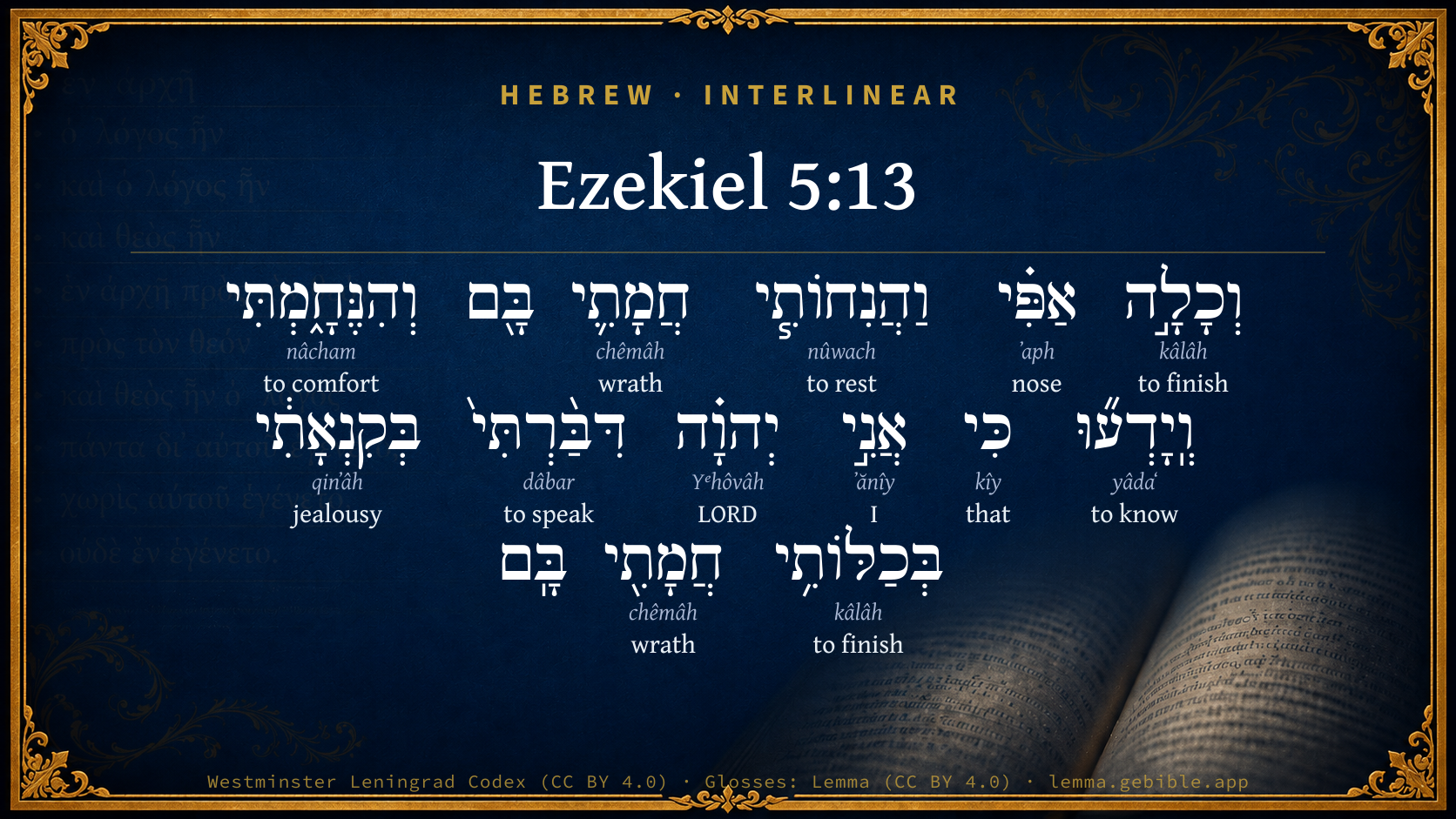
  1. וְכָלָ֣ה kâlâh H3615 “and · to finish” Conjunction + Verb, Qal, Sequential Perfect, 3rd Person, Masculine, Singular
  2. אַפִּ֗י ʼaph H639 “nose · my” Noun, Common, Masculine, Singular, Construct + Suffix, Personal, 1st Person, Common, Singular
  3. וַהֲנִחוֹתִ֧י nûwach H5117 “and · to rest” Conjunction + Verb, Hiphil, Sequential Perfect, 1st Person, Common, Singular
  4. חֲמָתִ֛י chêmâh H2534 “wrath · my” Noun, Common, Feminine, Singular, Construct + Suffix, Personal, 1st Person, Common, Singular
  5. וְהִנֶּחָ֑מְתִּי nâcham H5162 “and · to comfort” Conjunction + Verb, Hithpael, Sequential Perfect, 1st Person, Common, Singular
  6. וְֽיָדְע֞וּ yâdaʻ H3045 “and · to know” Conjunction + Verb, Qal, Sequential Perfect, 3rd Person, Common, Plural
  7. כִּי kîy H3588 “that” Conjunction
  8. אֲנִ֣י ʼănîy H589 “I” Pronoun, Personal, 1st Person, Common, Singular
  9. יְהוָ֗ה Yᵉhôvâh H3068 “LORD” Noun, Proper
  10. דִּבַּ֨רְתִּי֙ dâbar H1696 “to speak” Verb, Piel, Perfect, 1st Person, Common, Singular
  11. בְּכַלּוֹתִ֥י kâlâh H3615 “in/at · to finish · me” Preposition + Verb, Piel, Infinitive Construct + Suffix, Personal, 1st Person, Common, Singular
  12. חֲמָתִ֖י chêmâh H2534 “wrath · my” Noun, Common, Feminine, Singular, Construct + Suffix, Personal, 1st Person, Common, Singular

About this verse

These counts appear in no published source. They are computed here, from the morphology-tagged text and Lemma’s own curated glosses. What Lemma adds →

15
words
11
distinct lemmas
Prophets
section

Shared distinctive vocabulary

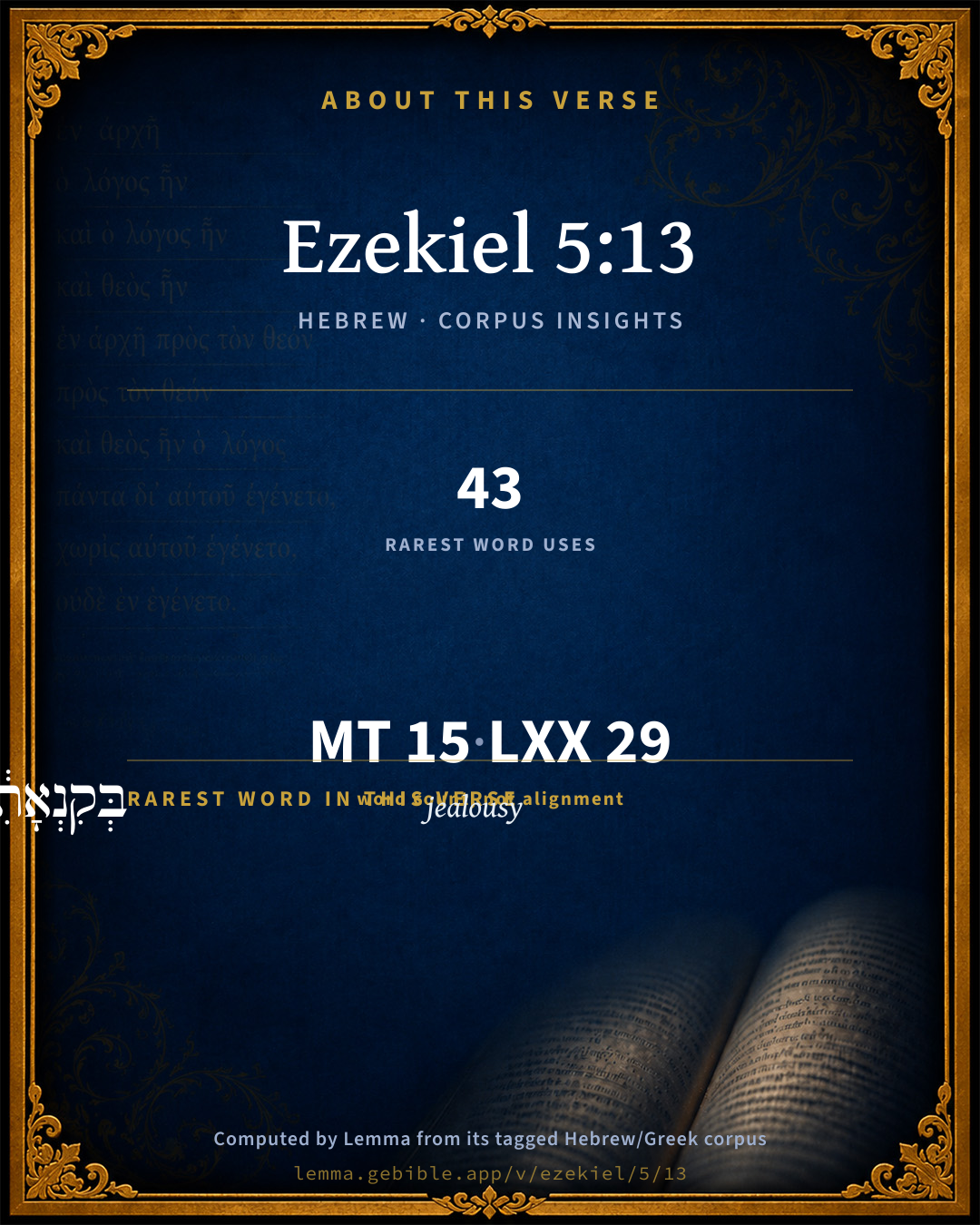
בְּקִנְאָתִ֔י jealousy H7068 occurs in 41 verses of the Hebrew Bible. Also found in:

Grammatical profile

  • 6 verbs
  • 5 nouns
  • 1 pronoun
  • 2 prepositions
  • 1 conjunction

Verb forms

  • וְכָלָ֣ה Qal · Sequential Perfect
  • וַהֲנִחוֹתִ֧י Hiphil · Sequential Perfect
  • וְהִנֶּחָ֑מְתִּי Hithpael · Sequential Perfect
  • וְֽיָדְע֞וּ Qal · Sequential Perfect
  • דִּבַּ֨רְתִּי֙ Piel · Perfect
  • בְּכַלּוֹתִ֥י Piel · Infinitive Construct

Repetition

Words recur within this verse — often emphatic in Hebrew:

  • וְכָלָ֣ה to finish H3615 ×2
  • חֲמָתִ֛י wrath H2534 ×2

Hebrew & Septuagint length

In English translation the verse runs 41 words from the Hebrew and 32 from the Septuagint (LXX English) — closely comparable.

A rough comparison of the two English renderings, which tokenize alike — not a word-level alignment.

Word counts can differ between the Hebrew and the Greek without any difference in meaning — e.g. the Hebrew direct-object marker אֵת has no separate Greek word, and Greek often adds the article ὁ.

In the original languages it is 15 Hebrew tokens and 29 Greek tokens — but the two are counted differently (Hebrew bundles its prefixes and suffixes into one token; the Greek is in lemma form), so that isn’t a like-for-like length.

Cross-references

24

Topical passages linked to Ezekiel 5:13 in the Treasury of Scripture Knowledge — connected by theme and wording, ordered by reader-vote popularity; previews shown in the World English Bible.

  • Isaiah 1:24 Therefore the Lord, Yahweh of Hosts, The Mighty One of Israel, says: "Ah, I will get relief from my adversaries, And avenge myself of my enemies;
  • Lamentations 4:11 Yahweh has accomplished his wrath, he has poured out his fierce anger; He has kindled a fire in Zion, which has devoured the foundations of it.
  • Ezekiel 6:12 He who is far off shall die of the pestilence; and he who is near shall fall by the sword; and he who remains and is besieged shall die by the famine: thus will I accomplish my wrath on them.
  • Ezekiel 7:8 Now will I shortly pour out my wrath on you, and accomplish my anger against you, and will judge you according to your ways; and I will bring on you all your abominations.
  • Ezekiel 20:8 But they rebelled against me, and would not listen to me; they did not every man cast away the abominations of their eyes, neither did they forsake the idols of Egypt. Then I said I would pour out my wrath on them, to accomplish my anger against them in the midst of the land of Egypt.
  • Ezekiel 20:21 But the children rebelled against me; they didn't walk in my statutes, neither kept my ordinances to do them, which if a man do, he shall live in them; they profaned my Sabbaths. Then I said I would pour out my wrath on them, to accomplish my anger against them in the wilderness.
  • Ezekiel 36:5–6 therefore thus says the Lord Yahweh: Surely in the fire of my jealousy have I spoken against the residue of the nations, and against all Edom, that have appointed my land to themselves for a possession with the joy of all their heart, with despite of soul, to cast it out for a prey.
  • Isaiah 59:17 He put on righteousness as a breastplate, and a helmet of salvation on his head; and he put on garments of vengeance for clothing, and was clad with zeal as a mantle.
  • Ezekiel 21:17 I will also strike my hands together, and I will cause my wrath to rest: I, Yahweh, have spoken it.
  • Deuteronomy 32:36 For Yahweh will judge his people, Repent himself for his servants; When he sees that [their] power is gone, There is none [remaining], shut up or left at large.
  • Isaiah 1:21 How the faithful city has become a prostitute! She was full of justice; righteousness lodged in her, But now murderers.
  • Isaiah 9:7 Of the increase of his government and of peace there shall be no end, on the throne of David, and on his kingdom, to establish it, and to uphold it with justice and with righteousness from henceforth even forever. The zeal of Yahweh of Hosts will perform this.
  • Jeremiah 25:12 It shall happen, when seventy years are accomplished, that I will punish the king of Babylon, and that nation, says Yahweh, for their iniquity, and the land of the Chaldeans; and I will make it desolate forever.
  • Lamentations 4:22 The punishment of your iniquity is accomplished, daughter of Zion; he will no more carry you away into captivity: He will visit your iniquity, daughter of Edom; he will uncover your sins.
  • Ezekiel 6:10 They shall know that I am Yahweh: I have not said in vain that I would do this evil to them.
  • Ezekiel 13:15 Thus will I accomplish my wrath on the wall, and on those who have daubed it with whitewash; and I will tell you, The wall is no more, neither those who daubed it;
  • Ezekiel 16:42 So will I cause my wrath toward you to rest, and my jealousy shall depart from you, and I will be quiet, and will be no more angry.
  • Ezekiel 16:63 that you may remember, and be confounded, and never open your mouth any more, because of your shame, when I have forgiven you all that you have done, says the Lord Yahweh.
  • Ezekiel 23:25 I will set my jealousy against you, and they shall deal with you in fury; they shall take away your nose and your ears; and your residue shall fall by the sword: they shall take your sons and your daughters; and your residue shall be devoured by the fire.
  • Ezekiel 24:13 In your filthiness is lewdness: because I have cleansed you and you weren't cleansed, you shall not be cleansed from your filthiness any more, until I have caused my wrath toward you to rest.
  • Ezekiel 38:18–19 It shall happen in that day, when Gog shall come against the land of Israel, says the Lord Yahweh, that my wrath shall come up into my nostrils.
  • Daniel 9:2 in the first year of his reign I, Daniel, understood by the books the number of the years about which the word of Yahweh came to Jeremiah the prophet, for the accomplishing of the desolations of Jerusalem, even seventy years.
  • Daniel 11:36 The king shall do according to his will; and he shall exalt himself, and magnify himself above every god, and shall speak marvelous things against the God of gods; and he shall prosper until the indignation be accomplished; for that which is determined shall be done.
  • Zechariah 6:8 Then he called to me, and spoke to me, saying, "Behold, those who go toward the north country have quieted my spirit in the north country."

Cross-references courtesy of OpenBible.info (CC BY 4.0).

Hebrew and Greek witnesses Masoretic Hebrew ↔ Greek Septuagint

The same verse in the two great witnesses to the Old Testament, shown verse-for-verse.

These are two independent witnesses, not word-aligned to each other, and the Septuagint is shown in lemma (dictionary) form.

Hebrew Ezekiel 5:13 Masoretic · Westminster Leningrad Codex

וְכָלָ֣ה אַפִּ֗י וַהֲנִחוֹתִ֧י חֲמָתִ֛י בָּ֖ם וְהִנֶּחָ֑מְתִּי וְֽיָדְע֞וּ כִּי אֲנִ֣י יְהוָ֗ה דִּבַּ֨רְתִּי֙ בְּקִנְאָתִ֔י בְּכַלּוֹתִ֥י חֲמָתִ֖י בָּֽם

Thus shall my anger be accomplished, and I will cause my wrath toward them to rest, and I shall be comforted; and they shall know that I, Yahweh, have spoken in my zeal, when I have accomplished my wrath on them.

World English Bible · Public Domain

Greek LXX Ezekiel 5:13 Septuagint · lemma form

καί συντελέω ὁ θυμός ἐγώ καί ὁ ὀργή ἐγώ ἐπί αὐτός καί ἐπιγιγνώσκω διότι ἐγώ κύριος λαλέω ἐν ζῆλος ἐγώ ἐν ὁ συντελέω ἐγώ ὁ ὀργή ἐγώ ἐπί αὐτός

And my wrath and my anger shall be accomplished upon them: and you shall know that I the Lord have spoken in my jealousy, when I have accomplished my anger upon them.

LXX2012 (modern English Septuagint) · Public Domain

Hebrew: Westminster Leningrad Codex (CC BY 4.0). Greek: Septuagint (public domain); English from LXX2012 (modern English Septuagint) (Public Domain). How the Septuagint differs from the Hebrew →

Targum (Aramaic paraphrase)

1

The Targum is the ancient Jewish Aramaic paraphrase of the Hebrew Scriptures — an interpretive translation, not the Hebrew text itself. Onkelos (literal) and Pseudo-Jonathan (expansive) render the Torah, and Jonathan the Prophets. Coverage is partial: where no permissively-licensed English translation exists for a verse, only the Aramaic is shown. This is verse-level text, not a word-by-word alignment to the Hebrew.

  1. Targum Jonathan Prophets (Joshua–Malachi)
    וְיָחוּל רוּגְזִי וַאֲנִיחַ חֵימְתִי בְהוֹן וַאֲסִיף וְיֵדְעוּן אֲרֵי אֲנָא יְיָ גְזַרֵית בְּמֵימְרִי וַאֲקַיֵים כַּד יָחוּל רוּגְזִי בְּהוֹן:

    (no public-domain English translation for this verse)

    Targum Jonathan — Aramaic: “Mikraot Gedolot” (public domain). English: “Sefaria Community Translation” (CC0 1.0 (public-domain dedication)); “London "Chaldee Paraphrase," 1871” (public domain). Text via Sefaria.

Commentary

Notes on Ezekiel 5:13 from classic Christian and Jewish commentators (each source and its license shown beneath its notes). The classic Christian expositions comment on the surrounding passage and are grouped to its opening verse, so a note may address several verses; the Jewish commentaries on the Tanakh (Rashi and others) are per-verse, so they appear only where the commentator wrote on this verse.

Lemma curates 59 commentaries, every one of them public domain or Creative Commons licensed, each selected and text-cleaned for this edition rather than reprinted as found. About our sources →

Trapp's Complete Commentary

John Trapp

Eze 5:13 Thus shall mine anger be accomplished, and I will cause my fury to rest upon them, and I will be comforted: and they shall know that I the LORD have spoken [it] in my zeal, when I have accomplished my fury in them.

Ver. 13. Then shall mine anger be accomplished.] God is then said to be angry when he doth what men do when angry - viz. (1.) Chide; (2.) Smite.

And I will be comforted.] This also is spoken after the manner of men, who are much comforted when they can be avenged. Their song is, Oh, how sweet is revenge!

“ Animumque explesse iuvabit. ” - Virgil

The same word in Hebrew that signifieth vengeance, signifieth comfort also; for God will be comforted in the execution of his wrath. But what a venomous and vile thing is sin, that causeth the most merciful God to take comfort in the destruction of his creature!

And they shall know that I the Lord have spoken it in my zeal.] That is, seriously threatened by my prophets, whom they have vilipended and derided, but shall now feel the weight of their words.

When I have accomplished my fury in them.] This he doth not usually all at once, but by degrees. He suffereth not his whole wrath to arise till there be no remedy. {as 2Ch 36:16}

John Trapp, A Commentary or Exposition upon All the Books of the Old and New Testament (1647–1656) — public domain. Text from a community e-Sword module.

The Biblical Illustrator

Joseph S. Exell

Eze_5:13

Thus shall Mine anger be accomplished.

Gods anger against sinners

1. God goes on by degrees in His wrath against a people. He had in times past corrected them like a father, He would now execute them like a judge; the drops of His wrath had done no good, now they should have the full vials.

2. Wrath let out against a sinful people, ofttimes lies long upon them. I will cause My fury to rest upon them. They were seventy years under Gods displeasure in Babylon.

3. God takes pleasure in executing judgment, in accomplishing His wrath, and causing His fury to rest upon impenitent and incurable sinners, He will be comforted in it (Pro_1:26).

4. The Word of God may be preached among a people, and they, through ignorance and malice, not know it, nor entertain it.

5. Wicked men shall be convinced, and left without excuse. They shall know that I the Lord have spoken; they eyed men and not Me, they deemed it mans voice, not Heavens; but they shall find that it was the voice of God amongst them.

6. God will justify His servants in their zealous labours for Him. They shall know that I have spoken it in My zeal. It is God speaks in the prophets; it is His zeal they express. Let men be zealous against sin, the iniquities of the times, they are counted mad, fiery fellows, troublers of Israel, seditious, factious, etc.

7. The Lord is intense, and will not recall His indignation, when He deals with unfaithful, covenant-breaking persons. As in Gods zeal there is intense love towards His Church (when God promises mercy to His people, it is sealed with this, The zeal of the Lord of hosts shall do it, 2Ki_19:31), so here is intense hatred, wrath against His enemies. (W. Greenhill, M. A.)

.

The Biblical Illustrator, edited by Joseph S. Exell (c. 1880s–1900s) — public domain. Text from a community e-Sword module.

Geneva Bible (1599)

Geneva Bible translators

That is, I will not be pacified, till I be revenged, Isa. 1:24.

Geneva Bible (1599) marginal notes — public domain. Text via Bolls.life.

Jamieson, Fausset & Brown

Robert Jamieson, A. R. Fausset & David Brown

cause my fury to rest upon them--as on its proper and permanent resting-place (Isa 30:32, Margin).

I will be comforted--expressed in condescension to man's conceptions; signifying His satisfaction in the vindication of His justice by His righteous judgments (Deu 28:63; Pro 1:26; Isa 1:24).

they shall how--by bitter experience.

Jamieson, Fausset & Brown — Commentary Critical and Explanatory on the Whole Bible (1871) — public domain (CC PDM 1.0). Text via the HelloAO Bible API.

Adam Clarke's Commentary

Verse 13. I will cause my fury to rest] My displeasure, and the evidences of it, shall not be transient; they shall be permanent upon you, and among you. And is not this dreadfully true to the present day?

Adam Clarke's Commentary on the Bible (1810–1826) — public domain. Text from a community e-Sword/MySword module.

John Calvin's Commentaries

In this verse the Prophet only teaches what he had said before, but by way of confirmation, namely, that God’s vengeance would be horrible and unceasing until the destruction and extinction of the people. There are some who think that this was interposed that God might mitigate the rigor of his vengeance, and so this verse, according to them, contains a promise of pardon; but it is rather a threat. For what they assert — that God would cause his anger to cease — cannot stand. For it follows afterwards they shall know that I Jehovah have said it, when I shall have filled up my wrath or anger against them And the context, as we shall afterwards see, will refute that comment. Let this, then, remain fixed, that the Prophet does not here promise the people any mitigation of their punishment, but goes on denouncing the vengeance which he formerly mentioned.

First he says, it shall be filled up: כלה, keleh, signifies sometimes “to finish,” but also, “to be accomplished,” “to consume,” and also, “to be consumed.” In this place God signifies that there should be no end to the punishments until he was satisfied. The image is taken from men desirous of vengeance, whose eagerness does not cease till they satiate themselves with revenge. God, therefore, here likens himself to men when he speaks of the end or fulfillment of his anger. Now he adds, I will cause my fury to rest upon them, that is, my fury shall be, as it were, fixed upon them. For “rest” is not to be received here for “cease,” for wrath is said to rest when it has spent itself, but God wishes here to mark by his Prophet the perseverance or untiring course of his vengeance. My wrath, therefore, shall rest upon them, that is, it shall not remove or pass away; for God is said to withdraw his hand when he ceases to punish us, but here the rest of his wrath is its perpetual continuing. He adds, I will take comfort Here God transfers to himself what properly does not belong to him, for he does not delight himself after the manner of men when he takes vengeance on wickedness; but we know that God’s judgment cannot be comprehended, unless he puts on the character of man, and in some manner transforms himself. Hence he is said to receive comfort in the approbation of just judgment. For this comfort signifies, that God cannot bear the contempt of his law — then that the malice of man is so desperate, that the judge must at length appear in his own nature; not that he indulges in any passions, as is sufficiently known, but because we cannot otherwise conceive him to be a just judge, unless he declare himself pleased with vengeance, when he sees men so utterly abandoned and beside themselves, as not to be otherwise recalled to penitence.

He afterwards adds, and they shall know that I Jehovah have spoken it Here God obliquely blames the stupidity of the people, because they not only despised all prophecies, but also proudly laughed at his threats. As often, then, as the Prophets declared the vengeance and judgments of God, they gave material for laughter to a perverse and impious people, and their obstinacy so blinded them that they did not think it was God who spoke; for they supposed that men only would be their adversaries, and hence their rage against the Prophets. For if they had thought that they had spoken by divine inspiration, they would never have dared to rise against them so madly; but because they thought that the Prophets uttered in public their own comments, therefore they strove with them in forgetfulness of God. The Jews, therefore, did not acknowledge him. But let us mark the source of their ignorance: they turned aside their senses from God of their own accord, as at this time many do not think that God speaks when his truth is openly shown from the Scriptures. Why do they not think so? because they are unwilling. Hence this blindness was voluntary and affected, so to speak, in the ancient people, since they imagined that the prophecies would be without effect. This is the reason why the Prophet says, then they shall know that I have spoken, because, as the proverb is, experience is the fool’s teacher; since, therefore, they rejected all threats, it came to pass that, by the teaching of calamity, they perceived too late that God was the speaker. And so there is an antithesis between experimental knowledge, and blindness which arises from an evil disposition and a contempt of God. For when he says, they shall know when he has fulfilled his wrath, that knowledge shall be too late and unfruitful. Lastly, God here pronounces, that he would inflict just punishment on their voluntary ignorance, from which the Jews should know, whether they would or not, that the prophecies against which they had closed their eyes had proceeded from himself alone.

He says also, that he had spoken in his zeal, or jealousy, because the Prophets were thought to be very furious when they thundered so against the impious. God therefore here acquits those whom we know were commonly esteemed fanatics, and says that he spoke in his zeal, because the impious, when they wish to load the servants of God with envy, object that he is mild and merciful, and that it does not accord with his character to speak roughly and sharply. God therefore says that he also uses zeal, or anger, that the Jews might not think his Prophets carried away with inconsiderate zeal and fervor, since we know that they fell into that grievous error. It follows —

John Calvin's Commentaries (1540-1563) — public domain. Text from the Calvin Translation Society English edition (1840s-50s) via the Christian Classics Ethereal Library (ccel.org). Calvin's coverage is partial (roughly two-thirds of the Bible); uncommented books and verses are honest gaps, never fabricated. The 19th-century editor's footnotes and remarks are omitted so the notes are faithfully Calvin's own voice.

Ellicott's Commentary for English Readers

(13) I will be comforted.—The word employed here is used in two different senses: either that of feeling compassion, and so of repenting of one’s anger, as in Isa_12:1; Isa_49:13; Isa_51:3; Isa_51:12; Isa_52:9, &c.; or of consoling oneself by taking vengeance, as in Gen_27:42, Isa_1:24 (Authorised Version, ease myself). (Comp. also Eze_31:16; Eze_32:31.) The latter is evidently the meaning here; the Divine honour, wounded by the sins of the chosen people and dishonoured before the heathen, should be vindicated by their punishment in the sight of all the world.

A Bible Commentary for English Readers, edited by Charles John Ellicott (1878–1897) — public domain. Text from a community e-Sword module.

The Cambridge Bible for Schools and Colleges

gen. ed. J. J. S. Perowne

13. my fury to rest upon them] Rather: will quiet (assuage, or, appease) my fury. Zec_7:8, “have quieted my spirit in the North country.” The phrase again, ch. Eze_16:42, Eze_21:17, Eze_24:13.

I will be comforted] i.e. appeased by the vengeance taken on the people’s sins, cf. Isa_1:24 (the word is for hithneḥamti).

in my zeal] The word, usually rendered “jealousy,” expresses the heat of any passion, here resentment, ch. Eze_16:38; Eze_16:42, Eze_23:25, Eze_36:5-6, Eze_38:19. Cf. ch. Eze_2:5, Eze_6:10, Eze_24:22.

The Cambridge Bible for Schools and Colleges (gen. ed. J. J. S. Perowne; Cambridge University Press, 1878–1918) — public domain. Text from a community e-Sword module.

John Gill's Exposition

Thus shall mine anger be accomplished,.... Finished, perfected, consummated, by bringing the above judgments upon them, pestilence, famine, and sword, and by scattering them to every wind: what had been threatened long, and only some drops of it were let fall in times past, now was poured forth to the uttermost:

and I will cause my fury to rest upon them; to continue and abide upon them, and not move, at least for the space of threescore and ten years; see Zac 1:12;

and I will be comforted; by taking vengeance on them; so satisfying his justice, and easing him of his enemies; see Isa 1:24; a speech after the manner of men; who, when they have been affronted, and have avenged themselves, are easy in their minds, and satisfied:

and they shall know that I the Lord have spoken it in my zeal; that is, they shall find by experience that what the Lord had spoken by his prophets, and had threatened to bring upon them, was said in earnest, and arose from a jealousy for his own glory; this will be a clear case, and out of question:

when I have accomplished my fury in them; by the utter destruction of them; as follows:

John Gill's Exposition of the Whole Bible (1746–1763) — public domain (CC PDM 1.0). Text via the HelloAO Bible API.

Albert Barnes' Notes on the Bible

Comforted - In the sense of “consoling oneself” and “feeling satisfaction in punishing;” hence, to “avenge oneself.”

The fury is to “rest” upon them, abide, so as not to pass away. The “accomplishment” of the divine anger is not the “completion” in the sense of bringing it to a close, but in the sense of carrying it out to the full.

Albert Barnes' Notes on the Bible (1834–1885) — public domain. Text from a community e-Sword/MySword module.

Haydock's Catholic Bible Commentary

Comforted, or revenged, chap. xxiv. 14., and Isaias i. 24.

George Leo Haydock (1774–1849), Haydock's Catholic Family Bible and Commentary, 1859 edition — public domain. Excludes Psalms (Douay-Rheims chapter numbering differs from Protestant) and Deuterocanonical books (Catholic canon only).

Matthew Poole's English Annotations

Thus; in this terrible and relentless manner already declared.

Mine anger; my provoked justice, not passion, shall be executed to the full of that I intend and have spoken.

My fury: after the manner of man is this spoken, and implies the great and hot displeasure of the Lord.

To rest; my bowels were troubled how to spare, and yet to punish, but now I will rest from such strugglings between my mercy and my justice; this shall be glorified, and I will be at ease.

I will be comforted; I did what in reason they could expect, and more than I was bound to, for their preservation; but nothing would prevail. O Israel, thou art destroyed, but it is my satisfaction thou hast destroyed thyself, and canst not charge it on me.

They shall know; these ruined ones by sad experience shall know.

In my zeal; in that indignation against your sins which the love of my own glory stirred up within me. In my provoked jealousy I spake, and will act against a persisting, perfidious, and adulterous wife, and it shall be known when I have finished my work.

Matthew Poole's English Annotations on the Holy Bible (1683–1685) — public domain. Text from a community e-Sword/MySword module.

Whedon's Commentary on the Bible

Daniel D. Whedon

13. I will be comforted — “Either as rejoicing in the punishment of evil for its own sake (as Deu_28:63; Isa_1:24), or because the punishment does its work in leading men to repentance.” — Plumptre.

They shall know that I the Lord have spoken it — Constantly does Jehovah affirm that this punishment of Israel will produce among the nations an acknowledgment of his own power and Godhead. The object which he sought to accomplish, and did partially accomplish, by his wonderful deliverances of the Israelites, he will now accomplish by his equally wonderful punishments. Israel’s sin cannot minish Jehovah’s glory. The prophets need not plead for mercy to the disobedient people on the ground that otherwise the heathen would think Jehovah had not the power to deliver. The judgments upon the chosen people should be so startling that all would acknowledge that their God had forsaken them.

Zeal — Literally, jealousy, heat of the soul. Jehovah could not accept, as did the heathen gods, a divided worship. This distinguished him among all gods. The heathen could worship many gods, but Jehovah grew hot with indignation if his worshiper recognized any other deity whatsoever. To the ancient world this was God’s most distinguished characteristic. The word may sound badly to modern ears, but jealousy, in the Bible sense, is the heat of love, and the emphasis of that monotheism which has conquered the earth.

Daniel D. Whedon (gen. ed.), Commentary on the Old and New Testaments (1874–1909) — public domain. Text from a community e-Sword module.

The Pulpit Commentary

I will cause my fury to rest upon them, etc.; Revised Version, I will satisfy, etc. The phrase meets us again in Eze_16:42 Eze_21:17 Eze_24:13. To "rest" here is to "repose" rather than to "abide." The thought is that a righteous anger, like that of Jehovah, rests (i.e. is quieted) when it has done its work, and that in this sense God is "comforted," either as rejoicing in the punishment of evil for its own sake (as in Deu_28:63; Isa_1:24) or because the punishment doesits work in leading men to repentance. Israel may be comforted, because God is comforted as he sees that his judgments have done their work, and that his wrath can find repose. Have spoken in my zeal. The thought implied is that what is spoken in the earnest purpose of "zeal" will assuredly be carried into execution. (comp. Isa_9:7 Isa_37:32) Men might deride the prophet"s warning as an idle threat. It would prove itself to have come from God.

The Pulpit Commentary (1880–1919), ed. H.D.M. Spence-Jones & Joseph S. Exell — public domain. Text from a community e-Sword module.

John Wesley's Explanatory Notes

Comforted - In executing my vengeance. In my zeal - For my own glory.

John Wesley, Explanatory Notes Upon the Whole Bible (1754–1765) — public domain. Text via the GEBible commentary corpus.

unfoldingWord translationNotes

Door43 World Missions Community

General Information:

Yahweh continues to speak to the people of Israel and Judah.

my wrath will be completed

"I will no longer be angry because I will have done everything I wanted to do because I was angry"

I will cause my fury toward them to rest

The word "fury" means violent anger, and here it is a metonym for punishment. "I will stop punishing them because I will have punished them fully." (See: Metonymy)

I will be satisfied

You may need to make explicit why Yahweh will be satisfied. AT: "I will be satisfied that I have punished them enough" (See: Assumed Knowledge and Implicit Information)

when I have completed my fury against them

"when I have finished punishing them"

translationWords

wrath

desolate

reproach

unfoldingWord translationNotes — © Distant Shores Media and the Door43 World Missions Community, licensed CC BY-SA 4.0. Source: git.door43.org/Door43/en_tn.

Rashi

Rabbi Shlomo Yitzchaki (Rashi)

and I shall cause My fury against them to subside When I avenge Myself against them, My fury will subside, and My spirit will not oppress Me.

and I shall be comforted Heb. וְהִנֶחָמְתִּי. And I shall be comforted from the pain that you inflicted upon Me.

Rashi on the Tanakh — English translations: “The Judaica Press complete Tanach with Rashi, translated by A. J. Rosenberg” (CC BY 4.0); “Pentateuch with Rashi's commentary by M. Rosenbaum and A.M. Silbermann, 1929-1934” (public domain); “The Metsudah Tanach series, Lakewood, N.J” (CC BY 4.0); and “The Book of Joshua, Metsudah Publications, 1997” (CC BY 4.0). Text via Sefaria.

Lesson kit

Teaching starters — assembled from the data on this page, not authored interpretation. Every prompt links to the verse data it draws on. Edit before teaching.

Ezekiel, in the Prophets, opens this verse with 15 words (11 distinct Hebrew lemmas). Its most distinctive word is qinʼâh (“jealousy”). A historical commentator’s framing appears above. Read the whole chapter for the surrounding context.

Discussion questions

  1. The word qinʼâh carries the sense “jealousy.” How does it shape the verse?
  2. Numbers 5:14 shares the word «jealousy» with this verse. How do the two illuminate each other?
  3. “to finish” occurs 2× in this one verse. What is the effect of the repetition?
  4. These translations render this verse differently. What is at stake in choosing one wording over another?
  5. The verb «וְכָלָ֣ה» is Qal Sequential Perfect. How does its form color the action?
  6. Reading how Trapp's Complete Commentary and The Biblical Illustrator read this verse, where do the two commentators agree and where do they part?

Things to notice

Reading settings

Reading text

Shown beneath each verse's original-language words.

Old Testament
Old Testament edition

Read the OT as the Masoretic Hebrew (MT) or the Greek Septuagint (LXX).

English shown for the Greek Septuagint (in the Hebrew ↔ Greek comparison).

Comparing translations? Open the Compare panel on any verse page to stack up to four side by side.