
2 Chronicles 4:11

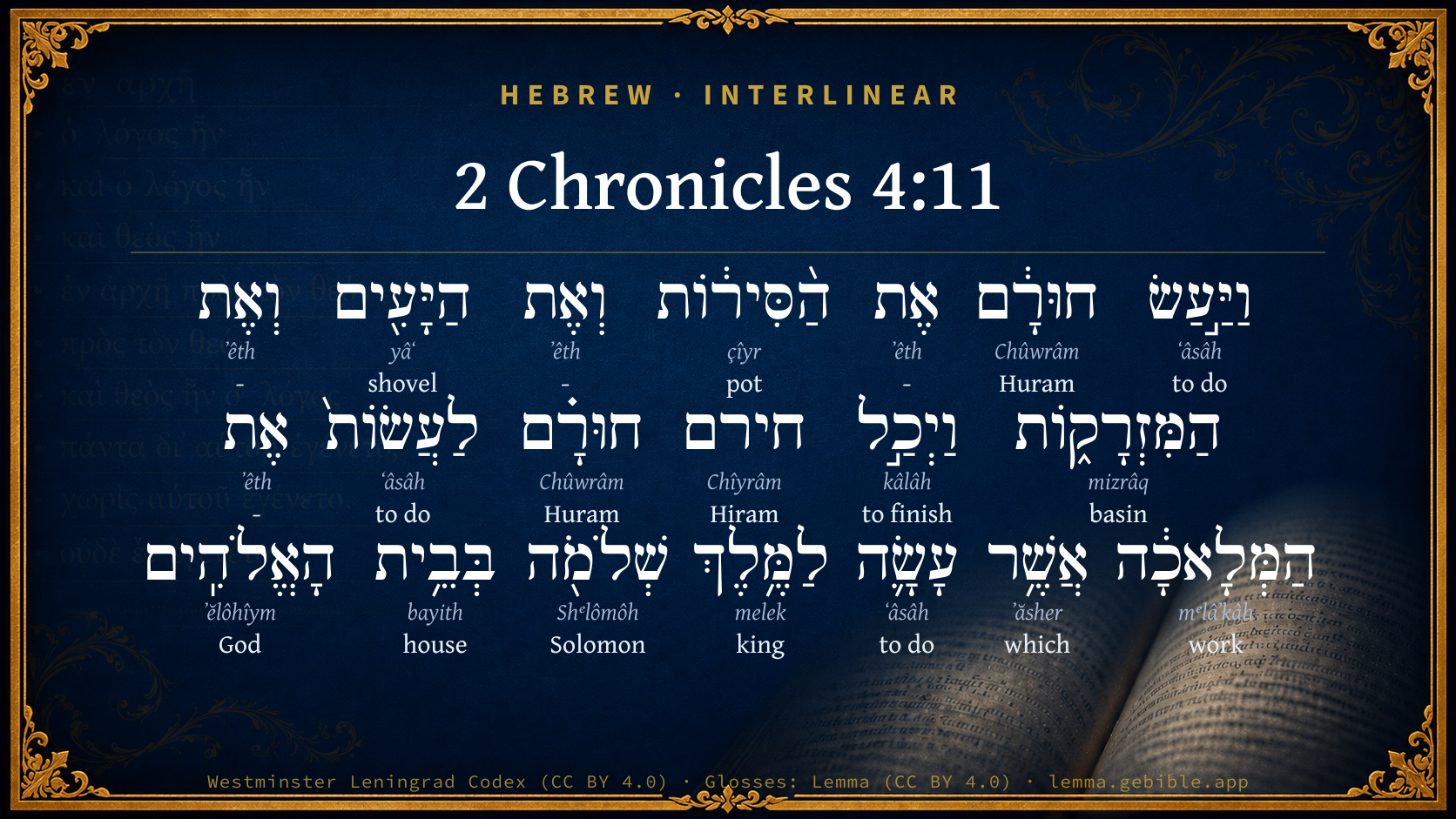
Hebrew (Westminster Leningrad Codex) 2 Chronicles 4:11 appears in the Hebrew Old Testament. The text above is from the Westminster Leningrad Codex. Each word links to its Strong’s number, a concise gloss, and parsing drawn from the Open Scriptures Hebrew Bible morphology. Click any word for its full Brown-Driver-Briggs (BDB) entry.
Download image
Cite this verse

2 Chronicles 4:11 (World English Bible). Public Domain. Lemma interlinear Bible study tool, https://lemma.gebible.app/v/2-chronicles/4/11.

Show BibTeX & RIS
BibTeX
RIS
English Translation
Huram made the pots, and the shovels, and the basins. So Huram made an end of doing the work that he did for king Solomon in the house of God:
World English Bible · Public Domain
Download a study sheet

One document with this verse’s original text, its word-by-word gloss line, the meaning frame, cross-references with their text, attributed commentary, and full source and license credits — printable, and it pastes into notes with its structure intact.

This verse Autodidact and up

Study sheet (.html) Plain text (.txt)

A passage Seminary Student

Up to 50 verses in one chapter. A passage sheet keeps up to 6 commentary sources and 12 cross-references per verse, in the order this page ranks them, and says so on the sheet whenever that leaves anything out. Ask for a single verse and you get the Autodidact verse sheet above.

Everything on this page stays free to read, with no account — the sheet is a download of what is already on screen, not access to it.

Want to remove ads? Support Godless Engineer
Compare translations 3

The same verse in 3 English versions, stacked beneath the original-language interlinear above. Click any original word for its lexicon entry.

Each is an independent rendering of the whole verse — the interlinear is not word-aligned to these translations.

Highlighted words mark where these versions differ — a whole-verse word diff, not a word-by-word alignment.

  • World English Bible Public Domain
    Huram made the pots, and the shovels, and the basins. So Huram made an end of doing the work that he did for king Solomon in the house of God:
  • King James Version Public Domain
    And Huram made the pots, and the shovels, and the basins. And Huram finished the work that he was to make for king Solomon for the house of God;
  • unfoldingWord Literal Text CC BY-SA 4.0
    And Huram made the tubs, and the shovels, and the basins. And Huram finished making the work that he made for King Solomon in the house of God:

unfoldingWord Literal Text — © unfoldingWord, licensed CC BY-SA 4.0. Word-aligned USFM3 via Door43 (git.door43.org/unfoldingWord/en_ult).

Versions to compare (up to 4)

3 of 4 selected

Show all 18 translations

Every available English version of this verse, each an independent rendering of the whole verse.

  • World English Bible Public Domain
    Huram made the pots, and the shovels, and the basins. So Huram made an end of doing the work that he did for king Solomon in the house of God:
  • Berean Standard Bible Public Domain
    Additionally, Huram made the pots, shovels, and sprinkling bowls. So Huram finished the work that he had undertaken for King Solomon in the house of God:
  • Majority Standard Bible Public Domain
    Additionally, Huram made the pots, shovels, and sprinkling bowls. So Huram finished the work that he had undertaken for King Solomon in the house of God:
  • King James Version Public Domain
    And Huram made the pots, and the shovels, and the basins. And Huram finished the work that he was to make for king Solomon for the house of God;
  • American Standard Version (1901) Public Domain
    And Huram made the pots, and the shovels, and the basins. So Huram made an end of doing the work that he wrought for king Solomon in the house of God:
  • Revised Version (1885) Public Domain
    And Huram made the pots, and the shovels, and the basons. So Huram made an end of doing the work that he wrought for king Solomon in the house of God:
  • Geneva Bible (1599) Public Domain
    And Huram made pottes and besoms and basens, and Huram finished the worke that hee shoulde make for King Salomon for the house of God,
  • Douay-Rheims (1899) Public Domain
    And he set the sea on the right side over against the east toward the south.
  • Young's Literal Translation Public Domain
    And Huram maketh the pots, and the shovels, and the bowls, and Huram finisheth to make the work that he made for king Solomon in the house of God;
  • Literal Standard Version CC BY-SA 4.0
    And Huram makes the pots, and the shovels, and the bowls, and Huram finishes to make the work that he made for King Solomon in the house of God;
  • Unlocked Literal Bible CC BY-SA 4.0
    Huram made the pots, the shovels, and the sprinkling bowls. So Huram finished the work that he did for King Solomon in the house of God:
  • unfoldingWord Literal Text CC BY-SA 4.0
    And Huram made the tubs, and the shovels, and the basins. And Huram finished making the work that he made for King Solomon in the house of God:
  • Darby Bible Public Domain
    And Huram made the pots and the shovels and the bowls. So Huram ended doing the work that he made for king Solomon in the house of God:
  • World Messianic Bible Public Domain
    Huram made the pots, the shovels, and the basins. So Huram finished doing the work that he did for King Solomon in God’s house:
  • Webster's Bible Public Domain
    And Huram made the pots, and the shovels, and the basins. And Huram finished the work that he was to make for king Solomon for the house of God;
  • Free Bible Version CC BY-SA 4.0
    Hiram also made the pots, shovels, and basins. Hiram completed the work that he had been doing for King Solomon on the Temple of God:
  • Bible in Basic English Public Domain
    And Huram made all the pots and the spades and the basins. So he came to the end of all the work he did for King Solomon in the house of God:
  • JPS Tanakh (1917) Public Domain
    And Huram made the pots, and the shovels, and the basins. So Huram made an end of doing the work that he wrought for king Solomon in the house of God:

Literal Standard Version (2020), Covenant Press — licensed CC BY-SA 4.0. Text via the HelloAO Bible API (eBible.org). Unlocked Literal Bible (unfoldingWord) — licensed CC BY-SA 4.0. Text via the HelloAO Bible API (eBible.org). unfoldingWord Literal Text — © unfoldingWord, licensed CC BY-SA 4.0. Word-aligned USFM3 via Door43 (git.door43.org/unfoldingWord/en_ult). Free Bible Version, Dr. Jonathan Gallagher — licensed CC BY-SA 4.0. Text via the HelloAO Bible API (eBible.org).

Word by word

More ways to search: Search by grammar → Find every occurrence → Compare this word →

Practice this passage: Drill this verse → Learn its vocabulary →

הַיָּעִ֖ים
yâʻ
H3257
“the · shovels”
Particle, Definite Article + Noun, Common, Masculine, Plural, Absolute
Part of Speech
Particle + Noun
Type
Common
Gender
Masculine
Number
Plural
State
Absolute
Full BDB Definition

Origin: from H3261

TWOT: 879a

shovel
  1. וַיַּ֣עַשׂ ʻâsâh H6213 “and · to do” Conjunction + Verb, Qal, Sequential Imperfect, 3rd Person, Masculine, Singular
  2. חוּרָ֔ם Chûwrâm H2361 “Huram” Noun, Proper
  3. אֶת ʼêth H853 “-” Particle, Direct Object
  4. הַ֨סִּיר֔וֹת çîyr H5518 “the · pots” Particle, Definite Article + Noun, Common, Both, Plural, Absolute
  5. וְאֶת ʼêth H853 “and · -” Conjunction + Particle, Direct Object
  6. וְאֶת ʼêth H853 “and · -” Conjunction + Particle, Direct Object
  7. הַמִּזְרָק֑וֹת mizrâq H4219 “the · basins” Particle, Definite Article + Noun, Common, Masculine, Plural, Absolute
  8. וַיְכַ֣ל kâlâh H3615 “and · to finish” Conjunction + Verb, Piel, Sequential Imperfect, 3rd Person, Masculine, Singular
  9. חירם Chîyrâm H2438 “Hiram” Noun, Proper
  10. חוּרָ֗ם Chûwrâm H2361 “Huram” Noun, Proper
  11. לַעֲשׂוֹת֙ ʻâsâh H6213 “to do” Preposition + Verb, Qal, Infinitive Construct
  12. אֶת ʼêth H853 “-” Particle, Direct Object
  13. הַמְּלָאכָ֔ה mᵉlâʼkâh H4399 “the · work” Particle, Definite Article + Noun, Common, Feminine, Singular, Absolute
  14. אֲשֶׁ֥ר ʼăsher H834 “which” Particle, Relative
  15. עָשָׂ֛ה ʻâsâh H6213 “to do” Verb, Qal, Perfect, 3rd Person, Masculine, Singular
  16. לַמֶּ֥לֶךְ melek H4428 “to/for the · king” Preposition, Determined + Noun, Common, Masculine, Singular, Absolute
  17. שְׁלֹמֹ֖ה Shᵉlômôh H8010 “Solomon” Noun, Proper
  18. בְּבֵ֥ית bayith H1004 “in/at · house of” Preposition + Noun, Common, Masculine, Singular, Construct
  19. הָאֱלֹהִֽים ʼĕlôhîym H430 “the · God(s)” Particle, Definite Article + Noun, Common, Masculine, Plural, Absolute

About this verse

These counts appear in no published source. They are computed here, from the morphology-tagged text and Lemma’s own curated glosses. What Lemma adds →

20
words
14
distinct lemmas
Historical
section

Notable vocabulary

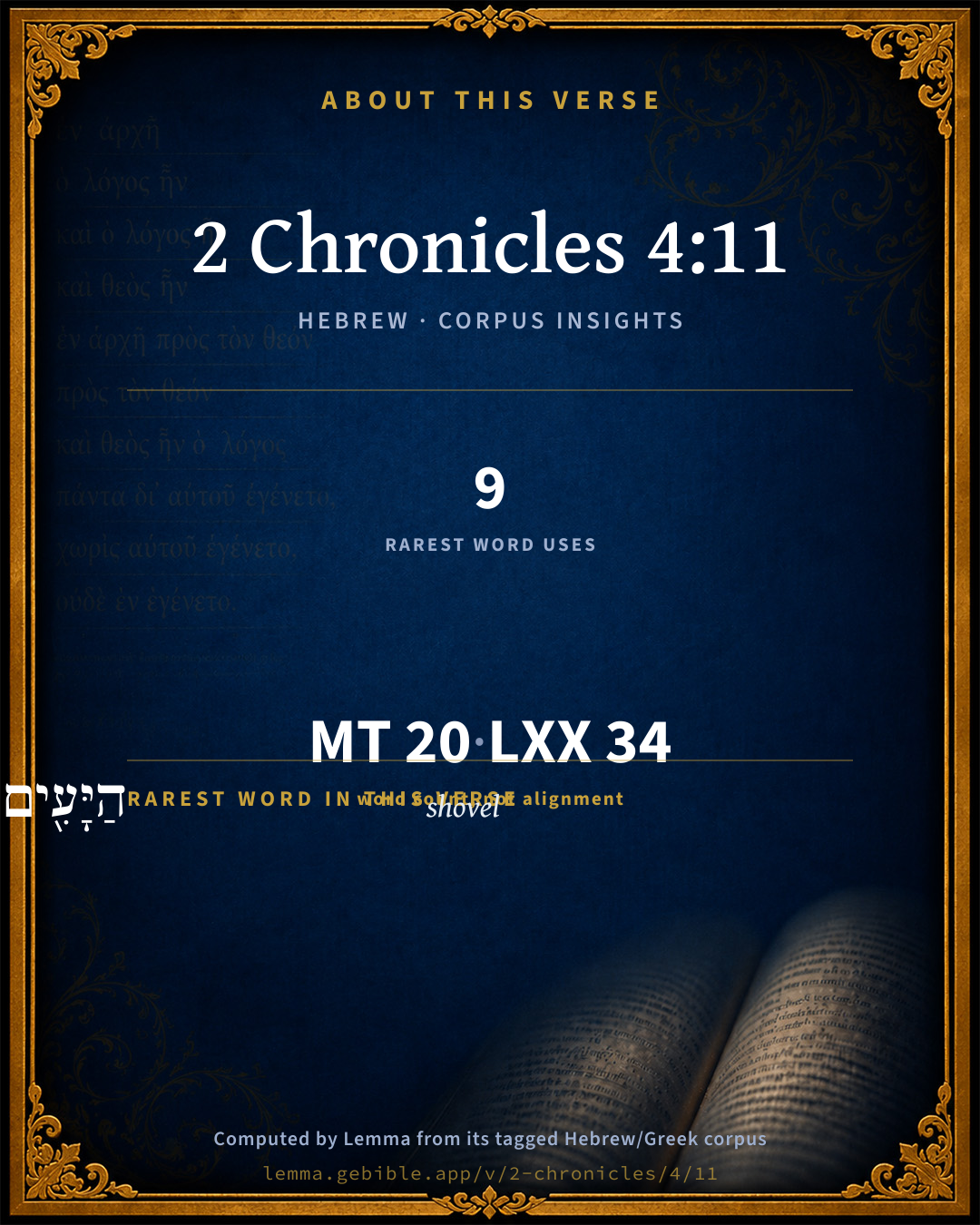
The rarest word here is הַיָּעִ֖ים shovel H3257 — appearing just 9 times in the whole Hebrew Bible.

Shared distinctive vocabulary

הַיָּעִ֖ים shovel H3257 occurs in 9 verses of the Hebrew Bible. Also found in:

Grammatical profile

  • 4 verbs
  • 11 nouns
  • 5 particles

Verb forms

  • וַיַּ֣עַשׂ Qal · Sequential Imperfect
  • וַיְכַ֣ל Piel · Sequential Imperfect
  • לַעֲשׂוֹת֙ Qal · Infinitive Construct
  • עָשָׂ֛ה Qal · Perfect

Repetition

Words recur within this verse — often emphatic in Hebrew:

  • וַיַּ֣עַשׂ to do H6213 ×3
  • חוּרָ֔ם Huram H2361 ×2

Hebrew & Septuagint length

In English translation the verse runs 30 words from the Hebrew and 37 from the Septuagint (LXX English) — closely comparable.

A rough comparison of the two English renderings, which tokenize alike — not a word-level alignment.

Word counts can differ between the Hebrew and the Greek without any difference in meaning — e.g. the Hebrew direct-object marker אֵת has no separate Greek word, and Greek often adds the article ὁ.

In the original languages it is 20 Hebrew tokens and 34 Greek tokens — but the two are counted differently (Hebrew bundles its prefixes and suffixes into one token; the Greek is in lemma form), so that isn’t a like-for-like length.

Cross-references

2

Topical passages linked to 2 Chronicles 4:11 in the Treasury of Scripture Knowledge — connected by theme and wording, ordered by reader-vote popularity; previews shown in the World English Bible.

  • 1 Kings 7:14 He was the son of a widow of the tribe of Naphtali, and his father was a man of Tyre, a worker in brass; and he was filled with wisdom and understanding and skill, to work all works in brass. He came to king Solomon, and performed all his work.
  • 1 Kings 7:40–51 Hiram made the basins, and the shovels, and the basins. So Hiram made an end of doing all the work that he worked for king Solomon in the house of Yahweh:

Cross-references courtesy of OpenBible.info (CC BY 4.0).

Hebrew and Greek witnesses Masoretic Hebrew ↔ Greek Septuagint

The same verse in the two great witnesses to the Old Testament, shown verse-for-verse.

These are two independent witnesses, not word-aligned to each other, and the Septuagint is shown in lemma (dictionary) form.

Hebrew 2 Chronicles 4:11 Masoretic · Westminster Leningrad Codex

וַיַּ֣עַשׂ חוּרָ֔ם אֶת הַ֨סִּיר֔וֹת וְאֶת הַיָּעִ֖ים וְאֶת הַמִּזְרָק֑וֹת וַיְכַ֣ל חירם חוּרָ֗ם לַעֲשׂוֹת֙ אֶת הַמְּלָאכָ֔ה אֲשֶׁ֥ר עָשָׂ֛ה לַמֶּ֥לֶךְ שְׁלֹמֹ֖ה בְּבֵ֥ית הָאֱלֹהִֽים

Huram made the pots, and the shovels, and the basins. So Huram made an end of doing the work that he did for king Solomon in the house of God:

World English Bible · Public Domain

Greek LXX 2 Chronicles 4:11 Septuagint · lemma form

καί ποιέω χιραμ ὁ κρεάγρα καί ὁ πυρεῖον καί ὁ ἐσχάρα ὁ θυσιαστήριον καί πᾶς ὁ σκεῦος αὐτός καί συντελέω χιραμ ποιέω πᾶς ὁ ἐργασία ὅς ποιέω σαλωμών ὁ βασιλεύς ἐν οἶκος ὁ θεός

And Chiram made the flesh hooks, and the fire-pans, and the grate of the altar, and all its instruments: and Chiram finished doing all the work which he wrought for king Solomon in the house of God:

LXX2012 (modern English Septuagint) · Public Domain

On this verse, Ellicott's Commentary for English Readers discusses the Septuagint’s reading. Read the note in Commentary ↓

Hebrew: Westminster Leningrad Codex (CC BY 4.0). Greek: Septuagint (public domain); English from LXX2012 (modern English Septuagint) (Public Domain). How the Septuagint differs from the Hebrew →

Commentary

Notes on 2 Chronicles 4:11 from classic Christian and Jewish commentators (each source and its license shown beneath its notes). The classic Christian expositions comment on the surrounding passage and are grouped to its opening verse, so a note may address several verses; the Jewish commentaries on the Tanakh (Rashi and others) are per-verse, so they appear only where the commentator wrote on this verse.

Lemma curates 59 commentaries, every one of them public domain or Creative Commons licensed, each selected and text-cleaned for this edition rather than reprinted as found. About our sources →

Matthew Henry's Commentary

We have here such a summary both of the brass-work and the gold-work of the temple as we had before (Kg1 7:13, etc.), in which we have nothing more to observe than, 1. That Huram the workman was very punctual: He finished all that he was to make (Ch2 4:11), and left no part of his work undone. Huram, his father, he is called, Ch2 4:16. Probably it was a sort of nickname by which he was commonly known, Father Huram; for the king of Tyre called him Huram Abi, my father, in compliance with whom Solomon called him his, he being a great artist and father of the artificers in brass and iron. He acquitted himself well both for ingenuity and industry. 2. Solomon was very generous. He made all the vessels in great abundance (Ch2 4:18), many of a sort, that many hands might be employed, and so the work might go on with expedition, or that some might be laid up for use when others were worn out. Freely he has received, and he will freely give. When he had made vessels enough for the present he could not convert the remainder of the brass to his own use; it is devoted to God, and it shall be used for him.

Matthew Henry's Commentary on the Whole Bible (1708–1710) — public domain (CC PDM 1.0). Text via the HelloAO Bible API.

Ellicott's Commentary for English Readers

(b) HURAM’S WORKS IN BRASS (2Ch_4:11-18)

Comp. 1Ki_7:40-47.

Throughout this section the narrative almost textually coincides with the parallel account.

(11) And Huram made the pots.—1Ki_7:40 has “lavers” (pans). Our reading, “pots,” appears correct, supported as it is by many MSS. and the LXX. and Vulg. of Kings. A single stroke makes the difference between the two words in Hebrew writing. These “pots” were scuttles for carrying away the ashes of the altar.

Basons.—“Bowls” (mizrâqôth). Probably the same as the mizrâqîm of 2Ch_4:8. So kîyôrôth (Kings) and kîyôrîm (Chron.).

Huram.—Hebrew text, Hiram, as in Kings. The LXX. renders: “And Hiram made the fleshhooks (κρεάγρας) and the firepans (πυρεια), and the hearth of the altar and all its vessels.”

The work.—Kings, “all the work,” and so some MSS., LXX., and Vulg. of Chron. The Syriac and Arabic omit 2Ch_4:11-17; 2Ch_4:19-22.

He was to make.—Rather, he made.

For the house.—In the house. Chronicles supplies the preposition in, which is not required according to ancient usage.

A Bible Commentary for English Readers, edited by Charles John Ellicott (1878–1897) — public domain. Text from a community e-Sword module.

Trapp's Complete Commentary

John Trapp

2Ch 4:11 And Huram made the pots, and the shovels, and the basons. And Huram finished the work that he was to make for king Solomon for the house of God;

Ver. 11. And Huram made the pots, and the shovels.] This diligent and exact description of these vessels of the temple showeth that all things needful to salvation are set down in the holy Scriptures, as Lavater well observeth.

John Trapp, A Commentary or Exposition upon All the Books of the Old and New Testament (1647–1656) — public domain. Text from a community e-Sword module.

Keil & Delitzsch

C. F. Keil & F. Delitzsch

Summary catalogue of the temple utensils and furniture. - Ch2 4:11-18. The brass work wrought by Huram.

Keil & Delitzsch — Biblical Commentary on the Old Testament (1861–1891) — public domain (CC PDM 1.0). Text via the HelloAO Bible API. (Old Testament only.)

Tyndale Open Study Notes

Tyndale Open Resources

4:11b-18 Cp. 1 Kgs 7:40b-47, which the Chronicler follows almost verbatim.

Tyndale Open Study Notes — © Tyndale Open Resources, licensed CC BY-SA 4.0. Text via the HelloAO Bible API.

Geneva Bible (1599)

Geneva Bible translators

Or, cauldrons.

Geneva Bible (1599) marginal notes — public domain. Text via Bolls.life.

Jamieson, Fausset & Brown

Robert Jamieson, A. R. Fausset & David Brown

Huram made--(See on Kg1 7:40).

Next: 2 Chronicles Chapter 5

Jamieson, Fausset & Brown — Commentary Critical and Explanatory on the Whole Bible (1871) — public domain (CC PDM 1.0). Text via the HelloAO Bible API.

The Cambridge Bible for Schools and Colleges

gen. ed. J. J. S. Perowne

11. Huram] For the form of the name see note on 2Ch_2:3.

And Huram finished the work that he was to make for king Solomon for the house of God] R.V. So Huram made an end of doing the work that he wrought for king Solomon in the house of God.

The Cambridge Bible for Schools and Colleges (gen. ed. J. J. S. Perowne; Cambridge University Press, 1878–1918) — public domain. Text from a community e-Sword module.

Matthew Poole's English Annotations

Of these and the following verses See Poole "1Ki 7:40", &c.

Matthew Poole's English Annotations on the Holy Bible (1683–1685) — public domain. Text from a community e-Sword/MySword module.

The Pulpit Commentary

The pots. As stated above, the Hebrew word is twOrySih. It occurs in the Old Testament twenty-seven times; it is translated in our Authorized Version "pans" once and "caldrons" four times. By a manifest copyist"s error, the parallel (1Ki_7:35) has twOryki, "layers," by the use of caph for samech. The use of the rysi was to boil the peace offerings, though some say they were hods in which to carry away the ashes; and it certainly is remarkable that it is no one of the words employed 1Sa_2:14. In addition to these twenty-seven times, it occurs also four times in Ecclesiastes, Isaiah, Hosed, Nahum, with the meaning of "thorns," and once in Amos it is translated "fish-hooks." The passage in Ecclesiastes (Ecc_7:6) is additionally remarkable, in the fact that the root occurs twice in the same sentence in its different significations, e.g. "the crackling of thorns under a pot." The shovels. The Hebrew word is This word occurs in the Old Testament nine times in Exodus, Numbers, Kings, Chronicles, and Jeremiah. The use of the shovel was to remove the ashes. The basins should very probably read flesh-hooks.

Vers. 11-22.

Completeness in Christian service.

Sacred service may be of two kinds: it may be feeble, slight, slovenly, wholly incomplete and unsatisfactory; or, on the other hand, it may be vigorous, effective, thorough, commanding the esteem of men and securing the commendation of Christ. The way in which Solomon"s temple was built brings before us the more excellent order of service. It was characterized by

I SOLIDITY. The "two pillars" (ver. 12), and the character of the timber and of the gold, are suggestive of strength and solidity. Our work for Christ should have no slightness about it; it should be good, solid, durable; work that will resist the disintegrating forces about us; that may be "tried by fire" and still endure. (see 1Co_3:12-15) For such a result we must not be content with stirring the emotions; we must convince the judgment, must produce conviction in the soul, must reach and win the whole spiritual nature.

II BEAUTY. The strong pillars were ornamented with pommels, with wreaths, and pomegranates (vers. 12, 13). Beauty as well as strength was in the building of the temple, and should be in the sanctuary of God, in the service of Jesus Christ. (Psa_96:6) We should introduce into the work we do for our Master all the graces that we can bring meekness of spirit, unselfishness of purpose, conciliatoriness of tone and temper, excellency of workmanship. On the top of the pillars should be pomegranates; covering and adorning our service should be sweetness and loveliness of manner and of spirit.

III FITNESS. "In the plain of Jordan did the king cast them" (ver. 17). That was obviously a more fitting place for such an operation than the near neighbourhood of the site of the temple. Everything in its own time and place. That which is wholly unfitted for the sanctuary may be quite right and altogether suitable and desirable in the hall or in the home. The fitness or unfitness of the surroundings of a work may make all the difference between the excellent and the objectionable, between the useful and the harmful.

IV ATTENTION TO THE MINUTE. "Hiram made the pots, and the shovels, and the basins" (ver. 11). "And the flowers, and the lamps, and the tongs, made he of gold, and that perfect gold" (ver. 21). Nothing was too small or too trivial to be made by this skilled artificer, or to be made by him with the best material. There is nothing we can do in the service of our Lord that is not honourable and worthy of our manhood; nothing that we should not do to the full height of our ability.

V ABUNDANCE. (Ver. 18.) It is not right that we should do our work in Christ"s vineyard in a spirit of perfunctoriness, as the workman who will do no more than is imperatively demanded of him. Ours is not a slavery; nor are we hirelings. We are the children of God; we are the friends of Jesus Christ; we are co-workers with him; his interests are ours also; we long intensely for the coming of his kingdom. We shall not do stintingly or grudgingly what we do for him. We shall not count the hours, or the days, or the weeks we spend in his service; we shall not measure the powers we employ for his glory. We shall gladly pour forth all our faculties, shall give in "great abundance" of our resources, that his Name may be extolled, and that he may be made "very high.

VI PURITY. All these things were made "of pure gold" (vers. 20, 22); the flowers, etc., of gold, "and that perfect gold" (ver. 21). The purest gold that could be obtained was used. The thought, the feeling, the energy, that is most perfectly refined of all dross of earthliness and selfishness, should be brought to the service of the Divine Redeemer.

VII CONTINUANCE. "Hiram finished the work that he was to make" (ver. 11). "The end crowns the work." Well is it for the Christian workman when, having endured all criticisms, having borne all rebuffs, having met and mastered all difficulties, having submitted to all disappointments, having cheerfully wrought all his labours and having struck his last stroke, he can say, "I have finished the work which thou gavest me to do." For him is a generous commendation and a large reward. (Mat_25:23) C.

The manufacture of the temple furniture.

I THE CHERUBIM. (2Ch_3:10-13)

1. Their appearance. Colossal winged figures; but whether, like the cherubim of Ezekiel (Eze_1:6) and of John, (Rev_4:7) possessed of four faces (of a man, of a lion, of an ox, of an eagle) and six wings, cannot be decided. Probably they had only one face, resembling that of a man. Unlike the cherubim in the tabernacle, which were "beaten out of one piece of gold", (Exo_37:7) these were made of olive wood, (1Ki_6:23) presumably on account of its durability and firmness, qualities which induced the Greeks to select it as the best material out of which to construct idols (see Riehm, "Handworterbuch," art. "Oelbaum"). The woodwork was overlaid with gold.

1. Their dimensions. In height ten cubits; (1Ki_6:23) their wings were each five cubits long, or twenty cubits in all. They were thus twice as broad as high, and probably altogether double in size to those on the capporeth.

2. Their position. In the holy of holies, their feet upon the ground, their wings touching the walls on either side, and their faces directed towards the interior of the building, i.e. towards the holy place, whence only an intruder could enter the secret shrine. Underneath and between their outstretched wings, the ark, with the mercy-seat and the lesser cherubim, were subsequently placed. (2Ch_5:8)

1. Their meaning. That similar winged figures are met with in the mythologies and religions of Oriental peoples, in particular of the Egyptians and Assyrians, does not prove the cherubim of Jewish theology to have been derived from those. That in those the beast-figure prevails, while in these the human face predominates, marks an essential distinction between the two. Hence the notion that among the Hebrews the cherubim had no higher significance than such winged creatures had in Egypt, Assyria, or Babylon were, in short, merely symbols of the underlying idea common to Oriental religions, that the life of nature is identical with the life of God (Bahr) is to be rejected. So also is the opinion that they were purely mythical figures, like the Egyptian or Greek sphinxes (the former half-man and half-lion, the latter half-woman and half-lion), or like the colossal winged lions at the doors of Babylonian and Assyrian temples (Hengstenberg, "Egypt and the Books of Moses," p. 153; Schrader, "Die

2. Keilinschriften, p. 40). That they represented real beings is now generally believed (Hofmann, Kurtz, Keil, Kliefoth, and others), and appears implied in the passage where they are first mentioned. (Gen_3:24) That they belonged to the same order of super-terrestrial existences as the angels and the seraphim of Scripture seems a necessary inference, from the fact that all three angels, (Psa_68:17) seraphim, (Isa_6:2) and cherubim (2Sa_22:11; Psa_18:10) are depicted as attending Jehovah in his theophanies, or manifestations of himself to men. That they were different from angels may be inferred from the fact that these are never exhibited as winged, and are usually represented as Jehovah"s messengers, (Psa_104:4) which the cherubim never are. It is not so certain that they were different from the seraphim, or shining ones: (Isa_6:2) who in appearance, situation, and function resembledthem, having six wings, appearing always in the vicinity of the self-revealing Jehovah, and proclaiming aloud the presence of his glory. Yet from the fact that they are commonly exhibited as bearers or upholders of the Divine throne, (Eze_1:26) whereas the seraphim surround the throne, (Isa_6:2) it may be concluded that the two, though belonging to the same order, were not the same species of being (cf. Delitzsch on Isaiah to 6:2). At the same time, whilst holding the cherubim to have been images intended to represent real existences, it need not be assumed that the actual cherubim had really the four faces of a man, of a lion, of an ox, and of an eagle. These belong to the department of symbology, in which supersensuous ideas are set forth in sensuous images. Hence, inasmuch as the human face represents the notion of intelligence, the leonine that of strength, the bovine that of endurance, and the aquiline that of keenness of vision, combined perhaps with the idea of swiftness of motion, the ascription of these to the cherubim can only mean that these heavenly beings were possessed of all the elements of a perfect life, and, as the crown and summit of creation, stood nearest God.

3. Their function. Comparing the Scriptures in which they are alluded to, the following may be regarded as the complex function performed by the cherubim:

(1) To proclaim the Divine pretence, so that, wherever they are or appear, God is (Psa_18:10; Exo_25:22; Eze_1:26)

(2) to keep guard over places rendered holy by the Divine presence, so that no unholy person might irreverently intrude therein; (Gen_3:24) and

(3) to symbolize that only beings themselves perfect could stand in the presence of the glory of God. (Rev_4:8) All three functions may be said to have been performed by the colossal figures in Solomon"s temple as well as by the smaller cherubim on the capporeth in the tabernacle (see Kurtz, in Herzog"s "Real Encyclopadie," art. "Cherubim; "Riehm" in "Handworterbuch," art. "Cherubim;" Keil, "Die Biblische Arehaotogie," pp. 92, etc.).

II THE ALTAR OF INCENSE. (Ver. 19.)

1. Its material. Like the other articles in the interior of the house, it was made of cedar wood and overlaid with gold. (1Ki_7:48) That in the tabernacle was formed of shittim wood overlaid with gold; was two cubits high, one long, and one broad; was furnished with a covering, and horns of the same wood overlaid with gold. (Exo_37:25)

2. Its position.

(1) In the holy place; and

(2) immediately in front of the entrance to the holy of holies, i.e. before the curtain, or second veil.

3. Its use. As in the tabernacle, (Exo_37:29) so in the temple, it was intended for the burning of fragrant incense before the holy of holies day and night, to symbolize the adoration of Jehovah"s worshipping people.

III THE CANDLESTICKS. (Ver. 7.)

1. Their number. Ten. This was demanded by the larger dimensions of the temple in comparison with the tabernacle, which con-rained only one.

2. Their form. Each seven-branched, as in the tabernacle, i.e. consisting of a main stalk with three branches on either side, rising to the same height as that, each of the six branches and the middle stalk being crowned with a. (Exo_25:31, etc.; 37:17, etc.)

1. Their ornaments. Bowls, knops, and flowers, as in the tabernacle candlestick, seeing that each in the temple was constructed "according to its form.

2. Their utensils. Snuffers and basins; the former to trim the wicks, the latter to receive what was removed by the process.

3. Their use. To keep a light continually burning in the holy place andbefore the holy of holies. (Exo_25:37 Exo_27:20) Their material.

4. Of gold (ver. 7), pure (ver. 20), and perfect (ver. 21). In this, again, theyresembled the candlestick in the tabernacle. (Exo_25:31)

5. Their position. In the holy place, before the oracle, five on either side.

6. Their significance. To symbolize either

(1) the light of God"s favour which the worshippers or the sacred community (represented by the priest who ministered in their name) enjoyed, when their sins had been first covered by the blood shed in the forecourt; (Psa_36:9 Psa_89:15) or

(2) the illumination which the Spirit-enlightened Church of God, collectively and individually, should shed forth upon the world (Mat_5:16; Php_2:15)

IV THE TABLES OF SHEWBREAD. (Vers. 8, 19.)

1. Their number. Ten; in the tabernacle, one.

2. Their position. Five on either side of the holy place. The one table in the tabernacle stood upon the side of the tabernacle northward, without the. (Exo_40:22)

1. Their material. Of gold. (1Ch_28:16)

2. Their purpose. To receive and set forth the shewbread, or the loaves of unleavened bread, twelve on each table, which were commanded to be set before the face of Jehovah continually. (Exo_25:30)

3. Their significance. To symbolize religious truths which it concerned Israel to know. The "face loaves" were so called, not because with them or the eating of them the sight of God"s face was associated, but because they stood continually in God"s presence as emblematic

(1) of the spiritual food Israel should present to God in the good works they should perform through Divine assistance, and

(2) of the spiritual nourishment pardoned worshippers should receive from. (Exo_24:11)

V THE BRAZEN ALTAR. (Ver. 1.)

1. Its position. In the interior of the fore court. (1Ki_8:22, 1Ki_8:64)

2. Its dimensions. Twenty cubits long, twenty broad, and ten high.

3. Its material. Brass.

4. Its use. To offer thereupon the burnt offerings presented by the worshippers who came to the temple.

VI THE MOLTEN SEA. (Vers. 2-5.)

1. Its appearance. A huge metallic basin, sup- ported on the backs of twelve metallic oxen looking toward the north, three looking toward the west, three looking toward the south, and three looking toward the east," all having their hinder parts inward. The basin had the form of a cup, decorated on the brim with flowers of lilies, underneath the brim with two rows of "knops," ten in a cubit, therefore with three hundred in all, compassing the basin around; (ver. 4 cf. 1Ki_7:28)

2. Its size. Ten cubits in diameter and thirty in circumference, five cubits high and a handbreadth in thickness, with a capacity of three thousand, or, according to a more accurate measurement, (1Ki_7:26) two thousand baths, i.e. upwards of twelve thousand gallons. With this may be compared the basin borne by twelve lions in the Alhambra at Granada, and the two giant sandstone vases which were found by Muller at Amathus in Cyprus, each of which was oval-shaped, thirty feet in circumference, had four handles, and rested on eight bulls, four in each half- round of the oval (see in Herzog and in Riehm, art. "Meer ehernes").

3. Its situation. Between the brazen altar and the porch, on the right side of the west end, over against the south of the court (ver. 10).

4. Its use. For the priests to wash in when they came to engage in thesacrificial worship of the sanctuary (ver. 6; cf. Exo_30:19-21)

5. Its significance.

(1) The form and decorations of the vessel showed it was designed for priestly service. "Its form, that of an open lily cup, corresponded to its purpose. If all budding and blossoming signified holiness and priesthood (Num_16:7; comp. with 17:20, 23; (Psa_92:14) the flower named the white, i.e. the lily, must have been pre-eminently the priestly one" (Bahr).

(2) The twelve oxen on which it rested accorded with the same idea. Oxen were the principal sacrificial animals, especially for the priests (Exo_29:10, etc.; Lev_4:3, etc.; Lev_16:11; Num_8:8) Twelve were selected, hardly for the sake of symmetry (Thenius), or to represent the twelve months of the year (Vatke), but, like the twelve loaves of shewbread, and the twelve lions on Solomon"s throne, (1Ki_10:20) to symbolize the twelve tribes of Israel, which also when in camp were placed, like the oxen, three to each quarter of the heavens. (Num_2:2-31)

(3) The washing of the priests was emblematic of that inward spiritual purity without which none can approach a holy God, or render to him acceptable service (Isa_1:16; Heb_10:22)

6. Its history. In after years it was taken down from off the brazen oxen by Ahaz and set upon a pavement of stones; (2Ki_16:17) it was ultimately broken in pieces by the Chaldeans, and its brass conveyed to Babylon. (2Ki_25:13) The brazen oxen the Chaldean general transported as booty to the East. (Jer_52:20)

VII THE LAVERS. (Ver. 6.)

1. Their material. Brass.

2. Their number. Ten.

3. Their position. Five on the right and five on the left of the brazen altar.

4. Their appearance. Basins resting upon bases or pedestals with wheels (ver. 14), of which a minute description is given in the First Book of Kings (7:27-37).

5. Their dimensions. Every laver or basin four cubits in diameter.

6. Their contents. Forty baths, or two hundred and forty gallons.

7. Their use. To wash the victims in when these were brought to the priests to be offered upon the altar. W.

The Pulpit Commentary (1880–1919), ed. H.D.M. Spence-Jones & Joseph S. Exell — public domain. Text from a community e-Sword module.

unfoldingWord translationNotes

Door43 World Missions Community

Huram

See how you translated this name in 2 Chronicles 2:13.

the sprinkling bowls

bowls that held blood that was used in the house of God for sprinkling the altar

Huram finished the work that he did ... He had

Here Huram represents all who worked on the temple. AT: "Huram and the other workers finished the work that they did ... They had" (See: Synecdoche)

bowl-like capitals

The upper part of a pillar is called a capital. See how you translated "capital" in 2 Chronicles 3:15. AT: "bowl-shaped tops" or "bowl-shaped upper parts"

decorative latticework

This refers to the decorative carving or markings on the upper part of the pillars. AT: "carvings that resembled chains"

the four hundred pomegranates

"the 400 pomegranates." Translate "pomegranates" as you did in 2 Chronicles 3:16. (See: Numbers)

translationWords

works

king

Solomon

house of God

column

pomegranate

unfoldingWord translationNotes — © Distant Shores Media and the Door43 World Missions Community, licensed CC BY-SA 4.0. Source: git.door43.org/Door43/en_tn.

Rashi

Rabbi Shlomo Yitzchaki (Rashi)

And Huram made the pots Copper pots, made to gather the ashes to put them into the pots.

Rashi on the Tanakh — English translations: “The Judaica Press complete Tanach with Rashi, translated by A. J. Rosenberg” (CC BY 4.0); “Pentateuch with Rashi's commentary by M. Rosenbaum and A.M. Silbermann, 1929-1934” (public domain); “The Metsudah Tanach series, Lakewood, N.J” (CC BY 4.0); and “The Book of Joshua, Metsudah Publications, 1997” (CC BY 4.0). Text via Sefaria.

Lesson kit

Teaching starters — assembled from the data on this page, not authored interpretation. Every prompt links to the verse data it draws on. Edit before teaching.

2 Chronicles, in the Historical, opens this verse with 20 words (14 distinct Hebrew lemmas). Its most distinctive word is yâʻ (“shovel”). A historical commentator’s framing appears above. Read the whole chapter for the surrounding context.

Discussion questions

  1. How does “shovel” (yâʻ) shape what this verse is saying?
  2. Exodus 27:3 shares the word «shovel» with this verse. How do the two illuminate each other?
  3. “to do” occurs 3× in this one verse. What is the effect of the repetition?
  4. The translations on this page render this verse differently — a whole-verse word diff, not a word-by-word alignment. What might account for the different wordings?
  5. The verb «וַיַּ֣עַשׂ» is Qal Sequential Imperfect. How does its form color the action?
  6. Reading how Matthew Henry's Commentary and Ellicott's Commentary for English Readers read this verse, where do the two commentators agree and where do they part?

Things to notice

Reading settings

Reading text

Shown beneath each verse's original-language words.

Old Testament
Old Testament edition

Read the OT as the Masoretic Hebrew (MT) or the Greek Septuagint (LXX).

English shown for the Greek Septuagint (in the Hebrew ↔ Greek comparison).

Comparing translations? Open the Compare panel on any verse page to stack up to four side by side.