Joshua 24:20

Hebrew (Westminster Leningrad Codex) Joshua 24:20 appears in the Hebrew Old Testament. The text above is from the Westminster Leningrad Codex. Each word links to its Strong’s number, a concise gloss, and parsing drawn from the Open Scriptures Hebrew Bible morphology. Click any word for its full Brown-Driver-Briggs (BDB) entry.
Download image
Cite this verse

Joshua 24:20 (World English Bible). Public Domain. Lemma interlinear Bible study tool, https://lemma.gebible.app/v/joshua/24/20.

Show BibTeX & RIS
BibTeX
RIS
English Translation
If you forsake Yahweh, and serve foreign gods, then he will turn and do you evil, and consume you, after that he has done you good.
World English Bible · Public Domain
Download a study sheet

One document with this verse’s original text, its word-by-word gloss line, the meaning frame, cross-references with their text, attributed commentary, and full source and license credits — printable, and it pastes into notes with its structure intact.

This verse Autodidact and up

Study sheet (.html) Plain text (.txt)

A passage Seminary Student

Up to 50 verses in one chapter. A passage sheet keeps up to 6 commentary sources and 12 cross-references per verse, in the order this page ranks them, and says so on the sheet whenever that leaves anything out. Ask for a single verse and you get the Autodidact verse sheet above.

Everything on this page stays free to read, with no account — the sheet is a download of what is already on screen, not access to it.

Want to remove ads? Support Godless Engineer
Compare translations 3

The same verse in 3 English versions, stacked beneath the original-language interlinear above. Click any original word for its lexicon entry.

Each is an independent rendering of the whole verse — the interlinear is not word-aligned to these translations.

Highlighted words mark where these versions differ — a whole-verse word diff, not a word-by-word alignment.

  • World English Bible Public Domain
    If you forsake Yahweh, and serve foreign gods, then he will turn and do you evil, and consume you, after that he has done you good.
  • King James Version Public Domain
    If ye forsake the LORD, and serve strange gods, then he will turn and do you hurt, and consume you, after that he hath done you good.
  • unfoldingWord Literal Text CC BY-SA 4.0
    If you forsake Yahweh and serve the gods of the foreigner, then he will turn and do harm to you and finish you, after when he has done good to you.”

unfoldingWord Literal Text — © unfoldingWord, licensed CC BY-SA 4.0. Word-aligned USFM3 via Door43 (git.door43.org/unfoldingWord/en_ult).

Versions to compare (up to 4)

3 of 4 selected

Show all 18 translations

Every available English version of this verse, each an independent rendering of the whole verse.

  • World English Bible Public Domain
    If you forsake Yahweh, and serve foreign gods, then he will turn and do you evil, and consume you, after that he has done you good.
  • Berean Standard Bible Public Domain
    If you forsake the LORD and serve foreign gods, He will turn and bring disaster on you and consume you, even after He has been good to you.”
  • Majority Standard Bible Public Domain
    If you forsake the LORD and serve foreign gods, He will turn and bring disaster on you and consume you, even after He has been good to you.”
  • King James Version Public Domain
    If ye forsake the LORD, and serve strange gods, then he will turn and do you hurt, and consume you, after that he hath done you good.
  • American Standard Version (1901) Public Domain
    If ye forsake Jehovah, and serve foreign gods, then he will turn and do you evil, and consume you, after that he hath done you good.
  • Revised Version (1885) Public Domain
    If ye forsake the LORD, and serve strange gods, then he will turn and do you evil, and consume you, after that he hath done you good.
  • Geneva Bible (1599) Public Domain
    If yee forsake the Lord and serue strange gods, then he will returne and bring euill vpon you, and consume you, after that hee hath done you good.
  • Douay-Rheims (1899) Public Domain
    If you leave the Lord, and serve strange gods, he will turn, and will afflict you, and will destroy you after all the good he hath done you.
  • Young's Literal Translation Public Domain
    When ye forsake Jehovah, and have served gods of a stranger, then He hath turned back and done evil to you, and consumed you, after that He hath done good to you.'
  • Literal Standard Version CC BY-SA 4.0
    When you forsake YHWH, and have served gods of a stranger, then He has turned back and done harm to you, and consumed you, after that He has done good to you.”
  • Unlocked Literal Bible CC BY-SA 4.0
    If you forsake Yahweh and worship foreign gods, then he will turn and do you harm. He will consume you, after he has done good to you.”
  • unfoldingWord Literal Text CC BY-SA 4.0
    If you forsake Yahweh and serve the gods of the foreigner, then he will turn and do harm to you and finish you, after when he has done good to you.”
  • Darby Bible Public Domain
    If ye forsake Jehovah, and serve strange gods, then he will turn and do you hurt, and consume you, after that he hath done you good.
  • World Messianic Bible Public Domain
    If you forsake the LORD, and serve foreign gods, then he will turn and do you evil, and consume you, after he has done you good.”
  • Webster's Bible Public Domain
    If ye forsake the LORD, and serve strange gods, then he will turn and do you hurt, and consume you, after that he hath done you good.
  • Free Bible Version CC BY-SA 4.0
    if you give up on him and worship foreign gods. He will turn against you and destroy you despite all the good he has done for you.”
  • Bible in Basic English Public Domain
    If you are turned away from the Lord and become the servants of strange gods, then turning against you he will do you evil, cutting you off, after he has done you good.
  • JPS Tanakh (1917) Public Domain
    If ye forsake the LORD, and serve strange gods, then He will turn and do you evil, and consume you, after that He hath done you good.'

Literal Standard Version (2020), Covenant Press — licensed CC BY-SA 4.0. Text via the HelloAO Bible API (eBible.org). Unlocked Literal Bible (unfoldingWord) — licensed CC BY-SA 4.0. Text via the HelloAO Bible API (eBible.org). unfoldingWord Literal Text — © unfoldingWord, licensed CC BY-SA 4.0. Word-aligned USFM3 via Door43 (git.door43.org/unfoldingWord/en_ult). Free Bible Version, Dr. Jonathan Gallagher — licensed CC BY-SA 4.0. Text via the HelloAO Bible API (eBible.org).

Word by word

More ways to search: Search by grammar → Find every occurrence → Compare this word →

Practice this passage: Drill this verse → Learn its vocabulary →

נֵכָ֑ר
nêkâr
H5236
“foreign”
Noun, Common, Masculine, Singular, Absolute
Part of Speech
Noun
Type
Common
Gender
Masculine
Number
Singular
State
Absolute
Full BDB Definition

Origin: from H5234

TWOT: 1368b

foreign, alien, foreignness, that which is foreign - foreignness, foreign gods - alien, foreigner - foreign (vanities)
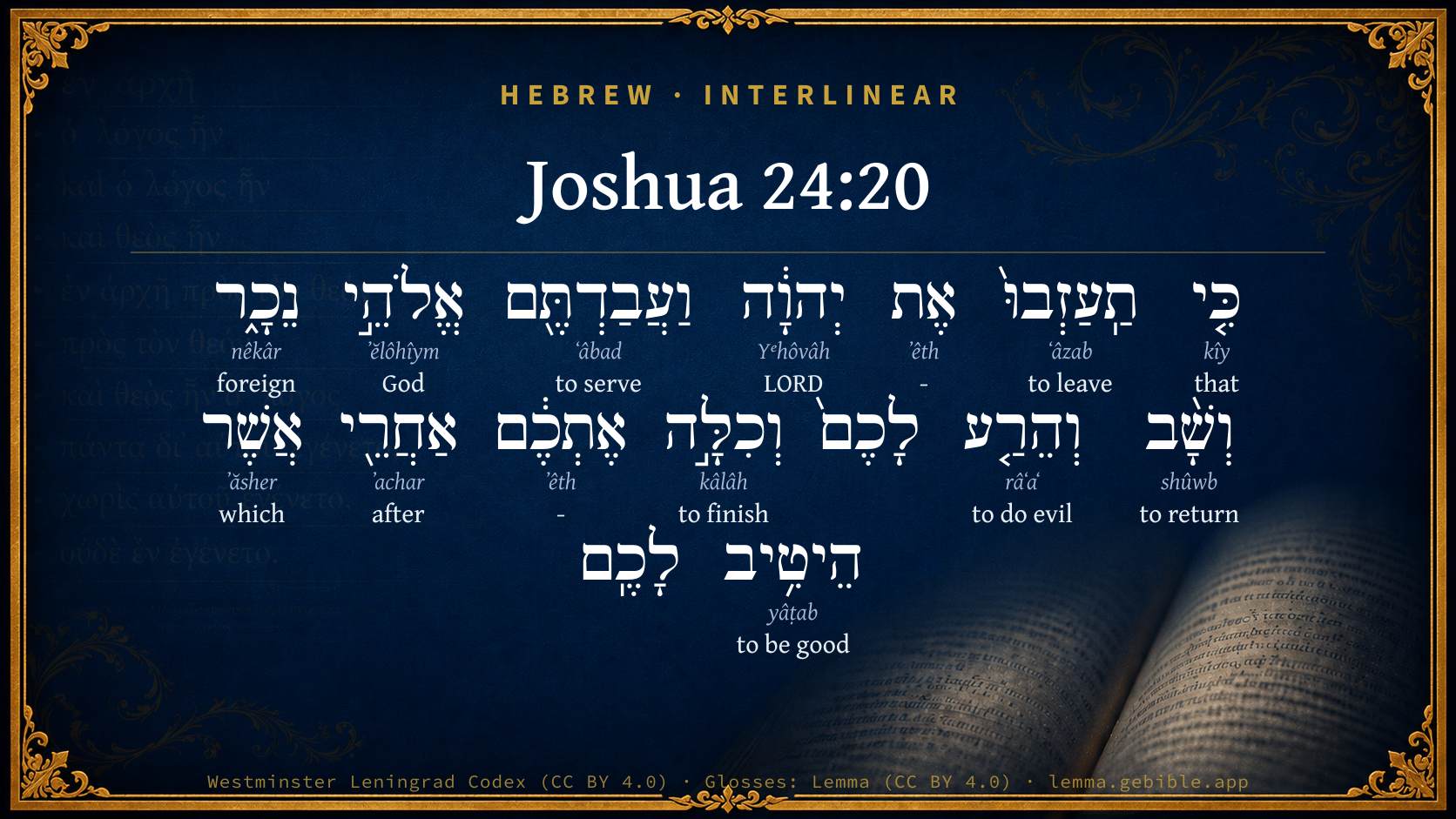
  1. כִּ֤י kîy H3588 “that” Conjunction
  2. תַֽעַזְבוּ֙ ʻâzab H5800 “to leave” Verb, Qal, Imperfect, 2nd Person, Masculine, Plural
  3. אֶת ʼêth H853 “-” Particle, Direct Object
  4. יְהוָ֔ה Yᵉhôvâh H3068 “LORD” Noun, Proper
  5. וַעֲבַדְתֶּ֖ם ʻâbad H5647 “and · to serve” Conjunction + Verb, Qal, Sequential Perfect, 2nd Person, Masculine, Plural
  6. אֱלֹהֵ֣י ʼĕlôhîym H430 “God(s) of” Noun, Common, Masculine, Plural, Construct
  7. וְשָׁ֨ב shûwb H7725 “and · to return” Conjunction + Verb, Qal, Sequential Perfect, 3rd Person, Masculine, Singular
  8. וְהֵרַ֤ע râʻaʻ H7489 “and · to do evil” Conjunction + Verb, Hiphil, Sequential Perfect, 3rd Person, Masculine, Singular
  9. וְכִלָּ֣ה kâlâh H3615 “and · to finish” Conjunction + Verb, Piel, Sequential Perfect, 3rd Person, Masculine, Singular
  10. אֶתְכֶ֔ם ʼêth H853 “- · you” Particle, Direct Object + Suffix, Personal, 2nd Person, Masculine, Plural
  11. אַחֲרֵ֖י ʼachar H310 “after” Preposition
  12. אֲשֶׁר ʼăsher H834 “which” Particle, Relative
  13. הֵיטִ֥יב yâṭab H3190 “to be good” Verb, Hiphil, Perfect, 3rd Person, Masculine, Singular

About this verse

These counts appear in no published source. They are computed here, from the morphology-tagged text and Lemma’s own curated glosses. What Lemma adds →

16
words
13
distinct lemmas
Historical
section

Shared distinctive vocabulary

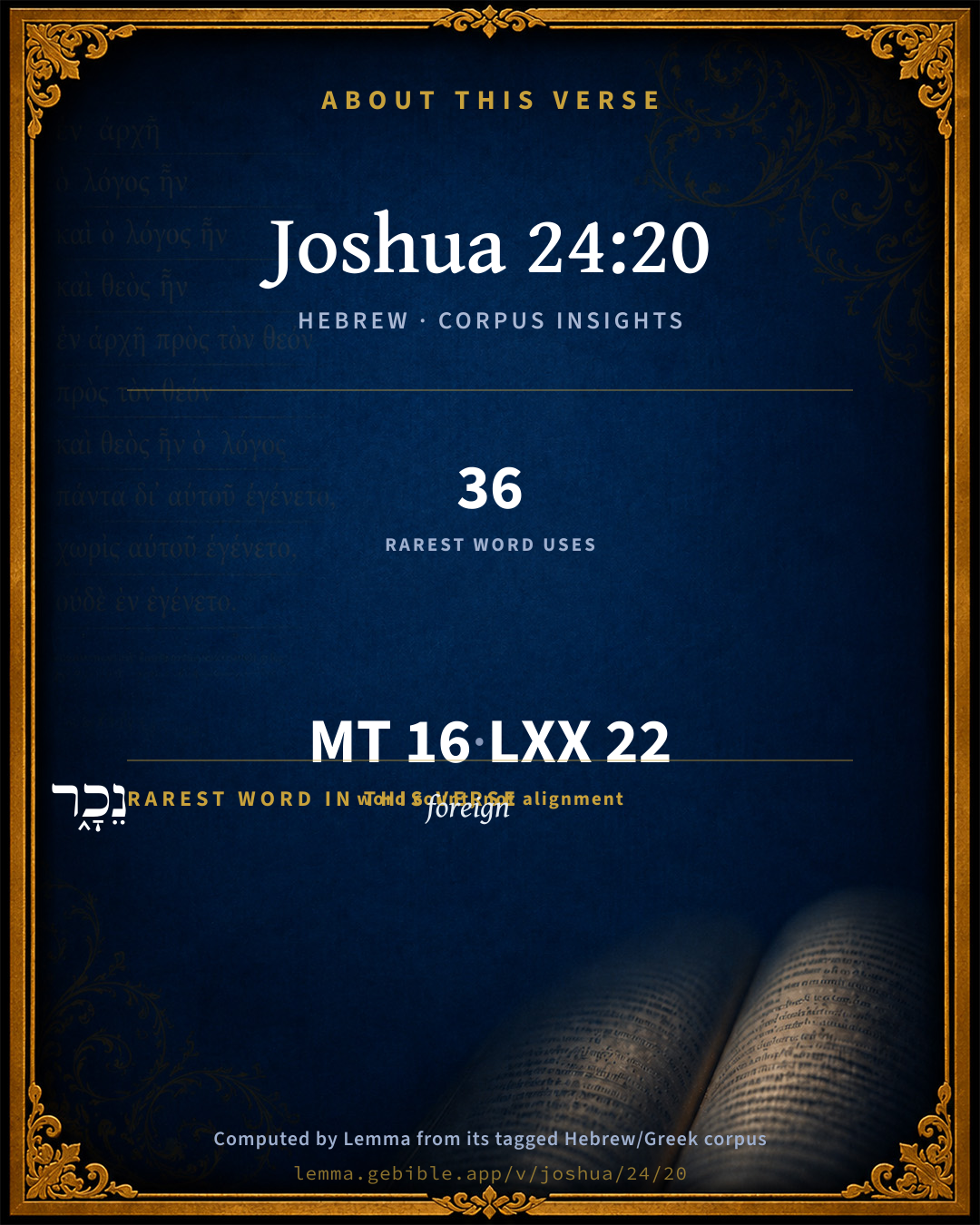
נֵכָ֑ר foreign H5236 occurs in 35 verses of the Hebrew Bible. Also found in:

Grammatical profile

  • 6 verbs
  • 3 nouns
  • 3 prepositions
  • 1 conjunction
  • 3 particles

Verb forms

  • תַֽעַזְבוּ֙ Qal · Imperfect
  • וַעֲבַדְתֶּ֖ם Qal · Sequential Perfect
  • וְשָׁ֨ב Qal · Sequential Perfect
  • וְהֵרַ֤ע Hiphil · Sequential Perfect
  • וְכִלָּ֣ה Piel · Sequential Perfect
  • הֵיטִ֥יב Hiphil · Perfect

Hebrew & Septuagint length

In English translation the verse runs 26 words from the Hebrew and 28 from the Septuagint (LXX English) — closely comparable.

A rough comparison of the two English renderings, which tokenize alike — not a word-level alignment.

Word counts can differ between the Hebrew and the Greek without any difference in meaning — e.g. the Hebrew direct-object marker אֵת has no separate Greek word, and Greek often adds the article ὁ.

In the original languages it is 16 Hebrew tokens and 22 Greek tokens — but the two are counted differently (Hebrew bundles its prefixes and suffixes into one token; the Greek is in lemma form), so that isn’t a like-for-like length.

Cross-references

12

Topical passages linked to Joshua 24:20 in the Treasury of Scripture Knowledge — connected by theme and wording, ordered by reader-vote popularity; previews shown in the World English Bible.

  • Hebrews 10:26–27 For if we sin willfully after we have received the knowledge of the truth, there remains no more a sacrifice for sins,
  • 1 Chronicles 28:9 You, Solomon my son, know the God of your father, and serve him with a perfect heart and with a willing mind; for Yahweh searches all hearts, and understands all the imaginations of the thoughts: if you seek him, he will be found of you; but if you forsake him, he will cast you off forever.
  • Jeremiah 17:13 Yahweh, the hope of Israel, all who forsake you shall be disappointed. Those who depart from me shall be written in the earth, because they have forsaken Yahweh, the spring of living waters.
  • Ezekiel 18:24 But when the righteous turns away from his righteousness, and commits iniquity, and does according to all the abominations that the wicked man does, shall he live? None of his righteous deeds that he has done shall be remembered: in his trespass that he has trespassed, and in his sin that he has sinned, in them shall he die.
  • Acts 7:42 But God turned, and gave them up to serve the host of the sky, as it is written in the book of the prophets, 'Did you offer to me slain animals and sacrifices Forty years in the wilderness, O house of Israel?
  • 2 Chronicles 15:2 and he went out to meet Asa, and said to him, Hear you me, Asa, and all Judah and Benjamin: Yahweh is with you, while you are with him; and if you seek him, he will be found of you; but if you forsake him, he will forsake you.
  • Ezra 8:22 For I was ashamed to ask of the king a band of soldiers and horsemen to help us against the enemy in the way, because we had spoken to the king, saying, The hand of our God is on all those who seek him, for good; but his power and his wrath is against all those who forsake him.
  • Isaiah 1:28 But the destruction of transgressors and sinners shall be together, And those who forsake Yahweh shall be consumed.
  • Isaiah 63:10 But they rebelled, and grieved his holy Spirit: therefore he was turned to be their enemy, [and] himself fought against them.
  • Isaiah 65:11–12 But you who forsake Yahweh, who forget my holy mountain, who prepare a table for Fortune, and who fill up mixed wine to Destiny;
  • Joshua 23:12–15 Else if you do at all go back, and cleave to the remnant of these nations, even these who remain among you, and make marriages with them, and go in to them, and they to you;
  • Hebrews 10:38 But the righteous will live by faith. If he shrinks back, my soul has no pleasure in him."

Cross-references courtesy of OpenBible.info (CC BY 4.0).

Hebrew and Greek witnesses Masoretic Hebrew ↔ Greek Septuagint

The same verse in the two great witnesses to the Old Testament, shown verse-for-verse.

These are two independent witnesses, not word-aligned to each other, and the Septuagint is shown in lemma (dictionary) form.

Hebrew Joshua 24:20 Masoretic · Westminster Leningrad Codex

כִּ֤י תַֽעַזְבוּ֙ אֶת יְהוָ֔ה וַעֲבַדְתֶּ֖ם אֱלֹהֵ֣י נֵכָ֑ר וְשָׁ֨ב וְהֵרַ֤ע לָכֶם֙ וְכִלָּ֣ה אֶתְכֶ֔ם אַחֲרֵ֖י אֲשֶׁר הֵיטִ֥יב לָכֶֽם

If you forsake Yahweh, and serve foreign gods, then he will turn and do you evil, and consume you, after that he has done you good.

World English Bible · Public Domain

Greek LXX Joshua 24:20 Septuagint · lemma form

ἡνίκα ἐάν ἐν καταλείπω κύριος καί λατρεύω θεός ἕτερος καί ἐπιἔρχομαι κακόω σύ καί ἐκ ἀναἁλίσκω σύ ἀντί ὅς εὖ ποιέω σύ

Whenever you⌃ shall forsake the Lord and serve other gods, then he shall come upon you and afflict you, and consume you, because he has done you good.

LXX2012 (modern English Septuagint) · Public Domain

Hebrew: Westminster Leningrad Codex (CC BY 4.0). Greek: Septuagint (public domain); English from LXX2012 (modern English Septuagint) (Public Domain). How the Septuagint differs from the Hebrew →

Targum (Aramaic paraphrase)

1

The Targum is the ancient Jewish Aramaic paraphrase of the Hebrew Scriptures — an interpretive translation, not the Hebrew text itself. Onkelos (literal) and Pseudo-Jonathan (expansive) render the Torah, and Jonathan the Prophets. Coverage is partial: where no permissively-licensed English translation exists for a verse, only the Aramaic is shown. This is verse-level text, not a word-by-word alignment to the Hebrew.

  1. Targum Jonathan Prophets (Joshua–Malachi)
    אֲרֵי תִשְׁבָּקוּן יַת פּוּלְחָנָא דַייָ וְתִפְלְחוּן טַעֲוַת עַמְמַיָא וִיתוּב וְיַבְאֵשׁ לְכוֹן וִישֵׁיצֵי יַתְכוֹן בָּתַר דְאוֹטֵיב לְכוֹן:

    (no public-domain English translation for this verse)

    Targum Jonathan — Aramaic: “Mikraot Gedolot” (public domain). English: “Sefaria Community Translation” (CC0 1.0 (public-domain dedication)); “London "Chaldee Paraphrase," 1871” (public domain). Text via Sefaria.

Commentary

Notes on Joshua 24:20 from classic Christian and Jewish commentators (each source and its license shown beneath its notes). The classic Christian expositions comment on the surrounding passage and are grouped to its opening verse, so a note may address several verses; the Jewish commentaries on the Tanakh (Rashi and others) are per-verse, so they appear only where the commentator wrote on this verse.

Lemma curates 59 commentaries, every one of them public domain or Creative Commons licensed, each selected and text-cleaned for this edition rather than reprinted as found. About our sources →

Trapp's Complete Commentary

John Trapp

Jos 24:20 If ye forsake the LORD, and serve strange gods, then he will turn and do you hurt, and consume you, after that he hath done you good.

Ver. 20. And consume you, after that he hath done you good.] Ingentia beneficia, flagitia, supplicia. From apostates God will take away his own and be gone, {Hos 2:9} he will curse their blessings, {Mal 2:2} blast their hopes, make them know the worth of his benefits by the want of them, making them cry out, as Jer 4:13, "Woe to us! for we are spoiled."

John Trapp, A Commentary or Exposition upon All the Books of the Old and New Testament (1647–1656) — public domain. Text from a community e-Sword module.

The Biblical Illustrator

Joseph S. Exell

Jos_24:20

If ye forsake the Lord . . . He will turn

Mercies abused, the precursors of wrath

I.

The reasonableness of expecting that abused mercies must lead to more aggravated punishment. We see this clearly in the history of Israel. Their career as a nation was marked by perfidy and ingratitude; at almost every step of their progress we find them in rebellion against the Most High--forsaking the Lord, and serving strange gods. And how did God deal with them when they thus acted? Is it not the case that He scourged them, and caused them to suffer punishment? Look at the plagues that befel them in the desert; look at the slaughters which God permitted them to experience in warfare with their enemies. And who can survey the subsequent history of the Jews, and not read a fulfilment of the threatening contained in our text? And what we are desirous you should gather from the foregoing observations is mainly this, that no experience of good at the hands of the Almighty affords warrant to expect that future disobedience will not be visited with righteous severity. If ye forsake the Lord and serve strange gods, then He will turn and do you hurt and consume you, after that He hath done you good.

II. The justice of the dealing which is referred to in the threatening before us. Now it will be admitted that every reason was given Israel to expect the continuance of the Divine favour and protection. We think it easily to be perceived that one main purpose of the Almighty in the calling of Israel as a nation was to maintain upon earth, through means of that race, the pure knowledge of Himself; to afford a witness to the unity of Jehovah, and against idolatry; to secure glory to Himself by the exhibition, on the part of this people, of a consistent obedience. Surely, then, if this purpose was, through the nations profligacy and disobedience, altogether thwarted, if all the resources which God gave them of national strength were abused and corrupted, indeed it were strange not to perceive that their conduct in this respect released every presumed obligation to do them good, and in short vindicates to the letter the justice of the warning, If ye forsake the Lord, and serve strange gods, then He will turn and do you hurt, and consume you, after that He hath done you good. And now, to take a more comprehensive range, from looking at the case of the Jewish people let us turn to that of mankind in general. Does it appear that God can be just in the apportionment of unmitigated wrath to mankind, notwithstanding all the manifestations of His determination to do them good? There are two grand exhibitions to be met with of Gods merciful intention towards mankind at large, to do them good. The first of these is furnished by creation, and the second by redemption. Our object of inquiry is simply this: whether the display of Gods love in creating or redeeming mankind offers any reason to conclude that, in harmony with His justice, He cannot turn and do them hurt, and consume them. To begin with creation: no man can doubt that his creation is the proof of a purpose on Gods part to do him good. Beyond all question this purpose was mans happiness, but then his happiness was to consist in assimilation to the Godhead; and if upon man devolve the guilt of having voluntarily destroyed and renounced that similitude, where is the inconsistency of the dealing, should God turn and do him hurt, and consume him? The nobler the faculties wherewith he was endowed the brighter the evidence of Gods purpose to do him good, the stronger then seem to me the reasons wherefore wrath should be executed upon those by whom the faculties are abused and the evidence slighted. We turn, lastly, to the manifestation of Gods goodness as displayed in redemption. There have been those who have argued--redemption is the evidence of a love so surpassing, they can never believe God will sentence to destruction those whom He has redeemed at such cost. The method of our atonement involves an expenditure of such wisdom and mercy, that how can we conceive of the Almighty as permitting its objects finally to perish? Mast to reason thus is equally, as in the former instances we have adduced, to overlook one main purpose of God in the scheme of human redemption. Is it not strange that men who have been made the objects of a sacrifice so costly should regard it so lightly and requite it so coldly? We may wonder that redeemed sinners should perish, but is it not more wonderful that redeemed sinners should refuse to be saved? Again, let us revert to the purpose of God in redemption. Indeed it was to bless the whole earth; it was to ransom humanity from the bondage of evil, and to exalt it to transcendent felicity. But after all, throughout every dealing of God with His intelligent creatures, we may discover the purpose to treat them as responsible beings, free to reject the overtures of His mercy. Now, redemption is offered upon certain terms; man is required to repent and to believe in order to be saved. It is no part of redemption to offer him an entrance into heaven irrespective of a moral fitness, to render him meet for heavens enjoyments; and in the acquisition of this moral fitness man is required to co-operate with the Divine Spirit. He can refuse to profit by what God hath done for him, and thus prove himself a despiser of the love which is so unsearchably great. He can resolutely withstand the design of the Almighty in redemption, namely, that he should glorify God, both in his body and soul; and, I ask, if it be possible for Him to act thus, is there not justice in the sentence which awards him to suffer in spite of all the declared willingness of God to do him good? (Bp. R. Bickersteth.)

Christians solemnly reminded of their obligations

I. That we are under obligations to serve the lord from our own choice, or voluntary engagements. Here I would premise that though voluntary obligations, taken upon ourselves by our own act, have something of a peculiar force in them, yet they are not the only obligations we are under to serve the Lord. We are bound to be His servants whether we will or not. His character as our creator, our preserver, and benefactor, and as a being of supreme excellency, give Him the most firm and indisputable right to our obedience. But though we are all under obligations to God, independent upon, and prior to, our own consent, yet there are a class of obligations which we have personally, and by our own act, taken upon ourselves; and in the breach of these we are guilty of more direct and aggravated perjury.

II. To inquire how and when, or in what respects, and at what periods of time, we are witnesses against ourselves that we have chosen the Lord to serve him.

1. You yourselves are witnesses against yourselves that you have chosen the Lord to be your God. You know and confess that you have been dedicated to God in baptism; and some of you know it was your own act and deed when capable of choosing for yourselves. You also know in your own consciences that you are often present at the table of the Lord, and there you renew your covenant with God afresh.

2. You are witnesses against one another that you have chosen the Lord to serve Him. You have seen the transactions that have passed between God and you in His house; you have seen some baptized themselves, some presenting their children to baptism, and so renewing their own covenant with God; some sealing their religious engagements at the Lords table. (President Davies.)

The Biblical Illustrator, edited by Joseph S. Exell (c. 1880s–1900s) — public domain. Text from a community e-Sword module.

Joseph Benson's Commentary

Jos 24:20. He will turn and do you hurt — That is, he will alter his course, and the manner of his dealing with you, and will be as severe as ever he was kind and gracious. He will repent of his former kindnesses, and his goodness abused will be turned into fury.

Joseph Benson's Commentary on the Old and New Testaments (1811–1818) — public domain. Text from a community e-Sword module.

The Cambridge Bible for Schools and Colleges

gen. ed. J. J. S. Perowne

20. then he will turn] He will turn round; He will alter His attitude towards you. “Convertet se et affliget vos atque subvertet,” Vulgate. “The Lord schal turne hym silf, and schal turment çou,” Wyclif. Comp. Jos_23:15; Isa_63:10.

after that he hath done you good] i.e. without any regard to the fact that He hath done you good, and poured His benefits upon you.

The Cambridge Bible for Schools and Colleges (gen. ed. J. J. S. Perowne; Cambridge University Press, 1878–1918) — public domain. Text from a community e-Sword module.

John Gill's Exposition

If you forsake the Lord, and serve strange gods,.... Joshua knew the proneness of this people to idolatry, and therefore expresses his jealousy of them, that they would not be able to continue in the service of God, and would be apt to be carried away after idols; and therefore, to make them the more cautious and watchful, he represents to them the danger they were in, and what would befall them should they forsake the Lord they now promised to serve, and follow after other gods, which their fathers worshipped before they were called out of their estate of Heathenism, or which the Canaanites, or Egyptians worshipped, whose examples they were too ready to imitate:

then he will turn and do you hurt; not that there is properly any change in God, either of his counsel or covenant, or of love and affection to his people, but of his providential dealings, or outward manner of acting towards men; or the sense is, he will again do you hurt, bring evils and calamities upon you again and again, frequently as you revolt from him, such as the sword, pestilence, famine, and captivity, which these people after experienced when they fell into idolatry:

and consume you; by these his sore judgments:

after that he hath done you good; by bringing you into such a good land, and bestowing so many good things upon you, natural, civil, and religious; and yet, notwithstanding, being disobedient to him, and especially in the instances mentioned, they are made to expect his resentment, and the effects of it.

John Gill's Exposition of the Whole Bible (1746–1763) — public domain (CC PDM 1.0). Text via the HelloAO Bible API.

Haydock's Catholic Bible Commentary

Turn, and alter his conduct in your regard, instead of being your protector, he will destroy you.

George Leo Haydock (1774–1849), Haydock's Catholic Family Bible and Commentary, 1859 edition — public domain. Excludes Psalms (Douay-Rheims chapter numbering differs from Protestant) and Deuterocanonical books (Catholic canon only).

Matthew Poole's English Annotations

He will turn, i.e. he will alter his course and the manner of his dealing with you, and will be as severe as ever he was kind and gracious.

Consume you, after that he hath done you good; he will repent of all his former kindness, and his goodness abused will be turned into fury.

Matthew Poole's English Annotations on the Holy Bible (1683–1685) — public domain. Text from a community e-Sword/MySword module.

Whedon's Commentary on the Bible

Daniel D. Whedon

20. Then he will turn — He will alter his attitude toward you. Strictly speaking, God is unchangeable. He is always toward the wicked a consuming fire. When a man changes from righteous to wicked he runs into this consuming fire.

Daniel D. Whedon (gen. ed.), Commentary on the Old and New Testaments (1874–1909) — public domain. Text from a community e-Sword module.

The Pulpit Commentary

Then he will turn. There is no contradiction between this passage and Jam_1:17, any more than our expression, the sun is in the east or in the west, conflicts with science. St. James is speaking of God as He is in Himself, sublime in His unchangeableness and bountiful purposes towards mankind. Joshua and the prophets, speaking by way of accommodation to our imperfect modes of expression, speak of Him as He is in relation to us. In reality it is not He but we who change. He has no more altered His position than the sun, which, as we say, rises in the east and sets in the west. But as He is in eternal opposition to all that is false or evil, we, when we turn aside from what is good and true, must of necessity exchange His favour for His displeasure. Do you hurt. Literally, do evil to you. After that he hath done you good. This implies what has been before stated, that it is not God who is inconsistent but man, not God who has changed His mind, but man who has changed his.

The Pulpit Commentary (1880–1919), ed. H.D.M. Spence-Jones & Joseph S. Exell — public domain. Text from a community e-Sword module.

John Wesley's Explanatory Notes

Will turn - That is, he will alter his course and the manner of his dealing with you, and will be as severe as ever he was kind and gracious. He will repent of his former kindnesses, and his goodness abused will be turned into fury.

John Wesley, Explanatory Notes Upon the Whole Bible (1754–1765) — public domain. Text via the GEBible commentary corpus.

Lesson kit

Teaching starters — assembled from the data on this page, not authored interpretation. Every prompt links to the verse data it draws on. Edit before teaching.

Joshua, in the Historical, opens this verse with 16 words (13 distinct Hebrew lemmas). Its most distinctive word is nêkâr (“foreign”). A historical commentator’s framing appears above. Read the whole chapter for the surrounding context.

Discussion questions

  1. How does “foreign” (nêkâr) shape what this verse is saying?
  2. Genesis 17:12 shares the word «foreign» with this verse. How do the two illuminate each other?
  3. The translations on this page render this verse differently — a whole-verse word diff, not a word-by-word alignment. What might account for the different wordings?
  4. The verb «תַֽעַזְבוּ֙» is Qal Imperfect. How does its form color the action?
  5. Reading how Trapp's Complete Commentary and The Biblical Illustrator read this verse, where do the two commentators agree and where do they part?

Things to notice

Reading settings

Reading text

Shown beneath each verse's original-language words.

Old Testament
Old Testament edition

Read the OT as the Masoretic Hebrew (MT) or the Greek Septuagint (LXX).

English shown for the Greek Septuagint (in the Hebrew ↔ Greek comparison).

Comparing translations? Open the Compare panel on any verse page to stack up to four side by side.