
Job 31:16

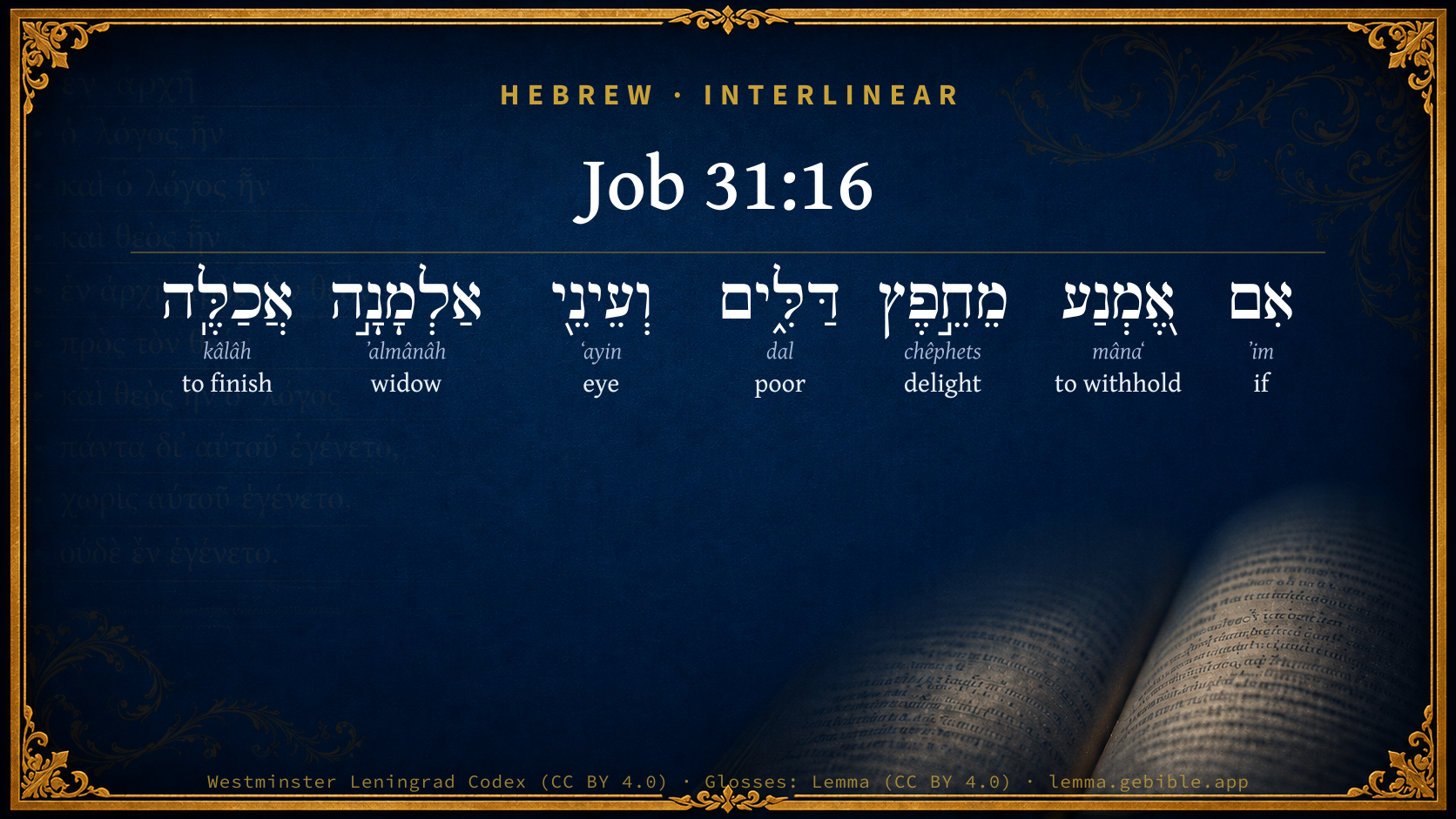
Hebrew (Westminster Leningrad Codex) Job 31:16 appears in the Hebrew Old Testament. The text above is from the Westminster Leningrad Codex. Each word links to its Strong’s number, a concise gloss, and parsing drawn from the Open Scriptures Hebrew Bible morphology. Click any word for its full Brown-Driver-Briggs (BDB) entry.
Download image
Cite this verse

Job 31:16 (World English Bible). Public Domain. Lemma interlinear Bible study tool, https://lemma.gebible.app/v/job/31/16.

Show BibTeX & RIS
BibTeX
RIS
English Translation
"If I have withheld the poor from their desire, Or have caused the eyes of the widow to fail,
World English Bible · Public Domain
Download a study sheet

One document with this verse’s original text, its word-by-word gloss line, the meaning frame, cross-references with their text, attributed commentary, and full source and license credits — printable, and it pastes into notes with its structure intact.

This verse Autodidact and up

Study sheet (.html) Plain text (.txt)

A passage Seminary Student

Up to 50 verses in one chapter. A passage sheet keeps up to 6 commentary sources and 12 cross-references per verse, in the order this page ranks them, and says so on the sheet whenever that leaves anything out. Ask for a single verse and you get the Autodidact verse sheet above.

Everything on this page stays free to read, with no account — the sheet is a download of what is already on screen, not access to it.

Want to remove ads? Support Godless Engineer
Compare translations 3

The same verse in 3 English versions, stacked beneath the original-language interlinear above. Click any original word for its lexicon entry.

Each is an independent rendering of the whole verse — the interlinear is not word-aligned to these translations.

Highlighted words mark where these versions differ — a whole-verse word diff, not a word-by-word alignment.

  • World English Bible Public Domain
    "If I have withheld the poor from their desire, Or have caused the eyes of the widow to fail,
  • King James Version Public Domain
    If I have withheld the poor from their desire, or have caused the eyes of the widow to fail;
  • unfoldingWord Literal Text CC BY-SA 4.0
    If I have withheld from the desire of the poor, or I have made the eyes of the widow fail,

unfoldingWord Literal Text — © unfoldingWord, licensed CC BY-SA 4.0. Word-aligned USFM3 via Door43 (git.door43.org/unfoldingWord/en_ult).

Versions to compare (up to 4)

3 of 4 selected

Show all 18 translations

Every available English version of this verse, each an independent rendering of the whole verse.

  • World English Bible Public Domain
    "If I have withheld the poor from their desire, Or have caused the eyes of the widow to fail,
  • Berean Standard Bible Public Domain
    If I have denied the desires of the poor or allowed the widow’s eyes to fail,
  • Majority Standard Bible Public Domain
    If I have denied the desires of the poor or allowed the widow’s eyes to fail,
  • King James Version Public Domain
    If I have withheld the poor from their desire, or have caused the eyes of the widow to fail;
  • American Standard Version (1901) Public Domain
    If I have withheld the poor from `their' desire, Or have caused the eyes of the widow to fail,
  • Revised Version (1885) Public Domain
    If I have withheld the poor from their desire, or have caused the eyes of the widow to fail;
  • Geneva Bible (1599) Public Domain
    If I restrained the poore of their desire, or haue caused the eyes of the widow to faile,
  • Douay-Rheims (1899) Public Domain
    If I have denied to the poor what they desired, and have made the eyes of the widow wait:
  • Young's Literal Translation Public Domain
    If I withhold from pleasure the poor, And the eyes of the widow do consume,
  • Literal Standard Version CC BY-SA 4.0
    If I withhold the poor from pleasure, || And consume the eyes of the widow,
  • Unlocked Literal Bible CC BY-SA 4.0
    If I have withheld poor people from their desire, or if I have caused the eyes of the widow to grow dim from crying,
  • unfoldingWord Literal Text CC BY-SA 4.0
    If I have withheld from the desire of the poor, or I have made the eyes of the widow fail,
  • Darby Bible Public Domain
    If I have withheld the poor from [their] desire, or caused the eyes of the widow to fail;
  • World Messianic Bible Public Domain
    “If I have withheld the poor from their desire, or have caused the eyes of the widow to fail,
  • Webster's Bible Public Domain
    If I have withheld the poor from their desire, or have caused the eyes of the widow to fail;
  • Free Bible Version CC BY-SA 4.0
    Have I refused to give the poor what they needed, or caused widows to despair?
  • Bible in Basic English Public Domain
    If I kept back the desire of the poor; if the widow's eye was looking for help to no purpose;
  • JPS Tanakh (1917) Public Domain
    If I have withheld aught that the poor desired, or have caused the eyes of the widow to fail;

Literal Standard Version (2020), Covenant Press — licensed CC BY-SA 4.0. Text via the HelloAO Bible API (eBible.org). Unlocked Literal Bible (unfoldingWord) — licensed CC BY-SA 4.0. Text via the HelloAO Bible API (eBible.org). unfoldingWord Literal Text — © unfoldingWord, licensed CC BY-SA 4.0. Word-aligned USFM3 via Door43 (git.door43.org/unfoldingWord/en_ult). Free Bible Version, Dr. Jonathan Gallagher — licensed CC BY-SA 4.0. Text via the HelloAO Bible API (eBible.org).

Word by word

More ways to search: Search by grammar → Find every occurrence → Compare this word →

Practice this passage: Drill this verse → Learn its vocabulary →

About this verse

These counts appear in no published source. They are computed here, from the morphology-tagged text and Lemma’s own curated glosses. What Lemma adds →

7
words
7
distinct lemmas
Wisdom
section

Shared distinctive vocabulary

אֶ֭מְנַע to withhold H4513 occurs in 29 verses of the Hebrew Bible. Also found in:

Grammatical profile

  • 2 verbs
  • 3 nouns
  • 1 adjective
  • 1 conjunction

Verb forms

  • אֶ֭מְנַע Qal · Imperfect
  • אֲכַלֶּֽה Piel · Imperfect

Hebrew & Septuagint length

In English translation the verse runs 19 words from the Hebrew and 21 from the Septuagint (LXX English) — closely comparable.

A rough comparison of the two English renderings, which tokenize alike — not a word-level alignment.

Word counts can differ between the Hebrew and the Greek without any difference in meaning — e.g. the Hebrew direct-object marker אֵת has no separate Greek word, and Greek often adds the article ὁ.

Cross-references

14

Topical passages linked to Job 31:16 in the Treasury of Scripture Knowledge — connected by theme and wording, ordered by reader-vote popularity; previews shown in the World English Bible.

  • Deuteronomy 15:7–10 If there be with you a poor man, one of your brothers, within any of your gates in your land which Yahweh your God gives you, you shall not harden your heart, nor shut your hand from your poor brother;
  • Isaiah 38:14 Like a swallow [or] a crane, so did I chatter; I did moan as a dove; my eyes fail [with looking] upward: Lord, I am oppressed, be my collateral.
  • Deuteronomy 28:32 Your sons and your daughters shall be given to another people; and your eyes shall look, and fail with longing for them all the day: and there shall be nothing in the power of your hand.
  • Job 5:16 So the poor has hope, And injustice shuts her mouth.
  • Job 20:19 For he has oppressed and forsaken the poor. He has violently taken away a house, and he shall not build it up.
  • Job 22:7–9 You haven't given water to the weary to drink, And you have withheld bread from the hungry.
  • Psalms 69:3 I am weary with my crying. My throat is dry. My eyes fail, looking for my God.
  • Psalms 112:9 He has dispersed, he has given to the poor. His righteousness endures forever. His horn will be exalted with honor.
  • Psalms 119:82 My eyes fail for your word. I say, "When will you comfort me?"
  • Psalms 119:123 My eyes fail looking for your salvation, For your righteous word.
  • Lamentations 4:17 Our eyes do yet fail [in looking] for our vain help: In our watching we have watched for a nation that could not save.
  • Luke 16:21 and desiring to be fed with the crumbs that fell from the rich man's table. Yes, even the dogs came and licked his sores.
  • Acts 11:29 As any of the disciples had plenty, each determined to send relief to the brothers who lived in Judea;
  • Galatians 2:10 They only asked us to remember the poor--which very thing I was also zealous to do.

Cross-references courtesy of OpenBible.info (CC BY 4.0).

Hebrew and Greek witnesses Masoretic Hebrew ↔ Greek Septuagint

The same verse in the two great witnesses to the Old Testament, shown verse-for-verse.

These are two independent witnesses, not word-aligned to each other, and the Septuagint is shown in lemma (dictionary) form.

Hebrew Job 31:16 Masoretic · Westminster Leningrad Codex

אִם אֶ֭מְנַע מֵחֵ֣פֶץ דַּלִּ֑ים וְעֵינֵ֖י אַלְמָנָ֣ה אֲכַלֶּֽה

"If I have withheld the poor from their desire, Or have caused the eyes of the widow to fail,

World English Bible · Public Domain

Greek LXX Job 31:16 Septuagint · lemma form

ἀδύνατος δέ χρεία ὅς ποτέ ἔχω οὐ ἀποτυγχάνω χήρα δέ ὁ ὀφθαλμός οὐ ἐκτήκω

But the helpless missed not whatever need they had, and I did not cause the eye of the widow to fail.

LXX2012 (modern English Septuagint) · Public Domain

On this verse, Keil & Delitzsch discusses the Septuagint’s reading. Read the note in Commentary ↓

Hebrew: Westminster Leningrad Codex (CC BY 4.0). Greek: Septuagint (public domain); English from LXX2012 (modern English Septuagint) (Public Domain). How the Septuagint differs from the Hebrew →

Commentary

Notes on Job 31:16 from classic Christian and Jewish commentators (each source and its license shown beneath its notes). The classic Christian expositions comment on the surrounding passage and are grouped to its opening verse, so a note may address several verses; the Jewish commentaries on the Tanakh (Rashi and others) are per-verse, so they appear only where the commentator wrote on this verse.

Lemma curates 59 commentaries, every one of them public domain or Creative Commons licensed, each selected and text-cleaned for this edition rather than reprinted as found. About our sources →

Matthew Henry's Commentary

Eliphaz had particularly charged Job with unmercifulness to the poor (Job 22:6, etc.): Thou hast withholden bread from the hungry, stripped the naked of their clothing, and sent widows away empty. One would think he could not have been so very positive and express in his charge unless there had been some truth in it, some ground, for it; and yet it appears, by Job's protestation, that it was utterly false and groundless; he was never guilty of any such thing. See here,

I. The testimony which Job's conscience gave in concerning his constant behaviour towards the poor. He enlarges most upon this head because in this matter he was most particularly accused. He solemnly protests,

1. That he had never been wanting to do good to them, as there was occasion, to the utmost of his ability. He was always compassionate to the poor, and careful of them, especially the widows and fatherless, that were destitute of help. (1.) He was always ready to grant their desires and answer their expectations, Job 31:16. If a poor person begged a kindness of his, he was ready to gratify him; if he could but perceive by the widow's mournful craving look that she expected an alms from him, though she had not confidence enough to ask it, he had compassion enough to give it, and never caused the eyes of the widow to fail. (2.) He put a respect upon the poor, and did them honour; for he took the fatherless children to eat with him at his own table: they should fare as he fared, and be familiar with him, and he would show himself pleased with their company as if they had been his own, Job 31:17. As it is one of the greatest grievances of poverty that it exposes to contempt, so it is none of the least supports to the poor to be respected. (3.) He was very tender of them, and had a fatherly concern for them, Job 31:18. He was a father to the fatherless, took care of orphans, brought them up with him under his own eye, and gave them, not only maintenance, but education. He was a guide to the widow, who had lost the guide of her youth; he advised her in her affairs, took cognizance of them, and undertook the management of them. Those that need not our alms may yet have occasion for our counsel, and it may be a real kindness to them. This Job says he did from his youth, from his mother's womb. He had something of tenderness and compassion woven in his nature; he began betimes to do good, ever since he could remember; he had always some poor widow or fatherless child under his care. His parents taught him betimes to pity and relieve the poor, and brought up orphans with him. (4.) He provided food convenient for them; they ate of the same morsels that he did (Job 31:17), did not eat after him, of the crumbs that fell from his table, but with him, of the best dish upon his table. Those that have abundance must not eat their morsels alone, as if they had none but themselves to take care of, nor indulge their appetite with a dainty bit by themselves, but take others to share with them, as David took Mephibosheth. (5.) He took particular care to clothe those that were without covering, which would be more expensive to him than feeding them, Job 31:19. Poor people may perish for want of clothing as well as for want of food - for want of clothing to lie in by night or to go abroad in by day. If Job knew of any that were in this distress, he was forward to relieve them, and instead of giving rich and gaudy liveries to his servants, while the poor were turned off with rags that were ready to be thrown to the dunghill, he had good warm strong clothes made on purpose for them of the fleece of his sheep (Job 31:20), so that their loins, whenever they girt those garments about them, blessed him; they commended his charity, blessed God for him, and prayed God to bless him. Job's sheep were burned with fire from heaven, but this was his comfort that, when he had them, he came honestly by them, and used them charitably, fed the poor with their flesh and clothed them with their wool.

2. That he had never been accessory to the wronging of any that were poor. It might be said, perhaps, that he was kind here and there to a poor orphan that was a favourite, but to others he was oppressive. No, he was tender to all and injurious to none. He never so much as lifted up his hand against the fatherless (Job 31:21), never threatened or frightened them, or offered to strike them; never used his power to crush those that stood in his way or squeeze what he could out of them, though he saw his help in the gate, that is, though he had interest enough, both in the people and in the judges, both to enable him to do it and to bear him out when he had done it. Those that have it in their power to do a wrong thing and go through with it, and a prospect of getting by it, and yet do justly, and love mercy, and are firm to both, may afterwards reflect upon their conduct with much comfort, as Job does here.

II. The imprecation with which he confirms this protestation (Job 31:22): "If I have been oppressive to the poor, let my arm fall from my shoulder-blade and my arm be broken from the bone," that is, "let the flesh rot off from the bone and one bone be disjointed and broken off from another." Had he not been perfectly clear in this matter, he durst not thus have challenged the divine vengeance. And he intimates that it is a righteous thing with God to break the arm that is lifted up against the fatherless, as he withered Jeroboam's arm that was stretched out against a prophet.

III. The principles by which Job was restrained from all uncharitableness and unmercifulness. He durst not abuse the poor; for though, with his help in the gate, he could overpower them, yet he could not make his part good against that God who is the patron of oppressed poverty and will not let oppressors go unpunished (Job 31:23): "Destruction from God was a terror to me, whenever I was tempted to this sin, and by reason of his highness I could not endure the thought of making him my enemy." He stood in awe, 1. Of the majesty of God, as a God above him. He thought of his highness, the infinite distance between him and God, which possessed him with such a reverence of him as made him very circumspect in his whole conversation. Those who oppress the poor, and pervert judgment and justice, forget that he who is higher than the highest regards, and there is a higher than they, who is able to deal with them (Ecc 5:8); but Job considered this. 2. Of the wrath of God, as a God that would certainly be against him if he should wrong the poor. Destruction from God, because it would be a certain and an utter ruin to him if he were guilty of this sin, was a constant terror to him, to restrain him from it. Note, Good men, even the best, have need to restrain themselves from sin with the fear of destruction from God, and all little enough. This should especially restrain us from all acts of injustice and oppression that God himself is the avenger thereof. Even when salvation from God is a comfort to us, yet destruction from God should be a terror to us. Adam, in innocency, was awed with a threatening.

Matthew Henry's Commentary on the Whole Bible (1708–1710) — public domain (CC PDM 1.0). Text via the HelloAO Bible API.

Trapp's Complete Commentary

John Trapp

Job 31:16 If I have withheld the poor from [their] desire, or have caused the eyes of the widow to fail;

Ver. 16. If I have withheld the poor from their desire] The poor man speaketh supplications, he comes to the rich with his God help me, as Lazarus did, Luk 16:20-21, his very name speaks as much, but the rich answereth him roughly, Pro 18:23 Either the answer cutteth off half the petition, as the echo doth the voice; or else he is commanded ad quercum dicere, to tell his tale to the statues and images, as Diogenes used to do; for of living men he could get no hearing. But Job’s suitors sped better. Pennyless they were, but not friendless; drawn dry (as the Hebrew word importeth) and such as whose wealth was utterly wasted; but Job shored them up and supplied them. And this he did readily, and at the first asking; they no sooner desired relief but they had it. Job was a cheerful giver, he neither denied nor delayed those that came to him for relief or refuge. Multi contra studiose causas inquirunt quibus se a benefaciendo cohibeant (Merlin). Many seek occasion to put off poor people, and to rid their hands of them.

Or have caused the eyes of the widow to fail] Viduae saepe sunt verecundae (Mercer). Widows many times are modest; their eyes are weakened with much weeping, while they remember their former comforts and present crosses. This good Job considered, and therefore soon condescended to their requests. He held it enough that their hearts ached, and would not suffer their eyes to ache with expecting his help, but speedily sped them.

H χαρις η βραδυπους αχαρις εστι χαρις.

John Trapp, A Commentary or Exposition upon All the Books of the Old and New Testament (1647–1656) — public domain. Text from a community e-Sword module.

Joseph Benson's Commentary

Job 31:16-17. If I have withheld the poor, &c. — If I have denied them what they desired of me, either in justice or from necessity; for he was under no obligation to grant their vain or inordinate desires. Or have caused the eyes of the widow to fail — With tedious expectation of my justice or charity. I durst neither deny nor delay my help, when they needed or required it. Or have eaten my morsel alone — Without communicating part of my provisions or property to the poor, as it follows; and the fatherless hath not eaten thereof — This one kind of necessitous persons is put for all the rest. Job is most large upon these heads of doing justice to the widows and fatherless, and relieving the poor, because Eliphaz had most particularly accused him in these respects.

Joseph Benson's Commentary on the Old and New Testaments (1811–1818) — public domain. Text from a community e-Sword module.

Geneva Bible (1599)

Geneva Bible translators

By long waiting for her request.

Geneva Bible (1599) marginal notes — public domain. Text via Bolls.life.

Jamieson, Fausset & Brown

Robert Jamieson, A. R. Fausset & David Brown

fail--in the vain expectation of relief (Job 11:20).

Jamieson, Fausset & Brown — Commentary Critical and Explanatory on the Whole Bible (1871) — public domain (CC PDM 1.0). Text via the HelloAO Bible API.

The Cambridge Bible for Schools and Colleges

gen. ed. J. J. S. Perowne

16. eyes of the widow to fail] i. e. with looking in vain for help, Psa_69:3.

The Cambridge Bible for Schools and Colleges (gen. ed. J. J. S. Perowne; Cambridge University Press, 1878–1918) — public domain. Text from a community e-Sword module.

John Gill's Exposition

Or have eaten my morsel myself alone,.... Though he had kept no doubt a plentiful table in the time of his prosperity suitable to his circumstances, yet had been no luxurious person, and therefore calls provisions a "morsel"; however, be it what it would, more or less, he did not eat it alone; what he had for himself the poor had a share of it with him, and the same he ate himself he gave to them:

and the fatherless hath not eaten thereof: meaning the poor fatherless: for as to the rich fatherless, it was no charity to feed them: this verse contradicts the charge exhibited against him, Job 22:7.

John Gill's Exposition of the Whole Bible (1746–1763) — public domain (CC PDM 1.0). Text via the HelloAO Bible API.

Albert Barnes' Notes on the Bible

If I have withheld the poor from their desire - Job now turns to another class of virtues, regarded also as of great importance in the patriarchal ages, kindness to the poor and the afflicted; to the fatherless and the widow. He appeals to his former life on this subject; affirms that he had a good conscience in the recollection of his dealings with them, and impliedly declares that it could not have been for any deficiency in the exercise of these virtues that his calamities had come upon him. The meaning here is, that he had not denied to the poor their wish. If they had come and desired bread of him, he had not withheld it; see Job 22:7.

Or caused the eyes of the widow to fail - That is, I have not frustrated her hopes, or disappointed her expectations, when she has looked intently upon me, and desired my aid. The “failing of the eyes” refers to failing of the object of their expectation; or the expression means that she had not looked to him in vain; see Job 11:20.

Albert Barnes' Notes on the Bible (1834–1885) — public domain. Text from a community e-Sword/MySword module.

Haydock's Catholic Bible Commentary

Wait, and not give sentence in due time, (Haydock) but frustrated her expectation. (Menochius)

George Leo Haydock (1774–1849), Haydock's Catholic Family Bible and Commentary, 1859 edition — public domain. Excludes Psalms (Douay-Rheims chapter numbering differs from Protestant) and Deuterocanonical books (Catholic canon only).

Matthew Poole's English Annotations

Withheld the poor from their desire, i.e. denied them what they desired of me, either in justice or from necessity; for he was not obliged to grant their vain or inordinate desires.

Caused the eyes of the widow to fail, to wit, with tedious expectation of my justice or charity. I durst neither deny nor delay my help when they required and needed it.

Matthew Poole's English Annotations on the Holy Bible (1683–1685) — public domain. Text from a community e-Sword/MySword module.

The Pulpit Commentary

If I have withheld the poor from their desire. As Eliphaz had maintained, (Job_22:6, Job_22:7) and as Job had already denied. (Job_29:12, Job_29:16) The duty of relieving the poor, solemnly enjoined upon the people of Israel in the Law, (Deu_15:7-11) was generally admitted by the civilized nations of antiquity. In Egypt it was especially insisted on. "The Egyptian"s duties to mankind," says Dr. Birch, "were comprised in giving bread to the hungry, drink to the thirsty, clothes to the naked, oil to the wounded, and burial to the dead" ("Egypt from the Earliest Times," p. 46). Or have caused the eyes of the widow to fail. "Thou hast sent widows away empty," was one of the accusations of Eliphaz. (Job_22:9) "I caused the widow"s heart," replied Job, "to sing for joy". (Job_29:13) The widow"s weakness has always been felt to give her a special claim on man"s benevolence. (see Exo_22:22 Deu_14:29 Deu_16:11, 14 24:19 26:12, 13 Psa_146:9 Pro_15:25 Isa_1:17 Jer_7:6 Mal_3:5 1Ti_5:16 Jam_1:27)

The Pulpit Commentary (1880–1919), ed. H.D.M. Spence-Jones & Joseph S. Exell — public domain. Text from a community e-Sword module.

John Wesley's Explanatory Notes

If I - Denied them what they desired of me. To fail - With tedious expectation of my justice or charity. Job is most large upon this head, because in this matter Eliphaz had most particularly accused him.

John Wesley, Explanatory Notes Upon the Whole Bible (1754–1765) — public domain. Text via the GEBible commentary corpus.

Keil & Delitzsch

C. F. Keil & F. Delitzsch

16 If I held back the poor from what they desired,

And caused the eyes of the widow to languish,

17 And ate my morsel alone

Without letting the fatherless eat thereof: -

18 No indeed, from my youth he grew up to me as to a father,

And from my mother's womb I guided her -

The whole strophe is the hypothetical antecedent of the imprecative conclusion, Job 31:22, which closes the following strophe. Since מנע דּבר ממּנוּ, cohibere aliquid ab aliquo (Job 22:7), is said as much in accordance with the usage of the language as מנעו מדּבר, cohibere aliquem ab aliquo (Num 24:11; Ecc 2:10), in the sense of denegare alicui aliquid, there is no reason for taking מחפץ דּלּים together as a genitival clause (a voto tenuium), as the accentuation requires it. On חפץ, vid., on Job 21:21; it signifies solicitude (what is ardently desired) and business, here the former: what is ever the interest and want of the poor (the reduced or those without means). From such like things he does not keep the poor back, i.e., does not refuse them; and the eyes of the widow he did not cause or allow to languish (כּלּה, to bring to an end, i.e., cause to languish, of the eyes, as Lev 26:16; Sa1 2:33); he let not their longing for assistance be consumed of itself, let not the fountain of their tears become dry without effect. If he had done the opposite, if he had eaten his bread (פּת = פּת לחם) alone, and not allowed the orphan to eat of it with him - but no, he had not acted thus; on the contrary (כּי as Psa 130:4 and frequently), he (the parentless one) grew up to him (גּדלני = גּדל לּי, Ges. 121, 4, according to Ew. 315, b, "by the interweaving of the dialects of the people into the ancient form of the declining language;" perhaps it is more correct to say it is by virtue of a poetic, forced, and rare brevity of expression) as to a father (= לאב כּמו), and from his mother's womb he guided her, the helpless and defenceless widow, like a faithful child leading its sick or aged mother. The hyperbolical expression מבּטן אמּי dates this sympathizing and active charity back to the very beginning of Job's life. He means to say that it is in-born to him, and he has exercised it ever since he was first able to do so. The brevity of the form גּדלני, brief to incorrectness, might be removed by the pointing גּדּלני (Olsh.): from my youth up he (the fatherless one) honoured me as a father; and גּדּלני (instead of כּבּדני would be explained by the consideration, that a veneration is meant that attributed a dignity which exceed his age to the נער who was not yet old enough to be a father. But גּדּל signifies "to cause to grow" in such a connection elsewhere (parall. רומם, to raise), wherefore lxx translates ἐξέτρεφον (גּדּלתּי); and גּדלני has similar examples of the construction of intransitives with the acc. instead of the dat. (especially Zac 7:5) in its favour: they became me great, i.e., became great in respect of me. Other ways of getting over the difficulty are hardly worth mentioning: the Syriac version reads כּאב (pain) and אנחות; Raschi makes Job 31:18, the idea of benevolence, the subj., and Job 31:18 (as מדּה, attribute) the obj. The suff. of אנחנּה Schlottm. refers to the female orphan; but Job refers again to the orphan in the following strophe, and the reference to the widow, more natural here on account of the gender, has nothing against it. The choice of the verb (comp. Job 38:32) also corresponds to such a reference, since the Hiph. has an intensified Kal-signification here.

(Note: זכר and הזכיר, to remember; זרע and הזריע, to sow, to cover with seed; חרשׁ and החרישׁ, both in the signification silere and fabricari; לעג and הלעיג, to mock, Job 21:3; משׁל and המשׁיל, dominari, Job 25:2; נטה and הטה, to extend, to bow; קנה ;w and הקנה (to obtain by purchase); קצר and הקציר, to reap, Job 24:6, are all similar. In Arab. the Kal nahaituhu signifies I put him aside by going on one side (nahw or nâhije), the Hiph. anhaituhu, I put him aside by bringing him to the side (comp. ינחם, Job 12:23).)

From earliest youth, so far back as he can remember, he was wont to behave like a father to the orphan, and like a child to the widow.

Keil & Delitzsch — Biblical Commentary on the Old Testament (1861–1891) — public domain (CC PDM 1.0). Text via the HelloAO Bible API. (Old Testament only.)

unfoldingWord translationNotes

Door43 World Missions Community

General Information:

Job continues describing situations in which he would deserve God's punishment, but he knows they are not true. He does not finish his sentence in verses 16 and 17. Instead he explains in verse 18 why they are not true. (See: Hypothetical Situations)

If I have withheld poor people from their desire

"If I have kept poor people from getting what they desire"

if I have caused the eyes of the widow to grow dim from crying

Here "to grow dim" refers to the widow having bad eyesight from crying a lot. AT: "if I have caused a widow to cry in great sadness" (See: Idiom)

my morsel

"my food"

because from my youth the orphan grew up with me as with a father

Here "the orphan" represents orphans in general. Job is describing how he truly treated orphans. AT: "because even when I was young I took care of orphans like a father" (See: Generic Noun Phrases)

because from my youth

The phrase "But I have done none of those things" is understood from the context. AT: "But I have done none of those things, because from my youth" (See: Ellipsis)

I have guided his mother, a widow, from my own mother's womb

Job is describing how he truly treated widows. With the phrase "from my own mother's womb" he uses exaggeration to emphasize that he did this all his life. AT: "all my life I have guided the orphan's mother, a widow" or "all my life I have guided widows" (See: Hyperbole and Generalization)

translationWords

womb

unfoldingWord translationNotes — © Distant Shores Media and the Door43 World Missions Community, licensed CC BY-SA 4.0. Source: git.door43.org/Door43/en_tn.

Rashi

Rabbi Shlomo Yitzchaki (Rashi)

I cause...to fail in that I did not fulfill her desire, which is “failure of the eyes.” One who desires and does not achieve is called “failure of the eyes.”

Rashi on the Tanakh — English translations: “The Judaica Press complete Tanach with Rashi, translated by A. J. Rosenberg” (CC BY 4.0); “Pentateuch with Rashi's commentary by M. Rosenbaum and A.M. Silbermann, 1929-1934” (public domain); “The Metsudah Tanach series, Lakewood, N.J” (CC BY 4.0); and “The Book of Joshua, Metsudah Publications, 1997” (CC BY 4.0). Text via Sefaria.

Lesson kit

Teaching starters — assembled from the data on this page, not authored interpretation. Every prompt links to the verse data it draws on. Edit before teaching.

Job, in the Wisdom, opens this verse with 7 words (7 distinct Hebrew lemmas). Its most distinctive word is mânaʻ (“to withhold”). A historical commentator’s framing appears above. Read the whole chapter for the surrounding context.

Discussion questions

  1. How does “to withhold” (mânaʻ) shape what this verse is saying?
  2. Genesis 30:2 shares the word «to withhold» with this verse. How do the two illuminate each other?
  3. The translations on this page render this verse differently — a whole-verse word diff, not a word-by-word alignment. What might account for the different wordings?
  4. The verb «אֶ֭מְנַע» is Qal Imperfect. How does its form color the action?
  5. Reading how Matthew Henry's Commentary and Trapp's Complete Commentary read this verse, where do the two commentators agree and where do they part?

Things to notice

Reading settings

Reading text

Shown beneath each verse's original-language words.

Old Testament
Old Testament edition

Read the OT as the Masoretic Hebrew (MT) or the Greek Septuagint (LXX).

English shown for the Greek Septuagint (in the Hebrew ↔ Greek comparison).

Comparing translations? Open the Compare panel on any verse page to stack up to four side by side.