
2 Chronicles 20:23

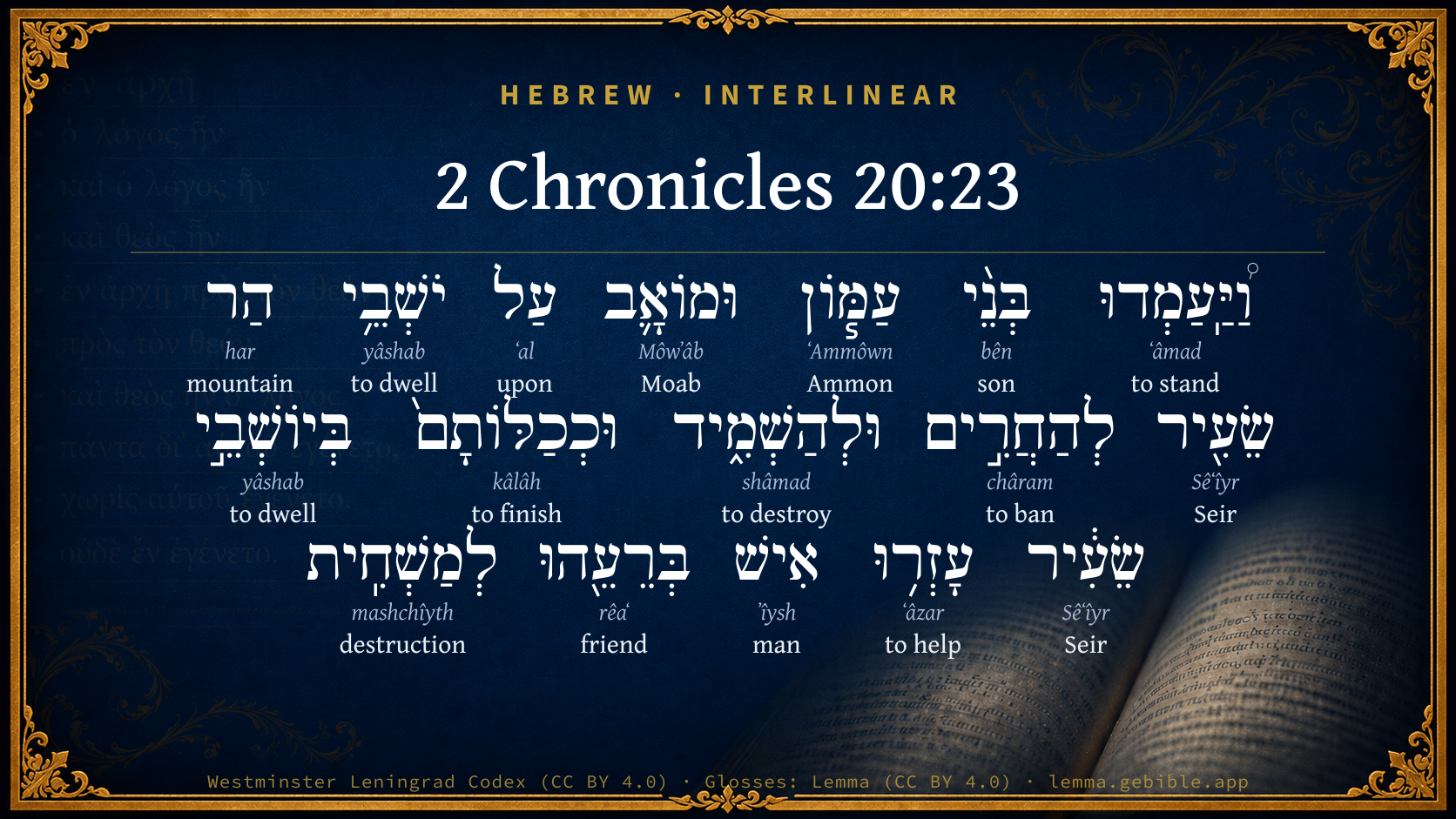
Hebrew (Westminster Leningrad Codex) 2 Chronicles 20:23 appears in the Hebrew Old Testament. The text above is from the Westminster Leningrad Codex. Each word links to its Strong’s number, a concise gloss, and parsing drawn from the Open Scriptures Hebrew Bible morphology. Click any word for its full Brown-Driver-Briggs (BDB) entry.
Download image
Cite this verse

2 Chronicles 20:23 (World English Bible). Public Domain. Lemma interlinear Bible study tool, https://lemma.gebible.app/v/2-chronicles/20/23.

Show BibTeX & RIS
BibTeX
RIS
English Translation
For the children of Ammon and Moab stood up against the inhabitants of Mount Seir, utterly to kill and destroy them: and when they had made an end of the inhabitants of Seir, everyone helped to destroy another.
World English Bible · Public Domain
Download a study sheet

One document with this verse’s original text, its word-by-word gloss line, the meaning frame, cross-references with their text, attributed commentary, and full source and license credits — printable, and it pastes into notes with its structure intact.

This verse Autodidact and up

Study sheet (.html) Plain text (.txt)

A passage Seminary Student

Up to 50 verses in one chapter. A passage sheet keeps up to 6 commentary sources and 12 cross-references per verse, in the order this page ranks them, and says so on the sheet whenever that leaves anything out. Ask for a single verse and you get the Autodidact verse sheet above.

Everything on this page stays free to read, with no account — the sheet is a download of what is already on screen, not access to it.

Want to remove ads? Support Godless Engineer
Compare translations 3

The same verse in 3 English versions, stacked beneath the original-language interlinear above. Click any original word for its lexicon entry.

Each is an independent rendering of the whole verse — the interlinear is not word-aligned to these translations.

Highlighted words mark where these versions differ — a whole-verse word diff, not a word-by-word alignment.

  • World English Bible Public Domain
    For the children of Ammon and Moab stood up against the inhabitants of Mount Seir, utterly to kill and destroy them: and when they had made an end of the inhabitants of Seir, everyone helped to destroy another.
  • King James Version Public Domain
    For the children of Ammon and Moab stood up against the inhabitants of mount Seir, utterly to slay and destroy them: and when they had made an end of the inhabitants of Seir, every one helped to destroy another.
  • unfoldingWord Literal Text CC BY-SA 4.0
    And the sons of Ammon and Moab stood against the inhabitants of Mount Seir, to devote to destruction and to destroy. And when they finished with the inhabitants of Seir, they helped a man against his neighbor for destruction.

unfoldingWord Literal Text — © unfoldingWord, licensed CC BY-SA 4.0. Word-aligned USFM3 via Door43 (git.door43.org/unfoldingWord/en_ult).

Versions to compare (up to 4)

3 of 4 selected

Show all 18 translations

Every available English version of this verse, each an independent rendering of the whole verse.

  • World English Bible Public Domain
    For the children of Ammon and Moab stood up against the inhabitants of Mount Seir, utterly to kill and destroy them: and when they had made an end of the inhabitants of Seir, everyone helped to destroy another.
  • Berean Standard Bible Public Domain
    The Ammonites and Moabites rose up against the inhabitants of Mount Seir, devoting them to destruction. And when they had made an end to the inhabitants of Seir, they helped to destroy one another.
  • Majority Standard Bible Public Domain
    The Ammonites and Moabites rose up against the inhabitants of Mount Seir, devoting them to destruction. And when they had finished off the inhabitants of Seir, they helped to destroy one another.
  • King James Version Public Domain
    For the children of Ammon and Moab stood up against the inhabitants of mount Seir, utterly to slay and destroy them: and when they had made an end of the inhabitants of Seir, every one helped to destroy another.
  • American Standard Version (1901) Public Domain
    For the children of Ammon and Moab stood up against the inhabitants of mount Seir, utterly to slay and destroy them: and when they had made an end of the inhabitants of Seir, every one helped to destroy another.
  • Revised Version (1885) Public Domain
    For the children of Ammon and Moab stood up against the inhabitants of mount Seir, utterly to slay and destroy them: and when they had made an end of the inhabitants of Seir, every one helped to destroy another.
  • Geneva Bible (1599) Public Domain
    For the children of Ammon and Moab rose against the inhabitants of mount Seir, to slay and to destroy them and when they had made an end of the inhabitantes of Seir, euery one helped to destroy another.
  • Douay-Rheims (1899) Public Domain
    For the children of Ammon, and of Moab, rose up against the inhabitants of mount Seir, to kill and destroy them: and when they had made an end of them, they turned also against one another, and destroyed one another.
  • Young's Literal Translation Public Domain
    and the sons of Ammon stand up, and Moab, against the inhabitants of mount Seir, to devote and to destroy, and at their finishing with the inhabitants of Seir, they helped, a man against his neighbour, to destroy.
  • Literal Standard Version CC BY-SA 4.0
    and the sons of Ammon stand up, and Moab, against the inhabitants of Mount Seir, to devote and to destroy, and at their finishing with the inhabitants of Seir, they helped, a man against his neighbor, to destroy.
  • Unlocked Literal Bible CC BY-SA 4.0
    For the people of Ammon and Moab rose to fight the inhabitants of Mount Seir, in order to completely kill them and destroy them. When they had finished with the inhabitants of Mount Seir, they all helped to destroy each other.
  • unfoldingWord Literal Text CC BY-SA 4.0
    And the sons of Ammon and Moab stood against the inhabitants of Mount Seir, to devote to destruction and to destroy. And when they finished with the inhabitants of Seir, they helped a man against his neighbor for destruction.
  • Darby Bible Public Domain
    And the children of Ammon and Moab stood up against the inhabitants of mount Seir, to exterminate and destroy [them]; and when they had made an end of the inhabitants of Seir, they helped to destroy one another.
  • World Messianic Bible Public Domain
    For the children of Ammon and Moab stood up against the inhabitants of Mount Seir to utterly kill and destroy them. When they had finished the inhabitants of Seir, everyone helped to destroy each other.
  • Webster's Bible Public Domain
    For the children of Ammon and Moab stood up against the inhabitants of mount Seir, utterly to slay and destroy them: and when they had made an end of the inhabitants of Seir, every one helped to destroy another.
  • Free Bible Version CC BY-SA 4.0
    The men of Ammon and Moab turned on the men from Mount Seir, killing all of them. Once they'd finished wiping out the army from Seir, they turned on each other, destroying themselves.
  • Bible in Basic English Public Domain
    And the children of Ammon and Moab made an attack on the people of Mount Seir with a view to their complete destruction; and when they had put an end to the people of Seir, everyman's hand was turned against his neighbour for his destruction.
  • JPS Tanakh (1917) Public Domain
    For the children of Ammon and Moab stood up against the inhabitants of mount Seir, utterly to slay and destroy them; and when they had made an end of the inhabitants of Seir, every one helped to destroy another.

Literal Standard Version (2020), Covenant Press — licensed CC BY-SA 4.0. Text via the HelloAO Bible API (eBible.org). Unlocked Literal Bible (unfoldingWord) — licensed CC BY-SA 4.0. Text via the HelloAO Bible API (eBible.org). unfoldingWord Literal Text — © unfoldingWord, licensed CC BY-SA 4.0. Word-aligned USFM3 via Door43 (git.door43.org/unfoldingWord/en_ult). Free Bible Version, Dr. Jonathan Gallagher — licensed CC BY-SA 4.0. Text via the HelloAO Bible API (eBible.org).

Word by word

More ways to search: Search by grammar → Find every occurrence → Compare this word →

Practice this passage: Drill this verse → Learn its vocabulary →

לְמַשְׁחִֽית
mashchîyth
H4889
“to/for · destruction”
Preposition + Noun, Common, Masculine, Singular, Absolute
Part of Speech
Preposition + Noun
Type
Common
Gender
Masculine
Number
Singular
State
Absolute
Full BDB Definition

Origin: from H7843

TWOT: 2370a

ruin, destruction
  1. וַ֠יַּֽעַמְדוּ ʻâmad H5975 “and · to stand” Conjunction + Verb, Qal, Sequential Imperfect, 3rd Person, Masculine, Plural
  2. בְּנֵ֨י bên H1121 “sons of” Noun, Common, Masculine, Plural, Construct
  3. עַמּ֧וֹן ʻAmmôwn H5983 “Ammon” Noun, Proper
  4. וּמוֹאָ֛ב Môwʼâb H4124 “and · Moab” Conjunction + Noun, Proper
  5. עַל ʻal H5921 “upon” Preposition
  6. יֹשְׁבֵ֥י yâshab H3427 “dwelling” Verb, Qal, Participle Active, Masculine, Plural, Construct
  7. הַר har H2022 “mountain of” Noun, Common, Masculine, Singular, Construct
  8. שֵׂעִ֖יר Sêʻîyr H8165 “Seir” Noun, Proper
  9. לְהַחֲרִ֣ים châram H2763 “to ban” Preposition + Verb, Hiphil, Infinitive Construct
  10. וּלְהַשְׁמִ֑יד shâmad H8045 “and · to destroy” Conjunction + Preposition + Verb, Hiphil, Infinitive Construct
  11. וּכְכַלּוֹתָם֙ kâlâh H3615 “and · like/as · to finish · them” Conjunction + Preposition + Verb, Piel, Infinitive Construct + Suffix, Personal, 3rd Person, Masculine, Plural
  12. בְּיוֹשְׁבֵ֣י yâshab H3427 “in/at · dwelling” Preposition + Verb, Qal, Participle Active, Masculine, Plural, Construct
  13. שֵׂעִ֔יר Sêʻîyr H8165 “Seir” Noun, Proper
  14. עָזְר֥וּ ʻâzar H5826 “to help” Verb, Qal, Perfect, 3rd Person, Common, Plural
  15. אִישׁ ʼîysh H376 “man” Noun, Common, Masculine, Singular, Absolute
  16. בְּרֵעֵ֖הוּ rêaʻ H7453 “in/at · friend · his” Preposition + Noun, Common, Masculine, Singular, Construct + Suffix, Personal, 3rd Person, Masculine, Singular

About this verse

These counts appear in no published source. They are computed here, from the morphology-tagged text and Lemma’s own curated glosses. What Lemma adds →

17
words
15
distinct lemmas
Historical
section

Notable vocabulary

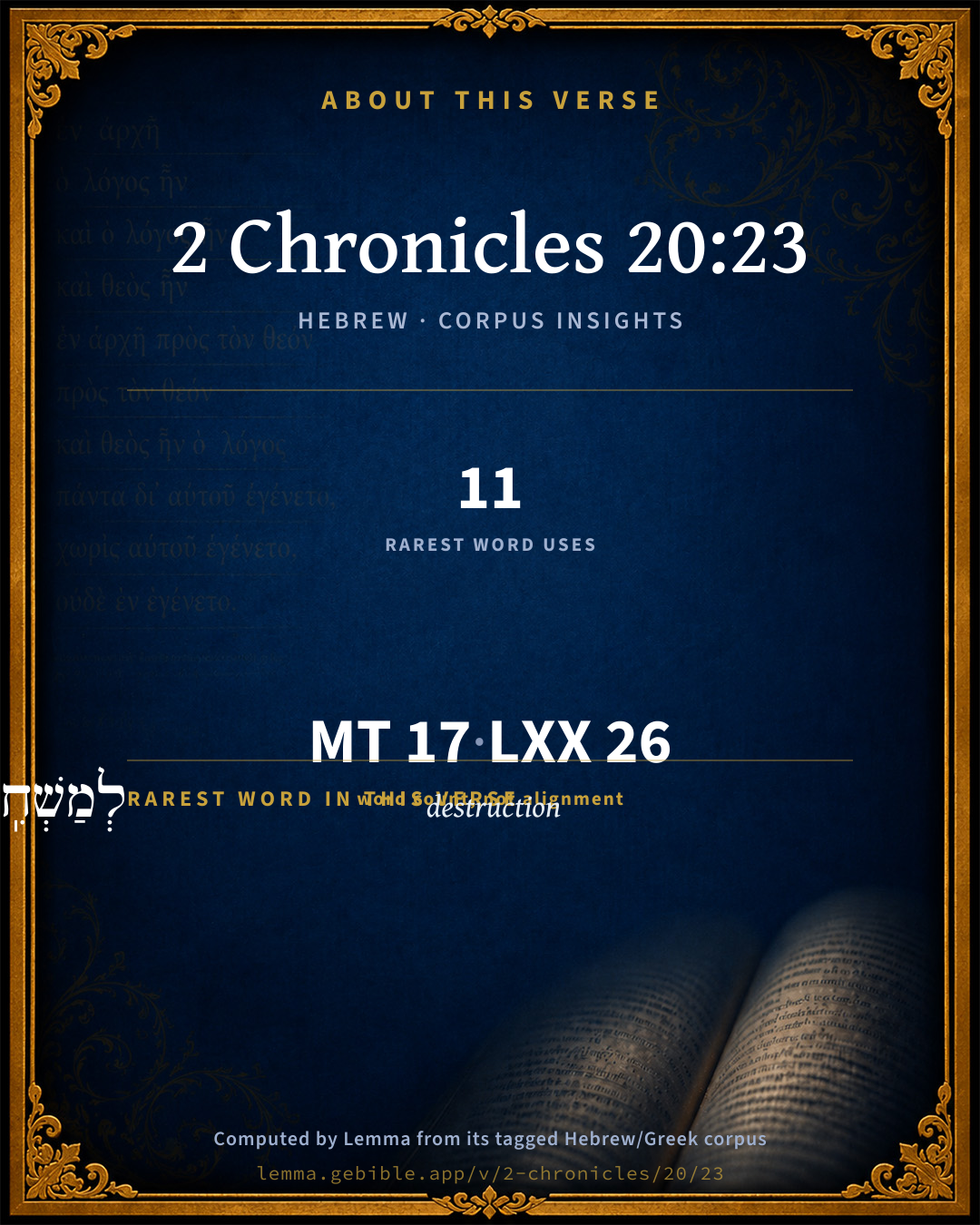
The rarest word here is לְמַשְׁחִֽית destruction H4889 — appearing just 11 times in the whole Hebrew Bible.

Shared distinctive vocabulary

לְמַשְׁחִֽית destruction H4889 occurs in 11 verses of the Hebrew Bible. Also found in:

Grammatical profile

  • 7 verbs
  • 9 nouns
  • 1 preposition

Verb forms

  • וַ֠יַּֽעַמְדוּ Qal · Sequential Imperfect
  • יֹשְׁבֵ֥י Qal · Participle Active
  • לְהַחֲרִ֣ים Hiphil · Infinitive Construct
  • וּלְהַשְׁמִ֑יד Hiphil · Infinitive Construct
  • וּכְכַלּוֹתָם֙ Piel · Infinitive Construct
  • בְּיוֹשְׁבֵ֣י Qal · Participle Active
  • עָזְר֥וּ Qal · Perfect

Repetition

Words recur within this verse — often emphatic in Hebrew:

  • יֹשְׁבֵ֥י to dwell H3427 ×2
  • שֵׂעִ֖יר Seir H8165 ×2

Hebrew & Septuagint length

In English translation the verse runs 38 words from the Hebrew and 45 from the Septuagint (LXX English) — closely comparable.

A rough comparison of the two English renderings, which tokenize alike — not a word-level alignment.

Word counts can differ between the Hebrew and the Greek without any difference in meaning — e.g. the Hebrew direct-object marker אֵת has no separate Greek word, and Greek often adds the article ὁ.

In the original languages it is 17 Hebrew tokens and 26 Greek tokens — but the two are counted differently (Hebrew bundles its prefixes and suffixes into one token; the Greek is in lemma form), so that isn’t a like-for-like length.

Cross-references

7

Topical passages linked to 2 Chronicles 20:23 in the Treasury of Scripture Knowledge — connected by theme and wording, ordered by reader-vote popularity; previews shown in the World English Bible.

  • Judges 7:22 They blew the three hundred trumpets, and Yahweh set every man's sword against his fellow, and against all the host; and the host fled as far as Beth-shittah toward Zererah, as far as the border of Abel Meholah, by Tabbath.
  • 1 Samuel 14:20 Saul and all the people who were with him were gathered together, and came to the battle: and, behold, every man's sword was against his fellow, [and there was] a very great confusion.
  • Genesis 36:8–9 Esau lived in the hill country of Seir. Esau is Edom.
  • Joshua 24:4 I gave to Isaac Jacob and Esau: and I gave to Esau Mount Seir, to possess it: and Jacob and his children went down into Egypt.
  • Ezekiel 35:2–3 Son of man, set your face against Mount Seir, and prophesy against it,
  • Genesis 14:6 and the Horites in their Mount Seir, to Elparan, which is by the wilderness.
  • Deuteronomy 2:5 don't contend with them; for I will not give you of their land, no, not so much as for the sole of the foot to tread on; because I have given Mount Seir to Esau for a possession.

Cross-references courtesy of OpenBible.info (CC BY 4.0).

Hebrew and Greek witnesses Masoretic Hebrew ↔ Greek Septuagint

The same verse in the two great witnesses to the Old Testament, shown verse-for-verse.

These are two independent witnesses, not word-aligned to each other, and the Septuagint is shown in lemma (dictionary) form.

Hebrew 2 Chronicles 20:23 Masoretic · Westminster Leningrad Codex

וַ֠יַּֽעַמְדוּ בְּנֵ֨י עַמּ֧וֹן וּמוֹאָ֛ב עַל יֹשְׁבֵ֥י הַר שֵׂעִ֖יר לְהַחֲרִ֣ים וּלְהַשְׁמִ֑יד וּכְכַלּוֹתָם֙ בְּיוֹשְׁבֵ֣י שֵׂעִ֔יר עָזְר֥וּ אִישׁ בְּרֵעֵ֖הוּ לְמַשְׁחִֽית

For the children of Ammon and Moab stood up against the inhabitants of Mount Seir, utterly to kill and destroy them: and when they had made an end of the inhabitants of Seir, everyone helped to destroy another.

World English Bible · Public Domain

Greek LXX 2 Chronicles 20:23 Septuagint · lemma form

καί ἀναἵστημι ὁ υἱός αμμων καί μωαβ ἐπί ὁ καταοἰκέω ὄρος σηιρ ἐκὀλεθρεύω καί ἐκτρίβω καί ὡς συντελέω ὁ καταοἰκέω σηιρ ἀναἵστημι εἰς ἀλλήλω ὁ ἐκὀλεθρεύω

Then the children of Ammon and Moab rose up against the dwellers in mount Seir, to destroy and consume them; and when they had made an end of destroying the inhabitants of Seir, they rose up against one another so that they were utterly destroyed.

LXX2012 (modern English Septuagint) · Public Domain

Hebrew: Westminster Leningrad Codex (CC BY 4.0). Greek: Septuagint (public domain); English from LXX2012 (modern English Septuagint) (Public Domain). How the Septuagint differs from the Hebrew →

Commentary

Notes on 2 Chronicles 20:23 from classic Christian and Jewish commentators (each source and its license shown beneath its notes). The classic Christian expositions comment on the surrounding passage and are grouped to its opening verse, so a note may address several verses; the Jewish commentaries on the Tanakh (Rashi and others) are per-verse, so they appear only where the commentator wrote on this verse.

Lemma curates 59 commentaries, every one of them public domain or Creative Commons licensed, each selected and text-cleaned for this edition rather than reprinted as found. About our sources →

Trapp's Complete Commentary

John Trapp

2Ch 20:23 For the children of Ammon and Moab stood up against the inhabitants of mount Seir, utterly to slay and destroy [them]: and when they had made an end of the inhabitants of Seir, every one helped to destroy another.

Ver. 23. Every one helped to destroy one another.] Like so many Terrigenae fratres. "Who would not fear thee, O King of nations!"

John Trapp, A Commentary or Exposition upon All the Books of the Old and New Testament (1647–1656) — public domain. Text from a community e-Sword module.

Joseph Benson's Commentary

2Ch 20:23-24. The children of Ammon and of Moab, &c. — These fell foul upon the Edomites, and cut them off; and then fell out with one another, and cut one another off. Thus God often makes wicked people instruments of destruction to one another. When Judah came toward the watch-tower — Which stood upon the cliff of Ziz, mentioned 2Ch 20:16, and looked toward the wilderness, where their enemies lay encamped, whose numbers, and order, and condition, they could descry from thence. They looked unto the multitude, and behold they were dead bodies — When they came to the view of this vast army, instead of finding living men to fight with, they found them all dead men, and their carcasses spread as dung upon the face of the earth. And none escaped — Or rather, none remained, because those who were not killed, made the best of their way home; for it cannot be supposed that they were absolutely all killed.

Joseph Benson's Commentary on the Old and New Testaments (1811–1818) — public domain. Text from a community e-Sword module.

Geneva Bible (1599)

Geneva Bible translators

Thus the Lord according to Jehoshaphat’s prayer declared his power, when he delivered his by causing their enemies to kill one another.

Geneva Bible (1599) marginal notes — public domain. Text via Bolls.life.

Ellicott's Commentary for English Readers

(23) Stood up against.—‘Amad ‘al, a late usage. (So 1Ch_21:1.)

Utterly to slay.—To exterminate (hacharîm), devote to destruction.

Made an end of.—Finished with. (See on 2Ch_20:22, “begin with,” and compare Gen_44:12.)

Every one helped . . . another.—Literally, they helped, each against (or, in the case of) his fellow, for destruction (mashchîth, 2Ch_22:4; Eze_5:16).

A Bible Commentary for English Readers, edited by Charles John Ellicott (1878–1897) — public domain. Text from a community e-Sword module.

The Cambridge Bible for Schools and Colleges

gen. ed. J. J. S. Perowne

23. For the children of Ammon] Render, And the children of Ammon. The sudden attack of the ambushed Judæans created a panic and a suspicion of treachery among the allies; so at Gideon’s surprise of Midian every man turned his sword against his fellow (Jdg_7:22).

utterly to slay] Lit. to devote; cp. Lev_27:28-29.

The Cambridge Bible for Schools and Colleges (gen. ed. J. J. S. Perowne; Cambridge University Press, 1878–1918) — public domain. Text from a community e-Sword module.

John Gill's Exposition

For the children of Ammon and Moab stood up against the inhabitants of Mount Seir,.... Supposing that they had acted a treacherous part by them, and took on the side of their enemies:

utterly to slay and destroy them; as they did:

and when they had made an end of the inhabitants of Seir; so that there were none left of them:

everyone helped to destroy one another; in their confusion mistook one another, either for Edomites or Jews, like the Midianites in the times of Gideon.

John Gill's Exposition of the Whole Bible (1746–1763) — public domain (CC PDM 1.0). Text via the HelloAO Bible API.

Whedon's Commentary on the Bible

Daniel D. Whedon

23. Ammon and Moab stood up against… Seir — The fight first turned almost wholly against the Maonites from the vicinity of Mount Seir, (note on 2Ch_20:1,) and when they were utterly cut off the Ammonites and Moabites went to destroying one another.

Daniel D. Whedon (gen. ed.), Commentary on the Old and New Testaments (1874–1909) — public domain. Text from a community e-Sword module.

The Pulpit Commentary

This verse proceeds to explain how this resulted in a kind of triangular duel on large scale. Vers. 23-37.

At and after the battle: lessons.

Armed with a holy trust in God, the king and his people advanced to meet their multitudinous enemies with bounding heart and tuneful lip. Nor were they unwarranted in so doing; the event completely justified their hopes. We learn

I THAT, OUR ENEMIES SOMETIMES DISPOSE OF ONE ANOTHER. (Ver. 23.) We sometimes find that the enemy is best "left well alone." Let Shimei "cast stones" at us; even though they be words of false accusation, they will do him much more harm than they will do us. Let the enemy blaspheme; his profanities will be a dead weight in his own balances. Let men make virulent attacks on our holy religion; they will answer one another; we can better spend our time (as a rule) in positive endeavours to build up the kingdom of God.

II That, under God"s hand, THE EVIL WE FEAR IS MORE THAN BALANCED BY THE GOOD WE GAIN. When the Jewish army returned from the wilderness of Tekoa, richly laden with spoil (ver. 25), they would doubtless have said that it was much better for them to have had their agitation followed by their success than not to have had any invasion of the enemy. They certainly congratulated themselves upon the entire incident, and, in their hearts, blessed those Moabites and Ammonites for giving them such an opportunity of enrichment. When God is on our side we may expect that our dangers will disappear, and that from the things that threaten us we shall ultimately derive blessing. Such is now and ever "the end of the Lord" ( (Joh_5:11; Job_42:10) Only we must make quite sure that God is on our side; and this we can only do by making a full surrender of ourselves to him and to his service, and by seeing to it that we choose the side of righteousness and of humanity, and not that of selfishness and of guilty pride.

III THAT GOODNESS OF HEART SHOULD FIRST TAKE THE FORM OF GRATITUDE. Whither but to "the house of the Lord" should that jubilant procession move? (ver. 28). Gladness finds its best utterance in sacred song, its best home in the sanctuary of God. Thus and there it will be chastened; it will be pure, it will be moderated, it will leave no sting of guilty memories behind. Moreover, if we are not first grateful to God for our mercies, but rather gratulatory of ourselves, we shall nurse a spirit of complacency that is likely to lead us astray from the humility which is our rectitude and our wisdom.

IV THAT IT IS WELL WHEN OUR TRIUMPH IS LOST IN THE FURTHERANCE OF THE CAUSE OF GOD. It was much that Jerusalem was safe; but it was more that "the fear of God was on all the kingdoms" (ver. 29). We may heartily rejoice that our own person, our own family, our own country, has been preserved; we may much more rejoice when the cause and kingdom of Christ has been greatly advanced. This should be the object of our solicitude and of our rejoicing.

V THAT REST IS THE RIGHTFUL PURCHASE OF LABOUR AND OF STRIFE. (Ver. 30.) The country that has won its religious liberty by heroic suffering and strife (as with Holland) may well settle down to a long period of rest and peace. The man who has gone through several decades of anxious and laborious activity may well enjoy a long evening of life when the burden is laid down and the sword is sheathed. The quieter service of the later years of life seems a fitting prelude to the peaceful and untiring activities which constitute the rest of immortality.

VI THAT THE WORTHIEST HUMAN LIVES DO NOT CORRESPOND TO OUR IDEAL. If we were to construct an ideal human life, we should not introduce another unwise combination (ver. 37)add a disastrous expedition to cast a shadow on its closing years. Yet this was the case with Jehoshaphat. Our lives, even at their best, do not answer to our conceptions of what is perfectly beautiful and complete. We must not look for this, for we shall very seldom find even the appearance of it. We must take the good man as God gives him to us, with a true soul, with a brave spirit, with a kind and faithful heart, with a character that is very fair and perhaps very fine, but that leaves something to be desired; with an ire that is very useful and perhaps very noble, but that bears marks of blemish even to the end. C.

The Pulpit Commentary (1880–1919), ed. H.D.M. Spence-Jones & Joseph S. Exell — public domain. Text from a community e-Sword module.

Rashi

Rabbi Shlomo Yitzchaki (Rashi)

when they finished with the inhabitants of Seir, each one helped his friend to destroy The Holy One, blessed be He, turned one against the other until they were completely destroyed; until the corpses fell to the ground with no survivors.

Rashi on the Tanakh — English translations: “The Judaica Press complete Tanach with Rashi, translated by A. J. Rosenberg” (CC BY 4.0); “Pentateuch with Rashi's commentary by M. Rosenbaum and A.M. Silbermann, 1929-1934” (public domain); “The Metsudah Tanach series, Lakewood, N.J” (CC BY 4.0); and “The Book of Joshua, Metsudah Publications, 1997” (CC BY 4.0). Text via Sefaria.

Lesson kit

Teaching starters — assembled from the data on this page, not authored interpretation. Every prompt links to the verse data it draws on. Edit before teaching.

2 Chronicles, in the Historical, opens this verse with 17 words (15 distinct Hebrew lemmas). Its most distinctive word is mashchîyth (“destruction”). A historical commentator’s framing appears above. Read the whole chapter for the surrounding context.

Discussion questions

  1. How does “destruction” (mashchîyth) shape what this verse is saying?
  2. How does Exodus 12:13, which shares the word «destruction», read alongside this verse?
  3. What does the repetition of “to dwell” (2× in this one verse) do in this verse?
  4. The translations on this page render this verse differently — a whole-verse word diff, not a word-by-word alignment. What might account for the different wordings?
  5. «וַ֠יַּֽעַמְדוּ» is a Qal Sequential Imperfect verb. How does that grammatical form shape the action described?
  6. Compare how Trapp's Complete Commentary and Joseph Benson's Commentary read this verse. Where do they agree or differ?

Things to notice

Reading settings

Reading text

Shown beneath each verse's original-language words.

Old Testament
Old Testament edition

Read the OT as the Masoretic Hebrew (MT) or the Greek Septuagint (LXX).

English shown for the Greek Septuagint (in the Hebrew ↔ Greek comparison).

Comparing translations? Open the Compare panel on any verse page to stack up to four side by side.