Lamentations 4:11

Hebrew (Westminster Leningrad Codex) Lamentations 4:11 appears in the Hebrew Old Testament. The text above is from the Westminster Leningrad Codex. Each word links to its Strong’s number, a concise gloss, and parsing drawn from the Open Scriptures Hebrew Bible morphology. Click any word for its full Brown-Driver-Briggs (BDB) entry.
Download image
Cite this verse

Lamentations 4:11 (World English Bible). Public Domain. Lemma interlinear Bible study tool, https://lemma.gebible.app/v/lamentations/4/11.

Show BibTeX & RIS
BibTeX
RIS
English Translation
Yahweh has accomplished his wrath, he has poured out his fierce anger; He has kindled a fire in Zion, which has devoured the foundations of it.
World English Bible · Public Domain
Download a study sheet

One document with this verse’s original text, its word-by-word gloss line, the meaning frame, cross-references with their text, attributed commentary, and full source and license credits — printable, and it pastes into notes with its structure intact.

This verse Autodidact and up

Study sheet (.html) Plain text (.txt)

A passage Seminary Student

Up to 50 verses in one chapter. A passage sheet keeps up to 6 commentary sources and 12 cross-references per verse, in the order this page ranks them, and says so on the sheet whenever that leaves anything out. Ask for a single verse and you get the Autodidact verse sheet above.

Everything on this page stays free to read, with no account — the sheet is a download of what is already on screen, not access to it.

Want to remove ads? Support Godless Engineer
Compare translations 3

The same verse in 3 English versions, stacked beneath the original-language interlinear above. Click any original word for its lexicon entry.

Each is an independent rendering of the whole verse — the interlinear is not word-aligned to these translations.

Highlighted words mark where these versions differ — a whole-verse word diff, not a word-by-word alignment.

  • World English Bible Public Domain
    Yahweh has accomplished his wrath, he has poured out his fierce anger; He has kindled a fire in Zion, which has devoured the foundations of it.
  • King James Version Public Domain
    The LORD hath accomplished his fury; he hath poured out his fierce anger, and hath kindled a fire in Zion, and it hath devoured the foundations thereof.
  • unfoldingWord Literal Text CC BY-SA 4.0
    Yahweh brought to completion his wrath; he poured out the burning of his nose. And he kindled a fire in Zion, and it consumed her foundations. LAMEDH

unfoldingWord Literal Text — © unfoldingWord, licensed CC BY-SA 4.0. Word-aligned USFM3 via Door43 (git.door43.org/unfoldingWord/en_ult).

Versions to compare (up to 4)

3 of 4 selected

Show all 18 translations

Every available English version of this verse, each an independent rendering of the whole verse.

  • World English Bible Public Domain
    Yahweh has accomplished his wrath, he has poured out his fierce anger; He has kindled a fire in Zion, which has devoured the foundations of it.
  • Berean Standard Bible Public Domain
    The LORD has exhausted His wrath; He has poured out His fierce anger; He has kindled a fire in Zion, and it has consumed her foundations.
  • Majority Standard Bible Public Domain
    The LORD has exhausted His wrath; He has poured out His fierce anger; He has kindled a fire in Zion, and it has consumed her foundations.
  • King James Version Public Domain
    The LORD hath accomplished his fury; he hath poured out his fierce anger, and hath kindled a fire in Zion, and it hath devoured the foundations thereof.
  • American Standard Version (1901) Public Domain
    Jehovah hath accomplished his wrath, he hath poured out his fierce anger; And he hath kindled a fire in Zion, which hath devoured the foundations thereof.
  • Revised Version (1885) Public Domain
    The LORD hath accomplished his fury, he hath poured out his fierce anger; and he hath kindled a fire in Zion, which hath devoured the foundations thereof.
  • Geneva Bible (1599) Public Domain
    The Lord hath accomplished his indignation: he hath powred out his fierce wrath, he hath kindled a fire in Zion, which hath deuoured the foundations thereof.
  • Douay-Rheims (1899) Public Domain
    Caph. The Lord hath accomplished his wrath, he hath poured out his fierce anger: and he hath kindled a fire in Sion, and it hath devoured the foundations thereof.
  • Young's Literal Translation Public Domain
    Completed hath Jehovah His fury, He hath poured out the fierceness of His anger, And he kindleth a fire in Zion, And it devoureth her foundations.
  • Literal Standard Version CC BY-SA 4.0
    YHWH has completed His fury, || He has poured out the fierceness of His anger, || And He kindles a fire in Zion, || And it devours her foundations.
  • Unlocked Literal Bible CC BY-SA 4.0
    Yahweh showed all his wrath; he poured out his fierce anger. He kindled a fire in Zion that consumed her foundations.
  • unfoldingWord Literal Text CC BY-SA 4.0
    Yahweh brought to completion his wrath; he poured out the burning of his nose. And he kindled a fire in Zion, and it consumed her foundations. LAMEDH
  • Darby Bible Public Domain
    Jehovah hath accomplished his fury; he hath poured out his fierce anger, and hath kindled a fire in Zion, which hath consumed the foundations thereof.
  • World Messianic Bible Public Domain
    The LORD has accomplished his wrath. He has poured out his fierce anger. He has kindled a fire in Zion, which has devoured its foundations.
  • Webster's Bible Public Domain
    The LORD hath accomplished his fury; he hath poured out his fierce anger, and hath kindled a fire in Zion, and it hath devoured her foundations.
  • Free Bible Version CC BY-SA 4.0
    The Lord has given full expression to his anger. He has poured out his fury. He has started a fire in Zion, and it has burned down her very foundations.
  • Bible in Basic English Public Domain
    The Lord has given full effect to his passion, he has let loose his burning wrath; he has made a fire in Zion, causing the destruction of its bases.
  • JPS Tanakh (1917) Public Domain
    The LORD hath accomplished His fury, He hath poured out His fierce anger; and He hath kindled a fire in Zion, which hath devoured the foundations thereof.

Literal Standard Version (2020), Covenant Press — licensed CC BY-SA 4.0. Text via the HelloAO Bible API (eBible.org). Unlocked Literal Bible (unfoldingWord) — licensed CC BY-SA 4.0. Text via the HelloAO Bible API (eBible.org). unfoldingWord Literal Text — © unfoldingWord, licensed CC BY-SA 4.0. Word-aligned USFM3 via Door43 (git.door43.org/unfoldingWord/en_ult). Free Bible Version, Dr. Jonathan Gallagher — licensed CC BY-SA 4.0. Text via the HelloAO Bible API (eBible.org).

Word by word

More ways to search: Search by grammar → Find every occurrence → Compare this word →

Practice this passage: Drill this verse → Learn its vocabulary →

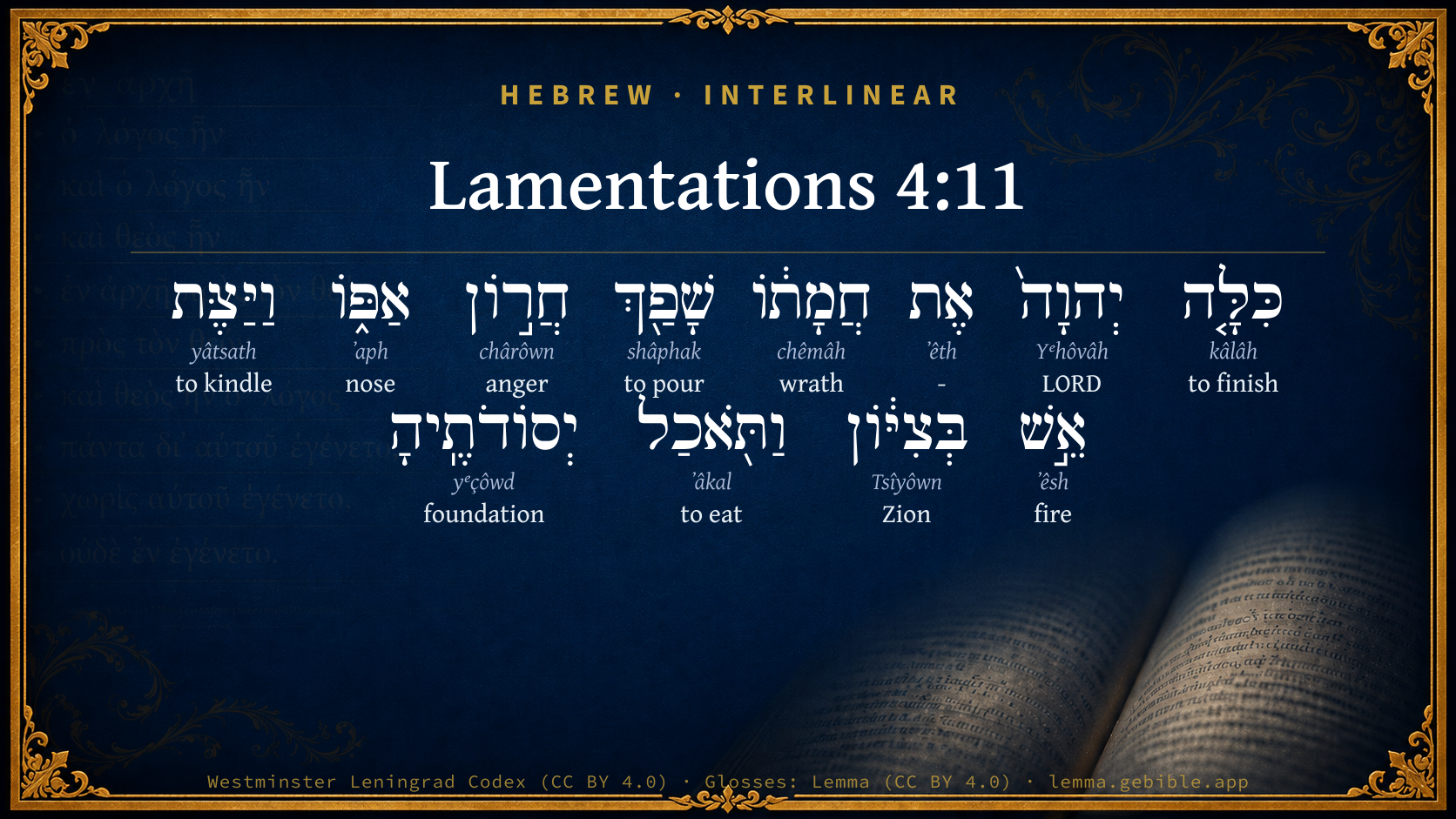
יְסוֹדֹתֶֽיהָ
yᵉçôwd
H3247
“foundations · her”
Noun, Common, Masculine, Plural, Construct + Suffix, Personal, 3rd Person, Feminine, Singular
Part of Speech
Noun
Type
Common
Gender
Masculine
Number
Plural
State
Construct
Full BDB Definition

Origin: from H3245

TWOT: 875b

foundation, base - foundation - base, bottom
  1. כִּלָּ֤ה kâlâh H3615 “to finish” Verb, Piel, Perfect, 3rd Person, Masculine, Singular
  2. יְהוָה֙ Yᵉhôvâh H3068 “LORD” Noun, Proper
  3. אֶת ʼêth H853 “-” Particle, Direct Object
  4. חֲמָת֔וֹ chêmâh H2534 “wrath · his” Noun, Common, Feminine, Singular, Construct + Suffix, Personal, 3rd Person, Masculine, Singular
  5. שָׁפַ֖ךְ shâphak H8210 “to pour” Verb, Qal, Perfect, 3rd Person, Masculine, Singular
  6. חֲר֣וֹן chârôwn H2740 “anger of” Noun, Common, Masculine, Singular, Construct
  7. אַפּ֑וֹ ʼaph H639 “nose · his” Noun, Common, Masculine, Singular, Construct + Suffix, Personal, 3rd Person, Masculine, Singular
  8. וַיַּצֶּת yâtsath H3341 “and · to kindle” Conjunction + Verb, Hiphil, Sequential Imperfect, 3rd Person, Masculine, Singular
  9. אֵ֣שׁ ʼêsh H784 “fire” Noun, Common, Both, Singular, Absolute
  10. בְּצִיּ֔וֹן Tsîyôwn H6726 “in/at · Zion” Preposition + Noun, Proper
  11. וַתֹּ֖אכַל ʼâkal H398 “and · to eat” Conjunction + Verb, Qal, Sequential Imperfect, 3rd Person, Feminine, Singular

About this verse

These counts appear in no published source. They are computed here, from the morphology-tagged text and Lemma’s own curated glosses. What Lemma adds →

12
words
12
distinct lemmas
Prophets
section

Notable vocabulary

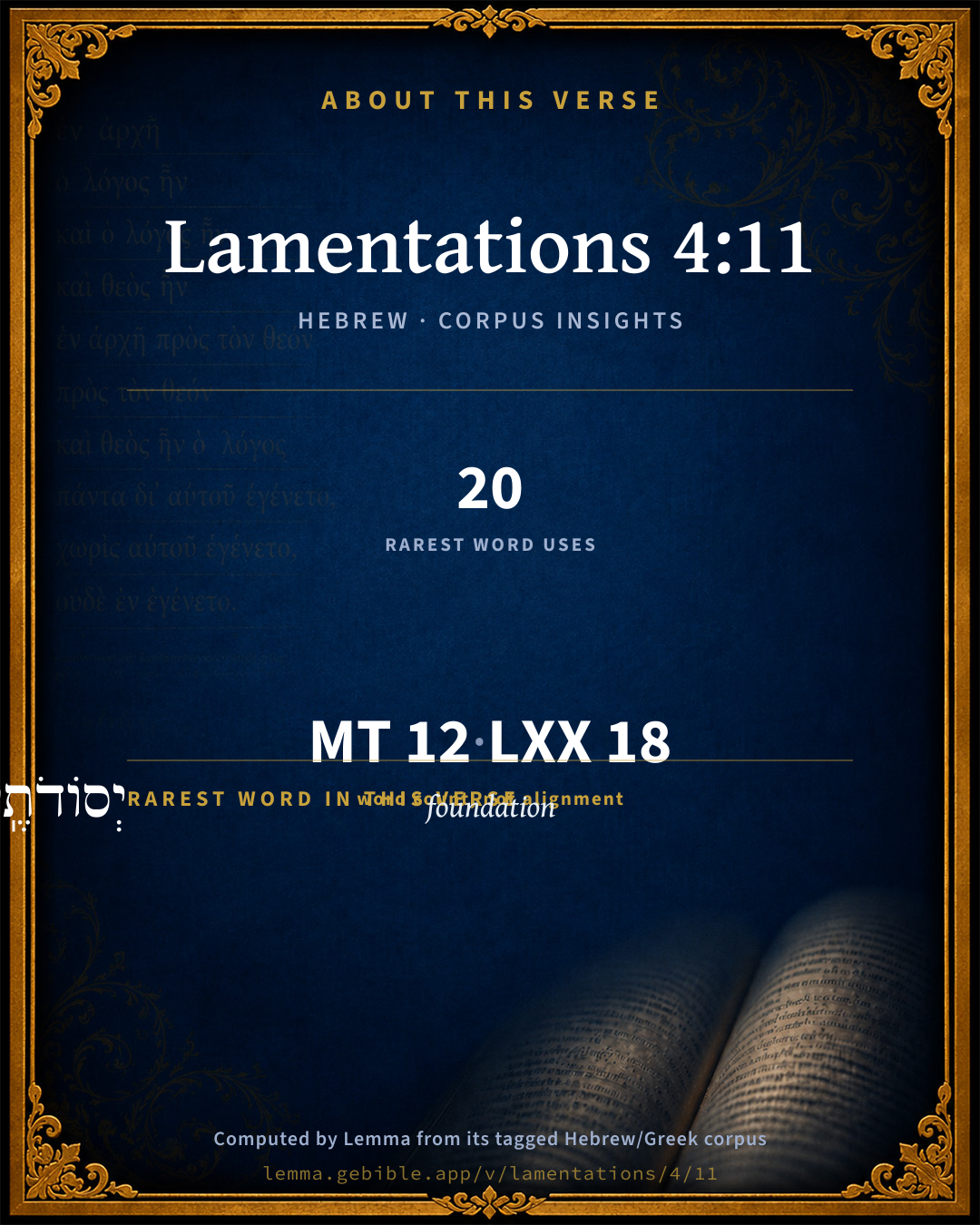
The rarest word here is יְסוֹדֹתֶֽיהָ foundation H3247 — appearing just 20 times in the whole Hebrew Bible.

Shared distinctive vocabulary

יְסוֹדֹתֶֽיהָ foundation H3247 occurs in 20 verses of the Hebrew Bible. Also found in:

Grammatical profile

  • 4 verbs
  • 7 nouns
  • 1 particle

Verb forms

  • כִּלָּ֤ה Piel · Perfect
  • שָׁפַ֖ךְ Qal · Perfect
  • וַיַּצֶּת Hiphil · Sequential Imperfect
  • וַתֹּ֖אכַל Qal · Sequential Imperfect

Hebrew & Septuagint length

In English translation the verse runs 26 words from the Hebrew and 26 from the Septuagint (LXX English) — the same length.

A rough comparison of the two English renderings, which tokenize alike — not a word-level alignment.

Word counts can differ between the Hebrew and the Greek without any difference in meaning — e.g. the Hebrew direct-object marker אֵת has no separate Greek word, and Greek often adds the article ὁ.

In the original languages it is 12 Hebrew tokens and 18 Greek tokens — but the two are counted differently (Hebrew bundles its prefixes and suffixes into one token; the Greek is in lemma form), so that isn’t a like-for-like length.

Cross-references

20

Topical passages linked to Lamentations 4:11 in the Treasury of Scripture Knowledge — connected by theme and wording, ordered by reader-vote popularity; previews shown in the World English Bible.

  • Jeremiah 7:20 Therefore thus says the Lord Yahweh: Behold, my anger and my wrath shall be poured out on this place, on man, and on animal, and on the trees of the field, and on the fruit of the ground; and it shall burn, and shall not be quenched.
  • Ezekiel 22:31 Therefore have I poured out my indignation on them; I have consumed them with the fire of my wrath: their own way have I brought on their heads, says the Lord Yahweh.
  • Jeremiah 17:27 But if you will not listen to me to make the Sabbath day holy, and not to bear a burden and enter in at the gates of Jerusalem on the Sabbath day; then will I kindle a fire in the gates of it, and it shall devour the palaces of Jerusalem, and it shall not be quenched.
  • Lamentations 2:17 Yahweh has done that which he purposed; he has fulfilled his word that he commanded in the days of old; He has thrown down, and has not pitied: He has caused the enemy to rejoice over you; he has exalted the horn of your adversaries.
  • Deuteronomy 32:21–25 They have moved me to jealousy with that which is not God; They have provoked me to anger with their vanities: I will move them to jealousy with those who are not a people; I will provoke them to anger with a foolish nation.
  • Jeremiah 6:11–12 Therefore I am full of the wrath of Yahweh; I am weary with holding in: pour it out on the children in the street, and on the assembly of young men together; for even the husband with the wife shall be taken, the aged with him who is full of days.
  • Jeremiah 9:9–11 Shall I not visit them for these things? says Yahweh; shall not my soul be avenged on such a nation as this?
  • Jeremiah 13:14 I will dash them one against another, even the fathers and the sons together, says Yahweh: I will not pity, nor spare, nor have compassion, that I should not destroy them.
  • Jeremiah 14:15–16 Therefore thus says Yahweh concerning the prophets who prophesy in my name, and I didn't send them, yet they say, Sword and famine shall not be in this land: By sword and famine shall those prophets be consumed.
  • Jeremiah 15:1–4 Then said Yahweh to me, Though Moses and Samuel stood before me, yet my mind would not be toward this people: cast them out of my sight, and let them go forth.
  • Jeremiah 19:3–11 and say, Hear you the word of Yahweh, kings of Judah, and inhabitants of Jerusalem: thus says Yahweh of Hosts, the God of Israel, Behold, I will bring evil on this place, which whoever hears, his ears shall tingle.
  • Jeremiah 21:14 I will punish you according to the fruit of your doings, says Yahweh; and I will kindle a fire in her forest, and it shall devour all that is round about her.
  • Jeremiah 23:19–20 Behold, the tempest of Yahweh, [even his] wrath, is gone forth, yes, a whirling tempest: it shall burst on the head of the wicked.
  • Jeremiah 24:8–10 As the bad figs, which can't be eaten, they are so bad, surely thus says Yahweh, So will I give up Zedekiah the king of Judah, and his princes, and the residue of Jerusalem, who remain in this land, and those who dwell in the land of Egypt,
  • Lamentations 2:8 Yahweh has purposed to destroy the wall of the daughter of Zion; He has stretched out the line, he has not withdrawn his hand from destroying; He has made the rampart and wall to lament; they languish together.
  • Lamentations 4:22 The punishment of your iniquity is accomplished, daughter of Zion; he will no more carry you away into captivity: He will visit your iniquity, daughter of Edom; he will uncover your sins.
  • Ezekiel 20:47–48 and tell the forest of the South, Hear the word of Yahweh: Thus says the Lord Yahweh, Behold, I will kindle a fire in you, and it shall devour every green tree in you, and every dry tree: the flaming flame shall not be quenched, and all faces from the south to the north shall be burnt thereby.
  • Daniel 9:12 He has confirmed his words, which he spoke against us, and against our judges who judged us, by bringing on us a great evil; for under the whole sky has not been done as has been done on Jerusalem.
  • Zechariah 1:6 But my words and my decrees, which I commanded my servants the prophets, didn't they overtake your fathers? "Then they repented and said, 'Just as Yahweh of Hosts determined to do to us, according to our ways, and according to our practices, so he has dealt with us.'"
  • Luke 21:22 For these are days of vengeance, that all things which are written may be fulfilled.

Cross-references courtesy of OpenBible.info (CC BY 4.0).

Hebrew and Greek witnesses Masoretic Hebrew ↔ Greek Septuagint

The same verse in the two great witnesses to the Old Testament, shown verse-for-verse.

These are two independent witnesses, not word-aligned to each other, and the Septuagint is shown in lemma (dictionary) form.

Hebrew Lamentations 4:11 Masoretic · Westminster Leningrad Codex

כִּלָּ֤ה יְהוָה֙ אֶת חֲמָת֔וֹ שָׁפַ֖ךְ חֲר֣וֹן אַפּ֑וֹ וַיַּצֶּת אֵ֣שׁ בְּצִיּ֔וֹן וַתֹּ֖אכַל יְסוֹדֹתֶֽיהָ

Yahweh has accomplished his wrath, he has poured out his fierce anger; He has kindled a fire in Zion, which has devoured the foundations of it.

World English Bible · Public Domain

Greek LXX Lamentations 4:11 Septuagint · lemma form

συντελέω κύριος θυμός αὐτός ἐκχέω θυμός ὀργή αὐτός καί ἀναἅπτω πῦρ ἐν σιων καί καταἐσθίω ὁ θεμέλιον αὐτός

CHAPH. The Lord has accomplished his wrath; he has poured out fierce anger, and has kindled a fire in Sion, and it has devoured her foundations.

LXX2012 (modern English Septuagint) · Public Domain

Hebrew: Westminster Leningrad Codex (CC BY 4.0). Greek: Septuagint (public domain); English from LXX2012 (modern English Septuagint) (Public Domain). How the Septuagint differs from the Hebrew →

Commentary

Notes on Lamentations 4:11 from classic Christian and Jewish commentators (each source and its license shown beneath its notes). The classic Christian expositions comment on the surrounding passage and are grouped to its opening verse, so a note may address several verses; the Jewish commentaries on the Tanakh (Rashi and others) are per-verse, so they appear only where the commentator wrote on this verse.

Lemma curates 59 commentaries, every one of them public domain or Creative Commons licensed, each selected and text-cleaned for this edition rather than reprinted as found. About our sources →

Trapp's Complete Commentary

John Trapp

Lam 4:11 The LORD hath accomplished his fury; he hath poured out his fierce anger, and hath kindled a fire in Zion, and it hath devoured the foundations thereof.

Ver. 11. The Lord hath accomplished his fury.] Which he had long deferred, but now hath paid it home. Cave ne ira delata fiat duplicata.

He hath poured out his fierce anger.] As it were by whole buckets or pailfuls. God’s anger may be let out in minnows as there may be much poison in little drops. But woe be those on whom it is poured!

He hath kindled a fire in Zion.] His wrath is like fire, that furious element, which at first burneth a little upon a few boards; but when it prevaileth, it bursteth forth into a terrible flame.

John Trapp, A Commentary or Exposition upon All the Books of the Old and New Testament (1647–1656) — public domain. Text from a community e-Sword module.

The Preacher's Complete Homiletical Commentary

Joseph S. Exell (gen. ed.)

HOMILETICS

EXEGETICAL NOTES.—

(כ) Lam_4:11 is a conclusion from the immediately preceding verses, as Lam_4:6 is from those preceding it. Jehovah has accomplished, i.e., has put forth a full measure of, His fury; has poured out the fierceness of His anger, and one method of its action is He has kindled a fire in Zion, and has devoured her foundations. The scenes of horror which have been depicted show the meeting-place of Zion’s guilt and its Divine punisher. God’s fierce wrath is the blast which consumes flagrant iniquities. The entire demolition of the former principles dominating the Israelites is thus symbolised, and so signifies that room is made for the new spirit which shall possess the restored captivity when they lay again the foundations of the House of the Lord.

A change of features is to be presented now by sketching, not so much the disasters on classes of the people, as the causes by which they were produced, and the baffled hopes ensuing.

(ל) Lam_4:12. The kings of the earth—men who might be considered experts—believed not, neither all the inhabitants of the world—men who were moved by appearances and common hearsay—that an adversary … should enter into the gates of Jerusalem. This belief cannot be merely “a deep subjective conviction.” Whether or not the city was previously taken is a matter of no importance. What is stated is a general opinion. The unverified belief would be grounded on the knowledge of the strong situation and careful fortifications of Jerusalem, which, with the means of siege then at command, might be considered almost impossible of capture. It was invested a year and a half before capture by the greatest warrior of the age. Besides this, there may well have been, since the remarkable repulse of Sennacherib, a wide-spread supposition, as when the tribes emerged from the desert, that the God of Israel was very mighty in the defence of His worshippers, and would not let His sacred city be subjugated.

THE DESTRUCTION OF ZION

(Lam_4:11-12)

I. Was thorough and complete. “The Lord kindled a fire in Zion, and it devoured the foundations thereof” (Lam_4:11). The holy city, the pride of the Jews and the envy of their enemies, was utterly overthrown. Not only were its walls, towers, palaces, and Temple demolished, but its very foundations were dug up and scattered: one stone was not left upon another. It was degraded and spurned by the resolute destroyers as a heap of useless rubbish. It was impossible for the rage of man to make a more complete ruin. In the intention of the irate Chaldeans it was destroyed for ever. And yet the Divine Guardian of the holy city allowed all this!

II. Was undeniable evidence of the reality of the Divine anger. “The Lord hath accomplished His fury: He hath poured out His fierce anger” (Lam_4:11). There was more of the righteous anger of Jehovah against the obstinate sin of His people in the destruction of Jerusalem, than there were skill and ferocity in the Chaldean army. The enemy would have been powerless to pierce the city bulwarks if the people had remained true to Jehovah, and sheltered themselves in humble trust beneath His all-powerful defence. But the wrath of God was provoked beyond the limit of further endurance, and the Chaldeans were used as the instruments of His vengeance. Surely the eyes of the suffering people were at last opened to see in the utter destruction of their beloved city that Jehovah was indeed angry with them.

III. Was a result deemed incredible by the nations. “The kings of the earth, and all the inhabitants of the world, would not have believed that the adversary should have entered into the gates of Jerusalem” (Lam_4:12). Jerusalem was so strongly fortified, not only by massive walls and bulwarks, but by the strength and heroism of its inhabitants, that it was deemed impregnable to all warlike forces of that day. Moreover, it was regarded as the dwelling-place of the Great King, who had hitherto baffled all attempts to capture it. The recent defeat of Sennacherib, one of the greatest warriors of the age, was fresh in the memory of the people. The belief gained general currency that the city could not be taken. It was invested for a year and a half by the Chaldean forces, furnished with the most powerful engines of assault, before it was actually captured. Its fall was the amazement of the world. What was believed impossible had come to pass. Others saw, what the Jews were slow to acknowledge, that their God had deserted them and given them up to the destroyer.

LESSONS.—

1. The holiest place may be polluted by sin,

2. Persistent sin provokes Divine vengeance.

3. Divine wrath is not poured out till every opportunity is given for repentance.

GERM NOTES ON THE VERSES

Lam_4:11. The Divine anger.

1. Will accomplish all it threatens.

2. Is terrible in its active manifestation.

3. May well be dreaded by the impenitent.

Lam_4:12. A world’s wonder.

1. That a divinely guarded city should fall.

2. That it should fall by the hands of the godless.

3. That some great sin must have been committed to make such a catastrophe possible.

ILLUSTRATIONS.—Terrible destruction. One of the officers at Fredericksburg says:—“Howard, who was with me, says I exclaimed, ‘Oh, great God, see how our men, our poor fellows, are falling!’ I remember that the whole plain was covered with men prostrate and falling. I had never before seen fighting like that—nothing approaching it in terrible uproar and destruction. As they charged, the artillery fire would break up their formation, and they would get mixed; then they would close up, go forward, receive the withering infantry fire, and those who were able would run to their houses and do all they could; then the next brigade coming up in succession would do their duty, and melt. It was like the snow coming down and melting on warm ground.”

Concentration of power destroys. In the eighteenth century an immense burning-glass was constructed in France, in which all the heat falling on a great lens was then concentrated on a smaller one, till at the focus such was the heat that iron, gold, and other metals ran like melted butter. Another one, made in England by Parker, fused the most refractory substances, and diamonds were by it reduced to vapour.

The Divine sovereignty. “God is free because no causes external to Himself have power over Him; and as good men are most free when most a law to themselves, so it is no infringement on God’s freedom to say that He must have acted as He acted; but rather He is absolutely free because absolutely a law Himself to Himself.”—Froude.

The curse of sin. It is the Trojan horse; it hath sword and famine and pestilence in the belly of it. Sin is a coal that not only blacks, but burns. Sin creates all our troubles; it puts gravel in our bread, wormwood in our cup. Sin rots the name, consumes the estates, buries relations. Sin shoots the flying roll of God’s curses into a family and kingdom (Zec_5:4). It is reported of Phocas, having built a wall of mighty strength about his city, there was a voice heard, “Sin is in the city, and that will throw down the wall.”

The Preacher's Complete Homiletical Commentary (gen. ed. Joseph S. Exell; Funk & Wagnalls, c. 1892) — public domain (pre-1929). A full-Bible homiletical/sermon-outline anthology covering 65 of 66 books (2 John is absent from the source module). Text from a community e-Sword module.

Jamieson, Fausset & Brown

Robert Jamieson, A. R. Fausset & David Brown

fire . . . devoured . . . foundations-- (Deu 32:22; Jer 21:14). A most rare event. Fire usually consumes only the surface; but this reached even to the foundation, cutting off all hope of restoration.

Jamieson, Fausset & Brown — Commentary Critical and Explanatory on the Whole Bible (1871) — public domain (CC PDM 1.0). Text via the HelloAO Bible API.

John Calvin's Commentaries

He at length concludes that nothing was wanting to complete the extreme vengeance of God; for had the Jews been chastised in an ordinary way, they would have still extenuated their sins, as we know that they were not easily led to repentance. Hence the Prophet, to shew that their offenses had not been slight, but that they had been extremely wicked before God, says that the whole of God’s wrath had been executed: Jehovah has completed his wrath The expression is indeed harsh to Latin ears; but the meaning is, that he had executed his extreme judgment.

He afterwards adds, He has poured forth the indignation of his wrath. God is indeed content with moderate punishment, provided men be awakened from their torpor; but when he pours forth his wrath, there is no hope of repentance. It is then a sign of final despair when God’s vengeance overflows like a deluge. But when Jeremiah thus speaks, he does not contend with God, but rather reminds the Jews of what they deserved, as it was stated yesterday. There is, then, no doubt but that he argues, from the grievousness of their punishment, that there was no reason for the Jews to flatter themselves any longer, since God had dealt so severely with them.

He then, in other words, points out the same thing, that God had kindled a fire which devoured or consumed the very foundations. Fire is wont rather to take hold on the roofs of houses, or, when it creeps farther, it does not proceed beyond the surface. It is a very rare thing for it to penetrate into the foundations. Let us at the same time know that the Prophet speaks metaphorically of the destruction of the city, for it was such as left nothing remaining. For when some ruins remain, there is some intimation of a future restoration at least the minds of beholders are inclined to hope that what has fallen is to be restored; but when the buildings are not only pulled down, but also demolished from their foundations, then the destruction seems to be without any hope of restoration. And this is what the Prophet means when he says, that the fire had consumed, not only what was above ground, but the very foundations of Jerusalem. It follows, —

John Calvin's Commentaries (1540-1563) — public domain. Text from the Calvin Translation Society English edition (1840s-50s) via the Christian Classics Ethereal Library (ccel.org). Calvin's coverage is partial (roughly two-thirds of the Bible); uncommented books and verses are honest gaps, never fabricated. The 19th-century editor's footnotes and remarks are omitted so the notes are faithfully Calvin's own voice.

Ellicott's Commentary for English Readers

(11) And hath kindled a fire . . .—The phrase is partly literal (2Ch_36:19), partly figurative, for the complete destruction of Jerusalem by the wrath of Jehovah.

A Bible Commentary for English Readers, edited by Charles John Ellicott (1878–1897) — public domain. Text from a community e-Sword module.

The Cambridge Bible for Schools and Colleges

gen. ed. J. J. S. Perowne

11. hath kindled a fire] metaphorical, as in Lam_1:13, Lam_2:3.

The Cambridge Bible for Schools and Colleges (gen. ed. J. J. S. Perowne; Cambridge University Press, 1878–1918) — public domain. Text from a community e-Sword module.

John Gill's Exposition

The Lord hath accomplished his fury,.... Which rose up in his mind, and which he purposed in himself to bring upon the sinful people of the Jews:

he hath poured out his fierce anger; the vials of his wrath in great abundance, even all he meant to pour out upon them:

and hath kindled a fire in Zion, and it hath devoured the foundations thereof: not in the strong hold of Zion only, but in the whole city of Jerusalem, which was set on fire by the Chaldeans, as instruments, according to the will of God; and which not only consumed the houses of it, but even the foundations of them; so that it looked as if there was no hope of its ever being rebuilt. Aben Ezra interprets this fire of the famine.

John Gill's Exposition of the Whole Bible (1746–1763) — public domain (CC PDM 1.0). Text via the HelloAO Bible API.

Matthew Poole's English Annotations

An unusual fire, which burns up not only the roof and superstructure, but the foundations, leaving no bottom for hopes of being restored. See Deu 32:22.

Matthew Poole's English Annotations on the Holy Bible (1683–1685) — public domain. Text from a community e-Sword/MySword module.

Whedon's Commentary on the Bible

Daniel D. Whedon

11. Hath devoured the foundations — As the foundations of the city were not literally destroyed at that time. Dr. Hornblower suggests that this is a prophecy of the more complete demolition of the city in later times, when not “one stone should be left upon another.” But there is no need of pressing this language. It implies total overthrow, but no importance attaches to the specification of “foundations” as that the threat must be literally fulfilled.

Daniel D. Whedon (gen. ed.), Commentary on the Old and New Testaments (1874–1909) — public domain. Text from a community e-Sword module.

The Pulpit Commentary

Hath accomplished means here, not "hath finished," but "hath poured out in full measure," as in the song of Moses Jehovah declares that he will "spend his arrows upon them". (the Hebrew verb is the same as Deu_32:23) To show the completeness of Zion"s ruin it is compared to a fire which hath devoured the (very) foundations thereof.

The Pulpit Commentary (1880–1919), ed. H.D.M. Spence-Jones & Joseph S. Exell — public domain. Text from a community e-Sword module.

unfoldingWord translationNotes

Door43 World Missions Community

Yahweh showed all his wrath; he poured out his fierce anger

Yahweh was very angry, and he did everything he wanted to do to show that he was angry. (See: Parallelism)

he poured out his fierce anger

God's punishing his people is spoken of as if his anger were a burning hot liquid that he poured out on them. AT: "because of his fierce anger, he punished his people" or "in fierce anger he responded to his people" (See: Metaphor)

He kindled a fire in Zion

This represents God causing Israel's enemies to start a fire in Jerusalem. AT: "He caused a fire to start in Zion" (See: Metonymy)

that consumed her foundations

Here "her foundations" represents the whole city, even the part of the city that would be ruined last. AT: "that burned down the city, even its foundations" (See: Synecdoche)

translationWords

Yahweh

rage

anger

fire

Zion

devour

found

unfoldingWord translationNotes — © Distant Shores Media and the Door43 World Missions Community, licensed CC BY-SA 4.0. Source: git.door43.org/Door43/en_tn.

Rashi

Rabbi Shlomo Yitzchaki (Rashi)

The Lord has spent His fury which burned in Him for many years; He now spent it when He avenged Himself upon them.

Rashi on the Tanakh — English translations: “The Judaica Press complete Tanach with Rashi, translated by A. J. Rosenberg” (CC BY 4.0); “Pentateuch with Rashi's commentary by M. Rosenbaum and A.M. Silbermann, 1929-1934” (public domain); “The Metsudah Tanach series, Lakewood, N.J” (CC BY 4.0); and “The Book of Joshua, Metsudah Publications, 1997” (CC BY 4.0). Text via Sefaria.

Lesson kit

Teaching starters — assembled from the data on this page, not authored interpretation. Every prompt links to the verse data it draws on. Edit before teaching.

Lamentations, in the Prophets, opens this verse with 12 words (12 distinct Hebrew lemmas). Its most distinctive word is yᵉçôwd (“foundation”). A historical commentator’s framing appears above. Read the whole chapter for the surrounding context.

Discussion questions

  1. What does “foundation” (yᵉçôwd) contribute to the verse as a whole?
  2. How does Exodus 29:12, which shares the word «foundation», read alongside this verse?
  3. The translations on this page render this verse differently — a whole-verse word diff, not a word-by-word alignment. What might account for the different wordings?
  4. «כִּלָּ֤ה» is a Piel Perfect verb. How does that grammatical form shape the action described?
  5. Compare how Trapp's Complete Commentary and The Preacher's Complete Homiletical Commentary read this verse. Where do they agree or differ?

Things to notice

Reading settings

Reading text

Shown beneath each verse's original-language words.

Old Testament
Old Testament edition

Read the OT as the Masoretic Hebrew (MT) or the Greek Septuagint (LXX).

English shown for the Greek Septuagint (in the Hebrew ↔ Greek comparison).

Comparing translations? Open the Compare panel on any verse page to stack up to four side by side.