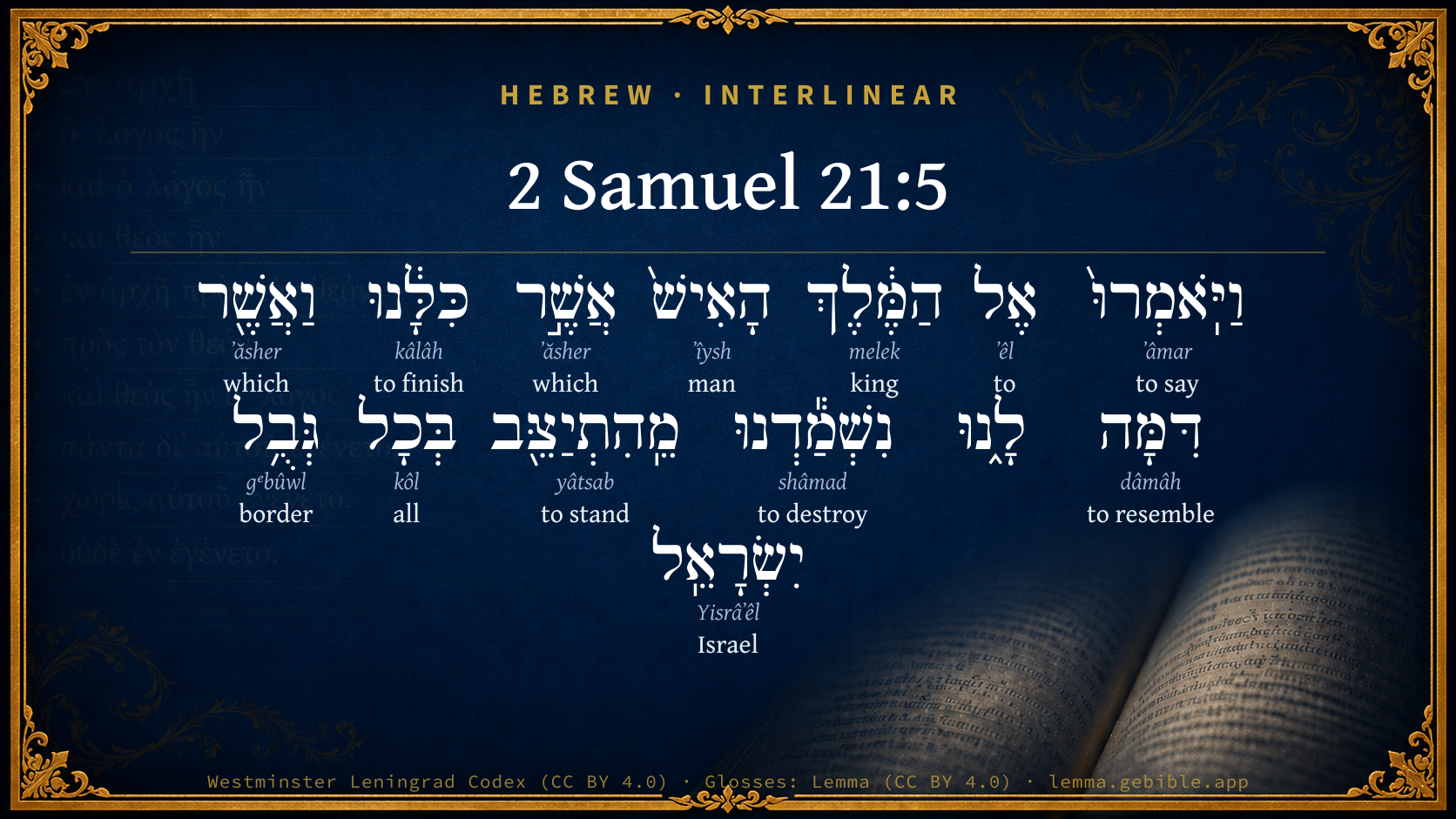
2 Samuel 21:5

Hebrew (Westminster Leningrad Codex) 2 Samuel 21:5 appears in the Hebrew Old Testament. The text above is from the Westminster Leningrad Codex. Each word links to its Strong’s number, a concise gloss, and parsing drawn from the Open Scriptures Hebrew Bible morphology. Click any word for its full Brown-Driver-Briggs (BDB) entry.
Download image
Cite this verse

2 Samuel 21:5 (World English Bible). Public Domain. Lemma interlinear Bible study tool, https://lemma.gebible.app/v/2-samuel/21/5.

Show BibTeX & RIS
BibTeX
RIS
English Translation
They said to the king, The man who consumed us, and who devised against us, [that] we should be destroyed from remaining in any of the borders of Israel,
World English Bible · Public Domain
Download a study sheet

One document with this verse’s original text, its word-by-word gloss line, the meaning frame, cross-references with their text, attributed commentary, and full source and license credits — printable, and it pastes into notes with its structure intact.

This verse Autodidact and up

Study sheet (.html) Plain text (.txt)

A passage Seminary Student

Up to 50 verses in one chapter. A passage sheet keeps up to 6 commentary sources and 12 cross-references per verse, in the order this page ranks them, and says so on the sheet whenever that leaves anything out. Ask for a single verse and you get the Autodidact verse sheet above.

Everything on this page stays free to read, with no account — the sheet is a download of what is already on screen, not access to it.

Want to remove ads? Support Godless Engineer
Compare translations 3

The same verse in 3 English versions, stacked beneath the original-language interlinear above. Click any original word for its lexicon entry.

Each is an independent rendering of the whole verse — the interlinear is not word-aligned to these translations.

Highlighted words mark where these versions differ — a whole-verse word diff, not a word-by-word alignment.

  • World English Bible Public Domain
    They said to the king, The man who consumed us, and who devised against us, [that] we should be destroyed from remaining in any of the borders of Israel,
  • King James Version Public Domain
    And they answered the king, The man that consumed us, and that devised against us that we should be destroyed from remaining in any of the coasts of Israel,
  • unfoldingWord Literal Text CC BY-SA 4.0
    And they said to the king, “The man who ended us and who intended against us we should be destroyed from stationing ourselves in all of the border of Israel,

unfoldingWord Literal Text — © unfoldingWord, licensed CC BY-SA 4.0. Word-aligned USFM3 via Door43 (git.door43.org/unfoldingWord/en_ult).

Versions to compare (up to 4)

3 of 4 selected

Show all 18 translations

Every available English version of this verse, each an independent rendering of the whole verse.

  • World English Bible Public Domain
    They said to the king, The man who consumed us, and who devised against us, [that] we should be destroyed from remaining in any of the borders of Israel,
  • Berean Standard Bible Public Domain
    And they answered the king, “As for the man who consumed us and plotted against us to exterminate us from existing within any border of Israel,
  • Majority Standard Bible Public Domain
    And they answered the king, “As for the man who consumed us and plotted against us to exterminate us from existing within any border of Israel,
  • King James Version Public Domain
    And they answered the king, The man that consumed us, and that devised against us that we should be destroyed from remaining in any of the coasts of Israel,
  • American Standard Version (1901) Public Domain
    And they said unto the king, The man that consumed us, and that devised against us, `that' we should be destroyed from remaining in any of the borders of Israel,
  • Revised Version (1885) Public Domain
    And they said unto the king, The man that consumed us, and that devised against us, that we should be destroyed from remaining in any of the borders of Israel,
  • Geneva Bible (1599) Public Domain
    Then they answered the King, The man that consumed vs and that imagined euill against vs, so that we are destroyed from remaining in any coast of Israel,
  • Douay-Rheims (1899) Public Domain
    And they said to the king: The man that crushed us and oppressed us unjustly, we must destroy in such manner that there be not so much as one left of his stock in all the coasts of Israel.
  • Young's Literal Translation Public Domain
    And they say unto the king, `The man who consumed us, and who devised against us -- we have been destroyed from stationing ourselves in all the border of Israel --
  • Literal Standard Version CC BY-SA 4.0
    And they say to the king, “The man who consumed us, and who devised against us—we have been destroyed from stationing ourselves in all the border of Israel—
  • Unlocked Literal Bible CC BY-SA 4.0
    They answered the king, “The man who tried to kill us all, who schemed against us, so that we are now destroyed and have no place within the borders of Israel—
  • unfoldingWord Literal Text CC BY-SA 4.0
    And they said to the king, “The man who ended us and who intended against us we should be destroyed from stationing ourselves in all of the border of Israel,
  • Darby Bible Public Domain
    And they said to the king, The man that consumed us, and that devised against us that we should be destroyed from remaining in all the borders of Israel,
  • World Messianic Bible Public Domain
    They said to the king, “The man who consumed us and who plotted against us, that we should be destroyed from remaining in any of the borders of Israel,
  • Webster's Bible Public Domain
    And they answered the king, The man that consumed us, and that devised against us that we should be destroyed from remaining within the borders of Israel,
  • Free Bible Version CC BY-SA 4.0
    They replied, “Regarding the man who destroyed us, who planned to prevent us having any place to live in the whole country of Israel,
  • Bible in Basic English Public Domain
    And they said to the king, As for the man by whom we were wasted, and who made designs against us to have us completely cut off from the land of Israel,
  • JPS Tanakh (1917) Public Domain
    And they said unto the king: 'The man that consumed us, and that devised against us, so that we have been destroyed from remaining in any of the borders of Israel,

Literal Standard Version (2020), Covenant Press — licensed CC BY-SA 4.0. Text via the HelloAO Bible API (eBible.org). Unlocked Literal Bible (unfoldingWord) — licensed CC BY-SA 4.0. Text via the HelloAO Bible API (eBible.org). unfoldingWord Literal Text — © unfoldingWord, licensed CC BY-SA 4.0. Word-aligned USFM3 via Door43 (git.door43.org/unfoldingWord/en_ult). Free Bible Version, Dr. Jonathan Gallagher — licensed CC BY-SA 4.0. Text via the HelloAO Bible API (eBible.org).

Word by word

More ways to search: Search by grammar → Find every occurrence → Compare this word →

Practice this passage: Drill this verse → Learn its vocabulary →

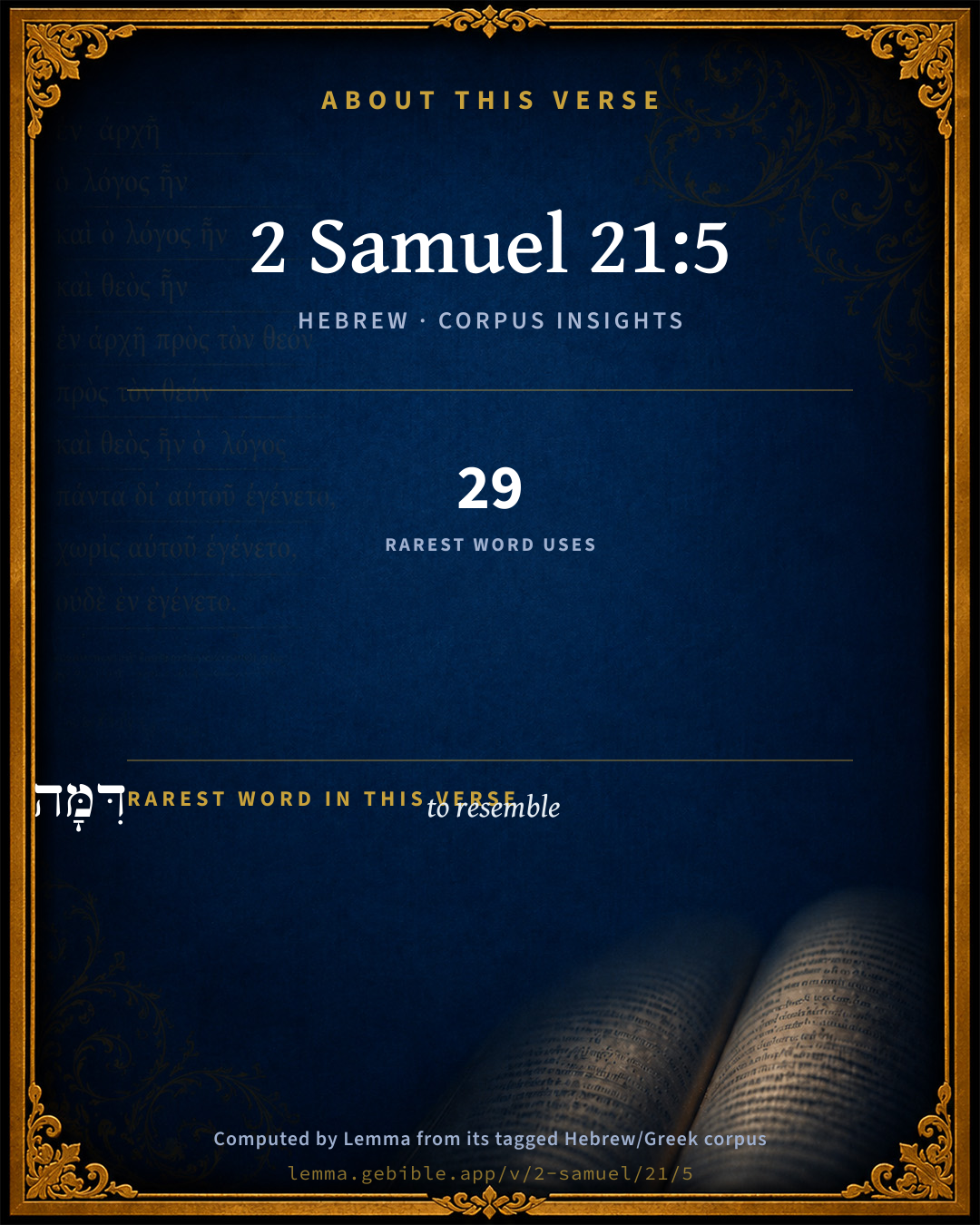
דִּמָּה
dâmâh
H1819
“to resemble”
Verb, Piel, Perfect, 3rd Person, Masculine, Singular
Part of Speech
Verb
Stem
Piel
Form
Perfect
Person
3rd Person
Gender
Masculine
Number
Singular
Full BDB Definition

Origin: a primitive root

TWOT: 437

to be like, resemble - (Qal) to be like, resemble - (Piel) - to liken, compare - to imagine, think - (Hithpael) to make oneself like - (Niphal)
  1. וַיֹּֽאמְרוּ֙ ʼâmar H559 “and · to say” Conjunction + Verb, Qal, Sequential Imperfect, 3rd Person, Masculine, Plural
  2. אֶל ʼêl H413 “to” Preposition
  3. הַמֶּ֔לֶךְ melek H4428 “the · king” Particle, Definite Article + Noun, Common, Masculine, Singular, Absolute
  4. הָאִישׁ֙ ʼîysh H376 “the · man” Particle, Definite Article + Noun, Common, Masculine, Singular, Absolute
  5. אֲשֶׁ֣ר ʼăsher H834 “which” Particle, Relative
  6. כִּלָּ֔נוּ kâlâh H3615 “to finish · us” Verb, Piel, Perfect, 3rd Person, Masculine, Singular + Suffix, Personal, 1st Person, Common, Plural
  7. וַאֲשֶׁ֖ר ʼăsher H834 “and · which” Conjunction + Particle, Relative
  8. נִשְׁמַ֕דְנוּ shâmad H8045 “to destroy” Verb, Niphal, Perfect, 1st Person, Common, Plural
  9. מֵֽהִתְיַצֵּ֖ב yâtsab H3320 “from · to stand” Preposition + Verb, Hithpael, Infinitive Construct
  10. בְּכָל kôl H3605 “in/at · all of” Preposition + Noun, Common, Masculine, Singular, Construct
  11. גְּבֻ֥ל gᵉbûwl H1366 “border of” Noun, Common, Masculine, Singular, Construct
  12. יִשְׂרָאֵֽל Yisrâʼêl H3478 “Israel” Noun, Proper

About this verse

These counts appear in no published source. They are computed here, from the morphology-tagged text and Lemma’s own curated glosses. What Lemma adds →

14
words
12
distinct lemmas
Historical
section

Shared distinctive vocabulary

דִּמָּה to resemble H1819 occurs in 27 verses of the Hebrew Bible. Also found in:

Grammatical profile

  • 5 verbs
  • 5 nouns
  • 2 prepositions
  • 2 particles

Verb forms

  • וַיֹּֽאמְרוּ֙ Qal · Sequential Imperfect
  • כִּלָּ֔נוּ Piel · Perfect
  • דִּמָּה Piel · Perfect
  • נִשְׁמַ֕דְנוּ Niphal · Perfect
  • מֵֽהִתְיַצֵּ֖ב Hithpael · Infinitive Construct

Repetition

A word recurs within this verse — often emphatic in Hebrew:

  • אֲשֶׁ֣ר which H834 ×2

Hebrew & Septuagint length

In English translation the verse runs 29 words from the Hebrew and 58 from the Septuagint (LXX English) — the Septuagint runs noticeably longer here. See the side-by-side →

A rough comparison of the two English renderings, which tokenize alike — not a word-level alignment.

Word counts can differ between the Hebrew and the Greek without any difference in meaning — e.g. the Hebrew direct-object marker אֵת has no separate Greek word, and Greek often adds the article ὁ.

Cross-references

4

Topical passages linked to 2 Samuel 21:5 in the Treasury of Scripture Knowledge — connected by theme and wording, ordered by reader-vote popularity; previews shown in the World English Bible.

  • 2 Samuel 21:1 There was a famine in the days of David three years, year after year; and David sought the face of Yahweh. Yahweh said, It is for Saul, and for his bloody house, because he put to death the Gibeonites.
  • Esther 9:24–25 because Haman the son of Hammedatha, the Agagite, the enemy of all the Jews, had plotted against the Jews to destroy them, and had cast Pur, that is the lot, to consume them, and to destroy them;
  • Daniel 9:26 After the sixty-two weeks the Anointed One shall be cut off, and shall have nothing: and the people of the prince who shall come shall destroy the city and the sanctuary; and the end of it shall be with a flood, and even to the end shall be war; desolations are determined.
  • Matthew 7:2 For with whatever judgment you judge, you will be judged; and with whatever measure you measure, it will be measured to you.

Cross-references courtesy of OpenBible.info (CC BY 4.0).

Hebrew and Greek witnesses Masoretic Hebrew ↔ Greek Septuagint

The same verse in the two great witnesses to the Old Testament, shown verse-for-verse.

Here the Septuagint runs noticeably longer than the Hebrew — LXX2012 (modern English Septuagint) 58 words vs World English Bible 29. A rough length comparison of the two English translations, not a word-level alignment — read both below.

These are two independent witnesses, not word-aligned to each other, and the Septuagint is shown in lemma (dictionary) form.

Hebrew 2 Samuel 21:5 Masoretic · Westminster Leningrad Codex

וַיֹּֽאמְרוּ֙ אֶל הַמֶּ֔לֶךְ הָאִישׁ֙ אֲשֶׁ֣ר כִּלָּ֔נוּ וַאֲשֶׁ֖ר דִּמָּה לָ֑נוּ נִשְׁמַ֕דְנוּ מֵֽהִתְיַצֵּ֖ב בְּכָל גְּבֻ֥ל יִשְׂרָאֵֽל

They said to the king, The man who consumed us, and who devised against us, [that] we should be destroyed from remaining in any of the borders of Israel,

World English Bible · Public Domain

Greek LXX 2 Samuel 21:5 Septuagint · lemma form

καί εἶπον πρός ὁ βασιλεύς ὁ ἀνήρ συντελέω ἐπί ἐγώ καί διώκω ἐγώ ὅς παραλογίζομαι ἐκὀλεθρεύω ἐγώ ἀπο ἀναἵζω αὐτός ὁ μή ἵστημι αὐτός ἐν πᾶς ὅριον ἰσραήλ

And he said, What say you⌃? speak, and I will do it for you. And they said to the king, The man who would have made an end of us, and persecuted us, who plotted against us to destroy us, let us utterly destroy him, so that he shall have no standing in all the coasts of Israel.

LXX2012 (modern English Septuagint) · Public Domain

Hebrew: Westminster Leningrad Codex (CC BY 4.0). Greek: Septuagint (public domain); English from LXX2012 (modern English Septuagint) (Public Domain). How the Septuagint differs from the Hebrew →

Targum (Aramaic paraphrase)

1

The Targum is the ancient Jewish Aramaic paraphrase of the Hebrew Scriptures — an interpretive translation, not the Hebrew text itself. Onkelos (literal) and Pseudo-Jonathan (expansive) render the Torah, and Jonathan the Prophets. Coverage is partial: where no permissively-licensed English translation exists for a verse, only the Aramaic is shown. This is verse-level text, not a word-by-word alignment to the Hebrew.

  1. Targum Jonathan Prophets (Joshua–Malachi)
    וַאֲמַרוּ לְמַלְכָּא גַבְרָא דְשֵׁצְיָנָא וּדְחַשֵׁב לָנָא אִשְׁתֵּיצֵינָא מִלְמֵידַר בְּכָל תְּחוּם אַרְעָא דְיִשְׂרָאֵל:

    (no public-domain English translation for this verse)

    Targum Jonathan — Aramaic: “Mikraot Gedolot” (public domain). English: “Sefaria Community Translation” (CC0 1.0 (public-domain dedication)); “London "Chaldee Paraphrase," 1871” (public domain). Text via Sefaria.

Commentary

Notes on 2 Samuel 21:5 from classic Christian and Jewish commentators (each source and its license shown beneath its notes). The classic Christian expositions comment on the surrounding passage and are grouped to its opening verse, so a note may address several verses; the Jewish commentaries on the Tanakh (Rashi and others) are per-verse, so they appear only where the commentator wrote on this verse.

Lemma curates 59 commentaries, every one of them public domain or Creative Commons licensed, each selected and text-cleaned for this edition rather than reprinted as found. About our sources →

Trapp's Complete Commentary

John Trapp

2Sa 21:5 And they answered the king, The man that consumed us, and that devised against us [that] we should be destroyed from remaining in any of the coasts of Israel,

Ver. 5. The man that consumed us and devised against us.] Saul, who not only murdered and massacred many of us out of a blind and bloody zeal, but also plotted and practised our utter extermination, though we are proselytes and professors of the truth according to godliness.

John Trapp, A Commentary or Exposition upon All the Books of the Old and New Testament (1647–1656) — public domain. Text from a community e-Sword module.

Joseph Benson's Commentary

2Sa 21:5-6. They answered, The man that consumed us, &c. — They desired no reparation of private damages, or revenge of injuries; all they required was that a public sacrifice should be made to justice, and to the divine vengeance inflicted upon the land. Let seven of his sons be delivered unto us, and we will hang them up before the Lord — As a satisfaction to his honour for an injustice and cruelty committed in defiance of a solemn oath given in his holy name. But it may be inquired, if Saul was thus wicked in destroying a people contrary to a solemn oath, ratified in the name of God, why should his sons and grandsons be punished for it? To this it may be answered, with great reason, and upon a good foundation, that they were not punished because Saul was guilty, but because they themselves were guilty, and had been the executioners of his unjust decrees. We have reason to conclude that his sons and his grandsons were among his captains of hundreds, and captains of thousands, as that was the practice of those days: and if so, undoubtedly they were employed in executing his cruel and unjust commands in regard to the Gibeonites, especially as the purpose of destroying them seems to have been to take their possessions; for we can scarcely suppose Saul to have been so solicitous to increase the fortunes of any, as those of his sons and grandsons. And this supposition the text before us seems to prove, as it not only entitles Saul bloody, but his house too: Saul and his bloody house. And it is likely that some of these still possessed some of the possessions of the Gibeonites, and that they defended and commended this action of Saul whenever there was any question about it: and, therefore, they very justly and deservedly suffered for it. See Delaney. In Gibeah of Saul — To make the punishment more remarkable and shameful, this being the city where Saul lived both before and after he was king. Whom the Lord did choose — This aggravated his guilt, that he had broken the oath of that God by whom he had been so highly favoured.

And the king said, I will give them — Having doubtless consulted God in the matter; who, as he had before declared Saul’s bloody house to be the cause of this judgment, so now commanded that justice should be done upon it, and that the remaining branches of it should be cut off; as sufficiently appears from hence that God was well pleased with the action; which he would not have been if David had done it without his command; for then it had been a sinful action of David’s, and contrary to a double law of God. Deu 21:23; Deu 24:16.

But here another question arises; supposing Saul’s sons and grandsons engaged in the fact, and therefore justly punished for it, how came it, or for what reason was it, that the whole people of Israel were afflicted with famine on that account? Undoubtedly because they were partakers too in Saul’s guilt, and had been abetting, aiding, and assisting in it; or, at least, had not opposed it, as they ought to have done. It is said expressly that Saul sought to slay the Gibeonites in his zeal for the children of Israel and Judah. Is it not absurd to think that any thing was done in zeal for them which they did not approve of? Or is there much reason to doubt whether they did not lend their hand to it? Is there the least colour to believe that they in any degree remonstrated against or opposed this proceeding of their prince? as they had a right, nay, were obliged by all the laws of justice to do, as a nation bound to make good the public faith they had given, and sworn to preserve. And if this was the case, were they not guilty as well as Saul, and were they not with justice punished?

Joseph Benson's Commentary on the Old and New Testaments (1811–1818) — public domain. Text from a community e-Sword module.

The Cambridge Bible for Schools and Colleges

gen. ed. J. J. S. Perowne

5. devised] This, and not the marginal alternative cut us off, is the right rendering.

in any of the coasts] In all the borders. Coast, from costa, a rib or side, originally meant any border or frontier-line, not the sea-line only; and then, like the Lat. fines, the territory enclosed by the border.

The Cambridge Bible for Schools and Colleges (gen. ed. J. J. S. Perowne; Cambridge University Press, 1878–1918) — public domain. Text from a community e-Sword module.

John Gill's Exposition

And they answered the king,.... Declaring expressly what they would have done: the man that consumed us; meaning Saul, who lessened their number by cruel oppressions of some, and by taking away the lives of others:

and that devised against us, that we should be destroyed from remaining in any of the coasts of Israel; who had formed schemes, and published edicts, for banishing them out of the land; perhaps at the same time that he put away wizards and those that had familiar spirits out of the land, under the same pretence for zeal for the glory of God, and the good of the people of the land, Sa1 28:3.

John Gill's Exposition of the Whole Bible (1746–1763) — public domain (CC PDM 1.0). Text via the HelloAO Bible API.

Matthew Poole's English Annotations

That we should be either killed, or banished from the land of Israel; which is as bad as death to us, because here, and here only, God is truly worshipped and enjoyed. Whereby it seems divers of them were hearty proselytes, and godly persons; and therefore God is more severe in punishing the injuries done to them. Compare 1Sa 26:19.

Matthew Poole's English Annotations on the Holy Bible (1683–1685) — public domain. Text from a community e-Sword/MySword module.

The Pulpit Commentary

The man that consumed us, etc. The strong language of this verse makes it plain that Saul had been guilty, not merely of some one great act of cruelty, but of a long series of barbarities intended to bring about their utter extirpation.

The Pulpit Commentary (1880–1919), ed. H.D.M. Spence-Jones & Joseph S. Exell — public domain. Text from a community e-Sword module.

unfoldingWord translationNotes

Door43 World Missions Community

who schemed against us

"who made plans against us"

let seven men from his descendants be handed over to us

This can be stated in active form. AT: "allow your men to give seven of his descendants to us" (See: Active or Passive)

we will hang them

"we will execute them by hanging"

in Gibeah of Saul

Saul was from the town of Gibeah.

the one chosen by Yahweh

This can be stated in active form. AT: "the one whom Yahweh chose" (See: Active or Passive)

translationWords

descend

hand

hang

Gibeah

chosen one

unfoldingWord translationNotes — © Distant Shores Media and the Door43 World Missions Community, licensed CC BY-SA 4.0. Source: git.door43.org/Door43/en_tn.

Rashi

Rabbi Shlomo Yitzchaki (Rashi)

And intended to destroy us. He said in his heart that we should be destroyed [and prevented] by him "from establishing etc." He intended to destroy us.

Intended. He intended to destroy us.

Rashi on the Tanakh — English translations: “The Judaica Press complete Tanach with Rashi, translated by A. J. Rosenberg” (CC BY 4.0); “Pentateuch with Rashi's commentary by M. Rosenbaum and A.M. Silbermann, 1929-1934” (public domain); “The Metsudah Tanach series, Lakewood, N.J” (CC BY 4.0); and “The Book of Joshua, Metsudah Publications, 1997” (CC BY 4.0). Text via Sefaria.

Lesson kit

Teaching starters — assembled from the data on this page, not authored interpretation. Every prompt links to the verse data it draws on. Edit before teaching.

2 Samuel, in the Historical, opens this verse with 14 words (12 distinct Hebrew lemmas). Its most distinctive word is dâmâh (“to resemble”). The Greek Septuagint runs longer here. A historical commentator’s framing appears above. Read the whole chapter for the surrounding context.

Discussion questions

  1. What does “to resemble” (dâmâh) contribute to the verse as a whole?
  2. How does Numbers 33:56, which shares the word «to resemble», read alongside this verse?
  3. What does the repetition of “which” (2× in this one verse) do in this verse?
  4. The Septuagint runs longer here than the Hebrew. What might account for the difference?
  5. These translations render this verse differently; the difference is in the English rendering, not the original. What questions does that raise?
  6. «וַיֹּֽאמְרוּ֙» is a Qal Sequential Imperfect verb. How does that grammatical form shape the action described?
  7. Compare how Trapp's Complete Commentary and Joseph Benson's Commentary read this verse. Where do they agree or differ?

Things to notice

Reading settings

Reading text

Shown beneath each verse's original-language words.

Old Testament
Old Testament edition

Read the OT as the Masoretic Hebrew (MT) or the Greek Septuagint (LXX).

English shown for the Greek Septuagint (in the Hebrew ↔ Greek comparison).

Comparing translations? Open the Compare panel on any verse page to stack up to four side by side.