
Ezekiel 42:15

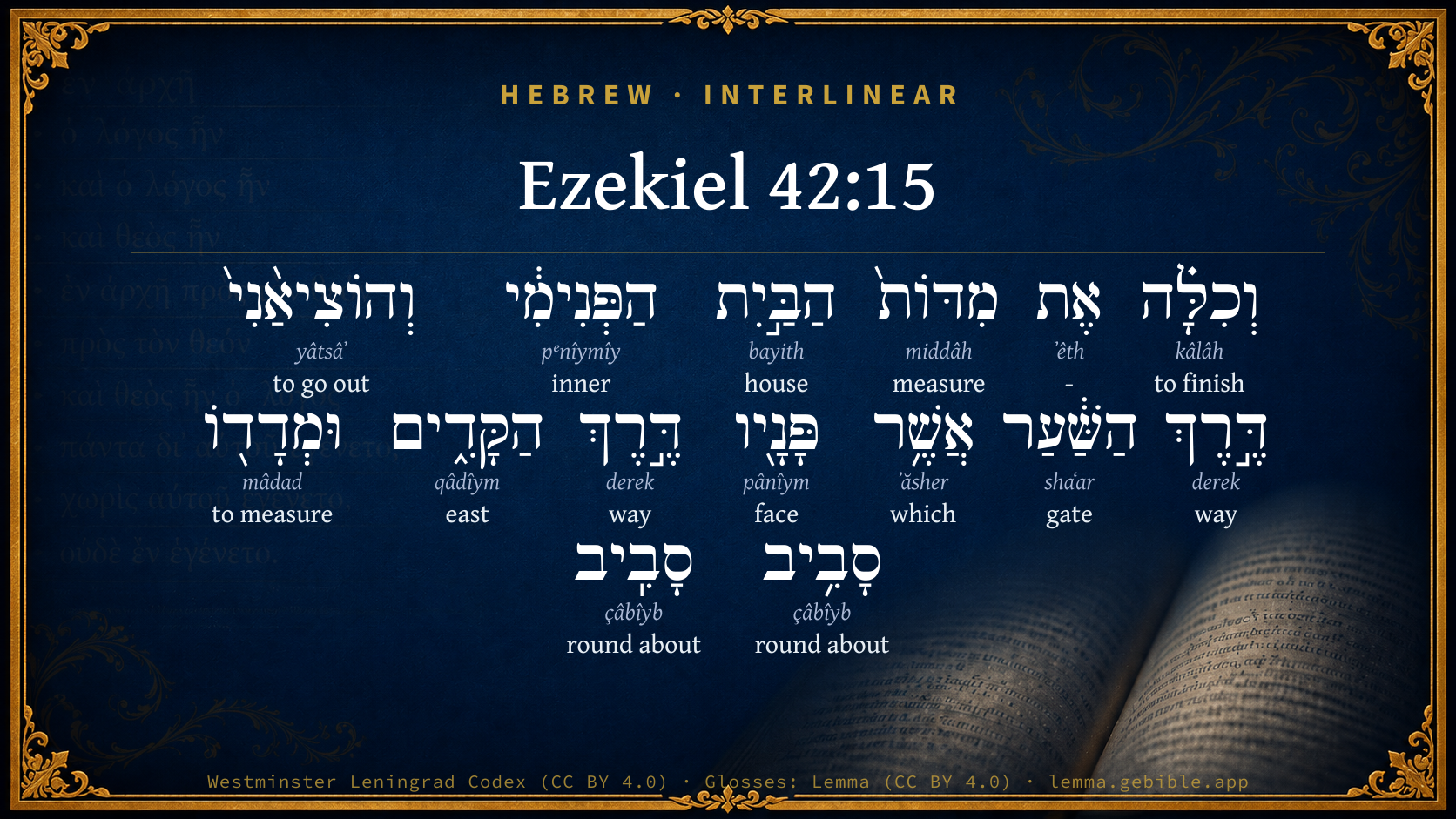
Hebrew (Westminster Leningrad Codex) Ezekiel 42:15 appears in the Hebrew Old Testament. The text above is from the Westminster Leningrad Codex. Each word links to its Strong’s number, a concise gloss, and parsing drawn from the Open Scriptures Hebrew Bible morphology. Click any word for its full Brown-Driver-Briggs (BDB) entry.
Download image
Cite this verse

Ezekiel 42:15 (World English Bible). Public Domain. Lemma interlinear Bible study tool, https://lemma.gebible.app/v/ezekiel/42/15.

Show BibTeX & RIS
BibTeX
RIS
English Translation
Now when he had made an end of measuring the inner house, he brought me forth by the way of the gate whose prospect is toward the east, and measured it round about.
World English Bible · Public Domain
Download a study sheet

One document with this verse’s original text, its word-by-word gloss line, the meaning frame, cross-references with their text, attributed commentary, and full source and license credits — printable, and it pastes into notes with its structure intact.

This verse Autodidact and up

Study sheet (.html) Plain text (.txt)

A passage Seminary Student

Up to 50 verses in one chapter. A passage sheet keeps up to 6 commentary sources and 12 cross-references per verse, in the order this page ranks them, and says so on the sheet whenever that leaves anything out. Ask for a single verse and you get the Autodidact verse sheet above.

Everything on this page stays free to read, with no account — the sheet is a download of what is already on screen, not access to it.

Want to remove ads? Support Godless Engineer
Compare translations 3

The same verse in 3 English versions, stacked beneath the original-language interlinear above. Click any original word for its lexicon entry.

Each is an independent rendering of the whole verse — the interlinear is not word-aligned to these translations.

Highlighted words mark where these versions differ — a whole-verse word diff, not a word-by-word alignment.

  • World English Bible Public Domain
    Now when he had made an end of measuring the inner house, he brought me forth by the way of the gate whose prospect is toward the east, and measured it round about.
  • King James Version Public Domain
    Now when he had made an end of measuring the inner house, he brought me forth toward the gate whose prospect is toward the east, and measured it round about.
  • unfoldingWord Literal Text CC BY-SA 4.0
    The man completed measuring the inner house and then took me out to the gate that faced the east and measured all the surrounding area there.

unfoldingWord Literal Text — © unfoldingWord, licensed CC BY-SA 4.0. Word-aligned USFM3 via Door43 (git.door43.org/unfoldingWord/en_ult).

Versions to compare (up to 4)

3 of 4 selected

Show all 18 translations

Every available English version of this verse, each an independent rendering of the whole verse.

  • World English Bible Public Domain
    Now when he had made an end of measuring the inner house, he brought me forth by the way of the gate whose prospect is toward the east, and measured it round about.
  • Berean Standard Bible Public Domain
    Now when the man had finished measuring the interior of the temple area, he led me out by the gate that faced east, and he measured the area all around:
  • Majority Standard Bible Public Domain
    Now when the man had finished measuring the interior of the temple area, he led me out by the gate that faced east, and he measured the area all around:
  • King James Version Public Domain
    Now when he had made an end of measuring the inner house, he brought me forth toward the gate whose prospect is toward the east, and measured it round about.
  • American Standard Version (1901) Public Domain
    Now when he had made an end of measuring the inner house, he brought me forth by the way of the gate whose prospect is toward the east, and measured it round about.
  • Revised Version (1885) Public Domain
    Now when he had made an end of measuring the inner house, he brought me forth by the way of the gate whose prospect is toward the east, and measured it round about.
  • Geneva Bible (1599) Public Domain
    Nowe when he had made an ende of measuring the inner house, he brought mee forth toward the gate whose prospect is towarde the East, and measured it round about.
  • Douay-Rheims (1899) Public Domain
    Now when he had made an end of measuring the inner house, he brought me out by the way of the gate that looked toward the east: and he measured it on every side round about.
  • Young's Literal Translation Public Domain
    And he hath finished the measurements of the inner house, and hath brought me forth the way of the gate whose front `is' eastward, and he hath measured it all round about.
  • Literal Standard Version CC BY-SA 4.0
    And he has finished the measurements of the inner house, and has brought me forth the way of the gate whose front [is] eastward, and he has measured it all around.
  • Unlocked Literal Bible CC BY-SA 4.0
    The man completed measuring the inner house and then took me out to the gate that faced the east and measured all the surrounding area there.
  • unfoldingWord Literal Text CC BY-SA 4.0
    The man completed measuring the inner house and then took me out to the gate that faced the east and measured all the surrounding area there.
  • Darby Bible Public Domain
    And when he had made an end of measuring the inner house, he brought me forth toward the gate whose front was toward the east, and measured [the enclosure] round about.
  • World Messianic Bible Public Domain
    Now when he had finished measuring the inner house, he brought me out by the way of the gate which faces toward the east, and measured it all around.
  • Webster's Bible Public Domain
    Now when he had made an end of measuring the inner house, he brought me forth towards the gate whose prospect is towards the east, and measured it around.
  • Free Bible Version CC BY-SA 4.0
    After the man finished measuring inside of the Temple area, he took me out through the east gate, and he measured the surrounding area as well.
  • Bible in Basic English Public Domain
    And when he had come to the end of measuring the inner house, he took me out to the doorway looking to the east, and took its measure all round.
  • JPS Tanakh (1917) Public Domain
    Now when he had made an end of measuring the inner house, he brought me forth by the way of the gate whose prospect is toward the east, and measured it round about.

Literal Standard Version (2020), Covenant Press — licensed CC BY-SA 4.0. Text via the HelloAO Bible API (eBible.org). Unlocked Literal Bible (unfoldingWord) — licensed CC BY-SA 4.0. Text via the HelloAO Bible API (eBible.org). unfoldingWord Literal Text — © unfoldingWord, licensed CC BY-SA 4.0. Word-aligned USFM3 via Door43 (git.door43.org/unfoldingWord/en_ult). Free Bible Version, Dr. Jonathan Gallagher — licensed CC BY-SA 4.0. Text via the HelloAO Bible API (eBible.org).

Word by word

More ways to search: Search by grammar → Find every occurrence → Compare this word →

Practice this passage: Drill this verse → Learn its vocabulary →

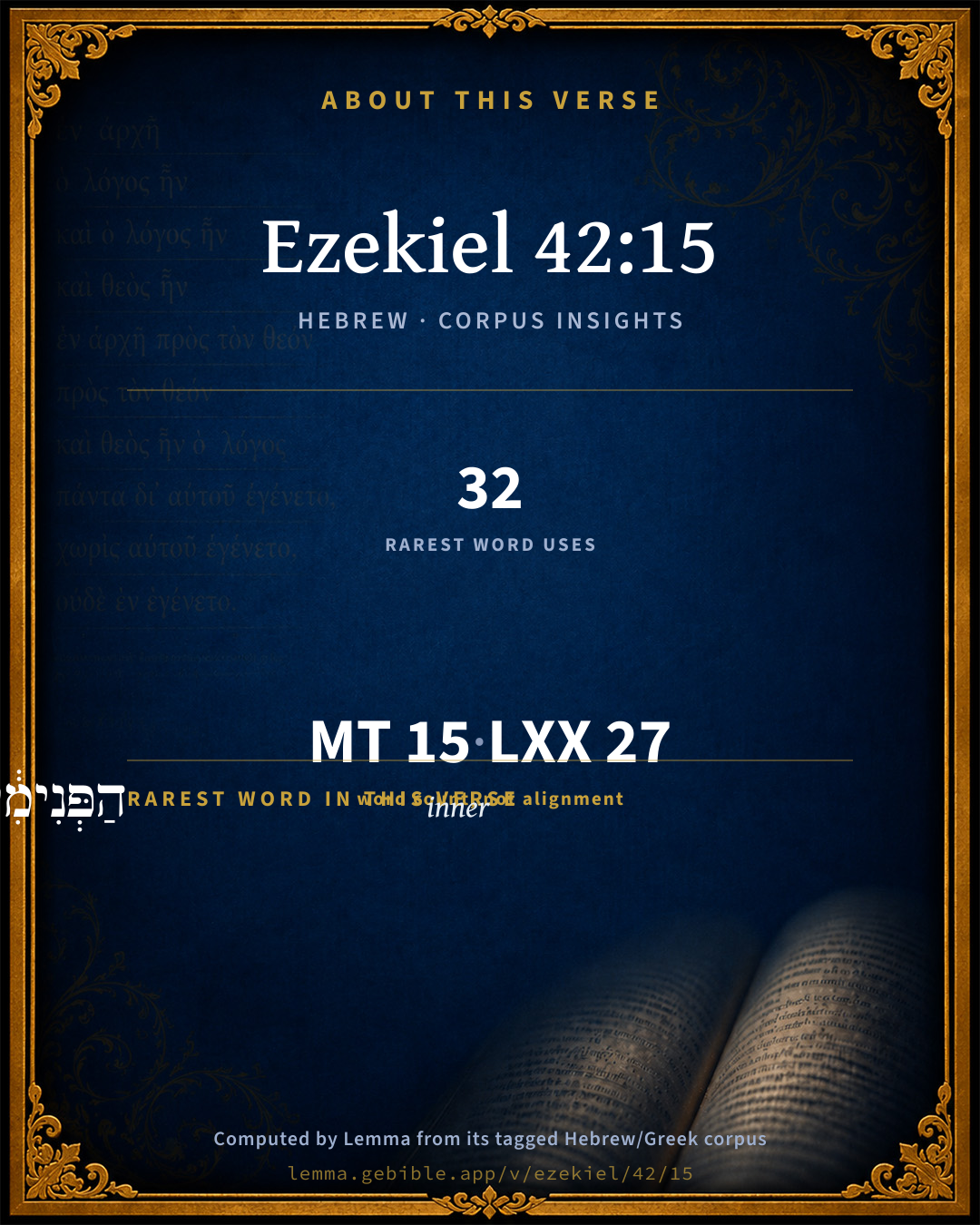
הַפְּנִימִ֔י
pᵉnîymîy
H6442
“the · inner”
Particle, Definite Article + Adjective, Adjective, Masculine, Singular, Absolute
Part of Speech
Particle + Adjective
Type
Adjective
Gender
Masculine
Number
Singular
State
Absolute
Full BDB Definition

Origin: from H6440

TWOT: 1782d

inner
  1. וְכִלָּ֗ה kâlâh H3615 “and · to finish” Conjunction + Verb, Piel, Perfect, 3rd Person, Masculine, Singular
  2. אֶת ʼêth H853 “-” Particle, Direct Object
  3. מִדּוֹת֙ middâh H4060 “measures of” Noun, Common, Feminine, Plural, Construct
  4. הַבַּ֣יִת bayith H1004 “the · house” Particle, Definite Article + Noun, Common, Masculine, Singular, Absolute
  5. וְהוֹצִיאַ֨נִי֙ yâtsâʼ H3318 “and · to go out · me” Conjunction + Verb, Hiphil, Perfect, 3rd Person, Masculine, Singular + Suffix, Personal, 1st Person, Common, Singular
  6. דֶּ֣רֶךְ derek H1870 “way of” Noun, Common, Both, Singular, Construct
  7. הַשַּׁ֔עַר shaʻar H8179 “the · gate” Particle, Definite Article + Noun, Common, Masculine, Singular, Absolute
  8. אֲשֶׁ֥ר ʼăsher H834 “which” Particle, Relative
  9. פָּנָ֖יו pânîym H6440 “face(s) · his” Noun, Common, Both, Plural, Construct + Suffix, Personal, 3rd Person, Masculine, Singular
  10. דֶּ֣רֶךְ derek H1870 “way of” Noun, Common, Both, Singular, Construct
  11. הַקָּדִ֑ים qâdîym H6921 “the · east” Particle, Definite Article + Noun, Common, Masculine, Singular, Absolute
  12. וּמְדָד֖וֹ mâdad H4058 “and · to measure · him” Conjunction + Verb, Qal, Perfect, 3rd Person, Masculine, Singular + Suffix, Personal, 3rd Person, Masculine, Singular
  13. סָבִ֥יב çâbîyb H5439 “round about” Noun, Common, Both, Singular, Absolute
  14. סָבִֽיב çâbîyb H5439 “round about” Noun, Common, Both, Singular, Absolute

About this verse

These counts appear in no published source. They are computed here, from the morphology-tagged text and Lemma’s own curated glosses. What Lemma adds →

15
words
13
distinct lemmas
Prophets
section

Shared distinctive vocabulary

הַפְּנִימִ֔י inner H6442 occurs in 29 verses of the Hebrew Bible. Also found in:

Grammatical profile

  • 3 verbs
  • 9 nouns
  • 1 adjective
  • 2 particles

Verb forms

  • וְכִלָּ֗ה Piel · Perfect
  • וְהוֹצִיאַ֨נִי֙ Hiphil · Perfect
  • וּמְדָד֖וֹ Qal · Perfect

Repetition

Words recur within this verse — often emphatic in Hebrew:

  • דֶּ֣רֶךְ way H1870 ×2
  • סָבִ֥יב round about H5439 ×2

Hebrew & Septuagint length

In English translation the verse runs 33 words from the Hebrew and 34 from the Septuagint (LXX English) — closely comparable.

A rough comparison of the two English renderings, which tokenize alike — not a word-level alignment.

Word counts can differ between the Hebrew and the Greek without any difference in meaning — e.g. the Hebrew direct-object marker אֵת has no separate Greek word, and Greek often adds the article ὁ.

In the original languages it is 15 Hebrew tokens and 27 Greek tokens — but the two are counted differently (Hebrew bundles its prefixes and suffixes into one token; the Greek is in lemma form), so that isn’t a like-for-like length.

Cross-references

4

Topical passages linked to Ezekiel 42:15 in the Treasury of Scripture Knowledge — connected by theme and wording, ordered by reader-vote popularity; previews shown in the World English Bible.

  • Ezekiel 43:1 Afterward he brought me to the gate, even the gate that looks toward the east.
  • Ezekiel 40:6–16 Then came he to the gate which looks toward the east, and went up the steps of it: and he measured the threshold of the gate, one reed broad; and the other threshold, one reed broad.
  • Ezekiel 41:2–5 The breadth of the entrance was ten cubits; and the sides of the entrance were five cubits on the one side, and five cubits on the other side: and he measured the length of it, forty cubits, and the breadth, twenty cubits.
  • Ezekiel 41:15 He measured the length of the building before the separate place which was at the back of it, and the galleries of it on the one side and on the other side, one hundred cubits; and the inner temple, and the porches of the court;

Cross-references courtesy of OpenBible.info (CC BY 4.0).

Hebrew and Greek witnesses Masoretic Hebrew ↔ Greek Septuagint

The same verse in the two great witnesses to the Old Testament, shown verse-for-verse.

These are two independent witnesses, not word-aligned to each other, and the Septuagint is shown in lemma (dictionary) form.

Hebrew Ezekiel 42:15 Masoretic · Westminster Leningrad Codex

וְכִלָּ֗ה אֶת מִדּוֹת֙ הַבַּ֣יִת הַפְּנִימִ֔י וְהוֹצִיאַ֨נִי֙ דֶּ֣רֶךְ הַשַּׁ֔עַר אֲשֶׁ֥ר פָּנָ֖יו דֶּ֣רֶךְ הַקָּדִ֑ים וּמְדָד֖וֹ סָבִ֥יב סָבִֽיב

Now when he had made an end of measuring the inner house, he brought me forth by the way of the gate whose prospect is toward the east, and measured it round about.

World English Bible · Public Domain

Greek LXX Ezekiel 42:15 Septuagint · lemma form

καί συντελέω ὁ διαμέτρησις ὁ οἶκος ἔσωθεν καί ἐκἄγω ἐγώ κατά ὁδός ὁ πύλη ὁ βλέπω πρός ἀνατολή καί διαμετρέω ὁ ὑπόδειγμα ὁ οἶκος κυκλόθεν ἐν διάταξις

So the measurement of the house within was accomplished: and he brought me forth by the way of the gate that looks eastward, and measured the plan of the house round about in order.

LXX2012 (modern English Septuagint) · Public Domain

On this verse, Joseph Benson's Commentary discusses the Septuagint’s reading. Read the note in Commentary ↓

Hebrew: Westminster Leningrad Codex (CC BY 4.0). Greek: Septuagint (public domain); English from LXX2012 (modern English Septuagint) (Public Domain). How the Septuagint differs from the Hebrew →

Targum (Aramaic paraphrase)

1

The Targum is the ancient Jewish Aramaic paraphrase of the Hebrew Scriptures — an interpretive translation, not the Hebrew text itself. Onkelos (literal) and Pseudo-Jonathan (expansive) render the Torah, and Jonathan the Prophets. Coverage is partial: where no permissively-licensed English translation exists for a verse, only the Aramaic is shown. This is verse-level text, not a word-by-word alignment to the Hebrew.

  1. Targum Jonathan Prophets (Joshua–Malachi)
    וְשֵׁיצֵי יַת מִשְׁחַת בֵּיתָא גַוָאָה וְאַפְקַנִי בְּאוֹרַח תַּרְעָא דִפְתִיחַ לְאוֹרַח מַדִינְחָא וּמַשְׁחֵהּ סְחוֹר סְחוֹר:

    (no public-domain English translation for this verse)

    Targum Jonathan — Aramaic: “Mikraot Gedolot” (public domain). English: “Sefaria Community Translation” (CC0 1.0 (public-domain dedication)); “London "Chaldee Paraphrase," 1871” (public domain). Text via Sefaria.

Commentary

Notes on Ezekiel 42:15 from classic Christian and Jewish commentators (each source and its license shown beneath its notes). The classic Christian expositions comment on the surrounding passage and are grouped to its opening verse, so a note may address several verses; the Jewish commentaries on the Tanakh (Rashi and others) are per-verse, so they appear only where the commentator wrote on this verse.

Lemma curates 59 commentaries, every one of them public domain or Creative Commons licensed, each selected and text-cleaned for this edition rather than reprinted as found. About our sources →

Trapp's Complete Commentary

John Trapp

Eze 42:15 Now when he had made an end of measuring the inner house, he brought me forth toward the gate whose prospect [is] toward the east, and measured it round about.

Ver. 15. Now when he had made an end of measuring the inner house.] The inner part of the Church. The Church invisible is first and chiefly to be looked into, rather than the external adjuncts, as multitude, prosperity, clarity, antiquity, &c.; the substantials rather than the accidentals. The Church of Rome borrows her mark from the market, plenty or cheapness, &c. Vilissimus pagus, saith Luther. The mean stivilage seems to me to be an ivory palace, if there be but in it a faithful pastor, and a few true believers.

John Trapp, A Commentary or Exposition upon All the Books of the Old and New Testament (1647–1656) — public domain. Text from a community e-Sword module.

Albert Barnes' Notes on the Bible

The Precincts. The temple and its courts were surrounded by an area of exact dimensions 3,000 cubits (1,500 yards) square. See Plan IV.

Eze 42:15

The inner house - The temple and its courts, all that lay within the “wall on the outside of the house Eze 40:5; the gate” is the eastern gate of the outer court.

Measured it round about - The precincts, into which he had brought the seer through the eastern gate of the outer court.

Albert Barnes' Notes on the Bible (1834–1885) — public domain. Text from a community e-Sword/MySword module.

Joseph Benson's Commentary

Eze 42:15-16. When he had made an end of measuring the inner house — The inner house denotes the temple, distinguished from the courts about it; he measured the east side, &c. — This and the following verses contain the measures of the holy mountain, or area, upon which the temple stood, and which is described to be an exact square, consisting of five hundred reeds in measure on each side of it, that is, of very near an English mile. The whole area, therefore, was near four miles in compass; a circuit as large as one-half of the whole city of Jerusalem, in its most flourishing condition, and certainly far greater than that occupied either by Solomon’s temple, with all its out-buildings and courts, or by the temple built after the return of the Jews from Babylon; and indeed greater than the mountain of the temple was capable of containing, according to the description given of it by all the Jewish writers. This proves, as Mr. Scott justly observes, that the vision cannot be explained of any temple that has hitherto been built, or indeed of any literal temple, but must be understood figuratively and mystically. Bishop Newcome indeed, following Capellus, says, “Read here, and Eze 42:17-19, אמות, cubits, for קנים, reeds, with the LXX., Eze 42:17; Eze 42:20.” But the former word, signifying cubits, does not once occur in the Hebrew text, whereas the word rendered reeds is repeated four times. And as to the LXX., it is evident they “had Solomon’s temple in view, and changed reeds for cubits, in order to adjust the dimensions of this temple to those of Solomon’s; and that late writers have proposed the alteration in the text for the same reason. But if men allow themselves to substitute one word for another in the sacred text, because the alterations would render that consistent with their systems which otherwise would be incompatible with them, there is no knowing to what lengths they may proceed. Surely it is better to acknowledge our ignorance on such abstruse subjects than to support a favourite scheme of interpretation, by giving countenance to so dangerous a measure.” We have said above, that the area here described is an exact square; and it is to be observed, that the heavenly Jerusalem, represented to St. John, Rev 21:16, is likewise described as foursquare, that figure being an emblem of solidity. And Ezekiel’s vision, as well as St. John’s, is designed, in its mystical sense, to represent the regularity and strength of Christ’s church and kingdom.

Joseph Benson's Commentary on the Old and New Testaments (1811–1818) — public domain. Text from a community e-Sword module.

Keil & Delitzsch

C. F. Keil & F. Delitzsch

Extent of the Holy Domain around the Temple

Eze 42:15. And when he had finished the measurements of the inner house, he brought me out by the way of the gate, which is directed toward the east, and measured there round about. Eze 42:16. He measured the eastern side with the measuring rod five hundred rods by the measuring rod round about; Eze 42:17. He measured the northern side five hundred rods by the measuring rod round about; Eze 42:18. The southern side he measured five hundred rods by the measuring rod; Eze 42:19. He turned round to the western side, measured five hundred rods by the measuring rod. Eze 42:20. To the four winds he measured it. It had a wall round about; the length was five hundred and the breadth five hundred, to divide between the holy and the common. - There has been a division of opinion from time immemorial concerning the area, the measuring of which is related in these verses, and the length and breadth of which are stated in Eze 42:20 to have been five hundred; as the Seventy, and after them J. D. Michaelis, Bttcher, Maurer, Ewald, and Hitzig, understand by this the space occupied by the temple with its two courts. But as that space was five hundred cubits long and five hundred broad, according to the sum of the measurements given in Ezekiel 40-42:15, the lxx have omitted the word קנים in Eze 42:16, Eze 42:18, and Eze 42:19, whilst they have changed it into πήχεις in Eze 42:17, and have also attached this word to the numbers in Eze 42:20. According to this, only the outer circumference of the temple area would be measured in our verses, and the wall which was five hundred cubits long and five hundred cubits broad (Eze 42:20) would be the surrounding wall of the outer court mentioned in Eze 40:5. Eze 42:15 could certainly be made to harmonize with this view. For even if we understood by the "inner house" not merely the temple house, which the expression primarily indicates, but the whole of the inner building, i.e., all the buildings found in the inner and outer court, and by the east gate the eastern gate of the outer court; the expression 'מדדו סביב , "he measured it round about," merely affirms that he measured something round about outside this gate. The suffix in מדדו is indefinite, and cannot be taken as referring to any of the objects mentioned before, either to השּׁער or to הבּית הפּנימי. The inner house he had already measured; and the measurements which follow are not applicable to the gate. Nor can the suffix be taken as referring to הבּית, illam sc. aedem (Ros.); or at any rate, there is nothing in Eze 42:20 to sustain such a reference. Nevertheless, we might think of a measuring of the outer sides of the whole building comprehended under the idea of the inner house, and regard the wall mentioned in Eze 42:20 as that which had been measured round about on the outer side both in length and breadth. But it is difficult to reconcile this view even with Eze 42:20; and with the measurements given in Eze 42:16-19 it is perfectly irreconcilable. Even if we were disposed to expunge קנים as a gloss in Eze 42:16, Eze 42:17, Eze 42:18, and Eze 42:19, the words, "he measured the east side with the measuring rod, five hundred by the measuring rod," are equivalent to five hundred rods, according to the well-known Hebrew usage; just as indisputably as מאה, a hundred by the cubit, is equivalent to a hundred cubits (see the comm. on Eze 40:21 at the close). The rejection of קנים as an imaginary gloss is therefore not only arbitrary, but also useless; as the appended words בּקנה המּדּה, even without קנים, affirm that the five hundred were not cubits, but rods.

(Note: The חמשׁ אמות for חמשׁ מאות in Eze 42:16 is utterly useless as a proof that cubits and not rods are intended; as it is obviously a copyist's error, a fact which even the Masoretes admit. Rabbi ben-Asher's view of this writing is an interesting one. Prof. Dr. Delitzsch has sent me the following, taken from a fragment in his possession copied from a codex of the Royal Library at Copenhagen. R. ben-Asher reckons אמות among the מוקדם ומאוחר, i.e., words written ὑστερον προτερον, of which there are forty-seven in the whole of the Old Testament, the following being quoted by ben-Asher (l.c.) by way of example: גּלון, Jos 20:8; Jos 21:27; ויּקּלהוּ, Sa2 20:14; בּעברות, Sa2 15:28; והימשׁני, Jdg 16:26; ותּראנה, Sa1 14:27.)

The סביב in Eze 42:16 and Eze 42:17 is not to be understood as signifying that on the east and north sides he measured a square on each side of five hundred rods in length and breadth, but simply indicates that he measured on all sides, as is obvious from Eze 42:20. For according to this, the space which was measured toward every quarter at five hundred rods had a boundary wall, which was five hundred rods long on every side. This gives an area of 250,000 square rods; whereas the temple,with the inner and outer courts, covered only a square of five hundred cubits in length and breadth, or 250,000 square cubits. It is evident from this that the measuring related in Eze 42:15-20 does not refer to the space occupied by the temple and its courts, and therefore that the wall which the measured space had around it (Eze 42:20) cannot be the wall of the outer court mentioned in Eze 40:5, the sides of which were not more than five hundred cubits long. The meaning is rather, that around this wall, which enclosed the temple and its courts, a further space of five hundred rods in length and breadth was measured off "to separate between the holy and profane," i.e., a space which was intended to form a separating domain between the sanctuary and the common land. The purpose thus assigned for the space, which was measured off on all four sides of the "inner house," leaves no doubt remaining that it was not the length of the surrounding wall of the outer court that was measured, but a space outside this wall. The following clause חומה , "a wall was round about it," is irreconcilable with the idea that the suffix in מדדו (Eze 40:20 and Eze 40:15) refers to this wall, inasmuch as the לו can only refer to the object indicated by the suffix attached to מדדו. This object, i.e., the space which was five hundred rods long and the same broad round about, i.e., on every one of the four sides, had a wall enclosing it on the outside, and forming the partition between the holy and the common. הקּדשׁ is therefore הבּית הפּנימי, "the inner house;" but this is not the temple house with its side-building, but the sanctuary of the temple with its two courts and their buildings, which was measured in Ezekiel 40:5-42:12.

The arguments which have been adduced in opposition to this explanation of our verses, - the only one in harmony with the words of the text, - and in vindication of the alterations made in the text by the lxx, are without any force. According to Bttcher (p. 355), Hitzig, and others, קנים is likely to be a false gloss, (1) "because בּקנה המּדּה stands close to it; and while this is quite needless after קנים, it may also have occasioned the gloss." But this tells rather against the suspicion that קנים is a gloss, since, as we have already observed, according to the Hebrew mode of expression, the "five hundred" would be defined as rods by בּקנה המּדּה, even without קנים. Ezekiel, however, had added בּקנה המּדּה for the purpose of expressing in the clearest manner the fact that the reference here is not to cubits, but to a new measurement of an extraordinary kind, to which nothing corresponding could be shown in the earlier temple. And the Seventy, by retaining this clause, ἐν καλάμῳ τοῦ μέτρου, have pronounced sentence upon their own change of the rods into cubits; and it is no answer to this that the Talmud (Midd. c. ii. note 5) also gives only five hundred cubits to the הר הבּ, since this Talmudic description is treating of the historical temple and not of Ezekiel's prophetic picture of a temple, although the Rabbins have transferred various statements from the latter to the former. The second and third reasons are weaker still - viz. "because there is no other instance in which the measurement is expressed by rods in the plural; and, on the other hand, אמּה is frequently omitted as being the ordinary measurement, and therefore taken for granted." For the first assertion is proved to be erroneous, not only by our verses, but also by Eze 45:1. and Eze 48:16., whilst there is no force whatever in the second. The last argument employed is a more plausible one - namely, that "the five hundred rods are not in keeping with the sanctuary, because the edifice with the courts and gates would look but a little pile according to the previous measurements in the wide expanse of 20,000 (?) rods." But although the space measured off around the temple-building for the separation between the holy and the profane was five times as long and five times as broad, according to the Hebrew text, or twenty-five times as large as the whole extent of the temple and its courts,

(a) Area of the temple with the two courts, 500 cubits square.

(b) Surrounding space, five hundred rods = 3000 cubits square.

(c) Circuit of fifty cubits in breadth around the surrounding space. - Eze 45:2

the appearance of the temple with its courts is not diminished in consequence, because the surrounding space was not covered with buildings; on the contrary, the fact that it was separated from the common by so large a surrounding space, would rather add to the importance of the temple with its courts. This broad separation is peculiar to Ezekiel's temple, and serves, like many other arrangements in the new sanctuary and worship, to symbolize the inviolable holiness of that sanctuary. The earlier sanctuary had nothing answering to this; and Kliefoth is wrong in supposing that the outer court served the same purpose in the tabernacle and Solomon's temple, whereas in the temple of Ezekiel this had also become part of the sanctuary, and was itself holy. The tabernacle had no outer court at all, and in Solomon's temple the outer court did form a component part of the sanctuary. The people might enter it, no doubt, when they desired to draw near to the Lord with sacrifices and gifts; but this continued to be the case in Ezekiel's temple, though with certain restrictions (cf. Eze 46:9 and Eze 46:10). Only, in the case of Solomon's temple, the outer court bordered directly upon the common soil of the city and the land, so that the defilement of the land produced by the sin of the people could penetrate directly even into the holy space of the courts. In the sanctuary of the future, a safeguard was to be placed against this by the surrounding space which separated the holy from the common. It is true that the surface of Moriah supplied no room for this space of five hundred rods square; but the new temple was not to be built upon the real Moriah, but upon a very high mountain, which the Lord would exalt and make ready for the purpose when the temple was erected. Moreover, the circumstance that Moriah was much too small for the extent of the new temple and its surroundings, cannot furnish any argument against the correctness of our view of the verses in question, for the simple reason that in Ezekiel 45 and 48 there follow still further statements concerning the separation of the sanctuary from the rest of the land, which are in perfect harmony with this, and show most indisputably that the temple seen by Ezekiel was not to have its seat in the ancient Jerusalem.

Keil & Delitzsch — Biblical Commentary on the Old Testament (1861–1891) — public domain (CC PDM 1.0). Text via the HelloAO Bible API. (Old Testament only.)

Fairbairn on Ezekiel, Jonah & the Pastoral Epistles

Patrick Fairbairn

Eze 42:15. And he finished the measurements of the house inwards, and he brought me forth by the gate which looks toward the east, and he measured it round about.

Eze 42:16. He measured the east side (literally, wind) with the measuring rod, 500 rods, with the measuring rod round about.

Eze 42:17. He measured the north side, 500 rods, with the measuring rod round about.

Eze 42:18. He measured the south side, 500 rods, with the measuring rod.

Eze 42:19. He turned about to the west side, and measured 500 rods with the measuring rod.

Eze 42:20. By the four sides he measured it; it had a wall round about, 500 long, and 500 broad, to make a separation between the holy and the profane.

We cannot but note the particularity with which these measurements are given,—the rod as the measuring instrument, and the number of lengths on each side, being successively stated in regard to each. This plainly shows the importance which the prophet attached to the external dimensions, while the frequent occurrence also of the terms employed more fully certifies us of their exact amount. Yet from an early period a disposition has been shown to tamper with the numbers. The Septuagint substitutes cubits for rods, and the great mass of modern commentators (still also Ewald, Hitzig, Böttcher, Thenius, the latter in his Anhang to the Com. on Kings) have thought it necessary to adopt the same alteration. The chief reasons for this are, first, the apparently extravagant compass assigned to the sacred buildings—a square of 500 rods, or 3000 cubits, and these cubits about two feet each (Eze 40:5), making in all a square of fully 11/7 of a mile. There can be no doubt that this exceeded the limits of all ancient Jerusalem; and so, it is thought, the prophet could never intend to give such enormous bounds to his new temple; he must have meant cubits only, and not rods. Then it is also alleged that the particular measurements in the preceding portion do not require a space larger than a square of 500 cubits, and that the adoption of rods here instead of cubits would necessarily leave an immense space of unappropriated ground. Hävernick has tried to evade this argument by denying that the 100 cubits mentioned in connection with the outer and inner courts (Eze 40:23, Eze 40:27) are given as the measures of the whole breadth of these, and contending that they apply only to the distance between one gate and another in the same court. I cannot concur in this, for I think the natural supposition is, that the gates between which the distances in question lay were simply those of the two courts respectively. But if by rejecting that method of relief we seem to have far too much space on hand, by adopting the smaller measures of cubits instead of rods we should have decidedly top little. I think this might be proved by reckoning up the different items of the several measures connected with the temple itself and the separate place. But as we should thus inevitably get into intricacies where few would follow, we prefer establishing our position by a simpler process. In the central part to the east of the temple there was a square of 100 cubits, the court of the priests. But if on three sides of an entire square of 500 cubits you take off first 100 cubits for the outer court, then 100 for the inner, with nothing intervening, there would be left precisely this square of 100 more for the court of the priests. But where, then, was the space to be found for the broad outermost wall, outside of which the measurement of 500 was made—six cubits all round? Where, again, for the seven steps leading up to the gate of the inner court, and the breadth of the wall dividing it from the outer? And where, once again, space for the eight steps leading up to the court of the priests, and the buildings of many chambers for them? There is evidently no room for these on the cubit hypothesis, which would require the different courts to be enclosed, and separated from each other by strictly mathematical lines; so that the objection of too much ground by the measurements of the text may fairly be met by the too little of the hypothesis.

In truth, we have here another of those traits which render manifest, and, I believe, were intended to render manifest and palpable, the ideal character of the whole description. It is of a nature throughout which defies all attempts to bring it within the bounds of the real. Those who have endeavoured so to deal with it have always been obliged to resort to numberless arbitrary suppositions and violent adjustments. And, in particular, the vast compass the prophet so explicitly and distinctly assigns to the whole area, involving a sort of natural incongruity, like the promise of the new David in the prophecies of the restoration, must ever be regarded as an inseparable obstacle to their superficial literalism. It is an incontrovertible evidence that the prophet had something else in his eye than the masonry of stone and lime erections, and was labouring with conceptions which could only find their embodiment in the high realities of God’s everlasting kingdom.

We abide, then, by the Hebrew text as the true handwriting of the prophet, the very difficulties of which are a proof of their correctness; and we regard the immense extent of the sacred area as a symbol of the vast enlargement that was to be given to the kingdom of God in the times of Messiah. It was immeasurably to surpass the old in the extent of its territory, and in the number of its adherents, as well as in the purity of its worship. The wall that surrounded the sacred buildings is expressly said, in Eze 42:20, to have been for separating between the holy and profane; not, therefore, as in Rev 21:12, and very commonly elsewhere, for defence and safety, as indeed its comparative want of elevation might seem to render it unfit for such a purpose. But its square form, and the square appearance of the entire buildings (as in John’s city, Rev 21:16), betokened the strength and solidity of the whole, along with a vast increase in extent and number. A perfect cube, it was the emblem of a kingdom that could not be shaken or removed. And thus every way it exhibited to the eye of faith the true ideal of that pure and glorious temple which, resting on the foundation of the eternal Son, and girt round by all the perfections of Godhead, shall shine forth the best and noblest workmanship of Heaven.

Patrick Fairbairn — An Exposition of Ezekiel (1851), Jonah (1849), and The Pastoral Epistles (1874) — public domain. Text from a community e-Sword module.

Matthew Henry's Commentary

We have attended the measuring of this mystical temple and are now to see how far the holy ground on which we tread extends; and that also is here measured, and found to take in a great compass. Observe, 1. What the dimensions of it were. It extended each way 500 reeds (Eze 42:16-19), each reed above three yards and a half, so that it reached every way about an English measured mile, which, the ground lying square, was above four miles round. Thus large were the suburbs (as I may call them) of this mystical temple, signifying the great extent of the church in gospel-times, when all nations should be discipled and the kingdoms of the world made Christ's kingdoms. Room should be made in God's courts for the numerous forces of the Gentiles that shall flow into them, as was foretold, Isa 49:18; Isa 60:4. It is in part fulfilled already in the accession of the Gentiles to the church; and we trust it shall have a more full accomplishment when the fulness of the Gentiles shall come in and all Israel shall be saved. 2. Why the dimensions of it were made thus large. It was to make a separation, by putting a very large distance between the sanctuary and the profane place; and therefore there was a wall surrounding it, to keep off those that were unclean and to separate between the previous and the vile. Note, A difference is to be put between common and sacred things, between God's name and other names, between his day and other days, his book and other books, his institutions and other observances; and a distance is to be put between our worldly and religious actions, so as still to go about the worship of God with a solemn pause.

Matthew Henry's Commentary on the Whole Bible (1708–1710) — public domain (CC PDM 1.0). Text via the HelloAO Bible API.

Ellicott's Commentary for English Readers

(15) The inner house.—This expression is here evidently used neither of the Holy of Holies, nor of the whole Temple building exclusively, but of all that had been measured, all that was included within the wall of the outer court. The prophet is led out from this by the eastern gate to measure a much larger space around it. It is not said in what part of this space the Temple with its courts was situated; but, for the reason given in Eze_42:20, it is to be supposed that it was in the centre.

A Bible Commentary for English Readers, edited by Charles John Ellicott (1878–1897) — public domain. Text from a community e-Sword module.

The Cambridge Bible for Schools and Colleges

gen. ed. J. J. S. Perowne

15. measured it] i.e. whole building, along the outer wall.

15–20. Measurements of the whole complex of the temple buildings on the outside

The measuring angel began by measuring the height and thickness of the outside surrounding wall (Eze_40:5); then he entered the outer gate, passing into the outer court, the measurements of which were made (Eze_40:6-27); then he entered the inner court, containing the house and cells, all of which he measured (Eze_40:28 to Eze_42:14). These measures being completed, the angel now returns to the outside by the way he entered, the eastern gate, and finishes by measuring the compass of the whole temple buildings outside. This building, its surrounding wall being measured, forms a square of 500 cubits.

The Cambridge Bible for Schools and Colleges (gen. ed. J. J. S. Perowne; Cambridge University Press, 1878–1918) — public domain. Text from a community e-Sword module.

John Gill's Exposition

Now when he had made an end of measuring the inner house,.... The holy place, and the holy of holies, with all the courts and chambers belonging to them; even the whole building within the compass of the outermost wall, and all that pertained unto it; the chambers last mentioned, as well as the rest, the dimensions of, which are given in this and the two preceding chapters:

he brought me forth toward the gate whose prospect is toward the east: not to the east gate of the outward wall, but to the east gate which led into the outward court; the gate he was first brought unto, and which was first measured, Eze 40:6, and measured it round about; not the east gate, nor the outward wall that went all round the house; though this was measured, and its dimensions given, last of all; nor the house itself, which had been measured already; or the figure of it, as the Septuagint and Arabic versions; but all that space that was between this building and the wall that surrounded it; the area or compass of ground on which the building stood.

John Gill's Exposition of the Whole Bible (1746–1763) — public domain (CC PDM 1.0). Text via the HelloAO Bible API.

Matthew Poole's English Annotations

The inner house; the holy of holies, the temple, and all the buildings that were in it, and its inner courts.

He brought me forth, quite out to the outmost court, and wall of it, which compassed all the rest of the courts.

Toward the gate whose prospect is toward the east; to the east gate of the outside wall, mentioned Eze 40:6, which see.

Round about, i.e. the four squares of the wall for this, as the other walls, was square, not round, and therefore this round about is to be understood of measuring all four equilateral sides or parallels.

Matthew Poole's English Annotations on the Holy Bible (1683–1685) — public domain. Text from a community e-Sword/MySword module.

Whedon's Commentary on the Bible

Daniel D. Whedon

15-20. If the present Hebrew text is to be followed, we have here a measurement of an outer wall, encompassing the temple quadrangle, three thousand sacred cubits (three thousand five hundred common cubits) long on every side. However, as this wall is not mentioned elsewhere, many scholars follow the LXX. text, reading “cubit,” instead of “reed.” Such a wall five hundred cubits on each side is spoken of Eze_45:2, and is entirely in accordance with the other measurements as given in detail. Yet if the Hebrew manuscripts originally read “cubit,” how could the word “reed” have been substituted for it? It is easy to see how the LXX. might in this, as in other cases, have changed the unusual statement to that which was more easily understood. No literal temple nine million square cubits in area could have been accommodated on any one of the mountains of Palestine. The reed is elsewhere very seldom used as a measure. (Yet see Eze_45:1; Eze_48:16.) In either case this wall was to mark the boundary between the sacred and the common (compare Eze_43:12; Eze_45:4), and whether the measurement was in cubits or reeds, the symbolism was the same. The perfect cube emblemed the perfect temple — the ideal church in the midst of the ideal nation.

Daniel D. Whedon (gen. ed.), Commentary on the Old and New Testaments (1874–1909) — public domain. Text from a community e-Sword module.

The Pulpit Commentary

Vers. 15-20The temple precincts. The seer"s guide, having completed his measurement of the house with its courts, proceeds to measure its encompassing wall, for this purpose conducting the prophet out by the east gate, and measuring, first the east, next the north, thirdly the south, and lastly the west wall, each five hundred reeds in length, or three thousand cubits, so that the entire area of the quadrangle amounted to 3000 3000 = 9, 000, 000 square cubits, equivalent to 2, 250, 000 square yards.

The inner house was not the temple as distinguished from its courts, but the temple with its courts, which lay within the wall about to be measured.

Vers. 15-19The symmetry of the sanctuary.

The measurements which are in this part of Ezekiel"s prophecies given with such abundance and such minuteness are intended primarily to convey the impression that the temple which was seen in vision was a building of perfect beauty, harmony, and completeness. But the material building was a figure of a spiritual edifice, and the material qualities ascribed to it were significant of moral attributes of the profoundest interest. And the structure, made without hands, yet possessing every quality that can command admiration and reverence, is none other than the Church of the living God.

I THE SYMMETRY OF THE CHURCH FOLLOWS FROM ITS BEING PLANNED BY GOD"S WISDOM. The tabernacle was constructed according to the pattern shown by God to Moses in the mount. The plan and details of Solomon"s temple are attributed to Divine inspiration. And the Church of Christ is in the New Testament compared to the temple, with its Divine foundation, its ample precincts, its spiritual sacrifices, its accepted worshippers. All the productions of the Divine mind are perfect. When God looks upon his works he pronounces them to be "very good." Upon the Church, as upon what possesses a higher interest and value than aught material, Divine wisdom has expended all its resources. And the perfectly symmetrical product is just what might be expected. In God s mind the spiritual temple is faultlessly perfect; and the actual Church is destined to realize the glorious ideal.

II THE SYMMETRY OF THE CHURCH RESULTS FROM ITS CONSTRUCTION UPON THE MODEL OF CHRIST HIMSELF. The humanity of the Lord Jesus was the temple of God. And when he departed from earth he left his representative in the Church which he redeemed and sanctified, and which he appointed to continue in his stead unto the end of time. The temple of his body was succeeded by the spiritual temple, built up of loyal and living souls. If Christ contained within himself, if Christ exhibited in his life, every moral perfection, it is manifest that the Church, which is his body, must perpetuate the spiritual excellences which existed in himself.

III THE SYMMETRY OF THE CHURCH IS WROUGHT BY THE INSPIRATION AND GOVERNMENT OF THE HOLY SPIRIT. There is a Divine presence in the Church, which, so far from being merely passive, is vital, energetic, and transforming. Who has not admired the action of certain physical and vital principles which produce the marvelous symmetry of crystals, and the yet more marvelous symmetry of every form of vegetable and animal life? What takes place in the natural kingdom is transcended by what occurs in the spiritual realm, although these results are not in the same way apparent to the senses of the observer, and appeal rather to his spiritual discernment and susceptibilities. But the provision for the growth and prosperity of Christ"s Church, the provision for ministers and officers, for cooperation and sympathy in Church worship and Church work, all tell of a Spirit informing, inspiring, and directing the whole, and producing a result of marvelous and admirable harmony and spiritual beauty.

IV THE SYMMETRY OF THE CHURCH WILL REACH ITS FULL AND PERFECT DEVELOPMENT IN THE HEAVENLY STATE. Who call read this portion of Ezekiel"s prophecies, and the corresponding chapters from the Book of the Revelation, without forming the conviction that, however this world may be the scene of the Church"s discipline, the scene of the Church"s maturity is elsewhere, is above? The heavenly temple is, in glory anti beauty, faintly imaged by the Church militant on earth. Yonder all imperfections shall be removed, all deficiencies shall be supplied, all holy tendencies shall be fully developed, all promise shall be fulfilled. There the city and the temple are one; for of the heavenly Jerusalem it is said, "The Lord God Almighty and the Lamb are the temple thereof. T.

Vers. 15-20The size and strength of the kingdom.

particularity with which these measurements are given. shows the importance attached by the prophet to the external dimensions... The compass assigned to the sacred buildings exceeded the limits of all ancient Jerusalem Here is another of those traits intended to render manifest the ideal character of the whole description" (Fairbairn). The fulfillment is found in the glorious magnitude of the Church of Christ, of which the temple was designed to be the type. We look, then, at

I THE SIZE OF THE KINGDOM. The kingdom of Christ is indeed of vast dimensions; it requires a heavenly messenger to compute it.

1. It is inclusive of all classes and characters. It is not confined to rich or poor, or to those who have "neither poverty nor riches;" it is not intended for the learned any more than for the unlearned; it is the home of those who have been devout and upright all their days, and it offers an asylum to those who have wandered away into the darkness and fallen into the depths of sin.

2. It is unlimited by race. The Jew at first imagined that the kingdom was for him only; but it was not long before the providence and the grace of God demonstrated that the kingdom of Christ was open to the whole Gentile world; and missionary labors have proved that there is no climate beneath the sun where the seeds of Christian truth will not spring up and bear flower and fruit.

3. It is extended through all time. Nineteen centuries have nearly gone since John declared that the kingdom was "at hand," and, so far from there being any signs of completion, there is more active and successful evangelization than at any previous period of Church history. The prophet might well see a large space measured when the area of the kingdom was in question.

II THE STRENGTH OF THE KINGDOM. This temple is a perfect square, five hundred reeds on every side. "Buildings which are four-square are the most stable, firm, and lasting." The kingdom of Christ is immovably strong, and nothing can withstand it, because:

1. It rests on the basis of Divine truth. Not "cunningly devised fables," but well-established facts, are the foundation on which the fair, spiritual edifice is resting the facts of the Incarnation, of the works of beneficent power wrought, of the words of truth and grace spoken, of the resurrection from the dead accomplished by Jesus Christ; the facts of the apostolic ministry, of the opposition offered to the gospel and of its steady, spiritual, glorious triumph over it.

2. It meets the deep and abiding needs of our humanity. Beneath all skies, under all conditions, through all changes and circumstances, after all political and social revolutions, man wants the same things to be truly and profoundly satisfied. He wants a Divine Father of his spirit; a salvation from sin; a refuge in time of trouble; a source of elevation in all the meanness and littleness of earthly life; hope in death. This the gospel of Christ is always offering him. To hungering, toiling, sorrowing, burdened humanity Jesus Christ is ever saying, "Come unto me I will give you rest.

3. It relies on the Divine power and presence. "All power is given to me in heaven and in earth; go ye, therefore, and teach all nations lo, I am with you always," etc.. (Mat_28:18-20) In the presence, the sympathetic and active presence, of the all-powerful Redeemer we have the strongest assurance that the kingdom will extend and prevail; it is strong in its present and mighty Lord. C.

The Pulpit Commentary (1880–1919), ed. H.D.M. Spence-Jones & Joseph S. Exell — public domain. Text from a community e-Sword module.

Kretzmann's Popular Commentary

Paul E. Kretzmann

The Outside Measurements

v. 15. Now, when He had made an end of measuring the inner house, the Temple-buildings proper, He brought me forth toward the gate whose prospect is toward the east and measured it round about, the outer circumference of all that was comprised within the Sanctuary area.

v. 16. He measured the east side with the measuring-reed, five hundred reeds, with the measuring-reed round about.

v. 17. He measured the north side, five hundred reeds, with the measuring-reed round about.

v. 18. He measured the south side, five hundred reeds, with the measuring-reed.

v. 19. He turned about to the west side and measured five hundred reeds with the measuring-reed. The dimensions of the Temple proper were thus five hundred cubits square, but the entire area in which the Temple was situated was five hundred rods square.

v. 20. He measured it by the four sides; it had a wall round about, five hundred reeds long and five hundred broad, to make a separation between the Sanctuary and the profane place, so that the separation would he clearly observed, not between Jew and Gentile, but between sacred and profane. The vast extent of time area of this singular Temple is a feature which clearly marks its ideal character. "It symbolizes the great enlargement of the kingdom of God, when Jehovah-Messiah shall reign to the ends of time earth. "

Paul E. Kretzmann, Popular Commentary of the Bible (1921–1924) — public domain. Text from a community e-Sword module.

unfoldingWord translationNotes

Door43 World Missions Community

to the gate that faced the east

"out to the east gate" or "out through the east gate"

translationWords

house

gate

face

unfoldingWord translationNotes — © Distant Shores Media and the Door43 World Missions Community, licensed CC BY-SA 4.0. Source: git.door43.org/Door43/en_tn.

Rashi

Rabbi Shlomo Yitzchaki (Rashi)

and he measured it round about the entire outer perimeter of the Temple Mount.

Rashi on the Tanakh — English translations: “The Judaica Press complete Tanach with Rashi, translated by A. J. Rosenberg” (CC BY 4.0); “Pentateuch with Rashi's commentary by M. Rosenbaum and A.M. Silbermann, 1929-1934” (public domain); “The Metsudah Tanach series, Lakewood, N.J” (CC BY 4.0); and “The Book of Joshua, Metsudah Publications, 1997” (CC BY 4.0). Text via Sefaria.

Lesson kit

Teaching starters — assembled from the data on this page, not authored interpretation. Every prompt links to the verse data it draws on. Edit before teaching.

Ezekiel, in the Prophets, opens this verse with 15 words (13 distinct Hebrew lemmas). Its most distinctive word is pᵉnîymîy (“inner”). A historical commentator’s framing appears above. Read the whole chapter for the surrounding context.

Discussion questions

  1. The word pᵉnîymîy carries the sense “inner.” How does it shape the verse?
  2. How does 1 Kings 6:27, which shares the word «inner», read alongside this verse?
  3. What does the repetition of “way” (2× in this one verse) do in this verse?
  4. These translations render this verse differently; the difference is in the English rendering, not the original. What questions does that raise?
  5. «וְכִלָּ֗ה» is a Piel Perfect verb. How does that grammatical form shape the action described?
  6. Compare how Trapp's Complete Commentary and Albert Barnes' Notes on the Bible read this verse. Where do they agree or differ?

Things to notice

Reading settings

Reading text

Shown beneath each verse's original-language words.

Old Testament
Old Testament edition

Read the OT as the Masoretic Hebrew (MT) or the Greek Septuagint (LXX).

English shown for the Greek Septuagint (in the Hebrew ↔ Greek comparison).

Comparing translations? Open the Compare panel on any verse page to stack up to four side by side.