Numbers 11:28

Hebrew (Westminster Leningrad Codex) Numbers 11:28 appears in the Hebrew Old Testament. The text above is from the Westminster Leningrad Codex. Each word links to its Strong’s number, a concise gloss, and parsing drawn from the Open Scriptures Hebrew Bible morphology. Click any word for its full Brown-Driver-Briggs (BDB) entry.
Download image
Cite this verse

Numbers 11:28 (World English Bible). Public Domain. Lemma interlinear Bible study tool, https://lemma.gebible.app/v/numbers/11/28.

Show BibTeX & RIS
BibTeX
RIS
English Translation
Joshua the son of Nun, the minister of Moses, one of his chosen men, answered, My lord Moses, forbid them.
World English Bible · Public Domain
Highlights
  • 1 first appearance in the Hebrew Bible
Full analysis ↓
Download a study sheet

One document with this verse’s original text, its word-by-word gloss line, the meaning frame, cross-references with their text, attributed commentary, and full source and license credits — printable, and it pastes into notes with its structure intact.

This verse Autodidact and up

Study sheet (.html) Plain text (.txt)

A passage Seminary Student

Up to 50 verses in one chapter. A passage sheet keeps up to 6 commentary sources and 12 cross-references per verse, in the order this page ranks them, and says so on the sheet whenever that leaves anything out. Ask for a single verse and you get the Autodidact verse sheet above.

Everything on this page stays free to read, with no account — the sheet is a download of what is already on screen, not access to it.

Want to remove ads? Support Godless Engineer
Compare translations 3

The same verse in 3 English versions, stacked beneath the original-language interlinear above. Click any original word for its lexicon entry.

Each is an independent rendering of the whole verse — the interlinear is not word-aligned to these translations.

Highlighted words mark where these versions differ — a whole-verse word diff, not a word-by-word alignment.

  • World English Bible Public Domain
    Joshua the son of Nun, the minister of Moses, one of his chosen men, answered, My lord Moses, forbid them.
  • King James Version Public Domain
    And Joshua the son of Nun, the servant of Moses, one of his young men, answered and said, My lord Moses, forbid them.
  • unfoldingWord Literal Text CC BY-SA 4.0
    And Joshua, the son of Nun, the one ministering to Moses from his youth, answered and said, “My lord Moses, restrain them.”

unfoldingWord Literal Text — © unfoldingWord, licensed CC BY-SA 4.0. Word-aligned USFM3 via Door43 (git.door43.org/unfoldingWord/en_ult).

Versions to compare (up to 4)

3 of 4 selected

Show all 18 translations

Every available English version of this verse, each an independent rendering of the whole verse.

  • World English Bible Public Domain
    Joshua the son of Nun, the minister of Moses, one of his chosen men, answered, My lord Moses, forbid them.
  • Berean Standard Bible Public Domain
    Joshua son of Nun, the attendant to Moses since youth, spoke up and said, “Moses, my lord, stop them!”
  • Majority Standard Bible Public Domain
    Joshua son of Nun, the attendant to Moses since youth, spoke up and said, “Moses, my lord, stop them!”
  • King James Version Public Domain
    And Joshua the son of Nun, the servant of Moses, one of his young men, answered and said, My lord Moses, forbid them.
  • American Standard Version (1901) Public Domain
    And Joshua the son of Nun, the minister of Moses, one of his chosen men, answered and said, My lord Moses, forbid them.
  • Revised Version (1885) Public Domain
    And Joshua the son of Nun, the minister of Moses, one of his chosen men, answered and said, My lord Moses, forbid them.
  • Geneva Bible (1599) Public Domain
    And Ioshua the sonne of Nun the seruant of Moses one of his yong men answered and said, My lord Moses, forbid them.
  • Douay-Rheims (1899) Public Domain
    Forthwith Josue the son of Nun, the minister of Moses, and chosen out of many, said: My lord Moses forbid them.
  • Young's Literal Translation Public Domain
    And Joshua son of Nun, minister of Moses, `one' of his young men, answereth and saith, `My lord Moses, restrain them.'
  • Literal Standard Version CC BY-SA 4.0
    And Joshua son of Nun, minister of Moses, [one] of his young men, answers and says, “My lord Moses, restrain them.”
  • Unlocked Literal Bible CC BY-SA 4.0
    Joshua son of Nun, Moses' assistant, one of his chosen men, said to Moses, “My master Moses, stop them.”
  • unfoldingWord Literal Text CC BY-SA 4.0
    And Joshua, the son of Nun, the one ministering to Moses from his youth, answered and said, “My lord Moses, restrain them.”
  • Darby Bible Public Domain
    And Joshua the son of Nun, the attendant of Moses, one of his young men, answered and said, My lord Moses, forbid them!
  • World Messianic Bible Public Domain
    Joshua the son of Nun, the servant of Moses, one of his chosen men, answered, “My lord Moses, forbid them!”
  • Webster's Bible Public Domain
    And Joshua the son of Nun, the servant of Moses, one of his young men, answered and said, My lord, Moses, forbid them.
  • Free Bible Version CC BY-SA 4.0
    Joshua, son of Nun, who had been Moses' assistant since he was young, reacted, saying, “Moses, my lord, you have to stop them!”
  • Bible in Basic English Public Domain
    Then Joshua, the son of Nun, who had been Moses' servant from the time when he was a child, said, My lord Moses, let them be stopped.
  • JPS Tanakh (1917) Public Domain
    And Joshua the son of Nun, the minister of Moses from his youth up, answered and said: 'My lord Moses, shut them in.'

Literal Standard Version (2020), Covenant Press — licensed CC BY-SA 4.0. Text via the HelloAO Bible API (eBible.org). Unlocked Literal Bible (unfoldingWord) — licensed CC BY-SA 4.0. Text via the HelloAO Bible API (eBible.org). unfoldingWord Literal Text — © unfoldingWord, licensed CC BY-SA 4.0. Word-aligned USFM3 via Door43 (git.door43.org/unfoldingWord/en_ult). Free Bible Version, Dr. Jonathan Gallagher — licensed CC BY-SA 4.0. Text via the HelloAO Bible API (eBible.org).

Word by word

More ways to search: Search by grammar → Find every occurrence → Compare this word →

Practice this passage: Drill this verse → Learn its vocabulary →

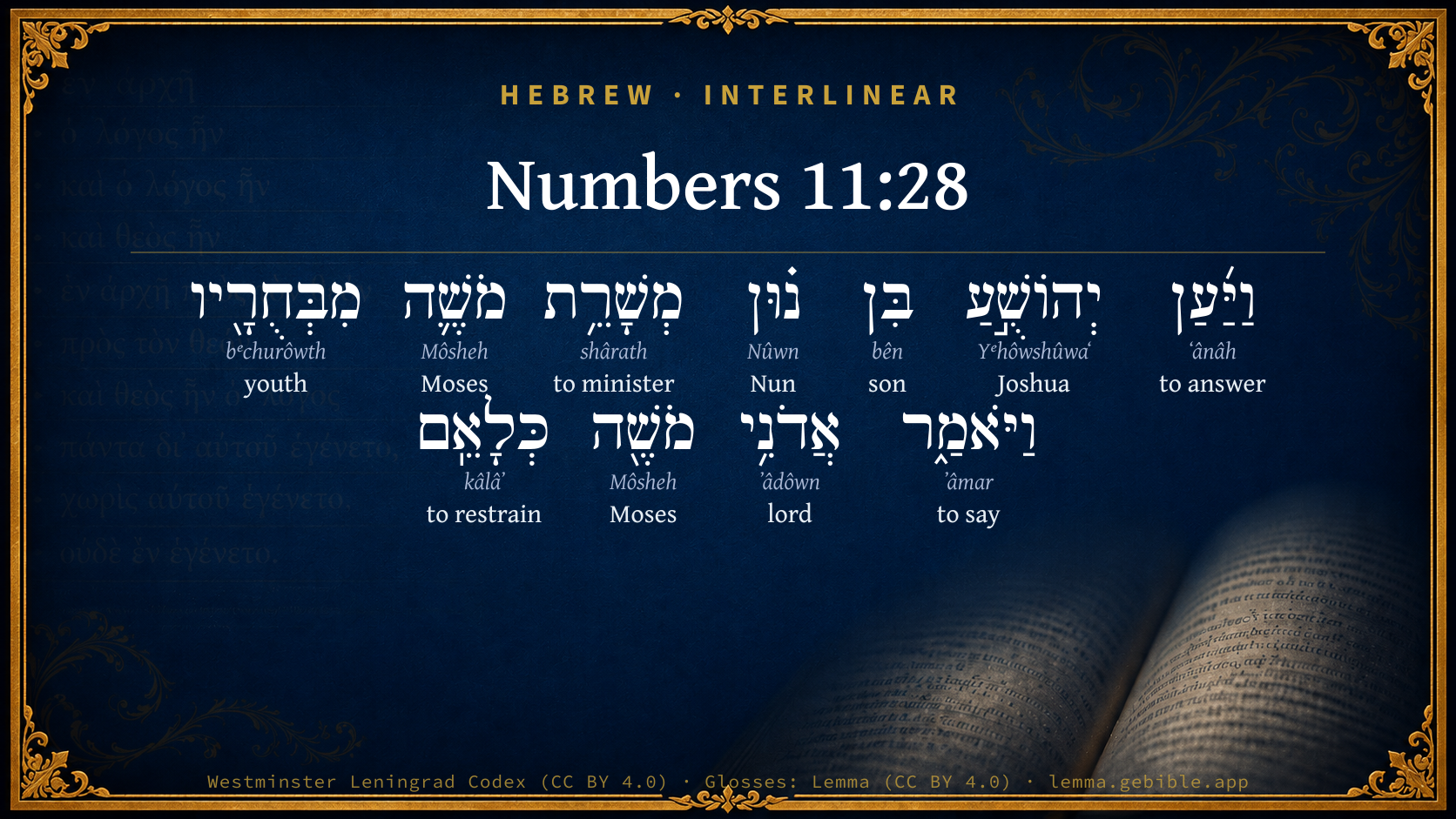
מִבְּחֻרָ֖יו
bᵉchurôwth
H979
“from · youth · his”
Preposition + Noun, Common, Both, Plural, Construct + Suffix, Personal, 3rd Person, Masculine, Singular
Part of Speech
Preposition + Noun
Type
Common
Gender
Both
Number
Plural
State
Construct
Full BDB Definition

Origin: from H970

TWOT: 231b

youth
  1. וַיַּ֜עַן ʻânâh H6030 “and · to answer” Conjunction + Verb, Qal, Sequential Imperfect, 3rd Person, Masculine, Singular
  2. יְהוֹשֻׁ֣עַ Yᵉhôwshûwaʻ H3091 “Joshua” Noun, Proper
  3. בִּן bên H1121 “son of” Noun, Common, Masculine, Singular, Construct
  4. נ֗וּן Nûwn H5126 “Nun” Noun, Proper
  5. מְשָׁרֵ֥ת shârath H8334 “ministering” Verb, Piel, Participle Active, Masculine, Singular, Construct
  6. מֹשֶׁ֛ה Môsheh H4872 “Moses” Noun, Proper
  7. וַיֹּאמַ֑ר ʼâmar H559 “and · to say” Conjunction + Verb, Qal, Sequential Imperfect, 3rd Person, Masculine, Singular
  8. אֲדֹנִ֥י ʼâdôwn H113 “lord · my” Noun, Common, Masculine, Singular, Construct + Suffix, Personal, 1st Person, Common, Singular
  9. מֹשֶׁ֖ה Môsheh H4872 “Moses” Noun, Proper
  10. כְּלָאֵֽם kâlâʼ H3607 “restrain · them” Verb, Qal, Imperative, 2nd Person, Masculine, Singular + Suffix, Personal, 3rd Person, Masculine, Plural

About this verse

These counts appear in no published source. They are computed here, from the morphology-tagged text and Lemma’s own curated glosses. What Lemma adds →

11
words
10
distinct lemmas
Pentateuch
section

Notable vocabulary

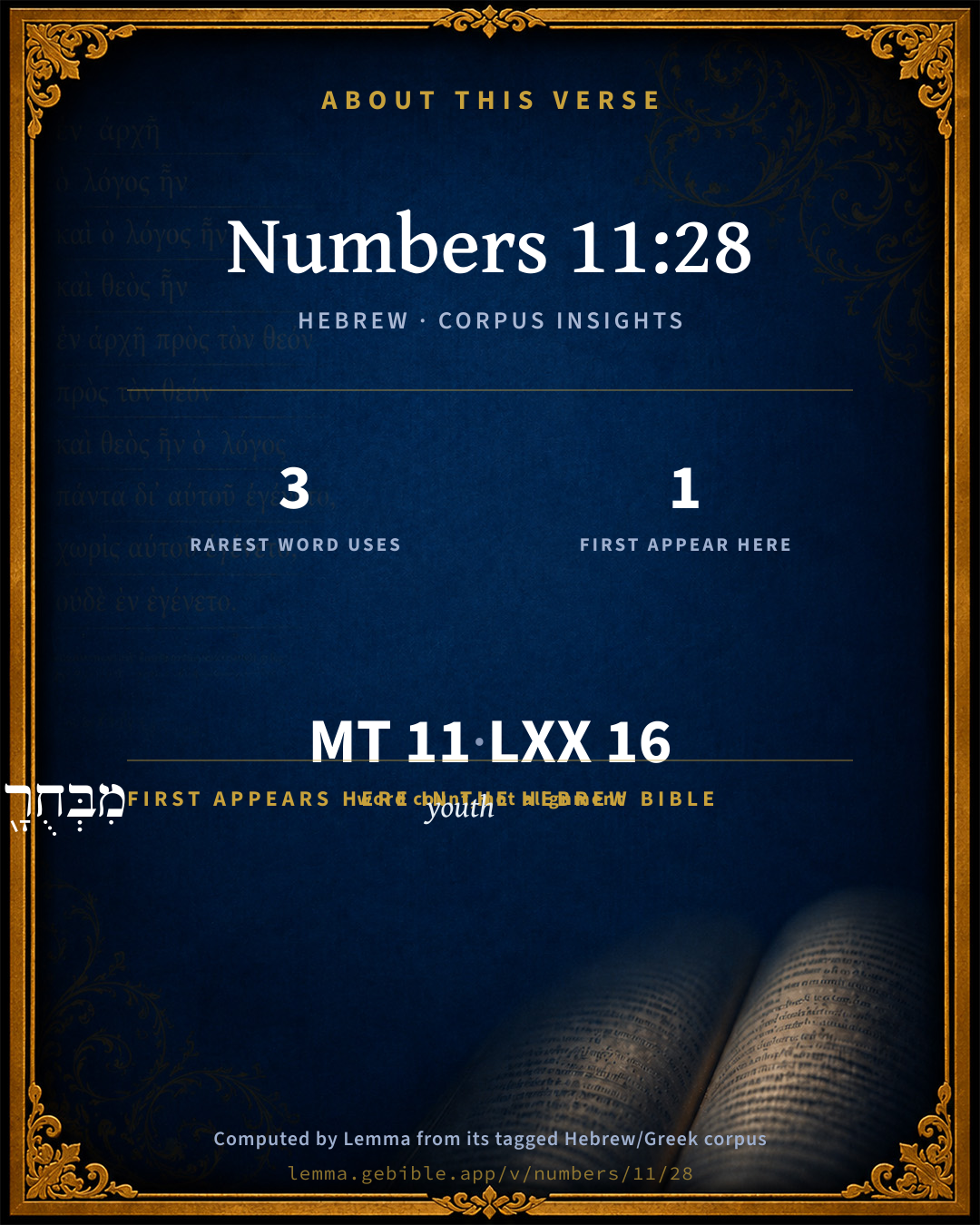
The rarest word here is מִבְּחֻרָ֖יו youth H979 — appearing just 3 times in the whole Hebrew Bible.

First appearance in Scripture

This word makes its first canonical appearance in the Hebrew Bible here:

  • מִבְּחֻרָ֖יו youth H979

Shared distinctive vocabulary

מִבְּחֻרָ֖יו youth H979 occurs in 3 verses of the Hebrew Bible. Also found in:

Grammatical profile

  • 4 verbs
  • 7 nouns

Verb forms

  • וַיַּ֜עַן Qal · Sequential Imperfect
  • מְשָׁרֵ֥ת Piel · Participle Active
  • וַיֹּאמַ֑ר Qal · Sequential Imperfect
  • כְּלָאֵֽם Qal · Imperative

Repetition

A word recurs within this verse — often emphatic in Hebrew:

  • מֹשֶׁ֛ה Moses H4872 ×2

Hebrew & Septuagint length

In English translation the verse runs 20 words from the Hebrew and 19 from the Septuagint (LXX English) — closely comparable.

A rough comparison of the two English renderings, which tokenize alike — not a word-level alignment.

Word counts can differ between the Hebrew and the Greek without any difference in meaning — e.g. the Hebrew direct-object marker אֵת has no separate Greek word, and Greek often adds the article ὁ.

In the original languages it is 11 Hebrew tokens and 16 Greek tokens — but the two are counted differently (Hebrew bundles its prefixes and suffixes into one token; the Greek is in lemma form), so that isn’t a like-for-like length.

Cross-references

6

Topical passages linked to Numbers 11:28 in the Treasury of Scripture Knowledge — connected by theme and wording, ordered by reader-vote popularity; previews shown in the World English Bible.

  • Luke 9:49–50 John answered, "Master, we saw someone casting out demons in your name, and we forbade him, because he doesn't follow with us."
  • Mark 9:38–40 John said to him, "Teacher, we saw someone who doesn't follow us casting out demons in your name; and we forbade him, because he doesn't follow us."
  • John 3:26 They came to John, and said to him, "Rabbi, he who was with you beyond the Jordan, to whom you have testified, behold, the same baptizes, and everyone is coming to him."
  • Joshua 1:1 Now it happened after the death of Moses the servant of Yahweh, that Yahweh spoke to Joshua the son of Nun, Moses' minister, saying,
  • Exodus 17:9 Moses said to Joshua, "Choose men for us, and go out, fight with Amalek. Tomorrow I will stand on the top of the hill with God's rod in my hand."
  • Exodus 33:11 Yahweh spoke to Moses face to face, as a man speaks to his friend. He turned again into the camp, but his servant Joshua, the son of Nun, a young man, didn't depart out of the Tent.

Cross-references courtesy of OpenBible.info (CC BY 4.0).

Hebrew and Greek witnesses Masoretic Hebrew ↔ Greek Septuagint

The same verse in the two great witnesses to the Old Testament, shown verse-for-verse.

These are two independent witnesses, not word-aligned to each other, and the Septuagint is shown in lemma (dictionary) form.

Hebrew Numbers 11:28 Masoretic · Westminster Leningrad Codex

וַיַּ֜עַן יְהוֹשֻׁ֣עַ בִּן נ֗וּן מְשָׁרֵ֥ת מֹשֶׁ֛ה מִבְּחֻרָ֖יו וַיֹּאמַ֑ר אֲדֹנִ֥י מֹשֶׁ֖ה כְּלָאֵֽם

Joshua the son of Nun, the minister of Moses, one of his chosen men, answered, My lord Moses, forbid them.

World English Bible · Public Domain

Greek LXX Numbers 11:28 Septuagint · lemma form

καί ἀποκρίνω ἰησοῦς ὁ ὁ ναυη ὁ παραἵστημι μωυσῆς ὁ ἐκελεκτός εἶπον κύριος μωυσῆς κωλύω αὐτός

And Joshua the son of Naue, who attended on Moses, the chosen one, said, My lord Moses, forbid them.

LXX2012 (modern English Septuagint) · Public Domain

Hebrew: Westminster Leningrad Codex (CC BY 4.0). Greek: Septuagint (public domain); English from LXX2012 (modern English Septuagint) (Public Domain). How the Septuagint differs from the Hebrew →

Targum (Aramaic paraphrase)

2

The Targum is the ancient Jewish Aramaic paraphrase of the Hebrew Scriptures — an interpretive translation, not the Hebrew text itself. Onkelos (literal) and Pseudo-Jonathan (expansive) render the Torah, and Jonathan the Prophets. Coverage is partial: where no permissively-licensed English translation exists for a verse, only the Aramaic is shown. This is verse-level text, not a word-by-word alignment to the Hebrew.

  1. Targum Onkelos Torah (Genesis–Deuteronomy)
    וַאֲתֵב יְהוֹשֻׁעַ בַּר נוּן מְשֻׁמְשִׁנֵהּ דְמשֶׁה מֵעוּלֵמוֹהִי וַאֲמַר רִבּוֹנִי משֶׁה אֲסָרִנוּן

    (no public-domain English translation for this verse)

    Targum Onkelos — Aramaic: “Onkelos Genesis” (public domain); “Onkelos Exodus” (public domain); “Onkelos Leviticus” (public domain); “Onkelos Numbers” (public domain); “Onkelos Deuteronomy” (public domain). English: “Sefaria Community Translation” (CC0 1.0 (public-domain dedication)); “J.W. Etheridge. The Targums of Onkelos and Jonathan Ben Uzziel on the Pentateuch. London: Longmans, Green, 1862” (public domain). Text via Sefaria.

  2. Targum Pseudo-Jonathan Torah (Genesis–Deuteronomy)
    וְאָתֵיב יְהוֹשֻׁעַ בַּר נוּן מְשׁוּמְשָׁנֵיהּ דְמשֶׁה וַאֲמַר רִבּוֹנִי משֶׁה בָּעֵי רַחֲמִין מִן קֳדָם יְיָ וּכְלִי מִנְהוֹן רוּחַ נְבוּאָתָא

    And Jehoshua bar Nun, the minister of Mosheh, answered and said: Ribboni Mosheh, pray for mercy before the Lord, that the Spirit of prophecy may be withheld from them.

    Targum Pseudo-Jonathan — Aramaic: “Targum Jonathan on Genesis” (public domain); “Targum Jonathan on Exodus” (public domain); “Targum Jonathan on Leviticus” (public domain); “Targum Jonathan on Numbers” (public domain); “Targum Jonathan on Deuteronomy” (public domain). English: “The Targum of Jonathan ben Uzziel, trans. J. W. Etheridge, London, 1862” (public domain). Text via Sefaria.

Commentary

Notes on Numbers 11:28 from classic Christian and Jewish commentators (each source and its license shown beneath its notes). The classic Christian expositions comment on the surrounding passage and are grouped to its opening verse, so a note may address several verses; the Jewish commentaries on the Tanakh (Rashi and others) are per-verse, so they appear only where the commentator wrote on this verse.

Lemma curates 59 commentaries, every one of them public domain or Creative Commons licensed, each selected and text-cleaned for this edition rather than reprinted as found. About our sources →

Trapp's Complete Commentary

John Trapp

Num 11:28 And Joshua the son of Nun, the servant of Moses, [one] of his young men, answered and said, My lord Moses, forbid them.

Ver. 28. My lord Moses, forbid.] Thus, "the spirit that is in us lusteth to envy." {Jas 4:5} Nero omnium erat aemulus, qui quoquo mode animum vulgi moverint, Nero envied every man that excelled.

John Trapp, A Commentary or Exposition upon All the Books of the Old and New Testament (1647–1656) — public domain. Text from a community e-Sword module.

Tyndale Open Study Notes

Tyndale Open Resources

11:28-29 Joshua’s zealous protest was prompted by his jealousy in a worthy but immature desire to safeguard his master’s status. Moses was humble (Num 12:3) and was not threatened by Eldad and Medad’s prophecy. Instead, he was magnanimous about sharing the spotlight and happy to learn that God was working through others in such special ways. Moses had leadership qualities that the younger Joshua had not yet acquired (cp. Mark 9:38-40).

Tyndale Open Study Notes — © Tyndale Open Resources, licensed CC BY-SA 4.0. Text via the HelloAO Bible API.

Geneva Bible (1599)

Geneva Bible translators

Or, a young man whom he had chosen from his youth.

Such blind zeal was in the Apostles, Mark 9:38; Luke 9:44.

Geneva Bible (1599) marginal notes — public domain. Text via Bolls.life.

Adam Clarke's Commentary

Verse 28. My lord Moses, forbid them.]

How often have I blindly done

What zealous Joshua did,

Impatient to the rulers run,

And cried, "My lords, forbid!

Silence the schismatics, constrain

Their thoughts with ours t' agree,

And sacrifice the souls of men

To idol UNITY!"

Adam Clarke's Commentary on the Bible (1810–1826) — public domain. Text from a community e-Sword/MySword module.

Ellicott's Commentary for English Readers

(28) My lord Moses, forbid them.—The motive which prompted Joshua in making this request appears to have been similar to that which led St. John to forbid the man to cast out devils who did not follow with the Apostles (Mar_9:38-39; Luk_9:49-50). But as the man did not cast out devils in his own name, but in that of Christ, so in this case Eldad and Medad prophesied in virtue of the spirit which rested upon them from above, of which the Holy Ghost, not Moses, was the giver. The motives which deterred Eldad and Medad from going to the tent of meeting are unknown. The history teaches the freeness and the sovereignty of the Holy Spirit’s influences, as afterwards did that of Cornelius, when the Holy Ghost fell upon him and upon those who were with him, previously to the reception of baptism, and they spoke with tongues and magnified God (Act_10:44-48).

A Bible Commentary for English Readers, edited by Charles John Ellicott (1878–1897) — public domain. Text from a community e-Sword module.

The Cambridge Bible for Schools and Colleges

gen. ed. J. J. S. Perowne

28. Joshua was not one of the seventy, but was attached to the sacred Tent as its aedituus or caretaker. Cf. Exo_33:11.

one of his chosen men] R.V. marg. is probably right—from his youth. But Joshua was still in his youth (Exo_33:11). The narrator, writing long after the event, adds parenthetically a general description of Joshua, not merely a description of what he had been at the moment.

The Cambridge Bible for Schools and Colleges (gen. ed. J. J. S. Perowne; Cambridge University Press, 1878–1918) — public domain. Text from a community e-Sword module.

John Gill's Exposition

And Joshua the son of Nun, the servant of Moses,.... That waited upon him, and ministered to him, and executed his orders, especially in civil things, and was to be his successor:

one of his young men; not that Joshua was a young man in age, for he must be now between fifty and sixty years of age; see Gill on Exo 33:11; nor does the word necessarily suppose that those men were young among whom Joshua was; but choice excellent persons, the principal servants of Moses, at the head of whom Joshua was being his prime minister: the Targum of Onkelos and the Syriac version render it, "from his youth", joining it with the word servant, as if he was the servant of Moses from his youth, or ever since he was a young man; but Moses had not been out of Midian but about two years, where he had kept his father's sheep; however, he

answered and said, my lord Moses, forbid them; prophesying, restrain them from it, suffer them not to go on in it; he would have him exert his authority as the chief magistrate, which he thought was affected by their prophesying without his knowledge and consent; and because a word from the root here used signifies a prison, some here interpret it,"put them in prison,''which is a sense Jarchi mentions; but it can hardly be thought that Joshua meant that such rigorous measures should be taken, only that they should be rebuked for what they had done, and be charged for the future to be silent.

John Gill's Exposition of the Whole Bible (1746–1763) — public domain (CC PDM 1.0). Text via the HelloAO Bible API.

Haydock's Catholic Bible Commentary

Chosen among the seventy, and designed, from his youth, to be the general, and successor of Moses; the Hebrew may be understood in all these senses. See Exodus xvii. 10. (Calmet) --- Josue was afraid lest they had assumed this air of authority in opposition to Moses. St. John addressed our Saviour, under the same impressions of zeal, Luke ix. 49.

George Leo Haydock (1774–1849), Haydock's Catholic Family Bible and Commentary, 1859 edition — public domain. Excludes Psalms (Douay-Rheims chapter numbering differs from Protestant) and Deuterocanonical books (Catholic canon only).

Matthew Poole's English Annotations

One of his young men, or one of his choice ministers, a chosen or excellent person; which may be emphatically added, to note that even great and good men may mistake and misjudge about the works of God. Or, from his youth, as the words will bear, and the Chaldee, Syriac, &c. render it. So it may be added as a reason why Joshua above others were concerned for Moses’s honour and authority. He feared either schism or sedition, or that by their usurpation of authority independently upon Moses, and separately from him, his power and esteem might be lessened, as the next words show.

Matthew Poole's English Annotations on the Holy Bible (1683–1685) — public domain. Text from a community e-Sword/MySword module.

Whedon's Commentary on the Bible

Daniel D. Whedon

28. Joshua — See Exo_17:9, and the Introduction to the Book of Joshua, page 7.

My lord — This title of respect is applied to Moses by Aaron in Num_12:11, and by the people in Num_32:25.

Forbid them — This is the beginning of religious intolerance for nonconformity in worship.

Daniel D. Whedon (gen. ed.), Commentary on the Old and New Testaments (1874–1909) — public domain. Text from a community e-Sword module.

The Pulpit Commentary

Joshua the son of Nun. See on Exo_17:9. As before, he is called Joshua by anticipation. One of his young men. This implies that there were others who to some extent shared his duties towards Moses; but that Joshua stood in a peculiar relation to his master is evident from Exo_24:13 Exo_32:17, as well as from this passage itself. My lord Moses, forbid them. Probably he did not know that they had been enrolled, and he was naturally jealous for the honour of Moses a jealousy which was not at all unnecessary, as the events of the next chapter proved. The prophesying of Eldad and Medad in the camp might well seem like the setting up of an independent authority, not in harmony with that of Moses.

The Pulpit Commentary (1880–1919), ed. H.D.M. Spence-Jones & Joseph S. Exell — public domain. Text from a community e-Sword module.

John Wesley's Explanatory Notes

One of his young men - Or, one of his choice ministers, which may be emphatically added, to note that even great and good men may mistake about the works of God. Forbid them - He feared either schism, or sedition, or that by their usurpation of authority, independently upon Moses, his power and esteem might be lessened.

John Wesley, Explanatory Notes Upon the Whole Bible (1754–1765) — public domain. Text via the GEBible commentary corpus.

unfoldingWord translationNotes

Door43 World Missions Community

stop them

"tell them to stop prophesying"

Are you jealous for my sake?

Moses uses this question to rebuke Joshua. It can be translated as a statement, if necessary. AT: "You should not be jealous for my sake." (See: Rhetorical Question)

Are you jealous for my sake?

What Joshua might have been jealous about can be stated clearly if needed. AT: "Are you concerned that they might be taking away something that belongs to me?" or "Are you concerned that people will not respect my authority?" (See: Assumed Knowledge and Implicit Information)

that he would put his Spirit on them all

Moses speaks of God's Spirit giving people power as if God were to put his Spirit on them. AT: "that God's Spirit would give them all power" (See: Metaphor)

translationWords

Joshua

lord

jealous

Israel

unfoldingWord translationNotes — © Distant Shores Media and the Door43 World Missions Community, licensed CC BY-SA 4.0. Source: git.door43.org/Door43/en_tn.

Rashi

Rabbi Shlomo Yitzchaki (Rashi)

כלאם — (This is taken as the equivalent of כַּלֵּם, “destroy them”, “make an end of them”; cf. Rashi on Exodus 17:9) — He meant: cast upon them the responsibility for public affairs and they will of themselves soon come to an end (through the worry and anxiety this entails). — Another explanation is: that the word means put them into prison (כלא). He said this because they were prophesying, “Moses will die and Joshua will bring Israel into the Land” (cf. Sifrei Bamidbar 96; Sanhedrin 17a).

Rashi on the Tanakh — English translations: “The Judaica Press complete Tanach with Rashi, translated by A. J. Rosenberg” (CC BY 4.0); “Pentateuch with Rashi's commentary by M. Rosenbaum and A.M. Silbermann, 1929-1934” (public domain); “The Metsudah Tanach series, Lakewood, N.J” (CC BY 4.0); and “The Book of Joshua, Metsudah Publications, 1997” (CC BY 4.0). Text via Sefaria.

Ramban (Nachmanides)

Rabbi Moshe ben Nachman (Ramban / Nachmanides)

MY LORD MOSES, ‘K’LA’EIM’ (SHUT THEM IN). The meaning of this is that Moses had told the people the words of G-d, that He would take of the spirit which was upon him and put it upon those that will stand with him in the Tent of Meeting. Now those that did not go to the Tent [i.e., Eldad and Medad who had also been designated for that honor], and yet held themselves to be among those upon whom Moses’ spirit had been put [by prophesying in the camp, as Eldad and Medad did], were as rebels against Moses’ words. Therefore Joshua said to Moses, “Shut them in, for perhaps it is a lying spirit in their mouths, or it is an evil spirit that terrifies them, and thus they must be put in a prison like a man that is mad, and maketh himself like a prophet.” But Moses in his humility answered: “Would that all the people of the Eternal were prophets, that the Eternal would give His spirit upon them! — for G-d put His spirit directly upon them without taking of the spirit which was upon me, and would that this would happen to all the people.”However, from the words of our Rabbis it appears that the custom in Israel was that no one would prophesy about future events in the presence of a prophet who is greater than him, but they would follow him as his disciples, and these were the sons of the prophets. as “those who sought the prophetic gift. And although they directed their minds towards it, the Divine Spirit might or might not rest upon them” (Hilchoth Yesodei Hatorah 7:5). Thus the Rabbis have said in Tractate Sanhedrin [with reference to the prophecy of Eldad and Medad]: “We can well understand according to that Sage who said that [Eldad and Medad prophesied that] ‘Moses will die [before entering the Land],’ that Joshua therefore said, My lord Moses, shut them in [since he wished to save Moses from grief]. But according to the Sage who said that [they prophesied] about the quails [that they would come from the sea], why should they be shut in [and not prophesy]? It is because the case resembled that of a pupil who renders a decision in the presence of his master.” Similarly [this was the reason why they were forbidden to prophesy] according to the Sage who says that they prophesied about Gog and Magog. And the Rabbis have mentioned a similar case in Tractate Megillah in the matter of Deborah. But Moses said that he, being the master, foregoes the honor due to him [and the law is that a Rabbi is able to renounce the honor due to him], and he desires and is happy [that they prophesy]. And I have seen that the Targum Yerushalmi rendered: “k’la’eim — withhold from them the Holy Spirit.” The Targum thus understood the word k’la’eim to be like the expressions: Behold, ‘lo echla’ (I did not refrain) my lips; ‘lo thichla’ (Thou wilt not withhold) Thy compassions from me., Verse 12.Now the reason for this matter is that Joshua thought that [Eldad and Medad] were prophesying because they were of them that were recorded [among the prescribed number of seventy men that were to join Moses], because the spirit of Moses was transmitted to all that were recorded, for he intended that all [seventy of them should become prophets]. Therefore Joshua said to Moses: “It is not fitting that they [Eldad and Medad] should prophesy in the camp, since they did not fulfill the word of G-d who commanded: and thou [Moses] shalt bring them unto the Tent of Meeting, that they may stand there with thee, and thus it might appear that not all of them prophesied through His putting of the spirit which was upon you [on them]. It is therefore fitting for my lord to direct your mind towards the spirit of G-d [which is upon you] and to bring it [completely] back to you, so that it should not be taken from you except for those who stand before you in accordance with the word of G-d. For it was because you intended at first that all who were recorded [should be prophets] that some of your glory came upon them, and if you will now intend to withdraw it from them, it will come to rest only upon those who stand before you in accordance with the word of G-d.” But Moses answered [Joshua by saying] that he should not be zealous for his sake, for he wishes that they prophesy whether in his presence or outside it, since G-d had put His spirit upon them — either by transmission from Moses or [directly from G-d] without such a transmission.

Ramban (Nachmanides) on the Tanakh — English translation: “Commentary on the Torah by Ramban (Nachmanides). Translated and annotated by Charles B. Chavel. New York, Shilo Pub. House, 1971-1976” (CC BY 4.0). Text via Sefaria.

Lesson kit

Teaching starters — assembled from the data on this page, not authored interpretation. Every prompt links to the verse data it draws on. Edit before teaching.

Numbers, in the Pentateuch, opens this verse with 11 words (10 distinct Hebrew lemmas). Its most distinctive word is bᵉchurôwth (“youth”). A historical commentator’s framing appears above. Read the whole chapter for the surrounding context.

Discussion questions

  1. How does “youth” (bᵉchurôwth) shape what this verse is saying?
  2. The word “youth” first appears here in Scripture. What is being introduced at this debut?
  3. Ecclesiastes 11:9 shares the word «youth» with this verse. How do the two illuminate each other?
  4. “Moses” occurs 2× in this one verse. What is the effect of the repetition?
  5. These translations render this verse differently. What is at stake in choosing one wording over another?
  6. The verb «וַיַּ֜עַן» is Qal Sequential Imperfect. How does its form color the action?
  7. Reading how Trapp's Complete Commentary and Tyndale Open Study Notes read this verse, where do the two commentators agree and where do they part?

Things to notice

Reading settings

Reading text

Shown beneath each verse's original-language words.

Old Testament
Old Testament edition

Read the OT as the Masoretic Hebrew (MT) or the Greek Septuagint (LXX).

English shown for the Greek Septuagint (in the Hebrew ↔ Greek comparison).

Comparing translations? Open the Compare panel on any verse page to stack up to four side by side.