
Psalms 119:87

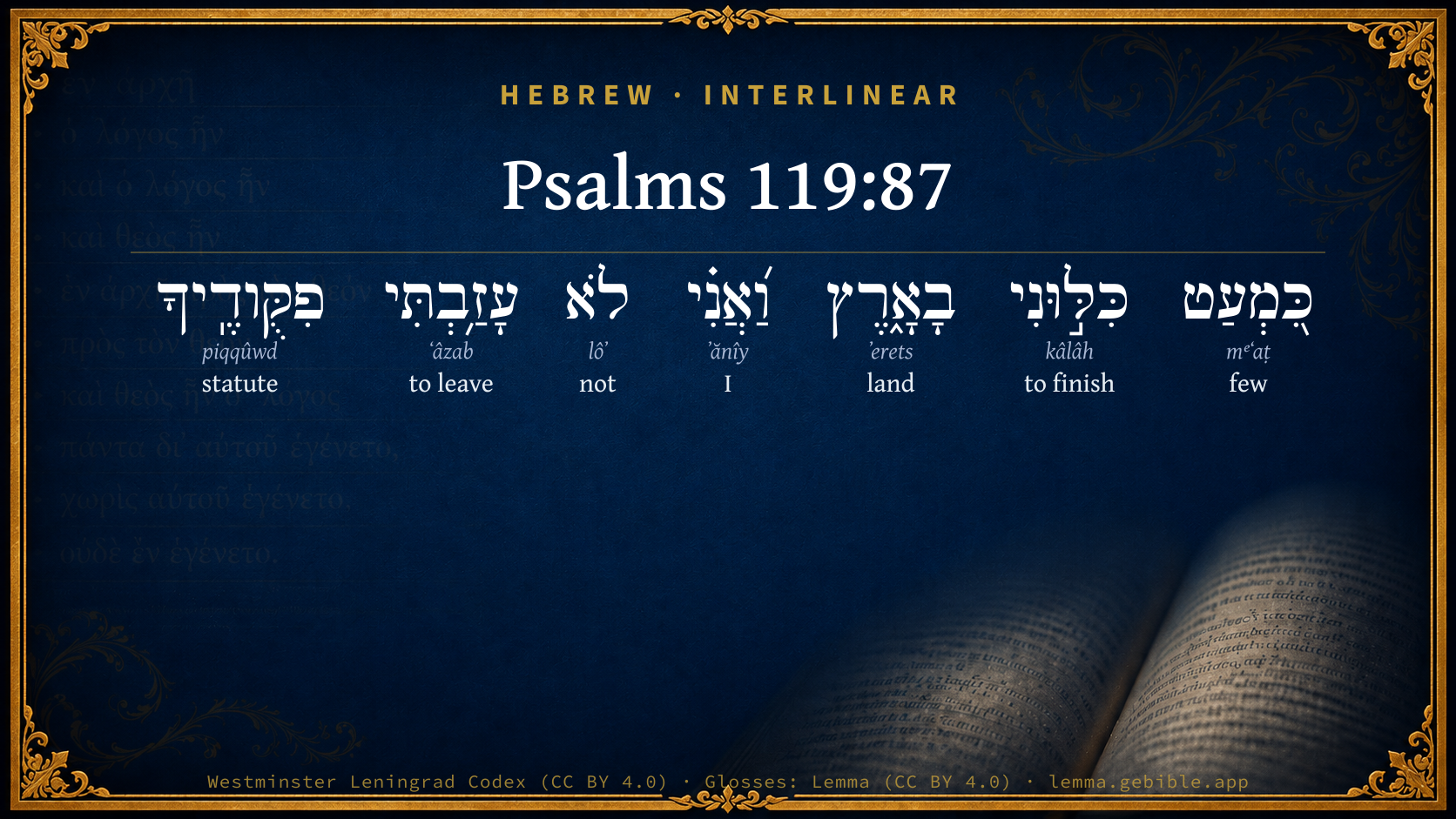
Hebrew (Westminster Leningrad Codex) Psalms 119:87 appears in the Hebrew Old Testament. The text above is from the Westminster Leningrad Codex. Each word links to its Strong’s number, a concise gloss, and parsing drawn from the Open Scriptures Hebrew Bible morphology. Click any word for its full Brown-Driver-Briggs (BDB) entry.
Download image
Cite this verse

Psalms 119:87 (World English Bible). Public Domain. Lemma interlinear Bible study tool, https://lemma.gebible.app/v/psalms/119/87.

Show BibTeX & RIS
BibTeX
RIS
English Translation
They had almost wiped me from the earth, But I didn't forsake your precepts.
World English Bible · Public Domain
Download a study sheet

One document with this verse’s original text, its word-by-word gloss line, the meaning frame, cross-references with their text, attributed commentary, and full source and license credits — printable, and it pastes into notes with its structure intact.

This verse Autodidact and up

Study sheet (.html) Plain text (.txt)

A passage Seminary Student

Up to 50 verses in one chapter. A passage sheet keeps up to 6 commentary sources and 12 cross-references per verse, in the order this page ranks them, and says so on the sheet whenever that leaves anything out. Ask for a single verse and you get the Autodidact verse sheet above.

Everything on this page stays free to read, with no account — the sheet is a download of what is already on screen, not access to it.

Want to remove ads? Support Godless Engineer
Compare translations 3

The same verse in 3 English versions, stacked beneath the original-language interlinear above. Click any original word for its lexicon entry.

Each is an independent rendering of the whole verse — the interlinear is not word-aligned to these translations.

Highlighted words mark where these versions differ — a whole-verse word diff, not a word-by-word alignment.

  • World English Bible Public Domain
    They had almost wiped me from the earth, But I didn't forsake your precepts.
  • King James Version Public Domain
    They had almost consumed me upon earth; but I forsook not thy precepts.
  • unfoldingWord Literal Text CC BY-SA 4.0
    As a little they have made an end of me in the land, but I, I have not rejected your precepts.

unfoldingWord Literal Text — © unfoldingWord, licensed CC BY-SA 4.0. Word-aligned USFM3 via Door43 (git.door43.org/unfoldingWord/en_ult).

Versions to compare (up to 4)

3 of 4 selected

Show all 17 translations

Every available English version of this verse, each an independent rendering of the whole verse.

  • World English Bible Public Domain
    They had almost wiped me from the earth, But I didn't forsake your precepts.
  • Berean Standard Bible Public Domain
    They almost wiped me from the earth, but I have not forsaken Your precepts.
  • Majority Standard Bible Public Domain
    They almost wiped me from the earth, but I have not forsaken Your precepts.
  • King James Version Public Domain
    They had almost consumed me upon earth; but I forsook not thy precepts.
  • American Standard Version (1901) Public Domain
    They had almost consumed me upon earth; But I forsook not thy precepts.
  • Revised Version (1885) Public Domain
    They had almost consumed me upon earth; but I forsook not thy precepts.
  • Geneva Bible (1599) Public Domain
    They had almost consumed me vpon the earth: but I forsooke not thy precepts.
  • Young's Literal Translation Public Domain
    Almost consumed me on earth have they, And I -- I have not forsaken Thy precepts.
  • Literal Standard Version CC BY-SA 4.0
    They have almost consumed me on earth, || And I have not forsaken Your precepts.
  • Unlocked Literal Bible CC BY-SA 4.0
    They have almost made an end to me on earth, but I do not reject your instructions.
  • unfoldingWord Literal Text CC BY-SA 4.0
    As a little they have made an end of me in the land, but I, I have not rejected your precepts.
  • Darby Bible Public Domain
    They had almost consumed me upon the earth; but as for me, I forsook not thy precepts.
  • World Messianic Bible Public Domain
    They had almost wiped me from the earth, but I didn’t forsake your precepts.
  • Webster's Bible Public Domain
    They had almost consumed me upon earth; but I forsook not thy precepts.
  • Free Bible Version CC BY-SA 4.0
    They have almost killed me, but I have not given up on what you say.
  • Bible in Basic English Public Domain
    They had almost put an end to me on earth; but I did not give up your orders.
  • JPS Tanakh (1917) Public Domain
    They had almost consumed me upon earth; but as for me, I forsook not Thy precepts.

Literal Standard Version (2020), Covenant Press — licensed CC BY-SA 4.0. Text via the HelloAO Bible API (eBible.org). Unlocked Literal Bible (unfoldingWord) — licensed CC BY-SA 4.0. Text via the HelloAO Bible API (eBible.org). unfoldingWord Literal Text — © unfoldingWord, licensed CC BY-SA 4.0. Word-aligned USFM3 via Door43 (git.door43.org/unfoldingWord/en_ult). Free Bible Version, Dr. Jonathan Gallagher — licensed CC BY-SA 4.0. Text via the HelloAO Bible API (eBible.org).

Word by word

More ways to search: Search by grammar → Find every occurrence → Compare this word →

Practice this passage: Drill this verse → Learn its vocabulary →

About this verse

These counts appear in no published source. They are computed here, from the morphology-tagged text and Lemma’s own curated glosses. What Lemma adds →

7
words
7
distinct lemmas
Wisdom
section

Notable vocabulary

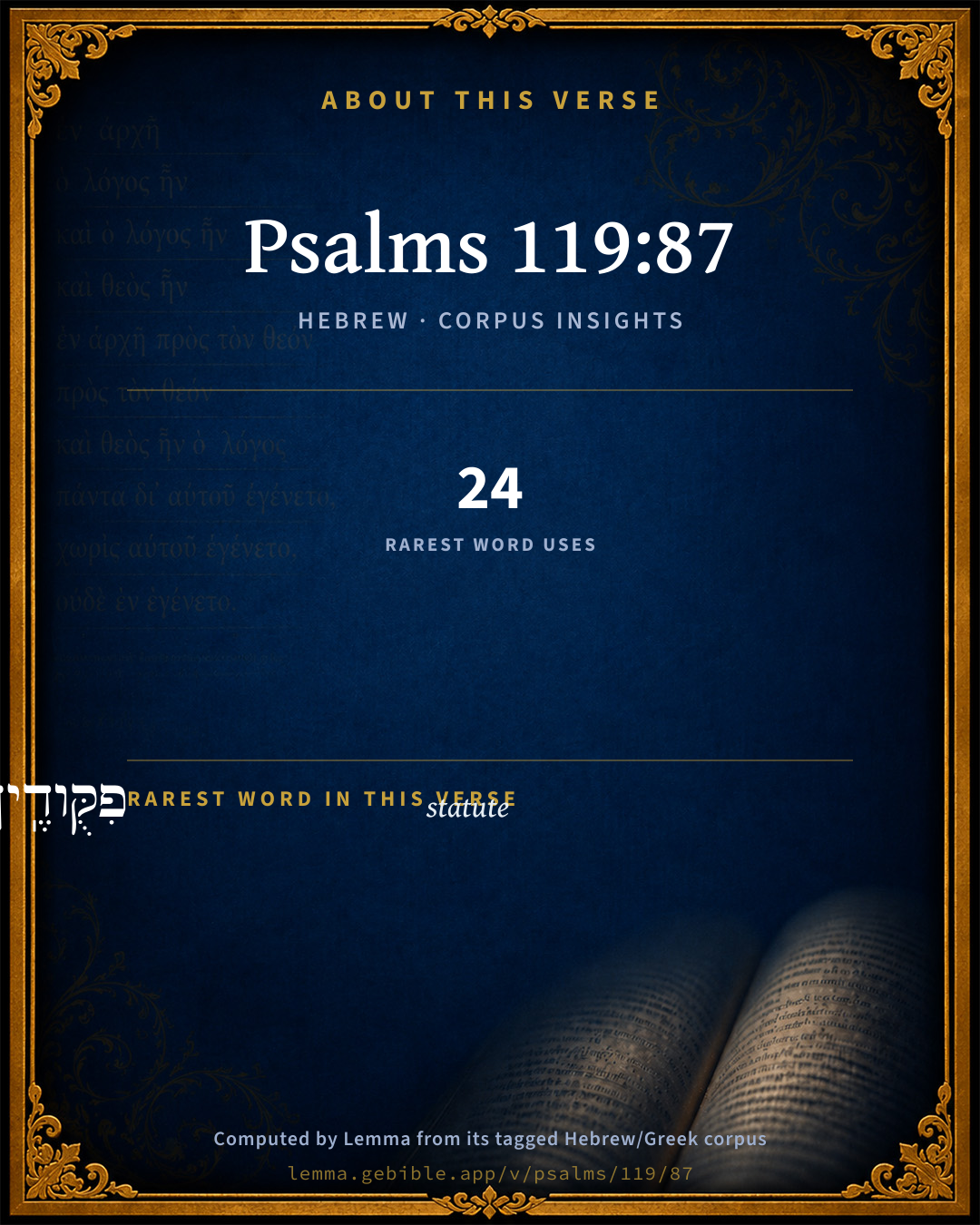
The rarest word here is פִקֻּודֶֽיךָ statute H6490 — appearing just 24 times in the whole Hebrew Bible.

Shared distinctive vocabulary

פִקֻּודֶֽיךָ statute H6490 occurs in 24 verses of the Hebrew Bible. Also found in:

Grammatical profile

  • 2 verbs
  • 3 nouns
  • 1 pronoun
  • 1 particle

Verb forms

  • כִּלּ֣וּנִי Piel · Perfect
  • עָזַ֥בְתִּי Qal · Perfect

Hebrew & Septuagint length

In English translation the verse runs 14 words from the Hebrew and 16 from the Septuagint (LXX English) — closely comparable.

A rough comparison of the two English renderings, which tokenize alike — not a word-level alignment.

Word counts can differ between the Hebrew and the Greek without any difference in meaning — e.g. the Hebrew direct-object marker אֵת has no separate Greek word, and Greek often adds the article ὁ.

Cross-references

10

Topical passages linked to Psalms 119:87 in the Treasury of Scripture Knowledge — connected by theme and wording, ordered by reader-vote popularity; previews shown in the World English Bible.

  • Matthew 10:28 Don't be afraid of those who kill the body, but are not able to kill the soul. Rather, fear him who is able to destroy both soul and body in Gehenna.
  • Psalms 119:61 The ropes of the wicked bind me, But I won't forget your law.
  • Isaiah 58:2 Yet they seek me daily, and delight to know my ways: as a nation that did righteousness, and didn't forsake the ordinance of their God, they ask of me righteous judgments; they delight to draw near to God.
  • 1 Samuel 26:24 Behold, as your life was much set by this day in my eyes, so let my life be much set by in the eyes of Yahweh, and let him deliver me out of all oppression.
  • Psalms 119:51 The arrogant mock me excessively, But I don't swerve from your law.
  • 1 Samuel 20:3 David swore moreover, and said, Your father knows well that I have found favor in your eyes; and he says, Don't let Jonathan know this, lest he be grieved: but truly as Yahweh lives, and as your soul lives, there is but a step between me and death.
  • 1 Samuel 23:26–27 Saul went on this side of the mountain, and David and his men on that side of the mountain: and David made haste to get away for fear of Saul; for Saul and his men compassed David and his men round about to take them.
  • 1 Samuel 24:6–7 He said to his men, Yahweh forbid that I should do this thing to my lord, Yahweh's anointed, to put forth my hand against him, seeing he is Yahweh's anointed.
  • 1 Samuel 26:9 David said to Abishai, Don't destroy him; for who can put forth his hand against Yahweh's anointed, and be guiltless?
  • 2 Samuel 17:16 Now therefore send quickly, and tell David, saying, Don't lodge this night at the fords of the wilderness, but by all means pass over; lest the king be swallowed up, and all the people who are with him.

Cross-references courtesy of OpenBible.info (CC BY 4.0).

Hebrew and Greek witnesses Masoretic Hebrew ↔ Greek Septuagint

The same verse in the two great witnesses to the Old Testament, shown verse-for-verse.

You’re reading Greek Psalm 118 (Hebrew Psalm 119). The Septuagint counts the superscription, so verse numbers can differ from the Hebrew — chapter-level alignment, not verse-by-verse. Numbering follows Rahlfs.

These are two independent witnesses, not word-aligned to each other, and the Septuagint is shown in lemma (dictionary) form.

Hebrew Psalms 119:87 Masoretic · Westminster Leningrad Codex

כִּ֭מְעַט כִּלּ֣וּנִי בָאָ֑רֶץ וַ֝אֲנִ֗י לֹא עָזַ֥בְתִּי פִקֻּודֶֽיךָ

They had almost wiped me from the earth, But I didn't forsake your precepts.

World English Bible · Public Domain

Greek LXX Greek Psalm 118:87 Septuagint · lemma form

παρά βραχύς συντελέω ἐγώ ἐν ὁ γῆ ἐγώ δέ οὐ ἐν καταλείπω ὁ ἐντολή σύ

They nearly made an end of me in the earth; but I forsook not your commandments.

LXX2012 (modern English Septuagint) · Public Domain

Hebrew: Westminster Leningrad Codex (CC BY 4.0). Greek: Septuagint (public domain); English from LXX2012 (modern English Septuagint) (Public Domain). How the Septuagint differs from the Hebrew →

Commentary

Notes on Psalms 119:87 from classic Christian and Jewish commentators (each source and its license shown beneath its notes). The classic Christian expositions comment on the surrounding passage and are grouped to its opening verse, so a note may address several verses; the Jewish commentaries on the Tanakh (Rashi and others) are per-verse, so they appear only where the commentator wrote on this verse.

Lemma curates 59 commentaries, every one of them public domain or Creative Commons licensed, each selected and text-cleaned for this edition rather than reprinted as found. About our sources →

Trapp's Complete Commentary

John Trapp

Psa 119:87 They had almost consumed me upon earth; but I forsook not thy precepts.

Ver. 87. They had almost consumed me upon earth] In heaven I shall be out of their reach. But this is their hour, and the power of darkness, Luk 12:53.

But I forsook not thy precepts] No trouble must pull us from the love of the truth. You may pull my tongue out of my head, but not my faith out of my heart, said that martyr. The saints choose affliction rather than sin.

John Trapp, A Commentary or Exposition upon All the Books of the Old and New Testament (1647–1656) — public domain. Text from a community e-Sword module.

The Biblical Illustrator

Joseph S. Exell

Psa_119:87

They had almost consumed me upon earth; but I forsook not Thy precepts.

Davids behaviour in trouble

I. How he behaved in extreme distress.

1. The precepts of God were the constant subject of his thoughts.

2. He was careful to walk in the way wherein he was directed by the Word of God to walk.

3. He patiently submitted to the will of God in all his persecutions and tribulations.

4. His patience was attended with meekness of spirit and behaviour towards the instruments of his calamities.

5. He maintained his uprightness under all the temptations of adversity and persecution.

6. He served God and his country in the best way that he could when he was restrained from serving them as he wished to do.

II. What his reasons were for so invariably adhering to his duty.

1. He was fully persuaded that nothing happened or could happen to him without the permission of Divine providence.

2. It was of incomparably greater importance in his view to behave dutifully under trouble than to obtain deliverance from it.

3. He knew that his troubles would all come to a happy end.

4. He knew that his troubles would turn to a good account through the grace of God enabling him to make the proper improvement of them. (H. Belfrage, D. D.)

When obedience is difficult

One of Dickenss most enjoyable and helpful characters, Mark Tapley, always kept up his spirits, and the spirits of all those around him, but he was dissatisfied because his surroundings were so pleasant that there was no credit in being jolly among them. At last his circumstances changed, and his surroundings became doleful indeed; but he saw his chance to be jolly with some credit to himself, and manfully rose to the glorious opportunity. In a similar way we may say that obeying when obedience is easy does not count for much; the real test of obedience comes when it is hard to obey, when we are asked to do something that we do not want to do, something that all our nature shrinks from. If we obey then, and, moreover, if we obey cheerfully and even with gladness, we may know that the spirit of obedience is really in us. The essence of Christian life is obedience. It is the key to all progress in character, to all growth in happiness, to all ownership in the Kingdom of Heaven. Any one that realizes this will actually long for opportunities of difficult obedience, as the athlete looks forward with ardour to the laborious practice, since it is the way, and the only way, to the olive wreath. (J. B. Morgan.)

The Biblical Illustrator, edited by Joseph S. Exell (c. 1880s–1900s) — public domain. Text from a community e-Sword module.

J. A. Alexander on Psalms

Joseph Addison Alexander

87. (Psa 119:87) They almost consumed me in the land, and I did not forsake thy precepts. The verb foe consumed or destroyed and the phrase in the land both occur in reference to the Canaanites, 2Ch 8:8. The translation in the earth (Psa 119:19) is admissible, but less significant and less in keeping with the national import of the psalm. The second clause, as usual in such cases, declares that notwithstanding his afflictions, he still sought to know and do the will of God.

Joseph Addison Alexander, The Psalms Translated and Explained (1850) — public domain. Text from a community e-Sword module.

Geneva Bible (1599)

Geneva Bible translators

Finding no help in earth, he lifteth up his eyes to heaven.

Geneva Bible (1599) marginal notes — public domain. Text via Bolls.life.

Adam Clarke's Commentary

Verse 87. They had almost consumed me] Had it not been for thy mercy, we had all been destroyed under this oppressive captivity.

Adam Clarke's Commentary on the Bible (1810–1826) — public domain. Text from a community e-Sword/MySword module.

John Calvin's Commentaries

87. They have almost consumed me upon the earth. He repeats, in somewhat different words, what he had spoken a little before, that, although he had been sorely tempted, he had nevertheless kept his footing, because he had not given up with true religion. A single declaration of this fact would have been enough for those who are perfect; but if we call to mind our own weakness, we will readily confess that it was not unworthy of being repeatedly stated. We not only forget the law of God when we are shaken by extreme conflicts, but the greater part lose their courage even before they engage in the conflict. On which account this wonderful strength of the prophet is worthy of more special notice, who, although almost reduced to death, yet never ceased to revive his courage by continual meditation on the law. Nor is it in vain that he adds, that it was upon the earth that his enemies had almost consumed him, conveying the idea, that, when the fears of death presented themselves to him on all sides in this world, he elevated his mind above the world. If faith reach to heaven, it will be an easy matter to emerge from despair.

John Calvin's Commentaries (1540-1563) — public domain. Text from the Calvin Translation Society English edition (1840s-50s) via the Christian Classics Ethereal Library (ccel.org). Calvin's coverage is partial (roughly two-thirds of the Bible); uncommented books and verses are honest gaps, never fabricated. The 19th-century editor's footnotes and remarks are omitted so the notes are faithfully Calvin's own voice.

Ellicott's Commentary for English Readers

(87) Upon earth.—Rather, on the land. (Comp. Psa_58:2.)

A Bible Commentary for English Readers, edited by Charles John Ellicott (1878–1897) — public domain. Text from a community e-Sword module.

The Cambridge Bible for Schools and Colleges

gen. ed. J. J. S. Perowne

87. His persecutors had almost succeeded in making an end of him, yet he still held fast to the law. The second line brings the godlessness of their conduct into prominence.

upon earth] The scene of life: or, in the land: the Psalmist and such as he were almost exterminated. Cp. Psa_12:1.

The Cambridge Bible for Schools and Colleges (gen. ed. J. J. S. Perowne; Cambridge University Press, 1878–1918) — public domain. Text from a community e-Sword module.

John Gill's Exposition

They continue this day according to thine ordinances,.... That is, the heavens and the earth do, before mentioned, just as they were from the beginning of the creation. The heavenly bodies have the same motion, magnitude, distance, and influence; the sun rises and sets as it did; the moon keeps her appointed seasons of full and change, of increase and decrease; the fixed stars retain their place, and the planets have their exact revolutions: and on earth things are as they were; seedtime and harvest, cold and heat, summer and winter, day and night; thus they are at this day, and will continue, according to the wise order and appointment of God. Aben Ezra and Kimchi interpret it,

"they stand or continue unto this day to do the will of God; to execute his judgments and decrees, or observe his order and ordinances.''

for all are thy servants; or "they", or "these all" (a); the heavens and earth, and all that is in them, all the works of God; he called them into being, and they rose up at his command; he calls them to service, and they stand up as obedient ones to do his will; he "commandeth the sun, and it riseth not" before its time; and "he sealeth up the stars", that they shine not when he pleases; once he commanded the sun to stand still on Gibeon, and the moon in the valley of Ajalon, and they obeyed him; see Isa 48:13. Hence it appears that the hosts of heaven, the sun, moon, and stars, ought not to be served and worshipped; but the Lord, the Maker of them, only, since they are his servants; and that men ought surely to serve the Lord, if these do, and especially such who are his chosen, redeemed, and called ones.

(a) "illa omnia", Junius & Tremellius; "universa haec", Gejerus.

John Gill's Exposition of the Whole Bible (1746–1763) — public domain (CC PDM 1.0). Text via the HelloAO Bible API.

Albert Barnes' Notes on the Bible

They had almost consumed me upon earth - The word which is here translated “consumed” is the same which is used in Psa 119:81, and there rendered “fainteth.” See the notes at that verse. The idea is, that their persecutions had been so severe, and so long continued, that his strength was almost exhausted; he was ready to faint and to die.

But I forsook not thy precepts - I still adhered to thee, even in the extremity of my suffering. The effect of persecution was not to drive me from thee, or to lead me to abandon thee. See Psa 119:61, note; Psa 119:69, note.

Albert Barnes' Notes on the Bible (1834–1885) — public domain. Text from a community e-Sword/MySword module.

Matthew Poole's English Annotations

They had almost consumed me upon earth, as to my present life and all my happiness upon earth; whereby he implies that his immortal soul and eternal happiness in heaven, of which he speaks, Psa 16:11; 17:15, and elsewhere, was safe, and out of their reach.

Matthew Poole's English Annotations on the Holy Bible (1683–1685) — public domain. Text from a community e-Sword/MySword module.

The Treasury of David

Charles H. Spurgeon

Ver. 87. They had almost consumed me upon earth. His foes had almost destroyed him so as to make him altogether fail. If they could they would have eaten him, or burned him alive; anything so that they could have made a full end of the good man. Evidently he had fallen under their power to a large extent, and they had so used that power that he was well nigh consumed. He was almost gone from off the earth; but almost is not altogether, and so he escaped by the skin of his teeth. The lions are chained: they can rage no further than our God permits. The Psalmist perceives the limit of their power: they could only touch his earthly life and earthly goods. Upon earth they almost ate him up, but he had an eternal portion which they could not even nibble at. "But I forsook not thy precepts." Nothing could drive him from obeying the Lord. If we stick to the precepts we shall be rescued by the promises. If ill usage could have driven the oppressed saint from the way of right the purpose of the wicked would have been answered, and we should have heard no more of David. If we are resolved to die sooner than forsake the Lord, we may depend upon it that we shall not die, but shall live to see the overthrow of them that hate us.

Ver. 87. Almost consumed. The lives of good men are full of narrow escapes. The righteous are scarcely saved. Many a time their feet do almost slip. Yet he, who has redeemed them, will not let them so fall that they can rise no more. One of their greatest perils is, a temptation to use unlawful means for terminating their trials. William S. Plumer.

Ver. 87. It should be noticed that he says "upon the earth:" for it shows, that even if his enemies had taken away his life.on earth, he nevertheless confidently looked for another life in heaven; and that already he had by faith entered into heaven, and was living a heavenly life; so that if the life of the body should be taken away, it was not to be regarded as an evil. They who live such a life speedily recover from despair. D.H. Mollerus.

Ver. 87.

1. What the good man loses by gaining.

2. What he gains by losing. G.R.

Ver. 87.

1. "Almost, "but not altogether.

2. The saving clause: "I forsook not thy precepts."

Ver. 87. Passing through fires, and the asbestos covering.

Psalms 119:88*

Charles H. Spurgeon's The Treasury of David (1869–1885) — public domain. Psalms only. Text from a community e-Sword/MySword module.

The Pulpit Commentary

They had almost consumed me upon earth; or, "made an end of me," "destroyed me." But I forsook not thy precepts (comp. vers. 69, 78, 83). Persecution made the psalmist cling the more to God"s Law.

The Pulpit Commentary (1880–1919), ed. H.D.M. Spence-Jones & Joseph S. Exell — public domain. Text from a community e-Sword module.

unfoldingWord translationNotes

Door43 World Missions Community

They have almost made an end to me on earth

This is a polite way of speaking about someone killing someone else. AT: "They have almost killed me" (See: Euphemism)

By your steadfast love

"According to your steadfast love." The phrase "steadfast love" or "faithfulness" can be stated as an adverb. AT: "because you faithfully love me" (See: Abstract Nouns)

translationWords

reject

instruct

life

covenant faithfulness

unfoldingWord translationNotes — © Distant Shores Media and the Door43 World Missions Community, licensed CC BY-SA 4.0. Source: git.door43.org/Door43/en_tn.

Rashi

Rabbi Shlomo Yitzchaki (Rashi)

They almost destroyed me I was on the earth as nothing, but I stood with my strength. Likewise (verse 95): “Concerning me, the wicked hoped to destroy me” from entering the congregation, and so (above 116:16): “You loosed my thongs.”

Rashi on the Tanakh — English translations: “The Judaica Press complete Tanach with Rashi, translated by A. J. Rosenberg” (CC BY 4.0); “Pentateuch with Rashi's commentary by M. Rosenbaum and A.M. Silbermann, 1929-1934” (public domain); “The Metsudah Tanach series, Lakewood, N.J” (CC BY 4.0); and “The Book of Joshua, Metsudah Publications, 1997” (CC BY 4.0). Text via Sefaria.

Lesson kit

Teaching starters — assembled from the data on this page, not authored interpretation. Every prompt links to the verse data it draws on. Edit before teaching.

Psalms, in the Wisdom, opens this verse with 7 words (7 distinct Hebrew lemmas). Its most distinctive word is piqqûwd (“statute”). A historical commentator’s framing appears above. Read the whole chapter for the surrounding context.

Discussion questions

  1. What does “statute” (piqqûwd) contribute to the verse as a whole?
  2. Psalms 19:8 shares the word «statute» with this verse. How do the two illuminate each other?
  3. The translations on this page render this verse differently — a whole-verse word diff, not a word-by-word alignment. What might account for the different wordings?
  4. The verb «כִּלּ֣וּנִי» is Piel Perfect. How does its form color the action?
  5. Reading how Trapp's Complete Commentary and The Biblical Illustrator read this verse, where do the two commentators agree and where do they part?

Things to notice

Reading settings

Reading text

Shown beneath each verse's original-language words.

Old Testament
Old Testament edition

Read the OT as the Masoretic Hebrew (MT) or the Greek Septuagint (LXX).

English shown for the Greek Septuagint (in the Hebrew ↔ Greek comparison).

Comparing translations? Open the Compare panel on any verse page to stack up to four side by side.