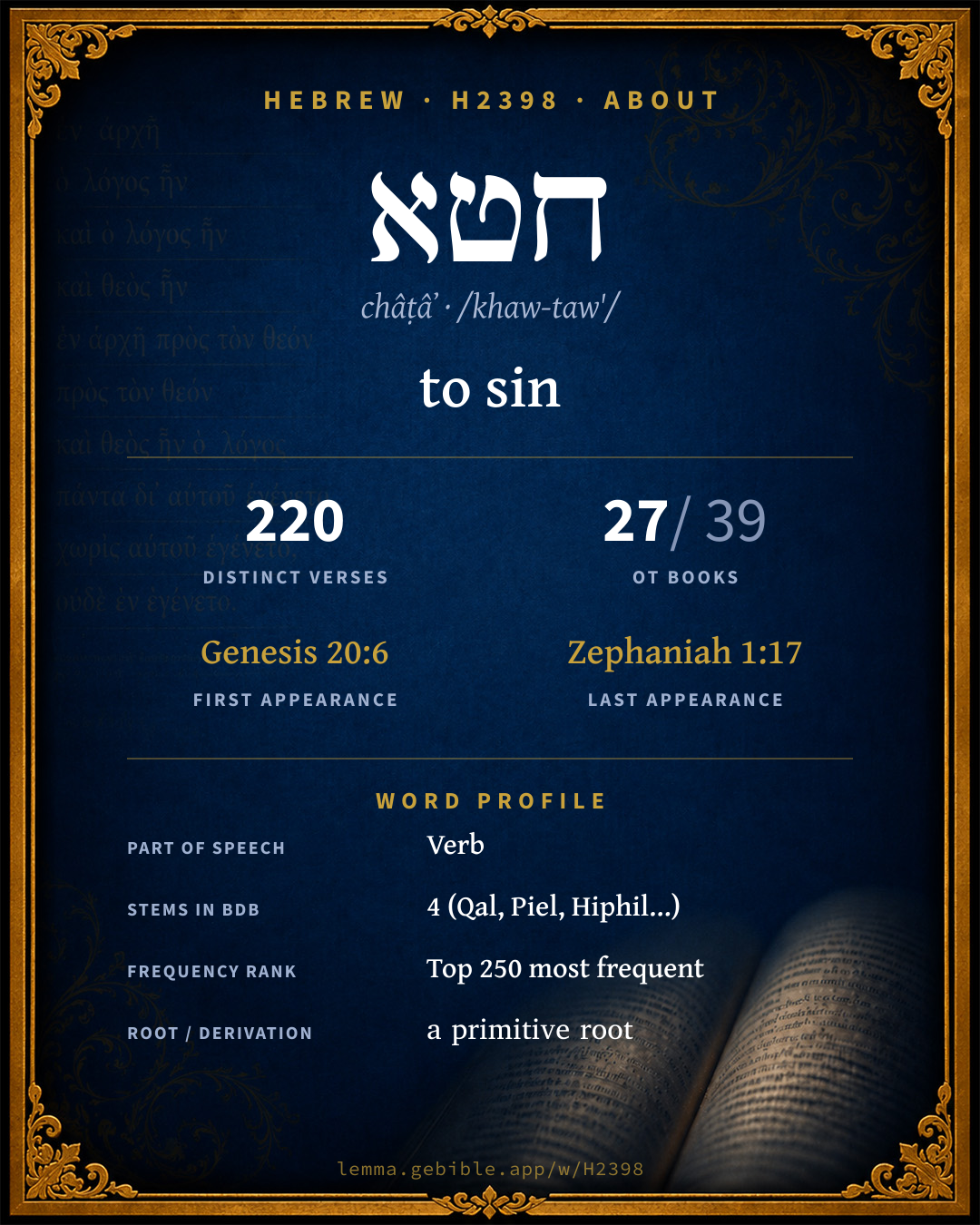
חָטָא
to sin
also: miss, miss the way, go wrong, incur guilt fuller range ↓
Full lexicon entry — Brown-Driver-Briggs (BDB)
From Brown-Driver-Briggs (BDB)
Where this word appears
See every Qal verb in the Hebrew Bible →
Grammar key — what these labels mean
Part of speech
- Verb
- An action or state-of-being word.
Noun type
- Common
- A common noun — a general class of person, place, or thing (“king,” “city,” “water”), not a specific name.
Stem
- Qal
- The basic, simple active stem — the plain form of the verb (“he wrote”). Here: ‘miss’
- Hiphil
- The causative active stem (“he caused / brought about”). Here: ‘miss the mark’
- Hithpael
- The reflexive or reciprocal stem (the subject acts on itself). Here: ‘miss oneself’
- Piel
- An intensive or resultative active stem. Here: ‘bear loss’
Form
- Perfect
- A completed action or state — Hebrew marks aspect (completeness) more than strict tense (“he wrote”).
- Imperfect
- An incomplete, ongoing, or future action (“he will / would write”).
- Infinitive Construct
- A bound verbal noun, frequently with prepositions (“to write / in writing”).
- Participle Active
- A verbal adjective expressing ongoing or characteristic action (“writing / one who writes”).
- Sequential Perfect
- A perfect with prefixed waw continuing a preceding imperfect or command (waw-consecutive perfect).
- Sequential Imperfect
- An imperfect with prefixed waw — the standard past-narrative form (waw-consecutive imperfect).
- Jussive
- A third- or second-person volitional form expressing wish or command (“let him write”).
State
- Absolute
- The independent form of a noun, not bound to a following word.
- Construct
- A noun bound to a following noun in a possessive / “of” relationship (the construct chain).
Person
- 3rd Person
- The one spoken about (“he / she / it / they”).
- 1st Person
- The speaker (“I / we”).
- 2nd Person
- The one addressed (“you”).
Gender
- Masculine
- Grammatically masculine.
- Common
- Either gender — not distinguished for this form.
- Feminine
- Grammatically feminine.
Number
- Singular
- One.
- Plural
- More than one (in Hebrew, generally three or more).
Grammatical forms 50 distinct
- Verb, Qal, Perfect, 3rd Person, Masculine, Singular 30 times (13%)
- Verb, Qal, Perfect, 1st Person, Common, Singular 26 times (11%)
- Verb, Qal, Perfect, 1st Person, Common, Plural 24 times (10%)
- Verb, Hiphil, Perfect, 3rd Person, Masculine, Singular 21 times (9%)
- Verb, Qal, Perfect, 3rd Person, Common, Plural 19 times (8%)
- Verb, Qal, Participle Active, Masculine, Singular, Absolute 13 times (5%)
- Verb, Qal, Imperfect, 3rd Person, Masculine, Singular 12 times (5%)
- Verb, Qal, Infinitive Construct 12 times (5%)
+42 more forms (83 occurrences)
Parsed forms decoded from the imported morphology (morphhb / Westminster Leningrad Codex — WLC text public domain, morphhb tagging CC BY 4.0), counted across 240 parsed occurrences — not distinct verses.
Page 1 of 2 — showing verses 1–200 of 220 distinct verses where H2398 appears, across 27 books. Click any verse to open its interlinear word-by-word view. Verse text shown in the World English Bible for context — . Each verse’s Hebrew form is shown with its reference; the English is not keyword-highlighted, since the data carries no word-level English alignment. Use “Compare translations” on any verse to read it across multiple English versions. This concordance covers the Hebrew Bible; Septuagint (Greek Old Testament) occurrences are not indexed here.
Genesis 8 verses
- Genesis 20:6 מֵ/חֲטוֹ prep + Qal inf.cs God said to him in the dream, "Yes, I know that in the integrity of your heart you have done this, and I also withheld you from sinning against me. Therefore I didn't allow you to touch her.
- Genesis 20:9 חָטָ֣אתִי Qal pf 1cs Then Abimelech called Abraham, and said to him, "What have you done to us? How have I sinned against you, that you have brought on me and on my kingdom a great sin? You have done deeds to me that ought not to be done!"
- Genesis 31:39 אֲחַטֶּ֔/נָּה Piel impf 1cs + sfx pers 3fs That which was torn of animals, I didn't bring to you. I bore the loss of it. Of my hand you required it, whether stolen by day or stolen by night.
- Genesis 39:9 וְ/חָטָ֖אתִי conj + Qal wpf 1cs He isn't greater in this house than I, neither has he kept back anything from me but you, because you are his wife. How then can I do this great wickedness, and sin against God?"
- Genesis 40:1 חָֽטְא֛וּ Qal pf 3cp It happened after these things, that the butler of the king of Egypt and his baker offended their lord, the king of Egypt.
- Genesis 42:22 תֶּחֶטְא֥וּ Qal juss 2mp Reuben answered them, saying, "Didn't I tell you, saying, 'Don't sin against the child,' and you wouldn't listen? Therefore also, behold, his blood is required."
- Genesis 43:9 וְ/חָטָ֥אתִֽי conj + Qal wpf 1cs I will be collateral for him. From my hand will you require him. If I don't bring him to you, and set him before you, then let me bear the blame forever,
- Genesis 44:32 וְ/חָטָ֥אתִי conj + Qal wpf 1cs For your servant became collateral for the boy to my father, saying, 'If I don't bring him to you, then I will bear the blame to my father forever.'
Exodus 10 verses
- Exodus 5:16 וְ/חָטָ֥את conj + Qal wpf 2ms No straw is given to your servants, and they tell us, 'Make brick!' and, behold, your servants are beaten; but the fault is in your own people."
- Exodus 9:27 חָטָ֣אתִי Qal pf 1cs Pharaoh sent, and called for Moses and Aaron, and said to them, "I have sinned this time. Yahweh is righteous, and I and my people are wicked.
- Exodus 9:34 לַ/חֲטֹ֑א prep + Qal inf.cs When Pharaoh saw that the rain and the hail and the thunders were ceased, he sinned yet more, and hardened his heart, he and his servants.
- Exodus 10:16 חָטָ֛אתִי Qal pf 1cs Then Pharaoh called for Moses and Aaron in haste, and he said, "I have sinned against Yahweh your God, and against you.
- Exodus 20:20 תֶחֱטָֽאוּ Qal impf 2mp Moses said to the people, "Don't be afraid, for God has come to test you, and that his fear may be before you, that you won't sin."
- Exodus 23:33 יַחֲטִ֥יאוּ Hiphil impf 3mp They shall not dwell in your land, lest they make you sin against me, for if you serve their gods, it will surely be a snare to you."
- Exodus 29:36 וְ/חִטֵּאתָ֙ conj + Piel wpf 2ms Every day shall you offer the bull of sin-offering for atonement: and you shall cleanse the altar, when you make atonement for it; and you shall anoint it, to sanctify it.
- Exodus 32:30 חֲטָאתֶ֖ם Qal pf 2mp It happened on the next day, that Moses said to the people, "You have sinned a great sin. Now I will go up to Yahweh. Perhaps I shall make atonement for your sin."
- Exodus 32:31 חָטָ֞א Qal pf 3ms Moses returned to Yahweh, and said, "Oh, this people have sinned a great sin, and have made themselves gods of gold.
- Exodus 32:33 חָֽטָא Qal pf 3ms Yahweh said to Moses, "Whoever has sinned against me, him will I blot out of my book.
Leviticus 27 verses
- Leviticus 4:2 תֶחֱטָ֤א Qal impf 3fs "Speak to the children of Israel, saying, 'If anyone sins unintentionally, in any of the things which Yahweh has commanded not to be done, and does any one of them:
- Leviticus 4:3 יֶחֱטָ֖א חָטָ֜א Qal impf 3ms Qal pf 3ms if the anointed priest sins so as to bring guilt on the people, then let him offer for his sin, which he has sinned, a young bull without blemish to Yahweh for a sin offering.
- Leviticus 4:14 חָטְא֖וּ Qal pf 3cp when the sin in which they have sinned is known, then the assembly shall offer a young bull for a sin offering, and bring it before the Tent of Meeting.
- Leviticus 4:22 יֶֽחֱטָ֑א Qal impf 3ms "'When a ruler sins, and unwittingly does any one of all the things which Yahweh his God has commanded not to be done, and is guilty;
- Leviticus 4:23 חָטָ֖א Qal pf 3ms if his sin, in which he has sinned, is made known to him, he shall bring as his offering a goat, a male without blemish.
- Leviticus 4:27 תֶּחֱטָ֥א Qal impf 3fs "'If anyone of the common people sins unwittingly, in doing any of the things which Yahweh has commanded not to be done, and is guilty;
- Leviticus 4:28 חָטָ֑א חָטָֽא Qal pf 3ms Qal pf 3ms if his sin, which he has sinned, is made known to him, then he shall bring for his offering a goat, a female without blemish, for his sin which he has sinned.
- Leviticus 4:35 חָטָ֖א Qal pf 3ms All its fat he shall take away, like the fat of the lamb is taken away from the sacrifice of peace offerings; and the priest shall burn them on the altar, on the offerings of Yahweh made by fire; and the priest shall make atonement for him concerning his sin that he has sinned, and he will be forgiven.
- Leviticus 5:1 תֶחֱטָ֗א Qal impf 3fs "'If anyone sins, in that he hears the voice of adjuration, he being a witness, whether he has seen or known, if he doesn't report it, then he shall bear his iniquity.
- Leviticus 5:5 חָטָ֖א Qal pf 3ms It shall be, when he is guilty of one of these, he shall confess that in which he has sinned:
- Leviticus 5:6 חָטָ֜א Qal pf 3ms and he shall bring his trespass offering to Yahweh for his sin which he has sinned, a female from the flock, a lamb or a goat, for a sin offering; and the priest shall make atonement for him concerning his sin.
- Leviticus 5:7 חָטָ֗א Qal pf 3ms "'If he can't afford a lamb, then he shall bring his trespass offering for that in which he has sinned, two turtledoves, or two young pigeons, to Yahweh; one for a sin offering, and the other for a burnt offering.
- Leviticus 5:10 חָטָ֖א Qal pf 3ms He shall offer the second for a burnt offering, according to the ordinance; and the priest shall make atonement for him concerning his sin which he has sinned, and he shall be forgiven.
- Leviticus 5:11 חָטָ֗א Qal pf 3ms "'But if he can't afford two turtledoves, or two young pigeons, then he shall bring his offering for that in which he has sinned, the tenth part of an ephah of fine flour for a sin offering. He shall put no oil on it, neither shall he put any frankincense on it, for it is a sin offering.
- Leviticus 5:13 חָטָ֛א Qal pf 3ms The priest shall make atonement for him concerning his sin that he has sinned in any of these things, and he will be forgiven; and the rest shall be the priest's, as the meal offering.'"
- Leviticus 5:15 וְ/חָֽטְאָה֙ conj + Qal wpf 3fs "If anyone commits a trespass, and sins unwittingly, in the holy things of Yahweh; then he shall bring his trespass offering to Yahweh, a ram without blemish from the flock, according to your estimation in silver by shekels, after the shekel of the sanctuary, for a trespass offering.
- Leviticus 5:16 חָטָ֨א Qal pf 3ms He shall make restitution for that which he has done wrong in the holy thing, and shall add a fifth part to it, and give it to the priest; and the priest shall make atonement for him with the ram of the trespass offering, and he will be forgiven.
- Leviticus 5:17 תֶֽחֱטָ֔א Qal impf 3fs "If anyone sins, and does any of the things which Yahweh has commanded not to be done; though he didn't know it, yet he is guilty, and shall bear his iniquity.
- Leviticus 6:2 תֶחֱטָ֔א Qal impf 3fs "If anyone sins, and commits a trespass against Yahweh, and deals falsely with his neighbor in a matter of deposit, or of bargain, or of robbery, or has oppressed his neighbor,
- Leviticus 6:3 לַ/חֲטֹ֥א prep + Qal inf.cs or has found that which was lost, and dealt falsely therein, and swearing to a lie; in any of all these things that a man does, sinning therein;
- Leviticus 6:4 יֶחֱטָ֣א Qal impf 3ms then it shall be, if he has sinned, and is guilty, he shall restore that which he took by robbery, or the thing which he has gotten by oppression, or the deposit which was committed to him, or the lost thing which he found,
- Leviticus 6:26 הַֽ/מְחַטֵּ֥א ptcl def.art + Piel ptcp.act ms The priest who offers it for sin shall eat it. It shall be eaten in a holy place, in the court of the Tent of Meeting.
- Leviticus 8:15 וַ/יְחַטֵּ֖א conj + Piel wimpf 3ms He killed it; and Moses took the blood, and put it on the horns of the altar round about with his finger, and purified the altar, and poured out the blood at the base of the altar, and sanctified it, to make atonement for it.
- Leviticus 9:15 וַֽ/יְחַטְּאֵ֖/הוּ conj + Piel wimpf 3ms + sfx pers 3ms He presented the people's offering, and took the goat of the sin offering which was for the people, and killed it, and offered it for sin, like the first.
- Leviticus 14:49 לְ/חַטֵּ֥א prep + Piel inf.cs To cleanse the house he shall take two birds, and cedar wood, and scarlet, and hyssop.
- Leviticus 14:52 וְ/חִטֵּ֣א conj + Piel wpf 3ms He shall cleanse the house with the blood of the bird, and with the running water, with the living bird, with the cedar wood, with the hyssop, and with the scarlet;
- Leviticus 19:22 חָטָ֑א חָטָֽא Qal pf 3ms Qal pf 3ms The priest shall make atonement for him with the ram of the trespass offering before Yahweh for his sin which he has committed: and the sin which he has committed shall be forgiven him.
Numbers 17 verses
- Numbers 6:11 חָטָ֖א Qal pf 3ms The priest shall offer one for a sin offering, and the other for a burnt offering, and make atonement for him, because he sinned by reason of the dead, and shall make his head holy that same day.
- Numbers 8:21 וַ/יִּֽתְחַטְּא֣וּ conj + Hithpael wimpf 3mp The Levites purified themselves from sin, and they washed their clothes; and Aaron offered them for a wave offering before Yahweh; and Aaron made atonement for them to cleanse them.
- Numbers 12:11 חָטָֽאנוּ Qal pf 1cp Aaron said to Moses, Oh, my lord, please don't lay sin on us, for that we have done foolishly, and for that we have sinned.
- Numbers 14:40 חָטָֽאנוּ Qal pf 1cp They rose up early in the morning, and got them up to the top of the mountain, saying, Behold, we are here, and will go up to the place which Yahweh has promised: for we have sinned.
- Numbers 15:27 תֶּחֱטָ֣א Qal impf 3fs If one person sin unwittingly, then he shall offer a female goat a year old for a sin-offering.
- Numbers 15:28 בְּ/חֶטְאָ֥ה prep + n c fs The priest shall make atonement for the soul who errs, when he sins unwittingly, before Yahweh, to make atonement for him; and he shall be forgiven.
- Numbers 16:22 יֶחֱטָ֔א Qal impf 3ms They fell on their faces, and said, God, the God of the spirits of all flesh, shall one man sin, and will you be angry with all the congregation?
- Numbers 19:12 יִתְחַטָּא יִתְחַטָּ֜א Hithpael impf 3ms Hithpael impf 3ms the same shall purify himself therewith on the third day, and on the seventh day he shall be clean: but if he doesn't purify himself the third day, then the seventh day he shall not be clean.
- Numbers 19:13 יִתְחַטָּ֗א Hithpael impf 3ms Whoever touches a dead person, the body of a man who has died, and doesn't purifies himself, defiles the tent of Yahweh; and that soul shall be cut off from Israel: because the water for impurity was not sprinkled on him, he shall be unclean; his uncleanness is yet on him.
- Numbers 19:19 וְ/חִטְּא/וֹ֙ conj + Piel wpf 3ms + sfx pers 3ms and the clean person shall sprinkle on the unclean on the third day, and on the seventh day: and on the seventh day he shall purify him; and he shall wash his clothes, and bathe himself in water, and shall be clean at even.
- Numbers 19:20 יִתְחַטָּ֔א Hithpael impf 3ms But the man who shall be unclean, and shall not purify himself, that soul shall be cut off from the midst of the assembly, because he has defiled the sanctuary of Yahweh: the water for impurity has not been sprinkled on him; he is unclean.
- Numbers 21:7 חָטָ֗אנוּ Qal pf 1cp The people came to Moses, and said, We have sinned, because we have spoken against Yahweh, and against you; pray to Yahweh, that he take away the serpents from us. Moses prayed for the people.
- Numbers 22:34 חָטָ֔אתִי Qal pf 1cs Balaam said to the angel of Yahweh, I have sinned; for I didn't know that you stood in the way against me: now therefore, if it displease you, I will get me back again.
- Numbers 31:19 תִּֽתְחַטְּא֞וּ Hithpael impf 2mp Encamp you outside of the camp seven days: whoever has killed any person, and whoever has touched any slain, purify yourselves on the third day and on the seventh day, you and your captives.
- Numbers 31:20 תִּתְחַטָּֽאוּ Hithpael impf 2mp As to every garment, and all that is made of skin, and all work of goats' [hair], and all things made of wood, you shall purify yourselves.
- Numbers 31:23 יִתְחַטָּ֑א Hithpael impf 3ms everything that may abide the fire, you shall make to go through the fire, and it shall be clean; nevertheless it shall be purified with the water for impurity: and all that doesn't withstand the fire you shall make to go through the water.
- Numbers 32:23 חֲטָאתֶ֖ם Qal pf 2mp But if you will not do so, behold, you have sinned against Yahweh; and be sure your sin will find you out.
Deuteronomy 6 verses
- Deuteronomy 1:41 חָטָאנוּ֮ Qal pf 1cp Then you answered and said to me, We have sinned against Yahweh, we will go up and fight, according to all that Yahweh our God commanded us. You girded on every man his weapons of war, and were forward to go up into the hill-country.
- Deuteronomy 9:16 חֲטָאתֶם֙ Qal pf 2mp I looked, and, behold, you had sinned against Yahweh your God; you had made you a molten calf: you had turned aside quickly out of the way which Yahweh had commanded you.
- Deuteronomy 9:18 חֲטָאתֶ֔ם Qal pf 2mp I fell down before Yahweh, as at the first, forty days and forty nights; I did neither eat bread nor drink water; because of all your sin which you sinned, in doing that which was evil in the sight of Yahweh, to provoke him to anger.
- Deuteronomy 19:15 יֶֽחֱטָ֑א Qal impf 3ms One witness shall not rise up against a man for any iniquity, or for any sin, in any sin that he sins: at the mouth of two witnesses, or at the mouth of three witnesses, shall a matter be established.
- Deuteronomy 20:18 וַ/חֲטָאתֶ֖ם conj + Qal wpf 2mp that they not teach you to do after all their abominations, which they have done to their gods; so would you sin against Yahweh your God.
- Deuteronomy 24:4 תַחֲטִיא֙ Hiphil impf 2ms her former husband, who sent her away, may not take her again to be his wife, after that she is defiled; for that is abomination before Yahweh: and you shall not cause the land to sin, which Yahweh your God gives you for an inheritance.
Joshua 2 verses
- Joshua 7:11 חָטָא֙ Qal pf 3ms Israel has sinned; yes, they have even transgressed my covenant which I commanded them: yes, they have even taken of the devoted thing, and have also stolen, and dissembled also; and they have even put it among their own stuff.
- Joshua 7:20 חָטָ֨אתִי֙ Qal pf 1cs Achan answered Joshua, and said, Of a truth I have sinned against Yahweh, the God of Israel, and thus and thus have I done:
Judges 4 verses
- Judges 10:10 חָטָ֣אנוּ Qal pf 1cp The children of Israel cried to Yahweh, saying, We have sinned against you, even because we have forsaken our God, and have served the Baals.
- Judges 10:15 חָטָ֔אנוּ Qal pf 1cp The children of Israel said to Yahweh, We have sinned: do you to us whatever seems good to you; only deliver us, we pray you, this day.
- Judges 11:27 חָטָ֣אתִי Qal pf 1cs I therefore have not sinned against you, but you do me wrong to war against me: Yahweh, the Judge, be judge this day between the children of Israel and the children of Ammon.
- Judges 20:16 יַחֲטִֽא Hiphil impf 3ms Among all this people there were seven hundred chosen men left-handed; everyone could sling stones at a hair-breadth, and not miss.
1 Samuel 12 verses
- 1 Samuel 2:25 יֶחֱטָ֨א יֶֽחֱטָא Qal impf 3ms Qal impf 3ms If one man sin against another, God shall judge him; but if a man sin against Yahweh, who shall entreat for him? Notwithstanding, they didn't listen to the voice of their father, because Yahweh was minded to kill them.
- 1 Samuel 7:6 חָטָ֖אנוּ Qal pf 1cp They gathered together to Mizpah, and drew water, and poured it out before Yahweh, and fasted on that day, and said there, We have sinned against Yahweh. Samuel judged the children of Israel in Mizpah.
- 1 Samuel 12:10 חָטָ֔אנוּ Qal pf 1cp They cried to Yahweh, and said, We have sinned, because we have forsaken Yahweh, and have served the Baals and the Ashtaroth: but now deliver us out of the hand of our enemies, and we will serve you.
- 1 Samuel 12:23 מֵ/חֲטֹ֣א prep + Qal inf.cs Moreover as for me, far be it from me that I should sin against Yahweh in ceasing to pray for you: but I will instruct you in the good and the right way.
- 1 Samuel 14:33 חֹטִ֥אים Qal ptcp.act mp Then they told Saul, saying, Behold, the people sin against Yahweh, in that they eat with the blood. He said, you have dealt treacherously: roll a great stone to me this day.
- 1 Samuel 14:34 תֶחֶטְא֥וּ Qal impf 2mp Saul said, Disperse yourselves among the people, and tell them, Bring me here every man his ox, and every man his sheep, and kill them here, and eat; and don't sin against Yahweh in eating with the blood. All the people brought every man his ox with him that night, and killed them there.
- 1 Samuel 15:24 חָטָ֔אתִי Qal pf 1cs Saul said to Samuel, I have sinned; for I have transgressed the commandment of Yahweh, and your words, because I feared the people, and obeyed their voice.
- 1 Samuel 15:30 חָטָ֔אתִי Qal pf 1cs Then he said, I have sinned: yet honor me now, Please, before the elders of my people, and before Israel, and turn again with me, that I may worship Yahweh your God.
- 1 Samuel 19:4 יֶחֱטָ֨א חָטָא֙ Qal juss 3ms Qal pf 3ms Jonathan spoke good of David to Saul his father, and said to him, Don't let the king sin against his servant, against David; because he has not sinned against you, and because his works have been very good toward you:
- 1 Samuel 19:5 תֶֽחֱטָא֙ Qal impf 2ms for he put his life in his hand, and struck the Philistine, and Yahweh worked a great victory for all Israel: you saw it, and did rejoice; why then will you sin against innocent blood, to kill David without a cause?
- 1 Samuel 24:11 חָטָ֣אתִי Qal pf 1cs Moreover, my father, behold, yes, see the skirt of your robe in my hand; for in that I cut off the skirt of your robe, and didn't kill you, know you and see that there is neither evil nor disobedience in my hand, and I have not sinned against you, though you hunt after my life to take it.
- 1 Samuel 26:21 חָטָ֜אתִי Qal pf 1cs Then said Saul, I have sinned: return, my son David; for I will no more do you harm, because my life was precious in your eyes this day: behold, I have played the fool, and have erred exceedingly.
2 Samuel 4 verses
- 2 Samuel 12:13 חָטָ֖אתִי Qal pf 1cs David said to Nathan, "I have sinned against Yahweh." Nathan said to David, "Yahweh also has put away your sin. You will not die.
- 2 Samuel 19:20 חָטָ֑אתִי Qal pf 1cs For your servant does know that I have sinned: therefore, behold, I am come this day the first of all the house of Joseph to go down to meet my lord the king.
- 2 Samuel 24:10 חָטָ֤אתִי Qal pf 1cs David's heart struck him after that he had numbered the people. David said to Yahweh, I have sinned greatly in that which I have done: but now, Yahweh, put away, I beg you, the iniquity of your servant; for I have done very foolishly.
- 2 Samuel 24:17 חָטָ֨אתִי֙ Qal pf 1cs David spoke to Yahweh when he saw the angel who struck the people, and said, Behold, I have sinned, and I have done perversely; but these sheep, what have they done? Please let your hand be against me, and against my father's house.
1 Kings 18 verses
- 1 Kings 8:31 יֶחֱטָ֥א Qal impf 3ms If a man sin against his neighbor, and an oath be laid on him to cause him to swear, and he come [and] swear before your altar in this house;
- 1 Kings 8:33 יֶחֶטְאוּ Qal impf 3mp When your people Israel are struck down before the enemy, because they have sinned against you; if they turn again to you, and confess your name, and pray and make supplication to you in this house:
- 1 Kings 8:35 יֶחֶטְאוּ Qal impf 3mp When the sky is shut up, and there is no rain, because they have sinned against you; if they pray toward this place, and confess your name, and turn from their sin, when you do afflict them:
- 1 Kings 8:46 יֶֽחֶטְאוּ יֶחֱטָ֔א Qal impf 3mp Qal impf 3ms If they sin against you (for there is no man who doesn't sin), and you are angry with them, and deliver them to the enemy, so that they carry them away captive to the land of the enemy, far off or near;
- 1 Kings 8:47 חָטָ֥אנוּ Qal pf 1cp yet if they shall repent themselves in the land where they are carried captive, and turn again, and make supplication to you in the land of those who carried them captive, saying, We have sinned, and have done perversely, we have dealt wickedly;
- 1 Kings 8:50 חָֽטְאוּ Qal pf 3cp and forgive your people who have sinned against you, and all their transgressions in which they have transgressed against you; and give them compassion before those who carried them captive, that they may have compassion on them
- 1 Kings 14:16 חָטָ֔א הֶחֱטִ֖יא Qal pf 3ms Hiphil pf 3ms He will give Israel up because of the sins of Jeroboam, which he has sinned, and with which he has made Israel to sin.
- 1 Kings 14:22 חָטָֽאוּ Qal pf 3cp Judah did that which was evil in the sight of Yahweh, and they provoked him to jealousy with their sins which they committed, above all that their fathers had done.
- 1 Kings 15:26 הֶחֱטִ֖יא Hiphil pf 3ms He did that which was evil in the sight of Yahweh, and walked in the way of his father, and in his sin with which he made Israel to sin.
- 1 Kings 15:30 חָטָ֔א הֶחֱטִ֖יא Qal pf 3ms Hiphil pf 3ms for the sins of Jeroboam which he sinned, and with which he made Israel to sin, because of his provocation with which he provoked Yahweh, the God of Israel, to anger.
- 1 Kings 15:34 הֶחֱטִ֖יא Hiphil pf 3ms He did that which was evil in the sight of Yahweh, and walked in the way of Jeroboam, and in his sin with which he made Israel to sin.
- 1 Kings 16:2 וַֽ/תַּחֲטִא֙ conj + Hiphil wimpf 2ms Because I exalted you out of the dust, and made you prince over my people Israel, and you have walked in the way of Jeroboam, and have made my people Israel to sin, to provoke me to anger with their sins;
- 1 Kings 16:13 חָטְא֗וּ הֶחֱטִ֨יאוּ֙ Qal pf 3cp Hiphil pf 3cp for all the sins of Baasha, and the sins of Elah his son, which they sinned, and with which they made Israel to sin, to provoke Yahweh, the God of Israel, to anger with their vanities.
- 1 Kings 16:19 חָטָ֔א לְ/הַחֲטִ֖יא Qal pf 3ms prep + Hiphil inf.cs for his sins which he sinned in doing that which was evil in the sight of Yahweh, in walking in the way of Jeroboam, and in his sin which he did, to make Israel to sin.
- 1 Kings 16:26 הֶחֱטִ֖יא Hiphil pf 3ms For he walked in all the way of Jeroboam the son of Nebat, and in his sins with which he made Israel to sin, to provoke Yahweh, the God of Israel, to anger with their vanities.
- 1 Kings 18:9 חָטָ֑אתִי Qal pf 1cs He said, Wherein have I sinned, that you would deliver your servant into the hand of Ahab, to kill me?
- 1 Kings 21:22 וַֽ/תַּחֲטִ֖א conj + Hiphil wimpf 2ms and I will make your house like the house of Jeroboam the son of Nebat, and like the house of Baasha the son of Ahijah for the provocation with which you have provoked me to anger, and have made Israel to sin.
- 1 Kings 22:52 הֶחֱטִ֖יא Hiphil pf 3ms He did that which was evil in the sight of Yahweh, and walked in the way of his father, and in the way of his mother, and in the way of Jeroboam the son of Nebat, in which he made Israel to sin.
2 Kings 18 verses
- 2 Kings 3:3 הֶחֱטִ֥יא Hiphil pf 3ms Nevertheless he cleaved to the sins of Jeroboam the son of Nebat, with which he made Israel to sin; he didn't depart from it.
- 2 Kings 10:29 הֶחֱטִ֣יא Hiphil pf 3ms However from the sins of Jeroboam the son of Nebat, with which he made Israel to sin, Jehu didn't depart from after them, [to wit], the golden calves that were in Bethel, and that were in Dan.
- 2 Kings 10:31 הֶחֱטִ֖יא Hiphil pf 3ms But Jehu took no heed to walk in the law of Yahweh, the God of Israel, with all his heart: he didn't depart from the sins of Jeroboam, with which he made Israel to sin.
- 2 Kings 13:2 הֶחֱטִ֥יא Hiphil pf 3ms He did that which was evil in the sight of Yahweh, and followed the sins of Jeroboam the son of Nebat, with which he made Israel to sin; he didn't depart from it.
- 2 Kings 13:6 החטי הֶחֱטִ֥יא Hiphil pf 3ms Hiphil pf 3ms Nevertheless they didn't depart from the sins of the house of Jeroboam, with which he made Israel to sin, but walked therein: and there remained the Asherah also in Samaria.)
- 2 Kings 13:11 הֶחֱטִ֥יא Hiphil pf 3ms He did that which was evil in the sight of Yahweh; he didn't depart from all the sins of Jeroboam the son of Nebat, with which he made Israel to sin; but he walked therein.
- 2 Kings 14:24 הֶחֱטִ֖יא Hiphil pf 3ms He did that which was evil in the sight of Yahweh: he didn't depart from all the sins of Jeroboam the son of Nebat, with which he made Israel to sin.
- 2 Kings 15:9 הֶחֱטִ֖יא Hiphil pf 3ms He did that which was evil in the sight of Yahweh, as his fathers had done: he didn't depart from the sins of Jeroboam the son of Nebat, with which he made Israel to sin.
- 2 Kings 15:18 הֶחֱטִ֥יא Hiphil pf 3ms He did that which was evil in the sight of Yahweh: he didn't depart all his days from the sins of Jeroboam the son of Nebat, with which he made Israel to sin.
- 2 Kings 15:24 הֶחֱטִ֖יא Hiphil pf 3ms He did that which was evil in the sight of Yahweh: he didn't depart from the sins of Jeroboam the son of Nebat, with which he made Israel to sin.
- 2 Kings 15:28 הֶחֱטִ֖יא Hiphil pf 3ms He did that which was evil in the sight of Yahweh: he didn't depart from the sins of Jeroboam the son of Nebat, with which he made Israel to sin.
- 2 Kings 17:7 חָטְא֤וּ Qal pf 3cp It was so, because the children of Israel had sinned against Yahweh their God, who brought them up out of the land of Egypt from under the hand of Pharaoh king of Egypt, and had feared other gods,
- 2 Kings 17:21 וְ/הֶחֱטֵיאָ֖/ם conj + Hiphil pf 3ms + sfx pers 3mp For he tore Israel from the house of David; and they made Jeroboam the son of Nebat king: and Jeroboam drove Israel from following Yahweh, and made them sin a great sin.
- 2 Kings 18:14 חָטָ֨אתִי֙ Qal pf 1cs Hezekiah king of Judah sent to the king of Assyria to Lachish, saying, I have offended; return from me: that which you put on me will I bear. The king of Assyria appointed to Hezekiah king of Judah three hundred talents of silver and thirty talents of gold.
- 2 Kings 21:11 וַ/יַּחֲטִ֥א conj + Hiphil wimpf 3ms Because Manasseh king of Judah has done these abominations, and has done wickedly above all that the Amorites did, who were before him, and has made Judah also to sin with his idols;
- 2 Kings 21:16 הֶחֱטִ֣יא Hiphil pf 3ms Moreover Manasseh shed innocent blood very much, until he had filled Jerusalem from one end to another; besides his sin with which he made Judah to sin, in doing that which was evil in the sight of Yahweh.
- 2 Kings 21:17 חָטָ֑א Qal pf 3ms Now the rest of the acts of Manasseh, and all that he did, and his sin that he sinned, aren't they written in the book of the chronicles of the kings of Judah?
- 2 Kings 23:15 הֶחֱטִ֣יא Hiphil pf 3ms Moreover the altar that was at Bethel, and the high place which Jeroboam the son of Nebat, who made Israel to sin, had made, even that altar and the high place he broke down; and he burned the high place and beat it to dust, and burned the Asherah.
1 Chronicles 2 verses
- 1 Chronicles 21:8 חָטָ֣אתִֽי Qal pf 1cs David said to God, I have sinned greatly, in that I have done this thing: but now, put away, I beg you, the iniquity of your servant; for I have done very foolishly.
- 1 Chronicles 21:17 חָטָ֨אתִי֙ Qal pf 1cs David said to God, Isn't it I who commanded the people to be numbered? It is even I who have sinned and done very wickedly; but these sheep, what have they done? Please let your hand, O Yahweh my God, be against me, and against my father's house; but not against your people, that they should be plagued.
2 Chronicles 7 verses
- 2 Chronicles 6:22 יֶחֱטָ֥א Qal impf 3ms If a man sin against his neighbor, and an oath is laid on him to cause him to swear, and he comes and swears before your altar in this house;
- 2 Chronicles 6:24 יֶֽחֶטְאוּ Qal impf 3mp If your people Israel be struck down before the enemy, because they have sinned against you, and shall turn again and confess your name, and pray and make supplication before you in this house;
- 2 Chronicles 6:26 יֶֽחֶטְאוּ Qal impf 3mp When the sky is shut up, and there is no rain, because they have sinned against you; if they pray toward this place, and confess your name, and turn from their sin, when you do afflict them:
- 2 Chronicles 6:36 יֶחֶטְאוּ יֶחֱטָ֔א Qal impf 3mp Qal impf 3ms If they sin against you (for there is no man who doesn't sin), and you are angry with them, and deliver them to the enemy, so that they carry them away captive to a land far off or near;
- 2 Chronicles 6:37 חָטָ֥אנוּ Qal pf 1cp yet if they shall repent themselves in the land where they are carried captive, and turn again, and make supplication to you in the land of their captivity, saying, We have sinned, we have done perversely, and have dealt wickedly;
- 2 Chronicles 6:39 חָֽטְאוּ Qal pf 3cp then hear from heaven, even from your dwelling-place, their prayer and their petitions, and maintain their cause, and forgive your people who have sinned against you.
- 2 Chronicles 29:24 וַֽ/יְחַטְּא֤וּ conj + Piel wimpf 3mp and the priests killed them, and they made a sin-offering with their blood on the altar, to make atonement for all Israel; for the king commanded [that] the burnt offering and the sin-offering [should be made] for all Israel.
Nehemiah 4 verses
- Nehemiah 1:6 חָטָ֣אנוּ חָטָֽאנוּ Qal pf 1cp Qal pf 1cp Let your ear now be attentive, and your eyes open, that you may listen to the prayer of your servant, which I pray before you at this time, day and night, for the children of Israel your servants while I confess the sins of the children of Israel, which we have sinned against you. Yes, I and my father's house have sinned:
- Nehemiah 6:13 וְ/חָטָ֑אתִי conj + Qal wpf 1cs For this cause was he hired, that I should be afraid, and do so, and sin, and that they might have matter for an evil report, that they might reproach me.
- Nehemiah 9:29 חָֽטְאוּ Qal pf 3cp and testified against them, that you might bring them again to your law. Yet they dealt proudly, and didn't listen to your commandments, but sinned against your ordinances, (which if a man do, he shall live in them), and withdrew the shoulder, and hardened their neck, and would not hear.
- Nehemiah 13:26 חָטָֽא הֶחֱטִ֔יאוּ Qal pf 3ms Hiphil pf 3cp Did not Solomon king of Israel sin by these things? yet among many nations was there no king like him, and he was beloved of his God, and God made him king over all Israel: nevertheless even him did foreign women cause to sin.
Job 12 verses
- Job 1:5 חָטְא֣וּ Qal pf 3cp It was so, when the days of their feasting had run their course, that Job sent and sanctified them, and rose up early in the morning, and offered burnt offerings according to the number of them all. For Job said, "It may be that my sons have sinned, and renounced God in their hearts." Thus did Job continually.
- Job 1:22 חָטָ֣א Qal pf 3ms In all this, Job did not sin, nor charge God with wrongdoing.
- Job 2:10 חָטָ֥א Qal pf 3ms But he said to her, "You speak as one of the foolish women would speak. What? Shall we receive good at the hand of God, and shall we not receive evil?" In all this Job didn't sin with his lips.
- Job 5:24 תֶחֱטָֽא Qal impf 2ms You shall know that your tent is in peace. You shall visit your fold, and shall miss nothing.
- Job 7:20 חָטָ֡אתִי Qal pf 1cs If I have sinned, what do I do to you, you watcher of men? Why have you set me as a mark for you, So that I am a burden to myself?
- Job 8:4 חָֽטְאוּ Qal pf 3cp If your children have sinned against him, He has delivered them into the hand of their disobedience;
- Job 10:14 חָטָ֥אתִי Qal pf 1cs If I sin, then you mark me. You will not acquit me from my iniquity.
- Job 24:19 חָטָֽאוּ Qal pf 3cp Drought and heat consume the snow waters; So does Sheol those who have sinned.
- Job 31:30 לַ/חֲטֹ֣א prep + Qal inf.cs (Yes, I have not allowed my mouth to sin By asking his life with a curse);
- Job 33:27 חָ֭טָאתִי Qal pf 1cs He sings before men, and says, 'I have sinned, and perverted that which was right, And it didn't profit me.
- Job 35:6 חָ֭טָאתָ Qal pf 2ms If you have sinned, what effect do you have against him? If your transgressions are multiplied, what do you do to him?
- Job 41:25 יִתְחַטָּֽאוּ Hithpael impf 3mp When he raises himself up, the mighty are afraid. They retreat before his thrashing.
Psalms 9 verses
- Psalms 4:4 תֶּ֫חֱטָ֥אוּ Qal juss 2mp Stand in awe, and don't sin. Search your own heart on your bed, and be still. Selah.
- Psalms 39:1 מֵ/חֲט֪וֹא prep + Qal inf.cs I said, "I will watch my ways, so that I don't sin with my tongue. I will keep my mouth with a bridle while the wicked is before me."
- Psalms 41:4 חָטָ֥אתִי Qal pf 1cs I said, "Yahweh, have mercy on me! Heal me, for I have sinned against you."
- Psalms 51:4 חָטָאתִי֮ Qal pf 1cs Against you, and you only, have I sinned, And done that which is evil in your sight; That you may be proved right when you speak, And justified when you judge.
- Psalms 51:7 תְּחַטְּאֵ֣/נִי Piel impf 2ms + sfx pers 1cs Purify me with hyssop, and I will be clean. Wash me, and I will be whiter than snow.
- Psalms 78:17 לַ/חֲטֹא prep + Qal inf.cs Yet they still went on to sin against him, To rebel against the Most High in the desert.
- Psalms 78:32 חָֽטְאוּ Qal pf 3cp For all this they still sinned, And didn't believe in his wondrous works.
- Psalms 106:6 חָטָ֥אנוּ Qal pf 1cp We have sinned with our fathers. We have committed iniquity. We have done wickedly.
- Psalms 119:11 אֶֽחֱטָא Qal impf 1cs I have hidden your word in my heart, That I might not sin against you.
Proverbs 6 verses
- Proverbs 8:36 וְֽ֭/חֹטְאִ/י conj + Qal ptcp.act ms cs + sfx pers 1cs But he who sins against me wrongs his own soul. All those who hate me love death."
- Proverbs 11:31 וְ/חוֹטֵֽא conj + Qal ptcp.act ms Behold, the righteous shall be repaid in the earth; How much more the wicked and the sinner!
- Proverbs 13:22 חוֹטֵֽא Qal ptcp.act ms A good man leaves an inheritance to his children's children, But the wealth of the sinner is stored for the righteous.
- Proverbs 14:21 חוֹטֵ֑א Qal ptcp.act ms He who despises his neighbor sins, But blessed is he who has pity on the poor.
- Proverbs 19:2 חוֹטֵֽא Qal ptcp.act ms It isn't good to have zeal without knowledge; Nor being hasty with one's feet and missing the way.
- Proverbs 20:2 חוֹטֵ֥א Qal ptcp.act ms The terror of a king is like the roaring of a lion: He who provokes him to anger forfeits his own life.
Ecclesiastes 7 verses
- Ecclesiastes 2:26 וְ/לַ/חוֹטֶא֩ conj + prep det + Qal ptcp.act ms For to the man who pleases him, God gives wisdom, knowledge, and joy; but to the sinner he gives travail, to gather and to heap up, that he may give to him who pleases God. This also is vanity and a chasing after wind.
- Ecclesiastes 5:6 לַ/חֲטִ֣יא prep + Hiphil inf.cs Don't allow your mouth to lead you into sin. Don't protest before the messenger that this was a mistake. Why should God be angry at your voice, and destroy the work of your hands?
- Ecclesiastes 7:20 יֶחֱטָֽא Qal impf 3ms Surely there is not a righteous man on earth, who does good and doesn't sin.
- Ecclesiastes 7:26 וְ/חוֹטֵ֖א conj + Qal ptcp.act ms I find more bitter than death the woman whose heart is snares and traps, whose hands are chains. Whoever pleases God shall escape from her; but the sinner will be ensnared by her.
- Ecclesiastes 8:12 חֹטֶ֗א Qal ptcp.act ms Though a sinner commits crimes a hundred times, and lives long, yet surely I know that it will be better with those who fear God, who are reverent before him.
- Ecclesiastes 9:2 כַּֽ/חֹטֶ֔א prep det + Qal ptcp.act ms All things come alike to all. There is one event to the righteous and to the wicked; to the good, to the clean, to the unclean, to him who sacrifices, and to him who doesn't sacrifice. As is the good, so is the sinner; he who takes an oath, as he who fears an oath.
- Ecclesiastes 9:18 וְ/חוֹטֶ֣א conj + Qal ptcp.act ms Wisdom is better than weapons of war; but one sinner destroys much good.
Isaiah 6 verses
- Isaiah 1:4 חֹטֵ֗א Qal ptcp.act ms Ah sinful nation, A people loaded with iniquity, A seed of evil-doers, Children who deal corruptly! They have forsaken Yahweh. They have despised the Holy One of Israel. They are estranged and backward.
- Isaiah 29:21 מַחֲטִיאֵ֤י Hiphil ptcp.act mp cs that make a man an offender in [his] cause, and lay a snare for him who reproves in the gate, and turn aside the just with a thing of nothing.
- Isaiah 42:24 חָטָ֣אנוּ Qal pf 1cp Who gave Jacob for a spoil, and Israel to the robbers? Didn't Yahweh? he against whom we have sinned, and in whose ways they would not walk, neither were they obedient to his law.
- Isaiah 43:27 חָטָ֑א Qal pf 3ms Your first father sinned, and your teachers have transgressed against me.
- Isaiah 64:5 וַֽ/נֶּחֱטָ֔א conj + Qal wimpf 1cp You meet him who rejoices and works righteousness, those who remember you in your ways: behold, you were angry, and we sinned: in them [have we been] of long time; and shall we be saved?
- Isaiah 65:20 וְ/הַ֣/חוֹטֶ֔א conj + ptcl def.art + Qal ptcp.act ms There shall be no more there an infant of days, nor an old man who has not filled his days; for the child shall die one hundred years old, and the sinner being one hundred years old shall be accursed.
Jeremiah 13 verses
- Jeremiah 2:35 חָטָֽאתִי Qal pf 1cs Yet you said, I am innocent; surely his anger is turned away from me. Behold, I will enter into judgment with you, because you say, I have not sinned.
- Jeremiah 3:25 חָטָ֗אנוּ Qal pf 1cp Let us lie down in our shame, and let our confusion cover us; for we have sinned against Yahweh our God, we and our fathers, from our youth even to this day; and we have not obeyed the voice of Yahweh our God.
- Jeremiah 8:14 חָטָ֖אנוּ Qal pf 1cp Why do we sit still? assemble yourselves, and let us enter into the fortified cities, and let us be silent there; for Yahweh our God has put us to silence, and given us water of gall to drink, because we have sinned against Yahweh.
- Jeremiah 14:7 חָטָֽאנוּ Qal pf 1cp Though our iniquities testify against us, work you for your name's sake, Yahweh; for our backslidings are many; we have sinned against you.
- Jeremiah 14:20 חָטָ֖אנוּ Qal pf 1cp We acknowledge, Yahweh, our wickedness, and the iniquity of our fathers; for we have sinned against you.
- Jeremiah 16:10 חָטָ֖אנוּ Qal pf 1cp It shall happen, when you shall show this people all these words, and they shall tell you, Why has Yahweh pronounced all this great evil against us? or what is our iniquity? or what is our sin that we have committed against Yahweh our God?
- Jeremiah 32:35 החטי הַחֲטִ֥יא Hiphil inf.cs Hiphil inf.cs They built the high places of Baal, which are in the valley of the son of Hinnom, to cause their sons and their daughters to pass through [the fire] to Molech; which I didn't command them, neither did it come into my mind, that they should do this abomination, to cause Judah to sin.
- Jeremiah 33:8 חָֽטְאוּ חָֽטְאוּ Qal pf 3cp Qal pf 3cp I will cleanse them from all their iniquity, by which they have sinned against me; and I will pardon all their iniquities, by which they have sinned against me, and by which they have transgressed against me.
- Jeremiah 37:18 חָטָ֨אתִֽי Qal pf 1cs Moreover Jeremiah said to king Zedekiah, Wherein have I sinned against you, or against your servants, or against this people, that you have put me in prison?
- Jeremiah 40:3 חֲטָאתֶ֤ם Qal pf 2mp and Yahweh has brought it, and done according as he spoke: because you have sinned against Yahweh, and have not obeyed his voice, therefore this thing is come on you.
- Jeremiah 44:23 חֲטָאתֶ֣ם Qal pf 2mp Because you have burned incense, and because you have sinned against Yahweh, and have not obeyed the voice of Yahweh, nor walked in his law, nor in his statutes, nor in his testimonies; therefore this evil is happened to you, as it is this day.
- Jeremiah 50:7 חָטְא֤וּ Qal pf 3cp All who found them have devoured them; and their adversaries said, We are not guilty, because they have sinned against Yahweh, the habitation of righteousness, even Yahweh, the hope of their fathers.
- Jeremiah 50:14 חָטָֽאָה Qal pf 3fs Set yourselves in array against Babylon round about, all you who bend the bow; shoot at her, spare no arrows: for she has sinned against Yahweh.
Lamentations 3 verses
- Lamentations 1:8 חָֽטְאָה֙ Qal pf 3fs Jerusalem has grievously sinned; therefore she is become as an unclean thing; All who honored her despise her, because they have seen her nakedness: Yes, she sighs, and turns backward.
- Lamentations 5:7 חָֽטְאוּ֙ Qal pf 3cp Our fathers sinned, and are no more; We have borne their iniquities.
- Lamentations 5:16 חָטָֽאנוּ Qal pf 1cp The crown is fallen from our head: Woe to us! for we have sinned.
Ezekiel 14 verses
- Ezekiel 3:21 חֲטֹ֛א חָטָ֑א Qal inf.cs Qal pf 3ms Nevertheless if you warn the righteous man, that the righteous not sin, and he does not sin, he shall surely live, because he took warning; and you have delivered your soul.
- Ezekiel 14:13 תֶחֱטָא Qal impf 3fs Son of man, when a land sins against me by committing a trespass, and I stretch out my hand on it, and break the staff of the bread of it, and send famine on it, and cut off from it man and animal;
- Ezekiel 16:51 חָטָ֑אָה Qal pf 3fs Neither has Samaria committed half of your sins; but you have multiplied your abominations more than they, and have justified your sisters by all your abominations which you have done.
- Ezekiel 18:4 הַ/חֹטֵ֖את ptcl def.art + Qal ptcp.act fs Behold, all souls are mine; as the soul of the father, so also the soul of the son is mine: the soul who sins, he shall die.
- Ezekiel 18:20 הַ/חֹטֵ֖את ptcl def.art + Qal ptcp.act fs The soul who sins, he shall die: the son shall not bear the iniquity of the father, neither shall the father bear the iniquity of the son; the righteousness of the righteous shall be on him, and the wickedness of the wicked shall be on him.
About this entry
At a glance — auto-summarized from this page’s data, not written by a person. Every figure links to its source below. This summary describes the numbers; it doesn’t interpret them.
חטא — transliterated châṭâʼ — is a Hebrew verb carrying the sense “to sin.” The verb spans 4 stems, from Qal to Piel. It appears 220 verses across 27 books of the Hebrew Bible, among its common vocabulary. Its earliest occurrence is Genesis 20:6. It shares a root with חטא, חטא and חטאה. Each statement above links to its evidence; the full detail follows below.
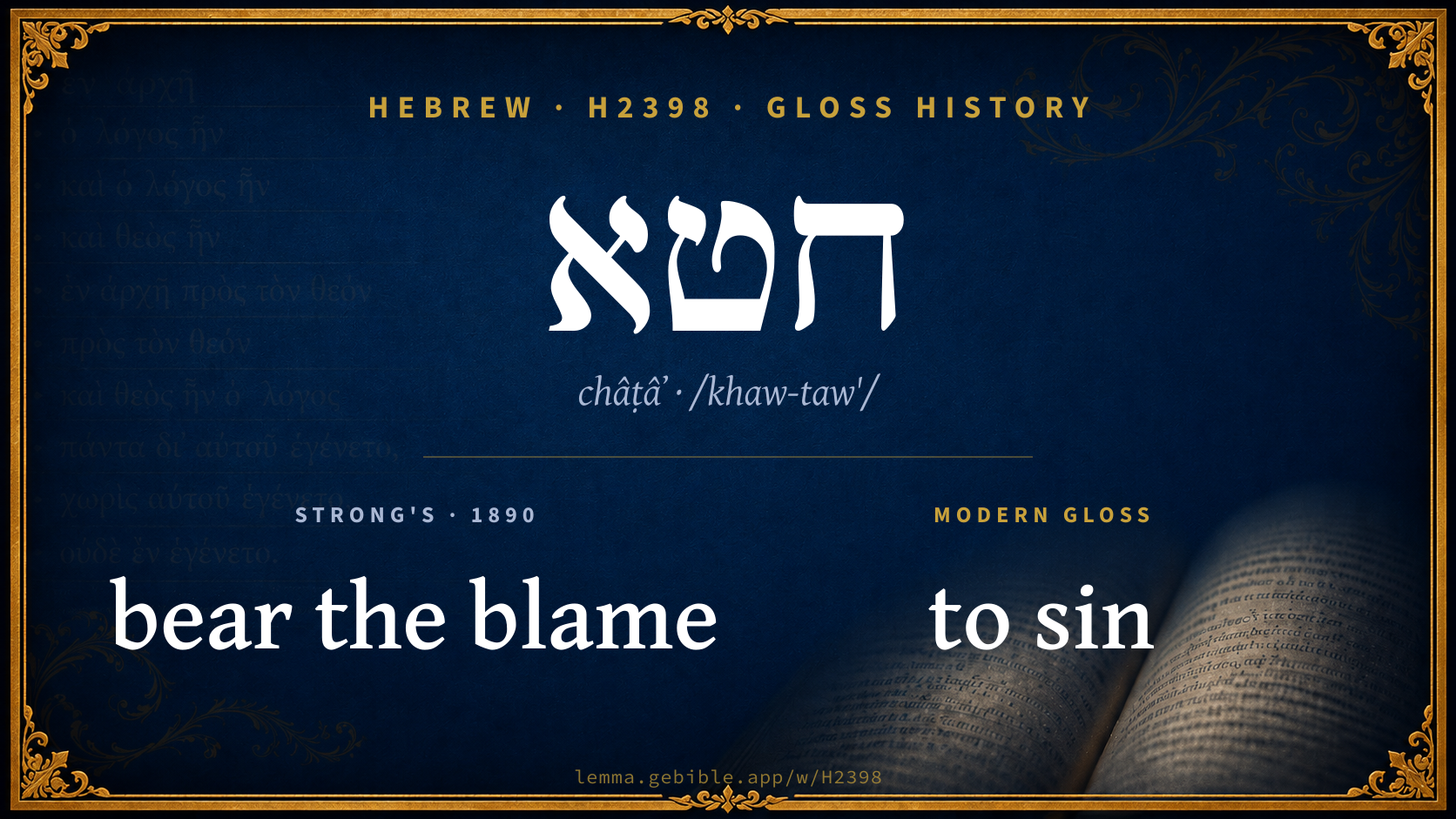
Gloss history
Strong's 1890 vs modern scholarship
About this word
Strong's H2398 catalogs a Hebrew word from the Hebrew Old Testament.
These counts are not copied from any lexicon or concordance. They are computed here, from the morphology-tagged Hebrew Old Testament. What Lemma adds →
- 220
- distinct verses
- The word appears in 220 distinct verses.
- 27 / 39
- OT books
- The word appears in 27 of 39 Old Testament books.
- #197
- by frequency
- Top 250 most frequent Hebrew words (rank 197 of 8,640 Hebrew words by occurrence).
View all 220 occurrences in the concordance →
By section of the Old Testament
By traditional corpus
Conventional, traditional groupings — biblical authorship is debated, so this is a traditional corpus grouping, not an authorship claim. Each share is this word’s portion of its verses in that division of the Hebrew canon. Each figure is a share of the word’s 220 distinct verses.
- Prophets (Nevi'im) 98 verses · 45%
- Torah (Pentateuch) 68 verses · 31%
- Writings (Ketuvim) 54 verses · 25%
How translations render this word
Counts come from each version’s own published word-to-Strong’s tagging or interlinear alignment — an approximate guide to how each version renders this word, not a word-level alignment the data otherwise carries. Because each total is that version’s own tagged count, the per-version totals vary from one another and need not match the appearance or distinct-verse counts above. These counts may also differ from a printed concordance because Lemma counts each distinctly tagged rendering and does not collapse phrase taggings into a single head-word total. This is a fixed set of word-tagged versions (KJV, ASV, BSB, ULT) and does not change with the reading translation you choose elsewhere. Each version’s license is shown beside its name below (and on Sources).
- King James Version: Sin 48×, We have sinned 22×, I have sinned 15×
- American Standard Version: Sin 43×, I have sinned 13×, We have sinned 13×
- Berean Standard Bible: Sin 24×, Commit 20×, Sins 20×
- unfoldingWord Literal Text: Sin 51×, We have sinned 21×, He sinned 19×
King James Version Public Domain
Renders H2398 across 238 tagged occurrences — most commonly:
Plus other, less common renderings. Plus 70 renderings that appear only once — usually multi-word phrases or single function words the recovered tagging swept in, not distinct renderings.
American Standard Version Public Domain
Renders H2398 across 238 tagged occurrences — most commonly:
Plus other, less common renderings. Plus 78 renderings that appear only once — usually multi-word phrases or single function words the recovered tagging swept in, not distinct renderings.
Berean Standard Bible Public Domain
Renders H2398 across 233 tagged occurrences — most commonly:
Plus other, less common renderings. Plus 70 renderings that appear only once — usually multi-word phrases or single function words the recovered tagging swept in, not distinct renderings. Not rendered by a distinct English word in 5 further occurrences.
unfoldingWord Literal Text CC BY-SA 4.0
Renders H2398 across 284 tagged occurrences — most commonly:
Plus other, less common renderings. Plus 62 renderings that appear only once — usually multi-word phrases or single function words the recovered tagging swept in, not distinct renderings.
20 senses and sub-senses in the full BDB
Hebrew verbs can shift meaning by stem (binyan): Qal is the basic action, Niphal is often passive or reflexive, Piel often intensifies or makes it factitive, and Hiphil is typically causative. The senses below are grouped under the stem BDB assigns to each. This entry also uses Hithpael (reflexive or reciprocal).
What do BDB’s symbols mean?
BDB uses these scholarly abbreviations:
| Symbol | Meaning |
|---|---|
| 𝔊 | the Septuagint (the ancient Greek translation, LXX) |
| 𝔙 | the Vulgate (the Latin translation) |
| 𝔖 | the Syriac version (the Peshitta) |
| 𝔗 | the Targum (the Aramaic translation) |
| ψ | the Psalms |
| √ | root (the underlying root or stem) |
| ‖ | parallel passage (a synonymous or contrasted parallel) |
| † | the dagger: every passage where the word occurs is cited |
The 20 senses and sub-senses the full Brown-Driver-Briggs lexicon distinguishes for this word, in lexicon order (not ranked by frequency), with BDB’s own verbatim wording and sub-sense lettering. Shown in Hebrew script with BDB’s own scholarly abbreviations. The condensed entry is in the Lexicon Entry tab. See also the Forms in the corpus table below.
Qal
- Pf. ח׳ Ex 32:31 + 29 times, 3 fs. חָֽטְאָה Lv 5:15 La 1:8, חָטָ֑אָה Je 50:14 Ez 16:15, חָטָאת Ex 5:16, etc., + 82 times Pf.; Impf. יֶחֱטָא Lv 4:3 + 12 times, תֶּחֱטָ֫אוּ Ex 20:20 ψ 4:5, etc. + 20 times Impf.; Inf. חֲטֹא Ez 3:21 + 8 times, מֵחֲטוֹא ψ 39:2, מֵחֲטוֹ (textual error for מחטא) Gn 20:6, בְּחֶטְאָה Nu 15:28, חֲטֹאתוֹ Ez 33:12 (del. Co); Pt. חוֹטֵא Pr 13:22 + 6 times, חֹטֵא Is 1:4 Ec 9:2, חוֹטֶא Is 65:20 + 2 times, חֹטֶא Ec 8:12, sf. חֹטְאִי Pr 8:36, pl. חֹטִ֯אֿים 1 S 14:33, sf. חֹטֵאת Ez 18:4, 20;— e.g. Exodus 32:31
- 1. miss: לא תחטא thou shalt not miss anything Jb 5:24, אָץ בְּרַגְלַיִם חוֹטֵא Pr 19:2 one hastening with his feet misseth (the way or the goal); חֹטְאִי חֹמֵס נַפְשׁוֹ Pr 8:36 the one missing me (Wisdom) is one wronging himself (opp. מֹצְאִי); miss, i.e. endanger, one’s life Pr 20:2 Hb 2:10 according to De VB (others sub 3 q.v.) e.g. Job 5:24
- 2. sin, miss the goal or path of right and duty:
- a. against man, abs. Ex 5:16 (E), 1 S 26:21 2 S 19:21 1 K 18:9 2 K 18:14; with לְ of the person against whom or towards whom one sins, Gn 40:1 (E), Ju 11:27 1 S 2:25; 19:4; 24:12, 1 K 8:31 = 2 Ch 6:22; מה חטאתי לך wherein have I sinned against thee? Gn 20:9 (E) Je 37:18; with בְּ, אל תחטאו בילד Gn 42:22 (E) do not sin against the lad, against David 1 S 19:4, 5. e.g. Exodus 5:16
- b. elsewhere always against God, abs. Ex 20:20 (E), 9:34 (J) Jos 7:11 (D) Lv 4:3; 5:1, 11, 17, 21, 23 Nu 16:22 (P), Ne 6:13 Jb 1:5, 22; 7:20; 10:14; 24:19; 35:6 ψ 4:5; 78:32 Is 43:27; 64:4 Je 2:35 La 5:7 Ez 3:21(×2); 16:51; 28:16; 33:12 Ho 8:11 (del. We Kl. Proph.), v 11 10:9; 13:2; לא נתתי לחטא חכי I have not permitted my palate to sin Jb 31:30; Pt. חֹטֵא, used as adj., sinful nation Is 1:4, sinful person Ez 18:4, 20; but usually as noun, sinner Pr 11:31; 13:22; 14:21 Ec 2:26; 7:26; 8:12; 9:2, 18 Is 65:20. Sin is confessed: חָטָאנוּ we have sinned Nu 14:40; 21:7 (E) Ju 10:15 1 S 12:10, 1 K 8:47 = 2 Ch 6:37, Ne 1:6 ψ 106:6 La 5:16 Dn 9:5, 15; חטאתי I have sinned Ex 9:27 Nu 22:34 (J) 1 S 15:24, 30 2 S 24:10, 17 1 Ch 21:8, 17 Jb 33:27. Sin is universal: אין אדם אשׁר לא יחטא there is no man who sinneth not 1 K 8:46 = 2 Ch 6:36, כי אדם אין צדיק בארץ אשׁר יעשׂה טוב ולא יחטא Ec 7:20 for man there is none righteous in the earth who doeth good and sinneth not; with לְ, against God Gn 20:6 (E), 39:9 (J), Ex 32:33 Nu 32:33 (both JE), Dt 9:16; 20:18 1 S 2:25; 12:23; 14:33, 34, 1 K 8:33, 35, 46, 50 = 2 Ch 6:24, 26, 36, 39, 2 K 17:7 Ho 4:7 Mi 7:9 Zp 1:17 Je 40:3; 44:23; 50:7, 14 Ez 14:13 Is 42:24 Jb 8:4 ψ 78:17; 119:11 Ne 1:6; in confession חטאתי ל Ex 10:16 Jos 7:20 (J), 2 S 12:13 ψ 41:5; 51:6; חטאנו ל Dt 1:41 Ju 10:10 1 S 7:6 Je 3:25; 8:14; 14:7, 20 Dn 9:8, 11; with בְּ of instr., lips Jb 2:10, tongue ψ 39:2; wherein Ez 37:23 Lv 4:23 (P), therein Lv 5:22 (P); ellipsis of בְּ in phrase עונם אשׁר ח׳ לי (their) iniquity wherein they sinned against me Je 33:8(×2); בשׁגגה by error, unwittingly Lv 4:2, 22, 27; 5:15 Nu 15:27, 28 (all P); against thy judgments Ne 9:29; with עַל, with regard to Lv 5:5 Nu 6:11 (P) Ne 13:26; with cognate acc. ח׳ חֲטָאָה Ex 32:30, 31 (JE); חַטָּאת אשׁר ח׳ Nu 12:11 (J) Lv 4:3, 28(×2), 35; 5:6, 10, 13 (all P) 19:22(×2) (H), Dt 9:18 1 K 14:16, 22; 15:30; 16:13, 19 2 K 21:17 Ez 18:24; 33:16; חטאת אשׁר ח׳ ל Je 16:10 Ne 1:6; חטאת אשׁר ח׳ על Lv 4:14 (P); חֵטְא ח׳ La 1:8; חֵטְא אשׁר ח׳ Dt 19:15. e.g. Exodus 20:17
- 3. incur guilt, penalty by sin, forfeit: וחטאתי לך כל הימים Gn 43:9 I shall incur the blame of sinning against thee all my days, cf. 44:32 (J); c. acc. חוֹטֵא נפשׁ for feiting one-self, one’s life Pr 20:2 Hb 2:10 according to most, yet v. sub 1.—והביא אשׁמו אשׁר ח׳ Lv 5:7, he shall bring his trespass-offering which he has incurred by sin; קרבנו אשׁר ח׳ Lv 5:11; את אשׁר ח׳ מן־הקדשׁ ישׁלּם v 16 what he hath incurred by taking of the holy thing he shall pay. e.g. Genesis 43:9
Piel
- Pf. חִטֵּא Lv 14:52; sf. חִטְּאוֹ Nu 19:19, חִטֵּאתָ Ex 29:36 + 2 times; 3 pl. חִטְּאוּ Ez 43:22(×2); Impf. וַיְחַטֵּא Lv 8:15; sf. וַיְחַטְּאֵהוּ Lv 9:15, תְּחַטְּאֵנִי ψ 51:9, אֲחַטֶּנָּה Gn 31:39, וַיְחַטְּאוּ 2 Ch 29:24; Inf. חַטֵּא Lv 14:49 Ez 43:23; Pt. הַמְחַטֵּא Lv 6:19;— e.g. Leviticus 14:52
- 1. bear loss: אָנֹכִי אֲחַטֶּנָּה I bare the loss of it Gn 31:39 (E; lit. I counted it missing? poss. read אֲחֻטּנה I was made to miss it?). e.g. Genesis 31:39
- 2. make a sin-offering: c. sf. referring to שׂעיר Lv 9:15 (P); to sin-offering Lv 6:19 (P); על המזבח upon the altar Ex 29:36 (P; not cleanse the altar RV); ח׳ את דמם המזבחה 2 Ch 29:24 made a sin-offering with their blood on the altar. e.g. Leviticus 9:15
- 3. purify from sin: the altar, by putting the blood of the sin-offering on its horns, Lv 8:15 (P), Ez 43:20, 22(×2), 23; the sanctuary, by applying to it the blood of the sin-offering Ez 45:18. e.g. Leviticus 8:15
- 4. purify from uncleanness: the house of the leper by application of the mixture of living water and blood of the bird Lv 14:49, 52 (P); a person, by application of the mixture of living water and ashes of the red heifer Nu 19:19 (P), by sprinkling with a hyssop sprig ψ 51:9. e.g. Leviticus 14:49
Hiphil
- Pf. הֶחֱטִיא 1 K 14:16 + 17 times, הֶחֶטִי֯ (Kt error for החטִיא) 2 K 13:6; sf. הֶחֱטִיאָם 2 K 17:21; pl. הֶחֱטִיאוּ 1 K 16:13 Ne 13:26; Impf. יַחֲטִא Ju 20:16 2 K 21:11; תַּחֲטִיא Dt 24:4; וַתַּחֲטִא 1 K 16:2; 21:22; pl. יַחֲטִיאוּ Ex 23:33; Inf. הַחֲטִיא Ec 5:5 1 K 16:19 Je 32:35 (Qr), הַחֲ֯טִי Je 32:35 (Kt error); Pt. pl. cstr. מַחֲטִיאֵי Is 29:21;— e.g. 1 Kings 14:16
- 1. miss the mark: קֹלֵעַ בָּאֶבֶן אֶל־הַשַּׂעְרָה וְלֹא יַחֲטִא Ju 20:16 slinging with stones at an hair and would not miss. e.g. Judges 20:16
- 2. induce or cause to sin: with acc. Ex 23:33 (JE), Ne 13:26; elsewhere in the phrase החטיא את ישׂראל (he) caused Israel to sin 1 K 14:16; 15:26, 30, 34; 16:2, 13, 19, 26; 21:22; 22:53; 2 K 3:3; 10:29, 31; 13:2, 6, 11; 14:24; 15:9, 18, 24, 28; 23:15; c. sf. ref. to Isr. 2 K 17:21; את יהודה 2 K 21:11, 16 Je 32:35 (sometimes c. 2nd acc.—חטאת, or אשׁר ref. to חטאת:—1 K 15:26, 34; 16:26 2 K 17:21; 21:16; prob. also 1 K 14:16; 15:30; 16:13; no 2nd acc. 1 K 16:2, 19; 21:22; 22:53 2 K 21:11; 23:15 Je 32:35; the rest are ambiguous). e.g. Exodus 23:33
- 3. bring into guilt, condemnation, punishment: מחטיאי אדם Is 29:21 who bring a man into condemnation; לא תחטיא את הארץ Dt 24:4 thou shalt not bring the land into guilt; אל תתן את־פיך לחטיא את־בשׂרך Ec 5:5 do not permit thy mouth to bring thy flesh into punishment. e.g. Isaiah 29:21
Hithpael
- Impf. יִתְחַטָּא Nu 19:12 + 4 times, יִתְחַטְּאוּ Nu 8:21, יִתְחַטָּ֑אוּ Jb 41:17, תִּתְחַטְּאוּ Nu 31:19, תִּתְחַטָּ֑אוּ Nu 31:20;— e.g. Numbers 19:12
- 1. miss oneself, lose oneself, fig. for be bewildered, beside oneself, מִשְּׁבָרִים יִתְחַטָּאוּ Jb 41:17 by reason of consternation they are beside themselves (‖ יגורו are afraid). e.g. Job 41:17
- 2. purify oneself from uncleanness, only in P:
- a. Levites Nu 8:21. e.g. Numbers 8:21
- b. those in contact with the dead Nu 19:12, 13, 20; 31:19, 20; with בְּ, בְּמֵי נִדָּה Nu 31:23; by a mixture of ashes of the red heifer with fresh water Nu 19:12. e.g. Numbers 19:12
Senses from the full Brown-Driver-Briggs lexicon (Brown, Driver, Briggs; Oxford 1906 — public domain), digitized via Sefaria, supplemented by the OpenScriptures HebrewLexicon (CC BY 4.0). Full attribution on Sources.
Word origin
vb. miss (a goal or way), go wrong, sin (NH id.; Aramaic חֲטָא, ܚܛܳܐ; Assyrian ḫaṭû, ZimBP 46; Sab. חֿטא, החֿטא, id., DHM in MV; Arabic خَطِىَٔ do wrong, commit a mistake or an error; ii. make to miss the mark; iv. miss the mark, miss the way; Ethiopic ኀጥአ fail to find or have; sometimes sin, especially in deriv.)—
— Brown-Driver-Briggs (Oxford 1906, public domain), digitized via Sefaria, supplemented by the OpenScriptures HebrewLexicon (CC BY 4.0). See Sources.
Origin: a primitive root
Jastrow Dictionary
A second Hebrew/Aramaic lexicon for comparison, covering Aramaic and post-biblical (Talmudic, Targumic, Midrashic) usage that the biblical-Hebrew BDB does not. Matched by lemma rather than by Strong’s number, so a lemma may carry more than one Jastrow headword (shown separately below), and the entries cover usage well beyond the Bible.
חָטָא
- , v. חטי
חֵטְא
- preced.) failure, sin. Ber. 4ᵃ שמא יגרום הח׳ perhaps sin is the cause (preventing the fulfillment of divine promise). Ib. אלא שגרם הח׳ but for sin that prevented it. Sabb. 119ᵇ, v. הֶבֶל; a. fr.—יְרֵא ח׳, יִרְאַת ח׳, v. יָרֵא a. יִרְאָה.—In Talm. Y. also חֵט. Y. Sabb. I, 3ᶜ top; a. fr.—Pl. חֲטָאִים. Ber. 10ᵃ (ref. to חַטָּאִים, Ps. CIV, 35) מי כתיב חוֹטְאִים ח׳ כתיב does the text read ḥot’im (sinners), it may be read ḥătaim (sins). Ib. כיון דְיִתַּמּוּ ח׳ וכ׳ when sins shall cease, the wicked shall be no more. Yoma IV, 2; a. fr. e.g. Psalms 104:35
חֵטא
- ch., v. חֶטְאָה
חִטָּא I
- (חטט), line drawn with a stylus.—Pl. חִטֵּי. Keth. 69ᵃ top ביני ח׳ between the lines, v. תְּלֵי.
חִטָּא II
- , wheat, v. חִיטָּא.
חַטָּא
- , v. next w.
חטי
- [to stroll idly, saunter (v. Fl. to Levy Targ. Dict. I, 4242),] to live in luxury, to be like a nobleman, to be well-dressed, clean &c. (cmp. פנק, פרנק).
- to make look well, polish, dress, cleanse, prepare. Ḥull. 27ᵃ (play on וש̇ח̇ט̇, Lev. I, 5) ממקום שש̇ח̇ חַטֵֹּהוּ from the place where the animal bends (its head, the front of the neck), cleanse it (let its blood run out). Ib. ממאי דהאי חטהו לישנא דדכויי הוא how can you prove that this ḥattehu has the meaning of cleansing?—Ib. ממקום שס̇ח̇ ח̇ט̇הו from where it utters sound, cleanse it. [Cant. R. to VII, 2, v. infra.] e.g. Leviticus 1:5
- 1. to enjoy, to be gratified. Cant. R. to VII, 2 [read:] כל חִיטּוּיִין … שישראל מִתְחַטִּין וכ׳ all luxuries and enjoyments which Israel indulge in and enjoy. Men. 66ᵇ (play on נ̇ת̇ע̇ל̇ס̇ה̇, Prov. VII, 18) נ̇שא ונת̇ן ונע̇לה ונ̇שמח ונִתְחַטֵּא באהבים let us have a conversation, then let us go up and rejoice and delight ourselves with dalliances; Sifra Vayikra, N’dabah, ch. XIV, Par. 13. Men. l. c. (play on נ̇ע̇ל̇ס̇ה̇ Job XXXIX, 13) נ̇וש̇א עול̇ה ונתח̇טא; Sifra l. c. נושא ועולה ומִתְחַטֵּא he (the bird) raises (his wings) and rises and enjoys himself (differ. interpret. in Rashi). e.g. Proverbs 7:18
- 2. to show one’s self a nobleman, to be generous, proud. Cant. R. to VII, 7 שהיה מתחטא על וכ׳ he was generous towards &c. (ref. to Gen. XIV, 23, Dan. V, 17). e.g. Genesis 14:23
- 3. to be imperious, to lord it, to ask petulantly. Taan. III, 8 אתה מתח׳ לפני thou comest petulantly before the Lord כבן שהוא מתח׳ על וכ׳ like a son that lords it over his father &c. Cant. R. to V, 6 (explain. חמק, ib.) נתח׳ וכ׳ he became petulant, he got angry with me.
חֲטִי
- ; part. חַטְיָא used to comfort, tender, delicate. Targ. Y. Gen. XXXIII, 13 טליא חַטְיָין (h. text רכים).
- to cause to be generous, to persuade to leniency. Koh. R. to IX, 18 אנא אזלא ומְחַטָּא ליה I will go to appeal to his generosity (Midr. Sam. ch. XXXII ומפייסה).
- to be raised in luxury. Part. pass. מִחְטֵי, fem. מֶחְטָיָא, מֶחְטַיְיתָא delicate. Targ. Y. I Deut. XXVIII, 54, Targ. Y. II, Deut. XXVIII, 54; 56.
חטי ²
- (b. h.) [to miss,] to fail, err, sin. Yoma IV, 2, sq. Ber. 17ᵃ; a. fr. R. Hash. 26ᵃ חוֹטֵא בל יקריב he that sinned (with gold by making the golden calf) shall not bring nigh (the gold, enter with gold garments); ח׳ בל יתגאה he that sinned (with gold) shall not parade himself (with it).—Keth. 11ᵃ שלא יהא חוטא נשכר that the sinner may not profit by his sin; Yeb. 92ᵇ; a. e.
- to expiate (cleanse from sin, v. חָטָא I). Yoma V, 5 (58ᵇ) מְחַטֵּא ויורד he expiates (sprinkles) and goes down (sprinkling downward; Rashi: moves his arm downward). Ib. במקומו היה עומד ומח׳ he remained in his place and sprinkled. Zeb. 53ᵃ
- to cause to sin. Midr. Till. to Ps. IV, 5; Pesik. Shubah, p. 158ᵃ. Ab. V, 18; a. fr.
חֲטִי ²
- Targ. Y. Gen. XLIX, 3. Targ. Josh. VII, 11; a. fr.—Sabb. 56ᵃ מֶהְטָא נמי לא חטאו but at all events they did not sin; ib. 56ᵇ ומיחטא וכ׳.—Pes. 113ᵇ; Macc. 11ᵃ, v. זִיגּוֹד; a. fr.
- to cause to sin. Targ. Y. Num. XXVII, 3; a. e.
- same. Targ. Y. II, Num. XXIV, 14 חַטֵּי יתהון (ed. Ven. חָטֵי) seduce them (to immorality).
- to be tempted. Y. Taan. I, 64ᵇ bot. תִיחְטְיִי that thou be not tempted to sin (through thy husband’s absence).
A Dictionary of the Targumim, the Talmud Babli and Yerushalmi, and the Midrashic Literature (Marcus Jastrow; London, Luzac, 1903) — Public Domain. Digitized via Sefaria. Digitized via Sefaria. Full attribution on Sources.
Forms in the corpus
The 156 distinct written forms H2398 takes in the Hebrew Bible, most frequent first — each parse links to that stem’s occurrences in the concordance. Hebrew forms include their vowel points and cantillation, so a single lemma takes many written forms.
The 60 most common forms are shown; 96 rarer forms follow in the full concordance.
Same root — word family
Other BDB entries built from the same root as H2398, grouped by Strong’s listed origin. These share a root / origin per the lexicon — not necessarily a shared meaning. Each links to that word’s own entry.
Derived from this word
- חטא chêṭᵉʼ H2399 sin
- חטא chaṭṭâʼ H2400 sinner
- חטאה chaṭṭâʼâh H2403 sin offering
- חטי chăṭîy H2408 sin
Compare all same-root words → Showing 4 of 5 — not the complete family. They share a root, not necessarily a meaning.
Septuagint verse parallels
This word appears in 206 verses that also exist in the Greek Old Testament (Septuagint), out of the 220 Hebrew verses it occurs in. You can read those verses in Greek by switching the Old Testament edition to the Septuagint.
Read these verses in the Septuagint
- Genesis 20:6
- Exodus 5:16
- Leviticus 4:2
- Numbers 6:11
- Deuteronomy 1:41
- Joshua 7:11
- Judges 10:10
- 1 Samuel 2:25
- 2 Samuel 12:13
- 1 Kings 8:31
- 2 Kings 3:3
- 1 Chronicles 21:8
This is a verse-level parallel only — the same verses exist in both the Hebrew and Greek Old Testaments. No word-level Hebrew↔Greek correspondence is claimed: the data carries no such alignment, so no Greek word is shown as this Hebrew word’s translation. Coverage is not total — the Septuagint omits the deuterocanon and renumbers the Psalms, so some Hebrew verses have no direct Greek parallel.