
Ezekiel 43:20

Hebrew (Westminster Leningrad Codex) Ezekiel 43:20 appears in the Hebrew Old Testament. The text above is from the Westminster Leningrad Codex. Each word links to its Strong’s number, a concise gloss, and parsing drawn from the Open Scriptures Hebrew Bible morphology. Click any word for its full Brown-Driver-Briggs (BDB) entry.
Download image
Cite this verse

Ezekiel 43:20 (World English Bible). Public Domain. Lemma interlinear Bible study tool, https://lemma.gebible.app/v/ezekiel/43/20.

Show BibTeX & RIS
BibTeX
RIS
English Translation
You shall take of the blood of it, and put it on the four horns of it, and on the four corners of the ledge, and on the border round about: thus shall you cleanse it and make atonement for it.
World English Bible · Public Domain
Download a study sheet

One document with this verse’s original text, its word-by-word gloss line, the meaning frame, cross-references with their text, attributed commentary, and full source and license credits — printable, and it pastes into notes with its structure intact.

This verse Autodidact and up

Study sheet (.html) Plain text (.txt)

A passage Seminary Student

Up to 50 verses in one chapter. A passage sheet keeps up to 6 commentary sources and 12 cross-references per verse, in the order this page ranks them, and says so on the sheet whenever that leaves anything out. Ask for a single verse and you get the Autodidact verse sheet above.

Everything on this page stays free to read, with no account — the sheet is a download of what is already on screen, not access to it.

Want to remove ads? Support Godless Engineer
Compare translations 3

The same verse in 3 English versions, stacked beneath the original-language interlinear above. Click any original word for its lexicon entry.

Each is an independent rendering of the whole verse — the interlinear is not word-aligned to these translations.

Highlighted words mark where these versions differ — a whole-verse word diff, not a word-by-word alignment.

  • World English Bible Public Domain
    You shall take of the blood of it, and put it on the four horns of it, and on the four corners of the ledge, and on the border round about: thus shall you cleanse it and make atonement for it.
  • King James Version Public Domain
    And thou shalt take of the blood thereof, and put it on the four horns of it, and on the four corners of the settle, and upon the border round about: thus shalt thou cleanse and purge it.
  • unfoldingWord Literal Text CC BY-SA 4.0
    Then you will take some of its blood and place it on the altar’s four horns and the four sides of its edge and on the surrounding rim; you will cleanse it and make atonement for it.

unfoldingWord Literal Text — © unfoldingWord, licensed CC BY-SA 4.0. Word-aligned USFM3 via Door43 (git.door43.org/unfoldingWord/en_ult).

Versions to compare (up to 4)

3 of 4 selected

Show all 18 translations

Every available English version of this verse, each an independent rendering of the whole verse.

  • World English Bible Public Domain
    You shall take of the blood of it, and put it on the four horns of it, and on the four corners of the ledge, and on the border round about: thus shall you cleanse it and make atonement for it.
  • Berean Standard Bible Public Domain
    You are to take some of its blood and put it on the four horns of the altar, on the four corners of the ledge, and all around the rim; thus you will cleanse the altar and make atonement for it.
  • Majority Standard Bible Public Domain
    You are to take some of its blood and put it on the four horns of the altar, on the four corners of the ledge, and all around the rim; thus you will cleanse the altar and make atonement for it.
  • King James Version Public Domain
    And thou shalt take of the blood thereof, and put it on the four horns of it, and on the four corners of the settle, and upon the border round about: thus shalt thou cleanse and purge it.
  • American Standard Version (1901) Public Domain
    And thou shalt take of the blood thereof, and put it on the four horns of it, and on the four corners of the ledge, and upon the border round about: thus shalt thou cleanse it and make atonement for it.
  • Revised Version (1885) Public Domain
    And thou shalt take of the blood thereof, and put it on the four horns of it, and on the four corners of the settle, and upon the border round about: thus shalt thou cleanse it and make atonement for it.
  • Geneva Bible (1599) Public Domain
    And thou shalt take of the blood thereof, and put it on the foure hornes of it, and on the foure corners of the frame, and vpon the border round about: thus shalt thou clense it, and reconcile it.
  • Douay-Rheims (1899) Public Domain
    And thou shalt give to the priests, and the Levites, that are of the race of Sadoc, who approach to me, saith the Lord God, to offer to me a calf of the herd for sin.
  • Young's Literal Translation Public Domain
    And thou hast taken of its blood, and hast put it on its four horns, and on the four corners of its border, and on the border round about, and hast cleansed it, and purified it.
  • Literal Standard Version CC BY-SA 4.0
    And you have taken of its blood, and have put it on its four horns, and on the four corners of its border, and on the border all around, and have cleansed it, and purified it.
  • Unlocked Literal Bible CC BY-SA 4.0
    Then you will take some of its blood and place it on the altar's four horns and the four sides of its edge and on the surrounding rim; you will cleanse it and make atonement for it.
  • unfoldingWord Literal Text CC BY-SA 4.0
    Then you will take some of its blood and place it on the altar’s four horns and the four sides of its edge and on the surrounding rim; you will cleanse it and make atonement for it.
  • Darby Bible Public Domain
    And thou shalt take of its blood, and put it on the four horns thereof, and on the four corners of the settle, and upon the border round about: so shalt thou purge and make atonement for it.
  • World Messianic Bible Public Domain
    You shall take of its blood and put it on its four horns, and on the four corners of the ledge, and on the border all around. You shall cleanse it and make atonement for it that way.
  • Webster's Bible Public Domain
    And thou shalt take of his blood, and put it on the four horns of it, and on the four corners of the settle, and upon the border around: thus shalt thou cleanse and purge it.
  • Free Bible Version CC BY-SA 4.0
    Take some of its blood and put it on the four horns of the altar, on the four corners of the ledge, and all the way round the rim. This is how you shall purify the altar and set it right.
  • Bible in Basic English Public Domain
    You are to take some of its blood and put it on the four horns and on the four angles of the shelf and on the edge all round: and you are to make it clean and free from sin.
  • JPS Tanakh (1917) Public Domain
    And thou shalt take of the blood thereof, and put it on the four horns of it, and on the four corners of the settle, and upon the border round about; thus shalt thou purify it and make atonement for it.

Literal Standard Version (2020), Covenant Press — licensed CC BY-SA 4.0. Text via the HelloAO Bible API (eBible.org). Unlocked Literal Bible (unfoldingWord) — licensed CC BY-SA 4.0. Text via the HelloAO Bible API (eBible.org). unfoldingWord Literal Text — © unfoldingWord, licensed CC BY-SA 4.0. Word-aligned USFM3 via Door43 (git.door43.org/unfoldingWord/en_ult). Free Bible Version, Dr. Jonathan Gallagher — licensed CC BY-SA 4.0. Text via the HelloAO Bible API (eBible.org).

Word by word

More ways to search: Search by grammar → Find every occurrence → Compare this word →

Practice this passage: Drill this verse → Learn its vocabulary →

הָעֲזָרָ֔ה
ʻăzârâh
H5835
“the · enclosure”
Particle, Definite Article + Noun, Common, Feminine, Singular, Absolute
Part of Speech
Particle + Noun
Type
Common
Gender
Feminine
Number
Singular
State
Absolute
Full BDB Definition

Origin: from H5826 in its original meaning of surrounding

TWOT: 1599a

enclosure - ledge (surrounding Ezekiel's altar) - court (outer one of temple)
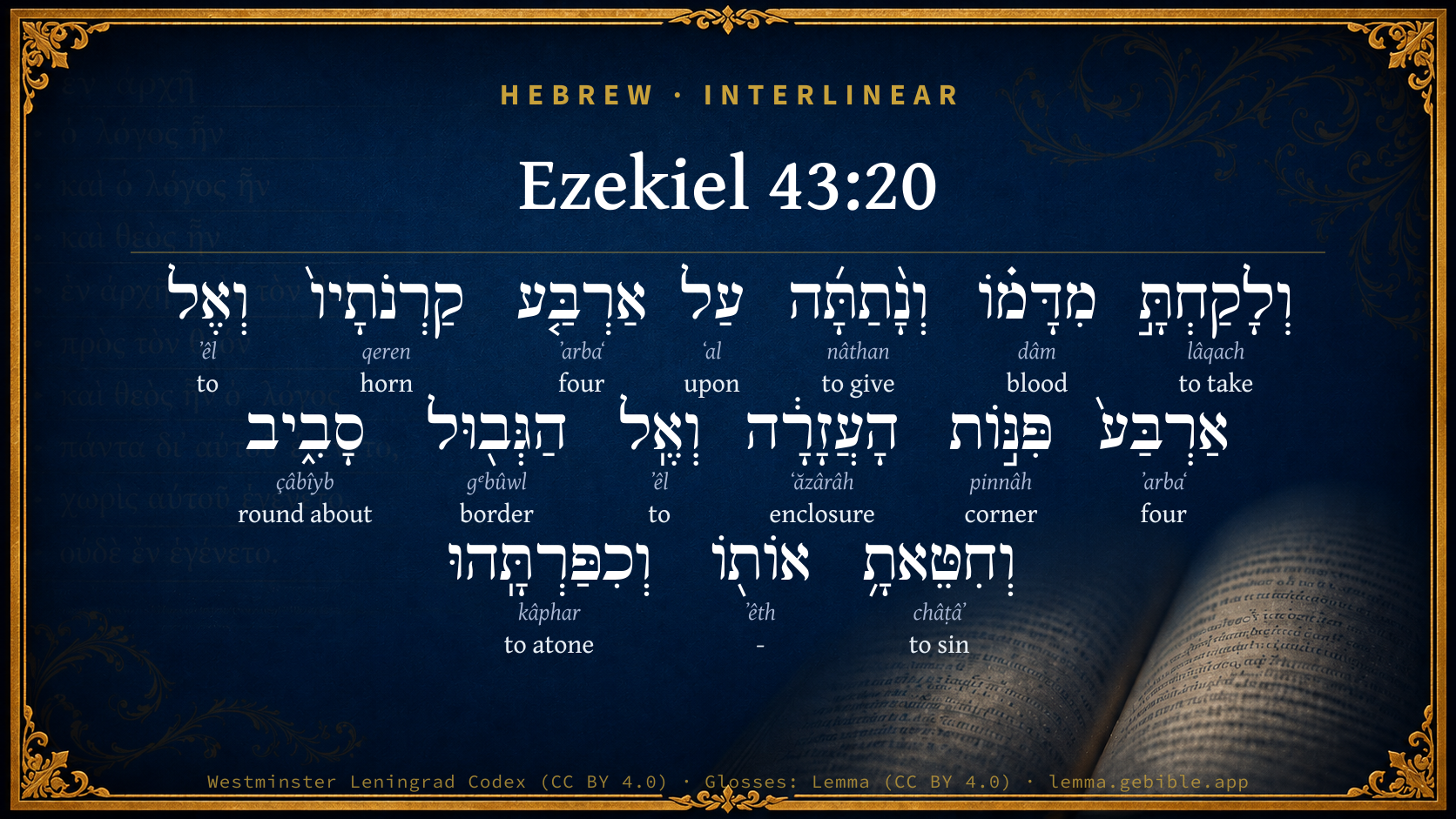
  1. וְלָקַחְתָּ֣ lâqach H3947 “and · to take” Conjunction + Verb, Qal, Sequential Perfect, 2nd Person, Masculine, Singular
  2. מִדָּמ֗וֹ dâm H1818 “from · blood · his” Preposition + Noun, Common, Masculine, Singular, Construct + Suffix, Personal, 3rd Person, Masculine, Singular
  3. וְנָ֨תַתָּ֜ה nâthan H5414 “and · to give” Conjunction + Verb, Qal, Sequential Perfect, 2nd Person, Masculine, Singular
  4. עַל ʻal H5921 “upon” Preposition
  5. אַרְבַּ֤ע ʼarbaʻ H702 “four” Adjective, Cardinal number, Feminine, Singular, Absolute
  6. קַרְנֹתָיו֙ qeren H7161 “horns · his” Noun, Common, Both, Plural, Construct + Suffix, Personal, 3rd Person, Masculine, Singular
  7. וְאֶל ʼêl H413 “and · to” Conjunction + Preposition
  8. אַרְבַּע֙ ʼarbaʻ H702 “four” Adjective, Cardinal number, Feminine, Singular, Absolute
  9. פִּנּ֣וֹת pinnâh H6438 “corners of” Noun, Common, Feminine, Plural, Construct
  10. וְאֶֽל ʼêl H413 “and · to” Conjunction + Preposition
  11. הַגְּב֖וּל gᵉbûwl H1366 “the · border” Particle, Definite Article + Noun, Common, Masculine, Singular, Absolute
  12. סָבִ֑יב çâbîyb H5439 “round about” Noun, Common, Both, Singular, Absolute
  13. וְחִטֵּאתָ֥ châṭâʼ H2398 “and · to sin” Conjunction + Verb, Piel, Sequential Perfect, 2nd Person, Masculine, Singular
  14. אוֹת֖וֹ ʼêth H853 “- · him” Particle, Direct Object + Suffix, Personal, 3rd Person, Masculine, Singular
  15. וְכִפַּרְתָּֽהוּ kâphar H3722 “and · to atone · him” Conjunction + Verb, Piel, Sequential Perfect, 2nd Person, Masculine, Singular + Suffix, Personal, 3rd Person, Masculine, Singular

About this verse

These counts appear in no published source. They are computed here, from the morphology-tagged text and Lemma’s own curated glosses. What Lemma adds →

16
words
14
distinct lemmas
Prophets
section

Notable vocabulary

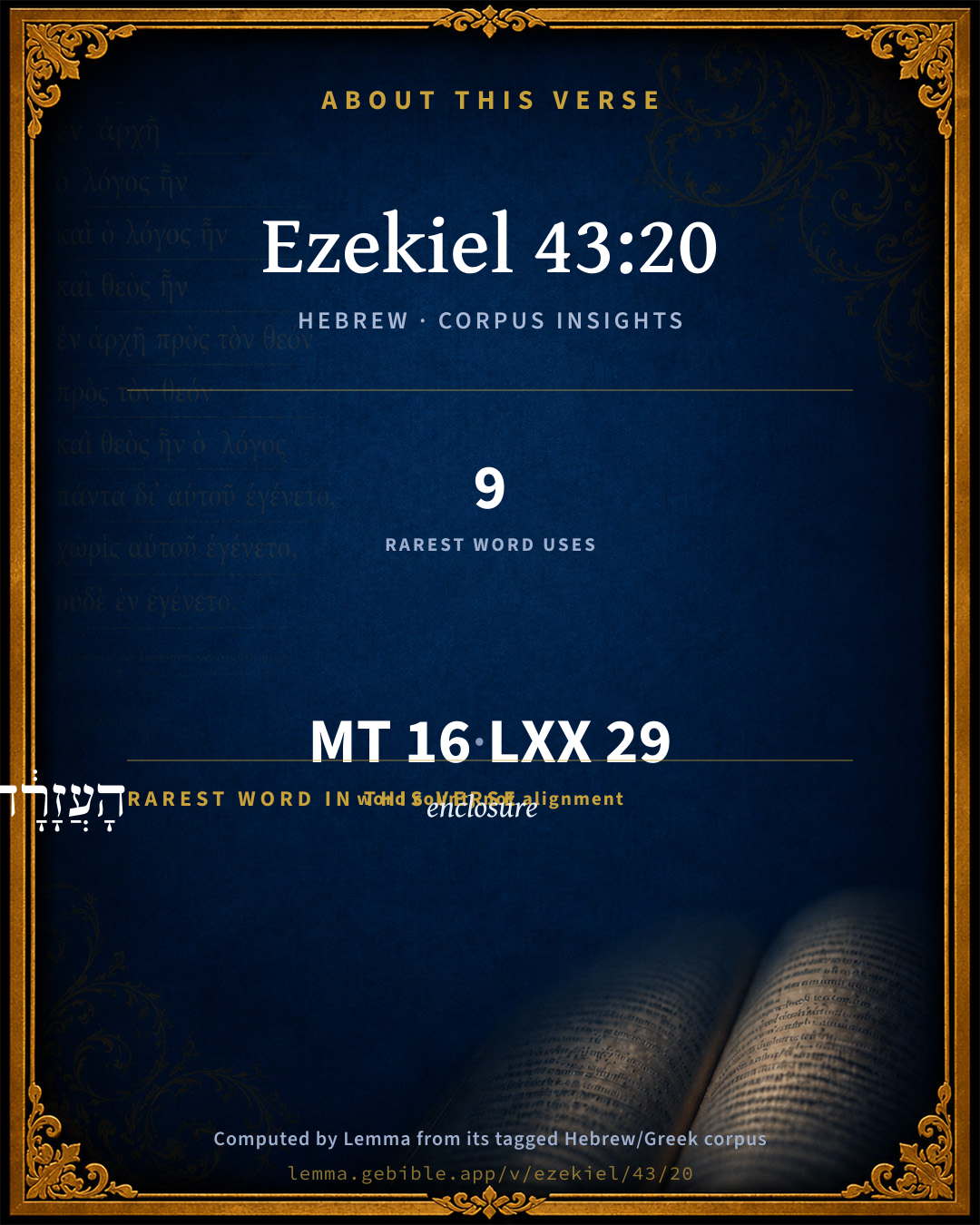
The rarest word here is הָעֲזָרָ֔ה enclosure H5835 — appearing just 9 times in the whole Hebrew Bible.

Shared distinctive vocabulary

הָעֲזָרָ֔ה enclosure H5835 occurs in 6 verses of the Hebrew Bible. Also found in:

Grammatical profile

  • 4 verbs
  • 6 nouns
  • 2 adjectives
  • 3 prepositions
  • 1 particle

Verb forms

  • וְלָקַחְתָּ֣ Qal · Sequential Perfect
  • וְנָ֨תַתָּ֜ה Qal · Sequential Perfect
  • וְחִטֵּאתָ֥ Piel · Sequential Perfect
  • וְכִפַּרְתָּֽהוּ Piel · Sequential Perfect

Repetition

Words recur within this verse — often emphatic in Hebrew:

  • אַרְבַּ֤ע four H702 ×2
  • וְאֶל to H413 ×2

Hebrew & Septuagint length

In English translation the verse runs 41 words from the Hebrew and 39 from the Septuagint (LXX English) — closely comparable.

A rough comparison of the two English renderings, which tokenize alike — not a word-level alignment.

Word counts can differ between the Hebrew and the Greek without any difference in meaning — e.g. the Hebrew direct-object marker אֵת has no separate Greek word, and Greek often adds the article ὁ.

In the original languages it is 16 Hebrew tokens and 29 Greek tokens — but the two are counted differently (Hebrew bundles its prefixes and suffixes into one token; the Greek is in lemma form), so that isn’t a like-for-like length.

Cross-references

12

Topical passages linked to Ezekiel 43:20 in the Treasury of Scripture Knowledge — connected by theme and wording, ordered by reader-vote popularity; previews shown in the World English Bible.

  • Leviticus 8:15 He killed it; and Moses took the blood, and put it on the horns of the altar round about with his finger, and purified the altar, and poured out the blood at the base of the altar, and sanctified it, to make atonement for it.
  • Leviticus 16:19 He shall sprinkle some of the blood on it with his finger seven times, and cleanse it, and make it holy from the uncleanness of the children of Israel.
  • Exodus 29:12 You shall take of the blood of the bull, and put it on the horns of the altar with your finger; and you shall pour out all the blood at the base of the altar.
  • Exodus 29:36 Every day shall you offer the bull of sin-offering for atonement: and you shall cleanse the altar, when you make atonement for it; and you shall anoint it, to sanctify it.
  • Leviticus 9:9 The sons of Aaron presented the blood to him; and he dipped his finger in the blood, and put it on the horns of the altar, and poured out the blood at the base of the altar:
  • Ezekiel 43:22 On the second day you shall offer a male goat without blemish for a sin-offering; and they shall cleanse the altar, as they did cleanse it with the bull.
  • Ezekiel 43:26 Seven days shall they make atonement for the altar and purify it; so shall they consecrate it.
  • Leviticus 4:25 The priest shall take some of the blood of the sin offering with his finger, and put it on the horns of the altar of burnt offering. He shall pour out the rest of its blood at the base of the altar of burnt offering.
  • Leviticus 4:30 The priest shall take some of its blood with his finger, and put it on the horns of the altar of burnt offering; and the rest of its blood he shall pour out at the base of the altar.
  • Leviticus 4:34 The priest shall take some of the blood of the sin offering with his finger, and put it on the horns of the altar of burnt offering; and all the rest of its blood he shall pour out at the base of the altar.
  • Ezekiel 43:15–17 The upper altar shall be four cubits; and from the altar hearth and upward there shall be four horns.
  • Hebrews 9:21–23 Moreover he sprinkled the tabernacle and all the vessels of the ministry in like manner with the blood.

Cross-references courtesy of OpenBible.info (CC BY 4.0).

Hebrew and Greek witnesses Masoretic Hebrew ↔ Greek Septuagint

The same verse in the two great witnesses to the Old Testament, shown verse-for-verse.

These are two independent witnesses, not word-aligned to each other, and the Septuagint is shown in lemma (dictionary) form.

Hebrew Ezekiel 43:20 Masoretic · Westminster Leningrad Codex

וְלָקַחְתָּ֣ מִדָּמ֗וֹ וְנָ֨תַתָּ֜ה עַל אַרְבַּ֤ע קַרְנֹתָיו֙ וְאֶל אַרְבַּע֙ פִּנּ֣וֹת הָעֲזָרָ֔ה וְאֶֽל הַגְּב֖וּל סָבִ֑יב וְחִטֵּאתָ֥ אוֹת֖וֹ וְכִפַּרְתָּֽהוּ

You shall take of the blood of it, and put it on the four horns of it, and on the four corners of the ledge, and on the border round about: thus shall you cleanse it and make atonement for it.

World English Bible · Public Domain

Greek LXX Ezekiel 43:20 Septuagint · lemma form

καί λαμβάνω ἐκ ὁ αἷμα αὐτός καί ἐπιτίθημι ἐπί ὁ τέσσαρες κέρας ὁ θυσιαστήριον καί ἐπί ὁ τέσσαρες γωνία ὁ ἱλαστήριον καί ἐπί ὁ βάσις κύκλος καί ἐκἱλάσκομαι αὐτός

And they shall take of its blood, and shall put it on the four horns of the altar, and upon the four corners of the propitiatory, and upon the base round about, and they shall make atonement for it.

LXX2012 (modern English Septuagint) · Public Domain

Hebrew: Westminster Leningrad Codex (CC BY 4.0). Greek: Septuagint (public domain); English from LXX2012 (modern English Septuagint) (Public Domain). How the Septuagint differs from the Hebrew →

Targum (Aramaic paraphrase)

1

The Targum is the ancient Jewish Aramaic paraphrase of the Hebrew Scriptures — an interpretive translation, not the Hebrew text itself. Onkelos (literal) and Pseudo-Jonathan (expansive) render the Torah, and Jonathan the Prophets. Coverage is partial: where no permissively-licensed English translation exists for a verse, only the Aramaic is shown. This is verse-level text, not a word-by-word alignment to the Hebrew.

  1. Targum Jonathan Prophets (Joshua–Malachi)
    וְתִיסַב מִדְמֵיהּ וְתִתֵּן עַל אַרְבַּע קַרְנָתֵיהּ וְעַל אַרְבַּע זִוְיַת מְסַמְתָא וְעַל תְּחוּמָה סְחוֹר סְחוֹר וּתְדַכֵּי יָתֵיהּ וּתְכַפֵּר עֲלוֹהִי:

    (no public-domain English translation for this verse)

    Targum Jonathan — Aramaic: “Mikraot Gedolot” (public domain). English: “Sefaria Community Translation” (CC0 1.0 (public-domain dedication)); “London "Chaldee Paraphrase," 1871” (public domain). Text via Sefaria.

Commentary

Notes on Ezekiel 43:20 from classic Christian and Jewish commentators (each source and its license shown beneath its notes). The classic Christian expositions comment on the surrounding passage and are grouped to its opening verse, so a note may address several verses; the Jewish commentaries on the Tanakh (Rashi and others) are per-verse, so they appear only where the commentator wrote on this verse.

Lemma curates 59 commentaries, every one of them public domain or Creative Commons licensed, each selected and text-cleaned for this edition rather than reprinted as found. About our sources →

Trapp's Complete Commentary

John Trapp

Eze 43:20 And thou shalt take of the blood thereof, and put [it] on the four horns of it, and on the four corners of the settle, and upon the border round about: thus shalt thou cleanse and purge it.

Ver. 20. And thou shalt take of the blood.] Christ, as mediator, was consecrated and qualified for the work.

John Trapp, A Commentary or Exposition upon All the Books of the Old and New Testament (1647–1656) — public domain. Text from a community e-Sword module.

Jamieson, Fausset & Brown

Robert Jamieson, A. R. Fausset & David Brown

cleanse--literally, "make expiation for."

Jamieson, Fausset & Brown — Commentary Critical and Explanatory on the Whole Bible (1871) — public domain (CC PDM 1.0). Text via the HelloAO Bible API.

Ellicott's Commentary for English Readers

(20) Take of the blood thereof.—Comp. Exo_29:12; Lev_8:15; Heb_9:18; Heb_9:22. Nothing is here said of the pouring the rest of the blood at the foot of the altar, as required in the law, and nothing of the burning of the fat upon the altar, because the prophet throughout supposes the ritual of the sacrifices to be well known, and only mentions a few particulars to indicate the whole, and also a few others now introduced, peculiar to the new ceremonial.

A Bible Commentary for English Readers, edited by Charles John Ellicott (1878–1897) — public domain. Text from a community e-Sword module.

The Cambridge Bible for Schools and Colleges

gen. ed. J. J. S. Perowne

20. Blood was to be put on the four horns of the altar hearth, on the four corners of the (upper) settle, and on the border; see on Eze_43:17. To “cleanse” is to purify from sin, to “un-sin,” if such a word could be formed; and to “purge” is usually rendered “to make atonement for.”

The Cambridge Bible for Schools and Colleges (gen. ed. J. J. S. Perowne; Cambridge University Press, 1878–1918) — public domain. Text from a community e-Sword module.

John Gill's Exposition

And thou shalt take of the blood thereof,.... Ezekiel being a priest. This must be understood in a visionary way; for, as Kimchi observes, Ezekiel did not live to come up out of the captivity, but died, and was buried in the land of Babylon, and so did not actually do this: though it is a mere dream of the same writer, that this is to be understood of the resurrection of the dead, when he supposes Ezekiel will be high priest, though Aaron be present; or however be the second, or deputy to him.

And put it on the four horns of it, and on the four corners of the settle, and upon the border round about; that is, on the four horns of the altar, and on the four corners of the settle which went round it, for the priests to walk on, and do their business; either the uppermost, or as others the lowermost, and as some both; and also on the border or ledge that enclosed the settle. The prophet's doing this, putting the blood on these several things, represents the nature of the Gospel ministry, and the business of it; which is to hold forth the blood of Christ, and the blessings of grace through it, as redemption, peace, pardon, righteousness, and life.

Thus shall thou cleanse and purge it; the altar; thus Christ, though without sin, and needed no cleansing and purging for himself, yet was sanctified by his own blood; that he might sanctify his people, and perfect by his sacrifice them that were sanctified, Joh 17:19.

John Gill's Exposition of the Whole Bible (1746–1763) — public domain (CC PDM 1.0). Text via the HelloAO Bible API.

Haydock's Catholic Bible Commentary

CHAPTER XLIII.

George Leo Haydock (1774–1849), Haydock's Catholic Family Bible and Commentary, 1859 edition — public domain. Excludes Psalms (Douay-Rheims chapter numbering differs from Protestant) and Deuterocanonical books (Catholic canon only).

Matthew Poole's English Annotations

Thou shalt take; appoint it to be taken.

Of the blood thereof; of the slain bullock.

Put it, not all, but some of the blood, on the horns of the altar, as Lev 4:30 prescribeth, and as Moses did, Lev 8:15.

Of the settle, on which the altar stood, which was two cubits high, and set upon one of a cubit high from the ground.

Upon the border: see Eze 43:17.

Cleanse and purge it; make it legally clean, that it may be fit for so sacred a use as this of sacrificing was.

Matthew Poole's English Annotations on the Holy Bible (1683–1685) — public domain. Text from a community e-Sword/MySword module.

The Pulpit Commentary

And thou shalt take of the blood thereof, and put it. The application of the victim"s blood to and upon the altar formed an integral part of every expiatory offering; but "whereas in all the other kinds of sacrifice the blood was poured indifferently round about the altar of the fore court, in the sin offering it was not to be sprinkled, lest the intention should be overlooked, but smeared with the finger upon the horns of the altar (And the priest shall put of the blood upon the horns," Lev_4:7, Lev_4:18, Lev_4:25, Lev_4:30, Lev_4:34) (Kurtz, "Sacrificial Worship of the Old Testament," In the present instance the blood was to be carefully put upon the four horns of the altar the only part to be smeared with blood in the Mosaic consecration (Exo_29:12) the four corners of the settle, or azarah, but whether the greater or lesser is left undecided, though in all probability it was the under, if not both, and the border round about, that mentioned in ver. 17; and the effect of this smearing with blood should be to cleanse and purge, or, make atonement for, the altar; not for the people, as Havernick interprets, saying, "without an atoned-for altar, no atoned-for people (ohne entsuhnten Altar, kein entsuhntes Volk)," but for the altar, either, as Kliefoth suggests, because, being made out of a part of the sinful earth and world, it required to be sanctified, or because, as Plumptre prefers, the sins of the people having been, as it were, transferred to it, it stood in need of cleansing.

The Pulpit Commentary (1880–1919), ed. H.D.M. Spence-Jones & Joseph S. Exell — public domain. Text from a community e-Sword module.

John Wesley's Explanatory Notes

Shalt take - Appoint it to be taken.

John Wesley, Explanatory Notes Upon the Whole Bible (1754–1765) — public domain. Text via the GEBible commentary corpus.

unfoldingWord translationNotes

Door43 World Missions Community

Then you will take

The word "you" is singular. See how you translated this in Ezekiel 43:19. (See: Forms of You)

four horns

The horns were the parts of the altar at the four corners of the altar that stuck up above the rest of the altar. See how you translated this in Ezekiel 43:15.

translationWords

blood

altar

clean

atonement

appoint

sanctuary

unfoldingWord translationNotes — © Distant Shores Media and the Door43 World Missions Community, licensed CC BY-SA 4.0. Source: git.door43.org/Door43/en_tn.

Rashi

Rabbi Shlomo Yitzchaki (Rashi)

on its four horns [i.e., the four horns] of the altar.

corners of the uppermost ledge the top of the altar.

and make it fit for atonement You shall “wipe” it of its ordinariness to initiate it into sanctity, so that it will befit for [providing] atonement from then on.

Rashi on the Tanakh — English translations: “The Judaica Press complete Tanach with Rashi, translated by A. J. Rosenberg” (CC BY 4.0); “Pentateuch with Rashi's commentary by M. Rosenbaum and A.M. Silbermann, 1929-1934” (public domain); “The Metsudah Tanach series, Lakewood, N.J” (CC BY 4.0); and “The Book of Joshua, Metsudah Publications, 1997” (CC BY 4.0). Text via Sefaria.

Lesson kit

Teaching starters — assembled from the data on this page, not authored interpretation. Every prompt links to the verse data it draws on. Edit before teaching.

Ezekiel, in the Prophets, opens this verse with 16 words (14 distinct Hebrew lemmas). Its most distinctive word is ʻăzârâh (“enclosure”). A historical commentator’s framing appears above. Read the whole chapter for the surrounding context.

Discussion questions

  1. What does “enclosure” (ʻăzârâh) contribute to the verse as a whole?
  2. 2 Chronicles 4:9 shares the word «enclosure» with this verse. How do the two illuminate each other?
  3. “four” occurs 2× in this one verse. What is the effect of the repetition?
  4. The translations on this page render this verse differently — a whole-verse word diff, not a word-by-word alignment. What might account for the different wordings?
  5. The verb «וְלָקַחְתָּ֣» is Qal Sequential Perfect. How does its form color the action?
  6. Reading how Trapp's Complete Commentary and Jamieson, Fausset & Brown read this verse, where do the two commentators agree and where do they part?

Things to notice

Reading settings

Reading text

Shown beneath each verse's original-language words.

Old Testament
Old Testament edition

Read the OT as the Masoretic Hebrew (MT) or the Greek Septuagint (LXX).

English shown for the Greek Septuagint (in the Hebrew ↔ Greek comparison).

Comparing translations? Open the Compare panel on any verse page to stack up to four side by side.