Leviticus 4:27

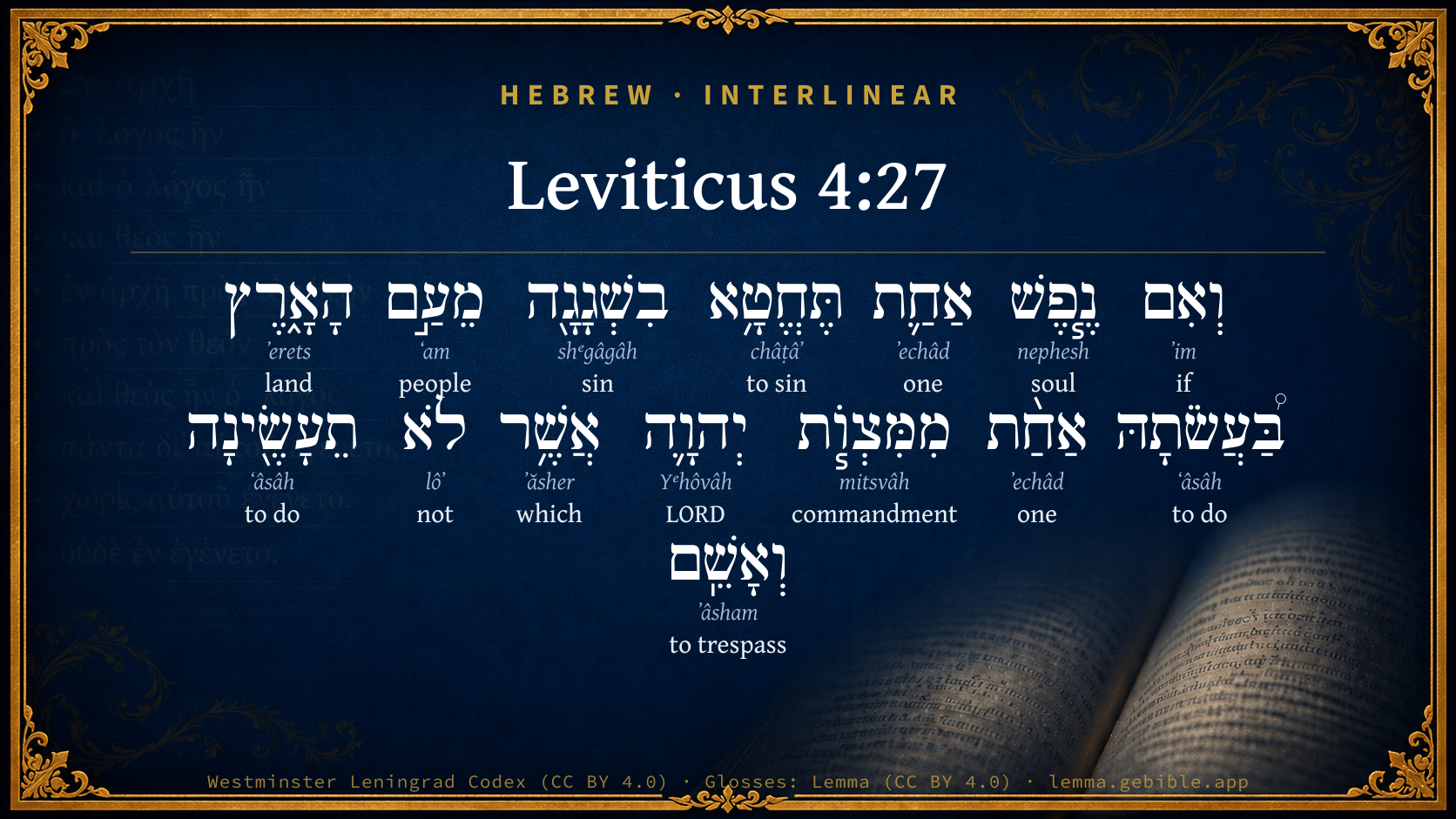
Hebrew (Westminster Leningrad Codex) Leviticus 4:27 appears in the Hebrew Old Testament. The text above is from the Westminster Leningrad Codex. Each word links to its Strong’s number, a concise gloss, and parsing drawn from the Open Scriptures Hebrew Bible morphology. Click any word for its full Brown-Driver-Briggs (BDB) entry.
Download image
Cite this verse

Leviticus 4:27 (World English Bible). Public Domain. Lemma interlinear Bible study tool, https://lemma.gebible.app/v/leviticus/4/27.

Show BibTeX & RIS
BibTeX
RIS
English Translation
"'If anyone of the common people sins unwittingly, in doing any of the things which Yahweh has commanded not to be done, and is guilty;
World English Bible · Public Domain
Download a study sheet

One document with this verse’s original text, its word-by-word gloss line, the meaning frame, cross-references with their text, attributed commentary, and full source and license credits — printable, and it pastes into notes with its structure intact.

This verse Autodidact and up

Study sheet (.html) Plain text (.txt)

A passage Seminary Student

Up to 50 verses in one chapter. A passage sheet keeps up to 6 commentary sources and 12 cross-references per verse, in the order this page ranks them, and says so on the sheet whenever that leaves anything out. Ask for a single verse and you get the Autodidact verse sheet above.

Everything on this page stays free to read, with no account — the sheet is a download of what is already on screen, not access to it.

Want to remove ads? Support Godless Engineer
Compare translations 3

The same verse in 3 English versions, stacked beneath the original-language interlinear above. Click any original word for its lexicon entry.

Each is an independent rendering of the whole verse — the interlinear is not word-aligned to these translations.

Highlighted words mark where these versions differ — a whole-verse word diff, not a word-by-word alignment.

  • World English Bible Public Domain
    "'If anyone of the common people sins unwittingly, in doing any of the things which Yahweh has commanded not to be done, and is guilty;
  • King James Version Public Domain
    And if any one of the common people sin through ignorance, while he doeth somewhat against any of the commandments of the LORD concerning things which ought not to be done, and be guilty;
  • unfoldingWord Literal Text CC BY-SA 4.0
    And if one person from the people of the land sins by mistake by doing it, one from the commands of Yahweh that shall not be done, and he becomes guilty,

unfoldingWord Literal Text — © unfoldingWord, licensed CC BY-SA 4.0. Word-aligned USFM3 via Door43 (git.door43.org/unfoldingWord/en_ult).

Versions to compare (up to 4)

3 of 4 selected

Show all 18 translations

Every available English version of this verse, each an independent rendering of the whole verse.

  • World English Bible Public Domain
    "'If anyone of the common people sins unwittingly, in doing any of the things which Yahweh has commanded not to be done, and is guilty;
  • Berean Standard Bible Public Domain
    And if one of the common people sins unintentionally and does what is prohibited by any of the LORD’s commandments, he incurs guilt.
  • Majority Standard Bible Public Domain
    And if one of the common people sins unintentionally and does what is prohibited by any of the LORD’s commandments, he incurs guilt.
  • King James Version Public Domain
    And if any one of the common people sin through ignorance, while he doeth somewhat against any of the commandments of the LORD concerning things which ought not to be done, and be guilty;
  • American Standard Version (1901) Public Domain
    And if any one of the common people sin unwittingly, in doing any of the things which Jehovah hath commanded not to be done, and be guilty;
  • Revised Version (1885) Public Domain
    And if any one of the common people sin unwittingly, in doing any of the things which the LORD hath commanded not to be done, and be guilty;
  • Geneva Bible (1599) Public Domain
    Likewise if any of the people of ye lande shall sinne through ignoraunce in doing against any of the commandements of the Lord, which should not be done, and shall offend,
  • Douay-Rheims (1899) Public Domain
    And if any one of the people of the land shall sin through ignorance, doing any of those things that by the law of the Lord are forbidden, and offending,
  • Young's Literal Translation Public Domain
    `And if any person of the people of the land sin through ignorance, by his doing `something against' one of the commands of Jehovah `regarding things' which are not to be done, and hath been guilty --
  • Literal Standard Version CC BY-SA 4.0
    And if any person of the people of the land sins through ignorance, by his doing [something against] one of the commands of YHWH [regarding things] which are not to be done, and has been guilty,
  • Unlocked Literal Bible CC BY-SA 4.0
    If anyone of the common people sins without intending to sin, doing any of the things which Yahweh has commanded him not to be done, and when he realizes his guilt,
  • unfoldingWord Literal Text CC BY-SA 4.0
    And if one person from the people of the land sins by mistake by doing it, one from the commands of Yahweh that shall not be done, and he becomes guilty,
  • Darby Bible Public Domain
    And if any one of the people of the land sin through inadvertence, that he do [somewhat against] any of the commandments of Jehovah [in things] which should not be done, and be guilty;
  • World Messianic Bible Public Domain
    “‘If anyone of the common people sins unwittingly, in doing any of the things which the LORD has commanded not to be done, and is guilty,
  • Webster's Bible Public Domain
    And if any one of the common people shall sin through ignorance, while he doeth somewhat against any of the commandments of the LORD concerning things which ought not to be done, and be guilty;
  • Free Bible Version CC BY-SA 4.0
    If any other Israelite sins unintentionally and does what is not permitted by any of the commandments of the Lord his God, he is guilty.
  • Bible in Basic English Public Domain
    And if any one of the common people does wrong in error, doing any of the things which the Lord has given orders are not to be done, causing sin to come on him;
  • JPS Tanakh (1917) Public Domain
    And if any one of the common people sin through error, in doing any of the things which the LORD hath commanded not to be done, and be guilty:

Literal Standard Version (2020), Covenant Press — licensed CC BY-SA 4.0. Text via the HelloAO Bible API (eBible.org). Unlocked Literal Bible (unfoldingWord) — licensed CC BY-SA 4.0. Text via the HelloAO Bible API (eBible.org). unfoldingWord Literal Text — © unfoldingWord, licensed CC BY-SA 4.0. Word-aligned USFM3 via Door43 (git.door43.org/unfoldingWord/en_ult). Free Bible Version, Dr. Jonathan Gallagher — licensed CC BY-SA 4.0. Text via the HelloAO Bible API (eBible.org).

Word by word

More ways to search: Search by grammar → Find every occurrence → Compare this word →

Practice this passage: Drill this verse → Learn its vocabulary →

בִשְׁגָגָ֖ה
shᵉgâgâh
H7684
“in/at · sin”
Preposition + Noun, Common, Feminine, Singular, Absolute
Part of Speech
Preposition + Noun
Type
Common
Gender
Feminine
Number
Singular
State
Absolute
Full BDB Definition

Origin: from H7683

TWOT: 2324a

sin, sin of error or inadvertence, inadvertent sin - error
  1. וְאִם ʼim H518 “and · if” Conjunction + Conjunction
  2. נֶ֧פֶשׁ nephesh H5315 “soul of” Noun, Common, Both, Singular, Construct
  3. אַחַ֛ת ʼechâd H259 “one” Adjective, Cardinal number, Feminine, Singular, Absolute
  4. תֶּחֱטָ֥א châṭâʼ H2398 “to sin” Verb, Qal, Imperfect, 3rd Person, Feminine, Singular
  5. מֵעַ֣ם ʻam H5971 “from · people of” Preposition + Noun, Common, Masculine, Singular, Construct
  6. הָאָ֑רֶץ ʼerets H776 “the · land” Particle, Definite Article + Noun, Common, Both, Singular, Absolute
  7. בַּ֠עֲשֹׂתָהּ ʻâsâh H6213 “in/at · to do · her” Preposition + Verb, Qal, Infinitive Construct + Suffix, Personal, 3rd Person, Feminine, Singular
  8. אַחַ֨ת ʼechâd H259 “one” Adjective, Cardinal number, Feminine, Singular, Absolute
  9. מִמִּצְוֺ֧ת mitsvâh H4687 “from · commandments of” Preposition + Noun, Common, Feminine, Plural, Construct
  10. יְהוָ֛ה Yᵉhôvâh H3068 “LORD” Noun, Proper
  11. אֲשֶׁ֥ר ʼăsher H834 “which” Particle, Relative
  12. לֹא lôʼ H3808 “not” Particle, Negative
  13. תֵעָשֶׂ֖ינָה ʻâsâh H6213 “to do” Verb, Niphal, Imperfect, 3rd Person, Feminine, Plural
  14. וְאָשֵֽׁם ʼâsham H816 “and · to trespass” Conjunction + Verb, Qal, Sequential Perfect, 3rd Person, Masculine, Singular

About this verse

These counts appear in no published source. They are computed here, from the morphology-tagged text and Lemma’s own curated glosses. What Lemma adds →

15
words
13
distinct lemmas
Pentateuch
section

Notable vocabulary

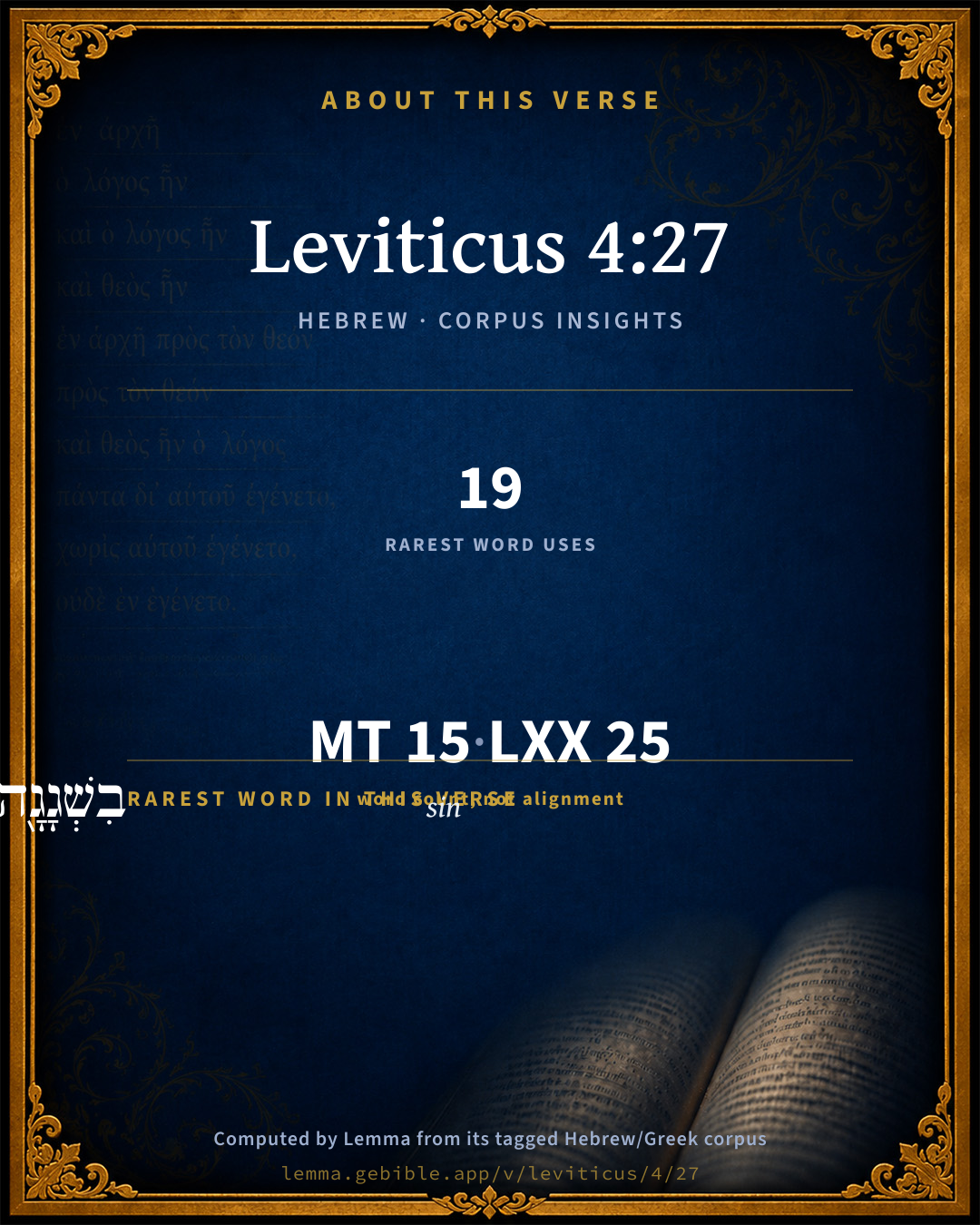
The rarest word here is בִשְׁגָגָ֖ה sin H7684 — appearing just 19 times in the whole Hebrew Bible.

Shared distinctive vocabulary

בִשְׁגָגָ֖ה sin H7684 occurs in 18 verses of the Hebrew Bible. Also found in:

Grammatical profile

  • 4 verbs
  • 6 nouns
  • 2 adjectives
  • 1 conjunction
  • 2 particles

Verb forms

  • תֶּחֱטָ֥א Qal · Imperfect
  • בַּ֠עֲשֹׂתָהּ Qal · Infinitive Construct
  • תֵעָשֶׂ֖ינָה Niphal · Imperfect
  • וְאָשֵֽׁם Qal · Sequential Perfect

Repetition

Words recur within this verse — often emphatic in Hebrew:

  • אַחַ֛ת one H259 ×2
  • בַּ֠עֲשֹׂתָהּ to do H6213 ×2

Hebrew & Septuagint length

In English translation the verse runs 25 words from the Hebrew and 35 from the Septuagint (LXX English) — the Septuagint runs noticeably longer here. See the side-by-side →

A rough comparison of the two English renderings, which tokenize alike — not a word-level alignment.

Word counts can differ between the Hebrew and the Greek without any difference in meaning — e.g. the Hebrew direct-object marker אֵת has no separate Greek word, and Greek often adds the article ὁ.

In the original languages it is 15 Hebrew tokens and 25 Greek tokens — but the two are counted differently (Hebrew bundles its prefixes and suffixes into one token; the Greek is in lemma form), so that isn’t a like-for-like length.

Cross-references

7

Topical passages linked to Leviticus 4:27 in the Treasury of Scripture Knowledge — connected by theme and wording, ordered by reader-vote popularity; previews shown in the World English Bible.

  • Leviticus 4:2 "Speak to the children of Israel, saying, 'If anyone sins unintentionally, in any of the things which Yahweh has commanded not to be done, and does any one of them:
  • Numbers 15:27 If one person sin unwittingly, then he shall offer a female goat a year old for a sin-offering.
  • Leviticus 4:13 "'If the whole congregation of Israel sins, and the thing is hidden from the eyes of the assembly, and they have done any of the things which Yahweh has commanded not to be done, and are guilty;
  • Numbers 5:6 "Speak to the children of Israel: When a man or woman commits any sin that men commit, so as to trespass against Yahweh, and that soul is guilty;
  • Numbers 15:29 You shall have one law for him who does anything unwittingly, for him who is home-born among the children of Israel, and for the stranger who lives as a foreigner among them.
  • Exodus 12:49 One law shall be to him who is born at home, and to the stranger who lives as a foreigner among you."
  • Numbers 15:16 One law and one ordinance shall be for you, and for the stranger who lives as a foreigner with you.

Cross-references courtesy of OpenBible.info (CC BY 4.0).

Hebrew and Greek witnesses Masoretic Hebrew ↔ Greek Septuagint

The same verse in the two great witnesses to the Old Testament, shown verse-for-verse.

Here the Septuagint runs noticeably longer than the Hebrew — LXX2012 (modern English Septuagint) 35 words vs World English Bible 25. A rough length comparison of the two English translations, not a word-level alignment — read both below.

These are two independent witnesses, not word-aligned to each other, and the Septuagint is shown in lemma (dictionary) form.

Hebrew Leviticus 4:27 Masoretic · Westminster Leningrad Codex

וְאִם נֶ֧פֶשׁ אַחַ֛ת תֶּחֱטָ֥א בִשְׁגָגָ֖ה מֵעַ֣ם הָאָ֑רֶץ בַּ֠עֲשֹׂתָהּ אַחַ֨ת מִמִּצְוֺ֧ת יְהוָ֛ה אֲשֶׁ֥ר לֹא תֵעָשֶׂ֖ינָה וְאָשֵֽׁם

"'If anyone of the common people sins unwittingly, in doing any of the things which Yahweh has commanded not to be done, and is guilty;

World English Bible · Public Domain

Greek LXX Leviticus 4:27 Septuagint · lemma form

ἐάν δέ ψυχή εἷς ἁμαρτάνω ἀκουσίως ἐκ ὁ λαός ὁ γῆ ἐν ὁ ποιέω εἷς ἀπό πᾶς ὁ ἐντολή κύριος ὅς οὐ ποιέω καί πλημμηλέω

And if a soul of the people of the land should sin unwillingly, in doing a thing contrary to any of the commandments of the Lord, which ought not to be done, and shall transgress,

LXX2012 (modern English Septuagint) · Public Domain

On this verse, Adam Clarke's Commentary discusses the Septuagint’s reading. Read the note in Commentary ↓

Hebrew: Westminster Leningrad Codex (CC BY 4.0). Greek: Septuagint (public domain); English from LXX2012 (modern English Septuagint) (Public Domain). How the Septuagint differs from the Hebrew →

Targum (Aramaic paraphrase)

2

The Targum is the ancient Jewish Aramaic paraphrase of the Hebrew Scriptures — an interpretive translation, not the Hebrew text itself. Onkelos (literal) and Pseudo-Jonathan (expansive) render the Torah, and Jonathan the Prophets. Coverage is partial: where no permissively-licensed English translation exists for a verse, only the Aramaic is shown. This is verse-level text, not a word-by-word alignment to the Hebrew.

  1. Targum Onkelos Torah (Genesis–Deuteronomy)
    וְאִם אֱנַשׁ חַד יֵחוֹב בְּשָׁלוּ מֵעַמָא דְאַרְעָא בְּמֶעְבְּדַהּ חַד מִפִּקוּדַיָא דַיְיָ דְלָא כַשְׁרִין לְאִתְעְבָדָא וְיֵחוֹב

    (no public-domain English translation for this verse)

    Targum Onkelos — Aramaic: “Onkelos Genesis” (public domain); “Onkelos Exodus” (public domain); “Onkelos Leviticus” (public domain); “Onkelos Numbers” (public domain); “Onkelos Deuteronomy” (public domain). English: “Sefaria Community Translation” (CC0 1.0 (public-domain dedication)); “J.W. Etheridge. The Targums of Onkelos and Jonathan Ben Uzziel on the Pentateuch. London: Longmans, Green, 1862” (public domain). Text via Sefaria.

  2. Targum Pseudo-Jonathan Torah (Genesis–Deuteronomy)
    וְאִין בַּר נַשׁ חַד יֵיחוֹב בְּשָׁלוּ מִן עַמָא דְאַרְעָא בְּמַעֲבְדֵיהּ חַד מִן פִּקוּדַיָא דַיְיָ דְלָא כַשְׁרִין לְאִתְעֲבָדָא וְיִתְחַיֵיב

    And if a man of the people of the land sin through ignorance in doing (against) one of the commandments of the Lord what was not right to do, and he hath sinned;

    Targum Pseudo-Jonathan — Aramaic: “Targum Jonathan on Genesis” (public domain); “Targum Jonathan on Exodus” (public domain); “Targum Jonathan on Leviticus” (public domain); “Targum Jonathan on Numbers” (public domain); “Targum Jonathan on Deuteronomy” (public domain). English: “The Targum of Jonathan ben Uzziel, trans. J. W. Etheridge, London, 1862” (public domain). Text via Sefaria.

Commentary

Notes on Leviticus 4:27 from classic Christian and Jewish commentators (each source and its license shown beneath its notes). The classic Christian expositions comment on the surrounding passage and are grouped to its opening verse, so a note may address several verses; the Jewish commentaries on the Tanakh (Rashi and others) are per-verse, so they appear only where the commentator wrote on this verse.

Lemma curates 59 commentaries, every one of them public domain or Creative Commons licensed, each selected and text-cleaned for this edition rather than reprinted as found. About our sources →

Matthew Henry's Commentary

I. Here is the law of the sin-offering for a common person, which differs from that for a ruler only in this, that a private person might bring either a kid or a lamb, a ruler only a kid; and that for a ruler must be a male, for the other a female: in all the circumstances of the management of the offering they agreed. Observe, 1. The case supposed: If any one of the common people sin through ignorance, Lev 4:27. The prophet supposes that they were not so likely as the great men to know the way of the Lord, and the judgment of their God (Jer 5:4), and yet, if they sin through ignorance, they must bring a sin-offering. Note, Even sins of ignorance need to be atoned for by sacrifice. To be able to plead, when we are charged with sin, that we did it ignorantly, and through the surprise of temptation, will not bring us off if we be not interested in that great plea, Christ hath died, and entitled to the benefit of that. We have all need to pray with David (and he was a ruler) to be cleansed from secret faults, the errors which we ourselves do not understand or are not aware of, Psa 19:12. 2. That the sins of ignorance committed by a single person, a common obscure person, did require a sacrifice; for, as the greatest are not above the censure, so the meanest are not below the cognizance of the divine justice. None of the common people, if offenders, were overlooked in a crowd. 3. That a sin-offering was not only admitted, but accepted, even from one of the common people, and an atonement made by it, Lev 4:31, Lev 4:35. Here rich and poor, prince and peasant, meet together; they are both alike welcome to Christ, and to an interest in his sacrifice, upon the same terms. See Job 34:19.

II. From all these laws concerning the sin-offerings we may learn, 1. To hate sin, and to watch against it. That is certainly a very bad thing to make atonement for which so many innocent and useful creatures must be slain and mangled thus. 2. To value Christ, the great and true sin-offering, whose blood cleanses from all sin, which it was not possible that the blood of bulls and of goats should take away. Now, if any man sin, Christ is the propitiation (Jo1 2:1, Jo1 2:2), not for Jews only, but for Gentiles. And perhaps there was some allusion to this law concerning sacrifices for sins of ignorance in that prayer of Christ's, just when he was offering up himself a sacrifice, Father, forgive them, for they know not what they do.

Matthew Henry's Commentary on the Whole Bible (1708–1710) — public domain (CC PDM 1.0). Text via the HelloAO Bible API.

Ellicott's Commentary for English Readers

(27) And if any one of the common people.—The fourth instance adduced (Lev_4:27-35) is that of any one of the people of the land, as this phrase is rendered in Lev_20:2; Lev_20:4; 2Ki_9:18-19; 2Ki_16:15. That is, any member of the congregation, whether he be a private Israelite, ordinary priest, or Levite, in contradistinction to the afore-mentioned high priest and ruler.

And be guilty.—Rather, and acknowledges his guilt. (See Lev_4:22.)

A Bible Commentary for English Readers, edited by Charles John Ellicott (1878–1897) — public domain. Text from a community e-Sword module.

Trapp's Complete Commentary

John Trapp

Lev 4:27 And if any one of the common people sin through ignorance, while he doeth [somewhat against] any of the commandments of the LORD [concerning things] which ought not to be done, and be guilty;

Ver. 27. And if any soul sin.] As there is none that liveth and sinneth not. {1Ki 8:46} Triste mortalitatis privilegium est licere aliquando peccare. {a}

{a} Ephor. Augusta nimis res est, et nulli mortalium concessa nuspiam errare. - Amama.

John Trapp, A Commentary or Exposition upon All the Books of the Old and New Testament (1647–1656) — public domain. Text from a community e-Sword module.

The Biblical Illustrator

Joseph S. Exell

Lev_4:27-31

If any one of the common people sin through ignorance.

The sin-offering for the common people

I. The person: a common person.

1. If a common person sin his sins will ruin him; he may not be able to do so much mischief by his sin as the ruler or a public officer, but his sin has all the essence of evil in it, and God will reckon with him for it. No matter how obscurely you may live, however poor and unlettered you may be, your sin will ruin you if not pardoned and put away. If one of the common people sin through ignorance, his sin is a damning sin, he must have it put away, or it will put him away for ever from the face of God.

2. A common persons sin can only he removed by an atonement of blood. In this case you see the victim was not a bullock, it was a female of the goats or of the sheep, but still it had to be an offering of blood, for without shedding of blood there is no remission. However commonplace your offences may have been, however insignificant you may be yourself, nothing will cleanse you but the blood of Jesus Christ.

3. But here is the point of joy, that for the common people there was an atonement ordained of God. Glory be to God, I may be unknown to men, but I am not unthought of by Him.

4. Observe with thankfulness that the sacrifice appointed for the common people was as much accepted as that appointed for the ruler. Of the ruler it is said, the priest shall make an atonement for him as concerning his sin, and it shall be forgiven him. The same thing is said of the common person. Christ is as much accepted for the poorest of His people as for the richest of them.

II. The sacrifice: a kid of the goats, a female without blemish.

1. Observe that there is a discrepancy between the type and the reality, for first the sin-offering under the law was only for sins of ignorance. But we have a far better sacrifice for sin than that, for have we not read, The blood of Jesus Christ, His Son, cleanseth us from all sin, not from sins of ignorance only, but from all sin.

2. Note another discrepancy, that the sinner of the common people in this case had to bring his sacrifice--he shall bring his offering. But our sin-offering has been provided for us.

3. Now let us notice that in the type the victim chosen for a sin-offering was unblemished; whether it was a goat or a sheep, it must be unblemished. How could Christ make an atonement for sins if He had had sins of His own?

4. But, the main point about the sacrifice was, it was slain as a substitute. There is nothing said about its being taken outside the camp--I do not think it was in this case: all that the offerer knew was, it was slain as a substitute. And everything that is essential to know in order to be saved is to know that you are a sinner and that Christ is your Substitute.

III. The after ceremonies.

1. In the case of one of the common people after the victim was slain, the blood was taken to the brazen altar, and the four horns of it were smeared, to show that the power of fellowship with God lies in the blood of substitution. There is no fellowship with God except through the blood, there is no acceptance with God for any one of us except through Him who suffered in our stead.

2. But then the blood was thrown at the feet of this same brazen altar, as if to show that the atonement is the foundation as well as the power of fellowship. We get nearest to God when we feel most the power of the blood, ay, and we could not come to God at all except it were through that encrimsoned way.

3. After this, a part of the offering was put upon the altar, and it is said concerning it, what is not said in any other of the cases, the priest shall burn it upon the altar for a sweet savour to the Lord. This common person had, in most respects, a dim view of Christ, compared with the others, but yet there were some points in which he had more light than others, for it does not say of the priest that what he offered was a sweet savour; but, for the comfort of this common person, that he might go his way having sweet consolation in his soul, he is told that the sin-offering he has brought is a sweet savour unto God. And oh, what a joy it is to think not only has Christ put away my sin if I believe in Him; but now for me He is a sweet savour to God, and I am for His sake accepted, for His sake beloved, for His sake delighted in, for His sake precious unto God.

IV. I have purposely omitted an essential act in the sacrifice, in order to enlarge upon it now. Observe that in all four cases there was one thing which was never left out, He shall lay his hand upon the head of the sin-offering.

1. That act signified confession. Here I stand as a sinner, and confess that I deserve to die. This goat which is now to be slain represents in its sufferings what I deserve of God. Oh, sinner! confess your sin now unto your great God, acknowledge that He would be just if He condemned you. Confession of sin is a part of the meaning of laying on of the hand.

2. The next thing meant by it was acceptance. I accept this goat as standing for me. I agree that this victim shall stand instead of me. That is what faith does with Christ, it pats its hand upon the ever blessed Son of God, and says, He stands for me, I take Him as my Substitute.

3. The next meaning of it was transference. I transfer, according to Gods ordinance, all my sin which I here confess, from myself to this victim. By that act the transference was made. God did lay sin in bulk upon Christ when He-laid upon Him the iniquity of us all, but by an act of faith every individual in another sense lays his sins on Jesus, and it is absolutely needful that each man should do so, if he would participate in the substitution.

4. This was a personal act. Nobody could lay his hand upon the bullock, or upon the goat, for another; each one had to put his own hand there. A godly mother could not say, My graceless boy will not lay his hand upon the victim, but I will put my hand there for him. It could not be. He who laid his hand there had the blessing, but no one else, and had the godliest saint with holy but mistaken zeal said, Rebellious man, wilt thou not put thy hand there, I will act as sponsor for thee, it had been of no avail; the offender must personally come. And so must you have a personal faith in Christ for yourself. The word is sometimes interpreted to lean, and some give it the meaning of leaning hard. What a blessed view of faith that gives us!

V. The assured blessing: And it shall be forgiven him (Lev_4:31). Was not that plain speaking? There were no ifs, no buts, no peradventures; but it shall be forgiven aim. Now, in those days it was only one sin, the sin confessed, that was forgiven, but now all manner of sin and blasphemy shall be forgiven unto men. In those days the forgiveness did not give the conscience abiding peace, for the offerer had to come with another sacrifice by and by; but now the blood of Christ blots out all the sins of believers at once and for ever, so that there is no need to bring a new sacrifice, or to come a second time with the blood of atonement in our hands. The sacrifice of the Jew had no intrinsic value. How could the blood of bulls and goats take away sin? It could only be useful as a type of the true sacrifice, the sin-offering of Christ. But in our Lord Jesus there is real efficacy, there is true atonement, there is real cleansing, and whosoever believeth in Him shall find actual pardon and complete forgiveness at this very moment. (C. H. Spurgeon.)

Lay his hand upon the head.

Laying the hand on the sacrifice

The text gives us a pictorial answer to the question--How can Christs sacrifice become available for me?

I. The intent of the symbol.

1. It was a confession of sin: else no need of a sin-offering. To this was added a confession of the desert of punishment, or why should the victim be slain? There was also an abandonment of all other methods of removing sin.

2. It was a consent to the plan of substitution. If God is content with this method of salvation, surely we may be. Substitution exceedingly honours the law, and vindicates justice. No other plan meets the case, or even looks fairly at it

3. It was an acceptance of the victim. Jesus is the most natural substitute, for He is the Second Adam, the second head of the race; the true ideal man. He is the only Person able to offer satisfaction, having a perfect humanity united with His Godhead. He alone is acceptable to God; He may well be acceptable to us.

4. It was a believing transference of sin. By laying on of hands sin was typically laid on the victim. It was laid there so as to be no longer on the offerer.

5. It was a dependence-leaning on the victim. Is there not a most sure stay in Jesus for the leaning heart? Consider the nature of the suffering and death by which the atonement was made, and you will rest in it. Consider the dignity and worth of the sacrifice by whom the death was endured. The glory of Christs person enhances the value of His atonement (Heb_10:5-10).

II. The simplicity of the symbol.

1. There were no antecedent rites. The victim was there, and hands were laid on it: nothing more. We add neither preface nor appendix to Christ: He is Alpha and Omega.

2. The offerer came in all his sin. Just as I am. It was to have his sin removed that the offerer brought the sacrifice: not because he had himself removed it

3. There was nothing in his hand of merit or price.

4. There was nothing on his hand. No gold ring to indicate wealth; no signet of power; no jewel of rank. The offerer came as a man, and not as learned, rich, or honourable.

5. He performed no cunning legerdemain with his hand. By leaning upon it he took the victim to be his representative; but he placed no reliance upon ceremonial performances.

6. Nothing was done to his hand. His ground of trust was the sacrifice, not his hands. He desired his hand to be clean, but upon that fact he did not rest for pardon. (C. H. Spurgeon.)

All can lean on Christ

The Puritans speak of faith as a recumbency, a leaning. It needs no power to lean; it is a cessation from our own strength, and allowing our weakness to depend upon anothers power. Let no man say, I cannot lean; it is not a question of what you can do, but a confession of what you cannot do, and a leaving of the whole matter with Jesus. (C. H. Spurgeon.)

.

The Biblical Illustrator, edited by Joseph S. Exell (c. 1880s–1900s) — public domain. Text from a community e-Sword module.

Whedon's Commentary on the Bible

Daniel D. Whedon

SIN OF A PRIVATE PERSON, Lev_4:27-35.

The only difference between the method of expiating the sin of a private person and that of a ruler is, that the offering of the former being a female kid is supposed to be inferior to that of the ruler.

Daniel D. Whedon (gen. ed.), Commentary on the Old and New Testaments (1874–1909) — public domain. Text from a community e-Sword module.

Tyndale Open Study Notes

Tyndale Open Resources

4:27-35 The common people, who had less responsibility than a priest or leader, were permitted the lesser offering of a female sheep or goat. A greater position brings greater responsibility (cp. Amos 3:2; Matt 25:14-30; Jas 3:1).

Tyndale Open Study Notes — © Tyndale Open Resources, licensed CC BY-SA 4.0. Text via the HelloAO Bible API.

Geneva Bible (1599)

Geneva Bible translators

Or, private person.

Geneva Bible (1599) marginal notes — public domain. Text via Bolls.life.

Jamieson, Fausset & Brown

Robert Jamieson, A. R. Fausset & David Brown

if any one of the common people sin through ignorance--In this case the expiatory offering appointed was a female kid, or a ewe-lamb without blemish; and the ceremonies were exactly the same as those observed in the case of the offending ruler [Lev 4:22-26]. In these two latter instances, the blood of the sin offering was applied to the altar of burnt offering--the place where bloody sacrifices were appointed to be immolated. But the transgression of a high priest, or of the whole congregation, entailing a general taint on the ritual of the tabernacle, and vitiating its services, required a further expiation; and therefore, in these cases, the blood of the sin offering was applied to the altar of incense [Lev 4:6, Lev 4:17].

Jamieson, Fausset & Brown — Commentary Critical and Explanatory on the Whole Bible (1871) — public domain (CC PDM 1.0). Text via the HelloAO Bible API.

Adam Clarke's Commentary

Verse 27. The common people] עם הארץ am haarets, the people of the land, that is, any individual who was not a priest, king, or ruler among the people; any of the poor or ordinary sort. Any of these, having transgressed through ignorance, was obliged to bring a lamb or a kid, the ceremonies being nearly the same as in the preceding cases. The original may denote the very lowest of the people, the labouring or agricultural classes.

The law relative to the general cases of sins committed through ignorance, and the sacrifices to be offered on such occasions, so amply detailed in this chapter, may be thus recapitulated. For all sins and transgressions of this kind committed by the people, the prince, and the priest, they must offer expiatory offerings. The person so sinning must bring the sacrifice to the door of the tabernacle, and lay his hands upon its head, as in a case already referred to, acknowledging the sacrifice to be his, that he needed it for his transgression; and thus he was considered as confessing his sin, and the sin was considered as transferred to the animal, whose blood was then spilt to make an atonement. See Clarke on Le 1:4.

Such institutions as these could not be considered as terminating in themselves, they necessarily had reference to something of infinitely higher moment; in a word, they typified Him whose soul was made an offering for sin, Isa 53:10. And taken out of this reference they seem both absurd and irrational. It is obviously in reference to these innocent creatures being brought as sin-offerings to God for the guilty that St. Paul alludes 2Co 5:21, where he says, He (God) made him to be sin (αμαρτιαν, a sin-offering) for us WHO KNEW NO SIN, that we might be made the righteousness of God - holy and pure by the power and grace of God, in or through him. And it is worthy of remark, that the Greek word used by the apostle is the same by which the Septuagint, in more than fourscore places in the Pentateuch, translate the Hebrew word הטאה hattaah, sin, which in all those places our translation renders sin-offering. Even sins of ignorance cannot be unnoticed by a strict and holy law; these also need the great atonement: on which account we should often pray with David, Cleanse thou me from secret faults! Ps 19:12. How little attention is paid to this solemn subject! Sins of this kind - sins committed sometimes ignorantly, and more frequently heedlessly, are permitted to accumulate in their number, and consequently in their guilt; and from this very circumstance we may often account for those painful desertions, as they are called, under which many comparatively good people labour. They have committed sins of ignorance or heedlessness, and have not offered the sacrifice which can alone avail in their behalf. How necessary in ten thousand cases is the following excellent prayer! "That it may please thee to give us true repentance; to forgive us all our sins, negligences, and ignorances; and to endue us with the grace of thy Holy Spirit, to amend our lives according to thy HOLY WORD." - Litany.

Adam Clarke's Commentary on the Bible (1810–1826) — public domain. Text from a community e-Sword/MySword module.

The Cambridge Bible for Schools and Colleges

gen. ed. J. J. S. Perowne

27–35. The Sin-Offering for one of the common people (Heb. ‘people of the land’), a she-goat or a lamb

The she-goat (Lev_4:28), according to Num_15:27, was to be of the first year. The lamb (Lev_4:32) was also to be a female. The ritual is the same for both animals, and like that of the offering of the ruler. The reason for treating the two in separate paragraphs is the same as in the case of the Peace-Offering.

The Cambridge Bible for Schools and Colleges (gen. ed. J. J. S. Perowne; Cambridge University Press, 1878–1918) — public domain. Text from a community e-Sword module.

John Gill's Exposition

Or if his sin which he hath sinned come to his knowledge,.... So that he is convinced that he has sinned:

then he shall bring his offering; to the door of the tabernacle of the congregation, to the priest there:

a kid of the goats: a young goat:

a female without blemish; and so inferior to the offering of the ruler or prince; for the characters of men are aggravations of their sins, and sacrifices were to be in some measure answerable to them, and suitable to their circumstances:

for the sin which he hath sinned; to atone for it in a typical way.

John Gill's Exposition of the Whole Bible (1746–1763) — public domain (CC PDM 1.0). Text via the HelloAO Bible API.

Albert Barnes' Notes on the Bible

The common people - literally, as in the margin, “the people of the land.” Compare Lev 20:2, Lev 20:4; 2Ki 11:18. It was the ordinary designation of the people, as distinguished from the priests and the rulers.

Albert Barnes' Notes on the Bible (1834–1885) — public domain. Text from a community e-Sword/MySword module.

Haydock's Catholic Bible Commentary

The land. A rustic or plebeian. (Menochius) --- The offences of such might be expiated by the sacrifice of a goat, ewe, lamb, ram, two pigeons, or flour, chap. v. 7. and xi. 15. (Calmet)

George Leo Haydock (1774–1849), Haydock's Catholic Family Bible and Commentary, 1859 edition — public domain. Excludes Psalms (Douay-Rheims chapter numbering differs from Protestant) and Deuterocanonical books (Catholic canon only).

Matthew Poole's English Annotations

The common people, whether Israelites, or strangers embodied with them and proselytes; for both were under one and the same law, Exo 12:49; Num 15:16.

Matthew Poole's English Annotations on the Holy Bible (1683–1685) — public domain. Text from a community e-Sword/MySword module.

The Pulpit Commentary

Vers. 27-35. The case of a common man. He is to offer a kid of the goats, or rather a she-goat. The ritual is to be the same as in the previous case.

Vers. 27-35. The sins of the common people.

The idea of the distinction is that those who, by their distance from the sanctuary and their lack of education, are more exposed to the possibility of offense, are less guilty, and therefore require a somewhat lower sacrifice. A female kid or a lamb would suffice; but the same ceremonies were indispensable the laying on of hands, the touching of the horns of the altar of burnt offering with blood, the pouring out of the blood at the bottom of the altar, the fire offering of sweet savour to the Lord. Thus the least sins, the sins of the least responsible people, the sins of ignorance and mere ceremonial uncleanness, were connected with the greatest, and the people were reminded that all sin, as transgression of the Law, must be atoned for, and without atonement there is no forgiveness. SubjectSins of the common people.

I We are taught to DEAL WITH THEM PITIFULLY, with consideration of circumstances, with remembrance of their comparative lesser guilt. Mere denunciations, unqualified condemnation, injurious. We should teach people the Law that they may see the sinfulness of sin, but in the spirit of love, lest they be blinded and hardened by a bewildering confusion of conscience and despondency. The traditional condemnation attached to those sins to which the masses are especially tempted might mislead, if not modified by the respect to antecedents.

II We must hold fast to the Scripture representation ALL SIN IS GUILT. The attempt to uplift the lower classes, without the power of atonement, by means of mere moral or intellectual appliances or social influences, must be a failure in the long run. Those who make it injure themselves, Nothing delivers them from sin but the power of Christ. Nor will it avail to imitate the folly which "makes light of sin." Cf. the Saviour"s instructions in Sermon on the Mount. (Mt 7) While we avoid censoriousness and uncharitable judgment, we must cultivate a wise caution, lest we cast our pearls before swine. The Spirit of Christ is our only guide and strength.

III The prescriptions of the Law varied according to the opportunity of the offender. We must SMOOTH THE WAY FOR RETURN TO GOD. By adapting the commandments to the capacity and opportunity of men. By teaching them the spirituality of the gospel method, which lays the chief stress on motive and affection, not on mere external value in the gift. By sympathy and cooperation helping them to find the way, holding them up in it for a time, surrounding them with cheerful companionship and encouraging words.

IV The common people being thus marked out, reminds us that there is a special urgency upon the Christian Church in THE MISSION OF THE GOSPEL TO THOSE THAT ARE AFAR OFF. We are apt to think it enough to care for those in and about the temple. The common people heard Jesus gladly. To the poor his gospel is especially preached. If all the sacrifices typify the Great Sacrifice of Calvary, and the sin offering more particularly, the adaptation or" the doctrine of Christ to the masses is thus set forth; we must present the sin offering, if we would redeem society from its teeming miseries.

The Pulpit Commentary (1880–1919), ed. H.D.M. Spence-Jones & Joseph S. Exell — public domain. Text from a community e-Sword module.

Keil & Delitzsch

C. F. Keil & F. Delitzsch

In the case of the sin of a common Israelite ("of the people of the land," i.e., of the rural population, Gen 23:7), that is to say, of an Israelite belonging to the people, as distinguished from the chiefs who ruled over the people (Kg2 11:18-19; Kg2 16:15), the sin-offering was to consist of a shaggy she-goat without blemish, or a ewe-sheep (Lev 4:32). The ceremonial in both cases was the same as with the he-goat (Lev 4:23.). - "According to the offerings made by fire unto the Lord" (Lev 4:35): see at Lev 3:5.

Keil & Delitzsch — Biblical Commentary on the Old Testament (1861–1891) — public domain (CC PDM 1.0). Text via the HelloAO Bible API. (Old Testament only.)

Kretzmann's Popular Commentary

Paul E. Kretzmann

For the Common People

v. 27. And if any one of the common people, any person, man or woman, native Jew or sojourning foreigner, Numbers 15, sin through ignorance, in the same inadvertent manner as in the cases considered till now, while he doeth somewhat against any of the commandments of the Lord concerning things which ought not to be done, and be guilty;

v. 28. or if his sin which he hath sinned come to his knowledge, if some one informs him of the wrong which he has committed, then he shall bring his offering, a kid of the goats, the shaggy variety being specified here, as above, a female without blemish, for his sin which he hath sinned, to make atonement for him.

v. 29. And he shall lay his hand upon the head of the sin-offering, and slay the sin-offering in the place of the burnt offering, on the north side of the large altar in the court.

v. 30. And the priest shall take of the blood thereof with his finger, and put it upon the horns of the altar of burnt offering, and shall pour out all the blood thereof at the bottom of the altar.

v. 31. And he shall take away all the fat thereof, as the fat is taken away from off the sacrifice of peace-offerings, the same loose pieces of fat from the various parts of the abdominal cavity; and the priest shall burn it upon the altar for a sweet savor unto the Lord; and the priest shall make an atonement for him, and it shall be forgiven him, the Lord accepting the sacrifice in mercy, as an offering of propitiation.

v. 32. And if he bring a lamb for a sin-offering, he shall bring it a female without blemish; this was the alternative for a sacrificial animal.

v. 33. And he (the worshiper) shall lay his hand upon the head of the sin-offering, and slay it for a sin-offering in the place where they kill the burnt offering.

v. 34. And the priest shall take of the blood of the sin-offering with his finger, and put it upon the horns of the altar of burnt offering, and shall pour out all the blood thereof at the bottom of the altar;

v. 35. and he shall take away all the fat thereof, as the fat of the lamb is taken away from the sacrifice of the peace-offerings, Lev 3:9-10;and the priest shall burn them upon the altar, of burnt offering, according to the offerings made by fire unto the Lord; and the priest shall make an atonement for his sin that he hath committed, and it shall be forgiven him. Thus the Lord in mercy provided a way for the believers of the Old Testament by which, although in a symbolical manner, they received the assurance of the forgiveness of their sins, the blood of their sacrifices foreshadowing the greater, the perfect sacrifice of Jesus Christ, who has found an eternal redemption for us.

Paul E. Kretzmann, Popular Commentary of the Bible (1921–1924) — public domain. Text from a community e-Sword module.

unfoldingWord translationNotes

Door43 World Missions Community

Yahweh has commanded him not to be done

All of the people of Israel were commanded not to sin. This can be stated in active form. AT: "Yahweh commanded the people not to do" (See: Active or Passive)

his sin which he has committed is made known to him

This can be stated in active form. AT: "he becomes aware of the sin he committed" (See: Active or Passive)

translationWords

sin

Yahweh

command

guilt

goat

sacrifice

blemish

unfoldingWord translationNotes — © Distant Shores Media and the Door43 World Missions Community, licensed CC BY-SA 4.0. Source: git.door43.org/Door43/en_tn.

Lesson kit

Teaching starters — assembled from the data on this page, not authored interpretation. Every prompt links to the verse data it draws on. Edit before teaching.

Leviticus, in the Pentateuch, opens this verse with 15 words (13 distinct Hebrew lemmas). Its most distinctive word is shᵉgâgâh (“sin”). The Greek Septuagint runs longer here. A historical commentator’s framing appears above. Read the whole chapter for the surrounding context.

Discussion questions

  1. How does “sin” (shᵉgâgâh) shape what this verse is saying?
  2. How does Leviticus 4:2, which shares the word «sin», read alongside this verse?
  3. What does the repetition of “one” (2× in this one verse) do in this verse?
  4. The Septuagint runs longer here than the Hebrew. What might account for the difference?
  5. These translations render this verse differently; the difference is in the English rendering, not the original. What questions does that raise?
  6. «תֶּחֱטָ֥א» is a Qal Imperfect verb. How does that grammatical form shape the action described?
  7. Compare how Matthew Henry's Commentary and Ellicott's Commentary for English Readers read this verse. Where do they agree or differ?

Things to notice

Reading settings

Reading text

Shown beneath each verse's original-language words.

Old Testament
Old Testament edition

Read the OT as the Masoretic Hebrew (MT) or the Greek Septuagint (LXX).

English shown for the Greek Septuagint (in the Hebrew ↔ Greek comparison).

Comparing translations? Open the Compare panel on any verse page to stack up to four side by side.