
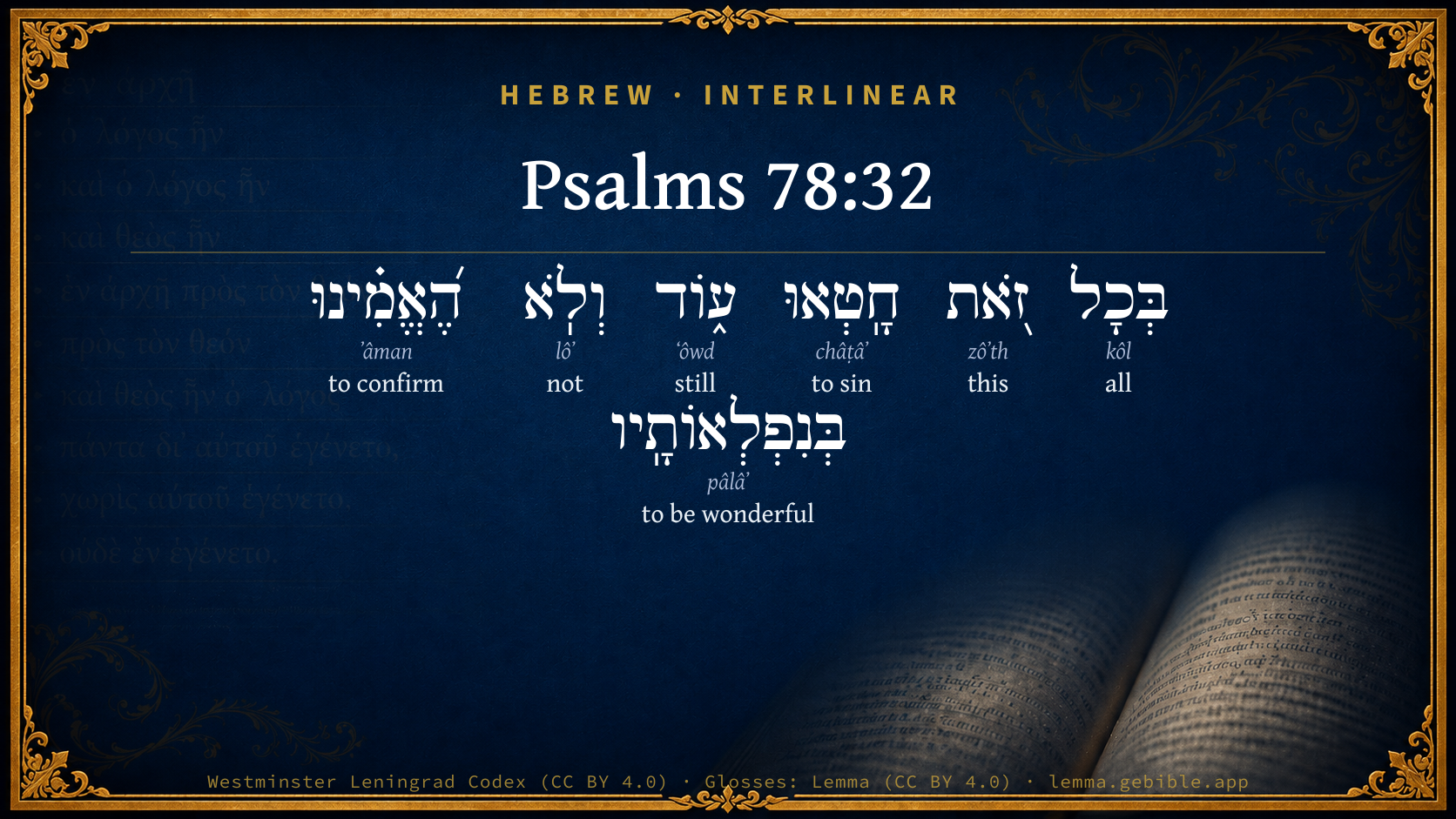
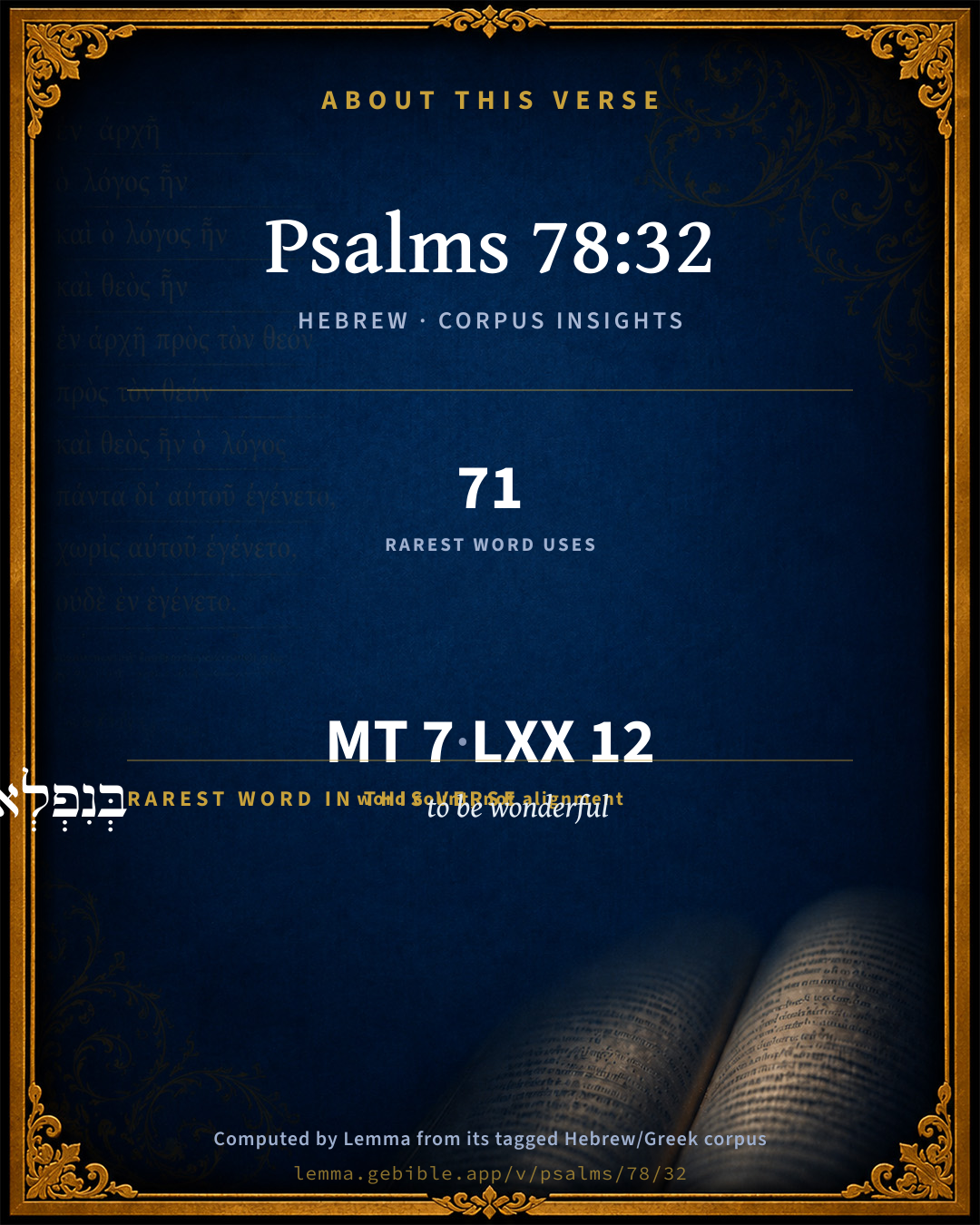
Psalms 78:32

Hebrew (Westminster Leningrad Codex) Psalms 78:32 appears in the Hebrew Old Testament. The text above is from the Westminster Leningrad Codex. Each word links to its Strong’s number, a concise gloss, and parsing drawn from the Open Scriptures Hebrew Bible morphology. Click any word for its full Brown-Driver-Briggs (BDB) entry.
Download image
Cite this verse

Psalms 78:32 (World English Bible). Public Domain. Lemma interlinear Bible study tool, https://lemma.gebible.app/v/psalms/78/32.

Show BibTeX & RIS
BibTeX
RIS
English Translation
For all this they still sinned, And didn't believe in his wondrous works.
World English Bible · Public Domain
Download a study sheet

One document with this verse’s original text, its word-by-word gloss line, the meaning frame, cross-references with their text, attributed commentary, and full source and license credits — printable, and it pastes into notes with its structure intact.

This verse Autodidact and up

Study sheet (.html) Plain text (.txt)

A passage Seminary Student

Up to 50 verses in one chapter. A passage sheet keeps up to 6 commentary sources and 12 cross-references per verse, in the order this page ranks them, and says so on the sheet whenever that leaves anything out. Ask for a single verse and you get the Autodidact verse sheet above.

Everything on this page stays free to read, with no account — the sheet is a download of what is already on screen, not access to it.

Want to remove ads? Support Godless Engineer
Compare translations 3

The same verse in 3 English versions, stacked beneath the original-language interlinear above. Click any original word for its lexicon entry.

Each is an independent rendering of the whole verse — the interlinear is not word-aligned to these translations.

Highlighted words mark where these versions differ — a whole-verse word diff, not a word-by-word alignment.

  • World English Bible Public Domain
    For all this they still sinned, And didn't believe in his wondrous works.
  • King James Version Public Domain
    For all this they sinned still, and believed not for his wondrous works.
  • unfoldingWord Literal Text CC BY-SA 4.0
    In all this they sinned again, and did not believe in his wonders. ts\*

unfoldingWord Literal Text — © unfoldingWord, licensed CC BY-SA 4.0. Word-aligned USFM3 via Door43 (git.door43.org/unfoldingWord/en_ult).

Versions to compare (up to 4)

3 of 4 selected

Show all 18 translations

Every available English version of this verse, each an independent rendering of the whole verse.

  • World English Bible Public Domain
    For all this they still sinned, And didn't believe in his wondrous works.
  • Berean Standard Bible Public Domain
    In spite of all this, they kept on sinning; despite His wonderful works, they did not believe.
  • Majority Standard Bible Public Domain
    In spite of all this, they kept on sinning; despite His wonderful works, they did not believe.
  • King James Version Public Domain
    For all this they sinned still, and believed not for his wondrous works.
  • American Standard Version (1901) Public Domain
    For all this they sinned still, And believed not in his wondrous works.
  • Revised Version (1885) Public Domain
    For all this they sinned still, and believed not in his wondrous works.
  • Geneva Bible (1599) Public Domain
    For all this, they sinned stil, and beleeued not his wonderous woorkes.
  • Douay-Rheims (1899) Public Domain
    In all these things they sinned still: and they believed not for his wondrous works.
  • Young's Literal Translation Public Domain
    With all this they have sinned again, And have not believed in His wonders.
  • Literal Standard Version CC BY-SA 4.0
    With all this they have sinned again, || And have not believed in His wonders.
  • Unlocked Literal Bible CC BY-SA 4.0
    Despite this, they continued to sin and did not believe his wonderful deeds.
  • unfoldingWord Literal Text CC BY-SA 4.0
    In all this they sinned again, and did not believe in his wonders. ts\*
  • Darby Bible Public Domain
    For all this, they sinned still, and believed not in his marvellous works;
  • World Messianic Bible Public Domain
    For all this they still sinned, and didn’t believe in his wondrous works.
  • Webster's Bible Public Domain
    For all this they sinned still, and believed not for his wondrous works.
  • Free Bible Version CC BY-SA 4.0
    Despite all this they went right on sinning. Despite the miracles, they refused to trust him.
  • Bible in Basic English Public Domain
    For all this they went on sinning even more, and had no faith in his great wonders.
  • JPS Tanakh (1917) Public Domain
    For all this they sinned still, and believed not in His wondrous works.

Literal Standard Version (2020), Covenant Press — licensed CC BY-SA 4.0. Text via the HelloAO Bible API (eBible.org). Unlocked Literal Bible (unfoldingWord) — licensed CC BY-SA 4.0. Text via the HelloAO Bible API (eBible.org). unfoldingWord Literal Text — © unfoldingWord, licensed CC BY-SA 4.0. Word-aligned USFM3 via Door43 (git.door43.org/unfoldingWord/en_ult). Free Bible Version, Dr. Jonathan Gallagher — licensed CC BY-SA 4.0. Text via the HelloAO Bible API (eBible.org).

Word by word

More ways to search: Search by grammar → Find every occurrence → Compare this word →

Practice this passage: Drill this verse → Learn its vocabulary →

בְּנִפְלְאוֹתָֽיו
pâlâʼ
H6381
“in/at · being wonderful · him”
Preposition + Verb, Niphal, Participle Active, Feminine, Plural, Construct + Suffix, Personal, 3rd Person, Masculine, Singular
Part of Speech
Preposition + Verb
Stem
Niphal
Form
Participle Active
Gender
Feminine
Number
Plural
State
Construct
Full BDB Definition

Origin: a primitive root

TWOT: 1768

to be marvellous, be wonderful, be surpassing, be extraordinary, separate by distinguishing action - (Niphal) - to be beyond one's power, be difficult to do - to be difficult to understand - to be wonderful, be extraordinary - marvellous (participle) - (Piel) to separate (an offering) - (Hiphil) - to do extraordinary or hard or difficult thing - to make wonderful, do wondrously - (Hithpael) to show oneself wonderful or marvellous
  1. בְּכָל kôl H3605 “in/at · all of” Preposition + Noun, Common, Masculine, Singular, Construct
  2. זֹ֭את zôʼth H2063 “this” Pronoun, Demonstrative, Feminine, Singular
  3. חָֽטְאוּ châṭâʼ H2398 “to sin” Verb, Qal, Perfect, 3rd Person, Common, Plural
  4. ע֑וֹד ʻôwd H5750 “still” Adverb
  5. וְלֹֽא lôʼ H3808 “and · not” Conjunction + Particle, Negative
  6. הֶ֝אֱמִ֗ינוּ ʼâman H539 “to confirm” Verb, Hiphil, Perfect, 3rd Person, Common, Plural

About this verse

These counts appear in no published source. They are computed here, from the morphology-tagged text and Lemma’s own curated glosses. What Lemma adds →

7
words
7
distinct lemmas
Wisdom
section

Grammatical profile

  • 3 verbs
  • 1 noun
  • 1 pronoun
  • 1 adverb
  • 1 particle

Verb forms

  • חָֽטְאוּ Qal · Perfect
  • הֶ֝אֱמִ֗ינוּ Hiphil · Perfect
  • בְּנִפְלְאוֹתָֽיו Niphal · Participle Active

Hebrew & Septuagint length

In English translation the verse runs 13 words from the Hebrew and 15 from the Septuagint (LXX English) — closely comparable.

A rough comparison of the two English renderings, which tokenize alike — not a word-level alignment.

Word counts can differ between the Hebrew and the Greek without any difference in meaning — e.g. the Hebrew direct-object marker אֵת has no separate Greek word, and Greek often adds the article ὁ.

In the original languages it is 7 Hebrew tokens and 12 Greek tokens — but the two are counted differently (Hebrew bundles its prefixes and suffixes into one token; the Greek is in lemma form), so that isn’t a like-for-like length.

Cross-references

9

Topical passages linked to Psalms 78:32 in the Treasury of Scripture Knowledge — connected by theme and wording, ordered by reader-vote popularity; previews shown in the World English Bible.

  • John 12:37 But though he had done so many signs before them, yet they didn't believe in him,
  • Psalms 78:22 Because they didn't believe in God, And didn't trust in his salvation.
  • Numbers 14:1–45 All the congregation lifted up their voice, and cried; and the people wept that night.
  • Psalms 78:11 They forgot his doings, His wondrous works that he had shown them.
  • Ezekiel 20:13 But the house of Israel rebelled against me in the wilderness: they didn't walk in my statutes, and they rejected my ordinances, which if a man keep, he shall live in them; and my Sabbaths they greatly profaned. Then I said I would pour out my wrath on them in the wilderness, to consume them.
  • Luke 16:31 "He said to him, 'If they don't listen to Moses and the prophets, neither will they be persuaded if one rises from the dead.'"
  • Numbers 16:1–17 Now Korah, the son of Izhar, the son of Kohath, the son of Levi, with Dathan and Abiram, the sons of Eliab, and On, the son of Peleth, sons of Reuben, took [men]:
  • Numbers 21:1–6 The Canaanite, the king of Arad, who lived in the South, heard tell that Israel came by the way of Atharim; and he fought against Israel, and took some of them captive.
  • Numbers 25:1–18 Israel abode in Shittim; and the people began to play the prostitute with the daughters of Moab:

Cross-references courtesy of OpenBible.info (CC BY 4.0).

Hebrew and Greek witnesses Masoretic Hebrew ↔ Greek Septuagint

The same verse in the two great witnesses to the Old Testament, shown verse-for-verse.

You’re reading Greek Psalm 77 (Hebrew Psalm 78). The Septuagint counts the superscription, so verse numbers can differ from the Hebrew — chapter-level alignment, not verse-by-verse. Numbering follows Rahlfs.

These are two independent witnesses, not word-aligned to each other, and the Septuagint is shown in lemma (dictionary) form.

Hebrew Psalms 78:32 Masoretic · Westminster Leningrad Codex

בְּכָל זֹ֭את חָֽטְאוּ ע֑וֹד וְלֹֽא הֶ֝אֱמִ֗ינוּ בְּנִפְלְאוֹתָֽיו

For all this they still sinned, And didn't believe in his wondrous works.

World English Bible · Public Domain

Greek LXX Greek Psalm 77:32 Septuagint · lemma form

ἐν πᾶς οὗτος ἁμαρτάνω ἔτι καί οὐ πιστεύω ἐν ὁ θαυμάσιος αὐτός

In the midst of all this they sinned yet more, and believed not his miracles.

LXX2012 (modern English Septuagint) · Public Domain

Hebrew: Westminster Leningrad Codex (CC BY 4.0). Greek: Septuagint (public domain); English from LXX2012 (modern English Septuagint) (Public Domain). How the Septuagint differs from the Hebrew →

Commentary

Notes on Psalms 78:32 from classic Christian and Jewish commentators (each source and its license shown beneath its notes). The classic Christian expositions comment on the surrounding passage and are grouped to its opening verse, so a note may address several verses; the Jewish commentaries on the Tanakh (Rashi and others) are per-verse, so they appear only where the commentator wrote on this verse.

Lemma curates 59 commentaries, every one of them public domain or Creative Commons licensed, each selected and text-cleaned for this edition rather than reprinted as found. About our sources →

Trapp's Complete Commentary

John Trapp

Psa 78:32 For all this they sinned still, and believed not for his wondrous works.

Ver. 32. For all this they sinned still] They utterly lost the fruit of their calamities; which godly men hold a very great loss.

And believed not] Neither mercies nor crosses duly affected them.

John Trapp, A Commentary or Exposition upon All the Books of the Old and New Testament (1647–1656) — public domain. Text from a community e-Sword module.

The Biblical Illustrator

Joseph S. Exell

Psa_78:32

For all this they sinned still

Sinning still

1.

Gods revelation of His power, goodness, love and grace to the sinners of our day, in the completed canon of the Holy Scriptures, infinitely transcends anything made to ancient Israel. And yet, in the noonday light of that full and august revelation, they sin still and remain stout in their rebellion.

2. God incarnate in humanity, dying on the cross, and rising from the dead, with all their attending marvels, is the most stupendous event in human or in angelic history; and yet in full sight of the cress, and of eighteen centuries of redeeming grace and triumph, the sinners of this generation scoff and revile.

3. The dispensation of the Spirit, the ministry of the Word, the Sabbath and other Christian institutions, are powerful factors in Gods plan of redeeming agencies; and yet, under the full force of these mighty Divine agencies, the sinners of this favoured day go on to sin and harden their hearts in iniquity.

4. The discipline of Divine providence has been tried again and again upon these rebellions, unrepentant souls; and still they sin on and wax worse and worse. Mercies do not soften their hearts, and judgments do not deter them. (Homiletic Review.)

What God does to keep men from sinning

God does a great deal to arrest the sinner and bring him to repentance. All His dispensations and dealings propose the sinners repentance and salvation, until that period when his Spirit, which He says shall not strive always with man, ceases to strive with him (Hos_4:17).

1. He proclaims His own infinite abhorrence of sin. And will you persist in the love and practice of that which He abhors; is it not reason enough why you should hate and eschew it, that He hates it in its most plausible form, and in its mildest degree?

2. In the exercise of His sovereign authority He positively and pointedly forbids it; and dare you do what God forbids, knowing, too, that He forbids it? Fear you not Him who can not only kill the body, but destroy both body and soul in hell?

3. He has annexed to the commission of sin a penalty, deep as hell, enduring as eternity, inexhaustible as infinitude. He has declared His inflexible determination to inflict that penalty without abatement. He can do it, for all power is His. He will do it, for there is no change in Him; hath He said, and shall He not do it?

4. He has ,not only threatened, but begun to execute His threatenings. The weight of His indignation long suspended, has fallen on many and buried them in the bottomless pit. Mans life here below is made up of vanity and labour because of sin.

5. But He has adopted a different set of measures; measures inviting, attracting, winning, melting; measures of mercy. He would draw by cords of love; He would overcome by methods of kindness. He declares His reluctance to punish. He proclaims His willingness to forgive. (W. Nevins, D. D.)

The Biblical Illustrator, edited by Joseph S. Exell (c. 1880s–1900s) — public domain. Text from a community e-Sword module.

The Treasury of David

Charles H. Spurgeon

Ver. 32. For all this they sinned still. Judgments moved them no more than mercies. They defied the wrath of God. Though death was in the cup of their iniquity, yet they would not put it away, but continued to quaff it as if it were a healthful potion. How truly might these words be applied to ungodly men who have been often afflicted, laid upon a sick bed, broken in spirit, and impoverished in estate, and yet have persevered in their evil ways, unmoved by terrors, unswayed by threatenings.

And believed not for his wondrous works. Their unbelief was chronic and incurable. Miracles both of mercy and judgment were unavailing. They might be made to wonder, but they could not be taught to believe. Continuance in sin and in unbelief go together. Had they believed they would not have sinned, had they not have been blinded by sin they would have believed. There is a reflex action between faith and character. How can the lover of sin believe? How, on the other hand, can the unbeliever cease from sin? God's ways with us in providence are in themselves both convincing and converting, but unrenewed nature refuses to be either convicted or converted by them.

Ver. 32. For all this they sinned still. They went on sinning, and believed not for his wondrous works. That is, even his great wonders or miracles, did not bring them to believe. Neither speculative atheism, nor atheism of heart, nor practical atheism was ever cured by miracles, because they are all founded in a wicked disposition. "Men are not always in a mood to be convinced." It is not want of evidence, but the want of right dispositions that keeps men from believing God. William S. Plumer.

Ver. 32. They did not believe the history of his works, namely, that such things as are there recorded were done; they could not but believe that God had wrought wonders for them in Egypt, that he had drowned Pharaoh in, and brought them safe through, the Red Sea: they saw these things, their senses were witnesses, but yet they did not believe the prophecy or promise which was virtually in those works, namely, that God would do more wonders for them till he had finished and accomplished their deliverance. That history of bringing through the Red Sea had this prophecy in it--that they should be brought safe to Canaan; but they did not believe the voice of this prophecy. When God gave them water out of the rock, this work promised that he would give them meat out of the clouds, if they needed it; but this they believed not. Hence the same Psalm reports their unbelief, under this notion (Ps 78:19-20). They spake against God; they said, Can God furnish a table in the wilderness Behold, he smote the rock, that the waters gushed out, and the streams overflowed; can he give bread also? can he provide flesh for his people? When the Lord heard this (language of unbelief) he was wroth. Joseph Caryl.

Ver. 32-33. What faith can do to a prophecy of judgment, the same can unbelief to a promise of mercy; overthrow it. The psalmist assigns this to the unbelief of the works of God, as well as of his word. They believed not his wondrous works. Therefore their days did he consume in vanity, and their years in trouble: but are not the days of all men consumed in vanity? Is not man at his best estate altogether vanity? Yes, but here was a special vanity, and somewhat more penal and judicial lay upon that generation for their unbelief, than lies upon mankind as the fruit of sin in general. And what was that? Even the evil threatened in the text (Isa 7:9, latter part): they could not be established. God lets them wander forty years in a wilderness, up and down, forward and backward; now in hope, anon in fear; now in joy, anon in sorrow; now in success, by and by in disappointment. Joseph Caryl.

Ver. 32. Experience ought to strengthen faith; but there must be present faith to use the experience. J. N. Darby, in "Practical Reflections on the Psalms." 1870.

None.

Psalms 78:33*

Ver. 32-33. See Psalms on "Ps 78:32" for further information.

Charles H. Spurgeon's The Treasury of David (1869–1885) — public domain. Psalms only. Text from a community e-Sword/MySword module.

J. A. Alexander on Psalms

Joseph Addison Alexander

32. (Psa 78:32) For all this they sinned still, and believed not for his wonders. Not-withstanding all these favours and extraordinary interpositions, the generation that came out of Egypt still persisted in their evil courses. The last clause does not charge them with denying the reality of the wonders which they witnessed, but with refusing to trust God on the strength of them. This appears from the history itself, Num 14:11, to which there is obvious allusion.

Joseph Addison Alexander, The Psalms Translated and Explained (1850) — public domain. Text from a community e-Sword module.

Tyndale Open Study Notes

Tyndale Open Resources

78:32-39 Israel’s rebellion resulted in God’s judgment, but even their short-lived and insincere repentance motivated God to exercise forbearance.

Tyndale Open Study Notes — © Tyndale Open Resources, licensed CC BY-SA 4.0. Text via the HelloAO Bible API.

Geneva Bible (1599)

Geneva Bible translators

Thus sin by continuance maketh man insensible, so that by no plagues they can be amended.

Geneva Bible (1599) marginal notes — public domain. Text via Bolls.life.

Adam Clarke's Commentary

Verse 32. For all this they sinned still] How astonishing is this! They were neither drawn by mercies, nor awed by judgments! But we shall cease to wonder at this, if we have a thorough acquaintance with our own hearts.

Adam Clarke's Commentary on the Bible (1810–1826) — public domain. Text from a community e-Sword/MySword module.

John Calvin's Commentaries

32. For all this they still sinned. It is a common proverb, that fools become wise when the rod is applied to them. Hence it follows, that those who have often been chastised of God, and yet are not thereby brought to repentance and amendment, are utterly to be despaired of. Such was the obstinacy of the Israelites here described. They could not be reformed by any of the afflictions which were sent upon them. It was a dreadful manifestation of the vengeance of God to see so many bodies of strong and vigorous men stretched dead on the ground. It was therefore a proof of monstrous obduracy, when they were not moved at such an appalling spectacle. By the expression wondrous works, is not only meant the plague just now spoken of: the other miracles, previously mentioned, are comprehended. There is, therefore, laid to the charge of the people a twofold wickedness; — they are accused not only of disbelieving the word of God, but also of despising the miracles which he wrought. For this reason, it is added, that their plagues were increased; even as God denounces and threatens by Moses, that he will deal sevenfold more severely with the obstinate and hardened who persevere in their wickedness.

John Calvin's Commentaries (1540-1563) — public domain. Text from the Calvin Translation Society English edition (1840s-50s) via the Christian Classics Ethereal Library (ccel.org). Calvin's coverage is partial (roughly two-thirds of the Bible); uncommented books and verses are honest gaps, never fabricated. The 19th-century editor's footnotes and remarks are omitted so the notes are faithfully Calvin's own voice.

Ellicott's Commentary for English Readers

(32-33) For the allusion see Num_14:11-12; Num_14:28-35.

A Bible Commentary for English Readers, edited by Charles John Ellicott (1878–1897) — public domain. Text from a community e-Sword module.

The Cambridge Bible for Schools and Colleges

gen. ed. J. J. S. Perowne

32. The further sin of murmuring and unbelief on the return of the spies, for which they were condemned to wander in the wilderness. See Numbers 14, esp. Psa_78:22 ff.

for his wondrous works] I.e., because of. Better, as R.V., in.

32–39. These judgements failed to reform them, and further chastisements produced only temporary and superficial amendments. Yet in spite of all, God continued to shew them mercy.

The Cambridge Bible for Schools and Colleges (gen. ed. J. J. S. Perowne; Cambridge University Press, 1878–1918) — public domain. Text from a community e-Sword module.

John Gill's Exposition

Therefore their days did he consume in vanity,.... They were not immediately cut off by the hand of God, though some were; but the greatest part spent their time, for about eight and thirty years together, in fruitless marches to and fro in the wilderness, and never entered into the land of Canaan, where they were gradually wasted and consumed, till at length all their carcasses fell in the wilderness; see Num 14:32, time spent in sin is all waste time, and is spent in vanity; let a man enjoy ever so much of worldly things, it is all vanity and vexation of spirit; if he does not get to heaven at last, his life here is lived in vain; it had been better if he had never been born:

and their years in trouble: or "in terror" (a) and consternation; through their enemies, who smote and discomfited them, Num 14:45, through the earth's opening and swallowing many of them up; through fire coming from heaven on some of them, and fiery serpents being sent among them all, Num 16:31. It is an awful consideration, and yet it is true, of some wicked men, though not all, that they have nothing but trouble here, by what their sins bring upon them, and hell at last. Kimchi renders the word here used "suddenly", and interprets it of the sudden death of the spies; so the Syriac and Arabic versions "swiftly", following the Vulgate Latin, which renders it "with haste".

(a) "in terrore", Montanus; "per consternationem aut terrorem", Gejerus; "in terrore et consternatione", Michaelis.

John Gill's Exposition of the Whole Bible (1746–1763) — public domain (CC PDM 1.0). Text via the HelloAO Bible API.

Albert Barnes' Notes on the Bible

For all this they sinned still - Even this did not reclaim them, and prevent their sinning. Heavy judgments do not always restrain men from sin. Not unfrequently they take occasion from such judgments to sin the more.

And believed not for his wondrous works - They did not trust in His wondrous works; or, those works did not have the effect of producing faith. See Psa 78:22-23. The same thing occurred in the life of the Saviour. Joh 12:37.

Albert Barnes' Notes on the Bible (1834–1885) — public domain. Text from a community e-Sword/MySword module.

Whedon's Commentary on the Bible

Daniel D. Whedon

32. They sinned still—Namely, at Kadesh, (Numbers 14;) and at their second arrival at Kadesh, thirty-eight years after, (Numbers 20;) in their murmur at the destruction of Korah and his company, (Num_16:41;) and later, in the Arabah, south of Mount Hor, (Num_21:4-9;) and in the valley of Jordan, (Num_25:1,) besides other instances of lesser note.

Believed not—Did not continue in faith. Their chastisements and their mercies were alike a “savour of death unto death.”

Daniel D. Whedon (gen. ed.), Commentary on the Old and New Testaments (1874–1909) — public domain. Text from a community e-Sword module.

The Pulpit Commentary

For all this they sinned still. Neither gratitude for favours received (vers. 13-17), nor alarm at punishments inflicted (ver. 31), had any effect on the stiff-necked people; despite of both, they "sinned still" (comp. vers. 40, 41, 56-58). And believed not for his wondrous works. Unbelief was at the root of their contumacy. They could not deny God"s mighty works in the past, but they did not accept them as any evidence of his power to do other mighty works in the future (see ver. 20).

The tenacity of sin.

This psalm might have for title, "The Devil"s Grip;" "The Heart hold of Sin;" "The Gates of Hell prevailing," or any other such sad surname. For throughout its weary length it tells of scarce anything else. And would that it were only an old-world story! a tale of ancient Israel, but of nobody else. But concerning such persistence in sin, note

I IT IS SEEN TODAY AS MUCH AS EVER. In the history of nations; of Churches; of families; of individuals. Of how many may it be said as it was of Amon, "But Amon sinned more and more"! What Christian pastor has not had under his own observation again and again those whose story is told here?

II THERE ARE NO GRACIOUS RESISTANCES WHICH IT DOES NOT OVERCOME. "For all this," was said of old, and can be now. This "all" includes now, as of old: Divine revelation (ver. 5); early education (ver. 3); warning from ill example of others near to them (ver. 8); unspeakable mercies and deliverances (vers. 11, 12); perpetual providential love; forbearance upon forbearance (ver. 38); terrible judgments (ver. 31); Opportunities of return (vers. 34, 35). All this and more of like gracious nature they disregarded, even as men do still.

III ITS SECRET IS EVER THE EVIL HEART OF UNBELIEF. Not the unbelief which is the result of the perverted brain, but that which is generated by the evil heart, the sin-loving soul.

IV ITS WORD OF WARNING IS VERY PLAIN.

1. "Fools make a mock at sin." What else can they be who tamper and trifle with such a deadly thing! It may be in you seemingly weak as a cobweb film; let alone, it will become strong as the cable which holds fast, let the strain on it be what it may.

2. Meet this tenacity of sin by the tenacity of grace. Cling to Christ instrenuous prayer; hold on so to him.

3. Be content with nothing less than the gift of the clean heart; be sanctified as well as justified. "The blood of Christ cleanseth from all sin.

4. Remember how the strong one was and ever will be cast out by the Stronger, (Luk_11:21, Luk_11:22) even Christ, who is "mighty to save," if we will give ourselves up to him. S.C.

Vers. 32-39. God"s tender mercy.

This passage describes the conduct of the rebellious and lustful Israelites in the wilderness, and sets forth three things God"s chastisement of their sin; their superficial repentance; God"s pitiful compassion.

I GOD"S CHASTISEMENT OF SIN. (Vers. 33, 34) "The wrath of God is revealed from heaven against all ungodliness and unrighteousness of men, who hold the truth in unrighteousness.

1. Their sin was sensual indifference to the wonders of God"s redemption. (Ver. 32) "They believed not his wondrous works in connection with their redemption from the miseries of Egypt. The same sin now in reference to the work of Christ.

2. The punishment was trouble and death. (Vers. 33, 34) Sin always leads to trouble, and sometimes to death.

3. By granting them their sinful desires. (Ver. 29)

II SUPERFICIAL REPENTANCE. (Vers. 34-37)

1. It was inspired by fear. (Ver. 34) Fear terror never produces genuine repentance.

2. They made insincere promises of amendment. (Ver. 36) "They flattered God with their mouth, and lied unto him with their tongues." It was no true repentance.

3. They were still unchanged in heart. (Ver. 37) And no repentance is true and lasting which does not make the heart right towards God.

III GOD"S PITIFUL COMPASSION. (Vers. 38, 39)

1. God"s punishment of sin is a moderated punishment. (Ver. 38) "And did not stir up all his wrath." No punishment goes beyond the desert, and he makes it as light as it can be.

2. God pities as well as condemns our weakness and misery. (Ver. 39) "He knoweth our frame, and remembereth that we are dust.

3. God"s forbearance is exercised with a view to our redemption. (Ver. 38) "Many a time turned he his anger away." "Not willing that any should perish, but that all should come to repentance. S.

The Pulpit Commentary (1880–1919), ed. H.D.M. Spence-Jones & Joseph S. Exell — public domain. Text from a community e-Sword module.

Lesson kit

Teaching starters — assembled from the data on this page, not authored interpretation. Every prompt links to the verse data it draws on. Edit before teaching.

Psalms, in the Wisdom, opens this verse with 7 words (7 distinct Hebrew lemmas). Its most distinctive word is pâlâʼ (“to be wonderful”). A historical commentator’s framing appears above. Read the whole chapter for the surrounding context.

Discussion questions

  1. What does “to be wonderful” (pâlâʼ) contribute to the verse as a whole?
  2. John 12:37 shares this passage’s theme. How do the two illuminate each other?
  3. The translations on this page render this verse differently — a whole-verse word diff, not a word-by-word alignment. What might account for the different wordings?
  4. The verb «חָֽטְאוּ» is Qal Perfect. How does its form color the action?
  5. Reading how Trapp's Complete Commentary and The Biblical Illustrator read this verse, where do the two commentators agree and where do they part?

Things to notice

Reading settings

Reading text

Shown beneath each verse's original-language words.

Old Testament
Old Testament edition

Read the OT as the Masoretic Hebrew (MT) or the Greek Septuagint (LXX).

English shown for the Greek Septuagint (in the Hebrew ↔ Greek comparison).

Comparing translations? Open the Compare panel on any verse page to stack up to four side by side.