
1 Kings 16:26

Hebrew (Westminster Leningrad Codex) 1 Kings 16:26 appears in the Hebrew Old Testament. The text above is from the Westminster Leningrad Codex. Each word links to its Strong’s number, a concise gloss, and parsing drawn from the Open Scriptures Hebrew Bible morphology. Click any word for its full Brown-Driver-Briggs (BDB) entry.
Download image
Cite this verse

1 Kings 16:26 (World English Bible). Public Domain. Lemma interlinear Bible study tool, https://lemma.gebible.app/v/1-kings/16/26.

Show BibTeX & RIS
BibTeX
RIS
English Translation
For he walked in all the way of Jeroboam the son of Nebat, and in his sins with which he made Israel to sin, to provoke Yahweh, the God of Israel, to anger with their vanities.
World English Bible · Public Domain
Download a study sheet

One document with this verse’s original text, its word-by-word gloss line, the meaning frame, cross-references with their text, attributed commentary, and full source and license credits — printable, and it pastes into notes with its structure intact.

This verse Autodidact and up

Study sheet (.html) Plain text (.txt)

A passage Seminary Student

Up to 50 verses in one chapter. A passage sheet keeps up to 6 commentary sources and 12 cross-references per verse, in the order this page ranks them, and says so on the sheet whenever that leaves anything out. Ask for a single verse and you get the Autodidact verse sheet above.

Everything on this page stays free to read, with no account — the sheet is a download of what is already on screen, not access to it.

Want to remove ads? Support Godless Engineer
Compare translations 3

The same verse in 3 English versions, stacked beneath the original-language interlinear above. Click any original word for its lexicon entry.

Each is an independent rendering of the whole verse — the interlinear is not word-aligned to these translations.

Highlighted words mark where these versions differ — a whole-verse word diff, not a word-by-word alignment.

  • World English Bible Public Domain
    For he walked in all the way of Jeroboam the son of Nebat, and in his sins with which he made Israel to sin, to provoke Yahweh, the God of Israel, to anger with their vanities.
  • King James Version Public Domain
    For he walked in all the way of Jeroboam the son of Nebat, and in his sin wherewith he made Israel to sin, to provoke the LORD God of Israel to anger with their vanities.
  • unfoldingWord Literal Text CC BY-SA 4.0
    And he walked in all of the way of Jeroboam, the son of Nebat, and in his sins which he caused Israel to sin, provoking Yahweh, the God of Israel, with their vapors.

unfoldingWord Literal Text — © unfoldingWord, licensed CC BY-SA 4.0. Word-aligned USFM3 via Door43 (git.door43.org/unfoldingWord/en_ult).

Versions to compare (up to 4)

3 of 4 selected

Show all 18 translations

Every available English version of this verse, each an independent rendering of the whole verse.

  • World English Bible Public Domain
    For he walked in all the way of Jeroboam the son of Nebat, and in his sins with which he made Israel to sin, to provoke Yahweh, the God of Israel, to anger with their vanities.
  • Berean Standard Bible Public Domain
    For he walked in all the ways of Jeroboam son of Nebat and in his sins, which he caused Israel to commit, provoking the LORD, the God of Israel, to anger with their worthless idols.
  • Majority Standard Bible Public Domain
    For he walked in all the ways of Jeroboam son of Nebat and in his sins, which he caused Israel to commit, provoking the LORD, the God of Israel, to anger with their worthless idols.
  • King James Version Public Domain
    For he walked in all the way of Jeroboam the son of Nebat, and in his sin wherewith he made Israel to sin, to provoke the LORD God of Israel to anger with their vanities.
  • American Standard Version (1901) Public Domain
    For he walked in all the way of Jeroboam the son of Nebat, and in his sins wherewith he made Israel to sin, to provoke Jehovah, the God of Israel, to anger with their vanities.
  • Revised Version (1885) Public Domain
    For he walked in all the way of Jeroboam the son of Nebat, and in his sins wherewith he made Israel to sin, to provoke the LORD, the God of Israel, to anger with their vanities.
  • Geneva Bible (1599) Public Domain
    For he walked in all the way of Ieroboam the sonne of Nebat, and in his sinnes wherewith he made Israel to sinne in prouoking the Lord God of Israel with their vanities.
  • Douay-Rheims (1899) Public Domain
    And he walked in all the way of Jeroboam the son of Nabat, and in his sins wherewith he made Israel to sin: to provoke the Lord the God of Israel to anger with their vanities.
  • Young's Literal Translation Public Domain
    and walketh in all the way of Jeroboam son of Nebat, and in his sin that he caused Israel to sin, to provoke Jehovah, God of Israel, with their vanities.
  • Literal Standard Version CC BY-SA 4.0
    and walks in all the way of Jeroboam son of Nebat, and in his sin that he caused Israel to sin, to provoke YHWH, God of Israel, with their vanities.
  • Unlocked Literal Bible CC BY-SA 4.0
    For he walked in all the ways of Jeroboam son of Nebat and in his sins by which he led Israel to sin, to provoke Yahweh, the God of Israel, to be angry with their worthless idols.
  • unfoldingWord Literal Text CC BY-SA 4.0
    And he walked in all of the way of Jeroboam, the son of Nebat, and in his sins which he caused Israel to sin, provoking Yahweh, the God of Israel, with their vapors.
  • Darby Bible Public Domain
    And he walked in all the way of Jeroboam the son of Nebat, and in his sins wherewith he made Israel to sin, provoking Jehovah the God of Israel to anger with their vanities.
  • World Messianic Bible Public Domain
    For he walked in all the way of Jeroboam the son of Nebat, and in his sins with which he made Israel to sin, to provoke the LORD, the God of Israel, to anger with their vanities.
  • Webster's Bible Public Domain
    For he walked in all the way of Jeroboam the son of Nebat, and in his sin with which he made Israel to sin, to provoke the LORD God of Israel to anger with their vanities.
  • Free Bible Version CC BY-SA 4.0
    For he followed all the ways of Jeroboam, son of Nebat, and in his sins which he made Israel commit, worshiping their useless idols which angered the Lord, the God of Israel.
  • Bible in Basic English Public Domain
    Copying all the evil ways of Jeroboam, the son of Nebat, and all the sins he did and made Israel do, moving the Lord, the God of Israel, to wrath by their foolish ways.
  • JPS Tanakh (1917) Public Domain
    For he walked in all the way of Jeroboam the son of Nebat, and in his sins wherewith he made Israel to sin, to provoke the LORD, the God of Israel, with their vanities.

Literal Standard Version (2020), Covenant Press — licensed CC BY-SA 4.0. Text via the HelloAO Bible API (eBible.org). Unlocked Literal Bible (unfoldingWord) — licensed CC BY-SA 4.0. Text via the HelloAO Bible API (eBible.org). unfoldingWord Literal Text — © unfoldingWord, licensed CC BY-SA 4.0. Word-aligned USFM3 via Door43 (git.door43.org/unfoldingWord/en_ult). Free Bible Version, Dr. Jonathan Gallagher — licensed CC BY-SA 4.0. Text via the HelloAO Bible API (eBible.org).

Word by word

More ways to search: Search by grammar → Find every occurrence → Compare this word →

Practice this passage: Drill this verse → Learn its vocabulary →

נְבָ֔ט
Nᵉbâṭ
H5028
“Nebat”
Noun, Proper
Part of Speech
Noun
Type
Proper
Full BDB Definition

Origin: from H5027

TWOT: None

Nebat = "aspect" - an Ephraimite of Zereda, father of king Jeroboam I of the northern kingdom of Israel
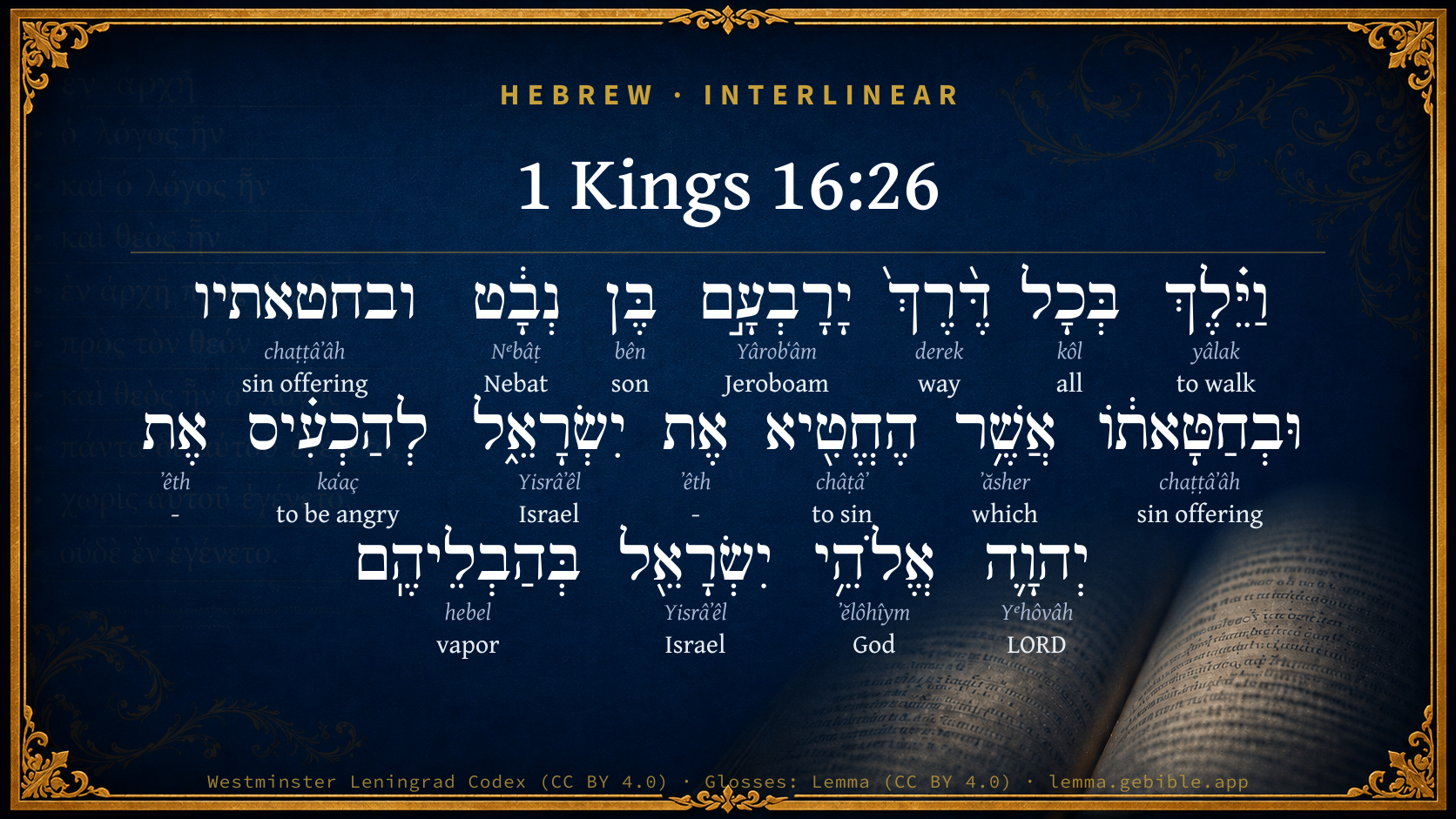
  1. וַיֵּ֗לֶךְ yâlak H3212 “and · to walk” Conjunction + Verb, Qal, Sequential Imperfect, 3rd Person, Masculine, Singular
  2. בְּכָל kôl H3605 “in/at · all of” Preposition + Noun, Common, Masculine, Singular, Construct
  3. דֶּ֨רֶךְ֙ derek H1870 “way of” Noun, Common, Both, Singular, Construct
  4. יָרָבְעָ֣ם Yârobʻâm H3379 “Jeroboam” Noun, Proper
  5. בֶּן bên H1121 “son of” Noun, Common, Masculine, Singular, Construct
  6. ובחטאתיו chaṭṭâʼâh H2403 “and · in/at · sin offerings · his” Conjunction + Preposition + Noun, Common, Feminine, Plural, Construct + Suffix, Personal, 3rd Person, Masculine, Singular
  7. וּבְחַטָּאת֔וֹ chaṭṭâʼâh H2403 “and · in/at · sin offering · his” Conjunction + Preposition + Noun, Common, Feminine, Singular, Construct + Suffix, Personal, 3rd Person, Masculine, Singular
  8. אֲשֶׁ֥ר ʼăsher H834 “which” Particle, Relative
  9. הֶחֱטִ֖יא châṭâʼ H2398 “to sin” Verb, Hiphil, Perfect, 3rd Person, Masculine, Singular
  10. אֶת ʼêth H853 “-” Particle, Direct Object
  11. יִשְׂרָאֵ֑ל Yisrâʼêl H3478 “Israel” Noun, Proper
  12. לְהַכְעִ֗יס kaʻaç H3707 “to be angry” Preposition + Verb, Hiphil, Infinitive Construct
  13. אֶת ʼêth H853 “-” Particle, Direct Object
  14. יְהוָ֛ה Yᵉhôvâh H3068 “LORD” Noun, Proper
  15. אֱלֹהֵ֥י ʼĕlôhîym H430 “God(s) of” Noun, Common, Masculine, Plural, Construct
  16. יִשְׂרָאֵ֖ל Yisrâʼêl H3478 “Israel” Noun, Proper
  17. בְּהַבְלֵיהֶֽם hebel H1892 “in/at · vanities · their” Preposition + Noun, Common, Masculine, Plural, Construct + Suffix, Personal, 3rd Person, Masculine, Plural

About this verse

These counts appear in no published source. They are computed here, from the morphology-tagged text and Lemma’s own curated glosses. What Lemma adds →

18
words
15
distinct lemmas
Historical
section

Notable vocabulary

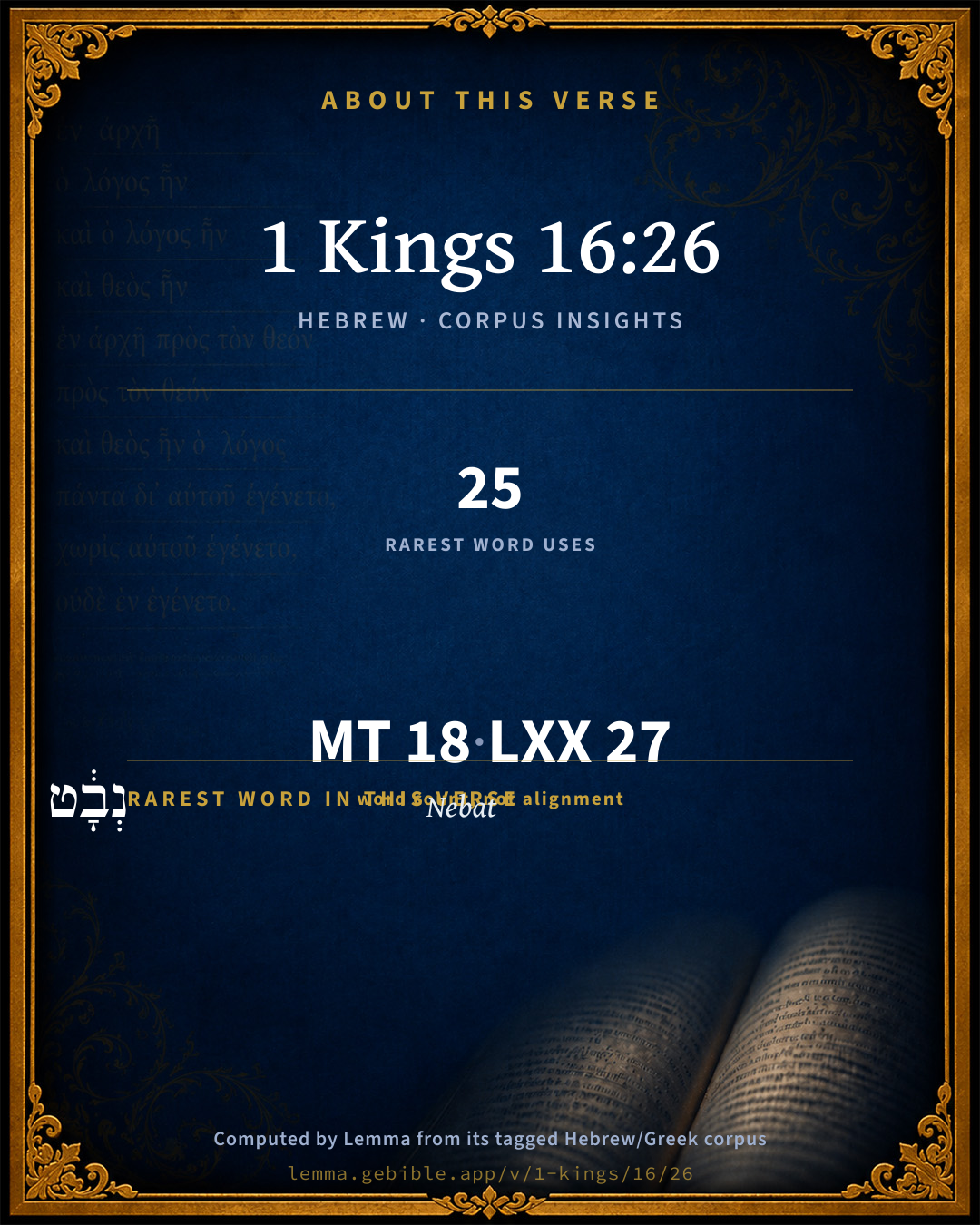
The rarest word here is נְבָ֔ט Nebat H5028 — appearing just 25 times in the whole Hebrew Bible.

Shared distinctive vocabulary

נְבָ֔ט Nebat H5028 occurs in 25 verses of the Hebrew Bible. Also found in:

Grammatical profile

  • 3 verbs
  • 12 nouns
  • 3 particles

Verb forms

  • וַיֵּ֗לֶךְ Qal · Sequential Imperfect
  • הֶחֱטִ֖יא Hiphil · Perfect
  • לְהַכְעִ֗יס Hiphil · Infinitive Construct

Repetition

Words recur within this verse — often emphatic in Hebrew:

  • ובחטאתיו sin offering H2403 ×2
  • יִשְׂרָאֵ֑ל Israel H3478 ×2

Hebrew & Septuagint length

In English translation the verse runs 36 words from the Hebrew and 33 from the Septuagint (LXX English) — closely comparable.

A rough comparison of the two English renderings, which tokenize alike — not a word-level alignment.

Word counts can differ between the Hebrew and the Greek without any difference in meaning — e.g. the Hebrew direct-object marker אֵת has no separate Greek word, and Greek often adds the article ὁ.

In the original languages it is 18 Hebrew tokens and 27 Greek tokens — but the two are counted differently (Hebrew bundles its prefixes and suffixes into one token; the Greek is in lemma form), so that isn’t a like-for-like length.

Cross-references

15

Topical passages linked to 1 Kings 16:26 in the Treasury of Scripture Knowledge — connected by theme and wording, ordered by reader-vote popularity; previews shown in the World English Bible.

  • 1 Kings 16:19 for his sins which he sinned in doing that which was evil in the sight of Yahweh, in walking in the way of Jeroboam, and in his sin which he did, to make Israel to sin.
  • 1 Kings 16:13 for all the sins of Baasha, and the sins of Elah his son, which they sinned, and with which they made Israel to sin, to provoke Yahweh, the God of Israel, to anger with their vanities.
  • 1 Kings 12:26–33 Jeroboam said in his heart, Now will the kingdom return to the house of David:
  • 1 Kings 13:33–34 After this thing Jeroboam didn't return from his evil way, but made again from among all the people priests of the high places: whoever would, he consecrated him, that there might be priests of the high places.
  • 1 Kings 16:2 Because I exalted you out of the dust, and made you prince over my people Israel, and you have walked in the way of Jeroboam, and have made my people Israel to sin, to provoke me to anger with their sins;
  • 1 Kings 16:7 Moreover by the prophet Jehu the son of Hanani came the word of Yahweh against Baasha, and against his house, both because of all the evil that he did in the sight of Yahweh, to provoke him to anger with the work of his hands, in being like the house of Jeroboam, and because he struck him.
  • Psalms 31:6 I hate those who regard lying vanities, But I trust in Yahweh.
  • Jeremiah 8:19 Behold, the voice of the cry of the daughter of my people from a land that is very far off: isn't Yahweh in Zion? Isn't her King in her? Why have they provoked me to anger with their engraved images, and with foreign vanities?
  • Jeremiah 10:3 For the customs of the peoples are vanity; for one cuts a tree out of the forest, the work of the hands of the workman with the axe.
  • Jeremiah 10:8 But they are together brutish and foolish: the instruction of idols! it is but a stock.
  • Jeremiah 14:22 Are there any among the vanities of the nations that can cause rain? or can the sky give showers? Aren't you he, Yahweh our God? therefore we will wait for you; for you have made all these things.
  • Jeremiah 16:19 Yahweh, my strength, and my stronghold, and my refuge in the day of affliction, to you shall the nations come from the ends of the earth, and shall say, Our fathers have inherited nothing but lies, [even] vanity and things in which there is no profit.
  • Jeremiah 18:15 For my people have forgotten me, they have burned incense to false [gods]; and they have been made to stumble in their ways, in the ancient paths, to walk in byways, in a way not built up;
  • Acts 14:15 "Men, why are you doing these things? We also are men of like passions with you, and bring you good news, that you should turn from these vain things to the living God, who made the sky and the earth and the sea, and all that is in them;
  • Romans 1:21–23 Because, knowing God, they didn't glorify him as God, neither gave thanks, but became vain in their reasoning, and their senseless heart was darkened.

Cross-references courtesy of OpenBible.info (CC BY 4.0).

Hebrew and Greek witnesses Masoretic Hebrew ↔ Greek Septuagint

The same verse in the two great witnesses to the Old Testament, shown verse-for-verse.

These are two independent witnesses, not word-aligned to each other, and the Septuagint is shown in lemma (dictionary) form.

Hebrew 1 Kings 16:26 Masoretic · Westminster Leningrad Codex

וַיֵּ֗לֶךְ בְּכָל דֶּ֨רֶךְ֙ יָרָבְעָ֣ם בֶּן נְבָ֔ט ובחטאתיו וּבְחַטָּאת֔וֹ אֲשֶׁ֥ר הֶחֱטִ֖יא אֶת יִשְׂרָאֵ֑ל לְהַכְעִ֗יס אֶת יְהוָ֛ה אֱלֹהֵ֥י יִשְׂרָאֵ֖ל בְּהַבְלֵיהֶֽם

For he walked in all the way of Jeroboam the son of Nebat, and in his sins with which he made Israel to sin, to provoke Yahweh, the God of Israel, to anger with their vanities.

World English Bible · Public Domain

Greek LXX 1 Kings 16:26 Septuagint · lemma form

καί πορεύομαι ἐν πᾶς ὁδός ιεροβοαμ υἱός ναβατ καί ἐν ὁ ἁμαρτία αὐτός ὅς ἐκἁμαρτάνω ὁ ἰσραήλ ὁ παραὀργίζω ὁ κύριος θεός ἰσραήλ ἐν ὁ μάταιος αὐτός

And he walked in all the way of Jeroboam the son of Nabat, and in his sins wherewith he caused Israel to sin, to provoke the Lord God of Israel by their vanities.

LXX2012 (modern English Septuagint) · Public Domain

Hebrew: Westminster Leningrad Codex (CC BY 4.0). Greek: Septuagint (public domain); English from LXX2012 (modern English Septuagint) (Public Domain). How the Septuagint differs from the Hebrew →

Targum (Aramaic paraphrase)

1

The Targum is the ancient Jewish Aramaic paraphrase of the Hebrew Scriptures — an interpretive translation, not the Hebrew text itself. Onkelos (literal) and Pseudo-Jonathan (expansive) render the Torah, and Jonathan the Prophets. Coverage is partial: where no permissively-licensed English translation exists for a verse, only the Aramaic is shown. This is verse-level text, not a word-by-word alignment to the Hebrew.

  1. Targum Jonathan Prophets (Joshua–Malachi)
    וַאֲזַל בְּכָל אוֹרְחָא יָרָבְעָם בַּר נְבָט וּבְחוֹבוֹהִי דִי חַיַב יַת יִשְׂרָאֵל לְאַרְגָזָא קֳדָם יְיָ אֱלָהָא דְיִשְׂרָאֵל בְּטַעֲוַתְהוֹן:

    (no public-domain English translation for this verse)

    Targum Jonathan — Aramaic: “Mikraot Gedolot” (public domain). English: “Sefaria Community Translation” (CC0 1.0 (public-domain dedication)); “London "Chaldee Paraphrase," 1871” (public domain). Text via Sefaria.

Commentary

Notes on 1 Kings 16:26 from classic Christian and Jewish commentators (each source and its license shown beneath its notes). The classic Christian expositions comment on the surrounding passage and are grouped to its opening verse, so a note may address several verses; the Jewish commentaries on the Tanakh (Rashi and others) are per-verse, so they appear only where the commentator wrote on this verse.

Lemma curates 59 commentaries, every one of them public domain or Creative Commons licensed, each selected and text-cleaned for this edition rather than reprinted as found. About our sources →

Trapp's Complete Commentary

John Trapp

1Ki 16:26 For he walked in all the way of Jeroboam the son of Nebat, and in his sin wherewith he made Israel to sin, to provoke the LORD God of Israel to anger with their vanities.

Ver. 26. For he walked in all the way.] In tota via Ieroboami et in singulis peccatis eius: yea, and herein he outdid Jeroboam, in that he "framed mischief by a law," {Psa 94:20} for we read of "the statutes of Omri" {Mic 6:16} binding people to idolatry.

John Trapp, A Commentary or Exposition upon All the Books of the Old and New Testament (1647–1656) — public domain. Text from a community e-Sword module.

The Cambridge Bible for Schools and Colleges

gen. ed. J. J. S. Perowne

26. in his sin [R.V. sins]. In the Hebrew text there is a various reading, the margin (Keri) having the singular, the text (Kethib) the plural, which the R.V. always translates where it can be done.

The Cambridge Bible for Schools and Colleges (gen. ed. J. J. S. Perowne; Cambridge University Press, 1878–1918) — public domain. Text from a community e-Sword module.

John Gill's Exposition

And in his days did Hiel the Bethelite build Jericho,.... Which was forbidden by Joshua under an anathema; but this man, either ignorant of that adjuration of Joshua, or in contempt and defiance of it, and knowing it might please the king and queen, set about the rebuilding of it; and it being done by the leave and under the authority of Ahab, is mentioned together with his wicked actions:

he laid the foundation thereof in Abiram his firstborn: that is, his firstborn died as soon as he laid the foundation of the city, but this did not deter him from going on with it:

and set up the gates thereof in his youngest son Segub; all the rest of his children died as he was rebuilding the city, until only his youngest son was left, and he was taken off by death just as he had finished it, signified by setting up the gates of it: all which was

according to the word of the Lord, which he spake by Joshua the son of Nun: between four hundred and five hundred years ago. It was after this a place of great note, and so continued many hundreds of years; See Gill on Jos 6:26 but is now, as Mr. Maundrell says (k), a poor nasty village of the Arabs.

(k) Journey from Aleppo, &c. p. 81.

Next: 1 Kings Chapter 17

John Gill's Exposition of the Whole Bible (1746–1763) — public domain (CC PDM 1.0). Text via the HelloAO Bible API.

Haydock's Catholic Bible Commentary

With their vanities. That is, their idols, their golden calves, vain, false, deceitful things.

George Leo Haydock (1774–1849), Haydock's Catholic Family Bible and Commentary, 1859 edition — public domain. Excludes Psalms (Douay-Rheims chapter numbering differs from Protestant) and Deuterocanonical books (Catholic canon only).

Matthew Poole's English Annotations

He walked in all the way of Jeroboam, i.e. did not only promote the worship of the calves, as Jeroboam and all his successors hitherto had done; but did also imitate all Jeroboam’s other sins, which doubtless were many and great; and peradventure he added this to the rest, that together with the calves he worshipped devils, i.e. other idols of the heathens, as may be thought from 1Co 10:20, where his worship of the devils and of the calves is distinguished. Besides, though he did no more for the substance of the action than his predecessors did, yet he might justly and truly be said to do worse than they, because he did it with greater aggravations, after so many terrible examples of Divine vengeance upon the kings and people of Israel for that sin; or because he made severer laws concerning the calf-worship, whence we read of the statutes of Omri, Mic 6:16; or did more industriously and violently execute them, with greater despite against God, and malice against his servants.

Matthew Poole's English Annotations on the Holy Bible (1683–1685) — public domain. Text from a community e-Sword/MySword module.

The Pulpit Commentary

For he walked in all the way of Jeroboam the son of Nebat, and in his sin wherewith he made Israel to sin, to provoke the Lord God of Israel to anger with their vanities.

The Pulpit Commentary (1880–1919), ed. H.D.M. Spence-Jones & Joseph S. Exell — public domain. Text from a community e-Sword module.

John Wesley's Explanatory Notes

Did worse - Perhaps he made severer laws concerning the calf worship; whence we read of the statutes of Omri, Micah vi, 16.

John Wesley, Explanatory Notes Upon the Whole Bible (1754–1765) — public domain. Text via the GEBible commentary corpus.

Lesson kit

Teaching starters — assembled from the data on this page, not authored interpretation. Every prompt links to the verse data it draws on. Edit before teaching.

1 Kings, in the Historical, opens this verse with 18 words (15 distinct Hebrew lemmas). Its most distinctive word is Nᵉbâṭ (“Nebat”). A historical commentator’s framing appears above. Read the whole chapter for the surrounding context.

Discussion questions

  1. How does “Nebat” (Nᵉbâṭ) shape what this verse is saying?
  2. 1 Kings 11:26 shares the word «Nebat» with this verse. How do the two illuminate each other?
  3. “sin offering” occurs 2× in this one verse. What is the effect of the repetition?
  4. These translations render this verse differently. What is at stake in choosing one wording over another?
  5. The verb «וַיֵּ֗לֶךְ» is Qal Sequential Imperfect. How does its form color the action?
  6. Reading how Trapp's Complete Commentary and The Cambridge Bible for Schools and Colleges read this verse, where do the two commentators agree and where do they part?

Things to notice

Reading settings

Reading text

Shown beneath each verse's original-language words.

Old Testament
Old Testament edition

Read the OT as the Masoretic Hebrew (MT) or the Greek Septuagint (LXX).

English shown for the Greek Septuagint (in the Hebrew ↔ Greek comparison).

Comparing translations? Open the Compare panel on any verse page to stack up to four side by side.