
Leviticus 5:10

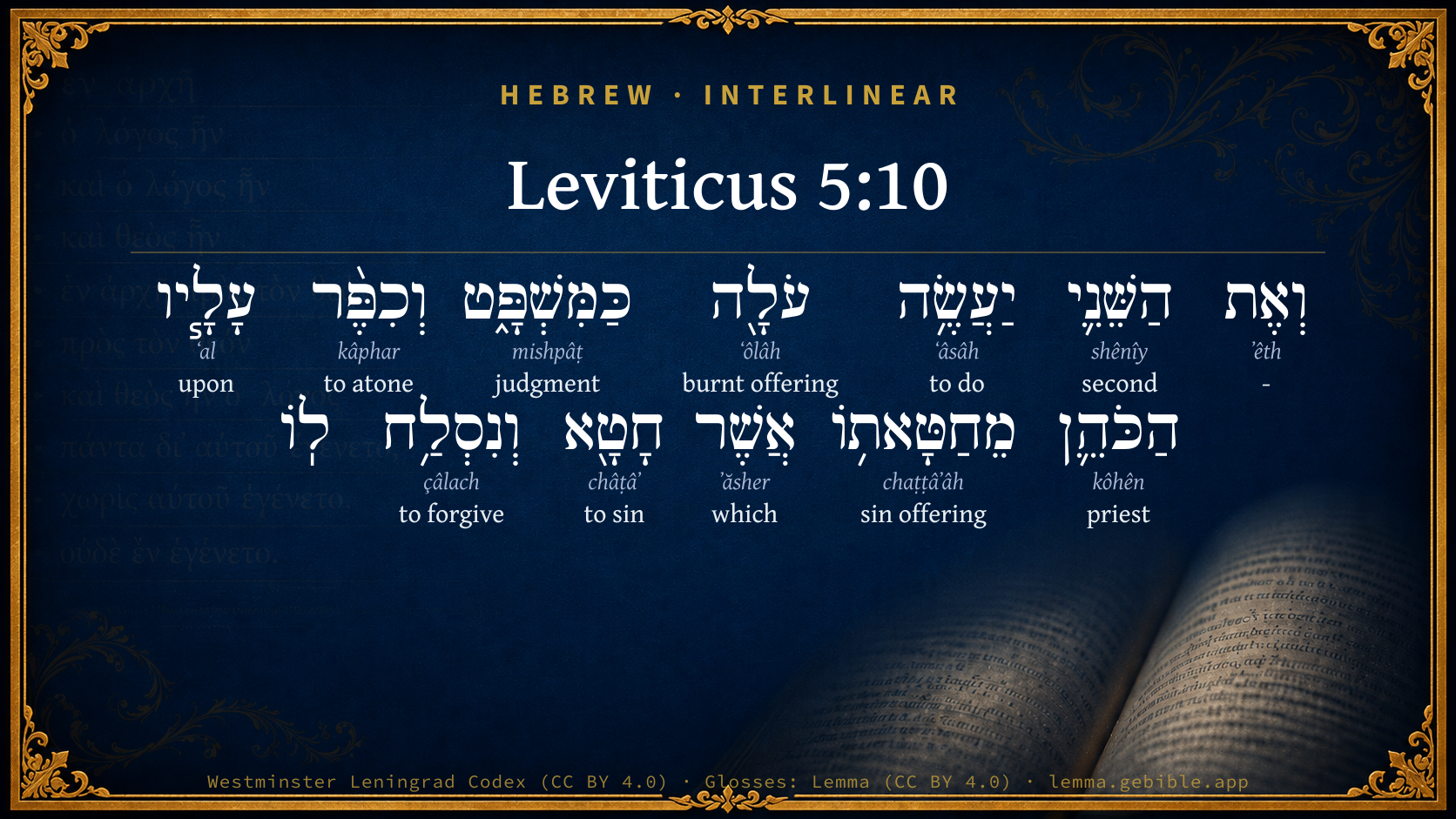
Hebrew (Westminster Leningrad Codex) Leviticus 5:10 appears in the Hebrew Old Testament. The text above is from the Westminster Leningrad Codex. Each word links to its Strong’s number, a concise gloss, and parsing drawn from the Open Scriptures Hebrew Bible morphology. Click any word for its full Brown-Driver-Briggs (BDB) entry.
Download image
Cite this verse

Leviticus 5:10 (World English Bible). Public Domain. Lemma interlinear Bible study tool, https://lemma.gebible.app/v/leviticus/5/10.

Show BibTeX & RIS
BibTeX
RIS
English Translation
He shall offer the second for a burnt offering, according to the ordinance; and the priest shall make atonement for him concerning his sin which he has sinned, and he shall be forgiven.
World English Bible · Public Domain
Download a study sheet

One document with this verse’s original text, its word-by-word gloss line, the meaning frame, cross-references with their text, attributed commentary, and full source and license credits — printable, and it pastes into notes with its structure intact.

This verse Autodidact and up

Study sheet (.html) Plain text (.txt)

A passage Seminary Student

Up to 50 verses in one chapter. A passage sheet keeps up to 6 commentary sources and 12 cross-references per verse, in the order this page ranks them, and says so on the sheet whenever that leaves anything out. Ask for a single verse and you get the Autodidact verse sheet above.

Everything on this page stays free to read, with no account — the sheet is a download of what is already on screen, not access to it.

Want to remove ads? Support Godless Engineer
Compare translations 3

The same verse in 3 English versions, stacked beneath the original-language interlinear above. Click any original word for its lexicon entry.

Each is an independent rendering of the whole verse — the interlinear is not word-aligned to these translations.

Highlighted words mark where these versions differ — a whole-verse word diff, not a word-by-word alignment.

  • World English Bible Public Domain
    He shall offer the second for a burnt offering, according to the ordinance; and the priest shall make atonement for him concerning his sin which he has sinned, and he shall be forgiven.
  • King James Version Public Domain
    And he shall offer the second for a burnt offering, according to the manner: and the priest shall make an atonement for him for his sin which he hath sinned, and it shall be forgiven him.
  • unfoldingWord Literal Text CC BY-SA 4.0
    And the second one he shall make a burnt offering, according to the regulation. And the priest shall make atonement for him from his sin that he sinned, and it will be forgiven to him.

unfoldingWord Literal Text — © unfoldingWord, licensed CC BY-SA 4.0. Word-aligned USFM3 via Door43 (git.door43.org/unfoldingWord/en_ult).

Versions to compare (up to 4)

3 of 4 selected

Show all 18 translations

Every available English version of this verse, each an independent rendering of the whole verse.

  • World English Bible Public Domain
    He shall offer the second for a burnt offering, according to the ordinance; and the priest shall make atonement for him concerning his sin which he has sinned, and he shall be forgiven.
  • Berean Standard Bible Public Domain
    And the priest must prepare the second bird as a burnt offering according to the ordinance. In this way the priest will make atonement for him for the sin he has committed, and he will be forgiven.
  • Majority Standard Bible Public Domain
    And the priest must prepare the second bird as a burnt offering according to the ordinance. In this way the priest will make atonement for him for the sin he has committed, and he will be forgiven.
  • King James Version Public Domain
    And he shall offer the second for a burnt offering, according to the manner: and the priest shall make an atonement for him for his sin which he hath sinned, and it shall be forgiven him.
  • American Standard Version (1901) Public Domain
    And he shall offer the second for a burnt-offering, according to the ordinance; and the priest shall make atonement for him as concerning his sin which he hath sinned, and he shall be forgiven.
  • Revised Version (1885) Public Domain
    And he shall offer the second for a burnt offering, according to the ordinance: and the priest shall make atonement for him as concerning his sin which he hath sinned, and he shall be forgiven.
  • Geneva Bible (1599) Public Domain
    Also he shall offer the seconde for a burnt offring as the maner is: so shall the Priest make an atonement for him (for his sinne which hee hath committed) and it shalbe forgiuen him.
  • Douay-Rheims (1899) Public Domain
    And the other he shall burn for a holocaust, as is wont to be done: and the priest shall pray for him, and for his sin, and it shall be forgiven him.
  • Young's Literal Translation Public Domain
    `And the second he maketh a burnt-offering, according to the ordinance, and the priest hath made atonement for him, because of his sin which he hath sinned, and it hath been forgiven him.
  • Literal Standard Version CC BY-SA 4.0
    And he makes the second a burnt-offering, according to the ordinance, and the priest has made atonement for him because of his sin which he has sinned, and it has been forgiven him.
  • Unlocked Literal Bible CC BY-SA 4.0
    Then he must offer the second bird as a burnt offering, as described in the instructions, and the priest will make atonement for him for the sin that he has committed, and the person will be forgiven.
  • unfoldingWord Literal Text CC BY-SA 4.0
    And the second one he shall make a burnt offering, according to the regulation. And the priest shall make atonement for him from his sin that he sinned, and it will be forgiven to him.
  • Darby Bible Public Domain
    And he shall offer the other for a burnt-offering, according to the ordinance. And the priest shall make atonement for him [to cleanse him] from his sin which he hath sinned, and it shall be forgiven him.
  • World Messianic Bible Public Domain
    He shall offer the second for a burnt offering, according to the ordinance; and the priest shall make atonement for him concerning his sin which he has sinned, and he shall be forgiven.
  • Webster's Bible Public Domain
    And he shall offer the second for a burnt-offering, according to the manner: and the priest shall make an atonement for him for his sin which he hath sinned, and it shall be forgiven him.
  • Free Bible Version CC BY-SA 4.0
    The priest must then prepare the second bird as a burnt offering according to the regulations. In this way the priest will make you right for your sin, and you will be forgiven.
  • Bible in Basic English Public Domain
    And the second is for a burned offering, in agreement with the law; and the priest will take away his sin and he will have forgiveness.
  • JPS Tanakh (1917) Public Domain
    And he shall prepare the second for a burnt-offering, according to the ordinance; and the priest shall make atonement for him as concerning his sin which he hath sinned, and he shall be forgiven.

Literal Standard Version (2020), Covenant Press — licensed CC BY-SA 4.0. Text via the HelloAO Bible API (eBible.org). Unlocked Literal Bible (unfoldingWord) — licensed CC BY-SA 4.0. Text via the HelloAO Bible API (eBible.org). unfoldingWord Literal Text — © unfoldingWord, licensed CC BY-SA 4.0. Word-aligned USFM3 via Door43 (git.door43.org/unfoldingWord/en_ult). Free Bible Version, Dr. Jonathan Gallagher — licensed CC BY-SA 4.0. Text via the HelloAO Bible API (eBible.org).

Word by word

More ways to search: Search by grammar → Find every occurrence → Compare this word →

Practice this passage: Drill this verse → Learn its vocabulary →

וְנִסְלַ֥ח
çâlach
H5545
“and · to forgive”
Conjunction + Verb, Niphal, Sequential Perfect, 3rd Person, Masculine, Singular
Part of Speech
Conjunction + Verb
Stem
Niphal
Form
Sequential Perfect
Person
3rd Person
Gender
Masculine
Number
Singular
Full BDB Definition

Origin: a primitive root

TWOT: 1505

to forgive, pardon - (Qal) to forgive, pardon - (Niphal) to be forgiven
  1. וְאֶת ʼêth H853 “and · -” Conjunction + Particle, Direct Object
  2. הַשֵּׁנִ֛י shênîy H8145 “the · second” Particle, Definite Article + Adjective, Ordinal number, Masculine, Singular, Absolute
  3. יַעֲשֶׂ֥ה ʻâsâh H6213 “to do” Verb, Qal, Imperfect, 3rd Person, Masculine, Singular
  4. עֹלָ֖ה ʻôlâh H5930 “burnt offering” Noun, Common, Feminine, Singular, Absolute
  5. כַּמִּשְׁפָּ֑ט mishpâṭ H4941 “like/as the · judgment” Preposition, Determined + Noun, Common, Masculine, Singular, Absolute
  6. וְכִפֶּ֨ר kâphar H3722 “and · to atone” Conjunction + Verb, Piel, Sequential Perfect, 3rd Person, Masculine, Singular
  7. עָלָ֧יו ʻal H5921 “upon · him” Preposition + Suffix, Personal, 3rd Person, Masculine, Singular
  8. הַכֹּהֵ֛ן kôhên H3548 “the · priest” Particle, Definite Article + Noun, Common, Masculine, Singular, Absolute
  9. מֵחַטָּאת֥וֹ chaṭṭâʼâh H2403 “from · sin offering · his” Preposition + Noun, Common, Feminine, Singular, Construct + Suffix, Personal, 3rd Person, Masculine, Singular
  10. אֲשֶׁר ʼăsher H834 “which” Particle, Relative
  11. חָטָ֖א châṭâʼ H2398 “to sin” Verb, Qal, Perfect, 3rd Person, Masculine, Singular

About this verse

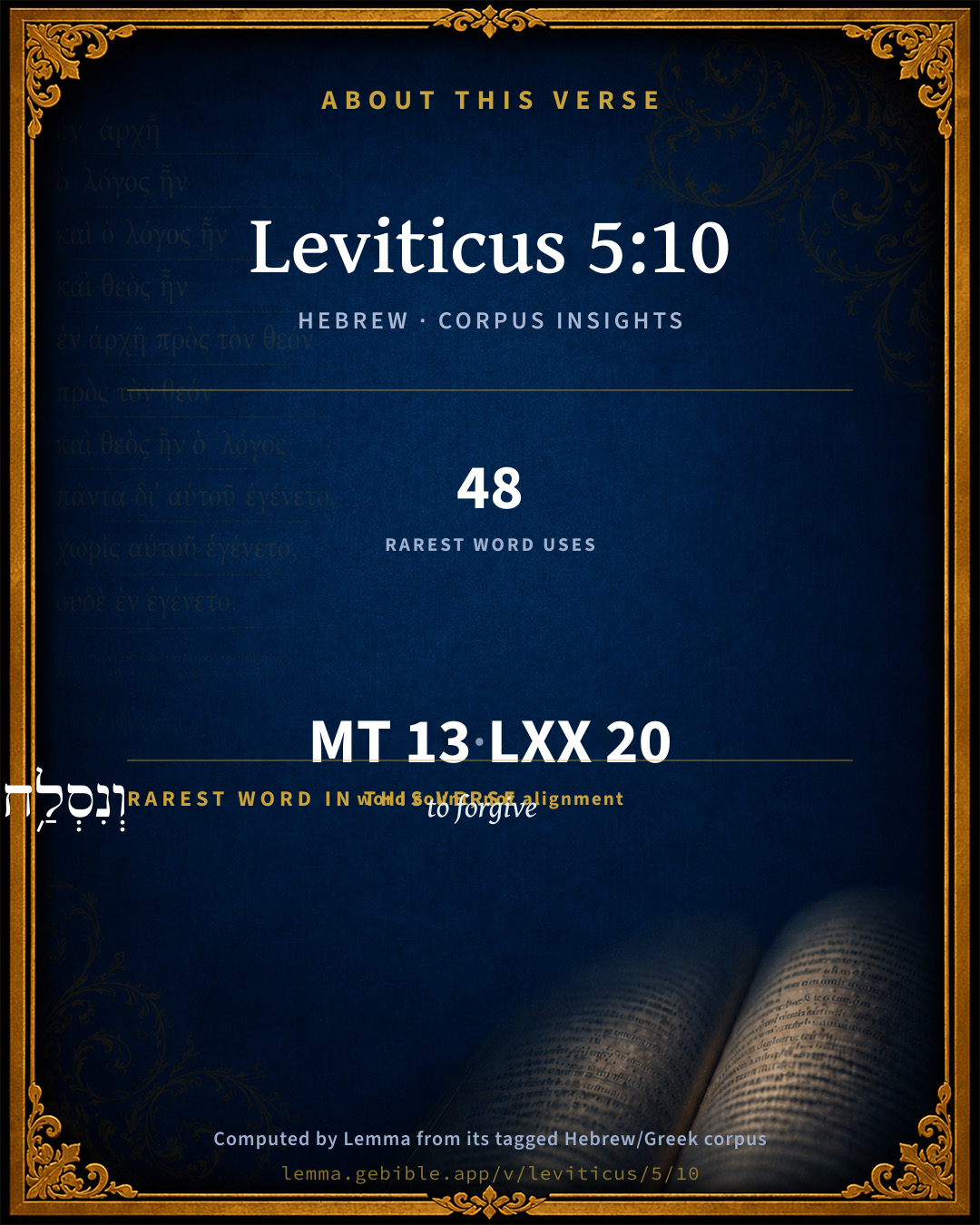
These counts appear in no published source. They are computed here, from the morphology-tagged text and Lemma’s own curated glosses. What Lemma adds →

13
words
12
distinct lemmas
Pentateuch
section

Shared distinctive vocabulary

וְנִסְלַ֥ח to forgive H5545 occurs in 45 verses of the Hebrew Bible. Also found in:

Grammatical profile

  • 4 verbs
  • 4 nouns
  • 1 adjective
  • 2 prepositions
  • 2 particles

Verb forms

  • יַעֲשֶׂ֥ה Qal · Imperfect
  • וְכִפֶּ֨ר Piel · Sequential Perfect
  • חָטָ֖א Qal · Perfect
  • וְנִסְלַ֥ח Niphal · Sequential Perfect

Hebrew & Septuagint length

In English translation the verse runs 33 words from the Hebrew and 33 from the Septuagint (LXX English) — the same length.

A rough comparison of the two English renderings, which tokenize alike — not a word-level alignment.

Word counts can differ between the Hebrew and the Greek without any difference in meaning — e.g. the Hebrew direct-object marker אֵת has no separate Greek word, and Greek often adds the article ὁ.

In the original languages it is 13 Hebrew tokens and 20 Greek tokens — but the two are counted differently (Hebrew bundles its prefixes and suffixes into one token; the Greek is in lemma form), so that isn’t a like-for-like length.

Cross-references

12

Topical passages linked to Leviticus 5:10 in the Treasury of Scripture Knowledge — connected by theme and wording, ordered by reader-vote popularity; previews shown in the World English Bible.

  • Leviticus 1:14–17 "'If his offering to Yahweh is a burnt offering of birds, then he shall offer his offering of turtledoves, or of young pigeons.
  • Leviticus 4:26 All its fat he shall burn on the altar, like the fat of the sacrifice of peace offerings; and the priest shall make atonement for him concerning his sin, and he will be forgiven.
  • Leviticus 4:20 Thus shall he do with the bull; as he did with the bull of the sin offering, so shall he do with this; and the priest shall make atonement for them, and they shall be forgiven.
  • Leviticus 4:31 All its fat he shall take away, like the fat is taken away from off of the sacrifice of peace offerings; and the priest shall burn it on the altar for a sweet savor to Yahweh; and the priest shall make atonement for him, and he will be forgiven.
  • Leviticus 4:35 All its fat he shall take away, like the fat of the lamb is taken away from the sacrifice of peace offerings; and the priest shall burn them on the altar, on the offerings of Yahweh made by fire; and the priest shall make atonement for him concerning his sin that he has sinned, and he will be forgiven.
  • Leviticus 5:13 The priest shall make atonement for him concerning his sin that he has sinned in any of these things, and he will be forgiven; and the rest shall be the priest's, as the meal offering.'"
  • Leviticus 5:16 He shall make restitution for that which he has done wrong in the holy thing, and shall add a fifth part to it, and give it to the priest; and the priest shall make atonement for him with the ram of the trespass offering, and he will be forgiven.
  • Romans 5:11 Not only so, but we also rejoice in God through our Lord Jesus Christ, through whom we have now received the reconciliation.
  • Ephesians 5:2 Walk in love, even as Christ also loved you, and gave himself up for us, an offering and a sacrifice to God for a sweet-smelling fragrance.
  • James 5:15 and the prayer of faith will heal him who is sick, and the Lord will raise him up. If he has committed sins, he will be forgiven.
  • 1 John 2:2 And he is the atoning sacrifice for our sins, and not for ours only, but also for the whole world.
  • Leviticus 5:6 and he shall bring his trespass offering to Yahweh for his sin which he has sinned, a female from the flock, a lamb or a goat, for a sin offering; and the priest shall make atonement for him concerning his sin.

Cross-references courtesy of OpenBible.info (CC BY 4.0).

Hebrew and Greek witnesses Masoretic Hebrew ↔ Greek Septuagint

The same verse in the two great witnesses to the Old Testament, shown verse-for-verse.

These are two independent witnesses, not word-aligned to each other, and the Septuagint is shown in lemma (dictionary) form.

Hebrew Leviticus 5:10 Masoretic · Westminster Leningrad Codex

וְאֶת הַשֵּׁנִ֛י יַעֲשֶׂ֥ה עֹלָ֖ה כַּמִּשְׁפָּ֑ט וְכִפֶּ֨ר עָלָ֧יו הַכֹּהֵ֛ן מֵחַטָּאת֥וֹ אֲשֶׁר חָטָ֖א וְנִסְלַ֥ח לֽוֹ

He shall offer the second for a burnt offering, according to the ordinance; and the priest shall make atonement for him concerning his sin which he has sinned, and he shall be forgiven.

World English Bible · Public Domain

Greek LXX Leviticus 5:10 Septuagint · lemma form

καί ὁ δεύτερος ποιέω ὁλοκαύτωμα ὡς καταἥκω καί ἐκἱλάσκομαι ὁ ἱερεύς περί ὁ ἁμαρτία αὐτός ὅς ἁμαρτάνω καί ἀποἵημι αὐτός

And he shall make the second a whole burnt offering, as it is fit; and the priest shall make atonement for his sin which he has sinned, and it shall be forgiven him.

LXX2012 (modern English Septuagint) · Public Domain

Hebrew: Westminster Leningrad Codex (CC BY 4.0). Greek: Septuagint (public domain); English from LXX2012 (modern English Septuagint) (Public Domain). How the Septuagint differs from the Hebrew →

Targum (Aramaic paraphrase)

2

The Targum is the ancient Jewish Aramaic paraphrase of the Hebrew Scriptures — an interpretive translation, not the Hebrew text itself. Onkelos (literal) and Pseudo-Jonathan (expansive) render the Torah, and Jonathan the Prophets. Coverage is partial: where no permissively-licensed English translation exists for a verse, only the Aramaic is shown. This is verse-level text, not a word-by-word alignment to the Hebrew.

  1. Targum Onkelos Torah (Genesis–Deuteronomy)
    וְיָת תִּנְיָנָא יַעְבֵּד עֲלָתָא כִּדְחָזֵי וִיכַפֵּר עֲלוֹהִי כַהֲנָא מֵחוֹבְתֵהּ דִי חָב וְיִשְׁתְּבֵק לֵהּ

    (no public-domain English translation for this verse)

    Targum Onkelos — Aramaic: “Onkelos Genesis” (public domain); “Onkelos Exodus” (public domain); “Onkelos Leviticus” (public domain); “Onkelos Numbers” (public domain); “Onkelos Deuteronomy” (public domain). English: “Sefaria Community Translation” (CC0 1.0 (public-domain dedication)); “J.W. Etheridge. The Targums of Onkelos and Jonathan Ben Uzziel on the Pentateuch. London: Longmans, Green, 1862” (public domain). Text via Sefaria.

  2. Targum Pseudo-Jonathan Torah (Genesis–Deuteronomy)
    וְיַת עוֹף תִּנְיָין יַעֲבֵיד עֲלָתָא הֵי כְּהִילְכַת עוֹפָא דְאִתְבְּחַר בְּשֵׁירוּיָא לְחַטָאתָא וְלָא כְּהִלְכַת חַטָאתָא דְתוֹרָא דְאִימַר בַּר עִיזֵי וִיכַפֵּר עֲלוֹי כַּהֲנָא מֵחוֹבְתֵיהּ דְחַב וְיִשְׁתְּבֵיק לֵיהּ

    And of the second bird he shall make a burnt sacrifice, according to the rite with the bird which he had chosen for the sin offering, and not according to the rite for the bullock, or the lamb, or the young goat. And the priest shall expiate him from the sin that he hath sinned, and it shall be forgiven him.

    Targum Pseudo-Jonathan — Aramaic: “Targum Jonathan on Genesis” (public domain); “Targum Jonathan on Exodus” (public domain); “Targum Jonathan on Leviticus” (public domain); “Targum Jonathan on Numbers” (public domain); “Targum Jonathan on Deuteronomy” (public domain). English: “The Targum of Jonathan ben Uzziel, trans. J. W. Etheridge, London, 1862” (public domain). Text via Sefaria.

Commentary

Notes on Leviticus 5:10 from classic Christian and Jewish commentators (each source and its license shown beneath its notes). The classic Christian expositions comment on the surrounding passage and are grouped to its opening verse, so a note may address several verses; the Jewish commentaries on the Tanakh (Rashi and others) are per-verse, so they appear only where the commentator wrote on this verse.

Lemma curates 59 commentaries, every one of them public domain or Creative Commons licensed, each selected and text-cleaned for this edition rather than reprinted as found. About our sources →

Trapp's Complete Commentary

John Trapp

Lev 5:10 And he shall offer the second [for] a burnt offering, according to the manner: and the priest shall make an atonement for him for his sin which he hath sinned, and it shall be forgiven him.

Ver. 10. According to the manner.] That is, the forms and rites prescribed. So, {Amo 8:14} "The manner of Beersheba," i.e, the forms and rites of worshipping in Beersheba, as the Chaldee paraphraseth it.

John Trapp, A Commentary or Exposition upon All the Books of the Old and New Testament (1647–1656) — public domain. Text from a community e-Sword module.

Geneva Bible (1599)

Geneva Bible translators

Or, according to the Law.

Or, declare him to be purged of that sin.

Geneva Bible (1599) marginal notes — public domain. Text via Bolls.life.

Adam Clarke's Commentary

Verse 10. He shall offer the second for a burnt-offering] The pigeon for the burnt-offering was wholly consumed, it was the Lord's property; that for the sin-offering was the priest's property, and was to be eaten by him after its blood had been partly sprinkled on the side of the altar, and the rest poured out at the bottom of the altar. See also Le 6:26.

Adam Clarke's Commentary on the Bible (1810–1826) — public domain. Text from a community e-Sword/MySword module.

Ellicott's Commentary for English Readers

(10) According to the manner.—That is, according to the rites prescribed in Lev_1:14, &c.

A Bible Commentary for English Readers, edited by Charles John Ellicott (1878–1897) — public domain. Text from a community e-Sword module.

The Cambridge Bible for Schools and Colleges

gen. ed. J. J. S. Perowne

10. according to the ordinance] i.e. as prescribed in Lev_1:14-17.

The Cambridge Bible for Schools and Colleges (gen. ed. J. J. S. Perowne; Cambridge University Press, 1878–1918) — public domain. Text from a community e-Sword module.

John Gill's Exposition

And he shall offer the second for a burnt offering, according to the manner,.... That is, the second turtledove or young pigeon, after the other was made a sin offering; and the manner according to which this was offered was not according to the rite or manner of the bird chosen first for a sin offering, as the Targum of Jonathan, but according to the burnt offering of the fowl in Lev 1:15 so Jarchi and Ben Gersom:

and the priest shall make an atonement for him, for his sin which he had sinned, and it shall be forgiven him; upon the atonement made; and so forgiveness of sin with God proceeds upon the atonement made by the blood of Christ, Heb 9:22. God never took one step towards it, without a regard to Christ the propitiation for sin; he promised it with a view to him; there is no instance of pardon under the Old Testament but in this way, and God always has respect to Christ in pardon, it is for his sake; and this way of forgiveness best provides for the glory of the divine perfections; there can be no better way, or infinite wisdom would have used it; there could be no other way, considering the council and covenant of peace; to pardon, without atonement and satisfaction, is not consistent with the purity, justice, and veracity of God; and to observe this great truth, the phrase is afterwards frequently repeated,

John Gill's Exposition of the Whole Bible (1746–1763) — public domain (CC PDM 1.0). Text via the HelloAO Bible API.

Matthew Poole's English Annotations

According to the manner or order appointed by God.

The priest shall make an atonement for him; either declaratively, he shall pronounce him to be pardoned; or typically, with respect to Christ.

Matthew Poole's English Annotations on the Holy Bible (1683–1685) — public domain. Text from a community e-Sword/MySword module.

Whedon's Commentary on the Bible

Daniel D. Whedon

10. According to the manner — See Lev_1:13-17.

Daniel D. Whedon (gen. ed.), Commentary on the Old and New Testaments (1874–1909) — public domain. Text from a community e-Sword module.

John Wesley's Explanatory Notes

According to the manner - Or order appointed by God. The priest shall make an atonement - Either declaratively, he shall pronounce him to be pardoned; or typically, with respect to Christ.

John Wesley, Explanatory Notes Upon the Whole Bible (1754–1765) — public domain. Text via the GEBible commentary corpus.

Scofield Reference Notes

C. I. Scofield

atonement

(See Scofield "Exo 29:33").

The Scofield Reference Bible (1917 edition), notes by C. I. Scofield — public domain. Text from a community e-Sword module.

unfoldingWord translationNotes

Door43 World Missions Community

as described in the instructions

This can be stated in active form. AT: "as Yahweh has instructed" (See: Active or Passive)

the priest will make atonement for him for the sin that he has committed

The abstract noun "atonement" can be stated as a verb. AT: "the priest will atone for the sin that the person committed" (See: Abstract Nouns)

the person will be forgiven

This can be stated in active form. AT: "Yahweh will forgive the person" (See: Active or Passive)

translationWords

burnt offering

priest

atonement

sin

forgive

unfoldingWord translationNotes — © Distant Shores Media and the Door43 World Missions Community, licensed CC BY-SA 4.0. Source: git.door43.org/Door43/en_tn.

Rashi

Rabbi Shlomo Yitzchaki (Rashi)

כמשפט [AND THE SECOND HE SHALL OFFER FOR A BURNT-OFFERING] ACCORDING TO THE REGULATION — according to the law that is mentioned with regard to a free-will burnt-offering of fowls at the beginning of the section (Leviticus 1:14) (cf. Sifra, Vayikra Dibbura d'Chovah, Chapter 18 10; Chullin 21a).

Rashi on the Tanakh — English translations: “The Judaica Press complete Tanach with Rashi, translated by A. J. Rosenberg” (CC BY 4.0); “Pentateuch with Rashi's commentary by M. Rosenbaum and A.M. Silbermann, 1929-1934” (public domain); “The Metsudah Tanach series, Lakewood, N.J” (CC BY 4.0); and “The Book of Joshua, Metsudah Publications, 1997” (CC BY 4.0). Text via Sefaria.

Lesson kit

Teaching starters — assembled from the data on this page, not authored interpretation. Every prompt links to the verse data it draws on. Edit before teaching.

Leviticus, in the Pentateuch, opens this verse with 13 words (12 distinct Hebrew lemmas). Its most distinctive word is çâlach (“to forgive”). A historical commentator’s framing appears above. Read the whole chapter for the surrounding context.

Discussion questions

  1. What does “to forgive” (çâlach) contribute to the verse as a whole?
  2. Exodus 34:9 shares the word «to forgive» with this verse. How do the two illuminate each other?
  3. The translations on this page render this verse differently — a whole-verse word diff, not a word-by-word alignment. What might account for the different wordings?
  4. The verb «יַעֲשֶׂ֥ה» is Qal Imperfect. How does its form color the action?
  5. Reading how Trapp's Complete Commentary and Geneva Bible (1599) read this verse, where do the two commentators agree and where do they part?

Things to notice

Reading settings

Reading text

Shown beneath each verse's original-language words.

Old Testament
Old Testament edition

Read the OT as the Masoretic Hebrew (MT) or the Greek Septuagint (LXX).

English shown for the Greek Septuagint (in the Hebrew ↔ Greek comparison).

Comparing translations? Open the Compare panel on any verse page to stack up to four side by side.