
Lamentations 5:16

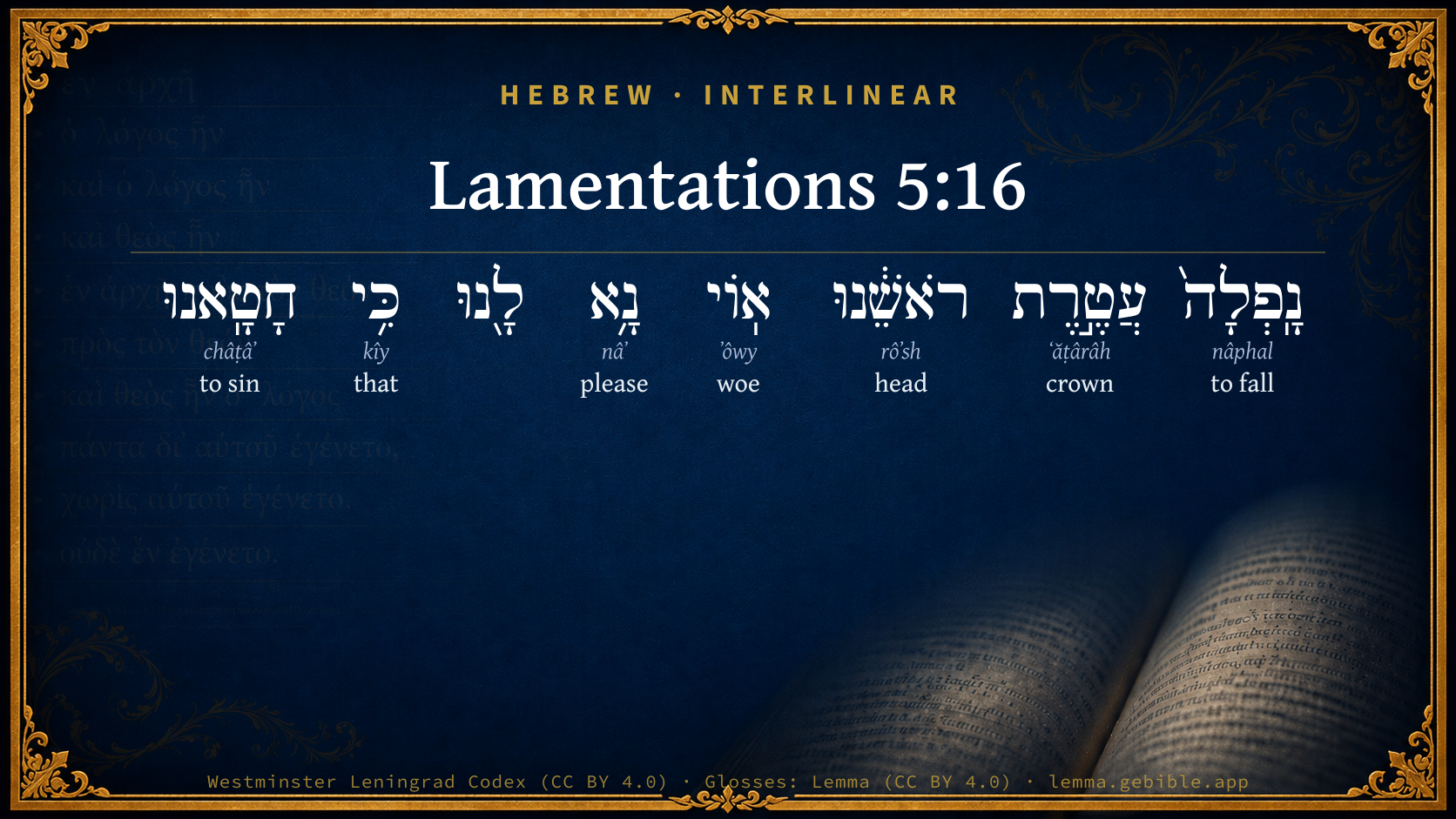
Hebrew (Westminster Leningrad Codex) Lamentations 5:16 appears in the Hebrew Old Testament. The text above is from the Westminster Leningrad Codex. Each word links to its Strong’s number, a concise gloss, and parsing drawn from the Open Scriptures Hebrew Bible morphology. Click any word for its full Brown-Driver-Briggs (BDB) entry.
Download image
Cite this verse

Lamentations 5:16 (World English Bible). Public Domain. Lemma interlinear Bible study tool, https://lemma.gebible.app/v/lamentations/5/16.

Show BibTeX & RIS
BibTeX
RIS
English Translation
The crown is fallen from our head: Woe to us! for we have sinned.
World English Bible · Public Domain
Download a study sheet

One document with this verse’s original text, its word-by-word gloss line, the meaning frame, cross-references with their text, attributed commentary, and full source and license credits — printable, and it pastes into notes with its structure intact.

This verse Autodidact and up

Study sheet (.html) Plain text (.txt)

A passage Seminary Student

Up to 50 verses in one chapter. A passage sheet keeps up to 6 commentary sources and 12 cross-references per verse, in the order this page ranks them, and says so on the sheet whenever that leaves anything out. Ask for a single verse and you get the Autodidact verse sheet above.

Everything on this page stays free to read, with no account — the sheet is a download of what is already on screen, not access to it.

Want to remove ads? Support Godless Engineer
Compare translations 3

The same verse in 3 English versions, stacked beneath the original-language interlinear above. Click any original word for its lexicon entry.

Each is an independent rendering of the whole verse — the interlinear is not word-aligned to these translations.

Highlighted words mark where these versions differ — a whole-verse word diff, not a word-by-word alignment.

  • World English Bible Public Domain
    The crown is fallen from our head: Woe to us! for we have sinned.
  • King James Version Public Domain
    The crown is fallen from our head: woe unto us, that we have sinned!
  • unfoldingWord Literal Text CC BY-SA 4.0
    The crown of our head has fallen. Woe now to us, for we have sinned!

unfoldingWord Literal Text — © unfoldingWord, licensed CC BY-SA 4.0. Word-aligned USFM3 via Door43 (git.door43.org/unfoldingWord/en_ult).

Versions to compare (up to 4)

3 of 4 selected

Show all 18 translations

Every available English version of this verse, each an independent rendering of the whole verse.

  • World English Bible Public Domain
    The crown is fallen from our head: Woe to us! for we have sinned.
  • Berean Standard Bible Public Domain
    The crown has fallen from our head. Woe to us, for we have sinned!
  • Majority Standard Bible Public Domain
    The crown has fallen from our head. Woe to us, for we have sinned!
  • King James Version Public Domain
    The crown is fallen from our head: woe unto us, that we have sinned!
  • American Standard Version (1901) Public Domain
    The crown is fallen from our head: Woe unto us! for we have sinned.
  • Revised Version (1885) Public Domain
    The crown is fallen from our head: woe unto us! for we have sinned.
  • Geneva Bible (1599) Public Domain
    The crowne of our head is fallen: wo nowe vnto vs, that we haue sinned.
  • Douay-Rheims (1899) Public Domain
    The crown is fallen from our head woe to us, because we have sinned.
  • Young's Literal Translation Public Domain
    Fallen hath the crown `from' our head, Wo `is' now to us, for we have sinned.
  • Literal Standard Version CC BY-SA 4.0
    The crown has fallen [from] our head, || Woe [is] now to us, for we have sinned.
  • Unlocked Literal Bible CC BY-SA 4.0
    The crown has fallen from our head; woe to us, for we have sinned!
  • unfoldingWord Literal Text CC BY-SA 4.0
    The crown of our head has fallen. Woe now to us, for we have sinned!
  • Darby Bible Public Domain
    The crown is fallen from our head: woe unto us, for we have sinned!
  • World Messianic Bible Public Domain
    The crown has fallen from our head. Woe to us, for we have sinned!
  • Webster's Bible Public Domain
    The crown is fallen from our head: woe to us, that we have sinned!
  • Free Bible Version CC BY-SA 4.0
    The crown has fallen from our head. What a disaster has come upon us because we have sinned!
  • Bible in Basic English Public Domain
    The crown has been taken from our head: sorrow is ours, for we are sinners.
  • JPS Tanakh (1917) Public Domain
    The crown is fallen from our head; woe unto us! for we have sinned.

Literal Standard Version (2020), Covenant Press — licensed CC BY-SA 4.0. Text via the HelloAO Bible API (eBible.org). Unlocked Literal Bible (unfoldingWord) — licensed CC BY-SA 4.0. Text via the HelloAO Bible API (eBible.org). unfoldingWord Literal Text — © unfoldingWord, licensed CC BY-SA 4.0. Word-aligned USFM3 via Door43 (git.door43.org/unfoldingWord/en_ult). Free Bible Version, Dr. Jonathan Gallagher — licensed CC BY-SA 4.0. Text via the HelloAO Bible API (eBible.org).

Word by word

More ways to search: Search by grammar → Find every occurrence → Compare this word →

Practice this passage: Drill this verse → Learn its vocabulary →

About this verse

These counts appear in no published source. They are computed here, from the morphology-tagged text and Lemma’s own curated glosses. What Lemma adds →

8
words
7
distinct lemmas
Prophets
section

Notable vocabulary

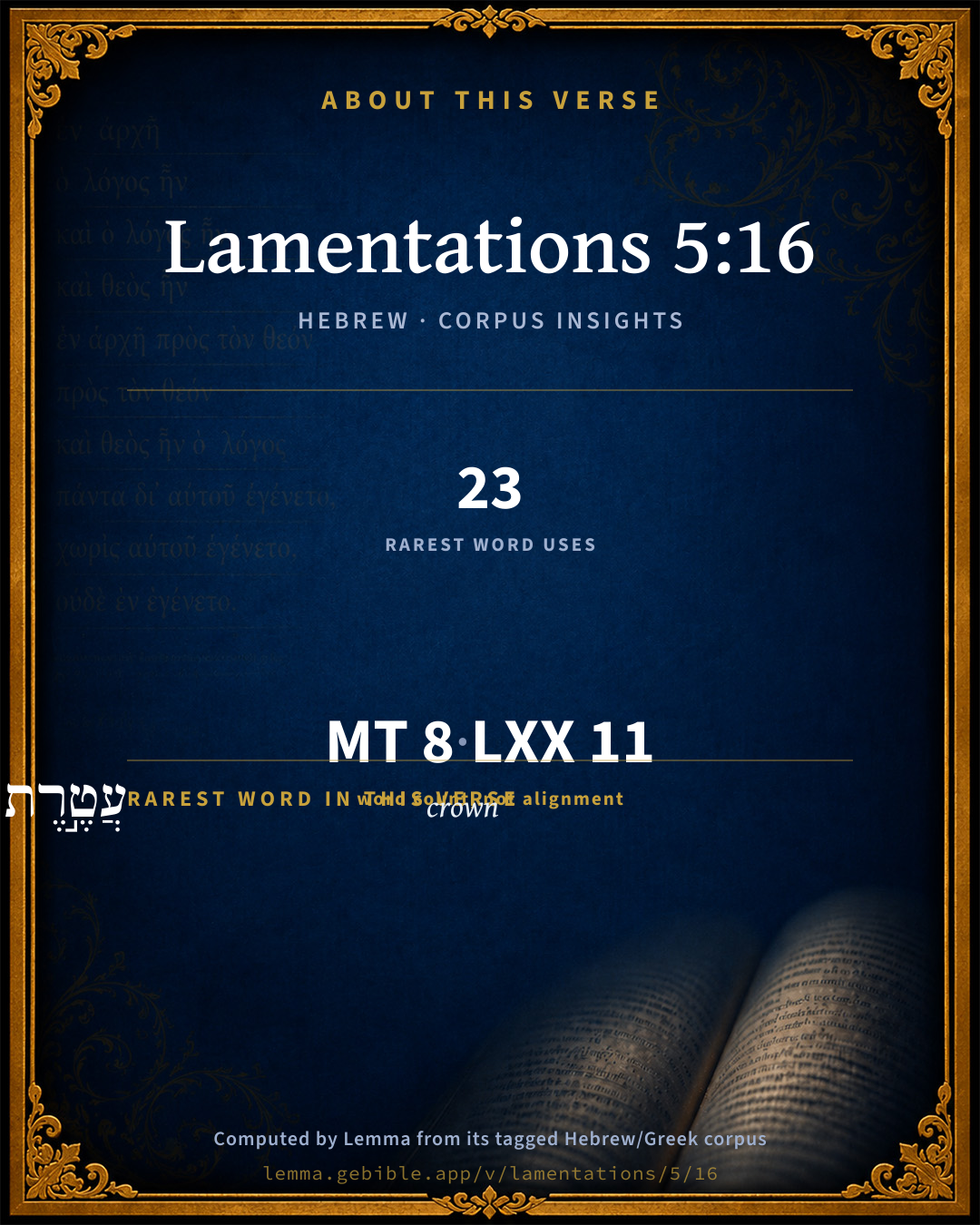
The rarest word here is עֲטֶ֣רֶת crown H5850 — appearing just 23 times in the whole Hebrew Bible.

Shared distinctive vocabulary

עֲטֶ֣רֶת crown H5850 occurs in 23 verses of the Hebrew Bible. Also found in:

Grammatical profile

  • 2 verbs
  • 2 nouns
  • 1 preposition
  • 1 conjunction
  • 2 particles

Verb forms

  • נָֽפְלָה֙ Qal · Perfect
  • חָטָֽאנוּ Qal · Perfect

Hebrew & Septuagint length

In English translation the verse runs 14 words from the Hebrew and 15 from the Septuagint (LXX English) — closely comparable.

A rough comparison of the two English renderings, which tokenize alike — not a word-level alignment.

Word counts can differ between the Hebrew and the Greek without any difference in meaning — e.g. the Hebrew direct-object marker אֵת has no separate Greek word, and Greek often adds the article ὁ.

In the original languages it is 8 Hebrew tokens and 11 Greek tokens — but the two are counted differently (Hebrew bundles its prefixes and suffixes into one token; the Greek is in lemma form), so that isn’t a like-for-like length.

Cross-references

19

Topical passages linked to Lamentations 5:16 in the Treasury of Scripture Knowledge — connected by theme and wording, ordered by reader-vote popularity; previews shown in the World English Bible.

  • Psalms 89:39 You have renounced the covenant of your servant. You have defiled his crown in the dust.
  • Isaiah 3:9–11 The look of their faces testify against them. They parade their sin like Sodom. They don't hide it. Woe to their soul! For they have brought disaster upon themselves.
  • Job 19:9 He has stripped me of my glory, And taken the crown from my head.
  • Jeremiah 13:18 Say you to the king and to the queen-mother, Humble yourselves, sit down; for your headdresses are come down, even the crown of your glory.
  • Lamentations 1:1 How does the city sit solitary, that was full of people! She has become as a widow, who was great among the nations! She who was a princess among the provinces is become tributary!
  • Lamentations 4:13 [It is] because of the sins of her prophets, [and] the iniquities of her priests, That have shed the blood of the just in the midst of her.
  • Proverbs 14:34 Righteousness exalts a nation, But sin is a disgrace to any people.
  • Jeremiah 2:17 Haven't you procured this to yourself, in that you have forsaken Yahweh your God, when he led you by the way?
  • Jeremiah 2:19 Your own wickedness shall correct you, and your backsliding shall reprove you: know therefore and see that it is an evil thing and a bitter, that you have forsaken Yahweh your God, and that my fear is not in you, says the Lord, Yahweh of Hosts.
  • Jeremiah 4:18 Your way and your doings have procured these things to you; this is your wickedness; for it is bitter, for it reaches to your heart.
  • Lamentations 1:8 Jerusalem has grievously sinned; therefore she is become as an unclean thing; All who honored her despise her, because they have seen her nakedness: Yes, she sighs, and turns backward.
  • Lamentations 1:18 Yahweh is righteous; for I have rebelled against his commandment: Please hear all you peoples, and see my sorrow: My virgins and my young men are gone into captivity.
  • Lamentations 2:1 How has the Lord covered the daughter of Zion with a cloud in his anger! He has cast down from heaven to the earth the beauty of Israel, And hasn't remembered his footstool in the day of his anger.
  • Ezekiel 7:17–22 All hands shall be feeble, and all knees shall be weak as water.
  • Ezekiel 21:26 thus says the Lord Yahweh: Remove the turban, and take off the crown; this [shall be] no more the same; exalt that which is low, and abase that which is high.
  • Ezekiel 22:12–16 In you have they taken bribes to shed blood; you have taken interest and increase, and you have greedily gained of your neighbors by oppression, and have forgotten me, says the Lord Yahweh.
  • Revelation 3:11 I am coming quickly! Hold firmly that which you have, so that no one takes your crown.
  • 2 Peter 2:4–6 For if God didn't spare angels when they sinned, but cast them down to Tartarus, and committed them to pits of darkness, to be reserved to judgment;
  • Revelation 2:10 Don't be afraid of the things which you are about to suffer. Behold, the devil is about to throw some of you into prison, that you may be tested; and you will have oppression for ten days. Be faithful to death, and I will give you the crown of life.

Cross-references courtesy of OpenBible.info (CC BY 4.0).

Hebrew and Greek witnesses Masoretic Hebrew ↔ Greek Septuagint

The same verse in the two great witnesses to the Old Testament, shown verse-for-verse.

These are two independent witnesses, not word-aligned to each other, and the Septuagint is shown in lemma (dictionary) form.

Hebrew Lamentations 5:16 Masoretic · Westminster Leningrad Codex

נָֽפְלָה֙ עֲטֶ֣רֶת רֹאשֵׁ֔נוּ אֽוֹי נָ֥א לָ֖נוּ כִּ֥י חָטָֽאנוּ

The crown is fallen from our head: Woe to us! for we have sinned.

World English Bible · Public Domain

Greek LXX Lamentations 5:16 Septuagint · lemma form

πίπτω ὁ στέφανος ὁ κεφαλή ἐγώ οὐαί δή ἐγώ ὅτι ἁμαρτάνω

The crown has fallen from our head: yes, woe to us! for we have sinned.

LXX2012 (modern English Septuagint) · Public Domain

Hebrew: Westminster Leningrad Codex (CC BY 4.0). Greek: Septuagint (public domain); English from LXX2012 (modern English Septuagint) (Public Domain). How the Septuagint differs from the Hebrew →

Commentary

Notes on Lamentations 5:16 from classic Christian and Jewish commentators (each source and its license shown beneath its notes). The classic Christian expositions comment on the surrounding passage and are grouped to its opening verse, so a note may address several verses; the Jewish commentaries on the Tanakh (Rashi and others) are per-verse, so they appear only where the commentator wrote on this verse.

Lemma curates 59 commentaries, every one of them public domain or Creative Commons licensed, each selected and text-cleaned for this edition rather than reprinted as found. About our sources →

Trapp's Complete Commentary

John Trapp

Lam 5:16 The crown is fallen [from] our head: woe unto us, that we have sinned!

Ver. 16. The crown is fallen from our head,] i.e., All our glory, both of Church and State, because we refused to serve God, which indeed is to "reign in righteousness." Now neither is all this, nor any of this, spoken to exasperate or exulcerate people’s hearts to fret against God, or to faint under their pressures, but to put them upon the practice of true humiliation, that so they may not lose the fruit of their afflictions, whence the following passage.

Woe unto us that we have sinned!] Which, as it runneth sweetly and rhythmically in the original, so it pointeth us to that savoury and sovereign practice of lamenting our sins more than our miseries, and humbling ourselves to the utmost under the mighty hand of God, that he may lift up in due season.

John Trapp, A Commentary or Exposition upon All the Books of the Old and New Testament (1647–1656) — public domain. Text from a community e-Sword module.

The Preacher's Complete Homiletical Commentary

Joseph S. Exell (gen. ed.)

EXEGETICAL NOTES.—

Lam_5:16. Fallen is the crown from our head. That which was their honour has gone—the crown with which the Lord Jehovah had decked His chosen nation. I put … a beautiful crown upon thine head … and thy renown went forth among the nations for thy beauty; for it was perfect through my majesty, which I had put upon thee (Eze_16:12; Eze_16:14). Now it is in the dust, set at nought by all those who had admired it. So, as if in irrepressible acknowledgment that they themselves were responsible for the dismal change, the exclamation bursts forth, Woe unto us! for we have sinned—sinned not against a ritual or a code of law, but against a living Person—Maker, Monarch, Father. This second clause is in correlation with Lam_5:7, and expresses the share which their own iniquities had in the guilt which had drawn down such condign suffering as they were subjected to. Like their fathers, they had disowned truth and righteousness, and addicted themselves to false and unholy practices. This view of themselves, and confession of its evil nature, opens the eyes of the heart to look for the throne of grace.

HOMILETICS

THE LOSS OF HONOUR

(Lam_5:16)

I. Honour is the crown of individual character. Honour is moral rectitude, the crown and dignity of the true man.

“Say what is honour? ’Tis the finest sense

Of justice which the human mind can frame,

Intent each lurking frailty to disclaim,

And guard the way of life from all offence

Suffered or done.”—Wordsworth.

Moral rectitude is not a natural possession; it is the gift of Divine grace. It must be humbly and penitently sought, gratefully received, and strengthened and increased by incessant exercise. It is all of grace, and this grace sheds a glory and lustre upon the soul. As the diamond in the ring, so is grace to the soul. A heart beautified with grace has the picture of the King of heaven hung in it. It is dignified with the reflected splendour of the Divine majesty.

II. When honour is lost, man is discrowned. “The crown is fallen from our head.” Israel not only lost their national king, and with him their national independence, but they lost their moral kingship, their personal righteousness; and this they lost before they were deprived of their earthly king. All that had given them rank and honour was tumbled in the dust

“Better to die ten thousand deaths

Than wound my honour.”

“Mine honour is my life; both grow in one;

Take honour from me, and my life is done.”

III. Honour is lost when righteousness is abandoned. “Woe unto us that we have sinned.” Afflicted Judah is getting clearer light. In the seventh verse they still cling to the idea that their national calamities were to be ascribed to the sins of their ancestors. Now they see the enormity of their own sins, and acknowledge that they deserved chastisement Man is invulnerable to the assaults of the enemy and to the heaviest blows of misfortune and suffering while he retains his integrity. He is fenced round with the unconquerable protection of the God in whom he trusts. It is when he is untrue to himself, to his highest sense of honour, that he is untrue to God, and, falling away from righteousness, he becomes discrowned, and sinks into disgrace and misery.

LESSONS.—

1. Righteousness confers dignity.

2. That man suffers unspeakable loss who does not act up to his holiest impulses.

3. When a man loses a sense of honour, he may sink to any depth of infamy.

GERM NOTES ON THE VERSES

Lam_5:16. The degradation of sin:

1. Begins in personal unfaithfulness.

2. It is undignified to sin.

3. The course of sin ends in misery and in woe.

A series of woes. “Woe unto us that we have sinned.”

1. The first woe is the polluting of the soul by sin.

2. The second woe is God’s hatred and abhorrence.

3. The third woe is God’s leaving us.

4. The fourth woe is all kinds of punishment—an Iliad of evils.—Bishop Ussher.

ILLUSTRATIONS.—True dignity.

“True dignity is never gained by place,

And never lost when honours are withdrawn.”—Massinger.

“Ye proud, ye selfish, ye severe,

How vain your mask of state;

The good alone have joy sincere,

The good alone are great.”—Beattie.

Fallen greatness.

“I have ventured,

Like little wanton boys that swim on bladders,

This many summers in a sea of glory,

But far beyond my depth: my high-blown pride

At length broke under me; and now has left me,

Weary and old with service, to the mercy

Of a rude stream, that must for ever hide me.

Vain pomp and glory of this world, I hate ye!”

—Wolsey.

Degradation. That which renders men so unwilling to believe themselves capable of union with God is but the sense of their own degradation. I would gladly be informed whence this creature, who acknowledges himself so weak, obtains the right to measure and limit the Divine mercy as his own fancy suggests. Man understands so little the nature of God that he understands not himself; and yet, troubled by the contemplation of his own condition, he boldly pronounces that it is beyond the power of God to qualify him for this connection.—Pascal.

The agony of dishonour. The most terrible blow that General Grant ever knew was when the bank in which he was a partner had suspended payment. Not only was he ruined, his sons and daughters penniless by reason of all their savings invested in it being lost; but after a few days there came out a horrible story of craft and guile, and it was seen that his honoured name had been used to entice and decoy hosts of friends, to their own injury and Grant’s discredit Imputations were even cast on the fame that belonged to the country, and this blow was worst of all: the shock of battle was less tremendous; his physical agonies less acute.

The Preacher's Complete Homiletical Commentary (gen. ed. Joseph S. Exell; Funk & Wagnalls, c. 1892) — public domain (pre-1929). A full-Bible homiletical/sermon-outline anthology covering 65 of 66 books (2 John is absent from the source module). Text from a community e-Sword module.

Jamieson, Fausset & Brown

Robert Jamieson, A. R. Fausset & David Brown

The crown--all our glory, the kingdom and the priesthood (Job 19:9; Psa 89:39, Psa 89:44).

Jamieson, Fausset & Brown — Commentary Critical and Explanatory on the Whole Bible (1871) — public domain (CC PDM 1.0). Text via the HelloAO Bible API.

Adam Clarke's Commentary

Verse 16. The crown is fallen from our head] At feasts, marriages, c., they used to crown themselves with garlands of flowers all festivity of this kind was now at an end. Or it may refer to their having lost all sovereignty, being made slaves.

Adam Clarke's Commentary on the Bible (1810–1826) — public domain. Text from a community e-Sword/MySword module.

John Calvin's Commentaries

By the crown of the head he no doubt understands all those ornaments by which that people had been adorned. They had a kingdom and a priesthood, which were like two luminaries or two precious jewels; they had also other things by which the Lord had adorned them. As, then, they were endued with such excellent things, they are said to have borne a crown on their head But a crown was not only taken for a diadem, — it was also a symbol of joy and of honor; for not only kings then wore crowns, but men were crowned at weddings and feasts, at games also, and theatres. The Prophet, in a word, complains, that though many ornaments did belong to the people, yet now they were denuded of them all: The crown, he says, has fallen from our head

He then exclaims, Woe to us now, for we have sinned! Here he sets forth an extreme misery, and at the same time shews that all hope of restoration was taken away. He, however, mentions the cause, because they had done wickedly By saying this he did not intend to exasperate their sorrow, so that they who were thus afflicted might murmur against God; but, on the contrary, his object was to humble the afflicted, so that they might perceive that they were justly punished. It is the same as though he had summoned them as guilty before the tribunal of God, and pronounced in one word that they justly suffered or sustained so grievous a punishment; for a just God is an avenger of wickedness.

We hence conclude, that when he said yesterday that the fathers who had sinned were dead, and their iniquity was borne by their children, he did not so speak as to exempt the living from all blame; for here he condemns them and includes himself in the number. But I explained yesterday the meaning of that verse; and here the Prophet ingenuously confesses that the people were justly punished, because they had by their sins provoked the wrath of God. And this doctrine ought to be carefully observed; because when we are pressed down by adversities, Satan will excite us to sorrow, and at the same time hurry us on to rage, except this doctrine comes to our minds, that we have to do with God, who is a righteous Judge. For the knowledge of our sins will tame our pride and also check all those clamorous complaints, which the unbelieving are wont to utter when they rise up against God. Our evils, then, ought to lead us to consider God’s judgment and to confess our sins; and this was the end which our Prophet had in view. It follows, —

John Calvin's Commentaries (1540-1563) — public domain. Text from the Calvin Translation Society English edition (1840s-50s) via the Christian Classics Ethereal Library (ccel.org). Calvin's coverage is partial (roughly two-thirds of the Bible); uncommented books and verses are honest gaps, never fabricated. The 19th-century editor's footnotes and remarks are omitted so the notes are faithfully Calvin's own voice.

Ellicott's Commentary for English Readers

(16) The crown is fallen.—The phrase is naturally symbolic of degradation, and need not be restricted to the destruction of the Temple or the devastation of Jerusalem.

We have sinned!—The confession of personal sinfulness produced by the contemplation of the miseries of the people contrasts, as has been already noticed, with the half-complaining tone of Lam_5:7.

A Bible Commentary for English Readers, edited by Charles John Ellicott (1878–1897) — public domain. Text from a community e-Sword module.

The Cambridge Bible for Schools and Colleges

gen. ed. J. J. S. Perowne

16. The crown is fallen from our head] Our honour is brought to the dust.

The Cambridge Bible for Schools and Colleges (gen. ed. J. J. S. Perowne; Cambridge University Press, 1878–1918) — public domain. Text from a community e-Sword module.

John Gill's Exposition

The crown is fallen from our head,.... Or, "the crown of our head is fallen" (a); all their honour and glory as a nation were gone; the glory of their kingdom and priesthood, to both which a crown or mitre belonged; the glory of church and state. Aben Ezra interprets it of the temple, the place of the divine Majesty. Sanctius thinks there is an allusion to the crowns they wore upon their heads at their feasts and festivals; and so the words have a close connection with what goes before:

woe unto us that we have sinned! which had brought all these evils upon them: this is not to be considered as an imprecation or denunciation of misery; but as a commiseration of their case; calling upon others to it, and particularly God himself, to have mercy upon them; for, alas for them! they had sinned, and justly deserved what was come upon them; and therefore throw themselves at the feet of mercy, and implore divine compassion.

(a) "cecidit corona capitis nostri", V. L. Pagninus, Montanus, Calvin, Junius & Tremellius, Piscator.

John Gill's Exposition of the Whole Bible (1746–1763) — public domain (CC PDM 1.0). Text via the HelloAO Bible API.

Albert Barnes' Notes on the Bible

Literally, “The crown of our head is fallen,” i. e. what was our chief ornament and dignity is lost; the independence of the nation, and all that gave them rank and honor.

Albert Barnes' Notes on the Bible (1834–1885) — public domain. Text from a community e-Sword/MySword module.

Haydock's Catholic Bible Commentary

Crown, used at feasts; (Calmet) or, we have lost the sovereign power. (Worthington)

George Leo Haydock (1774–1849), Haydock's Catholic Family Bible and Commentary, 1859 edition — public domain. Excludes Psalms (Douay-Rheims chapter numbering differs from Protestant) and Deuterocanonical books (Catholic canon only).

Matthew Poole's English Annotations

Or, The crown of our head is fallen, by which is not only to be understood the cessation of their kingdom, but all their honour, splendour, and dignity (crown being taken in a metaphorical notion).

Woe unto us, that we have sinned! we must thank ourselves for all this, this woe is come upon us because of our sins·

Matthew Poole's English Annotations on the Holy Bible (1683–1685) — public domain. Text from a community e-Sword/MySword module.

Whedon's Commentary on the Bible

Daniel D. Whedon

16. The crown is fallen — The grand summing up of all their disgrace and misery.

Daniel D. Whedon (gen. ed.), Commentary on the Old and New Testaments (1874–1909) — public domain. Text from a community e-Sword module.

The Pulpit Commentary

The crown is fallen, etc.; rather, the crown of our head is fallen. The Jewish people is compared to a rich man at a banquet, crowned with a diadem. (comp. Isa_28:1) Jeremiah has a similar phrase in his prophecies. (Jer_13:18) It evidently expresses figuratively the prosperity and honour formerly enjoyed by the now vanquished people.

Vers. 16, 17. The degradation of sin.

The promise of sin is something very different from this; no flattery is untried, no prospect withheld, which may induce men to rebel against God. But, as with our first parents, as with the dwellers in Jerusalem, so is it in the experience of all men; the promises which sin makes are unfulfilled; the wages of sin are death.

I THE PICTURE OF DEGRADATION. It is highly figurative language which the prophet here employs; but it is not exaggerated, it is not unjust.

1. The head is uncrowned. Judah"s independence and freedom was as a crown to the head; but the Chaldeans tore it off and flung it away. They who defy God must lose in so doing all that is most honourable, most sacred, most precious.

2. The heart is faint. Judah"s joy was turned into mourning, her hopes were dashed to the ground; how could the heart be other than faint? The ways of sin are ways of disappointment, weariness, and distress. The heart of the transgressor sinks within him when he sees the fruit of his doings.

3. The eyes are dim with watching for deliverance, with tears of woe.

II THE CAUSE OF DEGRADATION. Judah may have been unwilling to admit the truth, and may have been disposed to attribute calamities to second causes. But the prophet was just, and laid his hand upon the true explanation when he confessed on behalf of his countrymen, "We have sinned!" Trace up human misery and national disaster to the source, and this is to be reached only when we come to defection and departure from the righteous Lord.

III THE CONSCIOUSNESS OF DEGRADATION. "Woe unto us!" is the cry of the prophet. When men sin and suffer but fail to acknowledge their own ill desert, the intentions of Providence are as yet unfulfilled. The sin must be taken home; the punishment must be acknowledged just; the confession must be penitent, sincere, and frank.

IV THE LESSONS OF DEGRADATION.

1. Let the virtuous and obedient abjure self-confidence and cherish trust in God.

2. Let the tempted beware of the foe, and watch and pray lest they sin and come into this torment.

3. Let the smitten sinner repent and turn unto the Lord and seek pardon and renewal. T.

Discrowned Jerusalem.

I THE PAST HONOUR OF JERUSALEM. The crown has fallen from the head; a crown, therefore, has been upon the head. The lament is not over something striven for and not attained, but over something, as it seems, securely possessed and now irretrievably lost. Notice how Ezekiel is instructed to put the matter. (Eze_16:12) In making Jerusalem to know her abominations there is a contrast with former privileges. Jehovah says, "I put a beautiful crown upon thine head...and thy renown went forth among the heathen for thy beauty." Unquestionably Jerusalem and the land of which she was the radiant centre shone forth gloriously among the Gentiles. The great example of this is that queen of the south who came from the uttermost parts of the earth to hear the wisdom of Solomon. God for his own purposes, inscrutable, and yet, as we must believe, beneficent, constituted it so that Jerusalem was like a fair woman crowned with a crown of pure gold. Other cities had their strength, glory, peculiarities, but Jerusalem was uniquely glorious. And so human individuals may have most attractive natural endowments. There may be physical beauty, or genius, or some ineffable charm of character, or great intellectual capacity, something that lifts man or woman above the common crowd, and thus puts upon them a bright and manifest natural crown. The same great secret power that glorified Israel glorifies men still, not for what they do, nor for any claim they have, but that in their glory they may stimulate and inspire others, and multiply the happiness of every life coming within their sway. It was for the sake of the nations that Jehovah glorified Jerusalem and made her beautiful.

II HER PRESENT HUMILIATION. The crown has fallen from the head, but the mark of past and lost regality remains. It cannot be obliterated. The higher a nation climbs, the further it can fall and the more terrible becomes the spectacle of its fall. It needed all the slow and majestic ascent of Rome to greatness to make Gibbon"s great book possible. Thus, looking from such a height, he had pathetic struggles and contrasts to depict, which would else have been impossible. So, also, we contemplate the aberrations and miseries, the cynicism and misanthropy coming out in the lives of geniuses who have missed their way, men of richest endowments who, from the depths of serf-indulgence and debauchery, might well cry, "The crown is fallen from my head." And so we see that the great crown to be desired is, not that which comes through natural differences or differences in social position, but that which comes through the divinely inspired quality of one"s living. "The hoary head is a crown of glory, if it be found in the way of righteousness". Y. (Php_4:1 2Ti_4:8 Jam_1:12 1Pe_5:4)

The Pulpit Commentary (1880–1919), ed. H.D.M. Spence-Jones & Joseph S. Exell — public domain. Text from a community e-Sword module.

John Wesley's Explanatory Notes

The crown - All our honour, splendour and dignity.

John Wesley, Explanatory Notes Upon the Whole Bible (1754–1765) — public domain. Text via the GEBible commentary corpus.

Lesson kit

Teaching starters — assembled from the data on this page, not authored interpretation. Every prompt links to the verse data it draws on. Edit before teaching.

Lamentations, in the Prophets, opens this verse with 8 words (7 distinct Hebrew lemmas). Its most distinctive word is ʻăṭârâh (“crown”). A historical commentator’s framing appears above. Read the whole chapter for the surrounding context.

Discussion questions

  1. What does “crown” (ʻăṭârâh) contribute to the verse as a whole?
  2. How does 2 Samuel 12:30, which shares the word «crown», read alongside this verse?
  3. These translations render this verse differently; the difference is in the English rendering, not the original. What questions does that raise?
  4. «נָֽפְלָה֙» is a Qal Perfect verb. How does that grammatical form shape the action described?
  5. Compare how Trapp's Complete Commentary and The Preacher's Complete Homiletical Commentary read this verse. Where do they agree or differ?

Things to notice

Reading settings

Reading text

Shown beneath each verse's original-language words.

Old Testament
Old Testament edition

Read the OT as the Masoretic Hebrew (MT) or the Greek Septuagint (LXX).

English shown for the Greek Septuagint (in the Hebrew ↔ Greek comparison).

Comparing translations? Open the Compare panel on any verse page to stack up to four side by side.