
Proverbs 20:2

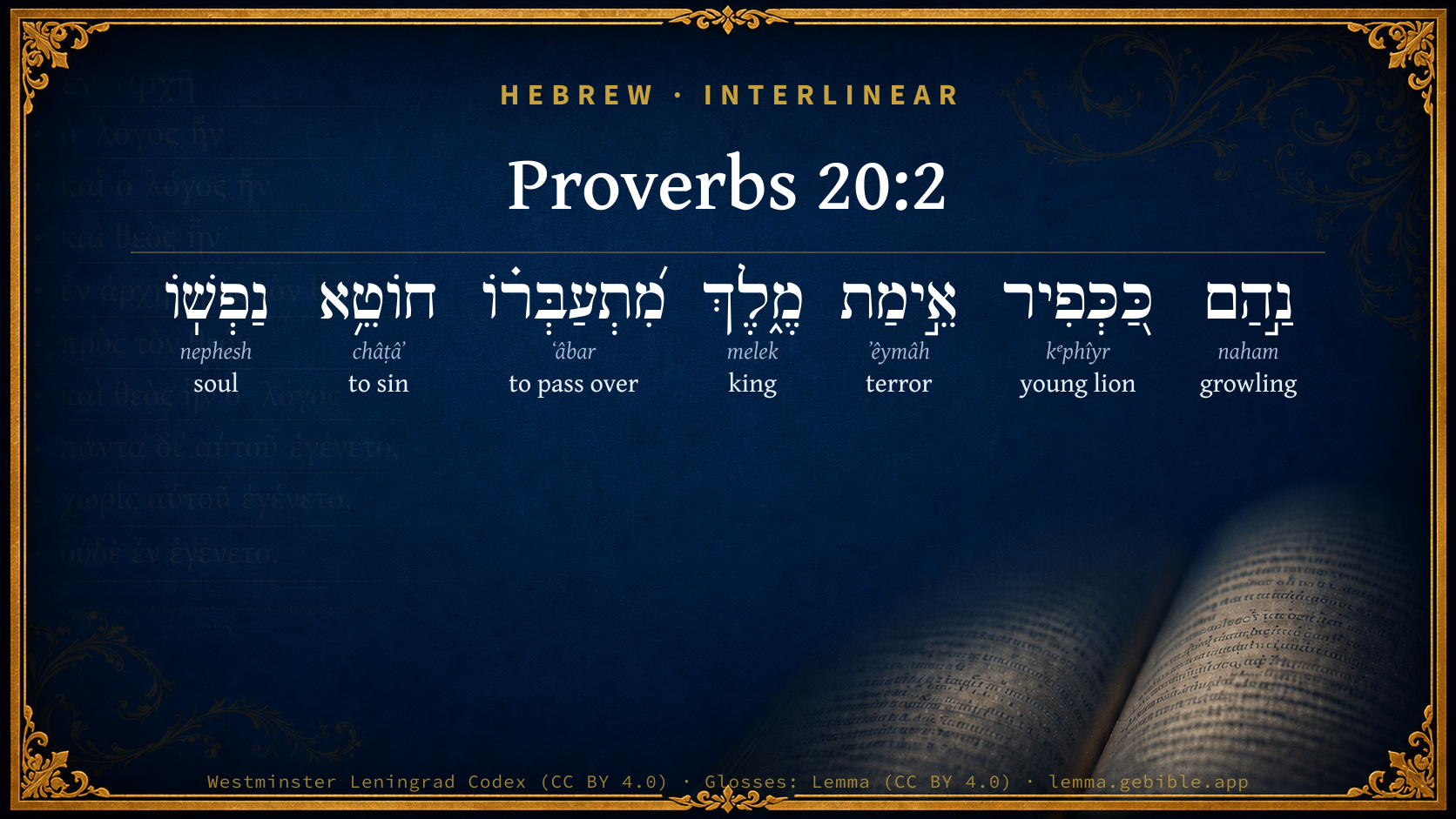
Hebrew (Westminster Leningrad Codex) Proverbs 20:2 appears in the Hebrew Old Testament. The text above is from the Westminster Leningrad Codex. Each word links to its Strong’s number, a concise gloss, and parsing drawn from the Open Scriptures Hebrew Bible morphology. Click any word for its full Brown-Driver-Briggs (BDB) entry.
Download image
Cite this verse

Proverbs 20:2 (World English Bible). Public Domain. Lemma interlinear Bible study tool, https://lemma.gebible.app/v/proverbs/20/2.

Show BibTeX & RIS
BibTeX
RIS
English Translation
The terror of a king is like the roaring of a lion: He who provokes him to anger forfeits his own life.
World English Bible · Public Domain
Download a study sheet

One document with this verse’s original text, its word-by-word gloss line, the meaning frame, cross-references with their text, attributed commentary, and full source and license credits — printable, and it pastes into notes with its structure intact.

This verse Autodidact and up

Study sheet (.html) Plain text (.txt)

A passage Seminary Student

Up to 50 verses in one chapter. A passage sheet keeps up to 6 commentary sources and 12 cross-references per verse, in the order this page ranks them, and says so on the sheet whenever that leaves anything out. Ask for a single verse and you get the Autodidact verse sheet above.

Everything on this page stays free to read, with no account — the sheet is a download of what is already on screen, not access to it.

Want to remove ads? Support Godless Engineer
Compare translations 3

The same verse in 3 English versions, stacked beneath the original-language interlinear above. Click any original word for its lexicon entry.

Each is an independent rendering of the whole verse — the interlinear is not word-aligned to these translations.

Highlighted words mark where these versions differ — a whole-verse word diff, not a word-by-word alignment.

  • World English Bible Public Domain
    The terror of a king is like the roaring of a lion: He who provokes him to anger forfeits his own life.
  • King James Version Public Domain
    The fear of a king is as the roaring of a lion: whoso provoketh him to anger sinneth against his own soul.
  • unfoldingWord Literal Text CC BY-SA 4.0
    The terror of a king a growling like the young lion; one who infuriates him one who wrongs his life.

unfoldingWord Literal Text — © unfoldingWord, licensed CC BY-SA 4.0. Word-aligned USFM3 via Door43 (git.door43.org/unfoldingWord/en_ult).

Versions to compare (up to 4)

3 of 4 selected

Show all 18 translations

Every available English version of this verse, each an independent rendering of the whole verse.

  • World English Bible Public Domain
    The terror of a king is like the roaring of a lion: He who provokes him to anger forfeits his own life.
  • Berean Standard Bible Public Domain
    The terror of a king is like the roar of a lion; whoever provokes him forfeits his own life.
  • Majority Standard Bible Public Domain
    The terror of a king is like the roar of a lion; whoever provokes him forfeits his own life.
  • King James Version Public Domain
    The fear of a king is as the roaring of a lion: whoso provoketh him to anger sinneth against his own soul.
  • American Standard Version (1901) Public Domain
    The terror of a king is as the roaring of a lion: He that provoketh him to anger sinneth `against' his own life.
  • Revised Version (1885) Public Domain
    The terror of a king is as the roaring of a lion: he that provoketh him to anger sinneth against his own life.
  • Geneva Bible (1599) Public Domain
    The feare of the King is like the roaring of a lyon: hee that prouoketh him vnto anger, sinneth against his owne soule.
  • Douay-Rheims (1899) Public Domain
    As the roaring of a lion, so also is the dread of a king: he that provoketh him, sinneth against his own soul.
  • Young's Literal Translation Public Domain
    The fear of a king `is' a growl as of a young lion, He who is causing him to be wroth is wronging his soul.
  • Literal Standard Version CC BY-SA 4.0
    The fear of a king [is] a growl as of a young lion, || He who is causing him to be angry is wronging his soul.
  • Unlocked Literal Bible CC BY-SA 4.0
    The fear of a king is like the fear of a young lion that is roaring; the one who makes him angry forfeits his life.
  • unfoldingWord Literal Text CC BY-SA 4.0
    The terror of a king a growling like the young lion; one who infuriates him one who wrongs his life.
  • Darby Bible Public Domain
    The terror of a king is as the roaring of a lion: he that provoketh him to anger sinneth against his own soul.
  • World Messianic Bible Public Domain
    The terror of a king is like the roaring of a lion. He who provokes him to anger forfeits his own life.
  • Webster's Bible Public Domain
    The fear of a king is as the roaring of a lion: whoever provoketh him to anger sinneth against his own soul.
  • Free Bible Version CC BY-SA 4.0
    When a king gets terribly angry, he sounds like a roaring lion; anyone who makes him furious is liable to be killed.
  • Bible in Basic English Public Domain
    The wrath of a king is like the loud cry of a lion: he who makes him angry does wrong against himself.
  • JPS Tanakh (1917) Public Domain
    The terror of a king is as the roaring of a lion: he that provoketh him to anger forfeiteth his life.

Literal Standard Version (2020), Covenant Press — licensed CC BY-SA 4.0. Text via the HelloAO Bible API (eBible.org). Unlocked Literal Bible (unfoldingWord) — licensed CC BY-SA 4.0. Text via the HelloAO Bible API (eBible.org). unfoldingWord Literal Text — © unfoldingWord, licensed CC BY-SA 4.0. Word-aligned USFM3 via Door43 (git.door43.org/unfoldingWord/en_ult). Free Bible Version, Dr. Jonathan Gallagher — licensed CC BY-SA 4.0. Text via the HelloAO Bible API (eBible.org).

Word by word

More ways to search: Search by grammar → Find every occurrence → Compare this word →

Practice this passage: Drill this verse → Learn its vocabulary →

About this verse

These counts appear in no published source. They are computed here, from the morphology-tagged text and Lemma’s own curated glosses. What Lemma adds →

7
words
7
distinct lemmas
Wisdom
section

Notable vocabulary

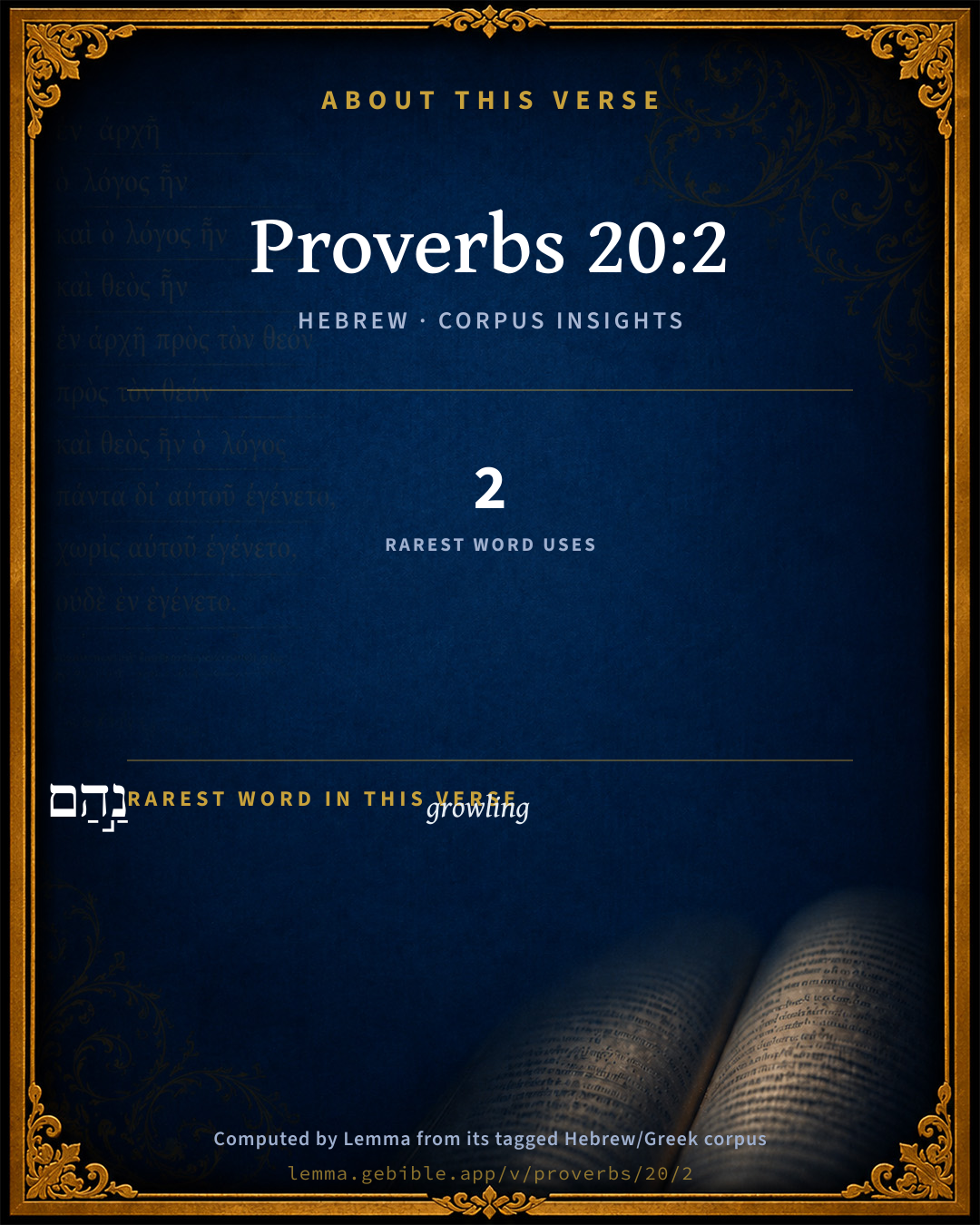
The rarest word here is נַ֣הַם growling H5099 — appearing just 2 times in the whole Hebrew Bible.

Shared distinctive vocabulary

נַ֣הַם growling H5099 occurs in 2 verses of the Hebrew Bible. Also found in:

Grammatical profile

  • 2 verbs
  • 5 nouns

Verb forms

  • מִ֝תְעַבְּר֗וֹ Hithpael · Participle Active
  • חוֹטֵ֥א Qal · Participle Active

Hebrew & Septuagint length

In English translation the verse runs 22 words from the Hebrew and 23 from the Septuagint (LXX English) — closely comparable.

A rough comparison of the two English renderings, which tokenize alike — not a word-level alignment.

Word counts can differ between the Hebrew and the Greek without any difference in meaning — e.g. the Hebrew direct-object marker אֵת has no separate Greek word, and Greek often adds the article ὁ.

Cross-references

9

Topical passages linked to Proverbs 20:2 in the Treasury of Scripture Knowledge — connected by theme and wording, ordered by reader-vote popularity; previews shown in the World English Bible.

  • Proverbs 19:12 The king's wrath is like the roaring of a lion, But his favor is like dew on the grass.
  • Ecclesiastes 10:4 If the spirit of the ruler rises up against you, don't leave your place; for gentleness lays great offenses to rest.
  • 1 Kings 2:23 Then king Solomon swore by Yahweh, saying, God do so to me, and more also, if Adonijah has not spoken this word against his own life.
  • Proverbs 8:36 But he who sins against me wrongs his own soul. All those who hate me love death."
  • Proverbs 16:14–15 The king's wrath is a messenger of death, But a wise man will pacify it.
  • Hosea 11:10 They will walk after Yahweh, Who will roar like a lion; For he will roar, and the children will come trembling from the west.
  • Amos 3:8 The lion has roared. Who will not fear? The Lord Yahweh has spoken. Who can but prophesy?
  • Habakkuk 2:10 You have devised shame to your house, by cutting off many peoples, and have sinned against your soul.
  • Numbers 16:38 even the censers of these sinners against their own lives; and let them be made beaten plates for a covering of the altar: for they offered them before Yahweh; therefore they are holy; and they shall be a sign to the children of Israel.

Cross-references courtesy of OpenBible.info (CC BY 4.0).

Hebrew and Greek witnesses Masoretic Hebrew ↔ Greek Septuagint

The same verse in the two great witnesses to the Old Testament, shown verse-for-verse.

These are two independent witnesses, not word-aligned to each other, and the Septuagint is shown in lemma (dictionary) form.

Hebrew Proverbs 20:2 Masoretic · Westminster Leningrad Codex

נַ֣הַם כַּ֭כְּפִיר אֵ֣ימַת מֶ֑לֶךְ מִ֝תְעַבְּר֗וֹ חוֹטֵ֥א נַפְשֽׁוֹ

The terror of a king is like the roaring of a lion: He who provokes him to anger forfeits his own life.

World English Bible · Public Domain

Greek LXX Proverbs 20:2 Septuagint · lemma form

οὐ διαφέρω ἀπειλή βασιλεύς θυμός λέων ὁ δέ παραὀξύνω αὐτός ἁμαρτάνω εἰς ὁ ἑαυτοῦ ψυχή

The threat of a king differs not from the rage of a lion; and he that provokes him sins against his own soul.

LXX2012 (modern English Septuagint) · Public Domain

On this verse, The Pulpit Commentary discusses the Septuagint’s reading. Read the note in Commentary ↓

Hebrew: Westminster Leningrad Codex (CC BY 4.0). Greek: Septuagint (public domain); English from LXX2012 (modern English Septuagint) (Public Domain). How the Septuagint differs from the Hebrew →

Commentary

Notes on Proverbs 20:2 from classic Christian and Jewish commentators (each source and its license shown beneath its notes). The classic Christian expositions comment on the surrounding passage and are grouped to its opening verse, so a note may address several verses; the Jewish commentaries on the Tanakh (Rashi and others) are per-verse, so they appear only where the commentator wrote on this verse.

Lemma curates 59 commentaries, every one of them public domain or Creative Commons licensed, each selected and text-cleaned for this edition rather than reprinted as found. About our sources →

Trapp's Complete Commentary

John Trapp

Pro 20:2 The fear of a king [is] as the roaring of a lion: [whoso] provoketh him to anger sinneth [against] his own soul.

Ver. 2. The fear of a king is as the roaring of a lion.] See Pro 16:14; Pro 19:12.

John Trapp, A Commentary or Exposition upon All the Books of the Old and New Testament (1647–1656) — public domain. Text from a community e-Sword module.

Joseph Benson's Commentary

Pro 20:2-3. The fear of a king, &c. — See on Pro 16:14; Pro 19:12. It is an honour to a man to cease from strife — Either to prevent it, or, if it be begun, to put an end to it: which, although proud and profane persons esteem dishonourable to them, would indeed be their glory, because it would be an evidence of their wisdom and power over their passions, and of their respect and obedience to their sovereign Lord, in which their honour and happiness consist; but every fool will be meddling — Namely, with matters of strife; he is always ready to begin strife, and obstinate in the continuance of it.

Joseph Benson's Commentary on the Old and New Testaments (1811–1818) — public domain. Text from a community e-Sword module.

Tyndale Open Study Notes

Tyndale Open Resources

20:2 Queen Esther was willing to rouse the king’s anger and risk her life (Esth 7).

Tyndale Open Study Notes — © Tyndale Open Resources, licensed CC BY-SA 4.0. Text via the HelloAO Bible API.

Geneva Bible (1599)

Geneva Bible translators

Putteth his life in danger.

Geneva Bible (1599) marginal notes — public domain. Text via Bolls.life.

Matthew Henry's Commentary

See here, 1. How formidable kings are, and what a terror they strike upon those they are angry with. Their fear, with which (especially when they are absolute and their will is a law) they keep their subjects in awe, is as the roaring of a lion, which is very dreadful to the creatures he preys upon, and makes them tremble so that they cannot escape from him. Those princes that rule by wisdom and love rule like God himself, and bear his image; but those that rule merely by terror, and with a high hand, do but rule like a lion in the forest, with a brutal power. Oderint, dum metuant - Let them hate, provided they fear. 2. How unwise therefore those are that quarrel with them, that are angry at them, and so provoke them to anger. They sin against their own lives. Much more do those do so that provoke the King of kings to anger. Nemo me impune lacesset - No one shall provoke me with impunity.

Matthew Henry's Commentary on the Whole Bible (1708–1710) — public domain (CC PDM 1.0). Text via the HelloAO Bible API.

Jamieson, Fausset & Brown

Robert Jamieson, A. R. Fausset & David Brown

(Compare Pro 19:12). Men who resist authority injure themselves (Rom 13:2).

Jamieson, Fausset & Brown — Commentary Critical and Explanatory on the Whole Bible (1871) — public domain (CC PDM 1.0). Text via the HelloAO Bible API.

Adam Clarke's Commentary

Verse 2. The fear of a king] Almost the same with Pr 19:12, which see.

Adam Clarke's Commentary on the Bible (1810–1826) — public domain. Text from a community e-Sword/MySword module.

Ellicott's Commentary for English Readers

(2) The fear of a king is as the roaring of a lion, i.e., the dread which he casts upon others when he is becoming angry is a warning of approaching. danger.

Sinneth against his own soul—i.e., against his own life.

A Bible Commentary for English Readers, edited by Charles John Ellicott (1878–1897) — public domain. Text from a community e-Sword module.

The Cambridge Bible for Schools and Colleges

gen. ed. J. J. S. Perowne

2. is as] The terror inspired by a king is like that caused by the roaring of a lion in act to spring upon its prey. See 1Pe_5:8.

soul] i.e. life, as R.V. with “Heb. soul,” in the marg. Comp. Hab_2:10.

The Cambridge Bible for Schools and Colleges (gen. ed. J. J. S. Perowne; Cambridge University Press, 1878–1918) — public domain. Text from a community e-Sword module.

John Gill's Exposition

The fear of a king is as the roaring of a lion,.... The wrath and displeasure of a king, which causes fear; see Pro 19:12; kings should be terrors to evil works and workers, though not to good ones, Rom 13:3. This is true of the King of kings, who one day will be terrible to the drunkards, the mockers, and murderers of his people, before spoken of;

whoso provoketh him to anger sinneth against his own soul; he exposes his life to danger: the Targum supplies it as we do. It may be rendered, his "soul sinneth" (a); he is guilty of sin, as well as is in danger of punishment; see Pro 8:36.

(a) .

John Gill's Exposition of the Whole Bible (1746–1763) — public domain (CC PDM 1.0). Text via the HelloAO Bible API.

Albert Barnes' Notes on the Bible

Sinneth against his own soul - i. e., Against his own life (compare Hab 2:10).

Albert Barnes' Notes on the Bible (1834–1885) — public domain. Text from a community e-Sword/MySword module.

Matthew Poole's English Annotations

The fear of a king, passively taken, the terror which the wrath of a king causeth, by comparing this with Pro 19:12.

Sinneth against his own soul; exposeth himself to manifest danger of death.

Matthew Poole's English Annotations on the Holy Bible (1683–1685) — public domain. Text from a community e-Sword/MySword module.

Whedon's Commentary on the Bible

Daniel D. Whedon

2. The fear of a king — The dread, terror, which a king inspires in those brought before him.

Provoketh him — Stirs him up to anger.

Sinneth against his own soul — Against his life, or himself; forfeits his life. Comp. Pro_6:32; Pro_8:36; Pro_16:14; Pro_19:12.

Daniel D. Whedon (gen. ed.), Commentary on the Old and New Testaments (1874–1909) — public domain. Text from a community e-Sword module.

The Pulpit Commentary

The fear of a king is as the roaring of a lion. (see Pro_19:12) The terror which a king causes when his anger is rising is like the roar of a lion, which betokens danger. Septuagint, "The threat of a king differeth not from the wrath of a lion." Whoso provoketh him to anger sinneth against his own soul; imperils his life, which he has no right wilfully to jeopard, Septuagint, "He who enrageth him (oo paroxunwn auton )." The Complutensian and some Greek versions introduce the words, kai epimignumenov , "and has intercourse with him;" i.e. he who having aroused a king"s resentment does not avoid his presence, exposes himself to certain death.

The Pulpit Commentary (1880–1919), ed. H.D.M. Spence-Jones & Joseph S. Exell — public domain. Text from a community e-Sword module.

John Wesley's Explanatory Notes

The fear - The terror which the wrath of a king causes.

John Wesley, Explanatory Notes Upon the Whole Bible (1754–1765) — public domain. Text via the GEBible commentary corpus.

Keil & Delitzsch

C. F. Keil & F. Delitzsch

2 A roaring as of a lion is the terror of the king;

And he that provoketh him forfeiteth his life.

Line first is a variation of Pro 19:12. The terror which a king spreads around (מלך, gen. subjecti., as, e.g., at Job 9:34 and generally) is like the growling of a lion which threatens danger. The thought here suggested is that it is dangerous to arouse a lion. Thus מתעבּרו does not mean: he who is angry at him (Venet.: χολούμενος αὐτῷ), but he who provokes him (lxx, Syr., Targ., Jerome, Luther). התעבּר signifies, as we saw at Pro 14:16, to be in a state of excessive displeasure, extreme anger. Here the meaning must be: he who puts him into a state of anger (lxx, ὁ παροξύνων αὐτόν, in other versions with the addition of καὶ ἐπιμιγνύμενος, who conducts himself familiarly towards him = מתערבו). But can mitharvo have this meaning? That the Hithpa. of transitive stems, e.g., התחגּן (Kg1 8:59) and השׁתּמּר (Mic 6:16), is construed with the accus. of that which any one performs for himself (cf. Ewald's Gramm. Arab. 180), is not unusual; but can the Hithpa. of the intrans. עבר, which signifies to fall into a passion, "express with the accusative the passion of another excited thereby" (Ewald, 282a)? There is no evidence for this; and Hitzig's conjecture, מתעבּרו (Tiphel of the Targ. תּעבור = עברה), is thus not without occasion. But one might suppose that התעבּר, as the reflexive of a Piel or Hiphil which meant to be put into a state of anger, may mean to draw forth the anger of any one, as in Arab., the VIIIth form (Hithpa.) of ḥaḍr, to be present, with the accus. as reflexive of the IVth form, may mean: sibi aliquid praesens sistere. Not so difficult is חטא with the accus. of that which is missing, vid., Pro 8:36 and Hab 2:10.

Keil & Delitzsch — Biblical Commentary on the Old Testament (1861–1891) — public domain (CC PDM 1.0). Text via the HelloAO Bible API. (Old Testament only.)

Bridges on Proverbs

Charles Bridges

The wrath of the king has been before mentioned under this figure. (Pro 19:12 .) Here his fear is described, the effect for the cause. Even Joab with all his valor, trembled at this roaring of the lion, and fled for refuge to the horns of the altar.†1 Jonathan felt the strong necessity for appeasing it.†2 Such was the power of the king (unknown in our happy land) the sole, the uncontrolled arbiter of life and death;†3 whosoever therefore provoked him to anger, sinned, as Adonijah found to his cost (1Ki 2:23 ), against his own soul. What must then be the fear of the Great King! ’Armies of terrors and doubts are nothing to a look of his angry countenance. "O LORD," says that holy man (concerning the frailty of poor man, and the power of God) "who knoweth the power of thine anger? According to thy fear, so is thy wrath."’†4 Even "a little kindling" is ruin past conception, and without remedy. (Psa 2:12 .) Nay — his very "enduring long-suffering," kindles the fire more fiercely for "the vessels of wrath," whose aggravated provocations of it have "fitted them for destruction." (Rom 9:22 .) ’Miserable sinner! deprecate his wrath. Seek a Mediator. Beware of continuing in sin.’†5

Footnotes:

†1 1Ki 2:28-34 .

†2 1Sa 19:4-6 . Ecc 10:4 .

†3 Pro 16:14. Est 7:8 .

†4 Leighton’s Sermon on Jer 10:23-24 . Psa 90:11 .

†5 Geier in loco.

Charles Bridges, An Exposition of the Book of Proverbs (1846) — public domain. Text from a community e-Sword module.

Kretzmann's Popular Commentary

Paul E. Kretzmann

v. 2. The fear of a king, the terror spread by his anger, is as the roaring of a lion, 19:12; whoso provoketh him to anger sinneth against his own soul, foolishly risks and even forfeits his own life.

Paul E. Kretzmann, Popular Commentary of the Bible (1921–1924) — public domain. Text from a community e-Sword module.

Rashi

Rabbi Shlomo Yitzchaki (Rashi)

Fear of a king is like a lion’s roar; he who provokes him Who angers him.

Rashi on the Tanakh — English translations: “The Judaica Press complete Tanach with Rashi, translated by A. J. Rosenberg” (CC BY 4.0); “Pentateuch with Rashi's commentary by M. Rosenbaum and A.M. Silbermann, 1929-1934” (public domain); “The Metsudah Tanach series, Lakewood, N.J” (CC BY 4.0); and “The Book of Joshua, Metsudah Publications, 1997” (CC BY 4.0). Text via Sefaria.

Lesson kit

Teaching starters — assembled from the data on this page, not authored interpretation. Every prompt links to the verse data it draws on. Edit before teaching.

Proverbs, in the Wisdom, opens this verse with 7 words (7 distinct Hebrew lemmas). Its most distinctive word is naham (“growling”). A historical commentator’s framing appears above. Read the whole chapter for the surrounding context.

Discussion questions

  1. What does “growling” (naham) contribute to the verse as a whole?
  2. How does Proverbs 19:12, which shares the word «growling», read alongside this verse?
  3. These translations render this verse differently; the difference is in the English rendering, not the original. What questions does that raise?
  4. «מִ֝תְעַבְּר֗וֹ» is a Hithpael Participle Active verb. How does that grammatical form shape the action described?
  5. Compare how Trapp's Complete Commentary and Joseph Benson's Commentary read this verse. Where do they agree or differ?

Things to notice

Reading settings

Reading text

Shown beneath each verse's original-language words.

Old Testament
Old Testament edition

Read the OT as the Masoretic Hebrew (MT) or the Greek Septuagint (LXX).

English shown for the Greek Septuagint (in the Hebrew ↔ Greek comparison).

Comparing translations? Open the Compare panel on any verse page to stack up to four side by side.