Psalms 51:4

Hebrew (Westminster Leningrad Codex) Psalms 51:4 appears in the Hebrew Old Testament. The text above is from the Westminster Leningrad Codex. Each word links to its Strong’s number, a concise gloss, and parsing drawn from the Open Scriptures Hebrew Bible morphology. Click any word for its full Brown-Driver-Briggs (BDB) entry.
Download image
Cite this verse

Psalms 51:4 (World English Bible). Public Domain. Lemma interlinear Bible study tool, https://lemma.gebible.app/v/psalms/51/4.

Show BibTeX & RIS
BibTeX
RIS
English Translation
Against you, and you only, have I sinned, And done that which is evil in your sight; That you may be proved right when you speak, And justified when you judge.
World English Bible · Public Domain
Download a study sheet

One document with this verse’s original text, its word-by-word gloss line, the meaning frame, cross-references with their text, attributed commentary, and full source and license credits — printable, and it pastes into notes with its structure intact.

This verse Autodidact and up

Study sheet (.html) Plain text (.txt)

A passage Seminary Student

Up to 50 verses in one chapter. A passage sheet keeps up to 6 commentary sources and 12 cross-references per verse, in the order this page ranks them, and says so on the sheet whenever that leaves anything out. Ask for a single verse and you get the Autodidact verse sheet above.

Everything on this page stays free to read, with no account — the sheet is a download of what is already on screen, not access to it.

Want to remove ads? Support Godless Engineer
Compare translations 3

The same verse in 3 English versions, stacked beneath the original-language interlinear above. Click any original word for its lexicon entry.

Each is an independent rendering of the whole verse — the interlinear is not word-aligned to these translations.

Highlighted words mark where these versions differ — a whole-verse word diff, not a word-by-word alignment.

  • World English Bible Public Domain
    Against you, and you only, have I sinned, And done that which is evil in your sight; That you may be proved right when you speak, And justified when you judge.
  • King James Version Public Domain
    Against thee, thee only, have I sinned, and done this evil in thy sight: that thou mightest be justified when thou speakest, and be clear when thou judgest.
  • unfoldingWord Literal Text CC BY-SA 4.0
    Against you, you only, I have sinned and done evil in your eyes, so you are right in your speaking, you are blameless in your judging.

unfoldingWord Literal Text — © unfoldingWord, licensed CC BY-SA 4.0. Word-aligned USFM3 via Door43 (git.door43.org/unfoldingWord/en_ult).

Versions to compare (up to 4)

3 of 4 selected

Show all 18 translations

Every available English version of this verse, each an independent rendering of the whole verse.

  • World English Bible Public Domain
    Against you, and you only, have I sinned, And done that which is evil in your sight; That you may be proved right when you speak, And justified when you judge.
  • Berean Standard Bible Public Domain
    Against You, You only, have I sinned and done what is evil in Your sight, so that You may be proved right when You speak and blameless when You judge.
  • Majority Standard Bible Public Domain
    Against You, You only, have I sinned and done what is evil in Your sight, so that You may be proved right when You speak and blameless when You judge.
  • King James Version Public Domain
    Against thee, thee only, have I sinned, and done this evil in thy sight: that thou mightest be justified when thou speakest, and be clear when thou judgest.
  • American Standard Version (1901) Public Domain
    Against thee, thee only, have I sinned, And done that which is evil in thy sight; That thou mayest be justified when thou speakest, And be clear when thou judgest.
  • Revised Version (1885) Public Domain
    Against thee, thee only, have I sinned, and done that which is evil in thy sight: that thou mayest be justified when thou speakest, and be clear when thou judgest.
  • Geneva Bible (1599) Public Domain
    Against thee, against thee onely haue I sinned, and done euill in thy sight, that thou mayest be iust when thou speakest, and pure when thou iudgest.
  • Douay-Rheims (1899) Public Domain
    Wash me yet more from my iniquity, and cleanse me from my sin.
  • Young's Literal Translation Public Domain
    Against Thee, Thee only, I have sinned, And done the evil thing in Thine eyes, So that Thou art righteous in Thy words, Thou art pure in Thy judging.
  • Literal Standard Version CC BY-SA 4.0
    Against You, You only, I have sinned, || And done evil in Your eyes, || So that You are righteous in Your words, || You are pure in Your judging.
  • Unlocked Literal Bible CC BY-SA 4.0
    Against you, you only, I have sinned and done what is evil in your sight; you are right when you speak; you are correct when you judge.
  • unfoldingWord Literal Text CC BY-SA 4.0
    Against you, you only, I have sinned and done evil in your eyes, so you are right in your speaking, you are blameless in your judging.
  • Darby Bible Public Domain
    Against thee, thee only, have I sinned, and done what is evil in thy sight; that thou mayest be justified when thou speakest, be clear when thou judgest.
  • World Messianic Bible Public Domain
    Against you, and you only, I have sinned, and done that which is evil in your sight, so you may be proved right when you speak, and justified when you judge.
  • Webster's Bible Public Domain
    \\51:2\\Wash me thoroughly from my iniquity, and cleanse me from my sin.
  • Free Bible Version CC BY-SA 4.0
    I have sinned against you, you alone. I have done evil in your sight. So you are right in what you say, and fair when you judge.
  • Bible in Basic English Public Domain
    Against you, you only, have I done wrong, working that which is evil in your eyes; so that your words may be seen to be right, and you may be clear when you are judging.
  • JPS Tanakh (1917) Public Domain
    (51-6) Against Thee, Thee only, have I sinned, and done that which is evil in Thy sight; that Thou mayest be justified when Thou speakest, and be in the right when Thou judgest.

Literal Standard Version (2020), Covenant Press — licensed CC BY-SA 4.0. Text via the HelloAO Bible API (eBible.org). Unlocked Literal Bible (unfoldingWord) — licensed CC BY-SA 4.0. Text via the HelloAO Bible API (eBible.org). unfoldingWord Literal Text — © unfoldingWord, licensed CC BY-SA 4.0. Word-aligned USFM3 via Door43 (git.door43.org/unfoldingWord/en_ult). Free Bible Version, Dr. Jonathan Gallagher — licensed CC BY-SA 4.0. Text via the HelloAO Bible API (eBible.org).

Word by word

More ways to search: Search by grammar → Find every occurrence → Compare this word →

Practice this passage: Drill this verse → Learn its vocabulary →

תִּזְכֶּ֥ה
zâkâh
H2135
“to be clean”
Verb, Qal, Imperfect, 2nd Person, Masculine, Singular
Part of Speech
Verb
Stem
Qal
Form
Imperfect
Person
2nd Person
Gender
Masculine
Number
Singular
Full BDB Definition

Origin: a primitive root [compare H2141 ]; to be translucent

TWOT: 549

to be clean, be pure, be clear - (Qal) - to be clean, be pure - to be clear, be justified - (Piel) - to make clean, make pure, keep clean, keep pure - (Hithpael) - to cleanse - to make yourself clean, purify oneself
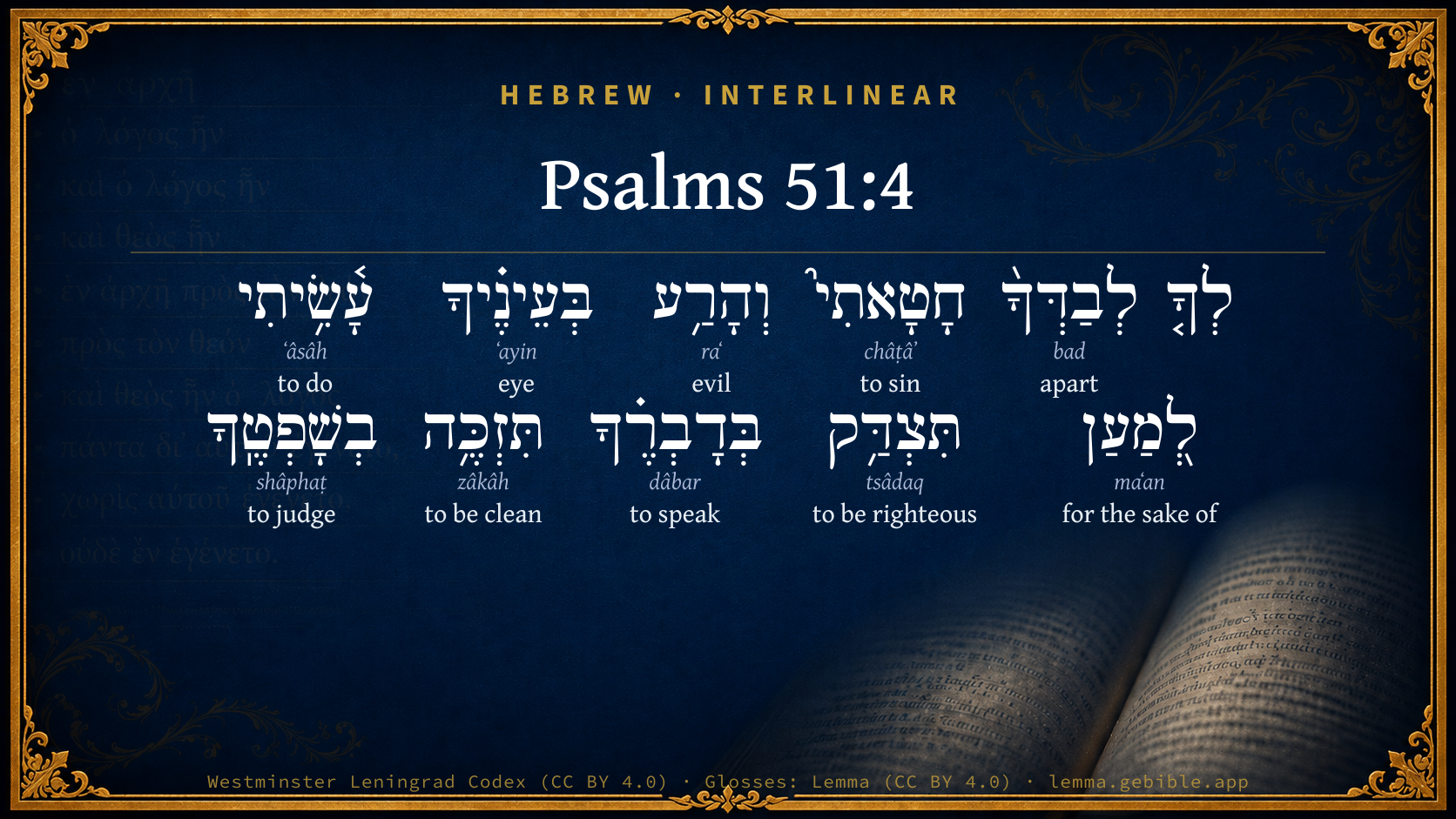
  1. לְבַדְּךָ֨ bad H905 “to/for · apart · your” Preposition + Noun, Common, Masculine, Singular, Construct + Suffix, Personal, 2nd Person, Masculine, Singular
  2. חָטָאתִי֮ châṭâʼ H2398 “to sin” Verb, Qal, Perfect, 1st Person, Common, Singular
  3. וְהָרַ֥ע raʻ H7451 “and · the · evil” Conjunction + Particle, Definite Article + Adjective, Adjective, Masculine, Singular, Absolute
  4. בְּעֵינֶ֗יךָ ʻayin H5869 “in/at · eyes · your” Preposition + Noun, Common, Both, Dual, Construct + Suffix, Personal, 2nd Person, Masculine, Singular
  5. עָ֫שִׂ֥יתִי ʻâsâh H6213 “to do” Verb, Qal, Perfect, 1st Person, Common, Singular
  6. לְ֭מַעַן maʻan H4616 “for the sake of” Preposition
  7. תִּצְדַּ֥ק tsâdaq H6663 “to be righteous” Verb, Qal, Imperfect, 2nd Person, Masculine, Singular
  8. בְּדָבְרֶ֗ךָ dâbar H1696 “in/at · to speak · you” Preposition + Verb, Qal, Infinitive Construct + Suffix, Personal, 2nd Person, Masculine, Singular
  9. בְשָׁפְטֶֽךָ shâphaṭ H8199 “in/at · to judge · you” Preposition + Verb, Qal, Infinitive Construct + Suffix, Personal, 2nd Person, Masculine, Singular

About this verse

These counts appear in no published source. They are computed here, from the morphology-tagged text and Lemma’s own curated glosses. What Lemma adds →

11
words
10
distinct lemmas
Wisdom
section

Notable vocabulary

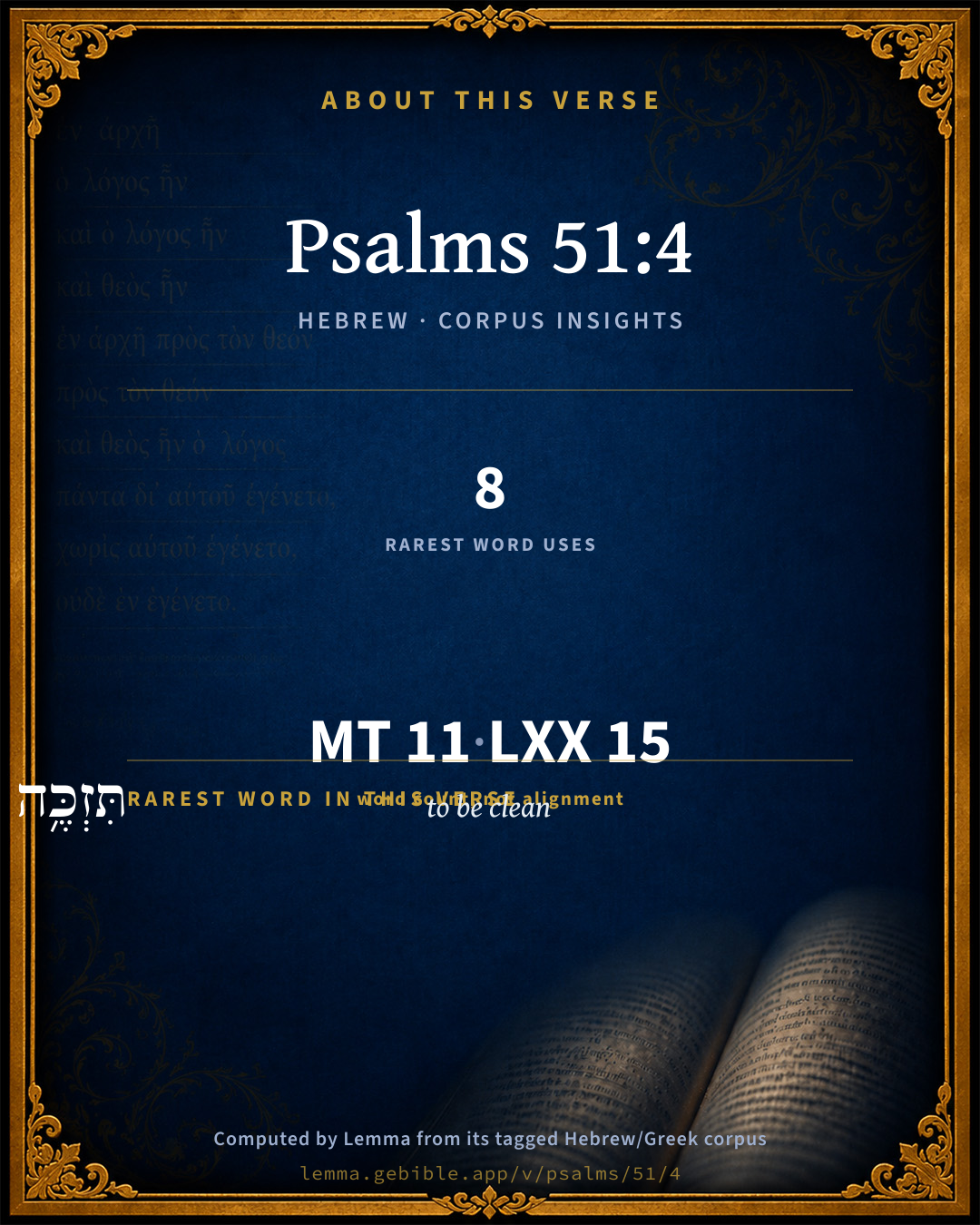
The rarest word here is תִּזְכֶּ֥ה to be clean H2135 — appearing just 8 times in the whole Hebrew Bible.

Shared distinctive vocabulary

תִּזְכֶּ֥ה to be clean H2135 occurs in 8 verses of the Hebrew Bible. Also found in:

Grammatical profile

  • 6 verbs
  • 2 nouns
  • 1 adjective
  • 2 prepositions

Verb forms

  • חָטָאתִי֮ Qal · Perfect
  • עָ֫שִׂ֥יתִי Qal · Perfect
  • תִּצְדַּ֥ק Qal · Imperfect
  • בְּדָבְרֶ֗ךָ Qal · Infinitive Construct
  • תִּזְכֶּ֥ה Qal · Imperfect
  • בְשָׁפְטֶֽךָ Qal · Infinitive Construct

Hebrew & Septuagint length

In English translation the verse runs 31 words from the Hebrew and 26 from the Septuagint (LXX English) — closely comparable.

A rough comparison of the two English renderings, which tokenize alike — not a word-level alignment.

Word counts can differ between the Hebrew and the Greek without any difference in meaning — e.g. the Hebrew direct-object marker אֵת has no separate Greek word, and Greek often adds the article ὁ.

In the original languages it is 11 Hebrew tokens and 15 Greek tokens — but the two are counted differently (Hebrew bundles its prefixes and suffixes into one token; the Greek is in lemma form), so that isn’t a like-for-like length.

Cross-references

22

Topical passages linked to Psalms 51:4 in the Treasury of Scripture Knowledge — connected by theme and wording, ordered by reader-vote popularity; previews shown in the World English Bible.

  • 2 Samuel 12:13–14 David said to Nathan, "I have sinned against Yahweh." Nathan said to David, "Yahweh also has put away your sin. You will not die.
  • Luke 15:21 The son said to him, 'Father, I have sinned against heaven, and in your sight. I am no longer worthy to be called your son.'
  • Genesis 20:6 God said to him in the dream, "Yes, I know that in the integrity of your heart you have done this, and I also withheld you from sinning against me. Therefore I didn't allow you to touch her.
  • Genesis 39:9 He isn't greater in this house than I, neither has he kept back anything from me but you, because you are his wife. How then can I do this great wickedness, and sin against God?"
  • Romans 3:4 May it never be! Yes, let God be found true, but every man a liar. As it is written, "That you might be justified in your words, And might prevail when you come into judgment."
  • Genesis 9:6 Whoever sheds man's blood, by man will his blood be shed, for in the image of God made he man.
  • Leviticus 6:2–7 "If anyone sins, and commits a trespass against Yahweh, and deals falsely with his neighbor in a matter of deposit, or of bargain, or of robbery, or has oppressed his neighbor,
  • Psalms 50:6 The heavens shall declare his righteousness, For God himself is judge. Selah.
  • Acts 17:31 because he has appointed a day in which he will judge the world in righteousness by the man whom he has ordained; of which he has given assurance to all men, in that he has raised him from the dead."
  • Romans 2:5 But according to your hardness and unrepentant heart you are treasuring up for yourself wrath in the day of wrath, revelation, and of the righteous judgment of God;
  • Revelation 16:5 I heard the angel of the waters saying, "You are righteous, who are and who were, you Holy One, because you have judged these things.
  • Leviticus 5:19 It is a trespass offering. He is certainly guilty before Yahweh."
  • 2 Kings 17:17 They caused their sons and their daughters to pass through the fire, and used divination and enchantments, and sold themselves to do that which was evil in the sight of Yahweh, to provoke him to anger.
  • 2 Kings 21:6 He made his son to pass through the fire, and practiced sorcery, and used enchantments, and dealt with those who had familiar spirits, and with wizards: he worked much evil in the sight of Yahweh, to provoke him to anger.
  • Psalms 50:4 He calls to the heavens above, To the earth, that he may judge his people:
  • Luke 7:29 When all the people and the tax collectors heard this, they declared God to be just, having been baptized with John's baptism.
  • James 2:9 But if you show partiality, you commit sin, being convicted by the law as transgressors.
  • Genesis 38:7 Er, Judah's firstborn, was wicked in the sight of Yahweh. Yahweh killed him.
  • 2 Samuel 12:9–10 Why have you despised the word of Yahweh, to do that which is evil in his sight? You have struck Uriah the Hittite with the sword, and have taken his wife to be your wife, and have slain him with the sword of the children of Ammon.
  • James 2:11 For he who said, "Do not commit adultery," said also, "Do not commit murder." Now if you do not commit adultery, but murder, you have become a transgressor of the law.
  • Revelation 15:3–4 They sang the song of Moses, the servant of God, and the song of the Lamb, saying, "Great and marvelous are your works, Lord God, the Almighty; Righteous and true are your ways, you King of the nations.
  • Revelation 19:11 I saw the heaven opened, and behold, a white horse, and he who sat on it is called Faithful and True. In righteousness he judges and makes war.

Cross-references courtesy of OpenBible.info (CC BY 4.0).

Hebrew and Greek witnesses Masoretic Hebrew ↔ Greek Septuagint

The same verse in the two great witnesses to the Old Testament, shown verse-for-verse.

You’re reading Greek Psalm 50 (Hebrew Psalm 51). The Septuagint counts the superscription, so verse numbers can differ from the Hebrew — chapter-level alignment, not verse-by-verse. Numbering follows Rahlfs.

These are two independent witnesses, not word-aligned to each other, and the Septuagint is shown in lemma (dictionary) form.

Hebrew Psalms 51:4 Masoretic · Westminster Leningrad Codex

לְךָ֤ לְבַדְּךָ֨ חָטָאתִי֮ וְהָרַ֥ע בְּעֵינֶ֗יךָ עָ֫שִׂ֥יתִי לְ֭מַעַן תִּצְדַּ֥ק בְּדָבְרֶ֗ךָ תִּזְכֶּ֥ה בְשָׁפְטֶֽךָ

Against you, and you only, have I sinned, And done that which is evil in your sight; That you may be proved right when you speak, And justified when you judge.

World English Bible · Public Domain

Greek LXX Greek Psalm 50:4 Septuagint · lemma form

ἐπί πολύς πλύνω ἐγώ ἀπό ὁ ἀνομία ἐγώ καί ἀπό ὁ ἁμαρτία ἐγώ καθαρίζω ἐγώ

Against you only have I sinned, and done evil before you: that you might be justified in your sayings, and might overcome when you are judged.

LXX2012 (modern English Septuagint) · Public Domain

On this verse, John Calvin's Commentaries discusses the Septuagint’s reading. Read the note in Commentary ↓

Hebrew: Westminster Leningrad Codex (CC BY 4.0). Greek: Septuagint (public domain); English from LXX2012 (modern English Septuagint) (Public Domain). How the Septuagint differs from the Hebrew →

Commentary

Notes on Psalms 51:4 from classic Christian and Jewish commentators (each source and its license shown beneath its notes). The classic Christian expositions comment on the surrounding passage and are grouped to its opening verse, so a note may address several verses; the Jewish commentaries on the Tanakh (Rashi and others) are per-verse, so they appear only where the commentator wrote on this verse.

Lemma curates 59 commentaries, every one of them public domain or Creative Commons licensed, each selected and text-cleaned for this edition rather than reprinted as found. About our sources →

Trapp's Complete Commentary

John Trapp

Psa 51:4 Against thee, thee only, have I sinned, and done [this] evil in thy sight: that thou mightest be justified when thou speakest, [and] be clear when thou judgest.

Ver. 4. Against thee, thee only, have I sinned] This he spake in respect of the secresy of his sins, say some; whence also it followeth, "And done this evil in thy sight." David sent for Bathsheba by his servants, but they knew not wherefore he sent for her, saith Kimchi; neither knew any one why letters were sent to Joab to kill Uriah; but because he refused to obey the king, bidding him go home to his house, &c. Others thus, Against thee only, that is, thee mainly; for every sin is a violation of God’s law; the trespass may be against man, but the transgression is ever against God. Others again thus, Against thee, &c., that is, against thee, so good a God, have I thus heinously offended, giving thereby thine enemies occasion to blaspheme thee. This, I take it, is the true meaning.

And done this evil in thy sight] Which was to despise thee, 2Sa 12:10, not caring though thou lookedst on.

That thou mightest be justified when thou speakest, &c.] i.e. Declared to be just, whatever thou hast denounced against me or shalt inflict upon me. The unrighteousness of man commendeth the righteousness of God, Rom 3:4-5. To thee, O Lord God, belongeth righteousness, but unto us confusion of face, saith Daniel, Psa 9:7.

John Trapp, A Commentary or Exposition upon All the Books of the Old and New Testament (1647–1656) — public domain. Text from a community e-Sword module.

The Biblical Illustrator

Joseph S. Exell

Psa_51:4

Against Thee, Thee only have I sinned, and done this evil in Thy sight: that Thou mightest be justified when Thou speakest, and be clear when Thou judgest.

Unimpeachable justice

Our subject will be, that both in the condemnation and in the punishment of every sinner God will be justified. Now, concerning such condemned ones, we will speak--

I. Of the Christian whose conscience condemns him. He will make the words of our text his own, and will say, Thou art justified when Thou speakest, and, etc. For--

1. He makes a confession. He owns Gods sentence just. And his confession is sincere; abundantly sufficient, without any attempt at extenuation, or promise that he will, of himself, do better. And not only does his confession justify God in condemning him, hub--

2. There is the fact that God Himself witnessed his crime; In Thy sight, he owns that it was done. And the witness of his conscience he owns to be true and abundant.

3. The Christian has no doubt about the justice of the punishment, however severe. For he remembers not only what he himself has done, but how he has made others sin.

II. The condemnation of the ungodly. This is far more terrible. But in it God will be clear.

1. Because of the sinners own confession.

2. The witnesses that will be against him.

3. And in the sinners heart there will be no doubt at last as to the righteousness of his punishment. (C. H. Spurgeon.)

Actual sin

When speaking of Original sin we had to prove its existence; but there is no need of that here. No one denies actual sin. But the readiness of this admission is our great difficulty in dealing with this subject. Its familiarity has bred indifference. But in spite of this, let us come to its consideration, and we speak--

I. Of its guilt. Take the very smallest sin and see its guilt in the fact that it has been committed against God. Thus David viewed his sin. Against Thee, Thee only, etc. This swallows up all other considerations. We are ever saying that we have net been a great sinner, never injured any man. As if the guilt was great only when man was wronged: the wrong to God being of little moment. But that a sin is against God--is that in which consists the greatness of its guilt; for, even among men, we measure the guilt of crimes not by the actual injury resulting from them, but by their injurious tendencies. The traitor who has attempted the life of his sovereign--the rebel who has tried to overthrow his authority--are rightly held as guilty when they fail as if they had succeeded. They are punished, not for the harm that their rebellion or their treason has done, but for the harm which rebellion and treason must do if not repressed. Now, what is a sinner but a rebel? He who sins has defied the sovereign authority of his God--he has set the will of the creature against the will of the Creator. But in this, your one small sin against God, you are guilty not only of rebellion, but of ingratitude. You have sinned against a Father who has made you, and preserved you, and blessed you with blessings innumerable. But more than this, there is in your sin against God not only rebellion and ingratitude, but insult. He who sins against God has been guilty of first making to himself an idol god whom he may offend with impunity, one who has eyes that see not, ears that hear not, and hands that smite not him that goeth on still in his wicked way. But you will say you never thought there could have been any harm in such a trifle. But has it ever occurred to you that this very thing that you allege in your excuse is an aggravation of your guilt? For ignorance, such as you plead, is an excuse for sin only where there is no law; where there is a law, there ignorance of that law is a sin, and a great one; it is the sin of refusing to hear God when He speaks. And if it were not so, if sins of ignorance were always guiltless, then there would be a direct bounty upon ignorance; this would be to give a revelation, and, at the same time, to give men the strongest inducement not to read it. But you will plead the force of habit, that you did it unconsciously. But this shows you have gone on in sin, and the plea is rather an aggravation of your guilt.

II. Their number--how incalculable. There are three kinds of sin,--sins, namely, of thought, word and deed; and each of these may be committed in two ways--by omission or by commission; and, further, that every sin of commission involves one of omission--that we can never do what we ought not to have done without having left undone what we ought to have done. And now, remembering the searching and comprehensive character of that law of which every transgression is a sin, try and form some remote idea of the number of your offences. And we ask you to compare sin as it appears in Gods sight, with sin as it appears in the sight, and as it is pictured in the language of men. How do men generally speak and think of sin? There are some who boast of it. But these are the exceptions, these are open profligates, whom moral and respectable society excommunicates. How, then, do morality and respectability think and speak of sin? Why--provided it offends not against the decencies and the proprieties of life--gently, indulgently, almost respectfully; there is no lack of polite phrases by which society can cloak sins, which, in their native and undisguised grossness it professes to repudiate. Adultery is gallantry; and profligacy is wildness; and profanity is a light way of speaking; infidelity is unsettled ideas about religion; and revenge is high spirit; and drunkenness is conviviality; and heartless and frivolous dissipation is innocent gaiety. And then morality and respectability have favourite vices which they will introduce to you as virtues--avarice is carefulness; and selfishness is prudence; and deceit is politeness; and wasteful luxury is hospitality; and pride is becoming self-respect--until, if you would believe them, you would be persuaded that sin was almost banished from good society, and that certainly there was no such thing to be found there as a miserable sinner. (Archbishop Magee.)

Repentance

There are two kinds of this--the sorrow of the world, and that of God. This latter regards sin as against God. It is the object of sin rather than its consequences that affect Him. For all sin is against God, more than it is against any other being. However it may despise human authority, it involves a greater contempt of His. It is a great error to say of a man that he is nobodys enemy but his own. For the carnal mind is enmity against God. And this is sins greatest aggravation, for see how glorious, how holy, how gracious God is. Failure to see this aggravation in our sin is the cause why conviction of sin is often so slight. True repentance equally regards all sin, for every sin is against God. And the reformation that follows such repentance is thorough. No sin can be a trifle, since it is against God. (W. Nevins, D. D.)

Davids accusating of himself and acquittal of God

I. The censure or accusation which he passes upon himself.

1. The simple acknowledgment or confession. Against Thee, Thee only have I sinned.

(1) His sin in the direct notion of it. The sins which are committed against our brethren and neighbours are committed against God Himself--

(a) As Lawgiver.

(b) As Creator.

(c) As Redeemer.

(2) The reduplication. Thee, Thee only. Only is here to be taken for chiefly; and that not only in regard of the sin itself, but likewise in regard of his affection and apprehension about it. This is that which should principally affect us in all our miscarriages, that they are trespasses upon God Himself.

(a) Thee, an only God; a God of pure eyes, and that cannot endure to behold iniquity.

(b) Thee, a just God, who wilt punish sin wheresoever Thou findest it.

(c) Thee, an Almighty God, a God of power and strength.

2. The additional ingemination of it. And done this evil in Thy sight.

(1) He acknowledges that his sin was not unknown to God, who saw and discerned all the windings and turnings of it.

(a) The thought and intention.

(b) The execution of it.

(c) All the excuses and pretences made for it.

This may serve to awaken and affright men in this respect; and especially as to secret miscarriages. There are abundance of people in the world who carry it fairly as to outward appearance, who yet have their private excursions into ways of wickedness, and their secret haunts of sin; and these please themselves oftentimes in the thought of their concealment from the world. Yea, but there is an all-seeing eye that beholds them in their greatest retiredness, an eye that neither slumbers nor sleeps.

(2) The enlargement and aggravation.

(a) His non-attendaney. He did not consider that God beheld him.

(b) He did not regard the presence of God.

For a thief to steal in the very sight of the judge is the highest piece of impudence that may be; and thus it is for any man to offend in the sight of God and not to be moved with it. Therefore, let us look to this, and consider what influence it has had upon us; the observing eye of God, and what it has not; what a shame is it for any to tremble at the presence of frail man, yea, it may be some little child, and beholding them in the commission of sin, and not regard the presence of the holy and pure God.

II. The acquitting of God.

1. A gracious heart gives testimony to the Word of God; it acknowledges the truth of God in that which comes from Him (Joh_3:33). This may be drawn forth according to all the words which are spoken by God. In His word of threatening, it justifies Him here by fearing and trembling at His word; as good Josiah, when he rent his clothes, and his heart was melted, etc. In his word of reproof, it justifies him here by acknowledging of the fall; Good is the word of the Lord which thou hast spoken, says Hezekiah, when he was told of his sin. In His word of promise, it justifies Him here by believing it, and expecting its accomplishment, as (Psa_119:49). In His word of command, it justifies Him hero by yielding obedience to it, and putting it into practice.

2. A submitting to the judgment of God. This is another temper and disposition of a gracious soul to clear God in His judiciary proceedings (Psa_119:75; Jer_12:1; Mic_7:9; Rom_3:2; Rom_3:19). And this is another thing which we should therefore in a sweet manner bring ourselves to; to submit with meekness and patience to Gods correction, acknowledging the justice of them, and that our punishment is still less than our iniquities have deserved. (Thomas Horton, D. D.)

Davids acknowledgment, of Gods justice

David is in thorough earnest with every confession. Here he presents the reasons why he thus avows his sin. He desires to approve the sentence of God, and to acknowledge that His verdict concerning Him could not be other than the righteous judgment which he had deserved. He could adduce nothing on which he could plead for any other sentence. If he were still to be received, it must only be upon the footing of free, undeserved grace. O, what a different experience is this from the superficial confession of sin with which most men rest content. They confess, indeed, that they are sinners; but the sin is a weakness, an infirmity, a misfortune. They have to sympathize with the sinner, but of the honour of God they think but little. The poor sinner must be comforted; but whether the honour of Gods law is maintained concerns them not. O my fellow-man, that is not repentance as the Spirit of God works it in the heart. No; he that is truly convinced of sin by the Spirit of God does not merely think of himself and what concerns him; but his great sorrow is that he has dared to commit transgression against such a God, with such a perfect law; and his great concern is how he can possibly restore that which he has destroyed; and since he can do nothing else, he lays himself down at the feet of God to yield to Him the only honour that he now can give, namely, to acknowledge that He is righteous in His judgment. (Andrew Murray.)

The Biblical Illustrator, edited by Joseph S. Exell (c. 1880s–1900s) — public domain. Text from a community e-Sword module.

Joseph Benson's Commentary

Psa 51:4. Against thee, thee only, have I sinned — Which is not to be understood absolutely, because he had sinned against Bath-sheba and Uriah, and many others; but comparatively. So the sense is, Though I have sinned against my own conscience, and against others, yet nothing is more grievous to me than that I have sinned against thee. And done this evil in thy sight — With gross contempt of thee, whom I knew to be a spectator of my most secret actions. That thou mightest be justified — This will be the fruit of my sin, that whatsoever severities thou shalt use toward me, it will be no blemish to thy righteousness, but thy justice will be glorified by all men. When thou speakest — Hebrew, in thy words, in all thy threatenings denounced against me. And be clear when thou judgest — When thou dost execute thy sentence upon me.

Joseph Benson's Commentary on the Old and New Testaments (1811–1818) — public domain. Text from a community e-Sword module.

J. A. Alexander on Psalms

Joseph Addison Alexander

6. (Psa 51:4). To thee, thee only, have I sinned, and done the evil in thine eyes, to the intent that thou mayest be just in thy speaking, and be clear in thy judging. The particle at the beginning denotes general relation, as to, or respecting. The precise relation meant must be determined by the context. See above, on Psa 35:19; Psa 35:24; Psa 38:17 (16). It does not, therefore, directly and explicitly substitute God for man as the injured party, which is the only sense that can be put upon the English phrase against thee. This idea, however, is undoubtedly implied, as well as perfectly consistent with the usage of the Scriptures in describing all sin as committed against God. Even murder, the highest crime that can be committed against man, is condemned and punished as the violation of God's image (Gen 9:6). It is also possible to understand thee, thee only, as opposed not to other objects, but to the sinner himself, as one of two contending parties. As if he had said, thou hast not sinned against me, but I have sinned against thee, thee only. The evil, not this evil, which restricts the acknowledgment too much, but that which is evil, meaning sin in general. To the intent that may have reference to the divine purpose in permitting David's sin to take this aggravated form, so that there could be neither doubt nor transfer nor participation of his guilt, and so that when God spoke in condemnation of it, he might not only be, but appear to be, entirely just. There is no need, therefore, of adopting the weaker meaning, so that, denoting a mere consequence but not a purpose, or of supposing the intention indicated to be merely that of the confession, "I acknowledge this, that thou mayest be just, etc. Speaking, i.e. speaking as a judge, deciding, or more definitely still, condemning." It is therefore substantially equivalent to the parallel term judging.

Joseph Addison Alexander, The Psalms Translated and Explained (1850) — public domain. Text from a community e-Sword module.

Tyndale Open Study Notes

Tyndale Open Resources

51:4 Against . . . you alone: This is hyperbole—the psalmist knows he also sinned against human beings (2 Sam 11:2-4, 15-17), but his offense against God is more important. He expects God to rebuke him and will accept whatever verdict God renders (see Rom 3:4).

Tyndale Open Study Notes — © Tyndale Open Resources, licensed CC BY-SA 4.0. Text via the HelloAO Bible API.

Geneva Bible (1599)

Geneva Bible translators

When thou givest sentence against sinners, they must needs confess thee to be just, and themselves sinners.

Geneva Bible (1599) marginal notes — public domain. Text via Bolls.life.

Jamieson, Fausset & Brown

Robert Jamieson, A. R. Fausset & David Brown

Against thee--chiefly, and as sins against others are violations of God's law, in one sense only.

that . . . judgest--that is, all palliation of his crime is excluded; it is the design in making this confession to recognize God's justice, however severe the sentence.

Jamieson, Fausset & Brown — Commentary Critical and Explanatory on the Whole Bible (1871) — public domain (CC PDM 1.0). Text via the HelloAO Bible API.

Adam Clarke's Commentary

Verse 4. Against thee, thee only, have I sinned] This verse is supposed to show the impropriety of affixing the above title to this Psalm. It could not have been composed on account of the matter with Bath-sheba and the murder of Uriah; for, surely, these sins could not be said to have been committed against God ONLY, if we take the words of this verse in their common acceptation. That was a public sin, grievous, and against society at large, as well as against the peace, honour, comfort, and life of an innocent, brave, and patriotic man. This is readily granted: but see below.

That thou mightest be justified when thou speakest] Perhaps, to save the propriety of the title, we might understand the verse thus: David, being king, was not liable to be called to account by any of his subjects; nor was there any authority in the land by which he could be judged and punished. In this respect, God ALONE was greater than the king; and to him ALONE, as king, he was responsible. Nam quando rex deliquit, SOLI DEO reus est; guia hominem non habet qui ejus facta dijudicet, says Cassiodorus. "For when a king transgresses, he is accountable to GOD ONLY; for there is no person who has authority to take cognizance of his conduct." On this very maxim, which is a maxim in all countries, David might say, Against thee only have I sinned. "I cannot be called to the bar of my subjects; but I arraign myself before thy bar. They can neither judge nor condemn me; but thou canst: and such are my crimes that thou wilt be justified in the eyes of all men, and cleared of all severity, shouldst thou inflict upon me the heaviest punishment." This view, of the subject will reconcile the Psalm to the title. As to the eighteenth and nineteenth verses, we shall consider them in their own place; and probably find that the objection taken from them has not much weight.

Adam Clarke's Commentary on the Bible (1810–1826) — public domain. Text from a community e-Sword/MySword module.

John Calvin's Commentaries

4. Against thee, thee only, have I sinned It is the opinion of some that he here adverts to the circumstance of his sin, although it was committed against man, being concealed from every eye but that of God. None was aware of the double wrong which he had inflicted upon Uriah, nor of the wanton manner in which he had exposed his army to danger; and his crime being thus unknown to men, might be said to have been committed exclusively against God. According to others, David here intimates, that however deeply he was conscious of having injured men, he was chiefly distressed for having violated the law of God. But I conceive his meaning to be, that though all the world should pardon him, he felt that God was the Judge with whom he had to do, that conscience hailed him to his bar, and that the voice of man could administer no relief to him, however much he might be disposed to forgive, or to excuse, or to flatter. His eyes and his whole soul were directed to God, regardless of what man might think or say concerning him. To one who is thus overwhelmed with a sense of the dreadfulness of being obnoxious to the sentence of God, there needs no other accuser. God is to him instead of a thousand. There is every reason to believe that David, in order to prevent his mind from being soothed into a false peace by the flatteries of his court, realised the judgment of God upon his offense, and felt that this was in itself an intolerable burden, even supposing that he should escape all trouble from the hands of his fellow-creatures. This will be the exercise of every true penitent. It matters little to obtain our acquittal at the bar of human judgment, or to escape punishment through the connivance of others, provided we suffer from an accusing conscience and an offended God. And there is, perhaps, no better remedy against deception in the matter of our sins than to turn our thoughts inward upon ourselves, to concentrate them upon God, and lose every self-complacent imagination in a sharp sense of his displeasure. By a violent process of interpretation, some would have us read the second clause of this verse, That thou mayest be justified when thou speakest, in connection with the first verse of the psalm, and consider that it cannot be referred to the sentence immediately preceding. But not to say that this breaks in upon the order of the verses, what sense could any attach to the prayer as it would then run, have mercy upon me, that thou mayest be clear when thou judgest? etc. Any doubt upon the meaning of the words, however, is completely removed by the connection in which they are cited in Paul’s Epistle to the Romans,

“For what if some did not believe? Shall God be unjust? God forbid: yea, let God be true, but every man a liar; as it is written, That thou mayest be justified in thy sayings, and mightest overcome when thou art judged.” — Romans 3:3, 4

Here the words before us are quoted in proof of the doctrine that God’s righteousness is apparent even in the sins of men, and his truth in their falsehood. To have a clear apprehension of their meaning, it is necessary that we reflect upon the covenant which God had made with David. The salvation of the whole world having been in a certain sense deposited with him by this covenant, the enemies of religion might take occasion to exclaim upon his fall, “Here is the pillar of the Church gone, and what is now to become of the miserable remnant whose hopes rested upon his holiness? Once nothing could be more conspicuous than the glory by which he was distinguished, but mark the depth of disgrace to which he has been reduced! Who, after so gross a fall, would look for salvation from his seed?” Aware that such attempts might be made to impugn the righteousness of God, David takes this opportunity of justifying it, and charging himself with the whole guilt of the transaction. He declares that God was justified when he spoke — not when he spoke the promises of the covenant, although some have so understood the words, but justified should he have spoken the sentence of condemnation against him for his sin, as he might have done but for his gratuitous mercy. Two forms of expression are here employed which have the same meaning, that thou mayest be justified when thou speakest, and be clear when thou judgest. As Paul, in the quotation already referred to, has altered the latter clause, and may even seem to have given a new turn to the sentiment contained in the verse, I shall briefly show how the words were applicable to the purpose for which they were cited by him. He adduces them to prove that God’s faithfulness remained unaffected by the fact that the Jews had broken his covenant, and fallen from the grace which he had promised. Now, at first sight it may not appear how they contain the proof alleged. But their appositeness will at once be seen if we reflect upon the circumstance to which I have already adverted. Upon the fall of one who was so great a pillar in the Church, so illustrious both as a prophet and a king, as David, we cannot but believe that many were shaken and staggered in the faith of the promises. Many must have been disposed to conclude, considering the close connection into which God had adopted David, that he was implicated in some measure in his fall. David, however, repels an insinuation so injurious to the divine honor, and declares, that although God should cast him headlong into everlasting destruction, his mouth would be shut, or opened only to acknowledge his unimpeachable justice. The sole departure which the apostle has made from the passage in his quotation consists in his using the verb to judge in a passive sense, and reading, that thou mightest overcome, instead of, that thou mightest be clear. In this he follows the Septuagint, and it is well known that the apostles do not study verbal exactness in their quotations from the Old Testament. It is enough for us to be satisfied, that the passage answers the purpose for which it was adduced by the apostle. The general doctrine which we are taught from the passage is, that whatever sins men may commit are chargeable entirely upon themselves, and never can implicate the righteousness of God. Men are ever ready to arraign his administration, when it does not correspond with the judgment of sense and human reason. But should God at any time raise persons from the depth of obscurity to the highest distinction, or, on the other hand, allow persons who occupied a most conspicuous station to be suddenly precipitated from it, we should learn from the example which is here set before us to judge of the divine procedure with sobriety, modesty, and reverence and to rest satisfied that it is holy, and that the works of God, as well as his words, are characterised by unerring rectitude. The conjunction in the verse, that-that thou mayest be justified, denotes not so much cause as consequence. It was not the fall of David, properly speaking, which caused the glory of God’s righteousness to appear. And yet, although men when they sin seem to obscure his righteousness, it emerges from the foul attempt only more bright than ever, it being the peculiar work of God to bring light out of darkness.

John Calvin's Commentaries (1540-1563) — public domain. Text from the Calvin Translation Society English edition (1840s-50s) via the Christian Classics Ethereal Library (ccel.org). Calvin's coverage is partial (roughly two-thirds of the Bible); uncommented books and verses are honest gaps, never fabricated. The 19th-century editor's footnotes and remarks are omitted so the notes are faithfully Calvin's own voice.

Ellicott's Commentary for English Readers

(4) Against thee, thee only . . .—This can refer to nothing but a breach of the covenant-relation by the nation at large. An individual would have felt his guilt against the nation or other individuals, as well as against Jehovah. The fact that St. Paul quotes (from the LXX.) part of the verse in Rom_3:4 (see Note, New Testament Commentary) has naturally opened up an avenue for discussion on the bearing of the words on the doctrines of free-will and predestination. But the immediate object of his quotation appears to be to contrast the faithfulness of the God of the covenant with the falsehood of the covenant people (“Let God be true, and every man a liar”). The honour of God, as God of the covenant, was at stake. It is this thought which appears in the last clauses of this verse.

That . . .—So that (or, in order that) thou art (or mayest be) justified in thy cause, and clear in thy judgment. The Hebrew, rendered in the Authorised Version when thou speakest, is often used of a cause or suit (see (Exo_18:16-22, “matter,” &c), and it is here plainly used in this sense and is parallel to judgment. The clause seems to imply not only a sense of a breach of the covenant, but some manifest judgment from Jehovah in consequence; and, as usual, it is of its effect on the heathen that the psalmist thinks. The Divine honour would be justified when the suffering nation confessed that condemnation and punishment had been deserved. This was apparently the meaning read in the words by the LXX.

A Bible Commentary for English Readers, edited by Charles John Ellicott (1878–1897) — public domain. Text from a community e-Sword module.

The Cambridge Bible for Schools and Colleges

gen. ed. J. J. S. Perowne

4. David’s confession to Nathan was couched in the simple words (two only in the Heb.), “I have sinned against Jehovah.” The additional words “thee only” have been taken as a proof that the Psalm cannot have been written by David. But they need not, as we have seen already, be pressed with such extreme logical precision as to exclude sin against man. All sin, even that by which man is most grievously injured, is, in its ultimate nature, sin against God, as a breach of His holy law; just as man’s duty to his fellow-man is based upon his duty to God and is regarded as part of it. Moreover the king, as Jehovah’s representative, was in an especial and peculiar way responsible to Him.

and done this evil] Better as R.V., and done that which is evil in thy sight. Cp. 2Sa_11:27, “the thing that David had done was evil in the sight of Jehovah”: and 2Sa_12:9, “Wherefore hast thou despised the word of Jehovah, to do that which is evil in his sight?”

that thou mightest &c.] Better, that thou mayest be justified when thou givest sentence: i.e., that Thy righteousness and holiness may be declared and vindicated when Thou dost pronounce sentence on my sin. When thou speakest is shewn by the parallelism to mean, ‘when Thou dost pronounce sentence.’ Be justified corresponds to the cardinal divine attribute of righteousness: be clear to that of holiness. Cp. Isa_5:16, “God the Holy One proves Himself holy in righteousness.”

But this is a hard saying. Can it be meant that the vindication of God’s holiness is the object of man’s sin? (1) Grammar forbids us to relieve the difficulty by rendering so that thou art justified (consequence) instead of in order that thou mayest be justified (purpose). (2) We might regard that as depending upon Psa_51:3-4 a taken together, and introducing the object of the Psalmist’s confession. ‘I confess my sin, that thou mayest be justified in pronouncing sentence upon me.’The sinner’s confession and self-condemnation is a justification of God’s sentence upon sin, just as, conversely, the sinner’s self-justification is a challenge and impugnment of God’s justice (Jos_7:19; Job_40:8; 1Jn_1:10). (3) Probably however we are meant to understand that man’s sin brings out into a clearer light the justice and holiness of God, Who pronounces sentence upon it. The Psalmist flings himself at the footstool of the Divine Justice. The consequence of his sin, and therefore in a sense its purpose (for nothing is independent of the sovereign Will of God), is to enhance before men the justice and holiness of God, the absolutely Righteous and Pure. “The Biblical writers … drew no sharp accurate line between events as the consequence of the Divine order, and events as following from the Divine purpose. To them all was ordained and designed of God. Even sin itself in all its manifestations, though the whole guilt of it rested with man, did not flow uncontrolled, but only in channels hewn for it by God, and to subserve His purposes.… We must not expect that the Hebrew mind … altogether averse from philosophical speculation, should have exactly defined for itself the distinction between an action viewed as the consequence, and the same action viewed as the end, of another action. The mind which holds the simple fundamental truth that all is of God, may also hold, almost as a matter of course, that all is designed of God” (Bishop Perowne). In this connexion passages such as 2Sa_24:1; Isa_6:10; Isa_63:17; Jdg_9:23; 1Sa_16:14; 1Sa_18:10; 1Sa_19:9; 1Ki_22:21, require careful consideration.

Such a view is obviously liable to misconstruction, as though, if sin is in any sense treated as part of the divine purpose, and redounding to God’s glory, it must cease to be sinful, and there must be an end of human responsibility. But the O.T. firmly maintains the truth of man’s responsibility: and St Paul, in applying the words of this verse to the course of Israel’s history (Rom_3:4) rebuts as the suggestion of an unhealthy conscience the notion that God is responsible for sin which He overrules to His glory.

The quotation in Rom_3:4 is from the LXX, in which the Heb. word for be clear is taken in its Aramaic sense, be victorious, prevail, and the last word (when thou judgest) is ambiguously rendered. The Greek word may be passive, when thou art judged (as P.B.V., derived from LXX through the Vulg., and A.V. in Rom.), i.e. when Thy justice is challenged: but more probably it is middle, ‘when Thou comest into judgement.’ So R.V. in Rom. Cp. Jer_2:9 (LXX); Mat_5:40.

The Cambridge Bible for Schools and Colleges (gen. ed. J. J. S. Perowne; Cambridge University Press, 1878–1918) — public domain. Text from a community e-Sword module.

John Gill's Exposition

Against thee, thee only, have I sinned,.... All sin, though committed against a fellow creature, being a transgression of the law, is against the lawgiver; and, indeed, begins at the neglect or contempt of his commandment, as David's sin did, Sa2 12:9; and being committed against God, that had bestowed so many favours upon him, was a cutting consideration to him, which made his sorrow appear to be of a godly sort; wherefore he makes his humble and hearty confession to the Lord, and who only could forgive his sin;

and done this evil in thy sight; for with respect to men it was secretly done; and was only known to God, with whom the darkness and the light are both alike;

that thou mightest be justified when thou speakest, and be clear when thou judgest; not that David committed this sin that God might be just, and pure, and holy; but this was the event and consequence of it: God, by taking notice of it, resenting it, and reproving for it, appeared to be a righteous Being, and of purer eyes than to behold sin with pleasure; see Exo 9:27. Or these words may be connected with his acknowledgment and confession of sin; which were done to this end and purpose, to justify God in his charge of it upon him, and in threatening him with evils on account of it, by the mouth of Nathan the prophet: or with his petitions for pardoning grace and mercy; that so he might appear to be just to his promise, of forgiving iniquity, transgression and sin, to humble penitents; and particularly that he might appear to be just and faithful to his Son, in forgiving sin for his sake; whom he had set forth, in his purposes and promises, to be the propitiation for sin, to declare his righteousness, Rom 3:25; see Rom 3:4.

John Gill's Exposition of the Whole Bible (1746–1763) — public domain (CC PDM 1.0). Text via the HelloAO Bible API.

Albert Barnes' Notes on the Bible

Against thee, thee only, have I sinned - That is, the sin, considered as an offence against God, now appeared to him so enormous and so aggravated, that, for the moment, he lost sight of it considered in any other of its bearings. It “was” a sin, as all other sins are, primarily and mainly against God; it derived its chief enormity from that fact. We are not to suppose that David did not believe and notice that he had done wrong to people, or that he had offended against human laws, and against the well-being of society. His crime against Uriah and his family was of the deepest and most aggravated character, but still the offence derived its chief heinousness from the fact that it was a violation of the law of God. The state of mind here illustrated is that which occurs in every case of true penitence. It is not merely because that which has been done is a violation of human law; it is not that it brings us to poverty or disgrace; it is not that it exposes us to punishment on earth from a parent, a teacher, or civil ruler; it is not that it exposes us to punishment in the world to come: it is that it is of itself, and apart from all other relations and consequences, “an offence against God;” a violation of his pure and holy law; a wrong done against him, and in his sight. Unless there is this feeling there can be no true penitence; and unless there is this feeling there can be no hope of pardon, for God forgives offences only as committed against himself; not as involving us in dangerous consequences, or as committed against our fellow-men.

And done this evil in thy sight - Or, When thine eye was fixed on me. Compare the notes at Isa 65:3. God saw what he had done; and David knew, or might have known, that the eye of God was upon him in his wickedness. It was to him then a great aggravation of his sin that he had “dared” to commit it when he “knew” that God saw everything. The presence of a child - or even of an idiot - would restrain people from many acts of sin which they would venture to commit if alone; how much more should the fact that God is always present, and always sees all that is done, restrain us from open and from secret transgression.

That thou mightest be justified when thou speakest - That thy character might be vindicated in all that thou hast said; in the law which thou hast revealed; in the condemnation of the sin in that law; and in the punishment which thou mayest appoint. That is, he acknowledged his guilt. He did not seek to apologise for it, or to vindicate it. God was right, and he was wrong. The sin deserved all that God in his law “had” declared it to deserve; it deserved all that God by any sentence which he might pass upon him “would” declare it to deserve. The sin was so aggravated that “any” sentence which God might pronounce would not be beyond the measure of its ill-desert.

And be clear when thou judgest - Be regarded as right, holy, pure, in the judgment which thou mayest appoint. See this more fully explained in the notes at Rom 3:4.

Albert Barnes' Notes on the Bible (1834–1885) — public domain. Text from a community e-Sword/MySword module.

Matthew Poole's English Annotations

Against thee, thee only; which is not to be understood simply and absolutely, because he had unquestionably sinned against Bathsheba and Uriah and many others, who were either injured by it, or scandalized at it; but comparatively. So the sense is this, Though I have sinned against my own body and conscience, and against others; yet nothing is more grievous and terrible to me, than to consider that I have sinned against thee; partly upon a general account, because this is the chief malignity and sinfulness of sin, that it offends and injures the glorious and blessed God; and partly upon particular reasons, because I set thee at defiance, and having used all wicked arts to conceal my sins from men, and being free from fear of punishment from them, I went on boldly in sin, casting off all reverence to thy holy and omniscient Majesty, and all dread of thy judgments, and because I sinned against thee, to whom I had such numerous and peculiar and eminent obligations, as thy prophet Nathan truly suggested to me, 2Sa 12:7,8.

In thy sight; with gross contempt of God, whom I well knew to be a spectator of my most secret actions.

That thou mightest be justified; the particle that is not taken causally or intentionally, as if this was David’s design, but eventually, as it is Exo 11:9; Psa 30:12; Hos 8:4. This will be the fruit or consequent of my sin, that whatsoever severities thou shalt use towards me and mine, it will be no blemish to thy benignity, or righteousness, or fidelity, but the blame of all will rest upon my head as I desire it may, and thy justice will be glorified by all men.

When thou speakest, Heb. in thy words, i.e. in all thy threatenings denounced against me by Nathan, and in any further sentence which thou shalt see fit to pass upon me.

When thou judgest; when thou dost plead or contend with me, or execute thy sentence or judgment upon me. Or, when thou art judged, as it is rendered Rom 3:4, for the word may be taken passively as well as actively; when any man shall presume to censure time, as not keeping thy covenant and mercy promised to David.

Matthew Poole's English Annotations on the Holy Bible (1683–1685) — public domain. Text from a community e-Sword/MySword module.

The Treasury of David

Charles H. Spurgeon

Ver. 4. Against thee, thee only have I sinned. The virus of sin lies in its opposition to God: the psalmist's sense of sin towards others rather tended to increase the force of this feeling of sin against God. All his wrong doing centred, culminated, and came to a climax, at the foot of the divine throne. To injure our fellow men is sin, mainly because in so doing we violate the law of God. The penitent's heart was so filled with a sense of the wrong done to the Lord himself, that all other confession was swallowed up in a broken hearted acknowledgment of offence against him. And done this evil in thy sight. To commit treason in the very court of the king and before his eye is impudence indeed: David felt that his sin was committed in all its filthiness while Jehovah himself looked on. None but a child of God cares for the eye of God, but where there is grace in the soul it reflects a fearful guilt upon every evil act, when we remember that the God whom we offend was present when the trespass was committed. That thou mightest be justified when thou speakest, and be clear when thou judgest. He could not present any argument against divine justice, if it proceeded at once to condemn him and punish him for his crime. His own confession, and the judge's own witness of the whole transaction, places the transgression beyond all question or debate; the iniquity was indisputably committed, and was unquestionably a foul wrong, and therefore the course of justice was clear and beyond all controversy.

Ver. 4. Against thee, thee only, have I sinned, and done this evil in thy sight. This verse is differently expounded by different persons, and it has ever been considered, that this one little point is the greatest difficulty that is met with in the whole Psalm. Although, therefore, I leave it to others to go according to their own interpretations, yet I have a good hope that I shall be enabled to give the true and genuine meaning of the text. This, then, I would first of all advise the reader to do--to bear in mind that which I observed at the beginning of the Psalm, that David is here speaking in the person of all the saints, and not in his own person only, not in his own person as an adulterer. Although I do not say it might not be, that it was this fall which, as a medium, brought him under the knowledge of himself and of his whole human nature, and made him think thus: "Behold! I, so holy a king, who have with so much pious devotedness observed the law and the worship of God, have been so tempted and overcome by the inbred evil and sin of my flesh, that I have murdered an innocent man, and have for adulterous purposes taken away his wife! And is not this an evident proof that my nature is more deeply infected and corrupted by sin than ever I thought it was? I who was yesterday chaste am today an adulterer! I who yesterday had hands innocent of blood, am today a man of blood guiltiness!" And it might be that in this way he derived the feeling sense of his entire sinfulness, from his fall into adultery and murder, and from thence drew his conclusion--that neither the tree nor the fruit of human nature were good, but that the whole was so deformed and lost by sin, that there was nothing sound left in the whole of nature. This I would have the reader bear in mind, first of all, if he desire to have the pure meaning of this passage. In the next place, the grammatical construction is to be explained, which seems to be somewhat obscure. For what the translator has rendered by the preterperfect, ought to be the present:Against thee only do I sin; that is, I know that before thee I am nothing but a sinner; or, before thee I do nothing but evil continual; that is, my whole life is evil and depraved on account of sin. I cannot boast before thee of merit or of righteousness, but am evil altogether, and in thy sight this is my character--I do evil. I have sinned, I do sin, and shall sin to the end of the chapter. Martin Luther.

Ver. 4. Against thee, thee only, have I sinned. Is there not matter here to make us at a stand? For, to say, "Against thee have I sinned, "is most just and fit; but to say, Against THEE ONLY I have sinned, seems something hard. It had perhaps been a fit speech in the mouth of our first parent Adam; he might justly have said to God, Against thee only have I sinned, who never sinned against any other; but for us to say it, who commit sins daily against our neighbours, and especially for David to say it, who had committed two notorious sins against his neighbour and faithful friend Uriah, what more unfit speech could possibly be devised? But is it not that these actions of David were great wrongs indeed, and enormous iniquities against Uriah; but can we properly say they were sins against Uriah? For what is sin, but a transgression of God's law? And how then can sin be committed against any but against him only whose law we transgress? Or is it, that it may justly be said, Against thee only have I sinned, because against others perhaps in a base tenure, yet only against God in capite? Or is it, that David might justly say to God, "Against the only have I sinned; "because from others he might appeal, as being a king and having no superior; but no appealing from God, as being King of kings and supreme Lord over all? Or is it that we may justly say, Against thee, thee only, have I sinned, seeing that Christ hath taken and still takes all our sins upon him; and every sin we commit is as a new burden laid upon his back and upon his back only? Or is it, lastly, that I may justly say, Against thee, the only, have I sinned, because in thy sight only I have done it? For from others I could hide it, and did conceal it? But what can be hidden from the All-seeing eye? And yet if this had been the worst, that I had sinned only against thee, though this had been bad enough, and infinitely too much, yet it might perhaps have admitted reconcilement; but to do this evil in thy sight, as if I should say, I would do it though thou stand thyself and look on, and as if in defiance; what sin so formidable? what sin can be thought of so unpardonable? A sin of infirmity may admit apology; a sin of ignorance may find out excuse; but a sin of defiance can find no defence. Sir Richard Baker.

Ver. 4. Against thee, thee only, have I sinned. There is a godly sorrow which leads a man to life; and this sorrow is wrought in a man by the Spirit of God, and in the heart of the godly; that he mourns for sin because it has displeased God, who is so dear and so sweet a Father to him. And suppose he had neither a heaven to lose, nor a hell to gain, yet he is sad and sorrowful in heart because he has grieved God. John Welch, 1576-1622.

Ver. 4. Have I sinned. Me, me, adsum, qui feci: Here, here am I that did it. I whom thou tookest from following the ewes great with lambs, whose sheep hook thou hast changed for a sceptre, whose sheep for thine own people Israel, upon whose head thou hast set a crown of pure gold. I whom thou didst lately invest in the full monarchy of thy people; to whom thou gavest the possession of Jerusalem from the Jebusites; I who settled peace, religion, and courts of justice in Jerusalem, that thou mightest be served and honoured, and I would fain have built thee an house there; Ego, I, to whom God committed the trust of government to rule others, the trust of judgment to punish others, as king over his inheritance. I, to whom God committed the care of others' souls to guide them by his word, to direct them by good counsel, to allure them by his gracious promises, to terrify them by his threatenings, as the Lord's holy prophet. I, who both ways as king and prophet should have been am example of holiness and righteousness to all Israel. Nathan said, Tu es homo, thou art the man, in just accusation, and now David saith, Ego sum homo, I am the man, in humble confession. Samuel Page.

Ver. 4. I have done this evil. We may find this in experience, that there be many who will not stick at a general speech that they be sinners, and yet will scarcely be known of one special evil to account for. If you fall with them into the several commandments, they will be ready to discover a conceit that there is scarce one that they are faulty in. In the first commandment they acknowledge no God but one; in the second, they do not worship images; in the third, they swear as little as any, and never but for the truth; in the fourth, they keep their church on Sundays as well as most; in the second table, there is neither treason, nor murder, nor theft, nor whoredom, nor the like gross sin, but concerning it they are ready to protest their innocency. He that shall hear them in particular, I do not see how he shall believe them in the general, when they say they be sinners; for when you arraign them at the several commandments they are ready to plead not guilty to them all. So long as men are thus without sense and apprehension of particulars, there is no hope of bringing them ever unto good. Happy is he that is pricked to the heart with the feeling of this evil. The truth of repentance for that one, will bring him to a thorough repentance for his whole estate. This one evil thoroughly understood, brought David on his knees, brake his heart, melted his soul, made him cry for pardon, beg for purging, and importune the Lord for a free spirit to establish him. Samuel Hieron, in "David's Penitential Psalm opened, "1617.

Ver. 4. In thy sight. David was so bent upon his sin, as that the majesty and presence of God did not awe him at all: this is a great aggravation of sin, and which makes it to be so much the more heinous. For a thief to steal in the very sight of the judge, is the highest piece of impudence that may be; and thus it is for any man to offend in the sight of God and not to be moved with it. Thomas Horton.

Ver. 4. That thou mightest be justified when thou speakest, and be clear when thou judgest. But hath not David a defence for it here, and that a very just one? For, in saying, "Against thee, thee only, have I sinned, that thou mightest be justified in thy saying, " doth he not speak as though he had sinned to do God a pleasure? therefore sinned that God might be justified? And what can be more said for justifying of God? But far is it from David to have any such meaning; his words import not a lessening but an aggravating of his sin, as spoken rather thus: Because a judge may justly be taxed of injustice if he lay a greater punishment upon an offender than the offence deserves; therefore to clear thee, O God, from all possibility of erring in this kind, I acknowledge my sins to be so heinous, my offences so grievous, that thou canst never be unmerciful in punishing though thy punishment should be never so unmerciful. For how can a judge pass the bounds of equity where the delinquent hath passed all bounds of iniquity? and what error can there be in thy being severe when the greatness of my fault is a justification of severity? That thou canst not lay so heavy a doom upon me, which I have not deserved? Thou canst not pronounce so hard a sentence against me, which I am not worthy of. If thou judge me to torture, it is but mildness; if to die the death, it is but my due; if to die everlastingly, I cannot say it were unjust. Sir Richard Baker.

Ver. 4.

1. The person--I.

2. The commission--done.

3. The trespass--evil.

4. The particularity--this.

5. The daring of it--in thy sight. Samuel Page.

Ver. 4. Against thee.

1. Thee, an holy God--a God of pure eyes, and that cannot endure to behold iniquity.

2. Thee, a just God--who will punish sin.

3. Thee, an Almighty God.

4. Thee, a gracious God. T. Horton.

Ver. 4.

1. Self condemnation.

1. For the greatness of sin. Not against self merely, or fellow men, but God. This includes all guilt, for all is against him.

2. Its effrontery, "in thy sight."

2. Divine justification.

1. In the permission of sin.

2. In its punishment.

3. In its forgiveness. God must be justified when he justifies the ungodly.

Psalms 51:5*

Charles H. Spurgeon's The Treasury of David (1869–1885) — public domain. Psalms only. Text from a community e-Sword/MySword module.

Whedon's Commentary on the Bible

Daniel D. Whedon

4. Against thee, thee only—The particle rendered “only,” should here take its radical signification of separately, apart, as it often does elsewhere. The sense is, “against thee, against thee” apart, or separately, from all human relations of my offense, have I sinned. His sin against humanity was great, but he now sees more clearly than ever that each sin against humanity is a sin against God, and it was the divine law, the relations of his soul to God, which gave sin its peculiar turpitude.

That… mightest be justified—The telic use of “that” appears strongly here, and the doctrine stands thus: From the relation of all souls to God every sin against man lies primarily against God, to the end, or final consequence, that God, who is the supreme and ultimate judge of all human conduct, may be justified in his sentence upon the wicked.

Daniel D. Whedon (gen. ed.), Commentary on the Old and New Testaments (1874–1909) — public domain. Text from a community e-Sword module.

The Pulpit Commentary

Against thee, thee only, have I sinned. Though no sins could be more directly against man than adultery and murder, yet David feels that that aspect of them shrinks away into insignificance, and is as if it were not, when they are viewed in their true and real character, as offences against the majesty of God. Every sin is mainly against God; and the better sort of men always feel this. "How can I do this great wickedness," says Joseph, when tempted by Potiphar"s wife, and sin against God?" And so David to Nathan, when he was first rebuked by him, "I have sinned against the Lord. (2Sa_12:13) And done this evil in thy sight; that thou mightest be justified when thou speakest, and be clear when thou judgest. Clear in the eyes of the world, that is; free from all charge of harshness or injustice, when thou judgest me, and condemnest me for my sins, as thou must do.

The Pulpit Commentary (1880–1919), ed. H.D.M. Spence-Jones & Joseph S. Exell — public domain. Text from a community e-Sword module.

John Wesley's Explanatory Notes

Thee only - Which is not to be, understood absolutely, because he had sinned against Bathsheba and Uriah, and many others; but comparatively. So the sense is, though I have sinned against my own conscience, and against others; yet nothing is more grievous to me, than that I have sinned against thee. Thy sight - With gross contempt of thee, whom I knew to be a spectator of my most secret actions. Justified - This will be the fruit of my sin, that whatsoever severities thou shalt use towards me, it will be no blemish to thy righteousness, but thy justice will be glorified by all men. Speakest - Hebrew. in thy words, in all thy threatenings denounced against me. Judgest - When thou dost execute thy sentence upon me.

John Wesley, Explanatory Notes Upon the Whole Bible (1754–1765) — public domain. Text via the GEBible commentary corpus.

Lesson kit

Teaching starters — assembled from the data on this page, not authored interpretation. Every prompt links to the verse data it draws on. Edit before teaching.

Psalms, in the Wisdom, opens this verse with 11 words (10 distinct Hebrew lemmas). Its most distinctive word is zâkâh (“to be clean”). A historical commentator’s framing appears above. Read the whole chapter for the surrounding context.

Discussion questions

  1. What does “to be clean” (zâkâh) contribute to the verse as a whole?
  2. Job 15:14 shares the word «to be clean» with this verse. How do the two illuminate each other?
  3. The translations on this page render this verse differently — a whole-verse word diff, not a word-by-word alignment. What might account for the different wordings?
  4. The verb «חָטָאתִי֮» is Qal Perfect. How does its form color the action?
  5. Reading how Trapp's Complete Commentary and The Biblical Illustrator read this verse, where do the two commentators agree and where do they part?

Things to notice

Reading settings

Reading text

Shown beneath each verse's original-language words.

Old Testament
Old Testament edition

Read the OT as the Masoretic Hebrew (MT) or the Greek Septuagint (LXX).

English shown for the Greek Septuagint (in the Hebrew ↔ Greek comparison).

Comparing translations? Open the Compare panel on any verse page to stack up to four side by side.