
Numbers 22:34

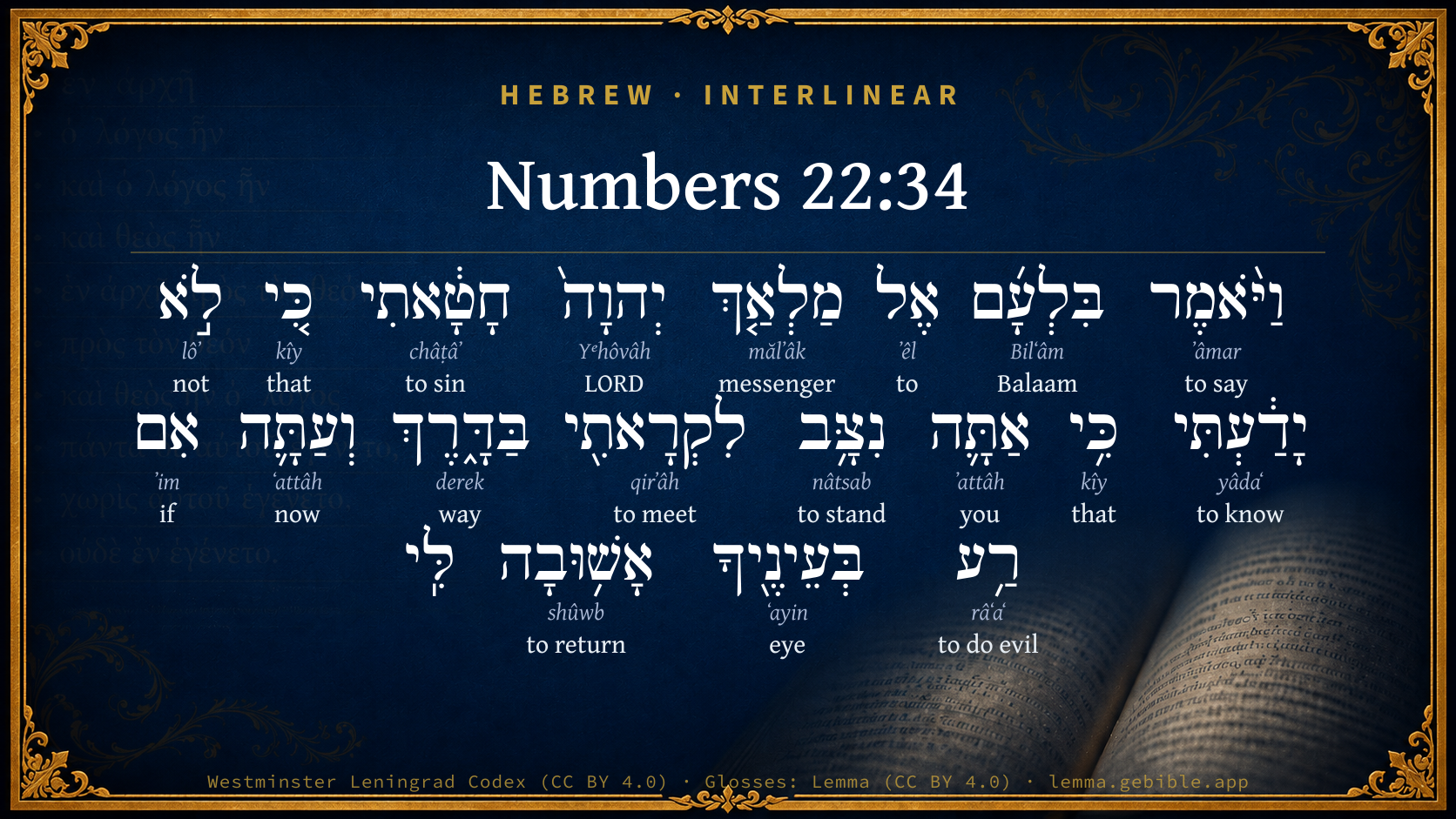
Hebrew (Westminster Leningrad Codex) Numbers 22:34 appears in the Hebrew Old Testament. The text above is from the Westminster Leningrad Codex. Each word links to its Strong’s number, a concise gloss, and parsing drawn from the Open Scriptures Hebrew Bible morphology. Click any word for its full Brown-Driver-Briggs (BDB) entry.
Download image
Cite this verse

Numbers 22:34 (World English Bible). Public Domain. Lemma interlinear Bible study tool, https://lemma.gebible.app/v/numbers/22/34.

Show BibTeX & RIS
BibTeX
RIS
English Translation
Balaam said to the angel of Yahweh, I have sinned; for I didn't know that you stood in the way against me: now therefore, if it displease you, I will get me back again.
World English Bible · Public Domain
Download a study sheet

One document with this verse’s original text, its word-by-word gloss line, the meaning frame, cross-references with their text, attributed commentary, and full source and license credits — printable, and it pastes into notes with its structure intact.

This verse Autodidact and up

Study sheet (.html) Plain text (.txt)

A passage Seminary Student

Up to 50 verses in one chapter. A passage sheet keeps up to 6 commentary sources and 12 cross-references per verse, in the order this page ranks them, and says so on the sheet whenever that leaves anything out. Ask for a single verse and you get the Autodidact verse sheet above.

Everything on this page stays free to read, with no account — the sheet is a download of what is already on screen, not access to it.

Want to remove ads? Support Godless Engineer
Compare translations 3

The same verse in 3 English versions, stacked beneath the original-language interlinear above. Click any original word for its lexicon entry.

Each is an independent rendering of the whole verse — the interlinear is not word-aligned to these translations.

Highlighted words mark where these versions differ — a whole-verse word diff, not a word-by-word alignment.

  • World English Bible Public Domain
    Balaam said to the angel of Yahweh, I have sinned; for I didn't know that you stood in the way against me: now therefore, if it displease you, I will get me back again.
  • King James Version Public Domain
    And Balaam said unto the angel of the LORD, I have sinned; for I knew not that thou stoodest in the way against me: now therefore, if it displease thee, I will get me back again.
  • unfoldingWord Literal Text CC BY-SA 4.0
    And Balaam said to the angel of Yahweh, “I have sinned, for I did not know that you stationed to meet me in the road. And now, if it is evil in your eyes, I will return for myself.”

unfoldingWord Literal Text — © unfoldingWord, licensed CC BY-SA 4.0. Word-aligned USFM3 via Door43 (git.door43.org/unfoldingWord/en_ult).

Versions to compare (up to 4)

3 of 4 selected

Show all 18 translations

Every available English version of this verse, each an independent rendering of the whole verse.

  • World English Bible Public Domain
    Balaam said to the angel of Yahweh, I have sinned; for I didn't know that you stood in the way against me: now therefore, if it displease you, I will get me back again.
  • Berean Standard Bible Public Domain
    “I have sinned,” Balaam said to the angel of the LORD, “for I did not realize that you were standing in the road to confront me. And now, if this is displeasing in your sight, I will go back home.”
  • Majority Standard Bible Public Domain
    “I have sinned,” Balaam said to the angel of the LORD, “for I did not realize that you were standing in the road to confront me. And now, if this is displeasing in your sight, I will go back home.”
  • King James Version Public Domain
    And Balaam said unto the angel of the LORD, I have sinned; for I knew not that thou stoodest in the way against me: now therefore, if it displease thee, I will get me back again.
  • American Standard Version (1901) Public Domain
    And Balaam said unto the angel of Jehovah, I have sinned; for I knew not that thou stoodest in the way against me: now therefore, if it displease thee, I will get me back again.
  • Revised Version (1885) Public Domain
    And Balaam said unto the angel of the LORD, I have sinned; for I knew not that thou stoodest in the way against me: now therefore, if it displease thee, I will get me back again.
  • Geneva Bible (1599) Public Domain
    Then Balaam saide vnto the Angel of the Lord, I haue sinned: for I wist not that thou stoodest in the way against me: now therefore if it displease thee, I will turne home againe.
  • Douay-Rheims (1899) Public Domain
    Balaam said: I have sinned, not knowing that thou didst stand against me: and now if it displease thee that I go, I will return.
  • Young's Literal Translation Public Domain
    And Balaam saith unto the messenger of Jehovah, `I have sinned, for I did not know that thou `art' standing to meet me in the way; and now, if evil in thine eyes -- I turn back by myself.'
  • Literal Standard Version CC BY-SA 4.0
    And Balaam says to the Messenger of YHWH, “I have sinned, for I did not know that You [are] standing to meet me in the way; and now, if [it is] evil in Your eyes, I turn back by myself.”
  • Unlocked Literal Bible CC BY-SA 4.0
    Balaam said to the angel of Yahweh, “I have sinned. I did not know that you stood against me in the road. So now, if it is displeasing to you, I will turn back.”
  • unfoldingWord Literal Text CC BY-SA 4.0
    And Balaam said to the angel of Yahweh, “I have sinned, for I did not know that you stationed to meet me in the road. And now, if it is evil in your eyes, I will return for myself.”
  • Darby Bible Public Domain
    And Balaam said to the Angel of Jehovah, I have sinned; for I knew not that thou stoodest in the way against me; and now, if it be evil in thine eyes, I will get me back again.
  • World Messianic Bible Public Domain
    Balaam said to the LORD’s angel, “I have sinned; for I didn’t know that you stood in the way against me. Now therefore, if it displeases you, I will go back again.”
  • Webster's Bible Public Domain
    And Balaam said to the angel of the LORD, I have sinned; for I knew not that thou stoodest in the way against me: now therefore, if it displeaseth thee, I will return again.
  • Free Bible Version CC BY-SA 4.0
    “I have sinned because I did not realize that you were standing in the road to confront me,” Balaam said to the angel of the Lord, “So if this isn't what you want, I'll go back home.”
  • Bible in Basic English Public Domain
    And Balaam said to the angel of the Lord, I have done wrong, for I did not see that you were in the way against me: but now, if it is evil in your eyes, I will go back again.
  • JPS Tanakh (1917) Public Domain
    And Balaam said unto the angel of the LORD: 'I have sinned; for I knew not that thou stoodest in the way against me; now therefore, if it displease thee, I will get me back.'

Literal Standard Version (2020), Covenant Press — licensed CC BY-SA 4.0. Text via the HelloAO Bible API (eBible.org). Unlocked Literal Bible (unfoldingWord) — licensed CC BY-SA 4.0. Text via the HelloAO Bible API (eBible.org). unfoldingWord Literal Text — © unfoldingWord, licensed CC BY-SA 4.0. Word-aligned USFM3 via Door43 (git.door43.org/unfoldingWord/en_ult). Free Bible Version, Dr. Jonathan Gallagher — licensed CC BY-SA 4.0. Text via the HelloAO Bible API (eBible.org).

Word by word

More ways to search: Search by grammar → Find every occurrence → Compare this word →

Practice this passage: Drill this verse → Learn its vocabulary →

בִּלְעָ֜ם
Bilʻâm
H1109
“Balaam”
Noun, Proper
Part of Speech
Noun
Type
Proper
Full BDB Definition

Origin: probably from H1077 and H5971

TWOT: 251b

Balaam = "not of the people" - the son of Beor, a man endowed with the gift of prophecy (noun proper masculine) - a town in Manasseh (noun proper locative)
  1. וַיֹּ֨אמֶר ʼâmar H559 “and · to say” Conjunction + Verb, Qal, Sequential Imperfect, 3rd Person, Masculine, Singular
  2. אֶל ʼêl H413 “to” Preposition
  3. מַלְאַ֤ךְ mălʼâk H4397 “messenger of” Noun, Common, Masculine, Singular, Construct
  4. יְהוָה֙ Yᵉhôvâh H3068 “LORD” Noun, Proper
  5. חָטָ֔אתִי châṭâʼ H2398 “to sin” Verb, Qal, Perfect, 1st Person, Common, Singular
  6. כִּ֚י kîy H3588 “that” Conjunction
  7. לֹ֣א lôʼ H3808 “not” Particle, Negative
  8. יָדַ֔עְתִּי yâdaʻ H3045 “to know” Verb, Qal, Perfect, 1st Person, Common, Singular
  9. כִּ֥י kîy H3588 “that” Conjunction
  10. אַתָּ֛ה ʼattâh H859 “you” Pronoun, Personal, 2nd Person, Masculine, Singular
  11. נִצָּ֥ב nâtsab H5324 “standing” Verb, Niphal, Participle Active, Masculine, Singular, Absolute
  12. לִקְרָאתִ֖י qirʼâh H7125 “to meet · me” Preposition + Verb, Qal, Infinitive Construct + Suffix, Personal, 1st Person, Common, Singular
  13. בַּדָּ֑רֶךְ derek H1870 “in/at the · way” Preposition, Determined + Noun, Common, Both, Singular, Absolute
  14. וְעַתָּ֛ה ʻattâh H6258 “and · now” Conjunction + Adverb
  15. אִם ʼim H518 “if” Conjunction
  16. רַ֥ע râʻaʻ H7489 “to do evil” Verb, Qal, Perfect, 3rd Person, Masculine, Singular
  17. בְּעֵינֶ֖יךָ ʻayin H5869 “in/at · eyes · your” Preposition + Noun, Common, Both, Dual, Construct + Suffix, Personal, 2nd Person, Masculine, Singular
  18. אָשׁ֥וּבָה shûwb H7725 “to return” Verb, Qal, Cohortative, 1st Person, Common, Singular

About this verse

These counts appear in no published source. They are computed here, from the morphology-tagged text and Lemma’s own curated glosses. What Lemma adds →

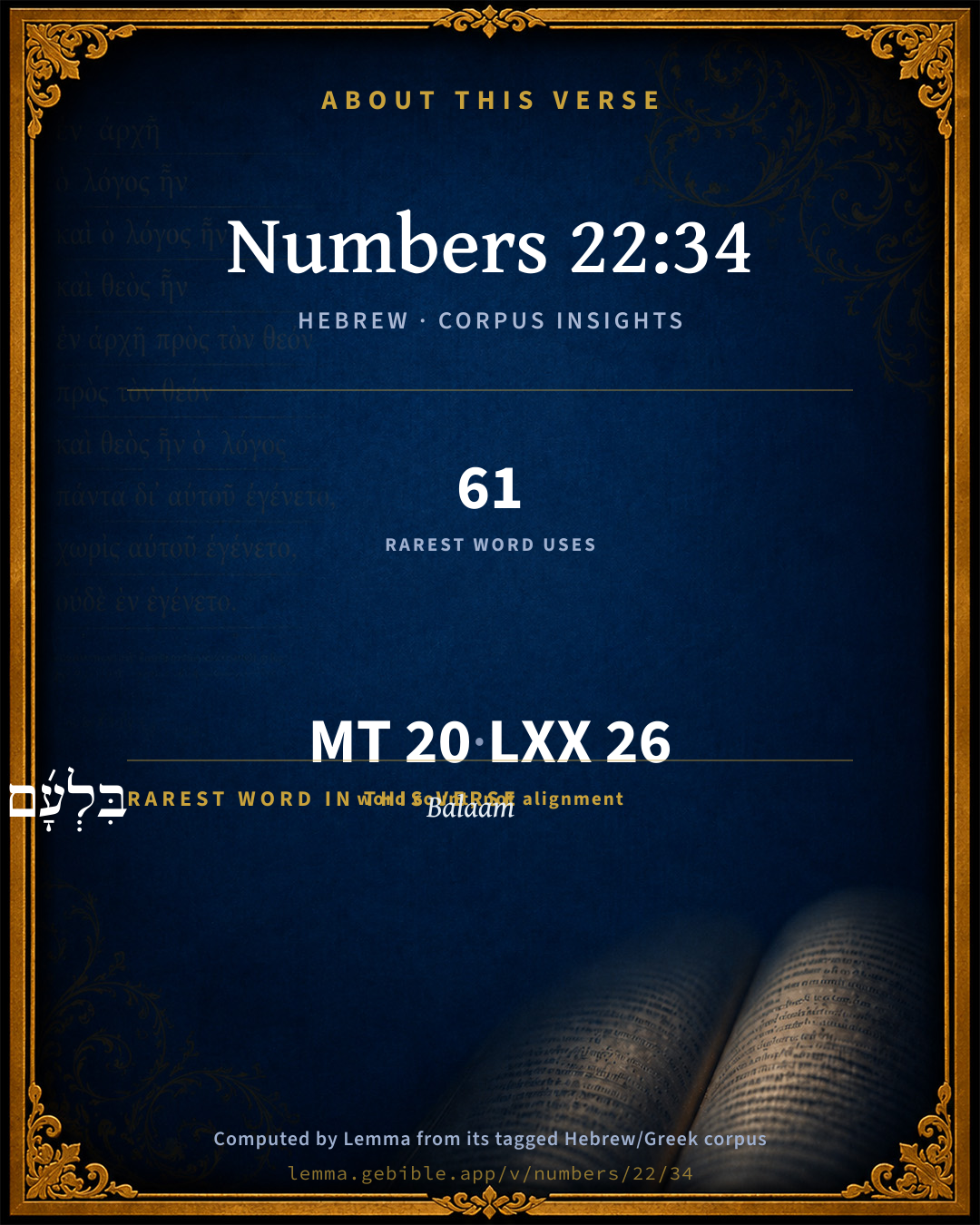
20
words
18
distinct lemmas
Pentateuch
section

Grammatical profile

  • 7 verbs
  • 5 nouns
  • 1 pronoun
  • 2 prepositions
  • 3 conjunctions
  • 1 adverb
  • 1 particle

Verb forms

  • וַיֹּ֨אמֶר Qal · Sequential Imperfect
  • חָטָ֔אתִי Qal · Perfect
  • יָדַ֔עְתִּי Qal · Perfect
  • נִצָּ֥ב Niphal · Participle Active
  • לִקְרָאתִ֖י Qal · Infinitive Construct
  • רַ֥ע Qal · Perfect
  • אָשׁ֥וּבָה Qal · Cohortative

Repetition

A word recurs within this verse — often emphatic in Hebrew:

  • כִּ֚י that H3588 ×2

Hebrew & Septuagint length

In English translation the verse runs 34 words from the Hebrew and 46 from the Septuagint (LXX English) — closely comparable.

A rough comparison of the two English renderings, which tokenize alike — not a word-level alignment.

Word counts can differ between the Hebrew and the Greek without any difference in meaning — e.g. the Hebrew direct-object marker אֵת has no separate Greek word, and Greek often adds the article ὁ.

In the original languages it is 20 Hebrew tokens and 26 Greek tokens — but the two are counted differently (Hebrew bundles its prefixes and suffixes into one token; the Greek is in lemma form), so that isn’t a like-for-like length.

Cross-references

15

Topical passages linked to Numbers 22:34 in the Treasury of Scripture Knowledge — connected by theme and wording, ordered by reader-vote popularity; previews shown in the World English Bible.

  • 1 Samuel 15:24 Saul said to Samuel, I have sinned; for I have transgressed the commandment of Yahweh, and your words, because I feared the people, and obeyed their voice.
  • Job 34:31–32 "For has any said to God, 'I am guilty, but I will not offend any more.
  • 2 Samuel 12:13 David said to Nathan, "I have sinned against Yahweh." Nathan said to David, "Yahweh also has put away your sin. You will not die.
  • 1 Samuel 15:30 Then he said, I have sinned: yet honor me now, Please, before the elders of my people, and before Israel, and turn again with me, that I may worship Yahweh your God.
  • 1 Samuel 26:21 Then said Saul, I have sinned: return, my son David; for I will no more do you harm, because my life was precious in your eyes this day: behold, I have played the fool, and have erred exceedingly.
  • Exodus 9:27 Pharaoh sent, and called for Moses and Aaron, and said to them, "I have sinned this time. Yahweh is righteous, and I and my people are wicked.
  • Exodus 10:16–17 Then Pharaoh called for Moses and Aaron in haste, and he said, "I have sinned against Yahweh your God, and against you.
  • Numbers 11:1 The people were as murmurers, [speaking] evil in the ears of Yahweh: and when Yahweh heard it, his anger was kindled; and the fire of Yahweh burnt among them, and devoured in the uttermost part of the camp.
  • Numbers 14:40 They rose up early in the morning, and got them up to the top of the mountain, saying, Behold, we are here, and will go up to the place which Yahweh has promised: for we have sinned.
  • Numbers 22:12 God said to Balaam, You shall not go with them; you shall not curse the people; for they are blessed.
  • 1 Samuel 24:17 He said to David, You are more righteous than I; for you have rendered to me good, whereas I have rendered to you evil.
  • 1 Chronicles 21:7 God was displeased with this thing; therefore he struck Israel.
  • Psalms 78:34 When he killed them, then they inquired after him. They returned and sought God earnestly.
  • Proverbs 24:18 Lest Yahweh see it, and it displease him, And he turn away his wrath from him.
  • Matthew 27:4–5 saying, "I have sinned in that I betrayed innocent blood." But they said, "What is that to us? You see to it."

Cross-references courtesy of OpenBible.info (CC BY 4.0).

Hebrew and Greek witnesses Masoretic Hebrew ↔ Greek Septuagint

The same verse in the two great witnesses to the Old Testament, shown verse-for-verse.

These are two independent witnesses, not word-aligned to each other, and the Septuagint is shown in lemma (dictionary) form.

Hebrew Numbers 22:34 Masoretic · Westminster Leningrad Codex

וַיֹּ֨אמֶר בִּלְעָ֜ם אֶל מַלְאַ֤ךְ יְהוָה֙ חָטָ֔אתִי כִּ֚י לֹ֣א יָדַ֔עְתִּי כִּ֥י אַתָּ֛ה נִצָּ֥ב לִקְרָאתִ֖י בַּדָּ֑רֶךְ וְעַתָּ֛ה אִם רַ֥ע בְּעֵינֶ֖יךָ אָשׁ֥וּבָה לִּֽי

Balaam said to the angel of Yahweh, I have sinned; for I didn't know that you stood in the way against me: now therefore, if it displease you, I will get me back again.

World English Bible · Public Domain

Greek LXX Numbers 22:34 Septuagint · lemma form

καί εἶπον βαλααμ ὁ ἄγγελος κύριος ἁμαρτάνω οὐ γάρ ἐπίσταμαι ὅτι σύ ἐγώ ἀντιἵστημι ἐν ὁ ὁδός εἰς συνάντησις καί νῦν εἰ μή σύ ἀρέσκω ἀποστρέφω

And Balaam said to the angel of the Lord, I have sinned, for I did not know that you were standing opposite in the way to meet me; and now if it shall not be pleasing to you for me to go on, I will return.

LXX2012 (modern English Septuagint) · Public Domain

Hebrew: Westminster Leningrad Codex (CC BY 4.0). Greek: Septuagint (public domain); English from LXX2012 (modern English Septuagint) (Public Domain). How the Septuagint differs from the Hebrew →

Targum (Aramaic paraphrase)

2

The Targum is the ancient Jewish Aramaic paraphrase of the Hebrew Scriptures — an interpretive translation, not the Hebrew text itself. Onkelos (literal) and Pseudo-Jonathan (expansive) render the Torah, and Jonathan the Prophets. Coverage is partial: where no permissively-licensed English translation exists for a verse, only the Aramaic is shown. This is verse-level text, not a word-by-word alignment to the Hebrew.

  1. Targum Onkelos Torah (Genesis–Deuteronomy)
    וַאֲמַר בִּלְעָם לְמַלְאָכָא דַיְיָ חָבִית אֲרֵי לָא יְדָעִית אֲרֵי אַתְּ מְעַתֵּד לָקֳדָמוּתִי בְּאָרְחָא וּכְעַן אִם בִּישׁ בְּעֵינָךְ אֵיתוּב לִי

    (no public-domain English translation for this verse)

    Targum Onkelos — Aramaic: “Onkelos Genesis” (public domain); “Onkelos Exodus” (public domain); “Onkelos Leviticus” (public domain); “Onkelos Numbers” (public domain); “Onkelos Deuteronomy” (public domain). English: “Sefaria Community Translation” (CC0 1.0 (public-domain dedication)); “J.W. Etheridge. The Targums of Onkelos and Jonathan Ben Uzziel on the Pentateuch. London: Longmans, Green, 1862” (public domain). Text via Sefaria.

  2. Targum Pseudo-Jonathan Torah (Genesis–Deuteronomy)
    וַאֲמַר בִּלְעָם לְמַלְאָכָא דַיְיָ חָבִית אֲרוּם לָא יְדָעִית אֲרוּם אַנְתְּ מְעַתַּד לִקְדָמוּתִי בְּאָרְחָא וּכְדוֹן אִין בִּישׁ קֳדָמָךְ אִיתוּב לִי

    And Bileam said to the angel of the Lord, I have sinned, because I knew not that thou wast standing against me in the way. But now, if it displease thee, I will go back.

    Targum Pseudo-Jonathan — Aramaic: “Targum Jonathan on Genesis” (public domain); “Targum Jonathan on Exodus” (public domain); “Targum Jonathan on Leviticus” (public domain); “Targum Jonathan on Numbers” (public domain); “Targum Jonathan on Deuteronomy” (public domain). English: “The Targum of Jonathan ben Uzziel, trans. J. W. Etheridge, London, 1862” (public domain). Text via Sefaria.

Commentary

Notes on Numbers 22:34 from classic Christian and Jewish commentators (each source and its license shown beneath its notes). The classic Christian expositions comment on the surrounding passage and are grouped to its opening verse, so a note may address several verses; the Jewish commentaries on the Tanakh (Rashi and others) are per-verse, so they appear only where the commentator wrote on this verse.

Lemma curates 59 commentaries, every one of them public domain or Creative Commons licensed, each selected and text-cleaned for this edition rather than reprinted as found. About our sources →

Joseph Benson's Commentary

Num 22:34. I have sinned — He confesses his passion and thoughtlessness in his ill treatment of the ass, and excuses himself for so wilfully persisting in his journey, from his ignorance of the angel’s standing in the way to oppose him; but he makes no confession of his covetousness, which was the dishonest principle that influenced him in all his steps.

Joseph Benson's Commentary on the Old and New Testaments (1811–1818) — public domain. Text from a community e-Sword module.

Tyndale Open Study Notes

Tyndale Open Resources

22:34 I have sinned: Balaam admitted his mistake in not perceiving the angel of the Lord or his intention and offered to go back.

Tyndale Open Study Notes — © Tyndale Open Resources, licensed CC BY-SA 4.0. Text via the HelloAO Bible API.

Geneva Bible (1599)

Geneva Bible translators

Or, before me, or to meet me.

Hebrew, I will return to me.

Geneva Bible (1599) marginal notes — public domain. Text via Bolls.life.

Jamieson, Fausset & Brown

Robert Jamieson, A. R. Fausset & David Brown

I have sinned . . . if it displease thee, I will get me back again--Notwithstanding this confession, he evinced no spirit of penitence, as he speaks of desisting only from the outward act. The words "go with the men" was a mere withdrawal of further restraint, but the terms in which leave was given are more absolute and peremptory than those in Num 22:20.

Jamieson, Fausset & Brown — Commentary Critical and Explanatory on the Whole Bible (1871) — public domain (CC PDM 1.0). Text via the HelloAO Bible API.

Adam Clarke's Commentary

Verse 34. If it displease thee, I will get me back again.] Here is a proof, that though he loved the wages of unrighteousness, yet he still feared God; and he is now willing to drop the enterprise if God be displeased with his proceeding. The piety of many called Christians does not extend thus far; they see that the thing displeases God, and yet they proceed. Reader, is this thy case?

Adam Clarke's Commentary on the Bible (1810–1826) — public domain. Text from a community e-Sword/MySword module.

John Gill's Exposition

And Balak said unto Balaam,.... Upon their meeting together:

did I not earnestly send unto thee to call thee? or "in sending send" (u); the first messengers in a very pressing manner, with great importunity, to give thee an invitation to come to me, and those men of rank and quality, with rewards of divination in their hands, and yet the invitation was rejected; and after them other messengers, more in number and greater in dignity, with larger offers and promises; and now indeed thou art come, but with much ado, what is the meaning of all this?

wherefore camest thou not unto me? at first, without showing so much indifference and reluctance, and which obliged me to send another message to thee:

am I not able to promote thee to honour? to give thee wealth and riches, and put thee into high places of honour and profit? hadst thou any doubt in thy mind about it, either concerning my ability or will to do it?

(u) "mittendo misi", Pagninus, Montanus.

John Gill's Exposition of the Whole Bible (1746–1763) — public domain (CC PDM 1.0). Text via the HelloAO Bible API.

Matthew Poole's English Annotations

A frivolous supposition; for it was apparently displeasing to God, who had now said that his way was perverse, and had therefore opposed him and sought to slay him: but hereby he shows how loth he was to go back and lose the hopes he had conceived; and besides he speaks of desisting from the outward action, but shows no sense of the plague of his heart, his vile affections, which were the root of this ill-designed journey.

Matthew Poole's English Annotations on the Holy Bible (1683–1685) — public domain. Text from a community e-Sword/MySword module.

Whedon's Commentary on the Bible

Daniel D. Whedon

34. I have sinned — An instance of a superficial repentance which confesses to sinful acts and still clings to wrong principles and cherishes evil purposes. The heart of Balaam was still swayed by covetousness.

If it displease thee — He still dwells upon outward acts, overlooking the motive in which the guilt or innocence of an act lies. The going had been permitted, the cursing had been forbidden. Balaam goes with the intention of cursing. Of this wicked intent there is no sign of repentance.

Daniel D. Whedon (gen. ed.), Commentary on the Old and New Testaments (1874–1909) — public domain. Text from a community e-Sword module.

Scofield Reference Notes

C. I. Scofield

angel

(See Scofield "Heb 1:4")

The Scofield Reference Bible (1917 edition), notes by C. I. Scofield — public domain. Text from a community e-Sword module.

unfoldingWord translationNotes

Door43 World Missions Community

So now, if it is displeasing to you

"So if you do not want me to continue going"

with the leaders of Balak

"with the leaders whom Balak had sent." See how you translated "Balak" in Numbers 22:2.

translationWords

sin

unfoldingWord translationNotes — © Distant Shores Media and the Door43 World Missions Community, licensed CC BY-SA 4.0. Source: git.door43.org/Door43/en_tn.

Rashi

Rabbi Shlomo Yitzchaki (Rashi)

כי לא ידעתי FOR I KNEW NOT — This statement, too, (cf. v. 29), was a disgrace for him, for in spite of himself he had to admit it — because he used to boast that he knew the will of of the Most High (24:16) and now his own mouth bore testimony: “I knew not” (Midrash Tanchuma, Balak 10).

אם רע בעיניך אשובה לי IF IT BE EVIL IN THINE EYES, I WILL RETURN — To set himself in opposition to the Omnipresent was the purpose of this reply. He said, in effect, “He Himself commanded me to go, and you, angel, annul His words. He is accustomed to this — that He says something and an angel recalls it. He said to Abraham, (Genesis 22:2) Take now thy son, etc.’ and by an angel annulled His words. I, too: "If it be evil in thine eyes, then I must return” (Midrash Tanchuma, Balak 10).

Rashi on the Tanakh — English translations: “The Judaica Press complete Tanach with Rashi, translated by A. J. Rosenberg” (CC BY 4.0); “Pentateuch with Rashi's commentary by M. Rosenbaum and A.M. Silbermann, 1929-1934” (public domain); “The Metsudah Tanach series, Lakewood, N.J” (CC BY 4.0); and “The Book of Joshua, Metsudah Publications, 1997” (CC BY 4.0). Text via Sefaria.

Lesson kit

Teaching starters — assembled from the data on this page, not authored interpretation. Every prompt links to the verse data it draws on. Edit before teaching.

Numbers, in the Pentateuch, opens this verse with 20 words (18 distinct Hebrew lemmas). Its most distinctive word is Bilʻâm (“Balaam”). A historical commentator’s framing appears above. Read the whole chapter for the surrounding context.

Discussion questions

  1. What does “Balaam” (Bilʻâm) contribute to the verse as a whole?
  2. How does 1 Samuel 15:24, which shares this passage’s theme, read alongside this verse?
  3. What does the repetition of “that” (2× in this one verse) do in this verse?
  4. The translations on this page render this verse differently — a whole-verse word diff, not a word-by-word alignment. What might account for the different wordings?
  5. «וַיֹּ֨אמֶר» is a Qal Sequential Imperfect verb. How does that grammatical form shape the action described?
  6. Compare how Joseph Benson's Commentary and Tyndale Open Study Notes read this verse. Where do they agree or differ?

Things to notice

Reading settings

Reading text

Shown beneath each verse's original-language words.

Old Testament
Old Testament edition

Read the OT as the Masoretic Hebrew (MT) or the Greek Septuagint (LXX).

English shown for the Greek Septuagint (in the Hebrew ↔ Greek comparison).

Comparing translations? Open the Compare panel on any verse page to stack up to four side by side.