
Leviticus 5:17

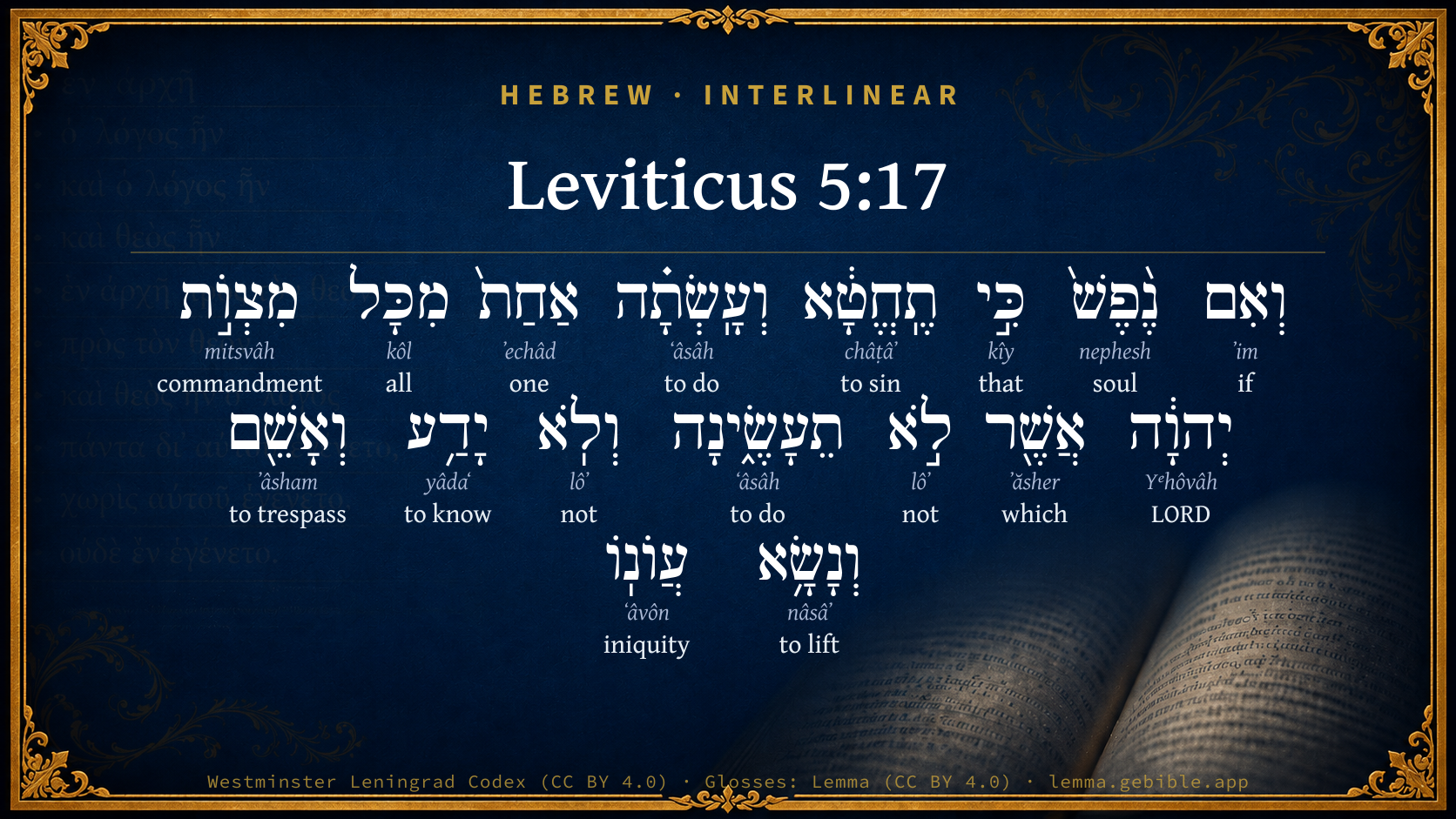
Hebrew (Westminster Leningrad Codex) Leviticus 5:17 appears in the Hebrew Old Testament. The text above is from the Westminster Leningrad Codex. Each word links to its Strong’s number, a concise gloss, and parsing drawn from the Open Scriptures Hebrew Bible morphology. Click any word for its full Brown-Driver-Briggs (BDB) entry.
Download image
Cite this verse

Leviticus 5:17 (World English Bible). Public Domain. Lemma interlinear Bible study tool, https://lemma.gebible.app/v/leviticus/5/17.

Show BibTeX & RIS
BibTeX
RIS
English Translation
"If anyone sins, and does any of the things which Yahweh has commanded not to be done; though he didn't know it, yet he is guilty, and shall bear his iniquity.
World English Bible · Public Domain
Download a study sheet

One document with this verse’s original text, its word-by-word gloss line, the meaning frame, cross-references with their text, attributed commentary, and full source and license credits — printable, and it pastes into notes with its structure intact.

This verse Autodidact and up

Study sheet (.html) Plain text (.txt)

A passage Seminary Student

Up to 50 verses in one chapter. A passage sheet keeps up to 6 commentary sources and 12 cross-references per verse, in the order this page ranks them, and says so on the sheet whenever that leaves anything out. Ask for a single verse and you get the Autodidact verse sheet above.

Everything on this page stays free to read, with no account — the sheet is a download of what is already on screen, not access to it.

Want to remove ads? Support Godless Engineer
Compare translations 3

The same verse in 3 English versions, stacked beneath the original-language interlinear above. Click any original word for its lexicon entry.

Each is an independent rendering of the whole verse — the interlinear is not word-aligned to these translations.

Highlighted words mark where these versions differ — a whole-verse word diff, not a word-by-word alignment.

  • World English Bible Public Domain
    "If anyone sins, and does any of the things which Yahweh has commanded not to be done; though he didn't know it, yet he is guilty, and shall bear his iniquity.
  • King James Version Public Domain
    And if a soul sin, and commit any of these things which are forbidden to be done by the commandments of the LORD; though he wist it not, yet is he guilty, and shall bear his iniquity.
  • unfoldingWord Literal Text CC BY-SA 4.0
    And if a person, when he sins and he does one from all the commands of Yahweh which shall not be done, but he does not know, then he becomes guilty, and he shall bear his iniquity.

unfoldingWord Literal Text — © unfoldingWord, licensed CC BY-SA 4.0. Word-aligned USFM3 via Door43 (git.door43.org/unfoldingWord/en_ult).

Versions to compare (up to 4)

3 of 4 selected

Show all 18 translations

Every available English version of this verse, each an independent rendering of the whole verse.

  • World English Bible Public Domain
    "If anyone sins, and does any of the things which Yahweh has commanded not to be done; though he didn't know it, yet he is guilty, and shall bear his iniquity.
  • Berean Standard Bible Public Domain
    If someone sins and violates any of the LORD’s commandments even though he was unaware, he is guilty and shall bear his punishment.
  • Majority Standard Bible Public Domain
    If someone sins and violates any of the LORD’s commandments even though he was unaware, he is guilty and shall bear his punishment.
  • King James Version Public Domain
    And if a soul sin, and commit any of these things which are forbidden to be done by the commandments of the LORD; though he wist it not, yet is he guilty, and shall bear his iniquity.
  • American Standard Version (1901) Public Domain
    And if any one sin, and do any of the things which Jehovah hath commanded not to be done; though he knew it not, yet is he guilty, and shall bear his iniquity.
  • Revised Version (1885) Public Domain
    And if any one sin, and do any of the things which the LORD hath commanded not to be done; though he knew it not, yet is he guilty, and shall bear his iniquity.
  • Geneva Bible (1599) Public Domain
    Also if any sinne and doe against any of the commandements of the Lord, which ought not to be done, and knowe not and sinne and beare his iniquitie,
  • Douay-Rheims (1899) Public Domain
    If any one sin through ignorance, and do one of those things which by the law of the Lord are forbidden, and being guilty of sin, understand his iniquity,
  • Young's Literal Translation Public Domain
    `And when any person sinneth, and hath done `something against' one of all the commands of Jehovah `regarding things' which are not to be done, and hath not known, and he hath been guilty, and hath borne his iniquity,
  • Literal Standard Version CC BY-SA 4.0
    And when any person sins, and has done [something against] one of all the commands of YHWH [regarding things] which are not to be done, and has not known, then he has been guilty, and has borne his iniquity.
  • Unlocked Literal Bible CC BY-SA 4.0
    If anyone sins and does anything that Yahweh has commanded not to be done, even if he was unaware of it, he is still guilty and must carry his own guilt.
  • unfoldingWord Literal Text CC BY-SA 4.0
    And if a person, when he sins and he does one from all the commands of Yahweh which shall not be done, but he does not know, then he becomes guilty, and he shall bear his iniquity.
  • Darby Bible Public Domain
    And if any one sin and do against any of all the commandments of Jehovah what should not be done, and hath not known [it], yet is he guilty, and shall bear his iniquity.
  • World Messianic Bible Public Domain
    “If anyone sins, doing any of the things which the LORD has commanded not to be done, though he didn’t know it, he is still guilty, and shall bear his iniquity.
  • Webster's Bible Public Domain
    And if a soul shall sin, and commit any of these things which are forbidden to be done by the commandments of the LORD; though he knew it not, yet is he guilty, and shall bear his iniquity.
  • Free Bible Version CC BY-SA 4.0
    If you sin and break any of the Lord's commandments, even if you are unaware of it, you are still guilty and bear responsibility for your guilt.
  • Bible in Basic English Public Domain
    And if anyone does wrong, and does any of the things which the Lord has given orders are not to be done, though he has no knowledge of it, still he is in the wrong and he is responsible.
  • JPS Tanakh (1917) Public Domain
    And if any one sin, and do any of the things which the LORD hath commanded not to be done, though he know it not, yet is he guilty, and shall bear his iniquity.

Literal Standard Version (2020), Covenant Press — licensed CC BY-SA 4.0. Text via the HelloAO Bible API (eBible.org). Unlocked Literal Bible (unfoldingWord) — licensed CC BY-SA 4.0. Text via the HelloAO Bible API (eBible.org). unfoldingWord Literal Text — © unfoldingWord, licensed CC BY-SA 4.0. Word-aligned USFM3 via Door43 (git.door43.org/unfoldingWord/en_ult). Free Bible Version, Dr. Jonathan Gallagher — licensed CC BY-SA 4.0. Text via the HelloAO Bible API (eBible.org).

Word by word

More ways to search: Search by grammar → Find every occurrence → Compare this word →

Practice this passage: Drill this verse → Learn its vocabulary →

וְאָשֵׁ֖ם
ʼâsham
H816
“and · to trespass”
Conjunction + Verb, Qal, Sequential Perfect, 3rd Person, Masculine, Singular
Part of Speech
Conjunction + Verb
Stem
Qal
Form
Sequential Perfect
Person
3rd Person
Gender
Masculine
Number
Singular
Full BDB Definition

Origin: a primitive root

TWOT: 180

to offend, be guilty, trespass - (Qal) - to do wrong, offend, trespass, commit an offense, do injury - to be or become guilty - to be held guilty - to be incriminated - (Niphal) to suffer punishment - (Hiphil) to declare guilty - (TWOT) to be desolate, acknowledge offense
  1. וְאִם ʼim H518 “and · if” Conjunction + Conjunction
  2. נֶ֨פֶשׁ֙ nephesh H5315 “soul” Noun, Common, Both, Singular, Absolute
  3. כִּ֣י kîy H3588 “that” Conjunction
  4. תֶֽחֱטָ֔א châṭâʼ H2398 “to sin” Verb, Qal, Imperfect, 3rd Person, Feminine, Singular
  5. וְעָֽשְׂתָ֗ה ʻâsâh H6213 “and · to do” Conjunction + Verb, Qal, Sequential Perfect, 3rd Person, Feminine, Singular
  6. אַחַת֙ ʼechâd H259 “one” Adjective, Cardinal number, Feminine, Singular, Absolute
  7. מִכָּל kôl H3605 “from · all of” Preposition + Noun, Common, Masculine, Singular, Construct
  8. מִצְוֺ֣ת mitsvâh H4687 “commandments of” Noun, Common, Feminine, Plural, Construct
  9. יְהוָ֔ה Yᵉhôvâh H3068 “LORD” Noun, Proper
  10. אֲשֶׁ֖ר ʼăsher H834 “which” Particle, Relative
  11. לֹ֣א lôʼ H3808 “not” Particle, Negative
  12. תֵעָשֶׂ֑ינָה ʻâsâh H6213 “to do” Verb, Niphal, Imperfect, 3rd Person, Feminine, Plural
  13. וְלֹֽא lôʼ H3808 “and · not” Conjunction + Particle, Negative
  14. יָדַ֥ע yâdaʻ H3045 “to know” Verb, Qal, Perfect, 3rd Person, Masculine, Singular
  15. וְנָשָׂ֥א nâsâʼ H5375 “and · to lift” Conjunction + Verb, Qal, Sequential Perfect, 3rd Person, Masculine, Singular
  16. עֲוֺנֽוֹ ʻâvôn H5771 “iniquity · his” Noun, Common, Both, Singular, Construct + Suffix, Personal, 3rd Person, Masculine, Singular

About this verse

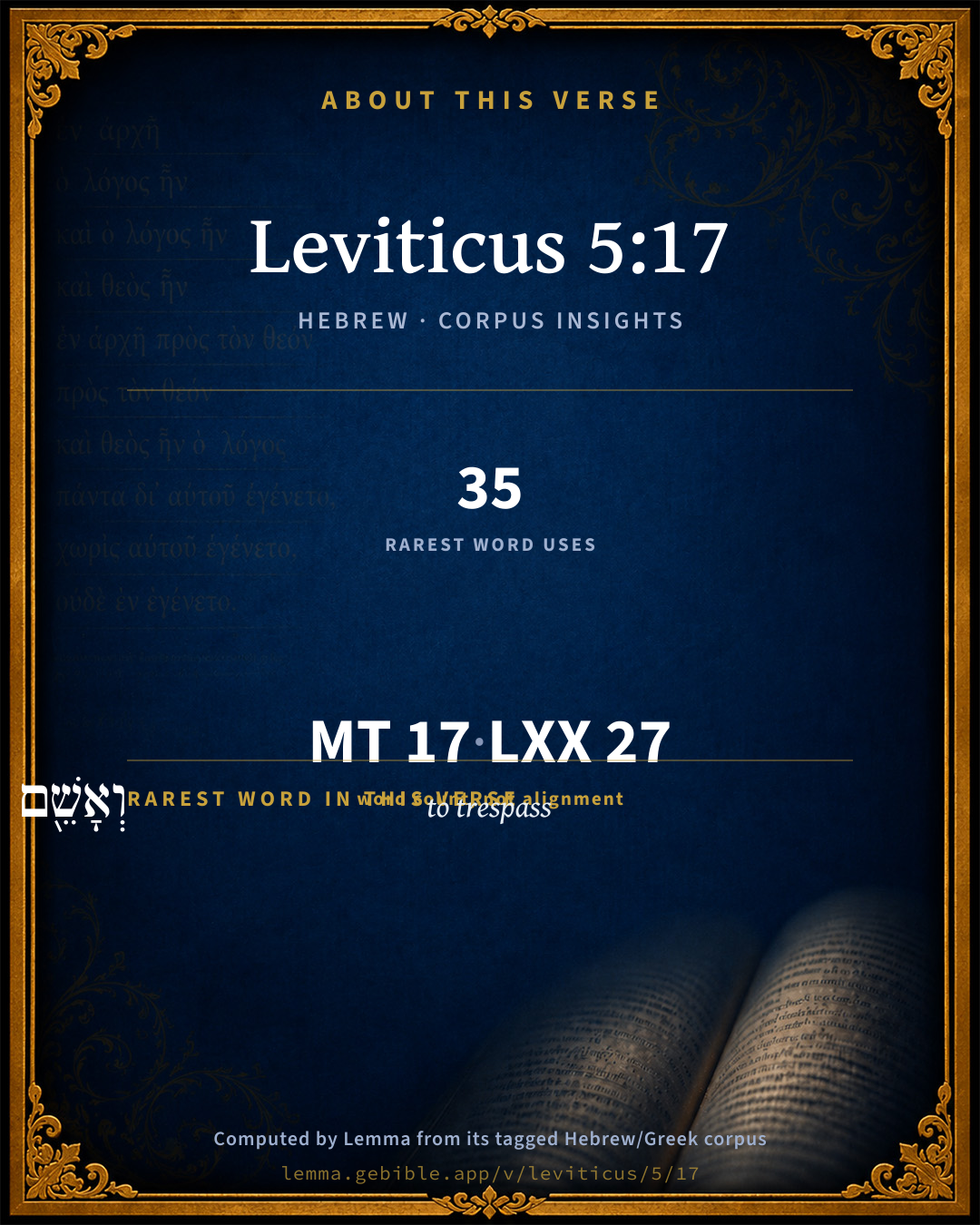
These counts appear in no published source. They are computed here, from the morphology-tagged text and Lemma’s own curated glosses. What Lemma adds →

17
words
15
distinct lemmas
Pentateuch
section

Shared distinctive vocabulary

וְאָשֵׁ֖ם to trespass H816 occurs in 32 verses of the Hebrew Bible. Also found in:

Grammatical profile

  • 6 verbs
  • 5 nouns
  • 1 adjective
  • 2 conjunctions
  • 3 particles

Verb forms

  • תֶֽחֱטָ֔א Qal · Imperfect
  • וְעָֽשְׂתָ֗ה Qal · Sequential Perfect
  • תֵעָשֶׂ֑ינָה Niphal · Imperfect
  • יָדַ֥ע Qal · Perfect
  • וְאָשֵׁ֖ם Qal · Sequential Perfect
  • וְנָשָׂ֥א Qal · Sequential Perfect

Repetition

Words recur within this verse — often emphatic in Hebrew:

  • וְעָֽשְׂתָ֗ה to do H6213 ×2
  • לֹ֣א not H3808 ×2

Hebrew & Septuagint length

In English translation the verse runs 31 words from the Hebrew and 39 from the Septuagint (LXX English) — closely comparable.

A rough comparison of the two English renderings, which tokenize alike — not a word-level alignment.

Word counts can differ between the Hebrew and the Greek without any difference in meaning — e.g. the Hebrew direct-object marker אֵת has no separate Greek word, and Greek often adds the article ὁ.

In the original languages it is 17 Hebrew tokens and 27 Greek tokens — but the two are counted differently (Hebrew bundles its prefixes and suffixes into one token; the Greek is in lemma form), so that isn’t a like-for-like length.

Cross-references

8

Topical passages linked to Leviticus 5:17 in the Treasury of Scripture Knowledge — connected by theme and wording, ordered by reader-vote popularity; previews shown in the World English Bible.

  • Leviticus 4:27 "'If anyone of the common people sins unwittingly, in doing any of the things which Yahweh has commanded not to be done, and is guilty;
  • Leviticus 4:13 "'If the whole congregation of Israel sins, and the thing is hidden from the eyes of the assembly, and they have done any of the things which Yahweh has commanded not to be done, and are guilty;
  • Leviticus 4:2–4 "Speak to the children of Israel, saying, 'If anyone sins unintentionally, in any of the things which Yahweh has commanded not to be done, and does any one of them:
  • Psalms 19:12 Who can discern his errors? Forgive me from hidden errors.
  • Leviticus 4:22 "'When a ruler sins, and unwittingly does any one of all the things which Yahweh his God has commanded not to be done, and is guilty;
  • Leviticus 5:15 "If anyone commits a trespass, and sins unwittingly, in the holy things of Yahweh; then he shall bring his trespass offering to Yahweh, a ram without blemish from the flock, according to your estimation in silver by shekels, after the shekel of the sanctuary, for a trespass offering.
  • Leviticus 5:1–2 "'If anyone sins, in that he hears the voice of adjuration, he being a witness, whether he has seen or known, if he doesn't report it, then he shall bear his iniquity.
  • Luke 12:48 but he who didn't know, and did things worthy of stripes, will be beaten with few stripes. To whoever much is given, of him will much be required; and to whom much was entrusted, of him more will be asked.

Cross-references courtesy of OpenBible.info (CC BY 4.0).

Hebrew and Greek witnesses Masoretic Hebrew ↔ Greek Septuagint

The same verse in the two great witnesses to the Old Testament, shown verse-for-verse.

These are two independent witnesses, not word-aligned to each other, and the Septuagint is shown in lemma (dictionary) form.

Hebrew Leviticus 5:17 Masoretic · Westminster Leningrad Codex

וְאִם נֶ֨פֶשׁ֙ כִּ֣י תֶֽחֱטָ֔א וְעָֽשְׂתָ֗ה אַחַת֙ מִכָּל מִצְוֺ֣ת יְהוָ֔ה אֲשֶׁ֖ר לֹ֣א תֵעָשֶׂ֑ינָה וְלֹֽא יָדַ֥ע וְאָשֵׁ֖ם וְנָשָׂ֥א עֲוֺנֽוֹ

"If anyone sins, and does any of the things which Yahweh has commanded not to be done; though he didn't know it, yet he is guilty, and shall bear his iniquity.

World English Bible · Public Domain

Greek LXX Leviticus 5:17 Septuagint · lemma form

καί ὁ ψυχή ὅς ἄν ἁμαρτάνω καί ποιέω εἷς ἀπό πᾶς ὁ ἐντολή κύριος ὅς οὐ δέω ποιέω καί οὐ γιγνώσκω καί πλημμηλέω καί λαμβάνω ὁ ἁμαρτία

And the soul which shall sin, and do one thing against any of the commandments of the Lord, which it is not right to do, and has not known it, and shall have transgressed, and shall have contracted guilt,

LXX2012 (modern English Septuagint) · Public Domain

On this verse, Haydock's Catholic Bible Commentary discusses the Septuagint’s reading. Read the note in Commentary ↓

Hebrew: Westminster Leningrad Codex (CC BY 4.0). Greek: Septuagint (public domain); English from LXX2012 (modern English Septuagint) (Public Domain). How the Septuagint differs from the Hebrew →

Targum (Aramaic paraphrase)

2

The Targum is the ancient Jewish Aramaic paraphrase of the Hebrew Scriptures — an interpretive translation, not the Hebrew text itself. Onkelos (literal) and Pseudo-Jonathan (expansive) render the Torah, and Jonathan the Prophets. Coverage is partial: where no permissively-licensed English translation exists for a verse, only the Aramaic is shown. This is verse-level text, not a word-by-word alignment to the Hebrew.

  1. Targum Onkelos Torah (Genesis–Deuteronomy)
    וְאִם אֱנַשׁ אֲרֵי יֵחוֹב וְיַעְבֵּד חֲדָא מִכָּל פִּקוּדַיָא דַיְיָ דִי לָא כָשְׁרִין לְאִתְעֲבָדָא וְלָא יָדַע וְיֵחוֹב וִיקַבֵּל חוֹבֵהּ

    (no public-domain English translation for this verse)

    Targum Onkelos — Aramaic: “Onkelos Genesis” (public domain); “Onkelos Exodus” (public domain); “Onkelos Leviticus” (public domain); “Onkelos Numbers” (public domain); “Onkelos Deuteronomy” (public domain). English: “Sefaria Community Translation” (CC0 1.0 (public-domain dedication)); “J.W. Etheridge. The Targums of Onkelos and Jonathan Ben Uzziel on the Pentateuch. London: Longmans, Green, 1862” (public domain). Text via Sefaria.

  2. Targum Pseudo-Jonathan Torah (Genesis–Deuteronomy)
    וְאִין בַּר נַשׁ אֲרוּם יֵיחוּב וְיַעֲבֵד חֲדָא מִכָּל פִּקוּדַיָיא דַיְיָ דְלָא כַשְׁרִין לְאִתְעוֹבָדָא וְלָא יְדַע וְאִתְחַיֵיב וִיקַבֵּל חוֹבֵיהּ

    If a man sin, and do against any one of all the commandments of the Lord that which is not right to do, though he knew it not, he hath sinned, and shall bear his guilt;

    Targum Pseudo-Jonathan — Aramaic: “Targum Jonathan on Genesis” (public domain); “Targum Jonathan on Exodus” (public domain); “Targum Jonathan on Leviticus” (public domain); “Targum Jonathan on Numbers” (public domain); “Targum Jonathan on Deuteronomy” (public domain). English: “The Targum of Jonathan ben Uzziel, trans. J. W. Etheridge, London, 1862” (public domain). Text via Sefaria.

Commentary

Notes on Leviticus 5:17 from classic Christian and Jewish commentators (each source and its license shown beneath its notes). The classic Christian expositions comment on the surrounding passage and are grouped to its opening verse, so a note may address several verses; the Jewish commentaries on the Tanakh (Rashi and others) are per-verse, so they appear only where the commentator wrote on this verse.

Lemma curates 59 commentaries, every one of them public domain or Creative Commons licensed, each selected and text-cleaned for this edition rather than reprinted as found. About our sources →

Ellicott's Commentary for English Readers

(17) And if a soul sin.—To guard the Israelites most effectually against making profane use of anything dedicated to the sanctuary and its service, it is here further enacted in Lev_5:17-19, that a trespass offering is to be brought when a man only suspects that he had used things which belonged to the Lord, though he can no longer remember what particular holy property it was, which he used for his own purpose. In the canonical exposition, which obtained during the second Temple, of these sacrificial laws, the trespass offering enacted here is called “The Doubtful Offering,” in contradistinction to the one enacted in Lev_5:14-16, which is called “The Certain Offering.”

These things.—That is, the holy things of the Lord specified in Lev_5:15.

Though he wist it not, i.e., is uncertain about it. Thus, for instance, he might be in doubt whether or not his transgression consisted in not delivering the first-fruit to the sanctuary, or in having used some other sacred property. (Comp. Gen_20:5, &c, 2Sa_20:1, &c.)

Yet is he guilty, and shall bear his iniquity.—Still, he feels that he may be guilty of the transgression, and consequently is burdened with the weight of his iniquity. (See Lev_5:1.)

A Bible Commentary for English Readers, edited by Charles John Ellicott (1878–1897) — public domain. Text from a community e-Sword module.

Trapp's Complete Commentary

John Trapp

Lev 5:17 And if a soul sin, and commit any of these things which are forbidden to be done by the commandments of the LORD; though he wist [it] not, yet is he guilty, and shall bear his iniquity.

Ver. 17. Though he wist it not.] Ignorance, though invincible and unavoidable, well may excuse a tanto, but not a toto {Luk 12:48}

John Trapp, A Commentary or Exposition upon All the Books of the Old and New Testament (1647–1656) — public domain. Text from a community e-Sword module.

The Biblical Illustrator

Joseph S. Exell

Lev_5:17-18

Though he wist it not, yet is he guilty.

Sins of ignorance

It is supposed in our text that men might commit forbidden things without knowing it; nay, it is not merely supposed, but it is taken for granted, and provided for. The Levitical law had special statutes for sins of ignorance, and one of its sections begins with these words (Lev_4:2). It is first of all supposed that a priest may sin (Lev_4:3). As Trapp says, The sins of teachers are teachers of sins, and therefore they were not overlooked, but had to be expiated by trespass-offerings. Further on in the chapter (verse 22) it is supposed that a ruler may sin. Errors in leaders are very fruitful of mischief, and therefore they were to be repented of and put away by an expiatory sacrifice. It was also according to the law regarded as very likely that any man might fall into sins of ignorance, for in Lev_4:27, we read, And if any one of the common people sin through ignorance, while he doeth somewhat against any of the commandments of the Lord. The sin even of the commonest person was not to be passed over as a mere trifle, even though he could plead ignorance of the law. An enlightened conscience mourns over sins of ignorance, which it would never do if they were innocent mistakes. The word rendered ignorance may also bear the translation of inadvertence. Inadvertence is a kind of acted ignorance: a man frequently does wrong for want of thought, through not considering the bearing of his action, or even thinking at all. He carelessly and hastily blunders into the course which first suggests itself, and errs because he did not study to be right. There is very much sin of this kind committed every day. There is no intent to do wrong, and yet wrong is done. Culpable neglect creates a thousand faults. Evil is wrought by want of thought as well as want of heart. We do not take time enough to examine our actions; we do not take good heed to our steps. Life should be a careful work of art, in which every single line and tint should be the fruit of study and thought, like the paintings of the great master who was wont to say, I paint for eternity; but alas! life is often slurred over, like those hasty productions of the scene painter, in which present effect alone is studied, and the canvas becomes a mere daub of colours hastily laid on. We seem intent to do much rather than to do well; we want to cover space rather than to reach perfection. This is not wise. Oh that every single thought were conformed to the will of God! Now, seeing that there are sins of ignorance and sins of inadvertence, what about them? Is there any actual guilt in them? In our text we have the Lords mind and judgment.

I. By the Divine declaration that sins of ignorance are really sins the commandment of god is honoured.

1. Enlarging upon this thought, I would observe that hereby the law is declared to be the supreme authority over men. The law is supreme, not conscience. Conscience is differently enlightened in different men, and the ultimate appeal as to right and wrong cannot be to your half-blinded conscience or to mine. If we break the law, although our conscience may not blame us, or even inform us of the wrong, yet still the deed is recorded against us; we must bear our iniquity. The law is also set above human opinion, for this man says, You may do that, and a second claims that he may do the other, but the law changes not according to mans judgment, and does not bend itself to the spirit of the age or the taste of the period. It is the supreme judge, from whose infallible decision there is no appeal. This exalts the law above the custom of nations and periods; for men are very wont to say, It is true I did so and so, which I could not have defended in itself; but then it is the way of the trade, other houses do so, general opinion and public consent have endorsed the custom; I do not therefore see how I can act differently from others, for if I did so I should be very singular, and should probably be a loser through my scrupulosity. Yes, but the customs of men are not the standard of right.

2. Note again, if a sin of ignorance renders us guilty, what must a wilful sin do? Do you not perceive at once how the law is again set on high by this?

3. Thus again, by the teaching of our text, men were driven to study the law: for if they were at all right-hearted they said, Let us know what God would have us do. We do not wish to be leaving His commands undone, or committing transgressions against His prohibitory precepts through not knowing better.

4. And you will see at once that this would lead every earnest Israelite to teach his children Gods law, lest his son should err through ignorance or indavertence. Fear of committing sins of ignorance was a spur to national education, and tended greatly to make all Israel honour the law of the Lord.

5. I close these thoughts by noting that to me the sin-revealing power of the law is wonderfully displayed as I read my text. What a law is this by which men are bound! How severe and searching! How holy and how pure must God Himself be!

II. By the teaching of the text the conscience is aroused.

1. Our ignorance is evidently very great. As the conies swarm in the holes of the rocks, the bats in the sunless caves of the earth, and the fish in the deep abysses of the sea, so do our sins swarm in the hidden parts of our nature. Who can understand his errors? Cleanse Thou me from secret faults!

2. The ignorance of very many persons is to a large degree wilful. Many do not read the Bible at all, or very seldom, and then without desiring to know its meaning. Even some professing Christians take their religion from the monthly magazine, or some standard book written by a human author and adopted by their sect, but few go to the Word of God itself; they are content to drink of the muddied streams of human teaching instead of filling their cups at the crystal fount of revelation itself. Now, if ye be ignorant of anything concerning Gods mind and will, it is not, in the case of any of you, for want of the Book, nor for want of a willing guide to instruct you in it; for, behold, the Holy Spirit waiteth to be gracious to you in this respect. Break in, O light eternal! Break in upon the dimness of our ignorance.

3. Now it will be vain for any man to say in his mind, as I fear some will do, God is hard in thus dealing with us. If thou sayest thus, O man, I ask thee to remember Gods answer. Christ puts your rebellious speech into the mouth of the unfaithful one who hid his talent. Wiser far is it to submit and crave for mercy.

4. Let us recollect, in order that our doctrine may appear less strange, that it is according to the analogy of nature that when Gods laws are broken, ignorance of those laws should not prevent the penalty falling upon the offenders.

5. It is of necessity that it should be according to this declaration. It is not possible that ignorance should be a justification of sin; for, first, if it were so, it would follow that the more ignorant a man was the more innocent he would be. If, again, the guilt of an action depended entirely upon a mans knowledge, we should have no fixed standard at all by which to judge right and wrong; it would be variable according to the enlightenment of each man, and there would be no ultimate and infallible court of appeal. Moreover, ignorance of the law of God is itself a bleach of law, since we are bidden to know and remember it. Can it be possible, then, that one sin is to be an excuse for another? If sins of ignorance are not sins, then Christs intercession was altogether a superfluity.

6. Once again, I am sure that many of us now present must have felt the truth of this in our own hearts. You who love the Lord and hate unrighteousness, must in your lives have come to a point of greater illumination, where you have said, I see a certain action to be wrong; I have been doing it for years, but God knows I would not have done it if I bad thought it wrong. Even now I see that other people are doing it, and thinking it right; but I cannot do so any more; my conscience has at last received new light, and I must make a change at once. In such circumstances did it ever come to your mind to say, What I have done was not wrong, because I did not know it to be wrong? Far from it. You have justly said to yourself, My sin in this matter is not so great as if I had transgressed wilfully with my eyes open, knowing it to be sin; but yet you have accused yourself of the fault and mourned over it.

III. By the grand and awful truth of the text the sacrifice is endeared. Just according to our sense of sin must be our value of the sacrifice. Gods way of delivering those who sinned ignorantly was not by denying their sin and passing it over, but by accepting an atonement for it. Under the law this atonement was to be a ram without blemish. Our Lord had no sin, nor shade of sin. He is the spotless victim which the law requires. All that justice, in its most severe mood, could require from man by way of penalty our Lord Jesus Christ has rendered; for in addition to His sacrifice for the sin, He has presented a recompense for the damage, as the person who sinned ignorantly was bound to do. He has recompensed the honour of God, and He has recompensed every man whom we have injured. Has another injured you? Well, since Christ has given Himself to you, there is a full recompense made to you, even as there has been made to God. We may rest in this sacrifice. How supremely efficacious it is. It takes away iniquity, transgression, and sin. (C. H. Spurgeon.)

Ignorance may be culpable

Some years ago through the mistake of a signalman an accident took place on the Metropolitan Railway, by which several persons lost their lives. At the inquiry it transpired that the signalman had in his possession a book of instructions which if they had been attended to the accident could not have occurred, but this book he confessed he had never read, hence the terrible accident. How many of the sins of professing Christians may be traced to similar culpable ignorance!

Knowledge of Gods law to be cultivated

A kindred error is that a man does right when he obeys his conscience--does what his conscience tells him is right; in other words, does what he thinks is right. If this be true then Saul was right when he made havoc of the Church, for he verily thought he was doing God service. We are, no doubt, bound to do what we think is right; but we are under equal obligations to have our thinking in regard to duty correct. God has given us reason, moral powers, and revelation that we may know our duty and do it. The intellect needs training that it may perceive what is true. The conscience needs training that it may perceive what is true; in other words, the minds power of perceiving both scientific and moral truth needs cultivating. It may err in regard to scientific truth. It may err in regard to moral truth. In regard to the latter we have an infallible standard in the Word of God, which, if rightly applied, will relieve us from error. We see why the Bible attaches so much importance to a knowledge of the truth. It is the condition of right perception in regard to duty.

The Biblical Illustrator, edited by Joseph S. Exell (c. 1880s–1900s) — public domain. Text from a community e-Sword module.

Joseph Benson's Commentary

Lev 5:17. The former law concerns the alienation of holy things from sacred to common use; this may concern other miscarriages about holy things and holy duties, as may be gathered from Lev 5:19, where this is said to be a trespass against the Lord, not in a general sense, for so every sin was, but in a proper and peculiar sense.

Joseph Benson's Commentary on the Old and New Testaments (1811–1818) — public domain. Text from a community e-Sword module.

Whedon's Commentary on the Bible

Daniel D. Whedon

17. If a soul sin… though he wist it not — The case described in Lev_5:17-19 differs from the preceding in the fact that this sin of ignorance never comes to knowledge, while there is ground for suspecting that the sin may have been committed. In this case the person is not to give himself the benefit of the doubt, but he should make amends for the hypothetical delinquency. The example cited by the rabbins is that of a person who has grounds for suspecting that he has eaten suet, or fat of the inwards, intermingled with other food. His conscience can be relieved of the doubt only by bringing a ram as a trespass offering. Thus that principle is divinely established which is cogently argued by Bishop Butler, namely, that doubt in religious matters involves proof enough to incite to the performance of religious duties, and to criminate the doubter if he refuses. See Rom_14:23, note. CONCLUDING NOTE.

Opponents of that central doctrine of both the Levitical and Christian dispensations, the vicarious atonement, endeavour to invalidate it by an objection drawn from this chapter, namely, the prominence given to defilements not moral, but merely bodily and external, as contact with the carcass of an unclean beast. But an attentive examination will show that this prominence is seeming rather than real. These ceremonial impurities appear to be of the greatest importance, because they are minutely defined and broadly spread out before the reader. But it will be found that the mention of them is only supplementary, lest the people should suppose that such comparatively trifling offences against the law of purity were not included. This must be evident to him who reads the preceding chapter, where it is said in regard to the priest, the prince, the congregation, and the private individual, if they sin “against any of the commandments of God,” let the prescribed sin offering be made. Here it requires no minute definition of sin, since the decalogue had been written on the tables of stone, a visible expression of the older decalogue written on the tablets of the heart. It was impossible for the Hebrews to understand “the commandments of God” in any other sense than the moral precepts and prohibitions given on Mount Sinai. These were prominently before their minds, and for infractions of these chiefly was the blood of the victims to be shed. Again, when the symbolical nature of ceremonial institutions shall be correctly unfolded, there will be found a moral element deeply embodied in them, for the sake of which alone these shadowy rites were instituted, the uncleanness of a man prefiguring the filthiness of “the flesh and spirit,” and the dead body fore-showing the natural corruption of the unregenerate heart, styled by St. Paul, “the body of this death.”

Daniel D. Whedon (gen. ed.), Commentary on the Old and New Testaments (1874–1909) — public domain. Text from a community e-Sword module.

Tyndale Open Study Notes

Tyndale Open Resources

5:17-19 This paragraph provides general principles for the guilt offering. Even if unaware of the infraction, an individual was guilty and had to provide the appropriate guilt offering. This applied to both sacred and secular property (5:14-16; 6:1-7).

Tyndale Open Study Notes — © Tyndale Open Resources, licensed CC BY-SA 4.0. Text via the HelloAO Bible API.

Geneva Bible (1599)

Geneva Bible translators

That is, afterward remembereth that he hath sinned when his conscience doth accuse him.

Geneva Bible (1599) marginal notes — public domain. Text via Bolls.life.

Jamieson, Fausset & Brown

Robert Jamieson, A. R. Fausset & David Brown

if a soul sin . . . though he wist it not, yet is he guilty--This also refers to holy things, and it differs from the preceding in being one of the doubtful cases,--that is, where conscience suspects, though the understanding be in doubt whether criminality or sin has been committed. The Jewish rabbis give, as an example, the case of a person who, knowing that "the fat of the inwards" is not to be eaten, religiously abstained from the use of it; but should a dish happen to have been at table in which he had reason to suspect some portion of that meat was intermingled, and he had, inadvertently, partaken of that unlawful viand, he was bound to bring a ram as a trespass offering [Lev 5:16]. These provisions were all designed to impress the conscience with the sense of responsibility to God and keep alive on the hearts of the people a salutary fear of doing any secret wrong.

Next: Leviticus Chapter 6

Jamieson, Fausset & Brown — Commentary Critical and Explanatory on the Whole Bible (1871) — public domain (CC PDM 1.0). Text via the HelloAO Bible API.

The Cambridge Bible for Schools and Colleges

gen. ed. J. J. S. Perowne

(b) 17–19. if any one sin, and do any of the things which the Lord hath commanded not to be done] The description of the sin in this case is the same as that in Lev_4:2; Lev_4:13; Lev_4:22; Lev_4:27. In what respect do these sins (which here require a Guilt-Offering) differ from those in ch. 4 for which a Sin-Offering is prescribed? The difference is indicated in the words ‘though he knew (‘wist’ A.V.) it not.’ They are not the same as the Heb. expression rendered unwittingly (concerning his ignorance A.V.), for in Lev_5:18 they occur as a further qualification of a thing done ‘unwittingly.’ The sins of ch. 4. are those of which a person becomes conscious (Lev_4:14; Lev_4:23; Lev_4:28). In such case he must offer a Sin-Offering. But the case here supposed is that of one who fears that he has been guilty of some infringement of the Divine commands, but cannot specify it.

He brings a ram as Guilt-Offering (in the same manner as in the preceding case (15, 16)), but no restitution is demanded as the amount cannot be estimated, since the offence remains unknown. This sacrifice was called by the Jews (’âshâm tâluy), lit. a suspended Guilt or Trespass-Offering. It was a voluntary offering, and relieved a troubled conscience. It is recorded of one pious Jew that he brought a sacrifice of this kind every day except on the day following the Great Day of Atonement.

The Cambridge Bible for Schools and Colleges (gen. ed. J. J. S. Perowne; Cambridge University Press, 1878–1918) — public domain. Text from a community e-Sword module.

John Gill's Exposition

And if a soul sin, and commit any of these things which are forbidden to be done by the commandments of the Lord,.... Respecting holy things:

though he wist it not; or did not know that he had transgressed a negative command:

yet he is guilty, and shall bear the iniquity; be chargeable with guilt, and is liable to punishment, and must make an atonement and satisfaction for it; see Luk 12:48.

John Gill's Exposition of the Whole Bible (1746–1763) — public domain (CC PDM 1.0). Text via the HelloAO Bible API.

Albert Barnes' Notes on the Bible

Though he wist it not - Ignorance of the Law, or even of the consequences of the act at the time that it was committed, was not to excuse him from the obligation to offer the sacrifice.

Albert Barnes' Notes on the Bible (1834–1885) — public domain. Text from a community e-Sword/MySword module.

Haydock's Catholic Bible Commentary

Through ignorance. These words are not found in the Hebrew or Septuagint; but the context shews, that they must be understood. Some pretend that the ignorance here spoken of, is that by which a person doubts whether the thing which he touched was unclean or not. But we may explain these last verses as a recapitulation of what had been already ordered. (Calmet)

George Leo Haydock (1774–1849), Haydock's Catholic Family Bible and Commentary, 1859 edition — public domain. Excludes Psalms (Douay-Rheims chapter numbering differs from Protestant) and Deuterocanonical books (Catholic canon only).

Matthew Poole's English Annotations

Any of these things, to wit, concerning holy things, of which he is yet speaking, though with some difference and addition, as it may seem. The former law concerns the alienation of holy things from the sacred to a common use; and this may concern other miscarriages about holy things and holy duties, as may be gathered from Lev 5:19, where this is said to be a trespass against the Lord, not in a general sense, for so every sin war, but in a proper and peculiar sense.

Though he wist it not; for if he did it knowingly, he must die, Num 15:30.

Matthew Poole's English Annotations on the Holy Bible (1683–1685) — public domain. Text from a community e-Sword/MySword module.

The Pulpit Commentary

Vers. 17-19. Sins of commission may be atoned for by the trespass offering as well as sins of omission.

Unconscious sin.

Is there not something here contrary to our generally received ideas respecting sin? Can a man sin "though he wast it not"? The text suggests

I THAT WE COMMONLY CONNECT WITH OUR IDEA OF SIN THE CONSCIOUSNESS OF GUILT AT the TIME OF TRANSGRESSION. Sin is only possible to intelligent, responsible beings; it implies the power of discernment; it is usually followed by self-reproach; it seems, at first sight, to involve a consciousness in the soul of error and wrong-doing at the moment of commission. Hence men expect to be excused if they can say they did not know it was wrong at the time, etc.

II THAT THIS THOUGHT ABOUT SIN IS BASED ON TRUTH. It is true:

1. That sin is a willful departure from rectitude: it is the soul consenting to commit some one of "those things which are forbidden to be done by the commandments of the Lord." Where the will does not consent, there is no moral character in the act at all.

2. That the less there is of knowledge, the less there is of guilt. (Luk_12:48)

3. That in the absence of all possible knowledge, there is entire freedom from guilt. "Where no law is, there is no transgression". (Rom_4:15) Scripture confirms what our reason declares, that there can be no condemnation where there are no means of knowing "the commandments of the Lord." But we are hound to remember for ourselves, and to impress on others, the opposite aspect, viz.

III THAT THIS TRUTH IS SUBJECT TO VERY GRAVE QUALIFICATIONS.

1. Attainable knowledge not gained involves sin. The Jews ought to have known that it was obligatory on them, and highly beneficial to them, to be loyal to Jehovah, to be obedient to his servant Moses, to receive the exhortations of the prophets; their ignorance was culpable, and therefore their errors were sinful. So with their non-recognition of Jesus Christ. So with our ignorance of that which is most binding on us and most beneficial to us. We ought to know that the service of Christ is the chief duty and the supreme blessing; in our ignorance is our guilt.

2. Needless forgetfulness is sin. It was criminal on the part of the Jews of the prophetic age to forget the merciful and mighty interpositions of God in earlier days; on the part of those of our Lord"s day to forget the mighty works by which he proved himself to be the very Son of God. It is criminal on our part to forget those vital truths of which God"s Word reminds us.

3. The blunting of our spiritual perceptions is sin. When we are blind to the truth which is before us, because our prejudice, or our pride, or our passion, or our worldly interests distort our vision, or because long continuance in folly has blunted our spiritual powers, we are guilty: we "know not what we do," even when we are crucifying a Messiah; but the guilt in the action lies chiefly in the existence of these enfeebled or perverted faculties, and, though we "wist not," yet we "are guilty" in the sight of God.

IV THAT UNCONSCIOUS SIN CARRIES ITS PENALTY WITH IT. "He shall bear his iniquity." The penalty is threefold:

1. The displeasure of God his condemnation.

2. Serious harm done to our own soul.

3. Awaking, soon, to the conviction that we have done grievous wrong to others, it may be a reparable, but it may be an irreparable, wrong. C.

The unwitting trespass.

"Though he wist it not, yet is he guilty, and shall bear his iniquity.

I THE ABSOLUTE PERFECTION OF THE DIVINE LAW. It must be maintained:

1. As a revelation of the character of God.

2. As a basis on which the moral law is placed.

3. As a means of convincing man of sin, separating the idea of guilt from arbitrary, capricious, local, individual, emotional respects.

II THE INFINITE FULNESS OF THE DIVINE COMPASSION.

1. Atonement is provided not only for sins repented of and confessed, but for offenses unwittingly committed. God is thus represented as the shield of his creature, amid, the working out of his inscrutable will in the universe.

2. The mind obtains wonderful peace when it is assured that all possible liabilities are foreseen and averted.

3. Forgiveness is not a mere doing away of sin in the conscience, but a removal of the burden from the life. The Law has nothing more against us. R.

The Pulpit Commentary (1880–1919), ed. H.D.M. Spence-Jones & Joseph S. Exell — public domain. Text from a community e-Sword module.

John Wesley's Explanatory Notes

The former law concerns the alienation of holy things from sacred to common use; this may concern other miscarriages about holy things, and holy duties, as may be gathered from ver. 19, where this is said to be a trespass against the Lord, not in a general sense, for so every sin was; but in a proper and peculiar sense.

John Wesley, Explanatory Notes Upon the Whole Bible (1754–1765) — public domain. Text via the GEBible commentary corpus.

unfoldingWord translationNotes

Door43 World Missions Community

has commanded not to be done

This can be stated in active form. AT: "has commanded the people not to do" (See: Active or Passive)

must carry his own guilt

A person's guilt is spoken of as if it were a physical object that the person carries. Here the word "guilt" represents the punishment for that guilt. AT: "he is responsible for his own guilt" or "Yahweh will punish him for his sin" (See: Metaphor)

worth the current value

This means the person must determine how many shekels the ram is worth by using the official standard of the sacred tent. See Leviticus 5:15. (See: Ellipsis)

he will be forgiven

This can be stated in active form. AT: "Yahweh will forgive him" (See: Active or Passive)

he is certainly guilty before Yahweh

"Yahweh certainly considers him guilty"

translationWords

sin

Yahweh

command

guilt

ewe

blemish

flocks

worthy

guilt offering

priest

atonement

forgive

unfoldingWord translationNotes — © Distant Shores Media and the Door43 World Missions Community, licensed CC BY-SA 4.0. Source: git.door43.org/Door43/en_tn.

Rashi

Rabbi Shlomo Yitzchaki (Rashi)

ולא ידע ואשם … והביא [AND IF A SOUL SIN, AND DO ANY OF THESE THINGS WHICH SHOULD NOT BE DONE …] AND HE DOES NOT DISCOVER THAT HE IS GUILTY … HE SHALL BRING [A RAM … FOR A GUILT OFFERING] — This paragraph (vv. 17—19) is speaking of a person to whom there has occurred a כרת ‎ספק (i. e. it is speaking of a person who is doubtful whether he has inadvertently committed an act of such a character as to be punishable with כרת if done willfully), and he does not know whether he has actually committed a sinful act or not. For instance: חלב (fat forbidden to be eaten under the penalty of כרת) and permitted fat (שומן) lay before him, and he believed that both were permissible food (i. e. that both were שומן), and he ate one of them. Afterwards, however, people told him that one of these was חלב, but he does not know whether he had eaten that which was חלב. Then such a one has to bring an אשם תלוי (the guilt-offering for a doubtful sin, lit., the guilt-offering in suspense, from תלה to “be in suspense”); and this protects him against punishment so long as he does not become cognisant that he has undoubtedly sinned, and if he becomes cognisant of this after a time he has to bring a sin-offering (cf. Keritot 22b, 23a).

‎ו אשם ונשא עונו‎‎ולא ידע AND HE DOES NOT DISCOVER THAT HE IS GUILTY, AND BEARETH HIS INIQUITY — R. José the Galilean said, “See, Scripture (God) punishes him who has no sure knowledge that he has sinned (in as much as it requires him to bring a guilt-offering); how much the more does it follow that He will punish him who does know that he is sinning and yet wilfully does it. — R. José said, “If you wish to know the reward prepared for the righteous, go and learn from the case of Adam Horishon, who was charged only with a negative command (not to eat from the עץ הדעת) and who transgressed it, — see how many kinds of death-penalties were on this account decreed as a punishment against himself and all his descendants! Now, which measure is greater, — that of good (of reward), or that of punishment? You must admit that it is that of reward (cf. Rashi on Exodus 20:6). If, then, the measure of punishment is the lesser, consider that if so many kinds of death-penalties were decreed as a punishment against himself and his descendants, surely, in the case of the measure of good which is the greater one, if a person refrains from eating sacrifices which have become abominable (פגול) or which have been left over beyond the prescribed time (נותר), or if he fasts on Yom Kippur, how much the more certain is it that he will acquire merit for himself and for his descendants and the descendants of his descendants until the end of all generations! — R. Akiba said, “See, it states, (Deuteronomy 19:15) “at the mouth of two witnesses, or, at the mouth of three witnesses [shall the matter be established]. — But if evidence can be established by two witnesses, why does Scripture afterwards specifically state that this may be done by three? But it is to bring the third witness under the law there stated — to be severe with him and to make his sentence exactly like that of these (the first two witnesses) in respect to punishment in case of “plotting” (evidence that is rebutted by proof that the witness was not present on the occasion to which he has testified; see Rashi on Deuteronomy 19:16). Now, if Scripture exacts punishment so severely from one who has only joined himself with sinners (he is so described because as a single witness he could not hope that his evidence would be effective), just as it does from the sinners themselves, how much the more certain is it that He will give a reward to him who attaches himself to those who practise meritorious deeds just as it does to those who themselves practise meritorious deeds! (Sanhedrin 9a; Makkot 5b). — R. Eleazar b. Azariah said: In Deuteronomy (24:19) Scripture states, “When thou reapest thy harvest in thy field, and hast forgotten a sheaf in the field, [thou shalt not return to take it; it shall be for the stranger, for the fatherless etc.]”, and, you see, it states immediately afterwards: “that the Lord thy God may bless thee etc.” Scripture (God) thus gives the assurance of a blessing to one through whom a meritorious deed came about (the feeding of the stranger, etc.), without himself knowing about it (since he forgot to remove the sheaf from the field)! You must now admit that if a Sela was tied up in the skirt of one’s garment and it fell from it and a poor man finds it and supports himself by it the Holy One, blessed be He gives the assurance of a blessing to him (to the man who has lost the Sela) (Sifra, Vayikra Dibbura d'Chovah, Section 12 7-13).

Rashi on the Tanakh — English translations: “The Judaica Press complete Tanach with Rashi, translated by A. J. Rosenberg” (CC BY 4.0); “Pentateuch with Rashi's commentary by M. Rosenbaum and A.M. Silbermann, 1929-1934” (public domain); “The Metsudah Tanach series, Lakewood, N.J” (CC BY 4.0); and “The Book of Joshua, Metsudah Publications, 1997” (CC BY 4.0). Text via Sefaria.

Sforno

Rabbi Ovadia Sforno

And he incurs guilt and will bear his iniquity. Chazal received the tradition that this is speaking about an uncertain guilt-offering where he does not know if he sinned or not, and for such a person it says, he will bear his iniquity — according to whether he sinned intentionally or not. However, if he was careless and thereby fell into uncertainty, he will bear the punishment as he deserves.

Sforno on the Tanakh — English translation: “Yalkut, Sifsei Chachomim Chumash, Metsudah Publications, 2009” (CC BY 4.0). Text via Sefaria.

Lesson kit

Teaching starters — assembled from the data on this page, not authored interpretation. Every prompt links to the verse data it draws on. Edit before teaching.

Leviticus, in the Pentateuch, opens this verse with 17 words (15 distinct Hebrew lemmas). Its most distinctive word is ʼâsham (“to trespass”). A historical commentator’s framing appears above. Read the whole chapter for the surrounding context.

Discussion questions

  1. The word ʼâsham carries the sense “to trespass.” How does it shape the verse?
  2. How does Leviticus 4:13, which shares the word «to trespass», read alongside this verse?
  3. What does the repetition of “to do” (2× in this one verse) do in this verse?
  4. The translations on this page render this verse differently — a whole-verse word diff, not a word-by-word alignment. What might account for the different wordings?
  5. «תֶֽחֱטָ֔א» is a Qal Imperfect verb. How does that grammatical form shape the action described?
  6. Compare how Ellicott's Commentary for English Readers and Trapp's Complete Commentary read this verse. Where do they agree or differ?

Things to notice

Reading settings

Reading text

Shown beneath each verse's original-language words.

Old Testament
Old Testament edition

Read the OT as the Masoretic Hebrew (MT) or the Greek Septuagint (LXX).

English shown for the Greek Septuagint (in the Hebrew ↔ Greek comparison).

Comparing translations? Open the Compare panel on any verse page to stack up to four side by side.