
Isaiah 65:20

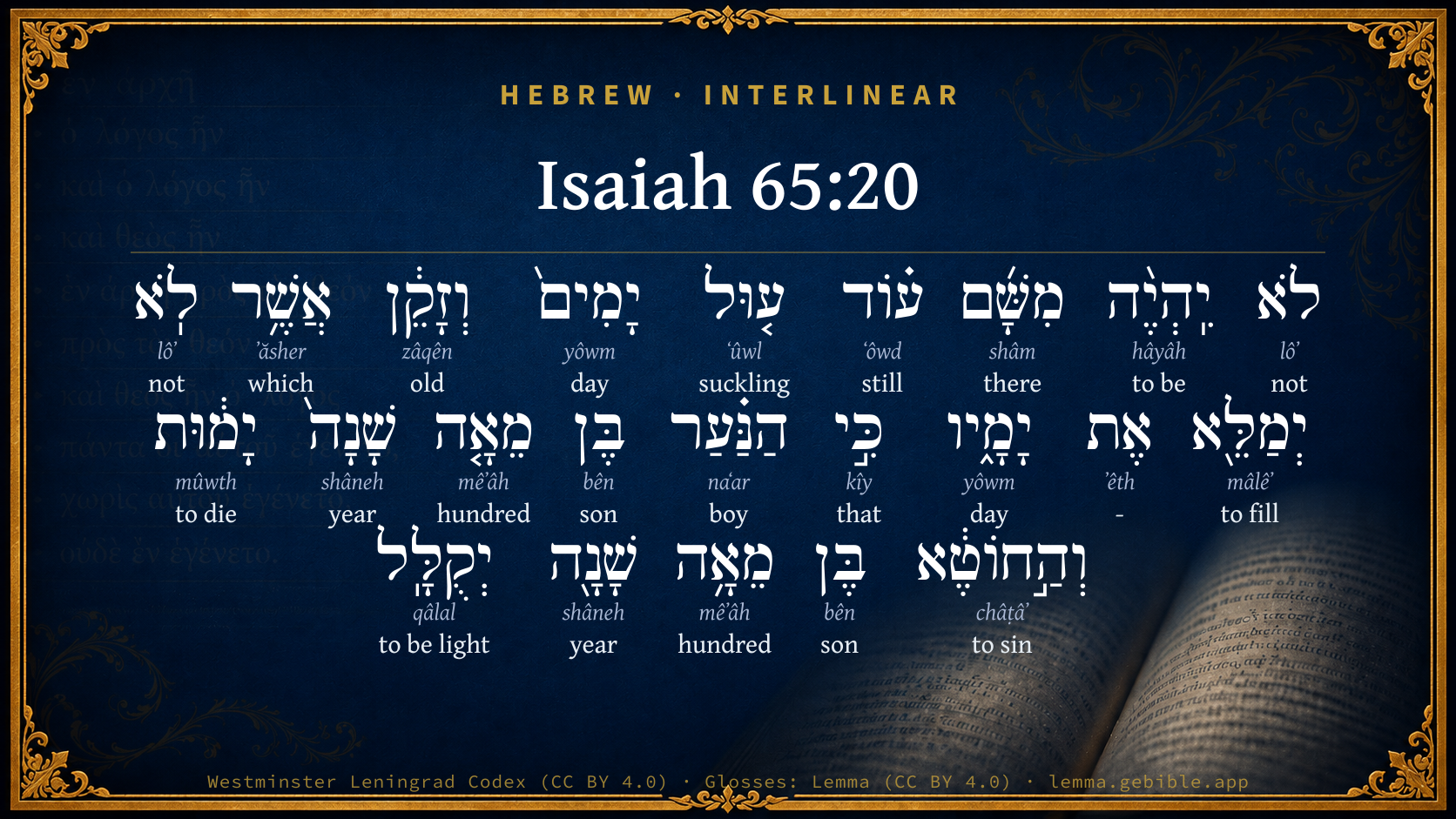
Hebrew (Westminster Leningrad Codex) Isaiah 65:20 appears in the Hebrew Old Testament. The text above is from the Westminster Leningrad Codex. Each word links to its Strong’s number, a concise gloss, and parsing drawn from the Open Scriptures Hebrew Bible morphology. Click any word for its full Brown-Driver-Briggs (BDB) entry.
Download image
Cite this verse

Isaiah 65:20 (World English Bible). Public Domain. Lemma interlinear Bible study tool, https://lemma.gebible.app/v/isaiah/65/20.

Show BibTeX & RIS
BibTeX
RIS
English Translation
There shall be no more there an infant of days, nor an old man who has not filled his days; for the child shall die one hundred years old, and the sinner being one hundred years old shall be accursed.
World English Bible · Public Domain
Download a study sheet

One document with this verse’s original text, its word-by-word gloss line, the meaning frame, cross-references with their text, attributed commentary, and full source and license credits — printable, and it pastes into notes with its structure intact.

This verse Autodidact and up

Study sheet (.html) Plain text (.txt)

A passage Seminary Student

Up to 50 verses in one chapter. A passage sheet keeps up to 6 commentary sources and 12 cross-references per verse, in the order this page ranks them, and says so on the sheet whenever that leaves anything out. Ask for a single verse and you get the Autodidact verse sheet above.

Everything on this page stays free to read, with no account — the sheet is a download of what is already on screen, not access to it.

Want to remove ads? Support Godless Engineer
Compare translations 3

The same verse in 3 English versions, stacked beneath the original-language interlinear above. Click any original word for its lexicon entry.

Each is an independent rendering of the whole verse — the interlinear is not word-aligned to these translations.

Highlighted words mark where these versions differ — a whole-verse word diff, not a word-by-word alignment.

  • World English Bible Public Domain
    There shall be no more there an infant of days, nor an old man who has not filled his days; for the child shall die one hundred years old, and the sinner being one hundred years old shall be accursed.
  • King James Version Public Domain
    There shall be no more thence an infant of days, nor an old man that hath not filled his days: for the child shall die an hundred years old; but the sinner being an hundred years old shall be accursed.
  • unfoldingWord Literal Text CC BY-SA 4.0
    An infant of days will no longer be from there, or an elder who does not fill his days, for a young man will die a son of 100 years, and the one failing a son of 100 years will be cursed.

unfoldingWord Literal Text — © unfoldingWord, licensed CC BY-SA 4.0. Word-aligned USFM3 via Door43 (git.door43.org/unfoldingWord/en_ult).

Versions to compare (up to 4)

3 of 4 selected

Show all 18 translations

Every available English version of this verse, each an independent rendering of the whole verse.

  • World English Bible Public Domain
    There shall be no more there an infant of days, nor an old man who has not filled his days; for the child shall die one hundred years old, and the sinner being one hundred years old shall be accursed.
  • Berean Standard Bible Public Domain
    No longer will a nursing infant live but a few days, or an old man fail to live out his years. For the youth will die at a hundred years, and he who fails to reach a hundred will be considered accursed.
  • Majority Standard Bible Public Domain
    No longer will a nursing infant live but a few days, or an old man fail to live out his years. For the youth will die at a hundred years, and he who fails to reach a hundred will be considered accursed.
  • King James Version Public Domain
    There shall be no more thence an infant of days, nor an old man that hath not filled his days: for the child shall die an hundred years old; but the sinner being an hundred years old shall be accursed.
  • American Standard Version (1901) Public Domain
    There shall be no more thence an infant of days, nor an old man that hath not filled his days; for the child shall die a hundred years old, and the sinner being a hundred years old shall be accursed.
  • Revised Version (1885) Public Domain
    There shall be no more thence an infant of days, nor an old man that hath not filled his days: for the child shall die an hundred years old, and the sinner being an hundred years old shall be accursed.
  • Geneva Bible (1599) Public Domain
    There shall be no more there a childe of yeeres, nor an olde man that hath not filled his dayes: for he that shall be an hundreth yeeres old, shall dye as a yong man: but the sinner being an hundreth yeeres olde shall be accursed.
  • Douay-Rheims (1899) Public Domain
    There shall no more be an infant of days there, nor an old man that shall not fill up his days: for the child shall die a hundred years old, and the sinner being a hundred years old shall be accursed.
  • Young's Literal Translation Public Domain
    There is not thence any more a suckling of days, And an aged man who doth not complete his days, For the youth a hundred years old dieth, And the sinner, a hundred years old, is lightly esteemed.
  • Literal Standard Version CC BY-SA 4.0
    There is not a suckling of [mere] days there anymore, || And an aged man who does not complete his days, || For the youth dies one hundred years old, || And the sinner, one hundred years old, is lightly esteemed.
  • Unlocked Literal Bible CC BY-SA 4.0
    Never again will an infant live there only a few days; nor will an old man die before his time. One who dies at one hundred years old will be considered a young person. Anyone who fails to reach the age of one hundred years old will be considered cursed.
  • unfoldingWord Literal Text CC BY-SA 4.0
    An infant of days will no longer be from there, or an elder who does not fill his days, for a young man will die a son of 100 years, and the one failing a son of 100 years will be cursed.
  • Darby Bible Public Domain
    There shall be no more thenceforth an infant of days, nor an old man that hath not completed his days; for the youth shall die a hundred years old, and the sinner being a hundred years old shall be accursed.
  • World Messianic Bible Public Domain
    “No more will there be an infant who only lives a few days, nor an old man who has not filled his days; for the child will die one hundred years old, and the sinner being one hundred years old will be accursed.
  • Webster's Bible Public Domain
    There shall be no more thence an infant of days, nor an old man that hath not filled his days: for the child shall die a hundred years old: but the sinner being a hundred years old shall be accursed.
  • Free Bible Version CC BY-SA 4.0
    No babies will die after just a few days, and no adults will die without having lived a long life. Those who reach a hundred will be thought of as just a child, and anyone who doesn't reach a hundred will be seen as being under a curse.
  • Bible in Basic English Public Domain
    No longer will there be there a child whose days are cut short, or an old man whose days have not come to their full measure: for the young man at his death will be a hundred years old, and he whose life is shorter than a hundred years will seem as one cursed.
  • JPS Tanakh (1917) Public Domain
    There shall be no more thence an infant of days, nor an old man, that hath not filled his days; for the youngest shall die a hundred years old, and the sinner being a hundred years old shall be accursed.

Literal Standard Version (2020), Covenant Press — licensed CC BY-SA 4.0. Text via the HelloAO Bible API (eBible.org). Unlocked Literal Bible (unfoldingWord) — licensed CC BY-SA 4.0. Text via the HelloAO Bible API (eBible.org). unfoldingWord Literal Text — © unfoldingWord, licensed CC BY-SA 4.0. Word-aligned USFM3 via Door43 (git.door43.org/unfoldingWord/en_ult). Free Bible Version, Dr. Jonathan Gallagher — licensed CC BY-SA 4.0. Text via the HelloAO Bible API (eBible.org).

Word by word

More ways to search: Search by grammar → Find every occurrence → Compare this word →

Practice this passage: Drill this verse → Learn its vocabulary →

ע֤וּל
ʻûwl
H5764
“suckling of”
Noun, Common, Masculine, Singular, Construct
Part of Speech
Noun
Type
Common
Gender
Masculine
Number
Singular
State
Construct
Full BDB Definition

Origin: from H5763

TWOT: 1579a

suckling, sucking child
  1. לֹא lôʼ H3808 “not” Particle, Negative
  2. יִֽהְיֶ֨ה hâyâh H1961 “to be” Verb, Qal, Imperfect, 3rd Person, Masculine, Singular
  3. מִשָּׁ֜ם shâm H8033 “from · there” Preposition + Adverb
  4. ע֗וֹד ʻôwd H5750 “still” Adverb
  5. יָמִים֙ yôwm H3117 “days” Noun, Common, Masculine, Plural, Absolute
  6. וְזָקֵ֔ן zâqên H2205 “and · old” Conjunction + Adjective, Adjective, Masculine, Singular, Absolute
  7. אֲשֶׁ֥ר ʼăsher H834 “which” Particle, Relative
  8. לֹֽא lôʼ H3808 “not” Particle, Negative
  9. יְמַלֵּ֖א mâlêʼ H4390 “to fill” Verb, Piel, Imperfect, 3rd Person, Masculine, Singular
  10. אֶת ʼêth H853 “-” Particle, Direct Object
  11. יָמָ֑יו yôwm H3117 “days · his” Noun, Common, Masculine, Plural, Construct + Suffix, Personal, 3rd Person, Masculine, Singular
  12. כִּ֣י kîy H3588 “that” Conjunction
  13. הַנַּ֗עַר naʻar H5288 “the · boy” Particle, Definite Article + Noun, Common, Masculine, Singular, Absolute
  14. בֶּן bên H1121 “son of” Noun, Common, Masculine, Singular, Construct
  15. מֵאָ֤ה mêʼâh H3967 “hundred” Adjective, Cardinal number, Both, Singular, Absolute
  16. שָׁנָה֙ shâneh H8141 “year” Noun, Common, Feminine, Singular, Absolute
  17. יָמ֔וּת mûwth H4191 “to die” Verb, Qal, Imperfect, 3rd Person, Masculine, Singular
  18. וְהַ֣חוֹטֶ֔א châṭâʼ H2398 “and · the · sinning” Conjunction + Particle, Definite Article + Verb, Qal, Participle Active, Masculine, Singular, Absolute
  19. בֶּן bên H1121 “son of” Noun, Common, Masculine, Singular, Construct
  20. מֵאָ֥ה mêʼâh H3967 “hundred” Adjective, Cardinal number, Both, Singular, Absolute
  21. שָׁנָ֖ה shâneh H8141 “year” Noun, Common, Feminine, Singular, Absolute
  22. יְקֻלָּֽל qâlal H7043 “to be light” Verb, Pual, Imperfect, 3rd Person, Masculine, Singular

About this verse

These counts appear in no published source. They are computed here, from the morphology-tagged text and Lemma’s own curated glosses. What Lemma adds →

23
words
18
distinct lemmas
Prophets
section

Notable vocabulary

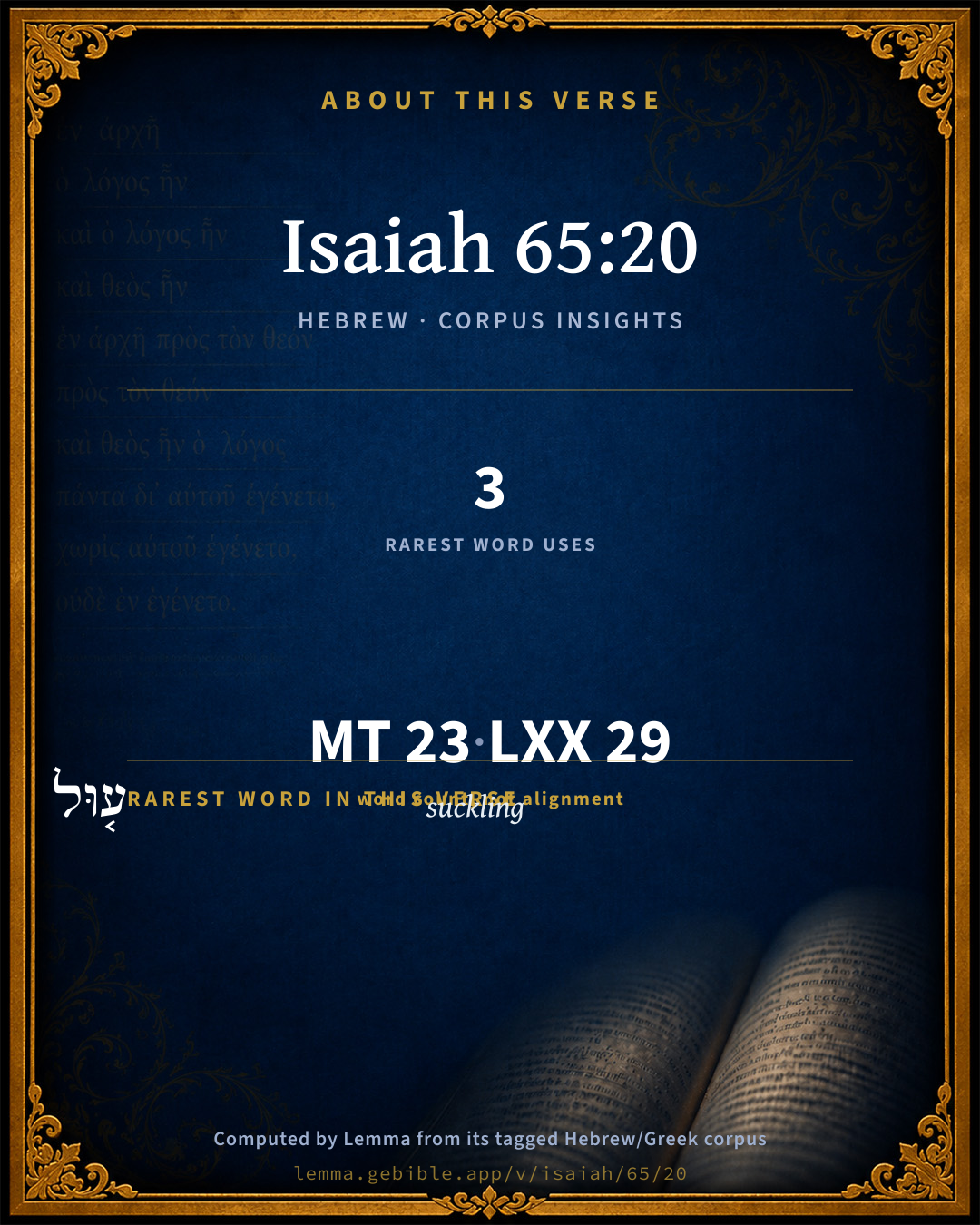
The rarest word here is ע֤וּל suckling H5764 — appearing just 3 times in the whole Hebrew Bible.

Shared distinctive vocabulary

ע֤וּל suckling H5764 occurs in 3 verses of the Hebrew Bible. Also found in:

Grammatical profile

  • 5 verbs
  • 8 nouns
  • 3 adjectives
  • 1 conjunction
  • 2 adverbs
  • 4 particles

Verb forms

  • יִֽהְיֶ֨ה Qal · Imperfect
  • יְמַלֵּ֖א Piel · Imperfect
  • יָמ֔וּת Qal · Imperfect
  • וְהַ֣חוֹטֶ֔א Qal · Participle Active
  • יְקֻלָּֽל Pual · Imperfect

Repetition

Words recur within this verse — often emphatic in Hebrew:

  • יָמִים֙ day H3117 ×2
  • בֶּן son H1121 ×2
  • מֵאָ֤ה hundred H3967 ×2
  • שָׁנָה֙ year H8141 ×2
  • לֹא not H3808 ×2

Hebrew & Septuagint length

In English translation the verse runs 40 words from the Hebrew and 44 from the Septuagint (LXX English) — closely comparable.

A rough comparison of the two English renderings, which tokenize alike — not a word-level alignment.

Word counts can differ between the Hebrew and the Greek without any difference in meaning — e.g. the Hebrew direct-object marker אֵת has no separate Greek word, and Greek often adds the article ὁ.

In the original languages it is 23 Hebrew tokens and 29 Greek tokens — but the two are counted differently (Hebrew bundles its prefixes and suffixes into one token; the Greek is in lemma form), so that isn’t a like-for-like length.

Cross-references

6

Topical passages linked to Isaiah 65:20 in the Treasury of Scripture Knowledge — connected by theme and wording, ordered by reader-vote popularity; previews shown in the World English Bible.

  • Job 5:26 You shall come to your grave in a full age, Like a shock of grain comes in its season.
  • Ecclesiastes 8:12–13 Though a sinner commits crimes a hundred times, and lives long, yet surely I know that it will be better with those who fear God, who are reverent before him.
  • Deuteronomy 4:40 You shall keep his statutes, and his commandments, which I command you this day, that it may go well with you, and with your children after you, and that you may prolong your days in the land, which Yahweh your God gives you, forever.
  • Psalms 34:12 Who is someone who desires life, And loves many days, that he may see good?
  • Romans 2:5–9 But according to your hardness and unrepentant heart you are treasuring up for yourself wrath in the day of wrath, revelation, and of the righteous judgment of God;
  • Isaiah 3:11 Woe to the wicked! Disaster is upon them; For the deeds of his hands will be paid back to him.

Cross-references courtesy of OpenBible.info (CC BY 4.0).

Hebrew and Greek witnesses Masoretic Hebrew ↔ Greek Septuagint

The same verse in the two great witnesses to the Old Testament, shown verse-for-verse.

These are two independent witnesses, not word-aligned to each other, and the Septuagint is shown in lemma (dictionary) form.

Hebrew Isaiah 65:20 Masoretic · Westminster Leningrad Codex

לֹא יִֽהְיֶ֨ה מִשָּׁ֜ם ע֗וֹד ע֤וּל יָמִים֙ וְזָקֵ֔ן אֲשֶׁ֥ר לֹֽא יְמַלֵּ֖א אֶת יָמָ֑יו כִּ֣י הַנַּ֗עַר בֶּן מֵאָ֤ה שָׁנָה֙ יָמ֔וּת וְהַ֣חוֹטֶ֔א בֶּן מֵאָ֥ה שָׁנָ֖ה יְקֻלָּֽל

There shall be no more there an infant of days, nor an old man who has not filled his days; for the child shall die one hundred years old, and the sinner being one hundred years old shall be accursed.

World English Bible · Public Domain

Greek LXX Isaiah 65:20 Septuagint · lemma form

καί οὐ μή γίγνομαι ἐκεῖ ἄωρος καί πρεσβύτης ὅς οὐ ἐνπίμπλημι ὁ χρόνος αὐτός εἰμί γάρ ὁ νέος ἑκατόν ἔτος ὁ δέ ἀποθνήσκω ἁμαρτωλός ἑκατόν ἔτος καί ἐπικατάρατος εἰμί

Neither shall there be there any more a child that dies untimely, or an old man who shall not complete his time: for the youth shall be one hundred years old, and the sinner who dies at one hundred years shall also be accursed:

LXX2012 (modern English Septuagint) · Public Domain

On this verse, Keil & Delitzsch discusses the Septuagint’s reading. Read the note in Commentary ↓

Hebrew: Westminster Leningrad Codex (CC BY 4.0). Greek: Septuagint (public domain); English from LXX2012 (modern English Septuagint) (Public Domain). How the Septuagint differs from the Hebrew →

Targum (Aramaic paraphrase)

1

The Targum is the ancient Jewish Aramaic paraphrase of the Hebrew Scriptures — an interpretive translation, not the Hebrew text itself. Onkelos (literal) and Pseudo-Jonathan (expansive) render the Torah, and Jonathan the Prophets. Coverage is partial: where no permissively-licensed English translation exists for a verse, only the Aramaic is shown. This is verse-level text, not a word-by-word alignment to the Hebrew.

  1. Targum Jonathan Prophets (Joshua–Malachi)
    וְלָא יְהֵי מִתַּמָן עוֹד יָנִיק יוֹמִין וְסָבָא דְלָא יַשְׁלַם יַת יוֹמוֹהִי אֲרֵי דְחַיֵיב עוֹלֵים בַּר מְאָה שְׁנִין יְהֵי מָאֵית וּדְחָטֵי בַּר מְאָה שְׁנִין יִתְּרָךְ:

    There shall be no more thence a suckling of days, or an old man that shall not accomplish his days, for even the child that sinneth shall die an hundred years old; but he that is a sinner being an hundred years old shall be thrust out.

    Targum Jonathan — Aramaic: “Mikraot Gedolot” (public domain). English: “Sefaria Community Translation” (CC0 1.0 (public-domain dedication)); “London "Chaldee Paraphrase," 1871” (public domain). Text via Sefaria.

Commentary

Notes on Isaiah 65:20 from classic Christian and Jewish commentators (each source and its license shown beneath its notes). The classic Christian expositions comment on the surrounding passage and are grouped to its opening verse, so a note may address several verses; the Jewish commentaries on the Tanakh (Rashi and others) are per-verse, so they appear only where the commentator wrote on this verse.

Lemma curates 59 commentaries, every one of them public domain or Creative Commons licensed, each selected and text-cleaned for this edition rather than reprinted as found. About our sources →

Trapp's Complete Commentary

John Trapp

Isa 65:20 There shall be no more thence an infant of days, nor an old man that hath not filled his days: for the child shall die an hundred years old; but the sinner [being] an hundred years old shall be accursed.

Ver. 20. There shall be no more thence an infant of days.] This verse, as some others, had been easy, had not commentators made it so knotty. There shall be no more thence - that is, from Jerusalem {Isa 65:19} - an infant of days, or a child for days; viz., that shall so die by an untimely death, for longevity is the blessing here promised.

Nor an old man that hath not filled his days.] That hath not lived his utmost, satur dierum, as Abraham.

For the child shall die an hundred years old,] i.e., He that is now a child, shall live till he be so many years old. Note this against those that otherwise understand the words, and have therehence fished out many frivolous crotchets too long here to be related.

But the sinner, being an hundred years old, {a} shall be accursed.] And the more accursed because so long lived, and yet dieth in his sin, going down to the grave with his bones full of the sins of his youth. See Ecc 8:12-13. {See Trapp on "Ecc 8:12"} {See Trapp on "Ecc 8:13"}

{a} Hinc proverb, Puer centum annorum.

John Trapp, A Commentary or Exposition upon All the Books of the Old and New Testament (1647–1656) — public domain. Text from a community e-Sword module.

The Biblical Illustrator

Joseph S. Exell

Isa_65:20

There shall be no more thence an infant of days

Longevity

The whole is a highly poetical description of longevity, to be explained precisely like the promise of new heavens and a new earth (Isa_65:17).

(J. A. Alexander.)

The child shall die an hundred years old

Youth and age

There is promised a practical annihilation of the line which divides youth and age. Youth shall be wise and age shall be ardent. We are to study the spirit of youth in history and in the Church. Hope, enthusiasm, energy, and audacity are elemental forces in youth. Youth makes mistakes, but age magnifies difficulties. Age regards that impossible which to youth presents the prospect of success. Most of the leaders of our American Revolution were under forty, and the same fact appears in European history, so that Disraeli was right in saying, The history of heroes is the history of youth So in art. Raphael died at thirty-seven, Keats at twenty-two, Shelley before thirty, and Professor Clifford at thirty-five. The time for action is the morning! There is a fiery enthusiasm in youth. It is to be utilized. Luther was but twenty-four when he denounced the Papa! Church, and Calvin twenty-six when he wrote his great work, The Institutes. So with Wesley and Summerfield, who made themselves felt in early manhood. Robertson, of Brighton, died at thirty-four. Though preaching to but few, he has influenced the world by his broad and catholic views. Henry Martyn died at thirty-two, and Harriet Newell when hardly out of girlhood. Is youth blind? It is sometimes good to be blind to danger and difficulty, uninfluenced by discouragements, if only awake to the grandeur of the work and the promised alliance of God!

I. THE ELDER SHOULD NOT BE JEALOUS OF THE YOUNGER. It is pitiful to see a cynical spirit shown toward those who are coming to take our places. Better imitate the magnanimous temper of John, who said, as he saw the growing popularity of the Master, He must increase, I must decrease. The coming generation must do their own thinking and make their own philosophies. Wisdom was not born with us. It will not die with us. God honours individuality. He makes faces unlike and minds unlike.

II. THE CHURCH SHOULD BE ALERT TO TRAIN YOUTH TO BE EQUAL TO THE DEMANDS OF THE AGE. its offices of trust should not be wholly in the hands of old persons.

III. SOME PEOPLE NEVER SEEM TO LOSE THEIR YOUTH. It is a lovely sight to see the youthful spirit strong at seventy. It is like seeing a river pouring its life through a desert.

IV. WE LEARN HOW TO CONTINUE TO BE YOUTHFUL. If linked to Christ, how can we be otherwise than glad and growing, hopeful and purposeful? A vital, vivid, constant faith in God feeds enthusiasm with perpetual strength. Suffering often brings a deep, quiet joy. Shrink not from it. Moreover, we can cultivate this youthful spirit. We can compel ourselves to look on the bright side of things. They who believe that all things work together for good to those who love God ought to be continually young. (A. H Bradford,. D. D.)

The child shall die an hundred years old

The verse is a puzzling one. But none the less it is true. The more Christlike men and women become, the nearer they grow to absolute childlikeness. It is with them as with the ripe corn in the autumn; the corn bends its head down again to the ground out of which it sprang in the spring. Just so the saints of God, in their maturity, in their noblest and wisest and heavenliest estate here on earth, resemble most the children--resemble them in their trustfulness and teachableness and lowliness. (A. Smellie, M. A.)

A child-man

When James Clerk Maxwell, loaded as he was with his scientific learning, lay dying, these were his last words: Lay me down lower, for I am very low myself, and it suits me to lie low; and then, with a long, loving look at his wife, he went home to God. He was a man, but he died as a child. (A. Smellie, M. A.)

But the sinner, being an hundred years old, shall be accursed

The aged sinner

I. IT IS NOT USUAL FOR A MAN TO LIVE TO THE AGE OF A HUNDRED YEARS. Some, indeed, have lived so long, but their number has been very small, and he who flatters himself that he shall do so is both vain and foolish.

II. As it is not usual for any man to live to the age of a hundred years, so IT IS LESS LIKELY THAT THE SINNER SHOULD LIVE SO LONG. The way of a sinner is such as naturally tends to shorten his days, and provoke God to destroy him.

III. IF A WICKED MAN SHOULD LIVE TO BE A HUNDRED YEARS OLD, YET HE MUST DIE AT LAST.

IV. WHENEVER WICKED MEN DIE, WHETHER IT BE IN YOUTH OR EXTREME OLD AGE, THEY DIE ACCURSED. Some of them are cursed by their fellow-creatures, whom they have injured or oppressed; but, above all, they are under the curse of God. It is a dreadful thing to live under a curse, but it is far worse to die under one; yet this is the awful condition of such as live and die in their sins. They may possess much, and have their houses, lands and estates, but it is with a curse; they may also hope for more, but when it comes it is with a curse. (B. Beddome, M. A.)

The Biblical Illustrator, edited by Joseph S. Exell (c. 1880s–1900s) — public domain. Text from a community e-Sword module.

Joseph Benson's Commentary

Isa 65:20. There shall be no more thence an infant of days, &c. — There shall he no untimely or premature deaths, either of infants and children, who do not grow up to man’s estate, or of old men, who do not live out the full term of life. For the child shall die, &c. — This should rather be translated, For he that dies a hundred years old shall die a child: and the sinner that dies a hundred years old shall be (that is, shall be deemed) accursed, or cut off by the justice of God for his crime. Thus “the prophet describes this renovation of the world as a paradisiacal state, and such as the patriarchs enjoyed before the flood, when men commonly lived nearly a thousand years. So he that died at a hundred years of age would have been looked upon as dying in the age of childhood, and be judged to have been cut off in the beginning of his years, as a punishment for some great sins he had committed.” — Lowth. It is justly observed here by Mr. Scott, that “the event alone can certainly determine whether this is meant literally or figuratively; but it is evident that the universal prevalence of real Christianity would so terminate wars, murders, contentions, idleness, intemperance, and licentiousness, as greatly to lengthen out the general term of man’s life. Many diseases which now destroy thousands and tens of thousands in the prime of life, and communicate distempers to succeeding generations, would, in that case, scarcely be heard of any more; and thus the human constitution would soon be much mended, and children would generally come into the world more vigorous and healthy than they can do while vice so greatly prevails. What God may further intend in this matter we cannot determine.” Vitringa’s view of the passage seems to have been, that “there shall be no violent or punitive death in this holy city, but that all the inhabitants being holy, all shall die full of days and happy, and shall have, as it were, a foretaste, pledge, and earnest of life eternal, in their long and happy life below.”

Joseph Benson's Commentary on the Old and New Testaments (1811–1818) — public domain. Text from a community e-Sword module.

Whedon's Commentary on the Bible

Daniel D. Whedon

20. No more… an infant of days — There is considerable variety of not very clever comment on this passage. Nor is it easy to be made clear. Evidently the thread of illustration is not broken from Isa_65:17, wherein Jehovah, under poetic imagery, is creating a new heaven and a new earth — perhaps even from Isa_65:13, in which contrast is drawn between the status of the righteous and that of the unrighteous. In Isa_65:20 the characteristic blessedness of the new order of things in the great future is that of longevity: “No more thence (from holy Jerusalem) shall be (rather, shall go, perhaps to burial) an infant of days.” To agree with second clause of this verse this must mean: No one shall die in infancy. The old man and the one now an infant shall alike enjoy the full covenant blessing made to Abraham when he was a hundred years old. (And even if early death perchance occur, it shall be no bar to the promise of the inheritance. Gen_17:17.) In the second clause comes the contrast, like that of Isa_65:13-16.

For the child shall die a hundred years old — This seems to have a meaning touching child-likeness in simplicity, truthfulness, sincerity, and standing in a right relationship with God for a hundred years, or for an indefinite length of life. But every sinner, though “a hundred years old,” shall die accursed. His long life has nothing in it to redeem his character from disgrace.

Daniel D. Whedon (gen. ed.), Commentary on the Old and New Testaments (1874–1909) — public domain. Text from a community e-Sword module.

Keil & Delitzsch

C. F. Keil & F. Delitzsch

There will be a different measure then, and a much greater one, for measuring the period of life and grace. "And there shall no more come thence a suckling of a few days, and an old man who has not lived out all his days; for the youth in it will die as one a hundred years old, and the sinner be smitten with the curse as one a hundred years old." Our editions of the text commence Isa 65:20 with לא־יהיה, but according to the Masora (see Mas. finalis, p. 23, col. 7), which reckons five ולא־יהיה at the commencement of verses, and includes our v. among them, it must read ולא־יהיה, as it is also rendered by the lxx and Targum. The meaning and connection are not affected by this various reading. Henceforth there will not spring from Jerusalem (or, what hâyâh really means, "come into existence;" "thence," misshâm, not "from that time," but locally, as in Hos 2:17 and elsewhere, cf., Isa 58:12) a suckling (see p. 90) of days, i.e., one who has only reached the age of a few days (yâmı̄m as in Gen 24:55, etc.), nor an old man who has not filled his days, i.e., has not attained to what is regarded as a rule as the full measure of human life. He who dies as a youth, or is regarded as having died young, will not die before the hundredth year of his life; and the sinner (והחוטא with seghol, as in Ecc 8:12; Ecc 9:18; Ges. 75, Anm. 21) upon whom the curse of God falls, and who is overwhelmed by the punishment, will not be swept away before the hundredth year of his life. We cannot maintain with Hofmann (Schriftbeweis, ii. 2, 567), that it is only in appearance that less is here affirmed than in Isa 25:8. The reference there is to the ultimate destruction of the power of death; here it is merely to the limitation of its power.

Keil & Delitzsch — Biblical Commentary on the Old Testament (1861–1891) — public domain (CC PDM 1.0). Text via the HelloAO Bible API. (Old Testament only.)

Geneva Bible (1599)

Geneva Bible translators

Meaning, in this wonderful restoration of the Church there should be no weakness of youth, nor infirmities of age, but all should be fresh and flourishing: and this is accomplished in the heavenly Jerusalem, when all sin shall cease, and the tears shall be wiped away.

Whereby he showeth that the infidels and unrepentant sinners have no part of this benediction.

Geneva Bible (1599) marginal notes — public domain. Text via Bolls.life.

Jamieson, Fausset & Brown

Robert Jamieson, A. R. Fausset & David Brown

The longevity of men in the first age of the world shall be enjoyed again.

thence--from that time forward.

infant of days--that is, an infant who shall only complete a few days; short-lived.

filled . . . days--None shall die without attaining a full old age.

child . . . die . . . hundred years--that is "he that dieth an hundred years old shall die a mere child" [LOWTH].

sinner . . . hundred . . . be accursed--"The sinner that dieth at an hundred years shall be deemed accursed," that is, his death at so early an age, which in those days the hundredth year will be regarded, just as if it were mere childhood, shall be deemed the effect of God's special visitation in wrath [ROSENMULLER]. This passage proves that the better age to come on earth, though much superior to the present will not be a perfect state; sin and death shall have place in it (compare Rev 20:7-8), but much less frequently than now.

Jamieson, Fausset & Brown — Commentary Critical and Explanatory on the Whole Bible (1871) — public domain (CC PDM 1.0). Text via the HelloAO Bible API.

Adam Clarke's Commentary

Verse 20. Thence - "There"] For משם mishsham, thence, the Septuagint, Syriac, and Vulgate, read שם sham, there.

Adam Clarke's Commentary on the Bible (1810–1826) — public domain. Text from a community e-Sword/MySword module.

Ellicott's Commentary for English Readers

(20) There shall be no more thence . . .—The prophet sees in the restored city not so much an eternal and a deathless life as the return of the traditional longevity of the prediluvian and patriarchal age (Genesis 5, 11), Life will not be prematurely cut off, as it had been, by pestilence and war. (Comp. Zec_8:4.) He who dies at the age of a hundred will be thought of as dying young; even the sinner, dying before his time as the penalty of his guilt, shall live out the measure of a century. The noticeable fact is that sin is thought of as not altogether extinct—as still appearing, though under altered conditions, even in the restored Jerusalem.

A Bible Commentary for English Readers, edited by Charles John Ellicott (1878–1897) — public domain. Text from a community e-Sword module.

The Cambridge Bible for Schools and Colleges

gen. ed. J. J. S. Perowne

20. Amongst the blessings of the new people of God the chief shall be a miraculous extension of the term of human life. This is the dominant idea down to the end of Isa_65:22. The expression of the thought is unaccountably laboured and obscure.

an infant of days] must mean one who lives only a few days.

nor an old man … days] (cf. Gen_25:8; Exo_23:26; Job_5:26), i.e. none shall become prematurely old; each shall attain the allotted measure of life according to the standard which shall then be normal.

for the youth shall die an hundred years old &c.] These two cases must be regarded as hypothetical merely. Death at the age of 100 years (if such a thing took place) would be looked on as an untimely death in extreme youth, and as a special mark of the Divine anger on a career of wickedness (Job_15:32; Job_20:5). The possibility of a hardened sinner being actually found in the Messianic community cannot be seriously contemplated (see ch. Isa_60:21).

It is evident that the idea of immortal life is unknown to the writer. He looks forward to a restriction of the power of death, but not to its entire cessation. The same idea is probably implied in a prophecy of the early post-exilic period (Zec_8:4; see on ch. Isa_25:8); and a conception precisely similar is characteristic of the first section of the Book of Enoch. see Charles, Book of Enoch, pp. 26, 55, 98. Comp. En. Isa_5:9 : “And [the elect] will not be punished all the days of their life, nor will they die of plagues or visitations of wrath, but they will complete the full number of the days of their life, and their lives will grow old in peace, and the years of their joy will be many, in eternal happiness and peace all the days of their life.” Cf. also Isa_10:17 and Isa_25:4-5.

The Cambridge Bible for Schools and Colleges (gen. ed. J. J. S. Perowne; Cambridge University Press, 1878–1918) — public domain. Text from a community e-Sword module.

John Gill's Exposition

There shall be no more thence an infant of days,.... That is, there shall no more be carried out from thence, from Jerusalem, or any other place where the church of God is, to the grave, in order to be interred, an infant that has lived but a few days, a very common thing now; but, in the latter day, such instances will be rare, or rather there will be none at all; every child born will live to the age of man, and not be cut off by any premature death, either by any natural disease, or by famine, or sword, or any other calamity, which will now have no place:

nor an old man that hath not filled his days; who, though he may in some sense, or in comparison of others, be said to be old, yet has not arrived to the full term of man's life, threescore years and ten, or more; for it seems, by what follows, as if the term of human life will be lengthened in the latter day, and reach in common to a hundred years; so that as long life is always reckoned a temporal happiness, among the rest that shall be enjoyed, this will be one in the latter day; and which is to be understood not of the Millennium state, in which there will be no death, Rev 21:4, which yet will be in this, as the following words show; but of the state preceding that, even the spiritual reign of Christ:

for the child shall die an hundred years old; not that that shall be reckoned a child that shall die at a hundred years of age (h), the life of man being now, in these days of the Messiah, as long as they were before the flood, as the Jewish interpreters imagine; but the child that is now born, or he that is now a child, shall live to the age of a hundred years, and not die before: but lest this outward happiness should be trusted to, and a man should imagine that therefore he is in a happy state for eternity, being blessed with such a long life, it follows, "but" or

though the sinner, being an hundred years old; shall be accursed; for though this shall be common in this state to good men and bad men, to live a hundred years, yet their death will not be alike; the good man will be blessed, and enter into a happy state of joy and peace; but the wicked man, though he lives as long as the other in this world, shall be accursed at death, and to all eternity; see Ecc 8:12.

(h) Vid. Gloss. in T. Bab. Sanhedrin, fol. 91. 2.

John Gill's Exposition of the Whole Bible (1746–1763) — public domain (CC PDM 1.0). Text via the HelloAO Bible API.

Albert Barnes' Notes on the Bible

There shall be no more thence - The Septuagint, the Syriac, and the Vulgate, read this, ‘There shall not be there.’ The change requires the omission of a single letter in the present Hebrew text, and the sense seems to demand it. The design of the prophet here is, to describe the times of happiness and prosperity which would succeed the calamities under which the nation had been suffering. This he does by a great variety of images, all denoting substantially the same thing. In Isa 65:17, the change is represented to be as great as if a new heaven and a new earth should be created; in this verse the image is, that the inhabitants would reach a great age, and that the comparatively happy times of the patriarchs would be restored; in Isa 65:21, the image is taken from the perfect security in their plans of labor, and the fact that they would enjoy the fruit of their toil; in Isa 65:25, the image employed is that taken from the change in the nature of the animal creation. All these are poetic images designed as illustrations of the general truth, and, like other poetic images, they are not to be taken literally.

An infant of days - A child; a sucking child. So the Hebrew word, עול ‛ûl, denotes. The Septuagint renders it, ‘Nor shall there be there anymore an untimely birth (ἄωρος aōros) and an old man who has not filled up his time.’ The idea is not that there should be no infant in those future times - which would be an idea so absurd that a prophet would not use it even in poetic fiction - but that there will not be an infant who shall not fill up his days, or who will be short-lived. All shall live long, and all shall be blessed with health, and continual vigor and youth.

Nor an old man that hath not filled his days - They shall enjoy the blessings of great longevity, and that not a longevity that shall be broken and feeble, but which shall be vigorous and happy. In further illustration of this sentiment, we may remark,

1. That there is no reason to suppose that it will be literally fulfilled even in the millenium. If it is to be regarded as literally to be fulfilled, then for the same reason we are to suppose that in that time the nature of the lion will be literally changed, and that he will eat straw like the ox, and that the nature of the wolf and the lamb will be so far changed that they shall lie down together Isa 65:25. But there is no reason to suppose this; nor is there any good reason to suppose that literally no infant or child will die in those times, or that no old man will be infirm, or that all will live to the same great age.

2. The promise of long life is regarded in the Bible as a blessing, and is an image, everywhere, of prosperity and happiness. Thus the patriarchs were regarded as having been highly-favored people, because God lengthened out their days; and throughout the Scriptures it is represented as a proof of the favor of God, that a man is permitted to live long, and to see a numerous posterity (see Gen 45:10; Psa 21:4; Psa 23:6; Psa 128:6 (Hebrew); Psa 91:16; Pro 3:2-14; Pro 17:6.

3. No one can doubt that the prevalence of the gospel everywhere would greatly lengthen out the life of man. Let anyone reflect on the great number that are now cut off in childhood in pagan lands by their parents, all of whom would have been spared had their parents been Christians; on the numbers of children who are destroyed in early life by the effects of the intemperance of their parents, most of whom would have survived if their parents had been virtuous; on the numbers of young men now cut down by vice, who would have continued to live if they had been under the influence of the gospel; on the immense hosts cut off, and most of them in middle life, by war, who would have lived to a good old age if the gospel had prevailed and put a period to wars; on the million who are annually cut down by intemperance and lust, and other raging passions, by murder and piracy, or who are punished by death for crime; on the million destroyed by pestilential disease sent by offended heaven on guilty nations; and let him reflect that these sources of death will be dried up by the prevalence of pure virtue and religion, and he will see that a great change may yet take place literally in the life of man.

4. A similar image is used by the classic writers to denote a golden age, or an age of great prosperity and happiness. Thus the Sybil, in the Sybilline Oracles, B. vii., speaking of the future age, says, Στήσει δὲ τὸ γένος, ὡς πάρος ἦν σοι Stēsei de to genos, hōs paros ēn soi - ‘A race shall be restored as it was in the ancient times.’ So Hesiod, describing the silver age, introduces a boy as having reached the age of an hundred years, and yet but a child:

Ἀλλ ̓ ἑκατόν μὲν παῖς ἔτεα παρὰ μητέρι κεδνρ,

Ἐτρέφετ ἀτάλλων υέγα νήπιος ὦ ἔνι οἴκῳ.

All' hekaton men tais etea para mēteri kednr,

Etrephet atallōn mega nēpios ō eni oikō.

For the child shall die an hundred years old - That is, he that is an hundred years old when he dies, shall still be a child or a youth. This is nearly the same sentiment which is expressed by Hesiod, as quoted above. The prophet has evidently in his eye the longevity of the patriarchs, when an individual of an hundred years of age was comparatively young - the proportion between that and the usual period of life then being about the same as that between the age of ten and the usual period of life now. We are not, I apprehend, to suppose that this is to be taken literally, but it is figurative language, designed to describe the comparatively happy state referred to by the prophet, as if human life should be lengthened out to the age of the patriarchs, and as if he who is now regarded as an old man, should then be regarded as in the vigor of his days. At the same time it is true, that the influence of temperance, industry, and soberness of life, such as would exist if the rules of the gospel were obeyed, would carry forward the vigor of youth far into advancing years, and mitigate most of the evils now incident to the decline of life.

The few imperfect experiments which have been made of the effect of entire temperance and of elevated virtue; of subduing the passions by the influence of the gospel, and of prudent means for prolonging health and life, such as the gospel will prompt a man to use, who has any just view of the value of life, show what may yet be done in happier times. It is an obvious reflection here, that if such effects are to be anticipated from the prevalence of true religion and of temperance, then he is the best friend of man who endeavors most sedulously to bring others under the influence of the gospel, and to extend the principles of temperance and virtue. The gospel of Christ would do more to prolong human life than all other causes combined; and when that prevails everywhere, putting a period, as it must, to infanticide, and war, and intemperance, and murder, and piracy, and suicide, and duelling, and raging and consuming passions, then it is impossible for the most vivid imagination to conceive the effect which shall be produced on the health and long life, as well as on the happiness of mankind.

But the sinner being an hundred years old shall be accursed - The sense of this appears to be, ‘not all who reach to a great age shall be judged to be the friends and favorites of God. Though a sinner shall reach that advanced period of life, yet he shall be cursed of God and shall be cut down in his sins. He shall be held to be a sinner and shall die, and shall be regarded as accursed.’ Other interpretations of this expression may be seen in Poole and in Vitringa. The above seems to me to be the true exposition.

Albert Barnes' Notes on the Bible (1834–1885) — public domain. Text from a community e-Sword/MySword module.

Haydock's Catholic Bible Commentary

Fill up. To die soon was deemed a misfortune, Psalm liv. 24., and Exodus xx. 12. Virtue is the measure of the Christian’s life, and God will reward those who labour even late, Matthew xx. 13. --- Accursed. This age will not be spared. Both just and wicked shall be immortal in eternity. (Theodoret)

George Leo Haydock (1774–1849), Haydock's Catholic Family Bible and Commentary, 1859 edition — public domain. Excludes Psalms (Douay-Rheims chapter numbering differs from Protestant) and Deuterocanonical books (Catholic canon only).

Matthew Poole's English Annotations

Whereas God hath made many promises of long life to the Jews, they should all be fulfilled to God’s people among them, so as there should be rare abortions among them, Exo 23:26; few infants should be carried out to burial, nor but few that should not have filled up their years; those that were now children should die at a great age; yet none of these things should be of any advantage to wicked men, but if, any of them should live to be.a hundred years old, yet they should die accursed. This seemeth to be the plain sense. If any desire to read more opinions of these words, he may find enough in the English Annotations.

Matthew Poole's English Annotations on the Holy Bible (1683–1685) — public domain. Text from a community e-Sword/MySword module.

The Pulpit Commentary

There shall be no more thence an infant of days; i.e. there shall not go from the new Jerusalem into the unseen world any infant of a few days old. On the contrary, even "the youth" shall reach a hundred; i.e. one who dies when he is a hundred shall be regarded as cut off in his youth. The general rule shall be, that old men shall "fill their days," or attain to patriarchal longevity. Even the sinner, who is under the curse of God, shall not be cut off till he is a hundred. What is most remarkable in the description is that death and sin are represented as still continuing. Death was spoken of as "swallowed up in victory" in one of the earlier descriptions of Messiah"s kingdom. (Isa_25:8)

The Christian view of age.

These words are not to be taken literally; they are distinctly pictorial, highly hyperbolical; they indicate a state of future blessedness, employing images most likely to be impressive and inspiring at the time of utterance. They may suggest to us the Christian aspect of old age.

I THAT CHRISTIAN LIFE TENDS TO LENGTH OF DAYS, Health, and therefore life, depends most on habit. What shortens life is folly, irregularity, excess, anxiety, sorrow; Christian principles guard against these, or materially modify them. What lengthens life is purity, temperance, serenity, and cheerfulness of spirit; Christian principles are a security for these.

II THAT CHRISTIAN LIFE TENDS TO PRESERVE THE CHILDHEART IN THE AGED MAN. A beautiful object is a "green old age;" an excellent thing it is when "he that is a hundred years old dies a youth." The best preservative of freshness of spirit, openness of mind, youthfulness of heart, is an unselfish habit. Disinterestedness of soul, broad and generous sympathies, active participation in all onward movements, this will keep the heart of youth in the form of age.

III THAT THE CHRISTIAN PROMISE POINTS TO THE LONG FUTURE. "The shorter life, the earlier immortality.

IV THAT WE MAY DIE YOUNG, AND YET FILL UP THE MEASURE OF OUR DAYS. Our Lord died a young man, and yet he "finished the work which the Father gave him to do." Many martyrs, many devoted labourers in the field of usefulness, have failed to reach extreme old age, but they have not failed to accomplish the task which the great Leader had set them. The excellency of life depends on its quality, not on its quantity. "One day in thy courts is better than a thousand," etc. "Though the sinner die a hundred years old, he shall be accursed," and his life will be a bane and a blot. A very few years (or months) of holy service may be of inestimable service to the cause of Christ and of man. C.

The woe of aged sinners.

There are three special periods of life in which men are peculiarly exposed to the power of temptation and sin. Most men that fall, fall either into young men"s perils, full-grown, men"s indulgences, or old men"s sins. A pure, humble, godly old man is one of the noblest sights to be seen under heaven. And by so much as that is beautiful, a godless, characterless, debased old man is a shame and contempt. A hoary head is a crown of glory if it be found in the way of righteousness." Yet old age has its special evils. Temptations to those sins which the Bible gathers up into the word "uncleanness." Often uncleanness of word and conversation; often, alas! of life and conduct also. It would appear that bodily lust and passion gathers itself in old age for one last struggle to gain the mastery. The flame flares up in the socket, and old men need to keep very near to God, very much in the power of the sanctifying Spirit, if, having withstood all the perils of youth and manhood, they do not fall under the temptations of old age. What an awful sight is the foul-mouthed, leering-eyed, depraved old man, tottering on the very edge of the eternal, where "he that is filthy shall be filthy still"! The prophet tells of the time when there shall be no confusions about the state of aged sinners, because they are in great state, or are spared long. "The sinner being a hundred years old shall be accursed.

I THE WOE OF AGED SINNERS COMES IN BITTERNESS OF SUFFERING. The self-indulgent life ensures an unusually suffering old age. There are natural and necessary penalties, which are first smitings of Divine judgment.

II THE WOE OF AGED SINNERS COMES IN THE ESTIMATE OF THOSE WHO TEND THEM. The aged sinner outlives his so-called friends, who shared his self-willed doings, and might have sympathized with him. He is put, for tending, into the hands of a new generation, who only see the wreck and ruin of body and character which the life has led to. He feels despised; he feels the misery of being despised. He knows well enough that they wish him gone.

III THE WOE OF AGED SINNERS COMES IN FEARS OF THE FUTURE. It comes on a man sooner or later that he will have to "give an account of his stewardship." His body was not his own; his time was not his own; his talents were not his own; his possessions were not his own; his relations were not his own. Presently he asks himself What have I done with God"s property, which was entrusted for a while to my care? Conscious of having diverted God"s property to his own uses, he may well fear to meet his offended God. R.T.

The Pulpit Commentary (1880–1919), ed. H.D.M. Spence-Jones & Joseph S. Exell — public domain. Text from a community e-Sword module.

John Wesley's Explanatory Notes

An infant - Those that were now children, shall die at a great age. But - Yet none of these things shall be of any advantage to wicked men, but if any of them shall live to be an hundred years old, yet they shall die accursed.

John Wesley, Explanatory Notes Upon the Whole Bible (1754–1765) — public domain. Text via the GEBible commentary corpus.

J. A. Alexander on Isaiah

Joseph Addison Alexander

“There shall be no more from there an infant of days, and an old man who shall not fulfill his days; for the child a hundred years old shall die, and the sinner a hundred years old shall be accursed.” The strict translation thence (from there) is not only admissible but necessary to the sense. It does not, however, mean springing or proceeding thence, but taken away thence, or carried thence to burial. It thus denotes that none shall die there in infancy. All the modern writers are agreed as to the literal meaning of this last clause, though they differ as to the relation of its parts. Some regard it as a synonymous parallelism, and understand the sense to be that he who dies a hundred years old will be considered as dying young, and by a special curse from God, interrupting the ordinary course of nature. Others make the parallelism antithetic, and contrast the child with the sinner. Perhaps the true view of the passage is, that it resumes the contrast drawn in vs. 13-15 between the servants of Jehovah and the sinners there addressed. Vs. 16-19 may then be regarded as a parenthetical amplification. As if He had said: My servants shall eat, but ye shall be hungry; my servants shall drink, but ye shall be thirsty; my servants shall rejoice, but ye shall mourn; my servants shall be just beginning life when ye are driven out of it; among the former, he who dies a hundred years old shall die a child; among you, he who dies at the same age shall die accursed. On the whole, however, the most natural meaning is the one already mentioned as preferred by most modern writers. Premature death, and even death in a moderate old age, shall be unknown; he who dies a hundred years old shall be considered either as dying in childhood, or as cut off by a special malediction. The whole is a highly poetical description of longevity, to be explained precisely like the promise of new heavens and a new earth in v. 17.

Joseph Addison Alexander, The Prophecies of Isaiah (1846–1847; New York: Scribner, 1870–1878) — public domain. Text from a community e-Sword module.

unfoldingWord translationNotes

Door43 World Missions Community

General Information:

Yahweh continues speaking about his faithful people.

one hundred years

"100 years" (See: Numbers)

will be considered a young person

This can be stated in active form. AT: "people will consider him a young person" (See: Active or Passive)

will be considered cursed

This can be stated this in active form. AT: "people will consider this person as cursed" (See: Active or Passive)

translationWords

die

curse

vineyard

fruit

unfoldingWord translationNotes — © Distant Shores Media and the Door43 World Missions Community, licensed CC BY-SA 4.0. Source: git.door43.org/Door43/en_tn.

Rashi

Rabbi Shlomo Yitzchaki (Rashi)

a youth Heb. עוּל יָמִים, a youth. Comp. (Lam. 2:11) “young children (עוֹלֵל).” [Hence,] עוּל יָמִים means young in years.

who is one hundred years old shall die He shall be subject to punishments to be liable to death for a capital sin. So it is explained in Gen. Rabbah (26:2).

shall be cursed for a sin requiring an anathema.

Rashi on the Tanakh — English translations: “The Judaica Press complete Tanach with Rashi, translated by A. J. Rosenberg” (CC BY 4.0); “Pentateuch with Rashi's commentary by M. Rosenbaum and A.M. Silbermann, 1929-1934” (public domain); “The Metsudah Tanach series, Lakewood, N.J” (CC BY 4.0); and “The Book of Joshua, Metsudah Publications, 1997” (CC BY 4.0). Text via Sefaria.

Ibn Ezra

Rabbi Abraham ibn Ezra

There shall be no more, etc. This verse shows, that those who will return to Zion will enjoy a long life. The old man will complete his days, that is, the days which the natural constitution of man permits him to live; he will live as long as the former generations from Adam to Noah lived; the same is the case with עולל═עול ימים infant of days. ימות וגו׳ כי הנער בן טאה שנה. For the young man shall die one hundred years old, etc. The sinner who dies a hundred years old, will be cursed; for if he lived less than that, his infancy will plead for him, his mental faculties not yet being fully developed; but being a hundred years old he is a young man, and being then a sinner, he is cursed. We learn from this verse that the world will at last be again as it was at the beginning.

Ibn Ezra on the Tanakh — English translations: “Sefaria Community Translation” (CC0 1.0 (public-domain dedication)); “Yalkut, Sifsei Chachomim Chumash, Metsudah Publications, 2009” (CC BY 4.0); and “Commentary of Ibn Ezra on Isaiah - trans. by M. Friedlander, 1873” (public domain). Text via Sefaria.

Lesson kit

Teaching starters — assembled from the data on this page, not authored interpretation. Every prompt links to the verse data it draws on. Edit before teaching.

Isaiah, in the Prophets, opens this verse with 23 words (18 distinct Hebrew lemmas). Its most distinctive word is ʻûwl (“suckling”). A historical commentator’s framing appears above. Read the whole chapter for the surrounding context.

Discussion questions

  1. How does “suckling” (ʻûwl) shape what this verse is saying?
  2. Job 24:9 shares the word «suckling» with this verse. How do the two illuminate each other?
  3. “day” occurs 2× in this one verse. What is the effect of the repetition?
  4. These translations render this verse differently. What is at stake in choosing one wording over another?
  5. The verb «יִֽהְיֶ֨ה» is Qal Imperfect. How does its form color the action?
  6. Reading how Trapp's Complete Commentary and The Biblical Illustrator read this verse, where do the two commentators agree and where do they part?

Things to notice

Reading settings

Reading text

Shown beneath each verse's original-language words.

Old Testament
Old Testament edition

Read the OT as the Masoretic Hebrew (MT) or the Greek Septuagint (LXX).

English shown for the Greek Septuagint (in the Hebrew ↔ Greek comparison).

Comparing translations? Open the Compare panel on any verse page to stack up to four side by side.