
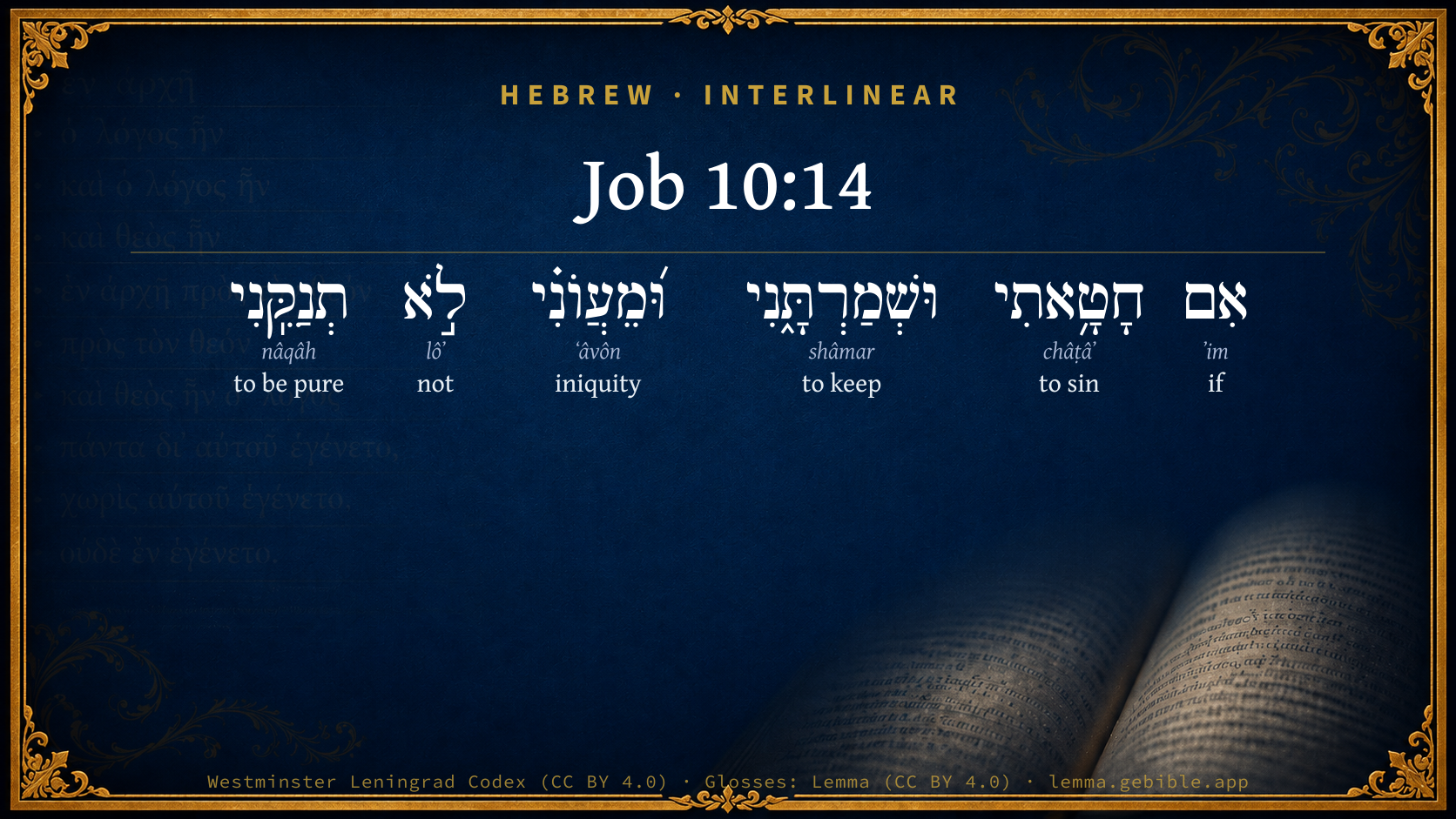
Job 10:14

Hebrew (Westminster Leningrad Codex) Job 10:14 appears in the Hebrew Old Testament. The text above is from the Westminster Leningrad Codex. Each word links to its Strong’s number, a concise gloss, and parsing drawn from the Open Scriptures Hebrew Bible morphology. Click any word for its full Brown-Driver-Briggs (BDB) entry.
Download image
Cite this verse

Job 10:14 (World English Bible). Public Domain. Lemma interlinear Bible study tool, https://lemma.gebible.app/v/job/10/14.

Show BibTeX & RIS
BibTeX
RIS
English Translation
If I sin, then you mark me. You will not acquit me from my iniquity.
World English Bible · Public Domain
Download a study sheet

One document with this verse’s original text, its word-by-word gloss line, the meaning frame, cross-references with their text, attributed commentary, and full source and license credits — printable, and it pastes into notes with its structure intact.

This verse Autodidact and up

Study sheet (.html) Plain text (.txt)

A passage Seminary Student

Up to 50 verses in one chapter. A passage sheet keeps up to 6 commentary sources and 12 cross-references per verse, in the order this page ranks them, and says so on the sheet whenever that leaves anything out. Ask for a single verse and you get the Autodidact verse sheet above.

Everything on this page stays free to read, with no account — the sheet is a download of what is already on screen, not access to it.

Want to remove ads? Support Godless Engineer
Compare translations 3

The same verse in 3 English versions, stacked beneath the original-language interlinear above. Click any original word for its lexicon entry.

Each is an independent rendering of the whole verse — the interlinear is not word-aligned to these translations.

Highlighted words mark where these versions differ — a whole-verse word diff, not a word-by-word alignment.

  • World English Bible Public Domain
    If I sin, then you mark me. You will not acquit me from my iniquity.
  • King James Version Public Domain
    If I sin, then thou markest me, and thou wilt not acquit me from mine iniquity.
  • unfoldingWord Literal Text CC BY-SA 4.0
    If I sinned, then you would notice me, and you would not acquit me of my iniquity.

unfoldingWord Literal Text — © unfoldingWord, licensed CC BY-SA 4.0. Word-aligned USFM3 via Door43 (git.door43.org/unfoldingWord/en_ult).

Versions to compare (up to 4)

3 of 4 selected

Show all 18 translations

Every available English version of this verse, each an independent rendering of the whole verse.

  • World English Bible Public Domain
    If I sin, then you mark me. You will not acquit me from my iniquity.
  • Berean Standard Bible Public Domain
    If I sinned, You would take note, and would not acquit me of my iniquity.
  • Majority Standard Bible Public Domain
    If I sinned, You would take note, and would not acquit me of my iniquity.
  • King James Version Public Domain
    If I sin, then thou markest me, and thou wilt not acquit me from mine iniquity.
  • American Standard Version (1901) Public Domain
    If I sin, then thou markest me, And thou wilt not acquit me from mine iniquity.
  • Revised Version (1885) Public Domain
    If I sin, then thou markest me, and thou wilt not acquit me from mine iniquity.
  • Geneva Bible (1599) Public Domain
    If I haue sinned, then thou wilt streightly looke vnto me, and wilt not holde mee giltlesse of mine iniquitie.
  • Douay-Rheims (1899) Public Domain
    If I have sinned and thou hast spared me for an hour: why dost thou not suffer me to be clean from my iniquity?
  • Young's Literal Translation Public Domain
    If I sinned, then Thou hast observed me, And from mine iniquity dost not acquit me,
  • Literal Standard Version CC BY-SA 4.0
    If I sinned, then You have observed me, || And do not acquit me from my iniquity,
  • Unlocked Literal Bible CC BY-SA 4.0
    that if I sinned, you would notice it; you would not acquit me of my iniquity.
  • unfoldingWord Literal Text CC BY-SA 4.0
    If I sinned, then you would notice me, and you would not acquit me of my iniquity.
  • Darby Bible Public Domain
    If I sinned, thou wouldest mark me, and thou wouldest not acquit me of mine iniquity.
  • World Messianic Bible Public Domain
    if I sin, then you mark me. You will not acquit me from my iniquity.
  • Webster's Bible Public Domain
    If I sin, then thou markest me, and thou wilt not acquit me from my iniquity.
  • Free Bible Version CC BY-SA 4.0
    to watch me, and if I sinned, then you would not forgive my wrongs.
  • Bible in Basic English Public Domain
    That, if I did wrong, you would take note of it, and would not make me clear from sin:
  • JPS Tanakh (1917) Public Domain
    If I sin, then Thou markest me, and Thou wilt not acquit me from mine iniquity.

Literal Standard Version (2020), Covenant Press — licensed CC BY-SA 4.0. Text via the HelloAO Bible API (eBible.org). Unlocked Literal Bible (unfoldingWord) — licensed CC BY-SA 4.0. Text via the HelloAO Bible API (eBible.org). unfoldingWord Literal Text — © unfoldingWord, licensed CC BY-SA 4.0. Word-aligned USFM3 via Door43 (git.door43.org/unfoldingWord/en_ult). Free Bible Version, Dr. Jonathan Gallagher — licensed CC BY-SA 4.0. Text via the HelloAO Bible API (eBible.org).

Word by word

More ways to search: Search by grammar → Find every occurrence → Compare this word →

Practice this passage: Drill this verse → Learn its vocabulary →

תְנַקֵּֽנִי
nâqâh
H5352
“to be pure · me”
Verb, Piel, Imperfect, 2nd Person, Masculine, Singular + Suffix, Personal, 1st Person, Common, Singular
Part of Speech
Verb
Stem
Piel
Form
Imperfect
Person
2nd Person
Gender
Masculine
Number
Singular
Full BDB Definition

Origin: a primitive root

TWOT: 1412

to be empty, be clear, be pure, be free, be innocent, be desolate, be cut off - (Qal) to be empty, be clean, be pure - (Niphal) - to be cleaned out, be purged out - to be clean, be free from guilt, be innocent - to be free, be exempt from punishment - to be free, be exempt from obligation - (Piel) - to hold innocent, acquit - to leave unpunished
  1. אִם ʼim H518 “if” Conjunction
  2. חָטָ֥אתִי châṭâʼ H2398 “to sin” Verb, Qal, Perfect, 1st Person, Common, Singular
  3. וּשְׁמַרְתָּ֑נִי shâmar H8104 “and · to keep · me” Conjunction + Verb, Qal, Sequential Perfect, 2nd Person, Masculine, Singular + Suffix, Personal, 1st Person, Common, Singular
  4. וּ֝מֵעֲוֺנִ֗י ʻâvôn H5771 “and · from · iniquity · my” Conjunction + Preposition + Noun, Common, Both, Singular, Construct + Suffix, Personal, 1st Person, Common, Singular
  5. לֹ֣א lôʼ H3808 “not” Particle, Negative

About this verse

These counts appear in no published source. They are computed here, from the morphology-tagged text and Lemma’s own curated glosses. What Lemma adds →

6
words
6
distinct lemmas
Wisdom
section

Shared distinctive vocabulary

תְנַקֵּֽנִי to be pure H5352 occurs in 33 verses of the Hebrew Bible. Also found in:

Grammatical profile

  • 3 verbs
  • 1 noun
  • 1 conjunction
  • 1 particle

Verb forms

  • חָטָ֥אתִי Qal · Perfect
  • וּשְׁמַרְתָּ֑נִי Qal · Sequential Perfect
  • תְנַקֵּֽנִי Piel · Imperfect

Hebrew & Septuagint length

In English translation the verse runs 15 words from the Hebrew and 16 from the Septuagint (LXX English) — closely comparable.

A rough comparison of the two English renderings, which tokenize alike — not a word-level alignment.

Word counts can differ between the Hebrew and the Greek without any difference in meaning — e.g. the Hebrew direct-object marker אֵת has no separate Greek word, and Greek often adds the article ὁ.

Cross-references

8

Topical passages linked to Job 10:14 in the Treasury of Scripture Knowledge — connected by theme and wording, ordered by reader-vote popularity; previews shown in the World English Bible.

  • Job 7:21 Why do you not pardon my disobedience, and take away my iniquity? For now shall I lie down in the dust. You will seek me diligently, but I shall not be."
  • Psalms 130:3 If you, Yah, kept a record of sins, Lord, who could stand?
  • Exodus 34:7 keeping loving kindness for thousands, forgiving iniquity and disobedience and sin; and that will by no means clear the guilty, visiting the iniquity of the fathers on the children, and on the children's children, on the third and on the fourth generation."
  • Numbers 14:18 Yahweh is slow to anger, and abundant in loving kindness, forgiving iniquity and disobedience; and that will by no means clear [the guilty], visiting the iniquity of the fathers on the children, on the third and on the fourth generation.
  • Job 9:28 I am afraid of all my sorrows, I know that you will not hold me innocent.
  • Job 13:26–27 For you write bitter things against me, And make me inherit the iniquities of my youth:
  • Psalms 139:1 Yahweh, you have searched me, And you know me.
  • Job 14:16 But now you number my steps. Don't you watch over my sin?

Cross-references courtesy of OpenBible.info (CC BY 4.0).

Hebrew and Greek witnesses Masoretic Hebrew ↔ Greek Septuagint

The same verse in the two great witnesses to the Old Testament, shown verse-for-verse.

These are two independent witnesses, not word-aligned to each other, and the Septuagint is shown in lemma (dictionary) form.

Hebrew Job 10:14 Masoretic · Westminster Leningrad Codex

אִם חָטָ֥אתִי וּשְׁמַרְתָּ֑נִי וּ֝מֵעֲוֺנִ֗י לֹ֣א תְנַקֵּֽנִי

If I sin, then you mark me. You will not acquit me from my iniquity.

World English Bible · Public Domain

Greek LXX Job 10:14 Septuagint · lemma form

ἐάν τε γάρ ἁμαρτάνω φυλάσσω ἐγώ ἀπό δέ ἀνομία οὐ ἀθῷος ἐγώ ποιέω

And if I should sin, you watch me; and you have not cleared me from iniquity.

LXX2012 (modern English Septuagint) · Public Domain

Hebrew: Westminster Leningrad Codex (CC BY 4.0). Greek: Septuagint (public domain); English from LXX2012 (modern English Septuagint) (Public Domain). How the Septuagint differs from the Hebrew →

Commentary

Notes on Job 10:14 from classic Christian and Jewish commentators (each source and its license shown beneath its notes). The classic Christian expositions comment on the surrounding passage and are grouped to its opening verse, so a note may address several verses; the Jewish commentaries on the Tanakh (Rashi and others) are per-verse, so they appear only where the commentator wrote on this verse.

Lemma curates 59 commentaries, every one of them public domain or Creative Commons licensed, each selected and text-cleaned for this edition rather than reprinted as found. About our sources →

Matthew Henry's Commentary

Here we have,

I. Job's passionate complaints. On this harsh and unpleasant string he harps much, in which, though he cannot be justified, he may be excused. He complained not for nothing, as the murmuring Israelites, but had cause to complain. If we think it looks ill in him, let it be a warning to us to keep our temper better.

1. He complains of the strictness of God's judgment and the rigour of his proceedings against him, and is ready to call it summum jus - justice bordering on severity. (1.) That he took all advantages against him: "If I sin, then thou markest me, Job 10:14.(1.) If I do but take one false step, misplace a word, or cast a look awry, I shall be sure to hear of it. Conscience, thy deputy, will be sure to upbraid me with it, and to tell me that this gripe, this twitch of pain, is to punish me for that." If God should thus mark iniquities, we should be undone; but we must acknowledge the contrary, that, though we sin, God does not deal in extremity with us. (2.) That he prosecuted those advantages to the utmost: Thou wilt not acquit me from my iniquity. While his troubles he could not take the comfort of his pardon, nor hear that voice of joy and gladness; so hard is it to see love in God's heart when we see frowns in his face and a rod in his hand. (3.) That, whatever was his character, his case at present was very uncomfortable, Job 10:15. [1.] If he be wicked, he is certainly undone in the other world: If I be wicked, woe to me. Note, A sinful state is a woeful state. This we should each of us believe, as Job here, with application to ourselves: "If I be wicked, though prosperous and living in pleasure, yet woe to me." Some especially have reason to dread double woes if they be wicked. "I that have knowledge, that have made a great profession of religion, that have been so often under strong convictions, and have made so many fair promises - I that was born of such good parents, blessed with a good education, that have lived in good families, and long enjoyed the means of grace - if I be wicked, woe, and a thousand woes, to me." [2.] If he be righteous, yet he dares not lift up his head, dares not answer as before, Job 9:15. He is so oppressed and overwhelmed with his troubles that he cannot look up with any comfort or confidence. Without were fightings, within were fears; so that, between both, he was full of confusion, not only confusion of face for the disgrace he was brought down to and the censures of his friends, but confusion of spirit; his mind was in a constant hurry, and he was almost distracted, Psa 88:15.

2. He complains of the severity of the execution. God (he thought) did not only punish him for every failure, but punish him in a high degree, Job 10:16, Job 10:17. His affliction was, (1.) Grievous, very grievous, marvellous, exceedingly marvellous. God hunted him as a lion, as a fierce lion hunts and runs down his prey. God was not only strange to him, but showed himself marvellous upon him, by bringing him into uncommon troubles and so making him prodigy, a wonder unto many. All wondered that God would inflict and that Job could bear so much. That which made his afflictions most grievous was that he felt God's indignation in them; it was this that made them taste so bitter and lie so heavy. They were God's witnesses against him, tokens of his displeasure; this made the sores of his body wounds in his spirit. (2.) It was growing, still growing worse and worse. This he insists much upon; when he hoped the tide would turn, and begin to ebb, still it flowed higher and higher. His affliction increased, and God's indignation in the affliction. He found himself no better, no way better. These witnesses were renewed against him, that, if one did not reach to convict him, another might. Changes and war were against him. If there was any change with him, it was not for the better; still he was kept in a state of war. As long as we are here in this world we must expect that the clouds will return after the rain, and perhaps the sorest and sharpest trials may be reserved for the last. God was at war with him, and it was a great change. He did not use to be so, which aggravated the trouble and made it truly marvellous. God usually shows himself kind to his people; if at any time he shows himself otherwise, it is his strange work, his strange act, and he does in it show himself marvellous.

3. He complains of his life, and that ever he was born to all this trouble and misery (Job 10:18, Job 10:19): "If this was designed for my lot, why was I brought out of the womb, and not smothered there, or stifled in the birth?" This was the language of his passion, and it was a relapse into the same sin he fell into before. He had just now called life a favour (Job 10:12), yet now he calls it a burden, and quarrels with God for giving it, or rather laying it upon him. Mr. Caryl gives this a good turn in favour of Job. "We may charitably suppose," says he, "that what troubled Job was that he was in a condition of life which (as he conceived) hindered the main end of his life, which was the glorifying of God. His harp was hung on the willow-tress, and he was quite out of tune for praising God. Nay, he feared lest his troubles should reflect dishonour upon God and give occasion to his enemies to blaspheme; and therefore he wishes, O that I had given up the ghost! A godly man reckons that he lives to no purpose if he do not live to the praise and glory of God." If that was his meaning, it was grounded on a mistake; for we may glorify the Lord in the fires. But this use we may make of it, not to be over-fond of life, since the case has been such sometimes, even with wise and good men, that they have complained of it. Why should we dread giving up the ghost, or covet to be seen of men, since the time may come when we may be ready to wish we had given up the ghost and no eye had seen us? Why should we inordinately lament the death of our children in their infancy, that are as if they had not been, and are carried from the womb to the grave, when perhaps we ourselves may sometimes wish it had been our own lot?

II. Job's humble requests. He prays, 1. That God would see his affliction (Job 10:15), take cognizance of his case, and take it into his compassionate consideration. Thus David prays (Psa 25:18), Look upon my affliction and my pain. Thus we should, in our troubles, refer ourselves to God, and may comfort ourselves with this, that he knows our souls in adversity. 2. That God would grant him some ease. If he could not prevail for the removal of his trouble, yet might he not have some intermission? "Lord, let me not be always upon the rack, always in extremity: O let me alone, that I may take comfort a little! Job 10:20. Grant me some respite, some breathing-time, some little enjoyment of myself." This he would reckon a great favour. Those that are not duly thankful for constant ease should think how welcome one hour's ease would be if they were in constant pain. Two things he pleads: - (1.) That life and its light were very short: "Are not my days few? Job 10:20. Yes, certainly they are, very few. Lord, let them not be all miserable, all in the extremity of misery. I have but a little time to live; let me have some comfort of life while it does last." This plea fastens on the goodness of God's nature, the consideration of which is very comfortable to an afflicted spirit. And, if we would use this as a plea with God for mercy ("Are not my days few? Lord, pity me"), we should use it as a plea with ourselves, to quicken us to duty: "Are not my days few? Then it concerns me to redeem time, to improve opportunities, what my hand finds to do to do it with all my might, that I may be ready for the days of eternity, which shall be many." (2.) That death and its darkness were very near and would be very long (Job 10:21, Job 10:22): "Lord, give me some ease before I die," that is, "lest I die of my pain." Thus David pleads (Psa 13:3), "Lest I sleep the sleep of death, and then it will be too late to expect relief; for wilt thou show wonders to the dead?" Psa 88:10. "Let me have a little comfort before I die, that I may take leave of this world calmly, and not in such confusion as I am now in." Thus earnest should we be for grace, and thus we should plead, "Lord, renew me in the inward man; Lord, sanctify me before I die, for otherwise it will never be done." See how he speaks here of the state of the dead. [1.] It is a fixed state, whence we shall not return ever again to live such a life as we now live, Job 7:10. At death we must bid a final farewell to this world. The body must then be laid where it will lie long, and the soul adjudged to that state in which it must be for ever. That had need be well done which is to be done but once, and done for eternity. [2.] It is a very melancholy state; so it appears to us. Holy souls, at death, remove to a land of light, where there is no death; but their bodies they leave to a land of darkness and the shadow of death. He heaps up expressions here of the same import to show that he has as dreadful apprehensions of death and the grave as other men naturally have, so that it was only the extreme misery he was in that made him wish for it. Come and let us look a little into the grave, and we shall find, First, That there is no order there: it is without any order, perpetual night, and no succession of day. All there lie on the same level, and there is no distinction between prince and peasant, but the servant is there free from his master, Job 3:19. No order is observed in bringing people to the grave, not the eldest first, not the richest, not the poorest, and yet every one in his own order, the order appointed by the God of life. Secondly, That there is no light there. In the grave there is thick darkness, darkness that cannot be felt indeed, yet cannot but be feared by those that enjoy the light of life. In the grave there is no knowledge, no comfort, no joy, no praising God, no working out our salvation, and therefore no light. Job was so much ashamed that others should see his sores, and so much afraid to see them himself, that the darkness of the grave, which would hide them and huddle them up, would upon that account be welcome to him. Darkness comes upon us; and therefore let us walk and work while we have the light with us. The grave being a land of darkness, it is well we are carried thither with our eyes closed, and then it is all one. The grave is a land of darkness to man; our friends that have gone thither we reckon removed into darkness, Psa 88:18. But that it is not so to God will appear by this, that the dust of the bodies of the saints, though scattered, though mingled with other dust, will none of it be lost, for God's eye is upon every grain of it and it shall be forth-coming in the great day.

Matthew Henry's Commentary on the Whole Bible (1708–1710) — public domain (CC PDM 1.0). Text via the HelloAO Bible API.

Trapp's Complete Commentary

John Trapp

Job 10:14 If I sin, then thou markest me, and thou wilt not acquit me from mine iniquity.

Ver. 14. If I sin, then thou markest me] Though through human frailty only I offend ( et nimis dedignatur mortalitatem qui peccasse erubescit), thou soon notest it, thou followest me up and down, as it were, with pen, ink, and paper, to set down my faults (Euphorm.). How, then say some, that God sees not sin in his children? Job thought the Lord was overstrict with him (which yet could not be), and that he put no difference between him and those that were notoriously wicked, as the next words import.

And thou wilt not acquit me from mine iniquity] That is, from the punishment of mine iniquity. Verba diffidentis, saith Mercer; words spoken according to the judgment of the flesh, saith Diodati, which holdeth God’s visitations to be punishments and vengeances.

John Trapp, A Commentary or Exposition upon All the Books of the Old and New Testament (1647–1656) — public domain. Text from a community e-Sword module.

Joseph Benson's Commentary

Job 10:14. If I sin — If I commit the least sin; then thou markest me — Thou dost not connive at, or pass by my sins, but dost severely and diligently observe them all, that thou mayest punish me. And thou wilt not acquit me from mine iniquity — Wilt not pardon, pity, and help me, but art resolved to punish me with rigour: words of great impatience and distrust. But he was so oppressed and overwhelmed with his troubles that it seems he could not look up with any comfort or confidence. Without were fightings, within were fears, so that between both he was full of confusion.

Joseph Benson's Commentary on the Old and New Testaments (1811–1818) — public domain. Text from a community e-Sword module.

Whedon's Commentary on the Bible

Daniel D. Whedon

14. If I (should) sin — The purpose Job thinks he has discovered, the Almighty carries into execution, whatever may be man’s moral character. He supposes four conditions of life: first, that of the ordinary sinner, (Job_10:14;) second, that of the gross and willful transgressor, (15 a;) third, that of the righteous, such as Job claimed to be, (15 b;) fourth, that of those consciously proud of guiltlessness, (Pharisaical righteousness,) as seems implied in “the head lift itself up.” Job_10:16. The two suppositions of irreligious life are offset to the two of religious life, and make what Ewald truly calls “a horrible tetralemma” — a cruel fourfold net.

Daniel D. Whedon (gen. ed.), Commentary on the Old and New Testaments (1874–1909) — public domain. Text from a community e-Sword module.

Jamieson, Fausset & Brown

Robert Jamieson, A. R. Fausset & David Brown

Job is perplexed because God "marks" every sin of his with such ceaseless rigor. Whether "wicked" (godless and a hypocrite) or "righteous" (comparatively sincere), God condemns and punishes alike.

Jamieson, Fausset & Brown — Commentary Critical and Explanatory on the Whole Bible (1871) — public domain (CC PDM 1.0). Text via the HelloAO Bible API.

Adam Clarke's Commentary

Verse 14. If I sin] From thee nothing can be hidden; if I sin, thou takest account of the transgression, and canst not hold me for innocent when thou knowest I am guilty.

Adam Clarke's Commentary on the Bible (1810–1826) — public domain. Text from a community e-Sword/MySword module.

Ellicott's Commentary for English Readers

(14) If I sin . . .—“If I had sinned Thou wouldst have marked me for punishment, and from mine iniquity Thou wouldst not acquit me. If I had been guilty, woe unto me 1 and if righteous, I must not lift up my head like an innocent person. I am full of shame, therefore behold Thou mine affliction, for only by Thy taking note of it can I find relief.”

A Bible Commentary for English Readers, edited by Charles John Ellicott (1878–1897) — public domain. Text from a community e-Sword module.

The Cambridge Bible for Schools and Colleges

gen. ed. J. J. S. Perowne

14. If I sin, then thou markest] Rather, if I sinned then thou wouldst mark. Similarly, wouldst not acquit. “To sin” here appears to mean, to be guilty of trivial sins (ch. Job_7:20, Job_13:26); if he sinned even venially his sin would be held in remembrance against him and not remitted. This is the first supposition included in the Divine purpose with Job.

The Cambridge Bible for Schools and Colleges (gen. ed. J. J. S. Perowne; Cambridge University Press, 1878–1918) — public domain. Text from a community e-Sword module.

John Gill's Exposition

If I be wicked, woe is me,.... In this world, and to all eternity; afflictions will abide me here, and everlasting wrath hereafter: these are the woes that belong to a wicked man; that is, a profane and abandoned sinner, that lives in sin, and gives up himself to all manner of wickedness; the Targum is,"destruction to me from the great judgment;''utter ruin is my portion, as it is of all wicked and unrighteous persons, Isa 3:11,

and if I be righteous, yet will I not lift up my head; live a holy life and conversation, be righteous in the sight of men, and behave so as not to know anything by himself, nor to be conscious of living in any known sin; yet he could not take any comfort from it, or have any pleasure in it, or speak peace to himself on account of it, or glory in it and make his boast of it; or lift up his head before God with boldness and confidence, who is so pure and holy, and his eyes so quick in discerning the sins of men: a good man derives his peace and comfort, not from his own righteousness, but from the righteousness of Christ, and puts his confidence in that only; he blushes, and is ashamed of his own; and cannot, nay, "dare not lift up his head", as Mr. Broughton, the Tigurine version, and others render it, through shame, being sensible that nothing of his own can stand before an holy God, or give him joy, peace, and pleasure there; the Targum adds, "before the ungodly"; but this a man may do before men, when he cannot before God:

I am full of confusion; being in such a dilemma; let him be what he would, he was sure to have affliction, sorrow, and distress, so that he knew not what to say or do; or "reproach" (z), which he was loaded with by his friends, and was occasioned by his afflictions, they judging from thence that he was a wicked man, and justly punished for his sins; the word used signifies a burning heat, such as a than feels in his breast, and which flushes in his face, when he is filled with anger or with shame:

therefore see thou mine affliction; not with his eye of omniscience, that he knew he did, but with an eye of pity and compassion, and deliver him from it; or, "I am full with seeing mine affliction", as Jarchi; or, "I am one that sees affliction" (a); that has an experience of it; sees it all around me, and nothing else, Lam 3:1; am a "spectator" (b) of it, as some render it; but not a mere spectator, but one that has a sensible feeling of it: some take this and the former clause both to be an address to God, and render them, "be satisfied with confusion, and behold my affliction", as Broughton and others (c); let the present calamity and confusion I am in be sufficient; let no more be laid upon me; be content with what has been done, and pity me, and do not lay thine hand heavier upon me, and add to my afflictions, as he thought he did, by what follows.

(z) "contumeliis", Tigurine version; "ignominia", Pagninus, Montanus, Beza, Vatablus, Mercerus, Piscator, Michaelis. (a) "et videns afflictionem", Beza, Vatablus, Mercerus, Piscator. (b) "Et spectator adflictionis meae", Schultens. (c) "Satiare ignominia", Junius & Tremellius.

John Gill's Exposition of the Whole Bible (1746–1763) — public domain (CC PDM 1.0). Text via the HelloAO Bible API.

Albert Barnes' Notes on the Bible

If I sin - The object of this verse and the following is, evidently, to say that he was wholly perplexed. He did not know how to act. He could not understand the reason of the divine dealings, and he was wholly unable to explain them, and hence, he did not know how to act in a proper manner. It is expressive of a state of mind where the individual wishes to think and feel right, but where he finds so much to perplex him, that he does not know what to do. Job was sure that his friends were not right in the position which they maintained - that he was a sinner of enormous character, and that his sufferings were proof of this, and yet he did not know how to answer their arguments. He desired to have confidence in God, and yet he knew not how to reconcile his dealings with his sense of right. He felt that he was a friend of God, and he did not know why he should visit one who had this consciousness in this distressing and painful manner. His mind was perplexed, vacillating, embarrassed, and he did not know what to do or say. The truth in this whole argument was, that he was more often right than his friends, but that he, in common with them, had embraced some principles which he was compelled to admit to be true, or which he could not demonstrate to be false, which gave them greatly the advantage in the argument, and which they pressed upon him now with overwhelming force.

Then thou markest me - Dost carefully observe every fault. Why he did this, Job could not see. The same difficulty he expressed in Job 7:17-19; see the notes at that place.

And wilt not acquit me - Wilt not pardon me. Job did not understand why God would not do this. It was exceedingly perplexing to him that God held him to be guilty, and would not pardon him if he had sinned. The same perplexity he expressed in Job 7:21; see the note at that verse.

Albert Barnes' Notes on the Bible (1834–1885) — public domain. Text from a community e-Sword/MySword module.

Haydock's Catholic Bible Commentary

Iniquity? Punishing me for the sins which seemed to be pardoned. (Calmet) --- Hebrew, "If I sin, then thou makest me, and wilt not suffer; (Haydock) or if thou hast not pardoned my iniquity: (15) And," &c. (Calmet)

George Leo Haydock (1774–1849), Haydock's Catholic Family Bible and Commentary, 1859 edition — public domain. Excludes Psalms (Douay-Rheims chapter numbering differs from Protestant) and Deuterocanonical books (Catholic canon only).

Matthew Poole's English Annotations

If I commit the least sin, (as who is there that liveth, and sinneth not?) thou dost not wink at or pass by my sins, as thou usually dost other men’s, but dost severely and diligently observe them all, that thou mayst punish them: compare Job 14:16; 31:4.

Thou wilt not acquit me from mine iniquity; I perceive thou art resolved to punish me with rigour, and that thou wilt not pardon, and pity, and help me: words of great impatience and distrust.

Matthew Poole's English Annotations on the Holy Bible (1683–1685) — public domain. Text from a community e-Sword/MySword module.

The Pulpit Commentary

If I sin, then thou markest me; rather, if I sinned then thou didst observe me. Thou tookest note of all my sins as I committed them, and laidest them up in thy memory. And thou wilt not acquit me from mine iniquity . This record of my offences thou still hast against me, and I cannot expect that thou wilt acquit me of them. Without some one to atone for them, men cannot be acquitted of their offences.

The Pulpit Commentary (1880–1919), ed. H.D.M. Spence-Jones & Joseph S. Exell — public domain. Text from a community e-Sword module.

John Wesley's Explanatory Notes

Markest - If I am a wicked man, I cannot hide it from thee; and thou wilt punish me for it.

John Wesley, Explanatory Notes Upon the Whole Bible (1754–1765) — public domain. Text via the GEBible commentary corpus.

Rashi

Rabbi Shlomo Yitzchaki (Rashi)

If I sinned, You watched me You laid Your eyes on me so as not to ignore [my sins] nor to forbear retaliation, and [from now on] You are not cleansing me of my iniquity but are requiting me for everything.

Rashi on the Tanakh — English translations: “The Judaica Press complete Tanach with Rashi, translated by A. J. Rosenberg” (CC BY 4.0); “Pentateuch with Rashi's commentary by M. Rosenbaum and A.M. Silbermann, 1929-1934” (public domain); “The Metsudah Tanach series, Lakewood, N.J” (CC BY 4.0); and “The Book of Joshua, Metsudah Publications, 1997” (CC BY 4.0). Text via Sefaria.

Lesson kit

Teaching starters — assembled from the data on this page, not authored interpretation. Every prompt links to the verse data it draws on. Edit before teaching.

Job, in the Wisdom, opens this verse with 6 words (6 distinct Hebrew lemmas). Its most distinctive word is nâqâh (“to be pure”). A historical commentator’s framing appears above. Read the whole chapter for the surrounding context.

Discussion questions

  1. What does “to be pure” (nâqâh) contribute to the verse as a whole?
  2. How does Genesis 24:8, which shares the word «to be pure», read alongside this verse?
  3. These translations render this verse differently; the difference is in the English rendering, not the original. What questions does that raise?
  4. «חָטָ֥אתִי» is a Qal Perfect verb. How does that grammatical form shape the action described?
  5. Compare how Matthew Henry's Commentary and Trapp's Complete Commentary read this verse. Where do they agree or differ?

Things to notice

Reading settings

Reading text

Shown beneath each verse's original-language words.

Old Testament
Old Testament edition

Read the OT as the Masoretic Hebrew (MT) or the Greek Septuagint (LXX).

English shown for the Greek Septuagint (in the Hebrew ↔ Greek comparison).

Comparing translations? Open the Compare panel on any verse page to stack up to four side by side.