
Exodus 32:33

Hebrew (Westminster Leningrad Codex) Exodus 32:33 appears in the Hebrew Old Testament. The text above is from the Westminster Leningrad Codex. Each word links to its Strong’s number, a concise gloss, and parsing drawn from the Open Scriptures Hebrew Bible morphology. Click any word for its full Brown-Driver-Briggs (BDB) entry.
Download image
Cite this verse

Exodus 32:33 (World English Bible). Public Domain. Lemma interlinear Bible study tool, https://lemma.gebible.app/v/exodus/32/33.

Show BibTeX & RIS
BibTeX
RIS
English Translation
Yahweh said to Moses, "Whoever has sinned against me, him will I blot out of my book.
World English Bible · Public Domain
Download a study sheet

One document with this verse’s original text, its word-by-word gloss line, the meaning frame, cross-references with their text, attributed commentary, and full source and license credits — printable, and it pastes into notes with its structure intact.

This verse Autodidact and up

Study sheet (.html) Plain text (.txt)

A passage Seminary Student

Up to 50 verses in one chapter. A passage sheet keeps up to 6 commentary sources and 12 cross-references per verse, in the order this page ranks them, and says so on the sheet whenever that leaves anything out. Ask for a single verse and you get the Autodidact verse sheet above.

Everything on this page stays free to read, with no account — the sheet is a download of what is already on screen, not access to it.

Want to remove ads? Support Godless Engineer
Compare translations 3

The same verse in 3 English versions, stacked beneath the original-language interlinear above. Click any original word for its lexicon entry.

Each is an independent rendering of the whole verse — the interlinear is not word-aligned to these translations.

Highlighted words mark where these versions differ — a whole-verse word diff, not a word-by-word alignment.

  • World English Bible Public Domain
    Yahweh said to Moses, "Whoever has sinned against me, him will I blot out of my book.
  • King James Version Public Domain
    And the LORD said unto Moses, Whosoever hath sinned against me, him will I blot out of my book.
  • unfoldingWord Literal Text CC BY-SA 4.0
    But Yahweh said to Moses, “Whoever that sinned against me, I will blot him out from my book.

unfoldingWord Literal Text — © unfoldingWord, licensed CC BY-SA 4.0. Word-aligned USFM3 via Door43 (git.door43.org/unfoldingWord/en_ult).

Versions to compare (up to 4)

3 of 4 selected

Show all 18 translations

Every available English version of this verse, each an independent rendering of the whole verse.

  • World English Bible Public Domain
    Yahweh said to Moses, "Whoever has sinned against me, him will I blot out of my book.
  • Berean Standard Bible Public Domain
    The LORD replied to Moses, “Whoever has sinned against Me, I will blot out of My book.
  • Majority Standard Bible Public Domain
    The LORD replied to Moses, “Whoever has sinned against Me, I will blot out of My book.
  • King James Version Public Domain
    And the LORD said unto Moses, Whosoever hath sinned against me, him will I blot out of my book.
  • American Standard Version (1901) Public Domain
    And Jehovah said unto Moses, Whosoever hath sinned against me, him will I blot out of my book.
  • Revised Version (1885) Public Domain
    And the LORD said unto Moses, Whosoever hath sinned against me, him will I blot out of my book.
  • Geneva Bible (1599) Public Domain
    Then the Lord sayd to Moses, Whosoeuer hath sinned against me, I will put out of my booke.
  • Douay-Rheims (1899) Public Domain
    And the Lord answered him: He that hath sinned against me, him will I strike out of my book:
  • Young's Literal Translation Public Domain
    And Jehovah saith unto Moses, `Whoso hath sinned against Me -- I blot him out of My book;
  • Literal Standard Version CC BY-SA 4.0
    And YHWH says to Moses, “Whoever has sinned against Me—I blot him out of My scroll;
  • Unlocked Literal Bible CC BY-SA 4.0
    Yahweh said to Moses, “Whoever has sinned against me, that person I will blot out of my book.
  • unfoldingWord Literal Text CC BY-SA 4.0
    But Yahweh said to Moses, “Whoever that sinned against me, I will blot him out from my book.
  • Darby Bible Public Domain
    And Jehovah said to Moses, Whoever hath sinned against me, him will I blot out of my book.
  • World Messianic Bible Public Domain
    The LORD said to Moses, “Whoever has sinned against me, I will blot him out of my book.
  • Webster's Bible Public Domain
    And the LORD said to Moses, Whoever hath sinned against me, him will I blot out of my book.
  • Free Bible Version CC BY-SA 4.0
    But the Lord replied to Moses, “It's those who sinned against me who will be blotted out of my scroll.
  • Bible in Basic English Public Domain
    And the Lord said to Moses, Whoever has done evil against me will be taken out of my book.
  • JPS Tanakh (1917) Public Domain
    And the LORD said unto Moses: 'Whosoever hath sinned against Me, him will I blot out of My book.

Literal Standard Version (2020), Covenant Press — licensed CC BY-SA 4.0. Text via the HelloAO Bible API (eBible.org). Unlocked Literal Bible (unfoldingWord) — licensed CC BY-SA 4.0. Text via the HelloAO Bible API (eBible.org). unfoldingWord Literal Text — © unfoldingWord, licensed CC BY-SA 4.0. Word-aligned USFM3 via Door43 (git.door43.org/unfoldingWord/en_ult). Free Bible Version, Dr. Jonathan Gallagher — licensed CC BY-SA 4.0. Text via the HelloAO Bible API (eBible.org).

Word by word

More ways to search: Search by grammar → Find every occurrence → Compare this word →

Practice this passage: Drill this verse → Learn its vocabulary →

אֶמְחֶ֖נּוּ
mâchâh
H4229
“to wipe out · him”
Verb, Qal, Imperfect, 1st Person, Common, Singular + Suffix, Personal, 3rd Person, Masculine, Singular
Part of Speech
Verb
Stem
Qal
Form
Imperfect
Person
1st Person
Gender
Common
Number
Singular
Full BDB Definition

Origin: a primitive root

TWOT: 1178 , 1179 , 1181c

to wipe, wipe out - (Qal) - to wipe - to blot out, obliterate - to blot out, exterminate - (Niphal) - to be wiped out - to be blotted out - to be exterminated - (Hiphil) to blot out (from memory) - (Qal) to strike - (Pual) full of marrow (participle)
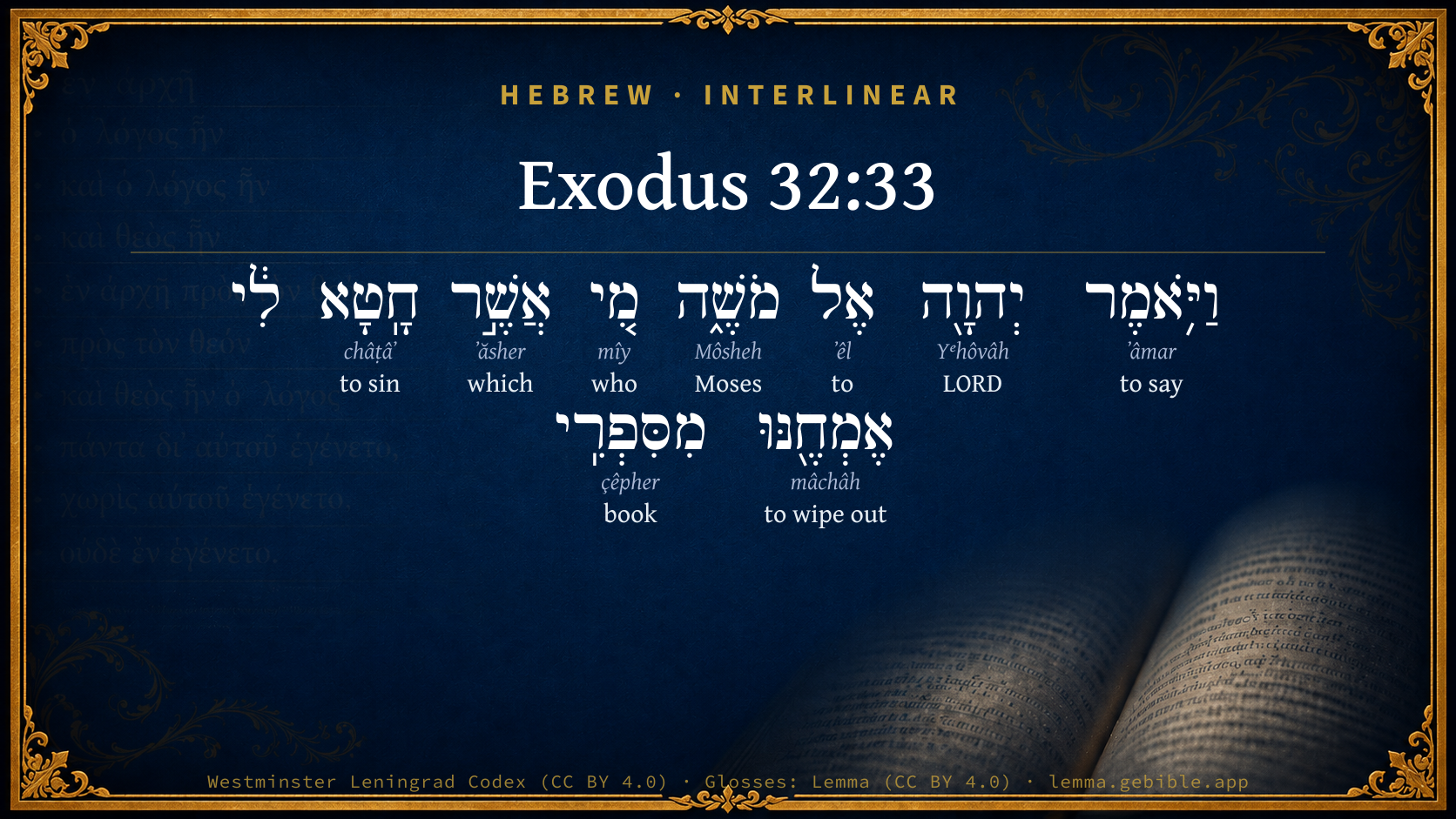
  1. וַיֹּ֥אמֶר ʼâmar H559 “and · to say” Conjunction + Verb, Qal, Sequential Imperfect, 3rd Person, Masculine, Singular
  2. יְהוָ֖ה Yᵉhôvâh H3068 “LORD” Noun, Proper
  3. אֶל ʼêl H413 “to” Preposition
  4. מֹשֶׁ֑ה Môsheh H4872 “Moses” Noun, Proper
  5. מִ֚י mîy H4310 “who” Particle, Interrogative
  6. אֲשֶׁ֣ר ʼăsher H834 “which” Particle, Relative
  7. חָֽטָא châṭâʼ H2398 “to sin” Verb, Qal, Perfect, 3rd Person, Masculine, Singular
  8. מִסִּפְרִֽי çêpher H5612 “from · book · my” Preposition + Noun, Common, Masculine, Singular, Construct + Suffix, Personal, 1st Person, Common, Singular

About this verse

These counts appear in no published source. They are computed here, from the morphology-tagged text and Lemma’s own curated glosses. What Lemma adds →

10
words
9
distinct lemmas
Pentateuch
section

Shared distinctive vocabulary

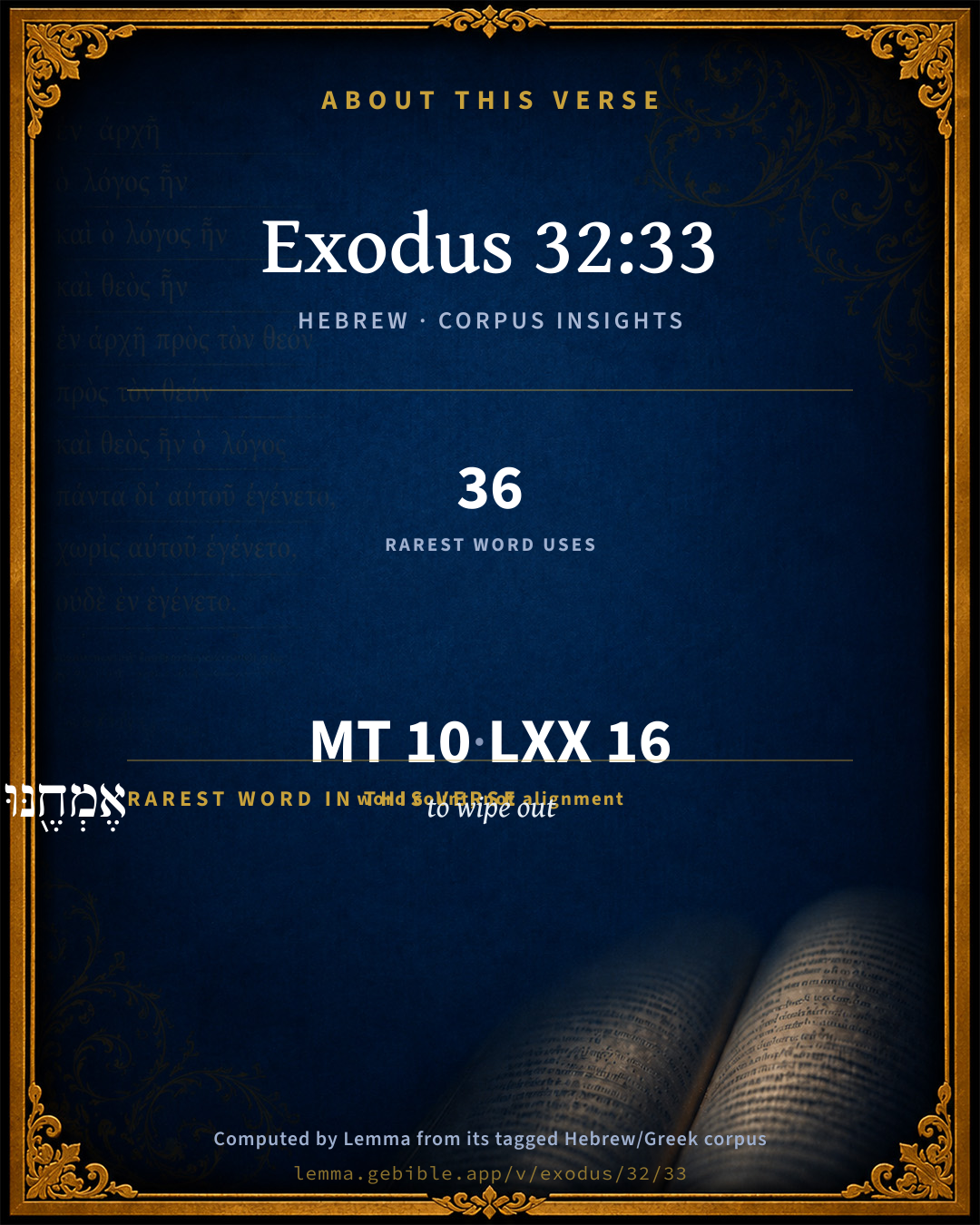
אֶמְחֶ֖נּוּ to wipe out H4229 occurs in 32 verses of the Hebrew Bible. Also found in:

Grammatical profile

  • 3 verbs
  • 3 nouns
  • 2 prepositions
  • 2 particles

Verb forms

  • וַיֹּ֥אמֶר Qal · Sequential Imperfect
  • חָֽטָא Qal · Perfect
  • אֶמְחֶ֖נּוּ Qal · Imperfect

Hebrew & Septuagint length

In English translation the verse runs 17 words from the Hebrew and 21 from the Septuagint (LXX English) — closely comparable.

A rough comparison of the two English renderings, which tokenize alike — not a word-level alignment.

Word counts can differ between the Hebrew and the Greek without any difference in meaning — e.g. the Hebrew direct-object marker אֵת has no separate Greek word, and Greek often adds the article ὁ.

In the original languages it is 10 Hebrew tokens and 16 Greek tokens — but the two are counted differently (Hebrew bundles its prefixes and suffixes into one token; the Greek is in lemma form), so that isn’t a like-for-like length.

Cross-references

9

Topical passages linked to Exodus 32:33 in the Treasury of Scripture Knowledge — connected by theme and wording, ordered by reader-vote popularity; previews shown in the World English Bible.

  • Deuteronomy 29:20 Yahweh will not pardon him, but then the anger of Yahweh and his jealousy will smoke against that man, and all the curse that is written in this book shall lie on him, and Yahweh will blot out his name from under the sky.
  • Ezekiel 18:4 Behold, all souls are mine; as the soul of the father, so also the soul of the son is mine: the soul who sins, he shall die.
  • Leviticus 23:30 Whoever it is who does any manner of work in that same day, that person I will destroy from among his people.
  • Psalms 69:28 Let them be blotted out of the book of life, And not be written with the righteous.
  • Revelation 20:12 I saw the dead, the great and the small, standing before the throne, and they opened books. Another book was opened, which is the book of life. The dead were judged out of the things which were written in the books, according to their works.
  • Psalms 9:5 You have rebuked the nations. You have destroyed the wicked. You have blotted out their name forever and ever.
  • Philippians 4:3 Yes, I beg you also, true yoke-fellow, help these women, for they labored with me in the Gospel, with Clement also, and the rest of my fellow workers, whose names are in the book of life.
  • Psalms 109:13–14 Let his posterity be cut off. In the generation following let their name be blotted out.
  • Revelation 13:8 All who dwell on the earth will worship him, everyone whose name has not been written from the foundation of the world in the book of life of the Lamb who has been killed.

Cross-references courtesy of OpenBible.info (CC BY 4.0).

Hebrew and Greek witnesses Masoretic Hebrew ↔ Greek Septuagint

The same verse in the two great witnesses to the Old Testament, shown verse-for-verse.

These are two independent witnesses, not word-aligned to each other, and the Septuagint is shown in lemma (dictionary) form.

Hebrew Exodus 32:33 Masoretic · Westminster Leningrad Codex

וַיֹּ֥אמֶר יְהוָ֖ה אֶל מֹשֶׁ֑ה מִ֚י אֲשֶׁ֣ר חָֽטָא לִ֔י אֶמְחֶ֖נּוּ מִסִּפְרִֽי

Yahweh said to Moses, "Whoever has sinned against me, him will I blot out of my book.

World English Bible · Public Domain

Greek LXX Exodus 32:33 Septuagint · lemma form

καί εἶπον κύριος πρός μωυσῆς εἰ τις ἁμαρτάνω ἐνώπιον ἐγώ ἐκἀλείφω αὐτός ἐκ ὁ βίβλος ἐγώ

And the Lord said to Moses, If any one has sinned against me, I will blot them out of my book.

LXX2012 (modern English Septuagint) · Public Domain

Hebrew: Westminster Leningrad Codex (CC BY 4.0). Greek: Septuagint (public domain); English from LXX2012 (modern English Septuagint) (Public Domain). How the Septuagint differs from the Hebrew →

Targum (Aramaic paraphrase)

2

The Targum is the ancient Jewish Aramaic paraphrase of the Hebrew Scriptures — an interpretive translation, not the Hebrew text itself. Onkelos (literal) and Pseudo-Jonathan (expansive) render the Torah, and Jonathan the Prophets. Coverage is partial: where no permissively-licensed English translation exists for a verse, only the Aramaic is shown. This is verse-level text, not a word-by-word alignment to the Hebrew.

  1. Targum Onkelos Torah (Genesis–Deuteronomy)
    וַאֲמַר יְיָ לְמשֶׁה מָן דִי חַב קֳדָמַי אֶמְחִנֵהּ מִסִפְרִי:

    (no public-domain English translation for this verse)

    Targum Onkelos — Aramaic: “Onkelos Genesis” (public domain); “Onkelos Exodus” (public domain); “Onkelos Leviticus” (public domain); “Onkelos Numbers” (public domain); “Onkelos Deuteronomy” (public domain). English: “Sefaria Community Translation” (CC0 1.0 (public-domain dedication)); “J.W. Etheridge. The Targums of Onkelos and Jonathan Ben Uzziel on the Pentateuch. London: Longmans, Green, 1862” (public domain). Text via Sefaria.

  2. Targum Pseudo-Jonathan Torah (Genesis–Deuteronomy)
    וַאֲמַר יְיָ לְמשֶׁה לָא חֲמֵי לְמִימְחֵי שְׁמָךְ אֱלָהֵן מַאן דְּחַב קֳדָמַי אַמְחִינֵיהּ מִסִּפְרִי

    And the Lord said to Mosheh, It is not right that I should blot out thy name; but whosoever sinneth before Me, him will I blot from My book.

    Targum Pseudo-Jonathan — Aramaic: “Targum Jonathan on Genesis” (public domain); “Targum Jonathan on Exodus” (public domain); “Targum Jonathan on Leviticus” (public domain); “Targum Jonathan on Numbers” (public domain); “Targum Jonathan on Deuteronomy” (public domain). English: “The Targum of Jonathan ben Uzziel, trans. J. W. Etheridge, London, 1862” (public domain). Text via Sefaria.

Commentary

Notes on Exodus 32:33 from classic Christian and Jewish commentators (each source and its license shown beneath its notes). The classic Christian expositions comment on the surrounding passage and are grouped to its opening verse, so a note may address several verses; the Jewish commentaries on the Tanakh (Rashi and others) are per-verse, so they appear only where the commentator wrote on this verse.

Lemma curates 59 commentaries, every one of them public domain or Creative Commons licensed, each selected and text-cleaned for this edition rather than reprinted as found. About our sources →

Trapp's Complete Commentary

John Trapp

Exo 32:33 And the LORD said unto Moses, Whosoever hath sinned against me, him will I blot out of my book.

Ver. 33. Blot out.] Cut him out of the roll of the living.

John Trapp, A Commentary or Exposition upon All the Books of the Old and New Testament (1647–1656) — public domain. Text from a community e-Sword module.

Joseph Benson's Commentary

Exo 32:33. Whosoever hath sinned, him will I blot out of my book — The soul that sins shall die, and not the innocent for the guilty.

Joseph Benson's Commentary on the Old and New Testaments (1811–1818) — public domain. Text from a community e-Sword module.

Tyndale Open Study Notes

Tyndale Open Resources

32:33 God dismissed Moses’ request. He would bring judgment only on those who had sinned in the incident.

Tyndale Open Study Notes — © Tyndale Open Resources, licensed CC BY-SA 4.0. Text via the HelloAO Bible API.

Geneva Bible (1599)

Geneva Bible translators

I will make it known that he was never predestinated in mine eternal counsel to life everlasting.

Geneva Bible (1599) marginal notes — public domain. Text via Bolls.life.

Adam Clarke's Commentary

Verse 33. Whosoever hath sinned against me, him will I blot out] As if the Divine Being had said: "All my conduct is regulated by infinite justice and righteousness: in no case shall the innocent ever suffer for the guilty. That no man may transgress through ignorance, I have given you my law, and thus published my covenant; the people themselves have acknowledged its justice and equity, and have voluntarily ratified it. He then that sins against me, (for sin is the transgression of the law, 1Jo 3:4, and the law must be published and known that it may be binding,) him will I blot out of my book." And is it not remarkable that to these conditions of the covenant God strictly adhered, so that not one soul of these transgressors ever entered into the promised rest! Here was justice. And yet, though they deserved death, they were spared! Here was mercy. Thus, as far as justice would permit, mercy extended; and as far as mercy would permit, justice proceeded. Behold, O reader, the GOODNESS and SEVERITY of GOD! MERCY saves all that JUSTICE can spare; and JUSTICE destroys all that MERCY should not save.

Adam Clarke's Commentary on the Bible (1810–1826) — public domain. Text from a community e-Sword/MySword module.

Ellicott's Commentary for English Readers

(33) Whosoever hath sinned against me, him will I blot out.—Comp. Eze_18:4 : “The soul that sinneth, it shall die.” A mere man cannot take other men’s sins on him, cannot relieve them of the penalties attached to sin, the worst of which is the depravation of the soul itself. Sin persisted in blots out from God’s book by the absolute contradiction that there is between evil and good. Even Christ’s merits cannot avail the sinner who does not put away his sin, detest it, abhor, it, revolt from it. Only One who can implant a principle of life in man can save from death.

A Bible Commentary for English Readers, edited by Charles John Ellicott (1878–1897) — public domain. Text from a community e-Sword module.

The Cambridge Bible for Schools and Colleges

gen. ed. J. J. S. Perowne

33. Jehovah replies that He will blot out of His book not the righteous, but those only who have sinned against Him.

The Cambridge Bible for Schools and Colleges (gen. ed. J. J. S. Perowne; Cambridge University Press, 1878–1918) — public domain. Text from a community e-Sword module.

John Gill's Exposition

Therefore now go, lead the people unto the place of which I have spoken unto thee,.... That is, to the land of Canaan, which he had promised to their fathers and to them, and had directed Moses to bring them to:

behold, mine angel shall go before thee: and not I, as Jarchi interprets it; not the Angel of the covenant, and of his presence, as in Exo 23:20 but a created angel, which, though a favour, was a lessening of the mercy before promised and granted; and which gave the people a great deal of concern, though Moses by his supplications got the former blessing restored, Exo 33:2,

nevertheless, in the day when I visit, I will visit their sin upon them; that is, when he should visit them in a way of correction for other sins, he would visit them in like manner for this sin, the worship of the golden calf; and so Jarchi well explains it,"when I visit upon them their iniquities, I will visit upon them a little of this iniquity, with the rest of iniquities; and there is no punishment (adds he) comes upon Israel, in which there is not something of the punishment of the sin of the calf;''and the Jews have a saying (t), that"there is not a generation in which there is not an ounce of the sin of the calf.''

(t) T. Hieros. Taanith, fol. 68. 3.

John Gill's Exposition of the Whole Bible (1746–1763) — public domain (CC PDM 1.0). Text via the HelloAO Bible API.

Haydock's Catholic Bible Commentary

Book: him will I slay; and, if he die impenitent, I will punish him for ever. (Haydock)

George Leo Haydock (1774–1849), Haydock's Catholic Family Bible and Commentary, 1859 edition — public domain. Excludes Psalms (Douay-Rheims chapter numbering differs from Protestant) and Deuterocanonical books (Catholic canon only).

Matthew Poole's English Annotations

Whosoever hath sinned, or, doth sin, to wit, presumptuously, obstinately, and impenitently, him will I cut off out of the land of the living, and eternally deprive of my favour and glory, and not thee who art innocent and righteous.

Matthew Poole's English Annotations on the Holy Bible (1683–1685) — public domain. Text from a community e-Sword/MySword module.

Whedon's Commentary on the Bible

Daniel D. Whedon

33. Him will I blot out — Only the wilful sinner, who violates the holy commandments and persists in his disobedience, shall be cut off from the people of God.

Daniel D. Whedon (gen. ed.), Commentary on the Old and New Testaments (1874–1909) — public domain. Text from a community e-Sword module.

The Pulpit Commentary

Whosoever hath sinned against me, him will I blot out of my book. Beyond a doubt, it is the general teaching of Scripture that vicarious punishment will not be accepted. "The son shall not bear the iniquity of the father, neither shall the father bear the iniquity of the son the righteousness of the righteous shall be upon him, and the wickedness of the wicked shall be upon him". (Eze_18:20) Man "cannot deliver his brother, or make agreement with God for him; for it cost more to redeem their souls, so that he must let that alone for ever". (Psa_49:7, Psa_49:8) One only atonement is accepted that of him who is at once man and God who has, himself, no sin and can therefore lake the punishment of others.

The Pulpit Commentary (1880–1919), ed. H.D.M. Spence-Jones & Joseph S. Exell — public domain. Text from a community e-Sword module.

John Wesley's Explanatory Notes

Whosoever hath sinned, him will I blot out of my book - The soul that sins shall die, and not the innocent for the guilty.

John Wesley, Explanatory Notes Upon the Whole Bible (1754–1765) — public domain. Text via the GEBible commentary corpus.

unfoldingWord translationNotes

Door43 World Missions Community

that person I will blot out of my book

The phrase "that person" represents "that person's name." AT: "I will erase that person's name from my book" (See: Metonymy)

my book

This refers to the book of Yahweh that Moses spoke of in Exodus 32:32.

But on the day that I punish them, I will punish them

On the day that God decides to punish them, it will be clear that it is God who is judging them.

Yahweh sent a plague on the people

This plague may have been a serious illness. AT: "Yahweh made the people very sick"

they had made the calf, the one that Aaron made

Even though Aaron made the calf, the people were also guilty because they told Aaron to do it. AT: "they told Aaron to make the calf"

translationWords

blot out

angel

punish

send

plague

unfoldingWord translationNotes — © Distant Shores Media and the Door43 World Missions Community, licensed CC BY-SA 4.0. Source: git.door43.org/Door43/en_tn.

Sforno

Rabbi Ovadia Sforno

Those who have sinned against Me. Alternatively this is a question, “Who has ever sinned against Me so that I have blotted him from My book?” A person’s merits are never erased even to atone for his own transgressions. Certainly, then, they cannot be erased on behalf of someone else.

Sforno on the Tanakh — English translation: “Yalkut, Sifsei Chachomim Chumash, Metsudah Publications, 2009” (CC BY 4.0). Text via Sefaria.

Lesson kit

Teaching starters — assembled from the data on this page, not authored interpretation. Every prompt links to the verse data it draws on. Edit before teaching.

Exodus, in the Pentateuch, opens this verse with 10 words (9 distinct Hebrew lemmas). Its most distinctive word is mâchâh (“to wipe out”). A historical commentator’s framing appears above. Read the whole chapter for the surrounding context.

Discussion questions

  1. The word mâchâh carries the sense “to wipe out.” How does it shape the verse?
  2. How does Genesis 6:7, which shares the word «to wipe out», read alongside this verse?
  3. The translations on this page render this verse differently — a whole-verse word diff, not a word-by-word alignment. What might account for the different wordings?
  4. «וַיֹּ֥אמֶר» is a Qal Sequential Imperfect verb. How does that grammatical form shape the action described?
  5. Compare how Trapp's Complete Commentary and Joseph Benson's Commentary read this verse. Where do they agree or differ?

Things to notice

Reading settings

Reading text

Shown beneath each verse's original-language words.

Old Testament
Old Testament edition

Read the OT as the Masoretic Hebrew (MT) or the Greek Septuagint (LXX).

English shown for the Greek Septuagint (in the Hebrew ↔ Greek comparison).

Comparing translations? Open the Compare panel on any verse page to stack up to four side by side.